Search Results: "ads"

14 October 2024

Dirk Eddelbuettel: RcppDate 0.0.4: New Upstream Minor

RcppDate wraps the featureful date library written by Howard Hinnant for use with R. This header-only modern C++ library has been in pretty wide-spread use for a while now, and adds to C++11/C++14/C++17 what will be (with minor modifications) the date library in C++20. This release, the first in 3 1/2 years, syncs the code with the recent date 3.0.2 release from a few days ago. It also updates a few packaging details such as URLs, badges or continuous integration.

Changes in version 0.0.4 (2024-10-14)
  • Updated to upstream version 3.0.2 (and adjusting one pragma)
  • Several small updates to overall packaging and testing

Courtesy of my CRANberries, there is also a diffstat report for the most recent release. More information is available at the repository or the package page. If you like this or other open-source work I do, you can sponsor me at GitHub.

This post by Dirk Eddelbuettel originated on his Thinking inside the box blog. Please report excessive re-aggregation in third-party for-profit settings.

Scarlett Gately Moore: Kubuntu 24.10 Released, KDE Snaps at 24.08.2, and I lived to tell you about it!

Happy 28th birthday KDE!Happy 28th Birthday KDE!
Sorry my blog updates have been MIA. Let me tell you a story As some of you know, 3 months ago I was in a no fault car accident. Thankfully, the only injury was I ended up with a broken arm. ER sends me home in a sling and tells me it was a clean break and it will mend itself in no time. After a week of excruciating pain I went to my follow up doctor appointment, and with my x-rays in hand, the doc tells me it was far from a clean break and needs surgery. So after a week of my shattered bone scraping my nerves and causing pain I have never felt before, I finally go in for surgery! They put in a metal plate with screws to hold the bone in place so it can properly heal. The nerve pain was gone, so I thought I was on the mend. Some time goes by and the swelling still has not subsided, the doctors are not as concerned about this as I am, so I carry on until it becomes really inflamed and developed fever blisters. After no success in reaching the doctors office my husband borrows the neighbors car and rushes me to the ER. Good thing too, I had an infection. So after a 5 day stay in the hospital, they sent us home loaded with antibiotics and trained my husband in wound packing. We did everything right, kept the place immaculate, followed orders with the wound care, took my antibiotics, yet when they ran out there was still no sign of relief, or healing. Went to doctors and they gave me another month supply of antibiotics. Two days after my final dose my arm becomes inflamed again and with extra spectacular levels of pain to go with it. I call the doctor office They said to come in on my appointment day ( 4 days away ). I asked, You aren t concerned with this inflammation? , to which they replied, No. . Ok, maybe I am over reacting and it s all in my head, I can power through 4 more days. The following morning my husband observed fever blisters and the wound site was clearly not right, so once again off we go to the ER. Well thankfully we did. I was in Sepsis and could have died After deliberating with the doctor on the course of action for treatment, the doctor accepted our plea to remove the plate, rather than tighten screws and have me drive 100 miles to hospital everyday for iv antibiotics (Umm I don t have a car!?) So after another 4 day stay I am released into the world, alive and well. I am happy to report, the swelling is almost gone, the pain is minimal, and I am finally healing nicely. I am still in a sling and I have to be super careful and my arm was not fully knitted. So with that I am bummed to say, no traveling for me, no Ubuntu Summit  I still need help with that car, if it weren t for our neighbor, this story would have ended much differently. https://gofund.me/00942f47 Despite my tragic few months for my right arm, my left arm has been quite busy. Thankfully I am a lefty! On to my work progress report. Kubuntu:
With Plasma 6! A big thank you to the Debian KDE/QT team and Rik Mills, could not have done it without you!
KDE Snaps: All release service snaps are done! Save a few problematic ones still WIP.. I have released 24.08.2 which you can find here: https://snapcraft.io/publisher/kde I completed the qt6 and KDE frameworks 6 content packs for core24 Snapcraft: I have a PR in for kde-neon-6 extension core24 support. That s all for now. Thanks for stopping by!

Philipp Kern: Touch Notifications for YubiKeys

When setting up your YubiKey you have the option to require the user to touch the device to authorize an operation (be it signing, decrypting, or authenticating). While web browsers often provide clear prompts for this, other applications like SSH or GPG will not. Instead the operation will just hang without any visual indication that user input is required. The YubiKey itself will blink, but depending on where it is plugged in that is not very visible.
yubikey-touch-detector (fresh in unstable) solves this issue by providing a way for your desktop environment to signal the user that the device is waiting for a touch. It provides an event feed on a socket that other components can consume. It comes with libnotify support and there are some custom integrations for other environments.For GNOME and KDE libnotify support should be sufficient, however you still need to turn it on:
$ mkdir -p ~/.config/yubikey-touch-detector
$ sed -e 's/^YUBIKEY_TOUCH_DETECTOR_LIBNOTIFY=.*/YUBIKEY_TOUCH_DETECTOR_LIBNOTIFY=true/' \
  < /usr/share/doc/yubikey-touch-detector/examples/service.conf.example \
  > ~/.config/yubikey-touch-detector/service.conf
$ systemctl --user restart yubikey-touch-detector
I would still have preferred a more visible, more modal prompt. I guess that would be an exercise for another time, listening to the socket and presenting a window. But for now, desktop notifications will do for me.PS: I have not managed to get SSH's no-touch-required to work with YubiKey 4, while it works just fine with a YubiKey 5.

13 October 2024

Andy Simpkins: The state of the art

A long time ago . A long time ago a computer was a woman (I think almost exclusively a women, not a man) who was employed to do a lot of repetitive mathematics typically for accounting and stock / order processing. Then along came Lyons, who deployed an artificial computer to perform the same task, only with fewer errors in less time. Modern day computing was born we had entered the age of the Digital Computer. These computers were large, consumed huge amounts of power but were precise, and gave repeatable, verifiable results. Over time the huge mainframe digital computers have shrunk in size, increased in performance, and consume far less power so much so that they often didn t need the specialist CFC based, refrigerated liquid cooling systems of their bigger mainframe counterparts, only requiring forced air flow, and occasionally just convection cooling. They shrank so far and became cheep enough that the Personal Computer became to be, replacing the mainframe with its time shared resources with a machine per user. Desktop or even portable laptop computers were everywhere. We networked them together, so now we can share information around the office, a few computers were given specialist tasks of being available all the time so we could share documents, or host databases these servers were basically PCs designed to operate 24 7, usually more powerful than their desktop counterparts (or at least with faster storage and networking). Next we joined these networks together and the internet was born. The dream of a paperless office might actually become realised we can now send email (and documents) from one organisation (or individual) to another via email. We can make our specialist computers applications available outside just the office and web servers / web apps come of age. Fast forward a few years and all of a sudden we need huge data-halls filled with Rack scale machines augmented with exotic GPUs and NPUs again with refrigerated liquid cooling, all to do the same task that we were doing previously without the magical buzzword that has been named AI; because we all need another dot com bubble or block chain band waggon to jump aboard. Our AI enabled searches take slightly longer, consume magnitudes more power, and best of all the results we are given may or may not be correct . Progress, less precise answers, taking longer, consuming more power, without any verification and often giving a different result if you repeat your question AND we still need a personal computing device to access this wondrous thing. Remind me again why we are here? (time lines and huge swaves of history simply ignored to make an attempted comic point this is intended to make a point and not be scholarly work)

12 October 2024

Jonathan Dowland: Code formatting in documents

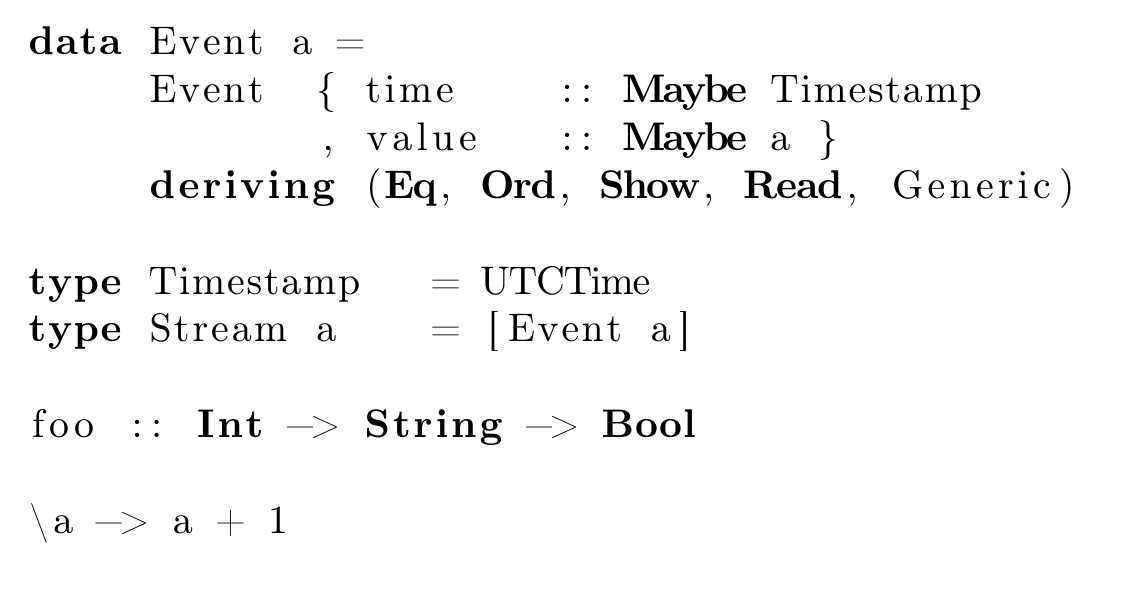
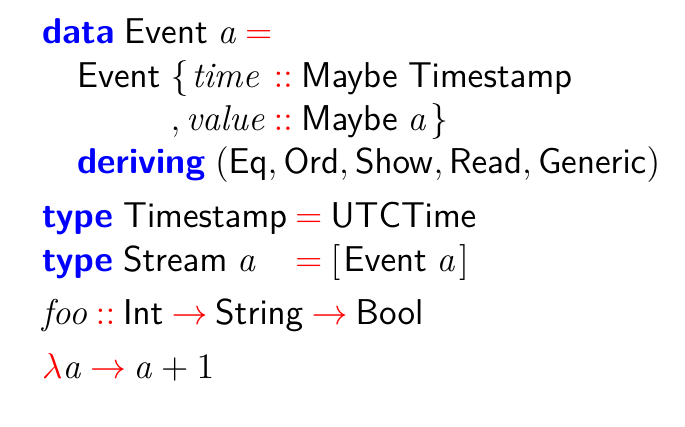
I've been exploring typesetting and formatting code within text documents such as papers, or my thesis. Up until now, I've been using the listings package without thinking much about it. By default, some sample Haskell code processed by listings looks like this (click any of the images to see larger, non-blurry versions):
default output of listings on a Haskell code sample
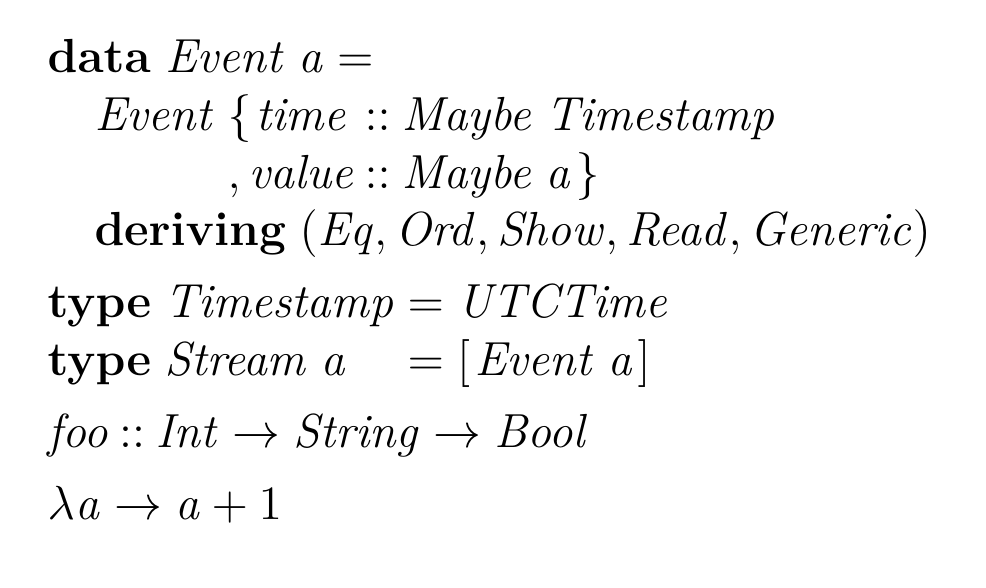
It's formatted with a monospaced font, with some keywords highlighted, but not syntactic symbols. There are several other options for typesetting and formatting code in LaTeX documents. For Haskell in particular, there is the preprocessor lhs2tex, The default output of which looks like this:
default output of lhs2tex on a Haskell code sample
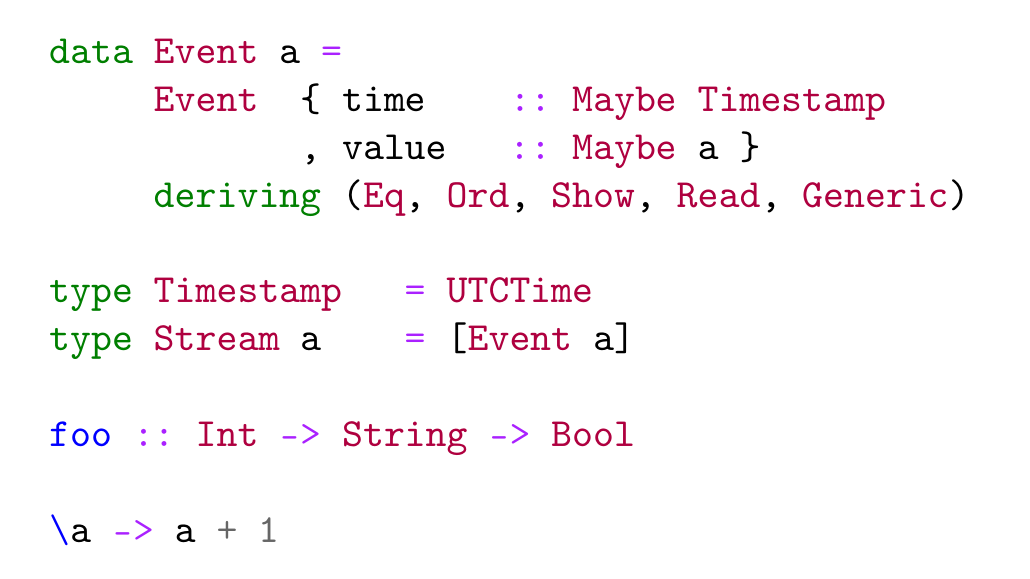
A proportional font, but it's taken pains to preserve vertical alignment, which is syntactically significant for Haskell. It looks a little cluttered to me, and I'm not a fan of nearly everything being italic. Again, symbols aren't differentiated, but it has substituted them for more typographically pleasing alternatives: -> has become , and \ is now . Another option is perhaps the newest, the LaTeX package minted, which leverages the Python Pygments program. Here's the same code again. It defaults to monospace (the choice of font seems a lot clearer to me than the default for listings), no symbolic substitution, and liberal use of colour:
default output of minted on a Haskell code sample
An informal survey of the samples so far showed that the minted output was the most popular. All of these packages can be configured to varying degrees. Here are some examples of what I've achieved with a bit of tweaking
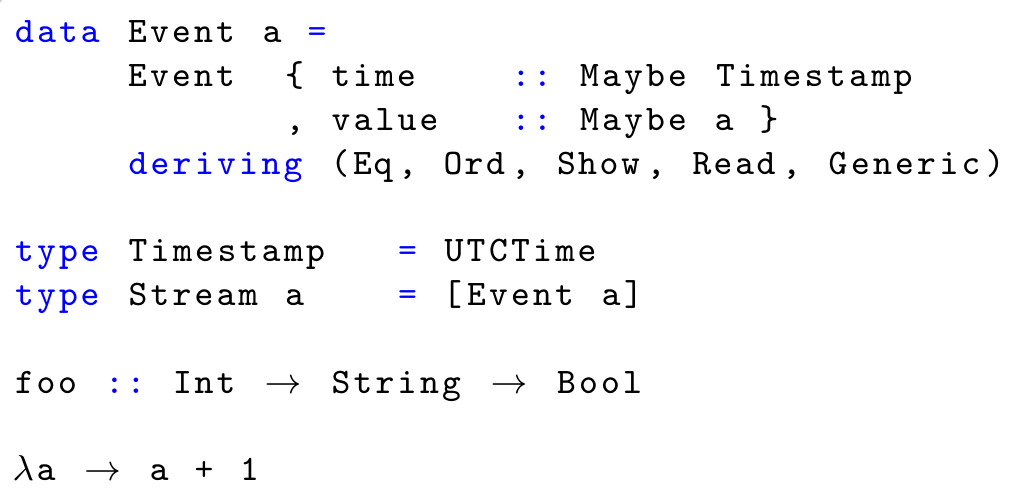
_listings_ adjusted with colour and some symbols substituted (but sadly not the two together) listings adjusted with colour and some symbols substituted (but sadly not the two together)
_lhs2tex_ adjusted to be less italic, sans-serif and use some colour lhs2tex adjusted to be less italic, sans-serif and use some colour
All of this has got me wondering whether there are straightforward empirical answers to some of these questions of style. Firstly, I'm pretty convinced that symbolic substitution is valuable. When writing Haskell, we write ->, \, /= etc. not because it's most legible, but because it's most practical to type those symbols on the most widely available keyboards and popular keyboard layouts.1 Of the three options listed here, symbolic substitution is possible with listings and lhs2tex, but I haven't figured out if minted can do it (which is really the question: can pygments do it?) I'm unsure about proportional versus monospaced fonts. We typically use monospaced fonts for editing computer code, but that's at least partly for historical reasons. Vertical alignment is often very important in source code, and it can be easily achieved with monospaced text; it's also sometimes important to have individual characters (., etc.) not be de-emphasised by being smaller than any other character. lhs2tex, at least, addresses vertical alignment whilst using proportional fonts. I guess the importance of identifying individual significant characters is just as true in a code sample within a larger document as it is within plain source code. From a (brief) scan of research on this topic, it seems that proportional fonts result in marginally quicker reading times for regular prose. It's not clear whether those results carry over into reading computer code in particular, and the margin is slim in any case. The drawbacks of monospaced text mostly apply when the volume of text is large, which is not the case for the short code snippets I am working with. I still have a few open questions:

  1. The Haskell package Data.List.Unicode lets the programmer use a range of unicode symbols in place of ASCII approximations, such as instead of elem, instead of /=. Sadly, it's not possible to replace the denotation for an anonymous function, \, with this way.

11 October 2024

Steve McIntyre: Rock 5 ITX

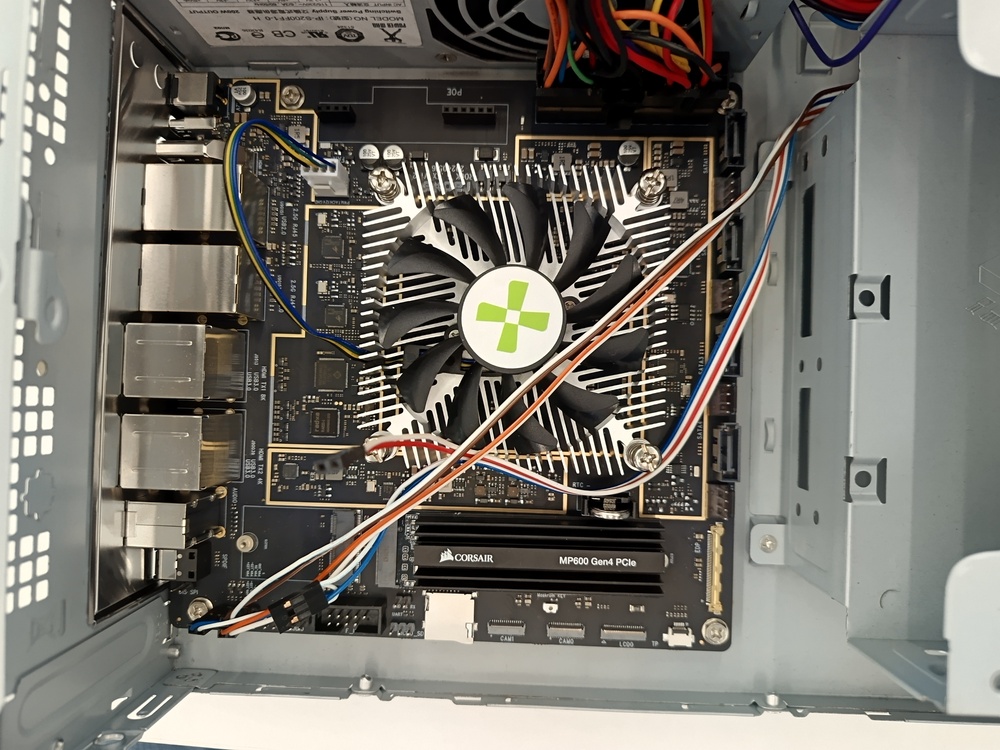
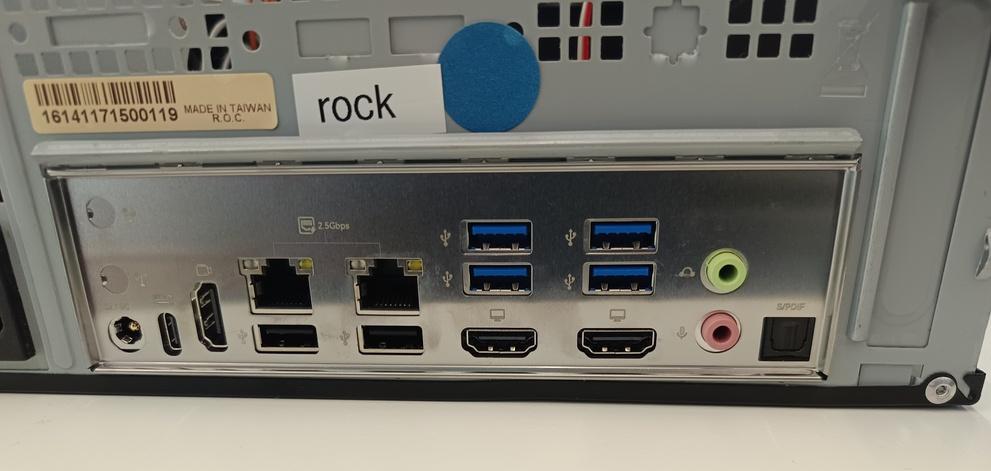
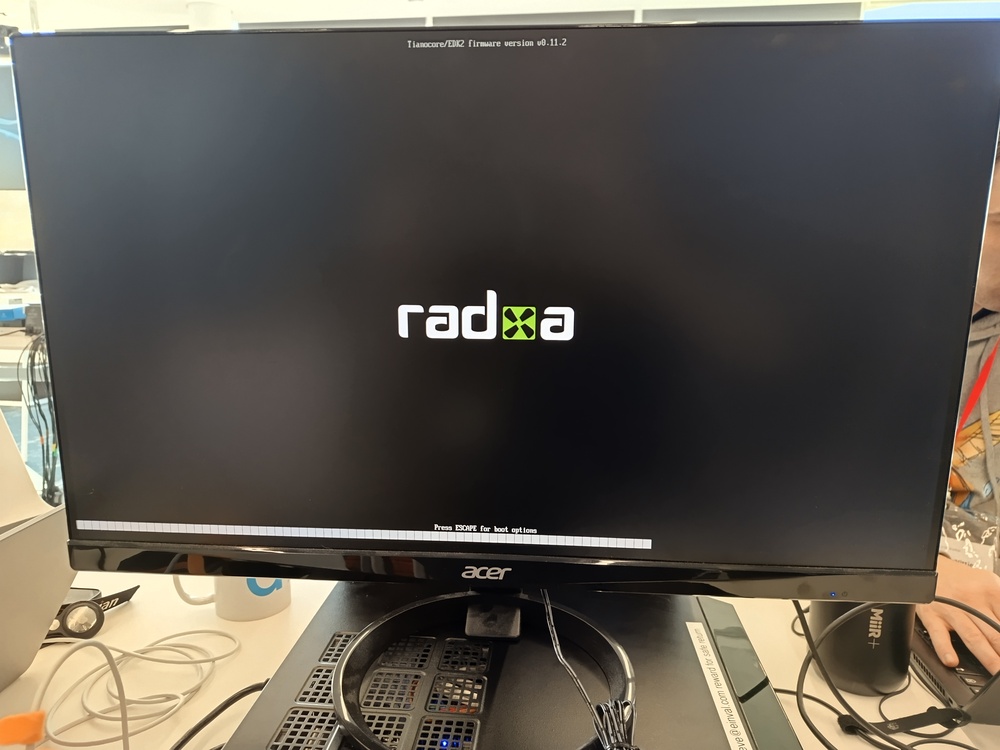
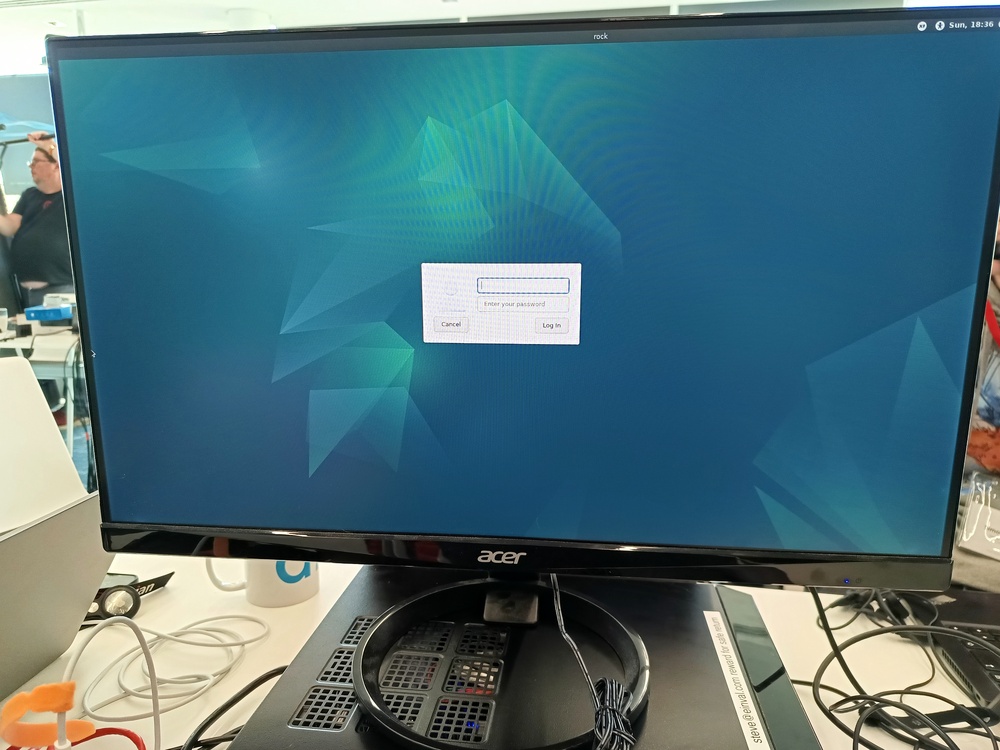
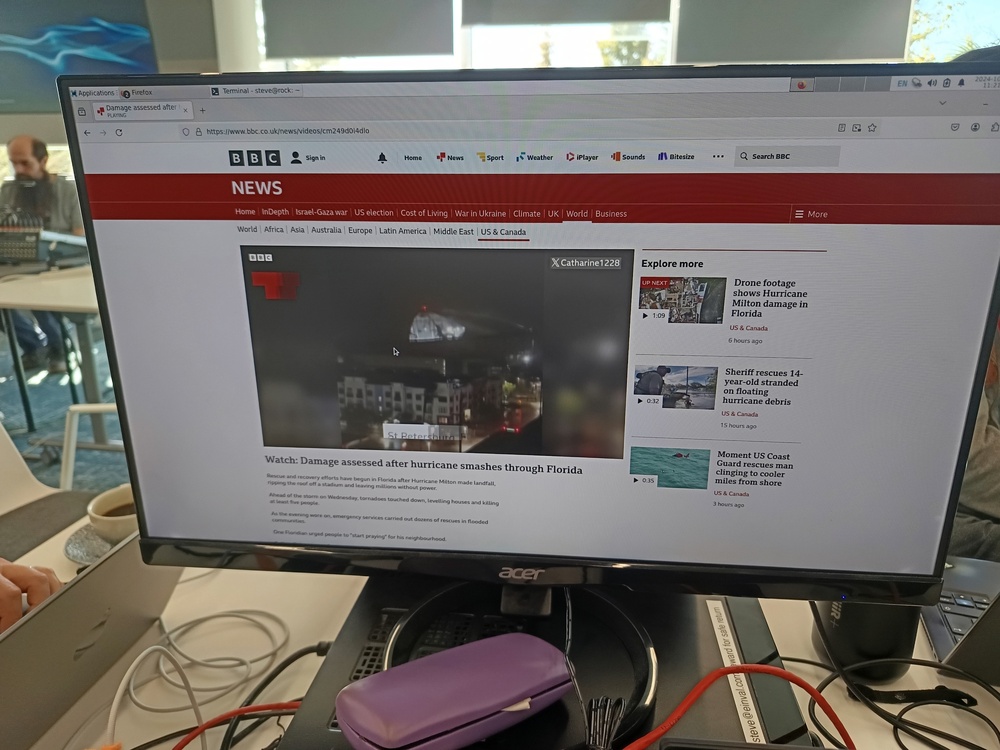
It's been a while since I've posted about arm64 hardware. The last machine I spent my own money on was a SolidRun Macchiatobin, about 7 years ago. It's a small (mini-ITX) board with a 4-core arm64 SoC (4 * Cortex-A72) on it, along with things like a DIMM socket for memory, lots of networking, 3 SATA disk interfaces. The Macchiatobin was a nice machine compared to many earlier systems, but it took quite a bit of effort to get it working to my liking. I replaced the on-board U-Boot firmware binary with an EDK2 build, and that helped. After a few iterations we got a new build including graphical output on a PCIe graphics card. Now it worked much more like a "normal" x86 computer. I still have that machine running at home, and it's been a reasonably reliable little build machine for arm development and testing. It's starting to show its age, though - the onboard USB ports no longer work, and so it's no longer useful for doing things like installation testing. :-/ So... I was involved in a conversation in the #debian-arm IRC channel a few weeks ago, and diederik suggested the Radxa Rock 5 ITX. It's another mini-ITX board, this time using a Rockchip RK3588 CPU. Things have moved on - the CPU is now an 8-core big.LITTLE config: 4*Cortex A76 and 4*Cortex A55. The board has NVMe on-board, 4*SATA, built-in Mali graphics from the CPU, soldered-on memory. Just about everything you need on an SBC for a small low-power desktop, a NAS or whatever. And for about half the price I paid for the Macchiatobin. I hit "buy" on one of the listed websites. :-) A few days ago, the new board landed. I picked the version with 24GB of RAM and bought the matching heatsink and fan. I set it up in an existing case borrowed from another old machine and tried the Radxa "Debian" build. All looked OK, but I clearly wasn't going to stay with that. Onwards to running a native Debian setup! I installed an EDK2 build from https://github.com/edk2-porting/edk2-rk3588 onto the onboard SPI flash, then rebooted with a Debian 12.7 (Bookworm) arm64 installer image on a USB stick. How much trouble could this be? I was shocked! It Just Worked (TM) I'm running a standard Debian arm64 system. The graphical installer ran just fine. I installed onto the NVMe, adding an Xfce desktop for some simple tests. Everything Just Worked. After many years of fighting with a range of different arm machines (from simple SBCs to desktops and servers), this was without doubt the most straightforward setup I've ever done. Wow! It's possible to go and spend a lot of money on an Ampere machine, and I've seen them work well too. But for a hobbyist user (or even a smaller business), the Rock 5 ITX is a lovely option. Total cost to me for the board with shipping fees, import duty, etc. was just over 240. That's great value, and I can wholeheartedly recommend this board! The two things that are missing compared to the Macchiatobin? This is soldered-on memory (but hey, 24G is plenty for me!) It also doesn't have a PCIe slot, but it has sufficient onboard network, video and storage interfaces that I think it will cover most people's needs. Where's the catch? It seems these are very popular right now, so it can be difficult to find these machines in stock online. FTAOD, I should also point out: I bought this machine entirely with my own money, for my own use for development and testing. I've had no contact with the Radxa or Rockchip folks at all here, I'm just so happy with this machine that I've felt the need to shout about it! :-) Here's some pictures... Rock 5 ITX top view Rock 5 ITX back panel view Rock 5 EDK2 startuo Rock 5 xfce login Rock 5 ITX running Firefox

Freexian Collaborators: Monthly report about Debian Long Term Support, September 2024 (by Roberto C. S nchez)

Like each month, have a look at the work funded by Freexian s Debian LTS offering.

Debian LTS contributors In September, 18 contributors have been paid to work on Debian LTS, their reports are available:
  • Abhijith PA did 7.0h (out of 0.0h assigned and 14.0h from previous period), thus carrying over 7.0h to the next month.
  • Adrian Bunk did 51.75h (out of 9.25h assigned and 55.5h from previous period), thus carrying over 13.0h to the next month.
  • Arturo Borrero Gonzalez did 10.0h (out of 0.0h assigned and 10.0h from previous period).
  • Bastien Roucari s did 20.0h (out of 20.0h assigned).
  • Ben Hutchings did 20.0h (out of 12.0h assigned and 12.0h from previous period), thus carrying over 4.0h to the next month.
  • Chris Lamb did 18.0h (out of 18.0h assigned).
  • Daniel Leidert did 23.0h (out of 26.0h assigned), thus carrying over 3.0h to the next month.
  • Emilio Pozuelo Monfort did 23.5h (out of 22.25h assigned and 37.75h from previous period), thus carrying over 36.5h to the next month.
  • Guilhem Moulin did 22.25h (out of 20.0h assigned and 2.5h from previous period), thus carrying over 0.25h to the next month.
  • Lucas Kanashiro did 10.0h (out of 5.0h assigned and 15.0h from previous period), thus carrying over 10.0h to the next month.
  • Markus Koschany did 40.0h (out of 40.0h assigned).
  • Ola Lundqvist did 6.5h (out of 14.5h assigned and 9.5h from previous period), thus carrying over 17.5h to the next month.
  • Roberto C. S nchez did 24.75h (out of 21.0h assigned and 3.75h from previous period).
  • Santiago Ruano Rinc n did 19.0h (out of 19.0h assigned).
  • Sean Whitton did 0.75h (out of 4.0h assigned and 2.0h from previous period), thus carrying over 5.25h to the next month.
  • Sylvain Beucler did 16.0h (out of 42.0h assigned and 18.0h from previous period), thus carrying over 44.0h to the next month.
  • Thorsten Alteholz did 11.0h (out of 11.0h assigned).
  • Tobias Frost did 17.0h (out of 7.5h assigned and 9.5h from previous period).

Evolution of the situation In September, we have released 52 DLAs. September marked the first full month of Debian 11 bullseye under the responsibility of the LTS Team and the team immediately got to work, publishing more than 4 dozen updates. Some notable updates include ruby2.7 (denial-of-service, information leak, and remote code execution), git (various arbitrary code execution vulnerabilities), firefox-esr (multiple issues), gnutls28 (information disclosure), thunderbird (multiple issues), cacti (cross site scripting and SQL injection), redis (unauthorized access, denial of service, and remote code execution), mariadb-10.5 (arbitrary code execution), cups (arbitrary code execution). Several LTS contributors have also contributed package updates which either resulted in a DSA (a Debian Security Announcement, which applies to Debian 12 bookworm) or in an upload that will be published at the next stable point release of Debian 12 bookworm. This list of packages includes cups, cups-filters, booth, nghttp2, puredata, python3.11, sqlite3, and wireshark. This sort of work, contributing fixes to newer Debian releases (and sometimes even to unstable), helps to ensure that upgrades from a release in the LTS phase of its lifecycle to a newer release do not expose users to vulnerabilities which have been closed in the older release. Looking beyond Debian, LTS contributor Bastien Roucari s has worked with the upstream developers of apache2 to address regressions introduced upstream by some recent vulnerability fixes and he has also reached out to the community regarding a newly discovered security issue in the dompurify package. LTS contributor Santiago Ruano Rinc n has undertaken the work of triaging and reproducing nearly 4 dozen CVEs potentially affecting the freeimage package. The upstream development of freeimage appears to be dormant and some of the issues have languished for more than 5 years. It is unclear how much can be done without the aid of upstream, but we will do our best to provide as much help to the community as we can feasibly manage. Finally, it is sometimes necessary to limit or discontinue support for certain packages. The transition of a release from being under the responsibility of the Debian Security Team to that of the LTS Team is an occasion where we assess any pending decisions in this area and formalize them. Please see the announcement for a complete list of packages which have been designated as unsupported.

Thanks to our sponsors Sponsors that joined recently are in bold.

10 October 2024

Gunnar Wolf: Started a guide to writing FUSE filesystems in Python

As DebConf22 was coming to an end, in Kosovo, talking with Eeveelweezel they invited me to prepare a talk to give for the Chicago Python User Group. I replied that I m not really that much of a Python guy But would think about a topic. Two years passed. I meet Eeveelweezel again for DebConf24 in Busan, South Korea. And the topic came up again. I had thought of some ideas, but none really pleased me. Again, I do write some Python when needed, and I teach using Python, as it s the language I find my students can best cope with. But delivering a talk to ChiPy? On the other hand, I have long used a very simplistic and limited filesystem I ve designed as an implementation project at class: FIUnamFS (for Facultad de Ingenier a, Universidad Nacional Aut noma de M xico : the Engineering Faculty for Mexico s National University, where I teach. Sorry, the link is in Spanish but you will find several implementations of it from the students ). It is a toy filesystem, with as many bad characteristics you can think of, but easy to specify and implement. It is based on contiguous file allocation, has no support for sub-directories, and is often limited to the size of a 1.44MB floppy disk. As I give this filesystem as a project to my students (and not as a mere homework), I always ask them to try and provide a good, polished, professional interface, not just the simplistic menu I often get. And I tell them the best possible interface would be if they provide support for FIUnamFS transparently, usable by the user without thinking too much about it. With high probability, that would mean: Use FUSE. Python FUSE But, in the six semesters I ve used this project (with 30-40 students per semester group), only one student has bitten the bullet and presented a FUSE implementation. Maybe this is because it s not easy to understand how to build a FUSE-based filesystem from a high-level language such as Python? Yes, I ve seen several implementation examples and even nice web pages (i.e. the examples shipped with thepython-fuse module Stavros passthrough filesystem, Dave Filesystem based upon, and further explaining, Stavros , and several others) explaining how to provide basic functionality. I found a particularly useful presentation by Matteo Bertozzi presented ~15 years ago at PyCon4 But none of those is IMO followable enough by itself. Also, most of them are very old (maybe the world is telling me something that I refuse to understand?). And of course, there isn t a single interface to work from. In Python only, we can find python-fuse, Pyfuse, Fusepy Where to start from? So I setup to try and help. Over the past couple of weeks, I have been slowly working on my own version, and presenting it as a progressive set of tasks, adding filesystem calls, and being careful to thoroughly document what I write (but maybe my documentation ends up obfuscating the intent? I hope not and, read on, I ve provided some remediation). I registered a GitLab project for a hand-holding guide to writing FUSE-based filesystems in Python. This is a project where I present several working FUSE filesystem implementations, some of them RAM-based, some passthrough-based, and I intend to add to this also filesystems backed on pseudo-block-devices (for implementations such as my FIUnamFS). So far, I have added five stepwise pieces, starting from the barest possible empty filesystem, and adding system calls (and functionality) until (so far) either a read-write filesystem in RAM with basicstat() support or a read-only passthrough filesystem. I think providing fun or useful examples is also a good way to get students to use what I m teaching, so I ve added some ideas I ve had: DNS Filesystem, on-the-fly markdown compiling filesystem, unzip filesystem and uncomment filesystem. They all provide something that could be seen as useful, in a way that s easy to teach, in just some tens of lines. And, in case my comments/documentation are too long to read, uncommentfs will happily strip all comments and whitespace automatically! So I will be delivering my talk tomorrow (2024.10.10, 18:30 GMT-6) at ChiPy (virtually). I am also presenting this talk virtually at Jornadas Regionales de Software Libre in Santa Fe, Argentina, next week (virtually as well). And also in November, in person, at nerdear.la, that will be held in Mexico City for the first time. Of course, I will also share this project with my students in the next couple of weeks And hope it manages to lure them into implementing FUSE in Python. At some point, I shall report! Update: After delivering my ChiPy talk, I have uploaded it to YouTube: A hand-holding guide to writing FUSE-based filesystems in Python, and after presenting at Jornadas Regionales, I present you the video in Spanish here: Aprendiendo y ense ando a escribir sistemas de archivo en espacio de usuario con FUSE y Python.

Freexian Collaborators: Debian Contributions: Packaging Pydantic v2, Reworking of glib2.0 for cross bootstrap, Python archive rebuilds and more! (by Anupa Ann Joseph)

Debian Contributions: 2024-09 Contributing to Debian is part of Freexian s mission. This article covers the latest achievements of Freexian and their collaborators. All of this is made possible by organizations subscribing to our Long Term Support contracts and consulting services.

Pydantic v2, by Colin Watson Pydantic is a useful library for validating data in Python using type hints: Freexian uses it in a number of projects, including Debusine. Its Debian packaging had been stalled at 1.10.17 in testing for some time, partly due to needing to make sure everything else could cope with the breaking changes introduced in 2.x, but mostly due to needing to sort out packaging of its new Rust dependencies. Several other people (notably Alexandre Detiste, Andreas Tille, Drew Parsons, and Timo R hling) had made some good progress on this, but nobody had quite got it over the line and it seemed a bit stuck. Colin upgraded a few Rust libraries to new upstream versions, packaged rust-jiter, and chased various failures in other packages. This eventually allowed getting current versions of both pydantic-core and pydantic into testing. It should now be much easier for us to stay up to date routinely.

Reworking of glib2.0 for cross bootstrap, by Helmut Grohne Simon McVittie (not affiliated with Freexian) earlier restructured the libglib2.0-dev such that it would absorb more functionality and in particular provide tools for working with .gir files. Those tools practically require being run for their host architecture (practically this means running under qemu-user) which is at odds with the requirements of architecture cross bootstrap. The qemu requirement was expressed in package dependencies and also made people unhappy attempting to use libglib2.0-dev for i386 on amd64 without resorting to qemu. The use of qemu in architecture bootstrap is particularly problematic as it tends to not be ready at the time bootstrapping is needed. As a result, Simon proposed and implemented the introduction of a libgio-2.0-dev package providing a subset of libglib2.0-dev that does not require qemu. Packages should continue to use libglib2.0-dev in their Build-Depends unless involved in architecture bootstrap. Helmut reviewed and tested the implementation and integrated the necessary changes into rebootstrap. He also prepared a patch for libverto to use the new package and proposed adding forward compatibility to glib2.0. Helmut continued working on adding cross-exe-wrapper to architecture-properties and implemented autopkgtests later improved by Simon. The cross-exe-wrapper package now provides a generic mechanism to a program on a different architecture by using qemu when needed only. For instance, a dependency on cross-exe-wrapper:i386 provides a i686-linux-gnu-cross-exe-wrapper program that can be used to wrap an ELF executable for the i386 architecture. When installed on amd64 or i386 it will skip installing or running qemu, but for other architectures qemu will be used automatically. This facility can be used to support cross building with targeted use of qemu in cases where running host code is unavoidable as is the case for GObject introspection. This concludes the joint work with Simon and Niels Thykier on glib2.0 and architecture-properties resolving known architecture bootstrap regressions arising from the glib2.0 refactoring earlier this year.

Analyzing binary package metadata, by Helmut Grohne As Guillem Jover (not affiliated with Freexian) continues to work on adding metadata tracking to dpkg, the question arises how this affects existing packages. The dedup.debian.net infrastructure provides an easy playground to answer such questions, so Helmut gathered file metadata from all binary packages in unstable and performed an explorative analysis. Some results include: Guillem also performed a cursory analysis and reported other problem categories such as mismatching directory permissions for directories installed by multiple packages and thus gained a better understanding of what consistency checks dpkg can enforce.

Python archive rebuilds, by Stefano Rivera Last month Stefano started to write some tooling to do large-scale rebuilds in debusine, starting with finding packages that had already started to fail to build from source (FTBFS) due to the removal of setup.py test. This month, Stefano did some more rebuilds, starting with experimental versions of dh-python. During the Python 3.12 transition, we had added a dependency on python3-setuptools to dh-python, to ease the transition. Python 3.12 removed distutils from the stdlib, but many packages were expecting it to still be available. Setuptools contains a version of distutils, and dh-python was a convenient place to depend on setuptools for most package builds. This dependency was never meant to be permanent. A rebuild without it resulted in mass-filing about 340 bugs (and around 80 more by mistake). A new feature in Python 3.12, was to have unittest s test runner exit with a non-zero return code, if no tests were run. We added this feature, to be able to detect tests that are not being discovered, by mistake. We are ignoring this failure, as we wouldn t want to suddenly cause hundreds of packages to fail to build, if they have no tests. Stefano did a rebuild to see how many packages were affected, and found that around 1000 were. The Debian Python community has not come to a conclusion on how to move forward with this. As soon as Python 3.13 release candidate 2 was available, Stefano did a rebuild of the Python packages in the archive against it. This was a more complex rebuild than the others, as it had to be done in stages. Many packages need other Python packages at build time, typically to run tests. So transitions like this involve some manual bootstrapping, followed by several rounds of builds. Not all packages could be tested, as not all their dependencies support 3.13 yet. The result was around 100 bugs in packages that need work to support Python 3.13. Many other packages will need additional work to properly support Python 3.13, but being able to build (and run tests) is an important first step.

Miscellaneous contributions
  • Carles prepared the update of python-pyaarlo package to a new upstream release.
  • Carles worked on updating python-ring-doorbell to a new upstream release. Unfinished, pending to package a new dependency python3-firebase-messaging RFP #1082958 and its dependency python3-http-ece RFP #1083020.
  • Carles improved po-debconf-manager. Main new feature is that it can open Salsa merge requests. Aiming for a lightning talk in MiniDebConf Toulouse (November) to be functional end to end and get feedback from the wider public for this proof of concept.
  • Carles helped one translator to use po-debconf-manager (added compatibility for bullseye, fixed other issues) and reviewed 17 package templates.
  • Colin upgraded the OpenSSH packaging to 9.9p1.
  • Colin upgraded the various YubiHSM packages to new upstream versions, enabled more tests, fixed yubihsm-shell build failures on some 32-bit architectures, made yubihsm-shell build reproducibly, and fixed yubihsm-connector to apply udev rules to existing devices when the package is installed. As usual, bookworm-backports is up to date with all these changes.
  • Colin fixed quite a bit of fallout from setuptools 72.0.0 removing setup.py test, backported a large upstream patch set to make buildbot work with SQLAlchemy 2.0, and upgraded 25 other Python packages to new upstream versions.
  • Enrico worked with Jakob Haufe to get him up to speed for managing sso.debian.org
  • Rapha l did remove spam entries in the list of teams on tracker.debian.org (see #1080446), and he applied a few external contributions, fixing a rendering issue and replacing the DDPO link with a more useful alternative. He also gave feedback on a couple of merge requests that required more work. As part of the analysis of the underlying problem, he suggested to the ftpmasters (via #1083068) to auto-reject packages having the too-many-contacts lintian error, and he raised the severity of #1076048 to serious to actually have that 4 year old bug fixed.
  • Rapha l uploaded zim and hamster-time-tracker to fix issues with Python 3.12 getting rid of setuptools. He also uploaded a new gnome-shell-extension-hamster to cope with the upcoming transition to GNOME 47.
  • Helmut sent seven patches and sponsored one upload for cross build failures.
  • Helmut uploaded a Nagios/Icinga plugin check-smart-attributes for monitoring the health of physical disks.
  • Helmut collaborated on sbuild reviewing and improving a MR for refactoring the unshare backend.
  • Helmut sent a patch fixing coinstallability of gcc-defaults.
  • Helmut continued to monitor the evolution of the /usr-move. With more and more key packages such as libvirt or fuse3 fixed. We re moving into the boring long-tail of the transition.
  • Helmut proposed updating the meson buildsystem in debhelper to use env2mfile.
  • Helmut continued to update patches maintained in rebootstrap. Due to the work on glib2.0 above, rebootstrap moves a lot further, but still fails for any architecture.
  • Santiago reviewed some Merge Request in Salsa CI, such as: !478, proposed by Otto to extend the information about how to use additional runners in the pipeline and !518, proposed by Ahmed to add support for Ubuntu images, that will help to test how some debian packages, including the complex MariaDB are built on Ubuntu. Santiago also prepared !545, which will make the reprotest job more consistent with the result seen on reproducible-builds.
  • Santiago worked on different tasks related to DebConf 25. Especially he drafted the fundraising brochure (which is almost ready).
  • Thorsten Alteholz uploaded package libcupsfilter to fix the autopkgtest and a dependency problem of this package. After package splix was abandoned by upstream and OpenPrinting.org adopted its maintenance, Thorsten uploaded their first release.
  • Anupa published posts on the Debian Administrators group in LinkedIn and moderated the group, one of the tasks of the Debian Publicity Team.
  • Anupa helped organize DebUtsav 2024. It had over 100 attendees with hand-on sessions on making initial contributions to Linux Kernel, Debian packaging, submitting documentation to Debian wiki and assisting Debian Installations.

9 October 2024

Ben Hutchings: FOSS activity in September 2024

8 October 2024

Thorsten Alteholz: My Debian Activities in September 2024

FTP master This month I accepted 441 and rejected 29 packages. The overall number of packages that got accepted was 448. I couldn t believe my eyes, but this month I really accepted the same number of packages as last month. Debian LTS This was my hundred-twenty-third month that I did some work for the Debian LTS initiative, started by Raphael Hertzog at Freexian. During my allocated time I uploaded or worked on: Despite the announcement the package libppd in Debian is not affected by the CVEs related to CUPS. By pure chance there is an unrelated package with the same name in Debian. I also answered some question about the CUPS related uploads. Due to the CUPS issues, I postponed my work on other packages to October. Last but not least I did a week of FD this month and attended the monthly LTS/ELTS meeting. Debian ELTS This month was the seventy-fourth ELTS month. During my allocated time I uploaded or worked on: I also started to work on updates for cups in Buster, Stretch and Jessie, but their uploads will happen only in October. I also did a week of FD and attended the monthly LTS/ELTS meeting. Debian Printing This month I uploaded Last but not least I tried to prepare an update for hplip. Unfortunately this is a nerve-stretching task and I need some more time. This work is generously funded by Freexian! Debian Matomo This month I even found some time to upload packages that are dependencies of Matomo This work is generously funded by Freexian! Debian Astro This month I uploaded a new upstream or bugfix version of: Most of the uploads were related to package migration to testing. As some of them are in non-free or contrib, one has to build all binary versions. From my point of view handling packages in non-free or contrib could be very much improved, but well, they are not part of Debian Anyway, starting in December there is an Outreachy project that takes care of automatic updates of these packages. So hopefully it will be much easier to keep those package up to date. I will keep you informed. Debian IoT This month I uploaded new upstream or bugfix versions of: Debian Mobcom This month I did source uploads of all the packages that were prepared last month by Nathan and started the transition. It went rather smooth except for a few packages where the new version did not propagate to the tracker and they got stuck in old failing autopkgtest. Anyway, in the end all packages migrated to testing. I also uploaded new upstream releases or fixed bugs in: misc This month I uploaded new upstream or bugfix versions of: Most of those uploads were needed to help packages to migrate to testing.

Debian Brasil: Testing feed in English

Testing the feed in English and check If it's going to Debian Planet. Sorry the noise :-)

6 October 2024

Bits from Debian: Bits from the DPL

Dear Debian community, this are my bits from DPL for September. New lintian maintainer I'm pleased to welcome Louis-Philippe V ronneau as a new Lintian maintainer. He humorously acknowledged his new role, stating, "Apparently I'm a Lintian maintainer now". I remain confident that we can, and should, continue modernizing our policy checker, and I see this as one important step toward that goal. SPDX name / license tools There was a discussion about deprecating the unique names for DEP-5 and migrating to fully compliant SPDX names. Simon McVittie wrote: "Perhaps our Debian-specific names are better, but the relevant question is whether they are sufficiently better to outweigh the benefit of sharing effort and specifications with the rest of the world (and I don't think they are)." Also Charles Plessy sees the value of deprecating the Debian ones and align on SPDX. The thread on debian-devel list contains several practical hints for writing debian/copyright files. proposal: Hybrid network stack for Trixie There was a very long discussion on debian-devel list about the network stack on Trixie that started in July and was continued in end of August / beginning of September. The discussion was also covered on LWN. It continued in a "proposal: Hybrid network stack for Trixie" by Lukas M rdian. Contacting teams I continued reaching out to teams in September. One common pattern I've noticed is that most teams lack a clear strategy for attracting new contributors. Here's an example snippet from one of my outreach emails, which is representative of the typical approach: Q: Do you have some strategy to gather new contributors for your team? A: No. Q: Can I do anything for you? A: Everything that can help to have more than 3 guys :-D Well, only the first answer, "No," is typical. To help the JavaScript team, I'd like to invite anyone with JavaScript experience to join the team's mailing list and offer to learn and contribute. While I've only built a JavaScript package once, I know this team has developed excellent tools that are widely adopted by others. It's an active and efficient team, making it a great starting point for those looking to get involved in Debian. You might also want to check out the "Little tutorial for JS-Team beginners". Given the lack of a strategy to actively recruit new contributors--a common theme in the responses I've received--I recommend reviewing my talk from DebConf23 about teams. The Debian Med team would have struggled significantly in my absence (I've paused almost all work with the team since becoming DPL) if I hadn't consistently focused on bringing in new members. I'm genuinely proud of how the team has managed to keep up with the workload (thank you, Debian Med team!). Of course, onboarding newcomers takes time, and there's no guarantee of long-term success, but if you don't make the effort, you'll never find out. OS underpaid The Register, in its article titled "Open Source Maintainers Underpaid, Swamped by Security, Going Gray", summarizes the 2024 State of the Open Source Maintainer Report. I find this to be an interesting read, both in general and in connection with the challenges mentioned in the previous paragraph about finding new team members. Kind regards Andreas.

4 October 2024

Jonathan Dowland: synths

Although I've never written about them, I've been interested in music synthesisers for ages. My colleagues know this. Whilst I've been off sick, they had a whip-round and bought me a voucher for Andertons, a UK-based music store, to cheer me up. I'm absolutely floored by this generosity. And so, I'm now on a quest to buy a synthesizer! Although, not my first one.
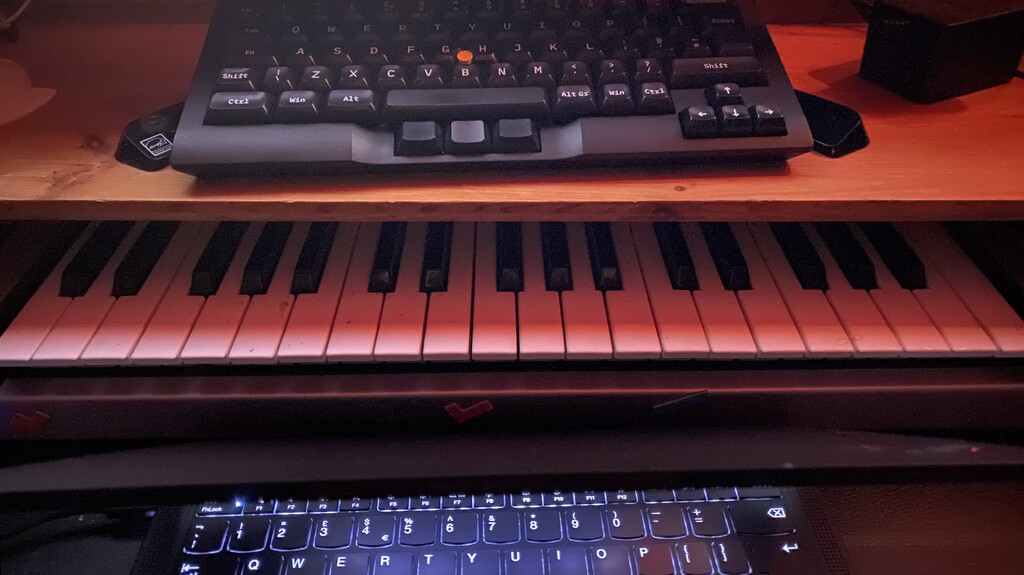
Alesis Micron on my desk, taunting me Alesis Micron on my desk, taunting me
I bought my first synth, an Alesis Micron, from a colleague at $oldjob, 16 years ago. For various reasons, I've struggled to engage with it, and it's mostly been gathering dust on my desk in all that time. (I might write more about the Micron in a later blog post). "Bad Gear" sums it up better than I could:
So, I'm not truly buying my "first" synth, but for all intents and purposes I'm on a similar journey to if I was, and I thought it might be fun to write about it. Goals I want something which has as many of its parameters presented physically, as knobs or sliders etc., as possible. One reason I've failed to engage with the Micron (so far) is it's at the other end of this spectrum, with hundreds of tunable parameters but a small handful of knobs. To change parameters you have to go diving into menus presented on a really old-fashioned, small LCD display. If you know what you are looking for, you can probably find it; but if you just want to experiment and play around, it's off-putting. Secondly, I want something I can use away from a computer, as much as possible. Computers are my day-job, largely dominate my existing hobbies, and are unavoidable even in some of the others (like 3d printing). Most of the computers I interact with run Linux. And for all its strengths, audio management is not one of them. If I'm going to carve out some of my extremely limited leisure time to explore this stuff, I don't to spend any of it (at least now) fighting Pulseaudio/ALSA/Pipewire/JACK/OSS/whatever, or any of the other foibles that might crop up1. Thirdly, I'd like something which, in its soul, is an instrument. You can get some amazing little synth boxes with a huge number of features in them. Something with a limited number of features but which really feels well put together would suit me better. So next time, I'll write about the 2-3 top candidates on my list. Can you guess what they might be?

  1. To give another example. The other day I sat down to try and use the Micron, which had its audio out wired into an external audio interface, in turn plugged into my laptop's Thunderbolt dock. For a while I couldn't figure out why I couldn't hear anything, until I realised the Thunderbolt dock was having "a moment" and not presenting its USB devices to the laptop. Hobby time window gone!

Bits from Debian: Debian welcomes Freexian as our newest partner!

Freexian logo We are excited to announce and welcome Freexian into Debian Partners. Freexian specializes in Free Software with a particular focus on Debian GNU/Linux. Freexian can assist with consulting, training, technical support, packaging, or software development on projects involving use or development of Free software. All of Freexian's employees and partners are well-known contributors in the Free Software community, a choice that is integral to Freexian's business model. About the Debian Partners Program The Debian Partners Program was created to recognize companies and organizations that help and provide continuous support to the project with services, finances, equipment, vendor support, and a slew of other technical and non-technical services. Partners provide critical assistance, help, and support which has advanced and continues to further our work in providing the 'Universal Operating System' to the world. Thank you Freexian!

3 October 2024

Mike Gabriel: Creating (a) new frontend(s) for Polis

After (quite) a summer break, here comes the 4th article of the 5-episode blog post series on Polis, written by Guido Berh rster, member of staff at my company Fre(i)e Software GmbH. Have fun with the read on Guido's work on Polis,
Mike
Table of Contents of the Blog Post Series
  1. Introduction
  2. Initial evaluation and adaptation
  3. Issues extending Polis and adjusting our goals
  4. Creating (a) new frontend(s) for Polis (this article)
  5. Current status and roadmap
4. Creating (a) new frontend(s) for Polis Why a new frontend was needed... Our initial experiences of working with Polis, the effort required to implement more invasive changes and the desire of iterating changes more rapidly ultimately lead to the decision to create a new foundation for frontend development that would be independent of but compatible with the upstream project. Our primary objective was thus not to develop another frontend but rather to make frontend development more flexible and to facilitate experimentation and rapid prototyping of different frontends by providing abstraction layers and building blocks. This also implied developing a corresponding backend since the Polis backend is tightly coupled to the frontend and is neither intended to be used by third-party projects nor supporting cross-domain requests due to the expectation of being embedded as an iframe on third-party websites. The long-term plan for achieving our objectives is to provide three abstraction layers for building frontends: The Particiapp Project Under the umbrella of the Particiapp project we have so far developed two new components: Both the participation frontend and backend are fully compatible and require an existing Polis installation and can be run alongside the upstream frontend. More specifically, the administration frontend and common backend are required to administrate conversations and send out notifications and the statistics processing server is required for processing the voting results. Particiapi server For the backend the Python language and the Flask framework were chosen as a technological basis mainly due to developer mindshare, a large community and ecosystem and the smaller dependency chain and maintenance overhead compared to Node.js/npm. Instead of integrating specific identity providers we adopted the OpenID Connect standard as an abstraction layer for authentication which allows delegating authentication either to a self-hosted identity provider or a large number of existing external identity providers. Particiapp Example Frontend The experimental example frontend serves both as a test bed for the client library and as a tool for better understanding the needs of frontend designers. It also features a completely redesigned user interface and results visualization in line with our goals. Branded variants are currently used for evaluation and testing by the stakeholders. In order to simplify evaluation, development, testing and deployment a Docker Compose configuration is made available which contains all necessary components for running Polis with our experimental example frontend. In addition, a development environment is provided which includes a preconfigured OpenID Connect identity provider (KeyCloak), SMTP-Server with web interface (MailDev), and a database frontend (PgAdmin). The new frontend can also be tested using our public demo server.

1 October 2024

Colin Watson: Free software activity in September 2024

Almost all of my Debian contributions this month were sponsored by Freexian. You can also support my work directly via Liberapay. Pydantic My main Debian project for the month turned out to be getting Pydantic back into a good state in Debian testing. I ve used Pydantic quite a bit in various projects, most recently in Debusine, so I have an interest in making sure it works well in Debian. However, it had been stalled on 1.10.17 for quite a while due to the complexities of getting 2.x packaged. This was partly making sure everything else could cope with the transition, but in practice mostly sorting out packaging of its new Rust dependencies. Several other people (notably Alexandre Detiste, Andreas Tille, Drew Parsons, and Timo R hling) had made some good progress on this, but nobody had quite got it over the line and it seemed a bit stuck. Learning Rust is on my to-do list, but merely not knowing a language hasn t stopped me before. So I learned how the Debian Rust team s packaging works, upgraded a few packages to new upstream versions (including rust-half and upstream rust-idna test fixes), and packaged rust-jiter. After a lot of waiting around for various things and chasing some failures in other packages I was eventually able to get current versions of both pydantic-core and pydantic into testing. I m looking forward to being able to drop our clunky v1 compatibility code once debusine can rely on running on trixie! OpenSSH I upgraded the Debian packaging to OpenSSH 9.9p1. YubiHSM I upgraded python-yubihsm, yubihsm-connector, and yubihsm-shell to new upstream versions. I noticed that I could enable some tests in python-yubihsm and yubihsm-shell; I d previously thought the whole test suite required a real YubiHSM device, but when I looked closer it turned out that this was only true for some tests. I fixed yubihsm-shell build failures on some 32-bit architectures (upstream PRs #431, #432), and also made it build reproducibly. Thanks to Helmut Grohne, I fixed yubihsm-connector to apply udev rules to existing devices when the package is installed. As usual, bookworm-backports is up to date with all these changes. Python team setuptools 72.0.0 removed the venerable setup.py test command. This caused some fallout in Debian, some of which was quite non-obvious as packaging helpers sometimes fell back to different ways of running test suites that didn t quite work. I fixed django-guardian, manuel, python-autopage, python-flask-seeder, python-pgpdump, python-potr, python-precis-i18n, python-stopit, serpent, straight.plugin, supervisor, and zope.i18nmessageid. As usual for new language versions, the addition of Python 3.13 caused some problems. I fixed psycopg2, python-time-machine, and python-traits. I fixed build/autopkgtest failures in keymapper, python-django-test-migrations, python-rosettasciio, routes, transmissionrpc, and twisted. buildbot was in a bit of a mess due to being incompatible with SQLAlchemy 2.0. Fortunately by the time I got to it upstream had committed a workable set of patches, and the main difficulty was figuring out what to cherry-pick since they haven t made a new upstream release with all of that yet. I figured this out and got us up to 4.0.3. Adrian Bunk asked whether python-zipp should be removed from trixie. I spent some time investigating this and concluded that the answer was no, but looking into it was an interesting exercise anyway. On the other hand, I looked into flask-appbuilder, concluded that it should be removed, and filed a removal request. I upgraded some embedded CSS files in nbconvert. I upgraded importlib-resources, ipywidgets, jsonpickle, pydantic-settings, pylint (fixing a test failure), python-aiohttp-session, python-apptools, python-asyncssh, python-django-celery-beat, python-django-rules, python-limits, python-multidict, python-persistent, python-pkginfo, python-rt, python-spur, python-zipp, stravalib, transmissionrpc, vulture, zodbpickle, zope.exceptions (adopting it), zope.i18nmessageid, zope.proxy, and zope.security to new upstream versions. debmirror The experimental and *-proposed-updates suites used to not have Contents-* files, and a long time ago debmirror was changed to just skip those files in those suites. They were added to the Debian archive some time ago, but debmirror carried on skipping them anyway. Once I realized what was going on, I removed these unnecessary special cases (#819925, #1080168).

Junichi Uekawa: Hello October.

Hello October. I've been trying to do the GPG signing from Debconf but my backlog of stuff is in my way.

Guido G nther: Free Software Activities September 2024

Another short status update of what happened on my side last month. Besides the usual amount of housekeeping last month was a lot about getting old issues resolved by finishing some stale merge requests and work in pogress MRs. I also pushed out the Phosh 0.42.0 Release phosh phoc phosh-mobile-settings libphosh-rs phosh-osk-stub phosh-wallpapers meta-phosh Debian ModemManager Calls bluez gnome-text-editor feedbackd Chatty libcall-ui glib wlr-protocols git-buildpackage iio-sensor-proxy Fotema Help Development If you want to support my work see donations. This includes a list of hardware we want to improve support for. Thanks a lot to all current and past donors.

30 September 2024

Bits from Debian: New Debian Developers and Maintainers (July and August 2024)

The following contributors got their Debian Developer accounts in the last two months: The following contributors were added as Debian Maintainers in the last two months: Congratulations!

Next.

Previous.