Search Results: "sto"

12 February 2008

Lior Kaplan: The benifits of working with GPL drivers


For the last few day I’m having problem with the tg3 driver for Broadcom’s NetXtreme Ethernet NIC on an IBM System x3850 machine with RHEL4 update 4. The problem was that the tg3 driver recognizes only one NIC and ignores the other, although lspci / lshw can show there are two on board NICs. The weird thing is that I couldn’t find reference to such a problem on google. IBM’s technical people suggested that I should use an updated driver, a change I’m usually reluctant to do, as some hardware requires proprietary drivers which come as a “black box”. But this time, the driver is licensed under the GPL and is also available in latest kernel releases. IBM provides a set of pre-built RPMs for RHEL4, but it only covers old updates for RHEL (which also represent minor changes to the kernel installed). With this set IBM also provides a source RPM to build the module yourself. That was easy enough to do, just install rpmbuild, the right kernel development package (usually kernel- uname - -devel), install the source RPM and build the custom RPM for your kernel. I fail to understand why IBM also provides a few more scripts and tools to build the rpm and install the pre-built ones. Every system administrator should be comfortable with using RPMs directly instead of using scripts to run a lot of other stuff before the actual RPM commands. The updated driver did solve the problem, and I finally can use both NICs. Having IBM’s stuff is nice, but I wanted to know what options do people have, without using their wrapping over the original driver. So I went to see what Broadcom have to offer. On their FAQ, Broadcom declare:
To better support users, Broadcom has been actively supporting, maintaining, and testing the in-kernel Linux drivers for the NetXtreme, NetXtreme II, NetLink and 4401 product lines.
I found that Broadcom offer an updated version for the tg3 driver (comparing to RHEL4 update 4) on their NetXtreme Server Drivers page. Clicking the download page showed this message:
The Broadcom Linux Ethernet drivers are licensed under the GNU GPL. The full text of the license is available in the driver archive.
That’s must be a good start (: Broadcom doesn’t give you pre-built RPMs, but they do provide a source RPM to ease your job. I actually preferred their simple spec file over IBM’s complex spec file. To conclude, having GPL drivers enable system administrator to build the drivers specifically for their system (operating system, distribution and kernel version), and lower the pressure (or necessity) for vendors to offer pre-built packages for each possible combination.

Neil Williams: Embedded Debian still Debian?

The basic Debian debootstrap system is 180Mb or so. Embedded systems need a full GUI installation in 64Mb or less and a basic debootstrap-equivalent system of 10Mb or less.
Such radical reductions in size mean radical changes to the structure of the the system itself. The question is, at what point does a modified Debian system become no longer Debian?
Main changes:

Main similarities:

So the question is, lazyweb, how far do we go before you would regard Emdebian as no longer Debian?
I now have image tarballs for such a system - 18mb compressed with a full GPE GUI included, 48Mb installed. The scripts could, potentially, work with any debootstrap tarball.
Although based on debootstrap, the Emdebian set can be unpacked separately from debootstrap so that as much of the workload can be done on the build machine as possible. This allows the "installer" to simply copy the decompressed filesystem onto the device, run /sbin/ldconfig and dpkg --configure -a and it's ready to go.
I have a few issues to resolve within the packages themselves and within the available kernel for my test machine but the result is a full GUI installation that will fit on a 64Mb SD card (32Mb is a tad too small) with enough room to spare to add a Linux kernel zImage, modules.tgz, Windows executable/autorun runes and a bootloader. i.e. a possible method of installing Emdebian onto a handheld running Windows CE or Windows Mobile. The only issue is getting the right kernel and modules for the device.
These are important benefits, the cost is whether such an installation still qualifies as "Debian".
At what point does Debian cease to be Debian?

11 February 2008

Joachim Breitner: How to fork privately

A few days ago, I asked how to fork a debian package privately. I got some repsonses by comments, e-Mail and other blog posts, and I want to summarize the tools that were suggested. I have not really tried them, just looked at the webpages, the documentation or the sourcecode. I m only including Debian-specific solutions, as using Gentoo might be nice, but is out of scope here :-)I also deleted half the text before saving it, and I hate rewriting stuff, so it might be a bit terse.debtooEddy Petri or tells me about his three year old project debtoo, which wants to bring a Gentoo-like experience to Debian. While it probably provides what I need, it feels too big in that it has a more general aim than what I m looking for. It is not in Debian and not actively developed in the last two years.srcinstEddy also tells me about srcinst, which is a small haskell program written by jgoerzen in 2005. This is more a proof-of-concept that builds a package and all necessariy build-dependencies without using a binary package, but does not allow for patches to be applied. It is in Debian, actively maintained, but not developed, and barely documented (just an IRC log).apt-buildA similar tool and also in Debian is apt-build. This package is created to compile packages for optimization (as it asks half a dozend compiler-flag-questions with DebConf during the installation). It allows the user to apply a patch to the source, but it has to be passed as a command line option, and patches seem not to be tracked. Not much development in the last year, and not much documentation.debpatchNot to be confused with the program in the debdelta package is the debpatch tool by Victor Hsieh which Carsten Hey told me about. Also written in 2005, this comes closest to what I want. For every package you want to modify, you can configure it to apply patches to the source, to add patches to the debian/patches directory or to statically replace files in the generated binary and puts it in a local apt repository. No code yet to track new versions of the packages and no support for pbuilder though. This perl script is not yet in Debian, but is available as a Debian package and seems to have seen some development in the last years. Quick Googleing does not return any user reports; has any already tried this?customdebSomewhat in this direction goes the script that I wrote two weeks ago for a totally different project, customdeb, but it is aimed at binary debian files exclusively, and debpatch already supports replacing files in the binary package.Summary I found a few projects that go in a similar direction, and one that seems to fit my needs quite well. All of them are not widely used and in a very early state of development. I m actually surprised that this is not a itch more people had to scratch! I will have a closer look at debpatch when I find the time and maybe, if found useful, see if it can be included in Debian probably after a name change, since we already have a debpatch binary.

Joachim Breitner: Ways to fork privately

A few days ago, I asked how to fork a debian package privately. I got some repsonses by comments, e-Mail and other blog posts, and I want to summarize the tools that were suggested. I have not really tried them, just looked at the webpages, the documentation or the sourcecode. I m only including Debian-specific solutions, as using Gentoo might be nice, but is out of scope here :-)I also deleted half the text before saving it, and I hate rewriting stuff, so it might be a bit terse.debtooEddy Petri or tells me about his three year old project debtoo, which wants to bring a Gentoo-like experience to Debian. While it probably provides what I need, it feels too big in that it has a more general aim than what I m looking for. It is not in Debian and not actively developed in the last two years.srcinstEddy also tells me about srcinst, which is a small haskell program written by jgoerzen in 2005. This is more a proof-of-concept that builds a package and all necessariy build-dependencies without using a binary package, but does not allow for patches to be applied. It is in Debian, actively maintained, but not developed, and barely documented (just an IRC log).apt-buildA similar tool and also in Debian is apt-build. This package is created to compile packages for optimization (as it asks half a dozend compiler-flag-questions with DebConf during the installation). It allows the user to apply a patch to the source, but it has to be passed as a command line option, and patches seem not to be tracked. Not much development in the last year, and not much documentation.debpatchNot to be confused with the program in the debdelta package is the debpatch tool by Victor Hsieh which Carsten Hey told me about. Also written in 2005, this comes closest to what I want. For every package you want to modify, you can configure it to apply patches to the source, to add patches to the debian/patches directory or to statically replace files in the generated binary and puts it in a local apt repository. No code yet to track new versions of the packages and no support for pbuilder though. This perl script is not yet in Debian, but is available as a Debian package and seems to have seen some development in the last years. Quick Googleing does not return any user reports; has any already tried this?customdebSomewhat in this direction goes the script that I wrote two weeks ago for a totally different project, customdeb, but it is aimed at binary debian files exclusively, and debpatch already supports replacing files in the binary package.apt-srcAlso a related tool Carsten Hey told me about is apt-src. This tool wants to provide apt-like features for source packages. It allows you to install sources somewhere, upgrade the source and build binary packages from them. It does not really hide the sources from the user and seems to be created for people who want to work with the source somehow. If you have local changes to the sources, it can try to merge them with the new version, but these changes are not kept as a separate patch but only as implicit changes. If that were different, it would seem be a very nice tool. It s written by Joey Hess he abondonned it in 2004. Since then, not much development has happened.debnestYet another approach is taken by debnest, which Peter Makholm took over. Here, you create a full debian source package with a debian/ directory containing a control and rule file etc., but besides the debian/ directory, it contains just the packed sources (.dsc et al) from another package. In your debian/rules, you can specify your changes. I can see no support for tracking new versions of the inner package, but at least this project is maintained and in Debian.Summary I found a few projects that go in a similar direction, and one that seems to fit my needs quite well. All of them are not widely used and in a very early state of development, and it seems to be something people start to work on and quickly lose interest. I m actually surprised that this is not a itch more people had to scratch! I will have a closer look at debpatch when I find the time and maybe, if found useful, see if it can be included in Debian probably after a name change, since we already have a debpatch binary. Or maybe I should try to add support for what I need to apt-src, which seems to be the most advanced of all these programs, although it s unmaintained longer than the others exist.Update: Added apt-src.Update 2: Added debnest;

Julien Danjou: Holidays and projects

Long story short: I'm busy. These days are quite busy. I'm working (you know, I need to eat so I've a job), to the point that I have many vacation days to take. So I'll be in holidays and offline from friday for 10 days. I'm still working on awesome developement. Code base is quite good now, so I don't do 30 commits/day anymore, and update are less frequent. It's very nice that the users base is increasing every day, without polluting the mailing list and the BTS with bug reports and request for documentation. That means we at least achieve to do a not-so-bad code with a not-so-bad documentation. The feature requests list is still a bit long, but I think it will decrease in the next weeks. On a human side, that's the biggest project I ever managed and it's very pleasant to have so many users and contributors. I've some more project I'd like to work too. I plan to write a small git stats generator in Python when I'll have some more spare time. I'd also like to do some developement work around LDAP and Python for my servers, but I did not find the courage to do it neither the good library to handle LDAP object correctly (a DB_Object way would be good). I'm always following Debian developement with one eye, so I'm not totally out. I really hope I could to some bug squashing like I did with several Debian buddies 2 years ago for the etch release. Stay tuned.

10 February 2008

Biella Coleman: The resurrection of an older war

The problem with the Internet is that it never goes to sleep. And if you study the Internet as I do, that means spending a lot of time starting at the screen tagging, copying, pasting, downloading, watching, and assessing. I have taken a step or two back away as I have moved from life as a postdoc to working full time but ever since Anonymous declared war on Scientology last month, I have been spending more time online again (more than I want to at least), tracking and following some of their developments, including spending time on some of their IRC channels, downloading lots and lots of videos as well as all sorts of great flyers. Well today there was an IRL action loosely coordinated by Anonymous to protest the CoS and I have to say, I am simultaneously surprised and unsurprised at what I think was a pretty vigorous response and turnout. I was not too surprised as the attack against and criticism of Scientology is one of the older wars spurred on in part by the net and net ethics and it always seems to crop of from time to time. But I think the depth of smack talking I witnessed on IRC, (often clearly youthful in nature as this example reveals—>, [mizzanon] I will have my full license in approx. 3-4 weeks, as soon as I do, i will be driving around my entire region with tons of
anti-propaganda) led me to believe that they could not pull of this global day of action. But they did and perhaps with the exception of New Zealand (where there are probably better things to do anyway), they seemed to garner a fair bit of participants. It will be interesting to see how long they will continue to generate this type of support. The next day of action will be around the middle of March.

Daniel Stone: awesome

After my shameless beg, a number of people emailed me (thanks -- sorry about the lack of comments) to tell me that I should really be using awesome, and I am. (Other popular suggestions were wmii and dwm.) I'm well happy with it so far, so thanks!

9 February 2008

Adam Rosi-Kessel: The Song of the Day is

Liberation Dance from the curiously-difficult-to-find album Anthem for the New Nations (yes, that’s CDN$97.18!) by Dollar Brand. Unfortunately, I can only share a taste (mp3, ogg). How music this good could be out of print is beyond me. Technorati Tags: , , , , Update: I added the Google embedded Mp3 player as an experiment and resampled the MP3. Apparently the Google MP3 player can only play files at 44.1 KHz correctly.

Russell Coker: The Bill - Computers for Police

I was watching the British police drama show The Bill [1] and I was impressed by their use of computers. They were analysing the evidence of a homicide and one of the tasks was to assemble a time-line of the related events. They had a projector connected to a computer which displayed the data and used what was apparently an infra-red pen (presumably similar in technology to Rusty’s infra-red pen for Wii-Mote Pong [2]) to write on the wall and the computer then performed OCR to convert it to printed text. When new evidence was discovered about the time of events they used drag and drop to move the events around to the correct time slots. I’ve seen many horribly faked renditions of computer stuff on TV, but this seemed quite realistic. It was all technically possible, in many cases what was displayed would be quite inconvenient to fake if you didn’t have software to do it, and little touches like closing the session when the case was resolved are things that you wouldn’t bother with if faking it. The down-side to my analysis is that I had a couple of glasses of red wine so I might be more gullible than usual. ;) Some years ago I swore off watching The Bill after a horribly stupid episode about computer crime (teenage haxor sells copies of cracked software to computer store owner for resale to the public, then computer store owner murders him for disrespect and price-gouging). I refrained from watching for almost a decade after that. But it seems that they have redeemed themself to some degree. I wonder whether the software they were showing is really used by law enforcement, or whether it’s designed for corporations to use in tele-conferences etc. In the same episode they showed the recordings of two security cameras on projectors side by side for comparison, they could fast-forward them independently but they couldn’t zoom in or do other silly and impossible things.

Daniel Stone: ionish

Dear lazyweb,
I want to try out a window manager like Ion, but I don't want to actually use Ion due to the fact the author's an irritating nutcase who I'd rather not encourage any further, and its utterly daft license. What's a man to do?

Jordi Mallach: Time for GRUB2?

My Apple Powerbook 5,4 just booted for the first time using GRUB, with no manual intervention, from Apple chime to GDM prompt. This is a great milestone for GRUB2 on powerpc-ieee1275 and OpenFirmware, as until now, multiple problems in the loader would drop you to OF console straight away, although other PowerPC hardware with other firmware implementations did manage to work. Recent fixes by Pavel in the core and some other minor fixes for the userland utils have taken grub2 to the point where it is usable on most PowerPC hardware. On Apple, the only minor issue remaining is grub-probe insisting on (hd) not being a valid device name, so for now I have to trick it into believing it's really (hd1). In parallel, many other GRUB2 improvements haven't stopped hitting CVS in the last months, which have seen how new contributors joined grub-devel and helped GRUB2 get the great momentum it's enjoying right now. Vesa, Robert and Bean have been really active lately, and have fixed long standing issues or written a lot of new code. One of the features GRUB2 acquired recently was image loading for background images. Much more powerful than the implementation in GRUB Legacy, GRUB2 can now read images in multiple formats, can handle up to 24bit colour and render a menu in arbitrary resolutions. The menu can now show UTF-8, and the Debian package will configure a pretty theme that matches the rest of the system if desktop-base is installed:


GRUB2 speaking UTF-8 Catalan Although I'm not sure if GRUB2 is completely up-to-par with GRUB Legacy on i386/amd64, it seems the tricky bits, like video, LVM, RAID and the standard filesystems are supported and working. What GRUB2 needs now, in order to finally replace the aging and upstream-lacking GRUB Legacy you probably have installed, is massive testing. Debian has traditionally been a testbed for GRUB Legacy patches, and is also the platform where GRUB2 is being more widely tested. Having GRUB2 included in lenny's debian-installer would be a great step forward, and by the looks, I think we're well on time to manage this. Replacing GRUB Legacy with GRUB2 is trivial. On PCs, just install the grub-pc package. You'll be offered to keep GRUB Legacy, but with an added menu entry to chainload GRUB2. If you're worried that GRUB2 might fail on your hardware, accept this, and try to load GRUB2 from GRUB. If it works, you then know you can get rid of GRUB Legacy completely and keep GRUB2 in the MBR. On PowerPC-based Macs, you'll have to work around the small issue I mentioned above. Install the grub-ieee1275 package. You also need a very recent powerpc-ibm-utils package, which was just uploaded to unstable. Mount your bootstrap partition, probably /dev/hda2 in /boot/grub, and generate a device.map file with grub-mkdevicemap. Check the contents. If your first device name lacks a drive number such as (hd), it's probably correct, although this will make things fail later. Change it to (hd0) for now. As grub-install relies on grub-probe, you'll have to generate your grub image by hand. Copy all .mod files in /usr/lib/grub/powerpc-ieee1275 to your bootstrap partition, and generate a core.img:

root@powerpc:/boot/grub# grub-mkimage -d . -o /boot/grub/core.img *.mod
root@powerpc:/boot/grub# update-grub
root@powerpc:/boot/grub# nvsetenv boot-device hd:2,core.img
The generated grub.cfg will have references to (hd0,X), which you'll have to correct back to (hd,X) if necessary for your OpenFirmware. After this, you are probably ready to reboot, cross two fingers and get a warm "Welcome to GNU GRUB!" message at boot, which will then be followed by a standard GRUB menu, but on your nice PowerPC box. Unfortunately, the eye candy in the screenshot above isn't available yet in this platform, as it lacks VESA. Does someone in the audience want to contribute a video driver for powerpc? :)

Romain Francoise: Shared links for 2008-02-09

8 February 2008

Jeff Bailey: Osteopaths in the USA

In Montreal, I discovered the joy of visiting Osteopaths. An Osteopath managed to cure Leif's colic and let us sleep, and unlike a chiropractor, a treatment from Martine at Santenergie on the plateau of Montreal (shameless plug) would actually stay in effect for more than 20 minutes (Sometimes for weeks at a time).

Coming to the US, however, means learning a whole new variety of Osteo. Osteopathy was written into law early on, and has grown up as a full alternative to medical doctors - including the ability to prescribe medication. In practice what happens is that Osteopaths wind up in family practice as just another variant of MDs. The amount of "Osteopath" training that they've had compared to an MD turns out not to be that big anyway.

All hope isn't actually lost, though. There are two groups in the US, the American Academy of Osteopathy (Members recognised by the letters FAAO after their names), an the American Osteopathic Assocation (, AOA). Physicians can be fellowshipped into one or the other of these groups and they have different philosophies.

So there are three types of Osteopaths here:

1) Regular doctors (For all that it matters for the patients coming in)

2) Regular doctors who will practice some forms of Osteopathic Manipulative Medicine, but may not perform all techniques, and whom are more likely to be involved in "Integrative medicine" - helping find overall wholistic solutions to problems that might include manipulation, but might include other naturopathic solutions.

3) Osteopaths who specialise in manipulative medicine.

The downside to #3 is that these are people who've taken full medical degrees, and then had to further it with what an Osteopath would take at home. They're expensive, often don't accept any form of medical insurance, and are generally part of private practices.

With some back troubles I've been having recently, I managed to find a doctor in the #2 category who explained to me how this all works (followed by us figuring out that there's more to it than he can fix. But that's another story for later). He very kindly wrote it out for me on a napkin, so I'm copying it here before I blow my nose it in by accident. =)

William Pitcock: Thoughts on srcinst

As eddyp wrote on Planet Debian, there is indeed a tool to roll custom builds of source packages. However, as he also mentioned, it’s written in Haskell, and may be unmaintained. One of the most commonly heard complaints I have received about Debian (and Ubuntu) is that it does not allow for easily rebuilding source packages. So, I’m going to start writing a new debian package builder for this purpose soon. It’ll probably be a package similar to pbuilder, except aimed at end users instead of developers. Here’s my plan of action: Phase 1: Phase 2: Thoughts: Anyway, that’s just a project I have planned on the side over the next few months.

Eddy Petrișor: forking privately in Debian

Joachim, the key is probably to implement patch support in srcinst and actually implement something nice which I think has nice applications.

It might be nice to combine srcinst with debian-xcontrol to obtain also customizable dependencies (e.g. no arts support).

I guess you'll be the best person to take over srcinst since:
  1. John Goerzen doesn't want to/can't continue maintaining it
  2. is written in Haskell and you know Haskell
  3. source is available for grabs from http://darcs.complete.org/srcinst/

The basic idea is to have another command[1] wrap aptitude/apt-get/srcinst and make sure it does the proper job, depending on the local configuration.


[1] let's say, the debtoo command - srcinst should remain the tool for clear 'from source installs'

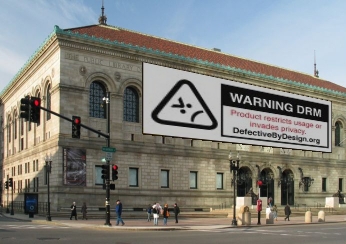
Benjamin Mako Hill: Protest DRM at the Boston Public Library

/copyrighteous/images/bpl_drm.jpg On Saturday February 9th, at 13:00, I'm going to be joining free software and anti-DRM activists to protest the use of DRM by the Boston Public Library on parts of its electronic collection. Those of us protesting are unhappy because the BPL has launched a new service powered by a company called OverDrive. The system gives BPL patrons access to books, music, and movies online -- but only if they use a Microsoft DRM system. There are lots of problems with the introduction of this system: it bars access to users of GNU/Linux and MacOS and creates a dependence on a single technology vendor for access. These are important issues, certainly. The worst problem, however, is much more fundamental. By adopting a DRM system for library content, the BPL is giving OverDrive, copyright holders, and Microsoft the ability to decide what, when, and how its patrons can and cannot read, listen, and watch these parts of the BPL collection. They are giving these companies veto power over the BPL's own ability to access this data -- both now and in the future. Cryptographically, BPL is quite literally handing over the keys to their collection. In the process, they are not only providing a disservice to their patrons. They are providing a disservice to themselves. The first-sale doctrine says that libraries can do essentially whatever they like with copies of books they purchase short of duplication, modification, or performance. Of course, copyright holders would prefer to charge a toll every time someone checks out a book. Public libraries were possible in spite of this desire because they were able to exploit power over the possession and control of their books in the interests of their patrons. With DRM, libraries will reduced to powerlessness. Of course, times have changed. As media and the ways we interact with it is increasingly digital, libraries have changed and will need to change more. But if public libraries are to succeed at their fundamental mission of spreading knowledge and serving communities, this change can't be at the expense of patrons' ability to control their own technology and libraries' ability to control their own collections. I've supported my academic library, MIT Libraries, as they took a risk and stood up to DRM when other institutions did not. And they won. BPL is the largest municipal library in the US and the third largest US library overall. It is the first library to be supported publicly, to be open to the public in the US, and to allow patrons to take home books to read and use them. BPL has an opportunity now to continue this history of leadership, of access, and of patron empowerment. If BPL stands up against DRM and in favor of its patrons' freedom and its own control of its technical destiny and collection, it may set an important precedent. If you're in or near Boston, please join me in Copley Square on Saturday to help make this happen. If you're not near Boston, please help put pressure on similar efforts in your own communities.

Romain Francoise: Quicksand, Saint-Michel, and a tip

My CC-licensed photo Quicksand is featured this morning on the front page of openDemocracy, illustrating this article about the US presence in Afghanistan and Iraq.

I took this picture in the summer of 2006 in Saint-Michel bay. At low tide it's possible to cross the bay on foot with a guide, from the shore to the island, a pleasant few kilometers of flat sand with a spectacular view of the Mont. Sadly, every year tourists attempt the trip unaccompanied, get stuck in the dangerous quicksands and drown when the rising tide enters the bay and completely fills it in mere minutes.

(If you ever get caught in that kind of quicksand, here's a survival tip: the key is to lie flat either on your back or on your stomach so that the bulk of your weight is supported by your upper body pressed flat against the sand. Then you just have to crawl forward with your arms and shoulders until your legs are freed from the sand.)

7 February 2008

Martin F. Krafft: Leaving LCA

I am 10 000 metres above sea level, on my way from Melbourne to Wellington. I am looking back at a very enjoyable week of conferencing, with LCA 2008 ending yesterday, followed by today s Open Day. The purpose of this final day is to invite the general public to learn about open-source. Individual projects present their work at booths and field questions by bypassers. Jacinta Richardson and the other organisers and helpers of the Open Day have done an amazing job. The place was buzzing and the selection of projects broad and interesting, even to me. Two talks and a series of lightning talks, as well as catered food for everyone rounded it off. I will try to have this event in mind as we organise a similar event in Buenos Aires after the forthcoming DebConf8 in Argentina. I had a splendid time at the conference and probably can t thank Donna Benjamin and her army of mignons enough for organising it. Compared to the other open-source conferences I previously attended, this one was the most professional. Good job, everyone!!! Here are the highlights: Apart from the busy programme, I particularly enjoyed the hallway track , which is usually the reason why I attend these events. I really ought to practice remembering names and faces a bit better. I am not paying enough tribute to this week with this report, but I shall conclude it regardless. Unless something very unexpected comes up, I will attend next year s LCA in Tasmania. NP: Porcupine Tree: Futile

Biella Coleman: On Confidence, Geekdom, and Desire

So a few folks left some interesting comments in response to my link to the article on the rise of the alpha-girl based on the research of Harvard psychologist, Dan Kindlon. My response to both Joe and Karl is that it is worthy to lower the barriers to entry not because girls will change the cultural ecology of geekdom in positive ways (though they may) or because geekdom is inherently “omg totally awesome!!!!!!!!!!!!!!!!!!!!” but for a much more mundane reason: it may allow girls to follow interests and eventually discover a passion. I think it is a great idea if more women were involved in geekdom and open source development not because it is inherently great but because I am sure there a lot of women out there who would enjoy it (and by extension, I am sure a lot who would not). By highlighting this article I am not advocating some forced hacker-female-labor-migration-policy but pointing to the fact that social conditions outside of geekdom play a role in ensuring more participation among women. But let me explain a few things before I argue my position a little further. First a little clarification, especially now that I have read the article. By alpha the author does not mean dominant, aggressive, and totally jerky, which is what might immediately come to mind when you read/hear alpha (especially if one knows any alpha-geeks or alpha-lawyers for that matter, who are much worse, imho). And I certainly don’t want any more alpha-anything (alpha-women, alpha-dogs, alpha-cats, alpha-hamsters ) given our world is already chock-full of alpha-jerks. By using the term, the author basically means confidence, which apparently is on the rise among girls, leaving them much more likely to be go-getters, undaunted by explicit and implicit barriers and obstacles and thus more likely then ever to enter arenas that have been thought of as traditionally male or in fact totally dominated by males. If this trend is indeed in place, I think it is great and I hope that this eventually translates into more girls/women populating traditionally male areas whether it is neurology, movie directing, hacking, or surfing. What I appreciate about the article is that his research can help us question the idea that women are naturally averse to competition due to their estrogenic hormones while boys, brimming with testosterone, just love it and exude it. I never identified with that conventional well-worn script, in part because I guess I am fairly confident and somewhat competitive. Being in academia for the last 10 years, I have witnessed a lot of really confident women that have helped inspire me and keep me going, especially when times got rough. What is fascinating about the article (and by extension probably his book) is that gender parity and equity and changes in the psychological makeup of women have not changed overnight but have taken a much longer time to settle in place. We are only now bearing the fruits of structural and educational changes first instituted decades ago and that tackled some serious forms of discrimination. As a result, we are seeing girls and women donning a deeper confidence that may help them participate with more success in the arenas they want to whether it be sports or in the workplaces (though there are certainly still major barriers and issues, which are addressed in the article). So why would someone want to participate in the world of free software and hacking in particular? My first answer is there may be any number of reasons why anyone, female or male or transgender or whatever, may want to do so for the love of technology, to feel an intense belonging to a community who share your passions and who work together to create something with a lot of value, to enjoy the challenge of learning, to spread freedom to every corner of the earth, etc… It is not that geekdom is inherently fun and exciting but that it will be interesting to some slice of the population men or women (or other) and what is the harm in lowering the barriers to entry, especially if it brings enjoyment and frankly a lot of economic security too? There are a number of girls/women who already find it worthwhile and I am sure many more who would. And the point is not to create some policy to make sure that we shuttle women into hackerdom but as a society we should equip them with the necessary psychological tools so that if they think this is worthwhile, and discover that they love it, etc, they will dare to venture in there and more importantly, stay if they want to. In terms of Karls point that a lot of people are professional geeks in part because they d have trouble being anything else; like being gay, it s not a choice, I think that is far too narrow of an assessment, not to mention an outdated caricature of geeks. While there is certainly a class of socially awkward geeks (if that is what you mean??), I would say they are in the minority though they may certainly stand out precisely because they are the odd ducks and because the stereotype is so entrenched. Many geeks I have met, while they may pretty darn focused on geekdom, also have full and rich lives/personalities that cannot be easily collapsed into one immutable personality type. Yes they may be obsessed with tech but aren’t doctors, academics, musicians, lawyers sort of fanatical too? I spend like my whole week working on academic stuff (part of necessity, part out of love). And at least hacking has way better conferences and economic perks, which may help explain why people stay :-) Finally, I think you assume a little to strongly that we do what we do because we have a pre-formed existing desired to do so. While I think this is the case for many things (and I knew the minute I learned about anthropology, I wanted to be one, which was odd but it proved to be correct), I think desire is also formed as much through experience and hence the importance of exposure to different worlds and experiences. I know that there are many things I could have never imagined I would have loved–karoake and sailing are two things that come to mind—until I tried them about both took some degree of courage. In the later case, it took a lot of guts to move onto some ship at the age of 18 instead of going to college and I am so glad I did. This is an instance where confidence and an initial curiosity led to discovering a love and passion I never knew I had. So if desire can be formed and not just expressed, I think it is key to make sure people have all sorts of opportunities to cultivate the passions they never knew they had.

5 February 2008

Aigars Mahinovs: Super bowl XLII

No Debian content here. Just like last year I decided to watch one of the largest sport events in the USA - the final game of the National Football League Super Bowl XLII (roman numerals are different for the sake of it :P ). I came to like the Japanese take on American football, so I watched the Superbowl last year and was appalled at the lack of any entertainment value in the game. I was told that it was one the worst Super bowls ever, so I gave it another try. Just like last year the American football looks to be very lawyer-friendly: bundles of complex rules and exceptions. The game could have been much simpler. Like for example, a lot of rues come from the fact that the game timer almost never stops. It is good for TV companies as they can plan their broadcast times better, but horrible for the stop-go game like the American football is. Just stopping the timer on every point the ball is stopped like they do in final seconds would cut out a lot of rules. Playclock and all. Rules on use of timeouts and stuff. Of course the game time would need to be adjusted down a bit. Now you have 4×15 minutes of ‘game’ where at most 20 minutes of that is in action. That game time is a lie - most of the time people are just standing around. Terminology irks me quite a lot. Why is it a “1st down” when there have been two “1st down”s just a few minutes ago? Something along the lines of “down counter reset” would be much clearer. And what is cryptic “1st & 10″ doing in the middle of the screen? It would have been much clearer if that info would be split: “Downs: 1/4″ and a measuring arrow between the ball and the yellow line with “10yd” written on it. And then there is an obscured “two in two” or “two for two” or “two in O” phrases which apparently means the same as “two 1st downs out of two tries” in the context. Can’t the commentators be a bit more elaborate and actually say the units of measurement? “Giants strength first tonight”? How about “in the lead”, English anyone? The camera placing editing is just horrible - the camera direction is switching all the time and that is confusing as hell. In normal football when professional camera teams are working, you always get all the shots from one side and even one general angle. If for clarity reasons a camera shot from other side is needed (usually in a replay) they always say that the image is from the reverse side in large letters on the screen. Here a lot of close-up shots were all over the place and even rotated around inside one shot! That might look fancy, but is just crappy camera work and editing. Then commentators start talking walls of numbers and walls of names. Unless you know by hearth who plays at what position, there is no way to understand what those people are saying. Than is just sloppy commentary. Is FOX incompetent in all possible ways? Then again the funky rules came into play just at the end of the first quarter - I have no idea why the ball was moved to the end line. Apparently the defender did or didn’t something. Did not see anything worth penalizing the team like that at all. They dropped the term ‘pass interference’ later on. Isn’t interfering with the pass the whole point of the defense play in this game??? Lawyer game, I’m telling you. And later on, pulling on guys arm while he is catching and being tackled apparently is just fine. And holding is illegal??? On the big penalty on the Giants the judge could have just said that the ball is out of bounds. Giving a 10yd penalty for such a minor thing is just ridiculous. The halftime show was kind of meh. Staged to extreme, but no soul nor sense. And what were all those people doing on the field? Isn’t that bad for the grass? And the commercials .. Average at best. Horrible at worst. For example a government commercial saying parents to protect their prescription medicine to .. help out your neighborhood drug dealer??? Oh and does anyone still doubt that media is controlled by republicans after that Coke commercial where the democrat is portrayed as bald and ugly and the republican is portrayed as the nice guy going for the compromise. And then they both Segway into the sunset? Brainwashing and prejudice embedded in a Coke commercial !?! WTF is going on in USA !? The 12-man-on-the-field penalty in the 3rd quarter is another legalese bullshit in the game. It is clear that the extra player had no effect on the game so it is just ridiculous for the judge to penalize the team for that. A couple small penalties were given for Patriots as well, judge bias was not as prevalent as last year. The camerawork stayed the same through the game - confusing, flashy and sloppy. Other cameras are in the shot line all the time. The game however did compensate for that all. The 4th quarter was very nice and exiting. I had no idea of the teams before the game, but I did like the Giants more - they just seemed to have more will and soul in their game. So I rooted for them since the 2nd quarter and it was very satisfying to see them win the game in the final seconds. Summary: good game, great final quarter, horrible coverage and crappy sideshows (adverts and halftime show).

Next.

Previous.