Search Results: "will"

6 January 2010

Dirk Eddelbuettel: littler 0.1.3

A new littler release (now at 0.1.3) just went out of the door this evening. littler provides r (pronounced littler), a shebang / scripting / quick eval / pipelining front-end to the the R language and system. This version adds a few minor behind-the-scenes improvements: As usual, our code is available via our svn archive or from tarballs off my littler page and the local directory here. A fresh package is in Debian's incoming queue and will hit mirrors shortly.

5 January 2010

Russell Coker: Which is Better, Original DVD or Pirate MP4?

For a long time it has been obvious that in all cases anti-piracy technologies discourage purchases and in many cases encourage piracy. I first discovered the significance of this in about 1991 when I attended a public lecture by a senior employee of Borland and a member of the audience claimed that the Borland product he bought didn t function correctly due to anti-piracy measures. The Borland employee firmly stated that Borland did not use anti-copying technology on any of it s products, didn t have any plans to do so, and the problem in question must have been caused by something else. Of all the hostile questions that were asked, this was the only one that caused the speaker to appear agitated so it was obviously an issue that was considered to be important within Borland. In the late 80 s anti-piracy measures were mostly based around creating floppy disks that couldn t be easily copied (violations of various aspects of the disk formatting standards). This meant that you couldn t make a backup copy of the data, so it wasn t uncommon for people to seek pirate copies of their commercial software for daily use to avoid wearing out their valuable original floppy disks. Then the dongle was invented and people who bought software sometimes sought pirate copies so that they could use their printer and their commercial software without having to change plugs on their PC. But in those cases the benefits to uncrippled software to the users were small. Now a large part of the battle on copy protection concerns DVDs. If you had a DVD of a recent movie and an MP4 which would you rather watch? Would you prefer to be forced to watch some anti-piracy rubbish for a couple of minutes at the start of the movie (with fast-forward disabled) or would you prefer to just start watching it? Would you prefer to be able to pre-program the sections of the movie that you watch (as some parents desire to skip the sex and/or violence in movies for their teenagers) or would you prefer to be forced to watch the movie straight-through with only a manual fast-forward to skip sections? Would you prefer to have a DVD that can t be played properly on many (most?) computers because of the CSS encoding or an MP4 that plays on everything from PCs to mobile phones without an issue? Would you rather have 100 movies in the spare space on your laptop hard drive when you travel and 1000 movies on your desktop system or the much smaller number of boxed DVDs that you can store? I think that in most cases a pirate MP4 will give a better experience than a DVD. So the question is, why pay for a DVD when in most cases you get a lesser experience than you will get from a MP4 file downloaded by bittorrent? One reason for buying the DVD is to support the film industry. But I doubt that such a profitable industry will get much sympathy in today s economy. Another reason is the morality, some people consider piracy to be theft (it isn t by definition theft requires that for at least a moment the property be completely in the possession of the thief) and therefore avoid it. One technical reason for buying a DVD is the fact that it may have multiple languages supported, it will have subtitles, it may have an audio track with the creators giving a commentary, and it may have extra scenes that were cut from the main release. I believe that work on adding subtitles to the video file formats is a work in progress, so it s only a matter of time before the DVD rips include all this extra data. Really the content creators should focus on making a product that meets the needs of users and that they want to pay for. Pirating books is technically possible, but almost no-one does it. Some successful authors such as Charles Stross freely publish significant parts of their work and Cory Doctorow freely publishes all his work in electronic form. Books just work well, they meet the needs of users and people want to buy them. Sure they can sell them second hand, lend them to other people, and it s technically possible to pirate them, but they remain profitable. On my documents blog I have a page of links to free short stories that I liked [1] and a page of links to free books [2]. It seems to me that creators of other copyright content should consider how they can be of service to their customers. We are all familiar with corporations and misguided individuals who get whiny about the supposed losses due to piracy. Bruce Everiss has unfortunately joined this trend and demanded the disconnection of Internet users based on unproven accusations of game piracy [3]. I don t know whether the game buying experience sucks as badly as the DVD buying experience, but based on the reports of locked-down consoles that have to be cracked before they run Linux I expect that the modern game industry is doing at least as badly as the movie industry. They need to provide things that users want! One thing to note is that a Windows or console game player who uses pirate games will probably buy some games at some future time, while someone like me who uses free software both by principle and because it gives a better user experience will probably never pay for a game (I haven t got time to play all the free games so I probably wouldn t even buy a Linux game).

Debian News: Aur lien Jarno added as new assistant to the security team

It is our pleasure to announce that Aur lien Jarno is now an assistant to the Debian Security Team.

He will concentrate most of his efforts on security support for the new kFreeBSD kernel.

Thanks Aur lien, and welcome to the team.

Steffen Joeris, on behalf of the Security Team

Russell Coker: An Interesting new Auction Site

BidRivals.com is an interesting new auction site, their business model is that you buy bids for $0.80 each. If you want to bid on an item it costs you $0.80, then if you win the auction you pay for it. Every bid increases the price by 2 cents. So if you see an auction with a current price of $2.00 that apparently means 100 bids have been placed IE $80 have been spent. Currently a Canon EOS 50D Digital SLR camera + a lens is on auction, it has a buy it now price of $2,499 (the same price that Harvey Norman advertises) and the bidding is at $163 and climbing so the auction site has apparently made almost $6,500 in revenue and the product has not been sold yet! The auction also has no fixed end time, it seems that about 10 or 15 seconds are added to the clock every time someone bids, and the autobidder will kick in when 4 seconds remain. So there will probably be an autobid every 6-11 seconds somewhere between 300 and 600 bids per hour at a cost of $0.80 each every item that is running with autobids will generate something between $240 and $480 in revenue without being sold! Now if you don t win the auction (or give up trying to win) then you can buy it for the difference between the cost of your bids and the product price. In the case of the camera in question if you had made 500 bids (which would be quite easy with the autobid feature) then that would be $400 worth of bids, and given a choice between losing that $400 and using it as a down-payment on the regular retail price I think that most people would choose to buy the product. Of course if you buy it from Harvey Norman you save the delivery fee and probably get more options if you want to return it I ve never had to return something to Harvey Norman but I m assuming that it would be a lot easier than returning an item to an online store! I don t consider this to be a real auction site. I believe that a real auction has genuine bids of a value that is determined by the bidder, the auctioneer (or auction software) may decline bids that are too low in value or which have too small an increment. Bidding in an auction generally costs the bidder nothing the only exception I ve personally seen is auctions which have a printed catalogue in which case you pay for the catelogue, a fixed fee which is small when compared to the auction prices. It seems to me that a significant portion of the revenue (possibly the majority of the revenue) of BidRivals is from the bidding fees, and the other significant portion of the revenue would be comprised of profits made from auction customers who opt to buy the item at it s list price to avoid wasting the money that they have put in to bids. The actual prices of the items are small by comparison. Note that I am not accusing BidRivals of doing anything illegal (such as running a gambling system), I am merely stating that I don t believe that they offer a good deal for customers. While they aren t strictly a gambling site, it seems that one could get lucky and make a single bid (costing $0.80) at the right time and get a $2,499 camera for $170 (or whatever it ends up selling for) while others may spend hundreds of dollars in bids and get nothing other than a potential down-payment on the full $2,499 price. That s a lot more luck than I want in any of my purchases! I recommend not doing business with them or anyone like them.

Peter Eisentraut: Remove and Purge

Debian's package manager dpkg has the perhaps unique feature that it distinguishes between removing and purging a package. Removing it removes the program files but keeps the configuration files (and sometimes the logs) around, purging it really removes everything. While this distinction undoubtedly has some uses, I have found that I almost never make use of it. I think in about six years of using Debian I have actually needed a remove-but-not-purge functionality about five times, during some really tricky upgrades (and using Aptitude instead of APT might have helped, not sure) and once when I wanted to build a package that had a build dependency that conflicted with a package I had installed (cowbuilder came later).

I think many people don't fully realize this distinction, and thus aged systems will often contain dozens or hundreds of removed-but-not-purged packages lying around. Great fun cleaning that up. And therefore, at some point in the distant past I have switched all my APTs to purge by default, using the configuration setting Apt::Get::Purge "true";. At the time I thought this would be daring, but I have never looked back. The one time a year that I don't want to purge I override this by hand.

Later, APT actually got an apt-get purge command, but there is no apt-get autopurge and no apt-get dist-upgrade-and-purge (or whatever) to purge the packages it wants to remove. This can be worked around by carefully adding --purge to all invocations of apt-get, but who will remember that. And of course apt-get remove is hardwired into my fingers.

How do other people handle this? Are there undiscovered reasons removing is the better default? How do you clean up packages that were forgotten to be purged?

4 January 2010

Russell Coker: Ext4 and RHEL5/CentOS5

I have just noticed that Red Hat added Ext4 support to RHEL-5 in kernel 2.6.18-110.el5. They also added a new package named e4fsprogs (a break from the e2fsprogs name that has been used for so long). Hopefully they will use a single package for utilities for Ext2/3/4 filesystems in RHEL-6 and not continue this package split. Using commands such as e4fsck and tune4fs is a minor inconvenience. Converting a RHEL 5 or CentOS 5 system to Ext4 merely requires running the command tune4fs -O flex_bg,uninit_bg /dev/WHATEVER to enable Ext4 on the devices, editing /etc/fstab to change the filesystem type to ext4, running a command such as mkinitrd -f /boot/initrd-2.6.18-164.9.1.el5xen.img 2.6.18-164.9.1.el5xen to generate a new initrd with Ext4 support (which must be done after editing /etc/fstab), and then rebooting. When the system is booted it will run fsck on the filesystems automatically but not display progress reports which is rather disconcerting. The system will display / contains a file system with errors, check forced. and apparently hang for a large amount of time. This is however slightly better than the situation on Debian/Unstable where upgrading to Ext4 results in an fsck error on boot which forces you to login in single user mode to run fsck [1] which would be unpleasant if you don t have convenient console access. Hopefully this will be fixed before Squeeze is released. I now have a couple of my CentOS 5 DomUs running with Ext4, it seems to work well.

Biella Coleman: All tech

Fall semester I did not teach any classes that covered digital media (in part because I was swimming in the stuff writing a review essay on the topic, which I am sending today to the journal, ending about 4 months of hell). On the other hand, spring semester will be all about digital media: hackers, free software, privacy, piracy, phone phreaking and more. I am excited. Here is my graduate syllabus on the commons and piracy and here is my undergraduate class on hacking. Both are still under development but pretty far along.

3 January 2010

Robert Collins: More evolution-reliability-speed


Evolution recently moved to a sqlite summary db rather than a custom summary db implementation. Its great to see such reuse of code. However, it s not really a complete transition yet as I ve had cause to find out today. I ve blogged before about performance with the sqlite summary sqlite database. Today I was greet with a crash-on-startup bug which happily has a patch upstream already. Before I looked in the bug tracker though, I did some house cleaning. I started with a 900MB folders.db. Doing a vacuum on the db dropped that to 300MB. It doesn t appear to be something that evolution does itself. Firefox too appears to lack an automatic vacuum. sqlite is an embedded database, and its wonderful at doing that, but its not as install-and-forget as (say) PostgreSQL which does autovacuum. So an additional tip is vacuum your folders, e.g. with http://www.gnome.org/~sragavan/evolution-rebuild-summarydb, a helper script that will run vacuum on all your account summary db s. Note that it *does not rebuild*, it solely vacuums, and as such does not add or delete (modulo bugs in sqlite) data to the summary database. After the housecleaning, I checked that the sqlite database was in good condition:
sqlite3 folders.db
pragma integrity_check;
This returned a number of indexing issues, so I reindexed:
reindex;
Evolution now starts up and crashes in a fraction of a second - a big improvement. Finally, I started looking at the evolution code as I now was fairly confident it was a bug - it was in a sqlite callback function - and the column the function extracts data from (flags) is missing a NOT NULL constraint, but the code doesn't check for NULL - boom. From there to finding the bug report and existing patch was trivial. And this is where my comment on reliability turns up: Evolution doesn't anticipate NULL flag values in its code, so why does it insert them into the database at all ? I suspect its due to some aspect of the incremental conversion to using sqlite summaries. More concerning for me is the possibility that there are many other such crash bugs lurking in the new sqlite based code. There are possibly some clues as to the excessive table scans done by evolution in the use of a flags bitset rather than separate columns, but I haven't looked close enough to really say.

Thorsten Glaser: new MirBSD-current snapshot; more TODO done

The MirBSD Midi-ISO (bi-arch manifold boot) and NetInstall for both i386 and sparc have been upgraded to the 20091226 snapshot (sorry for the delay). A separate news announcement will be done when a full ISO (MirBSD + MirGRML) is done. Other than that, I have fixed a couple of things all over the place, jupp for example. The planned release of mksh R39b is still not done though, as I m only human as well, and too much hacking isn t something one can do without relaxing some in between. On the Debian front, my RCBD #1 was continued, here s #1 results: Explanations: I did go overboard during the first patching session, but I suppose this is what the NM learning period is for too. The autossh maintainer said thanks and will probably integrate my patches, so I don t need to NMU. I could close the dietlibc bug. The other two didn t look as good, I had to separate the fix for the RC bug (and other required fixes, such as ftp-master rejects there were none though) and my other fixes; I submit the former as NMU diffs again and pointed Zack to the .dsc files, and opened the aforementioned two new bugs with the rest of the diffs, so the proper maintainers can take and apply them. There s questioning if gidentd should be removed (see the PR for more); the acorn-fdisk upstream (arm-fdisk it s called there) is not actively developing but will receive patches; the autossh maintainer said thanks but I didn t yet hear back from upstream. The binutils as intel_mode bug was fixed upstream and in experimental for my case, but I had to reopen things because the variant documented in binutils-current still doesn t work, so others (who use the new, more intel-like, syntax) don t run into it. Luk sent me a request to do more mipsel-FTBFS-due-to-toolchain-bugs workarounds. Will do (but can t promise to do so before the upcoming BSP. Robert Millan incorporated something like manifold-boot into GRUB 2, after I described it to him (the debian-bsd@ people are currently sorting out some heisenbugs with it, though). Now there s three variants (but then, this helps spotting bugs that don t appear in all implementations). sendmail 8.13.4 is out, I wonder when OgreBSD will upgrade I could do it myself again, but this time it s not that urgent. Still waiting for the TLS extension, though

Christian Perrier: Adopting/cleaning out font packages

After modernizing all font packages maintained by the pkg-fonts team (dropping defoma, source v3, etc.), I'm now investigating (with the help of other pkg-fonts team members) the list of ttf-* packages that are *not* maintained by our team. It seems that several of these suffer from low interest from their respective maintainers, so that task will often involve checking whether the said font is still wished in Debian, then talk with the maintainer if there is still one to convince him her to maintain the package collaboratively....or adopt the package when it is clearly abandoned. As of now, I already imported 4 ttf-arphic-* packages in our SVN and I'm working to modernize them. Dear readers, please feel free to point me to good candidates for this. Otherwise, I'll process the output of "apt-cache search -n ttf-" alphabetically...

Dirk Eddelbuettel: Rcpp 0.7.1

Two weeks after the Rcpp 0.7.0 release, Romain and I are happy to announce release 0.7.1 of Rcpp. It is currently in the incoming section of CRAN and has been accepted into Debian. Mirrors will catch up over the next few days, in the meantime the local page is available for download too. A lot has changed under the hood since 0.7.0, and this is the first release that really reflects many of Romain's additions. Some of the changes are As before, fuller details are in the ChangeLog on the Rcpp page.

2 January 2010

John Goerzen: A Poem for the Rich

In Egypt s sandy silence, all alone,
Stands a gigantic Leg, which far off throws
The only shadow that the Desert knows:
I am great OZYMANDIAS, saith the stone,
The King of Kings; this mighty City shows
The wonders of my hand. The City s gone,
Nought but the Leg remaining to disclose
The site of this forgotten Babylon. We wonder, and some Hunter may express
Wonder like ours, when thro the wilderness
Where London stood, holding the Wolf in chace,
He meets some fragments huge, and stops to guess
What powerful but unrecorded race
Once dwelt in that annihilated place. Horace Smith
Many of us that can afford an Internet connection still qualify as exceedingly rich compared to, for example, many poor people in Africa. On a scale of centuries, the ancient centers of civilization and wealth tend to collapse. Even Rome, with over a million inhabitants in its day of ancient prominence, shrank to only 20,000 over the course of history. Some other ancient cities no longer dot our maps. It helps us, perhaps, to have some perspective. Those magnificent working monuments to wealth in New York, London, or Tokyo probably won t be there 1000 years from now. What will?

1 January 2010

Neil Williams: listing packages by priority

Yes, aptitude can list packages by priority, but what I wanted was a simple list of just package names. I've got two ways of getting a bare list:

Updated with many thanks to Phil Hands.

$ aptitude search '~prequired' sed -ne 's/^i [ A] \([^ ]*\).*$/\1/p' tr '\n' ' ' sort -u fold -s ; echo

#!/bin/sh
# Licence: GPL-3+
FILE= find /var/lib/apt/lists/ -name '*unstable*Packages'
LIST= grep-dctrl -n -s Priority '' $FILE sort -u

for P in $LIST; do
[ "optional" != "$P" -a "extra" != "$P" ] continue
echo "Priority: $P"
grep-dctrl -n -s Package,Priority "$P" $FILE sed -ne '/^'$P'$/!h;/^'$P'$/ g;p ' tr '\n' ' ' fold -s
echo
done


The advantage with the script is that is lists all packages in all priorities except optional and extra and can be restricted to individual Packages files and therefore to individual repositories and components. (Change the find expression if you have more than one repository specifying unstable or adapt the script to accept a path to the relevant Packages file on the command line.)

I really ought to have used perl because pattern matching in perl is a
lot more natural to me than using sed or awk. I do tend to chain a
couple of sed commands, just so that it's easier to work out which bit
is broken when it breaks.

The final version of this script will end up in emdebian-grip-server,
converted to perl with POD content, translated and reading the Packages
files using Debian::Packages::Compare.

$ ~/scripts/list-priority
Priority: important
adduser apt-utils apt aptitude bsdmainutils libbz2-1.0 cpio cron libcwidget3
debian-archive-keyring dhcp3-client dhcp3-common dmidecode ed libgdbm3 gnupg
gpgv groff-base ifupdown iproute iptables iputils-ping logrotate libept0
libsigc++-2.0-0c2a libtasn1-3 libusb-0.1-4 man-db manpages module-init-tools
nano libncursesw5 net-tools netbase netcat-traditional libnewt0.52 whiptail
libssl0.9.8 libpopt0 libreadline5 libreadline6 readline-common rsyslog
tasksel-data tasksel libwrap0 info install-info traceroute udev vim-common
vim-tiny wget libxapian15
Priority: required
libacl1 libattr1 base-files base-passwd bash coreutils debconf-i18n debconf
debianutils diffutils dpkg e2fslibs e2fsprogs libcomerr2 libss2 libc-bin libc6
findutils gcc-4.3-base gcc-4.4-base libgcc1 libstdc++6 grep gzip hostname
lsb-base libdevmapper1.02.1 lzma liblocale-gettext-perl libselinux1 libsepol1
libtext-charwidth-perl libtext-iconv-perl libtext-wrapi18n-perl libunwind7 mawk
libncurses5 ncurses-base ncurses-bin libpam-modules libpam-runtime libpam0g
perl-base procps sed sensible-utils login passwd libslang2 initscripts sysv-rc
sysvinit-utils sysvinit tar tzdata bsdutils libblkid1 libuuid1 mount util-linux
zlib1g
Priority: standard
apt-listchanges at bash-completion bc dc bind9-host dnsutils libbind9-50
libdns53 libisc50 liblwres50 bsd-mailx libsasl2-2 libdb4.8 libdb4.5 libdb4.6
libdb4.7 debian-faq doc-debian doc-linux-text libc6-i386 locales exim4-base
exim4-config exim4-daemon-light exim4 file libmagic1 gettext-base libgnutls26
libgpm2 libkeyutils1 libgssapi-krb5-2 libgssrpc4 libk5crypto3 libkadm5clnt6
libkadm5srv6 libkdb5-4 libkrb5-3 libkrb5support0 less lsof libcap2 libedit2
libevent-1.4-2 libgc1c2 libgcrypt11 libgpg-error0 libgssglue1 libidn11
liblockfile1 libnfsidmap2 librpcsecgss3 libunwind7-dev libxml2 m4 mime-support
mlocate mutt ncurses-term ftp telnet nfs-common libldap-2.4-2 openssh-client
patch libpci3 pciutils libpcre3 perl-modules perl portmap procmail
python-central python-minimal python python2.5-minimal python2.5
python-reportbug reportbug wamerican libsqlite3-0 tcpd texinfo time ucf w3m
whois

Hmm, next step is to check the "Priority: standard" set for Emdebian - it looks far too large for what would be standard on an embedded device. LDAP will be dropped for one - and what is a -dev package doing in there? libunwind7-dev isn't even installed on my amd64 Debian desktop!

Probably check the important and required listings too, then tweak what we need to change via the archive overrides for Emdebian Grip.

Come to think of it, I might need a PHP version of this to read live data from the repository, documenting the changes.

Joey Hess: naught but a decade

This has been a big decade for me. Ten years ago, I was living in Sunnyvale, in the heart of Silicon Valley; VA had just had its crazy IPO; my unvested options were worth over a million dollars on paper. I remember sitting in first class[1] on the way out of Atlanta after the holidays and wondering what one did with a million dollars. Avoid working too much? Have a lot of interesting computers? Build a distributed house[2]? Mostly I decided to not count my chickens, which turned out to be the right choice. Six months later, I started debian-installer, in many ways my biggest project to date. In spring of '01, VA was crashing; I was sick of the Valley; gloom was everywhere. I took the hint and quit, cashed in my options for five figures, not seven, bade forewell to the many people I'd come to know, and moved back east. By reading my old journal, I can tell that subconciously, I had long before decided what to do when it was time to leave the Bay Area. So without really thinking too much about why I was able to do this, about how not just my own family, but others were indirectly making it possible, I moved to a 150 acre wooded "farm", and mostly went off and did mostly my own thing for three years. This was such a huge life change. I lived in a building affectionatly called "the shack". It was renovated from a chicken coop in the 70's and leaked during heavy rain, but I preferred it to the main house (warmer). I went back to dialup for internet. I hauled groceries and most everything half a mile in by hand. There was an outhouse and washwater hauled from a creek. I cut barely enough firewood and readapted my body from California to cold. My main tech project during this time was mooix. In some ways my largest failed project, but it was neat to be able to go off and do such a thing. This was a blissful, reflective, peaceful, amazing time. Parts were a second childhood. Somewhere in there I properly confronted my mortality. And learned to use a chainsaw. And over the course of three years, I dug myself into a rut, a hole. I wasn't going anywhere. (Except for a month in Honduras, and my first DebConf in Oslo.) In '04, I found myself talking on the phone to a cosmonaut in a house that had been without power for days in a hard winter. I realized I was ready to leave the farm if I could figure out how to do it, and I almost took him up on the job working on his new Linux distro -- but at the last minute Oslo connections suggested I work for SkoleLinux instead, and so I did. Soon after moving into a rented house in town, I was jaunting off to Brazil for a month, a great time. Followed by a productive year where I got heavily back into debian-installer, started Debian's testing security tream, and generally worked a lot. The next summer I fooled around with an RV, and sort of fell into a job with ADS. But my time on the farm had changed me, I think. I ended up going back to the farm for a year and working part time from there. During this time I also started ikiwiki and other smaller projects. One day I came back from a camping trip and found the kitchen had been torn down in my absence. Reminded unsubtly that I was not the only one with a claim to the place, I got out, though I somehow suspect not for good. For the last four years, I've been more outwardly settled, buying a house in town, continuing to work at the same job, starting little projects like pristine-tar, mr, and etckeeper. About two years in I began to feel antsy sometimes (and had a minor medical scare), and set up the yurt as a relief valve so I can have crazy adventures in the cold woods again. Still, I sometimes feel that a big change is building up. From here, this decade feels like it contained endless changes, important decisions, interesting projects, strong experiences. The 90's, containing only little things like college and moving to California, pale in comparison. Maybe the naught's will be the decade I always remember.. or maybe not. Anything could be around the corner.
  1. Bumped up due to an airline scheduling snafu, not because I was throwing money around.
  2. Concept of mine perhaps not worth explaining here although it was oddly similar to how I ended up living at the farm. Good ol' subconcious..

31 December 2009

John Goerzen: My Reading List for 2010

I can hear the question now: What kind of guy puts The Iliad and War and Peace on a list of things to read for fun? Well, me. I think that reading things by authors I ve never read before, people that take positions I haven t heard of before or don t agree with, or works that are challenging, will teach me something. And learning is fun. My entire list for 2010 is at Goodreads. I ve highlighted a few below. I don t expect to read all 34 books on the Goodreads list necessarily, but there is the chance. The Iliad by Homer, 750BC, trans. by Alexander Pope, 704 pages. A recent NPR story kindled my interest in this work. I m looking forward to it. The Oxford History of the Classical World by Boardman, Griffin, and Murray, 1986, 882 pages. It covers ancient Greece and Rome up through the fall of the Roman empire. The Fires of Heaven (Wheel of Time #5) by Robert Jordan, 1994, 912 pages. I ve read books 1 through 4 already, and would like to continue on the series. War and Peace by Lev Leo Nikolayevich Tolstoy, 1869, 1392 pages. Been on my list for way too long. Time to get to it. Haven t read anything by Tolstoy before. The Politics of Jesus by John Howard Yoder, 1972, 2nd ed., 270 pages. Aims to dispel the notion of Jesus as apolitical. An Intimate History of Humanity by Theodore Zeldin, 1996, 496 pages. Picked this up at Powell s in Portland on a whim, and it s about time I get to it. The Myth of a Christian Nation: How the Quest for Political Power Is Destroying the Church by Gregory A. Boyd, 2007, 224 pages. An argument that the American evangelical church allowed itself to be co-opted by the political right (and some on the left) and argues this is harmful to the church. Also challenges the notion that America ever was a Christian nation. Daily Life in Ancient Rome: The People and the City at the Height of the Empire, by Jerome Carcopino, 2003, 368 pages. I ve always been fascinated with how things were on the ground rather than at the perspective of generals and kings, and this promises to be interesting. Slavery, Sabbath, War, and Women: Case Issues in Biblical Interpretation (Conrad Grebel Lectures) by Willard M. Swartley, 1983, 368 pages. Looking at how people have argued from different Biblical perspectives about various issues over the years. To the Lighthouse by Virginia Woolf, 1927, 252 pages. I can t believe I ve never read Woolf before. Yet another one I m really looking forward to. Tales of the Jazz Age by F. Scott Fitzgerald, 1922, 319 pages. Per Goodreads: This book of five confessional essays from the 1930s follows Fitzgerald and his wife Zelda from the height of their celebrity as the darlings of the 1920s to years of rapid decline leading to the self-proclaimed Crack Up in 1936. Ulysses by James Joyce, 1922 (1961 unabridged version), 783 pages. The Future of Faith by Harvey Cox, 2009, 256 pages. Per Goodreads, Cox explains why Christian beliefs and dogma are giving way to new grassroots movements rooted in social justice and spiritual experience. Heard about this one in an interview with Diane Rehm. Being There by Jerzy Kosi ski, 1970, 128 pages. Jesus: Uncovering the Life, Teachings, and Relevance of a Religious Revolutionary by Marcus Borg, 2006, 352 pages. Whether or not you agree with Borg, this has got to be a thought-provoking title. The Three Musketeers by Alexandre Dumas, 1844, 640 pages. The Book of Tea by Kakuzo Okakura, 1906, 154 pages. Per Goodreads: In 1906 in turn-of-the century Boston, a small, esoteric book about tea was written with the intention of being read aloud in the famous salon of Isabella Gardner. It was authored by Okakura Kakuzo, a Japanese philosopher, art expert, and curator. Little known at the time, Kakuzo would emerge as one of the great thinkers of the early 20th century, a genius who was insightful, witty and greatly responsible for bridging Western and Eastern cultures. Nearly a century later, Kakuzo s The Book of Tea is still beloved the world over. Interwoven with a rich history of tea and its place in Japanese society is poignant commentary on Eastern culture and our ongoing fascination with it, as well as illuminating essays on art, spirituality, poetry, and more. More of my list is at Goodreads.

MJ Ray: 2009 Top 10 Software Cooperative News

Amazon Kindle Un-selling Books was the most-viewed news item on my blog this year. Once again, a lock-out/bad-business story takes the top spot. I don t think that one got as much coverage in the mainstream media as they usually do, which probably contributed to the relatively high reader numbers. I feel like I get criticised often for commenting about business ethics, but it does seem to attract a fairly big audience. The repost of Tribute to Richard Rothwell came a fairly close second. Again, not something that the mainstream tech news covered. the world is a sadder and lonelier place without him, and the rest of the world has lost one of its brightest stars. Top-placed technical item was HOWTO Apache httpd 2.2 PAM Authentication Modules which was a distant third. It was posted in late 2008, but I suspect that will keep getting viewers until everyone s upgraded. It s currently the top recipient of search engine traffic for the site. Other technical stories in the top ten were Windows 7: Released with known critical bug in fifth, ssh security in sixth and Top 8 J2ME MIDP Applications in tenth place. The only completely non-technical topic was the Cooperatives-SW Board and Housing Enquiry in ninth place. Cross-over topics complete the ten with 2009 Software in the Public Interest Board Election in fourth place, New #ukgovOSS Action Plan in seventh and Meeting about forming a Koha Foundation in eighth. Finally, I think the strangest three search phrases ending at my site this year are spi bike week , request free t-shirt and will britannia building society demutualise . Happy New Year! Found any easter eggs in your web stats?

30 December 2009

Christine Spang: Coders at Work

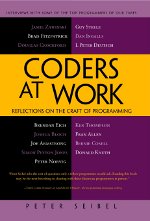
On the train to my parents' house for Christmas I finished up a wild run through the book Coders at Work. The book isn't even mine, but I'd been borrowing it very often, sometimes to the chagrin of its owner, because I could barely put it down. Coders at Work book cover The book is a collection of interviews with 15 great programmers of our time, starting with Jamie Zawinsky and ending with Donald Knuth. It's written in an interview style each interview starts with a brief introduction to the person being interviewed, summarizing what the person is known for and what he or she has accomplished and a few of the highlights of the interview, and then a transcript of the interview follows, with the author/editor, Peter Siebel, will saying something or asking a question, and the interviewee responding. I was skeptical about this format at first because I feel like it can be an easy way out of good editing and make the reader have to do the work of the editor, but on finishing I think that Siebel uses the format to his advantage in this case. For one, the speech format allows the reader to really form a picture of how the person being interviewed speaks and would act in a conversation. Jamie is somewhat bitter and pretty informal. Brad Fitzpatrick is flippant and energetic, his speech littered with profanity and colloquialisms. Others seem more stately and verbose Joe Armstrong's responses can go on for a page or more. In this way, not only do readers learn something about what these greats have learned about programming, but we also feel a bit more like we've met or know them, and can connect to them more as people. I always have this problem where I want to read computer books, but often computer books seem inextricably tied to the computer, so there's this dynamic of reading a bit and then wanting to get on a machine and try something out, write some code, play around especially with books focused on a specific language. Coders at Work retains some of this computer-book dynamic in that I constantly encountered things that I want to investigate or play around with more: Erlang, OCaml, various papers and essays, Knuth's literate programs, and books such as Higher Order Perl and others. Siebel makes a point to ask each person what her short-list of books and papers programmers should read are, so this book is a great source of pointers to other reading material. Unlike a more specific book, however, keeping a list in a notebook was enough to settle the mind to read away-from-a-computer for chapters at a time. It's obvious that despite the interview format, Siebel has done some serious editing. None of the prose is boring to read, and I can't imagine that the text is a straight transcript of how the interviews went. He also has arranged the interviews in an order such that different interviews play off each other. In Branden Eich's interview, for example, he disparages the book Design Patterns:
I never bought the Gamma book. Some people at Netscape did, some of Jamie Zawinski's and my nemeses from another acquisition, they waved it around like the Bible and they were kind of insufferable because they weren't the best programmers.
In the next chapter, Joshua Bloch names it as a book he thinks programmers should read:
Another one, which I have slightly mixed feelings about but I still think everyone should read, is Design Patterns. It gives us a common vocabulary. There are a lot of good ideas in there.
Similar plays, such as Ken Thompson and Fran Allen disagreeing on the badness of C, happen in later chapters, tieing together the different chapters and illustrating how even really good programmers disagree on the Right Thing all the time. Clearly the craft of programming is no settled thing. Besides the general structure of the book being well thought-out, the material is generally thought-provoking and interesting. One thing that stood out to me was Joshua Bloch describing what he called the "empathy gene", which is what a programmer has to have if he's going to be able to design good APIs and programming languages he has to be able to put himself in the shoes of the person who will be using the language or API. This is one thing that differentiates how different programmers can be good at different things. Another thing that stood out to me is that many of those interviewed stated that they don't use much in the way of modern tools and IDEs Joshua Bloch and Simon Peyton-Jones both touch on this, just to name a couple examples, even though some say that they think using these tools would make them more productive, especially when it comes to refactoring. This is a testament to the power of inertia sometimes there is just no chance to be unproductive now in order to be more productive later. Or perhaps just a sign that a programmable text-editor can stand on the same level as a heavier tool in terms of productivity in the right hands. I could go on with examples, but the conclusion here is that I thoroughly enjoyed Coders at Work, and I think it is a book that is well-worth the time spent reading the entire thing.

Gunnar Wolf: Internationalizing into your local customs

It seems strange to me. I don't think I know people as aware of internationalization issues as Bubulle, a.k.a. Christian PERRIER, and I have the feeling his last post regarding how he shall address himself is somewhat short-sighted. That might just mean I am in an even worse position. First, I recognize Christian's concern, but not only when dealing with people from around the globe It happens in my everyday life. When you show an ID stating Gunnar Eyal Wolf Iszaevich, the first reaction is a blank stare of disbelief, only to be followed by a question: So, what is your name? So I understand Christian wants to make it easier for people to guess what his name is in the least obtrusive way possible. I have seen the convention he suggests (uppercasing the family name) AFAICT used by French and Japanese people. But for me, it is intuitively backwards. If I were to emphasize a part of my name, it would be the part by which I expect people to address me with I would write GUNNAR Wolf. And yes, I usually leave out my second given name and my mother's family name, as it is customary here. Well, anyway... Reading my name, few people would guess I live in Mexico. Even fewer will believe I was born here. And if somebody calls me by the wrong part of my name, I won't feel at all offended. I strongly prefer my name to be used, as I like to be addressed casually, but quite often I am introduced as Dr. Wolf, in what at most would be an ex-profeso honoris causas doctorate, or at least an ignoratis causas one.

29 December 2009

Biella Coleman: This is one if for you: the hacker conference as ritual

One of the most frustrating things about being an untenured anthropology professor (aside from being untenured) is that, for the most part, the articles you must write to get tenure strike those you write about as hopelessly boring and jargony. I always imagine that when geeks read my articles, the experience can be represented as follows:
%*&%*&*(((& Linux *(&*(^%&%%^%% DeCSS &*(&^&&*^&^&^& Free Speech %^&%^%^%%^ Hacking &*(&^*(^^*^**^*Code*((*&&**&&*&* Emacs **(**)*( New Maintainer Process *&())))))))))&*&7&&*&)*&*&*&& DMCA **(**((( Copyleft. ****W$$&& TINC
Well, finally, I have my hands on the uncorrected proofs of an article that is far far more readable, accessible, and truth be told, romantic than anything I have written The Hacker Conference: A Ritual Condensation and Celebration of a Lifeworld. This article s ancestry goes back to this ancient blog entry that I wrote after Debconf4 in Brazil, later made it into my dissertation, and finally a gabillion years later is on the verge of publication. Debian developers, in particular, might dig this piece. I made use of your blog entries, mailing list discussions, interviews, and photos to reveal what is special about these events and also memorialize some important events, such as the the founding of Debian Women. So while some I am sure some academics will find this piece distasteful for idealizing these events, so be it. I grew very fond of these conferences, they changed the way I thought of computer hacking, and why not write something that makes those you worked with feel good (as opposed to bored and confused). Finally, academics have totally missed the theoretical boat when it comes to conferences, which are probably one of the most important ritual forms of modernity and yet there is so little written on them an issue I address briefly in the conclusion. Note that this version has various mistakes (including the name of Joel Espy Klecker and the caption under Figure 3, and Figure 9). Since many of your are human debugging machines, if anyone takes a preview read and finds any typos, feel free to send along as I will be sending the proofs back next week.

Next.

Previous.