Back in the US, crashing with
One of Sarah's university subjects this semester is a statistics course. One
of the requirements of this course is some software package that only runs
on Windows. As the only Windows machines in the house are my laptop, which
dual-boots between Linux and Windows XP and goes for many months without XP
seeing the light of day, and our desktop, which dual-boots between Linux and
an ageing Windows 2000 installation (which blue-screens on boot at the
moment because I have a Sun Quad Fast-Ethernet card in it), we figured it
might be a good idea to look into getting a copy of Windows XP (especially
before it stops becoming available). I wouldn't buy Vista, given all the bad
things I've heard about it.
The game plan was to either throw it on the desktop (and see if it tolerated
the QFE card better than 2000) or try out Boot Camp on Sarah's MacBook Pro.
We ended up doing the latter.
I did all of the post-installation configuration of XP while Sarah was
napping this afternoon, and I have to say I'm impressed. Apple (for whatever
reason) has gone to a fair amount of trouble to make sure that Windows runs
really well on their hardware, and the Boot Camp stuff is really slick. It
all "just works". Even the built-in iSight camera.
So I feel pretty dirty for forking out for a copy of Windows XP (although
I'm deriving some pleasure from boosting the Windows XP sales figures in
spite of Windows Vista being available), and then putting it on a Mac to
boot, but we'll blame the university for being uncool.
Now if I could just get the Windows version of ClamAV to make me feel
confident it was actually providing some protection...
I wanted to have a look at the French Virgin Megastore website, and I got the attached image. It says:
The version of your browser does not allow browsing this site under Linux. You must install Firefox. Well, I don't want to know how they are detecting the "correctness" of the browser (after all, this is Iceweasel, so it is Firefox), or why they are so stupid as to forbid browsing if the "correct" navigator is not used, but, well, they've just lost a customer.
Following the first
phase, the second and final phase of the Penny and Martin
adventure ended last Friday at Wellington airport.
I am now 11 500 metres high on my way from Bangkok to Zurich,
looking back at seven days on the New Zealand South Island, another
in Wellington, and a night in Melbourne.
Here s the summary of the 2200km we travelled, with selected photos
inline. Penny has more pictures in her Flickr
album.
Camping with a car isn t all bad.
From Haast, we took the beautiful road to Jackson
Bay and back, before heading into Cascade Valley for
another night of camping, this time with millions of sandflies
forcing us to dress appropriately.
NB: please, no new offers for fashion modeling contracts, I am
already fully booked. Penny might appreciate them though,
especially if she gets to wear white socks.
From there, headed west for Lewis Pass and passed up on
camping due to the heavy rainfall. Instead, we booked into the
Maruia Springs Resort
Hotel and indulged in hot springs recreation and
camping-stove-cooked pasta in the room.
On my way home from New Zealand, I spent a (Friday) night in
Melbourne. Peter, Donna, Andrew, and Mark, all of whom I knew from
LCA 2008, came out and helped me
get away from the after-work-craze that filled centre city. Thanks
to them, I found (and refound) a couple of places worth noting:
In the past few months in the Debian-EeePC team, a number of interesting things have been happening.
Progress has been made to ensure the Eee’s drivers get merged upstream. Chris Snook from Red Hat has taken over atl2 upstream and has started merging it with the atl1 driver to make a unified atlx driver that will be suitable for inclusion in the kernel. As well, there is continued progress on the madwifi driver, with a patch now included to support version 2.6.24 of the Linux kernel.
In the meantime, the Debian Eee PC Install HowTo has been under constant revision, even gaining recently the beginnings of translations in French and German.
ACPI, another important piece of infrastructure for the Eee, is now supported in lenny and sid through Eric Cooper’s eeepc-acpi kernel module. This is a fork of the asus-acpi module renamed so that it won’t conflict with the in-tree version. It turns out that asus-acpi is deprecated, having been replaced by asus-laptop. Eric has been in touch with the asus-laptop maintainer to ensure the Eee-specific bits are merged so that we can eventually retire our forked version.
There still remains at the top of our Todo list the issue of ACPI scripts to go with the kernel module. Having at first considered patching acpi-support, we have decided instead to start with Eric’s own scripts which will be packaged shortly for Debian. This gives us more freedom to tinker before considering submitting patches to more general laptop support packages like acpi-support.
Finally, after Brendan M. had to send his Eee back to Asus for repairs, work stopped for a while on the custom debian-eeepc installer. Fortunately, he just got his system back from the shop as good as new and has returned with renewed vigor to that task. He has produced a new version of the installer which we are now testing.
Thanks to the efforts of numerous users and developers who are being added to our ranks daily, we expect by the time Lenny releases we will be well on our way to providing a pure Debian solution for the Eee. Whether or not everything needed for the Eee is in Lenny at that time remains to be seen. We need to allow for how long it takes to get new drivers into the kernel. But if we miss the release, we will certainly provide backports and look forward to full support in the following release.
Modern electrical safety standards in most countries require that exposed pins of a power plug (other than the earth) be shielded to prevent metal objects or the fingers of young children from touching live conductors. The image above shows a recent Australian power plug which has the active and neutral pins protected with plastic such that if the plug is slightly removed there will be no access to live conductors. I have photographed it resting on a keyboard so that people who aren’t familiar with Australian plugs can see the approximate scale.
I’m not sure exactly when the new safer plugs were introduced, a mobile phone I bought just over three years ago has the old-style plug (no shielding) while most things that I bought since then have it. In any case I expect that a good number of PCs being used by Australian companies have the old style as I expect that some machines with the older plugs haven’t reached their three year tax write-down period.
For a device which has a plug with such shielding they sell kits for disassembling the power lead or taking the power point from the wall. I spoke to an an electrician who assured me that he could with a 100% success rate attach to wires within a power cord without any special tools (saving $149 of equipment that the HotPlug people offer). Any of these things will need to be implemented by a qualified electrician to be legal, and any electrician who has been doing the job for a while probably has a lot of experience working before the recent safety concerns about “working live“.
The part of the web site which concerns moving servers seems a little weak. It seems to be based on the idea that someone might have servers which don’t have redundant PSUs (IE really cheap machines - maybe re-purposed desktop machines) which have to be moved without any down-time and for which spending $500US on a device to cut the power (plus extra money to pay an electrician to use it) is considered a good investment. The only customers I can imagine for such a device are criminals and cops.
I also wonder whether you could get the same result with a simple switch that cuts from one power source to another. I find that it’s not uncommon for brief power fluctuations to cause the lights to flicker but for most desktop machines to not reboot. So obviously the capacitors in the PSU and on the motherboard can keep things running for a small amount of time without mains power. That should be enough for the power to be switched across to another source. It probably wouldn’t be as reliable but a “non-government” organisation which desires the use of such devices probably doesn’t want any evidence that they ever purchased one…
Now given that such devices are out there, the question is how to work around them. One thing that they advertise is “mouse jigglers” to prevent screen-lock programs from activating. So an obvious first step is to not allow jiggling to prevent the screen-saver. Forcing people to re-authenticate periodically during their work is not going to impact productivity much (of course the down-side is that it offers more opportunities for shoulder-surfing authentication methods).
Once a machine is taken the next step is to delay or prevent an attacker from reading the data. If an attacker has the resources of a major government behind them then they could read the bus of the machine to extract data and maybe isolate the CPU and send memory read commands to system memory to extract all data (including the keys for decrypting the hard drive). The only possible defence against that would be to have multiple machines exchanging encrypted heart-beat packets and configured to immediately shut themselves down if all other machines stop sending packets to them. But if defending against an attacker with more modest resources the shutdown period could be a lot longer (maybe a week without a successful login).
Obviously an attacker who gets physical ownership of a running machine will try and crack it. This is where all the OS security features we know can be used to delay them long enough to allow an automated shut-down that will remove the encryption keys from memory.
/usr/bin/screen -dm you can start a screen non-interactively,
eg. from cron, passing the command to run and its arguments as normal
arguments:
@reboot screen -dm rtorrent -p 12345-12346
However, I wanted to start from cron a screen that would run various
commands, each in its own window. AFAIK you can’t do this with a simple
invocation, but you can prepare a custom screenrc file that defines
which commands to run, with the screen command. For example:
% cat ~/.screenrc_foo
escape "^Oo"
startup_message off
hardstatus alwayslastline "%w"
screen 0 command0 -x -y
screen 1 command1 -z -w
screen -t windowname 2 command2
screen -t windowname 3 sh -c 'cd ~/quux && ./wrapper.sh'
Then you start it from cron like this:
@reboot screen -dm -c ~/.screenrc_foo
Thanks to Luca Capello and Romain Francoise in #debian-devel
for the tip.
Update: Laurence J. Lane points on IRC the -X option to screen, so
you could do without the screenrc file and do it like this:
% screen -dmS NAME command0 -x -y
% screen -S NAME -X screen command1 -z -w
% screen -S NAME -X screen -t windowname command2
...


from="skinner.debconf.org,72.32.250.224,72.32.79.241",no-port-forwarding,no-X11-forwarding,no-agent-forwarding,no-ptyin front of it while copying it to the pentabarf-backup users .ssh/authorized_keys file. I need a few directories, namely pentabarf-WAL-skinner, pentabarf-tarballs and pg_xlog-skinner for the stuff to backup, created in the home of the pentabarf-backup user. Next step is to tell PostgreSQL our wish to have online backups. Add the following statements to your postgresql.conf, adapting the values to your needs:
archive_command = 'ssh backup test ! -f pentabarf-WAL-skinner/%f && rsync -az %p backup:pentabarf-WAL-skinner/%f' checkpoint_timeout = 1h archive_timeout = 12hThe above tells PostGreSQL that i want it to archive the files using ssh to my backup host and transfer files with rsync (via ssh), but only if they do not exist yet. It also tells it to archive the files at least once every 12 hours. The effect is that WAL files get copied over when they are “full” or after 12 hours passed, whatever happens first. Don’t set it too low, as the file will always have the full, fixed size and you waste space transferring mostly-empty files. In case you are concerned with the possibly slow speed of a network link, the PostgreSQL site has the following to say about this: The speed of the archiving command is not important, so long as it can keep up with the average rate at which your server generates WAL data. Normal operation continues even if the archiving process falls a little behind. I haven’t had a problem with the speed yet. A 16MB file every (at least) 12 hours isn’t that bad. Now that we have done all the setup and are able to transfer WAL files, we need a base backup to start with. Issue a SELECT pg_start_backup(‘BASE_BACKUP’); as a database superuser and then backup the database cluster by backing up the whole clusters data/ directory (and every other location if you use tablespaces). When you are done issue SELECT pg_stop_backup(); and you are done with your base backup. You might want to exclude pg_xlog/ to save space, you don’t need it.
mv /var/lib/postgresql/8.2 /var/lib/postgresql/8.2_old
mkdir /var/lib/postgresql/8.2/main/pg_xlog chown postgres:postgres /var/lib/postgresql/8.2/main/pg_xlog chmod 40700 /var/lib/postgresql/8.2/main/pg_xlog mkdir /var/lib/postgresql/8.2/main/pg_xlog/archive_status chown postgres:postgres /var/lib/postgresql/8.2/main/pg_xlog/archive_status chmod 40700 /var/lib/postgresql/8.2/main/pg_xlog/archive_status
restore_command = 'cp /tmp/pg-WAL/%f "%p"'
Make sure that the file location you specify is the location you
put the WAL segment files into in the prior step.
I wonder if things could go any worse if we actively tried?
So despite going back to see the cardiologist on Monday afternoon, concerned
about there possibly being still some sort of infection, and being told
there wasn't, on Thursday morning, the top part of the incision was looking
swollen.
It looked even more so by the evening when I got home from work, and Sarah
emailed a photo to the cardiologist, and he agreed it didn't look too crash
hot, so he phoned a prescription for another, longer course of antibiotics
through to the pharmacy, but too late to get filled last night.
By bedtime it was looking even more ready to blow, and sure enough, around
1am (it's always 1am) it erupted everywhere. Fortunately (for me), I missed
all the gory details, but I think there was a fair bit of fluid built up in
there.
So we went back to the clinic this morning, and they decided that they
needed to open up part of the incision to let it drain and heal properly.
They took another swab to run another culture, and then got a physician's
assistant to take to her with a scalpel. I've seen my poor wife go through
too many painful things in the last six months. Today's was no better. Most
of the problem was the local anaesthetic injections, but watching them open
up the incision again wasn't much fun either. No one should have to go
through as much shit in a short time as what Sarah has had to. It's just not
fair.
She now has a gaping hole in her chest with some gauze packed in it, which
has to be changed twice a day (by lucky old me). The idea is to let it heal
from the bottom up, rather than the top down, as it seems an abscess had
formed in the wound, and that was were all the trouble was. So by leaving it
all open, it can drain properly, and heal from the bottom up. $DEITY only
knows what sort of mess it's going to make of the incision area, but we can
deal with that later. They reckon it'll take another 4-6 weeks to heal.
I'm really hoping now that with it draining, and another course of
antibiotics, Sarah will be in much less pain.
I just did the evening gauze change. Fun. The opening in the incision is
longer than I remembered them making this morning. It's about an inch long,
and a centimetre deep, and there's a small hole in the bottom that
presumably leads to the "interior". It's not as bad looking as I thought it
might be. Packing the gauze in didn't seem to hurt Sarah too much, which is
just as well.
This really is the pits. I really hope this is the end of this, and the
infection goes away for good, and the incision heals quickly. In terms of
recovery, this is a pretty major setback in my opinion. From now on, we
won't be relying on the cardiologist for surgical opinions, we'll be
insisting a member of the surgical team checks Sarah out.
The X Developers' Conference
2008 will be held at the Googleplex in Mountain View, California from
April 16th-18th, 2008. If you're interested in coming, please sign up at
the wiki; we're also interested in having people talk if they want to.
More details as they come to hand, but start booking your flights now.
for $book in /bookshelf//books
return
if ((every $author in $book/authors/author
satisfies $author/nativeLang eq "it_IT")
and $book/lang eq "it_IT")
then $book
else ()
(: think about the trouble of writing this in XSLT/XPath 1.0 ... :)
XSLT 2.0
XSLT 2.0 is what I would call a "bug fix release" of XSLT 1.0 +
the routinary reworking of the language to deal with typed values,
which is not sensibly different than what has been done for XPath
2.0. The fixed "bugs" are several, starting from the annoying issue
of result tree fragments. They are basically tree snippets
that in XSLT 1.0 you were able to generate for future use.
Unfortunately they were not thaaat reusable, given that you were
not even able to navigate them with XPath operators! Now the
specification is much more clear and distinguishes final result
trees from ordinary variables, which can now contain sequences
of (navigable) tree nodes.
Another important "bug" fixed is the new ability to output
multiple documents with a single XSLT stylesheet: it marks the
end of stupid extra post processing to be added in pipeline to a
XSLT processor.
Other minor "bugs" fixed are a limited amount of
backtracking capabilities among imported templates,
regular expression support directly in the language, and powerful
grouping constructs on the lines of SQL's GROUP
BY (but much more powerful). Here is a template snippet
exploiting the latter feature:
<xsl:for-each-group select="*" group-starting-with="h1">
<div>
<xsl:apply-templates select="current-group()" />
</div>
<xsl:for-each-group>
XQuery
XQuery is the end of the chains imposed by XML-based syntaxes.
Why the heck one has to use an XML syntax (as in the above snippet)
only because she is manipulating XML tress is one of the mysteries
of XML technologies which have always been floating around in my
head.
XQuery is the (supposedly) SQL equivalent for databases of XML
documents, but is actually much more than that. I depict it in my
head as the XML manipulation language with a syntax I can
finally stand. Technically it is XPath 2.0 (say 80% of the whole
language) + some extra ingredients (say 20%); so remember that
every XPath 2.0 expression is also a XQuery expression.
The main extra ingredient is the so called FLWOR
expression (to be read: "flower expression", which in addition
to the "smiley faces" used for comments gives a "back to
1968"-flavour to the language .... erm FLWOR/flower/flavour, no pun
intended). A FLWOR expression is very similar to SQL's
SELECT-FROM-WHERE: it lets you generate a tuple stream by
iterating on sequences (F: for clauses),
binding expression values to names (L:
let clauses), filter out tuples which do not satisfy a
required condition (W: where clause),
order the survived tuples (O: order by
clause), and finally return a sequence built using the residual
tuple stream (R: return clause).
The other interesting extra ingredient is the ability to build
the XML snippets you want to manipulate. Within XQuery you
do that using plain XML syntax (the only place where a sane-minded
programmer actually wants to see it!) which also supports a
classical interpolation mechanism to embed expressions
which will be evaluated inside XML snippets, and also the other way
around. A canonical XQuery example is:
for $t in doc("books.xml")//title,
$e in doc("reviews.xml")//entry
where $t = $e/title
return <review> $t, $e/remarks </review>
(: braces denote the escaping context where XQuery expressions will
be evaluated inside snippets; plain XML syntax is used for the
other way around :)
But remember: XQuery for XML is much more than SQL for RDBMS,
thanks to the implicit templating mechanism implemented by
interpolation, and thanks to several language features fostering
modularity (user-defined functions, library modules, XPath 2.0
standard library, ...) you can basically do with it any kind of XML
manipulation you can imagine.
I don't think I will ever write myself any other single line of XML output in DOM or XSLT ...
... if only this stuff were decently supported in the open source world.Last time I checked, the author of most parts of the GNOME toolchain for dealing with XML (libxml2, libxslt, ...) was not intentioned to implement XSLT 2.0, not even mentioning XQuery. This comes as no surprise, the whole GNOME XML toolkit is written in C, and XSLT 2.0 / XQuery have reached a level of complexity and formal specification which usually entails a higher level approach. So on the GNOME side we are stuck. The other open source implementations of XSLT 2.0 / XQuery I'm aware of are Saxon and Galax. Saxon is an XSLT 2.0 and XQuery implementation written in Java, which is unfortunate per se. Additionally, it is also unfortunate that it is only partially open source. Indeed, Saxon is split into SaxonB (for "basic") which is open source under the Mozilla Public License and SaxonSA which is commercial. While SaxonSA is a fully conformant, XML Schema-aware processor, with support for static typing, SaxonB is a basic-conformant processor with no type-aware features and actually much less optimized than SaxonSA. This is annoying. (Much more annoying is the fact that SaxonSA's author is the only editor of the XSLT 2.0 specification and that instead of his mail address the specification includes an URL pointing to the website selling SaxonSA ...) Galax is an open source (IBM CPL / Lucent license) OCaml implementation of XQuery which is not fully conformant to the specification (though it gets quite close) which is type-aware and implements static typing. The only XQuery / XSLT 2.0 implementation available in Debian at the time of writing is SaxonB. The binary package is libsaxonb-java, kudos to Michael Koch and the Debian Java Maintainers for having packaged it (and to have stood some annoying pings of mine
bug #408842).
To execute XQuery code you just have to aptitude install
libsaxonb-java, prepare a query.xq file containing
your query, and then execute something like:
CLASSPATH=/usr/share/java/saxonb.jar \
java net.sf.saxon.Query query.xq
note that the information in README.Debian are still referring
to old Saxon versions, see bug #465894 which proposes a
more up to date README.Debian.
Similarly, to perform a XSLT 2.0 transformation you have to do
something like:
CLASSPATH=/usr/share/java/saxonb.jar \
java net.sf.saxon.Transform -ext:off -s:input.xml -xsl:style.xsl -o:output.xml
Do not remove the -ext:off flag when processing untrusted
stylesheets!, see bug
#465885 for the reason.
I've written some handier (1-liner) shell script helpers which
remove the need of invoking java manually. They are attached to
bug #465894 and I've
proposed their addition to the saxonb package. Using them the above
invocations become:
saxonb-xquery query.xq
saxonb-xslt -ext:off -s:input.xml -xsl:style.xsl -o:output.xml
Galax in Debian ... well, since long time I've been planning to
package it (the ITP has been filed some months ago: bug #447984) and the authors
sent me a newer version than what is available online to gather
feedback before the long overdue final release. Unfortunately I've
been lagging behind in finishing the packaging (which is tricky due
to the need of binding libraries to several different languages:
OCaml is native, but there is also Java for example). Hopefully
this post will give me some renewed motivation for finishing the
work ...

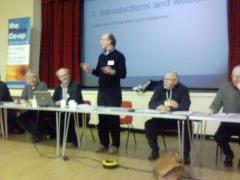
Saturday 2 February 2008 was the annual meeting of the Phone Coop (agent link). I travelled to Chipping Norton for it and took a few abbreviated notes, which I've expanded slightly here. Ask questions if you want, but it's already fading in my memory:- Local Loop Unbundling workshop: 20 years of calls for it. 1999 ofcom announced 01 eu announced. 05 threat to breakup BT. 06 openreach split. By 2007-04 there were 2million unbundled. Distribution points and cabinets. Exchange may make even cheaper faster video. TPC LLU should launch this summer. Should take minutes to transfer. Equivalence problems - want evidence of when BT is preferred. Alarm lines: coop unable to take some. Broadband workshop: at year 2000 launch was a .5M service for GBP 40pcm. Now charge represents use. The coop has 4 ADSL specialists and it accounts for 15pc of income. Bought in three parts: tails are the links to the customers, bandwidth is then 155 or 622M fused 60m base plus extra. Home contention is 50:1, business is 20:1. Available in bundles. My.phone.coop offers a usage view with only a day's delay - might be a first for retail broadband. Ambassadors workshop: Harness cooperative difference. Customers can help to get more customers. Possibly give half our local adverts to our phone agency. Interaction with agent scheme unknown yet. Someone asked about running cinema ads. AGM: intros apologies evaluations mugs window stickers 1b 565m mins. Directors report record sales and growth. Profit again. Service progress: 2nd of 19 in Which surveys. Sven is new manager. Midcounties. Sustainability fund. Finances. Highest dividend. Sales mix changed kind rental growth. Costs down 200k. 9k postage saving. Record balance sheet. Recruiting membership manager and secretary. Currently 6735 members. Negotiating .5k sales acquisition - no info to members yet as commercially sensitive. Shortlisted for green business awards on 12 march. Questions: Mobiles? high volume only economic. What is cws? Cooperative Wholesale Society, part of the Cooperative Group. Member profile. Coop purchases. Diversity. Southern acquisitions? Regulator Dependent. Name. Biodiesel. Satisfaction, corp members, large corp custs. Miles travelled. Walking payments. Group promotion of AOL is annoying. Third party card discouraged? Member-account links. Larger affinity. Works bus. 1 against scrutineer. Directors spend on average 4 hours a week on the coop.
As Josep asks for it every now and then,
and we really enjoyed this trip, it's time to write about the four days we
spent cycling from Ripoll to Girona, through the Ruta del Carrilet,
a Catalan via verda similar to the one
we completed
a year ago.
I spent this year's 9 d'Octubre cycling trip with totally different trip
mates, not related to my triathlon team. The extensive group was formed by
Sabri, Mar, B rbara, Carles, Desi, Adela, N ria, Amador and myself. We
started our journey by car from Val ncia to Mollet de Mar, where we parked
the cars and take a regional train to Ripoll with our bikes, where the
real journey would start.

Arrival at Ripoll
When we got to Ripoll, it was quite late and dark, but we managed to find
the start of the Ruta del Ferro rail trail which would take us to Sant
Joan de les Abadesses. It was quite cold, but especially really humid, so
we had to think twice before settling on a place to camp and setup our tents.
We had to take special care of covering the bicycles as the air was really wet,
and anything we left uncovered would appear soaking next morning. In part, my
shoes suffered from this.
Early next morning we had breakfast on the wet grass and then started our
way to Sant Joan through a deliciously well equipped and maintained cycling
track, which unfortunately only lasts for 12 kilometres through a splendind
landscape. After having breakfast in the old railway station in Sant Joan, we
abandoned the Ruta del Ferro to take a road to Olot via Sant Pau de
Seguries, where we had to climb a small mountain and then descend through the
Vall de Bianya until we got to Olot.

Sant Joan de les Abadesses' railway station
Asking the locals for the start of the Ruta del Carrilet was
fun due to the strong oriental accent in the area and we sometimes wouldn't get
a word of what we were told. An old man recommended us finding a big park in
the outskirts of the town, where we prepared our entrepans for
lunch, and after a little rest, we started cycling up the Carrilet,
which would take us to Girona in two stages. This Catalan area is of volcanic
origin, and there are several natural parks dedicated to the phenomenon. There
are many mountains covered with forests and impossible peak shapes, which due
to the time of the year were starting to go from green to brown and yellow,
making fantastic colour schemes in the landscape.

Under a green ceiling in Olot
Just after the few first kilometres, the railroad track starts to descend
most of the way, which makes it easy for people who aren't too trained, and
easier to enjoy your way chatting with people while you cycle. As we consumed
the daylight, we came across a parish church party with lots of old and young
people from the nearby town of Sant Miquel de Pineda. Amador and I were lagging
behind a bit at that point, and when we got there, we found the rest of the
group were already off their bikes and either having a curious look over the
party, or directly following suit and dancing like the others. We had a peek
into the small church and also into a small graveyard in the back, where I was
surprised to find the enemies of my Catalan grandmother: Fam lia Matabosch ,
as one of the headstones revealed.

Partying at Sant Miquel de Pineda
As it was getting late, we eventually started off again, but luckily B rbara
spotted what seemed a good sleeping place for that night. To the right of the
trail there was a hermitage (devoted to Santa Cec lia) up on the hill which,
for bonus points, had a porch with a recently renewed roof which would help
cover ourselves from humidity and rain, as we found soon after starting
cooking dinner.
While the cooks prepared our soup, some others went down to the
Carrilet in order to find out if the next town was close so we could
get some driking water for the dinner. Luckily, Sant Feliu was close enough,
and we found a bar where we got some water... and two bottles of wine, which
made some people back at the hermitage very happy. We were quite tired though,
so we eventually went to sleep after reading some stories from a great tale
book, with the sound of rain hitting the grass outside the porch.
The rain was still with us when we started waking up, so we had breakfast
and packed our stuff very slowly, in an attempt to avoid getting wet. But
rain didn't stop, so we made a few hacks on our bicycle bagpacks to minimise
the amount of rain wetting them. When we were finally ready to set off and
had cycled around 3 kilometres under the light rain, it finally stopped
raining, making the rest of the journey very pleasant.

Sleeping under the porch of Santa Cec lia's hermitage
This part of the route is again quite beautiful, with impressive amounts
of green vegetation at both sides of the track. There's a lot of water
presence in the land, which makes the type of trees and bushes quite different
to the ones we are used to find in the Valencian Country.
After going by a few small towns, we arrived in the old railway station
of Amer, hometown of the Puigdemonts. Even if it was a bit early, we
decided to have lunch there, so a few of us went down to the centre of the
town to buy bread and some other details to eat. Being in my friend Josep's
town for the first time, I wanted to visit his
family's bakery, but unfortunately it
is closed on Mondays. We had lunch back at the cute station, and eventually
kept going on our way to Girona. Outside Amer, the Carrilet was
temporarily cut by the road, and there were two possible alternatives: using
the road, with heavy lorry traffic, or diverting through a very steep track
with very hard slopes. Most of the group preferred the road, but Mar, Amador
and I went up that track, which was hard to climb and really fun to descend.
Apparently, Amer locals call those 1.5 kilometres the Tourmalet . It's
probably not so bad, though. :)

Amer's railway station
Unfortunately, the Ruta del Carrilet starts getting uglier after
Amer, and as you approach the more industrialised towns near the capital
Girona. The area around Angl s wasn't that fun, with the track continuously
being invaded by cars and other vehicles. Soon after we were in the
farmland area surrounding Girona and its Devesa.
Jonathan was waiting for us in the city, after his two month stay in
Scotland, and we were all happy to meet him. We discarded continuing our
way to the coast, which was the initial plan, and instead dropped our stuff
in the house of one of Adela's friends, and went out to have dinner to a
Wok restaurant, where the poor people running it suffered our
childish behaviour involving the rotating central dish on our table and
custard sucking contests.
Jonathan guided us through the Cathedal and city wall areas of the town
centre, which are impressive, and we climbed all of the wall towers to have
great looks over the dark and quiet city. Eventually, we went to sleep, as
Adela had to leave early, and we had to pack to get our train back to
Barcelona.
Back in Mollet, we cooked our last camping-gaz lunch in the park right next
to the station, before noticing the place stinked of dog poo. After the careful
operation of filling the three cars with 9 bicycles, we were finally on our
way back to Val ncia, completing another great cycling journey. If you like
bicycle tourism and can travel to this area in Catalonia, I highly recommend
it, as there's many great places to visit, all of them accessible with
bikes.

Having lunch in Mollet
Say you're working on a Debian box for which you don't have root access, you
need to get some source packages, but there is no deb-src lines
(or not the ones you need) in /etc/apt/sources.list. So usually
you will have to manually wget the files, after looking the exact location, and
all that jazz.
Today I found that APT can be configured to use a different
sources.list file, and different directories for the package
lists. Which is enough to make it work for downloading source packages.
What you need to do is:
$ mkdir aptTake Squid for instance, a 1975 program if I ever saw one: You tell it how much RAM it can use and how much disk it can use. It will then spend inordinate amounts of time keeping track of what HTTP objects are in RAM and which are on disk and it will move them forth and back depending on traffic patterns.Varnish was designed by FreeBSD developer Poul-Henning Kamp. There is something to be said about user-space apps designed by kernel developers: they're always super fast because kernel developers know how to make the most of the system, having spent hours optimizing the kernel itself for some usage patterns.
Well, today computers really only have one kind of storage, and it is usually some sort of disk, the operating system and the virtual memory management hardware has converted the RAM to a cache for the disk storage.
So what happens with squid's elaborate memory management is that it gets into fights with the kernel's elaborate memory management, and like any civil war, that never gets anything done.
winecfg, and it worked, and I was quite delighted.
So far, nothing fantastic. It so happens that I hate to play any game with the game's music/sounds/voices, as I prefer to be quietly listening to music of my taste (I have delicate ears). As in any other game, you can switch them off in Morrowind, which is what I immediately did. However, it happens that some sounds - so far, only the sound corresponding to a shield blocking an attack (a graceful and delicate sound as you imagine) - go through even with all sound volumes are turned down to 0. It is annoying to the point I had to stop using the computer for listening music and falling back to my old CD player. Painful ! Or at least so it was until today, when I finally took my courage and found out how to fool wine into believing it is playing sounds when in fact it is not. First step, create a null ALSA output device, by adding the following to your .asoundrc:
# Null audio output pcm.null type null # Null PCMThen, you need to have
wine use it (and only this one). For this, a quick look at the Useful Registry Keys showed that I had to add the following to my .wine/user.ref configuration file:
[Software\\Wine\\Alsa Driver] 1202930020 "DevicePCM1"="null" "AutoScanCards"="N" "DeviceCount"="1"Just make sure
wine is using ALSA output, and that's all ! Morrowind plays, without sound and does not segfault ! I'll be able to listen to my music again...
Note I'm unsure about the value 1202930020. The best is to add the key Software\Wine\Alsa Driver using regedit and then edit the configuration file -- or even do everything with regedit.
Next.