Search Results: "spa"

28 November 2005

Joachim Breitner: Extended-range telepresence

Today, I took part in a tour to the Intelligent Sensor-Acuator-Systems (ISAS) department here at the University of Karlsruhe. They work on a project for extended-range telepresence. At first it is like a regular Virtual Realtiy device: Head-mounted display for the 3D view of the world and an acoustic tracking system to record the user’s curret position and orientation. While this is a nice toy by itself, the guys from ISAS have developed a system where you can walk through inifinitely large virtual places, including a virtual museum, a pacman game and our cafeteria, rendered by quake, and still stay in the 5x5m room at the university.This works by bending the space, at least the space you percieve: The computer calculates a path that resembles the path you want to go with regard to length and turns, but bends it a barely noticeable bit, thus guiding you in circles around in that room. This guiding is done by shifting the view on the display, making you counter-act that shift and thus turning. A bit like dizziness, when you think you tip over and you move the other way.This works pretty well, at least for movement at regular speed and not too many unpredictable turns - the less predictable the path you take in the virtual world, the less optimal is the path you will take in the real room, thus having stronger and more noticable bends.To me, this seems to be the first step to a world like the one Tad Williams describes in his “Otherland”-Series. Together with what promising but also threatening advances are made on the neurological front, e.g. retina prothesises, “real” virtual reality for mass comsumption is not so far away. And even more improvements in the human-device-interface field have been made: Remote control of human movement by stimulation of the equilibrium sense was sucessfully tried in Japan (German link).I have more pictures of today’s presentation and check out the video on the Karlsruhe telepresence installation.

Benjamin Mako Hill: Upcoming Events @ The Acetarium

This coming Friday, The Acetarium will host a party to celebrate the beginning of my twenty-fifth year of life. According to the CDC's live expectancy data for people of my sex, age, and racial demographic, I am projected to live 51.0 years past this coming Friday. In three months, perhaps I should throw a "1/3 of my projected lifespan party." Details are on The Acetarium website. If you're in Boston and would like to come, please let me know.

Sergio Talens-Oliag: La MaratOO'o 2.0.1

I've been all this weekend on the Computer Science Department Labs as the owner of the keys. We have celebrated for the second time this year a MaratOO'o, a work meeting to fix and review the Catalan translations of OpenOffice.org. Last February we had other meeting that was devoted to translation, but this time it has been more a review thing. The meeting has been organized by Softcatal , a non-profit organization devoted to promote the use of Catalan on the IT world. They do a lot of l10n work for a lot of Free Software projects and had developed a set of tools for translators, including a style guide, something I believe is really important and I miss from other l10n teams for other languages like Spanish. While I don't translate (I'm very bad at it), I belong to the organization because of jordim and jcorrius, as they convinced me to help them organize the previous MaratOO'o (for this one it was jordi the one that convinced me). I believe this second session was good, I have not seen a single .po file, but I've helped with the migration of services from the old Softcatal to a new one. They have a lot of things configured in weird ways and the migration has not been really planned (I don't understand why some services were moved this weekend when there were 30 people using them), but probably is not strange as it seems that none of the people with admin rights on the machines has worked as sysadmin and they don't care much a about it, so things seem to be done and left alone once they work, but for a migration like the one they are doing, with a lot of program upgrades, the configuration of each service has to be reviewed or things break easily. On the L10N front it seems that things went well, we had near 30 people translating during two days and that means that all the program localization has been reviewed and some of the help files have been translated also, so we will probably have a better Catalan langpack for OpenOffice.org soon and maybe the help files also will be available. I was going to include a photo on this post, but jordim told me he was going to use it on his blog, so use his bandwidth if you want to see the people that was on the lab before we left (I'm not there, as I'm the one that took the photo).

Kai Hendry: Mail musings

I use Gmail to filter my mail. This has been the case since June 2005. I usually have about 1000 SPAMs in the SPAM mailbox. Recently I’m up to almost 1500. Sigh. I noticed alioth was spammed pretty bad. That’s one reason. I get quite a quite a few SPAM in my inbox which I need to manually send to the SPAM folder. That’s getting worse. Thankfully no HAM is found (knock wood) nowadays in Gmail’s SPAM folder. There was a monster thread over at Linux Users Victoria about Microsoft Exchange. For some odd reason the LUG doesn’t want the mailing list archived. Anyway I made a bit a of a tangent on the thread when I recommended people and companies outsource their mail to external hosts. The savings can be incredible. Though if employees send a lot of attachments, it can be quite painful.
Especially as Australia is using “Pay as you Go” style Internet. Setting up mail servers nowadays is too hard. In my (contracting) experience most offices are incapable of running their own mailservers. Currently I have a painful problem with my Debian (unstable) T30 laptop with Debian’s default exim4. Mail seems to get frozen if I don’t find a net connection within a couple of days when writing email offline. Finally here is a cheerful link of computing pictures to ease the pain.

26 November 2005

Aigars Mahinovs: Mad cosplay


Mad cosplay

More coverage from Latvia's 3rd Animefest coming up.
Todays features were:
* Hellsing - a phenomenally great vampire story. This is actually not a movie, but an anime series of 13 episodes - first 6 were shown today and 7 more will be shown tomorrow. It is not too scary - the good guys are quite good at what they do, but the taste of fun is unmistakeable. Highly recommended! :)
* Armitage III: Double Matrix - if you like the original Armitage III, then you should also see this - very nice action, kawai daughter, just a bit of interplanetary politics.
* Future Police - policemen in future Tokio doing their work in Mecha suits. A very interesting piece of film. It looks like the creators wanted to shine a bit in the glory of "Ghost in the Shell" and the "Law and Order" with a bit of "Numb3rs" thrown in :) Nice music and atmosphere, a simple plot that get stopped at times by politics and red tape, nice fighting and a bit of humor to spice thing up a bit. A little to drawn out in the middle though - the classic sequence of two cops "walking the streets and talking to people" could be a little shorter.
Bunch of new cosplays and cosplayers around. In the evening there was another event in the same cinema and the people that came to that event (in suits and ties) were quite amazed at us waling around there :D
My updated costume got some praise that it damn well deserved! Pics will come up later - after I get a decent sleep :)

Erinn Clark: What is this?

I have a picture of this space on my computer and, for the life of me, I cannot remember the name of it. If anyone can identify it, please email me. p.s., AJ, I thought we all agreed NIv2 would be named NINJA?

25 November 2005

Aigars Mahinovs: President and people


President and people
No time to process new pictures, so one of the oldies is here - our president again, this time from a more interesting angle.
Today there was a bit IT conference here - it looks like Latvia finally has a strategy for country wide growth capitalising on knowledge. The plans look sound and as specific as such thing can be. Very promising and apolitical.
Also the first day of Animefest was here, I only managed to see the last movie "Grave of the fireflies" - a very sad movie about war and loss and children. Very recommended if you can stand a bit of war shock and death.
Spent couple of hours improving my costume - they mocked the beta, but tomorrow I will be back with release! :D

Simon Law: Montr al geeks


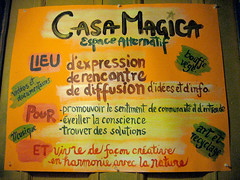
Casa Magica
Originally uploaded by sfllaw.
There's this artists collective on St-Laurent, across from La Sala Rossa. They call their place Casa Magica, and it's really quite groovy. They've got this cozy living area with an open plan. The kitchen is separated from the living room with a tiled countertop someone built themselves. It's decorated in that way with splashes of paint, splashes of light, and furnishings that look like they grew there. I showed up at this place to meet some people in the Free Software world. I've been in Montr al for about a year and I still don't know very many hackers in the city. So when I got invited to Les 24h SQIL, I decided to show up and meet some people. I went up St-Laurent to a non-descript red door with a poster about SQIL on it. "This must be the place," I thought as I tried the door. Upstairs, I was greeted by a living room full of random people: some sitting in front of computers, some chatting away, and one guy fiddling with a projector. I wandered around in a state of confusion until I was introduced to Robin. Robin Millette seems to do a lot of work for FACIL, which is an organisation for promoting free content in Quebec. He introduced me to a bunch of people, like Simon Raven whom I helped with finger-ldap. I met Fran ois from Quebec City, who was interested in Nitix. There was Nicolas who is a Java developer that writes web-based applications. And other people like Alex, Yan, Marco and Matthieu who seemed nice but I can no longer remember what they do. I returned later in the week to Robin's birthday party where I happened to meet Fabien, who is a consultant that does work on Firefox and Yannick who's a Ph.D. student at McGill. We had a good time talking about quantum computing and how to design a programming language for quantum computers. Good geeky times were had.

Andres Salomon: metablogirctasticfunk

<dilinger> sucker
<Clint> you just wait until you’re infested with mp3s
<dilinger> i wear my mp3 collar
<dilinger> it has my name and phone number engraved on it, too. in case i get lost.
<Clint> have you had your shots?
<dilinger> yes. i’ve been spayed and/or neutered, too. i highly recommend it; it was an enlightening experience
<Clint> you should blog about that There, done!

Daniel Burrows: Music for everyone

Several years ago (it seems like more than three) I was a student at Brown University. In addition to studying computer science and mathematics, I also took a bunch of courses in the music program, including three years of piano lessons. When I graduated, I gave a recital for friends and family, plus any members of the public who happened to wander in (not many did). And, this being the 21st century, we recorded it and I got a CD of the recording. I edited it, split it into tracks, and handed some copies out to my friends and professors as a going-away present.

Now I'm no longer a student of any sort, and Brown seems a lifetime away, but the music is still sitting on my hard drive. I've always meant to make it available for download, but I couldn't figure out how to get past technical issues of space or bandwidth. A few days ago, though, I had a rather belated bright idea: maybe the Creative Commons project would have links to places where you can host your music for free. Lo and behold, it turns out that the Internet Archive lets anyone upload audio to their server! Better yet, they're even willing to store lossless encodings -- more than willing, actually; FLAC is the preferred encoding of uploads.

So, to make a long story short, click here to hear my bad piano playing. :-)

NOKUBI Takatsugu: A free text-to-speech implementation

Sometimes I use festival as a text-to-speech engine. But it supports only non-Japanese languages. Then I can find a new engine with Japanes support, named GalaTalk. It is a part of production produced by Galatea Project. If I have a spare of time, I'll try to package it.

24 November 2005

Uwe Hermann: Video: Richard Stallman jamming with Gilberto Gil

Richard Stallman and Gilbert Gil OMG! I would have never believed this if I hadn't seen the videos with my own eyes: Richard M. Stallman of GNU and Free Software fame singing various songs, and Gilberto Gil, famous musician and currently Brazil's minister of culture, jamming on his guitar. Unbelievable. (via Boing Boing and netzpolitik.org )

Andrew Pollock: [meme] Priceless


My blog is worth $11,855.34.
How much is your blog worth?

Aigars Mahinovs: Cosplay warm-up


Cosplay warm-up
The opening of AnimeFest went great - there were few cosplayers and a huge lot of general public. Anime is on the high.
The fest was opened by two cute girls - one of them was speaking in Latvian and the other in Russian. At first they were translating each others lines both then they diverged and even started a small dispute. You had to know both languages to "get" the joke, but I think most of the people in Latvia do know Russian enough for that.
The opening program consisted of "Howl's Moving Castle" - a truly wonderful anime movie from the same director as the "Spirited Away". A great fairy tail as expected from Studio Ghibly.
Also:

My blog is worth $5,645.40.
How much is your blog worth?

I have no idea why, but I would like to check out half of it, please :)

Wouter Verhelst: Belpic for backports.org

I just uploaded a belpic that compiles on stable to my people.debian.org webspace, so that people using stable will be able to use belpic, too, and might be able to use their digital ID card to sign emails, or use the tax-on-web thingy of the Belgian government. The idea is to get this into backports.org, but I can't reach Norbert Tretkowski ATM, so it'll have to wait 'till he reads his mail. One thing is weird, though. To be able to build belpic for unstable, I had to change some things like (unsigned char **) in the code to (const unsigned char **), or it wouldn't compile. Now that I try to compile it on stable, I apparently have to reverse those changes, or it won't compile. Probably some definitions of one (or more) of the build-dependencies changed. Not that it's a problem, of course, but it is silly. On a slightly related note, Zetes N.V. (belpic's upstream) suggested I go ahead and maintain packages for them to put on the Government's website, too, so that people would be able to install it by downloading from belgium.be. This wouldn't just be the Debian packages, but also packages for other distributions (probably RPMs, then). Sounds like fun. This isn't at all official yet, but it might be some time from now.

Matthew Palmer: Key Signing and The Identity Problem

Yet another thread on keyring updates in Debian has gotten me thinking about key signatures, what they really represent, and other associated topics. For those of you who might not know what I'm talking about, a brief primer. Before someone can be admitted as a Debian Developer, they have to have an OpenPGP key (practically, a GPG key) signed by a current Debian Developer. That is, someone who is currently a DD has looked at a photo ID, compared the photo to the face offering a key fingerprint, and compared the name on the ID to the name on the key. If they all match, we have a signature. The other qualification for becoming a Developer is going through a process designed to determine whether you have the required competencies. Since this testing process is conducted electronically, not face-to-face, the primary means of identifying the person behind the answers is via the OpenPGP key they used throughout the process. So, what do we have out of this process? Two things, that I can determine: So, the problem at issue is this -- what do you do when you lose control of that key? You lose it, or it gets compromised, or it expires (whoops!), or whatever. For all intents and purposes, when you lose control of your key, you no longer have an identity, in Debian terms. Generating a new key (and hence identity) is straightforward -- a quick invocation of gpg and you're away. Unfortunately, all that gets you is a pile of bits. There's nothing that intrinsically links you to that key. That's what other people's signatures on your key is for. Then, it comes time to get Debian to accept your new key as belonging to you. This is a lot harder than trying to convince the RTA (DMV.en_AU('New South Wales')) to give you a replacement drivers' licence. Why should it be? You're doing effectively the same thing -- "I am $FIRSTNAME $LASTNAME, give me my (licence upload privileges)". The difference is that, in the Debian case, all of our identity is effectively tied up in the key we use to go through NM. The person behind the key is somehow secondary to that whole process. So when the key completes NM, we record it in the "people who can upload" keyring. When a new key (which is prima facie completely untrusted) should be put into the keyring, we need to ensure that it is qualified. How can that key prove qualification? Well, we can send the new key through NM (dear ghods, no!) or refer to the source document (as it were) -- the human being. We're looking for consistency between the person between the two keys. That's trickier than it looks at first glance. Why? The big one is the non-uniqueness of $FIRSTNAME $LASTNAME (or even $FIRSTNAME $INITIAL $LASTNAME, for those so blessed). Google for yourself one day, and you'll see what I'm talking about. Anyone who has the same name as you could, at first instance, pretend to be "you" (for some values of, anyway). It might seem fairly unlikely, but there are two DDs with easily-mistakable names, out of a pool of 1,000 or so. The probabilities are not in our favour on this one. Then, of course, there's fake IDs, which are a whole other ballgame. How does the government get around the problem of name clashes and identity-theft-by-ID? By using other metadata about you to more uniquely identify you. Your date of birth, street address, perhaps even a general physical description -- all of these can help to disambiguate all of the identically named people out there. Debian can't use that, though, since that metadata isn't initially collected, and so it can't be rechecked later. This does suggest a bit of a solution, though. I said that Debian doesn't collect that info, but that's not entirely true. There is an optional repository of Developer contact details stored for other DDs to access, so we've got something to work from. The Developer updates their own details (whatever they feel comfortable entering). But, of course, people signing your key need to know about all that before they sign the key, so they can check (for example) your residential address and date of birth on your photo ID. You might ask "but how is the info the developer themselves entered accurate?", and that's a good question. The answer is that the legitimate developer entered that info, so if someone with the same name matches that data, then it's reasonable that it's still the same physical person. It's not a real good solution, though. Not all developers enter full metadata (and I can understand why they don't want to). People also often forget to update their details, too, which could quickly cause all sorts of problems. What is a good solution, then? We could always go with a bit of biometrics -- if there was any solution that was sufficiently cheap, reliable, and distributed enough to be used to identify 1,000 developers distributed across the globe to a reasonable standard of reliability. I'll wait for a minute while you finish laughing and wipe your eyes dry. I have to say, I'm stumped. I'd hoped, while writing this, that by the time I was finished I would have worked something out. But nope, it's a problem that's way beyond me. But I think I've got a much clearer handle on the problem space, so with a bit of luck, my subconscious (or someone else's) will eventually produce a sensible answer.

Paul van Tilburg: Broken HDDs

So, what’s with all the broken laptop hard disks?! I have two laptops running almost all day (one as a cheap simple server with built-in UPS) and one as workstation. But in the last, say, 2 years I had to replace the 2.5” (laptop) hard disk drives 4 times! Since laptop HDDs cost a lot more per megabyte than normal 3.5” drives, this was becoming an expensive issue for me. So, I geared up S.M.A.R.T on both machines and did some investigating. The major issue seems to be the load/unload system that is integrated into more and more of these drives nowadays. The heads will automatically be retracted (parked) after some idle time to decrease the risk of shock damage and reduce power consumption. However, this seems to be a bad combination with Linux. I have not done any research into the specific implementation of the journaled file systems that I use (ext3, XFS), but it can something to do with it. It seems the heads of almost all laptop disks I encounter are continuously unloaded and loaded instead of around 5 times per hour. It seems a hard disk drive is made to allow for 300.000 load/unload cycles, after that the mechanism wears of so that inaccurate moving can occur and the platters can be damaged because of a small miss. Now, my drives had 650.000, 1.2000.000 and 900.000 before bad sectors and completely erratic behaviour start to occur, but this was within a year. My most recent broken drive had about 3 load cycles per minute, this means 180 per hour. With things going bad at 600.000, the disk thus had a lifetime of 3333 hours (138 days). This is ridiculously short. So I’ve turned APM of all my drives off (hdparm -B254). Better a small risk of bad sectors when dropping my laptop than having to replace my disk within the year. Also note that my brand new Western Digital disk has spent 14.000 of its load cycles within the first 15 hours that I was busy with installing Debian and recovering backups! If someone has more information about this, please let me know.

Martin F. Krafft: Bug squashing bounties

I just sent this to debian-devel-announce. Hopefully it will be a success!
Dear fellow developers and contributors, My publisher, Open Source Press, and I were pondering ways to help the F/OSS community (and Debian in particular) over a beer the other day, and the following idea is the result:
We are announcing a bug squashing period, starting now, and ending 14 Dec 2005, 11:59 CET. Squashing a bug gets you a certain number of points (depending mostly on triviality and severity). At the end of the three weeks, the 25 bug squashers with the highest score shall receive a copy of my book, The Debian System, donated by the publisher. If this turns out to be a success, we'll lather-rinse-repeat sometime soon.
Bug squashing is to be done according to the rules listed on the wiki. In particular, everyone is expected to make proper use of usertags to communicate to others that s/he is working on a particular bug. If you are working on a bug, you are expected to send status updates to the bug report at least once in four days, or someone else may announce the intent to lock the bug and take it over after 24 hours. Fixing a bug also involves augmenting the bug report with any relevant information as you go along, and testing the fix with which you came up.
Points will be given to those whose contributions fix a bug. A bug will be considered fixed if a patch addressing the problem has been sent to the BTS and the package's maintainer has not vetoed the patch within five days. Please do not actually close bugs in the BTS (unless you really know what you are doing). Points will only be awarded to patches for bugs which have been reported before this announcement (but you are, of course, welcome to fix any bug -- if it's obvious you aren't trying to cheat and you are otherwise very actively fixing bugs, you may even get points for those too). After submitting a patch to the BTS, please send a short note to book-bsp t pobox.madduck.net with the bug number in the subject, and from the email address you used to interact with the BTS. In the message, list any contributors who have helped with the bug, as well as an approximation of the time each of you spent on fixing this bug. Also, document how you have tested your patch. The amount of points to be awarded depends on the severity of the bug report, as well as the triviality of the patch you came up with. Put differently: while a one-line patch for a wishlist bug might get you 1 point, I could award 100 points for a clean yet elaborate patch to an important bug. Bonus points can be given if you provide reasonable proof of thorough testing of your fix (you could use test-driven development techniques..., also see here), ideally by a third party. Please be aware that bugs fixed by the reporter him/herself will be especially scrutinised.
Anyway, there are no strict rules for the amount of points a patch will get you. In fact, I reserve the right to announce the scores only after the end of the bug squashing period, and I will not answer questions about scores, or address complaints from people who think they have not received enough. However, I shall act as objectively as possible, fair, and honest; for that, I give you my word. I realise this is sketchy and if you don't trust me on this, it's your choice not to participate -- there is no point to argue at this stage. If you have a better suggestion, I would be interested in trying it the next time 'round. Maybe we can establish a good scoring system for the future, but at the moment, no such system exists. If you have any questions or suggestions, please do not hesitate to speak up (Reply-To set). Do note, however, that my tendonitis forces me to take things slow. For this reason, I would like to apologise in advance should the evaluation of all your contributions extend into the new year. Thanks to Markus Wirtz of Open Source Press for supporting this idea, and to Steve Langasek and Frank Lichtenheld for their advice.

Grzegorz B. Prokopski: 23 Nov 2005

SableVM SDK for Java is back with 1.13-pre1 ! Guess what---a new shiny prerelease of SableVM SDK suite for Java is out for you to have some serious fun with it! The main point of this release is getting new GNU Classpath 0.19 integrated. Tests show that with the updated class library Swing apps look waaaay better. Kudos to the GNU Classpath hackers and contributors! Installation of SableVM SDK is as simple as it can be. As usual you need recent GTK and a few other libraries and tools available as packages for most distributions. The non-commonly used elements (like libffi, libpopt) are included in SableVM SDK to cut the hassle of installing it to minimum. Basically all you need to do is to fetch the SableVM SDK 1.13-pre1 tar archive, unpack it, run ./configure && make and su; make install. With the default settings in /usr/local/lib/sablevm you'll find a fairly complete JAVA_HOME like environment. Enjoy! And please let us know of your successes and problems by sending as an email to sablevm-user@sablevm.org. This will ensure future SableVM SDK releases work better for you! In other news SableVM Project team has been silently working since many months on new JVM features that will start showing up in upcoming releases after 1.13. Stay tuned!

Uwe Hermann: 22C3 Fahrplan Online

22C3 banner The Fahrplan (yes, that's German — it means "schedule") of the 22C3 (the 22nd Chaos Communication Congress) is online now. Joi Ito will deliver the keynote speech titled "Private Investigations". Here's a small (really!) selection out of the plethora of great lectures: Four days, four rooms, lectures from 12:00 am to 12:00 pm every day. Need I say more?

Next.

Previous.