Search Results: "ron"

9 August 2006

NOKUBI Takatsugu: I'm trying to use xenoprof.

In Xen Dom0/U environment, some optimized binaries for the prossessor type i686 work slower than standard Debian binaries. To discover the reason, now I am trying to use xenoprof, some patchsets for Xen 3.0.0. The latest unstable Xen have already merged the patch, but Debian sid's package is still not supported, so I need to use Xen 3.0.0... I hope xenoprof will be merged the Debian Xen related packages.

Evan Prodromou: 21 Thermidor CCXIV

We had a great trip up from wt:Boston yesterday and today. Monday morning, after Wikimania had ended, I went to visit the Cambridge offices of Let's Go publications. Let's Go is a travel guide series researched, written, edited and published exclusively by Harvard students. It's an amazing feat, and I've always liked the quality of the guides and the depth of coverage. Let's Go is far from the most prolific of travel publishers, but they have good writing and high-quality listings. I spent about an hour talking with the publicity manager, editor-in-chief, and publisher, mostly about Let's Go but also about Wikitravel a bit. It was a good time. Catching back up with Maj and Amita June, we had lunch at the Barking Crab, a clam shack on the harbor in Boston. Amita June loved the clam chowder; Maj ordered crab legs, and cracked them open with a big rock. Sated, we headed out of Boston on Massachusetts highway 2, through wt:Concord (Massachusetts) and a few other towns to the Connecticut River. It took a while to get out of Greater Boston, but once we were out it was beautiful country, still very wild after almost 400 years of Europeans. We drove up through wt:Brattleboro to wt:White River Junction and then called it a night -- the baby was wailing something fierce. We got a calzone and a Greek salad delivered by Ramunto's Pizza in wt:West Lebanon (New Hampshire), right across the border. It was a great addition to the otherwise so-so wp:X-Men: The Last Stand that we watched on the hotel movie channel. tags: ramunto's pizza

Today This afternoon was even better. We got up this morning early and were on the road before 9AM. That's always the best time to drive with the baby -- before she gets too crazy. We whizzed past wt:Burlington (Vermont) and up into the Lake Champlain Islands -- a really nice string of communities that reminds me of wt:Prince Edward Island. The baby started wailing around noon, so we stopped at North Hero State Park and waded in the lake a bit. Lake Champlain has a lake serpent like Loch Ness, but this one is named "Champ". I held Amita June carefully to make sure she wasn't swept away by this fossil reptile. After a two-hour nap on the grass (!), we had some delicious sandwiches in wt:Alburg then crossed the border. Maj had to renew her work permit -- she sent in a renewal by mail a couple of months ago, but she hadn't received the permit by the time we left, so she had to re-apply at the border. Once we got through with that, it wasn't long before we were back in Montreal. Home again, home again, though. I guess there was some pretty nasty weather last week in Quebec -- there are huge tree limbs, 3-4 feet in diameter, on the ground across the street in Parc La Fontaine. My lawn out front is positively glowing green, though. tags:

8 August 2006

Ross Burton: Cornish Bliss (part 2)

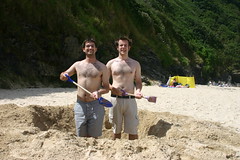
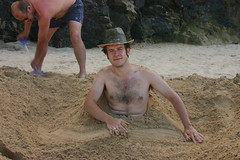
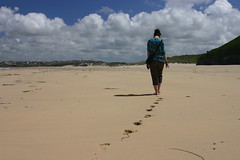
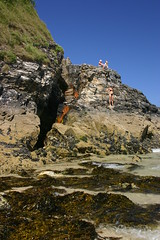
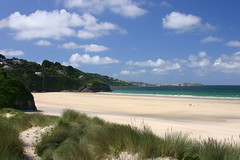
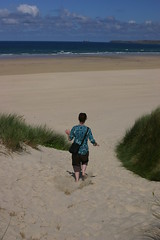
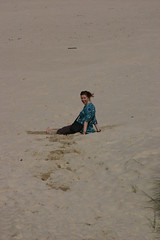
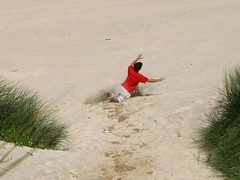
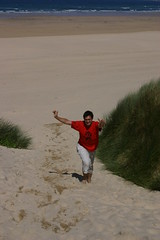
Now, where was I... Carbis Bay Carbis Bay Ah yes. After the horrendously grim weather had passed, the weather improved and we headed for the beach. On the way down we commented on how this was the classic British burning weather: bright sunshine, a strong breeze, and occassional clouds combine to burn skin without even feeling that hot. Of course knowing this meant nothing, we were too distracted with purchasing pasties and drink to think about putting a decent amount of sunblock on. Steve Relaxing Obviously the main thing to do at the beach, after we'd sat down, not applied sunblock, and scoffed a pasty, was to dig a hole. A huge hole. Spades were purchased and we took turns to help Pete dig The Hole. Digging Diggers Astute readers will notice the inevitable outcome of saying this is burning weather, not putting enough sunblock on, and digging a hole (an activity that results in the back being exposed to the sun). Ouch. After the hole had been dug we had to full it in again to avoid trapping small childen in it. Obviously this led to a series of hilarious scenes involving burying Pete up to his chest, modelling breasts and a penis, and so on. Finally the hole was flat again, at which point an impromptu long jump sand pit was arranged. I came first in the long jump, and although failing miserably at triple jump although I swear my technique was best (it's all in the wrists). Pete Next was to explore the costal path in the opposite direction towards Porthkidney beach. The beach is pretty huge by my standards, and due to the lack of facilities (no close car park, shops, toilets, and so on) it's almost deserted: there were a few other people there with dogs (the other local beaches are dog-free in summer) and that's about it. Googling to confirm the name of the beach reveals that there is a history of naturism and "inappropriate gay activity", but we didn't encounter any of that. ;) Progression Ross Footprints The costal path was great, far more rough than the walk to St Ives (often just a foot wide cutting in the ground), steep in places, and generally running very close to the cliff edge. The views were great, but I always think what a horror paths like these would be in winter, with the full force of the Atlantic winds pounding against the cliffs. As a finale it turns out that the costal path follows the cliff all the way along the back of the beach, which would easily be another twenty minutes of walking to reach sand. There is a shortcut down some stone stairs to the beach, but we arrived at high tide and the bottom of the stairs (well, rocks) were a foot deep in water. Wading up to the beach was a fitting end to the walk, and made the beach feel like our own little desert island! Cliff Steps Wading To Land Limpets! Ross I'll have to explain the expression on Vicky in the above photo. As a child when Vicky went to visit her father in Devon they used to go to the beach and spend the day annoying the wildlife: chasing crabs, kicking limpets off rocks and so on. When Vicky noticed that the rocks at the bottom of the cliff were covered in limpets, she shouted "limpets!" with a manic expression and preceeded to prod them frantically. After lots of sitting around and digging tunnels, we headed for the dunes for a spot of dune diving. This involves running at top spead down the dunes and throwing yourself into the sand at the bottom. Ah, the simple pleasures in life! Porthkidney Beach Dune Diving Dune Diving Dune Diving Dune Diving After my dive I ran back up the hill in the manner of a mad man, arms out-stretched to Vicky as I collapsed in front of her, gasping "It's". "What?", was the confused reply. This is terrible, I really need to get Vicky to watch the Best Of Monty Python DVD we have somewhere... It's! Possibly more to write, but Lost is on, so I'm off for now.

7 August 2006

Evan Prodromou: 20 Thermidor CCXIV

Wikimania is over now, and although I have to admit that I'm relieved in a lot of ways, since it's been a long week, I was still a little bummed to say goodbye to people at the closing event last night. I'm a big believer in the meaning and value of on-line communication, but there's something about being physically present with the people who are making wiki and Open Content happen that means a lot to me. Saturday's discussions were all pretty good -- I really liked hearing about The Internet Archive and the amazing amount of knowledge they're making available for future generations. 26 million books, 300,000 films, 3-4 million audio recordings... there is a lot of human culture that we can and should preserve in digital format. Brion's talk about future developments in MediaWiki was great, too. As usual, the hallway conversations were almost as productive as the sessions themselves. I talked to Ray and Mark about using WikiIndex as a clearinghouse for wp:Interwiki coordination. I talked to Ward, who's going to dig in deeper to the MediaWiki parser (impressive!). Maj and I talked with Gil Penchina, who's a real nice guy. And, as the event was wrapping up Saturday evening, I spent a half-hour talking with Kevin Scott, who's got some interesting ideas for launching a new wiki site (or cluster of sites). As I was getting ready to leave, I ran into a cluster of people around wp:Richard Stallman, who'd shown up more or less out of the blue. He was haranguing the crowd about the term intellectual property, and as Brad Patrick, interim CEO of the Wikimedia Foundation and an IP lawyer, was at the front of the line, I got the feeling that Brad had made the mistake of introducing himself. Whoops. I talked with Mako for a while; he had a t-shirt that said, "debian-legal stole my DFSG". Excellent! I also met Thomas Malone, and we talked a bit about how an information commons affects what we think of as "work" and "knowledge workers". Everyone was drifting off to eat before the party, and Professor Malone invited me to join him, but I had to get back and see Maj and Amita June. But, catching a familiar face nearby, I said, "Thomas, have you met wp:Ward Cunningham before...?" They headed off to dinner together, and since they were still hanging out when I saw them later at the party, I assume they hit it off. We had dinner Saturday night at Charlie's Kitchen, a misnamed bar with lots of good, fried crab items. I guess the burgers are good, too, but we enjoyed the seafood and the juke box. Poor Amita June -- growing up in juke joints across North America. She does love french fries, though... Saturday night we went to the Wikimania party at the MIT Museum, which had an amazing number of great exhibits of neat AI schtuff. I spent some time talking with Professor Malone and Ross Mayfield of SocialText. Ross had on a T-shirt from d-Camp, and as we talked about the BarCamp phenomenon Professor Malone decided to hold one at MIT. Cool. Ross had some questions about the recent launch of Wikicars, which has some configuration issues at launch time such that the license shown was incorrect. He was glad to hear it was fixed. I think Ross does a good job keeping an eye on the business aspect of wikis -- I don't think there's another blogger out there who's doing quite as good a job at it. We headed home early -- we've been dragging our poor baby around to too many parties lately -- and got a good night's sleep. tags:

Sunday Sunday's events were pretty good, although I was starting to feel pretty crispy. The discussion about the Wikimedia Foundation's board was really fascinating, but also a bit alarming. The Foundation has a huge job, and they're such a young organization -- like a colt just standing on its feet. Growing pains are inevitable, but it's impressive how committed the people on the board are. They love Wikipedia and the other Wikimedia as much as we all do. I saw a great discussion of wiki map editing (using SVG and Javascript to provide in-browser editing), something very near and dear to my heart, since we need it for Wikitravel. Sadly it was opposite Joseph Reagle's talk on neutrality, so I missed parts of both switching between events. The event ended with a big speech about the nature of knowledge by wp:Dave Weinberger. He started off with a hilarious send-up of Lawrence Lessig's presentation style, but got down to some fundamentals of semiotics in a very approachable way. It was a good finisher for the Wikimania event. Today we're going to stop in to see some people here in wt:Cambridge (Massachusetts), then it's off to wt:New Hampshire and back home. Where we'll be for all of 10 days before packing off for WikiSym. Man, what a month of wikis. tags:

Jos Parrella: About apt-proxy

apt-proxy has become an omnipresent tool in Debian-based environments. Both in work and in my clients I usually install it so we have a great way to save bandwidth (in a Country where a 512 Kbps ADSL line costs you around 50$/month, it matters) I have noticed also several Ubuntu users using it, even in big environments where a local mirror might be justified and even when other solutions like apt-cacher seem to be getting stronger. Sadly, current state of apt-proxy is not so good (see bugs 282746, 316670, 274679, 262528, 327268, 302503, 295329 and probably others). While upstream is doing a great job implementing fixes, the user base has evolved very quickly and it’s starting to find (and fix) bugs by its own. One example of this is the current release of this version of apt-proxy, made by Daniel Baur, which implements pending patches for eight bugs, including patches which solve Ubuntu-specific issues. A partial debdiff which shows the relevant changes on the code is here for the lazy admin. Chris Halls has acknowledged these fixes and plans to upload a new version to Sid soon. That would be a happy-ending chapter of saving apt-proxy from death. Personally, I’m going to have a closer look on apt-cacher while this new package appears.

6 August 2006

Ross Burton: Cornish Bliss (part 1)

Let's start this with a cliché: A Short History of Tractors in Ukrainian: £8
Best Of by Nina Simone: £14
One week in a rather swish house just outside St. Ives: about £200
No email. No Jabber. No Subversion. No Bugzilla: priceless For the last week Vicky and myself were in Cornwall, staying in a house just outside St. Ives with her family. The house was much nicer than we expected, very tastefully decorated and well equipped, with a DVD player, hi-fi, coffee machine, and so on. Settling In The house was in Carbis Bay, about a twenty minute walk from St. Ives along the costal path that was directly off the bottom of the garden. The path towards St. Ives is also the nicest stretch of costal path I've been on: it is surfaced and wide enougth to drive on, unlike the paths we've been on previously which are often no more than a foot wide cutting in the earth, next to a sheer cliff. St. Ives The Sea Our first impression of Cornwall was one of chill: when the taxi dropped me off at the train station to start the journey down the thermometer said 38°C, but at the same time the next day it was only 23°C. Brrrr. The traditional Cornish summer proceeded to roll in a few days later, with heavy rain, gusty wind and general grimness for a day. Yay for DVD players! Typical Cornish Summer St. Ives is a lovely town. Unlike Newquay which was got far too popular for it's own good (the two-carriage train had both a Stag and Hen party on board en route to Newquay, trying not that subtly to pull each other), St. Ives is busy but not crammed. There is no demographic that dominates the tourists, a mix of families young and old, surfers, twenty-somethings and pensioners means it doesn't feel like a tourist hotspot, and it manages to cater for everyone. The habour front has lounge bars, traditional pubs, restaurants and cornish pasty shops, catering for everyone. The town has become quite a focal point for artists recently (since 1928, Wikipedia tells me), and there seems to be more independent art galleries than pasty shops (!), including the Cornwish outpost of the Tate. Tate St. Ives is pretty small for anyone who has been to Tate Modern, but it's damn good: due to the size it is very focused (there are just two galleries) and the building itself is a wonderful modern piece of art deco architecture. We went with the intention of getting some more pictures for the house and did quite well: a print of Horizontal Stripes by Patrick Heron, and a limited run print (427/600) by a local artist. I'm too lazy to remember the name of the picture or the artist, but I'll take a photo of it later. Our Grand Plan of having more individual art in the house is going well, we've an original oil-on-canvas abstract to collect from the framers that we bought in Paris too. To be continued...

Andrew Pollock: [tech] Initial bonnie++ results with the uber-disk

So I ran bonnie++ over my 1.5 terabyte, exported via ATA-over-Ethernet logical volume of extreme immensity. I don't really know what I'm looking at, but I'll record the results here before I lose them. From both the MythTV front-end, and from minotaur, the box that has the disks attached, I ran bonnie++ twice:
bonnie++ -d /mnt -s 2G -n 1 -u nobody:nogroup
and
bonnie++ -d /mnt -s 2G -n 1024 -u nobody:nogroup
Firstly, I guess the results where the disks are directly attached (via USB):
Version  1.03       ------Sequential Output------ --Sequential Input- --Random-
                    -Per Chr- --Block-- -Rewrite- -Per Chr- --Block-- --Seeks--
Machine        Size K/sec %CP K/sec %CP K/sec %CP K/sec %CP K/sec %CP  /sec %CP
minotaur         2G 13595  95 20652  24 10204  12 13625  92 21362   6 295.5   1
                    ------Sequential Create------ --------Random Create--------
                    -Create-- --Read--- -Delete-- -Create-- --Read--- -Delete--
              files  /sec %CP  /sec %CP  /sec %CP  /sec %CP  /sec %CP  /sec %CP
                  1 +++++ +++ +++++ +++ +++++ +++ +++++ +++ +++++ +++ +++++ +++
and
Version  1.03       ------Sequential Output------ --Sequential Input- --Random-
                    -Per Chr- --Block-- -Rewrite- -Per Chr- --Block-- --Seeks--
Machine        Size K/sec %CP K/sec %CP K/sec %CP K/sec %CP K/sec %CP  /sec %CP
minotaur         2G 13646  95 20864  24 10195  12 13348  91 21377   6 288.8   2
                    ------Sequential Create------ --------Random Create--------
                    -Create-- --Read--- -Delete-- -Create-- --Read--- -Delete--
              files  /sec %CP  /sec %CP  /sec %CP  /sec %CP  /sec %CP  /sec %CP
               1024  6173  37  6090  17  2215  22  1032  22   184   0    93   2
The +'s indicate that the result occurred in an impossible to accurately measure, sub-500ms time. From the MythTV front-end, so with the ATA-over-Ethernet overhead thrown in:
Version  1.03       ------Sequential Output------ --Sequential Input- --Random-
                    -Per Chr- --Block-- -Rewrite- -Per Chr- --Block-- --Seeks--
Machine        Size K/sec %CP K/sec %CP K/sec %CP K/sec %CP K/sec %CP  /sec %CP
teevee           2G  3789   7  3761   0  3138   0 10742  23 11445   0 152.9   0
                    ------Sequential Create------ --------Random Create--------
                    -Create-- --Read--- -Delete-- -Create-- --Read--- -Delete--
              files  /sec %CP  /sec %CP  /sec %CP  /sec %CP  /sec %CP  /sec %CP
                  1 +++++ +++ +++++ +++  1029   2  1372   1 +++++ +++ +++++ +++
and
Version  1.03       ------Sequential Output------ --Sequential Input- --Random-
                    -Per Chr- --Block-- -Rewrite- -Per Chr- --Block-- --Seeks--
Machine        Size K/sec %CP K/sec %CP K/sec %CP K/sec %CP K/sec %CP  /sec %CP
teevee           2G  3848   8  3862   0  2876   0  9871  31 11440   1 147.9   0
                    ------Sequential Create------ --------Random Create--------
                    -Create-- --Read--- -Delete-- -Create-- --Read--- -Delete--
              files  /sec %CP  /sec %CP  /sec %CP  /sec %CP  /sec %CP  /sec %CP
               1024  2488   7  4633   8  1752  15   752   8   444   1   159   1
Wow, I'm going to go away and analyse these numbers and update this post, but on the face of it, it looks like there's a significant performance impact (at least on my home network, I'm sure it's not optimal) in using ATA over Ethernet. Hmmm.

Daniel Jacobowitz: Look Ma, I can blog too!

I've been meaning to set up a blog to keep track of random things that I run into and feel like sharing. One of those happened today, so I finally figured out how to install blosxom. I haven't gotten around to making a pretty CSS for it yet (not sure if I ever will, but I can pretend...) so for now it's somewhat utilitarian and default-looking. Blosxom is pretty bare-bones without plugins, and while Blosxom itself seems well documented the plugins are much less so. I spent about ten hours mucking around with the minimal set of plugins I needed to get something acceptable (timezone, autoblock, feedback, entriescache, interpolate_conditional, permalink, cooluri2, lastmodified, and a bunch of modified templates to use feedback and permalink). I tried and then discarded followsymlinks and metadate (for not playing well with other plugins I was using) and entries_index (lastmodified wanted something which set %others, so I used entriescache instead). I needed to hack lastmodified to work with entriescache, since it cleverly gets the timestamps from the cache, which are now publication dates. So here's a slightly modified lastmodified plugin which stats files directly. I spent a while getting RSS to behave, too. I used lastmodified to set lastBuildDate, modified the story template to use permalinks which were acceptable to feedback (it wants .rss on the end or it decides they aren't story pages), and eventually figured out that I needed to set <guid> to prevent liferea from thinking each modified post was new by comparing descriptions. All in all it was far more work than I meant to do last night when I decided this was a good idea. Hopefully I haven't messed it up too badly. We'll see whether I upset Planet. Leave me a note if it makes your feed reader unhappy, or something. I was actually going to use ikiwiki, but chickened out at the last moment; blosxom had fewer dependencies and I didn't want to mess around with getting ikiwiki to install on sarge. And it still seems to be evolving - so while it's wicked cool, I think I'll let it have a little more time to settle first. I spent most of this morning messing around with OpenWRT. I bought a LinkSys WRT54G quite a while ago (to replace a flaky D-Link DI-614+), and put OpenWRT on it. It took a little work to get it to do what I wanted, including fixing a quoting bug in the WPA startup script and tracking down an updated dnsmasq, but eventually I got it set up. Mostly the stock things: NAT, firewalling, wireless with WPA2, DHCP, internal DNS. Except that it can do one thing that none of the stock firmwares could: provide static DHCP addresses to specific boards, including custom options. This was absolutely essential for me to retire my old DHCP server, since I keep an embedded board lab in my office. I need the DHCP server to be able to tell boards where to get kernels and root filesystems. Anyway, it works well. Except that I've been having too many dropped connections lately and I have no way to track down whether it's the laptop (Dell Latitude D400, ipw2200 - mostly in Windows lately, I haven't retested it in Ubuntu in a bit) or the AP. I updated the Windows drivers and now it periodically tries to rekey, fails, reports "duplicated RSN" whatever that means, and periodically reports authentication failures. About the same as before except that now it has better diagnostic tools to tell me in undocumented messages what went wrong, instead of just telling me that something went wrong. So I next went looking for an updated driver for the other end. Which was a mistake. Note to others: if most of your packages are on a cromfs, running "ipkg update" is going to tear through your available MTD space really fast. And ipkg is not graceful at updates the way dpkg is; it failed to upgrade base-files due to file conflicts, leaving the updated dnsmasq unable to start. These are the same sorts of conflicts that you see in apt-get upgrade periodically: files moving from one package to another without sufficient package relationships (or in ipkg's case, maybe sufficient package manager support) to do it seamlessly. Then when I retried the update it succeeded, but it wiped out my firewall config and password file without asking. I don't really blame OpenWRT for this. "ipkg update" just isn't a good idea with their tools. But I miss apt. And I really miss 2.6 kernels; the binary-only Broadcom drivers that power the WRT54G only work on 2.4.30. And it's tight on flash/RAM anyway. So I went looking at options. Obviously, I can't get something that does exactly what I want for the kind of mass-market price the WRT54G sells at. But a suggestion from a coworker sent me looking at Mini-ITX systems, like the nice-looking Mini-Box M200. And at smaller things, like the WRAP WiFi and Soekris boards. I haven't done a hardware project of any sort since last summer, so I'm thinking about building myself an access point with benefits. I haven't decided what the benefits will be yet - if I get something like one of the Soekris boards, probably just bigger compact flash and back to dnsmasq for internal DHCP. But if I get a Mini-ITX system, I can throw a hard drive in it, arrange over-the-network backups, and use it as an incoming mail hub. This would let me decomission one of the always-on computers in my office. A mighty attractive proposition, although a bit less so now that the heat wave has broken.

5 August 2006

Steve Kemp: The foulest stench is in the air

I received a few interesting comments on my last post about mailing list software so I’m going to summerise my current thoughts. Before covering the available software I’ll say what I personally need from a mailing list manager: When it comes to the handling of spam I mostly don’t care. Messages are filtered via the mailserver at SMTP time (ditto for viruses) and although moderation is generally useful I prefer to either bounce or eat the messages which are not forwarded. (Either case is fine so long as logs are available). This simplifies things significantly since the pedning messages don’t need to be stored/queued. Here is a list of all the mailing list software which is available to users of Debian’s Sarge release along with some of my thoughts/comments/impressions. (Some of these details may be wrong, I’d happily be educated …):
ecartis
The Ecartis package for Debian GNU/Linux is mostly broken. In sid the package is essentially unmaintained, and that is a worrying sign. Ignoring that for the moment the software works reasonably well. It allows most of the kind of control I desire but the significant downside is that it is severaly broken with regard to character sets and encoding issues. For a cromulent example see this message.
enemies-of-carlotta
This software wins double-plus bonus points for a most excellent name. Naming software is hard, and although the relationship between the film and the purpose of the software is random I like it! eoc suffers from a virtually non-existant set of documentation. Whilst it might be simple to use I it isn’t documented except in a single manpage. I seem to recall I had difficulty getting my Exim4 configuration to pass relevent environment variables ($SENDER + $RECIPIENT) passed into the script properly. The lack of documentation just made this more irritating.
fml
There is a lot of documentation for this, which is half in English and half in Japanese. I admit I mostly didn’t explore this software - although my impression is that it doesn’t have support for virtual hosts.
mailman
Mailman is big, popular, and I dislike it with a passion. The admin interface has a billion configuration options, but even if you know they exist finding the damn things are an impossible job. The system requires about five python processes running even when it is “idle”. In my mind a mailing list software doesn’t need a daemon componant - just a program to spawn when a message “comes in”. The whole password system is broken and gains you zero additional security. Again to rail against mailman: it has integrated message archival, something i think should be distinct. (eg. mhonarc). Virtual hosting is possible, but I believe that mailing list names must be distinct regardless of domain name. That may not be correct honestly I’ve detested the softwware with a passion which suprises me and I may not be 100% objective here.
mlmmj
Looks nice. Looks clean. doesn’t look particularly joyful. (The name mlmmj means “mailing list managing made joyful”.) It doesn’t appear to support virtual hosting, and it doesn’t appear to support enough different list types.
quickml
Listens upon a network port (10025 by default) and not support different list types or virtual hosting.
smartlist
Complex. Icky.
sympa
Seems very featureful, but it is yet another system which has an integrated web-component like mailman == bad. It doesn’t support having the same named mailing list in multiple virtual hosts, although it appears to do everything else I desire.
In summery: There are several available packages, but none are good, and many are actively bad. I still believe that creating another list server would be a useful thing to do. I’ve written a brief design overview elsewhere which I will post for comment later. I’d like to support a couple of “advanced” features such as allowing the mailing list software to only accept GPG signed messages, or to act as a remailer such that messages posted to the list will be automatically GPG signed prior to delivery to all users. Looking around I think most of the individual bits of code are available (in Perl). eg. Mail::Message, Mail::GPG, etc. Its just a matter of gluing the bits together in a modular fashion.

Evan Prodromou: 18 Thermidor CCXIV

The first day of Wikimania 2006 yesterday was fantastic. Jimmy Wales opened up with a great discussion of the achievements of Wikimedia in the last 12 months -- as well as the tough issues like the John Siegenthaler, Sr. problems last winter. I also caught Mako's discussion of his and Erik M ller's new Free Content Definition effort. Mako and Erik are both extremely smart, extremely passionate people and I think they've made a big step in getting this definition off the ground. It was great to hear Ward talk about his experience with the PPR and with Wikipedia. Lawrence Lessig's discussion of Free Culture was, as I've heard before, totally awe-inspiring. We chatted a bit after the talk, and he promised to add some info to Wikitravel's wt:Costa Rica page. tags:

All you do to me is talk talk So, I finally got around to giving my presentation on Wiki and Open Content travel guides: past, present and future yesterday. It was kind of nerve-wracking (good to know that Dave Weinberger was having problem with his speech, too, though), and I was revising slides up until a few hours before the talk. Jack Herrick of [[$$vote for http://www.wikihow.com/ and I kept planning to sit down together and go over our slides, but we kept missing each other... or, we'd have time, and neither one of us felt ready to show the other how far we'd gotten. I saw Jack about 5 minutes before our talk, and asked how he felt, and he said, "I've only got a few more slides to finish..." His talk was great. The work he's done on wikiHow over the last few years -- expanding the idea of eHow into the wiki environment -- is awe-inspiring. The community there is great. I also liked that he talked about some of the mistakes he made with wikiHow -- kind of a brave thing to do. My talk went pretty OK, I think. The group that was watching was really receptive to the ideas of wiki and Open Content, so I could really concentrate on the importance of applying the ideas to travel guides. I had that great feeling of conveying my ideas and having them understood -- always a fine thing for a speaker. Chris Bronk from the State Department finished up with a discussion on Diplopedia, which I thought was pretty neat, too. It's an internal project of the State Dept to apply wiki-based knowledge management to the diplomatic corps. It's just launching and I hope it works out. The Q&A session went well -- one woman in particular grilled me about ideas on how to build personal opinion, reviews and ratings into the objective wiki platform. When I left the room at the end, one of her colleagues caught up with me. "I'm from the arch-enemy," he said, and pulled out his card from TripAdvisor. They started a wiki recently, although it's not Open Content, and they're here at Wikimania, too. tags:

Par-tay We also had our wt:Wikitravel:10K Party last night at Tommy Doyle's Irish Pub right off of Harvard Square. The food was good, and the beers were excellent, and all the bartenders had Irish accents, which made the whole experience worthwhile. It was great to have both Wikitravellers (those few of us who are at Wikimania) and non-WTers at the party. Amita June loved the venue because it was below street-level, and she could walk up the stairs and down the stairs (holding Mama or Papa's hands), up and down, up and down... She also enjoyed the pub food (quesadillas, stuffed mushrooms, potato skins, etc.) a little more than is probably healthy for a 1-year-old. I got to hang out with a lot of wiki people who are doing interesting things. Paul Youlton at Yellowikis.org was fun to talk to -- the business listings he's doing are fascinating. His site just got served notice by Yell, owner of the "Yellow Pages" trademark in the UK, for "passing off" as a Yellow Pages site. "Passing off" is a weaker charge than "trademark infringement", but it has the advantage for Yell that it doesn't put their trademark in jeopardy. (The "Yellow Pages" trademark in the US passed into the public domain at the breakup of AT&T.) The part was a good time, but it made me miss a lot of the great people who work on Wikitravel. I'd like to make a plan for a Wikitravel Getaway -- just a group trip to some cool part of the world with as many other Wikitravellers as can make it. It could be a lot of fun tags:

Wikimania bloggers One cool thing about being at Wikimania is that I'm finding all of the really active Wikimedia-related bloggers out there. Andrew Lih, better known as "Fuzheado", keeps a good blog on wiki and Wikipedia-related items. Angela Beesley, Wikimedia Foundation board member and exec at Wikia, also has a good blog about wiki-related items. tags:

Busted! Dan Bricklin came up today and thanked me for my blog entry about meeting him (see Journal/15 Thermidor CCXIV. D'oh! Totally busted. But we had a lot of good talk about spreadsheets as a form of presentation, the parsability of MediaWiki wikitext, and SocialText's great work with the rest of the wiki community. Nice person with a lot of interesting things to say... I need to stop being intimidated by software and Internet superstars, I guess. tags:

Michael Janssen: iBook failure recovery, and what else I've been doing

Well, I discovered last night while I was writing a blog entry that my iBook G4 is somewhat broken. After ignoring it for most of the day today, I am currently working on getting my home directory off of it so that I can try installing Debian later tonight. I think that some piece of hardware has failed, because I haven't seen OS X sieze up like this before. However, I haven't yet had a freeze occur when I am in Linux of some kind. The symptoms of this failure vary between not being able to boot (blue screen before progress bar) to booting and then freezing completely, to the point of no mouse movement, to booting and freezing partially allowing for mouse movement but no interaction of any kind. I'm trying to view this as an opportunity to install Debian now that the Airport Express works in Linux, but the type of failure is very frustrating. rsync to the rescue, to restart backups where they left off before they froze.

It seems that software isn't being nice to me lately either. When I tried to start Visual Studio .NET at work on Tuesday, it refused to start, including without a .sln being loaded up at all. This caused a complete work stoppage for me, spending about half the day trying to discover what was wrong and putting calls in to various help desks. The other half of the day and half of yesterday was spent attempting to setup a second system with the files needed for working. I think that when I return on Monday I will be in a state where I can just start working again. As a bonus, they should have my original machine (which is fairly beefy from a hardware standpoint) reimaged so I can start setting it up once more with the tools for work.

Other than the constant computer problems, I've been playing a fair amount of Battlefield 2. I've managed to get almost all of the basic badges, and I am quickly on my way to another promotion. The TiVo TV Diet is working out well, I am actually watching less TV than I planned for, mostly because I'm not really up for watching Jeopardy every day. That knocks me down to less than 2 hours a day. I seem to be getting a lot more personal work done, and watching more of my Netflix movies. I uploaded new packages for vgrabbj, codeville and bogosort. I am happy with the state of all of them excepting bittorrent, which is still a very old version due to the new license they switched to for the 4.X series. There has been some movement on that front lately however: apparently the Ubuntu people are bugging Bram and friends as well as myself about changes that the license needs. Crossing my fingers!

One Year Ago: The good part is that it does actually help you, well, get things done.
Two Years Ago: Tuesdays have now become my TV night.

4 August 2006

Wouter Verhelst: Password expiration sucks!

Just a few moments ago, I was trying to commit a minor fix to the NBD subversion repository. However, suddenly the server refused my commit; the password which I knew to be right wasn't working. So I loaded SourceForge.net in my browser and went to the admin link there to find out whether I had perhaps fucked up my own commit rights. I've been known to do that before. Doing so of course required me to log in. Which revealed the problem that was causing this in the first place: apparently my password had expired. I had been using the very same password since ages, but for some reason unknown to me, sourceforge has now decided that they want to introduce password expiry. Of course, good password management is very important if you want to avoid issues with people stealing your passwords. For that reason, I usually generate my passwords with pwgen -s 15, which generates passwords that are impossible to guess—one example of an actual password that I have used in the past (but that I do not have in use in any other system anymore today) is qChjZeWIbSDGON/. The hard part is, probably, to memorize that; for that, I have a pretty simple method: I enter 'gpg -o ~/foo' and enter my new password. Then I pick out some random .jpg file somewhere on my hard disk, and concatenate the gpg data to that file. It is usually still possible to view the file in a viewer with that extra data added to it; IME, most image viewers have the ability to view all data in a corrupt JPG-encoded image that occurs before the corruption—which in this case, will be all of the image. As such, if you don't know which file it is, and you don't know my GPG password, chances are low that you'll find it and steal my login data. Additionally, of course the .jpg file is either removed or restored to its original state when I memorized the password, and finally I also update my GPG key and the password of the system that contained the file with the encrypted password to be using the same new password, so chances of stomeone stealing it get even lower. However, even with this method, it still takes me a few days or weeks to memorize it. Also, synchronizing the new password to all the systems and websites on which I have an account takes a while. For that reason, I prefer not to do it too often. With that in light, it is slightly problematic to have an account on a system that has a password expiration policy in force, because a) this makes it impossible for me to use the highly secure passwords that I use "everywhere else" on these expiration-using systems, b) because the average expiration policy is 2 months, making it impractical for me to generate secure passwords for these sites as well (by the time I memorized the new password, we're already at least halfway through the two months if I need to use that password fairly regularly—or it might even be too short if I don't use the password regularly. The result of the above is that password expiration policies, in my case, force me to use less secure passwords of which I'm sure I can remember them—old passwords which I used before I had a GPG key or had learned about pwgen. I still use those on websites that require me to enter a password but which I do not trust to handle my passwords in a secure manner; I don't want to give these sites the password to unlock my gpg key, for example. The problem with these passwords is that they are easy to guess; they're usually not some unintelligible bit of random letters, but are six to eight characters that actually have a meaning. In fairness, I did have one of those old and insecure passwords in use at sourceforge, because I indeed didn't trust them with my secure passwords. If they base their password expiration policy on the strength of the password, then this whole blog post should be ignored. But in general, it is my point that password expiration policies do not improve security at all. It forces people to use passwords that they can quickly memorize (otherwise they're trying to memorize all the time), and it does not give people who usually pick easy to guess passwords any incentive to pick better, harder to guess passwords. On the contrary, in fact. Password expiration policies suck.

Pascal Hakim: Teams.debian.net

One of the things I've been working on, on and off for the last few months is teams.debian.net. Along with a few others, we felt that there were not enough options for Debian-related mailing list hosting. While this may seem strange to some, a number of people at DebConf5 found the idea to be worthwhile. Most Debian-related lists which would not be considered for lists.debian.org could find hosting at teams.debian.net instead. The main purposes behind teams.debian.net are:
To request a new mailing list, simply follow the instructions on teams.debian.net Of course, like any free software project, there are still some things which are needed. The main one is currently the lack of a public web archive for lists which want it. I wanted to try to replace MHonArc with something that looked a little better and was more user-friendly, but I have yet to find something which I think would be an appropriate replacement. While some have suggested Lurker, I feel that is not very useable in a long term hosting environment, as it is harder to navigate around older entries. While this is acceptable in some places, it's definitely not in others. You can consider a "Dear Lazyweb" paragraph if you wish. Many thanks to Andreas Barth and Martin Zobel-Helas for their help in setting this up, providing machine space, and prodding me along when necessary.

Kai Hendry: Howto: Copy&#038;Paste

Ok, I know I’ve whinged about Copy & Paste before. It just seems to have got worse. Maybe I am becoming more inept. Though I have a dream. A dream whereby I can copy and paste the URL bar of my Firefox with:
  1. CTRL+L
  2. CTRL+C
  3. Alt+1 (switch to uxterm)
  4. Middle click into uxterm or shift+insert on keyboard
Instead of the nightmare right now:
  1. CTRL+L
  2. CTRL+C
  3. Alt+1 (switch to uxterm)
  4. Middle click into uxterm
  5. Wrong text! (if you are using vim and pasting a lot of text, hilarious consequences ensue)
  6. Undo damage
  7. Alt+2 (switch to firefox)
  8. Find correct tab
  9. CTRL+L
  10. Double click with LMB (i hate having to use the mouse here)
  11. Pray
  12. Double click with LMB again just to be sure
  13. Alt+1 (switch to uxterm)
  14. Middle click into uxterm
Btw my window manager is wmii. Update: The dream has been realised! Step four is though now a Shift+Middleclick with this Xresources configuration for uxterm. Thanks guys…

Benjamin Seidenberg: Happy (NM) Anniversary to Me!

Today marks the 1 year anniversary of my application to become a Debian Developer. Here is an approximate break down of my time in the NM Queue: Waiting for advocate: 2.5 weeks (This should have been shorter, I had my advocate lined up, but then there was a question about me signing the key of the guy who signed mine, but I hadn’t checked his ID). Waiting for AM: 6 months Going through the checks: 2.5 months. (This would have been shorter had it not been right around the end of school, with the mad rush to cram everything in before exams)
Waiting for FD: 1.5 Months Waiting for DAM: almost 7 weeks so far… Total: 1 year and counting…

Erich Schubert: E-Passports cracked

As reported on engadget, E-Passports have been hacked less than one month before they are to be deployed. Apparently "hackers" (well: scientists) were able to copy the electronic passport. So seems like after all, the physical properties of the passport are still the more secure part. Note that you don't need RFID for making passports fast to read. My passports have been featuring easily machine readable letters for ages. And of course there are bar codes, too. No benefits from wireless here. It's all about tracking. About cutting into your privacy. Other related articles: VeriChip VeryEasy to clone longer article on this "hack", on wired.com

3 August 2006

Biella Coleman: In between pride and anxiety: the state of South Africa

Writing blog entries in South Africa did not come so easily, mainly for technological reasons. While for the first 4 days of my trip I had steady Internet access, most of my time was spent enjoying the Law and Society Summer Institute. Once over, I headed from Joburg to Durban and my access became much spottier, not to mention that Bernard, my indefatigable host, made sure the days were filled seeing the gritty but beautiful urban beach town, hanging with the crew of University of Chicago students/graduates that descended upon the city, and having a go at sufring in the Indian Ocean. In the evenings, I did have some free time, but they were too chilly for me to do much of anything but burrow myself deep under a small mountain of covers and pass out after a day filled with plenty to do and see. The theme of the conference I attended was the intersection of rights and regulations and given the Summer Institute was held in South Africa, it was not all that surprising that much of the conversation centered on one class of rights, those of human rights. Since the end of apartheid, SA has become a particularly-impossible-to-ignore beacon for human rights, and acts as a sort of modern guiding light that has defined the meaning and institutionalization of human rights post-WWII. So if WWII and the Holocaust represent the generative genesis of human rights, South Africa represents a new era of human rights, a place that revisited, rejuvenated the discourse and implementation in a post-Apartheid Constitution that has been touted, world-wide, as exemplary for its generous commitment to equality and other rights. In this respect, one feels, quite everywhere, the collective pride of a nation who managed to end a brutal regime and it did so under the gaze of world who followed the drama on TV screens, college campuses, and newspaper headlines. As SA has moved to another era of picking up pieces and trying to build a more equitable society, many in the world are still eagerly watching. But pride does not stand alone, in isolation, for it mixes with other collective sentiments. The collective admiration and pride of a nation, like the sweet water of a river, visibly and freely mixes with a more salty frustration and anxiety to produce an in-between brackish state of affairs. Pride in other words sits alongside social anxiety, which palpably manifests at different registers and tones, to texture the cultural and political landscapes of SA. The frustration follows from the fact that many are still living in dire poverty and in the last ten years, many steady jobs have vanished. Shantytowns, the symbols and material conditions of apartheid, are still omnipresent (though very well hidden from the middle class and the rich). The ruling government, while having roots in communism and socialism, has to contend with a world-wide regime of neoliberal governance and, thus, must try to balance satisfying commitments with the outside world with delivering promised goods to its population, demands that often run uncomfortably counter to the neoliberal logic of deregulation and financial austerity. Alongside this or perhaps as a manifestation of it, the talk of the town, especially in Johannesburg, is of the rampant crime. As a sign of crime and fear, most middle-class and wealthy houses are adorned with metal fences, barbed wires, electric fences, and a simple sign from private security companies (Chubb being the most common in Johannesburg) that announce they provide armed response security to break-ins. This is serious stuff. And while some of the fear of crime is a self-perpetuation exaggeration of itself (and as my friends explained, before the end of Apartheid the monitoring of crime was not as common, so crime statistic can only go one direction, up), it has in certain parts of cities spiraled out of control. And if there comes a time when the crime abates, the architecture of barbed wire and security services is now really an architecture-in-place and will be hard to dislodge from the mental and physical spaces of SA. So more than anything else, I found that the vibe of SA seesaws between pride and anxiety. As a visitor, you are enveloped in this dyanmic duality. You can’t help share in the pride now enshrined in national monuments and museums. But at the same time, you also are not sure what path the nation is heading in and you too share in the fear of crime and move your body and belongings cautiously through the cities. There is no doubt of the governmental commitment to provide services like health care and housing, a commitment that in places like the United States seems to exist more like an endangered species on the brink of perpetual extinction. And so it was awfully refreshing to be in a place where talk of such things is not seen with a suspicious eye that in the US is often tagged as something that runs counter to the realization of freedom and a just society. But whether these important goals can be brought into the plane of existence is another question, one that is not unique to SA but is something that many other countries, especially Latin American countries, from Venezuela to Bolivia are also asking and trying to answer. Bernard and others reminded me that South Africa is number 4 in terms of producing new millionaires, which is quite a remarkable statistic given how many nations there are in the world. But despite the poverty of the place, this wealth is evident and there was one place in particular that symbolized this: Melorse Arch. Located in Johannesburg, this is a lifestyle compound/gated community that mixes posh residential condos with posh restaurants and bars. To tell you the truth, I have never seen anything like this and it was probably been the most extraordinary thing I saw in South Africa. The United States and Puerto Rico (where I am from) and undoubtedly many parts of the world are no strangers to gated communities. But Melrose Arch took the implementation of them to a whole new, somewhat disturbing, level, in part because the domestic sphere of expensive housing co-mingles so intimately with sites of accentuated consumption, reminding visitors that the point of life, (hence the name lifestyle) is to make money so as to consume, and to do so lavishly. And what brought this really home was that the South African Bond Market was also located here in Melrose Arch. In fact we could see the building clearly from our restaurant, which proudly displayed a large Elephant statute (which, I think, harkens to the large bull in Wall Street NYC). I guess if you are a bond trader, and dislike commuting, and like good places to eat, well this is the place for you as you don’t ever have to leave your complex. Work and play become seamless and thus this place is perhaps one of the most powerful signs that the point of work is to play, is to consume, so that a perfect cycle is reached in which making money is a path for self-pleasure (or at least nuclear-family self-pleasure), a form of life, that does not have to engage with the rest of society, literally. Of course, there are many layers of production that do exist and make a place like Melrose Arch possible yet are well hidden from the visitors and residents of the compound. But Melrose Arch is not fully gated. It is open to outsiders so they can enjoy the fine dining, and if you sit in one of the many outdoor tables, one can fully take in the glittering performance of this social cycle, and for some, undoubtedly it is a measure for and of the good life, the right life, that to which others will aspire. What I find interesting about the place is that it captures, with unmistakable clarity and precision, the point of much of neoliberal economy, especially the love for finance (in which money seemingly is made out of nothing), a robust service economy (the service in the restaurant was unlike anything I have seen, with people bring you ceramic jugs of water to wash your hands, live entertainment, outdoor fires, and blankets, henna painters etc), and consumptive pleasure. To drive home the point, in Melrose Arch, there is not even a supermarket; lest there be any mistake, this place was constructed as a place of consumption, through and through. There were many other posh areas in South Africa, and as I mentioned earlier, the impoverished areas were kept a distance from middle class neighborhoods, so much so, that in some areas, like Cape Town, you really had to go out of your way to see them (again this is very different from many parts of Latin America where, in an instant, poor neighborhoods switch to wealthy). On the other hand, quite visible were things like malls and there were a lot of them. Apparently South Africa has been a testing ground for the modern mall. To get to the malls, there are very good roads to travel (much better than most of Latin America) and other basic services like tap water, and infrastructure like airports and phones, are in excellent condition. So it was somewhat surprising and frustrating that Internet services outside of business are somewhat scant, expensive, and slow. Sure Internet services are the best in Africa and you can get Cable, ADSL etc. at home but you have to pay a pretty Rand for it and on top of it, the access is pretty slow. Now, there are many parts of the world where this is the case (though apparently in a study that compared 12 countries at a similar lever of development to SA, Internet access was 10 times more expensive in SA than the most expensive country which was Chile), but for me, it was the juxtaposition of having such solid infrastructure and wealth mixed with lackluster Internet access that made it somewhat odd. And it also made me realize how much the Internet and access to it had not only saturated my life, but how I have come to see it as a something creeping close (though not the same) as a basic right. Of course, security and self-determination, food, shelter, and health services are for me are the basic architecture of human rights. Without these, existence in the most basic sense becomes difficult. Access to the Internet, though in no way is indispensable to the basic conditions of living, can at least greatly facilitate the type of political work and organizing needed to demand other basic human rights. In this sense, it is more like an extension of or at least serious complement to basic services like clean water, and it seems like once there has been an investment in securing fiber optic (which I am sure is pricey), the cost of maintenance compared to physical infrastructures is so much smaller that it is really worth the initial costs. This bring up some difficult questions and vexing specters related to many of the human rights (in the Universal declaration), which are I think not so much so how to define them in a general sense (I think this has been laid out somewhat well) but how to specify them so as to realistically implement them . On the one hand, the flexibility and vagueness of human rights is what gives it tremendous currency. Folks around the world have wielded the discourse of human rights to make demands that resound strongly and profoundly. But once a proclamation of a human right has been made, like article 25:
Everyone has the right to a standard of living adequate for the health and well-being of himself and of his family, including food, clothing, housing and medical care and necessary social services, and the right to security in the event of unemployment, sickness, disability, widowhood, old age or other lack of livelihood in circumstances beyond his control..
it seems like the real hard work is about specifying and implementation. We may easily agree that an adequate standard of living may not be Melrose Arch but it still does need definition and a plan for implementation. And so there seems to be plenty of room in human rights politics to move from the state of declaration to that of strategies of implementation.


DebianTimes: Debian GNU/Linux adopted in the Extremadura

The councillor for Infrastructure and Technological Development, Luis Mill n V zquez de Miguel, announced that within one year all the computers of the Junta of Extremadura (government of the autonomous region of Extremadura, Spain) will run Free Software office tools and gnuLinEx, the local flavour of Debian GNU/Linux 3.1, as mandatory operating system. It will be gradually introduced to all administrative organisations of the Junta of Extremadura. From now on, all workers of the public administration will also use Open Document Formats (ISO/IEC DIS 26300) for their office applications as well as PDF/A (Portable Document Format, ISO 19005-1:2005) for document exchange, when guaranteed unalterable visualisation is required. V zquez de Miguel explained that at the end of the period all additional software must be distributed under a free license. "This is an important initiative that the Junta of Extremadura has been working on for a long time, accumulating experience and analysing the impact on our organisation so as to guarantee its success", the councillor declared. According to V zquez de Miguel, Free Software also improves security, autonomy and rationalises public spending. Using Open Document Formats will guarantee the conservation of all the administrative documents for longer periods of time. It will also improve the relationship with the general public since it's not obliged to acquire proprietary software to access official documents. About Extremadura Extremadura is an autonomous region in the West of Spain, with a population of about 1 million. It is well known due to its innovative efforts to bring the information society to all citizens, recognised with distinctions such as the 2004 European prize for regional innovation, granted by the European Commission. About gnuLinEx gnuLinEx is based on Debian GNU/Linux 3.1, with GNOME as the default desktop. In 2004, it was already deployed in all public schools in Extremadura, and was in use in other environments, such as community centres. gnuLinEx closely follows the development of Debian, with a special focus on translation into Spanish, and easy of use and maintenance. About Debian Debian GNU/Linux is a free operating system, developed by more than a thousand volunteers from all over the world who collaborate via the Internet. Debian's dedication to Free Software, its non-profit nature, and its open development model make it unique among GNU/Linux distributions. The Debian project's key strengths are its volunteer base, its dedication to the Debian Social Contract, and its commitment to provide the best operating system possible.

2 August 2006

Neil McGovern: How ironic...

On the same day that Nominet signs up to ICANN, it's announced that the US government is doing a full consultation on the future of ICANN, possibly fundimentally changing how ICANN operates.

Roland Mas: Traveling again

Currently sitting next to Josselin Mouette aboard flight AF 434, due to arrive in Mexico in about four hours (and Debconf 6 in Oaxtepec maybe two hours after that). The new battery I recently bought for my laptop means I can type this and not fear being interrupted after a few minutes, and so here I am, re-using the asynchronous blogging system I had set up last year for my world tour. Fond memories come to mind, except that this time I'm reasonably confident there will be network access. And I'm looking forward to hacking all day long for a week. Some of my packages could use some attention. Hm. The only games installed on this laptop are moon-buggy and bastet. I'll have to get a few more in prevision for the return trip.

Next.

Previous.