Search Results: "will"

11 January 2010

Alastair McKinstry: Supporting free speech at home

Thanks to Joey Hess for the request to set up tor bridges. I wholeheartedly agree, and recommend the video he points to. I've installed a Tor bridge at home, and recommend others to do so. For the most part, I'm not politically active at the moment - I'm doing a PhD Part-time, and thats consuming all my "spare" time, other than work and family. Just given a blog site, however, one subject strikes me as very important - free speech. Hence the side links to Amnesty International, etc. In Ireland this campaign has a particular focus at the moment - the Repeal of the Blasphemy Law. This law came into effect in Ireland this January. While the government claims that this law will 'never be used', its bad in several ways. Firstly, it promotes the ideas of censorship as a method of hiding social issues, and secondly it may actually be used, as pointed out in : <object height="300" width="400"><param name="allowfullscreen" value="true"><param name="allowscriptaccess" value="always"><param name="movie" value="http://vimeo.com/moogaloop.swf?clip_id=5196379&amp;server=vimeo.com&amp;show_title=1&amp;show_byline=1&amp;show_portrait=0&amp;color=&amp;fullscreen=1"><embed allowfullscreen="true" allowscriptaccess="always" height="300" src="http://vimeo.com/moogaloop.swf?clip_id=5196379&amp;server=vimeo.com&amp;show_title=1&amp;show_byline=1&amp;show_portrait=0&amp;color=&amp;fullscreen=1" type="application/x-shockwave-flash" width="400"></embed></object>Blasphemy is a Victimless Crime from Limerick Blogger on Vimeo. Basically, with Europe-wide arrest warrants, if two European countries have criminal blasphemy laws, then someone may be extradited to face prosecution in another country. While the Irish government says they will never prosecute, they open the possibility of say, Irish citizens being extradited to Greece to safe prosecution for blasphemy. On a wider level, I recommend Index on Censorship. It keeps documenting the cost of censorship around the world, and has been instrumental in campaigning for Libel reform in the UK, which is ncreasingly important for open scientific discussion. Tags , ,

Riccardo Setti: news about me

It's a long time that i think to resign from Debian/Ubuntu. In fact i stopped the active development years ago.
I kept on following people and development in general, but i dind't produce anything new/cool.

The strange thing is that everytime i changed work one of my primary assigment was port all custom
software needed at installation time from stupid_install.script to common useful debian package.

I don't even know why i never fill an ITP, and/or find someone who want care about $package and give
my work to him (or maybe share it in a public place). i'm definetly lazy.

This time was the same. Changed job in october and (as said before) i had to create some
custom debian package.

So now that the Cascaad is out i can give away some of my debian related work.

If you care about:
solr
activemq
mcollective
mule
feel free to contanct me at giskard _ at _ debian.org OR giskard _at_ ubuntu.com .
i will be happy to give to you my debian/ and discuss where you can improve the package.

MJ Ray: SPI January 2010

A clear announcement went out in plenty of time and the meeting agenda is already posted for Wednesday s SPI board IRC meeting which will be at 2100 UTC (an hour later than recently). As I write this, it s a pretty lean meeting, though I guess that s understandable when the run-up included holidays for most people. What do you think SPI s new year resolutions should be?

10 January 2010

Lior Kaplan: congratulations to the Hebrew wikipedia for having 100,000 entries


On January 10th the Hebrew wikipedia got its 100,000th entry. The event will be celebrated on the coming weekend by a members meeting. This achievement is quite remarkable for a language with less than 10 million speakers, from which about 3.5 million are native speakers (data taken from the Hebrew wikipedia). Posted in Israeli Community, Wikipedia Tagged: Wikipedia

Russell Coker: The Always Innovating Smartbook/Netbook

Always Innovating have an interesting netbook that can be detached from it s keyboard [1]. It provides features which are a close match for the tablet PC with optional keyboard that I advocated in my post about the Lenovo U1 [2]. Such devices are deemed to be in a new category of computer called the Smartbook which is regarded as being like a cross between a Netbook and a smart-phone [3]. The AI system is always idling, so there is no boot up required like a mobile phone it will respond immediately to input. It has no fans which will be a good improvement over the EeePC my EeePC 701 is annoyingly loud at times. It is designed to replace Netbooks not desktops, the screen resolution of 1024*600 is reasonable by Netbook standards but is really poor by desktop standards, it also lacks a VGA port. The company has a stated policy of being friendly to free software, so hopefully a community of developers will form around it. Of course this partly depends on how they develop their new systems. If they make new systems vastly incompatible with older systems then it will fracture the community and make things difficult for everyone. There have been problems in this regard in the past with ARM as the instruction set has changed. One interesting thing about the Always Innovating Touch Book is that you can order the keyboard and extra battery part separately from the main computer/display unit. This means that if you break one part you can replace it without replacing the entire system (handy if you break the keyboard (the cheaper part). It s interesting to note that their web site offers to sell me as many as 558 complete systems, as many as 896 tablets, or as many as 992 keyboards. So according to the web site anyone who wanted to buy more than 558 systems would have to order the tablets separately from the keyboards. This wouldn t be a bad thing as the complete unit costs $399, the tablet costs $299, and the keyboard costs $99. So ordering the keyboard and tablet separately would save $1 per unit! Of course anyone who really wanted to buy 600 computers wouldn t use a web site, they would call the sales people and get a discount that is significantly greater than $1 per unit. But these limits for the web sales seem strange enough to be worthy of comment. It s an interesting system, it would be handy for reading documents when on the move and for light sysadmin work (basic login to server and restart crashed daemon stuff). If I was after a new system I would probably buy one.

Robert Collins: Announcing testrepository


For a while now I ve been using subunit as part of my regular development workflow. I would pipe test results to a file, use subunit to report on failures from that file, and be able to inspect all the failures at my leisure without rerunning tests or copy and pasting from far back in my history. However this is a bit adhoc, and its not trivial to get good pipelines together while its not hard, its not obvious either. And commands like tee are less readily available for Windows users. So during my holidays I started a small project to automate this workflow. I didn t get all that much done due to a combination of travel and coming down with a nasty bug near the end of my holidays which I m now recovering from. Yay health returning + medicines. If only we had medichines :) . However, I managed to get a reasonable first release out the door this evening. Grab it from launchpad or pypi. Testrepository has a few deps all listed in INSTALL.txt. Folk on Ubuntu Lucid should be able to just apt-get them all (sudo apt-get install subunit will be enough to run testrepository). If you re not on Lucid you can grab the debs manually, or use the subunit ppa (sudo add-apt-repository ppa:subunit), though I ve noticed just today that that karmic subunit build there only works with python 2.5, not the default of 2.6 I will fix that at some point. Using Testrepository is easy if you are developing python code:
$ testr init
$ python -m subunit.run project.tests.test_suite   testr load
id: 0 tests: 114
This will report any failures that occur. To see them again:
$ testr last
id: 0 tests: 114
The actual subunit streams are stored in .testrepository in sequentially numbered files (for now at least). So its very easy to get at them (for instance, subunit-stats < .testrepository/12). If you are not using python, you can still use subunit easily if you are using shunit, check or cppunit . subunit ships with bindings for shunit and cppunit, and check uses libsubunit with the CK_SUBUNIT output mode. TAP users can use tap2subunit to get a subunit stream from a TAP based testsuite. It s still early days but I m finding this much nicer than the adhoc subunit management I was doing before.

Russell Coker: The Lenovo U1 Hybrid an example of how Proprietary OSs Suck

Lenovo have announced their innovative new U1 Hybrid laptop [1]. It consists of a tablet-style device with a resistive touch-screen that runs Linux on a 1GHz ARM processor which attaches to a base computer that has a keyboard and a Core2 processor running Windows 7. They apparently have some special software to synchronise web browsing on both computers so you can maintain your web sessions when you detach the computers. How they manage to use the power of the Core2 CPU for javascript and flash intensive web sites while allowing the active browser sessions to migrate to a different OS must be a neat technical trick. Revision3 have a youtube review of the U1 which shows what it can do in terms of the hardware interface [2] Running two computers requires having two batteries, motherboards, etc which means more weight or means less battery life for the weight, whichever way you think of it the user is losing because of this choice. The idea of having two computers in one is one of these cool technical ideas which just won t provide a benefit for the users. The best thing for the users would be to have a single light-weight computer that provides an adequate amount of performance. A 1GHz ARM processor should give good performance when running Linux for most tasks (web browsing, office applications, and most games). So it seems that a good tablet with some USB ports and a matching USB keyboard would be a better option. Maybe you could have a spare battery integrated with the keyboard as most times when you want a full sized keyboard weight isn t such a big problem. The problem with MS-Windows in regard to such machines is that performance is poor and processors other than i386 and AMD64 have never really been supported (sure you can buy MS-Windows-based PDAs that have ARM and PPC CPUs, but the application support for them is minimal). These problems will never be solved. MS wants to compel users to continually upgrade their software, this requires always adding new features (bloat) while an older or less featureful OS is often a better option for lesser hardware. Vendors of proprietary applications will never support the range of CPU architectures that a free software distribution such as Debian or NetBSD supports (not that NetBSD is an ideal tablet OS but it does demonstrate what can be done if you want a portable OS). These inherent flaws in the proprietary software environment lead to some unusual hardware being designed to work around them such as the Lenovo U1. I don t have any reason to believe that the Lenovo is a bad machine, it sounds like a reasonable work-around for some of the problems that MS-Windows has forced on the industry. But I believe that it would be a much better machine if it was lighter, had a better battery life, and had a choice of keyboards all of which would have been achieved if it was designed as an ARM-only tablet machine that you can connect to an external keyboard. They could even have used a multi-core ARM CPU. But the market for such systems apparently isn t large enough for Lenovo (or anyone else) to ship ARM laptops for serious use. There have been a couple of netbooks released recently with CPUs that don t support the i386 or AMD64 instruction set, but they were aimed at web browsing use not general purpose computing. Almost everything that I do on computers could be done at least as well with a CPU that doesn t run an Intel-based instruction set, the only exception is virtualisation which doesn t seem to be well supported on architectures other than AMD64 nowadays.

Gunnar Wolf: Winter in the tropics

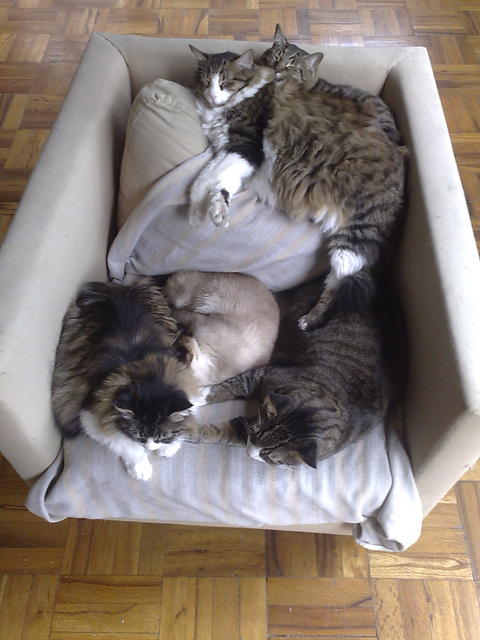
Five out of six experts agree: Five out of six cats cannot be mistaken
It. Is. Cold.
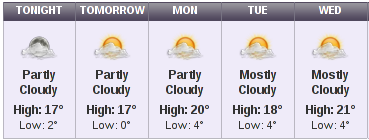
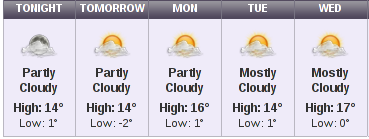
No, we are far from this very impressive picture of a fully-snowed UK seen from the sky that everybody and their dog must have seen by now. Still, in Mexico City we are experiencing the traditional one-or-two-weeks-a-year where it is genuinely cold. And, very strange being this Winter (the rainy season is Summer around here, January should be dry!) we have rain all day long. The Ajusco mountain is around 15Km south from my home, and it is the closest of the giants that surround our valley. Yesterday I managed to get some peeks at it behind the very thick layer of clouds we have. Ajusco looks really gorgeous all snowed, maybe down to the 3400m line (while the city's main area is at 2300m). This picture was not taken this year, we have snow in Ajusco almost every year (although very seldom as much as this time): (last photo is not current, we have not yet had a clear day to take a picture of our Ajusco yet this year) How does it feel? Well, I live in Coyoac n, in the flat area of the valley. Remember that houses here are not built to endure extreme temperatures (and this week is what we call extreme, of course ;-) ). According to Yahoo! Weather: And while the difference appears to be small, what about Magdalena Contreras, ~200m higher, where many people dear to me live (and have even a window pending to be installed)? People say this cold wave is the strongest in 120 years, since records are being taken. Every year people get excited, expecting that this time we will get snow. This has only happened once in at least a century, in 1966 AFAIR. I do not think this year to be atypical. Still, I have a reputation for being insensible to cold weather. Everybody wears heavy jackets while I still go to work with my usual long-sleeved shirt and that's it. But the last two days, I have been using jacket and scarf... But, of course, I don't look as gratious or cute as my cats :-
9 January 2010

Rapha&#235;l Hertzog: Debian related goals for 2010

Here s stuff that I d like to do this year, more or less by decreasing order of importance: All of this probably doesn t fit in my free time (being a father since last month does not help increasing my free time :-) ), so if you re interested in seeing one or more of those projects completed, and if you know some person/company that could sponsor them, get in touch with me! Partagez cet article / Share This

Erich Schubert: Facebook Scam Groups

Facebook seems to have little interest in protecting its users from a huge flow of common scam/spam. Sure they do get active when accounts are mass hacked, and I havn't seen a "Facebook virus" for some time. Their JavaScript filtering is pretty neat, and they have implemented dereferrer pages they can use to quickly stop URLs from spreading.However, some of my friends keep on joining very dubious groups and installing very dubios applications. No wonder "FarmVille" is sometime nicknamed "ScamVille". There still is a lot of money to make in dubious ways.The big problem with Facebook is that everyone can set up groups and applications that look like they might be real. This is why people keep on installing "Mafia wars gifts" applications that have nothing to do with the actual game except the name. And sometimes not even realize they don't actually get these gifts in the real game.Even worse are the "pimp" groups. It's a classic pyramid scheme. Invite all your friends to the group, then you get extra Mafia points. Facebook really needs to stop that.A quick search for "invite proof" - these groups usually require you to post "proof" of having invited all your friends - turns up 246 groups, almost all of which promise you Mafia stuff.Searching for "getElementsByTagName" in Facebook turns up "over 500" groups. This string is a JavaScript command commonly used to auto-invite all your friends to a group. A typical mass-spread group will use this in its "join instructions".Facebook needs to combat this kind of spam/scam. And it's not too hard. Just actually check user complaints/reports, do simple searches like the ones I posted above, and have some employee go through them and just delete all these dubious mass-join groups. Pyramid schemes likely violate the Facebook TOS, and they definitely are illegal in at least Germany.

Christian Perrier: [life] [running] Some news

It's quite some time since I gave news about my running junkiness. So here they are. Apparently, my last blog entry was about my worries about which marathon(s) to run next year. At least one is scheduled, of course Paris. The highest probability as of now if Berlin in September (probable enough for me to register as soon as it becomes possible)...which would also leave a possibility to run Donostia in late November if I manage to convince Elisabeth that running 3 marathons in a year is not entirely crazy. I'll also try again to run a solo marathon in late May in for t de Rambouillet (: I still have to see some wallabies that are said to be living here). Other planned runs include the Semi de Paris (Paris half-marathon), which is twinned with the Paris marathon, 5 weeks before, as well as a much smaller one, the semi-marathon des Lions in Bullion, in the Rambouillet forest, where I had a memorable run on Dec 17th on a snowy day. That will make 3 mass runs in a row, one per month, culminating to Paris marathon. Sounds like a good plan. So, since I ran the Cologne marathon, my plans were mostly to stay trained enough. For this, I went back to me regular schedule of one short 10km run on Saturday morning, then a longer one on Sunday morning, plus hopefully small runs with colleagues, or alone, at lunch break. The most interesting things to notice during this October-December timeframe were then: All this, plus many others cumulated about 375km in 3 months which is fairly what I planned to do. The goal right now is to both enjoy winter runs in snowy landscapes as we are very lucky to have a real winter this year in Paris area (I'll try to shoot some pictures tomorrow and post them on my gallery)....and properly prepare the Paris marathon, where my goal is to break the 4h barrier and go down to about 3h50 (some might say I'm not ambitious enough). A long term goal (probably 2011) is the well-known Saint Lyon long distance night run, starting from my birth city, Saint- tienne: 69km, departure at midnight, 1300m positive slope (1700m negative), up to 850m altitude from 500m, 55 editions. This on the first week-end of December, which in that season may mean "snow" (the 1990 edition was stopped at the 2/3 of the run because of a 70cm snow fall, but 80 heroes completed the whole run anyway). That run will be the next Grail, as it seems.:)

Russell Coker: Another Hot Summer

Yesterday was ~30C in my area, today was well over 30C during the day (although cooler in the evening). They forecast 33C for tomorrow in Melbourne, but that means where I live it will probably be about 36C (it s always a few degrees hotter than the overall forecast for the city). Monday is predicted to be 41C and Tuesday may be 32C. I turned off my SE Linux Play Machine this morning and will probably leave it off until at least Tuesday evening. The hardware I use for the Play Machine is fairly energy efficient, but it s in a confined space with some other electronic stuff so it s best not to take chances. I ll probably leave it offline for about half the duration of January and February. I miss Amsterdam and London weather.

Julien Blache: forked-daapd: porting to FreeBSD

Since I released forked-daapd, I ve got a couple of emails about porting it to FreeBSD. Apart from isolating and reimplementing the parts of the code using signalfd and inotify, there isn t much work to do beside taking care of the usual libc/platform issues. However, when you don t know the codebase and don t know the APIs you re replacing, it makes it a bigger job. So, I ve just spent a day going through FreeBSD documentation, installing FreeBSD 8.0 in qemu (because it wouldn t install on my spare machine due to a bootloader issue that s at least 5 years old ), and started porting the codebase. A dozen or so commits later, forked-daapd builds and runs on FreeBSD. With one caveat: the filescanner doesn t update the database on the fly when the library directory is modified. While I ve put in support for kqueue/kevent to replace inotify, it s only a stub for now. Someone will have to write the code to actually act on the events and trigger the rescans/database updates. kqueue/kevent delivers a lot less information compared to inotify, which means there s a lot of work needed to track renames and moves. And I didn t feel like doing it. So, FreeBSD users: send patches! :)

Andrew Pollock: [life/americania] TransLink, the Bay Area's best kept public transportation secret?

We're not huge users of Caltrain, because frankly, it sucks. It's way slower than driving to San Francisco, and by the time you've paid for two return tickets, you might as well have driven and paid for parking. That said, we do use it from time to time. One of the things I noticed when we first moved over here was this intriguing box on a pole, to the side of the normal ticket vending machine. It looked all battered and faded, kind of like a deprecated form of ticketing that had been phased out years ago. Except it looked too high-tech to be phased out. Fast forward to four years later, and we're using Caltrain to get back from SFO after returning from Atlanta for Christmas, and there's this "Don't forget to tag off" TransLink poster inside the carriage. I'm now officially intrigued. I did some browsing of their website on the journey home. How could this be? Hong Kong's MTR has the Octopus Card. London's Tube has the Oyster Card, and the Bay Area has TransLink? Why the hell isn't this thing being pimped out more? It's awesome! I mentioned it to a co-worker the other day, who's been in the Bay Area for 7 years, and he'd never heard of it. So I signed up for it for myself and Sarah, and two cards promptly arrived. If you sign up with an autoload of $20 or more, there's no cost for cards at all. So from now on, whenever we need to ride Caltrain (or BART or Muni, which are the public transport networks we're ever likely to use) we can just wave these cards at something and never have to worry about a ticket ever again. It's awesome. Apparently VTA is coming on board with it later this year, so that'll round things out nicely. It sounds like it's been an epic implementation, starting back in 1999, and still rolling out ten years later. Better late than never. The added bonus will be for our visitors. When they come, we can just give them these cards, and they won't have to deal with BART's utterly confusing (for casual riders) fare system. One of my favourite things about Hong Kong was the MTR and the Octopus Card. Now we just need awesome mass transit for the Bay Area. Somehow, I think that's going to take even longer than TransLink.

Andrew Pollock: [life] Renovations coming along

renovate
v 1: restore to a previous or better condition
  2: make brighter and prettier
remodel
v 1: do over, as of (part of) a house
  2: cast or model anew
I much prefer the term renovate to remodel. Remodelling to me feels more like tearing down internal walls and changing the actual layout of the place. But we're in America, so remodelling it is. We've had a bit of (mostly self-inflicted) scope creep. It started with just wanting to get some Ethernet cabling installed, then we decided to get recessed canned lighting (the whole lamp thing over here drives us nuts), and then we discovered that acoustic ("popcorn") ceilings are a haven for dust mites (we're both allergic) so it made sense to get the ceilings redone while they were putting the lights in. We're also getting the light switches replaced, and new childproof power outlets. We also got the electrical panel upgraded. Removing popcorn ceilings is somewhat hilarious. They put down plastic everywhere, then have at it with a garden hose, and then it just scrapes off. The ceilings they've completely finished already look a million bucks, so we're very happy with the decision to do that. The Ethernet cabling installation caused a lot of wall carnage, so we're going to get the walls repainted as well. Then we can get the carpets cleaned and stain proofed, and then we can start thinking about trying to move some non-essential stuff in. Hopefully it'll all be done by next weekend. The kitchen cabinets have a six week lead time, so the kitchen remodelling will have to be done while we're living there. Unfortunately some unexpectedly time demanding stuff has come up at work, right in the middle of this, so Sarah's had to do the bulk of the running around to sort out contractors for all of the work, and I've been stuck at work until all hours, 7 days a week. To cap it off, I've managed to come down with a cold, and feel quite crappy. NyQuil consumption is ensuing.

Andrew Pollock: [life] Twenty weeks later

Sarah hit the 20 week mark on Monday, and so we had the big anatomical ultrasound. We also found out that it looks like we're having a girl. We're now trying to come up with a name. There was also a worrying piece of news: they couldn't see the cavum septum pellucidum, while they were checking out her brain. Apparently the cavum septum pellucidum is a particular marker they look for when they're checking everything out. Now what the absence of the cavum septum pellucidum actually means isn't terribly clear. Apparently normally this is found along with other abnormalities, but the rest of her brain structures look fine. The nuchal translucency we had earlier in the pregnancy came back fine also. So we got bustled off to have a chat with the genetic counsellor (during which the 4.1 earthquake happened). We got booked in for an amniocentesis for later that afternoon, as well as a fetal MRI at 22 weeks, and trundled off home. To cap things off, when we were trying to park back at the hospital for the 2pm appointment, I managed to scrape the car up against one of the poles in the car park. (The lower level parking is notoriously tight). Note to self: always use the free valet parking service from now on. Sarah had some second thoughts about the amniocentesis, as it does carry with it some risk of miscarriage, and after chatting with with a couple of the obstetricians, we elected not to do it. The fetal MRI should definitively determine if the cavum septum pellucidum is absent, and then we can talk to a paediatric neurologist about what the ramifications of that might be. One of the reasons they wanted to do an amniocentesis now, rather than after the fetal MRI, is the amniocentesis itself takes a couple of weeks for the results to come back, and that would bring us up to the 24 week mark. Apparently if we wanted to terminate the pregnancy, once it was at 24 weeks, we'd have to go to LA to do it. Whilst I consider myself an atheist these days, I was raised a Catholic, and although I like to think of myself as pro-choice, I still have a lot of problems with abortion, so I don't think I'd be comfortable terminating unless it could be shown with reasonable certainty that our baby was going to be in a really bad way. Based on how the rest of the brain looked, and the nuchal translucency results, and the fact that the amniocentesis would only identify chromosomal and not genetic neurological disorders, I don't think we'll be aborting. From my limited research, it sounds like the cavum septum pellucidum disappears at about 3 months after birth anyway, so looking at it one way, you could say our baby's brain is developing faster. Other research has indicated a correlation with optic nerve development issues, so I don't know if that means she might be blind. We really need to chat with a paediatric neurologist. But hopefully the fetal MRI will find it, and this will turn out to be nothing. An anxious two weeks will now follow.

8 January 2010

Bdale Garbee: TeleMetrum v0.2 All Here

Today, the panels of bare circuit boards, the paste stencil, and the last parts I need (the Venus GPS modules) to hand assemble first-article prototypes of TeleMetrum v0.2 all arrived! The parts for the first three prototypes are staged and ready to load, so my next step is to go use my CNC mill to rip up one of the panels into individual boards, then make up a fixture for the stencil. Meanwhile, the solder paste is out of the shop fridge warming up... For my friends in Colorado, this means I will not try to attend the NCR annual meeting this weekend. It's about a 6 hour round-trip drive from my house to Ault, and getting boards loaded and tested before I leave for New Zealand where Keith and I are scheduled to give a talk at LCA about our work takes priority!

Russell Coker: Ext4 and Debian/Lenny

I want to use the Ext4 filesystem on Xen DomUs. The reason for this is that the problem of fsck times on ext4 (as described in my previous post about Ext4 [1]) is compounded if you have multiple DomUs running fsck at the same time. One issue that makes this difficult is the fact that it is very important to be able to mount a DomU filesystem in the Dom0 and it is extremely useful to be able to fsck a DomU filesystem from a Dom0 (for example when you want to resize the root filesystem of the DomU). I have Dom0 systems running CentOS5, RHEL5, and Debian/Lenny, and I have DomU systems running CentOS5, RHEL4, Debian/Lenny, and Debian/Unstable. So to get Ext4 support on all my Xen servers I need it for Debian/Lenny and RHEL4 (Debian/Unstable has full support for Ext4 and RHEL5 and CentOS5 have been updated to support it [2]). The Debian kernel team apparently don t plan to add kernel support for Ext4 in Lenny (they generally don t do such things) and even backports.debian.org doesn t have a version of e2fsprogs that supports ext4. So getting Lenny going with Ext4 requires a non-default kernel and a back-port of the utilities. In the past I ve used CentOS and RHEL kernels to run Debian systems and that has worked reasonably well. I wouldn t recommend doing so for a Dom0 or a non-virtual install, but for a DomU it works reasonably well and it s not too difficult to recover from problems. So I have decided to upgrade most of my Lenny virtual machines to a CentOS 5 kernel. When installing a CentOS 5 kernel to replace a Debian/Lenny kernel you have to use console=tty0 as a kernel parameter instead of xencons=tty , you have to use /dev/xvc0 as the name of the terminal for running a getty (IE xvc0 is a parameter to getty) and you have to edit /etc/rc.local (or some other init script) to run killall -9 nash-hotplug as a nash process from the Red Hat initrd goes into an infinite loop. Of course upgrading a CentOS kernel on a Debian system is a little more inconvenient (I upgrade a CentOS DomU and then copy the kernel modules to the Debian DomUs and the vmlinuz and initrd to the Dom0). The inconvenience of this can be an issue in an environment where multiple people are involved in running the systems, if a sysadmin who lacks skills or confidence takes over they may be afraid to upgrade the kernel to solve security issues. Also apt-get dist-upgrade won t show that a CentOS kernel can be updated, so a little more management effort is required in tracking which machines need to be upgraded. deb http://www.coker.com.au lenny misc To backport the e2fsprogs package I first needed to backport util-linux, debhelper, libtool, xz-utils, base-files, and dpkg. This is the most significant and invasive back-port I ve done. The above apt repository has all the packages for AMD64 and i386 architectures. For a Debian system after the right kernel is installed and e2fsprogs (and it s dependencies) are upgraded the command tune2fs -O flex_bg,uninit_bg /dev/xvda can be used to enable the ext4 filesystem. At the next reboot the system will prompt for the root password and allow you to manually run e2fsck -y /dev/xvda to do the real work of transitioning the filesystem (unlike Red Hat based distributions which do this automatically). So the state of my Debian systems running this is that the DomUs run the CentOS kernel and my backported utilities while the Dom0 just runs the backported utilities with the Lenny kernel. Thus the Debian Dom0 can t mount filesystems from the DomUs which makes things very difficult when there is a problem that needs to be fixed in a DomU, I have to either mount the filesystem from another DomU or boot with init=/bin/bash .

7 January 2010

Neil Williams: Change of career and relocation.

Further to my previous entry of putting the house on the market, it's now definite that I'm relocating to Cambridge to work as a self-employed application developer with Toby!Churchill.

Time to start hunting for accommodation in Cambridge tomorrow . . .

6 January 2010

Christine Spang: configuring Gnome screensaver for unicode-screensaver

I love unicode. You should too. For the unicode-lover out there, Joachim Breitner recently created an xscreensaver hack called unicode and uploaded it to debian. [1] I didn't like the default colourscheme of black text on a white background, so I hacked it to support colour configurability. The patches are in the Debian package as of version 0.2-1. If you're using xscreensaver, you can configure it using the xscreensaver configuration dialog for a subset of the available colours. If you want different colours, you can edit ~/.xscreensaver by hand. Gnome screensaver, however, does not have a configuration UI, opting instead to present a simpler interface and also allow administrators to lock down the screensaver configuration if desired. You can still configure the screensaver on unlocked systems without a GUI. Here's how to do it. [2] At a terminal:
mkdir -p .local/share/applications/screensavers
cp /usr/share/applications/screensavers/unicode.desktop .local/share/applications/screensavers
editor .local/share/applications/screensavers
There's an Exec line in the file that should look like this:
Exec=/usr/lib/xscreensaver/unicode -root
Change it to look like this:
Exec=/usr/lib/xscreensaver/unicode -root -background <bgcolor> -foreground <fontcolor>
Swap the two colours with any X11 colour of your choice. Make sure to quote any multiple-word colour names. I like black as a background, with white or firebrick or another non-jarring bright colour as the font colour. If you want, you can also change the "Name" field in the file, but it's not necessary for things to work. Now, open up gnome-screensaver-preferences and select the new screensaver. U+2673: RECYCLING SYMBOL FOR TYPE-1 PLASTICS Lastly, leave your laptop strategically with the screensaver on to geek out all your friends with your unicode prowess. [1] Thanks Joachim! [2] There is actually another way to do it, if you prefer to interact graphically. For the other method, get /usr/share/applications/screensavers/unicode.desktop, edit it to your taste, and then drag-and-drop it onto gnome-screensaver-preferences, which will automatically put it in the right place in .local. You may need to restart gnome-screensaver preferences in order to see the new screensaver in the selection box. The feedback isn't very good.

Next.

Previous.