Russell Coker: Chilled Memory Attacks
In 1996 Peter Gutmann wrote a paper titled “Secure Deletion of Data from Magnetic and Solid-State Memory” [1]. In that paper he mentions the fact that the contents of RAM last longer at lower temperatures and suggests that data could be retained for weeks at a temperature of -60C or lower (while 140C causes rapid data loss). The paper also addresses issues of data recovery from hard drives, but given that adequate CPU power for encryption is available recovering data from a disk shouldn’t be an issue unless thee attacker can get the key to decrypt it or crack the algorithm - so disk recovery is not a hot issue at the moment.
Recently some researchers at Princeton University have published a paper describing in detail how to chill RAM to make it keep its data after a power cycle and even after being installed in a different computer [2]. This attracted a lot of attention, while Peter’s paper described the theoretical concept (in great detail) the Princeton group showed how to implement the attack using materials that are commonly available.
Most of the analysis of this misses some fundamental points. Any suggestion that you can wipe the RAM on power failure or on boot misses the point entirely. If an attacker can chill a DIMM and then remove it from the system then there is no chance for it to be wiped. Maybe if you had security on the PC case to detect case opening (some servers have a basic version of this) such things would do a little good, but it shouldn’t be difficult to bypass in most cases.
Another common flawed analysis is to suggest that this is no big deal because sniffing the memory bus has been possible for years. While it has always been possible for government agencies and companies who design motherboards to sniff the bus, for most potential attackers it has been overly difficult.
When considering the effectiveness of a security system you should first consider what your threat model is. Who is going to attack you and what resources will they be willing and able to devote to the attack? An organisation that is prepared to use expensive equipment and highly trained people to break your encryption probably has other methods of gaining access to your secret data that are easier and cheaper.
The research from Princeton suggests that I could perform such attacks with my spare time and with equipment that is very cheap. I’ve been idly considering doing this to an old PC just for fun! Therefore I have to assume that everyone who has the same amount of skill and money as me can potentially compromise my data if they capture one of my machines.
It is still most likely that if anyone steals my laptop they will want to sell it and use the money to buy drugs. I don’t think that I have any data that is anywhere near valuable enough to justify a targeted mugging. But my procedures (in terms of changing passwords etc) in the case of my laptop being stolen now need to be scaled up due to the ease in which data might be compromised.
The best way of dealing with this would be to have the decryption keys locked inside the CPU (stored in registers or memory that’s locked in the CPU cache). The possibility of getting a modern CPU to operate at any temperature approaching -60C is laughable, and the CPU is a well contained package that can operate on its own and is difficult to attack. This would make things significantly more difficult for an attacker while requiring little effort (in fact it might be possible to lock data in the CPU cache already in which case a software change is all that is required).
Update: A comment by Mike made a good point about CPU cooling. Toms Hardware performed an overclocking experiment (from 3.2GHz to 5.25GHz) and used liquid nitrogen cooling [3]. It might be possible to cool a CPU core to -60C in a reasonably small amount of time. But I still believe that it would raise the bar enough to make it worth doing.
Update2: Thanks Jaime for the spelling advice.
 Yesterday really didn't go to plan. The plan was to clear a few work tasks and then travel to London for an early afternoon Koha-related meeting, then fix some other problems on site before travelling home this evening. Unusually, this trip involved bike, train, tube coach and bus. Everything but the car, indeed, so a pretty good example of using greener transport for
 Today I've noticed that my last post was on August and I've decided that I'm
going to try to keep this blog alive.
Since this summer I've left the University and now I only have two jobs... my
daily work and my son; I believe that things are going better at a personal
level, but the truth is that lately I have near zero time to devote to Debian
and Free Software in general.
As I don't want to leave the FLOSS world and I'm still able to do some
sysadmin related tasks at work and at home I've decided that I'll try to
reserve some time for blogging about them.
I'm also thinking about starting a blog and a wiki in Spanish, mainly to be
able to publish some of the documents I write at work about our installations,
the advantage for me is that I can publish them with a little revision and
that is much faster than translating them into English.
Anyway, before creating new blogs my first task is to finish my home server
migration; I'm moving all the services that were running on my old PowerBook
(PowerPC @ 400Mhz, 378MB of RAM, 10 GB HD) to my other PowerBook (PowerPC @
1Ghz, 768MB of RAM, 60GB HD), as I haven't used it for ages and I still use a
lot the old machine.
On the move I plan to change a lot of things, the machine is going to run
multiple vservers and I plan to change a lot of the software I was using,
always trying to simplify the maintenance and/or get more performance from the
new machine:
 I was at FOSDEM last week-end. As usual there, I spent an excellent week-end. It was really nice to see all those friends again (and even meet some friends for the first time, hi gaston/carxwol/atmaniak!) Only problem is, FOSDEM is definitely too short ;-)
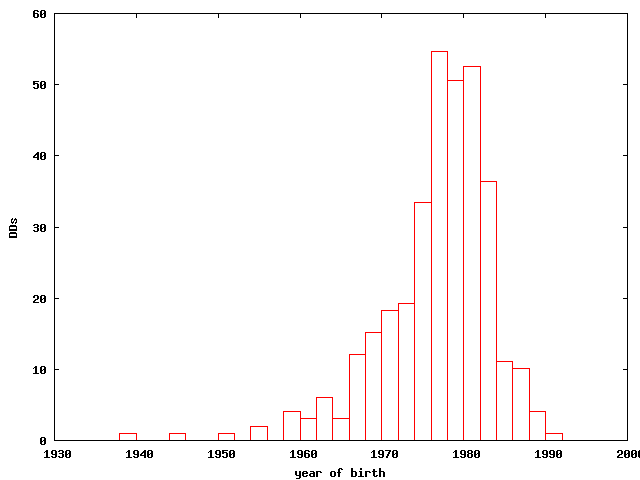
To make this post a bit more interesting, I did some homework. The opening talk about FreeBSD had those stats about developers’ age, so I made the same ones for Debian (using the birthDate LDAP field, which was filled in by 340 DDs). Here is the graph. It would be interesting to compare that with other communities, which are sometimes perceived as “younger”.
 I'm going to be traveling and giving talks quite a bit this spring.
Here's what my schedule looks like now. I don't think much will be added
to it:


 Title: How to subtile fsck your Apache setup.
Solution (quoting the original command line):
 Day one of FOSDEM 2008 has now ended, and almost everything seems to
have gone fine from my end. Note, "fine" is not "perfect"; there were
some issues.
 Wanted: a device that will rewind time, turn off greylisting in my mail server,
wait for the other side send the mail, and then resume business as before.