Software Engineering distinguishes between
software features and
software
bugs.
It is usually understood that features are positive, expected characteristics
of a computer program. Features make users happy by allowing them to do
something useful, interesting, or fun. Something
good, anyways. Bugs are
instead undesirable and annoying. You're sitting there at your computer writing
a long email and the software crashes right before your email is sent.
Bad
stuff.
Features are generally implemented by programmers on purpose, whereas bugs are
purely unintentional. They are
mistakes. You don't make a mistake
on
purpose.
We might at this point be inclined to think that: i) what is good for users is
done on purpose by software manufacturers; ii) what is bad for users was not
meant to be. It happened by mistake.
Here is a handy table to visualize this idea:
| |
On purpose |
By mistake |
|---|
| Good |
Feature |
|
| Bad |
|
Bug |
It seems to make a lot of sense. But you might have noticed that two cells of
the table are empty. Right!
In a great talk titled
When Free Software isn't better, Benjamin Mako Hill
mentions the concept of antifeatures, and how they relate to
Free
Software.
Antifeatures are features that make the software do something users will hate.
Something they will hate
so much they would pay to have those features
removed, if that's an option. Microsoft Windows 7 is used in the talk to
provide some examples of software antifeatures: the Starter Edition
does not
allow users to change their background image. Also, it limits the amount of
usable memory on the computer to 2GBs, regardless of how much memory the system
actually has. Two antifeatures engineered to afflict users to the point that
they will purchase a more expensive version of the software, if they have the
means to do that.
I have another nice example. The Spotify music streaming service plays
advertisements between songs every now and then. To make sure users are annoyed
as much as possible, Spotify automatically pauses an advertisement if it
detects that the volume is being lowered. A poor Spotify user even
tried to
report the bug on The Spotify Community forum, only to find out that what she
naively considered as a software error was "intentional behavior". A
spectacular antifeature indeed.
Whenever a piece of technology does something you most definitely do not want
it to do, such as
allowing the NSA to take complete control of your Apple
iPhone, including turning on its microphone and camera against your will,
that's an antifeature.
| |
On purpose |
By mistake |
|---|
| Good |
Feature |
|
| Bad |
Antifeature |
Bug |
Both bugs and antifeatures are bad for users. The difference between them is
that antifeatures are
engineered. Time and money are spent to make sure the
goal is reached. A testing methodology is followed. "Are we really sure
customers cannot change their wallpaper even if they try very very hard?"
Engineering processes, of course, can fail. If the poor devils at Microsoft who
implemented those harassments would have made a mistake that allows users to
somehow change their wallpaper on Windows Starter... Well, I would call that a
glorious antibug.
| |
On purpose |
By mistake |
|---|
| Good |
Feature |
Antibug |
| Bad |
Antifeature |
Bug |
There is no place for antifeatures in Free and Open Source Software. Free
Software gives users
control over what their software does. Imagine Mozilla
adding a feature to Firefox that sets your speakers volume to 11 and starts
playing a random song from the black metal artist
Burzum every time you add
a bookmark, unless you pay for
Mozilla Firefox Premium Edition. The source
code for Firefox is available under a free license. People who are not into
Burzum's music would immediately remove this neat antifeature.
I have spent many years of my life advocating Free and Open Source Software,
perhaps using the wrong arguments.
Mako's talk made me think about all this
(thanks mate!). All these years I've been preaching about the technical
superiority of Free Software, despite evidence of thousands of bugs and
usability issues in the very programs I am using, and contributing to develop.
Free Software is not better than Proprietary Software per se. Sometimes it is,
sometimes it's not. But it gives you control, and freedom. When it annoys you,
when it doesn't do what you expect and want, you can be sure it's not on
purpose. And we can fix it together.
 This year I am able to join the Debian Booth on FOSDEM again. I am also looking forward to meet some projects like foreman and many others. I also hope that I find the time to do some listmaster work, like accepting new lists or getting my new solr based search engine for lists.debian.org online. If you want to meet me, try the debian booth or drop me a short mail or twitter message (@formorer).
 Today I am mostly in my bed suffering from "the plague".
Between naps I've worked on a new site a little:

 I want Zoe to do one "extra curricular" activity per term this year. Something
dance-related, something gymnastics-related and maybe some other form of sport
(I'm thinking soccer). My girlfriend and I were wandering through
 Couple of weeks ago I was in the situation of having to setup up a new laptop. I decided to go with wheezy s DVD installer. So far so good. I didn t expect (somewhere in the lies-I-tell-myself dept.) to have GNOME as the default Debian desktop. However after install I ve figured it was the new GNOME3 everybody was talking about. Before that I ve seen it in Ubuntu systems used by my classmates. I thought yeah, OK GNOME3, I think that s fine for them as a Linux desktop. Turns out that I ve started using the Debian desktop aka GNOME3 and noticed that it was not as bloated as the Ubuntu desktop I ve seen before looked, so I sticked with it, (I thought for a while).
Turns out that I did like this new so called GNOME3, the non-window based but an application-based system (that is something that sticks in my head). I liked the way it makes sense as a desktop system, like when you look for applications, documents, connect to networks, use pluggable devices or just configure stuff every time with less and less effort. Good practices and concepts learned from Mac OS X-like environments and for sure taking advantage of the new features the Linux kernel and user-space environment got over the years. So, like one month later I stick with it and it makes sense for me to keep it. I had no chance to try the latest XFCE or KDE, my default choices before this experience. Kudos GNOME team, even after the depictions you guys had on GNOME Shell; as I learned.
This whole situation got me into some pondering about the past of the Linux user experience and how we in the community lead people into joining. I remember that when I guy asked: how do I configure this new monitor/VGA card/network card/Etc? the answer was in the lines of: what is the exact chipset model and specific whole product code number that your device has? Putting myself in the shoes of such people or today s people I d say: what are you talking about? what it is a chipset? I mean, like it was too technical that only one guy with more than average knowledge could grasp. From a product perspective this is similar for a car manufacturer tell to a customer to look for the exact layout or design your car s engine has, so that they are able to tell whether is the 82 s model A or 83 s model C. Simplicity on naming and identification was not in the mindset of most of us.
This is funny because as technology advances it also becomes more transparent to the customer. So, for instance, today s kids can become really power users of any new technology as if they had, indeed, many pre-set chipsets in their brain. But when going into the details we had to grasp few years ago they have some hard time figuring out the complexity of the product that presents itself on this clean and simple interface. New times, interesting times. Always good to look back. No, I m not getting old.
 Do you remember the very vocal people who, a decade ago, would endlessly argue that udev was broken and that they would never use it?
 My friend
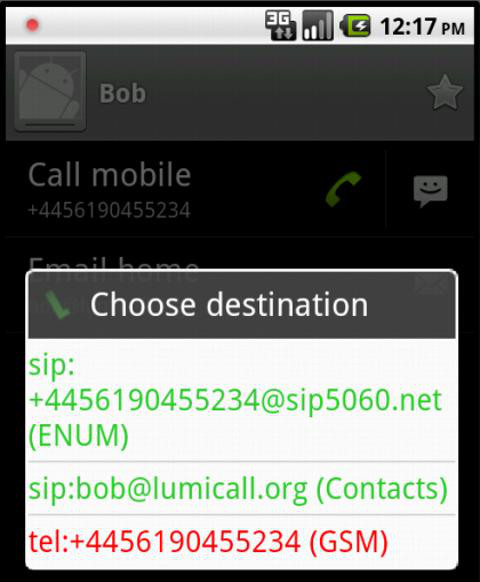 While the user may have simply pressed the "call" button, Lumicall alerts them to several ways that they may proceed:
 The