Julien Blache: forked-daapd: v0.15
- the code generating the song list was slightly reworked;
- hash tables of static data were replaced with static hash tables generated by gperf;
- the artwork code can now send out both PNG and JPEG to clients.
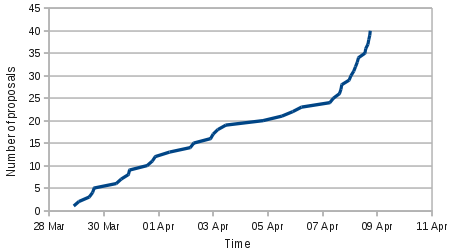
If you're an admin or a mentor, you can produce a similar graph for your
own org(s) - just download this OpenDocument spreadsheet and follow the
instructions inside.
Now the task of selection starts in earnest. I've gone through and marked
the seven spam proposals as ineligible (that's one line proposals,
proposals with no connection at all to Xapian, and proposals which are just a
title and/or paste from our ideas list with a generic biography).
That leaves 33, but not all are really in the running, before our student
applicants start to despair! I don't have a good picture yet, but it
looks like there are something like 10-15 we'll be seriously considering.
I've got a Debian GNU/Linux lenny installation (2.6.26-2-vserver-amd64 kernel) running on a Dell Poweredge 2950 with BIOS 2.0.1 (2007-10-27). It has two Intel(R) Xeon(R) CPU 5160 @ 3.00GHz processors (according to /proc/cpuinfo, 8 1GiB 667MHz DDR2 ECC modules (part number HYMP512F72CP8N3-Y5), according to dmidecode, and an Intel Corporation 5000X Chipset Memory Controller Hub (rev 12) according to lspci. The machine has been running stably for many months. On the morning of March 31st, i started getting the following messages from the kernel, on the order of one pair of lines every 3 seconds: Mar 31 07:04:38 zamboni kernel: [16883514.141275] EDAC i5000 MC0: NON-FATAL ERRORS Found!!! 1st NON-FATAL Err Reg= 0x800 Mar 31 07:04:38 zamboni kernel: [16883514.141278] EDAC i5000: NON-Retry Errors, bits= 0x800A bit of digging turned up a redhat bug report that seems to suggest that these warnings are just noise, and should be ignorable. Another link thinks it's a conflict with IPMI, though i don't think this model actually has an IPMI subsystem correction: this machine does have IPMI, though i am not making use of it. However, i also notice from munin logs that at the same time the error messages started, the machine exhibited a marked change in CPU activity (including in-kernel activity) and local timer interrupts:
![[Individual interrupts - by month]](http://dkg.fifthhorseman.net/blog/i5000_edac/irqstats-month.png)
I also note that more rescheduling interrupts started happening, and fewer megasas interrupts at about the same time. I'm not sure what this means. A review of other logs and graphs on the system turns up no other evidence of interaction that might cause this kind of elevated activity. One thought was that the elevated activity was just due to writing out a bunch more logs. So i tried removing the i5000_edac module just to keep dmesg and /var/log/kern.log cleaner. Leaving that turned off doesn't lower the CPU utilization or change the interrupts, though. Any suggestions on what might be going on, or further diagnostics i should run? The machine is in production, and I'd really rather not take down the machine for an extended period of time to do a lengthy memory test. But i also don't want to see this kind of extra CPU usage (more than double the machine's baseline).Tags: i5000_edac, troubleshooting
It's incredible how many people are of the misguided belief that just
because I happen to run a company, I
am automatically interested in their newsletter about whatever it is
that they are doing, no matter how far it is removed from the kinds of
things my company actually does.
Are these people spammers? Yes, definitely, and I don't want to do
business with them. But there's a major difference between this kind of
mails and your common nigerian scammer or counterfeit blue pill
"salesperson". Unlike the latter, some newsletter spammers are
interested in forming a genuine business relationship with my company.
They're going about it the wrong way, but that doesn't necessarily mean
they're trying to trick me into doing something that would not be in my
best interest they're not just after my money.
Although their methods are wrong, that does not mean they're entirely
clueless. Some of these unwanted newsletters are sent with VERP-style
return paths, which suggests that if the mail bounces at SMTP time, I
would no longer receive their junk. So bouncing them is what I do. Exim makes this very easy:
acl_check_mail: deny message = Your domain has been blacklisted log_message = domain blacklisted condition = $ lookup $sender_address_domain wildlsearch /etc/exim4/blacklist-domains true false acceptWhat this does is use a wildlsearch lookup to verify whether the domain of the envelope sender (i.e., as specified in the MAIL FROM: SMTP command) exists in the /etc/exim4/blacklist-domains file. Since we use a wildlsearch, we can use the * as a wildcard
*grep.bewould mean 'grep.be, or any of its subdomains', whereas
*.grep.bewould mean 'any of the grep.be subdomains'. This is because at least one of the people I've blacklisted that way sends their newsletter through a distributed service, and the VERP-style header is based upon the server that actually communicates with my system; and others have a subdomain for the newsletter, but don't use it (or use a different one) for regular mail. If I'm not interested in their spam, I'm probably also not interested in their other mail, so therefore the wildcard (is this overkill? Maybe, but I don't care I don't do business with spammers). This ACL is then activated for the SMTP MAIL FROM: command (search for acl_smtp_mail variable in the exim specification). This makes it impossible for the spammer to reach postmaster@ from the same domain, too, but that doesn't matter; they can always use a different address. One might be wondering why I'm using this kind of domain-based blacklisting rather than a regular bayesian spamfilter, or anything of the sorts. The reason is fairly simple: because the general format of these newsletters is distinctly different from regular spam. For instance, some of these newsletter spammers are in fact competitors who didn't bother to check who they're sending mail to. As a result, their newsletters would contain key words that would appear in mails which I send to my regular customers, too; if I were to classify them as spam in my bayesian classifier, that would increase the chance of the classifier misclassifying a mail from an actual customer as spam. Most of these are very similar in format to newsletters that I did consciously subscribe to, and which are therefore not spam, etc. Finally, bouncing mail rather than blackholing it or filing it in a separate folder (as I have spamassassin do) has the added advantage of making it clear to a newsletter spammer that their junk is not wanted. Most (though certainly not all) will then remove me from their newsletter, saving me bandwith and processing power. And since we do this at MAIL FROM: time, rather than upon completion of the RCPT TO: or DATA commands, I'm not actually giving away any information that they don't have, either.
Reading GSoC applications is sometimes funny. This year I've decided to be active only in phpMyAdmin projects, but this still gives enough interesting texts.
Some people definitely did not even care about looking at our name and think phpMyAdmin is written in C:
I assume this project would require C/C++ programming and, of course, SQL.We ask people to tell us a little about their real life, in most cases this includes information where did the student study and so on, but sometimes it is just:
I'm a fairly standard guy.In some cases people rather use some random file sharing service to post their CV and I'm too impatient to wait for several minutes till free download is available and I'm definitely not going to pay to download it. PS: As usual, the last day we receive most incomplete proposals over the time. Generally I think that the best proposals arrive at beginning and the quality lowers. This is probably heavily influenced by our requirements for students to know the code before and advertising GSoC early, so that the really interested ones are ready to submit proposals as soon as the interface is open, while others trying to catch train later.
Filed under: English Phpmyadmin 1 comments Flattr this!
Wouter says
he's going to drive to DebConf this year (from Belgium to
Bosnia). There's a number
of folks from the
UK looking to do the same thing, and there's time for more people
to join us yet. Maybe we'll see you en route Wouter!
Another pure maintenance release, this time of RcppClassic, the package
supporting the deprecated older classic
Rcpp API defined in
the earlier 2005 to 2006 releases, is now on
CRAN
It contains no new code, but smoothes one or two edges in the build process
and noticed by the newest versions of
R CMD check, just like
yesterday's RcppGSL release.
Courtesy of
CRANberries, here are
the changes to
the previous release.
Diff between RcppClassic versions 0.9.0 dated 2010-12-20 and 0.9.1 dated 2011-04-07 RcppClassic-0.9.0/RcppClassic/build only RcppClassic-0.9.0/RcppClassic/inst/lib only RcppClassic-0.9.1/RcppClassic/ChangeLog 17 ++++++ RcppClassic-0.9.1/RcppClassic/DESCRIPTION 8 +-- RcppClassic-0.9.1/RcppClassic/inst/doc/Makefile 25 ++++++---- RcppClassic-0.9.1/RcppClassic/inst/doc/RcppClassic-unitTests.pdf binary RcppClassic-0.9.1/RcppClassic/inst/doc/RcppClassic.pdf binary RcppClassic-0.9.1/RcppClassic/inst/doc/unitTests-results/RcppClassic-unitTests.html only RcppClassic-0.9.1/RcppClassic/inst/doc/unitTests-results/RcppClassic-unitTests.txt only RcppClassic-0.9.1/RcppClassic/inst/unitTests/runit.RcppDate.R 24 ++++----- 10 files changed, 49 insertions(+), 25 deletions(-)Questions, comments etc should go to the rcpp-devel mailing list off the R-Forge page.
Adam D. Barratt is a Debian developer since 2008, in just a few years he got heavily involved to the point of being now Release manager , a high responsibility role within the community. He worked hard with the other members of the release team to make Squeeze happen.
You could expect the release managers to have some rest after a big release, but it s not really the case. With the long freeze, loads of transitions have accumulated and they are now busy to get all those updated packages in the new testing (wheezy). Despite this Adam took some time to answer my questions.
He shares with us his impression on the Squeeze release, his opinion on time-based freezes (regular/predictable freeze) and much more. Read on. My questions are in bold, the rest is by Adam.
Who are you?
I m a 31 year old software developer and part-time sysadmin for a software and IT services company based in the south of England. I have no children, no pets and a long-suffering partner who puts up with me spending far too much time tinkering with things and people making fun of her Macbook during Debconf.
As well as being on the release team, I m a member of the maintainer teams for devscripts and lintian.
Can you describe your journey in Debian and in the release team?
I was introduced to Debian as part of an infrastructure upgrade at work, moving from a set of Red Hat and Solaris-based systems. As part of that, we submitted some bugs for issues we found during the upgrade and for small patches we included in some software to add extra functionality we wanted. From that starting point I became more interested in Debian in general and began following some of the mailing lists and IRC channels.
When Julian Gilbey asked for help with the maintenance of devscripts, I submitted some patches for some of the outstanding bug reports and was invited to join the team which was being created to handle maintenance for the package. One of the then Release Managers was also on the team and asked if I d be interested in working on a couple of updates they wanted to the scripts which generate the proposed-updates overview pages. I added the new functionality which was merged in to the live scripts and a little while later I was invited to join the team, shortly before Debconf 9.
As most readers will be aware, we unfortunately reached a point during last year where we didn t have anyone filling the Release Manager role. During that period, I became more active in handling transitions and requests for updates to stable and as time went on more people started to suggest that I should put myself forward for the position, or refer to me as already being RM. I procrastinated over the decision for some time but after discussions during Debconf 10 I came round to the idea that we should have the RM role filled again and agreed to take it on, together with Neil. The rest, as they say
How much time do you usually spend working for the release team ?
I ve been trying to work out how to usefully answer this question. My initial answer was approximately two hours each day , but the longer I thought about it the more I started debating exactly what I should include under the umbrella of release work; after some to-and-fro I ve decided to stick with my initial answer.
During periods when Debian is frozen and particularly in the lead up to the release that time commitment increases significantly, particularly over weekends. I m reliably informed that at that point the correct answer to the question is too much time . No comment Liked this article? Click here. My blog is Flattr-enabled.
(from http://lists.debconf.org/lurker/message/20110213.040506.1beb418f.en.html)
To: debconf-video
Subject: [Debconf-video] Announcing debian/watch, the Debian Miro Community Hi all,
With help of dc-video people I've just finished generating RSS feeds from penta data and published all Debconf(5-10) available videos to our new Miro Community page: http://debian.mirocommunity.org/
Soon I'll upload the feeds to dc-video repository. The process had to be semi- automated since I noticed some inconsistencies in penta which I'll point later.
I've written the following description for this channel: http://debian.mirocommunity.org/about/ (english language fixes / suggestions are welcome!)
Other nice Miro Community channels for reference:
http://gnome.mirocommunity.org/ http://ubuntu.mirocommunity.org/ [...]
(from a recent email message to Debian Miro Community admins)
Your Site is Now Running Miro Community 1.2!
Hi,
We have just migrated http://debian.mirocommunity.org/ to the latest version of Miro Community. From here forward, we're asking our heaviest users to help support ongoing software development and server costs by upgrading to a paid account, which is very easy to do!
This release limits some features you currently use. You will have 2 weeks to upgrade your account or you will no longer be able to use the following features.
* You have more than one administrator. If you choose to remain at the Basic account level, the following administrators will lose admin privileges: valessio tiago
* You have 556 published videos. If you do not upgrade your account, we will unpublish the oldest videos to keep you within the 500 video limit. You can also cull videos you no longer want at http://debian.mirocommunity.org/admin/bulk_edit/ [...]Although I understand Miro Community needs of releasing paid accounts, I think the features are now too restricted for non-premium users.So, at the end I have to thank Valessio for his amazing CSS work on this and Holger for warning me in time to not announce Debian Miro Community as an official channel for Debconf videos.It seems Miro will unpublish 56 videos from our channel in two weeks. I'm thinking about keeping there only Debconf videos, which should then fit on their new quota... At least until we find another place to publish them. Suggestions are very welcome. Debconf and other Debian videos are currently hosted at http://video.debian.net. Debconf videos feeds are available at http://tiagovaz.org/videoteam/ and corresponding thumbnails at http://tiagovaz.org/thumbs/.
I realized I never announced this on the blog, so without further ado.... Rcpp Workshop in Chicago on April 28, 2011 This year's R/Finance conference will be preceded by a full-day masterclass on Rcpp and related topics which will be held on Thursday, April 28, 2011, on the University of Illinois at Chicago campus. Join Dirk Eddelbuettel and Romain Francois for six hours of detailed and hands-on instructions and discussions around Rcpp, inline, RInside, RcppArmadillo and other packages---in an intimate small-group setting. The full-day format allows to combine a morning introductory session with a more advanced afternoon session while leaving room for sufficient breaks. There will be about six hours of instructions, a one-hour lunch break and two half-hour coffee breaks. Morning session: "A hands-on introduction to R and C++" The morning session will provide a practical introduction to the Rcpp package (and other related packages). The focus will be on simple and straightforward applications of Rcpp in order to extend R and/or to significantly accelerate the execution of simple functions. The tutorial will cover the inline package which permits embedding of self-contained C, C++ or Fortran code in R scripts. We will also discuss RInside to embed R code in C++ applications, as well as standard Rcpp extension packages such as RcppArmadillo for linear algebra and RcppGSL. Afternoon session: "Advanced R and C++ topics" This afternoon tutorial will provide a hands-on introduction to more advanced Rcpp features. It will cover topics such as writing packages that use Rcpp, how 'Rcpp modules' and the new R ReferenceClasses interact, and how 'Rcpp sugar' lets us write C++ code that is often as expressive as R code. Another possible topic, time permitting, may be writing glue code to extend Rcpp to other C++ projects. We also hope to leave some time to discuss problems brought by the class participants. Prerequisites Knowledge of R as well as general programming knowledge; C or C++ knowledge is helpful but not required. Users should bring a laptop set up so that R packages can be built. That means on Windows, Rtools needs to be present and working, and on OS X the Xcode package should be installed. Registration Registration is available via the R/Finance conference at
http://www.RinFinance.com/register/or directly at RegOnline
http://www.regonline.com/930153The cost is USD 500 for the whole day, and space will be limited. Questions Please contact us directly at RomainAndDirk@r-enthusiasts.com.
I just received a strange call. Basically, someone phoned me up and tried to convince me to change my computer s settings. They called my direct line (not the co-op switchboard), so I think they might be calling other numbers in the Weston-super-Mare area. Watch out for this attack.
I d heard about these calls from Box Bush Farm a year or so ago, but this is the first one I ve had. They introduced themselves as calling from Kilman IT Services (if I heard it correctly I didn t find it in a web search, so hopefully they re not defaming a real company) and say they re calling about the critical error that I reported from my computer (I guess they mean the dialogue that some applications pop up when they crash). I said something non-commital like riiight and they continued.

Apparently, that error has been registered in my computer s files and could cause damage at any time! So, they need me to edit my computer s registers to remove the error. Then they started trying to talk me through the process of running regedit. I m guessing the changes would have allowed them to control a Windows computer somehow.
At this point, I introduced myself and hung up the phone. Of course, there was no caller ID shown. If only I d picked up the call from a phone with a record button, I would post a recording! It sounded like a call centre and the caller spoke English with a far-eastern accent, but of course it could be from anywhere.
This is a crude social engineering attack. Don t fall for it. As it says on Get Safe Online: How to spot social engineering: You get an unexpected call, email or visit from a technical support person . Better yet, make sure you know the names of your tech support providers and refer any unsolicited repair calls to them. I think real IT services would talk to your lead support provider.
This sort of obnoxiousness is part of the reason why our co-op doesn t publish our client list. I m posting this mainly so if anyone searches for Kilman IT Services they ll find details of the call.
Last week, I had to put my daily (real) work off for a bit, to get some rest. I took this occasion to implement a few ideas I had for the Buildd Status Pages. Mainly, I wanted to get rid of my external dependencies which are:
The Background
If you weren't online last Friday you probably have missed the big news announcement on the various community distribution websites. The main pages of them got replaced by a placeholder announcing the birth of The Canterbury Project. People started to wonder whether it is an April fool's prank or for real. This blog post is meant to shine a bit more light on it and address one comment received about it.
If you go to the news item on the Debian site you'll get your answer about that it indeed was an April fool's prank. The idea for doing something in coordination with other distributions came to me when I thought about last year's (or was it already two year's ago?) prank that the various web cartoon sites pulled: they replaced their main page with the page of another cartoonist. My original idea was actually along that lines. So I started to dig up website contacts from different distributions, I was aiming at the big names in the community distribution sector.
Given that my time is pretty limited these days with renovating the house we plan to live in soonish I knew I had to let in others in within Debian. I though didn't want to involve too many people, for several reasons: it should be a surprise to as many as possible, but more importantly, I didn't want to shy away other distributions by an overwhelming Debian involvement. That's also part of the reason why I didn't contact many Debian based distributions.
So first contacts where made, a dedicated IRC channel used for coordination, and people involved joined in. Then the thing happened which the Free Software community is so well known for: additional ideas came in, two people independently addressed me whether it wouldn't be better that instead of a circle replacement of the frontpage, why not display the same page on all of them. And one of them added that a corresponding news item might make sense.
So there we were, having to think about text to put into two things: the news item and the replacement page itself. At this stage Alexander threw in a project name with a background that was adopted. Francesca started with an idea for the news item, I started to put quotes in and asked for ones from the other involved people that fit their distribution well. Klaas came up with a template for the replacement page that we tweaked. Fortunately we ended up being five distributions and the colors of the banner did match the distribution ones rather well (except for one, we had to tweak the color of one banner).
The Credits
We were all set, and actually everything went fine. And it definitely caught the attention. This blog post goes out in thanks to the following people:
Collaboration Across Bordersactually is possible. And the background information put into the news section of the replacement site is real. Also, my personal quote in the news item was meant dead honest. I do believe that DEX has a limited point of view and only tackles part of the problem. Unfortunately, for such efforts to really come to life it takes people with a really long breath and dedication to it. Efforts like the VCS-PKG and the Freedesktop Games effort are more or less stalled. Even though a lot of people do believe in stronger collaboration to be a good thing, the basis is not working out too well. I'm in the fortunate position that for some of the packages I maintain there is exchange between packagers from different distributions to avoid common troubles. If it can't be done in the big it should at least be tried in the small. I want to specifically highlight again one part of the updates in the replacement page: the CrossDistro track at this year's FOSDEM. This one was more than fruitful, on several levels. From what I've heard a lot of discussion happened besides the talks too, and connections got established. It doesn't sound unlikely like this might be done again next year. So again, thanks for enjoying this April fool's prank, thanks to everyone who helped to deliver it, and especially a lot of thanks to the people who this might have got thinking of possibilities to improve on the collaboration front!
sudo sysctl net.ipv6.conf.interface.accept_ra_rt_info_max_plen=64Which will enable anything up to a /64 prefix to be advertised at us. Looking at how the kernel handles default routing tables, what would be really useful (to me at least) would be to be able to set default metrics per interface so that when a route is advertised at it it used the per interface metric rather than the (sortof) hardcoded kernel metrics.
aero
snap was
one of the launch features of Windows 7 that was quickly copied into other
desktop systems (most recently, gnome
3).
I've written about it before.
Essentially, dragging windows to hot regions of the screen resizes those
windows to occupy some area of the screen. To the top: the whole window area
(maximize). To the left or right, 50% of the width of the window area, all of
the height.
This is a pretty useful feature that I wanted to steal for myself. There is a
somewhat fragile-looking (but functional) way of achieving this using
compiz and some embedded shell
scripts which I
used for a while, but has several drawbacks: there's no visual indication that
resizing will occur; resizing occurs after a time interval and not in response
to you releasing the window from its drag; it's therefore very easy to
accidentally resize windows (focussing a window adjacent to an edge and parking
the mouse pointer in the edge region is sufficient).
Aero snap is not without its own shortcomings: whilst having side-by-side
windows is great for comparing two documents, you can't arrange two windows
top-to-bottom, each occupying half of the vertical height of the screen.
This is very useful for working on two spreadsheets.
A less interactive but more functional way of achieving this is the grid
plugin for compiz and keyboard shortcuts.
The grid plugin can be found in the Debian package
compiz-fusion-plugins-extra.
So far I'm quite pleased by quality of GSoC applications we receive for phpMyAdmin. Tightening our applicant guide seems to be good idea and getting people active early and discuss the proposals seems to filter out the bad ones.
This also means that we will probably receive much less applications than last year. We've received 64 last year and we're not yet at half of the count, while only three days are left for students to submit their proposals.
Anyway take this as friendly reminder that not much time is left, especially if you want to receive some feedback for adjusting missing bits in the proposal.
Filed under: English Phpmyadmin 0 comments Flattr this!
We're heading to release candidates for phpMyAdmin 3.4.0, so the translators have less time to make the translations better. The Italian translation got to 100% this week thanks to Rouslan Placella. So there are now 14 translations at 100%:
Filed under: English Phpmyadmin 0 comments Flattr this!
"It seems to be a common belief between some developers that users should have to read dozens of pages of documentation before attempting to do anything.I think this is an interesting quote as it shows an important misunderstand of what Debian is for many people. Debian (and Linux in general) was in its beginnings quite complicated and often not very easy to use. People still felt a deep relieve to have it and a strong love. Why? Because it's not so much about about how you can use it, but how you can fix it. A system that only has a nice surface and hides everything below it, that does in a majority of cases just what you most likely want it is nice. But if the only options are "On", "Off" and perhaps some "something is not working as it should, try to fix it" (aka "Repair") it is essentially a form of paternalism: There is your superior that decided what is good for you, you would not understand it anyway, just swallow what you get. Not very surprisingly many people to be in the position of the inferior of a computer (the less the more stupid the computer is, but even modern computers are still stupid enough for most people). So what those people want is not necessarily a system that can only be used after reading a dozen pages of documentation, but a system they know they can force to do what they want even if that might then mean reading some pages of documentation. So a good software in that sense might have some nice interface and some defaults working most of the time. But more importantly it has a good documentation, easy enough internals so one can grasp them and be transparent enough that one can understand why it is currently not working and what to do against this and then allowing enough user interference to fix it. If all I get offered is some "interface for users too stupid to understand it anyway" and all options to fix it are checking and unchecking all boxes and restarting a lot or perhaps some gracious offer of "There is the source code, just read that spaghetti code, you can there see anything it does though you might need to build a debug version just to see why it does not work" then I would not call any strong feelings against this situation "elitist".
"I m happy that not all of us share this elitist view of software. I thought we were building the Universal Operating System, not the Operating System for bearded gurus."
A new comment on the Samsung N150 Ubuntu Netbook Remix reminded me that maybe I should post this here:
I ve just seen a report of lost files in a dual-boot Windows 7 situation. One suggestion is that you shouldn t suspend Windows, boot GNU, edit files on the Windows disks, shutdown GNU, then resume Windows.
I ve not dual-booted for over a decade, but friends and clients do and they re slowly moving to Windows 7 as it comes on new PCs. Is this a new twist on the old Windows-expects-one-user-at-a-time sharing problems, perhaps?
Next.