Search Results: "will"

27 January 2010

Christian Perrier: Translations: LOL, but after?

Of course, one would expect me to react to this post. Apparently, from my cumulated experience, joking about funny translations is a very widespread game among german-speaking developers (of course, as everybody knows, us French do translate everissing and no single Frainche DiDi will make such fun abaouttel10n wouhorke, aha). I'd say: more generally widespread among people .who jargonize about computing so often in their daily work that they often forget that not everybody, even in a country where people are as clever about English as German/Austrian/Swiss folks are (we all know that 100% population in these places speak a very perfect English) do understand what "downgrade" means. Seriously, "funny" translations are our (translators) daily nightmare. We hate them because we know people hate us (or make jokes about our work) when they face them. The example taken by Patrick is a nice case as "downgrade" is tricky for all of us. For instance, French translators have chosen "revenir la version pr c dente" as "bring back to former version". This is about the only "right" way to say what's being done ("d grader" is another option but that has a negative connotation). Of course, I often *hear* people (incl. me) say "downgrader" which is an horrible neologism....and of course doesn't say anything to people who are clueless in English. English is, unfortunately, often a very compact language. This is our daily pain. So, as German translation of "to downgrade", what do *you* propose, Patrick? "Downgradieren"? Tricky, eh? Taken from APT for "downgrade": Hint: you can see this with "apt-get source aptitude" and look in po/ for you favorite language. That sounds funny to you? Fine. But as usual in free software, please report.....and patches welcome...

Bastian Venthur: Query Google Scholar using Python

In desperate need to organize my collection of scientific papers, I had a look at various tools which could help me organizing them. Probably one of the best out there is Mendeley. Mendeley seems to be a very good tool to keep your massive collection of pdfs under control. Unfortunately a very basic function, namely looking up a newly imported paper in Google Scholar to get attributes like: Authors, Year, etc. right, is bundled with a Mendeley account. I guess that s their way of forcing the user to participate to their community stuff, since without the Google Scholar lookup Mendeley is pretty useless unless you want to fill all the attributes manually. So I decided to write my own tool to make the lookup. Unfortunately Google does not really want to give away that precious data: they don t provide an API and even block certain User-Agents from accessing the page. Then, there is also the problem of scraping the results page to get the right data. The first problem can be trivially solved by setting a common User-Agent string, the second one can be elegantly circumvented by using the bibtex files provided in the search results. The bibtex entries are however only showed if you enabled them in the settings, which are stored in a cookie. After a few tries, I figured that the CF attribute (citation format?) controls which bibliography format should be offered in the results page and CF=4 corresponds to bibtex. Generating a fake cookie is easy, but you have to know what must be included. In this case it looks like a 16 digit hex as ID and the CF attribute is sufficient. The ID is probably supposed to be your id, but a randomly generated one also works like a charm. The resulting cookie looks like this: GSP=ID=762a112b5c765732:CF=4 All you have to do now is to query Google Scholar using the user string and the cookie:

...
# fake google id (looks like it is a 16 elements hex)
google_id = hashlib.md5(str(random.random())).hexdigest()[:16]
GOOGLE_SCHOLAR_URL =  http://scholar.google.com 
HEADERS =  User-Agent  :  Mozilla/5.0 ,
         Cookie  :  GSP=ID=%s:CF=4  % google_id  
def query(searchstr):
     "Return a list of bibtex items. " 
    searchstr =  /scholar?q= +urllib2.quote(searchstr)
    url = GOOGLE_SCHOLAR_URL + searchstr
    request = urllib2.Request(url, headers=HEADERS)
    response = urllib2.urlopen(request)
    html = response.read()
    # grab the bibtex links
     

And Google Scholar will offer you links to the bibtex files of the results. Getting those links is easy since they all start with "/scholar.bib". Just search for those and download the targets. The complete code is available on github. It can be used as a python library or a standalone application, you just call it like this: gscolar "some author or title" and it will print the first ten results in bibtex to stdout.

Mike Hommey: Ubuntu switches default search engine. Will Google react ?

Many have commented on the event. As I noted in a reply to Romain Beauxis s post, the only reason Google was the default search engine in Ubuntu, and is still in other distros is because Mozilla has a revenue deal with Google. Which means that actually, Mozilla might be getting money from Debian, Ubuntu and other distros users actions on the Google search engine. (maybe not from Debian, though, because of the search url including iceweasel instead of firefox). Now, at least, Ubuntu will be the one getting the money. One has to know that these revenue deals probably don t cost a dime to Google and Microsoft (through Yahoo), because they may be transferring revenue they get from the extra advertising revenue they can get from these users being using their search engine as default. Anyways, much more interesting to know is how Google is going to react on other services: some core functionalities of Firefox (geolocation, safe browsing) are based on Google services. These are actually a possible problem for Debian, depending on the agreement between Mozilla and Google, and I have yet to address the RC bug I filed on my own package about these. Now, since Google is going to get less advertising revenue from Ubuntu users in favour of one of its competitor, why should they provide the geolocation and safe browsing to these users ?

Romain Beauxis: Voluntering

For those who wonder why Debian is and should remain a voluntary-driven project, here are some insights... I hope I will never read this in a Debian mailing list:
Why? I am pursuing this change because Debian has negotiated a revenue sharing deal with XXXXX
I have nothing against ubuntu and I think it is a great distro. However, I believe that decisions like this go strongly against the principle of free software as we consider, in particular when it comes to putting the user first and not some cash deal. Forcing the user to choose for something because the company gave money for that is totally again this to me.

Russell Coker: The Australian Open and Android Phones (Seer)

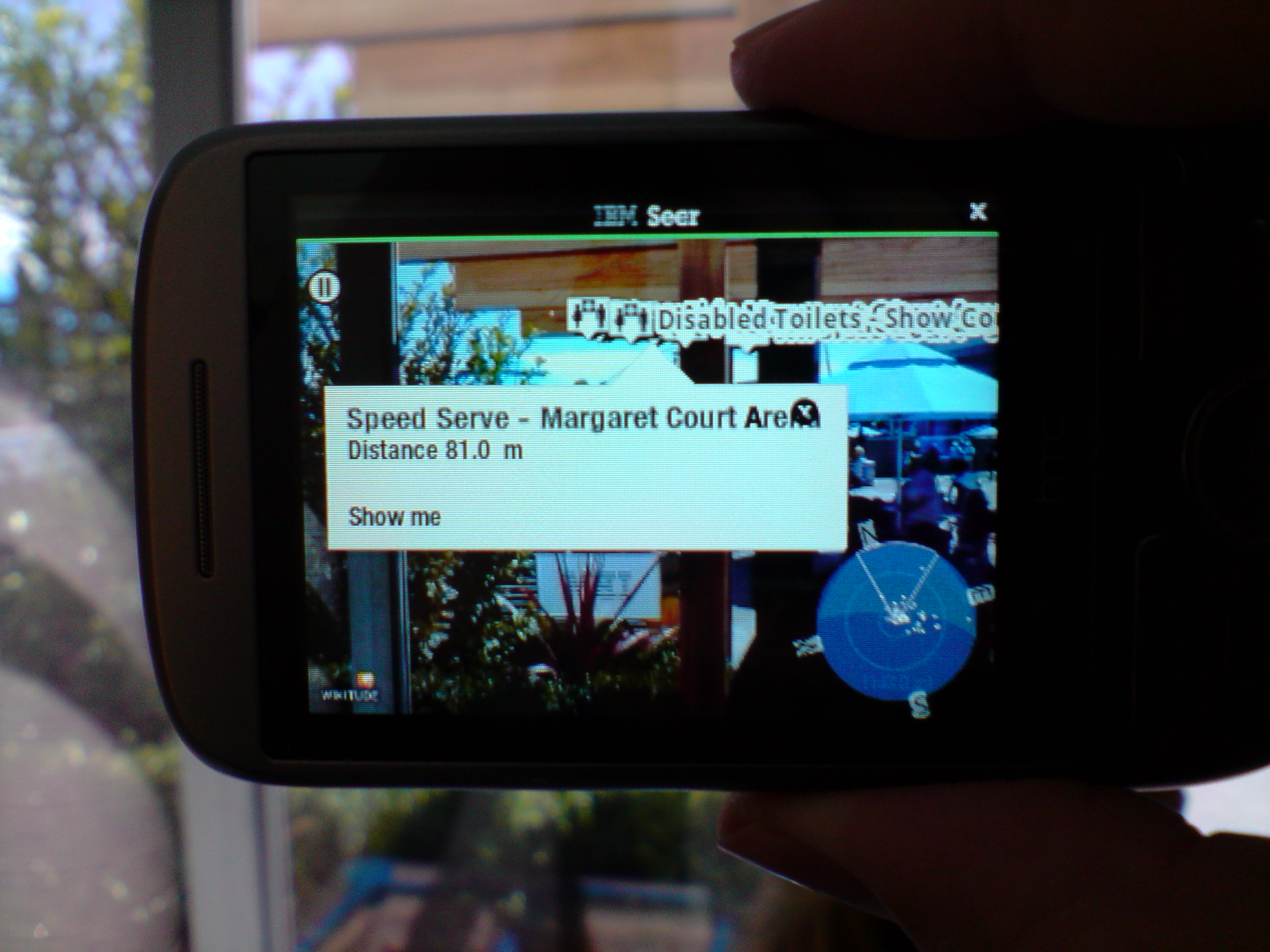
On Monday I visited the Australian Open [1] it s one of the world s greatest tennis championships and it s on in Melbourne right now. IBM sponsored my visit to show me the computer technology that they use to run the event and display the results to the world via their web site and to various media outlets. picture of IBM Seer software running on HTC Hero The first thing that they showed me was the IBM Seer software on the HTC Hero phone (which runs the Google Android OS). Seer can be freely downloaded from the Android store. The most noteworthy feature is that it uses the camera in the Android phone to display a picture of whatever you are looking at with points of interest superimposed (such as the above picture where I asked for locations of events and toilets). But it also displays a map view and has some other features I didn t get a chance to test such as viewing twitter data relevant to the event. We really need this augmented reality feature enabled with tourist data for major cities. I m sure that there s lots of interesting things I haven t seen in my own home city, if I could just pull out a phone and see a map of what s around me whenever I m bored I could see some of them. I think that this has the potential to change the way we use phones, in theory this was available as soon as Google Maps was released, but Seer seems to be the start of a whole new range of developments. One of the uses of this will be for identifying the background in tourist photos, no more of the me in front of old building descriptions. Here is a Youtube Video of the Seer software in action [BMLgHGV4zWM]. The tour guide explained that to get the software to work on an iPhone would require the 3GS for navigation as the earlier iPhones don t have a compass. The Seer software was initially developed for The Championships, Wimbledon 2009 which happened at about the same time as the iPhone 3GS release. I expect that there will be enough iPhone 3GS units sold before Wimbledon 2010 to give IBM a good incentive to port Seer to the iPhone. Three (my phone company at the moment) has just sold out of the HTC Magic which has a digital compass. They are selling the HTC Touch Pro and HTC Touch Diamond that appear to lack a digital compass. Vodaphone is offering a HTC Magic free on the $29 contract right now. The other Australian mobile phone companies don t seem to offer any Android phones. So it seems that the only option right now if I wanted to purchase a phone in Australia that can run Seer is the Vodaphone HTC Magic, and that s a phone that was released almost a year ago (a long time with recent progress in phone development it s the modem before the HTC Hero I tested) and which has only a 3.2MP camera (the LG U990 Viewty I used to take the picture for this post has a 5MP camera and is older than that). So I expect that there aren t many people using Seer in Australia. If you happen to be in Melbourne and have an Android phone with a digital compass then you may want to visit the Australian open to try the Seer software. It should work equally well from outside the security fence I ll write about the other things I saw over the next few days.

Jonathan McDowell: Sinful admission

Knowing full well that it will cause many of my readers to tut and roll their eyes at me I derive slight pleasure from confessing that I have now eaten at McDonalds on 6 continents. To make it worse I only did so in Asia and Australia so I could say I had.

It does lead me into a slightly more valid ramble. I'm not particularly bothered about eating on my own. I like food (even if I'm picky about what I like), but I prefer it with company. This means I'm not particularly great about being organised to cook complicated things when I'm on my own; largely the whole thing just turns into dealing with hunger. It also mean I'm bad at finding nice places to eat out while travelling. Which, when you're travelling for a month to some interesting places, is a bit of a bugger. I've got a bit better at actually going to nice places, and trying not to bolt my food into me so I can get out ASAP but instead enjoy it. A book helps. Also places that aren't quite as busy (which if you have no agenda is nicely achieved by letting your body clock desync from the world around you). Unfortunately I didn't really do so until after Hong Kong. Guess I'll just have to go back at some point...

(More on my travels at some point, maybe. I've started the tortuous journey home now.)

Russell Coker: Costs and Benefits of Search Engines

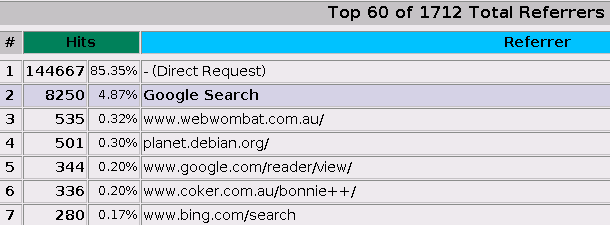
Chris Smart writes about the latest money making schemes for OS distributors, Canonical is getting paid by Yahoo to make them stop using Google as the default Firefox search engine [1]. I think this is OK, the user can easily change it back if desired and it allows them to pay the salaries of more employees who contribute code back to upstream projects. MSN uses 455M, Google uses 189M, and Yahoo uses 109MGoogle referrs 8250 hits, but Bing only refers 280 Above are sections of my Webalizer output related to my blog which show the data transfer use of search.msn.com (Bing presumably) which is 50% greater than that of Google and Yahoo combined. Why does MSN need to do 455MB of transfer so far this month to scan my blog when Google gets the job done with 189M and Yahoo only takes 109M? Also judging by the referrals Bing is only 3% as much use to me as Google. MSN uses 525M, Yahoo uses 132M, and Google only uses 35M Above is a sample of the Webalizer output from www.coker.com.au, MSN is using 525MB of data to scan the site which contains about 1.2G of static files that change very rarely. A Russian malware site seems to be downloading it three times a month, and Google only takes 35MB of data transfer to scan the site (which is probably still excessive). If Bing was a quality search engine that returned appropriate results then this could be forgiven. But however it is a very poor search engine that returns bad results. For example if you query Google or Yahoo for bonnie++ you will get an entire page of search results concerning my Bonnie++ benchmark, and those results are ordered in a sensible way. If you ask Bing then the first four results concern Bonnie (three women and a plant) and most of the first page don t concern my benchmark. Some time ago I had blocked MSN from scanning a server that I ran. The server in question had all the web servers for my domain plus quite a few other small domains. The total MSN data transfer was 3G per month which was almost half the data allowance for the server in question (data plans in Australia suck that s why my web servers are hosted in Germany now), so it was a question of whether to allow normal operation of the business or MSN searches. With Microsoft not running a popular search engine (then or now) it was an easy decision. I think that anyone who accepts money from Microsoft/Bing is doing their users a mis-service. Bing is simply an inferior search engine, it gets bad results and imposes excessive costs on service providers. Yahoo however seems to be a reasonable service, not as good as Google for the web hosters but not too bad. I wonder what would happen if Yahoo offered some sponsorship money to the Debian project in exchange for being the default search engine. I m sure it would be dramatic.

Michal Čihař: Gammu is being used in vendor software

I always thought Gammu to be workaround for phones whose vendors do not provide software for your favorite operating system. We try to do our best job to work with variety of phones, even though this is hard and never finished job. However today I was really surprised to find out that some phone vendor built their official application for managing phone on Gammu. The application is of course closed source and available only for Windows, but this does not change anything on the fact they use it. They seem to have modified code slightly, adding some new functions and removing others, separated the code to several DLLs, however I'm 100% sure it is Gammu as they use some unique (read awful) things we have in our code. I'm not going to disclose their name right now as I want to give them fair amount of time for reaction on my asking for sources. But you will for sure find more information later in my blog. PS: Gammu is of course not the only free software used inside this application, you can find more there (and you will find there more than I did if you will look longer than few minutes I spent on examining rest of code).

26 January 2010

Joey Hess: issues with openmicroblogging

I tried switching from identi.ca to brainbird today, when my always present frustration with 140 character limit in microblogging boiled over. Again. In the process, I've found some warts in the OpenMicroblogging system, beyond its obsession with fitting into an obsolete sideband communication medium that I will never actually use. Rant mode on. Let's assume that OpenMicroblogging catches on, in a big way, and we're all using it in 10 years. So, it will be something like email. And its federated design allows for that; there can be multiple servers that communicate, and so on. (Which is a very good thing, compared to the twitter monoloth.) But: How many times have you changed your email address? When you did, you probably set up a .forward for the old email address, and emailed some people from the new address to let them update their address book, and it was not a big deal. But the experience when changing an OpenMicroblogging site is not the same. You have to go out and re-follow everyone. For each person, you have to go through a multiple screen (OAUTH) process. This process may not even be automatible. Second problem is that OpenMicroblogging does not use addresses. So to talk to me, one uses @joey'. It's not clear to me how sites determine whether to direct that to joey@identica or to joey@brainbird. Seemed like, if I switched to brainbird, I would need to pick a new username, to avoid having to check both places. Finally, the OpenMicroblogging spec, while really quite a neat approach to piggyback on OAUTH, has some absurd limits. 140 characters for a biography. Even the limit for one's full name is longer than that. Absurd. Suprisingly, no 140 character limit on messages actually exists, that's just a recommendation. But it's unclear how a system that sends a longer message interoperates with systems that use shorter messages. Probably the message will be truncated. And there is no way in the protocol to discover the message limit of a remote system. All in all, I think I prefer RSS, or Google Wave, or even IRC from a protocol perspective. And from a usability perspective, Facebook does not have absurd message limits, and most people read my messages there anyway. Meh.

Joey Hess: started termcasting

I've hooked one of my laptop's terminals up to the net, so anyone with IPv6 can telnet in and see it. I've long wanted to be able to broadcast my terminal sessions on occasions when it makes sense. Like when I'm fixing someone's bug, or closely collaborating with someone distant. I am also interested in finding things to host on IPv6. Right now, that means only people who care will be able to access it. So it seems the trick is to find places where that is a benefit. I plan to keep an eye out for more things like this. (A side benefit of using IPv6 is that it makes it easier to serve content from my laptop, that moves from network to network.) So, tune in to my termcast! termcast

Guido G nther: Git-buildpackage and 3.0 source format

Here's a short overview of 3.0 source format support in git-buildpackage 0.4.64: One loose end is the handling of multiple upstream tarballs (#561071, #561072). I'd be great to hear from people already using this feature how this can best be added into the gbp workflow. The newer kids in town gbp-clone, gbp-pull (for keeping the repo up to date when using team maintenance) and gbp-pq (for managing the quilt patch-queue) don't care about the underlying source package format. These three are a bit underdocumented in the manual but information about the workflow is in the wiki.

Rob Taylor: The Semantic Desktop, SPARQL and You @ FOSDEM

In a couple of weeks at FOSDEM, I ll be giving a talk in the GNOME developer room on the semantic desktop and showing the new world of interaction that RDF, SPARQL and Tracker make possible. I ll be joined by Philip Van Hoof and Roberto Guido. We ll be digging behind the buzzwords, explaining what it s all about and most importantly showing off cool real-world apps using this stuff. We ll also announce a competition for the coolest app using Tracker and RDF, for which Codethink will sponsor a prize. See you all there! I'm going to FOSDEM, the Free and Open Source Software Developers' European Meeting

Uwe Hermann: Roda RK886EX (Rocky III+) first laptop/notebook being supported by coreboot

coreboot logo Only few days ago a long-standing bug in coreboot, the Free Software x86 BIOS/fimware project, has been fixed: Adding support for a laptop/notebook. The code was developed by coresystems GmbH (thanks a lot!). Quoting from the announcement:
coreboot is running on a multitude of different computers, ranging from tiny embedded systems as small as the palm of your hand over desktop and server systems to super computers with thousands of nodes. However, one might say that in the area of mobile computers coreboot has to catch up, compared to its support of other devices. Thus, I am especially glad to announce that coresystems GmbH is releasing coreboot for the Roda RK886EX a.k.a Rocky III+ notebook today. It's a rugged notebook, protected against shock, vibration, dust and humidity:
http://www.roda-computer.com/en/products/notebooks/rocky-iii-rk886ex.html We have been testing various Linux distributions as well as Windows XP and Windows 7 booting on this nice notebook. I want to sincerely thank those who made this project possible with their funding:
  • secunet Security Networks AG
  • Bundesamt f r Sicherheit in der Informationstechnologie (Federal Office for Information Security, BSI)
A big thank you also goes to everyone who worked with coresystems on this project.
The committed patch series includes improved support for the Intel i945 / ICH7 chipset (which was also written by coresystems), the SMSC LPC47N227 Super I/O, the Texas Instruments Cardbus+Firewire bridge TI PCI7420, and finally the Renesas M3885x Embedded Controller (EC). Btw, the latter, the so-called embedded controller (sometimes integrated in the Super I/O, sometimes it's an extra chip) is one of the major problems for coreboot support on laptops. They are almost always undocumented (i.e., no public datasheets are available), but they have low-level control over power/battery management, early power-up sequence, and often include keyboard controller functionality and other important stuff. Luckily, for this notebook an EC datasheet is available. Checkout the coreboot EC support code for the Renesas M3885x for an impression of what this stuff is all about. Anyway, there is hope that this laptop will only be the first in a row of multiple supported ones in the future. Interested developers and contributors are of course always welcome on the coreboot mailing list :-)

25 January 2010

Peter Eisentraut: PostgreSQL: The Universal Database Management System

I'm glad you asked, since I've been pondering this for a while. $subject is my new project slogan. Now I'm not sure whether we can actually use it, because a) it's stolen from Debian, and b) another (commercial, proprietary) database product already uses the "universal database" line.

I have come to appreciate that the "universality" of a software proposition can be a killer feature. For example, Debian GNU/Linux, the "universal operating system", might not be the operating system that is the easiest to approach or use, but once you get to know it, the fact that it works well and the same way on server, desktop, and embedded ensures that you never have to worry about what operating system to use for a particular task. Or Python, it's perhaps not the most geeky nor the most enterprisy programming language, but you can use it for servers, GUIs, scripting, system administration, like few other languages. It might as well be the "universal programming language". A lot of other software is not nearly universal, which means that whenever you move into a new area, you have to learn a lot of things from scratch and cannot easily apply and extend past experiences. And often the results are then poor and expensive.

The nice thing about PostgreSQL is that you never have to worry about whether to use it, because you can be pretty sure that it will fit the job. Even if you don't care whether something is "open source" or "most advanced". But it will fit the job. The only well-known exception is embedded databases, and frankly I think we should try to address that.

Tollef Fog Heen: How free is the N900?

Lucas asks about how free the N900 is, whether he can download and recompile and reflash. I'll try to answer some of those questions. No, you can't download all the source. Part of it is just not open. I am not privy to Nokia's decisions on why or why not to open up, but it seems like the user interface bits are only partially open. Hildon itself is open so you can poke at widgets and see how those work. The address book is not open. The telepathy component that talks to the cellular modem is not open. As for having to accept EULAs, I honestly don't remember accepting one of those, but I'm not going to say there are none. There's at least one which is every time you install a package where you have to check a box saying "Yes, I know this package is third party and will not sue Nokia if it causes my house to burn down, my wife to divorce me or causes somebody to steal the car". It's annoying, but I'm willing to live with it. The contents of apt's sources.list is:
deb https://downloads.maemo.nokia.com/fremantle/ssu/apps/ ./ 
deb https://downloads.maemo.nokia.com/fremantle/ssu/mr0 ./ 
deb https://downloads.maemo.nokia.com/fremantle/ovi/ ./ 
deb http://repository.maemo.org/extras/ fremantle free non-free
deb http://repository.maemo.org/extras-devel/ fremantle free non-free
(technically, it comes from /etc/apt/sources.list.d/hildon-application-manager.list, not sources.list.) I believe the built-in applications are generally not free, so rebuilding everything that is free will for instance leave you without any address book UI, the built-in map application or camera. Sadly, the X driver is also proprietary, so you won't be able to see anything either. I don't think you can usefully install another free distro on the N900. You might be able to, at some point, assuming somebody goes to the effort. The last question is "- Besides the non-free telephony stack, are there any other antifeatures I should be aware of?". The telephony stack is implemented around Telepathy, which is LGPL-ed free software. While it's correct that telepathy-ring (which talks to the cellular modem), the call UI and most of the address book are proprietary, the rest of Telepathy is free. There are SIP and XMPP connection managers that are free, and you can install more connection managers for MSN, IRC and so on. Also, I think it's important to emphasise that the telephony stack does not contain any antifeatures. The closest thing you would be able to find is probably the restriction to one active and one held call at the same time, but as one of the developers said: "That's to prevent the UI from going mad". While I like to tout the N900 as a free phone, it is in no way completely free. Large parts of it are free, and almost as importantly: most of the programming interfaces are free and at least somewhat documented, so if somebody wants to replace the built-in camera application with a free one, they can replace the DBus interface that the camera app provides. Ditto for maps applications, the address book and so on.

MJ Ray: Critical Eye: Google, China, DNS and an Event

My Google Bugs page started off as a blog post back in 2006, but I ve moved it to a more permanent home and started to bring it up to date. Recent additions include the China Controversy updated, a recent search bug added andDNS service added. In just over a month, BathLitFest will be holding a debate on Is Google Good For You? Sunday 28 Feb, 1pm 2pm. The key questions are:
In the data-sharing and database age, how much information are we prepared to give away about ourselves and who, ultimately, controls that information? Is the price of convenient, high-speed communication an almost total loss of privacy? And is it right that one company knows more about us than our government, or even than we know ourselves?
Tickets are on sale, priced 7. That s pretty much what I was pointing out back in 2006. I don t hate Google or anything, but we should be realistic: it is a for-profit company, so probably won t be doing anything truly for free. There s always a payback and we should recognise it as part of making an informed choice about whether to trade with them. It s nice to see these questions getting a more mainstream airing. If you ve got any updates for the Google Bugs page, please let me have them.

Martin F. Krafft: Vodafone intransparency

Coming to New Zealand for an extended period of time, I figured it would make sense to purchase a prepay mobile plan to make it easier to mix with locals. Not knowing better, I went with Vodafone, which I whole-heartedly regret: their website is a massive pain in the ass, their price plans completely over the top, and their customer service representative incompetent and unfriendly. My latest experience eclipsed all previous encounters, and makes me want to tell you about it: Between all the obscure add-ons Vodafone threw at me when I bought this SIM card, two weeks ago I couldn t figure out how my balance had decreased from $30 to $0 when I rarely ever made calls. I wrote an e-mail to their customer service hotline, and it took them a week to get back to me, with the following text:

Due to being a Prepay Customer, unfortunately usage details are not available as per terms and conditions. I have although checked your usage and can confirm that all charges are correct.
Obviously, I wasn t going to accept this claim of omniscience, so when last weekend, $20 disappeared over the course of a day, that was the catalyst for me to reopen the ticket and reply along the lines of:
Only I know when I used my phone and thus only I can determine whether the charges are correct. Please show the full records to me, or else
This seemed to convince the representative, and 8 messages and 11 days after my initial request, I was told I could request the records at $5/30 records. Yes, you read that right: they wanted to charge me to view the records. I thus replied:
I am NOT willing to pay for that. If you are unable to comply with my desire for transparency, then I shall terminate the contract and make sure to inform the media as well as the consumer institute of this conduct. As stated previously, I shall also consult with a lawyer. Charging consumers to view data that is obviously available is a strong indication that you do not want me to see it. I can t imaging why this would be the case other than the data being inconsistent with reality.
That worked, and I finally got an Excel sheet with my usage data, which allowed me to track down the depletion of my account: to lure customers in, they promise free calls to other Vodafone numbers for the first four weekends. There are three problems with that though:
  1. Having purchased my card on Saturday afternoon, I was annoyed to find out that the remaining 34 hours of that weekend would be counted as a whole weekend.
  2. They don t provide a way by which to find out whether a given number actually belongs to Vodafone or not. The 021 prefix is not enough of an indication.
  3. They don t actually tell you anywhere but the aforementioned horrific website that the addon has expired.
So thanks, Vodafone. You ve lost a customer, who should have gone with 2degrees in the first place, who have much lower rates, even though their data coverage doesn t seem as good. I don t need data anyway. I ll still insist on Vodafone providing the data in a Free format. You can find more information about NZ mobile phone providers on the LCA2010 wiki page. NP: Age Pryor: Shank s Pony

24 January 2010

Russell Coker: Old Mobile Phones as Toys

In the past I have had parents ask for advice on buying a digital camera for a young child. For some years there have been digital cameras on sale for much less than $100 cheap enough that no-one will be THAT bothered if the child breaks it, so digital photography is a good hobby for a young child. Such cameras are however quite bulky and require AA batteries which often don t last that long between charges. Some of the cheap phones are large enough that a 3yo child can have trouble carrying them. I recently gave an old LG U8110 phone to a young child for use as a camera. The phone has a 640*480 resolution camera and a display that is a few centimeters wide. It s no good for any remotely serious photography, and among other problems I never managed to get it s USB connection to work so the only way I ever managed to get a photograph off it was to MMS it to a newer camera. But it s quite adequate for a child to play with, it s small, light, and the battery stays charged for ages. Also the phone has a clock built in which is a handy feature it seems that nowadays the trend in society is away from wearing a watch and towards using a mobile phone to discover the time. Also a phone is a fairly capable computer, I think that the first two computers that I owned had significantly less CPU power and RAM than an LG U8110 and lots of newer phones compare well to PCs that were manufactured in the mid 90 s. The trend has been towards having an increasing number of applications and games on phones which of course gives more things for a child to play with. I believe that playing with computers that have a variety of different user interfaces and sets of applications is good for the education of young children. Now to make a phone work you need to have a SIM. If a phone was designed by someone who was intelligent and who was acting on behalf of the owner of the phone then it would support the camera etc without a SIM. But it seems that mobile phones are either designed by idiots or they are designed to act on behalf of the phone companies to the exclusion of the customer s interests, so I haven t seen a camera-phone that is usable for any purpose other than calling the emergency services when there is no SIM installed. Fortunately it is possible to get old SIMs, I had one that was replaced due to an intermittent fault that caused calls to drop out. I also have some SIMs from other telcos that would probably work (I m not sure whether a phone that is locked to one carrier will take photos if a SIM from another carrier is installed). Update: It seems that there is a range of phones that operate without a SIM, a Nokia N900 (if you consider it to be a phone rather than an Internet tablet), an Android, or a phone running the Symbian OS. I suspect that the majority of phones that are currently in use and due to be replaced soon will require a SIM though. One final notable aspect of giving a phone to a child is the possibility of it being used to call emergency services (which will work even when there is no SIM or a SIM that is not associated with an account). If you are planning to give a phone to someone else s child then you should ask the parents first, some parents believe (either correctly or incorrectly) that the chance of their child making prank calls to the emergency services is too great. A present that a child receives which is undesired by their parents will probably get lost or broken quickly When such a phone gets broken by a child (they are tough, but almost everything that is used without restriction by a child gets broken) the next thing to do is to disassemble it. With modern design and manufacturing probably all that a child could really learn from a phone is how the keyboard works and not even that for a touch-screen phone. But it s still a good experience for a child to take apart old machines. When I was young my father gave me many old machines to take apart, I had a lot of fun and learned some interesting things. I find it really sad to see those boxes for recycling old phones at the mobile phone stores which are full of 2yo phones that are mostly in good condition. Almost everyone has some young relatives or friends who have children who could find a good use for that stuff. Send the bits to be recycled AFTER the children nearest to you have finished doing things to the old phone!

Steve Kemp: What the hell are you laughing at?

Slaughter
I received my first patch to slaughter today, which made me happy. (I've made a new release including it, and updated the list of primitives to actually document the file-deletion facilities which previously I'd omitted to avoid encouraging mass-breakage.)
Signing Binaries
Andrew Pollock mentions that the days of elfsign might be numbered. This is a shame because I've always liked the idea of signing binaries. Once upon a time, in the 2.4.x days, I wrote a kernel patch which would refuse to execute non-signed binaries. (This was mostly a waste of time; since it denied the execution of shell scripts. Which meant that the system init scripts mostly failed. My solution in the end was to only modprobe my module once the system was up and running, and hope for the best ...) Right now, having performed only a quick search, I don't see anything like that at the moment.
  • elfsign will let you store a binaries MD5 hash.
  • bsign will let you sign a binary with a GPG key.
But where is the kernel patch to only execute such hashed/signed binaries, preventing the execution of random shell scripts and potentially trojaned binaries? Without that I think signing binaries is a crazyish thing to do. Sure you can test that a file hasn't been modified, but even without those tools you can do the same thing via md5sums. (ObRandom: Clearly if you mass-modify all your binaries the system md5sums database will be trashed.)
Perl UTF
I've received a bug report against chronicle, my blog compiler. It seems that some versions of perl fail to run this:
     #
     #  Run the command, reading stdout.
     #
    open( FILTER, "$cmd ;utf8" ) or
       die "Failed to run filter: $!";
Removing the ;utf8 filter allows things to work, but will trash any UTF-8 characters from the output - so that's a nasty solution. I'm not sure what the sane solution is here, so I'm going to sit on it for a few days and continue to write test scripts.
ObSubject: 300

Alexander Reichle-Schmehl: Question:

How many DDs does it take to open the CD-ROM drive of a PowerPC G4 running Mac OS X 10.2? 9 and two external helpers. And they need more than 25 minutes. I'm sure pictures will follow soon... PS: I don't mention how to do it, to not take the fun for future observers...

Next.

Previous.