Search Results: "uli"

27 June 2010

Anand Kumria: L'arnac ur (The Heartbreaker)

The setup and premise is fantastic. Alex is a professional in the love game. He job is ensure that people do not end up with the wrong partner. He is good looking, charming, speaks a multitude of languages are swears by a moral code to Never break-up a happy couple. His mission is to break up the seemingly perfect couple Juliette (played by Vanessa Paradis who has a lovely Diastema) and Jonathan (Andrew Lincoln) before they marry in 10 days. Stylish and set in luxurious Monaco. It's damn French. It's damn funny. Plenty of high-tech. spy stuff, drama about loan sharks, lots of dancing and lots of fun, if you get the chance, see this. You'll enjoy it.

23 June 2010

Christoph Berg: Cool Unix Features: nproc

Since coreutils 8.1 (in Squeeze, not Lenny), there is a command that simply prints out how many processors (cores, processing units) are available:
$ nproc
2
The use case is obvious:
$ make -j $(nproc)
On a side note, this is gnulib's nproc module wrapped into a C program. If you didn't know gnulib before (it had slipped my attention until recently), it is a library of portability functions and other useful things. Adding it to a project is simply done by calling gnulib-tool and tweaking a few lines in the automake/whatever build scripts. PS: do not use nproc unconditionally in debian/rules. Parse DEB_BUILD_OPTIONS for "parallel" instead.

19 June 2010

Torsten Werner: Results from the Debian Community Poll

I have announced the Debian Community Poll in my former blog post. I have closed the poll today and I will start publishing its results now.
What is the codename of the current stable release?This is the only compulsory question with the intention to block spammers. The correct codename is Lenny but I have accepted almost any answer that is somehow related to Debian. Version numbers, names from Sarge to Experimental, even well known codenames and version numbers from Ubuntu have been counted as correct. 22 partipants answered wrongly and their submissions got removed from the result set. A whopping number of 3258 submissions have been accepted and get analyzed now. Thanks to all participants!
How long have you been using Debian?

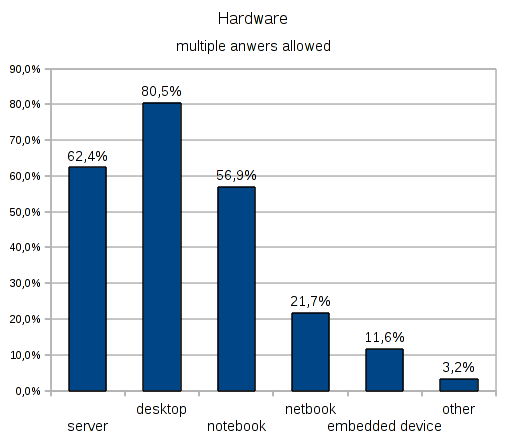
On what kind of hardware are you using Debian?
Multiple answers are allowed for this question and that is why the values do not sum up to 100%.
  • 80.5% are using Debian on the desktop
  • 62.4% on the server
  • 56.9% on the notebook
  • 21.7% on the netbook
  • 11.6% on embedded device(s)
  • 3.2% on other device(s)
The following other devices have been mentioned: smartphone, virtual machine, nettop, NAS, HTPC, workstation, pendrive, live cd, cluster, thin client, router, rocket flight computer, ibm mainframe, and automatic bar tender.

Do you contribute to Debian?
  • 50.0% choose answer #5: I don't contribute on a regular base.
  • 31.2% choose answer #4: I'm regularly helping other Debian users.
  • 8.0% choose other (see below) or simply did not answer
  • 4.9% choose answer #3: I'm regularly contributing to Debian packages without uploading them by myself.
  • 4.5% choose answer #1: I'm a Debian developer.
  • 1.4% choose answer #2: I'm a Debian maintainer.
The following other answers have been provided:
  • upstream developer or contributor
  • translator
  • bug reporter
  • advocator
  • former DD or DM
  • prospective DD or DM
  • mirror maintainer
  • package/installer tester
  • documentation writer
  • donator or debconf sponsor
  • debconf organizer or helper

How do you think about the Debian Free Software Guidelines (DFSG)?
  • 46.0% choose answer #2: I like the DFSG but it is not the most important reason for using Debian.
  • 36.6% choose answer #1: The DFSG is very important to me. I could live with many changes in Debian but I would be very upset if Debian would allow non-free software into its main component in the future.
  • 10.1% choose answer #3: I don't know.
  • 4.9% choose answer #4: I don't care.
  • 2.4% did not answer.

Are you using Debian derived distributions, too?
Multiple answers are allowed for this question and that is why the values do not sum up to 100%. There were a lot of different answers but the most frequent are:
  • 47.1%: Ubuntu (Kubuntu, Lubuntu, Xubuntu)
  • 40.8%: no answer; this was the only way to say that someone does not use a derived distribution
  • 11.0%: other (see below)
  • 7.0%: damn small linux
  • 4.8%: Sidux
  • 4.3%: grml (juxlala)
  • 2.2%: Knoppix
  • 1.6%: ELive
  • 1.4%: Maemo
The other answer includes the following distributions: 64studio, ALT Linux, arch linux, ArtistX, BackTrack, BRLix, Canaima GNU/Linux, catix, cdlinux.pl, CloneZilla, CrunchBang, Custom, ddwrt, debian arm userspace for zipit z2, DebXO (?), DreamLinux, Easy Peasy, eb4, eeebuntu, EMC2 Ubuntu (linuxcnc.org), Emdebian, Estrella Roja, Fedora, Finnix, Gentoo, gNewSense, Hackable:1, Kanotix, Kuliax, LFS and CLFS, LinEx, Linux Mint, live CDs, live-helper, Mepis antix, Musix, My own LiveCD, Mythbuntu, OpenInkpot, openwrt, paipix gnu, Parsix, Peppermint, personal debian derived, proxmox, Puppy, PureOS, qtopia, SHR, simplyMEPIS, Skolelinux, slackware, SymphonyOS, Toutou, Trisquel, tty GNU/Linux, UHU Linux, Univention Corporate Server, vinux, Voyage, Vyatta, whiite, Xandros, Xarnoppix. Not all of them are derived from Debian.

- to be continued -

Julien Valroff: My experience without Adobe Flash Player

Adobe recently announced they have (temporarily) stopped working on the amd64 version of their Flash Player for GNU/Linux. The previous releases contain a big security issue, which makes them totally unusable. As I didn t want to wait until the flashplugin-nonfree package to be updated to support the i386 plugin through nspluginwrapper (as suggested in #586273), I have decided to simply switch to the free alternative: gnash. After a few hours with it, I am now able to use most of the websites I usually visit, including Youtube and Dailymotion. Note that I use Iceweasel, which does not support WebM (for now), nor H.264 (which will never be supported by Mozilla). Youtube support is brought by a Greasemonkey user script available at: http://turanct.wordpress.com/2010/02/25/gnash-youtube/
The only tiny drawback is that the videos load in pause mode. For now, everything else seems to work fine. Users of other browers (Chromium, Safari, Opera) can try their HTML5 beta: http://www.youtube.com/html5 It is even easier for Dailymotion, as the videos on their HTML5 beta program are encoded in the Ogg Theora format, which is natively supported by Iceweasel/Firefox >= 3.5. To ease things, I have written a small Greasemonkey script which simply automatically redirects www.dailymotion.com to openvideo.dailymotion.com. This script can be downloaded here. The drawback is that videos won t play before they are loaded completely, which is not a big problem anyway. I still cannot play the videos avilable on Vimeo, and have noticed while wirting this post that the Flash file uploader of WordPress didn t work with gnash (obviously, WP provides an alternative way for file upload). I will go on with this experience as long as I do not see major issue with gnash.
I will also update this post, or add comments, if I encounter other issues, or find any alternatives. I would be curious to read your comments if you have run similar experience.

16 June 2010

Julien Danjou: Announcing rainbow-mode

While customizing Emacs this last weeks, I had the need to customize also the color theme. Color themes are always a pain in the ass to edit, because you're supposed to read color strings like #aabbcc and guess what colors they represent. This is why I wrote rainbow-mode, a minor mode for Emacs that will highlight strings that represents color, using the color they represent. This support hexadecimal syntax, HTML color name, X color names and rgb() CSS syntax.

14 June 2010

Gunnar Wolf: What Mexico feels like

I have been recently approached by several friends, from different countries. Mexico and the violence seems to be a frequent news topic all over the world. I live in Mexico City, as ~25% of the country's population does. This is not an easy city, of course, and I won't deny it has tons of problems of its own. However, Mexico City (and even more so the approximately of it that is politically located in Distrito Federal, the formal country capital) is very lucky in this regard. Still, in most of the country, the violence is mostly in the news, mostly a worrying perception that is every day more insistent. My parents live in Cuernavaca, Morelos, ~80Km south from us. Morelos has been known for decades for being the druglords' getaway and safe haven, so it remained a mostly peaceful state for most of this time. This has changed, and at some points during this year, militarization feels quite creepy... Fortunately, just for a couple of weeks, and then back to what seems like normal. The real problems in Morelos is the undeniable corruption of its successive governments, the lack of regard for the population, the inexistent urban planning... However, I know from several friends living in the North of the country (and all along the very long border - The most drug-related violent states nowadays are Chihuahua, Durango, Sinaloa, Tamaulipas and Nuevo Le n, with only two states in the South Michoac n and Guerrero) that violence is really felt by local population on the streets. Some friends say they have grown used to hearing shootings (Durango), others say that it is now usual that the cartels openly strangle the city's vial system with the express purpose of showing off their strength (Monterrey, Nuevo Le n, one of Mexico's most important cities and taken in the past as a token of industrialization and first-world-like life conditions... Just don't look towards the poor areas). About Chihuahua, I'd rather not even talk, as by all accounts (official even) it rivals Iraq in the lack of control the government has of its territory. Still, with all that as background... I am afraid of what I read today in the news. I know a single declaration is not enough to worry about (as said in El Quijote, una golondrina sola no hace verano , a single swallow does not mean it's summer), but those things always start small... Until they explode. La Jornada reports that The retired general Luis Garfias Maga a recommends suspending constitutional guarantees in the country to be able to properly fight violence. The last century we had a sad and long history of cases where the military took over civilian power and suspended the constitutional rights in basically every nation in Latin America Except for Mexico. Not one of those cases was overall successful. Not one of them went by without raging abuses, without terrible consequences. I don't see imminent we will go over to a military rule nor anything close to it, but the environment is getting each time closer to how it was like before said rights suspension. We should learn that it is just not the way, it leads nowhere. I am convinced, and will keep insisting on it at every ocassion, that the only possible way to fight violence is by reducing the social distance, and that should be achieved most importantly by reducing poverty, but also by making it harder to become incredibly rich. Mexico's percentage of poor people has grown over the last decades, but at the same time, the amount of wealth concentrated in very few hands has grown much faster. A society with terribly rich and terribly poor people leads to hatred, leads to desperation, leads to violence. A flatter society, even if the overall standard was to be somewhat lower, tends to a better equilibrium. And yes, I know the original problem with drugs is that Mexico is a great transit area for drugs to reach the USA (and I could also rant about drug legalization I won't, it's late and I must go to work), but the main fuel for young people to leave everything behind and take the risk of starting a life of open ilegality is the lack of future they face all life long. That leads many to risk their lives attempting to cross the border to the USA (Mexico "exports" 500,000 people every year), but also lures them to jobs where they will have easy money... In exchange for their lifes, ultimately. Anyway... Just to repeat and round off: The answer to this problem is not repression, is not policial or military strength. Our only way out is through social justice.

13 June 2010

Petter Reinholdtsen: Lenny->Squeeze upgrades, removals by apt and aptitude

My testing of Debian upgrades from Lenny to Squeeze continues, and I've finally made the upgrade logs available from http://people.skolelinux.org/pere/debian-upgrade-testing/. I am now testing dist-upgrade of Gnome and KDE in a chroot using both apt and aptitude, and found their differences interesting. This time I will only focus on their removal plans. After installing a Gnome desktop and the laptop task, apt-get wants to remove 72 packages when dist-upgrading from Lenny to Squeeze. The surprising part is that it want to remove xorg and all xserver-xorg-video* drivers. Clearly not a good choice, but I am not sure why. When asking aptitude to do the same, it want to remove 129 packages, but most of them are library packages I suspect are no longer needed. Both of them want to remove bluetooth packages, which I do not know. Perhaps these bluetooth packages are obsolete? For KDE, apt-get want to remove 82 packages, among them kdebase which seem like a bad idea and xorg the same way as with Gnome. Asking aptitude for the same, it wants to remove 192 packages, none which are too surprising. I guess the removal of xorg during upgrades should be investigated and avoided, and perhaps others as well. Here are the complete list of planned removals. The complete logs is available from the URL above. Note if you want to repeat these tests, that the upgrade test for kde+apt-get hung in the tasksel setup because of dpkg asking conffile questions. No idea why. I worked around it by using 'echo >> /proc/pidofdpkg/fd/0' to tell dpkg to continue. apt-get gnome 72
bluez-gnome cupsddk-drivers deskbar-applet gnome gnome-desktop-environment gnome-network-admin gtkhtml3.14 iceweasel-gnome-support libavcodec51 libdatrie0 libgdl-1-0 libgnomekbd2 libgnomekbdui2 libmetacity0 libslab0 libxcb-xlib0 nautilus-cd-burner python-gnome2-desktop python-gnome2-extras serpentine swfdec-mozilla update-manager xorg xserver-xorg xserver-xorg-core xserver-xorg-input-all xserver-xorg-input-evdev xserver-xorg-input-kbd xserver-xorg-input-mouse xserver-xorg-input-synaptics xserver-xorg-input-wacom xserver-xorg-video-all xserver-xorg-video-apm xserver-xorg-video-ark xserver-xorg-video-ati xserver-xorg-video-chips xserver-xorg-video-cirrus xserver-xorg-video-cyrix xserver-xorg-video-dummy xserver-xorg-video-fbdev xserver-xorg-video-glint xserver-xorg-video-i128 xserver-xorg-video-i740 xserver-xorg-video-imstt xserver-xorg-video-intel xserver-xorg-video-mach64 xserver-xorg-video-mga xserver-xorg-video-neomagic xserver-xorg-video-nsc xserver-xorg-video-nv xserver-xorg-video-openchrome xserver-xorg-video-r128 xserver-xorg-video-radeon xserver-xorg-video-radeonhd xserver-xorg-video-rendition xserver-xorg-video-s3 xserver-xorg-video-s3virge xserver-xorg-video-savage xserver-xorg-video-siliconmotion xserver-xorg-video-sis xserver-xorg-video-sisusb xserver-xorg-video-tdfx xserver-xorg-video-tga xserver-xorg-video-trident xserver-xorg-video-tseng xserver-xorg-video-v4l xserver-xorg-video-vesa xserver-xorg-video-vga xserver-xorg-video-vmware xserver-xorg-video-voodoo xulrunner-1.9 xulrunner-1.9-gnome-support aptitude gnome 129
bluez-gnome bluez-utils cpp-4.3 cupsddk-drivers dhcdbd djvulibre-desktop finger gnome-app-install gnome-mount gnome-network-admin gnome-spell gnome-vfs-obexftp gnome-volume-manager gstreamer0.10-gnomevfs gtkhtml3.14 libao2 libavahi-compat-libdnssd1 libavahi-core5 libavcodec51 libbluetooth2 libcamel1.2-11 libcdio7 libcucul0 libcupsys2 libcurl3 libdatrie0 libdirectfb-1.0-0 libdvdread3 libedataserver1.2-9 libeel2-2.20 libeel2-data libepc-1.0-1 libepc-ui-1.0-1 libfaad0 libgail-common libgd2-noxpm libgda3-3 libgda3-common libgdl-1-0 libgdl-1-common libggz2 libggzcore9 libggzmod4 libgksu1.2-0 libgksuui1.0-1 libgmyth0 libgnomecups1.0-1 libgnomekbd2 libgnomekbdui2 libgnomeprint2.2-0 libgnomeprint2.2-data libgnomeprintui2.2-0 libgnomeprintui2.2-common libgnomevfs2-bin libgpod3 libgraphviz4 libgtkhtml2-0 libgtksourceview-common libgtksourceview1.0-0 libgucharmap6 libhesiod0 libicu38 libiw29 libkpathsea4 libltdl3 libmagick++10 libmagick10 libmalaga7 libmetacity0 libmtp7 libmysqlclient15off libnautilus-burn4 libneon27 libnm-glib0 libnm-util0 libopal-2.2 libosp5 libparted1.8-10 libpoppler-glib3 libpoppler3 libpt-1.10.10 libpt-1.10.10-plugins-alsa libpt-1.10.10-plugins-v4l libraw1394-8 libsensors3 libslab0 libsmbios2 libsoup2.2-8 libssh2-1 libsuitesparse-3.1.0 libswfdec-0.6-90 libtalloc1 libtotem-plparser10 libtrackerclient0 libxalan2-java libxalan2-java-gcj libxcb-xlib0 libxerces2-java libxerces2-java-gcj libxklavier12 libxtrap6 libxxf86misc1 libzephyr3 mysql-common nautilus-cd-burner openoffice.org-writer2latex openssl-blacklist p7zip python-4suite-xml python-eggtrayicon python-gnome2-desktop python-gnome2-extras python-gtkhtml2 python-gtkmozembed python-numeric python-sexy serpentine svgalibg1 swfdec-gnome swfdec-mozilla totem-gstreamer update-manager wodim xserver-xorg-video-cyrix xserver-xorg-video-imstt xserver-xorg-video-nsc xserver-xorg-video-v4l xserver-xorg-video-vga zip apt-get kde 82
cupsddk-drivers karm kaudiocreator kcoloredit kcontrol kde kde-core kdeaddons kdeartwork kdebase kdebase-bin kdebase-bin-kde3 kdebase-kio-plugins kdesktop kdeutils khelpcenter kicker kicker-applets knewsticker kolourpaint konq-plugins konqueror korn kpersonalizer kscreensaver ksplash libavcodec51 libdatrie0 libkiten1 libxcb-xlib0 quanta superkaramba texlive-base-bin xorg xserver-xorg xserver-xorg-core xserver-xorg-input-all xserver-xorg-input-evdev xserver-xorg-input-kbd xserver-xorg-input-mouse xserver-xorg-input-synaptics xserver-xorg-input-wacom xserver-xorg-video-all xserver-xorg-video-apm xserver-xorg-video-ark xserver-xorg-video-ati xserver-xorg-video-chips xserver-xorg-video-cirrus xserver-xorg-video-cyrix xserver-xorg-video-dummy xserver-xorg-video-fbdev xserver-xorg-video-glint xserver-xorg-video-i128 xserver-xorg-video-i740 xserver-xorg-video-imstt xserver-xorg-video-intel xserver-xorg-video-mach64 xserver-xorg-video-mga xserver-xorg-video-neomagic xserver-xorg-video-nsc xserver-xorg-video-nv xserver-xorg-video-openchrome xserver-xorg-video-r128 xserver-xorg-video-radeon xserver-xorg-video-radeonhd xserver-xorg-video-rendition xserver-xorg-video-s3 xserver-xorg-video-s3virge xserver-xorg-video-savage xserver-xorg-video-siliconmotion xserver-xorg-video-sis xserver-xorg-video-sisusb xserver-xorg-video-tdfx xserver-xorg-video-tga xserver-xorg-video-trident xserver-xorg-video-tseng xserver-xorg-video-v4l xserver-xorg-video-vesa xserver-xorg-video-vga xserver-xorg-video-vmware xserver-xorg-video-voodoo xulrunner-1.9 aptitude kde 192
bluez-utils cpp-4.3 cupsddk-drivers cvs dcoprss dhcdbd djvulibre-desktop dosfstools eyesapplet fifteenapplet finger gettext ghostscript-x imlib-base imlib11 indi kandy karm kasteroids kaudiocreator kbackgammon kbstate kcoloredit kcontrol kcron kdat kdeadmin-kfile-plugins kdeartwork-misc kdeartwork-theme-window kdebase-bin-kde3 kdebase-kio-plugins kdeedu-data kdegraphics-kfile-plugins kdelirc kdemultimedia-kappfinder-data kdemultimedia-kfile-plugins kdenetwork-kfile-plugins kdepim-kfile-plugins kdepim-kio-plugins kdeprint kdesktop kdessh kdict kdnssd kdvi kedit keduca kenolaba kfax kfaxview kfouleggs kghostview khelpcenter khexedit kiconedit kitchensync klatin klickety kmailcvt kmenuedit kmid kmilo kmoon kmrml kodo kolourpaint kooka korn kpager kpdf kpercentage kpf kpilot kpoker kpovmodeler krec kregexpeditor ksayit ksim ksirc ksirtet ksmiletris ksmserver ksnake ksokoban ksplash ksvg ksysv ktip ktnef kuickshow kverbos kview kviewshell kvoctrain kwifimanager kwin kwin4 kworldclock kxsldbg libakode2 libao2 libarts1-akode libarts1-audiofile libarts1-mpeglib libarts1-xine libavahi-compat-libdnssd1 libavahi-core5 libavc1394-0 libavcodec51 libbluetooth2 libboost-python1.34.1 libcucul0 libcurl3 libcvsservice0 libdatrie0 libdirectfb-1.0-0 libdjvulibre21 libdvdread3 libfaad0 libfreebob0 libgail-common libgd2-noxpm libgraphviz4 libgsmme1c2a libgtkhtml2-0 libicu38 libiec61883-0 libindex0 libiw29 libk3b3 libkcal2b libkcddb1 libkdeedu3 libkdepim1a libkgantt0 libkiten1 libkleopatra1 libkmime2 libkpathsea4 libkpimexchange1 libkpimidentities1 libkscan1 libksieve0 libktnef1 liblockdev1 libltdl3 libmagick10 libmimelib1c2a libmozjs1d libmpcdec3 libneon27 libnm-util0 libopensync0 libpisock9 libpoppler-glib3 libpoppler-qt2 libpoppler3 libraw1394-8 libsmbios2 libssh2-1 libsuitesparse-3.1.0 libtalloc1 libtiff-tools libxalan2-java libxalan2-java-gcj libxcb-xlib0 libxerces2-java libxerces2-java-gcj libxtrap6 mpeglib networkstatus openoffice.org-writer2latex pmount poster psutils quanta quanta-data superkaramba svgalibg1 tex-common texlive-base texlive-base-bin texlive-common texlive-doc-base texlive-fonts-recommended xserver-xorg-video-cyrix xserver-xorg-video-imstt xserver-xorg-video-nsc xserver-xorg-video-v4l xserver-xorg-video-vga xulrunner-1.9

9 June 2010

Julien Danjou: Desktop notification support for Emacs

This last weeks, I've worked on implementing the Desktop Notification Specification into Emacs. It allows sending desktop notification in a very simple way.

(notifications-notify
    :title "You've got mail!"
    :body "There's 34 mails unread"
    :app-icon "~/.emacs.d/icons/mail.png"
    :urgency 'low)
It supports the protocol signals (NotificationClosed and ActionInvoked) and the two main methods (Notify and CloseNotification). The methods specification are implemented entirely (hints, replaces, actions, icon, etc). The signals are supported via callbacks function provided on the notification creation. It have been merged into Emacs trunk today.
2010-06-09  Julien Danjou  <julien@danjou.info>
        * net/notifications.el: New file.
This also allowed me to discover, raise and fix a bug in the D-Bus binding of Emacs, which will be probably fixed in trunk soon.

8 June 2010

Jelmer Vernooij: Proof of concept OpenChange server working

Seeing this makes me very happy. It's taken us a couple of years to get to this point but we've finally made it, mostly thanks to the dedication and persistence of Julien and Brad.

7 June 2010

Julien Danjou: Announcing erc-track-score

A couple of months ago, I've started using ERC to hang out on IRC. I've read all the pages on EmacsWiki about it, just to see how far I could customize it. I must admit that I was not disappointed, even if I expected to be. It's quite a nice software, and once well configured it's more convenient that my old irssi setup. While browsing EmacsWiki, I read an interesting idea about channel scoring/temperature on the erc-track page. The idea is to see if it's worth jumping to an IRC channel to see what people are talking about. Challenge accepted! I sat up and started to dig though ERC source code to find the information I needed about variables and functions. I finally did write something nice, which I called erc-track-score. And yet another piece of software I wrote for my lovely Emacs! How does it work? Ha-ha, I was sure you would ask. You're so predictable, dude! Read the following, and you'll know everything you ever wanted to know about it since the moment you read the title of that blog entry. Which probably turned you on. Nasty you. First of all, the score of a channel starts at zero. Zero means "seriously, don't bother, nothing is happening here". Upon each new message arrival, the score is incremented by 1. If a new message contains a keyword, your nickname or is sent by a pal, the score is increased by configurable values, by default between 2 and 20 points, depending on the match type. On the other hand, when a message is send by some fool, the score is decreased by 1 by default. Obviously, if the score is going negative, you really should not jump to the channel. Finally, the score is permanently and slowly brought back to 0. By default, the score is decreased by 1 point every 10 seconds. Overall, reading the score should gives you a good idea of the channel temperature. I'm still not sure what is the best formula to compute the score, but so far the default values seem quite good. We'll see.

5 June 2010

Julien Valroff: Goodbye Facebook

Today, I have finally permanently deleted my Facebook account. I have followed Matt Zimmerman s procedure, and it seems everything went well.
Now, I just need to not login to Facebook over the next 14 days, which shouldn t be a problem at all (my last connection was something like 2 or 3 months ago!). My aim is now to make more and more people use identi.ca as their primary social network. I will also follow the Diaspora project. My identi.ca profile : http://identi.ca/julienvalroff

2 June 2010

Axel Beckert: xen-tools back in Debian Unstable

After xen-tools had been removed from Debian Unstable by the upstream developer last December due to no more upstream development, I took over upstream development as well as Debian package maintainership in January. Since then a lot happened: But despite all the things which were to fix after Steve discontinued the xen-tools developement, Steve Kemp did a great job to bring xen-tools so far initially. I m really happy that this software exists and that s the reason why I won t let it die so fast. :-) xen-tools 4.2 beta 1 released Last weekend I released xen-tools 4.2 beta 1 which I also uploaded to Debian Unstable. And thanks to the active ftp-master team, xen-tools went through the NEW queue in less than 12 hours and is now available again in Debian Unstable. 4.2 beta 1 still has some known bugs, the worst ones are in xen-delete-image. But no fear, it doesn t delete more than wanted, just not enough or things which don t exist anyway. :-) There are also some smaller issues to fix for a final 4.2 release. We may also create an PPA for Ubuntu Lucid in the future to work around the lack of xen-tools in Ubuntu Lucid. What about Fedora/RedHat/CentOS support? Since rinse is out of date with regards to current Fedora releases, rpmstrap seems to be out of date for even longer (it has been removed from Debian before the Lenny release) and febootstrap neither seems to work out of the box nor seems to support bootstrapping to mount points (because it wants to delete them first and fails), bootstrapping Fedora ist currently not supported. The copy installation method should work though. rinse still is able to bootstrap CentOS 4 and 5, but the installation seems incomplete. We ll try to work around these issues for the final 4.2 release. We haven t looked at mach and mock so far, but according to Lucas, both are out of date, too. Sure, implementing Lucas howto in form of a script would be a possible way, but we think it would just create yet another not so well supported clone of rinse, rpmstrap, mach, mock or febootstrap. Because of that, Dmitry works on support for the installation of Xen DomUs via kickstart. Fate of xen-shell? Xen-shell has also been removed from Debian Unstable last December because Steve stopped its developement, too. But in comparison to xen-tools itself, we didn t resurrect xen-shell since none of us currently has use for it. So if you are currently using xen-shell and intend to continue to do so, you should hurry up if you want to see it in Debian Squeeze. We can also help you, but we surely can t and won t do it alone nor will we take the majority of the necessary workload.

1 June 2010

Debian News: New Debian Developers (May 2010)

The following developers got their Debian accounts in the last month: Congratulations!

Julien Danjou: Thoughts and rambling on the X protocol

Two years ago, while working on awesome, I joined the Freedesktop initiative to work on XCB. I had to learn the arcane of the X11 protocol and all the mysterious and old world that goes with it. Now that I've swum all this months in this mud, I just feel like I need to share my thoughts about what become a mess over the decades. When I was unborn

the Toto band were releasing their song "Africa" and some smart guys were working on a windowing system: the X Window System (this is its full name) which therefore has a (too) long history. The latest version of its protocol, the 11th one, has been designed in the 80's. You can learn more about the history in the Wikipedia article about X. In 2010, we still listen disco music and we still use various protocols designed in the 80's and even before X. Music have evolved, protocols have evolved, and so did X11. The problem is that X11 did not evolve that well. The guys at MIT-and-some other-places-with-very-smart-people-in-it created X version 1 in 1984, and updated it until X version 11 (the one we're still using) in 1987. Eleven version in 3 years, that was following the "release early, release often" model. But I don't know why, it just stopped to happen for the last 23 years1. I don't know what changes have been made in the first 11 major versions of the X protocol, but I'm rather sure we should have deserve a couple of major version updates this last 2 decades. In my humble opinion, X11 was not designed to live 23 years. But hey, I'm not blaming anyone here: I was 4 years old and playing Lego when they released this latest version of the X protocol, so there is little chance I'd have done something better.

1. That's not totally true: they added (and then deprecated) many extensions. We won't fix. We'll work-around.

That is probably one of the guideline of the X protocol for the last years. And don't misread me: I'm not bashing anyone thereafter. Since the X11 protocol was aging, the X guys started to add extensions. They added tons of them over the years. This, in application of one of the early principles of X:

It is as important to decide what a system is not as to decide what it is. Do not serve all the world's needs; rather, make the system extensible so that additional needs can be met in an upwardly compatible fashion.

All of them with no exception were added because, bad luck, the X11 protocol did not anticipated the things that happened in the last 23 years, like video, OpenGL, multiple monitors, or the pleasure to draw oval windows. Some of this extensions are still in use, while some of them have been dropped. While this is not a bad thing to extends the protocol, it seems like a bad thing to try to fix the protocol with for example the XFixes extension, even with all the good intentions Keith Packard might have in his greatness. Actually it's even worst than you think

The X11 protocol (without extensions) defines about 120 types of requests: create a window, move a window, etc. Nowadays, there's at least 25 % of them which are useless: usage of server-side font, or the drawing of squares and polygon, are unused by any modern application or toolkit. All of this is superseded by requests from extensions, like the XRender one. The handling of multiple monitors displays has totally been screwed up. X11 has been designed to work in Zaphod mode (independent monitors). But Xinerama, and nowadays XRandR have replaced it up: recent X servers (released after ~2007) does not support Zaphod mode anymore, even if it's a core piece of the X11 protocol. Worst: on many requests, there's limitation or design flaws, like described in this document: Why X Is Not Our Ideal Window System by DEC researchers. We'll add more broken standard on top of that

Following its early principle, X does not define policies but only mechanisms, which seems like a good thing, Consequently, people started writing specifications to determine a number of stuff and dogmas: ICCCM. That was 22 years ago in 1988. It's useless to add that many things in this specification are now obsolete, useless, or that it misses many modern stuff. I was not the only one to think that. The people from what will be the major desktop environments, KDE and GNOME, saw that too in the 90's while I was learning to count. So they wrote EWMH, another standard that comes on top of ICCCM and extends it with nifty features like maximization, full screen mode, etc. The problem is that this standard has also been written by narrow-minded people who at that time, were working on GNOME or KDE (and maybe others). This desktop environments were having and still have some strong concepts of how should work a desktop: "it should have work-spaces", "a window is only on one workspace", "we only see a workspace at a time", "you do not have multiple screens", etc. Dude, we don't care: we have toolkits!

This vision of how the desktop should work have now been written in marble in all applications and libraries implementing EWMH, like GTK+ or Qt. Nowadays, everybody forgot about all of this standards. Toolkits have implemented this, circumvented the X11 protocol limitation and flaws, and nobody wants to look back. Like all standards, obviously some people implemented them badly. This had some side effects, like OpenOffice acting like a pager. We don't look back? Worst, we forgot where we came from!

With all these layers of bad designed standards, the desktop continued to evolve for more than a decade. They continued to add more standard, the more recent ones being based on D-Bus like the Desktop Notification Specification or the latest Status Notifier Specification developed by KDE. The Status Notifier is a new implementation of the good old system tray based on XEmbed, using D-Bus instead of the X11 mechanisms, and adding the possibility to show the system tray with something else than icons. This specification draft saw an important issue and design flaw raised by Wolfgang Draxinger in this thread on the XDG mailing-list. What Wolfgang points out, is that X is network-oriented, and D-Bus is not. Therefore, making the Status Notifier specification to use D-Bus to pass system tray messages around is a bad idea, since running a X application from host A on host B will draw the system tray on the wrong host! Apparently, reading the thread, this does not fear some of the KDE people:

of course this is a bizarre corner case not worth much thought. at least that's what you'll think until you actually run into it yourself (be it because you are testing something or because you are setting up some weird kiosk environment).

What Oswald describes as a corner case is an actual common use case for many of us. Of course, YMMV. From my point of view, this is a step back in the wrong direction. But we can conclude that the network part of X is now worthless, to at least KDE. I used to believe in XCB

When I joined Freedesktop, it was to work on XCB, the X C Binding. XCB is a nice, clean, 21st century technology based API to play with the X11 protocol. Its code is auto generated based on XML file describing the protocol. In comparison, Xlib is 80's obfuscated code with almost no comments and hard-coded things. Only a few people can understand some of its corner like its i18n or XKB implementations. And all its code is synchronous. For people not knowing it yet, X is a network protocol where you send request (like a GET in HTTP) and then get a response. Xlib forces the application to wait for the reply to its request, so the application is blocked until the X server sends the reply to the request. XCB on the other hand does not block and allows the application to send a batch of requests, do some other stuff in the mean time, and then gets the replies. It's like your Web browser would send one request at a time to a Web server, and would wait until you downloaded all the images one by one to display the page. In cases where X and all its clients are on the same host, the latency is small and not really visible, therefore the gain for XCB to be asynchronous is small. On slow network however, the gain can be huge, as proved in the rewrite of xlsclients with XCB by Peter Harris. One of the long standing goal of the XCB folks is to kick-out Xlib, to increase speed and hides latency in X11 applications. That requires to port many libraries, because almost none of them (Cairo being an exception) supports XCB. From where I stand, I don't really see if the work is worth it now. The desktop world is trusted by GNOME and KDE, meaning GTK+ and Qt. It seems none of this toolkits are interested to work on XCB, neither on the X protocol. They probably put hard effort in bypassing X limitation and flaws, and they now sit on top of crap of workarounds and broken-by-design-standard implementation. It seems to me they don't want to go back in the layers and improves things. They're too high to go back down and they don't see what the gain would be. Enlightenment with its EFL was the first toolkit to have an XCB back-end with the work of Vincent Torri. Unfortunately, the back-end is not maintained and nobody cares about it. Last time I tried it, it did not compile at all. X12 ?

There's a page called X12 on the Freedesktop wiki, listing all the things that should be fixed some days. Unfortunately, the list continues to grow up an no one talks about working on X12. On the other hand, there's a handset of people trying to work when they will have time on XKB2, the second version of the "let's-try-to-fix-up-the keyboard-part-of-the-protocol-we-wrote-23-years-ago-a-second-time" extension. To me, it does not seem X12 will happen in the next decade neither. Alternative ?

Do we got alternative to X ? There's Wayland, but it's far from being usable. There's DirectFB, but that's not very portable. None seems candidate to replace X some days to me. Anyhow, none of the main toolkits around support this alternative. GTK+ once supported DirectFB, but as far as I know, it is not supported nor works nowadays, as stated by Josselin Mouette. This is why recent versions of the Debian installer have migrated to X for the graphic part, thanks to Cyril Brulebois work. Conclusion

XCB has been around for more than half-a-decade, and very few people showed interested in it. As far as I can see, nobody is interested to use the X protocol and everybody tries to encapsulate it in some higher-level API as soon as possible to stop seeing it. This leads to poorly written application and toolkits, with a lot of ugly hack. All of that also means that starting to write applications and graphical toolkits based on XCB would be a very interesting project, but that would lead to spend too much time learning to circumvent the X protocol flaws, things that have been done in years by predecessors like Qt and GTK+. Major toolkits implementations have almost nothing to win in going back in the dark water of X. I guess most of their folks prefer to work on shiny 3D effects based on your GPS location, rather than redefining better basis for everyone. The manpower available in the X world is very small. Debian lacking of X maintainers is just the summit of that. There is very smart and very competent and skilled guys in the X world, as you can see by simply reading blog posts on Planet Freedesktop for example (me excluded). Unfortunately, there's not enough of them to cover all the things involved in X: input devices, graphics devices, new protocol extension specification and so on. The X server is really late, and it seems most of the developers prefers to work on the server itself than on the protocol behalf. Which is understandable. I'm curious to see where all of that will lead in the upcoming years. I've been walking in the X world hallways for about 3 years now, and I feel desktop alternatives to KDE and GNOME will all die sooner or later. The time were you could choose between a dozen "modern" window managers has passed away. After all, maybe that is simply Darwinism applied to computer software.

30 May 2010

Julian Andres Klode: 0 14

So, yesterday was my 0 14 (20th) birthday and Germany won the Eurovision Song Contest 2010. Next up is Formula One in Turkey and Sebastian Vettel starting from position 3, hopefully he manages to overtake Hamilton and Webber and win this race. Let s see
Filed under: General

27 May 2010

Matt Zimmerman: Rethinking the Ubuntu Developer Summit

This is a repost from the ubuntu-devel mailing list, where there is probably some discussion happening by now. After each UDS, the organizers evaluate the event and consider how it could be further improved in the future. As a result of this process, the format of UDS has evolved considerably, as it has grown from a smallish informal gathering to a highly structured matrix of hundreds of 45-to-60-minute sessions with sophisticated audiovisual facilities. If you participated in UDS 10.10 (locally or online), you have hopefully already completed the online survey, which is an important part of this evaluation process. A survey can t tell the whole story, though, so I would also like to start a more free-form discussion here among Ubuntu developers as well. I have some thoughts I d like to share, and I m interested in your perspectives as well. Purpose The core purpose of UDS has always been to help Ubuntu developers to explore, refine and share their plans for the subsequent release. It has expanded over the years to include all kinds of contributors, not only developers, but the principle remains the same. We arrive at UDS with goals, desires and ideas, and leave with a plan of action which guides our work for the rest of the cycle. The status quo UDS looks like this: This screenshot is only 1600 1200, so there are another 5 columns off the right edge of the screen for a total of 18 rooms. With 7 time slots per day over 5 days, there are over 500 blocks in the schedule grid. 9 tracks are scattered over the grid. We produce hundreds of blueprints representing projects we would like to work on. It is an impressive achievement to pull this event together every six months, and the organizers work very hard at it. We accomplish a great deal at every UDS, and should feel good about that. We must also constantly evaluate how well it is working, and make adjustments to accommodate growth and change in the project. How did we get here? (this is all from memory, but it should be sufficiently accurate to have this discussion) In the beginning, before it was even called UDS, we worked from a rough agenda, adding items as they came up, and ticking them off as we finished talking about them. Ad hoc methods worked pretty well at this scale. As the event grew, and we held more and more discussions in parallel, it was hard to keep track of who was where, and we started to run into contention. Ubuntu and Launchpad were planning their upcoming work together at the same time. One group would be discussing topic A, and find that they needed the participation of person X, who was already involved in another discussion on topic B. The A group would either block, or go ahead without the benefit of person X, neither of which was seen to be very effective. By the end of the week, everyone was mentally and physically exhausted, and many were ill. As a result, we decided to adopt a schedule grid, and ensure that nobody was expected to be in two places at once. Our productivity depended on getting precisely the right people face to face to tackle the technical challenges we faced. This meant deciding in advance who should be present in each session, and laying out the schedule to satisfy these constraints. New sessions were being added all the time, so the UDS organizers would stay up late at night during the event, creating the schedule grid for the next day. In the morning, over breakfast, everyone would tell them about errors, and request revisions to the schedule. Revisions to the schedule were painful, because we had to re-check all of the constraints by hand. So, in the geek spirit, we developed a program which would read in the constraints and generate an error-free schedule. The UDS organizers ran this at the end of each day during the event, checked it over, and posted it. In the morning, over breakfast, everyone would tell them about constraints they hadn t been aware of, and request revisions to the schedule. Revisions to the schedule were painful, because a single changed constraint would completely rearrange the schedule. People found themselves running all over the place to different rooms throughout the day, as they were scheduled into many different meetings back-to-back. At around this point, UDS had become too big, and had too many constraints, to plan on the fly (unconference style). We resolved to plan more in advance, and agree on the scheduling constraints ahead of time. We divided the event into tracks, and placed each track in its own room. Most participants could stay in one place throughout the day, taking part in a series of related meetings except where they were specifically needed in an adjacent track. We created the schedule through a combination of manual and automatic methods, so that scheduling constraints could be checked quickly, but a human could decide how to resolve conflicts. There was time to review the schedule before the start of the event, to identify and fix problems. Revisions to the schedule during the event were fewer and less painful. We added keynote presentations, to provide opportunities to communicate important information to everyone, and ease back into meetings after lunch. Everyone was still exhausted and/or ill, and tiredness took its toll on the quality of discussion, particularly toward the end of the week. Concerns were raised that people weren t participating enough, and might stay on in the same room passively when they might be better able to contribute to a different session happening elsewhere. As a result, the schedule was randomly rearranged so that related sessions would not be held in the same room, and everyone would get up and move at the end of each hour. This brings us roughly to where things stand today. Problems with the status quo
  1. UDS is big and complex. Creating and maintaining the schedule is a lot of work in itself, and this large format requires a large venue, which in turn requires more planning and logistical work (not to mention cost). This is only worthwhile if we get proportionally more benefit out of the event itself.
  2. UDS produces many more blueprints than we need for a cycle. While some of these represent an explicit decision not to pursue a project, most of them are set aside simply because we can t fit them in. We have the capacity to implement over 100 blueprints per cycle, but we have *thousands* of blueprints registered today. We finished less than half of the blueprints we registered for 10.04. This means that we re spending a lot of time at UDS talking about things which can t get done that cycle (and may never get done).
  3. UDS is (still) exhausting. While we should work hard, and a level of intensity helps to energize us, I think it s a bit too much. Sessions later in the week are substantially more sluggish than early on, and don t get the full benefit of the minds we ve brought together. I believe that such an intense format does not suit the type of work being done at the event, which should be more creative and energetic.
  4. The format of UDS is optimized for short discussions (as many as we can fit into the grid). This is good for many technical decisions, but does not lend itself as well to generating new ideas, deeply exploring a topic, building broad consensus or tackling big picture issues facing the project. These deeper problems sometimes require more time. They also benefit tremendously from face-to-face interaction, so UDS is our best opportunity to work on them, and we should take advantage of it.
  5. UDS sessions aim for the minimum level of participation necessary, so that we can carry on many sessions in parallel: we ask, who do we need in order to discuss this topic? This is appropriate for many meetings. However, some would benefit greatly from broader participation, especially from multiple teams. We don t always know in advance where a transformative idea will come from, and having more points of view represented would be valuable for many UDS topics.
  6. UDS only happens once per cycle, but design and planning need to continue throughout the cycle. We can t design everything up front, and there is a lot of information we don t have at the beginning. We should aim to use our time at UDS to greatest effect, but also make time to continue this work during the development cycle. design a little, build a little, test a little, fly a little
Proposals
  1. Concentrate on the projects we can complete in the upcoming cycle. If we aren t going to have time to implement something until the next cycle, the blueprint can usually be deferred to the next cycle as well. By producing only moderately more blueprints than we need, we can reduce the complexity of the event, avoid waste, prepare better, and put most of our energy into the blueprints we intend to use in the near future.
  2. Group related sessions into clusters, and work on them together, with a similar group of people. By switching context less often, we can more easily stay engaged, get less fatigued, and make meaningful connections between related topics.
  3. Organize for cross-team participation, rather than dividing teams into tracks. A given session may relate to a Desktop Edition feature, but depends on contributions from more than just the Desktop Team. There is a lot of design going on at UDS outside of the Design track. By working together to achieve common goals, we can more easily anticipate problems, benefit from diverse points of view, and help each other more throughout the cycle.
  4. Build in opportunities to work on deeper problems, during longer blocks of time. As a platform, Ubuntu exists within a complex ecosystem, and we need to spend time together understanding where we are and where we are going. As a project, we have grown rapidly, and need to regularly evaluate how we are working and how we can improve. This means considering more than just blueprints, and sometimes taking more than an hour to cover a topic.

24 May 2010

Lior Kaplan: Taking the rust of my debian packaging skills

582784 It s been a long time since my last upload to the archive. Actually more than a year and a half. This weekend I tried to get back to packaging, hoping to catch up with some of the needed work. The beginning was very weird, forcing me to review the developer references, the policy and the new maintainer guide for information I already forgot. After a few hours of hacking, it felt like I wasn t MIA at all. After 72 hours, I quite happy with the results: Another issue I started and not sure how to continue is finding programs who lost their bidi support due to the last upgrade of libfribidi-dev. In the last version (0.19.x), the fribidi-config utility was dropped by upstream and pkg-config should be used instead. The problem is that programs which build against libfribidi-dev, look for fribidi-config and FTBFS (see #571351) or ignore it s disappearance and stop providing bidi support (see #582784).
Filed under: Debian GNU/Linux

Julien Danjou: Making startup-notification XCB native

I'm trying to work on XCB this week. And today I've started to accomplish the second step of a long term goal: making an X11 only library using XCB as its primary interface instead of Xlib. Last year, I had extended the API of startup-notification to support XCB as a back-end. This had been made possible by factorizing some code, duplicating the X11 code and translating it into equivalent XCB. Today, I've accomplished the second step, being dropping the Xlib code inside startup-notification to keep only the XCB one. For this, I used the x11-xcb library, which is available when Xlib is compiled with XCB as its transport, which is nowadays the standard. This library provides the function XGetXCBConnection, which can convert a Display pointer to a xcb_connection_t pointer. Consequently, it's now possible to write and execute XCB based code and being compatible with Xlib. I've made some benchmark of my work for the occasion, in order to measure what the gain is. The first table described 1000 launches of a fake application (a modified version of the startup-notification test suite actually). The X server is local (the latency is very minimal then). The gain is computed between the same back-end type for the total time. Full XCB is the "version" I'm working on.
Version - Back-end User time (seconds) Kernel time (seconds) Total time (seconds) Gain
0.10 - libx11 3.20 7.42 12.989 -
0.10 - libxcb 2.76 7.36 12.414 -
Full XCB - libx11 2.74 7.50 12.380 4.6 %
Full XCB - libxcb 2.72 7.16 12.037 3.0 %
The user time and kernel time are provided but are not really interesting. XCB does not offers a big gain in CPU execution time, but is more about latency. Anyhow, there's always a gain with XCB. This second table describe the same test but running only 100 times over a slow network.
Version - Back-end Total time (seconds) Gain
0.10 - libx11 76 -
0.10 - libxcb 35 -
Full XCB - libx11 72 5.2 %
Full XCB - libxcb 33 5.7%
The gain is relatively small, about 5 %. But anyhow, there's still a gain. Note that the difference between the execution time of the same test written in XCB and Xlib is just huge. I've tried to optimize the Xlib test, but I did not manage to win more seconds. In conclusion, considering that startup-notification is only used when an application launches another application, the perceivable gain might be even smaller. But anyhow, I think it's worth it.

19 May 2010

Julien Danjou: Announcing muse-blog

Digging into the fabulous world of Emacs and Lisp, I wanted to use it to build my personal Web site and my blog. I already moved from ikiwiki to Emacs Muse for my HTML pages some weeks ago. Muse provides an extension to maintain a journal, called muse-journal. Unfortunately, it was far to fulfill all my needs, and I decided that it would be a good exercise to write a better extension. Consequently, I started to wrote my own extension, which I named muse-blog. And this is now what is used to build this blog. :-)

17 May 2010

Julien Danjou: Entering the Emacs world

In February 2009, my friend dim tried to force me using Emacs. I know a couple of people using it and Gnus for reading their mail, and it always made me curious. At that time, more than a year ago, Emacs 22 and Gnus did not seem usable from my point of view. But around mid February, with the help of dim, I tried again to start using Emacs. Actually, this was not something new for me. I (very basically) used Emacs between 2000 and 2006. In 2006, when I finished the university and started working at Easter-eggs, I met a couple of vim enthusiasts. They taught me how to use it in various ways, and I started to know more about vim than Emacs, so I switched. This time, I started by configuring it, but reading the manual and also learning a bit of Lisp. It took me several weeks, but step by step I learned many, many things. And I must admit, I liked it. I've configured and starting to use some very important mode, like Gnus, Muse, the famous Org mode or even ERC. I'll probably talk about various Emacs related things in the near future, since I already wrote more than a thousand lines of Lisp in the last 2 months. Anyhow, I'd just conclude by asserting that my new Emacs/Gnus/Org/ERC setup beats my old vim/mutt/nothing/irssi to the death with a baseball bat. :-)

Next.

Previous.