Search Results: "tim"

6 November 2024

Bits from Debian: Bits from the DPL

Dear Debian community, this is Bits from DPL for October. In addition to a summary of my recent activities, I aim to include newsworthy developments within Debian that might be of interest to the broader community. I believe this provides valuable insights and foster a sense of connection across our diverse projects. Also, I welcome your feedback on the format and focus of these Bits, as community input helps shape their value. Ada Lovelace Day 2024 As outlined in my platform, I'm committed to increasing the diversity of Debian developers. I hope the recent article celebrating Ada Lovelace Day 2024 featuring interviews with women in Debian will serve as an inspiring motivation for more women to join our community. MiniDebConf Cambridge This was my first time attending the MiniDebConf in Cambridge, hosted at the ARM building. I thoroughly enjoyed the welcoming atmosphere of both MiniDebCamp and MiniDebConf. It was wonderful to reconnect with people who hadn't made it to the last two DebConfs, and, as always, there was plenty of hacking, insightful discussions, and valuable learning. If you missed the recent MiniDebConf, there's a great opportunity to attend the next one in Toulouse. It was recently decided to include a MiniDebCamp beforehand as well. FTPmaster accepts MRs for DAK At the recent MiniDebConf in Cambridge, I discussed potential enhancements for DAK to make life easier for both FTP Team members and developers. For those interested, the document "Hacking on DAK" provides guidance on setting up a local DAK instance and developing patches, which can be submitted as MRs. As a perfectly random example of such improvements some older MR, "Add commands to accept/reject updates from a policy queue" might give you some inspiration. At MiniDebConf, we compiled an initial list of features that could benefit both the FTP Team and the developer community. While I had preliminary discussions with the FTP Team about these items, not all ideas had consensus. I aim to open a detailed, public discussion to gather broader feedback and reach a consensus on which features to prioritize. Sometimes, packages are rejected not because of DFSG-incompatible licenses but due to other issues that could be resolved within an existing package (as discussed in my DebConf23 BoF, "Chatting with ftpmasters"[1]). During the "Meet the ftpteam" BoF (Log/transcription of the BoF can be found here), for the moment until the MR gets accepted, a new option was proposed for FTP Team members reviewing packages in NEW:

Accept + Bug Report This option would allow a package to enter Debian (in unstable or experimental) with an automatically filed RC bug report. The RC bug would prevent the package from migrating to testing until the issues are addressed. To ensure compatibility with the BTS, which only accepts bug reports for existing packages, a delayed job (24 hours post-acceptance) would file the bug.

When binary package names change, currently the package must go through the NEW queue, which can delay the availability of updated libraries. Allowing such packages to bypass the queue could expedite this process. A configuration option to enable this bypass specifically for uploads to experimental may be useful, as it avoids requiring additional technical review for experimental uploads. Previously, I believed the requirement for binary name changes to pass through NEW was due to a missing feature in DAK, possibly addressable via an MR. However, in discussions with the FTP Team, I learned this is a matter of team policy rather than technical limitation. I haven't found this policy documented, so it may be worth having a community discussion to clarify and reach consensus on how we want to handle binary name changes to get the MR sensibly designed. When a developer requests the removal of a package whether entirely or for specific architectures RM bugs must be filed for the package itself as well as for each package depending on it. It would be beneficial if the dependency tree could be automatically resolved, allowing either:
a) the DAK removal tooling to remove the entire dependency tree
   after prompting the bug report author for confirmation, or
b) the system to auto-generate corresponding bug reports for all
   packages in the dependency tree.
The latter option might be better suited for implementation in an MR for reportbug. However, given the possibility of large-scale removals (for example, targeting specific architectures), having appropriate tooling for this would be very beneficial. In my opinion the proposed DAK enhancements aim to support both FTP Team members and uploading developers. I'd be very pleased if these ideas spark constructive discussion and inspire volunteers to start working on them--possibly even preparing to join the FTP Team. On the topic of ftpmasters: an ongoing discussion with SPI lawyers is currently reviewing the non-US agreement established 22 years ago. Ideally, this review will lead to a streamlined workflow for ftpmasters, removing certain hurdles that were originally put in place due to legal requirements, which were updated in 2021. Contacting teams My outreach efforts to Debian teams have slowed somewhat recently. However, I want to emphasize that anyone from a packaging team is more than welcome to reach out to me directly. My outreach emails aren't following any specific orders--just my own somewhat na ve view of Debian, which I'm eager to make more informed. Recently, I received two very informative responses: one from the Qt/KDE Team, which thoughtfully compiled input from several team members into a shared document. The other was from the Rust Team, where I received three quick, helpful replies one of which included an invitation to their upcoming team meeting. Interesting readings on our mailing lists I consider the following threads on our mailing list some interesting reading and would like to add some comments. Sensible languages for younger contributors Though the discussion on debian-devel about programming languages took place in September, I recently caught up with it. I strongly believe Debian must continue evolving to stay relevant for the future. "Everything must change, so that everything can stay the same." -- Giuseppe Tomasi di Lampedusa, The Leopard I encourage constructive discussions on integrating programming languages in our toolchain that support this evolution. Concerns regarding the "Open Source AI Definition" A recent thread on the debian-project list discussed the "Open Source AI Definition". This topic will impact Debian in the future, and we need to reach an informed decision. I'd be glad to see more perspectives in the discussions particularly on finding a sensible consensus, understanding how FTP Team members view their delegated role, and considering whether their delegation might need adjustments for clarity on this issue. Kind regards Andreas.

4 November 2024

Ravi Dwivedi: Asante Kenya for a Good Time

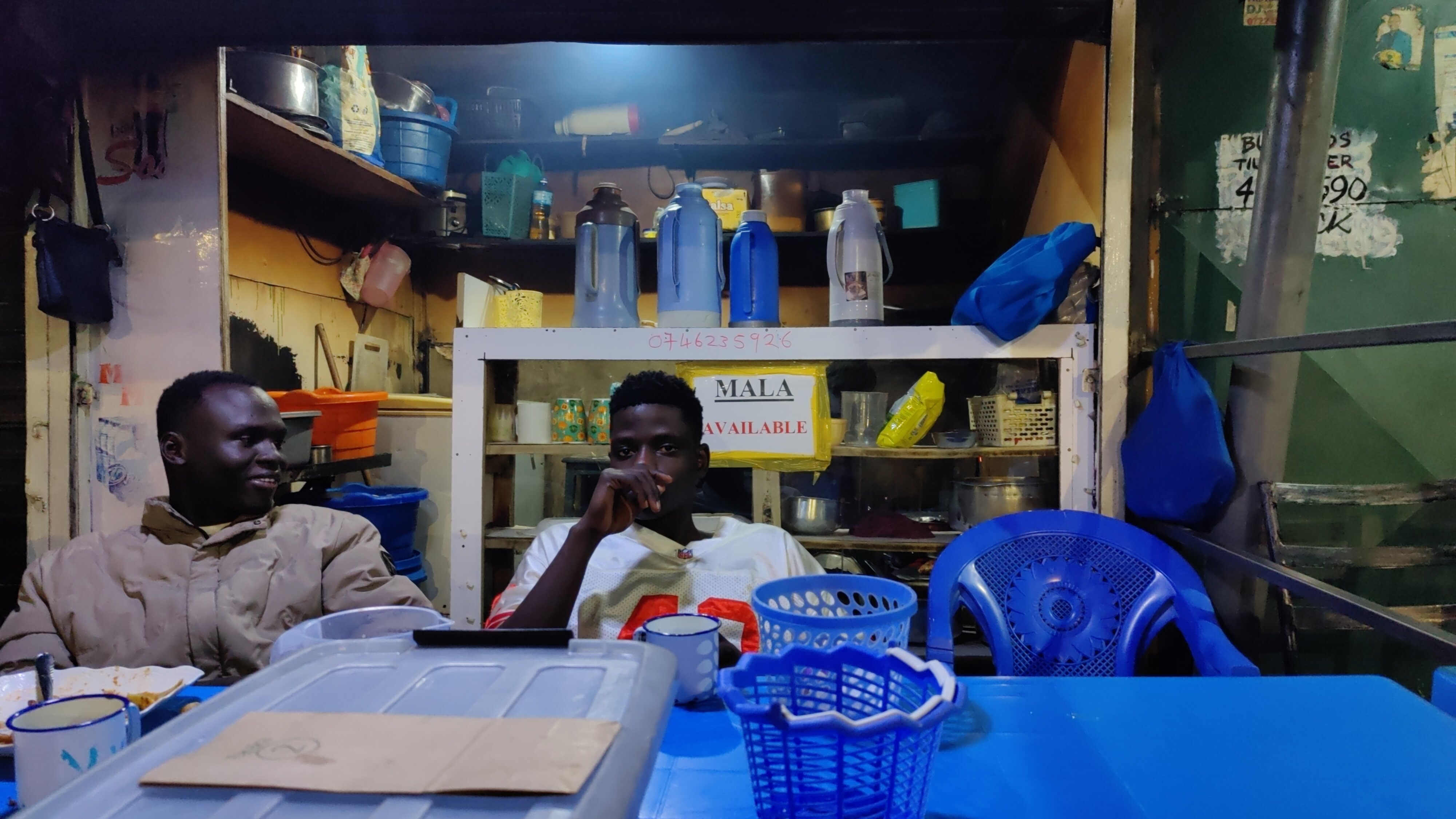
In September of this year, I visited Kenya to attend the State of the Map conference. I spent six nights in the capital Nairobi, two nights in Mombasa, and one night on a train. I was very happy with the visa process being smooth and quick. Furthermore, I stayed at the Nairobi Transit Hotel with other attendees, with Ibtehal from Bangladesh as my roommate. One of the memorable moments was the time I spent at a local coffee shop nearby. We used to go there at midnight, despite the grating in the shops suggesting such adventures were unsafe. Fortunately, nothing bad happened, and we were rewarded with a fun time with the locals.
The coffee shop Ibtehal and me used to visit during the midnight
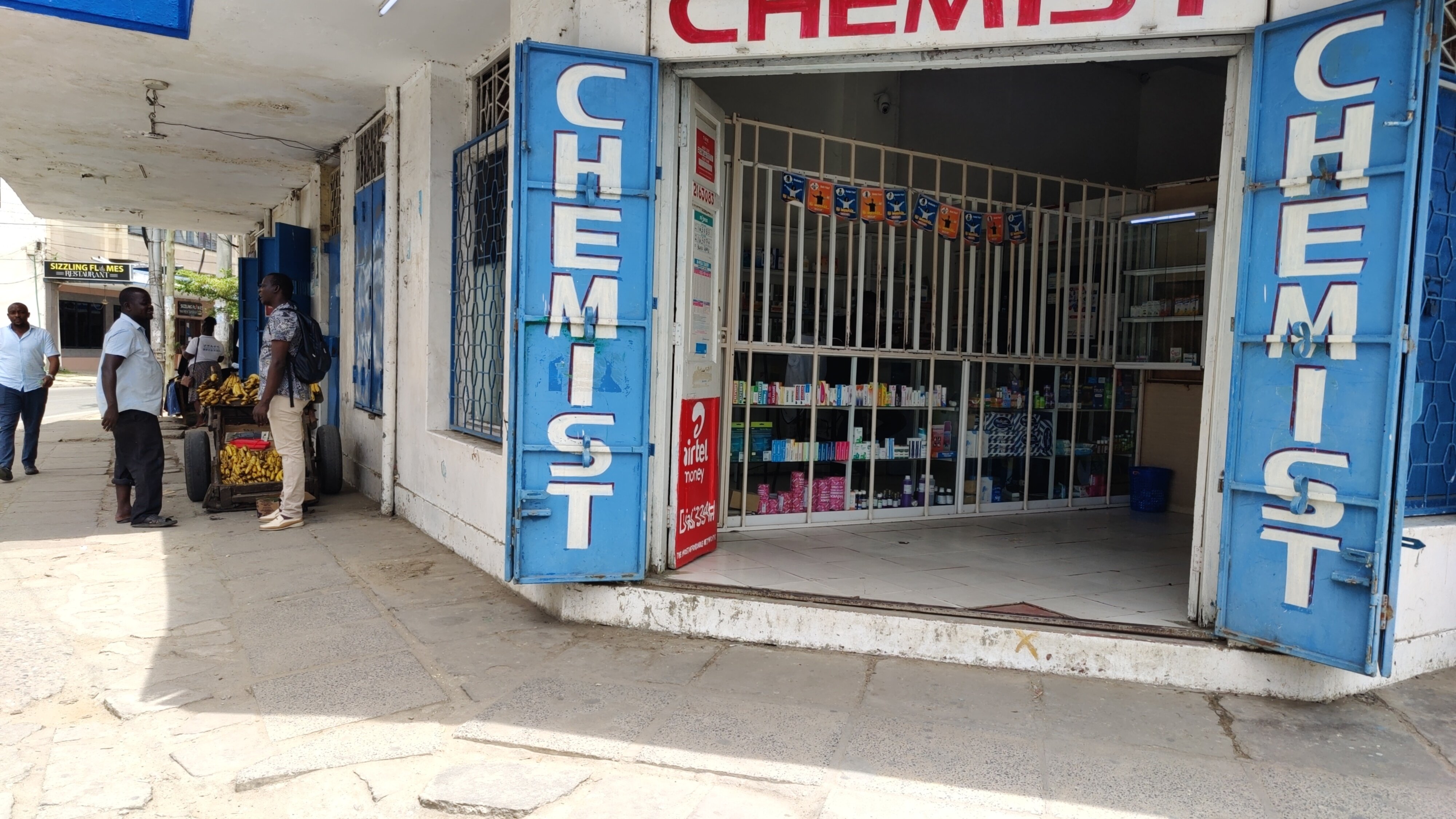
Grating at a chemist shop in Mombasa, Kenya
The country lies on the equator, which might give the impression of extremely hot temperatures. However, Nairobi was on the cooler side (10 25 degrees Celsius), and I found myself needing a hoodie, which I bought the next day. It also served as a nice souvenir, as it had an outline of the African map printed on it. I also bought a Safaricom SIM card for 100 shillings and recharged it with 1000 shillings for 8 GB internet with 5G speeds and 400 minutes talk time.

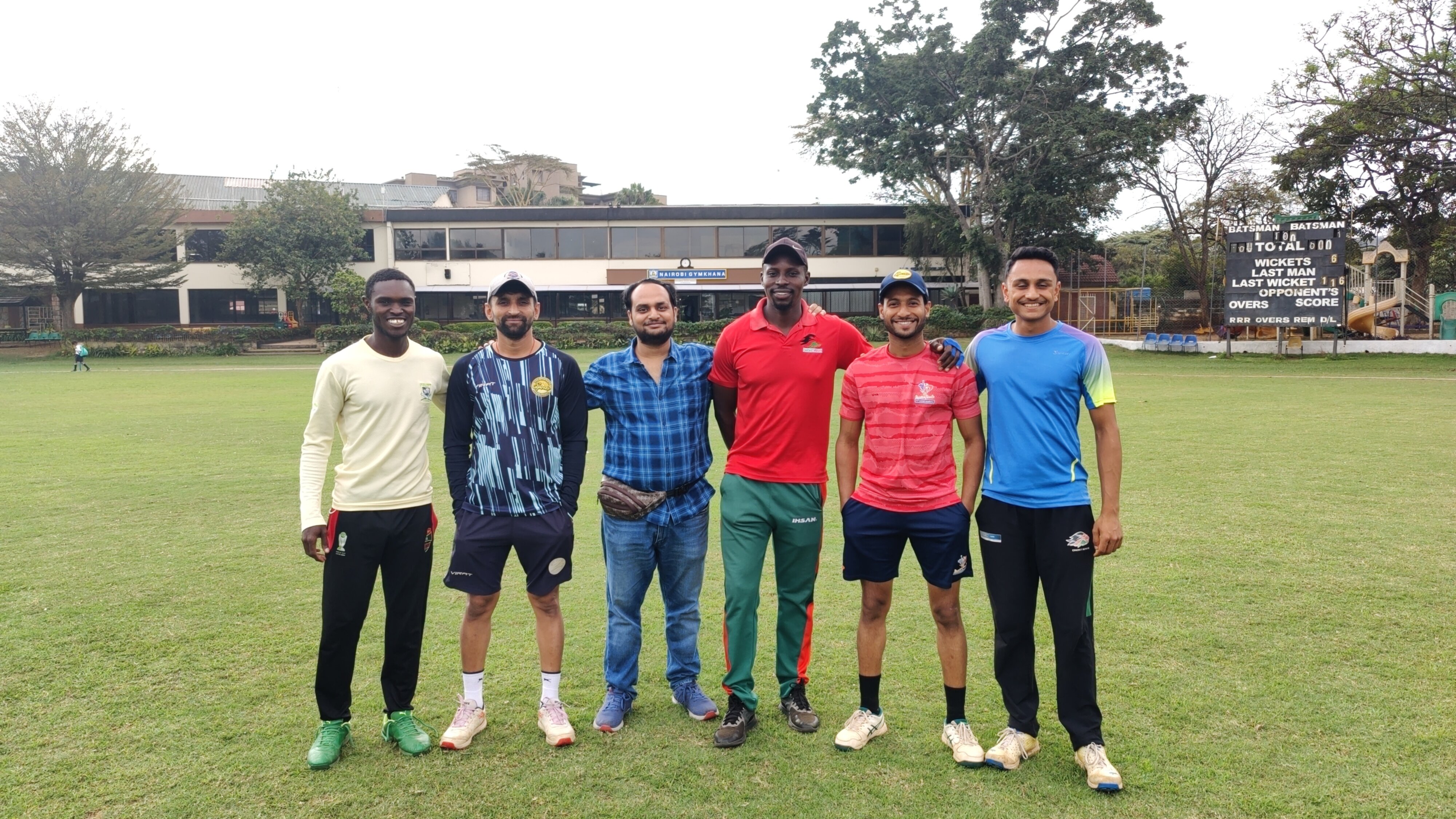
A visit to Nairobi s Historic Cricket Ground On this trip, I got a unique souvenir that can t be purchased from the market a cricket jersey worn in an ODI match by a player. The story goes as follows: I was roaming around the market with my friend Benson from Nairobi to buy a Kenyan cricket jersey for myself, but we couldn t find any. So, Benson had the idea of visiting the Nairobi Gymkhana Club, which used to be Kenya s main cricket ground. It has hosted some historic matches, including the 2003 World Cup match in which Kenya beat the mighty Sri Lankans and the record for the fastest ODI century by Shahid Afridi in just 37 balls in 1996. Although entry to the club was exclusively for members, I was warmly welcomed by the staff. Upon reaching the cricket ground, I met some Indian players who played in Kenyan leagues, as well as Lucas Oluoch and Dominic Wesonga, who have represented Kenya in ODIs. When I expressed interest in getting a jersey, Dominic agreed to send me pictures of his jersey. I liked his jersey and collected it from him. I gave him 2000 shillings, an amount suggested by those Indian players.
Me with players at the Nairobi Gymkhana Club
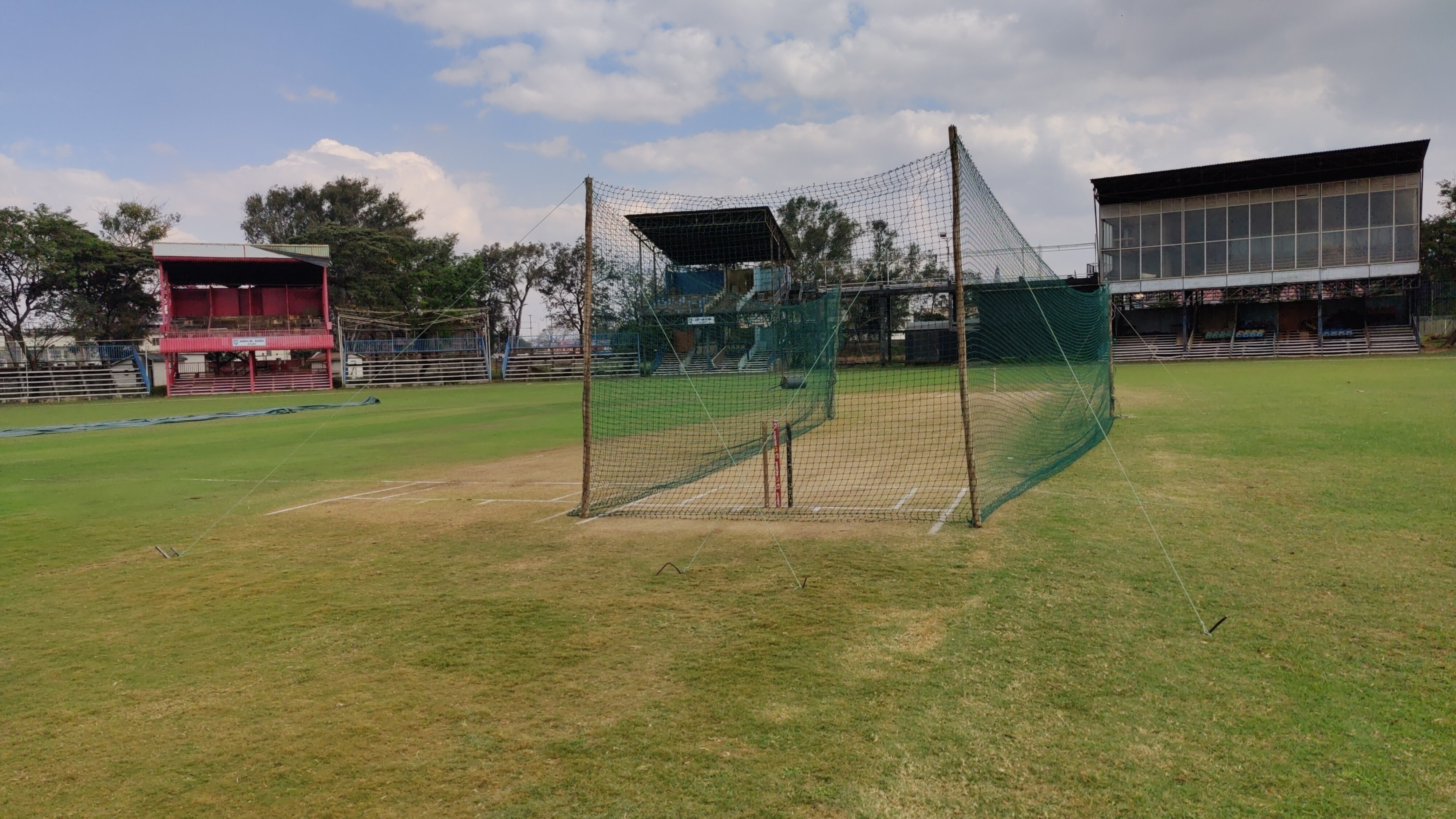
Cricket pitch at the Nairobi Gymkhana Club
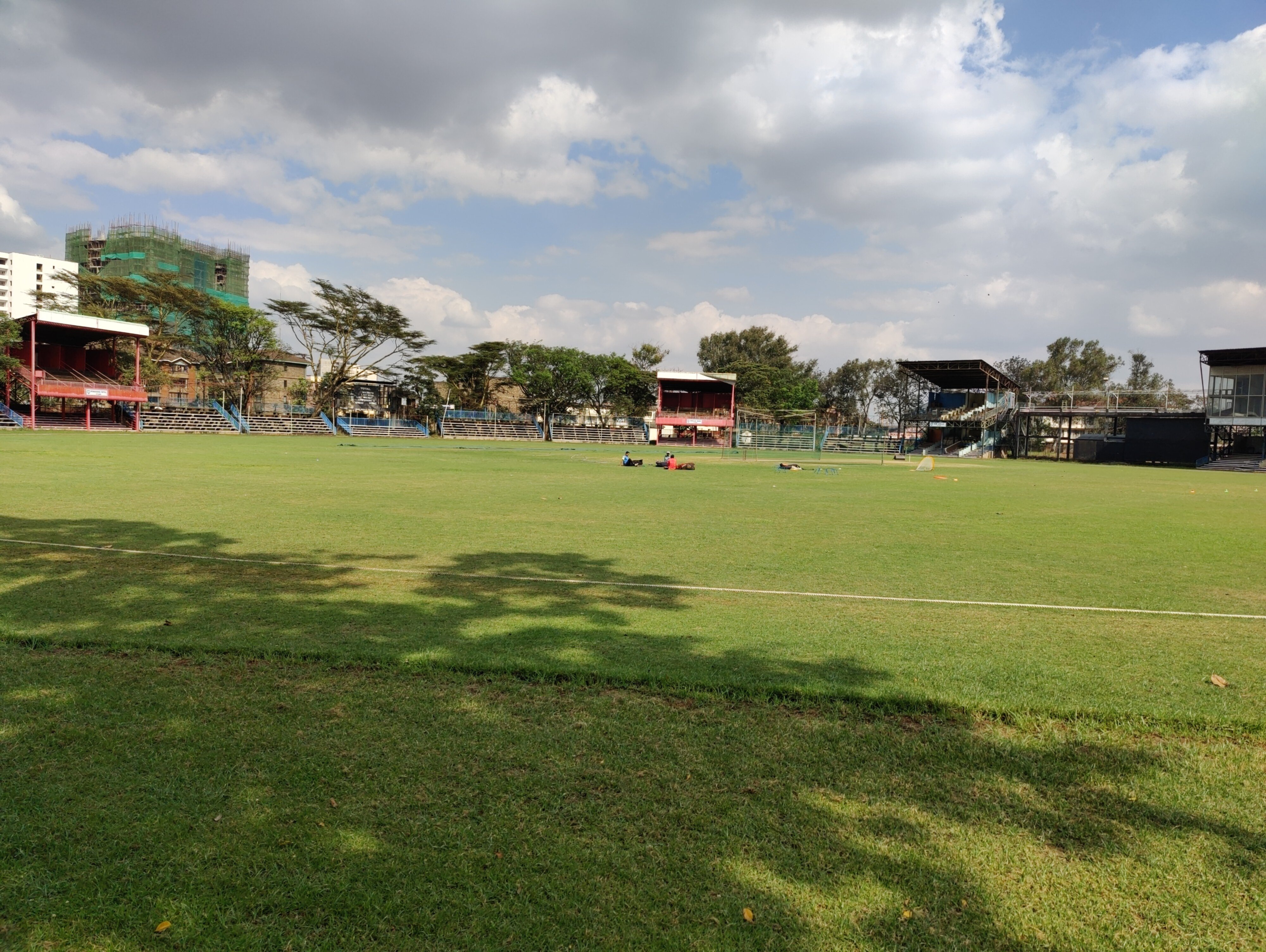
A view of the cricket ground inside the Nairobi Gymkhana Club
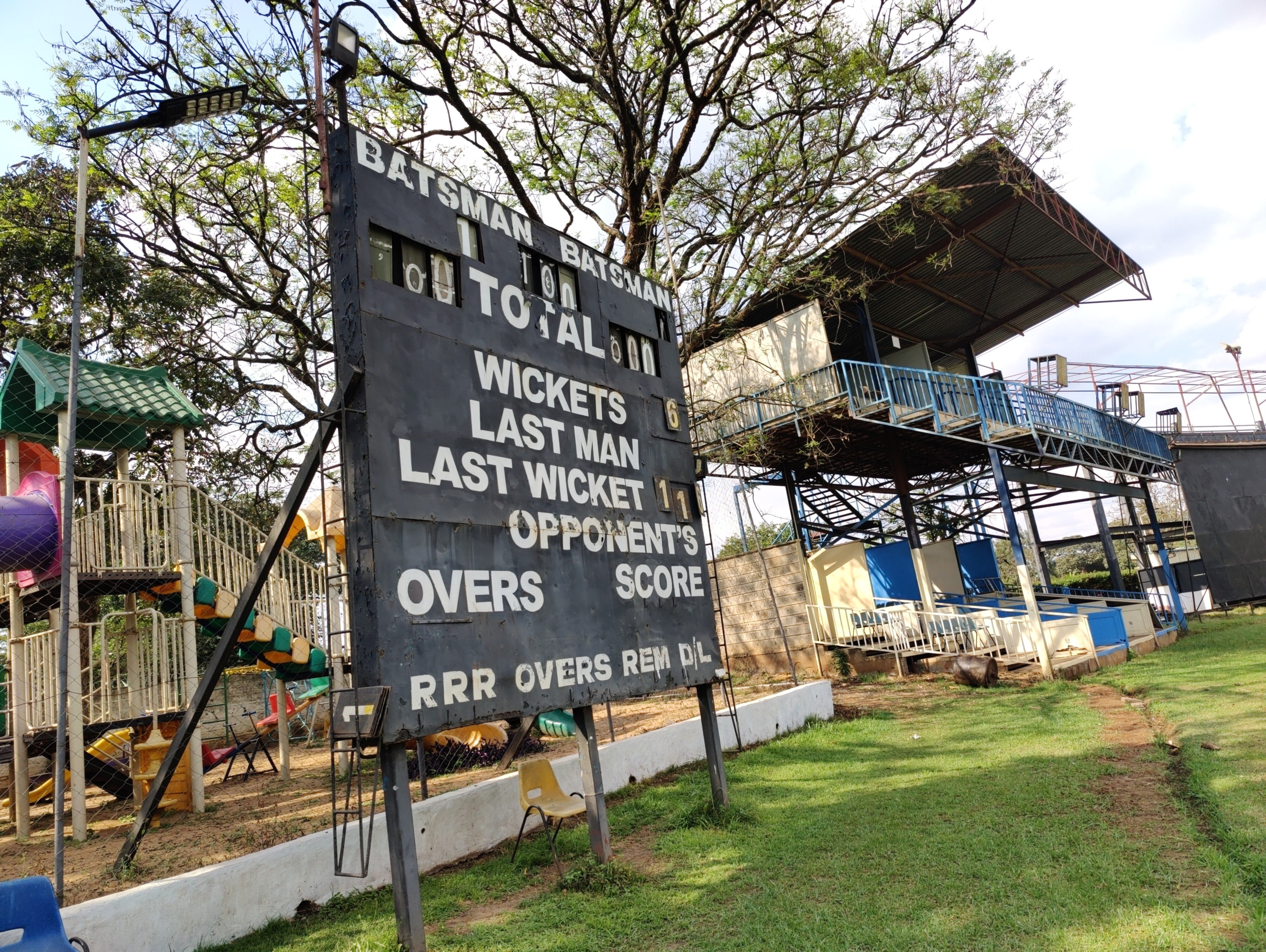
Scoreboard at the Nairobi Gymkhana cricket ground

Giraffe Center in Nairobi Kenya is known for its safaris and has no shortage of national parks. In fact, Nairobi is the only capital in the world with a national park. I decided not to visit one, as most of them were expensive and offered multi-day tours, and I didn t want to spend that much time in the wildlife. Instead, I went to the Giraffe Center in Nairobi with Pragya and Rabina. The ticket cost 1500 Kenyan shillings (1000 Indian rupees). In Kenya, matatus - shared vans, usually decorated with portraits of famous people and play rap songs - are the most popular means of public transport. Reaching the Giraffe Center from our hotel required taking five matatus, which cost a total of 150 shillings, and a 2 km walk. The journey back was 90 shillings, suggesting that we didn t find the most efficient route to get there. At the Giraffe Center, we fed giraffes and took photos.
A matatu with a Notorious BIG portrait.
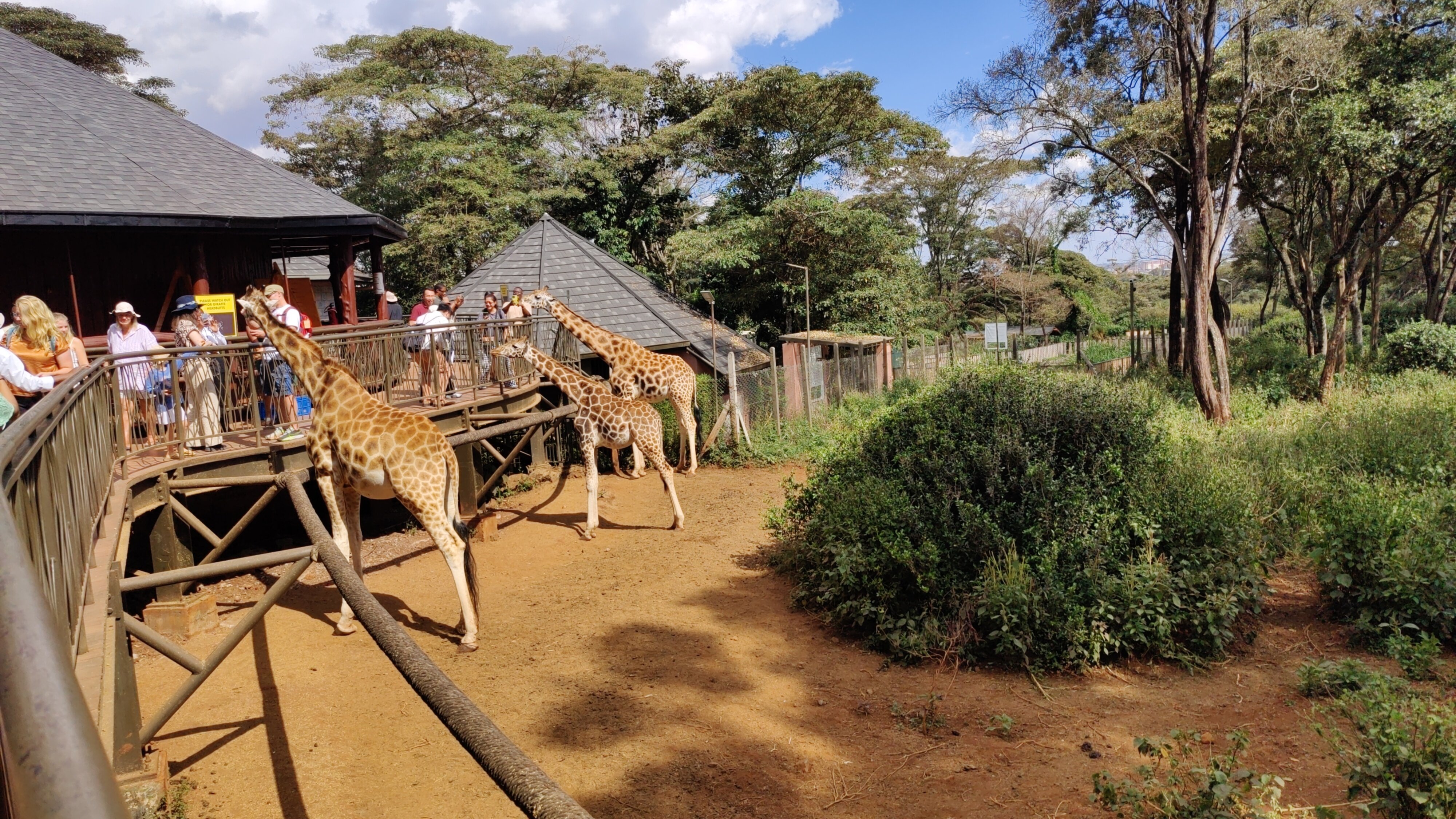
Inside the Giraffe Center
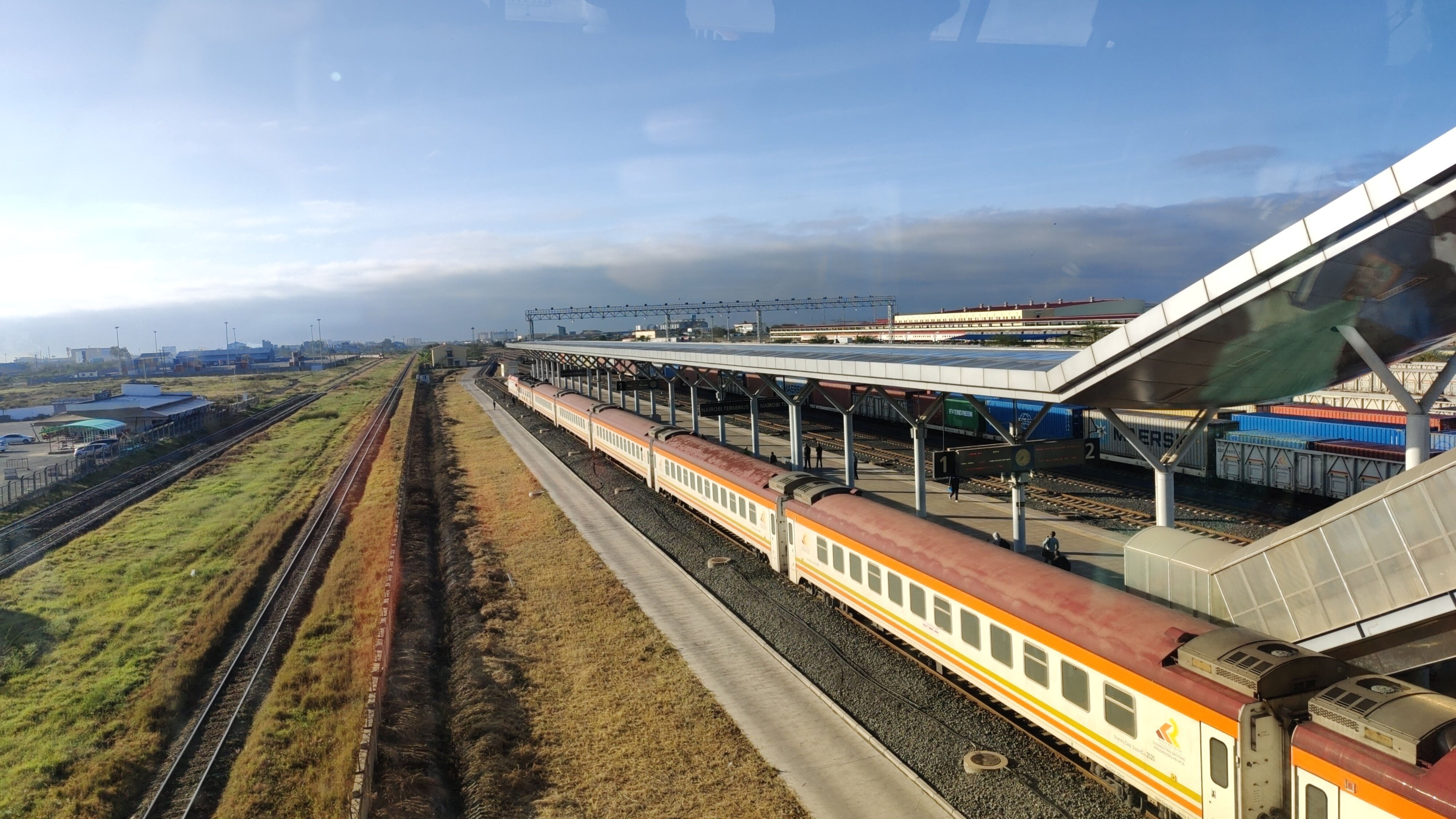
Train ride from Nairobi to Mombasa I took a train from Nairobi to Mombasa. The train is known as the SGR Train, where SGR refers to Standard Gauge Railway. The journey was around 500 km. M-Pesa was the only way to make payment for pre-booking the train ticket, and I didn t have an M-Pesa account. Pragya s friend Mary helped facilitate the payment. I booked a second-class ticket, which cost 1500 shillings (1000 Indian rupees). The train was scheduled to depart from Nairobi at 08:00 hours in the morning and arrive in Mombasa at 14:00 hours. The security check at the station required scanning our bags and having them sniffed by sniffer dogs. I also fell victim to a scam by a security official who offered to help me get my ticket printed, only to later ask me to get him some coffee, which I politely declined. Before boarding the train, I was treated to some stunning views at the Nairobi Terminus station. It was a seating train, but I wished it were a sleeper train, as I was sleep-deprived. The train was neat and clean, with good toilets. The train reached Mombasa on time at around 14:00 hours.
SGR train at Nairobi Terminus.
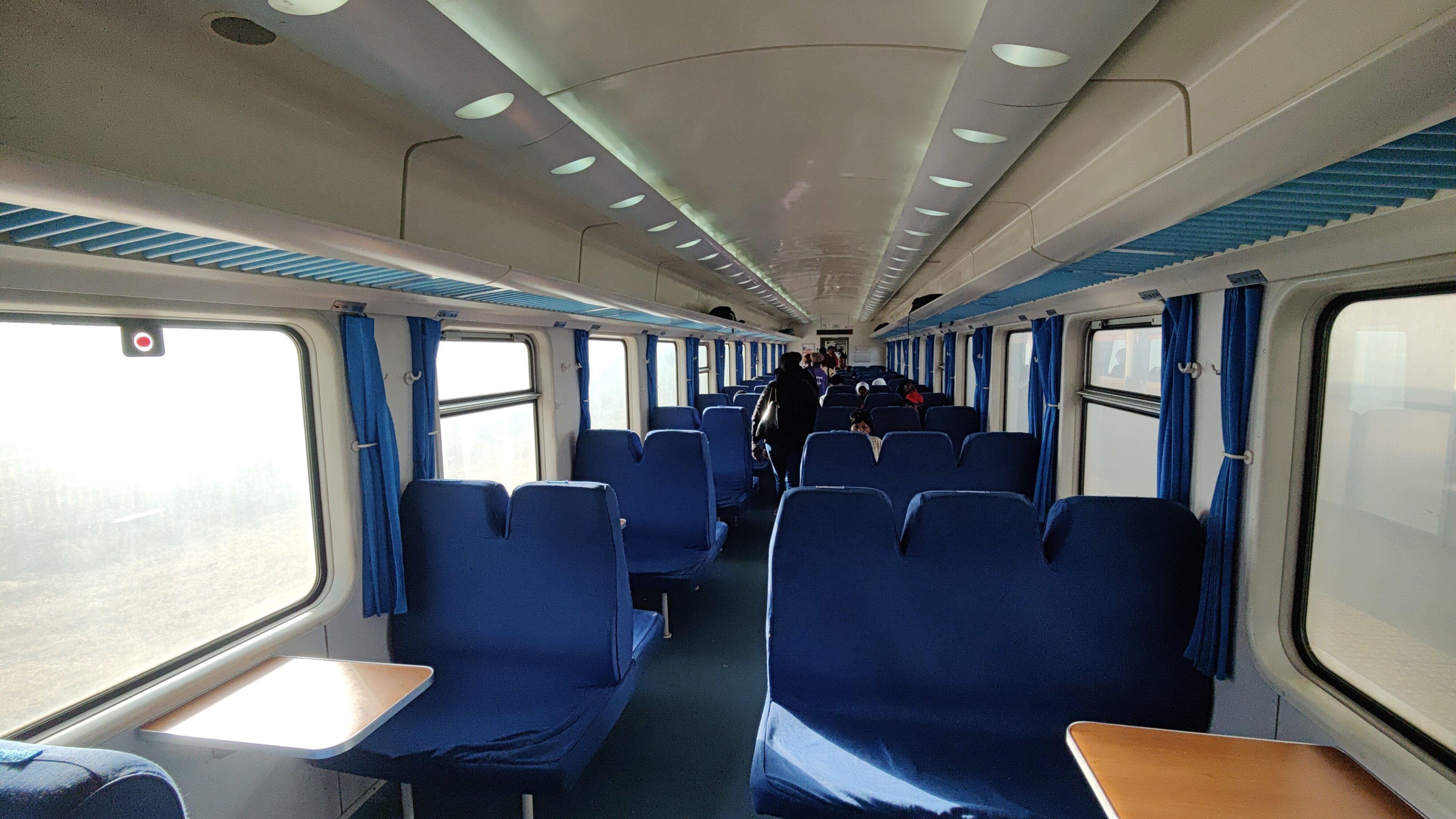
Interior of the SGR train
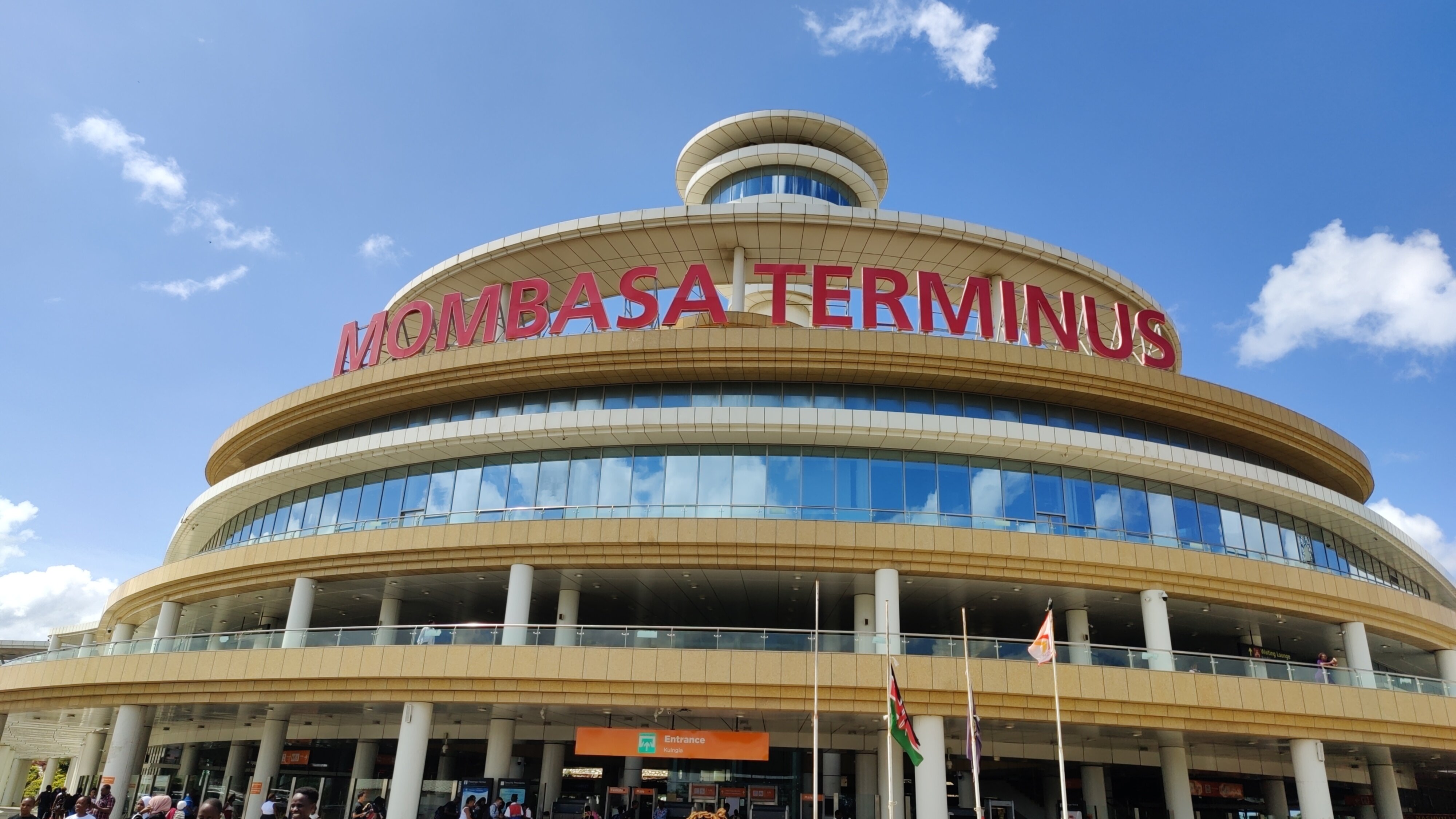
Arrival in Mombasa
Mombasa Terminus station.
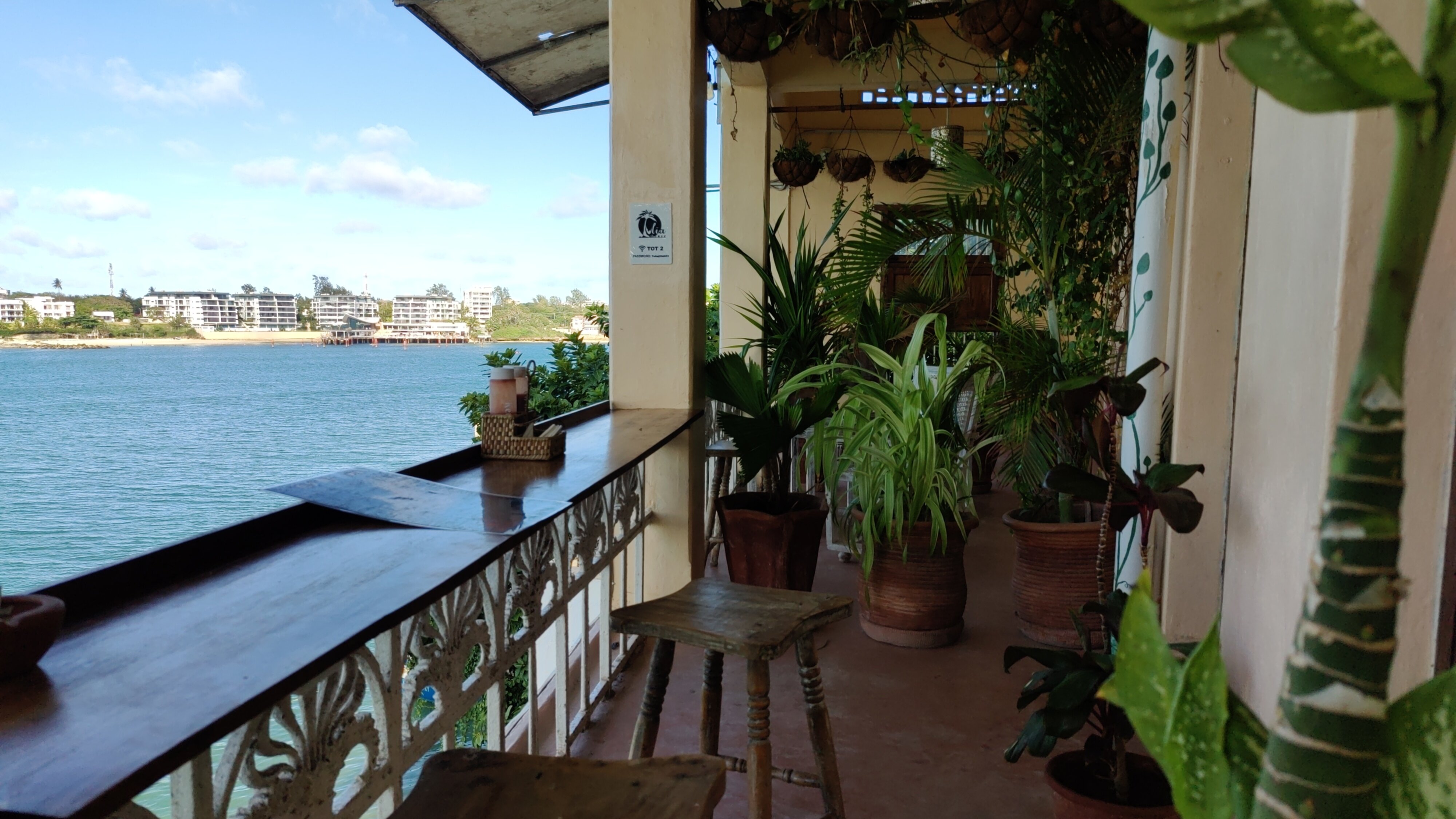
Mombasa was a bit hotter than Nairobi, with temperatures reaching around 30 degrees Celsius. However, that s not too hot for me, as I am used to higher temperatures in India. I had booked a hostel in the Old Town and was searching for a hitchhike from the Mombasa Terminus station. After trying for more than half an hour, I took a matatu that dropped me 3 km from my hostel for 200 shillings (140 Indian rupees). I tried to hitchhike again but couldn t find a ride. I think I know why I couldn t get a ride in both the cases. In the first case, the Mombasa Terminus was in an isolated place, so most of the vehicles were taxis or matatus while any noncommercial cars were there to pick up friends and family. If the station were in the middle of the city, there would be many more car/truck drivers passing by, thus increasing my possibilities of getting a ride. In the second case, my hostel was at the end of the city, and nobody was going towards that side. In fact, many drivers told me they would love to give me a ride, but they were going in some other direction. Finally, I took a tuktuk for 70 shillings to reach my hostel, Tulia Backpackers. It was 11 USD (1400 shillings) for one night. The balcony gave a nice view of the Indian Ocean. The rooms had fans, but there was no air conditioning. Each bed also had mosquito nets. The place was walking distance of the famous Fort Jesus. Mombasa has had more Islamic influence compared to Nairobi and also has many Hindu temples.
The balcony at Tulia Backpackers Hostel had a nice view of the ocean.
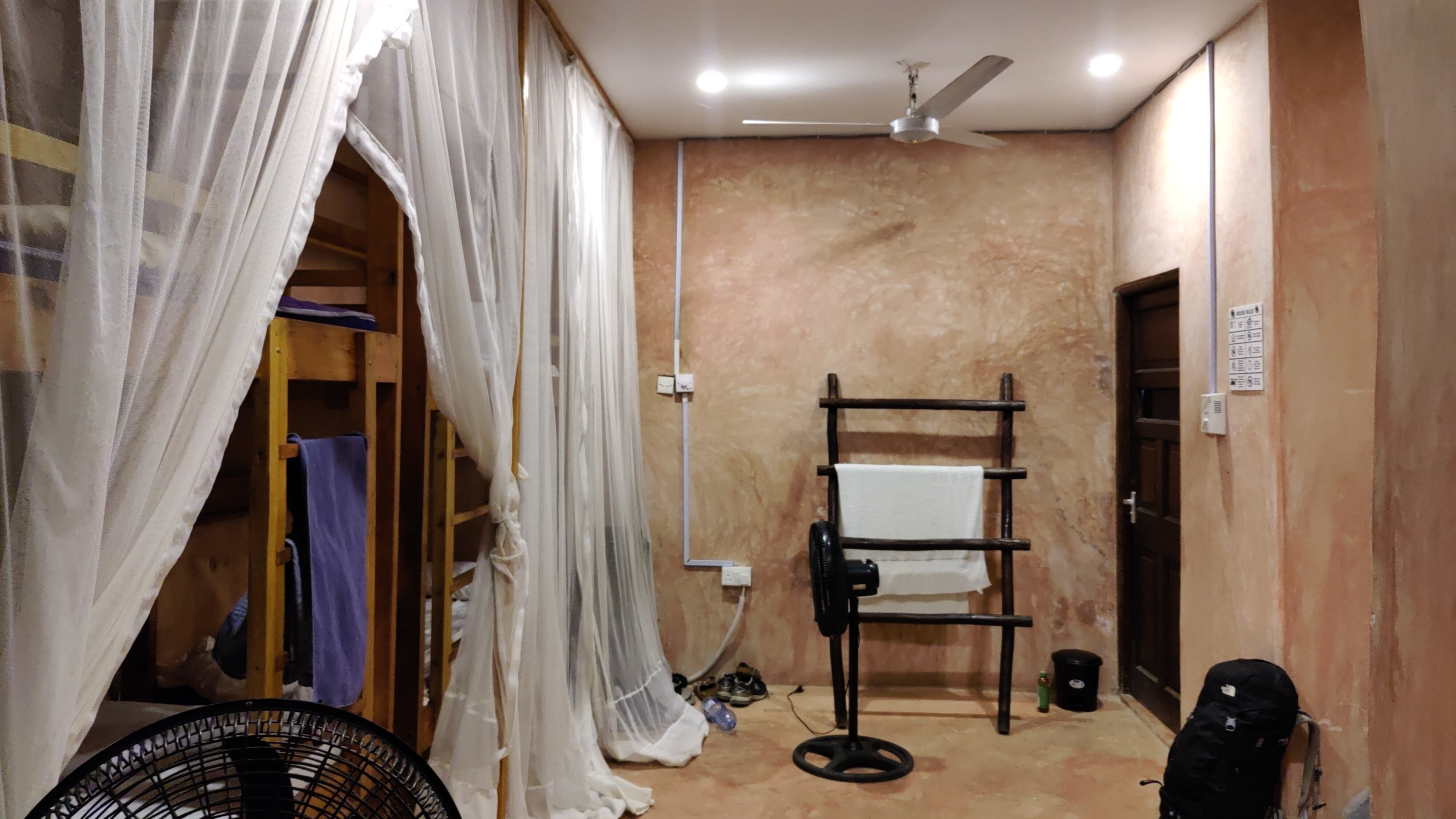
A room inside the hostel with fans and mosquito nets on the beds

Visiting White Sandy Beaches and Getting a Hitchhike Visiting Nyali beach marked my first time ever at a white sand beach. It was like 10 km from the hostel. The next day, I visited Diani Beach, which was 30 km from the hostel. Going to Diani Beach required crossing a river, for which there s a free ferry service every few minutes, followed by taking a matatu to Ukunda and then a tuk-tuk. The journey gave me a glimpse of the beautiful countryside of Kenya.
Nyali beach is a white sand beach
This is the ferry service for crossing the river.

During my return from Diani Beach to the hostel, I was successful in hitchhiking. However, it was only a 4 km ride and not sufficient to reach Ukunda, so I tried to get another ride. When a truck stopped for me, I asked for a ride to Ukunda. Later, I learned that they were going in the same direction as me, so I got off within walking distance from my hostel. The ride was around 30 km. I also learned the difference between a truck ride and a matatu or car ride. For instance, matatus and cars are much faster and cooler due to air conditioning, while trucks tend to be warmer because they lack it. Further, the truck was stopped at many checkpoints by the police for inspections as it carried goods, which is not the case with matatus. Anyways, it was a nice experience, and I am grateful for the ride. I had a nice conversation with the truck drivers about Indian movies and my experiences in Kenya.
Diani beach is a popular beach in Kenya. It is a white sand beach.
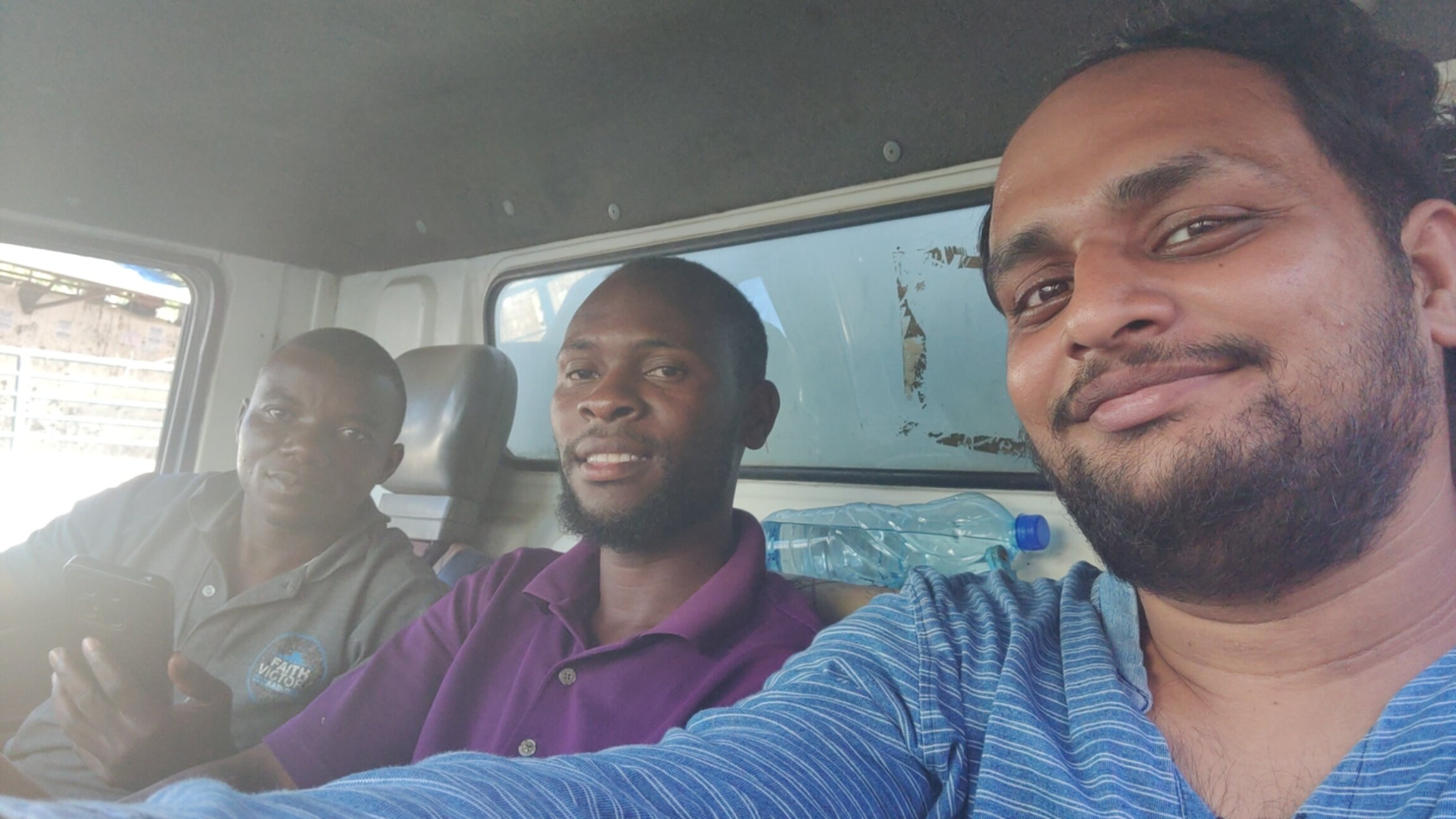
Selfie with truck drivers who gave me the free ride

Back to Nairobi I took the SGR train from Mombasa back to Nairobi. This time I took the night train, which departs at 22:00 hours, reaching Nairobi at around 04:00 in the morning. I could not sleep comfortably since the train only had seater seats. I had booked the Zarita Hotel in Nairobi and had already confirmed if they allowed early morning check-in. Usually, hotels have a fixed checkout time, say 11:00 in the morning, and you are not allowed to stay beyond that regardless of the time you checked in. But this hotel checked me in for 24 hours. Here, I paid in US dollars, and the cost was 12 USD.

Almost Got Stuck in Kenya Two days before my scheduled flight from Nairobi back to India, I heard the news that the airports in Kenya were closed due to the strikes. Rabina and Pragya had their flight back to Nepal canceled that day, which left them stuck in Nairobi for two additional days. I called Sahil in India and found out during the conversation that the strike was called off in the evening. It was a big relief for me, and I was fortunate to be able to fly back to India without any changes to my plans.
Newspapers at a stand in Kenya covering news on the airport closure
Experience with locals I had no problems communicating with Kenyans, as everyone I met knew English to an extent that could easily surpass that of big cities in India. Additionally, I learned a few words from Kenya s most popular local language, Swahili, such as Asante, meaning thank you, Jambo for hello, and Karibu for welcome. Knowing a few words in the local language went a long way. I am not sure what s up with haggling in Kenya. It wasn t easy to bring the price of souvenirs down. I bought a fridge magnet for 200 shillings, which was the quoted price. On the other hand, it was much easier to bargain with taxis/tuktuks/motorbikes. I stayed at three hotels/hostels in Kenya. None of them had air conditioners. Two of the places were in Nairobi, and they didn t even have fans in the rooms, while the one in Mombasa had only fans. All of them had good Wi-Fi, except Tulia where the internet overall was a bit shaky. My experience with the hotel staff was great. For instance, we requested that the Nairobi Transit Hotel cancel the included breakfast in order to reduce the room costs, but later realized that it was not a good idea. The hotel allowed us to revert and even offered one of our missing breakfasts during dinner. The staff at Tulia Backpackers in Mombasa facilitated the ticket payment for my train from Mombasa to Nairobi. One of the staff members also gave me a lift to the place where I could catch a matatu to Nyali Beach. They even added an extra tea bag to my tea when I requested it to be stronger.

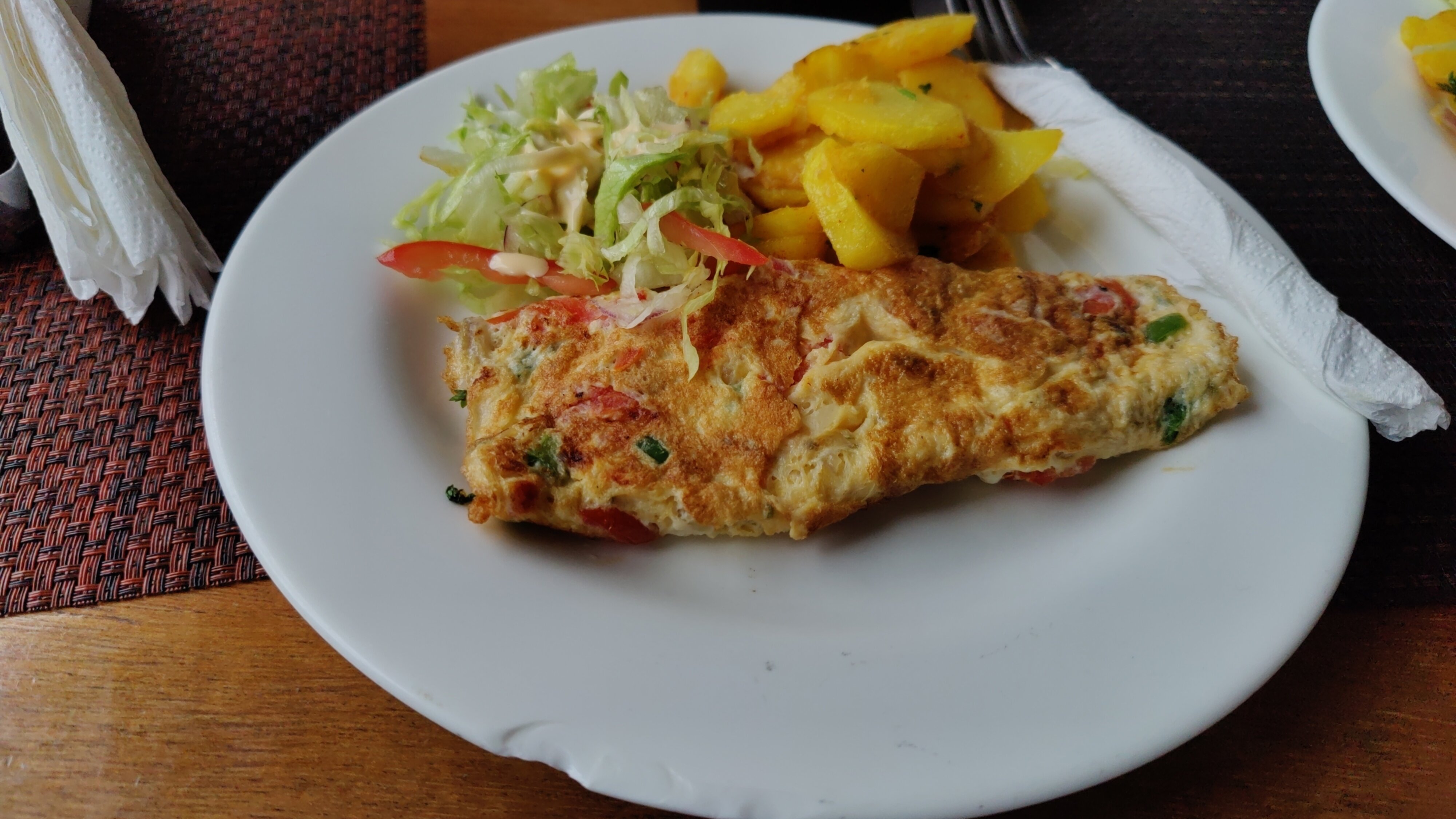
Food At the Nairobi Transit Hotel, a Spanish omelet with tea was served for breakfast. I noticed that Spanish omelette appeared on the menus of many restaurants, suggesting that it is popular in Kenya. This was my first time having this dish. The milk tea in Kenya, referred to by locals as white tea, is lighter than Indian tea (they don t put a lot of tea leaves).
Spanish Omelette served in breakfast at Nairobi Transit Hotel
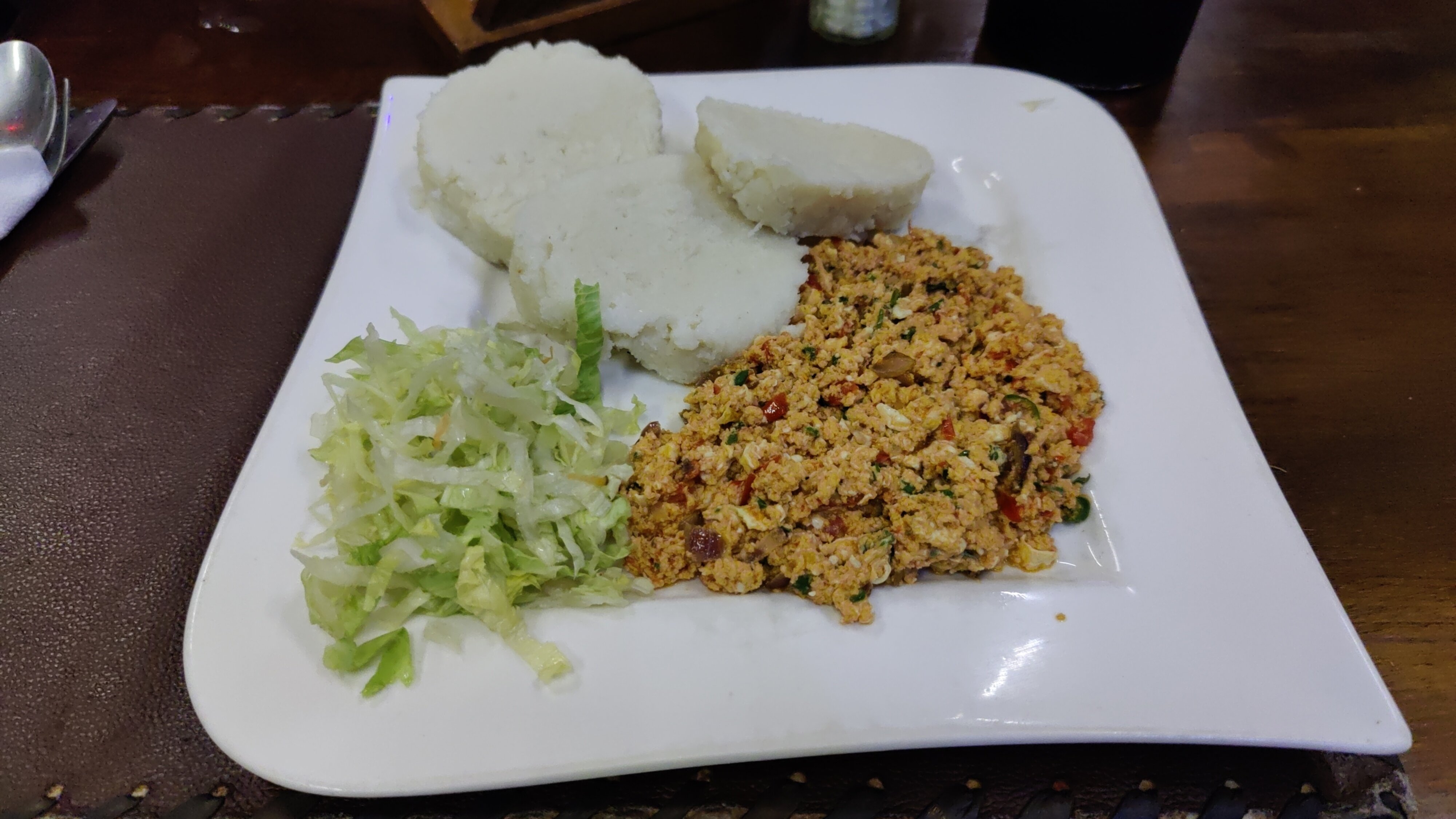
I also sampled ugali with eggs. In Mombasa, I visited an Indian restaurant called New Chetna and had a buffet thali there twice.
Ugali with eggs.

Tips for Exchanging Money In Kenya, I exchanged my money at forex shops a couple of times. I received good exchange rates for bills larger than 50 USD. For instance, 1 USD on xe.com was 129 shillings, and I got 128.3 shillings per USD (a total of 12,830 shillings) for two 50 USD notes at an exchange in Nairobi, while 127 shillings, which was the highest rate at the banks. On the other hand, for smaller bills such as a one US dollar note, I would have got 125 shillings. A passport was the only document required for the exchange, and they also provided a receipt. A good piece of advice for travelers is to keep 50 USD or larger bills for exchanging into the local currency while saving the smaller US dollar bills for accommodation, as many hotels and hostels accept payment in US dollars (in addition to Kenyan shillings).

Missed Malindi and Lamu There were more places on my to-visit list in Kenya. But I simply didn t have time to cover them, as I don t like rushing through places, especially in a foreign country where there is a chance of me underestimating the amount of time it takes during transit. I would have liked to visit at least one of Kilifi, Watamu or Malindi beaches. Further, Lamu seemed like a unique place to visit as it has no cars or motorized transport; the only options for transport are boats and donkeys. That s it for now. Meet you in the next one :)

3 November 2024

Guido G nther: Free Software Activities October 2024

Another short status update of what happened on my side last month. Besides a phosh bugfix release improving text input and selection was a prevalent pattern again resulting in improvements in the compositor, the OSK and some apps. phosh phoc phosh-mobile-settings libphosh-rs phosh-osk-stub phosh-osk-data xdg-desktop-portal-phosh Debian ModemManager Calls GTK feedbackd Chatty libcmatrix phosh-ev git-buildpackage Unified push specification swipeGuess wlr-clients iotas (Note taking app) Flare (Signal app) xdg-desktop-portal Reviews This is not code by me but reviews on other peoples code. The list is fairly incomplete, hope to improve on this in the upcoming months: Help Development If you want to support my work see donations. This includes a list of hardware we want to improve support for. Thanks a lot to all current and past donors.

2 November 2024

Russell Coker: More About the Yoga Gen3

Two months ago I bought a Thinkpad X1 Yoga Gen3 [1]. I m still very happy with it, the screen is a great improvement over the FullHD screen on my previous Thinkpad. I have yet to discover what s the best resolution to have on a laptop if price isn t an issue, but it s at least 1440p for a 14 display, that s 210DPI. The latest Thinkpad X1 Yoga is the 7th gen and has up to 3840*2400 resolution on the internal display for 323DPI. Apple apparently uses the term Retina Display to mean something in the range of 250DPI to 300DPI, so my current laptop is below Retina while the most expensive new Thinkpads are above it. I did some tests on external displays and found that this Thinkpad along with a Dell Latitude of the same form factor and about the same age can only handle one 4K display on a Thunderbolt dock and one on HDMI. On Reddit u/Carlioso1234 pointed out this specs page which says it supports a maximum of 3 displays including the built in TFT [2]. The Thunderbolt/USB-C connection has a maximum resolution of 5120*2880 and the HDMI port has a maximum of 4K. The latest Yoga can support four displays total which means 2*5K over Thunderbolt and one 4K over HDMI. It would be nice if someone made a 8000*2880 ultrawide display that looked like 2*5K displays when connected via Thunderbolt. It would also be nice if someone made a 32 5K display, currently they all seem to be 27 and I ve found that even for 4K resolution 32 is better than 27 . With the typical configuration of Linux and the BIOS the Yoga Gen3 will have it s touch screen stop working after suspend. I have confirmed this for stylus use but as the finger-touch functionality is broken I couldn t confirm that. On r/thinkpad u/p9k told me how to fix this problem [3]. I had to set the BIOS to Win 10 Sleep aka Hybrid sleep and then put the following in /etc/systemd/system/thinkpad-wakeup-config.service :
# https://www.reddit.com/r/thinkpad/comments/1blpy20/comment/kw7se2l/?context=3
[Unit]
Description=Workarounds for sleep wakeup source for Thinkpad X1 Yoga 3
After=sysinit.target
After=systemd-modules-load.service
[Service]
Type=oneshot
ExecStart=/bin/sh -c "echo 'enabled' > /sys/devices/platform/i8042/serio0/power/wakeup"
ExecStart=/bin/sh -c "echo 'enabled' > /sys/devices/platform/i8042/serio1/power/wakeup"
ExecStart=/bin/sh -c "echo 'LID' > /proc/acpi/wakeup"
[Install]
WantedBy=multi-user.target
Now it works fine, for stylus at least. I still get kernel error messages like the following which don t seem to cause problems:
wacom 0003:056A:5146.0005: wacom_idleprox_timeout: tool appears to be hung in-prox. forcing it out.
When it wasn t working I got the above but also kernel error messages like:
wacom 0003:056A:5146.0005: wacom_wac_queue_insert: kfifo has filled, starting to drop events
This change affected the way suspend etc operate. Now when I connect the laptop to power it will leave suspend mode. I ve configured KDE to suspend when the lid is closed and there s no monitor connected.

Russell Coker: Moving Between Devices

I previously wrote about the possibility of transferring work between devices as an alternative to convergence (using a phone or tablet as a desktop) [1]. This idea has been implemented in some commercial products already. MrWhosTheBoss made a good YouTube video reviewing recent Huawei products [2]. At 2:50 in that video he shows how you can link a phone and tablet, control one from the other, drag and drop of running apps and files between phone and tablet, mirror the screen between devices, etc. He describes playing a video on one device and having it appear on the other, I hope that it actually launches a new instance of the player app as the Google Chromecast failed in the market due to remote display being laggy. At 7:30 in that video he starts talking about the features that are available when you have multiple Huawei devices, starting with the ability to move a Bluetooth pairing for earphones to a different device. At 16:25 he shows what Huawei is doing to get apps going including allowing apk files to be downloaded and creating what they call Quick Apps which are instances of a web browser configured to just use one web site and make it look like a discrete app, we need something like this for FOSS phone distributions does anyone know of a browser that s good for it? Another thing that we need is to have an easy way of transferring open web pages between systems. Chrome allows sending pages between systems but it s proprietary, limited to Chrome only, and also takes an unreasonable amount of time. KDEConnect allows sharing clipboard contents which can be used to send URLs that can then be pasted into a browser, but the process of copy URL, send via KDEConnect, and paste into other device is unreasonably slow. The design of Chrome with a Send to your devices menu option from the tab bar is OK. But ideally we need a Send to device for all tabs of a window as well, we need it to run from free software and support using your own server not someone else s server (AKA the cloud ). Some of the KDEConnect functionality but using a server rather than direct connection over the same Wifi network (or LAN if bridged to Wifi) would be good. What else do we need?

Russell Coker: What is a Workstation?

I recently had someone describe a Mac Mini as a workstation , which I strongly disagree with. The Wikipedia page for Workstation [1] says that it s a type of computer designed for scientific or technical use, for a single user, and would commonly run a multi-user OS. The Mac Mini runs a multi-user OS and is designed for a single user. The issue is whether it is for scientific or technical use . A Mac Mini is a nice little graphical system which could be used for CAD and other engineering work. But I believe that the low capabilities of the system and lack of expansion options make it less of a workstation. The latest versions of the Mac Mini (to be officially launched next week) have up to 64G of RAM and up to 8T of storage. That is quite decent compute power for a small device. For comparison the HP ML 110 Gen9 workstation I m currently using was released in 2021 and has 256G of RAM and has 4 * 3.5 SAS bays so I could easily put a few 4TB NVMe devices and some hard drives larger than 10TB. The HP Z640 workstation I have was released in 2014 and has 128G of RAM and 4*2.5 SATA drive bays and 2*3.5 SATA drive bays. Previously I had a Dell PowerEdge T320 which was released in 2012 and had 96G of RAM and 8*3.5 SAS bays. In CPU and GPU power the recent Mac Minis will compare well to my latest workstations. But they compare poorly to workstations from as much as 12 years ago for RAM and storage. Which is more important depends on the task, if you have to do calculations on 80G of data with lots of scans through the entire data set then a system with 64G of RAM will perform very poorly and a system with 96G and a CPU less than half as fast will perform better. A Dell PowerEdge T320 from 2012 fully loaded with 192G of RAM will outperform a modern Mac Mini on many tasks due to this and the T420 supported up to 384G. Another issue is generic expansion options. I expect a workstation to have a number of PCIe slots free for GPUs and other devices. The T320 I used to use had a PCIe power cable for a power hungry GPU and I think all the T320 and T420 models with high power PSUs supported that. I think that a usable definition of a workstation is a system having a feature set that is typical of servers (ECC RAM, lots of storage for RAID, maybe hot-swap storage devices, maybe redundant PSUs, and lots of expansion options) while also being suitable for running on a desktop or under a desk. The Mac Mini is nice for running on a desk but that s the only workstation criteria it fits. I think that ECC RAM should be a mandatory criteria and any system without it isn t a workstation. That excludes most Apple hardware. The Mac Mini is more of a thin-client than a workstation. My main workstation with ECC RAM could run 3 VMs that each have more RAM than the largest Mac Mini that will be sold next week. If 32G of non-ECC RAM is considered enough for a workstation then you could get an Android phone that counts as a workstation and it will probably cost less than a Mac Mini.

1 November 2024

Colin Watson: Free software activity in October 2024

Almost all of my Debian contributions this month were sponsored by Freexian. You can also support my work directly via Liberapay. Ansible I noticed that Ansible had fallen out of Debian testing due to autopkgtest failures. This seemed like a problem worth fixing: in common with many other people, we use Ansible for configuration management at Freexian, and it probably wouldn t make our sysadmins too happy if they upgraded to trixie after its release and found that Ansible was gone. The problems here were really just slogging through test failures in both the ansible-core and ansible packages, but their test suites are large and take a while to run so this took some time. I was able to contribute a few small fixes to various upstreams in the process: This should now get back into testing tomorrow. OpenSSH Martin- ric Racine reported that ssh-audit didn t list the ext-info-s feature as being available in Debian s OpenSSH 9.2 packaging in bookworm, contrary to what OpenSSH upstream said on their specifications page at the time. I spent some time looking into this and realized that upstream was mistakenly saying that implementations of ext-info-c and ext-info-s were added at the same time, while in fact ext-info-s was added rather later. ssh-audit now has clearer output, and the OpenSSH maintainers have corrected their specifications page. I looked into a report of an ssh failure in certain cases when using GSS-API key exchange (which is a Debian patch). Once again, having integration tests was a huge win here: the affected scenario is quite a fiddly one, but I was able to set it up in the test, and thereby make sure it doesn t regress in future. It still took me a couple of hours to get all the details right, but in the past this sort of thing took me much longer with a much lower degree of confidence that the fix was correct. On upstream s advice, I cherry-picked some key exchange fixes needed for big-endian architectures. Python team I packaged python-evalidate, needed for a new upstream version of buildbot. The Python 3.13 transition rolls on. I fixed problems related to it in htmlmin, humanfriendly, postgresfixture (contributed upstream), pylint, python-asyncssh (contributed upstream), python-oauthlib, python3-simpletal, quodlibet, zope.exceptions, and zope.interface. A trickier Python 3.13 issue involved the cgi module. Years ago I ported zope.publisher to the multipart module because cgi.FieldStorage was broken in some situations, and as a result I got a recommendation into Python s dead batteries PEP 594. Unfortunately there turns out to be a name conflict between multipart and python-multipart on PyPI; python-multipart upstream has been working to disentangle this, though we still need to work out what to do in Debian. All the same, I needed to fix python-wadllib and multipart seemed like the best fit; I contributed a port upstream and temporarily copied multipart into Debian s python-wadllib source package to allow its tests to pass. I ll come back and fix this properly once we sort out the multipart vs. python-multipart packaging. tzdata moved some timezone definitions to tzdata-legacy, which has broken a number of packages. I added tzdata-legacy build-dependencies to alembic and python-icalendar to deal with this in those packages, though there are still some other instances of this left. I tracked down an nltk regression that caused build failures in many other packages. I fixed Rust crate versioning issues in pydantic-core, python-bcrypt, and python-maturin (mostly fixed by Peter Michael Green and Jelmer Vernoo , but it needed a little extra work). I fixed other build failures in entrypoints, mayavi2, python-pyvmomi (mostly fixed by Alexandre Detiste, but it needed a little extra work), and python-testing.postgresql (ditto). I fixed python3-simpletal to tolerate future versions of dh-python that will drop their dependency on python3-setuptools. I fixed broken symlinks in python-treq. I removed (build-)depends on python3-pkg-resources from alembic, autopep8, buildbot, celery, flufl.enum, flufl.lock, python-public, python-wadllib (contributed upstream), pyvisa, routes, vulture, and zodbpickle (contributed upstream). I upgraded astroid, asyncpg (fixing a Python 3.13 failure and a build failure), buildbot (noticing an upstream test bug in the process), dnsdiag, frozenlist, netmiko (fixing a Python 3.13 failure), psycopg3, pydantic-settings, pylint, python-asyncssh, python-bleach, python-btrees, python-cytoolz, python-django-pgtrigger, python-django-test-migrations, python-gssapi, python-icalendar, python-json-log-formatter, python-pgbouncer, python-pkginfo, python-plumbum, python-stdlib-list, python-tokenize-rt, python-treq (fixing a Python 3.13 failure), python-typeguard, python-webargs (fixing a build failure), pyupgrade, pyvisa, pyvisa-py (fixing a Python 3.13 failure), toolz, twisted, vulture, waitress (fixing CVE-2024-49768 and CVE-2024-49769), wtf-peewee, wtforms, zodbpickle, zope.exceptions, zope.interface, zope.proxy, zope.security, and zope.testrunner to new upstream versions. I tried to fix a regression in python-scruffy, but I need testing feedback. I requested removal of python-testing.mysqld.

Russ Allbery: Review: Overdue and Returns

Review: Overdue and Returns, by Mark Lawrence
Publisher: Mark Lawrence
Copyright: June 2023
Copyright: February 2024
ASIN: B0C9N51M6Y
ASIN: B0CTYNQGBX
Format: Kindle
Pages: 99
Overdue is a stand-alone novelette in the Library Trilogy universe. Returns is a collection of two stories, the novelette "Returns" and the short story "About Pain." All of them together are about the length of a novella, so I'm combining them into a single review. These are ancillary stories in the same universe as the novels, but not necessarily in the same timeline. (Trying to fit "About Pain" into the novel timeline will give you a headache and I am choosing to read it as author's fan fiction.) I'm guessing they're part of the new fad for releasing short fiction on Amazon to tide readers over and maintain interest between books in a series, a fad about which I have mixed feelings. Given the total lack of publisher metadata in either the stories or on Amazon, I'm assuming they were self-published even though the novels are published by Ace, but I don't know that for certain. There are spoilers for The Book That Wouldn't Burn, so don't read these before that novel. There are no spoilers for The Book That Broke the World, and I don't think the reading order would matter. I found all three of these stories irritating and thuddingly trite. "Returns" is probably the best of the lot in terms of quality of storytelling, but I intensely dislike the structural implications of the nature of the book at its center and am therefore hoping that it's non-canonical. I would not waste your time with these even if you are enjoying the novels. "Overdue": Three owners of the same bookstore at different points in time have encounters with an albino man named Yute who is on a quest. One of the owners is trying to write a book, one of them is older, depressed, and closed off, and one of them has regular conversations with her sister's ghost. The nature of the relationship between the three is too much of a spoiler, but it involves similar shenanigans as The Book That Wouldn't Burn. Lawrence uses my least favorite resolution of benign ghost stories. The story tries very hard to sell it as a good thing, but I thought it was cruel and prefer fantasy that rejects both branches of that dilemma. Other than that, it was fine, I guess, although the moral was delivered with all of the subtlety of the last two minutes of a Saturday morning cartoon. (5) "Returns": Livira returns a book deep inside the library and finds that she can decipher it, which leads her to a story about Yute going on a trip to recover another library book. This had a lot of great Yute lines, plus I always like seeing Livira in exploration mode. The book itself is paradoxical in a causality-destroying way, which is handwaved away as literal magic. I liked this one the best of the three stories, but I hope the world-building of the main series does not go in this direction and I'm a little afraid it might. (6) "About Pain": A man named Holden runs into a woman named Clovis at the gym while carrying a book titled Catcher that his dog found and that he's returning to the library. I thoroughly enjoy Clovis and was happy to read a few more scenes about her. Other than that, this was fine, I guess, although it is a story designed to deliver a point and that point is one that appears in every discussion of classics and re-reading that has ever happened on the Internet. Also, I know I'm being grumpy, but Lawrence's puns with authors and character names are chapter-epigraph amusing but not short-story-length funny. Yes, yes, his name is Holden, we get it. (5) Rating: 5 out of 10

Taavi V n nen: Custom domains on the Wikimedia Cloud VPS web proxy

The shared web proxy used on Wikimedia Cloud VPS now has technical support for using arbitrary domains (and not just wmcloud.org subdomains) in proxy names. I think this is a good example of how software slowly evolves over time as new requirements emerge, with each new addition building on top of the previous ones. According to the edit history on Wikitech, the web proxy service has its origins in 2012, although the current idea where you create a proxy and map it to a specific instance and port was only introduced a year later. (Before that, it just directly mapped the subdomain to the VPS instance with the same name). There were some smaller changes in the coming years like the migration to acme-chief for TLS certificate management, but the overall logic stayed very similar until 2020 when the wmcloud.org domain was introduced. That was implemented by adding a config option listing all possible domains, so future domain additions would be as simple as adding the new domain to that list in the configuration. Then the changes start becoming more frequent:

30 October 2024

Dirk Eddelbuettel: gcbd 0.2.7 on CRAN: More Mere Maintenance

Another pure maintenance release 0.2.7 of the gcbd package is now on CRAN. The gcbd proposes a benchmarking framework for LAPACK and BLAS operations (as the library can exchanged in a plug-and-play sense on suitable OSs) and records result in local database. Its original motivation was to also compare to GPU-based operations. However, as it is both challenging to keep CUDA working packages on CRAN providing the basic functionality appear to come and go so testing the GPU feature can be challenging. The main point of gcbd is now to actually demonstrate that yes indeed we can just swap BLAS/LAPACK libraries without any change to R, or R packages. The configure / rebuild R for xyz often seen with xyz being Goto or MKL is simply plain wrong: you really can just swap them (on proper operating systems, and R configs see the package vignette for more). But nomatter how often we aim to correct this record, it invariably raises its head another time. This release accommodates a CRAN change request as we were referencing the (now only suggested) package gputools. As hinted in the previous paragraph, it was once on CRAN but is not right now so we adjusted our reference. CRANberries also provides a diffstat report for the latest release. If you like this or other open-source work I do, you can sponsor me at GitHub.

This post by Dirk Eddelbuettel originated on his Thinking inside the box blog. Please report excessive re-aggregation in third-party for-profit settings.

28 October 2024

Sven Hoexter: GKE version 1.31.1-gke.1678000+ is a baddy

Just a "warn your brothers" for people foolish enough to use GKE and run on the Rapid release channel. Update from version 1.31.1-gke.1146000 to 1.31.1-gke.1678000 is causing trouble whenever NetworkPolicy resources and a readinessProbe (or health check) are configured. As a workaround we started to remove the NetworkPolicy resources. E.g. when kustomize is involved with a patch like this:
- patch:  -
    $patch: delete
    apiVersion: "networking.k8s.io/v1"
    kind: NetworkPolicy
    metadata:
        name: dummy
  target:
    kind: NetworkPolicy
We tried to update to the latest version - right now 1.31.1-gke.2008000 - which did not change anything. Behaviour is pretty much erratic, sometimes it still works and sometimes the traffic is denied. It also seems that there is some relevant fix in 1.31.1-gke.1678000 because that is now the oldest release of 1.31.1 which I can find in the regular and rapid release channels. The last known good version 1.31.1-gke.1146000 is not available to try a downgrade.

Thomas Lange: 30.000 FAIme jobs created in 7 years

The number of FAIme jobs has reached 30.000. Yeah!
At the end of this November the FAIme web service for building customized ISOs turns 7 years old. It had reached 10.000 jobs in March 2021 and 20.000 jobs were reached in June 2023. A nice increase of the usage. Here are some statistics for the jobs processed in 2024: Type of jobs
3% cloud image
11% live ISO
86% install ISO
Distribution
2% bullseye
8% trixie
12% ubuntu 24.04
78% bookworm
Misc Execution Times The cloud and live ISOs need more time for their creation because the FAIme server needs to unpack and install all packages. For the install ISO the packages are only downloaded. The amount of software packages also affects the build time. Every ISO is build in a VM on an old 6-core E5-1650 v2. Times given are calculated from the jobs of the past two weeks.
Job type Avg Max
install no desktop 1 min 2 min
install GNOME 2 min 5 min
The times for Ubuntu without and with desktop are one minute higher than those mentioned above.
Job type Avg Max
live no desktop 4 min 6 min
live GNOME 8 min 11 min
The times for cloud images are similar to live images. A New Feature For a few weeks now, the system has been showing the number of jobs ahead of you in the queue when you submit a job that cannot be processed immediately. The Next Milestone At the end of this years the FAI project will be 25 years old. If you have a success story of your FAI usage to share please post it to the linux-fai mailing list or send it to me. Do you know the FAI questionnaire ? A lot of reports are already available. Here's an overview what happened in the past 20 years in the FAI project. About FAIme FAIme is the service for building your own customized ISO via a web interface. You can create an installation or live ISO or a cloud image. Several Debian releases can be selected and also Ubuntu server or Ubuntu desktop installation ISOs can be customized. Multiple options are available like selecting a desktop and the language, adding your own package list, choosing a partition layout, adding a user, choosing a backports kernel, adding a postinst script and some more.

26 October 2024

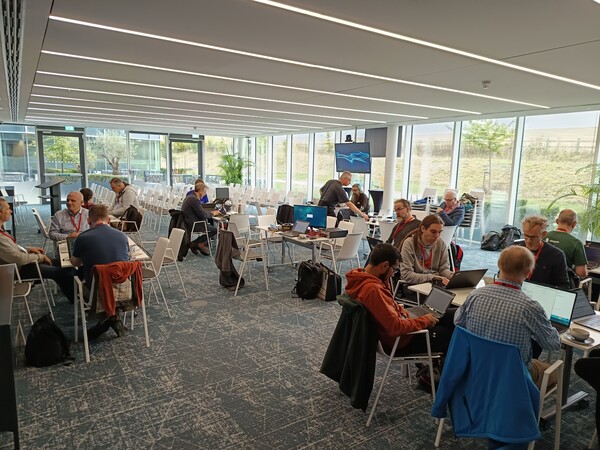
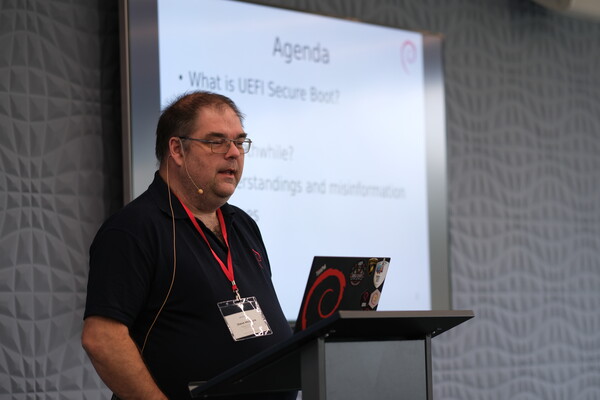
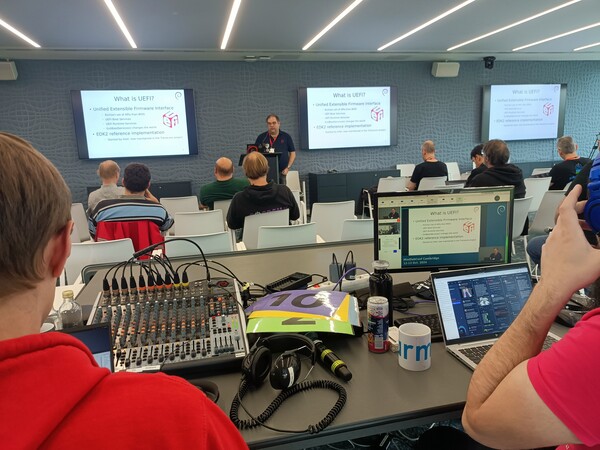
Steve McIntyre: Mini-Debconf in Cambridge, October 10-13 2024

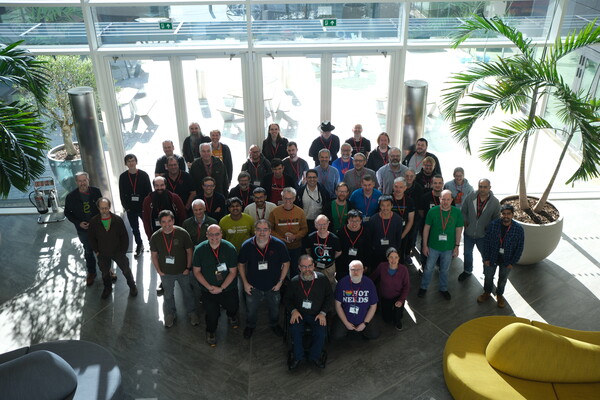
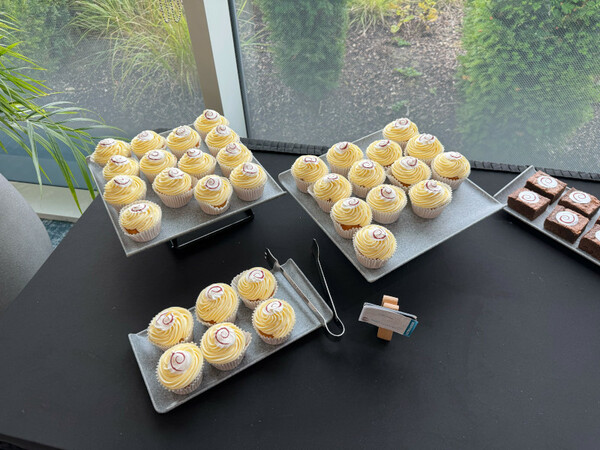
Group photo Again this year, Arm offered to host us for a mini-debconf in Cambridge. Roughly 60 people turned up on 10-13 October to the Arm campus, where they made us really welcome. They even had some Debian-themed treats made to spoil us! Cakes Hacking together minicamp For the first two days, we had a "mini-debcamp" with disparate group of people working on all sorts of things: Arm support, live images, browser stuff, package uploads, etc. And (as is traditional) lots of people doing last-minute work to prepare slides for their talks. Sessions and talks Secure Boot talk Saturday and Sunday were two days devoted to more traditional conference sessions. Our talks covered a typical range of Debian subjects: a DPL "Bits" talk, an update from the Release Team, live images. We also had some wider topics: handling your own data, what to look for in the upcoming Post-Quantum Crypto world, and even me talking about the ups and downs of Secure Boot. Plus a random set of lightning talks too! :-) Video team awesomeness Video team in action Lots of volunteers from the DebConf video team were on hand too (both on-site and remotely!), so our talks were both streamed live and recorded for posterity - see the links from the individual talk pages in the wiki, or http://meetings-archive.debian.net/pub/debian-meetings/2024/MiniDebConf-Cambridge/ for the full set if you'd like to see more. A great time for all Again, the mini-conf went well and feedback from attendees was very positive. Thanks to all our helpers, and of course to our sponsor: Arm for providing the venue and infrastructure for the event, and all the food and drink too! Photo credits: Andy Simpkins, Mark Brown, Jonathan Wiltshire. Thanks!

Russell Coker: The CUPS Vulnerability

The Announcement Late last month there was an announcement of a severity 9.9 vulnerability allowing remote code execution that affects all GNU/Linux systems (plus others) [1]. For something to affect all Linux systems that would have to be either a kernel issue or a sshd issue. The announcement included complaints about the lack of response of vendors and And YES: I LOVE hyping the sh1t out of this stuff because apparently sensationalism is the only language that forces these people to fix . He seems to have a different experience to me of reporting bugs, I have had plenty of success getting bugs fixed without hyping them. I just report the bug, wait a while, and it gets fixed. I have reported potential security bugs without even bothering to try and prove that they were exploitable (any situation where you can make a program crash is potentially exploitable), I just report it and it gets fixed. I was very dubious about his ability to determine how serious a bug is and to accurately report it so this wasn t a situation where I was waiting for it to be disclosed to discover if it affected me. I was quite confident that my systems wouldn t be at any risk. Analysis Not All Linux Systems Run CUPS When it was published my opinion was proven to be correct, it turned out to be a series of CUPS bugs [2]. To describe that as all GNU/Linux systems (plus others) seems like a vast overstatement, maybe a good thing to say if you want to be a TikTok influencer but not if you want to be known for computer security work. For the Debian distribution the cups-browsed package (which seems to be the main exploitable one) is recommended by cups-daemon, as I have my Debian systems configured to not install recommended packages by default that means that it wasn t installed on any of my systems. Also the vast majority of my systems don t do printing and therefore don t have any part of CUPS installed. CUPS vs NAT The next issue is that in Australia most home ISPs don t have IPv6 enabled and CUPS doesn t do the things needed to allow receiving connections from the outside world via NAT with IPv4. If inbound port 631 is blocked on both TCP and USP as is the default on Australian home Internet or if there is a correctly configured firewall in place then the network is safe from attack. There is a feature called uPnP port forwarding [3] to allow server programs to ask a router to send inbound connections to them, this is apparently usually turned off by default in router configuration. If it is enabled then there are Debian packages of software to manage this, the miniupnpc package has the client (which can request NAT changes on the router) [4]. That package is not installed on any of my systems and for my home network I don t use a router that runs uPnP. The only program I knowingly run that uses uPnP is Warzone2100 and as I don t play network games that doesn t happen. Also as an aside in version 4.4.2-1 of warzone2100 in Debian and Ubuntu I made it use Bubblewrap to run the game in a container. So a Remote Code Execution bug in Warzone 2100 won t be an immediate win for an attacker (exploits via X11 or Wayland are another issue). MAC Systems Debian has had AppArmor enabled by default since Buster was released in 2019 [5]. There are claims that AppArmor will stop this exploit from doing anything bad. To check SE Linux access I first use the semanage fcontext command to check the context of the binary, cupsd_exec_t means that the daemon runs as cupsd_t. Then I checked what file access is granted with the sesearch program, mostly just access to temporary files, cupsd config files, the faillog, the Kerberos cache files (not used on the Kerberos client systems I run), Samba run files (might be a possibility of exploiting something there), and the security_t used for interfacing with kernel security infrastructure. I then checked the access to the security class and found that it is permitted to check contexts and access-vectors not access that can be harmful. The next test was to use sesearch to discover what capabilities are granted, which unfortunately includes the sys_admin capability, that is a capability that allows many sysadmin tasks that could be harmful (I just checked the Fedora source and Fedora 42 has the same access). Whether the sys_admin capability can be used to do bad things with the limited access cupsd_t has to device nodes etc is not clear. But this access is undesirable. So the SE Linux policy in Debian and Fedora will stop cupsd_t from writing SETUID programs that can be used by random users for root access and stop it from writing to /etc/shadow etc. But the sys_admin capability might allow it to do hostile things and I have already uploaded a changed policy to Debian/Unstable to remove that. The sys_rawio capability also looked concerning but it s apparently needed to probe for USB printers and as the domain has no access to block devices it is otherwise harmless. Below are the commands I used to discover what the policy allows and the output from them.
# semanage fcontext -l grep bin/cups-browsed
/usr/bin/cups-browsed                              regular file       system_u:object_r:cupsd_exec_t:s0 
# sesearch -A -s cupsd_t -c file -p write
allow cupsd_t cupsd_interface_t:file   append create execute execute_no_trans getattr ioctl link lock map open read rename setattr unlink write  ;
allow cupsd_t cupsd_lock_t:file   append create getattr ioctl link lock open read rename setattr unlink write  ;
allow cupsd_t cupsd_log_t:file   append create getattr ioctl link lock open read rename setattr unlink write  ;
allow cupsd_t cupsd_runtime_t:file   append create getattr ioctl link lock open read rename setattr unlink write  ;
allow cupsd_t cupsd_rw_etc_t:file   append create getattr ioctl link lock open read rename setattr unlink write  ;
allow cupsd_t cupsd_t:file   append create getattr ioctl link lock open read rename setattr unlink write  ;
allow cupsd_t cupsd_tmp_t:file   append create getattr ioctl link lock open read rename setattr unlink write  ;
allow cupsd_t faillog_t:file   append getattr ioctl lock open read write  ;
allow cupsd_t init_tmpfs_t:file   append getattr ioctl lock read write  ;
allow cupsd_t krb5_host_rcache_t:file   append create getattr ioctl link lock open read rename setattr unlink write  ; [ allow_kerberos ]:True
allow cupsd_t print_spool_t:file   append create getattr ioctl link lock open read relabelfrom relabelto rename setattr unlink write  ;
allow cupsd_t samba_var_t:file   append getattr ioctl lock open read write  ;
allow cupsd_t security_t:file   append getattr ioctl lock open read write  ;
allow cupsd_t security_t:file   append getattr ioctl lock open read write  ; [ allow_kerberos ]:True
allow cupsd_t usbfs_t:file   append getattr ioctl lock open read write  ;
# sesearch -A -s cupsd_t -c security
allow cupsd_t security_t:security check_context; [ allow_kerberos ]:True
allow cupsd_t security_t:security   check_context compute_av  ;
# sesearch -A -s cupsd_t -c capability
allow cupsd_t cupsd_t:capability net_bind_service; [ allow_ypbind ]:True
allow cupsd_t cupsd_t:capability   audit_write chown dac_override dac_read_search fowner fsetid ipc_lock kill net_bind_service setgid setuid sys_admin sys_rawio sys_resource sys_tty_config  ;
# sesearch -A -s cupsd_t -c capability2
allow cupsd_t cupsd_t:capability2   block_suspend wake_alarm  ;
# sesearch -A -s cupsd_t -c blk_file
Conclusion This is an example of how not to handle security issues. Some degree of promotion is acceptable but this is very excessive and will result in people not taking security announcements seriously in future. I wonder if this is even a good career move by the researcher in question, will enough people believe that they actually did something good in this that it outweighs the number of people who think it s misleading at best?

24 October 2024

Emmanuel Kasper: back to blogging and running a feed reader as a containerized systemd service

After reading about Jonathan McDowell feed reader install and the back to blogging initiative, I decided to install a feed reader to follow all those nice blog posts. With a feed reader you can compose your own feed of news based on blog posts, websites, mastodon toots. And then you are independant from ad oriented ranking algorithms of social networks. Since Jonathan used FreshRSS as a feed reader, I started with the same software. On a quick glance on its github page, it sounded like a good project:
  • active contributions
  • different channels for stable and latest version of the software
  • container images pointing to the stable release
  • support multiple databases for storage, including PostgreSQL
  • correct documentation mentioning security caveats
I prefer to do the container image installation using podman since:
  • upgrades from FreshRSS are easy to do and can be done separately from operating system upgrades
  • I do not mess my based operating system with php (subjective) and in case of a compromized freshrss, the freshrss/apache install would be still restrained to its own Linux namespaces, separated from the rest of the system.
Podman is image compatible with Docker as they both implement the OCI runtime specification, and have a nearly identical command line interface. This installation will be done on a Debian server, but should work too on any Linux distribution. Initial setup
  • start a container image based on the start command provided by the FreshRSS project. The podman command line is nearly identical to the docker command line, excepts that podman expects the fully qualified domain name associated with the container image, and I chose to run the freshrss container on the localhost interface only. I also use a defined version tag, because using the latest tag makes it complicated to track which exact ersion I have installed.
# podman pull docker.io/freshrss/freshrss:1.20.1
# podman run --detach --restart unless-stopped --log-opt max-size=10m \
  --publish 127.0.0.1:8081:80 \
  --env TZ=Europe/Paris \
  --env 'CRON_MIN=1,31' \
  --volume freshrss_data:/var/www/FreshRSS/data \
  --volume freshrss_extensions:/var/www/FreshRSS/extensions \
  --name freshrss \
  docker.io/freshrss/freshrss:1.20.1
  • verify where the podman volumes have been created. This is where the user data of freshrss will be stored.
# podman volume ls
# podman volume inspect freshrss_data
  • now that freshrss is installed, you can start its configuration wizard at localhost:8081. You should keep the default sqlite choice
  • finally after running the wizard, you can login again and add some feeds
  • verify that your config has been stored outside the container, and inside the volume (so that it will not be erased in case of upgrages)
# ls -l /var/lib/containers/storage/volumes/freshrss_data/_data/users/
  • verify the state of sqlite database
echo '.tables'  sqlite3  /var/lib/containers/storage/volumes/freshrss_data/_data/users/<your freshrss user>/db.sqlite 
category  entry     entrytag  entrytmp  feed      tag
Going with FreshRSS in Production Podman has this very nice feature that it can generate a systemd unit from a running container, and use systemd to start a container on boot. This is in contrary to docker where the docker daemon does the stop/start of containers on boot. I prefer the systemd approach as it treats containers the same way as other system services. Once the freshrss container is running we can generate a systemd unit of it with:
# podman generate systemd --new --name freshrss   tee /etc/systemd/system/container-freshrss.service
Let s stop the container we started previously, and use systemd to manage it:
# podman stop freshrss
# systemctl enable --now container-freshrss.service
We can verify that we have a listening socket on the localhost interface, on the source port 8081
# systemctl status container-freshrss.service
  ...
# ss --listening --numeric --process '( sport = 8081 )'
Netid         State           Recv-Q          Send-Q                   Local Address:Port                   Peer Address:Port         Process         
tcp           LISTEN          0               4096                         127.0.0.1:8081                        0.0.0.0:*             users:(("conmon",pid=4464,fd=5))
Nota Bene: conmon (8) is the process managing the network namespace in which fresh-rss is running, hence it is displayed as the process owning the listening socket Exposing FreshRSS to the external world We have now a running service, but we need to make it reachable from the internet. The simplest, classical way, is to create a subdomain and a VirtualHost configured as a reverse proxy to access the service at 127.0.0.1:8081. Fortunately the FreshRSS authors have documented this setup in https://github.com/FreshRSS/FreshRSS/tree/edge/Docker#alternative-reverse-proxy-using-apache and those steps are no different from a standard application behind a web reverse proxy. Upgrading freshrss container to a newer version A documentation showing how to install a piece of software is nothing when it does not show how to upgrade that said software. Installing is easy, upgrading is where the challenge is. Fortunately to the good stateless design of freshrss (everything is in the sqlite database, which is backed by a non-epheremal volume in our setup), switchting versions is a peace of cake.
# podman pull docker.io/freshrss/freshrss:1.20.2
# systemctl stop container-freshrss.service
# sed -i 's,docker.io/freshrss/freshrss:1.20.1,docker.io/freshrss/freshrss:1.20.2,' /etc/systemd/system/container-freshrss.service
# systemctl daemon-reload
# systemctl start container-freshrss.service
If you need to rollback, you just need to revert version numbers in the instruction above. Enjoy your own reader feed ! I will add the following feeds of blogs I like, let us see if I follow them better with a feed reader !

Valhalla's Things: Asemic Writing, a Zine

Posted on October 24, 2024
Tags: madeof:atoms, madeof:bits, craft:zine
An open booklet with lines that look like some kind of cursive non-alphabetic script, framed by a border in the same script and four symbols in the corners. I have no idea either. The front of that booklet, with three lines of fake text in different sizes and a circle of the same. Happy Maladay1 to those who celebrate it, I guess.
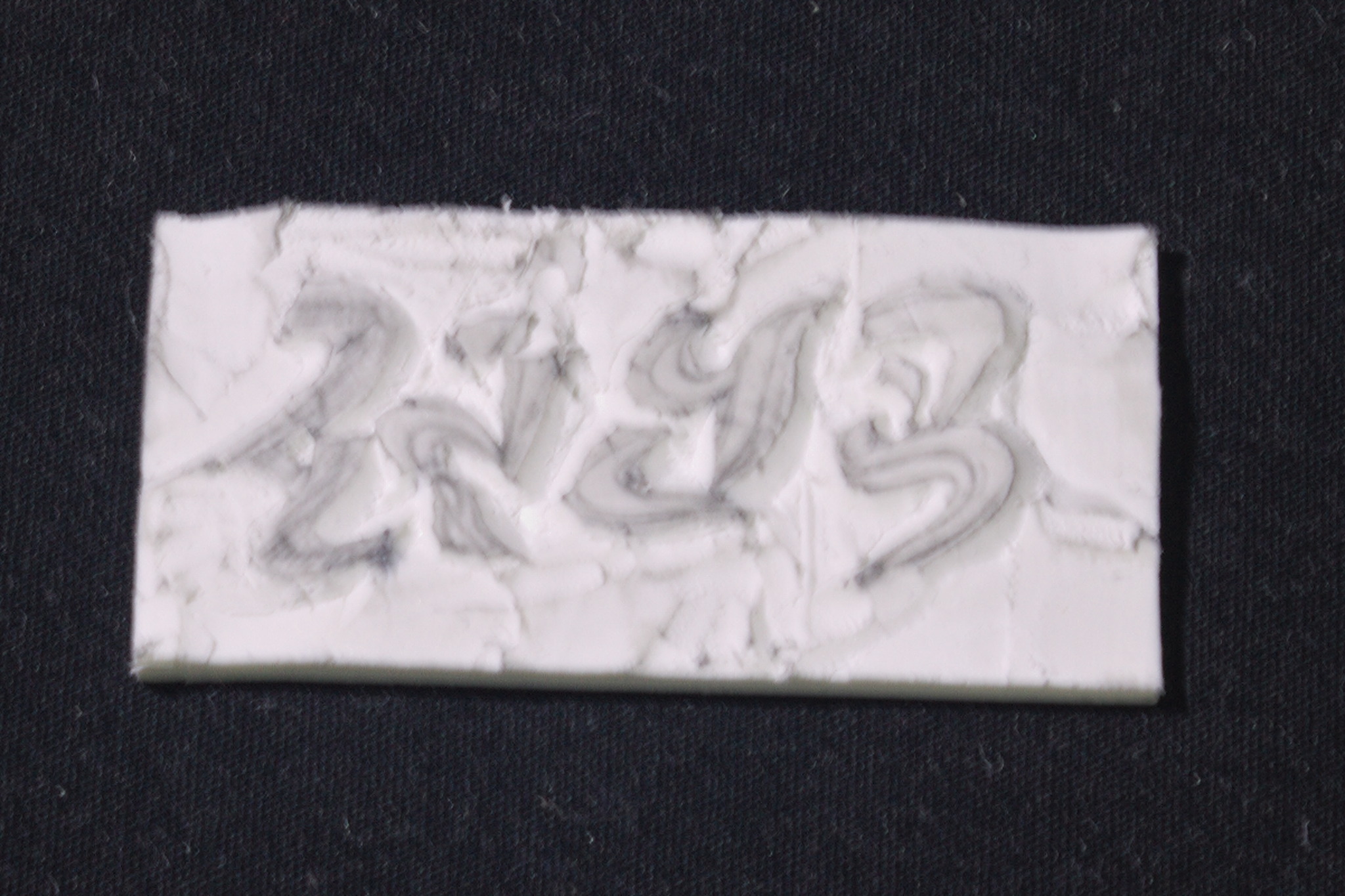
A template on white paper with pencil lines where text is supposed to go. Multiple A4 sheet of tracing paper with fake text, plus an A6 sheet and a white A6 sheet with a stamp impression. If you care about the how, it started as china ink on tracing paper, with the help of a template (and a correction sheet for one page where I used the wrong line on the template). alt A rubber stamp was carved with the author s signature and stamped on white paper because the ink from the pad wasn t working well on tracing paper. Then everything was scanned (with the correction on top of the wrong page) asemic_zine_scans.tar. Imported in Inkscape and traced asemic_zine_svg.tar. Printed, cut in half, folded and stapled. The magenta lines weren t by design, but are there because my printer is currently2 cursed. And finally, asemic_zine.pdf was created, joining the pages together with pdfjam, for convenience in case somebody wants to download the full thing. All the .tar and .pdf downloads from this page are released under the WTFPL, or All Rites Reversed..
  1. it s still technically Maladay when I write this, even if by the time you ll get this it s probably the 6th of The Aftermath.
  2. I mean, all printers are always cursed, but at different times they can be cursed in different and novel ways.

23 October 2024

Jonathan Dowland: Arturia Microfreak

Arturia Microfreak. [  CC-BY-SA 4](https://commons.wikimedia.org/wiki/File:MicroFreak.jpg) Arturia Microfreak. CC-BY-SA 4
I nearly did, but ultimately I didn't buy an Arturia Microfreak. The Microfreak is a small form factor hybrid synth with a distinctive style. It's priced at the low end of the market and it is overflowing with features. It has a weird 2-octave keyboard which is a stylophone-style capacitive strip rather than weighted keys. It seems to have plenty of controls, but given the amount of features it has, much of that functionality is inevitably buried in menus. The important stuff is front and centre, though. The digital oscillators are routed through an analog filter. The Microfreak gained sampler functionality in a firmware update that surprised and delighted its owners.
I watched a load of videos about the Microfreak, but the above review from musician Stimming stuck in my mind because it made a comparison between the Microfreak and Teenage Engineering's OP-1.
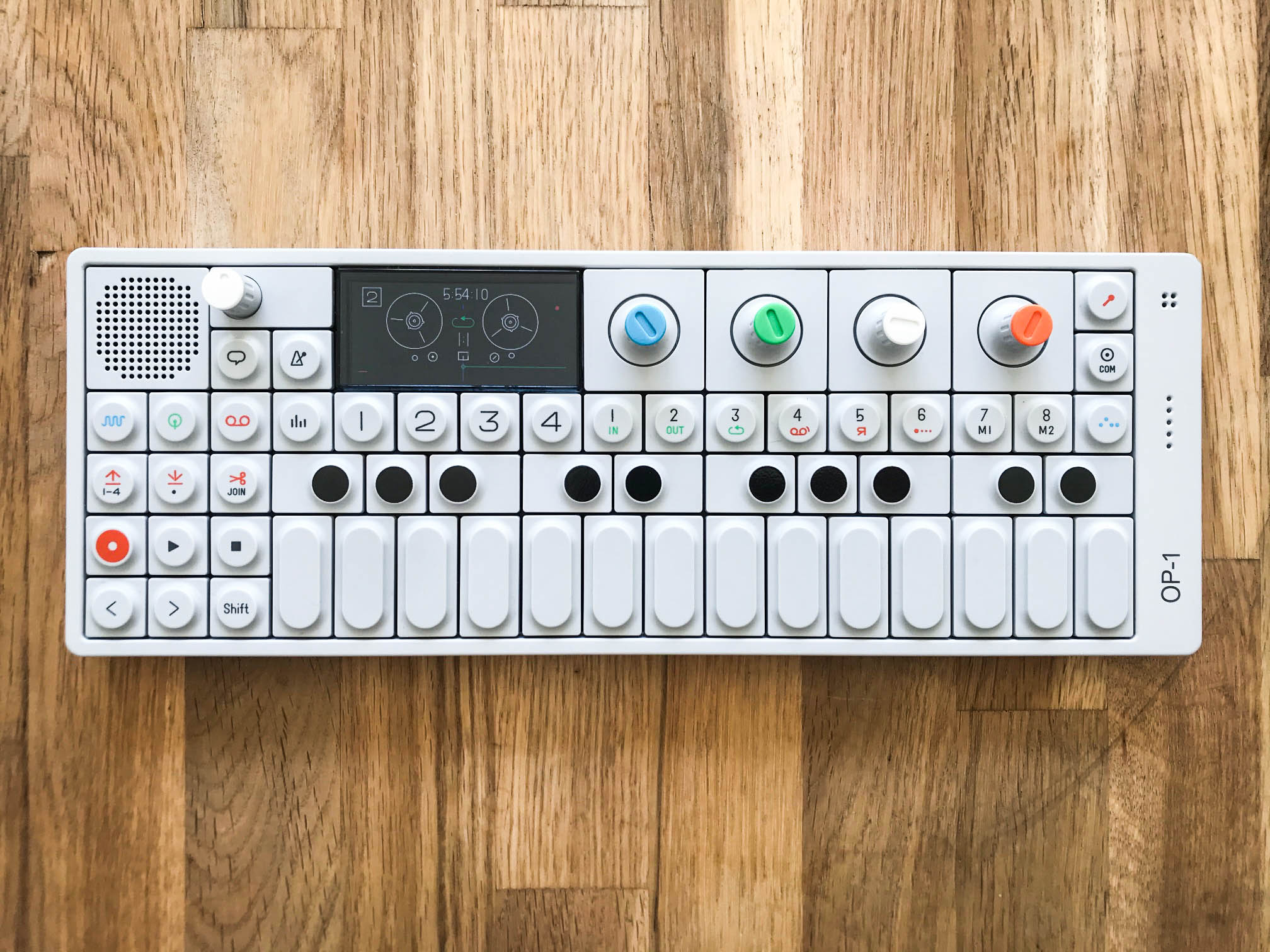
The Teenage Engineering OP-1. The Teenage Engineering OP-1.
I'd been lusting after the OP-1 since it appeared in 2011: a pocket-sized1 music making machine with eleven synthesis engines, a sampler, and less conventional features such as an FM radio, a large colour OLED display, and a four track recorder. That last feature in particular was really appealing to me: I loved the idea of having an all-in-one machine to try and compose music. Even then, I was not keen on involving conventional computers in music making. Of course in many ways it is a very compromised machine. I never did buy a OP-1, and by now they've replaced it with a new model (the OP-1 field) that costs 50% more (but doesn't seem to do 50% more) I'm still not buying one. Framing the Microfreak in terms of the OP-1 made the penny drop for me. The Microfreak doesn't have the four-track functionality, but almost no synth has: I'm going to have to look at something external to provide that. But it might capture a similar sense of fun; it's something I could use on the sofa, in the spare room, on the train, during lunchbreaks at work, etc. On the other hand, I don't want to make the same mistake as with the Micron: too much functionality requiring some experience to understand what you want so you can go and find it in the menus. I also didn't get a chance to audition the unusual keyboard: there's only one music store carrying synths left in Newcastle and they didn't have one. So I didn't buy the Microfreak. Maybe one day in the future once I'm further down the road. Instead, I started to concentrate my search on more fundamental, back-to-basics instruments

  1. Big pockets, mind

Jonathan Dowland: Why hardware synths?

Russell wrote a great comment on my last post (thanks!):
What benefits do these things offer when a general purpose computer can do so many things nowadays? Is there a USB keyboard that you can connect to a laptop or phone to do these things? I presume that all recent phones have the compute power to do all the synthesis you need if you have the right software. Is it just a lack of software and infrastructure for doing it on laptops/phones that makes synthesisers still viable?
I've decided to turn my response into a post of its own. The issue is definitely not compute power. You can indeed attach a USB keyboard to a computer and use a plethora of software synthesisers, including very faithful emulations of all the popular classics. The raw compute power of modern hardware synths is comparatively small: I ve been told the modern Korg digital synths are on a par with a raspberry pi. I ve seen some DSPs which are 32 bit ARMs, and other tools which are roughly equivalent to arduinos. I can think of four reasons hardware synths remain popular with some despite the above:
  1. As I touched on in my original synth post, computing dominates my life outside of music already. I really wanted something separate from that to keep mental distance from work.
  2. Synths have hard real-time requirements. They don't have raw power in compute terms, but they absolutely have to do their job within microseconds of being instructed to, with no exceptions. Linux still has a long way to go for hard real-time.
  3. The Linux audio ecosystem is complex. Dealing with pipewire, pulseaudio, jack, alsa, oss, and anything else I've forgotten, as well as their failure modes, is too time consuming.
  4. The last point is to do with creativity and inspiration. A good synth is more than the sum of its parts: it's an instrument, carefully designed and its components integrated by musically-minded people who have set out to create something to inspire. There are plenty of synths which aren't good instruments, but have loads of features: they re boxes of "stuff". Good synths can't do it all: they often have limitations which you have to respond to, work around or with, creatively. This was expressed better than I could by Trent Reznor in the video archetype of a synthesiser:

22 October 2024

Dirk Eddelbuettel: drat 0.2.5 on CRAN: Small Updates

drat user A new minor release of the drat package arrived on CRAN today, which is just over a year since the previous release. drat stands for drat R Archive Template, and helps with easy-to-create and easy-to-use repositories for R packages. Since its inception in early 2015 it has found reasonably widespread adoption among R users because repositories with marked releases is the better way to distribute code. Because for once it really is as your mother told you: Friends don t let friends install random git commit snapshots. Properly rolled-up releases it is. Just how CRAN shows us: a model that has demonstrated for over two-and-a-half decades how to do this. And you can too: drat is easy to use, documented by six vignettes and just works. Detailed information about drat is at its documentation site. That said, and these days , if you mainly care about github code then r-universe is there too, also offering binaries its makes and all that jazz. But sometimes you just want to, or need to, roll a local repository and drat can help you there. This release contains a small PR (made by Arne Holmin just after the previous release) adding support for an OSflacour variable (helpful for macOS). We also corrected an issue with one test file being insufficiently careful of using git2r only when installed, and as usual did a round of maintenance for the package concerning both continuous integration and documentation. The NEWS file summarises the release as follows:

Changes in drat version 0.2.5 (2024-10-21)
  • Function insertPackage has a new optional argument OSflavour (Arne Holmin in #142)
  • A test file conditions correctly about git2r being present (Dirk)
  • Several smaller packaging updates and enhancements to continuous integration and documentation have been added (Dirk)

Courtesy of my CRANberries, there is a comparison to the previous release. More detailed information is on the drat page as well as at the documentation site. If you like this or other open-source work I do, you can sponsor me at GitHub.

This post by Dirk Eddelbuettel originated on his Thinking inside the box blog. Please report excessive re-aggregation in third-party for-profit settings.

21 October 2024

Russ Allbery: California general election

As usual with these every-two-year posts, probably of direct interest only to California residents. Maybe the more obscure things we're voting on will be a minor curiosity to people elsewhere. I'm a bit late this year, although not as late as last year, so a lot of people may have already voted, but I've been doing this for a while and wanted to keep it up. This post will only be about the ballot propositions. I don't have anything useful to say about the candidates that isn't hyper-local. I doubt anyone who has read my posts will be surprised by which candidates I'm voting for. As always with Calfornia ballot propositions, it's worth paying close attention to which propositions were put on the ballot by the legislature, usually because there's some state law requirement (often that I disagree with) that they be voted on by the public, and propositions that were put on the ballot by voter petition. The latter are often poorly written and have hidden problems. As a general rule of thumb, I tend to default to voting against propositions added by petition. This year, one can conveniently distinguish by number: the single-digit propositions were added by the legislature, and the two-digit ones were added by petition. Proposition 2: YES. Issue $10 billion in bonds for public school infrastructure improvements. I generally vote in favor of spending measures like this unless they have some obvious problem. The opposition argument is a deranged rant against immigrants and government debt and fails to point out actual problems. The opposition argument also claims this will result in higher property taxes and, seriously, if only that were true. That would make me even more strongly in favor of it. Proposition 3: YES. Enshrines the right to marriage without regard to sex or race into the California state constitution. This is already the law given US Supreme Court decisions, but fixing California state law is a long-overdue and obvious cleanup step. One of the quixotic things I would do if I were ever in government, which I will never be, would be to try to clean up the laws to make them match reality, repealing all of the dead clauses that were overturned by court decisions or are never enforced. I am in favor of all measures in this direction even when I don't agree with the direction of the change; here, as a bonus, I also strongly agree with the change. Proposition 4: YES. Issue $10 billion in bonds for infrastructure improvements to mitigate climate risk. This is basically the same argument as Proposition 2. The one drawback of this measure is that it's kind of a mixed grab bag of stuff and probably some of it should be supported out of the general budget rather than bonds, but I consider this a minor problem. We definitely need to ramp up climate risk mitigation efforts. Proposition 5: YES. Reduces the required super-majority to pass local bond measures for affordable housing from 67% to 55%. The fact that this requires a supermajority at all is absurd, California desperately needs to build more housing of any kind however we can, and publicly funded housing is an excellent idea. Proposition 6: YES. Eliminates "involuntary servitude" (in other words, "temporary" slavery) as a legally permissible punishment for crimes in the state of California. I'm one of the people who think the 13th Amendment to the US Constitution shouldn't have an exception for punishment for crimes, so obviously I'm in favor of this. This is one very, very tiny step towards improving the absolutely atrocious prison conditions in the state. Proposition 32: YES. Raises the minimum wage to $18 per hour from the current $16 per hour, over two years, and ties it to inflation. This is one of the rare petition-based propositions that I will vote in favor of because it's very straightforward, we clearly should be raising the minimum wage, and living in California is absurdly expensive because we refuse to build more housing (see Propositions 5 and 33). The opposition argument is the standard lie that a higher minimum wage will increase unemployment, which we know from numerous other natural experiments is simply not true. Proposition 33: NO. Repeals Costa-Hawkins, which prohibits local municipalities from enacting rent control on properties built after 1995. This one is going to split the progressive vote rather badly, I suspect. California has a housing crisis caused by not enough housing supply. It is not due to vacant housing, as much as some people would like you to believe that; the numbers just don't add up. There are way more people living here and wanting to live here than there is housing, so we need to build more housing. Rent control serves a valuable social function of providing stability to people who already have housing, but it doesn't help, and can hurt, the project of meeting actual housing demand. Rent control alone creates a two-tier system where people who have housing are protected but people who don't have housing have an even harder time getting housing than they do today. It's therefore quite consistent with the general NIMBY playbook of trying to protect the people who already have housing by making life harder for the people who do not, while keeping the housing supply essentially static. I am in favor of rent control in conjunction with real measures to increase the housing supply. I am therefore opposed to this proposition, which allows rent control without any effort to increase housing supply. I am quite certain that, if this passes, some municipalities will use it to make constructing new high-density housing incredibly difficult by requiring it all be rent-controlled low-income housing, thus cutting off the supply of multi-tenant market-rate housing entirely. This is already a common political goal in the part of California where I live. Local neighborhood groups advocate for exactly this routinely in local political fights. Give me a mandate for new construction that breaks local zoning obstructionism, including new market-rate housing to maintain a healthy lifecycle of housing aging into affordable housing as wealthy people move into new market-rate housing, and I will gladly support rent control measures as part of that package. But rent control on its own just allocates winners and losers without addressing the underlying problem. Proposition 34: NO. This is an excellent example of why I vote against petition propositions by default. This is a law designed to affect exactly one organization in the state of California: the AIDS Healthcare Foundation. The reason for this targeting is disputed; one side claims it's because of the AHF support for Proposition 33, and another side claims it's because AHF is a slumlord abusing California state funding. I have no idea which side of this is true. I also don't care, because I am fundamentally opposed to writing laws this way. Laws should establish general, fair principles that are broadly applicable, not be written with bizarrely specific conditions (health care providers that operate multifamily housing) that will only be met by a single organization. This kind of nonsense creates bad legal codes and the legal equivalent of technical debt. Just don't do this. Proposition 35: YES. I am, reluctantly, voting in favor of this even though it is a petition proposition because it looks like a useful simplification and cleanup of state health care funding, makes an expiring tax permanent, and is supported by a very wide range of organizations that I generally trust to know what they're talking about. No opposition argument was filed, which I think is telling. Proposition 36: NO. I am resigned to voting down attempts to start new "war on drugs" nonsense for the rest of my life because the people who believe in this crap will never, ever, ever stop. This one has bonus shoplifting fear-mongering attached, something that touches on nasty local politics that have included large retail chains manipulating crime report statistics to give the impression that shoplifting is up dramatically. It's yet another round of the truly horrific California "three strikes" criminal penalty obsession, which completely misunderstands both the causes of crime and the (almost nonexistent) effectiveness of harsh punishment as deterrence.

Next.

Previous.