Search Results: "rra"

3 October 2014

Lars Wirzenius: Matthew Garret and Intel and the so-called gamergate

Kudos to Matthew for taking a stance. It has, not surprisingly, provoked a lot of comments and feedback, most of it unpleasant. If I did anything that was directly related to Intel, I'd join him, but I do very, very little architecture dependent stuff anymore. I will, however, say this: Even if the "gamergate" were actually about good journalism and ethics (and it's clear it isn't), if your reaction to a differing opinion is abuse, harrassment, and other kinds of psychological violence, you're not making anything better, you're making it all worse. Reasonable people can handle disagreement without any kind of violence.

Marco d'Itri: 15 years of whois

Exactly 15 years ago I uploaded to Debian the first release of my whois client. At the end of 1999 the United States Government forced Network Solutions, at the time the only registrar for the .com, .net and .org top level domains, to split their functions in a registry and a registrar and to and allow competing registrars to operate. Since then, two whois queries are needed to access the data for a domain in a TLD operating with a thin registry model: first one to the registry to find out which registrar was used to register the domain, and then one the registrar to actually get the data. Being as lazy as I am I tought that this was unacceptable, so I implemented a whois client that would know which whois server to query for all TLDs and then automatically follow the referrals to the registrars. But the initial reason for writing this program was to replace the simplistic BSD-derived whois client that was shipped with Debian with one that would know which server to query for IP addresses and autonomous system numbers, a useful feature in a time when people still used to manually report all their spam to the originating ISPs. Over the years I have spent countless hours searching for the right servers for the domains of far away countries (something that has often been incredibly instructive) and now the program database is usually more up to date than the official IANA one. One of my goals for this program has always been wide portability, so I am happy that over the years it was adopted by other Linux distributions, made available by third parties to all common variants of UNIX and even to systems as alien as Windows and OS/2. Now that whois is 15 years old I am happy to announce that I have recently achieved complete world domination and that all Linux distributions use it as their default whois client.

1 October 2014

Vincent Sanders: It is a bad plan that admits of no modification

I find it somewhat interesting that thousands of years later that our society still uses Publilius Syrus sententiae though I imagine the tendency to leave well enough alone means such phrases stay in usage.

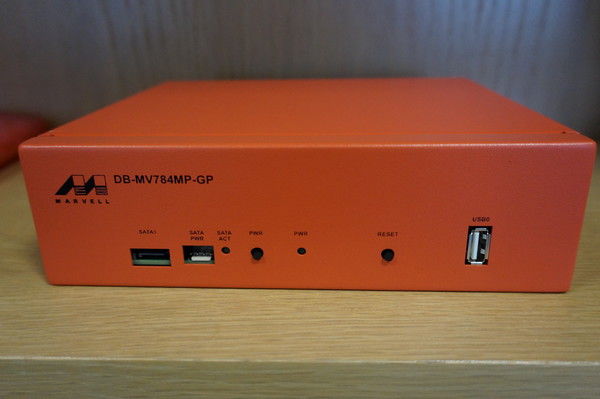
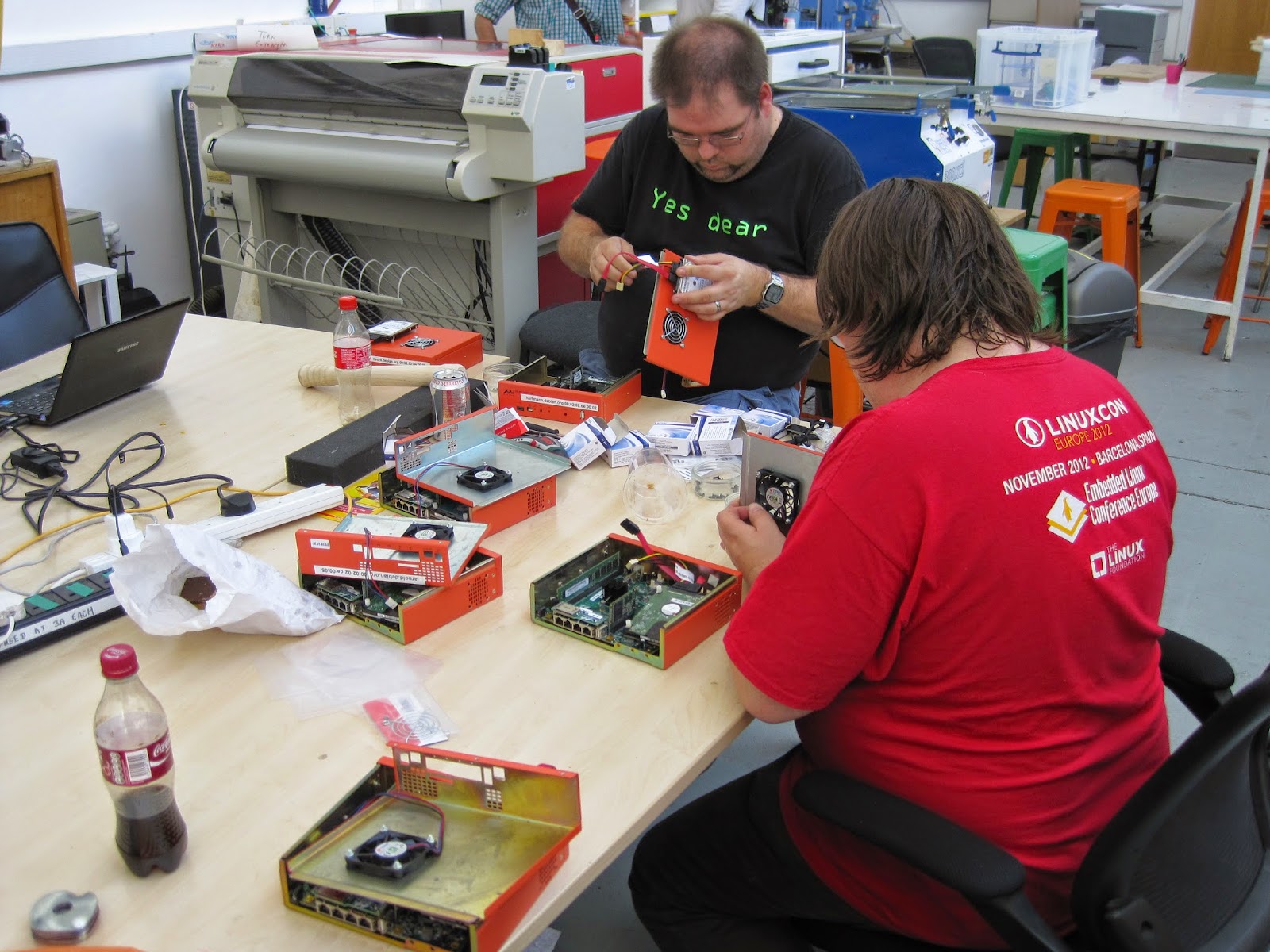
Marvell ARM system - Photo from Steve McIntyre
One weekend Steve McIntyre asked me if I could find a source of some of some 40mm fans for some systems with some pretty strict requirements. They needed to be long life and shift a lot of air to combat a persistent overheating issue.

I sat with him and went through the Farnell utterly hateful parametric web interface and eventually came up with a couple of options which were very expensive. Only then did I stop and ask what the actual problem was.

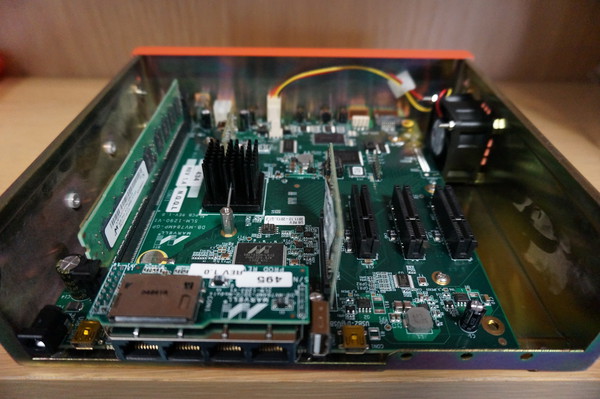
Marvell ARM system Original internal cooling arrangement - Photo from Steve McIntyre
Steve showed me one of the Debian ARM buildd boxes which are Marvell development machines. These systems are powerful quad core machines housed in compact steel enclosures.

There is a single 40mm fan trying to provide cooling for the entire enclosure. When the units are placed horizontally and used intermittently this proves adequate. Unfortunately when the system are arranged vertically in a rack and run at full load continuously they often overheat and have to be restarted. In addition the small high speed fans need replacing frequently as their bearings wore out quickly.

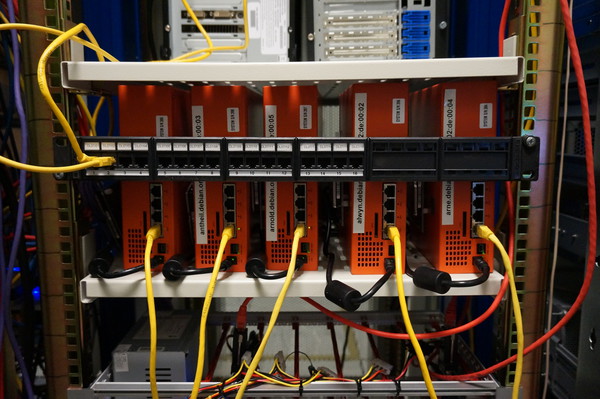
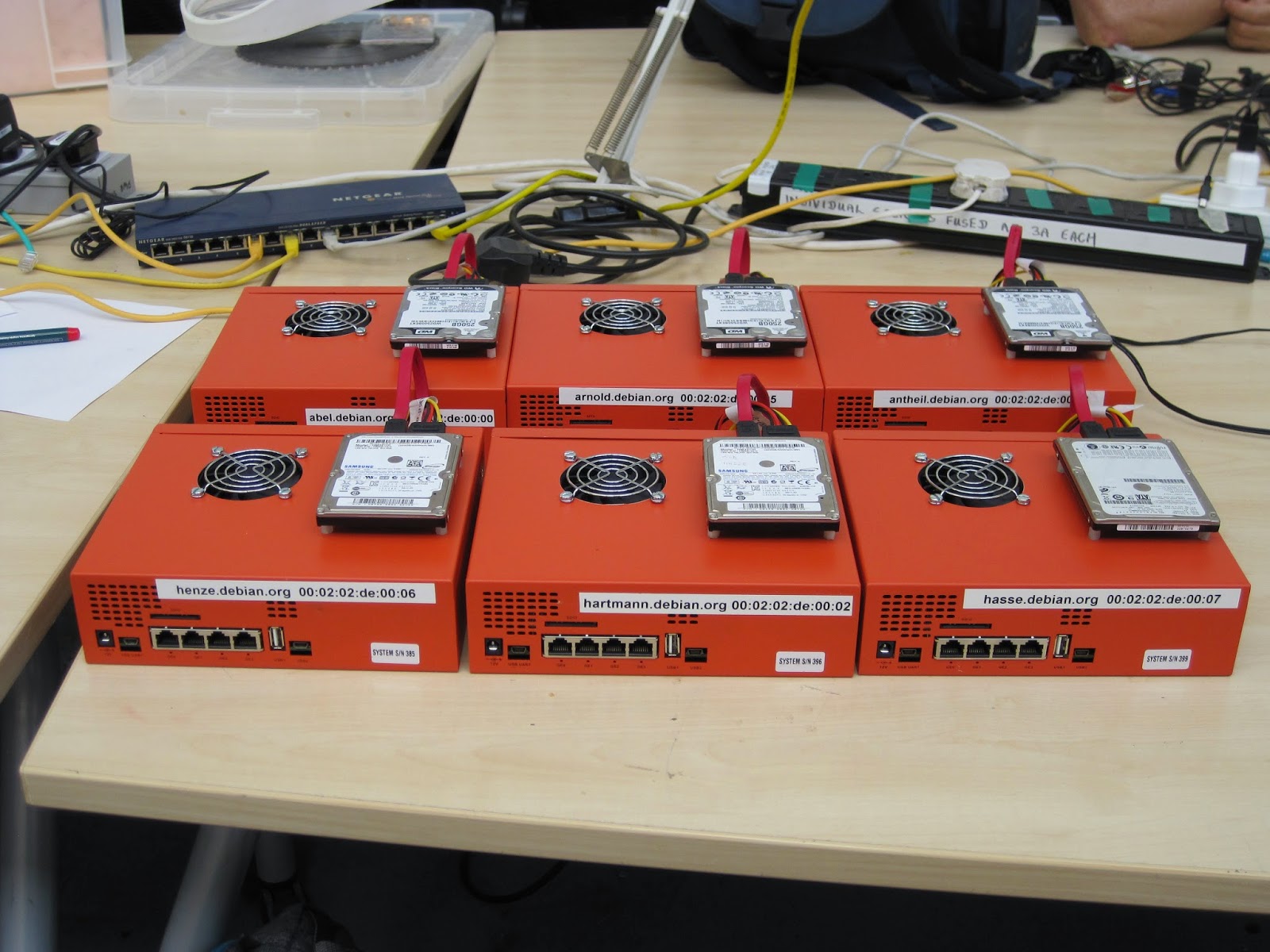
Debian ARM buildd systems - Photo from Steve McIntyreThis was obviously causing some issues for the ARM Debian ports which Steve wanted to rectify. After talking the problem through for a while we came to the conclusion we could use much larger 60mm fans to blow air directly through the top of the case onto the cpu heatsink.

Larger fans can be run much more slowly to move a similar volume of air to the smaller 40mm fans which gives a much longer service life.

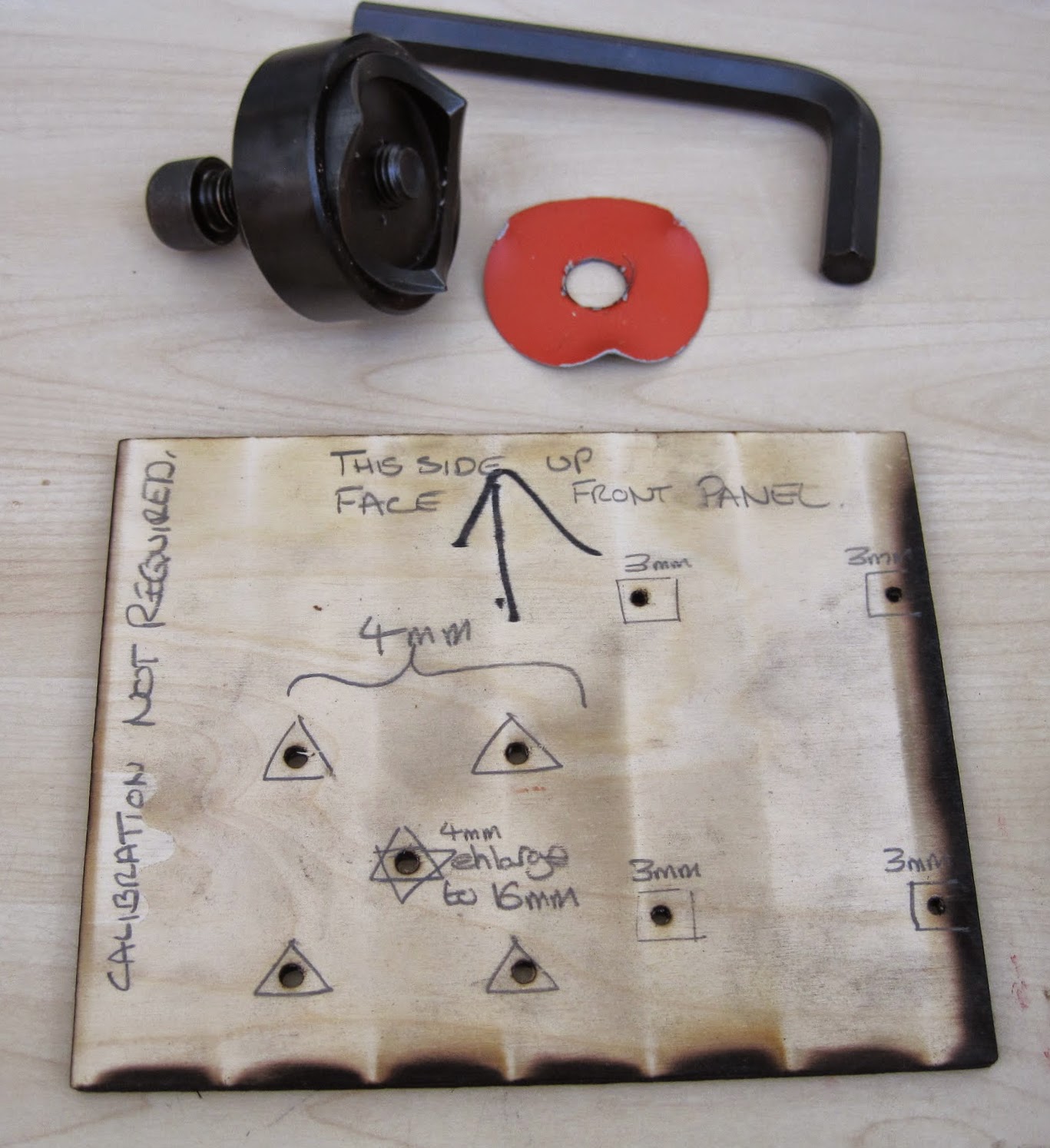
Hole punch and Drilling template
Steve proceeded to order enough parts to allow us to modify all the Debian systems, this worked out cheaper than a single "special" 40mm high volume fan.

I acquired a rather large steel hole punch, I chose this tool because it produces a much superior finish to a hole cutter and this project demanded a high level of finish (not to mention I loved having a valid excuse to own and use a huge allen key!)

If we had simply been modifying a single case I would have measured and marked up by hand. With the prospect of altering at least eight I laser cut a template from plywood which Andy Simpkins took great glee in excessively annotating.

We also used the opportunity to add bolt holes to securely attach the 2.5 inch SATA drives instead of using sticky pads.

Steve and I modified a single system to begin with both to check our alignment and the efficacy of the change. We were pleasantly surprised to discover that hoiby could now repeatedly do kernel compiles with all four cores flat out which was not possible before. The measured CPU temperature, which had previously been around 90 C, did not rise above 40 C

Steve and Andy on the assembly line
Steve, Andy and I then arranged a day where we took all the remaining units out of the rack at ARM, modified and returned them. We used the facilities at the Cambridge Makespace where I am a member to do the modifications.

I broke two 3mm drill bits and dulled a 4mm bit drilling all the holes, Roger Smith was good enough to loan us the use of his "Christmas tree bit" to ream the fan hole out to 16mm so we could thread the hole punch and cut the 60mm fan aperture out.

six modified systems ready to be re-racked.
We managed to get quite an assembly line going and, in my opinion, the results look pretty professional.

It has been several months since we did this work and these systems continue to run without issue. To complete the story we can see some graphs courtesy of the DSA munin instance.

CPU load on arnold.debian.org
You can clearly see the huge drop in temperature at the end of Week 25 despite the continuously high CPU load. Also there is only a single gap in the data after the changes (these indicate crashes where data was not recorded) where before there were frequent and extensive times where the systems were simply unusable.

CPU Temperature of arnold.debian.org
One reason I continue to enjoy Debian so much is the wide variety of ways in which I can contribute not only by maintaining my packages. Sometimes this kind of work does not receive the credit it deserves and hopefully highlights a small part of the frantic paddling that goes on under the serene surface of the Debian project to keep things "just working".

28 September 2014

Ean Schuessler: RoboJuggy at JavaOne

A few months ago I was showing my friend Bruno Souza the work I had been doing with my childhood friend and robotics genius, David Hanson. I had been watching what David was going through in his process of creating life-like robots with the limited industrial software available for motor control. I had suggested to David that binding motors to Blender control structures was a genuinely viable possibility. David talked with his forward looking CEO, Jong Lee, and they were gracious enough to invite me to Hong Kong to make this exciting idea a reality. Working closely the HRI team (Vytas, Gabrielos, Fabien and Davide) with David s friend and collaborators at OpenCog (Ben Goertzel, Mandeep, David, Jamie, Alex and Samuel) a month long creative hack-fest yielded pretty amazing results. Bruno is an avid puppeteer, a global organizer of java user groups and creator of Juggy the Java Finch, mascot of Java users and user groups everywhere. We started talking about how cool it would be to have a robot version of Juggy. When I was in China I had spent a little time playing with Mark Tilden s RSMedia and various versions of David s hobby servo based emotive heads. Bruno and I did a little research into the ROS Java bindings for the Robot Operating System and decided that if we could make that part of the picture we had a great and fun idea for a JavaOne talk. Hunting and gathering I tracked down a fairly priced RSMedia in Alaska, Bruno put a pair of rubber Juggy puppet heads in the mail and we were on our way.
We had decided that we wanted RoboJuggy to be able to run about untethered and the new RaspberryPi B+ seemed like the perfect low power brain to make that happen. I like the Debian based Raspbian distributions but had lately started using the netinst Pi images. These get your Pi up and running in about 15 minutes with a nicely minimalistic install instead of a pile of dependencies you probably don t need. I d recommend anyone interested I m duplicating our work to stay their journey there: Raspbian UA Net Installer Robots seem like an embedded application but ROS only ships packages for Ubuntu. I was pleasantly surprised that there are very good instructions for building ROS from source on the Pi. I ended up following these instructions: Setting up ROS Hydro on the Raspberry Pi Building from source means that all your install ends up being isolated (in ROS speak) and your file locations and build instructions end up being subtly current. As explained in the linked article, this process is also very time consuming. One thing I would recommend once you get past this step is to use the UNIX dd command to back up your entire SD card to a desktop. This way if you make a mess of things in later steps you can restore your install to a pristine Raspbian+ROS install. If your SD drive was on /dev/sdb you might use something like this to do the job:
sudo dd bs=4M if=/dev/sdb   gzip > /home/your_username/image date +%d%m%y .gz
Getting Java in the mix Once you have your Pi all set up with minimal Raspbian and ROS you are going to want a Java VM. The Pi runs the ARM CPU so you need the corresponding version of Java. I tried getting things going initially with OpenJDK and I had some issues with that. I will work on resolving that in the future because I would like to have a 100% Free Software kit for this but since this was for JavaOne I also wanted JDK8, which isn t available in Debian yet. So, I downloaded the Oracle JDK8 package for ARM. Java 8 JDK for ARM At this point you are ready to start installing the ROS Java packages. I m pretty sure the way I did this initially is wrong but I was trying to reconcile the two install procedures for ROS Java and ROS Hydro for Raspberry Pi. I started by following these directions for ROS Java but with a few exceptions (you have to click the install from source link in the page to see the right stuff: Installing ROS Java on Hydro Now these instructions are good but this is a Pi running Debian and not an Ubuntu install. You won t run the apt-get package commands because those tools were already installed in your earlier steps. Also, this creates its own workspace and we really want these packages all in one workspace. You can apparently chain workspaces in ROS but I didn t understand this well enough to get it working so what I did was this:
> mkdir -p ~/rosjava 
> wstool init -j4 ~/rosjava/src https://raw.github.com/rosjava/rosjava/hydro/rosjava.rosinstall
> source ~/ros_catkin_ws/install_isolated/setup.bash > cd ~/rosjava # Make sure we've got all rosdeps and msg packages.
> rosdep update 
> rosdep install --from-paths src -i -y
and then copied the sources installed into ~/rosjava/src into my main ~/ros_catkin_ws/src. Once those were copied over I was able to run a standard build.
> catkin_make_isolated --install
Like the main ROS install this process will take a little while. The Java gradle builds take an especially long time. One thing I would recommend to speed up your workflow is to have an x86 Debian install (native desktop, QEMU instance, docker, whatever) and do these same build from source installs there. This will let you try your steps out on a much faster system before you try them out in the Pi. That can be a big time saver. Putting together the pieces Around this time my RSMedia had finally showed up from Alaska. At first I thought I had a broken unit because it would power up, complain about not passing system tests and then shut back down. It turns out that if you just put the D batteries in and miss the four AAs that it will kind of pretend to be working so watch for that mistake. Here is a picture of the RSMedia when it first came out of the box: wpid-20140911_142904.jpg Other parts were starting to roll in as well. The rubber puppet heads had made their way through Brazilian customs and my Pololu Mini Maestro 24 had also shown up as well as the my servo motors and pan and tilt camera rig. I had previously bought a set of 10 motors for goofing around so I bought the pan and tilt rig by itself for about $5(!) but you can buy a complete set for around $25 from a number of EBay stores. Complete pan and tilt rig with motors for $25 A bit more about the Pololu. This astonishing little motor controller costs about $25 and gives you control of 24 motors with an easy to use and high level serial API. It is probably also possible to control these servos directly from the Pi and eliminate this board but that will be genuinely difficult because of the real-time timing issues. For $25 this thing is a real gem and you won t regret buying it. Now it was time to start dissecting the RSMedia and getting control of its brain. Unfortunately a lot of great information about the RSMedia has floated away since it was in its heyday 5 years ago but there is still some solid information out there that we need to round up and preserve. A great resource is the SourceForge based website here at http://rsmediadevkit.sourceforge.net. That site has links to a number of useful sites. You will definitely want to check out their wiki. To disassemble the RSMedia I followed their instructions. I will say, it would be smart to take more pictures as you are going because they don t take as many as they should. I took pictures of each board and its associated connections as dismantled the unit and that helped me get things back together later. Another important note is that if all you want to do is solder onto the control board and not replace the head then its feasible to solder the board in place without completely disassembling the unit. Here are some photos of the dis-assembly: wpid-20140921_114742.jpg wpid-20140921_113054.jpg wpid-20140921_112619.jpg Now I also had to start adjusting the puppet head, building an armature for the motors to control it and hooking it into the robot. I need to take some more photos of the actual armature. I like to use cardboard for this kind of stuff because it is so fast to work with and relatively strong. One trick I have also learned about cardboard is that if you get something going with it and you need it to be a little more production strength you can paint it down with fiberglass resin from your local auto store. Once it dries it becomes incredibly tough because it soaks through the fibers of the cardboard and hardens around them. You will want to do this in a well ventilated area but its a great way to build super tough prototypes. Another prototyping trick I can suggest is using a combination of Velcro and zipties to hook things together. The result is surprisingly strong and still easy to take apart if things aren t working out. Velcro self-adhesive pads stick to rubber like magic and that is actually how I hooked the jaw servo onto the mask. You can see me torturing its first initial connection here: Since the puppet head had come all the way from Brazil I decided to cook some chicken hearts in the churrascaria style while I worked on them in the garage. This may sound gross but I m telling you, you need to try it! I soaked mine in soy sauce, Sriracha and chinese cooking wine. Delicious but I digress. wpid-20140920_191551.jpg As I was eating my chicken hearts I was also connecting the pan and tilt armature onto the puppet s jaw and eye assembly. It took me most of the evening to get all this going but by about one in the morning things were starting to look good! I only had a few days left to hack things together before JavaOne and things were starting to get tight. I had so much to do and had also started to run into some nasty surprises with the ROS Java control software. It turns out that ROS Java is less than friendly with ROS message structures that are not built in . I had tried to follow the provided instructions but was not (and still have not) been able to get that working. Using unofficial messages with ROS Java I still needed to get control of the RSMedia. Doing that required the delicate operation of soldering to its control board. On the board there are a set of pins that provide a serial interface to the ARM based embedded Linux computer that controls the robot. To do that I followed these excellent instructions: Connecting to the RSMedia Linux Console Port After some sweaty time bent over a magnifying glass I had success: wpid-20140921_143327.jpg I had previously purchased the USB-TTL232 accessory described in the article from Dallas awesome Tanner Electronics store in Dallas. If you are a geek I would recommend that you go there and say hi to its proprietor (and walking encyclopedia of electronics knowledge) Jim Tanner. It was very gratifying when I started a copy of minicom, set it to 115200, N, 8, 1, plugged in the serial widget to the RSMedia and booted it up. I was greeted with a clearly recognizable Linux startup and console prompt. At first I thought I had done something wrong because I couldn t get it to respond to commands but I quickly realized I had flow control turned on. Once turned off I was able to navigate around the file system, execute commands and have some fun. A little research and I found this useful resource which let me get all kinds of body movements going: A collection of useful commands for the RSMedia At this point, I had a usable set of controls for the body as well as the neck armature. I had a controller running the industry s latest and greatest robotics framework that could run on the RSMedia without being tethered to power and I had most of a connection to Java going. Now I just had to get all those pieces working together. The only problem is that time was running out and I only had a couple of days until my talk and still had to pack and square things away at work. The last day was spent doing things that I wouldn t be able to do on the road. My brother Erik (and fantastic artist) came over to help paint up the juggy head and fix the eyeball armature. He used a mix of oil paint, rubber cement which stuck to the mask beautifully. I bought battery packs for the USB Pi power and the 6v motor control and integrated them into a box that could sit below the neck armature. I fixed up a cloth neck sleeve that could cover everything. Luckily during all this my beautiful and ever so supportive girlfriend Becca had helped me get packed or I probably wouldn t have made it out the door. Welcome to San Francisco THIS ARTICLE IS STILL BEING WRITTEN

27 September 2014

Ritesh Raj Sarraf: Laptop Mode Tools 1.66

I am pleased to announce the release of Laptop Mode Tools at version 1.66. This release fixes an important bug in the way Laptop Mode Tools is invoked. Users, now when disable it in the config file, the tool will be disabled. Thanks to bendlas@github for narrowing it down. The GUI configuration tool has been improved, thanks to Juan. And there is a new power saving module for users with ATI Radeon cards. Thanks to M. Ziebell for submitting the patch. Laptop Mode Tools development can be tracked @ GitHub

AddThis:

Categories:

Keywords:

25 September 2014

Russ Allbery: Review: Turn the Ship Around!

Review: Turn the Ship Around!, by L. David Marquet
Publisher: Portfolio
Copyright: 2012
ISBN: 1-101-62369-1
Format: Kindle
Pages: 272
Turn the Ship Around! (yes, complete with the irritating exclamation point in the title) is marketed to the business and management non-fiction market, which is clogged with books claiming to provide simple techniques to be a great manager or fix an organization. If you're like me, this is a huge turn-off. The presentation of the books is usually just shy of the click-bait pablum of self-help books. Many of the books are written by famous managers best known for doing horrible things to their staff (*cough* Jack Welch). It's hard to get away from the feeling that this entire class of books is an ocean of bromides covering a small core of outright evil. This book is not like that, and Marquet is not one of those managers. It can seem that way at times: it is presented in the format that caters to short attention span, with summaries of primary points at the end of every short chapter and occasionally annoying questions sprinkled throughout. I'm capable of generalizing information to my own life without being prompted by study questions, thanks. But that's just form. The core of this book is a surprisingly compelling story of Marquet's attempt to introduce a novel management approach into one of the most conservative and top-down of organizations: a US Navy nuclear submarine. I read this book as an individual employee, and someone who has no desire to ever be a manager. But I recently changed jobs and significantly disrupted my life because of a sequence of really horrible management decisions, so I have strong opinions about, at least, the type of management that's bad for employees. A colleague at my former employer recommended this book to me while talking about the management errors that were going on around us. It did such a good job of reinforcing my personal biases that I feel like I should mention that as a disclaimer. When one agrees with a book this thoroughly, one may not have sufficient distance from it to see the places where its arguments are flawed. At the start of the book, Marquet is assigned to take over as captain of a nuclear submarine that's struggling. It had a below-par performance rating, poor morale, and the worst re-enlistment rate in the fleet, and was not advancing officers and crew to higher ranks at anywhere near the level of other submarines. Marquet brought to this assignment some long-standing discomfort with the normal top-down decision-making processes in the Navy, and decided to try something entirely different: a program of radical empowerment, bottom-up decision-making, and pushing responsibility as far down the chain of command as possible. The result (as you might expect given that you can read a book about it) was one of the best-performing submarines in the fleet, with retention and promotion rates well above average. There's a lot in here about delegated decision-making and individual empowerment, but Turn the Ship Around! isn't only about that. Those are old (if often ignored) rules of thumb about how to manage properly. I think the most valuable part of this book is where Marquet talks frankly about his own thought patterns, his own mistakes, and the places where he had to change his behavior and attitude in order to make his strategy successful. It's one thing to say that individuals should be empowered; it's quite another to stop empowering them (which is still a top-down strategy) and start allowing them to be responsible. To extend trust and relinquish control, even though you're the one who will ultimately be held responsible for the performance of the people reporting to you. One of the problems with books like this is that they focus on how easy the techniques presented in the book are. Marquet does a more honest job in showing how difficult they are. His approach was not complex, but it was emotionally quite difficult, even though he was already biased in favor of it. The control, hierarchy, and authority parts of the book are the most memorable, but Marquet also talks about, and shows through specific examples from his command, some accompanying principles that are equally important. If everyone in an organization can make decisions, everyone has to understand the basis for making those decisions and understand the shared goals, which requires considerable communication and open discussion (particularly compared to a Navy ideal of an expert and taciturn captain). It requires giving people the space to be wrong, and requires empowering people to correct each other without blame. (There's a nice bit in here about the power of deliberate action, and while Marquet's presentation is more directly applicable to the sorts of physical actions taken in a submarine, I was immediately reminded of code review.) Marquet also has some interesting things to say about the power of, for lack of a better term, esprit de corps, how to create it, and the surprising power of acting like you have it until you actually develop it. As mentioned, this book is very closely in alignment with my own biases, so I'm not exactly an impartial reviewer. But I found it fascinating the degree to which the management situation I left was the exact opposite of the techniques presented in this book in nearly every respect. I found it quite inspiring during my transition period, and there are bits of it that I want to read again to keep some of the techniques and approaches fresh in my mind. There is a fair bit of self-help-style packaging and layout here, some of which I found irritating. If, like me, you don't like that style of book, you'll have to wade through a bit of it. I would have much preferred a more traditional narrative story from which I could draw my own conclusions. But it's more of a narrative than most books of this sort, and Marquet is humble enough to show his own thought processes, tensions, and mistakes, which adds a great deal to the presentation. I'm not sure how directly helpful this would be for a manager, since I've never been in that role, but it gave me a lot to think about when analyzing successful and unsuccessful work environments. Rating: 8 out of 10

24 September 2014

Laura Arjona: 10 short steps to contribute translations to free software for Android

This small guide assumes that you know how to create a public repository with git (or other version control system). Maybe some projects use other VCS, Subversion or whatever; the process would be similar although the commands will be different of course. If you don t want to use any VCS, you can just download the corresponding file, translate it, and send it by email or to the BTS of the project, but the commands required are very easy and you ll see soon that using git (or any VCS) is quite comfortable and less scary than what it seems. So, you were going to recommend a nice app that you use or found in F-Droid to your friend, but she does not understand English. Why not translating the app for her? And for everybody? It s a job that can be done in 15 minutes or so (Android apps have very short strings, few menus, and so). Let s go! 1.- Search the app in the F-Droid website You can do it going to the URL: https://f-droid.org/repository/browse/?fdfilter=wordofappname Example: https://f-droid.org/repository/browse/?fdfilter=pomodoro Then, open the details of the app, and learn where s the source code. 2.- Clone the source code If you have an account in that forge, fork/clone the project into your account, and then, clone your fork/clone in local. If you haven t got an account in that forge, clone the project in local. git clone URLofTheProjectOrYourClone 3.- In local, create a new branch, and checkout to it. cd nameofrepo git checkout -b Spanish 4.- Then, copy the /res/values folder into res/values-XX folder (where XX is your language code) cp ./res/values /res/values-es -R 5.- Translate Edit the strings.xml file that is in the res/values-XX folder, and change the English strings to your language (respect the XML format). 6.- Translate other files, or delete them If there are more files in that folder (e.g. arrays.xml ), review them to know if they have translatable strings. If yes, translate them. If not, delete the files. 7.- Commit When you are finished, commit your changes: git add res/values-es/* git commit -a (Message can be Spanish translation or so) 8.- Push your changes to your public repo If you didn t create a public clone of the repo in your forge, create a public repo and push your local stuff into there. git push --all 9.- Request a merge to the original repo (Using the web interface of the forge, if it is the same for the original repo and your clone, or sending an email or creating an issue and providing the URL of your repo). For example, open a new issue in the project s BTS Title: Spanish translation available for merging Body: Hi everybody. Thanks for your work in "nameofapp". I have completed a Spanish translation, it's available for review/merge in the Spanish branch of my repo: https://urlofyourclone Best regards 10.- Congratulations! Translations are new features, and having a new feature in your app for free is a great thing, so probably the app developer(s) will merge your translation soon. Share your joy with your friends, so they begin to use the app you translated, and maybe become translators too! Comments? You can comment on this post in this pump.io thread.
Filed under: Tools, Writings (translations) Tagged: Android, Contributing to libre software, English, Free Software, libre software, translations

Vincent Sanders: I wanted to go to Portland because it's a really good book town.

Plane at Heathrow terminal 5 taking me to America for Debconf 14Patti Smith is right, more than any other US city I have visited, Portland feels different. Although living in Cambridge, which sometimes feels like where books were invented, might give me a warped sense of a place.

Jo McIntyre getting on the tram at PDX
I have visited Portland a few times previously and I feel comfortable every time I arrive at PDX. Sure the place still suffers from the american obsession with the car but similar to New York you can rely on public transport to get about.

On this occasion my visit was for the Debian Conference which i was excited to attend having missed the previous one in Switzerland. This time the conference has changed its format to being 10 days long and mixing the developer time in with the more formal sessions.

The opening session gave Steve McIntyre and myself the opportunity to present a small token of our appreciation to Russ. The keynote speakers that afternoon were all very interesting both Stefano Zacchiroli and Gabriella Coleman giving food for thought on two very different subjects.

The sponsored accomodation rooms were plesent
Several conferences in the past have experienced issues with sponsored accommodation and food, I am very pleased to report that both were very good this time. The room I was in had a small kitchen area, en-suite bathroom, desks and most importantly comfortable beds.

Andy and Patty in the Ondine dining area
The food provision was in the form of a buffet in the Ondine facility. The menu was not greatly varied but catered to all requirements including vegetarian and gluten free diets.

Neil, Rob, Jo, Steve , Neil, Daniel and Andy dining under the planes
Some of us went on a visit to the Evergreen air and space museum to look at some rare aircraft and rockets. I can thoroughly recommend a visit if you are in the area.

These are just the highlights of the week though, the time in the hack-labs was productive with several practical achievements Including:
- Uploading new packages reducing the bug count
- Sorting out getting an updated key into the Debian keyring.

Overall I had a thoroughly enjoyable time and got a lot out of the conference this year. The new format suited me surprisingly well and as usual the social side was as valuable as the practical.

I hope the organisers have recovered enough to appreciate just how good a job they did and not get hung up on the small number of things that went wrong when the majority of things went perfectly to plan.

Russ Allbery: Review: 2014 Hugos: Short Story Nominees

Review: 2014 Hugos: Short Story Nominees, edited by Loncon 3
Publisher: Loncon 3
Copyright: 2014
Format: Kindle
This is a bit of a weird "book review," since this is not a book. Rather, it's the collection of Hugo-nominated short stories for the 2014 Hugos (given for works published in 2013) at Loncon 3, the 2014 Worldcon. As such, the "editor" is the pool of attendees and supporting members who chose to nominate works, all of which had been previously edited by other editors in their original publication. This is also not something that someone else can acquire; if you were not a supporting or attending member, you didn't get the voting packet. But I believe all of the stories here are available on-line for free in some form, a short search away. "If You Were a Dinosaur, My Love" by Rachel Swirsky: The most common complaint about this story is that it's not really a story, and I have to agree. It's a word image of an alternate world in which the narrator's love is a human-sized dinosaur, starting with some surreal humor and then slowly shifting tone as it reveals the horrible event that's happened to the narrator's actual love, and that's sparked the wish for her love to have claws and teeth. It's reasonably good at what it's trying to do, but I wanted more of a story. The narrator's imagination didn't do much for me. (5) "The Ink Readers of Doi Saket" by Thomas Olde Heuvelt: At least for me, this story suffered from being put in the context of a Hugo nominee. It's an okay enough story about a Thai village downstream from a ritual that involves floating wishes down the river, often with offerings in the improvised small boats. The background of the story is somewhat cynical: the villagers make some of the wishes come true, sort of, while happily collecting the offerings and trying to spread the idea that the wishes with better offerings are more likely to come true. The protagonist follows a familiar twist: he actually can make wishes come true, maybe, but is very innocent about his role in the world. This is not a bad story, although stories written by people with western-sounding names about non-western customs worry me, and there were a few descriptions and approaches here (such as the nickname translations in footnotes and the villager archetypes) that made my teeth itch. But it is not a story that belongs on the Hugo nomination slate, at least in my opinion. It's either cute or mildly irritating, depending on one's mood when one meets it, not horribly original, and very forgettable. (5) "Selkie Stories Are for Losers" by Sofia Samatar: I really liked this story for much of its length. It features a couple of young, blunt, and bitter women, and focuses on the players in the typical selkie story that don't get much attention. The selkie's story is one of captivity or freedom; her lover's story is the inverse, the captor or the lover. But I don't recall a story about the children before, and I think Samatar got the tone right. It has the bitterness of divorce and abandonment mixed with the disillusionment of fantasy turned into pain. My problem with this story is the ending, or rather, the conclusion, since the story doesn't so much end as stop. There's a closing paragraph that gives some hint of the shape to come, but it gave me almost no closure, and it didn't answer any of the emotional questions that the rest of the story raised for me. I wanted something more, some sort of epiphany or clearer determination. (7) "The Water That Falls on You from Nowhere" by John Chu: This was by far my favorite of the nominees, which is convenient since it won. I thought it was the only nominee that felt in the class of stories I would expect to win a Hugo. I think this story needs one important caveat up front. The key conceit of the story is that, in this world, water falls on you out of nowhere if you tell any sort of lie. It does not explore the practical impact on that concept for the broader world. That didn't bother me; for some reason, I wasn't really expecting it to do so. But it did bother several other people I've seen comment on this story. They were quite frustrated that the idea was used primarily to shape a personal and family emotional dilemma, not to explore the impact on the world. So, go into this with the right expectations: if you want world-building or deep exploration of a change in physical laws, you will want a different story. This story, instead, is a beautiful gem about honesty in relationships, about communication about very hard things and very emotional things, about coming out, about trusting people, and about understanding people. I thought it was beautiful. If you read Captain Awkward, or other discussion of how to deal with difficult families and the damage they cause to relationships, seek this one out. It surprised me, and delighted me, and made me cry in places, and I loved the ending. It's more fantasy than science fiction, and it uses the conceit as a trigger for a story about people instead of a story about worlds and technology, but I'm still very happy to see it win. (9) Rating: 7 out of 10

15 September 2014

Ritesh Raj Sarraf: apt-offline 1.5

I am very pleased to announce the release of apt-offline, version 1.5. In version 1.4, the offline bug report functionality had to be dropped. In version 1.5, it is back again. apt-offline now uses the new Debian native BTS library. Thanks to its developers, this library is much more slim and neat. The only catch is that it depends on the SOAPpy library which currently is not stock in Python. If you run apt-offline of Debian, you may not have to worry as I will add a Recommends on that package. For users using it on Microsoft Windows, please ensure that you have the SOAPpy library installed. It is available on pypi. The old bundled magic library has been replaced with the version of python magic library that Debian ships. This library is derived from the file package and is portable on almost all Unixes. For Debian users, there will be a Recommends on it too. There were also a bunch of old, outstanding, and annoying bugs that have been fixed in this release. For a full list of changes, please refer to the git logs. With this release, apt-offline should be in good shape for the Jessie release. apt-offline is available on Alioth @ https://alioth.debian.org/projects/apt-offline/

AddThis:

Categories:

Keywords:

Keith Packard: xserver-pending-fixes

A Forest of X Server Changes We've got about another month left in the X server merge window for 1.17 and I've written a small set of fixes which haven't been reviewed yet for merging. I thought I'd advertise them a bit and see if I couldn't encourage a few of you to take a look and see if they're useful, correct and complete. All of these are in my personal X server repository:
git://people.freedesktop.org/~keithp/xserver.git
Cleaning up the X Registry Branch: registry-fixes I'll bet most of you don't even know about this code. It serves as a database mapping various X enumerations to strings to aid in diagnostics. For the security extensions, SECURITY and XSELinux, it holds names for all of the request, event and errors in the core protocol and all registered extensions. For X-Resource, it has the names of the registered resource types. The X registry gets the request, event and error data from a file, "protocol.txt", which is installed in /usr/lib/xorg/protocol.txt on my machine. It gets the resource names as a part of resource type allocation. So, what's wrong with this? Three basic things:
  1. A simple bug -- protocol.txt is left open while the server runs. This consumes a file descriptor for no good reason.
  2. protocol.txt is read and parsed even if the security extensions aren't available. This wastes time and memory.
  3. The resource names are kept even if X-Resource isn't in use.
The fixes remove the configure options for including the registry code; these functions are only used by the above extensions, so we can tell whether to include the code based solely on whether the extensions are being built. Getting rid of the TCP listener by default Branch: listen-fixes We've had the '-nolisten' option for a while now to disable inbound TCP connections. It's useful for security reasons, but we've never enabled this by default. This patch sequence provides configure options for each of the listen sockets (tcp, unix and local), leaves unix and local enabled by default and disables tcp by default. A new option, '-listen', is added which allows the user to override the -nolisten defaults in case they actually want to use TCP connections to X. Glamor bug fixes branch: glamor-fixes This branch fixes two bugs:
  1. Scale a large pixmap down to a small pixmap. This happens when you display enormous images in a web page. Iceweasel sends the whole huge image to X and uses Render to scale it to the screen. If the image is larger than a single texture, the X server splits it up into tiles, but the code which tries to perform the merged scale is just broken. Five patches fix this.
  2. Shader-based trapezoids. This code uses area coverage to compute trapezoids. That violates the Render spec, which requires point sampling. Further, the performance of these trapezoids is lower than software (by a lot). This one patch removes the code.
Present bug fixes branch: present-fixes A selection of small bug fixes:
  1. Clear pending flips at CloseScreen. This removes a reference to any pending flip pixmap, allowing it to be freed. Otherwise, we'll leak memory across server reset.
  2. Add support for PresentOptionCopy. This has been in the protocol spec for a while, and was completely trivial to implement. However, it never got done. One tiny little patch.
  3. Expose the Present API to drivers via sdksyms.sh. Until now, the present extension APIs have only been available inside the X server. This exposes them to drivers. This took a few cleanup patches first.
Use Present for Glamor XV branch: glamor-present-xv Painting XV to the screen should be done at vblank time to avoid tearing. Present offers vblank synchronized operations. Hooking those two together required a few new present APIs to expose the vblank functionality outside of the present code, then a bit of glamor code to hook up that new API to the XV bits. Switching Glamor to a GL core profile context branch: glamor-core-profile This patch set is still in progress, but demonstrates how close we are. We'll be requiring OpenGL 3.3 for this so that we get texture swizzling, which is required for our single channel objects. The changes present on the branch are:
  1. Switch single channel surfaces from GL_ALPHA to GL_RED.
  2. Use vertex array objects.
  3. Switch ephyr over to using a core 3.3 profile.
Still left to do is
  1. Switch Render code to VBOs
The core code uses VBOs everywhere, but the Render code doesn't. This means that all Render drawing fails, which makes the resulting server not very useful. My main objective for getting this done is to reduce memory usage by about 16MB, which is the space allocated for software rendering in Mesa in case someone does something which the hardware doesn't handle, and that can only with some legacy OpenGL APIs. Please help out! All of these friendly little patches are looking for a bit of review so that they can get merged before the 1.17 window closes.

11 September 2014

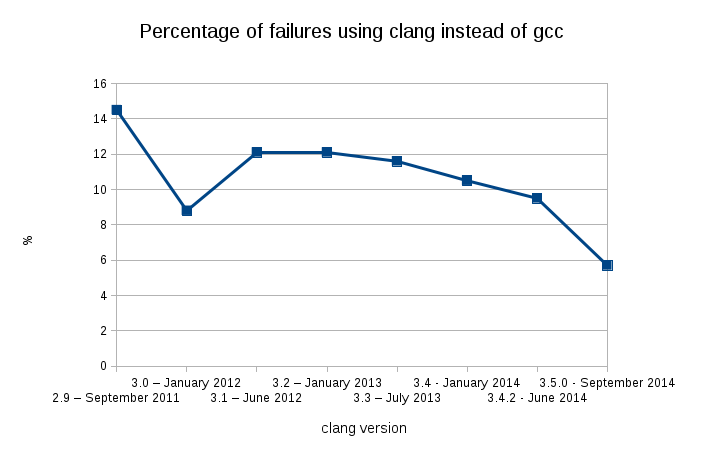
Sylvestre Ledru: Rebuild of Debian using Clang 3.5.0

Clang 3.5.0 has just been released. A new rebuild has been done highlight the progress to get Debian built with clang. tl;dr: Great progress. We decreased from 9.5% to 5.7% of failures. Full results are available on http://clang.debian.net At time of the rebuild with 3.4.2, we had 2040 packages failing to build with clang. With 3.5.0, this dropped to 1261 packages. Fixes With Arthur Marble and Alexander Ovchinnikov, both GSoC students, we worked on various ways to decrease the number of errors. Upstream fixes First, the most obvious way, we fixed programming bugs/mistakes in upstream sources. Basically, we took categories of failure and fixed issues one after the other. We started with simple bugs like 'Wrong main declaration', 'non-void function should return a value' or 'Void function should not return a value'.

They are trivial to fix. We continued with harder fixes like ' Undefined reference' or 'Variable length array for a non POD (plain old data) element'.

So, besides these one, we worked on:
In total, we reported 295 bugs with patches. 85 of them have been fixed (meaning that the Debian maintainer uploaded a new version with the fix).

In parallel, I think that the switch by FreeBSD and Mac OS X to Clang also helped to fix various issues by upstreams. Hacking in clang As a parallel approach, we started to implement a suggestion from Linus Torvalds and a few others. Instead of trying to fix all upstream, where we can, we tried to update clang to improve the gcc compatibility.

gcc has many flags to disable or enable optimizations. Some of them are legacy, others have no sense in clang, etc. Instead of failing in clang with an error, we create a new category of warnings (showing optimization flag '%0' is not supported) and moved all relevant flags into it. Some examples, r212805, r213365, r214906 or r214907

We also updated clang to silent some useless arguments like -finput_charset=UTF-8 (r212110), clang being UTF-8 compliant.

Finally, we worked on the forwarding of linker flags. Clang and gcc have a very different behavior: when gcc does not know an argument, it is going to forward the argument to the linker. Clang, in this case, is going to reject the argument and fail with an error. In clang, we have to explicitly declare which arguments are going to be transfer to the linker. Of course, the correct way to pass arguments to the linker is to use -Xlinker or -Wl but the Debian rebuild proved that these shortcuts are used. Two of these arguments are now forwarded: New errors Just like in other releases, new warnings are added in clang. With (bad) usage of -Werror by upstream software, this causes new build failures: I also took the opportunity to add some further categorizations in the list of errors. Some examples: Next steps The Debile project being close to ready with Cl ment Schreiner's GSoC, we will now have an automatic and transparent way to rebuild packages using clang. Conclusion As stated, we can see a huge drop in term of number of failures over time:
Hopefully, Clang getting better and better, more and more projects adopting it as the default compiler or as a base for plugin/extension developments, this percentage will continue to decrease.
Having some kind of release goal with clang for Jessie+1 can now be considered as potentially reachable. Want to help? There are several things which can be done to help: Acknowledgments Thanks to David Suarez for the rebuilds of the archive, Arthur Marble and Alexander Ovchinnikov for their GSoC works and Nicolas S velin-Radiguet for the few fixes.

31 August 2014

Ritesh Raj Sarraf: apt-offline 1.4

apt-offline 1.4 has been released [1]. This is a minor bug fix release. In fact, one feature, offline bug reports (--bug-reports), has been dropped for now. The Debian BTS interface seems to have changed over time and the older debianbts.py module (that used the CGI interface) does not seem to work anymore. The current debbugs.py module seems to have switched to the SOAP interface. There are a lot of changes going on personally, I just haven't had the time to spend. If anyone would like to help, please reach out to me. We need to use the new debbugs.py module. And it should be cross-platform. Also, thanks to Hans-Christoph Steiner for providing the bash completion script. [1] https://alioth.debian.org/projects/apt-offline/

AddThis:

Categories:

Keywords:

Russell Coker: Links August 2014

Matt Palmer wrote a good overview of DNSSEC [1]. Sociological Images has an interesting article making the case for phasing out the US $0.01 coin [2]. The Australian $0.01 and $0.02 coins were worth much more when they were phased out. Multiplicity is a board game that s designed to address some of the failings of SimCity type games [3]. I haven t played it yet but the page describing it is interesting. Carlos Buento s article about the Mirrortocracy has some interesting insights into the flawed hiring culture of Silicon Valley [4]. Adam Bryant wrote an interesting article for NY Times about Google s experiments with big data and hiring [5]. Among other things it seems that grades and test results have no correlation with job performance. Jennifer Chesters from the University of Canberra wrote an insightful article about the results of Australian private schools [6]. Her research indicates that kids who go to private schools are more likely to complete year 12 and university but they don t end up earning more. Kiwix is an offline Wikipedia reader for Android, needs 9.5G of storage space for the database [7]. Melanie Poole wrote an informative article for Mamamia about the evil World Congress of Families and their connections to the Australian government [8]. The BBC has a great interactive web site about how big space is [9]. The Raspberry Pi Spy has an interesting article about automating Minecraft with Python [10]. Wired has an interesting article about the Bittorrent Sync platform for distributing encrypted data [11]. It s apparently like Dropbox but encrypted and decentralised. Also it supports applications on top of it which can offer social networking functions among other things. ABC news has an interesting article about the failure to diagnose girls with Autism [12]. The AbbottsLies.com.au site catalogs the lies of Tony Abbott [13]. There s a lot of work in keeping up with that. Racialicious.com has an interesting article about Moff s Law about discussion of media in which someone says why do you have to analyze it [14]. Paul Rosenberg wrote an insightful article about conservative racism in the US, it s a must-read [15]. Salon has an interesting and amusing article about a photography project where 100 people were tased by their loved ones [16]. Watch the videos.

30 August 2014

John Goerzen: 2AM to Seattle

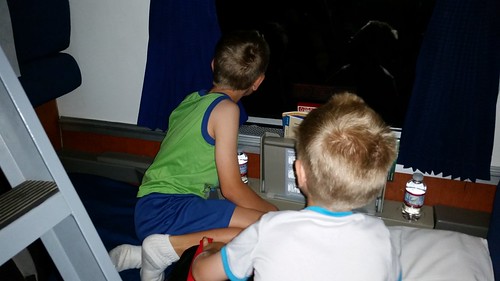
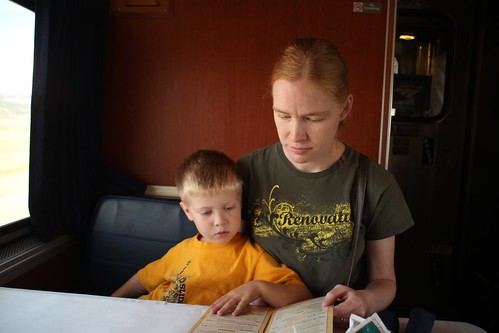
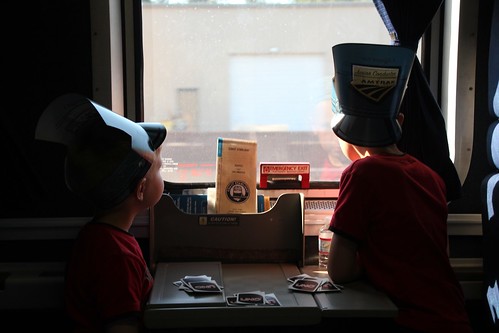
Monday morning, 1:45AM. Laura and I walk into the boys room. We turn on the light. Nothing happens. (They re sound sleepers.) Boys, it s time to get up to go get on the train! Four eyes pop open. Yay! Oh I m so excited! And then, Meow! (They enjoy playing with their stuffed cats that Laura got them for Christmas.) Before long, it was out the door to the train station. We even had time to stop at a donut shop along the way. We climbed into our family bedroom (a sleeping car room on Amtrak specifically designed for families of four), and as the train started to move, the excitement of what was going on crept in. Yes, it s 2:42AM, but these are two happy boys: 2014-08-04 02 Jacob and Oliver love trains, and this was the beginning of a 3-day train trip from Newton to Seattle that would take us through Kansas, Colorado, the Rocky Mountains of New Mexico, Arizona, Los Angeles, up the California coast, through the Cascades, and on to Seattle. Whew! Here we are later that morning before breakfast: IMG_3776 Here s our train at a station stop in La Junta, CO: IMG_3791 And at the beautiful small mountain town of Raton, NM: IMG_3805 Some of the passing scenery in New Mexico: IMG_3828 Through it all, we found many things to pass the time. I don t think anybody was bored. I took the boys exploring the train several times we d walk from one end to the other and see what all was there. There was always the dining car for our meals, the lounge car for watching the passing scenery, and on the Coast Starlight, the Pacific Parlor Car. Here we are getting ready for breakfast one morning. IMG_3830 Getting to select meals and order in the train restaurant was a big deal for the boys. IMG_3832 Laura brought one of her origami books, which even managed to pull the boys away from the passing scenery in the lounge car for quite some time. IMG_3848 Origami is serious business: IMG_3869 They had some fun wrapping themselves around my feet and challenging me to move. And were delighted when I could move even though they were trying to weight me down! IMG_3880 Several games of Uno were played, but even those sometimes couldn t compete with the passing scenery: IMG_3898 The Coast Starlight features the Pacific Parlor Car, which was built over 50 years ago for the Santa Fe Hi-Level trains. They ve been updated; the upper level is a lounge and small restaurant, and the lower level has been turned into a small theater. They show movies in there twice a day, but most of the time, the place is empty. A great place to go with little boys to run around and play games. IMG_3896 The boys and I sort of invented a new game: roadrunner and coyote, loosely based on the old Looney Tunes cartoons. Jacob and Oliver would be roadrunners, running around and yelling MEEP MEEP! Meanwhile, I was the coyote, who would try to catch them even briefly succeeding sometimes but ultimately fail in some hilarious way. It burned a lot of energy. And, of course, the parlor car was good for scenery-watching too: IMG_3908 We were right along the Pacific Ocean for several hours sometimes there would be a highway or a town between us and the beach, but usually there was nothing at all between us and the coast. It was beautiful to watch the jagged coastline go by, to gaze out onto the ocean, watching the birds apparently so beautiful that I didn t even think to take some photos. Laura s parents live in California, and took a connecting train. I had arranged for them to have a sleeping car room near ours, so for the last day of the trip, we had a group of 6. Here are the boys with their grandparents at lunch Wednesday: 2014-08-06 11 We stepped off the train in Seattle into beautiful King Street Station. P8100197 Our first day in Seattle was a quiet day of not too much. Laura s relatives live near Lake Washington, so we went out there to play. The boys enjoyed gathering black rocks along the shore. IMG_3956 We went blackberry picking after that filled up buckets for a cobbler. The next day, we rode the Seattle Monorail. The boys have been talking about this for months a kind of train they ve never been on. That was the biggest thing in their minds that they were waiting for. They got to ride in the very front, by the operator. P8080073 Nice view from up there. P8080078 We walked through the Pike Market I hadn t been in such a large and crowded place like that since I was in Guadalajara: P8080019 At the Seattle Aquarium, we all had a great time checking out all the exhibits. The please touch one was a particular hit. P8080038 Walking underneath the salmon tank was fun too. We spent a couple of days doing things closer to downtown. Laura s cousin works at MOHAI, the Museum of History and Industry, so we spent a morning there. The boys particularly enjoyed the old periscope mounted to the top of the building, and the exhibit on chocolate (of course!) P8100146 They love any kind of transportation, so of course we had to get a ride on the Seattle Streetcar that comes by MOHAI. P8090094 All weekend long, we had been noticing the seaplanes taking off from Lake Washington and Lake Union (near MOHAI). So finally I decided to investigate, and one morning while Laura was doing things with her cousin, the boys and I took a short seaplane ride from one lake to another, and then rode every method of transportation we could except for ferries (we did that the next day). Here is our Kenmore Air plane: P8100100 The view of Lake Washington from 1000 feet was beautiful: P8100109 I think we got a better view than the Space Needle, and it probably cost about the same anyhow. P8100117 After splashdown, we took the streetcar to a place where we could eat lunch right by the monorail tracks. Then we rode the monorail again. Then we caught a train (it went underground a bit so it was a subway to them!) and rode it a few blocks. There is even scenery underground, it seems. P8100151 We rode a bus back, and saved one last adventure for the next day: a ferry to Bainbridge Island. 2014-08-11 14 2014-08-11 16 Laura and I even got some time to ourselves to go have lunch at an amazing Greek restaurant to celebrate a year since we got engaged. It s amazing to think that, by now, it s only a few months until our wedding anniversary too! There are many special memories of the weekend I could mention visiting with Laura s family, watching the boys play with her uncle s pipe organ (it s in his house!), watching the boys play with their grandparents, having all six of us on the train for a day, flying paper airplanes off the balcony, enjoying the cool breeze on the ferry and the beautiful mountains behind the lake. One of my favorites is waking up to high-pitched Meow? Meow meow meow! Wake up, brother! sorts of sounds. There was so much cat-play on the trip, and it was cute to hear. I have the feeling we won t hear things like that much more. So many times on the trip I heard, Oh dad, I am so excited! I never get tired of hearing that. And, of course, I was excited, too.























26 August 2014

Simon Josefsson: The Case for Short OpenPGP Key Validity Periods

After I moved to a new OpenPGP key (see key transition statement) I have received comments about the short life length of my new key. When I created the key (see my GnuPG setup) I set it to expire after 100 days. Some people assumed that I would have to create a new key then, and therefore wondered what value there is to sign a key that will expire in two months. It doesn t work like that, and below I will explain how OpenPGP key expiration works; how to extend the expiration time of your key; and argue why having a relatively short validity period can be a good thing.
The OpenPGP message format has a sub-packet called the Key Expiration Time, quoting the RFC:
5.2.3.6. Key Expiration Time
   (4-octet time field)
   The validity period of the key.  This is the number of seconds after
   the key creation time that the key expires.  If this is not present
   or has a value of zero, the key never expires.  This is found only on
   a self-signature.
You can print the sub-packets in your OpenPGP key with gpg --list-packets. See below an output for my key, and notice the created 1403464490 (which is Unix time for 2014-06-22 21:14:50) and the subpkt 9 len 4 (key expires after 100d0h0m) which adds up to an expiration on 2014-09-26. Don t confuse the creation time of the key ( created 1403464321 ) with when the signature was created ( created 1403464490 ).
jas@latte:~$ gpg --export 54265e8c   gpg --list-packets  head -20
:public key packet:
	version 4, algo 1, created 1403464321, expires 0
	pkey[0]: [3744 bits]
	pkey[1]: [17 bits]
:user ID packet: "Simon Josefsson "
:signature packet: algo 1, keyid 0664A76954265E8C
	version 4, created 1403464490, md5len 0, sigclass 0x13
	digest algo 10, begin of digest be 8e
	hashed subpkt 27 len 1 (key flags: 03)
	hashed subpkt 9 len 4 (key expires after 100d0h0m)
	hashed subpkt 11 len 7 (pref-sym-algos: 9 8 7 13 12 11 10)
	hashed subpkt 21 len 4 (pref-hash-algos: 10 9 8 11)
	hashed subpkt 30 len 1 (features: 01)
	hashed subpkt 23 len 1 (key server preferences: 80)
	hashed subpkt 2 len 4 (sig created 2014-06-22)
	hashed subpkt 25 len 1 (primary user ID)
	subpkt 16 len 8 (issuer key ID 0664A76954265E8C)
	data: [3743 bits]
:signature packet: algo 1, keyid EDA21E94B565716F
	version 4, created 1403466403, md5len 0, sigclass 0x10
jas@latte:~$ 
So the key will simply stop being valid after that time? No. It is possible to update the key expiration time value, re-sign the key, and distribute the key to people you communicate with directly or indirectly to OpenPGP keyservers. Since that date is a couple of weeks away, now felt like the perfect opportunity to go through the exercise of taking out my offline master key and boot from a Debian LiveCD and extend its expiry time. See my earlier writeup for LiveCD and USB stick conventions.
user@debian:~$ export GNUPGHOME=/media/FA21-AE97/gnupghome
user@debian:~$ gpg --edit-key 54265e8c
gpg (GnuPG) 1.4.12; Copyright (C) 2012 Free Software Foundation, Inc.
This is free software: you are free to change and redistribute it.
There is NO WARRANTY, to the extent permitted by law.
Secret key is available.
pub  3744R/54265E8C  created: 2014-06-22  expires: 2014-09-30  usage: SC  
                     trust: ultimate      validity: ultimate
sub  2048R/32F8119D  created: 2014-06-22  expires: 2014-09-30  usage: S   
sub  2048R/78ECD86B  created: 2014-06-22  expires: 2014-09-30  usage: E   
sub  2048R/36BA8F9B  created: 2014-06-22  expires: 2014-09-30  usage: A   
[ultimate] (1). Simon Josefsson 
[ultimate] (2)  Simon Josefsson 
gpg> expire
Changing expiration time for the primary key.
Please specify how long the key should be valid.
         0 = key does not expire
        = key expires in n days
      w = key expires in n weeks
      m = key expires in n months
      y = key expires in n years
Key is valid for? (0) 150
Key expires at Fri 23 Jan 2015 02:47:48 PM UTC
Is this correct? (y/N) y
You need a passphrase to unlock the secret key for
user: "Simon Josefsson "
3744-bit RSA key, ID 54265E8C, created 2014-06-22
pub  3744R/54265E8C  created: 2014-06-22  expires: 2015-01-23  usage: SC  
                     trust: ultimate      validity: ultimate
sub  2048R/32F8119D  created: 2014-06-22  expires: 2014-09-30  usage: S   
sub  2048R/78ECD86B  created: 2014-06-22  expires: 2014-09-30  usage: E   
sub  2048R/36BA8F9B  created: 2014-06-22  expires: 2014-09-30  usage: A   
[ultimate] (1). Simon Josefsson 
[ultimate] (2)  Simon Josefsson 
gpg> key 1
pub  3744R/54265E8C  created: 2014-06-22  expires: 2015-01-23  usage: SC  
                     trust: ultimate      validity: ultimate
sub* 2048R/32F8119D  created: 2014-06-22  expires: 2014-09-30  usage: S   
sub  2048R/78ECD86B  created: 2014-06-22  expires: 2014-09-30  usage: E   
sub  2048R/36BA8F9B  created: 2014-06-22  expires: 2014-09-30  usage: A   
[ultimate] (1). Simon Josefsson 
[ultimate] (2)  Simon Josefsson 
gpg> expire
Changing expiration time for a subkey.
Please specify how long the key should be valid.
         0 = key does not expire
        = key expires in n days
      w = key expires in n weeks
      m = key expires in n months
      y = key expires in n years
Key is valid for? (0) 150
Key expires at Fri 23 Jan 2015 02:48:05 PM UTC
Is this correct? (y/N) y
You need a passphrase to unlock the secret key for
user: "Simon Josefsson "
3744-bit RSA key, ID 54265E8C, created 2014-06-22
pub  3744R/54265E8C  created: 2014-06-22  expires: 2015-01-23  usage: SC  
                     trust: ultimate      validity: ultimate
sub* 2048R/32F8119D  created: 2014-06-22  expires: 2015-01-23  usage: S   
sub  2048R/78ECD86B  created: 2014-06-22  expires: 2014-09-30  usage: E   
sub  2048R/36BA8F9B  created: 2014-06-22  expires: 2014-09-30  usage: A   
[ultimate] (1). Simon Josefsson 
[ultimate] (2)  Simon Josefsson 
gpg> key 2
pub  3744R/54265E8C  created: 2014-06-22  expires: 2015-01-23  usage: SC  
                     trust: ultimate      validity: ultimate
sub* 2048R/32F8119D  created: 2014-06-22  expires: 2015-01-23  usage: S   
sub* 2048R/78ECD86B  created: 2014-06-22  expires: 2014-09-30  usage: E   
sub  2048R/36BA8F9B  created: 2014-06-22  expires: 2014-09-30  usage: A   
[ultimate] (1). Simon Josefsson 
[ultimate] (2)  Simon Josefsson 
gpg> key 1
pub  3744R/54265E8C  created: 2014-06-22  expires: 2015-01-23  usage: SC  
                     trust: ultimate      validity: ultimate
sub  2048R/32F8119D  created: 2014-06-22  expires: 2015-01-23  usage: S   
sub* 2048R/78ECD86B  created: 2014-06-22  expires: 2014-09-30  usage: E   
sub  2048R/36BA8F9B  created: 2014-06-22  expires: 2014-09-30  usage: A   
[ultimate] (1). Simon Josefsson 
[ultimate] (2)  Simon Josefsson 
gpg> expire
Changing expiration time for a subkey.
Please specify how long the key should be valid.
         0 = key does not expire
        = key expires in n days
      w = key expires in n weeks
      m = key expires in n months
      y = key expires in n years
Key is valid for? (0) 150
Key expires at Fri 23 Jan 2015 02:48:14 PM UTC
Is this correct? (y/N) y
You need a passphrase to unlock the secret key for
user: "Simon Josefsson "
3744-bit RSA key, ID 54265E8C, created 2014-06-22
pub  3744R/54265E8C  created: 2014-06-22  expires: 2015-01-23  usage: SC  
                     trust: ultimate      validity: ultimate
sub  2048R/32F8119D  created: 2014-06-22  expires: 2015-01-23  usage: S   
sub* 2048R/78ECD86B  created: 2014-06-22  expires: 2015-01-23  usage: E   
sub  2048R/36BA8F9B  created: 2014-06-22  expires: 2014-09-30  usage: A   
[ultimate] (1). Simon Josefsson 
[ultimate] (2)  Simon Josefsson 
gpg> key 3
pub  3744R/54265E8C  created: 2014-06-22  expires: 2015-01-23  usage: SC  
                     trust: ultimate      validity: ultimate
sub  2048R/32F8119D  created: 2014-06-22  expires: 2015-01-23  usage: S   
sub* 2048R/78ECD86B  created: 2014-06-22  expires: 2015-01-23  usage: E   
sub* 2048R/36BA8F9B  created: 2014-06-22  expires: 2014-09-30  usage: A   
[ultimate] (1). Simon Josefsson 
[ultimate] (2)  Simon Josefsson 
gpg> key 2
pub  3744R/54265E8C  created: 2014-06-22  expires: 2015-01-23  usage: SC  
                     trust: ultimate      validity: ultimate
sub  2048R/32F8119D  created: 2014-06-22  expires: 2015-01-23  usage: S   
sub  2048R/78ECD86B  created: 2014-06-22  expires: 2015-01-23  usage: E   
sub* 2048R/36BA8F9B  created: 2014-06-22  expires: 2014-09-30  usage: A   
[ultimate] (1). Simon Josefsson 
[ultimate] (2)  Simon Josefsson 
gpg> expire
Changing expiration time for a subkey.
Please specify how long the key should be valid.
         0 = key does not expire
        = key expires in n days
      w = key expires in n weeks
      m = key expires in n months
      y = key expires in n years
Key is valid for? (0) 150
Key expires at Fri 23 Jan 2015 02:48:23 PM UTC
Is this correct? (y/N) y
You need a passphrase to unlock the secret key for
user: "Simon Josefsson "
3744-bit RSA key, ID 54265E8C, created 2014-06-22
pub  3744R/54265E8C  created: 2014-06-22  expires: 2015-01-23  usage: SC  
                     trust: ultimate      validity: ultimate
sub  2048R/32F8119D  created: 2014-06-22  expires: 2015-01-23  usage: S   
sub  2048R/78ECD86B  created: 2014-06-22  expires: 2015-01-23  usage: E   
sub* 2048R/36BA8F9B  created: 2014-06-22  expires: 2015-01-23  usage: A   
[ultimate] (1). Simon Josefsson 
[ultimate] (2)  Simon Josefsson 
gpg> save
user@debian:~$ gpg -a --export 54265e8c > /media/KINGSTON/updated-key.txt
user@debian:~$ 
I remove the transport USB stick from the offline computer, and back on my laptop I can inspect the new updated key. Let s use the same command as before. The key creation time is the same ( created 1403464321 ), of course, but the signature packet has a new time ( created 1409064478 ) since it was signed now. Notice created 1409064478 and subpkt 9 len 4 (key expires after 214d19h35m) . The expiration time is computed based on when the key was generated, not when the signature packet was generated. You may want to double-check the pref-sym-algos, pref-hash-algos and other sub-packets so that you don t accidentally change anything else. (Btw, re-signing your key is also how you would modify those preferences over time.)
jas@latte:~$ cat /media/KINGSTON/updated-key.txt  gpg --list-packets   head -20
:public key packet:
	version 4, algo 1, created 1403464321, expires 0
	pkey[0]: [3744 bits]
	pkey[1]: [17 bits]
:user ID packet: "Simon Josefsson "
:signature packet: algo 1, keyid 0664A76954265E8C
	version 4, created 1409064478, md5len 0, sigclass 0x13
	digest algo 10, begin of digest 5c b2
	hashed subpkt 27 len 1 (key flags: 03)
	hashed subpkt 11 len 7 (pref-sym-algos: 9 8 7 13 12 11 10)
	hashed subpkt 21 len 4 (pref-hash-algos: 10 9 8 11)
	hashed subpkt 30 len 1 (features: 01)
	hashed subpkt 23 len 1 (key server preferences: 80)
	hashed subpkt 25 len 1 (primary user ID)
	hashed subpkt 2 len 4 (sig created 2014-08-26)
	hashed subpkt 9 len 4 (key expires after 214d19h35m)
	subpkt 16 len 8 (issuer key ID 0664A76954265E8C)
	data: [3744 bits]
:user ID packet: "Simon Josefsson "
:signature packet: algo 1, keyid 0664A76954265E8C
jas@latte:~$ 
Being happy with the new key, I import it and send it to key servers out there.
jas@latte:~$ gpg --import /media/KINGSTON/updated-key.txt 
gpg: key 54265E8C: "Simon Josefsson " 5 new signatures
gpg: Total number processed: 1
gpg:         new signatures: 5
jas@latte:~$ gpg --send-keys 54265e8c
gpg: sending key 54265E8C to hkp server keys.gnupg.net
jas@latte:~$ gpg --keyserver keyring.debian.org  --send-keys 54265e8c
gpg: sending key 54265E8C to hkp server keyring.debian.org
jas@latte:~$ 
Finally: why go through this hassle, rather than set the key to expire in 50 years? Some reasons for this are:
  1. I don t trust myselt to keep track of a private key (or revocation cert) for 50 years.
  2. I want people to notice my revocation certificate as quickly as possible.
  3. I want people to notice other changes to my key (e.g., cipher preferences) as quickly as possible.
Let s look into the first reason a bit more. What would happen if I lose both the master key and the revocation cert, for a key that s valid 50 years? I would start from scratch and create a new key that I upload to keyservers. Then there would be two keys out there that are valid and identify me, and both will have a set of signatures on it. None of them will be revoked. If I happen to lose the new key again, there will be three valid keys out there with signatures on it. You may argue that this shouldn t be a problem, and that nobody should use any other key than the latest one I want to be used, but that s a technical argument and at this point we have moved into usability, and that s a trickier area. Having users select which out of a couple of apparently all valid keys that exist for me is simply not going to work well. The second is more subtle, but considerably more important. If people retrieve my key from keyservers today, and it expires in 50 years, there will be no need to refresh it from key servers. If for some reason I have to publish my revocation certificate, there will be people that won t see it. If instead I set a short validity period, people will have to refresh my key once in a while, and will then either get an updated expiration time, or will get the revocation certificate. This amounts to a CRL/OCSP-like model. The third is similar to the second, but deserves to be mentioned on its own. Because the cipher preferences are expressed (and signed) in my key, and that ciphers come and go, I would expect that I will modify those during the life-time of my long-term key. If I have a long validity period of my key, people would not refresh it from key servers, and would encrypt messages to me with ciphers I may no longer want to be used. The downside of having a short validity period is that I have to do slightly more work to get out the offline master key once in a while (which I have to once in a while anyway because I m signing other peoples keys) and that others need to refresh my key from the key servers. Can anyone identify other disadvantages? Also, having to explain why I m using a short validity period used to be a downside, but with this writeup posted that won t be the case any more. :-) flattr this!

22 August 2014

Russell Coker: Men Commenting on Women s Issues

A lecture at LCA 2011 which included some inappropriate slides was followed by long discussions on mailing lists. In February 2011 I wrote a blog post debunking some of the bogus arguments in two lists [1]. One of the noteworthy incidents in the mailing list discussion concerned Ted Ts o (an influential member of the Linux community) debating the definition of rape. My main point on that issue in Feb 2011 was that it s insensitive to needlessly debate the statistics. Recently Valerie Aurora wrote about another aspect of this on The Ada Initiative blog [2] and on her personal blog. Some of her significant points are that conference harassment doesn t end when the conference ends (it can continue on mailing lists etc), that good people shouldn t do nothing when bad things happen, and that free speech doesn t mean freedom from consequences or the freedom to use private resources (such as conference mailing lists) without restriction. Craig Sanders wrote a very misguided post about the Ted Ts o situation [3]. One of the many things wrong with his post is his statement I m particularly disgusted by the men who intervene way too early without an explicit invitation or request for help or a clear need such as an immediate threat of violence in womens issues . I believe that as a general rule when any group of people are involved in causing a problem they should be involved in fixing it. So when we have problems that are broadly based around men treating women badly the prime responsibility should be upon men to fix them. It seems very clear that no matter what scope is chosen for fixing the problems (whether it be lobbying for new legislation, sociological research, blogging, or directly discussing issues with people to change their attitudes) women are doing considerably more than half the work. I believe that this is an indication that overall men are failing. Asking for Help I don t believe that members of minority groups should have to ask for help. Asking isn t easy, having someone spontaneously offer help because it s the right thing to do can be a lot easier to accept psychologically than having to beg for help. There is a book named Women Don t Ask which has a page on the geek feminism Wiki [4]. I think the fact that so many women relate to a book named Women Don t Ask is an indication that we shouldn t expect women to ask directly, particularly in times of stress. The Wiki page notes a criticism of the book that some specific requests are framed as complaining , so I think we should consider a complaint from a woman as a direct request to do something. The geek feminism blog has an article titled How To Exclude Women Without Really Trying which covers many aspects of one incident [5]. Near the end of the article is a direct call for men to be involved in dealing with such problems. The geek feminism Wiki has a page on Allies which includes Even a blog post helps [6]. It seems clear from public web sites run by women that women really want men to be involved. Finally when I get blog comments and private email from women who thank me for my posts I take it as an implied request to do more of the same. One thing that we really don t want is to have men wait and do nothing until there is an immediate threat of violence. There are two massive problems with that plan, one is that being saved from a violent situation isn t a fun experience, the other is that an immediate threat of violence is most likely to happen when there is no-one around to intervene. Men Don t Listen to Women Rebecca Solnit wrote an article about being ignored by men titled Men Explain Things to Me [7]. When discussing women s issues the term Mansplaining is often used for that sort of thing, the geek feminism Wiki has some background [8]. It seems obvious that the men who have the greatest need to be taught some things related to women s issues are the ones who are least likely to listen to women. This implies that other men have to teach them. Craig says that women need space to discover and practice their own strength and their own voices . I think that the best way to achieve that goal is to listen when women speak. Of course that doesn t preclude speaking as well, just listen first, listen carefully, and listen more than you speak. Craig claims that when men like me and Matthew Garrett comment on such issues we are making women s spaces more comfortable, more palatable, for men . From all the discussion on this it seems quite obvious that what would make things more comfortable for men would be for the issue to never be discussed at all. It seems to me that two of the ways of making such discussions uncomfortable for most men are to discuss sexual assault and to discuss what should be done when you have a friend who treats women in a way that you don t like. Matthew has covered both of those so it seems that he s doing a good job of making men uncomfortable I think that this is a good thing, a discussion that is comfortable and palatable for the people in power is not going to be any good for the people who aren t in power. The Voting Aspect It seems to me that when certain issues are discussed we have a social process that is some form of vote. If one person complains then they are portrayed as crazy. When other people agree with the complaint then their comments are marginalised to try and preserve the narrative of one crazy person. It seems that in the case of the discussion about Rape Apology and LCA2011 most men who comment regard it as one person (either Valeria Aurora or Matthew Garrett) causing a dispute. There is even some commentary which references my blog post about Rape Apology [9] but somehow manages to ignore me when it comes to counting more than one person agreeing with Valerie. For reference David Zanetti was the first person to use the term apologist for rapists in connection with the LCA 2011 discussion [10]. So we have a count of at least three men already. These same patterns always happen so making a comment in support makes a difference. It doesn t have to be insightful, long, or well written, merely I agree and a link to a web page will help. Note that a blog post is much better than a comment in this regard, comments are much like conversation while a blog post is a stronger commitment to a position. I don t believe that the majority is necessarily correct. But an opinion which is supported by too small a minority isn t going to be considered much by most people. The Cost of Commenting The Internet is a hostile environment, when you comment on a contentious issue there will be people who demonstrate their disagreement in uncivilised and even criminal ways. S. E. Smith wrote an informative post for Tiger Beatdown about the terrorism that feminist bloggers face [11]. I believe that men face fewer threats than women when they write about such things and the threats are less credible. I don t believe that any of the men who have threatened me have the ability to carry out their threats but I expect that many women who receive such threats will consider them to be credible. The difference in the frequency and nature of the terrorism (and there is no other word for what S. E. Smith describes) experienced by men and women gives a vastly different cost to commenting. So when men fail to address issues related to the behavior of other men that isn t helping women in any way. It s imposing a significant cost on women for covering issues which could be addressed by men for minimal cost. It s interesting to note that there are men who consider themselves to be brave because they write things which will cause women to criticise them or even accuse them of misogyny. I think that the women who write about such issues even though they will receive threats of significant violence are the brave ones. Not Being Patronising Craig raises the issue of not being patronising, which is of course very important. I think that the first thing to do to avoid being perceived as patronising in a blog post is to cite adequate references. I ve spent a lot of time reading what women have written about such issues and cited the articles that seem most useful in describing the issues. I m sure that some women will disagree with my choice of references and some will disagree with some of my conclusions, but I think that most women will appreciate that I read what women write (it seems that most men don t). It seems to me that a significant part of feminism is about women not having men tell them what to do. So when men offer advice on how to go about feminist advocacy it s likely to be taken badly. It s not just that women don t want advice from men, but that advice from men is usually wrong. There are patterns in communication which mean that the effective strategies for women communicating with men are different from the effective strategies for men communicating with men (see my previous section on men not listening to women). Also there s a common trend of men offering simplistic advice on how to solve problems, one thing to keep in mind is that any problem which affects many people and is easy to solve has probably been solved a long time ago. Often when social issues are discussed there is some background in the life experience of the people involved. For example Rookie Mag has an article about the street harassment women face which includes many disturbing anecdotes (some of which concern primary school students) [12]. Obviously anyone who has lived through that sort of thing (which means most women) will instinctively understand some issues related to threatening sexual behavior that I can t easily understand even when I spend some time considering the matter. So there will be things which don t immediately appear to be serious problems to me but which are interpreted very differently by women. The non-patronising approach to such things is to accept the concerns women express as legitimate, to try to understand them, and not to argue about it. For example the issue that Valerie recently raised wasn t something that seemed significant when I first read the email in question, but I carefully considered it when I saw her posts explaining the issue and what she wrote makes sense to me. I don t think it s possible for a man to make a useful comment on any issue related to the treatment of women without consulting multiple women first. I suggest a pre-requisite for any man who wants to write any sort of long article about the treatment of women is to have conversations with multiple women who have relevant knowledge. I ve had some long discussions with more than a few women who are involved with the FOSS community. This has given me a reasonable understanding of some of the issues (I won t claim to be any sort of expert). I think that if you just go and imagine things about a group of people who have a significantly different life-experience then you will be wrong in many ways and often offensively wrong. Just reading isn t enough, you need to have conversations with multiple people so that they can point out the things you don t understand. This isn t any sort of comprehensive list of ways to avoid being patronising, but it s a few things which seem like common mistakes. Anne Onne wrote a detailed post advising men who want to comment on feminist blogs etc [13], most of it applies to any situation where men comment on women s issues.

21 August 2014

Dirk Eddelbuettel: RcppEigen 0.3.2.2.0

A new upstream release of the Eigen C++ template library for linear algebra was released a few days ago. And Yixuan Qiu did some really nice work rolling this into a new RcppEigen released and then sent me a nice pull requent. The new version is now on CRAN, and I will prepare a Debian in a moment too. Upstream changes for Eigen are summarized in their changelog. On the RcppEigen side, Yixuan also rolled in some more changes on as() and wrap() converters as noted below in the NEWS entry.
Changes in RcppEigen version 0.3.2.2.0 (2014-08-19)
  • Updated to version 3.2.2 of Eigen
  • Rcpp::as() now supports the conversion from R vector to row array , i.e., Eigen::Array<T, 1, Eigen::Dynamic>
  • Rcpp::as() now supports the conversion from dgRMatrix (row oriented sparse matrices, defined in Matrix package) to Eigen::MappedSparseMatrix<T, Eigen::RowMajor>
  • Conversion from R matrix to Eigen::MatrixXd and Eigen::ArrayXXd using Rcpp::as() no longer gives compilation errors
Courtesy of CRANberries, there are diffstat reports for the most recent release. Questions, comments etc about RcppEigen should go to the rcpp-devel mailing list off the R-Forge page.

This post by Dirk Eddelbuettel originated on his Thinking inside the box blog. Please report excessive re-aggregation in third-party for-profit settings.

15 August 2014

Aurelien Jarno: Intel about to disable TSX instructions?

Last time I changed my desktop computer I bought a CPU from the Intel Haswell family, the one available on the market at that time. I carefully selected the CPU to make sure it supports as many instructions extensions as possible in this family (Intel likes segmentation, even high-end CPUs like the Core i7-4770k do not support all possible instructions). I ended-up choosing the Core i7-4771 as it supports the Transactional Synchronization Extensions (Intel TSX) instructions, which provide transactional memory support. Support for it has been recently added in the GNU libc, and has been activated in Debian. By choosing this CPU, I wanted to be sure that I can debug this support in case of bug report, like for example in bug#751147. Recently some computing websites started to mention that the TSX instructions have bugs on Xeon E3 v3 family (and likely on Core i7-4771 as they share the same silicon and stepping), quoting this Intel document. Indeed one can read on page 49:
HSW136. Software Using Intel TSX May Result in Unpredictable System Behavior

Problem: Under a complex set of internal timing conditions and system events, software using the Intel TSX (Transactional Synchronization Extensions) instructions may result in unpredictable system behavior.
Implication: This erratum may result in unpredictable system behavior.
Workaround: It is possible for the BIOS to contain a workaround for this erratum.
And later on page 51:
Due to Erratum HSw136, TSX instructions are disabled and are only supported for software development. See your Intel representative for details.
The same websites tell that Intel is going to disable the TSX instructions via a microcode update. I hope it won t be the case and that they are going to be able to find a microcode fix. Otherwise it would mean I will have to upgrade my desktop computer earlier than expected. It s a bit expensive to upgrade it every year and that s a the reason why I skipped the Ivy Bridge generation which didn t bring a lot from the instructions point of view. Alternatively I can also skip microcode and BIOS updates, in the hope I won t need another fix from them at some point.

11 August 2014

Juliana Louback: JSCommunicator - Setup and Architecture

Preface During Google Summer of Code 2014, I got to work on the Debian WebRTC portal under the mentorship of Daniel Pocock. Now I had every intention of meticulously documenting my progress at each step of development in this blog, but I was a bit late in getting the blog up and running. I ll now be publishing a series of posts to recap all I ve done during GSoC. Better late than never. Intro JSCommunicator is a SIP communication tool developed in HTML and JavaScript. The code was designed to make integrating JSCommunicator with a website or web app as simple as possible. It s quite easy, really. However, I do think a more detailed explanation on how to set things up and a guide to the JSCommunicator architecture could be of use, particularly for those wanting to modify the code in any way. Setup To begin, please fork the JSCommunicator repo. If you are new to git, feel free to follow the steps in section Setup and Clone in this post. If you read the README file (which you always should), you ll see that JSCommunicator needs a SIP proxy that supports SIP over Websockets transport. Some options are: I didn t find a tutorial for Kamailio setup, I did find one for repro setup. And bonus, here you have a great tutorial on how to setup and configure your SIP proxy AND your TURN server. In your project s root directory, you ll see a file named config-sample.js. Make a copy of that file named config.js. The config-sample.js file has comments that are very instructive. In sum, the only thing you have to modify is the turn_servers property and the websocket property. In my case, debrtc.org was the domain registered for testing my project, so my config file has:
turn_servers: [
	  server:"turn:debrtc.org"       
],
Note that unlike the sample, I didn t set a username and password so SIP credentials will be used. Now fill in the websocket property here we use sip5060.net.
websocket:  
    servers: 'wss://ws.sip5060.net',
    connection_recovery_min_interval: 2,
    connection_recovery_max_interval: 30,
   ,
I m pretty sure you can set the connection_recovery properties to whatever you like. Everything else is optional. If you set the user property, specifically display_name and uri, that will be used to fill in the Login form and takes preference over any Remember me data. If you also set sip_auth_password, JSCommunicator will automatically log in. All the other properties are for other optional functionalities and are well explained. You ll need some third-party javascript that is not included in the JSCommunicator git repo. Namely jQuery version 1.4 or higher and ArbiterJS version 1.0. Download jQuery here and ArbiterJS here and place the .js files in your project s root directory. Do make sure that you are including the correct filename in your html file. For example, in phone-dev.shtml, a file named jquery.js is included. The file you downloaded will likely have version numbers in it s file name. So rename the downloaded file or change the content of src in your includes. This is uber trivial, but I ve made the mistake several times. You ll also need JsSIP.js which can be downloaded here. Same naming care must be taken as is the case for jQuery and ArbiterJS. The recently added Instant Messaging component and some of the new features need jQuery-UI - so far version 1.11.* is known to work. From the downloaded .zip all you need is the jquery-ui-...js file and the jquery-ui-...css file, also to be placed in the project s root directory. If you ll be using the internationalization support you ll also need jquery.i18n.properties.js. To try out JSCommunicator, deploy the website locally by copying your project directory to the apache document root directory (provided you are using apache, which is a good idea.). You ll likely have to restart your server before this works. Now the demo .shtml pages only have a header with all the necessary includes, then a Server Side Include for the body of the page, with all the JSCommunicator html. The html content is in the file jscommunicator.inc. You can enable SSI on apache, OR you can simply copy and paste the content of jscommunicator.inc into phone-dev.shmtl. Start up apache, open a browser and navigate to localhost/jscommunicator/phone-dev.shmtl and you should see: jscommunicatorRaw Actually, pending updates to JSCommunicator, you should see a brand new UI! But all the core stuff will be the same. Architecture Disclaimer: I m explaining my view of the JSCommunicator architecture, which currently may not be 100% correct. But so far it s been enough for me to make my modifications and additions to the code, so it could be of use. One I get a JSCommunicator Founding Father s stamp of approval, I ll be sure to confirm the accuracy. Now to explain how the JSCommunicator code interacts, the use of each code item is described, ignoring all the html and css which will vary according to how you choose to use JSCommunicator. I m also not going to explain jQuery which is a dependency but not specific to WebRTC. The core JSCommunicator code is the following: Each of these files will be presented in what I hope is an intuitive order. The next three files could be considered utils : These two are where the magic happens: Now for some extras: Third party code: Here s a diagram of sorts to help you visualize how the code interacts: jscommArch In sum, 1 - JSCommUI.js handles what is displayed in the UI and feeds data to JSCommManager.js; 2 - JSCommManager.js actually does stuff, feeding data to be displayed to JSCommUI.js; 3 - JSCommManager.js calls functions from the three utils , parseuri.js, webrtc-check.js and jssip-helpher.js which organizes the data from config.js; 4 - JSCommManager.js initializes a SIP User Agent based on the implementation in Arbiter.js. When making any changes to JSCommunicator, you will likely only be working with JSCommUI.js and JSCommManager.js.

Next.

Previous.