Search Results: "nion"

16 October 2010

Pietro Abate: hidden ssh service via tor

We live in a nat-ed / firewall-ed world. Almost all DSL providers don't give public IPs and when the do, they are often behind a draconian firewall. In this context having an emergency remote shell, despite not fast and not public is very handy. A simple way to solve this problem it to create a hidden server on the tor network and the access the shell from anywhere in the world without caring of change of IPs, routing, dns or anything else. On debian you can just install tor from the official repository. Since Tor is not available in ubuntu (but it is available on debian), we need to get it directly from the tor website. There is a nice write-up on the ubuntu site : https://help.ubuntu.com/community/Tor . And these are the details on the tor website. So we add this to apt.sources
deb http://deb.torproject.org/torproject.org lucid main
and the we aptitude install tor .The package will install and run by default the tor daemon. Next step is to edit /etc/tor/torrc to add the proxy server.
HiddenServiceDir /var/lib/tor/ssh/
HiddenServicePort 22 127.0.0.1:22
Remember also to install the openssh-server server if you don't have it already. And this is it. In the directory /var/lib/tor/ssh/ you will find a file with the hostname on the TOR ring that you have to use to connect to you new hidden server. On the client side we need to aptitude install connect-proxy. It's a simple tool to tunnel ssh through a socks5 connection. Now you are ready to test. In your ~/.ssh/config you can simply add something like
Host *.onion
ProxyCommand connect -R remote -5 -S 127.0.0.1:9050 %h %p
and then ssh-way youronionhost.onion server . The connection will be veeeeery slow since you are going through different layers of encryption and indirection. You should also check the hostid of your server before connecting and dropping in a pub-key as you should never trust your friendly TOR providers (US govt, Chinese gvt, Iranian govt, etc ...). For emergency is actually pretty handy. For anything else if will make you die of boredom ...

Update Ahhh . It seems I've assumed that since TOR was not available on ubuntu, this was the same on debian. Tor is definitely available on debian, but not on ubuntu. Blah... check before asserting wrong information ! Post fixed.

Vincent Sanders: Coming to terms

Yesterday was not a great day. One of the family's cats died.

Molly just after she arrived 26th September 2000
Molly, for that was her name, came to us the week Melodie and I moved into our first house together. September 15th 2000, in the middle of the fuel protests which were raging at the time, we hired a van and moved in.

Most people would have considered that enough for one week! We happened to be in Halifax on the Sunday afternoon at the supermarket and decided to visit the RSPCA because somehow we decided what our new home needed was a cat.

On that day a decade ago we saw Molly and Lucy, a pair of cats who needed a new home as their previous owners had a baby who was allergic to them. I still recall them skulking at the back of their cage in the cattery, Lucy who was reluctant to come down of a perch to be petted and Molly looking generally unhappy. No-one else wanted this misfit pair because they were already both over 5 years old, the warden despairing of ever finding them a home.

Of course they were obviously the right animals for us! ;-) So by the end of the week we had taken them home. Molly immediately showed how things were going to be by shredding her way out of the RSPCA provided double walled cardboard carrier. To the day she died she detested being placed inside a carrier, funny that.

Melodie and Molly in the snow 28th December 2000
By the end of the year, when the snow came, the cats ruled the house and we were all happy together.

Little did we realise that soon in the summer of 2001 there would be another arrival to the family.

Molly with Melodie and Alex 2001
The arrival of our first child in June 2001 was a complete change in all our lives but we all managed to settle back into a routine. Although the banishment of the cats from upstairs remained a point of disagreement for a long time.

As Alex grew up the cats learned that feeding times for Alex could result in all manner of things falling from above. Soon Alex was mobile which resulted in different lessons on cats being sharp objects if not treated with respect. In February 2003 our family grew once more with the arrival of Joshua. The cats, now used to infants, took this in their stride.

Molly in Febuary 2004 hiding on a windowsill
While still about day to day the cats are not captured on camera so often form this point on.

Over the forthcoming months they ensured they were out of reach of the newborn and the precocious toddler.

By the time of Joshuas first birthday in 2004 Molly had taken to hiding "out of the way" as much as possible but remained as affectionate as ever.

Molly in a box March 2007
As the children grew up and life progressed Molly became ever more at home and developed the odd aggravating trait like taking clean washing off airers and dragging it out the window, through the cat flap and upstairs so she could sleep on it!

She still enjoyed participating in claiming boxes and defending them vigorously though!

The kids took on the job of feeding the cats which made their bond closer ensuring they were greeted by happy cats sitting lookout as they came home from school each day.

Molly continued to be a good companion and an infuriating self centred animal like all good cats.
Molly asleep in the kitchen sink
Then on Tuesday evening our Neighbour knocked on our front door. They gave us the news that one of our cats had been run over and taken to the Vet. I immediately went to the back door and called and shook the treat box.

Lucy came running, but molly did not. We rang the vets who confirmed they had molly (we had them electronically tagged back in Halifax) and that they advised we did not come and see her until they had chance to asses her and deal with the shock.

As the days progressed her prognosis improved and then sank. She had a broken jaw, broken teeth, a dislocated hip, extensive bruising and something was definitely wrong with her kidney function.

Thursday evening the whole family went to see her and she purred and seemed happy to see us, she looked as bad as I feared though and somehow I knew there and then that this was probably goodbye. The children stroked her and petted her for a while and we left with an odd sadness, oh and to the sound of molly trying to gouge the veterinary nurse.

Yesterday she was due to have surgery to fix her jaw and hip...Alas when she was anaesthetised and x-rayed once more it became evident the hip was not just dislocated but her femur was fractured and there was additional damage. So just after midday came the call to ask what we wanted to do. The vet could attempt the repairs but due to her age and the other complications it was probably futile. So with heavy heart we agreed the best thing was not to revive her and she died a short time later.

I shall miss her morning greetings, her demands for attention, her sleeping in odd places and her companionship. I keep calling for her at meal times forgetting she will never come. I think Lucy is upset too, after spending their lives together her friend is gone and I cannot explain that to her.

So that is the end of Molly, a good cat.


14 October 2010

Axel Beckert: Thoughts on Gitorious and GitHub plus a useful git hook

When I took over the developement of xen-tools, I looked around for an appropriate git hosting. I especially had a look at GitHub and Gitorious. If you just regard the features, GitHub is definitely more targetted on single developers and Gitorious more towards projects: At GitHub, every repository has its URL under the URL of a user page which makes it nearly impossible to have user independent, official repositories for projects which have more than one official developer. At Gitorious, every hosted repository needs to belong to a project, even if it s only a published configuration. But a project can have more than one git repository. You only seem to be able to have personal repositories if you clone some existing Gitorious repository. So from a feature point of view, the xen-tools git repositories fit way better to Gitorious hosting while the git repositories with zshrc, conkerorrc and desktop configuration files defintely have a more fitting addresses on GitHub, in my case http://github.com/xtaran/$repository. On Gitorious, they are now together under a project called Axel s configuration files at http://gitorious.org/abe which contains git repositories of my on grml s .zshrc based .zshrc, my configuration for Conkeror and all the files necessary for my ratpoison/xmobar based netbook/laptop desktop. I though feel a little bad for giving the project the very short slug name abe instead of abe-config (as I did initially) since abe is IMHO not a proper project name for my configuration files and possibly other projects would have a more reasonable claim for that project name on Gitorious. But that way it suites more its purpose: Gather some of my git repositories which don t belong to a proper project. But there s another important point when comparing Gitorious and GitHub: Free Software needs free tools as Benjamin Mako Hill posted recently on Planet Debian. Despite my (probably well known) distrust against Google and therefore also Google Code, and despite knowing the history of SourceForge becoming non-free, I was not that much aware that GitHub s software is only partially open source and therefore also not free software while Gitorious is both as it s licensed under the GNU Affero General Public License (like StatusNet/identi.ca for example) which is basically GPLv3, but its ideas applied to hosted web applications scenario (where the GPL itself doesn t grasp), too. Initially I just had the xen-tools git repositories on Gitorious and all my small one-repository projects as copies of the repositories on my own git server on GitHub to get some more publicity for them and allow social cloning . After reading Mako s article, I decided to at least have repository clones on Gitorious of all repositories I mirror at GitHub, too. That way I force nobody to use the non-free tools on GitHub for social cloning one of my git repositories. And of course I have copies of my code somewhere on the net as backup. Or to say it with Linus Torvalds (slightly updated) words: Only wimps use tape backup: real men just upload their important stuff on git, and let the rest of the world clone it. ;-) But isn t that tedious to always push your code to three repositories? No, it isn t. I just push my code to git.noone.org where I have configured the according remotes and the following post-receive hook:
#!/bin/sh
                                                                     
read oldrev newrev refname
git push gitorious $ refname:t 
git push github $ refname:t 
The only other thing necessary is to use ssh-agent and SSH agent forwarding to at least the host you re pushing to.

11 October 2010

Lars Wirzenius: In defense of Nicole

In the real world, David does not always win over Goliath. That's sad, but it's true. Particularly in the case of a big corporation using its wealth, influence, and minions to stomp down invividuals, to prevent them from reducing those all-important profits. A corporation must profit, by any means necessary. Profit is more important than people. A corporation has exactly as little ethics, morals, conscience, and good behavior as it can get away with. It all pretty much rests the officers, and their personal balance between greed and being good people. While most CEOs and managers and other decision makers in a corporation aren't going to do big evil, say, have people killed, they might not mind being a little bit nasty occasionally. If you have a large corporation, with a culture of profit-worshipping, you'll have a large number of people willing to be a little bit nasty, and that amounts to a lot of nastiness. That's all a long prelude to this: earlier this year, the PTFS corporation bought Liblime, a competitor. They did this to get a controlling interest on Koha, the free software librarary mangament system. Much to their surprise, you can't buy a healthy free software project like that. The community of users and developers of Koha has resisted PTFS's strongarm tactics. PTFS wants control of the code base, version control systems, mailing lists, domains, web pages, wikis, and decision making, but the community doesn't let them. Right now they are attacking Nicole Engard, the documentation manager for the Koha community, spreading lies about her. Nicole is one of the Koha community members who has spoken against PTFS's actions. She also works for a PTFS competitor, another sin against PTFS. This is an unfortunate situation for Nicole, for Koha, and for free software in general. If corporations like PTFS manage to silence their critics by nastiness, then nastiness is a working strategy and will be used more in the future. We need to squash this every time it happens, so it does not spread. However, for PTFS to lose, Nicole will have to have the courage to stand up against even more aggression. In the old world, before the Internet, this would have been quite hard. She would have had to get newspapers interested in her case. PTFS would almost certainly have been able to prevent that, by using their PR muscle to conduct a smear campaign against her. However, with the Internet, it's easier. Anyone can step up and help defend Nicole. That's what this is. I've never actually met Nicole, but in my brief involvement with the Koha community, she was always helpful and professional. She has, personally, helped Koha and free software spread farther than it would otherwise have. She does good. Like pretty much everyone in the Koha community, she is considerate, polite, and just to a fault, even when dealing with those attacking her. PTFS, on the other hand, has done only one honorable thing that I am aware of: they finally released their version of Koha. Every other action from PTFS seems to be an attempt to gain an upper hand by underhanded stratagems. Luckily, they seem to be failing. Let's see if giving more publicity to the attack on Nicole will make it, too, fail. See Nicole's post about this for more information.

6 October 2010

Russ Allbery: Review: Thinking in Java

Review: Thinking in Java, by Bruce Eckel
Publisher: Prentice Hall
Copyright: 2006
Printing: October 2009
ISBN: 0-13-187248-6
Format: Trade paperback
Pages: 1461
Thinking in Java has gone through multiple editions. This review is of the 4th edition, which is targetted at Java 5 (with some minor updates for Java 6, released as it was going to press). Prior to reading this book, I'd never written code from scratch in Java and had never learned anything about Java in a structured fashion. My CS degrees come before the era of ubiquitous Java; the most I'd ever done with the language was look over and make some minor fixes to code other people had written, using general programming knowledge. I choose this book as my introduction because I was looking for a ground-up introduction with good reviews and was avoiding books that contained a printed version of the Java library documentation. I can get that myself on-line. I kept a set of notes on my impressions of the Java language itself separately and will not get into that here. This is, instead, a review of Thinking in Java as a book and as a training tool for someone who wants to pick up the language. First off, this is a remarkably well-titled book, much more so than the typical programming language book. Eckel is not just teaching Java as one programming language among many. He tries hard to teach the reader to think in Java, with a lot of attention to idiomatic use of the language and natural ways to use its expressiveness. This is exactly what I was looking for I don't want to just write C or Perl in Java syntax and I was very satisfied with the result. The book is also very heavy on source code examples; this is much of the reason why it's 1,461 pages. Eckel illustrates everything with Java code, generally complete functioning short programs. Even exploratory musings and experiments are implemented as Java code. I don't think there's any significant thought in this book that isn't shown in both text and in explained Java code. Eckel has also clearly put significant effort into choosing good examples and designing his sample programs. I have some past (mild) experience with object-oriented design, and a lot of experience with higher-level system design, and I was satisfied and occasionally intrigued by the object structures and design tips that Eckel provides. He uses design pattern language heavily, but not in a confusing way, and he takes some time to explain typical design patterns and illustrate them repeatedly. This is a solid introduction to good object-oriented program design as well as an introduction to Java. One oddity of this book, though, is that Eckel introduces the language from the ground up, starting with syntax and basic types, and is very careful not to use any concepts before he introduces them. The result is a very thorough introduction to the Java language, but it means that it takes 900 pages (!) before Eckel introduces I/O and the possibility of writing a useful program based on just the information in the book. This is for entirely sound conceptual reasons: I/O in Java relies on lots of concepts, like exceptions and generics, that require extensive introduction and discussion. However, it does mean that through well more than half of a monumental tome the reader is learning the language through rather artificial programs. I have extensive prior programming background and a high tolerance for more abstract examples (I have a master's degree in software theory), so I could deal with this, but even with that background I was starting to feel like my head was getting too full and too crowded with concepts without being able to make them concrete. It probably would have helped to work through some of the exercises, but I dislike exercises that aren't grounded in some problem I personally want to solve. If you're someone who only learns languages through practical application, this approach to teaching the language may drive you nuts, and you may want to look for another book that compromises conceptual progression to get you started faster. Related to this, Thinking in Java is not about the standard library. It's about the language, and the vast majority of this book is focused directly on the language level: inheritance, information hiding, generics, exceptions, introspection, concurrency, annotations, serialization, and so forth. The only parts of the standard library that Eckel covers in depth are the container classes, I/O, and a somewhat odd and misplaced final chapter on Swing. There is nothing about databases, essentially nothing about web applications or containers, no network programming, and very little in the way of practical, applied problems. As you might guess from the combination of that limitation of scope and the length of this book, that means it is extremely comprehensive; I doubt there are many corners of the basic language semantics, including around generics, that Eckel leaves unexplored. This is exactly what I wanted (I know how to read library documentation myself and all language core libraries start looking mostly the same after you've programmed in five or six languages), but it's very different from the typical approach of a programming language book. Don't be surprised. This biggest problem with Thinking in Java from my perspective is that it defers many interesting topics to Eckel's web pages and to free companion books and material that is supposedly found there, to the point of advertising that on the cover. This is a good way to allow the reader to explore extra topics that are of specific interest while skipping others, provided that one actually delivers on that promise. However, Eckel's web site is dire. The first time I looked at it earlier this year I was unable to find most of the supplemental material the book promises is there, and now www.mindview.net doesn't resolve in DNS. I've found copies of some of that material hosted elsewhere in Google searches, but this is a rather frustrating experience if one was relying on that supplemental material to fill in the gaps. And the book is clearly written expecting people to go look at the web materials; Eckel refers to them probably a hundred times over the course of the book. Less of a serious problem, and more of a quirk, is the closing chapter on Swing. This chapter really doesn't fit much with the book. I suppose Eckel felt obligated to put in at least one chapter on some concrete applied topic (I personally would have preferred databases be that topic, but oh well), and it does serve a useful purpose in showing how concurrency, inner classes, inheritance, and introspection all work together in a significant Java library. But it's not presented as just an example, and it fits in oddly with the rest of the book. It also has an inexplicable middle section about Flash programming. I ended up mostly skimming this. But this isn't much of a flaw in the book; if one ignores 100 pages out of 1,450, that's not much of a loss. Eckel comes from a C++ background (he was a founding member of the C++ standardization committee), which shows up most prominantly in the generics chapter. It's a solid, thorough introduction to Java generics, but it also has an extensive exploration of all the problems with the Java erasure model and many, many examples of the things that one would find intuitive from C++ that don't work the same way in Java. If you come from a C++ background, this is quite possibly useful; if, like me, you don't care about C++, it's at best mildly interesting and gets a touch tedious. There are a few other places where Eckel pokes surprisingly sharp sticks at the Java designers, but taken in context I think this is a quirk of the book's conversational style (which is otherwise a feature). Eckel's love of Python is also somewhat entertaining (particularly the long advertisement for Python in the introductory chapters of a book on Java), but has little impact on the book. I think the largest drawback of it is that all the examples in this book are tested using a Python framework, which isn't so much a problem with them as a lost opportunity. They're annotated with metadata used by Eckel's Python test framework, and in a Java book I would have been much more interested in a good Java test framework built on top of something like JUnit. Oh well. Overall, this is a very solid book which, despite being enormous, does not feel pointlessly padded. It's thorough and exhaustive on its topic, but there's a point to nearly everything in here. It was also exactly the Java book I wanted: an introduction to the language, built on a firm foundation of object-oriented program design, with discussion and pointers on how to think idiomatically in the language and use it to its fullest potential, and without mindlessly reproducing the standard library documentation. If that's also what you're looking for in a Java book, I recommend it highly. Just know going in what sort of book you're getting, since its pacing and order of presentation may frustrate some learning styles. Rating: 8 out of 10

5 October 2010

Gerfried Fuchs: New Backports Suite created

The Backports Team is pleased to announce the availability of a new suite on backports: lenny-backports-sloppy. Please read carefully before considering using or uploading to it what this entails. The Background You might want to ask: What's that? Let me explain it. During the etch release discussions popped up on the backports list with two clashing groups: The standing at that time was to accept packages that were in testing after the release, which wasn't etch anymore but lenny. The same discussion started again before the lenny release, and given that we are facing the upcoming squeeze release we started internally to discuss how to noise down these long and tedious discussions, because both groups of people had valid opinions that shouldn't get ignored. So this is where the idea for lenny-backports-sloppy comes from. The Change lenny-backports-sloppy will please the group that is happy to upgrade from lenny + lenny-backports to squeeze + squeeze-backports. lenny-backports is meant only for packages from squeeze, even after the release. Technically that means it will get locked down for uploads after the release of squeeze and require manual approval (for e.g. point release update versions, or security updates that happen during the squeeze release cycle), while lenny-backports-sloppy will accept packages from wheezy. Uploading to lenny-backports will have to get approved by the Debian Backports Team after the squeeze release, just like uploads to lenny are currently approved by the Release Team. While lenny-backports-sloppy is created already and working we ask you to not upload packages there without prior discussion with the Backports Team. This is meant to ensure that the Uploader is aware about the expectations that come along with that: The package should have a good chance to get included in the next Debian release aka wheezy, and that the Uploader is willing to look after the package in the upcoming squeeze-backports suite after the release of squeeze to ensure upgradability. In case of questions, feel free to ask either directly on the debian-backports@lists.debian.org mailinglist, or contact team@backports.debian.org privately. We are also pleased to announce that the first upload to lenny-backports-sloppy already happened. From now on you will be able to install Postgresql 9.0 (which is not targeted at squeeze) from lenny-backports-sloppy. How to use If you want to use lenny-backports-sloppy you will have to add both lenny-backports and lenny-backports-sloppy to your sources.list. Backports from lenny-backports-sloppy may depend on packages in lenny-backports.
  deb http://backports.debian.org/debian-backports lenny-backports   main
  deb http://backports.debian.org/debian-backports lenny-backports-sloppy main
About Backports You are running Debian stable, because you prefer the stable Debian tree. It runs great, there is just one problem: the software is a little bit outdated compared to other distributions. That is where backports come in. Backports are recompiled packages from testing (mostly) and unstable (in a few cases only, e.g. security updates), so they will run without new libraries (wherever it is possible) on a stable Debian distribution. It is recommended to pick out single backports which fit your needs, and not to use all available backports. Thanks for reading this far, and enjoy!
Rhonda in the name of the Backports Team

/debian permanent link Comments: 1 Flattr this

Alexander Wirt: A new player in the house: lenny-backports-sloppy

The Backports Team is pleased to announce the availability of a new
suite on backports: lenny-backports-sloppy. Please read carefully
before considering using or uploading to it what this entails.
The Background You might want to ask: What's that? Let me explain it. During the etch
release discussions popped up on the backports list with two clashing
groups: The standing at that time was to accept packages that were in testing
after the release, which wasn't etch anymore but lenny. The same discussion started again before the lenny release, and given that
we are facing the upcoming squeeze release we started internally to discuss
how to noise down these long and tedious discussions, because both groups
of people had valid opinions that shouldn't get ignored. So this is where
the idea for lenny-backports-sloppy comes from.
The Change lenny-backports-sloppy will please the group that is happy to upgrade from
lenny + lenny-backports to squeeze + squeeze-backports. lenny-backports is
meant only for packages from squeeze, even after the release. Technically
that means it will get locked down for uploads after the release of squeeze
and require manual approval (for e.g. point release update versions, or
security updates that happen during the squeeze release cycle), while
lenny-backports-sloppy will accept packages from wheezy. Uploading to
lenny-backport will have to get approved by the Debian Backports Team after
the squeeze release, just like uploads to lenny are currently approved by
the Release Team. While lenny-backports-sloppy is created already and working we ask you to
NOT upload packages there without prior discussion with the Backports Team.
This is meant to ensure that the Uploader is aware about the expectations
that come along with that: The package should have a good chance to get
included in the next Debian release aka wheezy, and that the Uploader is
willing to look after the package in the upcoming squeeze-backports suite
after the release of squeeze to ensure upgradeability. In case of questions, feel free to ask either directly on the
debian-backports@lists.debian.org mailinglist, or contact
team@backports.debian.org privately. We are also pleased to annonce that the first upload to
lenny-backports-sloppy already happened. From now on you will be able
to install Postgresql 9.0 (which is not targeted at squeeze) from
lenny-backports-sloppy.
How to use If you want to use lenny-backports-sloppy you will have to add both
lenny-backports and lenny-backports-sloppy to your sources.list. Backports
from lenny-backports-sloppy may depend on packages in lenny-backports.
deb http://backports.debian.org/debian-backports lenny-backports main
deb http://backports.debian.org/debian-backports lenny-backports-sloppy main

1 October 2010

Russ Allbery: Productivity

For once, not using that journal entry title to talk about my own. Someone posted a pointer to an opinion piece looking at productivity differences between the US and Germany to a private hierarchy I read. I know productivity numbers like this are somewhat disputed, but I don't want to get into that. What I'm more interested in is the analysis. Whether or not the US does significantly better or worse than other countries in this regard is hotly debated, but what isn't is that the length of typical work weeks for employees, particularly in IT, is not going down. Fifty or a hundred years ago, it was common to expect that the growth of automation would mean more leisure for humanity. There was, at the time, some argument over whether that would be a good thing, but it seemed to be a trend. This didn't happen here. The above article argues that the amount of vacation that US employees take is going down over time. And in IT it's common to hear about 50 hour weeks (or 80 hour weeks in startups). Little of that promise of increased leisure from modern technology seems to have happened in the US, although it seems to have happened somewhat in Europe; about all we managed was to get down to a 40-hour work week, which is now honored in the breech for a lot of exempt employees. And that was seventy years ago. Most of the scientific research that we have available is quite clear that working longer hours causes diminished productivity. Standard time management advice is to focus more and work in shorter intervals. Hours of unfocused work are considerably less effective than much shorter periods of focused work, recovery time is vital, and forcing oneself to work long hours leads to bad decision-making. Even in less cerebral and more repetitive work, such as some assembly line work, we've known for many decades that working longer hours leads to more accidents and more bad decisions, and there the costs of an accident are often much higher. So, why are we so dead-set on doing the exact opposite of what available evidence says is the best way to work? I think this is to some extent a Rorschach blot question: you're going to see the answer in this that fits your pre-conceived notions about what's dysfunctional about US workplaces. I rambled elsewhere about my own pet peeve: the overwhelming focus on money and short-term profit and cutting cost, which I think leads to a lot of the nasty employment abuses in the US. But here I want to raise a different point: as the article says, we work long hours because that's what we're measured on and rewarded for. We work unproductively for many of those hours partly because it's impossible to be productive for that many hours. We get used to feeling intermittantly unproductive at work; it becomes normal. And in many jobs, particularly in IT, we don't measure ourselves by results because we have no idea what a reasonable level of results actually is. Management gets a lot of blame for failure to manage by results rather than by artificial measures like attendance and time worked (or tickets closed, or hours logged against customer requests, or similar trivially manipulatable and artifical measures). But I think this goes deeper than management. I think even we ourselves, with as good of knowledge as anyone could possibly have of what our jobs are and what good results look like, don't have a clear idea of how much to expect from ourselves on a daily basis. I know from time management exercises that I wildly mis-estimate tasks and don't have a good feedback loop to get better at estimates. I also tend to plan towards maximums rather than the average. If I have a very good day, I try to work at that level and hold myself to that level of work, rather than trying to find a long-term average. And my perceptions about what results constitute good results vary wildly based on the most recent events and surrounding context (such as whether a project is late), even though I know that my basic work capacity is not going to change significantly because a project is late. If we want to change how we measure work, I think this may be the place to start. We can't ask managers to measure us by results if we don't even know what that measurement would look like. I'm going to start asking myself some new questions: What is the average amount of work I can get done in a day? What's the standard deviation? Is there some way that I can measure this over time so that I'm not fooling myself based on circumstances or temporary surges of productivity, since my day-to-day productivity seems to have a lot of "noise"? What realistically constitutes finishing a week's worth of work? When am I "working" but not accomplishing something, and more importantly, why am I doing that? What broke when that happens? I'm firmly convinced that one of my personal breakthroughs in time management will happen when I can stop "working" when I'm not being productive. Whenever I manage this (rarely, right now), I both find I needed the break and find that I can return far more productive than I was before I took the break. But usually I continue to "work" unproductively, clocking hours without creating results, and feel both guilty about the lack of results and even less productive. That's the trap that I think this article is pointing at.

29 September 2010

Russell Coker: Links September 2010

Kevin Stone gave an interesting TED talk about the biological future of joint replacement [1]. Using stem cells and animal tissue which has been prepared to destroy the chemicals that trigger immune responses the tissues can regrow. Replacing joints with titanium and ceramic lets people walk again, regrowing them with Kevin s methods allows them to compete at the highest levels of sporting contests! Derek Sivers gave a brief and interesting TED talk advising people to keep their goals secret if they want to achieve them [2]. The Parrot AR.Drone is an interesting device [3], it s a four-propeller helicopter that is controlled by WiFi. Apparently there is little security (it binds to the first WiFi client it sees) which is a significant down-side. It returns a video feed to the controlling iPhone as it flys and can hover when it loses it s connection. It will be interesting to see when people write software for other devices (Android etc). Also I wonder whether there will be open source weapons kits for it. If you could have those devices use either a nerf gun or a lance to attack each other s turbines then you could have drone jousting. Don Marti had an interesting new idea for a crime game [4]. The main concept is to use the element of mistrust that is present in real criminal gangs. The new guy you invite to join a job might inform the police and you won t know for sure. Sometimes a heist will be discovered by the police through bad luck (or good police work) and you will wonder whether there was an informant. The aim is for a simple game design and with the complexity in email discussions between the players. The C64 isn t dead, it s even on the Internet [5], an original C64 is running a web site! Tan Li gave an interesting TED talk about a new headset to read brain-waves [6]. The device in question can be applied in minutes, requires no gel or abrasion of the scalp, connects to the computer wirelessly and is relatively cheap at $300US. The developer s kit (which I think includes a headset) is $500US. I wonder if the community can develop a cheaper version of this which is more open. Lisa Margonelli gave an interesting TED talk about the politics of oil [7]. One of her insightful points is that the subsidies for oil should be shifted from the oil industry to middle-class consumers. But she goes off track a bit by suggesting gradual oil tax increases until 2020, according to the best estimates of groups such as the CSIRO they won t need to have taxes to give a high oil price in 2020! She is aiming for a 20% reduction in petrol use by 2020, but I m not aware of any serious group of scientists who have evidence to suggest that the production capacity in 2020 will be close to 80% what it is now. Slate has a good article about The Innocence Project which uses DNA tests to overturn false convictions [8], it s scarey how badly the justice system works. Rachel Sussman gave an interesting talk about the World s Oldest Living Things [9], nothing less than 2000 years old is included. Nicholas Negroponte gave an interesting EG 2007 talk about the OLPC project [10]. While some of the content about OLPC production is a little dated the OLPC history is relevant and his personal opinions regarding the benefits that children receive from computers are insightful. Jayne Poynter gave an interesting TED talk about life in Biosphere 2 [11]. Her work on mini-biospheres is also interesting. Let s hope we get a permanent Biosphere running outside the Earth sometime soon. Sheryl WuDunn gave an informative TED talk titled Our Century s Greatest Injustice about the plight of women in most of the world [12]. Daniel Kahn Gillmor wrote a good article about the use of ssh-agent [13]. You really should use it to secure your ssh keys. Mark Shuttleworth has described the development process for the Ubuntu font [14]. This is a very interesting project and IMHO one of the most significant things that Ubuntu has done. Prior to this an entirely closed development process has been used for font development. Now we are getting a major new font family developed with a free and open process and with some new legal developments for a font license! One thing to note that this project appears to have involved a lot of work from professional font designers, it sounds like Canonical spent a significant amount of money on this project.

28 September 2010

Gerfried Fuchs: That's What Friends Are For

If I'll make it through this week it's because of these special people in my life. They help me through thick and thin, they believe in me, they are there for me. There is one universal term for them, friends. The term in its real meaning, in its original meaning, not in the perverted sense that sites like Facebook want to make you believe that it's alright to apply to random bystanders. You won't go as far for those as you'd go for your true friends, so don't let them steal away the meaning of the word from you. As music is one of the most driving force for me and this song makes me wanna cry, this is what I want to send out to my friends who are able to motivate me to keep me going: That's What Friends Are For. And as this song is so special I won't drown it in two more like I usual do, this blog entry goes to my personal section anyway. There is though a second video of a live version of it that in my opinion adds quite something to it, it contains a short interview with Dionne Warwick at the end. Enjoy!

/personal permanent link Comments: 2 Flattr this

19 September 2010

Iustin Pop: Debian Thanks

There are many ways that people express their thanks to Debian: mails, nice comments in a bug report, patches, so on. But to receive them in person is one of the most pleasing ones. I recently visited Bologna at the invitation of another DD (hi Guido!). The trip was nice, my first trip to this city, and a significant part of it was devoted to the local food (of course!). One evening, after a late dinner which included an absolutely fantastic Mascarpone desert, as we were paying at the cashier, one of the guys from the restaurant came forward and shook my hand while telling me something. I was tired and the few Italian I know didn't help at all, so I was at a loss on what's happening. Now, if you've ever been in a foreign country without knowing the language, you know this feeling: there is something strange going on, people are talking in a language you don't understand, and you might have just made a very big social mistake without realising it. Or it's just a silly, harmless misunderstanding. The only question is whether staying silent and just smiling is the right thing to do. In other words, you're at a complete loss. This all happens usually in just one or two seconds, before someone (if anyone, that is) manages to translate for you. In this particular case, the translation initially didn't make any sense at all: It's your t-shirt ; I usually wear t-shirts, and people never congratulate me for it. Then I realised: I was wearing one of my Debian t-shirts. My companions told him that I'm indeed involved with Debian, and he was extending his thanks. So, from a bolognese fan whose name I unfortunately didn't catch, to the Debian Project: thanks!

Gunnar Wolf: Unambiguous name for Free Software without ideological dillution

Asheesh posted When "free software" got a new name, which mentions about the transition period where the Free Software movement started its quest towards being understood by non-geeks, and when people started finding terms better suited for general (and specifically, business-minded) audiences. We are talking about facts that reached concretion 12 years ago, when the term Open Source was coined and divulgated. That is already far in the past to try and change it Still, during DebConf I was talking with several friends about it. In my opinion, there was never really the need to choose such an ambiguous name In English, the word Liberty unambiguously refers to free as in freedom, with no conceptual links to gratuity. Liberty is also a concept held dear by the values of the USA society (which is the birthplace of our ideological movement, so it's specially important). Jimmy Kaplowitz pointed out a reason: Liberty is an incomplete word. You could translate what Asheesh's post mentions, Freed Software Liberated Software, but libertydoes not exist as an adjective by itself, only when used as contrasting with an earlier more restricted situation. We can say some piece of software was liberated if it was born unfree, but what about things that were libre since the beginning? So, yes, as beautiful as Liberty is, and as advantageous as such a concept would have been for us... Liberty seems to be too imperfect to be able to represent our movement.

Andreas Metzler: What I hated about my sqeeeze upgrade experience - udev

Rant follows. I have upgraded my PC to squeeze this weekend. While this generally worked fine, udev (version 160-1) made my day. As usual I had not read the release notes previously and was hit by
Please upgrade your kernel before or while upgrading udev.

AT YOUR OWN RISK, you can force the installation of this version of udev WHICH DOES NOT WORK WITH YOUR RUNNING KERNEL AND WILL BREAK YOUR SYSTEM
dpkg to the rescue:
dpkg -i /var/cache/apt/archives/linux-base_2.6.32-21_all.deb 
dpkg -i /var/cache/apt/archives/linux-image-2.6.32-5-amd64_2.6.32-21_i386.deb  /var/cache/apt/archives/linux-image-2.6-amd64_2.6.32+28_i386.deb 
reboot
Afterwards the upgrade succeded. (For reference: The correct solution would probably have been to run apt-get install linux-image-2.6-amd64 and rebooting, before starting the dist-upgrade.) udev was not finished with me, though, the syntax for udev rules has changed again. ("NAME="%k" is ignored, because it breaks kernel supplied names", "SYSFS = will be removed in a future udev version, please use ATTR =", "BUS= will be removed in a future udev version, please use SUBSYSTEM=", etc.) So I started googling and rewriting my custom rules for USB-sticks and USB cardreader. After many reboots (the only way to test these rules nowadays), thing were still not working. My cardreader is not an exotic but a common one, i.e. it does not report media changes. (The guide for writing udev rules shares this opinion.) Previously I had:
BUS=="scsi", KERNEL=="sd*", SYSFS model =="Compact Flash",SYSFS vendor =="Generic-",NAME all_partitions ="cardreader/cf"
which caused udev to generate /dev/cardreader/cf1, /dev/cardreader/cf2, etc. on bootup (without media present), enabling me to configure /etc/fstab to allow mounting of /dev/cardreader/cf1 without superuser privileges. After googling I ended up with this new rule:
SUBSYSTEMS=="scsi", KERNEL=="sd*", DRIVERS=="sd", ATTRS vendor =="Generic-", ATTRS model =="SD/MMC          ", SYMLINK+="cardreader/sd%n", OPTIONS+="all_partitions"
and while I get ...
argenau:~# ls -l /dev/cardreader/sd
lrwxrwxrwx 1 root root 6 Sep 19 14:42 /dev/cardreader/sd -> ../sdd
... there is still no /dev/cardreader/sd1 (unless I insert a card and run fdisk -l /dev/cardreader/sd as superuser). Looks like OPTIONS+="all_partitions" is ignored. And indeed I find this in udev's changelog:
udev 152
[...]
The option "all_partitions" was removed from udev. This should not be needed for usual hardware. Udev can not safely make assumptions about non-existing partition major/minor numbers, and therefore no longer provide this unreliable and unsafe option.

Joy. Thanks udev for telling me consumer devices have been fixed overnight, USB cardreaders have suddenly started reporting media change events.

Russ Allbery: eyrie.org now with IPv6

I've now enabled IPv6 for both eyrie.org systems and have published corresponding DNS records (although DNS as always may take some time to update). Panix mentioned a while back that they now supported IPv6 (with, as usual, a great admin console interface that made it trivial to turn it on and set up proper reverse DNS), but I knew there were going to be some issues with setting it up so I put it off. Amusingly, it was Debian that finally pushed me into configuring it: I kept getting the AAAA record for security.debian.org first and waiting for the connection to time out before connecting to the IPv4 address, and I got tired of waiting. For the most part, I just had to turn it on and everything simply worked. There were only a couple bits of weirdness:

15 September 2010

Gunnar Wolf: On enjoying history, opposed to what happens around me

Portadas de los discos de Diana Uribe I have always liked learning and understanding history. Since I discovered him, for a couple of years already I always try to catch Javier Garciadiego's program Conversaciones sobre historia, Saturday 9AM in the Horizonte 108 radio station (can be listened to online). This program started by going over the events just before the beginning of the 1910 revolution in Mexico - and along slightly over five years, one hour per week and following different threads, the program has reached the end of the Cristiada, in the early 1930s. Garciadiego has a very nice, followable, amenable way of telling history, and I have recommended his program to many friends. This last June, I spent some days in Guatemala City, for DrupalCamp Centroam rica. I stayed with my good Colombian friend, Dilson, and at his house he had framed a poster of the History of the Civilizations. Of course, I got my nose close to it, guessing as many faces as possible in the lot. And he showed me his last Christmas present: Two books, each of them with 6 CDs. One is Historia de las Civilizaciones, the second one is Historia de las independencias. They are made by Colombia's very well known and well regarded historian Diana Uribe. I copied the CDs in order to listen to them later And wow, was I impressed! Diana Uribe makes a great narrative about topics that to some people would seem boring and dry. As I said, I have always found passion in understanding the human processes that have shaped civilization and brought us all the way to where we stand now. Well, Diana Uribe manages to bring more "normal" people to this passion. While looking for information on her to share in this blog post, I found so many places offering download of her disks, with apparently young people talking about how she has got them all so excited and interested in history... That's, I think, the best "thank you" any academician can get: having non-specialists say how her work has opened up the passion of one of the world's least sexy professions to them. And yes there are so many "thank you" and "I want" commentaries, so much of what I would call "fan mail", that it took me a bit to find an online library carrying both works. And yes, at ~US$50 each, I do intend to buy them. Now, why am I writing this today? Well, yes, because I finished listening to the series today, but besides During this year, most of Latin American countries conmemorate their 200 years of existence. Most of the independentist struggles in the continent started in 1809-1810. And today is the "partying" day in Mexico Says the legend that in the night between September 15 and 16, 1810, a priest who is always painted as old and charismatic called on his small town urging the people to rise and fight for independence, and as a result of that, only 11 years later Mexico was a fully independent country, spanning from Costa Rica to California, and... well, a nice and very idealized myth. A century later, in 1910, after a very long stability and growth period (attained mostly through repression, the same abstract thing named as "the people" rose against the dictator Porfirio D az, who had been Mexico's president for 30 years. The revolution deeply changed the social face of the country, but politically... After ~15 years of fighting, the result was that a 30 year long dictatorship was replaced by a 70 year long one... And our political system still has not evolved beyond that model. Now, comparing what has not improved nor even stayed the same but went backwards... A century ago, the festivities of the hundred years of independence were a time for showing pride, for showing to the guests from more "civilized" countries how ours was by then a modern, thriving country worth believing in, worth investing in: Besides the important, majestic and well built monuments that were erected and still stand today (i.e. the Column of the Independence or Hemiciclo a Ju rez, many institutions that would socially shape the next century even after D az's death, even after he had been declared not the role model we wanted after all were born: The National University (nowadays the most important university in Latin America), the National School for Professors, the Railroad Technical School and many others (see Javier Aranda's note for some more details)... The celebration was well-thought and planned. Of course, it didn't go into some darker corners, the country was as uneven and unfair as it can be for the poorer indigenous population (which back then was a majority), and what not. But this year? Well, we are expecting an impressive show tonight (which I won't see, even though I'd like to, as I no longer have a TV and even if I had wanted to go downtown for the celebration, different government branches are insisting we should just sit and watch it by TV at home as it can be too crowded... so not even that was well thought out Of course not every Mexican can go to the same square and see the same de-facto president do the ritual, but some more redundancy could be thought, spreading acts through all of the city instead of concentrating the festivities all along Reforma. But anyway Leaving aside our current de-facto ruler's inabilities to do anything worthy, which are already well known and documented... I took this opportunity to listen to a great work, and am most happy to do it, and to be able to share it with you.

10 September 2010

Bernd Zeimetz: refactoring the guruplug server plus

As mentioned in my last blog post the GuruPlug Server Plus needs some major refactoring before it can be used. Not doing so will make you end up with a fried brick. There are various stories in the forums about cooling it properly, so you might want to have a look first instead of following mine blindly. And of course - whatever you do - it is your fault when you end up with a brick, not mine!.

Replacing the power supply As I would never ever trust the PSU (see my last blog post for the gory details) and some additional free space in the case is necessary, it is time to rip it out. As replacement I've ordered an external 5V/20W PSU. To connect it to the plug I've drilled a hole into the case and added a proper connector after soldering the original cable from the old PSU to it. Make sure to add some retainer to stop the cable from touching the CPU/memory heat sinks later. GuruPlug Server Plus PSU replacement GuruPlug Server Plus PSU cabling

Proper heatsinks One of the biggest problems in the original GuruPlug design is the heat spreading and collecting piece of alloy, which probably makes things even worse than better. After some discussion in #debian-devel the idea came up, that the board should be able to run fine without a heatsink - at least when idling. That is the case, indeed. So let's get rid of that piece of alloy, together with the holders and springs. Unfortunately heat things are necessary to handle some work load. To mount them make sure you get some good thermal glue as you don't want to insulate the chips from their heat sinks. I've used Arctic Silver II thermal glue - not cheap, but working well. Make sure to clean the heat sinks and chips properly with alcohol (2-Propanol is my favourite for that), so there is no fat and dust left. When you use the glue be careful to read the documentation properly and make sure you apply only as much as necessary - a thin coating is enough. After applying the glue and mounting the heat sink you need a clamp to put some pressure on it while the glue dries.

Heat sinks for the memory As there is a lot of space around the memory chips, I've got some 14x14x6mm heat sinks. Luckily there are only small parts on the other side of the board, so it was not hard to attach clamps to ensure the glue is able to dry properly. In case largish amounts of glue are squeezing out between heat sink and chip you probably want to start from scratch and clean everything (quickly!) with alcohol again. GuruPlug Server Plus memory heat sink clamping

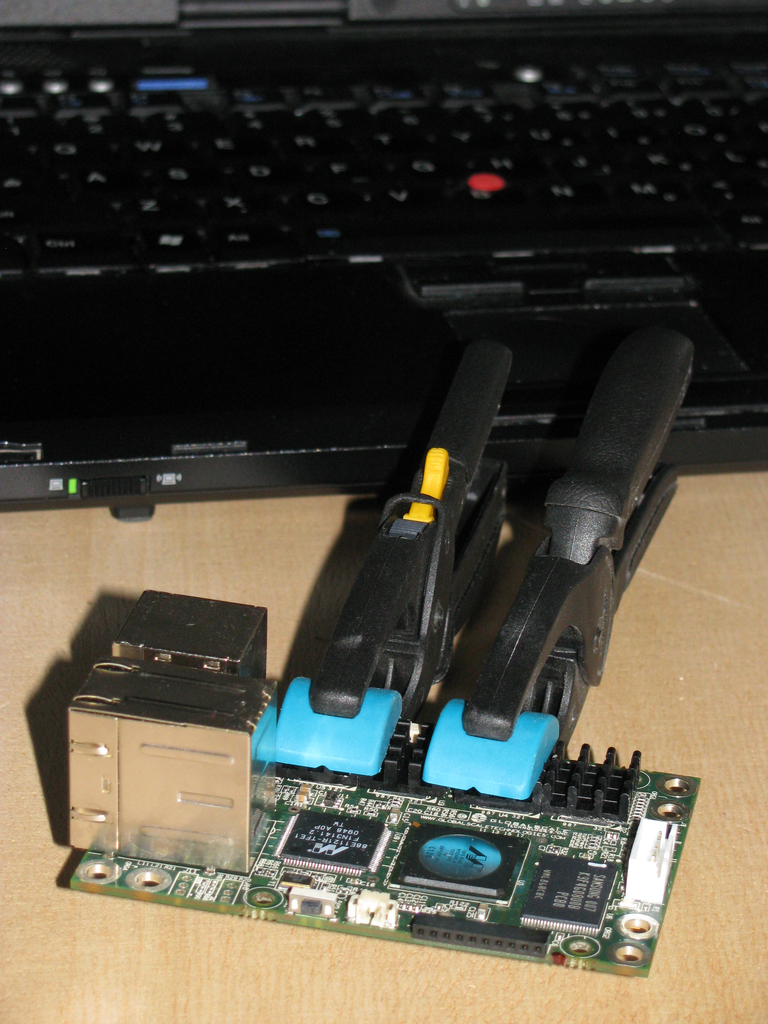
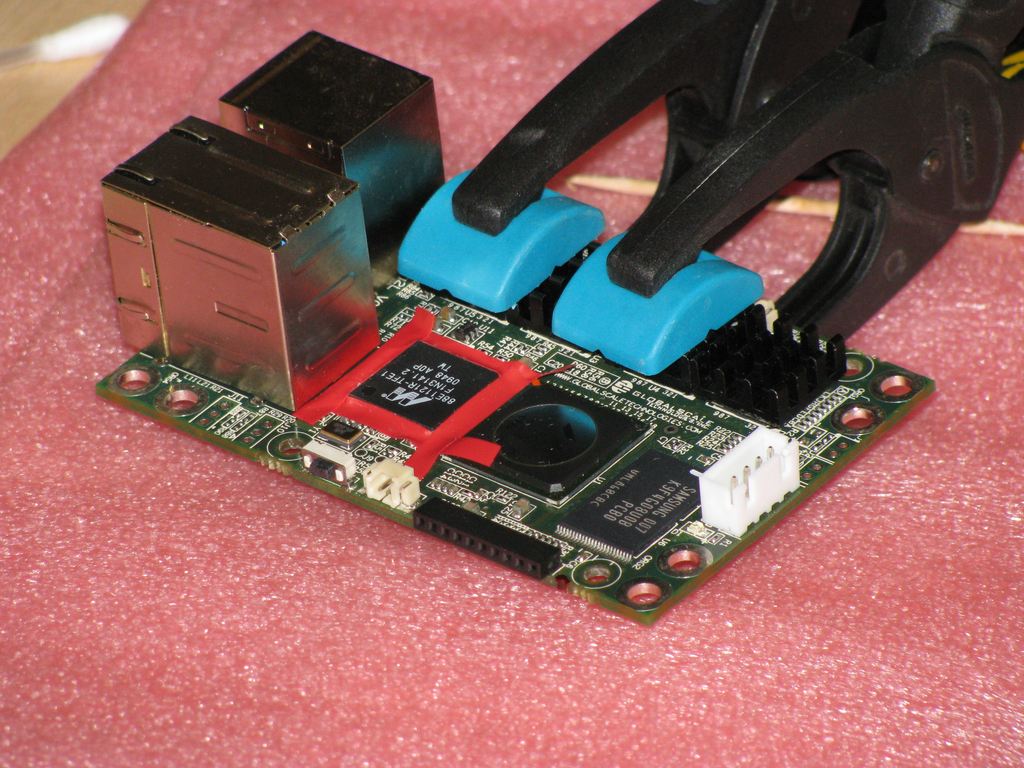
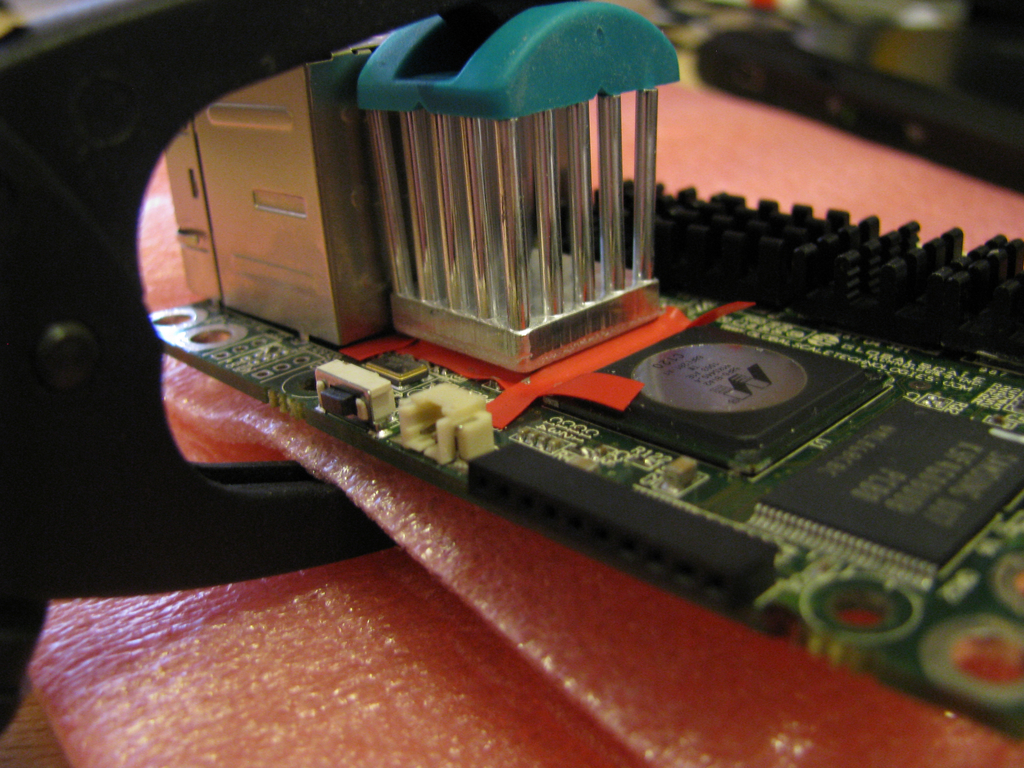
Gigabit Ethernet PHY and CPU heatsinks PHY and CPU need proper heatsinks as they're becoming pretty hot under load. Due to space limitations I had to stick with a 17x17x20mm heat sink for the PHY. I've tried to get a largish heat sink with BGA mount for the CPU, but I was not able to find one in short time and without ordering 1000 of them. So I've got another one of the 17x17x20mm model for the CPU. Later I found two other heat sinks which might fit on the GuruPlug's CPU: Malico 19x19x25mm or a Advanced Thermal Solutions Maxigrip. But for now the smaller one will have to do the job, also I'm scared to removed it without destroying the CPU. To mount the heat sink on the PHY a bit of preparation is necessary to ensure that the glue doesn't result in short cuts on the IC's pins. The arctic silver documentation recommends to use silicone on the pins to stop the glue. As I neither had the proper silicone nor did I want to make such a mess, I've decided to get a sticky insulating tape and some tooth picks to mount it properly on the IC pins. Make sure to do a proper job here! With good clamps you can work on the PHY while the memory heat sink glue is still drying. GuruPlug Server Plus - preparing the PHY The other problem on this side of the board is that some higher parts are mounted on the lower side of the board, so make sure to get some foam to protect them from your clamps. Except of the size of the heat sinks there is no real difference to the small ones: add glue, mount the heat sink and fix it with a clamp. GuruPlug Server Plus - mounting the PHY heatsink Before the glue dries completely make sure you remove the duct tape strips again. Be careful not to wipe any excess glue onto the IC pins. If you manage to do so you might want to remove and clean everything properly. So just be careful and everything should be fine. GuruPlug Server Plus - mounting the PHY heatsink 3 Mounting the heat sink on the CPU is easier as the CPU is a nice BGA package. No need to protect pins an there are none. GuruPlug Server Plus - mounting the CPU heatsink

Finished As you're able to see on the photo I did not the very perfect job, but fine enough to work properly. GuruPlug Server Plus - heatsinks

First tests with the new heatsinks Some tests with stress and some heavy network traffic showed quickly that the heat sinks are working well! But not well enough to be able to mount them into the original closed case (how the hell was this supposed to work before!?). Without any air to breath the temperature on the CPU heat sink went up to 85 deg C quickly. So on the CPU's die are > 100 deg C, which is at least close to the max allowed temperature. GuruPlug Server Plus - still too hot

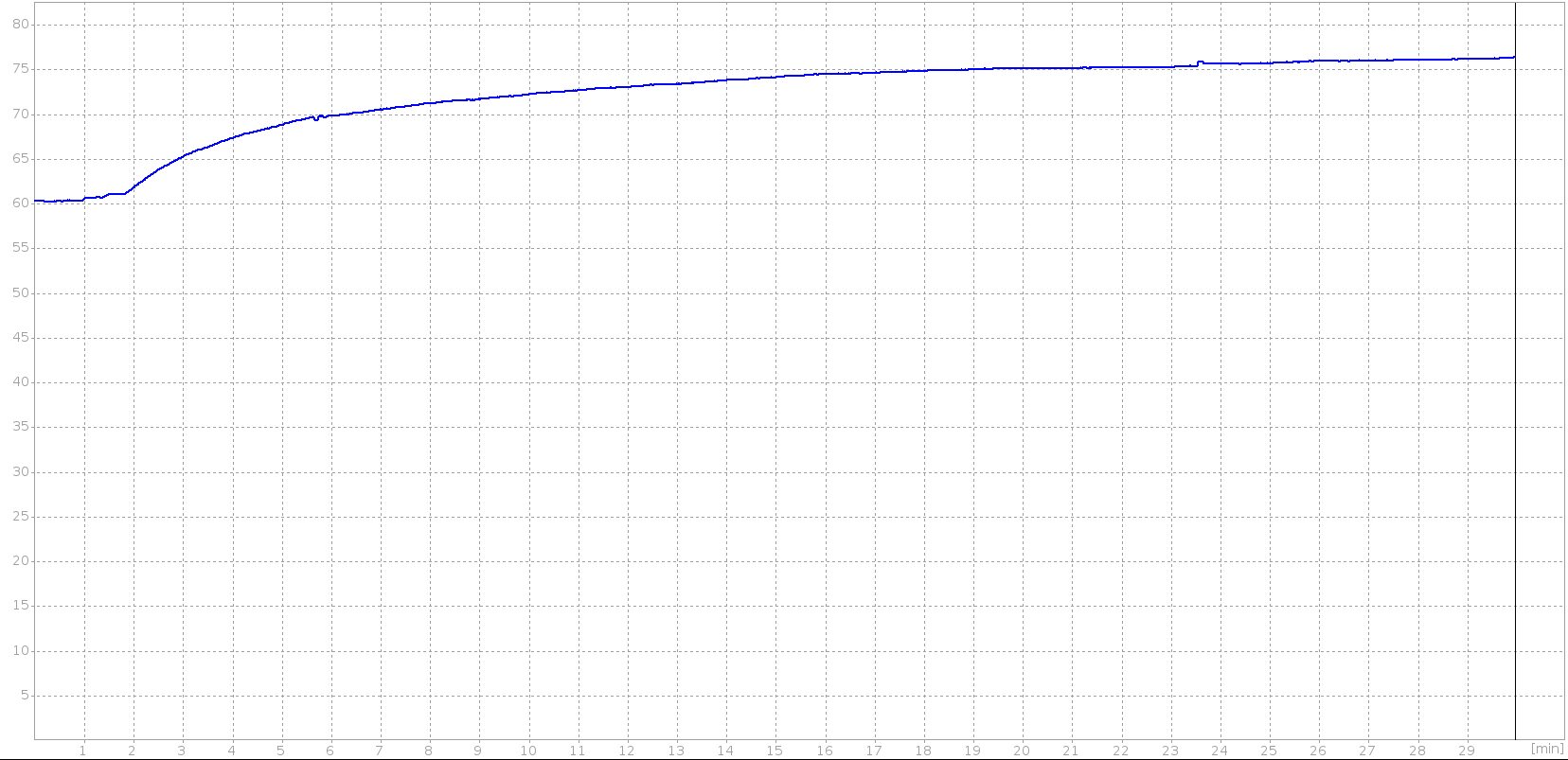
Adding air holes Obviously some additional air holes are necessary. After meeting my drill and cutter, the original case looks a bit like a piece of cheese now. GuruPlug Server Plus - case with air holes 1 GuruPlug Server Plus - case with air holes 2 Some more tests show that the temperature sticks around 76 deg C under heavy load now. That is still pretty hot, especially when the temperature in the room becomes hotter in summer. As I'm not going to run a lot of traffic trough it (my cable connection is limited to 20 MBit/s anyway), I guess it will work. Below is a graph I've recorded with my multimeter and qtdmm. It shows that the temperature rises to ~76 deg C and stays there. GuruPlug Server Plus - temperature curve Not sure if I could introuce some more load, the CPU had a load of 6 running stress. Network traffic was around 2x100MBit/s again. I could imagine with 2xGBit the CPU and PHY would become much hotter (no idea if it would be able to handle it at all, though). The PHY was usually a bit cooler than the CPU, so I didn't spend time to measure the temperature properly.

Conclusion My opinion is still the the original design of the plug is an insane QA and design failure. There is no way that it could ever work as shipped originally. If I'd have to design a new case for it, it should have a single insulated compartment for a PSU to ensure that no contact with high voltage is possible. The case around all other parts should be made of alloy with a lot of air holes. So the case could be used as heat sink (properly done, not with these insulating duct tape strips) and at the same time allow air circulation and a nice view on the LEDs on the board. Of course the case would be much more expensive than, but I'm sure it would work properly and would be worth the money. And if done peoperly, it would look much better than this blinking plastic thing. I could imagine it would sell well! So at the end I'm wondering what GlobalScale Technologies will do. I doubt it will be possible to create the 'professional upgrade kit' as they had announced before. Replacing all units is the only proper way. We'll see what happens. At least my GuruPlug is working well now and it will be used as replacement for my OpenWRT router soon. WiFi is not working, but that will be handled by my media center anyway. GuruPlug Server Plus - running plug

Sylvain Le Gall: Dirty fix for omlet vim extension

omlet (or here) is a vim extension for writing OCaml code. In my opinion, it has a better indentation than the standard OCaml vim support. Unfortunately, it has a cost: the indentation vim code is more complex. And it has a few bugs :-( The main bug is that it doesn't like unbalanced comment opening "(*" and closing "*)" tags. From time to time, it enters an infinite (or very long) loop when there such a tag left in your file. It can be very far away from the point you are editing. It isn't too problematic, because unbalanced tags are a syntax error. But the problem is that it matches these tags inside strings also. So whenever you start using regular expression like "(.*)" the whole indentation fails. But there is a very ugly solution to this problem! Problematic code:
 let parse_rgxp =
   Pcre.regexp ~flags:[ CASELESS] 
     "^(?<license>[A-Z0-9\\-]*[A-Z0-9]+)\
      (?<version>-[0-9\\.]+)?(?<later>\\+)?\
      ( *with *(?<exception>.*) *exception)?$"
Solution, add ignore"(*":
 let parse_rgxp =
   ignore "(*";
   Pcre.regexp ~flags:[ CASELESS] 
     "^(?<license>[A-Z0-9\\-]*[A-Z0-9]+)\
      (?<version>-[0-9\\.]+)?(?<later>\\+)?\
      ( *with *(?<exception>.*) *exception)?$"
Very very ugly coder: you balance comment tags in dead code -- very very bad ;-) ps: another solution when the plugin enters the infinite loop, hit Ctrl-C. This will stop it and let you define your own indentation.

9 September 2010

Rapha&#235;l Hertzog: Can Debian achieve world domination without being on Facebook?

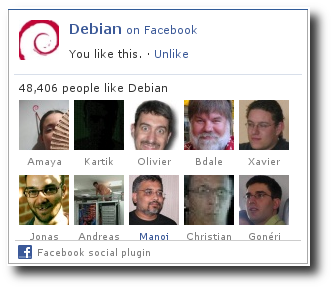
Debian Developers who like Debian on FacebookFacebook is not very popular among free software hackers. When I announced my Facebook page on identi.ca (see here) I got a few replies suggesting it was odd for me to use Facebook. Indeed there are many good reasons why Facebook should be avoided: it is a centralized and proprietary service that is not very privacy-friendly. But the truth is that lots of people are using it (even Debian developers, can you recognize them on the picture?) and some are using their Facebook news feed as their main source of news. You might wonder how many persons that represents, so here are the figures: the Debian Facebook page has 48,361 fans and the Ubuntu one has 247,932 fans. That s right, an announce put on the Debian facebook page would reach more persons than the most popular announce list that Debian is currently running (debian-announce@lists.debian.org has about 29,000 subscribers). Unfortunately that Debian Facebook page is empty and I don t even know who the administrator is. The Ubuntu page on the contrary is properly configured to relay news from The Fridge and Jono Bacon is posting some custom updates from time to time. Debian contributors regularly mention world domination as the ultimate goal of the universal operating system (I even feature this in my blog header banner! :-) ). But working towards world domination means in my opinion that we should communicate our ideals of freedom to as many people as possible, even if they are using a service that we don t want to promote. The Debian social contract acknowledges that some users have to use non-free software and we provide the non-free section for them. In the same spirit, I believe we must have a presence on Facebook. That does not mean that we endorse Facebook, and we should surely promote Joindiaspora once it s usable. But in the mean time we should reach out to Facebook users and allow them to follow us with the platform of their choice. That s the choice I recently made when I decided to setup a public facebook page featuring my free software work, my blog and my book. So if you are a Facebook user, click here to visit my page and click on Like if you want to follow this blog in your Facebook news feed. I also share interesting Debian or Ubuntu related articles that I discover while reading my RSS subscriptions. Below are the usual facebook widgets for the 3 pages quoted in this article (they might not show up if you read this article through an RSS feed):
<iframe allowtransparency="true" frameborder="0" scrolling="no" src="http://www.facebook.com/plugins/likebox.php?id=103161013077063&amp;width=292&amp;connections=0&amp;stream=false&amp;header=false&amp;height=62" style="border:none; overflow:hidden; width:292px; height:62px;"></iframe>
<iframe allowtransparency="true" frameborder="0" scrolling="no" src="http://www.facebook.com/plugins/likebox.php?id=9801962186&amp;width=292&amp;connections=0&amp;stream=false&amp;header=false&amp;height=62" style="border:none; overflow:hidden; width:292px; height:62px;"></iframe>
<iframe allowtransparency="true" frameborder="0" scrolling="no" src="http://www.facebook.com/plugins/likebox.php?id=6723083591&amp;width=292&amp;connections=0&amp;stream=false&amp;header=false&amp;height=62" style="border:none; overflow:hidden; width:292px; height:62px;"></iframe> Flattr this Share/Bookmark 14 comments Support my work

2 September 2010

Russell Coker: Raw Satire Usually Fails on the Internet

Sarcasm and satire usually don t work on the Internet. One cause of this is the lack of out of band signalling via facial expression or tone of voice. Another issue is the fact that in real life people usually know something about the person who they listen to while on the Internet it s most common to read articles without knowing much about the author. So the reader can t use I know that the author isn t an asshole as a starting point to determine whether a message should be interpreted literally. This is really nothing new. The standard in printed communication for a long time has been to use Emoticons (Wikipedia) to indicate emotion and other interpretation that might not be deduced from a direct reading of the text. The Wikipedia page cites examples of emoticon use dating back to 1857 although the combinations of characters used for different emotions has changed significantly many times. The common uses that we now know on the Internet date back to 1982. In my experience the symbol :-# is commonly used to note sarcasm or satire. Unfortunately it seems that none of the Internet search engines allow searching for such strings so I couldn t find an early example of this being used. While I haven t found a reference describing this practice, I regularly receive messages annotated with it and find that people generally understand what I mean when I use it in my own email. But that is usually applied to a sentence or two. For a larger section of text a pseudo-HTML tag such as </satire> can be used to signal the end of satire. It seems that a matching start tag is optional as recognising the start of satire is a lot easier once the reader knows that some of the content is satirical. In spoken English a phrase such as but seriously may be used for the same purpose, but such a subtle signal may be missed on the Internet particularly by readers who don t use English as their first language. Another way of signaling a non-literal interpretation is by using Scare Quotes the deliberate usage of quotation symbols to indicate that the writer disagrees with the content that is written. That is common for the case of referencing a phrase or sentence that you disagree with, but doesn t work for a larger section of text. A final option is to make the satire or sarcasm so extreme that no-one can possibly mistake it for being literal. This is not always possible, Poe s Law holds that Without a winking smiley or other blatant display of humor, it is impossible to create a parody of Fundamentalism that SOMEONE won t mistake for the real thing [1]. I think that Poe was understating the case, it is impossible to create a parody of religion that most people won t mistake for the real thing without signals or context. For an example read LandOverBaptist.org and Chick.com, of course if you know those sites then you will know whether they are satirical or serious but I expect that most readers of my blog won t invest enough effort into either of those religious sites to determine whether they are serious or satire. But satire and sarcasm without signals or a reputation usually fails. One example of success is The Onion which is a long running and well known satirical news site [2]. But even The Onion it is regularly mistaken for being serious the number of occasions when people forward me Onion articles for amusement are vastly outnumbered by the number of occasions when I see people taking it seriously. Even when material is known to be satirical it can still fail grossly. An example is the Chaser s satire of the Make A Wish Foundation [3]. Even material that is well known to be satirical seems to fail when it attacks bad targets or attacks in a bad way. One difficulty is in satirising bigoted people, to effectively satirise them without attacking the minority groups that they dislike can be a difficult challenge. Finally, when you write some satire and members of your audience don t recognise it you should consider the possibility that you failed to do it properly. If you can t get a hit rate close to 100% for people with the same background as you then it s probably a serious failure.

1 September 2010

Gunnar Wolf: Cycling, cycling everywhere!

I have been wanting to post for several days already, at least since this last Sunday. I have repeatedly bragged about taking part in the Ciclot n: The last Sunday every month, the city's government closes to automotive transit a ~33Km circuit, for cyclists to enjoy. And by cyclists, I mean people from all expertise ranges Well, the very elite bikers will not take part of such a massive thing, but there are people pedalling a couple of blocks, people taking their small kids to drive a bit, and I recognized an amazingly large proportion of people doing the whole route. Well, this last Sunday one lap was not enough for me I did two laps, ~65Km. (oh, and just for keeping the complaint current: After all, SportsTracker did release a version of thier software for the N95... But it requires Flash for using the webpage at all. I have several pointers at other applications... but am time-starved right now to start reviewing :-/ ) Anyway, I decided to do this double ciclot n in order to train for next week. If you are anywhere near Mexico City, you are invited - this is meant to be a large group ride, and looks very fun! Doble Marat n Ciclista Urbano del Bicentenario We are two weeks away from the 200 year conmemoration of the beginning of the Independence War in Mexico. A group of cyclists came up with the idea to organize a Double Marathon to celebrate! 84Km of biking in Mexico City: For some reason, the distance numbers in that map were made... in miles :-P Anyway, the planned route will be:
  1. Jardin de los periodistas ilustres (Delegaci n Venustiano Carranza)
  2. Aeropuerto Internacional de la Ciudad de M xico
  3. Circuito Bicentenario ( antes circuito interior )
  4. Monumento a La Raza - Hospital La Raza
  5. R o San Joaquin
  6. Viaducto Bicentenario ( carril confinado sin interrumpir la circulacion )
  7. Torres de Sat lite 50 aniversario
  8. Presidencia municipal de Tlalnepantla
  9. Presidencia municipal de Naucalpan
  10. Anillo Periferico Sur
  11. Secretar a de la Defensa
  12. Bosque de Chapultepec 1 y 2 secci n
  13. Segundo Piso del Distrito Federal
  14. Ciudad Universitaria patrimonio cultural de la humanidad
  15. Insurgentes Sur
  16. Miguel ngel de Quevedo
  17. Calzada de Tlapan
  18. Z calo centro historico del distrito federal
  19. Calle 16 de septiembre fin del recorrido
It looks very fun. Besides, although it is not that flat, it is one of the flattest long distance routes you will ever have. The toughest part will be IMO the Northern part of Circuito Bicentenario and possibly some bits of Perif rico towards Naucalpan. Then, a long flat stretch, with one long but not steep way up in Segundo Piso (near Las Flores), and a little stretch towards Ciudad Universitaria. Other than that, it looks very doable if you are in a moderately decent condition. And taking part in such a thing is very very worthy! As a final note... This same Sunday, it has been somewhat publicized the first D a Nacional de la Bicicleta (Bycicling National Day) will be held all over the country, kickstarting the National Cycling Crusade. Sounds nice, right? Even impressive? Yeah, but... If you look at the published information (in the page I just linked), you will see several cities are opening cyclist circuits. For one day only, which means, it does not build awareness among the population on how easy, how convenient and how fun it is to use the bicycle as means of transportation. And not only that The cyclist routes clearly make a point that cycling is a good way, at most, to have fun... But not a general habit we should all embrace. Lets see, as an example, the distances offered (only for the cities quoting route length): ...And so it goes. As you can see, several very important cities (i.e. Monterrey, Chilpancingo, Cuernavaca) put only a 2km route. 2Km by bike is... Nothing. 2Km is done at a leisurely pace in less than 15 minutes (I often sustain 20Km/h, which would mean 2Km in 6 minutes). And, in this short sample (the linked page has the information for several other states, but the pattern holds), most states are only making this in the largest city or two, completely forgetting the bulk of their territories. In my opinion, this "effort" was done backwardsly, and ends up delivering the exact opposite message to what should be done.

Next.

Previous.