Search Results: "jan"

14 August 2012

Michal Čihař: Weblate 1.2

Quite on schedule, Weblate 1.2 has been released today. It comes with lot of improvements, especially for project admins, handling of po files and improved performance. Full list of changes for 1.2: You can find more information about Weblate on it's website, the code is hosted on Github. If you are curious how it looks, you can try it out on demo server. You can login there with demo account using demo password or register your own user. Ready to run appliances can be found in SUSE Studio Gallery. Weblate is also being used https://l10n.cihar.com/ as official translating service for phpMyAdmin, Gammu, Weblate itself and others. If you are free software project which would like to use Weblate, I'm happy to help you with set up or even host Weblate for you (this will be decided case by case as my hosting space is limited). Update: Weblate appliace has been updated to 1.2 as well.

Filed under: English Weblate 0 comments Flattr this!

8 August 2012

Raphaël Hertzog: How to use quilt to manage patches in Debian packages

Most Debian source packages are using the 3.0 (quilt) format. This means that Debian changes to upstream files are managed in a quilt patch series. Knowledge of quilt is thus a must if you want to get involved in some serious packaging work. Don t worry, this tutorial will teach you how to use quilt in the context of Debian packaging. Pre-requisites Install the packaging-dev package to get a decent set of packages to do Debian packaging. It includes the quilt package.
$ sudo apt-get install packaging-dev
What s quilt? Read the description of the Debian package:
Quilt manages a series of patches by keeping track of the changes each of them makes. They are logically organized as a stack, and you can apply, un-apply, update them easily by traveling into the stack (push/pop). Quilt is good for managing additional patches applied to a package received as a tarball or maintained in another version control system. The stacked organization is proven to be efficient for the management of very large patch sets (more than hundred patches). As matter of fact, it was designed by and for Linux kernel hackers (Andrew Morton, from the -mm branch, is the original author), and its main use by the current upstream maintainer is to manage the (hundreds of) patches against the kernel made for the SUSE distribution.
The various files involved Stack of files PictureTo better understand the various quilt commands, you should have a basic idea of how the tool works. The stack of patches is maintained in a dedicated directory ( patches by default, but in Debian packages we override this value to debian/patches ). This directory contains the patch files and a series file that gives an ordered list of patches to apply. Example:

$ ls debian/patches/
01_use_stdlib_htmlparser_when_possible.diff
02_disable-sources-in-sphinxdoc.diff
03_manpage.diff
06_use_debian_geoip_database_as_default.diff
series
$ cat debian/patches/series
01_use_stdlib_htmlparser_when_possible.diff
02_disable-sources-in-sphinxdoc.diff
03_manpage.diff
06_use_debian_geoip_database_as_default.diff
When quilt is used, it also maintains some internal files in a directory of its own (it s named .pc ). This directory is used to know what patches are currently applied (.pc/applied-patches) and to keep backup copies of files modified by the various patches. Configuring quilt Before going further, you should put this in your ~/.quiltrc file:
for where in ./ ../ ../../ ../../../ ../../../../ ../../../../../; do
    if [ -e $ where debian/rules -a -d $ where debian/patches ]; then
        export QUILT_PATCHES=debian/patches
        break
    fi
done
This ensures that quilt will always use debian/patches instead of patches when your current directory is within a Debian source package where debian/patches exists. If you only use quilt for debian packaging, then you can be more expedient and put a simple export QUILT_PATCHES=debian/patches in that file. As a matter of personal preferences, I also have those lines in my ~/.quiltrc:
QUILT_PUSH_ARGS="--color=auto"
QUILT_DIFF_ARGS="--no-timestamps --no-index -p ab --color=auto"
QUILT_REFRESH_ARGS="--no-timestamps --no-index -p ab"
QUILT_DIFF_OPTS='-p'
It enables syntax coloring for the output of several commands and customizes the generated patches to get rid of useless information. I recommend you to use those settings too. Applying and unapplying patches, navigating in the stack of patches When you already have a patch series, you can navigate in the stack of patches so that any subset of consecutive patches (starting from the bottom) can be applied. quilt series will list all patches known by quilt. You can apply all patches with quilt push -a or unapply them all with quilt pop -a. You can also verify what patches are applied (quilt applied) or unapplied (quilt unapplied). quilt push applies the next unapplied patch (i.e. the patch returned by quilt next) and quilt pop unapplies the last applied patch (i.e. the patch returned by quilt top). You can give a patch name as parameter to quilt push/pop and it will apply/unapply all the patches required until the given patch is on the top. Here are some examples of navigation in a quilt patch series
$ quilt series
02_disable-sources-in-sphinxdoc.diff
03_manpage.diff
06_use_debian_geoip_database_as_default.diff
$ quilt applied
No patches applied
$ quilt next
02_disable-sources-in-sphinxdoc.diff
$ quilt push
Applying patch 02_disable-sources-in-sphinxdoc.diff
patching file docs/conf.py
Now at patch 02_disable-sources-in-sphinxdoc.diff
$ quilt push
Applying patch 03_manpage.diff
patching file docs/man/django-admin.1
Now at patch 03_manpage.diff
$ quilt applied
02_disable-sources-in-sphinxdoc.diff
03_manpage.diff
$ quilt unapplied
06_use_debian_geoip_database_as_default.diff
$ quilt pop -a
Removing patch 03_manpage.diff
Restoring docs/man/django-admin.1
Removing patch 02_disable-sources-in-sphinxdoc.diff
Restoring docs/conf.py
No patches applied
$ quilt push 03_manpage.diff
Applying patch 02_disable-sources-in-sphinxdoc.diff
patching file docs/conf.py
Applying patch 03_manpage.diff
patching file docs/man/django-admin.1
Now at patch 03_manpage.diff
$ quilt top
03_manpage.diff
Creating a new patch If there s no quilt series yet, you want to create the debian/patches directory first. If you already have one, you need to decide where to insert the new patch. Quilt will always add the new patch just after the patch which is currently on top. So if you want to add the patch at the end of the series, you need to run quilt push -a first. Then you can use quilt new name-of-my-patch.diff to tell quilt to insert a new empty patch after the current topmost patch. In this operation quilt does almost nothing except updating the series file and recording the fact that the new patch is applied (even if still empty at this point!). Now to add changes in this patch, you re supposed to modify files but only after having informed quilt of your intent to modify those files. You do this with quilt add file-to-modify. At this point quilt will make a backup copy of that file so that it can generate the final patch when you re done with your changes. It s quite common to forget this step and to be unable to generate the patch afterward. That s why I recommend you to use quilt edit file-to-modify which is a shorthand for doing quilt add and then opening the file in your favorite text editor. If you want, you can review your work in progress with quilt diff. When you re done with the changes, you should call quilt refresh to generate the patch (or to update it if it was already existing). And since you re a good packager, you call quilt header --dep3 -e to add DEP-3 meta-information to your patch header. Importing an external patch If someone else already prepared a patch, you can just import it right away with quilt import /tmp/the-patch. If you want to import it under a better name you can use the option -P better-patch-name . Like quilt new, it inserts the patch after the topmost patch. Updating patches for a new upstream version With some luck, your patches will still apply with some offsets in line numbers (quilt displays those offsets) and sometimes with some fuzz:
$ quilt push
[...]
Hunk #1 succeeded at 1362 (offset 11 lines).
Hunk #2 succeeded at 1533 with fuzz 1 (offset 4 lines).
[...]
While offsets are nothing to worry about (it means some lines were added and/or removed before the patched part), fuzz means that patch had to ignore some context lines to find the place where to apply the changes. In that case, you need to double check that patch did the right thing because it might have made changes somewhere where it shouldn t. Also, you ll have to update those patches because dpkg-source doesn t accept any fuzz. If you re confident that all patches are correctly applied by quilt, you can refresh them to get rid of those warnings:
$ quilt pop -a
[...]
$ while quilt push; do quilt refresh; done
That was for the easy case. Now let s deal with the case where some of the patches no longer apply. There s one case that is usually nice to have:
$ quilt push
Applying patch 04_hyphen-manpage.diff
patching file docs/man/django-admin.1
Hunk #1 FAILED at 194.
1 out of 1 hunk FAILED -- rejects in file docs/man/django-admin.1
Patch 04_hyphen-manpage.diff can be reverse-applied
When the patch can be reverse-applied, it means that the upstream authors included the Debian patch (or that they made the same change even though you forgot to forward the patch). You can thus get rid of it:
$ quilt delete -r 04_hyphen-manpage.diff
Removed patch 04_hyphen-manpage.diff
Note that without the -r the patch is only dropped from the series file. With -r the patch file is also removed. But there s a less desirable case where the patch is still relevant but it doesn t apply any longer:
$ quilt push
Applying patch 01_disable_broken_test.diff
patching file tests/regressiontests/test_utils/tests.py
Hunk #1 FAILED at 422.
1 out of 1 hunk FAILED -- rejects in file tests/regressiontests/test_utils/tests.py
Patch 01_disable_broken_test.diff does not apply (enforce with -f)
In that case, you should follow quilt s advice to force the patch application, manually apply the parts of the patch that were rejected, and then refresh the patch.
$ quilt push -f
Applying patch 01_disable_broken_test.diff
patching file tests/regressiontests/test_utils/tests.py
Hunk #1 FAILED at 422.
1 out of 1 hunk FAILED -- saving rejects to file tests/regressiontests/test_utils/tests.py.rej
Applied patch 01_disable_broken_test.diff (forced; needs refresh)
$ vim tests/regressiontests/test_utils/tests.py    
$ quilt refresh
Refreshed patch 01_disable_broken_test.diff
Other quilt commands You should probably read quilt s manual page too to learn about the various other commands and options that exist. There s at least quilt rename new-name that you can also find useful to rename the topmost patch (you can use -P patch-to-rename to rename a patch which is not currently at the top). Feedback Please leave comments if you have suggestions of improvements, or if there are some tips that are good to know. I might incorporate them in this article. Feel free to share this article with newbie packagers which are struggling with quilt. For your convenience, you can also refer to this article with this URL: http://raphaelhertzog.com/go/quilt
Found it useful? Be sure to not miss other packaging tips (or lessons), click here to subscribe to my free newsletter and get new articles by email.

2 comments Liked this article? Click here. My blog is Flattr-enabled.

6 August 2012

Michal Čihař: Ukolovnik 1.4

Great effort of new translators finally forced me to release Ukolovnik 1.4. There are only minor bug fixes besides translations updates. Full list of changes: PS: I don't plan any further development of this tool, in fact I have not touched it in last year and I don't expect this to change.

Filed under: English Ukolovnik 0 comments Flattr this!

2 August 2012

Russell Coker: Sam Harris on Lying

The Neuroscientist and atheism advocate Sam Harris has written a short blog post about a journalist named Jonah Lehrer who destroyed his career through false quotes and lies about them [1]. The main point of the article seems to be to promote his new eBook about Lying. The book is available for free until the end of the week (not sure if that is Friday, Saturday, or Sunday and in what time zone get it quick if you want it). The book is very short, 58 pages with a single column of large font text. If written a densely as a typical research paper it would probably be about 12 pages. But it has some good points to make. He makes a good moral case against most forms of lying, even answering questions such as do I look fat . It seems that anyone who was to follow his advice would be unusually honest even by Aspie standards. Related posts:
  1. Lies and Online Dating Separating Fact From Fiction: An Examination of Deceptive Self-Presentation in...
  2. Links January 2012 Cops in Tennessee routinely steal cash from citizens [1]. They...
  3. Desks Lindsay Holmwood has written about the benefits of a standing...

1 August 2012

Raphaël Hertzog: My Debian Activities in July 2012

This is my monthly summary of my Debian related activities. If you re among the people who made a donation to support my work (72.65 , thanks everybody!), then you can learn how I spent your money. Otherwise it s just an interesting status update on my various projects. This month has been a short one since I have been away for 2 weeks of vacation. Dpkg My dpkg work encompasses a bunch of small tasks: Packaging I updated nautilus-dropbox to version 1.4.0 and python-django-registration to version 0.8. Both have been uploaded to unstable and I initially wanted to request an unblock for the latter, but it turns out it has gained reverse dependencies and version 0.8 introduces API changes so it s not an option at this point of the freeze. QA work I investigated and fixed #678356 where it had been reported that the PTS static news were no longer working as expected. At the start of the month, I also unblocked the mostly-unknown but important mole service it was out of date of several weeks and several people were annoyed that the information about new upstream versions was no longer up-to-date. Vacation Almost no Debian work during my vacation but the lack of Wifi nearby made me look for solutions to connect my computer through my Nokia N900 3G/GPRS connection. I discovered the Mobile Hotspot application (homepage) and it worked like a charm (although it required Maemo s non-default devel repository to be able to install the alternative kernel for power users ). The Debian Handbook Michal iha proposed us to host a Weblate instance to help translate the book with a web interface. He kindly agreed to implement some improvements to better suit my requirements. Those have been completed and the weblate instance is now live at debian.weblate.org. There s no requirement to use Weblate for translations teams but for those that do, it sure makes it easier to recruit volunteers who have no prior knowledge of Git and PO files. If you want to help, please checkout this page first though, you should not start using Weblate without getting in touch with the respective translations teams. Apart from translations, I also had the pleasure to merge some patches from Philipp Kern who improved the section covering IPv6 and a few other parts. We can make the book even better if more people share their expertise in the part of the book where they know better than me and Roland. :-) Thanks See you next month for a new summary of my activities.

No comment Liked this article? Click here. My blog is Flattr-enabled.

28 July 2012

Luke Faraone: Simple two-factor authentication


Do you want to allow "Rebooting of Cluster 19" as Jane Doe, Foo Corp? Yes/NoI've been thinking a lot recently about information security and passwords. It's widely agreed that two-factor authentication, which combines something-you-know (a password) with something you have (eg. a smart card or some one-time-password) is superior to using a password by itself. Most solutions I've seen, short of client-side certificates, both require a trusted third party and provide little auditability.

I'm working on a project which attempts to address those problems. Basically, the idea is that you attempt to perform an action on a website, like logging in, moving some money between accounts, or restarting a cluster. Then, your mobile device ((iPhone used in the graphic to the right because a SVG was handy. Image adapted from work by Virgile Pypaert [CC-BY-SA-3.0], via Wikimedia Commons)) (Android, iPhone, or some custom hardware) starts buzzing, displaying the text of the action. When you approve or deny the action, your device uses a locally stored private key to sign the text of the approval and send it back to the server. The server checks that you approved the same transaction number and text, then allows the action. The server can store the approval notice to allow auditors later to determine that somebody in possession of the private key signed the action request.

So far, I've written a small Django server application, and a Python CLI device and client. They're not yet ready for a public release; I need to write up installation instructions and test it a bit more, but I'll publish them soon on Launchpad. On the usability side of things, I plan to conduct some trials in January comparing it to things like Google Authenticator.

This should be less susceptible to MITM attacks than one-time-passwords, since you can authenticate specific transactions, rather than entire sessions.

On the other hand, I'm no security researcher. Dear lazyweb, are there any problems with the above approach? Also, if I'm going to release this (as I plan to once I get something working), I need a name. Ideas?

26 July 2012

Michal Čihař: Weblate hacking #4

Fourth day of Hackweek VIII was for me again mostly spent on Weblate. This time there are no new nice features, but rather general improvements to the code. First task was to add support for django-registration 0.8. Originally my plan was to support both 0.7 and 0.8, but that proven to be too complicated so Weblate now requires 0.8, which brings quite a lot of differences in API. Later I've installed django-debug-toolbar and looked at some bottlenecks in some hot paths. This resulted in few optimizations of translations merging and new caching for translation stats. This turned out to be too expensive for bigger translations and caching these can save few seconds on page load. I will probably focus more on performance tuning tomorrow as I don't plan to add any new features to 1.2 release.

Filed under: English Suse Weblate 0 comments Flattr this!

24 July 2012

Michal Čihař: Weblate hacking #2

Second day of Hackweek VIII is over and there has been again great progress on Weblate. I've started with improving documentation. Most of improvements were possible by using djangodocs extension for Sphinx, which allows better documenting of Django admin commands and settings. Then I've focused on handling languages as there were some things which I did not like. Most importantly, Weblate will now try to use existing languages even if used code does not 100% match (eg. cs_CZ and cs-CZ are treated equal). Also with help of locale aliases, some specific variants won't be created and generic one used instead (eg. cs_CZ will use cs, as these are actually same). If there will be need to differentiate them, you still can create language manually and Weblate will use matched one. Last thing is translation locking - translator can now lock translation for exclusive use and nobody else will be able to work on that. This will help in situations where more people started to work on same translation and basically duplicated the effort. There are 3 open issues targeted for 1.2 release, but I'm not sure if some of these are good ideas, let's keep the decision for next days.

Filed under: English Suse Weblate 0 comments Flattr this!

22 July 2012

Evgeni Golov: RC bugs 2012/29

RCBW report for 2012/29 (16.7.-22.7.) The motto for this week was:
shut up and take my patches!
(Don t take it personally, it s just a meme :P)

14 July 2012

Romain Francoise: Getting clickable URLs in xterm (sort of)

My terminal emulator of choice is xterm: it's fast, light, and (since it's pretty much the reference implementation) it has excellent support for everything a console user could desire... except for one thing that would be very, very convenient: making URLs clickable. Other terminal emulators have this feature, but they also have problems that make them inferior to xterm in different ways. Over the years people have come up with various workarounds for this situation, like screen scraping utilities (urlview, urlscan) that can be hooked up to other console programs to extract and browse URLs, but they're still not as convenient as just using the mouse, and often require the program to run on the same machine as the browser. Fortunately, xterm #277 (released in January 2012) added a new feature that provides almost exactly what I had been looking for: it can now spawn programs using the exec-formatted action and give them as argument the contents of the current selection or clipboard. So you can add the following to your ~/.Xresources: *VT100*translations: #override Meta <Btn1Up>: exec-formatted("x-www-browser '%t'", PRIMARY) which makes xterm run x-www-browser on the selection when it receives Alt + left click. (Adjust for whatever your Meta key is.) This is advantageously combined with a charClass setting to make xterm treat URLs as a single word, so that you can just double-click on them to select them: XTerm*charClass: 33:48,36-47:48,58-59:48,61:48,63-64:48,95:48,126:48 With both of these enabled, opening URLs is now just a matter of:
  1. Double-clicking the URL to select it
  2. Doing Alt + click anywhere on the xterm window to run the browser
which, while more involved than a single click, it still much faster than having to copy the URL manually to the browser.

12 July 2012

Enrico Zini: More diversity in Debian skills

More diversity in Debian skills This blog post has been co-authored with Francesca Ciceri. In his Debconf talk, zack said:
We need to understand how to invite people with different backgrounds than packaging to join the Debian project [...] I don't know what exactly, but we need to do more to attract those kinds of people.
Francesca and I know what we could do: make other kinds of contributions visible. Basically, we should track and acknowledge the contributions of webmasters, translators, programmers, sysadmins, event organisers, and so on, at the same level as what we do for packagers: DDPO, minechangelogs, Portfolio... For any non-packaging activity that we can make visible and credited, we get: Here's an example: who's the lead translator for German? And if you are German, who's the lead translator for Spanish? Czech? Thai? I (Enrico) don't know the answers, not even for Italian, but we all should! Or at least it should be trivial to find out. To start to change this, is just a matter of programming. Francesca already worked on a list of trackable data sources, at least for translators. Here are some more details, related to translation: And here are some notes about other fields: And finally, if you are still wondering who those translation coordinators are, they are listed here, although not all teams keep that page up to date. Of course, when a data source is too hard to mine, it can make sense to see if the workflow could be improved, rather than spending months writing compicated mining code. This is a fun project for people at Debconf to get together and try. If by the end of the conference we had a way to credit some group of non-packaging contributors, even if just one like translators or website contributors, at least we would finally have started having official trackers for the activities of non-packagers.

8 July 2012

Jonathan Wiltshire: Point Release Security, Reloaded

When I first undertook the tracking of minor security fixes in point releases, I quickly out-scaled flat text files and a good memory. A Python library and sqlite database helped automate sending notifications and keeping tabs, but the manual work associated with tracking incoming bugs from the security team, applications to and responses from the release team, and the action or inaction of maintainers was still too time-consuming to be useful. This weekend I deployed pyprsc2, with a public view at http://prsc.debian.net/tracker/<bug>. I had planned to do this at Debconf12, but given the circumstances still, it needed doing anyway and what better time? Result: my work now involves adding tracks where required; keeping an eye on the notified list for manual prods; and after a point release, archiving the included bugs and updating the suite version numbers. Bliss. Features: Todo: Technical: prsc.debian.net leverages large parts of the Django MVC framework in fact, this was really a learning exercise in disguise since I want to use Django on some more complex projects later. BTS synchronisation is handled by python-debianbts, and synchronisation with proposed-updates is through XML and lxml/objectify (thanks to the release team s awesome XML queue viewer and Adam adding bug numbers to it). Since this was a learning exercise, some of the Python is probably questionable at best and downright wrong at worst, so it probably needs some work still.
Point Release Security, Reloaded is a post from: jwiltshire.org.uk Flattr

4 July 2012

Johannes Schauer: enumerating elementary circuits of a directed_graph

For my GSoC project this year I need to be able to enumerate all elementary circuits of a directed graph. My code is written in Ocaml but neither the ocamlgraph library nor graph libraries for other languages seem to implement a well tested algorithm for this task. In lack of such a well tested solution to the problem, I decided to implement a couple of different algorithms. Since it is unlikely that different algorithms yield the same wrong result, I can be certain enough that each individual algorithm is working correctly in case they all agree on a single solution. As a result I wrote a testsuite, containing an unholy mixture of Python, Ocaml, D and Java code which implements algorithms by D. B. Johnson, R. Tarjan, K. A. Hawick and H. A. James.
Algorithm by R. Tarjan The earliest algorithm that I included was published by R. Tarjan in 1973.
Enumeration of the elementary circuits of a directed graph
R. Tarjan, SIAM Journal on Computing, 2 (1973), pp. 211-216
http://dx.doi.org/10.1137/0202017
I implemented the pseudocode given in the paper using Python. The git repository can be found here: https://github.com/josch/cycles_tarjan

Algorithm by D. B. Johnson The algorithm by D. B. Johnson from 1975 improves on Tarjan's algorithm by its complexity.
Finding all the elementary circuits of a directed graph.
D. B. Johnson, SIAM Journal on Computing 4, no. 1, 77-84, 1975.
http://dx.doi.org/10.1137/0204007
In the worst case, Tarjan's algorithm has a time complexity of O(n e(c+1)) whereas Johnson's algorithm supposedly manages to stay in O((n+e)(c+1)) where n is the number of vertices, e is the number of edges and c is the number of cycles in the graph. I found two implementations of Johnson's algorithm. One was done by Frank Meyer and can be downloaded as a zip archive. The other was done by Pietro Abate and the code can be found in a blog entry which also points to a git repository. The implementation by Frank Meyer seemed to work flawlessly. I only had to add code so that a graph could be given via commandline. The git repository of my additions can be found here: https://github.com/josch/cycles_johnson_meyer Pietro Abate implemented an iterative and a functional version of Johnson's algorithm. It turned out that both yielded incorrect results as some cycles were missing from the output. A fixed version can be found in this git repository: https://github.com/josch/cycles_johnson_abate

Algorithm by K. A. Hawick and H. A. James The algorithm by K. A. Hawick and H. A. James from 2008 improves further on Johnson's algorithm and does away with its limitations.
Enumerating Circuits and Loops in Graphs with Self-Arcs and Multiple-Arcs.
Hawick and H.A. James, In Proceedings of FCS. 2008, 14-20
www.massey.ac.nz/~kahawick/cstn/013/cstn-013.pdf
In contrast to Johnson's algorithm, the algorithm by K. A. Hawick and H. A. James is able to handle graphs containing edges that start and end at the same vertex as well as multiple edges connecting the same two vertices. I do not need this functionality but add the code as additional verification. The paper posts extensive code snippets written in the D programming language. A full, working version with all pieces connected together can be found here: https://github.com/josch/cycles_hawick_james The algorithm was verified using example output given in the paper. The project README states how to reproduce it.

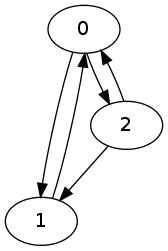
Input format All four codebases have been modified to produce executables that take the same commandline arguments which describes the graphs to investigate. The first argument is the number of vertices of the graph. Subsequent arguments are ordered pairs of comma separated vertices that make up the directed edges of the graph. Lets look at the following graph as an example: cycle example The DOT source for this graph is:
digraph G  
  0;
  1;
  2;
  0 -> 1;
  0 -> 2;
  1 -> 0;
  2 -> 0;
  2 -> 1;
   
To generate the list of elementary circuits using Tarjan's algorithm for the graph above, use:
$ python cycles.py 3 0,1 0,2 1,0 2,0 2,1
0 1
0 2
0 2 1
The commandline arguments are the exact same for the other three methods and yield the same result in the same order. If the DOT graph is in a format as simple as above, the following sed construct can be used to generate the commandline argument that represents the graph:
$ echo  sed -n -e '/^\s*[0-9]\+;$/p' graph.dot   wc -l   sed -n -e 's/^\s*\([0-9]\) -> \([0-9]\);$/\1,\2/p' graph.dot 

Testsuite As all four codebases take the same input format and have the same output format, it is now trivial to write a testsuite that compares the individual output of each algorithm for the same input and checks for differences. The code of the testsuite is available via this git repository: https://github.com/josch/cycle_test The other four repositories exist as submodules of the testsuite repository.
$ git clone git://github.com/josch/cycle_test.git
$ cd cycle_test
$ git submodule update --init
A testrun is done via calling:
$ ./test.sh 11
The argument to the shell script is an integer denoting the maximum number N of vertices for which graphs will be generated. The script will compile the Ocaml, Java and D sourcecode of the submodules as well as an ocaml script called rand_graph.ml which generates random graphs from v = 1..N vertices where N is given as a commandline argument. For each number of vertices n, e = 1..M number of edges are chosen where M is maximum number of edges given the number of vertices. For every combination of number of vertices v and number of edges e, a graph is randomly generated using Pack.Digraph.Rand.graph from the ocamlgraph library. Each of those generated graphs is checked for cycles and written to a file graph-v-e.dot if the graph contains a cycle. test.sh then loops over all generated dot files. It uses the above sed expression to convert each dot file to a commandline argument for each of the algorithms. The outputs of each algorithm are then compared with each other and only if they do not differ, does the loop continue. Otherwise the script returns with an exit code. The tested algorithms are the Python implementation of Tarjan's algorithm, the iterative and functional Ocaml implementation as well as the Java implementation of Johnson's algorithm and the D implementation of the algorithm by Hawick and James.

Future developments Running the testsuite with a maximum of 12 vertices takes about 33 minutes on a 2.53GHz Core2Duo and produces graphs with as much as 1.1 million cycles. It seems that all five implementations agree on the output for all 504 generated graphs that were used as input. If there should be another implementation of an algorithm that enumerates all elementary circuits of a directed graph, I would like to add it. There are some more papers that I would like to read but I lack access to epubs.siam.org and ieeexplore.ieee.org and would have to buy them. Benchmarks seem a bit pointless as not only the algorithms are very different from each other (and there are many ways to tweak each of them) but also the programming languages differ. Though for the curious kind, it follows the time each algorithm takes to enumerate all cycles for all generated graphs up to 11 vertices.
algorithmtime (s)
Johnson, Abate, Ocaml, iterative137
Johnson, Abate, Ocaml, functional139
Tarjan, Python153
Hawick, D175
Johnson, Meyer, Java357
The iterative Ocaml code performs as well as the functional one. In practice, the iterative code should probably be preferred as the functional code is not tail recursive. On the other hand it is also unlikely that cycles ever grow big enough to make a difference in the used stack space. The Python implementation executes surprisingly fast, given that Tarjan's algorithm is supposedly inferior to Johnson's and given that Python is interpreted but the Python implementation is also the most simple one with the least amount of required datastructures. The D code potentially suffers from the bigger datastructures and other bookkeeping that is required to support multi and self arcs. The java code implements a whole graph library which might explain some of its slowness.

2 July 2012

Christian Perrier: Bug #680000

Jan Dejemyr reported Debian bug #680000 on Monday July 2nd, against update-manager-core. Bug #670000 was reported as of April 22nd: 2 months and 10 days for 10,000 bugs. About a constant bug report rate (2 months and 7 days last time). How will the wheezy freeze affect this? We'll see in two months!

29 June 2012

Michal &#268;iha&#345;: New job, new challenges

Starting next week, I'll start at new job. I will still stay at SUSE, so it's not that big change, but still it is new challenge for me. I'll be moving out of L3 department, where I've spend almost four years. L3 is really a great team where man can learn basically anything, simply because you can meet there anything from broken swap on S390 up to wrong icons in LibreOffice :-). The new position is inside Security team, still I'll be mostly focused on writing some internal tools, rather than doing security work (at least for first year or so). The current plan is base on work I've done for L3 tools and use Django for the web interface, but that's just a plan for now and might change in the future. Anyway looking forward to new challenges at new job.

Filed under: Django English Suse 0 comments Flattr this!

25 June 2012

Jan Wagner: nagios-plugins 1.4.16 is going to be released

Short before Debian is freezing the upcoming release of a new version of nagios-plugins is scheduled for Wednesday. The good news is, that a recent version is available in unstable and testing. Upstream only fixed some check_ping issues, which are not included in nagios-plugins 1.4.16~pre1-1. There is also a package available through squeeze-backports. If you are able to, please test the packages as soon as possible. If there are some quirks, these can be fixed in the next two days upstream.

21 June 2012

Raphael Geissert: Introducing http.debian.net, Debian's mirrors redirector

You've been there: you are about to install a package, upgrade, or get the source package, and the mirror fails. It is offline, it is out of date, etc. Whatever the reason, you couldn't do it.

That's only one of the issues that http.debian.net attempts to address. In a nutshell: it works as an http-only content distribution network. It uses the network and geographic location to select the best online and up-to-date mirrors.

APT's sources.list one liner:
deb http://http.debian.net/debian stable main

Use /debian-backports for backports, and /debian-archive for archive.debian.org.

Originally introduced to the Debian mirrors community back in January, the code on the server and client sides has improved since. All is needed is squeeze's APT (or aptitude), but wheezy's and sid's will perform better.

Advantages and more details are discussed at the Debian mirrors redirector's website.

(Thanks to the early testers, everyone who has provided feedback, my friends at PuffinHost, and all the mirrors-related people, obviously including those who sponsor them!)

5 June 2012

Anand Kumria: Internet-o! Or why the Internode Business SLA is not worth a damn.

Last week (28th May), I had five Internet services across two countries. This week, I have seven (7), with two new ones in Australia. It all begin, when Internode decided that in their own best interest to migrate me from my existing DSLAM to one of their own infrastructure. They had sent an email indicating when it was likely to occur. And they were sending invoices to the same address. Naturally, they would send the date of the migration to the same address they had used for the past 9 months to communicate to me with, right? Wrong. Internode still do not understand why they never sent the notification email, as it turns out. Compare the response time, update times, and restore times they specify to what actually occurred.
2012-05-28 12:05 BST
I'm informed of an outage. In the past, the problem has been at my end, so I run through the standard diagnostic procedure. Everything seems to be normal, so I call Internode. Sure enough, our service dropped off the Internet. According to Timothy, that happened at 11:15 AEST because of a migration to their own DSLAM. After some diagnosis from Internode, they realise that whilst the migration has successfully disconnected the service, they have not reconnected anything. There is no sync. Ticket #454448 raised - which is when I'm informed that I'm on the business SLA. I've asked for updated to both an Australian and UK mobile. "Not a problem". Estimated time of resolution: 48 hours. Yes, 48 hours. There goes the first SLA milestone.
2012-05-30 07:28 BST
I ring and speak with Carl. He indicates that as best he knows, the service is to be 7pm. for those keeping score, no updates have occurred during this time. To either number. I query him about the SLA period. He says the response time is 2hrs and restore time is 10hrs. He also indicates that this can all be checked online and that we can apply for a refund.
2012-05-30 10:27 BST
I ring, again, and this time speak with Justin. I ask why I've not have an updated, since 7pm AEST has well and truly gone. He authenticates me and places me on hold to investigate. Advises that the issue is fixed, says he sees sync on the line. I indicate that I do not. He asks me to turn off the ADSL modem, we do, and he still sees sync. on the line. Believes there is another problem at the exchange, another issue raised with wholesaler. No ticket number issues to me. ETA to fix 7pm 2nd June. Note:This was a 1 hour International call
2012-06-01 04:00 BST
I happened to check, and notice I have connectivity to the external interfaces (and thus, obviously, line sync.) again. No notification though.
2012-06-01 14:31 BST
Amidst all this, I also have to to source two external connections - Telstra & Optus, get them setup, reconfigure routing, email delivery and other network services so that the businesses which are relying on the Internet, still work. Not fun. Especially when I have no access to the routers. I had to get multiple people on site.
2012-06-04 11:XX CEST
I'm told that the second site has gone done. Inexplicably. After some round-trip and diagnosis, we determine that the routing change has occurred. However it has been done incorrectly. And, of course, no notice / or update occurred either. Multiple tickets are raised by multiple people, amongst them: #4562559 from my mobile phone whilst I am in Zurich.
2012-06-04 16:56 CEST
I am informed, and it is confirmed, that the attempted routing change has been reverted and we are back to how things were on 2012-06-01.
2012-06-05 05:44 CEST
I wake up, and find out that of at least three hours ago, they appear to have called (finally!) and actually fixed the routing to both sites. That is a week of down time, multiple people (4 people) around in various countries around the World and hundreds of dollars in calls between us all to get things working. Now, to look into compensation.
2012-06-05 09:43 CEST
I receive a missed call, which I later learn is Internode actually calling me (for once!). At that moment, I'm actually giving a lightening talk on Django-PaaS
And that, dear reader, is why Internode Business SLA is a waste of money. The services were broken by a change of no net benefit to me, was over a week ago. Also, during this process. My UK home Internet went down. My UK Three post-paid service "ran out of money" and Vodafone has a service outage for half a day. A perfect storm of Internet dis-connectivity. So, if you have been wondering, that is why I've been offline for various parts of the last week.

23 May 2012

Anand Kumria: Lifelong learning

Below are four of my (150!) browser tabs opened, that I oddly had in sequence. Various tabs open to online learning websites. There has been much made of the pheonmen of lifelong learning and although I thought I had finished my exams when I finished University, I'm still doing them. From left to right:
Duolingo, where I am learning Spanish.
Quite a reasonable site, currently invite-only. My worry is my pronounciation will be crap though. I do wish that it did not have to use Flash to accomplish things though.
Udacity, where I am doing CS212 - Design of Computer Programs
Nice interface, annoying that it uses YouTube to host videos as that meant I had to whitelist YouTube in Flashblock.I picked this course as one of the other ones I wanted to do had already closed. I suspect I'll eventually do each of the courses they have on offer. One nice thing is that courses run every 8 weeks or so.
Codeacademy, I am currently doing their Codeyear course.
Well presented, but I find that their Javascript interface is extremely slow to startup. It consistently lags behind my typing speed by about 3 seconds.I'm using Firefox beta, so I'm always running something fairly fast and modern too.I'm primarily doing this course to see how/what they are trying to teach non-programmers. My feedback is that it is not geared towards someone with no programming knowledge. The initial 10 weeks of Javascript presentation proceeded at a very fast pace. If I weren't a programmer already, I'd have stuggled to keep up.
Coursera, here I am doing the Machine Learning class.
I'm not a fan of this interface at all, which is why I find it hard to come back to the site each week. I'm not sure exactly why though, since it uses WebM and no Flash. Hurray!!Either way, I'm doing the Machine Learning class. I tried this last time it was offered and got to week 5 same week I'm on now and then I got suddenly busy IRL, so was not able to complete the course.Unlike Udacity, courses run at set times and you have to do the work on the required dates in order to get the statement of attainment, which can be hard when you are juggling multiple things
Keep in mind, these are just the extra things I have decided to learn. I'm also learning more about Django, Puppet and Python in my work everyday. Plus I'm actually doing a Spanish course in real life too. Oh, and I have a job and I go out. I'm generally actually pushed for time. Which probably explains why I have not been keeping up with the blog. It isn't because I hate you, although it might be too ;-) , I'm just busy.

18 May 2012

Petter Reinholdtsen: ColorHug - USB and free software based screen color calibration

In january, I discovered the ColorHug, a USB dongle from Hughski to calibrate the color on a computer screen. The software required is included in Debian, and I decided back then to preorder from the next batch. Yesterday I finally heard back from them, and got the opportunity to order. Today I ordered mine, and eagerly await the delivery. I hope it arrive next week, as I got a confirmation that it should go in the mail on monday. :) If you want to ensure the colors on the screen match the intended colors, I suggest you check out this cheap tool with free software drivers. :)

Next.

Previous.



