Search Results: "ghe"

2 May 2009

Joey Hess: "I didn't know it went down so far!"

Sinking Creek passes by my sister's place and then does something strange: It disappears under ground, passes beneath both a hill and the Clinch River, to emerge on the other side as a spring and finally flow into the river. I've always wanted to find where it does this, and today we set out to do that. So for an hour or so we waded and scrambled down the soft-bottomed creek, through water that was often waist deep, with sometimes deeper suprises, past stands of cane, watching the banks rise up higher and higher, until we were in a 50+ foot deep gully. There were many signs of flooding and erosion from when the underground outlet gets plugged. Lots of interesting trees suspended on their roots. The sinkhole itself was not very impressive, and is less so here, but the landscape around it was breathtaking. These photos can't really show the scale of the place.
the sinkhole
On the way back we got to play hide-n-seek from a farmer on his tractor, which added a nice adrenalin rush. He was scarier than this creek doll. (Photos courtesy Anna Hess; her blog about it.)

20 April 2009

Russell Coker: The Future of Electric Cars

TED published an interesting interview with Shai Agassi about electric cars [1]. One idea that I hadn t heard before is that of moving car batteries between regions as they lose capacity. An old battery for an electric car that can only handle short journeys may be useful in a region where journeys are typically short. On a similar note I expect that in a few decades the less prosperous countries will import old electric vehicles and fit them with 4 or more batteries. Last time I checked the Prius battery pack weighed about 120Kg, so the car would be usable with 4 battery packs if driven at low speeds. Shai Agassi also gave a TED talk on this topic [2]. The real solution for the problem of providing convenient and affordable electric vehicles is to start by recharging the batteries whenever the vehicle is parked (at the office, shopping center, home, etc). Then on the rare occasions when the car is being driven for longer distances and the battery gets flat it can be swapped for a charged battery. They have apparently designed a robot for changing car batteries, so changing the battery would be like driving through a car-wash. He describes this as an economic model that decouples the expensive battery from the car, so you pay for the use of the battery not the ownership - just as with a petrol car you pay for the petrol you use not for a portion of the ownership of an oil well. He also pointed out that cars produce 25% of the world s CO2 emissions, so his plan for all electric cars everywhere seems to be an essential part of solving the environmental problems. He then compared this to the UK parliamentary discussion on ending slavery, at the time slaves provided 25% of the energy used by the UK. After a month of discussion the decision was made to make the moral choice and end slavery regardless of the cost.

10 April 2009

Russell Coker: Fixing the Correct Network Bottleneck

The latest news in the Australian IT industry is the new National Broadband Network (NBN) plan [1]. It will involve rolling out Fiber To The Home for 90% of the population, the plan is that it will cost the government $43,000,000,000 making it the biggest government project. Kevin Rudd used Twitter to say Just announced biggest ever investment in Australian broadband - really exciting, infrastructure for the future [2]. Now whenever someone says that a certain quantity of a resource is enough you can expect someone to try and refute that claim by mentioning that Bill Gates supposedly stated that 640K is enough when referring to the RAM limits of the original IBM PC. As an aside, it s generally believed that Bill Gates actually didn t claim that 640K would be enough RAM, Wikiquote has him claiming to have never said any such thing [3]. He did however say that he had hoped that it would be enough for 10 years. I think that I needed that disclaimer before stating that I think that broadband speeds in Australia are high enough at the moment. In any computer system you will have one or more resources that will be limited and will be bottlenecks that limit the overall performance. Adding more of other resources will often make no difference to performance that a user might notice. On the machine I m using right now to browse the web the bottleneck is RAM. A combination of bloated web pages and memory inefficient web browsers uses lots of memory, I have 1.5G of RAM and currently there is 1.3G of swap in use and performance suffers because of it. It s not uncommon for the machine to page enough that the mouse cursor is not responsive while browsing the web. My options for getting faster net access on this machine are to add more RAM (it can t take more than 2G - so that doesn t gain much), to use more memory efficient web browsers and X server, and to simply buy a new machine. Dell is currently selling desktop machines with 2G of RAM, as they are 64bit systems and will therefore use more memory than 32bit systems for the same tasks they will probably give less performance than my 32bit machine with 1.5G of RAM for my usage patterns. Also the latest EeePC [4] ships with 1G of RAM as standard and is limited to a maximum of 2G, I think that this is typical of Netbook class systems. I don t use my EeePC for any serious work, but I know some people who do. Does anyone have suggestions on memory efficient web browsers for Linux? I m currently using Konqueror and Iceweasel (Firefox). Maybe the government could get a better return on their investment by spending a small amount of money sponsoring the development of free web browsers. A million dollars spent on optimising Firefox seems likely to provide good performance benefits for everyone. My wife s web browsing experience is bottlenecked by the speed of the video hardware in her machine (built-in video on a Dell PowerEdge T105 which is an ATI ES1000). The recent dramatic price reductions of large TFT monitors seem likely to make video performance more of an issue, and also increases the RAM used by the X server. Someone who has reasonably good net access at the moment will have an ADSL2+ connection and a computer that is equivalent to a low-end new Dell machine (which is more powerful than the majority of systems in use). In that case the bottleneck will be in the PC used for web browsing if you are doing anything serious (EG having dozens of windows open, including PDFs and other files that are commonly loaded from the web). If however a machine was used for simply downloading web pages with large pictures in a single session then FTTH would provide a real benefit. Downloading movies over the net would also benefit a lot from FTTH. So it seems to me that browsing the web for research and education (which involves cross-referencing many sites) would gain more of a benefit from new hardware (which will become cheap in a few years) while porn surfing and downloading movies would gain significantly from FTTH. The NBN will have the potential to offer great bi-directional speeds. The ADSL technology imposes a limit on the combination of upload and download speeds, and due to interference it s apparently technically easier to get a high download speed. But the upload speeds could be improved a lot by using different DSLAMS. Being able to send out data at a reasonable speed (20Mbit/s or more) has the potential to significantly improve the use of the net in Australia. But if the major ISPs continue to have terms of service prohibiting the running of servers then that won t make much difference to most users. Finally there s the issue of International data transfer which is slow and expensive. This is going to keep all affordable net access plans limited to a small quota (20G of downloads per month or less). It seems to me that the best way of spending taxpayer money to improve net access would be to provide better connectivity to the rest of the world through subsidised International links. Brendan makes an interesting point that the NBN is essentially a subsidy to the entertainment industry and that copyright law reform should be a higher priority [5].

8 April 2009

Eddy Petrișor: About the protests in Moldavian Republic

Many people in the western world are completely unaware that in the Moldavian Republic there is an ongoing protest against the current Communist Party which is at power after the parliamentary elections held on Sunday. The protestants accuse the Communists of election fraud and there are numerous reports of dead people being recorded as voters, people which, by religion, chose not to vote, and other several people which couldn't have voted.

Tuesday the protests took a violent turn, apparently "aided" by some instigators which were reported to be seen as recording the protesters, taking notes and, generally, not fitting the picture. During the day the national television broadcasted absolutely no information on the events, and aired documentaries, cartoons and no news on any of the protests. To me, this looked very much alike what the Romanian Television aired during the Romanian Revolution in December '89 when during the fights in the streets of Bucharest the Television aired no images from the centre of Bucharest.

But, back to Moldavia, at the end of the day, sadly, the Parliament and Presidency buildings were devastated, making it easy for the Communist leaders to produce some disinformation propaganda based on real footage.

Yet again, sadly, but it seems under the protection of some of the aforementioned instigators, the flags of the EU and Romania were waved at the highest levels of the Parliament building during the time the protesters allegedly took over that building (there were several reports that the Police forces actually simply let them in, without actually needing/being forced to do that; also the passivity of the policemen seen in the footage from Romanian televisons was obvious).

As many Moldavian students live and study in Romania, some of them wanted to go home and take part at the protests happening in Chi in u. To their surprise, many of them were denied the right to enter their home country. Many, if not all, Romanian journalists were also denied access in the country accusing alternatively technical issues, lack of proper papers (although only the passport or the ID card was officially required), lack of safety, or simply refusing without reason.


Today, the Moldavian president Voronin, accused Romania as being behind the manifestations in Chi in u, Moldova's capital and said it will declare as a persona non grata the Ambasador of Romania in Moldova, and thus forcing him to leave Moldova within 24 hours. He went even further and said that visas will be required from now on for Romanian nationals. As soon as this was announced, it was one of the most invoked reasons by the Moldavian customs as a rejection reason, although, according to Moldavian Embassy officials in Romania, no rules or procedure were known for the release of visas for Romanian nationals.

Also, during Wenesday, Moldavian crossing points were opened and closed alternatively but incosistently accros the entire border for Moldavian nationals. Romanian nationals were denied in most cases (although some Romanian truck drivers were reported as allowed to cross). At some point during the day the Moldavian officials from the customs told the Moldavian students awating at the border that they are offered access on the condition they go direclty home with the buses provided by the Moldavian customs and were warned that going to Chi in u wasn't a smart choice for them. Some of the information from students which managed to enter their home country suggested that is advisable to not enter the country since they were going to be denied of the right to leave the country later, when they were to return to Romania to their studies (after Easter).

What's sadder is that the Moldavian voting system is built in such a way that the vote counting, in the end is done by Government officials behind closed doors, inside a Ministry. OTOH, the international official observed the things which happend in public, but did not see any of the dead voter lists (since they were not present when those votes were casted), and declared the vote as mostly legal and without major or significant incidents.


According to the media, before the elections, the Communists were credited with 35-37% of the votes in an independent poll, while in the exit poll conducted by the Communists themselves they were credited with 42-45% of the votes. In the end the last official partial results credited them with approximately 51% of the votes.

About Vladimir Voronin, it is a known fact that he has double citizenship, Moldavian and Russian and is a reserve general within the Russian Army and currently has a pretty nice pension from the Russian state.


All I can say is that, although the Moldavians' desire to have a real democracy is a legal and reasonable request, the western world chose, due to the international circumstances, to look the other way around and not to incommodate Russia in any way. Moreover, to accuse Romania to have unionist desires an act upon those desires is planly stupid since now Romania is part of the EU and Moldova uniting with Romania is simply impossible now, since Moldavia's economy would sunk even more the fragile and regressing Romanian economy and Romania would instantly fail the EU requirements which would mean disaster for us.

3 April 2009

Russell Coker: Google Server Design

Cnet has an article on the design of the Google servers [1]. It seems that their main servers are 2RU systems with a custom Gigabyte motherboard that takes only 12V DC input. The PSUs provide 12V DC and each system has a 12V battery backup to keep things running before a generator starts in the event of a power failure. They claim that they get better efficiency with small batteries local to the servers than with a single large battery array. From inspecting the pictures it seems that the parts most likely to fail are attached by velcro. The battery is at one end, the PSU is at the other, and the hard disks are at one side. It appears that it might be possible to replace the PSU or the battery while the server is operational and in the rack. The hard disks are separated from the motherboard by what appears to be a small sheet of aluminium which appears to give two paths for air to flow through the system. The thermal characteristics of the motherboard (CPUs) and the hard drives are quite different to having separate air flows seems likely to allow warmer air to be used in cooling the system (thus saving power). Google boast that their energy efficiency now matches what the rest of the industry aims to do by 2011! The servers are described as taking up 2RU, which gives a density of one CPU per RU. This surprised me as some companies such as Servers Direct [2] sell 1RU servers that have four CPUs (16 cores). Rackable systems [3] (which just bought the remains of SGI) sells 2RU half-depth systems (which can allow two systems in 2RU of rack space) that have four CPUs and 16 cores (again 4 CPUs per RU). Rackable systems also has a hardware offering designed for Cloud Computing servers, those CloudRack [4] systems have a number of 1RU trays. Each CloudRack tray can have as many as two server boards that has two CPUs (4 CPUs in 1RU) and 8 disks. While I wouldn t necessarily expect that Google would have the highest density of CPUs per rack, it did surprise me to see that they have 1/4 the CPU density of some commercial offerings and 1/8 the disk density! I wonder if this was a deliberate decision to use more server room space to allow slower movement of cooling air and thus save energy. It s interesting to note that Google have been awarded patents on some of their technology related to the batteries. Are there no journalists reading the new patents? Surely anyone who saw such patents awarded to Google could have published most of this news before Cnet got it. Now, I wonder how long it will take for IBM, HP, and Dell to start copying some of these design features. Not that I expect them to start selling their systems by the shipping crate.

1 April 2009

Nicolas Valc rcel: Guadalinex-Edu Beta Announcement

Guadalinex-EDU: New educational distribution based in Jaunty

Guadalinex Edu is a new GNU / Linux distribution developed by the Advanced Center for ICT Schools Management (CGA), initially created for use by the educational community of Andalucia, Spain which will be available for teachers and students within the domestic sphere. Guadalinex Edu distribution is equivalent to the future Guadalinex V6 citizen but oriented to the educational sector.

Looking for the highest possible level of stability in the distribution, the CGA will be releasing a beta version of the distribution, installable by anyone who wants it. The aim is to involve the educational community in the stabilization and development of Guadalinex Edu, before its deployment in local schools.

Guadalinex Edu Beta 1 is fully functional, but should not forget that this is a beta version which may contain errors from both: the applications included by the CGA in the distribution, and errors coming from the base distribution where it must be installed (Jaunty Jackalope Ubuntu 9.04), so it is not recommended for use in production computers and, in any case, it is recommend making a backup of important data before installation.

Within an ICT Center, Guadalinex Edu will take advantage of the network infrastructure and servers from the center to offer:

For domestic users, Guadalinex Edu is offered as a meta package to be installed on Ubuntu Jaunty and offers tons of applications like:

Plus all the benefits of Guadalinex:

And Ubuntu:

Installation instructions for home users are available here(In spanish)

If you have a Launchpad account, you can add comments and report bugs at the following addresses (if you do not have an account, you can register with Launchpad for one)

Comments:
https://launchpad.net/guadalinexedu/+addquestion

Bug reports:
https://bugs.launchpad.net/guadalinexedu

Original link in spanish here

27 March 2009

Bdale Garbee: TeleMetrum Working

Keith and I have been plugging away for the last couple weeks turning on and testing the various bits of TeleMetrum, and I can now very happily report that we have all the hardware working! Amazingly, we got almost everything right in the hardware design. Only two things need to be changed. We need to be able to control the chip select line on the the SPI non-volatile memory chip, which means we need one more GPIO line to it from the processor. To free up a line, we gave up the ability to put the accelerometer in to self test mode. Two trace cuts and two jumpers to the current board implement this change. The last thing we got working just this evening was the ability to sense the presence of an ejection charge igniter. We need another resistor in each of the two sense circuits to form a voltage divider so that we don't overload the ADC input. Not sure how we missed that in our many design reviews! Oh well. To ensure robust ignition of the electric matches we prefer to use for ejection charges, we charge a 1000uF cap to a voltage higher than our ADC inputs can handle. Fixing this problem on the current boards requires changing the values of two resistors, then tacking extra resistor to one end of each of the existing ones and then wiring the other ends of the new resistors to ground. Since the resistors in question are all 0402 surface mount parts, this is a royal pain... but with my finest dental-pick soldering iron tip, and working under the inspection microscope, it is indeed possible. Alternatively, if the ability to sense igniter continuity isn't important, just leaving off R14 and R15 at least prevents the 3.3V processor from going whacko due to having 5V applied to two ADC inputs! I'm really impressed at how well these first two boards reflow soldered in the electric skillet in my basement came out. Getting the right amount of solder paste on the board is something I'm likely to get better at with practice, but so far we've only had a few (very obvious during inspection) shorts to clean up, and a couple poorly soldered pins. All in all, I couldn't be happier with how this has gone... and I'm really looking forward to flying one of these boards sometime soon as an auxiliarly payload to gather some initial flight data!

23 March 2009

Daniel Burrows: Sometimes, tools are useful.

I generally try not to get caught up in writing auxiliary tools for my free software projects. My experience in the past has been that given how little spare time I have each week, a tool that takes more than an hour or two to write quickly ends up becoming a time sink that prevents me from making progress on the main project. But occasionally it's worth the effort. screenshot I spent the last couple weeks putting together a tool to extract information about a dependency search from a log trace of aptitude's resolver. The search is displayed in a log interface that shows both the steps of the search in order, and the tree structure of the search. It took a long time to write, but after working with it for just a few hours, I was able to track down the bugs in the resolver modifications I was trying to write; without a tool like this, it would have taken a lot of painful grepping through log files to get all the information I needed. In other news, the resolver now stores the choices it has made as a single set of choices, instead of using two different sets for the two types of choices it can make. There's no user-visible change (although I did fix another performance problem that affected safe-upgrade), but this will pave the way for adding more types of choices in a cleaner way: in particular, the resolver should get explicit support for package replacements in the near future. The code for this is available in the tools directory of aptitude's experimental Mercurial repository, http://hg.debian.org/hg/aptitude/post-lenny. When I get around to merging it this with the main repository, it will also be available at http://hg.debian.org/hg/aptitude/head.
A brief digression regarding the implementation language The tool is implemented in Haskell, a decision that I'm not sure was the right one. Haskell's data model was perfect for this task: having algebraic datatypes allows me to precisely represent cases where parts of the structure can't be inferred from the log file, or can only be inferred incompletely. And of course there are the other well-known benefits of Haskell (pure, a strong type system, good support for higher-order programming, etc). But all those benefits were wiped out by the time I spent fighting the runtime. The thing is, Haskell is a lazy language. In theory, this means that it never evaluates anything you don't need and that you can work with arbitrarily large (even infinite) values and only allocate the parts you actually use. In practice, this means that you have to pay excruciatingly close attention to every single expression you write, or as soon as you run your program on non-trivial input, it will either run very slowly, eat all your memory, die with a stack overflow, or all of the above. Oh, and did I mention that laziness means that you can't have a runtime debugger, that trace statements are mostly-useless, because your program doesn't run in any predictable order, and that it's impossible to get backtraces when there's a fatal error? I think if I were doing this over again, I'd use O'Caml. I'm less familiar with it and its syntax is clunkier, but I have used it productively in the past and it provides the core stuff I wanted from Haskell (functional programming with algebraic datatypes). If someone could make a language that was pure, had Haskell's nice syntax and type features, but was also strict, and that had decent tool support and development resources, I think I'd be in nerd heaven.

Julian Andres Klode: Change has come to python-apt - aka 0.7.9 released


With version 0.7.9 change has come to python-apt, and I will tell you now what the new stuff is about: 1. Introduction of the documentation As you may know, python-apt 0.7.8 s only documentation was available from the source code and to some parts from the docstrings. This changed in python-apt 0.7.9~exp2, when I introduced a complete documentation written in reStructuredText, and generated using Sphinx. This documentation has even improved in the final 0.7.9 release, and I will push it to the online mirror at http://apt.alioth.debian.org/python-apt-doc/ soon (it currently still has 0.7.9~exp2). 2. Graphical Progress The module apt.progress.gtk2 provides widgets for Python GTK+ coders, allowing them to easily build graphical applications interacting directly with apt. I am still looking for someone to write a apt.progress.qt4 module, if no one wants to do this, I will do it myself. 3. Enhanced apt.debfile module A lot of code has been merged from gdebi, now allowing to do a large set of operations on local .deb files. For example, you can now install these packages. This module is also the first module to follow PEP8 naming conventions (lowercase_with_underscores), the others will be adapted at a later point. 4. Complete code cleanup I have worked on cleaning up the whole code, fixing white space problems, and more. Ben Finney was very helpful, I merged some of his patches for whitespace. I also fixed several other problems related to PEP8 conformance. Previously the PEP8 checking tool (see documentation) found about possible 964 issues, this has been reduced to 7 (-957), but these 7 issues are simply the usage of has_key() at locations where it can t be avoided [interfacing with TagSection objects], i.e. they are false positives. 5. Introduction of apt.package.Version In python-apt 0.7.9 I am introducing a new class apt.package.Version. This class provides access to various attributes of a version, like the record, the version number, the origin and even allows you to fetch the corresponding source code. But one of the best things about it is that it is sortable, allowing you to write:
print 'Highest bash version:', max(apt.Cache()['bash'].versions)
This makes it very clear that you can build really cool applications with it. The various candidate*() and installed*() methods of apt.Package objects haven been deprecated, and you should use the Version() objects available via Package.installed or Package.candidate properties. Summary All in all, the python-apt 0.7.9 is a big step forward. It is one of the largest releases in the history of python-apt and provides various new features to make developing easier. With all the code cleanups, and the documentation, you should be able to find everything you need; if not please report a bug. When we are asked Can we do this with python-apt? , we can finally say: Yes we can! Posted in Debian

16 March 2009

Theodore Ts'o: Don t fear the fsync!

After reading the comments on my earlier post, Delayed allocation and the zero-length file problem as well as some of the comments on the Slashdot story as well as the Ubuntu bug, it s become very clear to me that there are a lot of myths and misplaced concerns about fsync() and how best to use it. I thought it would be appropriate to correct as many of these misunderstandings about fsync() in one comprehensive blog posting. As the Eat My Data presentation points out very clearly, the only safe way according that POSIX allows for requesting data written to a particular file descriptor be safely stored on stable storage is via the fsync() call. Linux s close(2) man page makes this point very clearly:
A successful close does not guarantee that the data has been successfully saved to disk, as the kernel defers writes. It is not common for a file system to flush the buffers when the stream is closed. If you need to be sure that the data is physically stored use fsync(2).
Why don t application programmers follow these sage words? These three reasons are most often given as excuses:
  1. (Perceived) performance problems with fsync()
  2. The application only needs atomicity, but not durability
  3. The fsync() causing the hard drive to spin up unnecessarily in laptop_mode
Let s examine each of these excuses one at a time, to see how valid they really are. (Perceived) performance problems with fsync() Most of the bad publicity with fsync() originated with the now infamous problem with Firefox 3.0 that showed up about a year ago in May, 2008. What happened with Firefox 3.0 was that the primary user interface thread called the sqllite library each time the user clicked on a link to go to a new page. The sqllite library called fsync(), which in ext3 s data=ordered mode, caused a large, visible latency which was visible to the user if there was a large file copy happening by another process. Nearly all of the reported delays was a few seconds, which would be expected; normally there isn t that much dirty data that needs to be flushed out on a Linux system, even if it is even very busy. For example, consier the example of a laptop downloading an .iso image from a local file server; if the laptop has the exclusive link of a 100 megabit/second ethernet link, and the server has the .iso file in cache, or has a nice fast RAID array so it is not the bottleneck, then in the best case, the laptop will be able to download data at the rate of 10-12 MB/second. Assuming the default 5 second commit interval, that means that in the worst case, there will be at most 60 megabytes which must be written out before the commit can proceed. A reasonably modern 7200 rpm laptop drive can write between 60 and 70 MB/second. (The Seagate Momentus 7200.4 laptop drive is reported to be able to deliver 85-104 MB/second, but I can t find it for sale anywhere for love or money.) In this example, an fsync() will trigger a commit and might need to take a second while the download is going on; perhaps half a second if you have a really fast 7200 rpm drive, and maybe 2-3 seconds if you have a slow 5400 rpm drive. (Jump to Sidebar: What about those 30 second fsync reports?) Obviously, you can create workloads that aren t bottlenecked on the maximum ethernet download speed, or the speed of reading from a local disk drive; for example, dd if=/dev/zero of=big-zero-file will create a very large number of dirty pages that must be written to the hard drive at the next commit or fsync() call. It s important to remember though, fsync() doesn t create any extra I/O (although it may remove some optimization opportunities to avoid double writes); fsync() just pushes around when the I/O gets done, and whether it gets done synchronously or asynchronously. If you create a large number of pages that need to be flushed to disk, sooner or later it will have a significant and unfortunate effect on your system s performance. Fsync() might make things more visible, but if the fsync() is done off the main UI thread, the fact that fsync() triggers a commit won t actually disturb other processes doing normal I/O; in ext3 and ext4, we start a new transaction to take care of new file system operations while the committing transction completes. The final observation I ll make is that part of the problem is that Firefox as an application wants to make a huge number of updates to state files and was concerned about not losing that information even in the face of a crash. Every application writer should be asking themselves whether this sort of thing is really necessary. For example, doing some quick measurements using ext4, I determined that Firefox was responsible for 2.54 megabytes written to the disk for each web page visited by the user (and this doesn t include writes to the Firefox cache; I symlinked the cache directory to a tmpfs directory mounted on /tmp to reduce the write load to my SSD). So these 2.54 megabytes is just for Firefox s cookie cache and Places database to maintain its Awesome bar . Is that really worth it? If you visit 400 web pages in a day, that s 1GB of writes to your SSD, and if you write more than 20GB/day, the Intel SSD will enable its write endurance management feature which slows down the performance of the drive. In light of that, exactly how important is it to update those darned sqllite databases after every web click? What if Firefox saved a list of URL s that has been visited, and only updated every 30 or 60 minutes, instead? Is it really that every last web page that you browse be saved if the system crashes? An fsync() call every 15, 30, or 60 minutes, done by a thread which doesn t block the application s UI, would have never been noticed and would have not started the firestorm on Firefox s bugzilla #421482. Very often, after a little thinking, a small change in the application is all that s necessary for to really optimize the application s fsync() usage. (Skip over the sidebar if you ve already read it). Sidebar: What about those 30 second fsync reports? If you read through the Firefox s bugzilla entry, you ll find reports of fsync delays of 30 seconds or more. That tale has grown in the retelling, and I ve seen some hyperbolic claims of five minute delays. Where did that come from? Well, if you look that those claims, you ll find they were using a very read-heavy workload, and/or they were using the ionice command to set a real-time I/O priority. For example, something like ionice -c 1 -n 0 tar cvf /dev/null big-directory . This will cause some significant delays, first of all because ionice -c 1 causes the process to have a real-time I/O priority, such that any I/O requests issued by that process will be serviced before all others. Secondly, even without the real-time I/O priority, the I/O scheduler naturally prioritizes reads as higher priority than writes because normally processes are waiting for reads to complete, but writes are normally asynchronous. This is not at all realistic workload, and it is even more laughable that some people thought this might be an accurate representation of the I/O workload of a kernel compile. These folks had never tried the experiment, or measured how much I/O goes on during a kernel compile. If you try it, you ll find that a kernel compile sucks up a lot of CPU, and doesn t actually do that much I/O. (In fact, that s why an SSD only speeds up a kernel compile by about 20% or so, and that s in a completely cold cache case. If the commonly used include files are already in the system s page cache, the performance improvement of the SSD is much less.) Jump back to reading Performance problems with fsync. The atomicity not durability argument One argument that has commonly been made on the various comment streams is that when replacing a file by writing a new file and the renaming file.new to file , most applications don t need a guarantee that new contents of the file are committed to stable store at a certain point in time; only that either the new or the old contents of the file will be present on the disk. So the argument is essentially that the sequence: is too expensive, since it provides atomicity and durability , when in fact all the application needed was atomicity (i.e., either the new or the old contents of foo should be present after a crash), but not durability (i.e., the application doesn t need to need the new version of foo now, but rather at some intermediate time in the future when it s convenient for the OS). This argument is flawed for two reasons. First of all, the squence above exactly provides desired atomicity without durability . It doesn t guarantee which version of the file will appear in the event of an unexpected crash; if the application needs a guarantee that the new version of the file will be present after a crash, it s necessary to fsync the containing directory. Secondly, as we discussed above, fsync() really isn t that expensive, even in the case of ext3 and data=ordered; remember, fsync() doesn t create extra I/O s, although it may introduce latency as the application waits for some of the pending I/O s to complete. If the application doesn t care about exactly when the new contents of the file will be committed to stable store, the simplest thing to do is to execute the above sequence (open-write-fsync-close-rename) in a separate, asynchronous thread. And if the complaint is that this is too complicated, it s not hard to put this in a library. For example, there is currently discussion on the gtk-devel-list on adding the fsync() call to g_file_set_contents(). Maybe if someone asks nicely, the glib developers will add an asynchronous version of this function which runs g_file_set_contents() in a separate thread. Voila! Avoiding hard drive spin-ups with laptop_mode Finally, as Nathaniel Smith said in Comment #111 of of my previous post:
The problem is that I don t, really, want to turn off fsync s, because I like my data. What I want to do is to spin up the drive as little as possible while maintaining data consistency. Really what I want is a knob that says I m willing to lose up to minutes of work, but no more . We even have that knob (laptop mode and all that), but it only works in simple cases.
This is a reasonable concern, and the way to fix this is to enhance laptop_mode in the Linux kernel. Bart Samwel, the author and maintainer of laptop_mode, actually discussed this idea with me last month at FOSDEM. Laptop_mode already adjusts /proc/sys/vm/dirty_expire_centisecs and /proc/sys/vm/dirty_writeback_centisecs based on the configuration parameter MAX_LOST_WORK_SECONDS, and it also adjusts the file system commit time (for ext3; it needs to be taught to do the same thing for ext4, which is a simple patch) to MAX_LOST_WORK_SECONDS as well. All that is necessary is a kernel patch to allow laptop_mode to disable fsync() calls, since the kernel knows that it is in laptop_mode, and it notices that the disk has spun up, it will sync out everything to disk, since once the energy has been spent to spin up the hard drive, we might as well write everything in memory that needs to be written out right away. Hence, a patch which allows fsync() calls to be disabled while in laptop_mode should do pretty much everything Nate has asked. I need to check to see if laptop_mode does this already, but if it doesn t force a file system commit when it detects that the hard drive has been spun up, it should obviously do this as well. (In addition to having a way to globally disable fsync() s, it may also be useful to have a way to selectively disable fsync() s on a per-process basis, or on the flip side, exempt some process from a global fsync-disable flag. This may be useful if there are some system daemons that really do want to wake up the hard drive and once the hard drive is spinning, naturally everything else that needs to pushed out to stable store should be immediately written.) With this relatively minor change to the kernel s support of laptop_mode, it should be possible to achieve the result that Nate desires, without needing force applications to worry about this issue; applications should be able to just simply use fsync() without fear. Summary As we ve seen, the reasons most people think fsync() should be avoided really don t hold water. The fsync() call really is your friend, and it s really not the villain that some have made it out to be. If used intelligently, it can provide your application with a portable way of assuring that your data has been safely written to stable store, without causing a user-visible latency in your application. The problem is getting people to not fear fsync(), understand fsync(), and then learning the techniques to use fsync() optimally. So just as there has been a Don t fear the penguin campaign, maybe we also need to have a Don t fear the fsync() campaign. All we need is a friendly mascot and logo for a Don t fear the fsync() campaign. Anybody want to propose an image? We can make some T-shirts, mugs, bumper stickers Related posts (automatically generated):
  1. Delayed allocation and the zero-length file problem A recent Ubuntu bug has gotten slashdotted, and has started...

15 March 2009

Biella Coleman: Obsessing: A Way of Life

When I teach my course on computer hackers, one of the first things that students learn is that many hackers are obsessed a viewpoint promulgated by academics and media types alike. I tend to agree with the assessment but turn it on its head a little by pointing out that many professionals (doctors, lawyers, investment bankers and my own profession, which, attracts and houses nerds and geeks alike) are equally obsessed. It is just that the professional work is legitimized via all sorts of norms, expectations, and practices, unlike hacking, which is often treated in quite exceptional terms.

9 March 2009

Wouter Verhelst: Uitmuntend

Yesterday, the choir of which I've been a member for these past few years went to the provincial tournament for the first time in its existence. For those of you unaware with what this is: the "provincial tournament" isn't a tournament in the traditional sense (which would have a winner etc); instead, you get to sing in front of an expert jury which will classify you in one of six categories; the category you're in then determines government subsidy your group gets. This is done for all nonprofessional music groups, and makes for a pretty fair way of deciding who gets what, IMO. Apart from that, it's of course also fun. Anyway, as said this was the first time our choir went to such a "tournament", but of course we weren't alone; apart from us, there were six other choirs, two of which were also part of the Ekerse C-koren: Cantando (the semi-professional choir of our group) and Cantilene (for those between the ages of 18 and 25 (or 16 and 25 for boys). And we did well. Cantilene (who did very well in the most recent edition of the 'Koor van het Jaar' contest) was categorized in the 'superieure afdeling' ('superior category'), with 75% in that category. Cantando did even better than that; they achieved a score of 93%, also in the superieure afdeling. This is the highest category in the whole system, so it deserves some special praise. Caljent , our choir, didn't quite reach that level yet; considering the fact that we've only existed about three years, however, that isn't very surprising. Yet, we did quite well; we were categorized in the 'Uitmuntendheid' category, with a score of 75% in that category. Uitmuntendheid (which would translate to something like 'greatness') is the third possible category, which puts us in the top half of the choirs of the province of Antwerp. Quite an achievement for what is, after all, a fairly new choir. Of course we're all very happy with that especially so our conductor, who was rather surprised when she heard the outcome... For those interested, one of the choir members had a camera with him, and he put the four pieces we sang up on youtube: Credo, Dostoyno Yest, Wals van kwart voor middernacht, and Hodie Christus Natus Est. There're also films of the other choirse, but you'll have to look for those yourself ;-P

5 March 2009

Matt Brubeck: 5 Mar 2009

Async Map and Fold in JavaScript My latest experiment is an implementation of asynchronous/parallel "map" (and other array functions) in JavaScript and Oni. Oni is a "structured concurrency language" embedded in JavaScript. For my source code and commentary, see oni-map at GitHub. You can leave comments at GitHub too. All this time reading Real World Haskell must really have warped my brain if a simple testing framework for a JavaScript program has got me thinking about higher-order functions and concurrency semantics...

Colin Watson: Bug triage, redux

I've been a bit surprised by the strong positive response to my previous post. People generally seemed to think it was quite non-ranty; maybe I should clean the rust off my flamethrower. :-) My hope was that I'd be able to persuade people to change some practices, so I guess that's a good thing. Of course, there are many very smart people doing bug triage very well, and I don't want to impugn their fine work. Like its medical namesake, bug triage is a skilled discipline. While it's often repetitive, and there are lots of people showing up with similar symptoms, a triage nurse can really make a difference by spotting urgent cases, cleaning up some of the initial blood, and referring the patient quickly to a doctor for attention. Or, if a pattern of cases suddenly appears, a triage nurse might be able to warn of an incipient epidemic. [Note: I have no medical experience, so please excuse me if I'm talking crap here. :-)] The bug triagers who do this well are an absolute godsend; especially when they respond to repetitive tasks with tremendously useful pieces of automation like bughelper. The cases I have trouble with are more like somebody showing up untrained, going through everyone in the waiting room, and telling each of them that they just need to go home, get some rest, and stop complaining so much. Sometimes of course they'll be right, but without taking the time to understand the problem they're probably going to do more harm than good. Ian Jackson reminded me that it's worth mentioning the purpose of bug reports on free software: namely, to improve the software. The GNU Project has some advice to maintainers on this. I think sometimes we stray into regarding bug reports more like support tickets. In that case it would be appropriate to focus on resolving each case as quickly as possible, if necessary by means of a workaround rather than by a software change, and only bother the developers when necessary. This is the wrong way to look at bug reports, though. The reason that we needed to set up a bug triage community in Ubuntu was that we had a relatively low developer-to-package ratio and a very high user-to-developer ratio, and we were getting a lot of bug reports that weren't fleshed out enough for a developer to investigate them without spending a lot of time in back-and-forth with the reporter, so a number of people volunteered to take care of the initial back-and-forth so that good clear bug reports could be handed over to developers. This is all well and good, and indeed I encouraged it because I was personally finding myself unable to keep up with incoming bugs and actually fix anything at the same time. Somewhere along the way, though, some people got the impression that what we wanted was a first-line support firewall to try to defend developers from users, which of course naturally leads to ideas such as closing wishlist bugs containing ideas because obviously those important developers wouldn't want to be bothered by them, and closing old bugs because clearly they must just be getting in developers' way. Let me be clear about this now: I absolutely appreciate help getting bug reports into a state where I can deal with them efficiently, but I do not want to be defended from my users! I don't have a basis from which to state that all developers feel the same way, but my guess is that most do. Antti-Juhani Kaijanaho said he'd experienced most of these problems in Debian. I hadn't actually intended my post to go to Planet Debian - I'd forgotten that the "ubuntu" category on my blog goes there too, which generally I see as a feature, but if I'd remembered that I would have been a little clearer that I was talking about Ubuntu bug triage. If I had been talking about Debian bug triage I'd probably have emphasised different things. Nevertheless, it's interesting that at least one Debian (and non-Ubuntu) developer had experienced similar problems. Justin Dugger mentions a practice of marking duplicate bugs invalid that he has problems with. I agree that this is suboptimal and try not to do it myself. That said, this is not something I object to to the same extent. Given that the purpose of bugs is to improve the software, the real goal is to be able to spend more time fixing bugs, not to get bugs into the ideal state when the underlying problem has already been solved. If it's a choice between somebody having to spend time tracking down the exact duplicate bug number versus fixing another bug, I know which I'd take. Obviously, when doing this, it's worth apologising that you weren't able to find the original bug number, and explaining what the user can do if they believe that you're mistaken (particularly if it's a bug that's believed to be fixed); the stock text people often use for this doesn't seem informative enough to me. Sebastien Bacher commented that preferred bug triage practices differ among teams: for instance, the Ubuntu desktop team deals with packages that are very much to the forefront of users' attention and so get a lot of duplicate bugs. Indeed - and bug triagers who are working closely with the desktop team on this are almost certainly doing things the way the developers on the desktop team prefer, so I have no problem with that. The best advice I can give bug triagers is that their ultimate aim is to help developers, and so they should figure out which developers they need to work with and go and talk to them! That way, rather than duplicating work or being counterproductive, they can tailor their work to be most effective. Everybody wins.

26 February 2009

Theodore Ts'o: Fast ext4 fsck times, revisited

Last night I managed to finish up a rather satisfying improvement to ext4 s inode and block allocators. The ext4 s original allocator was actually a bit more simple-minded than ext3 s, in that it didn t implement the Orlov algorithm to spread out top-level directories for better filesystem aging. It also was buggy in certain ways, where it would return ENOSPC even when there were still plenty of inodes in the file system. So I had been working on extending ext3 s original Orlov allocator so it would work well with ext4. While I was at it, it occurred to me that one of the tricks I could play with ext4 s flex groups (which are higher-order collection of block groups), was to bias the block allocation algorithms such that the first block group in a flexgroup would be preferred for use by directories, and biased against data blocks for regular files. This meant that directory blocks would get clustered together, which cut a third off the time needed for e2fsck pass2:
Comparison of e2fsck times on an 32GB partition
Pass ext4 old allocator ext4 new allocator
time (s) I/O time (s) I/O
real user system MB read MB/s real user system MB read MB/s
1 6.69 4.06 0.90 82 12.25 6.70 3.63 1.58 82 12.23
2 13.34 2.30 3.78 133 9.97 4.24 1.27 2.46 133 31.36
3 0.02 0.01 0 1 63.85 0.01 0.01 0.01 1 82.69
4 0.28 0.27 0 0 0 0.23 0.22 0 0 0
5 2.60 2.31 0.03 1 0.38 2.42 2.15 0.07 1 0.41
Total 23.06 9.03 4.74 216 9.37 13.78 7.33 4.19 216 15.68

As you may recall from my previous observations on this blog, although we hadn t been explicitly engineering for this, a file system consistency check on an ext4 file system tends to be a factor of 6-8 faster than the e2fsck times on an equivalent ext3 file system, mainly due to the elimination of indirect blocks and the uninit_bg feature reducing the amount of disk reads necessary in e2fsck s pass 1. However, the ext4 layout optimizations didn t do much for e2fsck s pass 2. Well, the optimization of the block and inode allocators is complementary to the original ext4 fsck improvements, since it focuses on what we hadn t optimized the first time around: e2fsck pass 2 times have been cut by a third, and the overall fsck time has been cut by 40%. Not too shabby! Of course, we need to do more testing to make sure we haven t caused other file system benchmarks to degrade, although I m cautiously optimistic that this will end up being a net win. I suspect that some benchmarks will go up by a little, and others will go down a little, depending on how heavily the benchmark exercises directory operations versus sequential I/O patterns. If people want to test this new allocator, it is in the ext4 patch queue. If all goes well, I will hopefully be pushing it to Linus after 2.6.29 is released, at the next merge window.

horizontal separator For comparison s sake, here is a comparison of the fsck time of the same collection of files and directories, comparing ext3 and the original ext4 block and inode allocator. The file system in question is a 32GB install of Ubuntu Jaunty, with a personal home directory, a rather large Maildir directory, some linux kernel trees, and an e2fsprogs tree. It s basically the emergency environment I set up on my Netbook at FOSDEM. In all cases the file systems were freshly copied from the original root directory using the command rsync -axH / /mnt. It s actually a bit surprising to me that ext3 s pass 2 e2fsck times was that much better than e2fsck time under the old ext4 allocator. My previous experience has shown that the two are normally about the same, with a write throughput of around 9-10 MB/s on for e2fsck s pass 2 for both ext3 file systems and ext4 file systems with the original inode/block allocators. Hence, I would have expected ext3 s pass2 time to have been 12-13 seconds, and not 6. I m not sure how that happened, unless it was the luck of draw in terms of how things ended up getting allocated on disk. So I m not too sure what happened there, but overall things look quite good for ext4 and fsck times!
Comparison of e2fsck times on an 32GB partition
Pass ext3 ext4 old allocator
time (s) I/O time (s) I/O
real user system MB read MB/s real user system MB read MB/s
1 108.40 13.74 11.53 583 5.38 6.69 4.06 0.90 82 12.25
2 5.91 1.74 2.56 133 22.51 13.34 2.30 3.78 133 9.97
3 0.03 0.01 0 1 31.21 0.02 0.01 0 1 63.85
4 0.28 0.27 0 0 0 0.28 0.27 0 0 0
5 3.17 0.92 0.13 2 0.63 2.60 2.31 0.03 1 0.38
Total 118.15 16.75 14.25 718 6.08 23.06 9.03 4.74 216 9.37
Vital Statistics of the 32GB partition
312214 inodes used (14.89%)
263 non-contiguous files (0.1%)
198 non-contiguous directories (0.1%)
# of inodes with ind/dind/tind blocks: 0/0/0
Extent depth histogram: 292698/40
4388697 blocks used (52.32%)
0 bad blocks
1 large file
263549 regular files
28022 directories
5 character device files
1 block device file
5 fifos
615 links
20618 symbolic links (19450 fast symbolic links)
5 sockets
312820 files
Related posts (automatically generated):

  1. Fast ext4 fsck times This wasn t one of the things we were explicitly engineering...
  2. Wanted: Incremental Backup Solutions that Use a Database Dear Lazyweb, I m looking for recommendations for Open Source backup...
  3. Ext4 is now the primary filesystem on my laptop Over the weekend, I converted my laptop to use the...

Theodore Ts'o: Fast ext4 fsck times, revisited

Last night I managed to finish up a rather satisfying improvement to ext4 s inode and block allocators. The ext4 s original allocator was actually a bit more simple-minded than ext3 s, in that it didn t implement the Orlov algorithm to spread out top-level directories for better filesystem aging. It also was buggy in certain ways, where it would return ENOSPC even when there were still plenty of inodes in the file system. So I had been working on extending ext3 s original Orlov allocator so it would work well with ext4. While I was at it, it occurred to me that one of the tricks I could play with ext4 s flex groups (which are higher-order collection of block groups), was to bias the block allocation algorithms such that the first block group in a flexgroup would be preferred for use by directories, and biased against data blocks for regular files. This meant that directory blocks would get clustered together, which cut a third off the time needed for e2fsck pass2:
Comparison of e2fsck times on an 32GB partition
Pass ext4 old allocator ext4 new allocator
time (s) I/O time (s) I/O
real user system MB read MB/s real user system MB read MB/s
1 6.69 4.06 0.90 82 12.25 6.70 3.63 1.58 82 12.23
2 13.34 2.30 3.78 133 9.97 4.24 1.27 2.46 133 31.36
3 0.02 0.01 0 1 63.85 0.01 0.01 0.01 1 82.69
4 0.28 0.27 0 0 0 0.23 0.22 0 0 0
5 2.60 2.31 0.03 1 0.38 2.42 2.15 0.07 1 0.41
Total 23.06 9.03 4.74 216 9.37 13.78 7.33 4.19 216 15.68

As you may recall from my previous observations on this blog, although we hadn t been explicitly engineering for this, a file system consistency check on an ext4 file system tends to be a factor of 6-8 faster than the e2fsck times on an equivalent ext3 file system, mainly due to the elimination of indirect blocks and the uninit_bg feature reducing the amount of disk reads necessary in e2fsck s pass 1. However, the ext4 layout optimizations didn t do much for e2fsck s pass 2. Well, the optimization of the block and inode allocators is complementary to the original ext4 fsck improvements, since it focuses on what we hadn t optimized the first time around: e2fsck pass 2 times have been cut by a third, and the overall fsck time has been cut by 40%. Not too shabby! Of course, we need to do more testing to make sure we haven t caused other file system benchmarks to degrade, although I m cautiously optimistic that this will end up being a net win. I suspect that some benchmarks will go up by a little, and others will go down a little, depending on how heavily the benchmark exercises directory operations versus sequential I/O patterns. If people want to test this new allocator, it is in the ext4 patch queue. If all goes well, I will hopefully be pushing it to Linus after 2.6.29 is released, at the next merge window.

horizontal separator For comparison s sake, here is a comparison of the fsck time of the same collection of files and directories, comparing ext3 and the original ext4 block and inode allocator. The file system in question is a 32GB install of Ubuntu Jaunty, with a personal home directory, a rather large Maildir directory, some linux kernel trees, and an e2fsprogs tree. It s basically the emergency environment I set up on my Netbook at FOSDEM. In all cases the file systems were freshly copied from the original root directory using the command rsync -axH / /mnt. It s actually a bit surprising to me that ext3 s pass 2 e2fsck times was that much better than e2fsck time under the old ext4 allocator. My previous experience has shown that the two are normally about the same, with a write throughput of around 9-10 MB/s on for e2fsck s pass 2 for both ext3 file systems and ext4 file systems with the original inode/block allocators. Hence, I would have expected ext3 s pass2 time to have been 12-13 seconds, and not 6. I m not sure how that happened, unless it was the luck of draw in terms of how things ended up getting allocated on disk. So I m not too sure what happened there, but overall things look quite good for ext4 and fsck times!
Comparison of e2fsck times on an 32GB partition
Pass ext3 ext4 old allocator
time (s) I/O time (s) I/O
real user system MB read MB/s real user system MB read MB/s
1 108.40 13.74 11.53 583 5.38 6.69 4.06 0.90 82 12.25
2 5.91 1.74 2.56 133 22.51 13.34 2.30 3.78 133 9.97
3 0.03 0.01 0 1 31.21 0.02 0.01 0 1 63.85
4 0.28 0.27 0 0 0 0.28 0.27 0 0 0
5 3.17 0.92 0.13 2 0.63 2.60 2.31 0.03 1 0.38
Total 118.15 16.75 14.25 718 6.08 23.06 9.03 4.74 216 9.37
Vital Statistics of the 32GB partition
312214 inodes used (14.89%)
263 non-contiguous files (0.1%)
198 non-contiguous directories (0.1%)
# of inodes with ind/dind/tind blocks: 0/0/0
Extent depth histogram: 292698/40
4388697 blocks used (52.32%)
0 bad blocks
1 large file
263549 regular files
28022 directories
5 character device files
1 block device file
5 fifos
615 links
20618 symbolic links (19450 fast symbolic links)
5 sockets
312820 files
Related posts (automatically generated):

  1. Fast ext4 fsck times This wasn t one of the things we were explicitly engineering...
  2. Wanted: Incremental Backup Solutions that Use a Database Dear Lazyweb, I m looking for recommendations for Open Source backup...
  3. Ext4 is now the primary filesystem on my laptop Over the weekend, I converted my laptop to use the...

Ian Wienand: rdtsc - now even less useful!

An interesting extract from the latest IA32 SDM (18.20.5)
The TSC, IA32_MPERF, and IA32_FIXED_CTR2 operate at the same, maximum-resolved frequency of the platform, which is equal to the product of scalable bus frequency and maximum resolved bus ratio.
For processors based on Intel Core microarchitecture, the scalable bus frequency is encoded in the bit field MSR_FSB_FREQ[2:0] at (0CDH), see Appendix B, "Model-Specific Registers (MSRs)". The maximum resolved bus ratio can be read from the following bit field:
  • If XE operation is disabled, the maximum resolved bus ratio can be read in MSR_PLATFORM_ID[12:8]. It corresponds to the maximum qualified frequency.
  • IF XE operation is enabled, the maximum resolved bus ratio is given in MSR_PERF_STAT[44:40], it corresponds to the maximum XE operation frequency configured by BIOS.
In summary, TSC increment = (scalable bus frequency) * (maximum resolved bus ratio). This implies the TSC is incrementing based on some external bus source (any hardware engineers explain what happened for Core here?), and is a departure from simply assuming that the TSC increments once for each CPU cycle. The interesting bit is that if XE operation is disabled, the bus ratio is assumed to be the maximum qualified frequency. This seems to mean that if you overclock your CPU and your processor is running at higher than the qualified frequency, attempts to measure the CPU speed by counting TSC ticks over a given time may yeild the wrong results (well, will yield the rated result; i.e. the speed of the processor you bought out of the box). While interesting, this divergence is probably has little practical implications because using the TSC for benchmarking is already fraught with danger. You have to be super careful to make sure the compiler and processor don't reschedule things around you and handle other architectural nuances. If you need this level of information, you're much better using the right tools to get it (my favourite is perfmon2).

18 February 2009

Andrew Stribblehill: The story of ping(1)

How we laughed when we discovered that Linux s ping makes a reverse DNS lookup for every incoming ICMP echo reply! For added mirth and/or merriment, it also happens on flood-ping.

John Goerzen: How To Think About Compression, Part 2

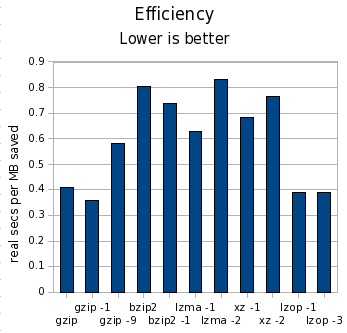
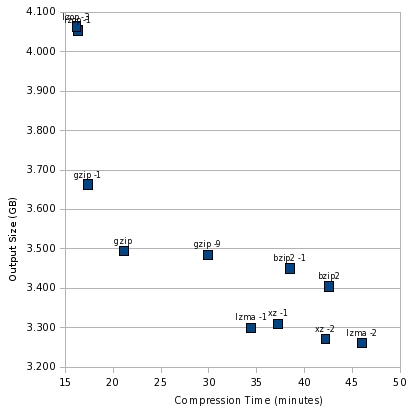
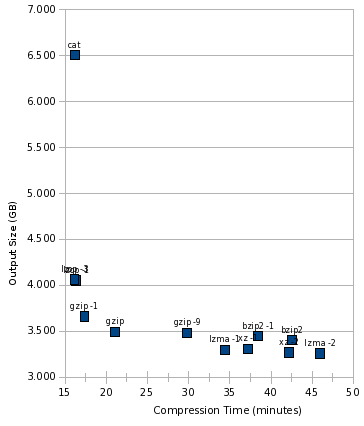
Yesterday, I posted part 1 of how to think about compression. If you haven t read it already, take a look now, so this post makes sense. Introduction In the part 1 test, I compressed a 6GB tar file with various tools. This is a good test if you are writing an entire tar file to disk, or if you are writing to tape. For part 2, I will be compressing each individual file contained in that tarball individually. This is a good test if you back up to hard disk and want quick access to your files. Quite a few tools take this approach rdiff-backup, rdup, and backuppc are among them. We can expect performance to be worse both in terms of size and speed for this test. The compressor tool will be executed once per file, instead of once for the entire group of files. This will magnify any startup costs in the tool. It will also reduce compression ratios, because the tools won t have as large a data set to draw on to look for redundancy. To add to that, we have the block size of the filesystem 4K on most Linux systems. Any file s actual disk consumption is always rounded up to the next multiple of 4K. So a 5-byte file takes up the same amount of space as a 3000-byte file. (This behavior is not unique to Linux.) If a compressor can t shrink enough space out of a file to cross at least one 4K barrier, it effectively doesn t save any disk space. On the other hand, in certain situations, saving one byte of data could free 4K of disk space. So, for the results below, I use du to calculate disk usage, which reflects the actual amount of space consumed by files on disk. The Tools Based on comments in part 1, I added tests for lzop and xz to this iteration. I attempted to test pbzip2, but it would have taken 3 days to complete, so it is not included here more on that issue below. The Numbers Let s start with the table, using the same metrics as with part 1:
Tool MB saved Space vs. gzip Time vs. gzip Cost
gzip 3081 100.00% 100.00% 0.41
gzip -1 2908 104.84% 82.34% 0.36
gzip -9 3091 99.72% 141.60% 0.58
bzip2 3173 97.44% 201.87% 0.81
bzip2 -1 3126 98.75% 182.22% 0.74
lzma -1 3280 94.44% 163.31% 0.63
lzma -2 3320 93.33% 217.94% 0.83
xz -1 3270 94.73% 176.52% 0.68
xz -2 3309 93.63% 200.05% 0.76
lzop -1 2508 116.01% 77.49% 0.39
lzop -2 2498 116.30% 76.59% 0.39
As before, in the MB saved column, higher numbers are better; in all other columns, lower numbers are better. I m using clock seconds here on a dual-core machine. The cost column is clock seconds per MB saved. Let s draw some initial conclusions: The Pretty Charts Now, let s look at an illustration of this. As before, the sweet spot is the lower left, and the worst spot is the upper right. First, let s look at the compression tools themselves: compress2-zoomed At the extremely fast, but not as good compression, end is lzop. gzip is still the balanced performer, bzip2 still looks really bad, and lzma -1 is still the best high-compression performer. Now, let s throw cat into the mix: compress2-big Here s something notable, that this graph makes crystal clear: lzop was just as fast as cat. In other words, it is likely that lzop was faster than the disk, and using lzop compression would be essentially free in terms of time consumed. And finally, look at the cost: compress2-efficiency What happened to pbzip2? I tried the parallel bzip2 implementation just like last time, but it ran extremely slow. Interestingly, pbzip2 < notes.txt > notes.txt.bz2 took 1.002 wall seconds, but pbzip2 notes.txt finished almost instantaneously. This 1-second startup time for pbzip2 was a killer, and the test would have taken more than 3 days to complete. I killed it early and omitted it from my results. Hopefully this bug can be fixed. I didn t expect pbzip2 to help much in this test, and perhaps even to see a slight degradation, but not like THAT. Conclusions As before, the difference in time was far more significant than the difference in space. By compressing files individually, we lost about 400MB (about 7%) space compared to making a tar file and then combining that. My test set contained 270,101 files. gzip continues to be a strong all-purpose contender, posting fast compression time and respectable compression ratios. lzop is a very interesting tool, running as fast as cat and yet turning in reasonable compression though 25% worse than gzip on its default settings. gzip -1 was almost as fast, though, and compressed better. If gzip weren t fast enough with -6, I d be likely to try gzip -1 before using lzop, since the gzip format is far more widely supported, and that s important to me for backups. These results still look troubling for bzip2. lzma -1 continued to turn in far better times and compression ratios that bzip2. Even bzip2 -1 couldn t match the speed of lzma -1, and compressed barely better than gzip. I think bzip2 would be hard-pressed to find a comfortable niche anywhere by now. As before, you can download my spreadsheet with all the numbers behind these charts and the table.

Next.

Previous.