Search Results: "ean"

5 March 2023

Enrico Zini: Generating MIDI events with JACK and Python

I had a go at trying to figure out how to generate arbitrary MIDI events and send them out over a JACK MIDI channel. Setting up JACK and Pipewire Pipewire has a JACK interface, which in theory means one could use JACK clients out of the box without extra setup. In practice, one need to tell JACK clients which set of libraries to use to communicate to servers, and Pipewire's JACK server is not the default choice. To tell JACK clients to use Pipewire's server, you can either: Programming with JACK Python has a JACK client library that worked flawlessly for me so far. Everything with JACK is designed around minimizing latency. Everything happens around a callback that gets called form a separate thread, and which gets a buffer to fill with events. All the heavy processing needs to happen outside the callback, and the callback is only there to do the minimal amount of work needed to shovel the data your application produced into JACK channels. Generating MIDI messages The Mido library can be used to parse and create MIDI messages and it also worked flawlessly for me so far. One needs to study a bit what kind of MIDI message one needs to generate (like "note on", "note off", "program change") and what arguments they get. It also helps to read about the General MIDI standard which defines mappings between well-known instruments and channels and instrument numbers in MIDI messages. A timed message queue To keep a queue of events that happen over time, I implemented a Delta List that indexes events by their future frame number. I called the humble container for my audio experiments pyeep and here's my delta list implementation. A JACK player The simple JACK MIDI player backend is also in pyeep. It needs to protect the delta list with a mutex since we are working across thread boundaries, but it tries to do as little work under lock as possible, to minimize the risk of locking the realtime thread for too long. The play method converts delays in seconds to frame counts, and the on_process callback moves events from the queue to the jack output. Here's an example script that plays a simple drum pattern:
#!/usr/bin/python3
# Example JACK midi event generator
#
# Play a drum pattern over JACK
import time
from pyeep.jackmidi import MidiPlayer
# See:
# https://soundprogramming.net/file-formats/general-midi-instrument-list/
# https://www.pgmusic.com/tutorial_gm.htm
DRUM_CHANNEL = 9
with MidiPlayer("pyeep drums") as player:
    beat: int = 0
    while True:
        player.play("note_on", velocity=64, note=35, channel=DRUM_CHANNEL)
        player.play("note_off", note=38, channel=DRUM_CHANNEL, delay_sec=0.5)
        if beat == 0:
            player.play("note_on", velocity=100, note=38, channel=DRUM_CHANNEL)
            player.play("note_off", note=36, channel=DRUM_CHANNEL, delay_sec=0.3)
        if beat + 1 == 2:
            player.play("note_on", velocity=100, note=42, channel=DRUM_CHANNEL)
            player.play("note_off", note=42, channel=DRUM_CHANNEL, delay_sec=0.3)
        beat = (beat + 1) % 4
        time.sleep(0.3)
Running the example I ran the jack_drums script, and of course not much happened. First I needed a MIDI synthesizer. I installed fluidsynth, and ran it on the command line with no arguments. it registered with JACK, ready to do its thing. Then I connected things together. I used qjackctl, opened the graph view, and connected the MIDI output of "pyeep drums" to the "FLUID Synth input port". fluidsynth's output was already automatically connected to the audio card and I started hearing the drums playing!

Reproducible Builds: Reproducible Builds in February 2023

Welcome to the February 2023 report from the Reproducible Builds project. As ever, if you are interested in contributing to our project, please visit the Contribute page on our website.
FOSDEM 2023 was held in Brussels on the 4th & 5th of February and featured a number of talks related to reproducibility. In particular, Akihiro Suda gave a talk titled Bit-for-bit reproducible builds with Dockerfile discussing deterministic timestamps and deterministic apt-get (original announcement). There was also an entire track of talks on Software Bill of Materials (SBOMs). SBOMs are an inventory for software with the intention of increasing the transparency of software components (the US National Telecommunications and Information Administration (NTIA) published a useful Myths vs. Facts document in 2021).
On our mailing list this month, Larry Doolittle was puzzled why the Debian verilator package was not reproducible [ ], but Chris Lamb pointed out that this was due to the use of Python s datetime.fromtimestamp over datetime.utcfromtimestamp [ ].
James Addison also was having issues with a Debian package: in this case, the alembic package. Chris Lamb was also able to identify the Sphinx documentation generator as the cause of the problem, and provided a potential patch that might fix it. This was later filed upstream [ ].
Anthony Harrison wrote to our list twice, first by introducing himself and their background and later to mention the increasing relevance of Software Bill of Materials (SBOMs):
As I am sure everyone is aware, there is a growing interest in [SBOMs] as a way of improving software security and resilience. In the last two years, the US through the Exec Order, the EU through the proposed Cyber Resilience Act (CRA) and this month the UK has issued a consultation paper looking at software security and SBOMs appear very prominently in each publication. [ ]

Tim Retout wrote a blog post discussing AlmaLinux in the context of CentOS, RHEL and supply-chain security in general [ ]:
Alma are generating and publishing Software Bill of Material (SBOM) files for every package; these are becoming a requirement for all software sold to the US federal government. What s more, they are sending these SBOMs to a third party (CodeNotary) who store them in some sort of Merkle tree system to make it difficult for people to tamper with later. This should theoretically allow end users of the distribution to verify the supply chain of the packages they have installed?

Debian

F-Droid & Android

diffoscope diffoscope is our in-depth and content-aware diff utility. Not only can it locate and diagnose reproducibility issues, it can provide human-readable diffs from many kinds of binary formats. This month, Chris Lamb released versions 235 and 236; Mattia Rizzolo later released version 237. Contributions include:
  • Chris Lamb:
    • Fix compatibility with PyPDF2 (re. issue #331) [ ][ ][ ].
    • Fix compatibility with ImageMagick version 7.1 [ ].
    • Require at least version 23.1.0 to run the Black source code tests [ ].
    • Update debian/tests/control after merging changes from others [ ].
    • Don t write test data during a test [ ].
    • Update copyright years [ ].
    • Merged a large number of changes from others.
  • Akihiro Suda edited the .gitlab-ci.yml configuration file to ensure that versioned tags are pushed to the container registry [ ].
  • Daniel Kahn Gillmor provided a way to migrate from PyPDF2 to pypdf (#1029741).
  • Efraim Flashner updated the tool metadata for isoinfo on GNU Guix [ ].
  • FC Stegerman added support for Android resources.arsc files [ ], improved a number of file-matching regular expressions [ ][ ] and added support for Android dexdump [ ]; they also fixed a test failure (#1031433) caused by Debian s black package having been updated to a newer version.
  • Mattia Rizzolo:
    • updated the release documentation [ ],
    • fixed a number of Flake8 errors [ ][ ],
    • updated the autopkgtest configuration to only install aapt and dexdump on architectures where they are available [ ], making sure that the latest diffoscope release is in a good fit for the upcoming Debian bookworm freeze.

reprotest Reprotest version 0.7.23 was uploaded to both PyPI and Debian unstable, including the following changes:
  • Holger Levsen improved a lot of documentation [ ][ ][ ], tidied the documentation as well [ ][ ], and experimented with a new --random-locale flag [ ].
  • Vagrant Cascadian adjusted reprotest to no longer randomise the build locale and use a UTF-8 supported locale instead [ ] (re. #925879, #1004950), and to also support passing --vary=locales.locale=LOCALE to specify the locale to vary [ ].
Separate to this, Vagrant Cascadian started a thread on our mailing list questioning the future development and direction of reprotest.

Upstream patches The Reproducible Builds project detects, dissects and attempts to fix as many currently-unreproducible packages as possible. We endeavour to send all of our patches upstream where appropriate. This month, we wrote a large number of such patches, including:

Testing framework The Reproducible Builds project operates a comprehensive testing framework (available at tests.reproducible-builds.org) in order to check packages and other artifacts for reproducibility. In February, the following changes were made by Holger Levsen:
  • Add three new OSUOSL nodes [ ][ ][ ] and decommission the osuosl174 node [ ].
  • Change the order of listed Debian architectures to show the 64-bit ones first [ ].
  • Reduce the frequency that the Debian package sets and dd-list HTML pages update [ ].
  • Sort Tested suite consistently (and Debian unstable first) [ ].
  • Update the Jenkins shell monitor script to only query disk statistics every 230min [ ] and improve the documentation [ ][ ].

Other development work disorderfs version 0.5.11-3 was uploaded by Holger Levsen, fixing a number of issues with the manual page [ ][ ][ ].
Bernhard M. Wiedemann published another monthly report about reproducibility within openSUSE.
If you are interested in contributing to the Reproducible Builds project, please visit the Contribute page on our website. You can get in touch with us via:

4 March 2023

Matt Brown: Retrospective: Feb 2023

February ended up being a very short work month as I made a last minute decision to travel to Adelaide for the first 2 weeks of the month to help my brother with some house renovations he was undertaking. I thought I might be able to keep up with some work and my writing goals in the evenings while I was there, but days of hard manual labour are such an unfamiliar routine for me that I didn t have any energy left to make good on that intention. The majority of my time and focus for the remaining one and half weeks of the month was catching up on the consulting work that I had pushed back while in Adelaide. So while it doesn t make for a thrilling first month to look back and report on, overall I m not unhappy with what I achieved given the time available. Next month, I hope to be able to report some more exciting progress on the product development front as well.

Monthly Scoring Rubric I m evaluating each goal using a 10 point scale based on execution velocity and risk level, rather than absolute success (which is what I will look at in the annual/mid-year review). If velocity is good and risk is low or well managed the score is high, if either the velocity is low, or risk is high then the score is low. E.g:
  • 10 - perfect execution with low-risk, on track for significantly overachieving the goal.
  • 7 - good execution with low or well managed risk, highly likely to achieve the goal.
  • 5 - execution and risk are OK, should achieve the goal if all goes well.
  • 3 - execution or risk have problems, goal is at risk.
  • 0 - stalled, with no obvious path to recovery or success.

Goals

Consulting - 6/10 Goal: Execute a series of successful consulting engagements, building a reputation for myself and leaving happy customers willing to provide testimonials that support a pipeline of future opportunities.
  • I have one active local engagement assisting a software team with migrating their application from a single to multi-region architecture.
  • Two promising international engagements which were close to starting both cancelled based on newly issued company policies freezing their staffing/outsourcing budgets due to the current economic climate.
I m happy with where this is at - I hit 90% of my target hours in February (taking into account 2 weeks off) and the feedback I m receiving is positive. The main risk is the future pipeline of engagements, particularly if the cancellations indicate a new pattern. I m not overly concerned yet, as all the opportunities to date have been from direct or referred contacts in my personal network, so there s plenty of potential to more actively solicit work to create a healthier pipeline.

Product Development - 3/10 Goal: Grow my product development skill set by taking several ideas to MVP stage with customer feedback received, and launch at least one product which generates revenue and has growth potential.
  • Accelerating electrification - I continued to keep up with industry news and added some interesting reports to my reading queue, but made no significant progress towards identifying a specific product opportunity.
  • Farm management SaaS - no activity or progress at all.
  • co2mon.nz - I put significant thought and planning into how to approach a second iteration of this product. I started writing and completed 80% of a post to communicate the revised business plan, but it s not ready for publication yet, and even if it was, the real work towards it would need to actually happen to score more points here.
I had high hopes to make at least some progress in all three areas in February, but it just didn t happen due to lack of time. The good news is that since the low score here is purely execution driven, there s no new risks or blockers that will hinder much better progress here in March.

Professional Network Development - 8/10 Goal: To build a professional relationship with at least 30 new people this year. This is off to a strong start, I made 4 brand new connections and re-established contact with 9 other existing people I d not talked to for a while. I ve found the conversations energising and challenging and I m looking forward to continuing to keep this up.

Writing - 2/10 Goal: To publish a high-quality piece of writing on this site at least once a week. Well off track as already noted. I am enjoying the writing process and I continue to find it useful in developing my thoughts and forcing me to challenge my assumptions, but coupling the writing process with the thinking/planning that is a prerequisite to get those benefits definitely makes my output a lot slower than I was expecting. The slower speed, combined with the obvious time constraints of this month are not a great doubly whammy to be starting with, but I think with some planning and preparation it should have been avoidable by having a backlog of pre-written content for use in weeks where I m on holiday or otherwise busy. It s worth noting that among all the useful feedback I received, this writing target was often called out as overly ambitious, or likely to be counterproductive to producing quality writing. The feedback makes sense - for now I m not planning to change the goal (I might at my 6-month review point), but I am going to be diligent about adhering to my quality standard, which in turn means I m choosing to accept missing a weekly post here and there and taking a lower score on the goal overall. I apologise if you ve been eagerly waiting for writing that never arrived over February!

Community - 5/10 Goal: To support the growth of my local technical community by volunteering my experience and knowledge with others through activities such as mentoring, conference talks and similar.
  • I was an invited participant of the monthly KiwiSRE meet-up which was discussing SRE team models, and in particular I was able to speak to my experiences as described in an old CRE blog post on this topic.
  • I joined the program committee for SREcon23 APAC which is scheduled for mid-June in Singapore. I also submitted two talk proposals of my own (not sharing the details for now, since the review process is intended to be blind) which I m hopeful might make the grade with my fellow PC members!

Feedback As always, I d love to hear from you if you have thoughts or feedback triggered by anything I ve written above. In particular, it would be useful to know whether you find this type of report interesting to read and/or what you d like to see added/removed or changed.

3 March 2023

Louis-Philippe V ronneau: Goodbye Bullseye report from the Montreal 2023 BSP

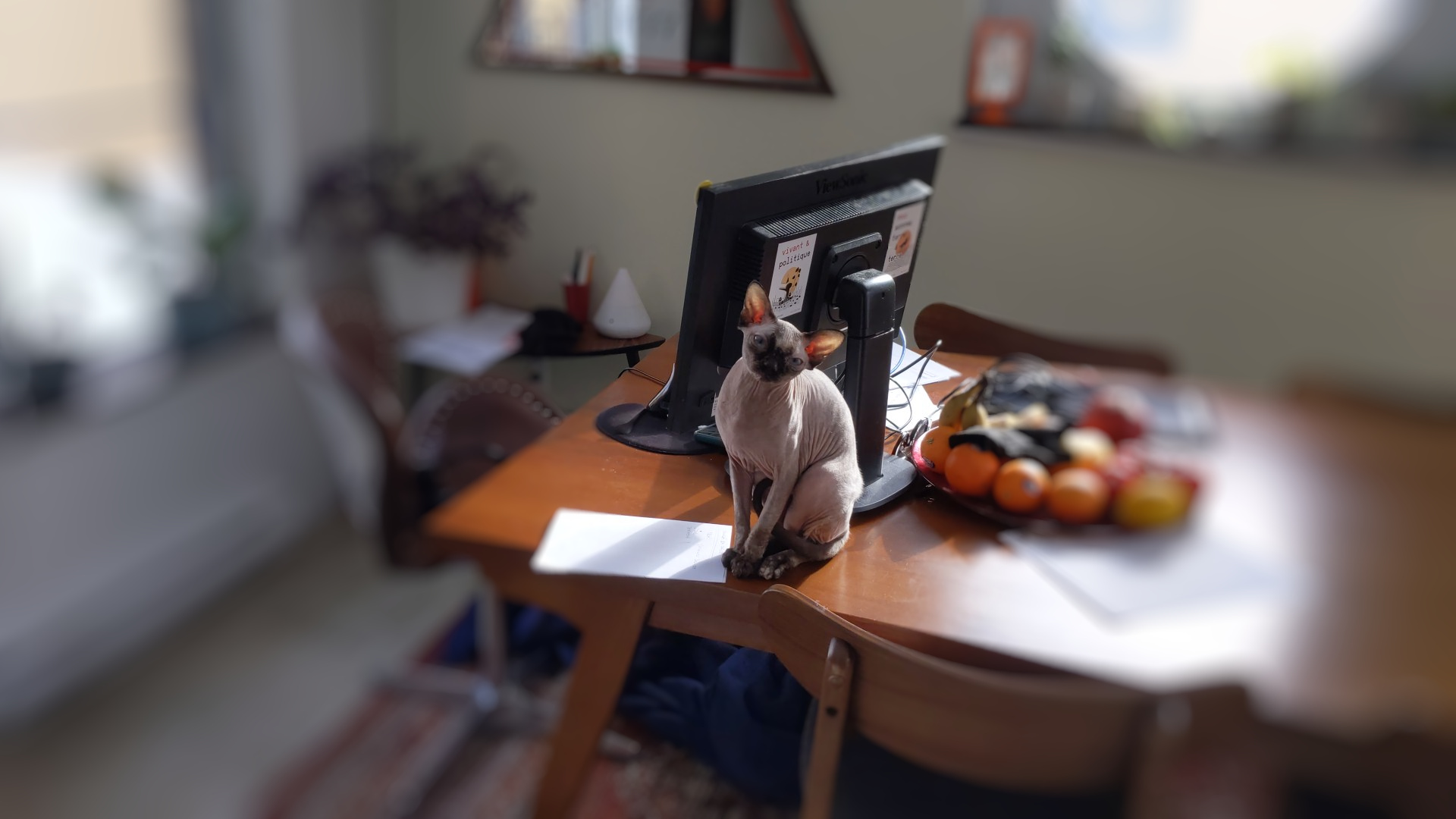
Hello World! I haven't really had time to blog here since the start of the semester, as I've been pretty busy at work1. All this to say, this report for the Bug Squashing Party we held in Montreal last weekend is a little late, sorry :) First of all, I'm pleased to announce our local community seems to be doing great and has recovered from the pandemic-induced lull. May COVID stay away from our bodies forever. This time around, a total of 9 people made it to what has become somewhat of a biennial tradition2. We worked on a grand total of 14 bugs and even managed to close some! It looks like I was too concentrated on bugs to take a picture of the event... To redeem myself, I hereby offer you a picture of a cute-but-hairless cat I met on Sunday morning: Picture of a curious sphinx cat on a table You should try to join an upcoming BSP or to organise one if you can. It's loads of fun and you'll be helping the project make the next release happen sooner! As always, thanks to Debian for granting us a budget for the food and to rent the venue. Goodbye Bullseye!

  1. Which I guess is a good thing, since it means I actually have work this semester :O
  2. See our previous BSPs in 2017, 2019 and 2021.

1 March 2023

Russ Allbery: Small book haul

I'm a bit behind on both free software maintenance and on writing reviews, what with one thing and another, but hopefully will have time to catch up next month. Meanwhile, publishing continues and books keep catching my eye. Blake Crouch (ed.) Forward (sff anthology)
Kate Elliott The Keeper's Six (sff)
Ruthanna Emrys A Half-Built Garden (sff)
R.F. Kuang Babel (sff)
Seanan McGuire The Unkindest Tide (sff)
Seanan McGuire A Killing Frost (sff)
Seanan McGuire When Sorrows Come (sff)
Seanan McGuire Be the Serpent (sff)
Terry Pratchett Thief of Time (sff)
Terry Pratchett The Last Hero (sff)
Terry Pratchett The Amazing Maurice and His Educated Rodents (sff)
Terry Pratchett Night Watch (sff)
Terry Pratchett The Wee Free Men (sff)
Terry Pratchett Monstrous Regiment (sff) I keep hearing amazing things about Babel, so it's very high on the list.

28 February 2023

Utkarsh Gupta: FOSS Activites in February 2023

Here s my (forty-first) monthly but brief update about the activities I ve done in the F/L/OSS world.

Debian
This was my 50th month of actively contributing to Debian. I became a DM in late March 2019 and a DD on Christmas 19! \o/ There s a bunch of things I do, both, technical and non-technical. Here are the things I did this month:

Uploads

Others
  • Looked up some Release team documentation.
  • Sponsored php-font-lib and php-dompdf-svg-lib for William.
  • Granted DM rights for php-dompdf.
  • Mentoring for newcomers.
  • Reviewed micro bits for Nilesh, new uploads and changes.
  • Ruby sprints.
  • Bug work (on BTS and #debian-ruby) for rails and redmine.
  • Moderation of -project mailing list.
A huge thanks to Freexian for sponsoring my Debian work and Entrouvert for sponsoring the Redmine backports. :D

Ubuntu
This was my 25th month of actively contributing to Ubuntu. Now that I joined Canonical to work on Ubuntu full-time, there s a bunch of things I do! \o/ I mostly worked on different things, I guess. I was too lazy to maintain a list of things I worked on so there s no concrete list atm. Maybe I ll get back to this section later or will start to list stuff from the fall, as I was doing before. :D

Debian (E)LTS
Debian Long Term Support (LTS) is a project to extend the lifetime of all Debian stable releases to (at least) 5 years. Debian LTS is not handled by the Debian security team, but by a separate group of volunteers and companies interested in making it a success. And Debian Extended LTS (ELTS) is its sister project, extending support to the stretch and jessie release (+2 years after LTS support). This was my forty-first month as a Debian LTS and thirty-second month as a Debian ELTS paid contributor.
I worked for 24.25 hours for LTS and 28.50 hours for ELTS.

LTS CVE Fixes and Announcements:
  • Fixed CVE-2022-47016 for tmux and uploaded to buster via 2.8-3+deb10u1.
    But decided to not roll the DLA for the package as the CVE got rejected upstream.
  • Issued DLA 3359-1, fixing CVE-2019-13038 and CVE-2021-3639, for libapache2-mod-auth-mellon.
    For Debian 10 buster, these problems have been fixed in version 0.14.2-1+deb10u1.
  • Issued DLA 3360-1, fixing CVE-2021-30151 and CVE-2022-23837, for ruby-sidekiq.
    For Debian 10 buster, these problems have been fixed in version 5.2.3+dfsg-1+deb10u1.
  • Worked on ruby-rails-html-sanitize and added notes to the security-tracker.
    TL;DR: we need newer methods in ruby-loofah to make the patches for ruby-rails-html-sanitize backportable.
  • Started to look at other set of packages meanwhile.

ELTS CVE Fixes and Announcements:
  • Issued ELA 813-1, fixing CVE-2017-12618 and CVE-2022-25147, for apr-util.
    For Debian 8 jessie, these problems have been fixed in version 1.5.4-1+deb8u1.
    For Debian 9 stretch, these problems have been fixed in version 1.5.4-3+deb9u1.
  • Issued ELA 814-1, fixing CVE-2022-39286, for jupyter-core.
    For Debian 9 stretch, these problems have been fixed in version 4.2.1-1+deb9u1.
  • Issued ELA 815-1, fixing CVE-2022-44792 and CVE-2022-44793, for net-snmp.
    For Debian 8 jessie, these problems have been fixed in version 5.7.2.1+dfsg-1+deb8u6.
    For Debian 9 stretch, these problems have been fixed in version 5.7.3+dfsg-1.7+deb9u5.
  • Helped facilitate RabbitMQ s update queries by one of our customers.
  • Started to look at other set of packages meanwhile.

Other (E)LTS Work:
Until next time.
:wq for today.

27 February 2023

Daniel Lange: Thunderbird gpg key import

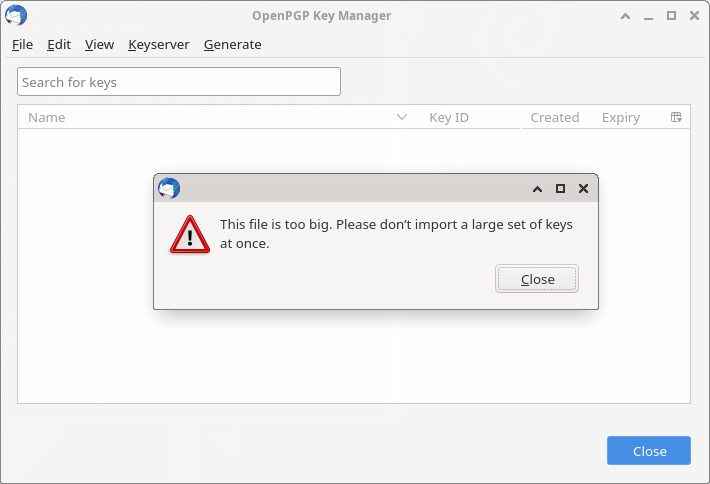
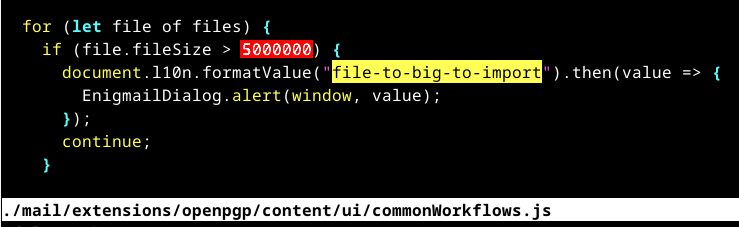
Thunderbird, srsly? 5MB (or 4.8MiB) import limit. Sure. My modest pubring (111 keys) is 18MB. The Debian keyring is 28MB. May be, just may be, add another 0 to that if statement? So, until that happens, workarounds ... Option 1: Export each pubkey into a separate file. The import dialog allows to select them all in one go. But - of course - it will ask confirmation for each. So prepare some valerian tea.
gpg --with-colons --list-public-keys grep ^pub cut -d : -f 5 xargs -I -n 1 gpg -ao .pub --export ;
Option 2: Strip all the signatures, so Thunderbird gets a smaller file to chew on. This uses pgp-clean from signing-party.
gpg --with-colons --list-public-keys grep ^pub cut -d : -f 5 xargs pgp-clean -s >> there_you_go_thunderbird.pub
Option 1 will retain the signatures on individual keys, Option 2 will not.

Daniel Lange: Getting gpg to import signatures again

The GnuPG (gpg) ecosystem has been played with a bit in 2019 by adding fake signatures en masse to well known keys. The main result is that the SKS Keyserver network based on the OCaml software of the same name is basically history. A few other keyservers have come up like Hagrid (Rust) and Hockeypuck (Go) but there seems to be no clear winner yet. In case you missed it in 2019, see my take on cleaning these polluted keys. Now the changed defaults in gpg to "mitigate" this issue are trickling down to even the conservative distributions. Debian Bullseye has self-sigs-only on gpg 2.2.27 and it looks like Debian Bookworm will get gpg 2.2.40. This would add import-clean but Daniel Kahn Gillmor patched it out. He argues correctly that this new default could delete data from good locally store pubkeys. This all ends in you getting some random combination of self-sigs-only and / or import-clean depending on which Linux distribution and version you happen to use. Better be explicit. I recommend to add:
# disable new gpg defaults
keyserver-options no-self-sigs-only
keyserver-options no-import-clean
to your ~/.gnupg/gpg.conf to make sure you can manage signatures yourself and receive them from keyservers or local imports as intended. In case you care: See info gnupg --index-search=keyserver-options for the fine documentation. Of course apt install info first to be able to read info pages. 'cause who still used them in 2023? Oh, wait...

Billy Warren: My take on IRCs - let's rest from Slack and Discord for a while.

I want to interest those that haven t used IRCs for a while through this article. This article generally leans toward the Debian Community but I hope it gives you some perspectives into IRCs and also interests you in joining the Debian Community as well. Most Generation Z developers I know have at least used slack, discord, discourse and so many other communication tools but so few have used IRCs so heavily and this could be because they find it boring and limited to what kind of content they can share and what community they are participating in. I got interested in using IRCs when I joined Debian and was able to navigate my way through using some online resources. While IRC may not be as popular as other communication tools like Slack or Discord, it remains a valuable tool for communication and collaboration within the open-source community. Its open-source nature and lightweight protocol make it a flexible and customizable tool that can be used in various settings. Internet Relay Chat (IRC) is a communication protocol that has been around since the late 1980s. Despite its age, it is still a popular tool for communication and collaboration, especially within the open-source community. It is mostly known to be used by people that work on boring projects or maintain legacy code (I can t state how true this is though). Interesting facts about IRC include that it was created by a Finnish developer named Jarkko Oikarinen, who wanted to create a communication tool that would allow him to chat with his friends in real-time (the FaceBook of those days). The first IRC network was called EFnet, and it quickly grew in popularity as more and more people began to use the protocol for communication and collaboration. IRC allows users to connect to servers and join channels (chat rooms) where they can communicate in real time with other users who have also joined the same channel. Many open-source projects use IRC channels for communication and collaboration among developers. The Debian project has a number of IRC channels that are used for communication and collaboration among developers and users. I have at least interacted with three of them which include;- To start using IRC, you will need to choose an IRC client, which is software that allows you to connect to IRC networks. Some popular IRC clients for Debian users include HexChat, irssi, and WeeChat. These clients are free and open source, and can be downloaded from the Debian repositories.Once you have chosen an IRC client, you can connect to an IRC network and start joining channels. Many open-source projects have their own IRC channels, where developers can discuss the project and collaborate in real time. One of the benefits of using IRC that I found out was that it is a lightweight protocol, which means that it can be used on a wide variety of devices, including desktop computers and smartphones. This makes it an ideal communication tool for developers who may be working on different devices and need to communicate with each other quickly and easily. IRC is still a valuable tool for communication and collaboration within the open-source community even if it is not given the same popularity as other communication tools. Like some of the good old legacy designs whose function never goes old, IRC is one of them.

25 February 2023

Gregor Herrmann: demo video: dpt(1) in pkg-perl-tools

in the Debian Perl Group we are maintaining a lot of packages (around 4000 at the time of writing). this also means that we are spending some time on improving our tools which allow us to handle this amount of packages in a reasonable time. many of the tools are shipped in the pkg-perl-tools package since 2013, & lots of them are scripts which are called as subcommands of the dpt(1) wrapper script. in the last years I got the impression that not all team members are aware of all the useful tools, & that some more promotion might be called for. & last week I was in the mood for creating a short demo video to showcase how I use some dpt(1) subcommands when updating a package to a new upstream release. (even though I prefer text over videos myself :)) probably not a cinematographic masterpiece but as the feedback of a few viewers has been positive, I'm posting it here as well: (direct link as planets ignore iframes )

24 February 2023

Dirk Eddelbuettel: ttdo 0.0.9 on CRAN: Small Update

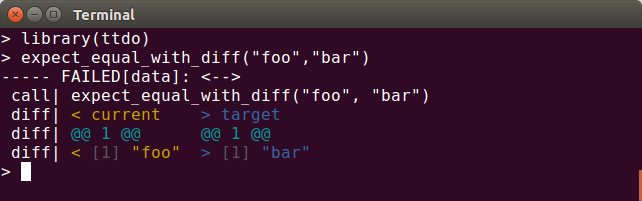
A new minor release of our ttdo package arrived on CRAN a few days ago. The ttdo package extends the excellent (and very minimal / zero depends) unit testing package tinytest by Mark van der Loo with the very clever and well-done diffobj package by Brodie Gaslam to give us test results with visual diffs (as shown in the screenshot below) which seemingly is so compelling an idea that it eventually got copied by another package which shall remain unnamed ttdo screenshot This release adds a versioned dependency on the just released tinytest version 1.4.1. As we extend tinytest (for use in the autograder we deploy within the lovely PrairieLearn framework) by consuming the tinytest code we have to update in sync. There were no other code changes in the package beside the usual maintenance of badges and continuous integration setup. As usual, the NEWS entry follows.

Changes in ttdo version 0.0.9 (2023-02-21)
  • Minor cleanup in README.md
  • Minor continuous integration update
  • Updated (versioned) depends on tinytest to 1.4.1

My CRANberries provides the usual summary of changes to the previous version. Please use the GitHub repo and its issues for any questions. If you like this or other open-source work I do, you can now sponsor me at GitHub.

This post by Dirk Eddelbuettel originated on his Thinking inside the box blog. Please report excessive re-aggregation in third-party for-profit settings.

Scarlett Gately Moore: Snowstorms, Kittens and Shattered dreams

Icy morning Witch Wells AzIcy morning Witch Wells Az
Long ago I applied for my dream job at a company I have wanted to wok for since its beginning and I wasn t ready technically. Fast forward to now, I am ready! A big thank you goes out to Blue Systems for that. So I go out and find the perfect role and start the application process. The process was months long, but was going very well, the interviews and I passed the technical with flying colors. I got to the end where the hiring lead told me he was submitting my offer I was so excited, so much so, I told my husband and parents I got the job! I know, I jinxed myself there. Soon I receive the There was a problem .. One obscure assessment called GIA came back not so good. I remember that day, we were in the middle of a long series of winter storms and I when I took the test, my kitten decided right then it was me time. I couldn t very well throw her out into the snowstorm, so I continued on the best I could. It is my fault, it clearly states to be distraction free. So I speak again to the hiring lead and we both feel with my experience and technical knowledge and abilities we can still move forward. I still had hope. After some time passes, I asked for an update and got the dreaded rejection. I am told it wasn t just the GIA, but that I am not a good overall fit for the company. In one fell swoop my dreams are dashed and final, for this and all roles within that company. I wasn t given a reason either. I am devastated, heart broken, and shocked. I get along with everyone, I exceed the technical requirements, and I work well in the community. Dream door closed. I will not let this get me down. I am moving on. I will find my place where I fit in . With that said, I no longer have the will, passion, or drive to work on snaps anymore. I will leave instructions with Jonathon as to what needs to be done to move forward. The good news is my core22 kde-neon extension was merged into upstream snapcraft, so whomever takes over will have a much easier time knocking them out. @kubuntu-council I will do whatever it takes to pay back the money for the hardware you provided me to do snaps, I am truly sorry about this. What does my future hold? I will still continue with my Debian efforts. In fact, I have ventured out from the KDE umbrella and joined the go-team. I am finalizing my packaging for https://github.com/charmbracelet/gum and it s dependencies: roff, mango, mango-kong. I had my first golang patch for a failing test and have submitted it upstream. I will upload these to experimental while the freeze is on. I will be moving all the libraries in the mycroft team to the python umbrella as they are useful for other things and mycroft is no more. During the holidays I was tinkering around with selenium UI testing and stumbled on some accessibility issues within KDE, so I think this is a good place for me to dive into for my KDE contributions. I have been approached to collaborate with OpenOS on a few things, time permitting I will see what I can do there. I have a possible gig to do some websites, while I move forward in my job hunt. I will not give up! I will find my place where I fit in . Meanwhile, I must ask for donations to get us by. Anything helps, thank you for your consideration. https://gofund.me/a9c36b87

23 February 2023

Paul Tagliamonte: Announcing hz.tools

Interested in future updates? Follow me on mastodon at @paul@soylent.green. Posts about hz.tools will be tagged #hztools.

If you're on the Fediverse, I'd very much appreciate boosts on my announcement toot!
Ever since 2019, I ve been learning about how radios work, and trying to learn about using them the hard way by writing as much of the stack as is practical (for some value of practical) myself. I wrote my first Hello World in 2018, which was a simple FM radio player, which used librtlsdr to read in an IQ stream, did some filtering, and played the real valued audio stream via pulseaudio. Over 4 years this has slowly grown through persistence, lots of questions to too many friends to thank (although I will try), and the eternal patience of my wife hearing about radios nonstop for years into a number of Go repos that can do quite a bit, and support a handful of radios. I ve resisted making the repos public not out of embarrassment or a desire to keep secrets, but rather, an attempt to keep myself free of any maintenance obligations to users so that I could freely break my own API, add and remove API surface as I saw fit. The worst case was to have this project feel like work, and I can t imagine that will happen if I feel frustrated by PRs that are getting ahead of me solving problems I didn t yet know about, or bugs I didn t understand the fix for. As my rate of changes to the most central dependencies has slowed, i ve begun to entertain the idea of publishing them. After a bit of back and forth, I ve decided it s time to make a number of them public, and to start working on them in the open, as I ve built up a bit of knowledge in the space, and I and feel confident that the repo doesn t contain overt lies. That s not to say it doesn t contain lies, but those lies are likely hidden and lurking in the dark. Beware. That being said, it shouldn t be a surprise to say I ve not published everything yet for the same reasons as above. I plan to open repos as the rate of changes slows and I understand the problems the library solves well enough or if the project dead ends and I ve stopped learning.

Intention behind hz.tools It s my sincere hope that my repos help to make Software Defined Radio (SDR) code a bit easier to understand, and serves as an understandable framework to learn with. It s a large codebase, but one that is possible to sit down and understand because, well, it was written by a single person. Frankly, I m also not productive enough in my free time in the middle of the night and on weekends and holidays to create a codebase that s too large to understand, I hope! I remain wary of this project turning into work, so my goal is to be very upfront about my boundaries, and the limits of what classes of contributions i m interested in seeing. Here s some goals of open sourcing these repos:
  • I do want this library to be used to learn with. Please go through it all and use it to learn about radios and how software can control them!
  • I am interested in bugs if there s a problem you discover. Such bugs are likely a great chance for me to fix something I ve misunderstood or typoed.
  • I am interested in PRs fixing bugs you find. I may need a bit of a back and forth to fully understand the problem if I do not understand the bug and fix yet. I hope you may have some grace if it s taking a long time.
Here s a list of some anti-goals of open sourcing these repos.
  • I do not want this library to become a critical dependency of an important project, since I do not have the time to deal with the maintenance burden. Putting me in that position is going to make me very uncomfortable.
  • I am not interested in feature requests, the features have grown as I ve hit problems, I m not interested in building or maintaining features for features sake. The API surface should be exposed enough to allow others to experiment with such things out-of-tree.
  • I m not interested in clever code replacing clear code without a very compelling reason.
  • I use GNU/Linux (specifically Debian ), and from time-to-time I ve made sure that my code runs on OpenBSD too. Platforms beyond that will likely not be supported at the expense of either of those two. I ll take fixes for bugs that fix a problem on another platform, but not damage the code to work around issues / lack of features on other platforms (like Windows).

I m not saying all this to be a jerk, I do it to make sure I can continue on my journey to learn about how radios work without my full time job becoming maintaining a radio framework single-handedly for other people to use even if it means I need to close PRs or bugs without merging it or fixing the issue. With all that out of the way, I m very happy to announce that the repos are now public under github.com/hztools.

Should you use this? Probably not. The intent here is not to provide a general purpose Go SDR framework for everyone to build on, although I am keenly aware it looks and feels like it, since that what it is to me. This is a learning project, so for any use beyond joining me in learning should use something like GNU Radio or a similar framework that has a community behind it. In fact, I suspect most contributors ought to be contributing to GNU Radio, and not this project. If I can encourage people to do so, contribute to GNU Radio! Nothing makes me happier than seeing GNU Radio continue to be the go-to, and well supported. Consider donating to GNU Radio!

hz.tools/rf - Frequency types The hz.tools/rf library contains the abstract concept of frequency, and some very basic helpers to interact with frequency ranges (such as helpers to deal with frequency ranges, or frequency range math) as well as frequencies and some very basic conversions (to meters, etc) and parsers (to parse values like 10MHz). This ensures that all the hz.tools libraries have a shared understanding of Frequencies, a standard way of representing ranges of Frequencies, and the ability to handle the IO boundary with things like CLI arguments, JSON or YAML. The git repo can be found at github.com/hztools/go-rf, and is importable as hz.tools/rf.
 // Parse a frequency using hz.tools/rf.ParseHz, and print it to stdout.
 freq := rf.MustParseHz("-10kHz")
fmt.Printf("Frequency: %s\n", freq+rf.MHz)
// Prints: 'Frequency: 990kHz'

// Return the Intersection between two RF ranges, and print
 // it to stdout.
 r1 := rf.Range rf.KHz, rf.MHz 
r2 := rf.Range rf.Hz(10), rf.KHz * 100 
fmt.Printf("Range: %s\n", r1.Intersection(r2))
// Prints: Range: 1000Hz->100kHz
These can be used to represent tons of things - ranges can be used for things like the tunable range of an SDR, the bandpass of a filter or the frequencies that correspond to a bin of an FFT, while frequencies can be used for things such as frequency offsets or the tuned center frequency.

hz.tools/sdr - SDR I/O and IQ Types This is the big one. This library represents the majority of the shared types and bindings, and is likely the most useful place to look at when learning about the IO boundary between a program and an SDR. The git repo can be found at github.com/hztools/go-sdr, and is importable as hz.tools/sdr. This library is designed to look (and in some cases, mirror) the Go io idioms so that this library feels as idiomatic as it can, so that Go builtins interact with IQ in a way that s possible to reason about, and to avoid reinventing the wheel by designing new API surface. While some of the API looks (and is even called) the same thing as a similar function in io, the implementation is usually a lot more naive, and may have unexpected sharp edges such as concurrency issues or performance problems. The following IQ types are implemented using the sdr.Samples interface. The hz.tools/sdr package contains helpers for conversion between types, and some basic manipulation of IQ streams.
IQ Format hz.tools Name Underlying Go Type
Interleaved uint8 (rtl-sdr) sdr.SamplesU8 [][2]uint8
Interleaved int8 (hackrf, uhd) sdr.SamplesI8 [][2]int8
Interleaved int16 (pluto, uhd) sdr.SamplesI16 [][2]int16
Interleaved float32 (airspy, uhd) sdr.SamplesC64 []complex64
The following SDRs have implemented drivers in-tree.
SDR Format RX/TX State
rtl u8 RX Good
HackRF i8 RX/TX Good
PlutoSDR i16 RX/TX Good
rtl kerberos u8 RX Old
uhd i16/c64/i8 RX/TX Good
airspyhf c64 RX Exp
The following major packages and subpackages exist at the time of writing:
Import What is it?
hz.tools/sdr Core IQ types, supporting types and implementations that interact with the byte boundary
hz.tools/sdr/rtl sdr.Receiver implementation using librtlsdr.
hz.tools/sdr/rtl/kerberos Helpers to enable coherent RX using the Kerberos SDR.
hz.tools/sdr/rtl/e4k Helpers to interact with the E4000 RTL-SDR dongle.
hz.tools/sdr/fft Interfaces for performing an FFT, which are implemented by other packages.
hz.tools/sdr/rtltcp sdr.Receiver implementation for rtl_tcp servers.
hz.tools/sdr/pluto sdr.Transceiver implementation for the PlutoSDR using libiio.
hz.tools/sdr/uhd sdr.Transceiver implementation for UHD radios, specifically the B210 and B200mini
hz.tools/sdr/hackrf sdr.Transceiver implementation for the HackRF using libhackrf.
hz.tools/sdr/mock Mock SDR for testing purposes.
hz.tools/sdr/airspyhf sdr.Receiver implementation for the AirspyHF+ Discovery with libairspyhf.
hz.tools/sdr/internal/simd SIMD helpers for IQ operations, written in Go ASM. This isn t the best to learn from, and it contains pure go implemtnations alongside.
hz.tools/sdr/stream Common Reader/Writer helpers that operate on IQ streams.

hz.tools/fftw - hz.tools/sdr/fft implementation The hz.tools/fftw package contains bindings to libfftw3 to implement the hz.tools/sdr/fft.Planner type to transform between the time and frequency domain. The git repo can be found at github.com/hztools/go-fftw, and is importable as hz.tools/fftw. This is the default throughout most of my codebase, although that default is only expressed at the leaf package libraries should not be hardcoding the use of this library in favor of taking an fft.Planner, unless it s used as part of testing. There are a bunch of ways to do an FFT out there, things like clFFT or a pure-go FFT implementation could be plugged in depending on what s being solved for.

hz.tools/ fm,am - analog audio demodulation and modulation The hz.tools/fm and hz.tools/am packages contain demodulators for AM analog radio, and FM analog radio. This code is a bit old, so it has a lot of room for cleanup, but it ll do a very basic demodulation of IQ to audio. The git repos can be found at github.com/hztools/go-fm and github.com/hztools/go-am, and are importable as hz.tools/fm and hz.tools/am. As a bonus, the hz.tools/fm package also contains a modulator, which has been tested on the air and with some of my handheld radios. This code is a bit old, since the hz.tools/fm code is effectively the first IQ processing code I d ever written, but it still runs and I run it from time to time.
 // Basic sketch for playing FM radio using a reader stream from
 // an SDR or other IQ stream.

bandwidth := 150*rf.KHz
reader, err = stream.ConvertReader(reader, sdr.SampleFormatC64)
if err != nil  
...
 
demod, err := fm.Demodulate(reader, fm.DemodulatorConfig 
Deviation: bandwidth / 2,
Downsample: 8, // some value here depending on sample rate
 Planner: fftw.Plan,
 )
if err != nil  
...
 
speaker, err := pulseaudio.NewWriter(pulseaudio.Config 
Format: pulseaudio.SampleFormatFloat32NE,
Rate: demod.SampleRate(),
AppName: "rf",
StreamName: "fm",
Channels: 1,
SinkName: "",
 )
if err != nil  
...
 
buf := make([]float32, 1024*64)
for  
i, err := demod.Read(buf)
if err != nil  
...
 
if i == 0  
panic("...")
 
if err := speaker.Write(buf[:i]); err != nil  
...


hz.tools/rfcap - byte serialization for IQ data The hz.tools/rfcap package is the reference implementation of the rfcap spec , and is how I store IQ captures locally, and how I send them across a byte boundary. The git repo can be found at github.com/hztools/go-rfcap, and is importable as hz.tools/rfcap. If you re interested in storing IQ in a way others can use, the better approach is to use SigMF rfcap exists for cases like using UNIX pipes to move IQ around, through APIs, or when I send IQ data through an OS socket, to ensure the sample format (and other metadata) is communicated with it. rfcap has a number of limitations, for instance, it can not express a change in frequency or sample rate during the capture, since the header is fixed at the beginning of the file.

21 February 2023

Billy Warren: A straight Guide to Salsa CI - A Debian Continuous Integration tool

I won t waste your time with introductions. The title says it all so let s jump right in. I ll give you as many links as possible so that this article stays as short as possible. So first, what is Salsa? Salsa is a name of a GitLab instance that is used by Debian teams to manage Debian packages and also collaborate on Development. If you have used GitLab before, the Salsa platform is not any different. To have a feel of it, it is available at https://salsa.debian.org. Still, want to know more? Find more information in the wiki. Intrigued to a point of getting started? Setup up your account by following this information Secondly, what is Salsa CI? Like many large projects with different contributors and strict maintenance, Debian is no different. This Linux distribution is made up of many packages which need to follow a certain standard and structure or purpose of compatibility, scalability and maintainability. The Salsa CI is a continuous integration tool that does just that. I hope that is precise and satisfying . I would have ended here but since our focus is Salsa CI tool, let me get a little deeper and wider. You could also make great use of your time when I provide more information. The Salsa CI was developed to continuously check for the health of Debian packages before they can be uploaded to the archive by running a series of CI/CD jobs. The jobs are run against setup images that are already uploaded and updated regularly to reduce build time. A screenshot showing the Salsa Ci jobs. The use of Salsa CI is becoming prominent ever since its inception. The Salsa CI pipeline has become popular (used by ~8k projects, from MariaDB to the Linux kernel packaging), and it is even the base for more complex CI pipelines used by other Linux flavours. The issue is the more popular it becomes, the more efficient it has to get and the more need to make the build time as shorter as possible. This happens by iterating and testing out different tools during different stages of the pipeline to find the best industrial tool. This is one of the priorities for anyone who develops for or maintains Salsa CI. So that is how deep I can go for now. But wait, what if you what to contribute?
If you have working knowledge in bash, git, CI, python and knowledge in building Debian packages it could be easy for you to figure out where components are and how they interact with each other. What if you don t have the knowledge? Then that is where the fun comes in. Getting started on making a meaningful contribution to Salsa CI will need more passion and discipline, the expertise comes later and slowly. I have contributed to Salsa CI even without high-level expertise and knowledge in some of the tools. When I started contributing to Salsa CI what a Debian package is, I even didn t know that the tool that I am trying to navigate is being used by prominent software teams. But it is the challenge that I set for myself that as of now, enabled me to be able to work on a crucial part of the whole Continous integration. Wanna know what it is? I am, as at the time of writing this article, integrating sbuild into Salsa CI to replace it with dpkg-buildpackage. This in turn will help to reduce the build time by getting rid of some jobs hence making the CI work faster. Cool, right? Contributing to such a significant project can be a little challenging at the start but when you realize how important the piece you are working on is, you suddenly fall in love with it and want to follow through so that you can also be part of the large community that helps to make this world a better place in obscure ways. So why don t you check out some of the Salsa CI open issues and see if you d be interested in improving it?

Freexian Collaborators: Monthly report about Debian Long Term Support, January 2023 (by Anton Gladky)

Like each month, have a look at the work funded by Freexian s Debian LTS offering. This is the first monthly report in 2023.

Debian LTS contributors In January, 17 contributors have been paid to work on Debian LTS. which is possibly the highest number of active contributors per month! Their reports are available:
  • Abhijith PA did 0.0h (out of 3.0h assigned and 11.0h from previous period), thus carrying over 14.0h to the next month.
  • Adrian Bunk did 26.25h (out of 26.25h assigned).
  • Anton Gladky did 11.5h (out of 8.0h assigned and 7.0h from previous period), thus carrying over 3.5h to the next month.
  • Ben Hutchings did 8.0h (out of 24.0h assigned), thus carrying over 16.0h to the next month.
  • Chris Lamb did 18.0h (out of 18.0h assigned).
  • Emilio Pozuelo Monfort did 8.0h (out of 0h assigned and 43.0h from previous period), thus carrying over 35.0h to the next month.
  • Guilhem Moulin did 20.0h (out of 17.5h assigned and 2.5h from previous period).
  • Helmut Grohne did 10.0h (out of 15.0h assigned), thus carrying over 5.0h to the next month.
  • Lee Garrett did 7.5h (out of 20.0h assigned), thus carrying over 12.5h to the next month.
  • Markus Koschany did 26.25h (out of 26.25h assigned).
  • Ola Lundqvist did 4.5h (out of 10.0h assigned and 6.0h from previous period), thus carrying over 11.5h to the next month.
  • Roberto C. S nchez did 3.75h (out of 18.75h assigned and 7.5h from previous period), thus carrying over 22.5h to the next month.
  • Stefano Rivera did 4.5h (out of 0h assigned and 32.5h from previous period), thus carrying over 28.0h to the next month.
  • Sylvain Beucler did 23.5h (out of 0h assigned and 38.5h from previous period), thus carrying over 15.0h to the next month.
  • Thorsten Alteholz did 14.0h (out of 10.0h assigned and 4.0h from previous period).
  • Tobias Frost did 19.0h (out of 19.0h assigned).
  • Utkarsh Gupta did 43.25h (out of 26.25h assigned and 17.0h from previous period).

Evolution of the situation Furthermore, we released 46 DLAs in January, which resolved 146 CVEs. We are working diligently to reduce the number of packages listed in dla-needed.txt, and currently, we have 55 packages listed. We are constantly growing and seeking new contributors. If you are a Debian Developer and want to join the LTS team, please contact us.

Thanks to our sponsors Sponsors that joined recently are in bold.

17 February 2023

Jonathan McDowell: First impressions of the VisionFive 2

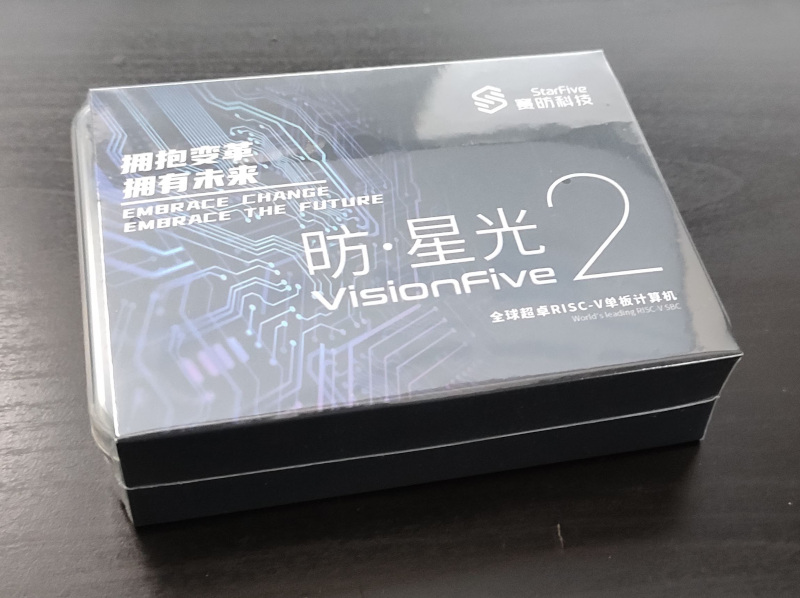
VisionFive 2 packaging Back in September last year I chose to back the StarFive VisionFive 2 on Kickstarter. I don t have a particular use in mind for it, but I felt it was one of the first RISC-V systems that were relatively capable (mentally I have it as somewhere between a Raspberry Pi 3 + a Pi 4). In particular it s a quad 1.5GHz 64-bit RISC-V core with 8G RAM, USB3, GigE ethernet and a single M.2 PCIe slot. More than ample as a personal machine for playing around with RISC-V and doing local builds. I ended up paying 67 for the Early Bird variant (dual GigE ethernet rather than 1 x 100Mb and 1 x GigE). A couple of weeks ago I got an email with a tracking number and last week it finally turned up. Being impatient the first thing I did was plug it into a monitor, connect up a keyboard, and power it on. Nothing except some flashing lights. Looking at the boot selector DIP switches suggested it was configured to boot from UART, so I flipped them to (what I thought was) the flash setting. It wasn t - turns out the ON marking on the switches represents logic 0 and it was correctly setup when I got it. I went to read the documentation which talked about writing an image to a MicroSD card, but also had details of the UART connection. Wanting to make sure the device was at least doing something before I actually tried an OS on it I hooked up a USB/serial dongle and powered the board up again. Success! U-Boot appeared and I could interact with it. I went to the VisionFive2 Debian page and proceeded to torrent the Image-69 image, writing it to a MicroSD card and inserting it in the slot on the bottom of the board. It booted fine. I can t even tell you what graphical environment it booted up because I don t remember; it worked fine though (at 1080p, I ve seen reports that 4K screens will make it croak). Poking around the image revealed that it s built off a snapshot.debian.org snapshot from 20220616T194833Z, which is a little dated at this point but I understand the rationale behind picking something that works and sticking with it. The kernel is of course a vendor special, based on 5.15.0. Further investigation revealed that the entire X/graphics stack is living in /usr/local, which isn t overly surprising; it s Imagination based. I was pleasantly surprised to discover there is work to upstream the Imagination support, but I m not planning to run the board with a monitor attached so it s not a high priority for me. Having discovered all that I decided to see how well a clean Debian unstable install from Debian Ports would go. I had a spare Intel Optane lying around (it s a stupid 22110 M.2 which is too long for any machine I own), so I put it in the slot on the bottom of the board. To my surprise it Just Worked and was detected ok:
# lspci
0000:00:00.0 PCI bridge: PLDA XpressRich-AXI Ref Design (rev 02)
0000:01:00.0 USB controller: VIA Technologies, Inc. VL805/806 xHCI USB 3.0 Controller (rev 01)
0001:00:00.0 PCI bridge: PLDA XpressRich-AXI Ref Design (rev 02)
0001:01:00.0 Non-Volatile memory controller: Intel Corporation NVMe Datacenter SSD [Optane]
I created a single partition with an ext4 filesystem (initially tried btrfs, but the StarFive kernel doesn t support it), and kicked off a debootstrap with:
# mkfs -t ext4 /dev/nvme0n1p1
# mount /dev/nvme0n1p1 /mnt
# debootstrap --keyring=/etc/apt/trusted.gpg.d/debian-ports-archive-2023.gpg \
	unstable /mnt https://deb.debian.org/debian-ports
The u-boot setup has a convoluted set of vendor scripts that eventually ends up reading a /boot/extlinux/extlinux.conf config from /dev/mmcblk1p2, so I added an additional entry there using the StarFive kernel but pointing to the NVMe device for /. Made sure to set a root password (not that I ve been bitten by that before, too many times), and rebooted. Success! Well. Sort of. I hit a bunch of problems with having a getty running on ttyS0 as well as one running on hvc0. The second turns out to be a console device from the RISC-V SBI. I did a systemctl mask serial-getty@hvc0.service which made things a bit happier, but I was still seeing odd behaviour and output. Turned out I needed to reboot the initramfs as well; the StarFive one was using Plymouth and doing some other stuff that seemed to be confusing matters. An update-initramfs -k 5.15.0-starfive -c built me a new one and everything was happy. Next problem; the StarFive kernel doesn t have IPv6 support. StarFive are good citizens and make their 5.15 kernel tree available, so I grabbed it, fed it the existing config, and tweaked some options (including adding IPV6 and SECCOMP, which chrony wanted). Slight hiccup when it turned out trying to do things like make sound modular caused it to fail to compile, and having to backport the fix that allowed the use of GCC 12 (as present in sid), but it got there. So I got cocky and tried to update it to the latest 5.15.94. A few manual merge fixups (which I may or may not have got right, but it compiles and boots for me), and success. Timings:
$ time make -j 4 bindeb-pkg
  [linux-image-5.15.94-00787-g1fbe8ac32aa8]
real	37m0.134s
user	117m27.392s
sys	6m49.804s
On the subject of kernels I am pleased to note that there are efforts to upstream the VisionFive 2 support, with what appears to be multiple members of StarFive engaging in multiple patch submission rounds. It s really great to see this and I look forward to being able to run an unmodified mainline kernel on my board. Niggles? I have a few. The provided u-boot doesn t have NVMe support enabled, so at present I need to keep a MicroSD card to boot off, even though root is on an SSD. I m also seeing some errors in dmesg from the SSD:
[155933.434038] nvme nvme0: I/O 436 QID 4 timeout, completion polled
[156173.351166] nvme nvme0: I/O 48 QID 3 timeout, completion polled
[156346.228993] nvme nvme0: I/O 108 QID 3 timeout, completion polled
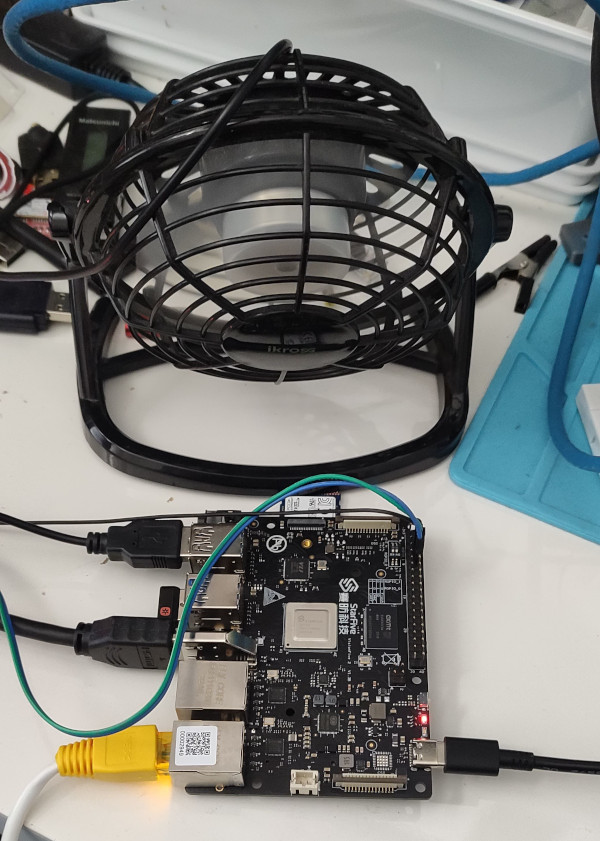
It doesn t seem to cause any actual issues, and it could be the SSD, the 5.15 kernel or an actual hardware thing - I ll keep an eye on it (I will probably end up with a different SSD that actually fits, so that ll provide another data point). More annoying is the temperature the CPU seems to run at. There s no heatsink or fan, just the metal heatspreader on top of the CPU, and in normal idle operation it sits at around 60 C. Compiling a kernel it hit 90 C before I stopped the job and sorted out some additional cooling in the form of a desk fan, which kept it as just over 30 C. Bare VisionFive 2 SBC board with a small desk fan pointed at it I haven t seen any actual stability problems, but I wouldn t want to run for any length of time like that. I ve ordered a heatsink and also realised that the board supports a Raspberry Pi style PoE Hat , so I ve got one of those that includes a fan ordered (I am a complete convert to PoE especially for small systems like this). With the desk fan setup I ve been able to run the board for extended periods under load (I did a full recompile of the Debian 6.1.12-1 kernel package and it took about 10 hours). The M.2 slot is unfortunately only a single PCIe v2 lane, and my testing topped out at about 180MB/s. IIRC that is about half what the slot should be capable of, and less than a 10th of what the SSD can do. Ethernet testing with iPerf3 sustained about 941Mb/s, so basically maxing out the port. The board as a whole isn t going to set any speed records, but it s perfectly usable, and pretty impressive for the price point. On the Debian side I ve not hit any surprises. There s work going on to move RISC-V to a proper release architecture, and I m hoping to be able to help out with that, but the version of unstable I installed from the ports infrastructure has looked just like any other Debian install. Which is what you want. And that pretty much sums up my overall experience of the VisionFive 2; it s not noticeably different than any other single board computer. That s a good thing, FWIW, and once the kernel support lands properly upstream (it ll be post 6.3 at least it seems) it ll be a boring mainline supported platform that just happens to be RISC-V.

16 February 2023

Gunnar Wolf: We are GREAT at handling multimedia!

I have mentioned several times in this blog, as well as by other communication means, that I am very happy with the laptop I bought (used) about a year and a half ago: an ARM-based Lenovo Yoga C630. Yes, I knew from the very beginning that using this laptop would pose a challenge to me in many ways, as full hardware support for ARM laptops are nowhere as easy as for plain boring x86 systems. But the advantages far outweigh the inconvenience (i.e. the hoops I had to jump through to handle video-out when I started teaching presentially, which are fortunately a thing of the past now). Anyway This post is not about my laptop. Back in 2018, I was honored to be appointed as a member of the Debian Technical Committee. Of course, that meant (due to the very clear and clever point 6.2.7.1 of the Debian Constitution that my tenure in the Committee (as well as Niko Tyni s) finished in January 1, 2023. We were invited to take part of a Jitsi call as a last meeting, as well as to welcome Matthew Garrett to the Committee. Of course, I arranged so I would be calling from my desktop system at work (for which I have an old, terrible webcam but as long as I don t need to control screen sharing too finely, mostly works). Out of eight people in the call, two had complete or quite crippling failures with their multimedia setup, and one had a frozen image (at least as far as I could tell). So Yes, Debian is indeed good and easy and simple and reliable for most nontechnical users using standard tools. But I guess that we power users enjoy tweaking our setup to our precise particular liking. Or that we just don t care about frivolities such as having a working multimedia setup. Or I don t know what happens. But the fact that close to half of the Technical Committee, which should consist of Debian Developers who know their way around technical obstacles, cannot get a working multimedia setup for a simple, easy WebRTC call (even after a pandemic that made us all work via teleconferencing solutions on a daily basis!) is just Beautiful

15 February 2023

Lukas M rdian: Netplan v0.106 is now available

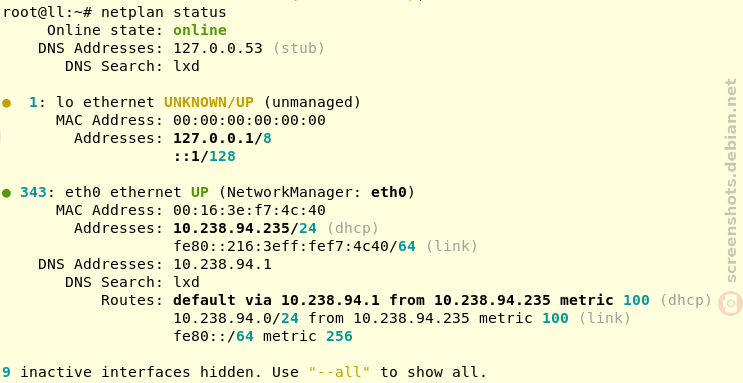
I m happy to announce that Netplan version 0.106 is now available on GitHub and is soon to be deployed into an Ubuntu/Debian/Fedora installation near you! Six months and 65 commits after the previous version, this release is brought to you by 4 free software contributors from around the globe. Highlights Highlights of this release include the new netplan status command, which queries your system for IP addresses, routes, DNS information, etc in addition to the Netplan backend renderer (NetworkManager/networkd) in use and the relevant Netplan YAML configuration ID. It displays all this in a nicely formatted way (or alternatively in machine readable YAML/JSON format).
Furthermore, we implemented a clean libnetplan API which can be used by external tools to parse Netplan configuration, migrated away from non-inclusive language (PR#303) and improved the overall Netplan documentation. Another change that should be noted, is that the match.macaddress stanza now only matches on PermanentMACAddress= on the systemd-networkd backend, as has been the case on the NetworkManager backend ever since (see PR#278 for background information on this slight change in behavior). Changelog Bug fixes:

Valhalla's Things: My experience with a PinePhone

Posted on February 15, 2023
I ve had and used1 a PinePhone for quite some time now, and a shiny new blog sounds like a good time to do a review of my experience. TL;DL: I love it, but my use cases may not be very typical. While I ve had a mobile phone since an early time (my parents made me carry one for emergencies before it was usual for my peers) I ve never used a typical smartphone (android / iPhone / those other proprietary things) because I can t trust them not to be designed to work against me (data collection, ads, tricking users into micro payments, and other antipatterns of proprietary software design), and bringing them to sanity as most of the people I know do is too much effort for my tastes. Instead, as a phone I keep using an old nokia featurephone2 which is reliable, only requires charging once a week, and can easily survive falling from hand height to the ground, even if thrown 3. And then I ve been carrying a variety of other devices to do other computer-like tasks; earlier it was just a laptop, or a netbook, a Pandora (all of which used a dongle to connect to mobile network internet) then I tried a phone with FirefoxOS (it could have been better) and now the PinePhone has taken their place, at least when I m not carrying a laptop anyway. So, the tasks I use the PinePhone for are mostly:
  1. sending and receiving xmpp messages, with no need for notifications (when somebody needs to tell me something where urgency is required, they know to use the other phone, either with a call or an sms);
  2. tethering an internet connection to the laptop;
  3. reading djvu scans of old books while standing in a queue or something;
  4. checking something on the internet when I m not close to a real computer (i.e. one with a keyboard and a big screen);
  5. running a timer while heat-setting fabric paint with an iron (and reading a djvu book at the same time yes, this is a very specific task, but it has happened multiple times already :D );
  6. running a calculator with unit conversions;
  7. running the odd command line program;
  8. taking pictures, especially those that I want to send soon (I often also carry a DSLR camera, but I tend to wait a few days before I download them from the card);
  9. map related things.
3 and 5 work perfectly well, no issues there. 1, 2 and 4 usually work just fine, except for the fact that sometimes while the phone is suspended it forgets about being a phone, and needs to be restarted to turn the modem back on. It s not a big deal while using the phone, I just need to check before I try to use it after a few hours. For 1, I also had to take care to install dino-im from experimental, as up to now the features required to fit the interface in a mobile screen aren t available in the official release, but I believe that this has just been fixed. Somewhat related to 4, I ve also installed kiwix and the dumps of wiktionary and wikivoyage, but I haven t had a chance to travel much, so I m not really using it. For 6 I m quite happy with qalculate, the GUI version of qalc (which is what I use on my laptop), even if it has a few minor interface issues, and 7 of course works as well as it can, given the limitations of a small screen and virtual keyboard. 8 is, let us say, problematic. The camera on the PinePhone is peculiar, only works with a specific software, and even there the quality of the pictures is, well, low-fi, vintagey pictures are a look and that s a specific artistic choice, right? Thanks to the hard work of the megapixels maintainer the quality has improved a lot, and these days it is usable, but there are still limits (no webcam in the browser, no recording of videos). 9 is really bad. A few times I can remember getting a GPS fix. A few times in many months, and now and then I keep trying, to see if a miracle has happened, but usually I only get a vague position from wifi data (which isn t great, when walking through less densely populated areas). I ve seen another PinePhone running gpsd and getting data from an external GPS receiver via bluetooth, and if I really needed it I may seriously consider that solution. Also, the apps available in mobian aren t great either, even when compared to running tangogps on an OpenMoko with pre-downloaded maps (I mean! I don t think my expectations are too high!). I ve heard that PureMaps is quite good as a software, but a bit of a PITA to package for Debian, and I really hope that one day there will be a linux-first mobile device with good GPS hardware, so that people will be encouraged to fix the software side. Thankfully, I don t usually need GPS and navigation software; when I m driving into places I don t know I usually have a human navigator, and when walking into places I can do with just a static map (either printed on paper or on the PinePhone), maybe some pre-calculated route from the OSM website and looking at street names to find out where I am. Overall, for my use cases the PinePhone works just fine and is an useful addition to the things I always carry with me, and I don t feel the pressing need to get an android phone. I don t think it s ready as a daily driver for everybody, but I think that depending on one s needs it s worth asking around (I d recommend doing so on the fediverse with a #PinePhone and #mobian hashtag), as there is a non-zero chance that it may be a good fit for you.

  1. which, if I m not mistaken, is often not implied by the fact of owning it :D
  2. for very low values of feature: it doesn t have any kind of internet access, and there are only 3 games, one of which is snake.
  3. don t ask.

14 February 2023

Holger Levsen: 20230214-i-love-osuosl

I love free software and I OSUOSL So in December 2018 I was approached somewhat out of the blue by someone from OSUOSL who offered eight servers to the Reproducible Builds project and as these machines had 32 cores and 144 GB Ram each (plus 3 TB on a single HDD) and they also offered free hosting, I very happyly said yes. And since them I'm a very happy Oregon State University Open Source Labs user, and these days we're switching the setup to different machines, which is another story to tell some other time...! ;-) My point now is: since 2018 I got to know OSUOSL and every year I like them more. They are super friendly, reliable (a working ticket system and a great IRC channel), offer help in various ways, be it with DNS names (and renamings...) or finding new hardware suited to our needs or whatever else we come up with. They are really dedicated to help free software projects and I'm grateful having the privilege to enjoy this since more than four years now. To quote https://osuosl.org/: "The Open Source Lab is a nonprofit organization working for the advancement of open source technologies. The lab, in partnership with the School of Electrical Engineering and Computer Science at Oregon State University, provides hosting for more than 160 projects, including those of worldwide leaders like the Apache Software Foundation, the Linux Foundation and Drupal. Together, the OSL s hosted sites deliver nearly 430 terabytes of information to people around the world every month. The most active organization of its kind, the OSL offers world-class hosting services, professional software development and on-the-ground training for promising students interested in open source management and programming." So, IOW, I'm just seeing a very tiny tip of the iceberg of their awesome work. Check out https://osuosl.org/communities/ to see what I mean with very tiny tip. Search for "Debian" and "Reproducible" on that page :) Thank you, everybody at OSUOSL! You rock and make a big difference for many projects!

Next.

Previous.