Search Results: "beh"

29 August 2016

Joey Hess: hiking the Roan

Three moments from earlier this week.. Sprawled under a tree after three hours of hiking with a heavy, water-filled pack, I look past my feet at six ranges of mountains behind mountains behind flowers. From my campsite, I can see the rest of the path of the Appalachian Trail across the Roan balds, to Big Hump mountain. It seems close enough to touch, but not this trip. Good to have a goal. Near sunset, land and sky merge as the mist moves in.

28 August 2016

Reproducible builds folks: Reproducible builds: week 70 in Stretch cycle

What happened in the Reproducible Builds effort between Sunday August 21 and Saturday August 27 2016: GSoC and Outreachy updates Packages reviewed and fixed, and bugs filed Reviews of unreproducible packages 10 package reviews have been added and 6 have been updated this week, adding to our knowledge about identified issues. A large number of issue types have been updated: Weekly QA work 29 FTBFS bugs have been reported by: diffoscope development Holger also created another test job for diffoscope on jenkins.debian.net, so that now also all commits to branches other than master are being tested. strip-nondeterminism development strip-nondeterminism 0.023-1 was uploaded by Chris Lamb:
 * Support Android .apk files with the JAR normalizer.
 * handlers/png.pm: Drop unused Archive::Zip import
 * Remove hyphen from non-determinism and non-deterministic.
 * javaproperties.pm: Match more styles of .properties and loosen filename matching.
 * Improve tests:
   - Make fixture runner generic to all normalizer types.
   - Replace (single) pearregistry test with a fixture.
   - Set a canonical time for fixture tests.
   - Add gzip testcase fixture.
   - Replace t/javadoc.t with fixture
   - Replace t/ar.t with a fixture.
   - t/javaproperties: move pom.properties and version.properties tests to fixtures
   - t/fixtures.t: move to using subtests
   - t/fixtures.t: Explicitly test that we can find a normalizer
   - t/fixtures.t: Don't run normalizer if we didn't find one.
strip-nondeterminism 0.023-2 uploaded by Mattia Rizzolo to allow stderr in autopkgtest. disorderfs development tests.reproducible-builds.org Debian: Somewhat related to reproducible builds there has been a first Debian jenkins team maintainance meeting on the #debian-qa IRC channel, to discuss current issues with the setup and to start the work of migrating jenkins.debian.net to jenkins.debian.org. The next meeting will take place on September 28th 2016 at 19 UTC. Misc. This week's edition was written by Chris Lamb and Holger Levsen and reviewed by a bunch of Reproducible Builds folks on IRC.

26 August 2016

Norbert Preining: ESSLLI 2016 Course: Algebraic Specification and Verification with CafeOBJ

During this year s ESSLLI (European Summer School in Logic, Language and Information) I was teaching a course on Algebraic Specification and Verification with CafeOBJ. Now that the course is over I can relax a bit and enjoy the beauty of the surrounding North Tyrol.
ESSLLI-2016-logo-darkblue-small For those who couldn t attend the ESSLLI or the course, here are the course materials: Thanks to the participants for the interesting questions and participation. What follows is the original description of the course. Abstract Ensuring correctness of complex systems like computer programs or communication protocols is gaining ever increasing importance. For correctness it does not suffice to consider the finished system, but correctness already on the level of specification is necessary, that is, before the actual implementation starts. To this aim, algebraic specification and verification languages have been conceived. They are aiming at a mathematically correct description of the properties and behavior of the systems under discussion, and in addition often allow to prove (verify) correctness within the same system. This course will give an introduction to algebraic specification, its history, logic roots, and actuality with respect to current developments. Paired with the theoretical background we give an introduction to CafeOBJ, a programming language that allows both specification and verification to be carried out together. The course should enable students to understand the theoretical background of algebraic specification, as well as enable them to read and write basic specifications in CafeOBJ. Description CafeOBJ is a specification language based on three-way extensions to many-sorted equational logic: the underlying logic is order-sorted, not just many-sorted; it admits unidirectional transitions, as well as equations; it also accommodates hidden sorts, on top of ordinary, visible sorts. A subset of CafeOBJ is executable, where the operational semantics is given by a conditional order-sorted term rewriting system. The language system CafeOBJ has been under constant development at the institute of the lecturers since the late 80ies. It is closely related to other algebraic specification languages in the OBJ family, including Maude. The CafeOBJ language and the range of verification methods and tools it supports including its support for inductive theorem proving, verification of behavioral specifications, deductive invariant proof, and reachability analysis of concurrent systems has played a key role in both extending and bringing algebraic specification techniques into contact with many software engineering applications. The following topics will be discussed: To make the lectures not too heavy , we will structure each lecture into two parts: A first part providing an introduction of some theoretical concept, or framework, and a second part dealing with actual programming and implementation. Especially for the second part of each lecture students are encouraged to use their laptops to try out code and experiment.

24 August 2016

Zlatan Todori : Take that boredom

While I was bored on Defcon, I took the smallest VPS in DO offering (512MB RAM, 20GB disk), configured nginx on it, bought domain zlatan.tech and cp'ed my blog data to blog.zlatan.tech. I thought it will just be out of boredom and tear it apart in a day or two but it is still there. Not only that, the droplet came with Debian 8.5 but I just added unstable and experimental to it and upgraded. Just to experiment and see what time will I need to break it. To make it even more adventurous (and also force me to not take it too much serious, at least at this point) I did something on what Lars would scream - I did not enable backups! While having fun with it I added letsencrypt certificate to it (wow, that was quite easy). Then I installed and configured Tor. Ende up adding an .onion domain for it! It is: pvgbzphm622hv4bo.onion My main blog is still going to be zgrimshell.github.io (for now at least) where I push my Nikola (static site generator written in python) generated content as git commits. To my other two domains (on my server) I just rsync the content now. Simple and efficient. I must admit I like my blog layout. It is simple, easy to read, efficient and fast, I don't bother with comments and writing a blog in markdown (inside terminal as all good behaving hacker citizen) while compiling it with Nikola is breeze (and yes, I did choose Nikola because of Nikola Tesla and python). Also I must admit that nginx is pretty nice webserver, no need to explain the beauty of git but I can't recommend enough of rsync. If anyone is interested in doing the same I am happy to talk about it but these tools are really simple (as I enjoy simple things and by simple I mean small tools, no complicated configs and easy execution).

22 August 2016

Satyam Zode: Google Summer of Code 2016 : Final Report

Project Title : Improving diffoscope tool and reproducibility of Debian packages Project details This project aims to improve diffoscope tool and fix Debian packages which are unreproducible in Reproducible builds testing framework. diffoscope recursively unpack archives of many kinds and transform various binary formats into more human readable form to compare them. As a part of this project I worked on argument completion feature and ignoring .buildinfo feature. This project is a part of Reproducible Builds effort Mentor and Co-Mentor Project Discussion Project Implementation Challenges and Work Left Future work Acknowledgement I would like to express my deepest gratitude to Lunar for mentoring me throughout Google Summer of Code program and for being cool. Lunar s deep knowledge regarding diffoscope and Python skills helped me a lot throughout the project and we literally had great discussions. I would also like to thank Debaian community and Google for giving me this opportunity. Special thanks to Reproducible Builds folks for all the guidance!

Vincent Sanders: Down the rabbit hole

My descent began with a user reporting a bug and I fear I am still on my way down.

Like Alice I headed down the hole. https://commons.wikimedia.org/wiki/File:Rabbit_burrow_entrance.jpg
The bug was simple enough, a windows bitmap file caused NetSurf to crash. Pretty quickly this was tracked down to the libnsbmp library attempting to decode the file. As to why we have a heavily used library for bitmaps? I am afraid they are part of every icon file and many websites still have favicons using that format.

Some time with a hex editor and the file format specification soon showed that the image in question was malformed and had a bad offset header entry. So I was faced with two issues, firstly that the decoder crashed when presented with badly encoded data and secondly that it failed to deal with incorrect header data.

This is typical of bug reports from real users, the obvious issues have already been encountered by the developers and unit tests formed to prevent them, what remains is harder to produce. After a debugging session with Valgrind and electric fence I discovered the crash was actually caused by running off the front of an allocated block due to an incorrect bounds check. Fixing the bounds check was simple enough as was working round the bad header value and after adding a unit test for the issue I almost moved on.

Almost...

american fuzzy lop are almost as cute as cats https://commons.wikimedia.org/wiki/File:Rabbit_american_fuzzy_lop_buck_white.jpg
We already used the bitmap test suite of images to check the library decode which was giving us a good 75% or so line coverage (I long ago added coverage testing to our CI system) but I wondered if there was a test set that might increase the coverage and perhaps exercise some more of the bounds checking code. A bit of searching turned up the american fuzzy lop (AFL) projects synthetic corpora of bmp and ico images.

After checking with the AFL authors that the images were usable in our project I added them to our test corpus and discovered a whole heap of trouble. After fixing more bounds checks and signed issues I finally had a library I was pretty sure was solid with over 85% test coverage.

Then I had the idea of actually running AFL on the library. I had been avoiding this because my previous experimentation with other fuzzing utilities had been utter frustration and very poor return on investment of time. Following the quick start guide looked straightforward enough so I thought I would spend a short amount of time and maybe I would learn a useful tool.

I downloaded the AFL source and built it with a simple make which was an encouraging start. The library was compiled in debug mode with AFL instrumentation simply by changing the compiler and linker environment variables.

$ LD=afl-gcc CC=afl-gcc AFL_HARDEN=1 make VARIANT=debug test
afl-cc 2.32b by <lcamtuf@google.com>
COMPILE: src/libnsbmp.c
afl-cc 2.32b by <lcamtuf@google.com>
afl-as 2.32b by <lcamtuf@google.com>
[+] Instrumented 751 locations (64-bit, hardened mode, ratio 100%).
AR: build-x86_64-linux-gnu-x86_64-linux-gnu-debug-lib-static/libnsbmp.a
COMPILE: test/decode_bmp.c
afl-cc 2.32b by <lcamtuf@google.com>
afl-as 2.32b by <lcamtuf@google.com>
[+] Instrumented 52 locations (64-bit, hardened mode, ratio 100%).
LINK: build-x86_64-linux-gnu-x86_64-linux-gnu-debug-lib-static/test_decode_bmp
afl-cc 2.32b by <lcamtuf@google.com>
COMPILE: test/decode_ico.c
afl-cc 2.32b by <lcamtuf@google.com>
afl-as 2.32b by <lcamtuf@google.com>
[+] Instrumented 65 locations (64-bit, hardened mode, ratio 100%).
LINK: build-x86_64-linux-gnu-x86_64-linux-gnu-debug-lib-static/test_decode_ico
afl-cc 2.32b by <lcamtuf@google.com>
Test bitmap decode
Tests:606 Pass:606 Error:0
Test icon decode
Tests:392 Pass:392 Error:0
TEST: Testing complete

I stuffed the AFL build directory on the end of my PATH, created a directory for the output and ran afl-fuzz

afl-fuzz -i test/bmp -o findings_dir -- ./build-x86_64-linux-gnu-x86_64-linux-gnu-debug-lib-static/test_decode_bmp @@ /dev/null

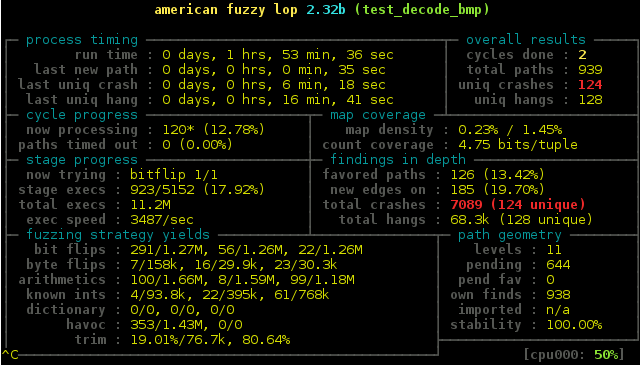
The result was immediate and not a little worrying, within seconds there were crashes and lots of them! Over the next couple of hours I watched as the unique crash total climbed into the triple digits.

I was forced to abort the run at this point as, despite clear warnings in the AFL documentation of the demands of the tool, my laptop was clearly not cut out to do this kind of work and had become distressingly hot.

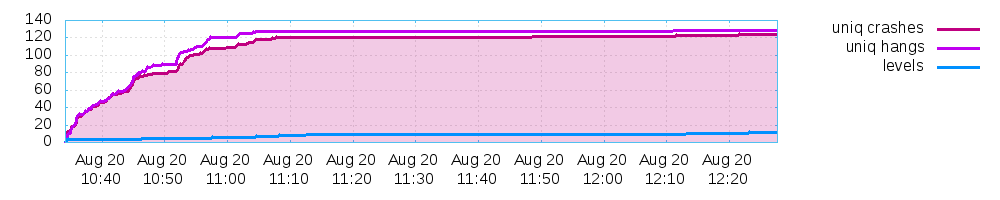
AFL has a visualisation tool so you can see what kind of progress it is making which produced a graph that showed just how fast it managed to produce crashes and how much the return plateaus after just a few cycles. Although it was finding a new unique crash every ten minutes or so when aborted.

I dove in to analyse the crashes and it immediately became obvious the main issue was caused when the test tool attempted allocations of absurdly large bitmaps. The browser itself uses a heuristic to determine the maximum image size based on used memory and several other values. I simply applied an upper bound of 48 megabytes per decoded image which fits easily within the fuzzers default heap limit of 50 megabytes.

The main source of "hangs" also came from large allocations so once the test was fixed afl-fuzz was re-run with a timeout parameter set to 100ms. This time after several minutes no crashes and only a single hang were found which came as a great relief, at which point my laptop had a hard shutdown due to thermal event!

Once the laptop cooled down I spooled up a more appropriate system to perform this kind of work a 24way 2.1GHz Xeon system. A Debian Jessie guest vm with 20 processors and 20 gigabytes of memory was created and the build replicated and instrumented.

AFL master node display
To fully utilise this system the next test run would utilise AFL in parallel mode. In this mode there is a single "master" running all the deterministic checks and many "secondary" instances performing random tweaks.

If I have one tiny annoyance with AFL, it is that breeding and feeding a herd of rabbits by hand is annoying and something I would like to see a convenience utility for.

The warren was left overnight with 19 instances and by morning had generated crashes again. This time though the crashes actually appeared to be real failures.

$ afl-whatsup sync_dir/
Summary stats
=============

Fuzzers alive : 19
Total run time : 5 days, 12 hours
Total execs : 214 million
Cumulative speed : 8317 execs/sec
Pending paths : 0 faves, 542 total
Pending per fuzzer : 0 faves, 28 total (on average)
Crashes found : 554 locally unique

All the crashing test cases are available and a simple file command immediately showed that all the crashing test files had one thing in common the height of the image was -2147483648 This seemingly odd number is actually meaningful to a programmer, it is the largest negative number which can be stored in a 32bit integer (INT32_MIN) I immediately examined the source code that processes the height in the image header.

if ((width <= 0)   (height == 0))          
return BMP_DATA_ERROR;
if (height < 0)
bmp->reversed = true;
height = -height;

The bug is where the height is made a positive number and results in height being set to 0 after the existing check for zero and results in a crash later in execution. A simple fix was applied and test case added removing the crash and any possible future failure due to this.

Another AFL run has been started and after a few hours has yet to find a crash or non false positive hang so it looks like if there are any more crashes to find they are much harder to uncover.

Main lessons learned are:
I will of course be debugging any new crashes that occur and perhaps turning my sights to all the projects other unit tested libraries. I will also be investigating the generation of our own custom test corpus from AFL to replace the demo set, this will hopefully increase our unit test coverage even further.

Overall this has been my first successful use of a fuzzing tool and a very positive experience. I would wholeheartedly recommend using AFL to find errors and perhaps even integrate as part of a CI system.

19 August 2016

Simon D saulniers: [GSOC] Final report


The Google Summer of Code is now over. It has been a great experience and I m very glad I ve been able to make it. I ve had the pleasure to contribute to a project showing very good promise for the future of communication: Ring. The words privacy and freedom in terms of technologies are being more and more present in the mind of people. All sorts of projects wanting to achieve these goals are coming to life each days like decentralized web networks (ZeroNet for e.g.), blockchain based applications, etc.

Debian I ve had the great opportunity to go to the Debian Conference 2016. I ve been introduced to the debian community and debian developpers ( dd in short :p). I was lucky to meet with great people like the president of the FSF, John Sullivan. You can have a look at my Debian conference report here. If you want to read my debian reports, you can do so by browsing the Google Summer Of Code category on this blog.

What I have done Ring is now in official debian repositories since June 30th. This is a good news for the GNU/Linux community. I m proud to say that I ve been able to contribute to debian by working on OpenDHT and developing new functionalities to reduce network traffic. The goal behind this was to finally optimize the data persistence traffic consumption on the DHT. Github repository: https://github.com/savoirfairelinux/opendht

Queries Issues:
  • #43: DHT queries
Pull requests:
  • #79: [DHT] Queries: remote values filtering
  • 93: dht: return consistent query from local storage
  • #106: [dht] rework get timings after queries in master

Value pagination Issues:
  • #71: [DHT] value pagination
Pull requests:
  • #110: dht: Value pagination using queries
  • #113: dht: value pagination fix

Indexation (feat. Nicolas Reynaud) Pull requests:
  • #77: pht: fix invalid comparison, inexact match lookup
  • #78: [PHT] Key consistency

General maintenance of OpenDHT Issues:
  • #72: Packaging issue for Python bindings with CMake: $DESTDIR not honored
  • #75: Different libraries built with Autotools and CMake
  • #87: OpenDHT does not build on armel
  • #92: [DhtScanner] doesn t compile on LLVM 7.0.2
  • #99: 0.6.2 filenames in 0.6.3
Pull requests:
  • #73: dht: consider IPv4 or IPv6 disconnected on operation done
  • #74: [packaging] support python installation with make DESTDIR=$DIR
  • #84: [dhtnode] user experience
  • #94: dht: make main store a vector>
  • #94: autotools: versionning consistent with CMake
  • #103: dht: fix sendListen loop bug
  • #106: dht: more accurate name for requested nodes count
  • #108: dht: unify bootstrapSearch and refill method using node cache

View by commits You can have a look at my work by commits just by clicking this link: https://github.com/savoirfairelinux/opendht/commits/master?author=sim590

What s left to be done

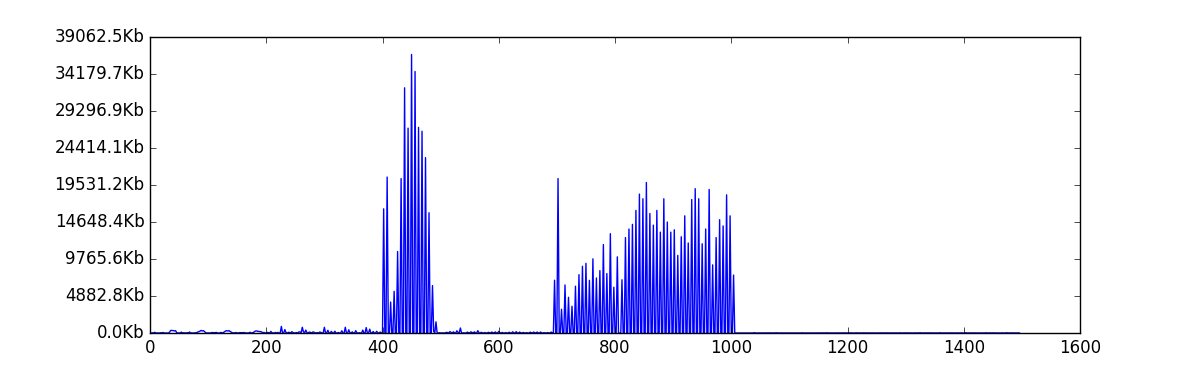
Data persistence The only thing left before achieving the totality of my work is to rigorously test the data persistence behavior to demonstrate the network traffic reduction. To do so we use our benchmark python module. We are able to analyse traffic and produce plots like this one:

Plot: 32 nodes, 1600 values with normal condition test.
This particular plot was drawn before the enhancements. We are confident to improve the results using my work produced during the GSOC.

TCP In the middle of the GSOC, we soon realized that passing from UDP to TCP would ask too much efforts in too short lapse of time. Also, it is not yet clear if we should really do that.

Zlatan Todori : Defcon24

I went to Defcon24 as Purism representative. It was (as usual) held in Las Vegas, the city of sin. In the same module as with DebConf, here we go with good, bad and ugly. Good Badges are really cool. You can find good hackers here and there (but very small number compared to total number). Some talks are good and workshop + village idea looks good (although I didn't manage to attend any workshop as there was place for 1100 and there were 22000 attendees). The movie night idea is cool and Arcade space (where you can play old arcade games, relax and hack and also listen to some cool music) is really lovely. Also you have a camp/village for kids learning things such as electronics, soldering etc but you need to pay attention that they don't see too much of twisted folks that also gather on this con. And that's it. Oh, yea, Dark Tangent appears actually to be cool dude. Bad One does not simply hold a so-called hacker conference in Las Vegas. Having a conference inside hotel/casino where you mix with gamblers and casino workes (for good or for bad) is simply not in hacker spirit and certainly brings all kind of people to the same place. Also, there were simply not enough space for 22000 Defcon attendees, and you don't get proud of having on average ONLY 40min lines. You get proud if you don't have lines! Organization is not the strongest part of Defcon. Huge majority of attendees are not hackers. They are script kiddies, hacker wannabes, comic con people, few totally lost souls etc etc. That simply brings the quality of a conference down. Yes it is cool to have mix of many diverse people but not for the sake of just having people. Ugly They lack Code of Conduct (everyone knows I am not in favor of any writens rules how people should behave but after Defcon I clearly see need for it). Actually, tbh, they do have it but no one gives a damn about it. And you should report to Goons, more about them below. Sexism is huge here. I remember and hear about stories of sexual harassment in IT industry, but Debian somehow mitigated that before me entering its domains, so I never experienced it. The sheer number of sexist behavior on Defcon is tremendous. It appears to me that those people had lonely childhood and now they act as a spoiled 6 year old: they're spoiled, they need to yell to show their point, they have low and stupid sexist jokes and they simply think that is cool. Majority of Goons (their coordinators or whatever) are simply idiots. I don't know do they feel they have some superpowers, or are drunk or just stupid but yelling on people, throwing low jokes on people, more yelling, cursing all the time, more yelling - simply doesn't work for me. So now you can see the irony of CoC on Defcon. They even like to say, hey we are old farts, let us our con be as we want it to be. So no real diversity there. Either it is their way, and god forsaken if you try to change something for better and make them stop cursing or throwing sexist jokes ("squeeze, people. together, touch each other, trust me it will feel good"), or highway. Also it appears that to huge number of vocal people, word "fuck" has some fetish meaning. Either it needs to show how "fucking awesome this con or they are" or to "fucking tell few things about random fucking stuff". Thank you, but no thank you. So what did I do during con. I attended few talks, had some discussion with people, went to one party (great DJs, again people doing stupid things, like breaking invertory to name just one of them) and had so much time (read "I was bored") that I bought domain, brough up server on which I configured nginx and cp'ed this blog to blog.zlatan.tech (yes, recently I added letsencrypt because it is, let me be in Defcon mood, FUCKING AWESOME GRRR UGH) and now I even made .onion domain for it. What can boredom do to people, right? So the ultimate question is - would I go again to Defcon. I am strongly leaning to no, but in my nature is to give second chance and now I have more experience (and I also have thick skin so I guess I can play calm for one more round).

18 August 2016

Zlatan Todori : DebConf16 - new age in Debian community gathering

DebConf16 Finally got some time to write this blog post. DebConf for me is always something special, a family gathering of weird combination of geeks (or is weird a default geek state?). To be honest, I finally can compare Debian as hacker conference to other so-called hacker conferences. With that hat on, I can say that Debian is by far the most organized and highest quality conference. Maybe I am biased, but I don't care too much about that. I simply love Debian and that is no secret. So lets dive into my view on DebConf16 which was held in Cape Town, South Africa. Cape Town This was the first time we had conference on African continent (and I now see for the first time DebConf bid for Asia, which leaves only Australia and beautiful Pacific islands to start a bid). Cape Town by itself, is pretty much Europe-like city. That was kinda a bum for me on first day, especially as we were hosted at University of Cape Town (which is quite beautiful uni) and the surrounding neighborhood was very European. Almost right after the first day I was fine because I started exploring the huge city. Cape Town is really huge, it has by stats ~4mil people, and unofficially it has ~6mil. Certainly a lot to explore and I hope one day to be back there (I actually hope as soon as possible). The good, bad and ugly I will start with bad and ugly as I want to finish with good notes. Racism down there is still HUGE. You don't have signs on the road saying that, but there is clearly separation between white and black people. The houses near uni all had fences on walls (most of them even electrical ones with sharp blades on it) with bars on windows. That just bring tensions and certainly doesn't improve anything. To be honest, if someone wants to break in they still can do easily so the fences maybe need to bring intimidation but they actually only bring tension (my personal view). Also many houses have sign of Armed Force Response (something in those lines) where in case someone would start breaking in, armed forces would come to protect the home. Also compared to workforce, white appear to hold most of profit/big business positions and fields, while black are street workers, bar workers etc etc. On the street you can feel from time to time the tension between people. Going out to bars also showed the separation - they were either almost exclusively white or exclusively black. Very sad state to see. Sharing love and mixing is something that pushes us forward and here I saw clear blockades for such things. The bad part of Cape Town is, and this is not only special to Cape Town but to almost all major cities, is that small crime is on wide scale. Pickpocketing here is something you must pay attention to it. To me, personally, nothing happened but I heard a lot of stories from my friends on whom were such activities attempted (although I am not sure did the criminals succeed). Enough of bad as my blog post will not change this and it is a topic for debate and active involvement which I can't unfortunately do at this moment. THE GOOD! There are so many great local people I met! As I mentioned, I want to visit that city again and again and again. If you don't fear of those bad things, this city has great local cuisine, a lot of great people, awesome art soul and they dance with heart (I guess when you live in rough times, you try to use free time at your best). There were difference between white and black bars/clubs - white were almost like standard European, a lot of drinking and not much dancing, and black were a lot of dancing and not much drinking (maybe the economical power has something to do with it but I certainly felt more love in black bars). Cape Town has awesome mountain, the Table Mountain. I went on hiking with my friends, and I must say (again to myself) - do the damn hiking as much as possible. After every hike I feel so inspired, that I will start thinking that I hate myself for not doing it more often! The view from Table mountain is just majestic (you can even see the Cape of Good Hope). The WOW moments are just firing up in you. Now lets transfer to DebConf itself. As always, organization was on quite high level. I loved the badge design, it had a map and nice amount of information on it. The place we stayed was kinda not that good but if you take it into account that those a old student dorms (in we all were in female student dorm :D ) it is pretty fancy by its own account. Talks were near which is always good. The general layout of talks and front desk position was perfect in my opinion. All in one place basically. Wine and Cheese this year was kinda funny story because of the cheese restrictions but Cheese cabal managed to pull out things. It was actually very well organized. Met some new people during the party/ceremony which always makes me grow as a person. Cultural mix on DebConf is just fantastic. Not only you learn a lot about Debian, hacking on it, but sheer cultural diversity makes this small con such a vibrant place and home to a lot. Debian Dinner happened in Aquarium were I had nice dinner and chat with my old friends. Aquarium by itself is a thing where you can visit and see a lot of strange creatures that live on this third rock from Sun. Speaking of old friends - I love that I Apollo again rejoined us (by missing the DebConf15), seeing Joel again (and he finally visited Banja Luka as aftermath!), mbiebl, ah, moray, Milan, santiago and tons of others. Of course we always miss a few such as zack and vorlon this year (but they had pretty okay-ish reasons I would say). Speaking of new friends, I made few local friends which makes me happy and at least one Indian/Hindu friend. Why did I mention this separately - well we had an accident during Group Photo (btw, where is our Lithuanian, German based nowdays, photographer?!) where 3 laptops of our GSoC students were stolen :( . I was luckily enough to, on behalf of Purism, donate Librem11 prototype to one of them, which ended up being the Indian friend. She is working on real time communications which is of interest also to Purism for our future projects. Regarding Debian Day Trip, Joel and me opted out and we went on our own adventure through Cape Town in pursue of meeting and talking to local people, finding out interesting things which proved to be a great decision. We found about their first Thursday of month festival and we found about Mama Africa restaurant. That restaurant is going into special memories (me playing drums with local band must always be a special memory, right?!). Huh, to be honest writing about DebConf would probably need a book by itself and I always try to keep my posts as short as possible so I will try to stop here (maybe I write few bits in future more about it but hardly). Now the notes. Although I saw the racial segregation, I also saw the hope. These things need time. I come from country that is torn apart in nationalism and religious hate so I understand this issues is hard and deep on so many levels. While the tensions are high, I see people try to talk about it, try to find solution and I feel it is slowly transforming into open society, where we will realize that there is only one race on this planet and it is called - HUMAN RACE. We are all earthlings, and as sooner we realize that, sooner we will be on path to really build society up and not fake things that actually are enslaving our minds. I just want in the end to say thank you DebConf, thank you Debian and everyone could learn from this community as a model (which can be improved!) for future societies.

14 August 2016

Steinar H. Gunderson: Linear interpolation, source alignment, and Debian's embedding policy

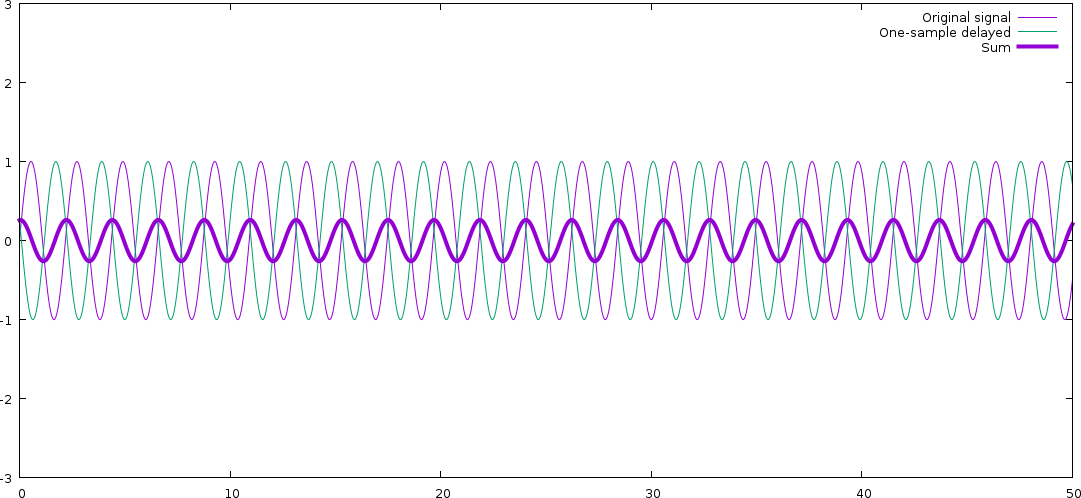
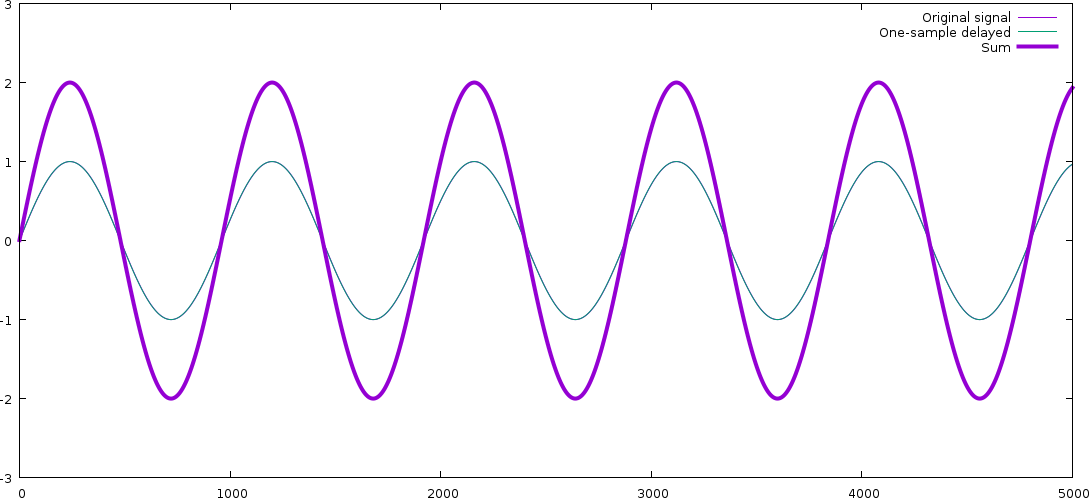
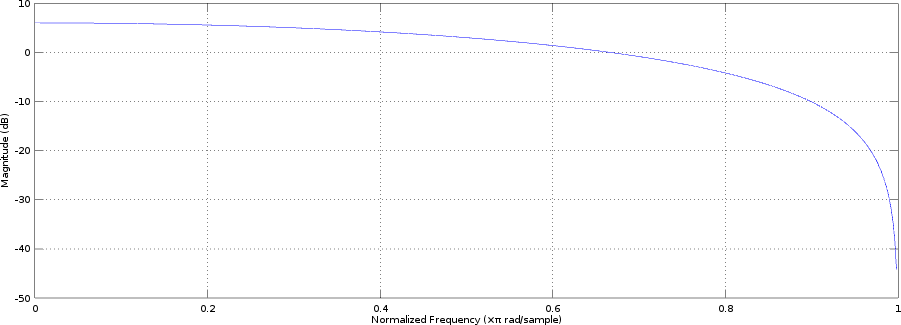
At some point back when the dinosaurs roamed the Earth and I was in high school, I borrowed my first digital signal processing book from a friend. I later went on to an engineering education and master's thesis about DSP, but the very basics of DSP never stop to fascinate me. Today, I wanted to write something about one of them and how it affects audio processing in Nageru (and finally, how Debian's policies put me in a bit of a bind on this issue). DSP texts tend to obscure profound truths with large amounts of maths, so I'll try to present a somewhat less general result that doesn't require going into the mathematical details. That rule is: Adding a signal to weighted, delayed copies of itself is a filtering operation. (It's simple, but ignoring it will have sinister effects, as we'll see later.) Let's see exactly what that means with a motivating example. Let's say that I have a signal where I want to get rid of (or rather, reduce) high frequencies. The simplest way I can think of is to add every neighboring sample; that is, set yn = xn + xn-1. For each sample, we add the previous sample, ie., the signal as it was one sample ago. (We ignore what happens at the edges; the common convention is to assume signals extend out to infinity with zeros.) What effect will this have? We can figure it out with some trigonometry, but let's just demonstrate it by plotting instead: We assume 48 kHz sample rate (which means that our one-sample delay is 20.83 s) and a 22 kHz note (definitely treble!), and plot the signal with one-sample delay (the x axis is sample number): Filtered 22 kHz As you can see, the resulting signal is a new signal of the same frequency (which is always true; linear filtering can never create new frequencies, just boost or dampen existing ones), but with much lower amplitude. The signal and the delayed version of it end up cancelling each other mostly out. Also note that there signal has changed phase; the resulting signal has been a bit delayed compared to the original. Now let's look at a 50 Hz signal (turn on your bass face). We need to zoom out a bit to see full 50 Hz cycles: Filtered 50 Hz The original signal and the delayed one overlap almost exactly! For a lower frequency, the one-sample delay means almost nothing (since the waveform is varying so slowly), and thus, in this case, the resulting signal is amplified, not dampened. (The signal has changed phase here, too actually exactly as much in terms of real time but we don't really see it, because we've zoomed out.) Real signals are not pure sines, but they can be seen as sums of many sines (another fundamental DSP result), and since filtering is a linear operation, it affects those sines independently. In other words, we now have a very simple filter that will amplify low frequencies and dampen high frequencies (and delay the entire signal a little bit). We can do this for all frequencies from 0 to 24000 Hz; let's ask Octave to do it for us: Frequency plot for simple filter (Of course, in a real filter, we'd probably multiply the result with 0.5 to leave the bass untouched instead of boosting it, but it doesn't really change anything. A real filter would have a lot more coefficients, though, and they wouldn't all be the same!) Let's now turn to a problem that will at first seem different: Combining audio from multiple different time sources. For instance, when mixing video, you could have input from two different cameras or sounds card and would want to combine them (say, a source playing music and then some audience sound from a camera). However, unless you are lucky enough to have a professional-grade setup where everything runs off the same clock (and separate clock source cables run to every device), they won't be in sync; sample clocks are good, but they are not perfect, and they have e.g. some temperature variance. Say we have really good clocks and they only differ by 0.01%; this means that after an hour of streaming, we have 360 ms delay, completely ruining lip sync! This means we'll need to resample at least one of the sources to match the other; that is, play one of them faster or slower than it came in originally. There are two problems here: How do you determine how much to resample the signals, and how do we resample them? The former is a difficult problem in its own right; about every algorithm not backed in solid control theory is doomed to fail in one way or another, and when they fail, it's extremely annoying to listen to. Nageru follows a 2012 paper by Fons Adriaensen; GStreamer does well, something else. It fails pretty badly in a number of cases; see e.g. this 2015 master's thesis that tries to patch it up. However, let's ignore this part of the problem for now and focus on the resampling. So let's look at the case where we've determined we have a signal and need to play it 0.01% faster (or slower); in a real situation, this number would vary a bit (clocks are not even consistently wrong). This means that at some point, we want to output sample number 3000 and that corresponds to input sample number 3000.3, ie., we need to figure out what's between two input samples. As with so many other things, there's a way to do this that's simple, obvious and wrong, namely linear interpolation. The basis of linear interpolation is to look at the two neighboring samples and weigh them according to the position we want. If we need sample 3000.3, we calculate y = 0.7 x3000 + 0.3 x3001 (don't switch the two coefficients!), or, if we want to save one multiplication and get better numerical behavior, we can use the equivalent y = x3000 + 0.3 (x3001 - x3000). And if we need sample 5000.5, we take y = 0.5 x5000 + 0.5 x5001. And after a while, we'll be back on integer samples; output sample 10001 corresponds to x10000 exactly. By now, I guess it should be obvious what's going on: We're creating a filter! Linear interpolation will inevitably result in high frequencies being dampened; and even worse, we are creating a time-varying filter, which means that the amount of dampening will vary over time. This manifests itself as a kind of high-frequency flutter , where the amount of flutter depends on the relative resampling frequencies. There's also cubic resampling (which can mean any of several different algorithms), but it only really reduces the problem, it doesn't really solve it. The proper way of interpolating depends a lot on exactly what you want (e.g., whether you intend to change the rate quickly or not); this paper lays out a bunch of them, and was the paper that originally made me understand why linear interpolation is so bad. Nageru outsources this problem to zita-resampler, again by Fons Adriaensen; it yields extremely high-quality resampling under controlled delay, through a relatively common technique known as polyphase filters. Unfortunately, doing this kind of calculations takes CPU. Not a lot of CPU, but Nageru runs in rather CPU-challenged environments (ultraportable laptops where the GPU wants most of the TDP, and the CPU has to go down to the lowest frequency), and it is moving in a direction where it needs to resample many more channels (more on the later), so every bit of CPU helps. So I coded up an SSE optimization of the inner loop for a particular common case (stereo signals) and sent it in for upstream inclusion. (It made the code 2.7 times as fast without any structural changes or reducing precision, which is pretty much what you can expect from SSE.) Unfortunately, after a productive discussion, suddenly upstream went silent. I tried pinging, pinging again, and after half a year pinging again, but to no avail. I filed the patch in Debian's BTS, but the maintainer understandably is reluctant to carry a delta against upstream. I also can't embed a copy; Debian policy would dictate that I build against the system's zita-resampler. I could work around it by rewriting zita-resampler until it looks nothing like the original, which might be a good idea anyway if I wanted to squeeze out the last drops of speed; there are AVX optimizations to be had in addition to SSE, and the structure as-is isn't ideal for SSE optimizations (although some of the changes I have in mind would have to be offset against increased L1 cache footprint, so careful benchmarking would be needed). But in a sense, it feels like just working around a policy that's there for good reason. So like I said, I'm in a bit of a bind. Maybe I should just buy a faster laptop. Oh, and how does GStreamer solve this? Well, it doesn't use linear interpolation. It does something even worse it uses nearest neighbor. Gah. Update: I was asked to clarify that this is about the audio resampling done by the GStreamer audio sink to sync signals, not in the audioresample element, which solves a related but different problem (static sample rate conversion). The audioresample element supports a number of different resampling methods; I haven't evaluated them.
13 August 2016

David Moreno: Disable Nginx logging

This is something that is specified clearly on the Nginx manual, but it s nice to have it as a quick reference. The access_log and error_log directives on Nginx are on separate modules (HTTP Log and Core modules respectively) and they don t behave the same way when all you want is to disable all logging on your server (in our case, we serve a gazillion static files and perform a lot of reverse proxying and we re not interested on tracking that). It s a common misconception that you can set error_log to off, because that s how you disable access_log (if you do that, the server will still log to the file $nginx_path/off). Instead, you have to set error_log to log to the always mighty black hole /dev/null using the highest level for logging (which triggers the fewest events), crit:
http  
  server  
    # ...
    access_log off;
    error_log /dev/null crit;
    # ...
   
  #...
 
If you re the possessor of the blingest of bling-bling, you can disable all logging (not only for a server block), by putting error_log on the root of the configuration and access_log within your http block and make sure you don t override that on any of the inner blocks. And you re good to go.

David Moreno: Geo::PostalCode::NoDB 0.01

Geo::PostalCode is a great Perl module. It lets you find surrounding postal areas (zip codes) around a given an amount of miles (radius), calculate distance between them, among other nice features. Sadly, I couldn t get it to work with updated data and because the file its Berkely DB installer was producing was not being recognized by its parser, which bases off on DB_File. Since I was able to find working data for the source of zip codes, I ended up hacking the module and producing a version with no Berkeley DB support. So basically, and taken from the POD:
RATIONALE BEHIND NO BERKELEY DB
On a busy day at work, I couldn t get Geo::PostalCode to work with newer data (the data source TJMATHER points to is no longer available), so the tests shipped with his module pass, but trying to use real data no longer seems to work. DB_File marked the Geo::PostalCode::InstallDB output file as invalid type or format. If you don t run into that issue by not wanting to use this module, please drop me a note! I would love to learn how other people made it work.

So, in order to get my shit done, I decided to create this module. Loading the whole data into memory from the class constructor has been proven to be enough for massive usage (citation needed) on a Dancer application where this module is instantiated only once.
$ sudo cpanm Geo::PostalCode::NoDB now!

12 August 2016

Markus Koschany: My Free Software Activities in July 2016

Welcome to gambaru.de. Here is my monthly report that covers what I have been doing for Debian. Debian Android Debian Games Debian Java Debian LTS This was my sixth month as a paid contributor and I have been paid to work 14,7 hours on Debian LTS. In that time I did the following: Misc and QA

10 August 2016

Norbert Preining: Suki Kim Without You, There Is No Us

A book that goes further behind the walls that surround North Korea than anything else I have seen. Suki Kim managed to squeeze herself, American-Korean, into a English teaching job at the Pyongyang University of Science and Technology, and reports her experiences during two visits there. suki-kim_without-you Most of us in the connected world are well aware about the incredibly backwardness of North Korea, and the harsh living conditions despite the praise that is bombarded onto us through the official channels. But reading about the incredibly underdeveloped students at PUST, Pyongyang University of Science and Technology, the elite of the country, who never heard about the most basic techniques, is still surprising.
Time there seemed to pass differently. When you are shut off from the world, every day is exactly the same as the one before. This sameness has a way of wearing down your soul until you become nothing but a breathing, toiling, consuming thing that awakes to the sun and sleeps at the dawning of the dark.
Another very disturbing part of this book are the short but intensive looks into the country side, when excursions or shopping trips were scheduled. They lay open a barren land, with Gulag like working conditions and permanent shortage of proper food. I have been aware about the situation in North Korea, but reading about it from a very special perspective gave me the shivers.

9 August 2016

John Goerzen: Easily Improving Linux Security with Two-Factor Authentication

2-Factor Authentication (2FA) is a simple way to help improve the security of your systems. It restricts the scope of damage if a machine is compromised. If, for instance, you have a security token or authenticator app on your phone that is required for ssh to a remote machine, then even if every laptop you use to connect to the remote is totally owned, an attacker cannot establish a new ssh session on their own. There are a lot of tutorials out there on the Internet that get you about halfway there, so here is some more detail. Background In this article, I will be focusing on authentication in the style of Google Authenticator, which is a special case of OATH HOTP or TOTP. You can use the Google Authenticator app, FreeOTP, or a hardware token like Yubikey to generate tokens with this. They are all 100% compatible with Google Authenticator and libpam-google-authenticator. The basic idea is that there is a pre-shared secret key. At each login, a different and unique token is required, which is generated based on the pre-shared secret key and some other information. With TOTP, the other information is the current time, implying that both machines must be reasably well in-sync time-wise. With HOTP, the other information is a count of the number of times the pre-shared key has been used. Both typically have a window on the server side that can let times within a certain number of seconds, or a certain number of login accesses, work. The beauty of this system is that after the initial setup, no Internet access is required on either end to validate the key (though TOTP requires both ends to be reasonably in sync time-wise). The basics: user account setup and ssh authentication You can start with the basics by reading one of these articles: one, two, three. Debian/Ubuntu users will find both the pam module and the user account setup binary in libpam-google-authenticator. For many, you can stop there. You re done. But if you want to kick it up a notch, read on: Enhancement 1: Requiring 2FA even when ssh public key auth is used Let s consider a scenario in which your system is completely compromised. Unless your ssh keys are also stored in something like a Yubikey Neo, they could wind up being compromised as well if someone can read your files and sniff your keyboard, your ssh private keys are at risk. So we can configure ssh and PAM so that a OTP token is required even for this scenario. First off, in /etc/ssh/sshd_config, we want to change or add these lines:
UsePAM yes
ChallengeResponseAuthentication yes
AuthenticationMethods publickey,keyboard-interactive
This forces all authentication to pass two verification methods in ssh: publickey and keyboard-interactive. All users will have to supply a public key and then also pass keyboard-interactive auth. Normally keyboard-interactive auth prompts for a password, but we can change /etc/pam.d/sshd on this. I added this line at the very top of /etc/pam.d/sshd:
auth [success=done new_authtok_reqd=done ignore=ignore default=bad] pam_google_authenticator.so
This basically makes Google Authenticator both necessary and sufficient for keyboard-interactive in ssh. That is, whenever the system wants to use keyboard-interactive, rather than prompt for a password, it instead prompts for a token. Note that any user that has not set up google-authenticator already will be completely unable to ssh into their account. Enhancement 1, variant 2: Allowing automated processes to root On many of my systems, I have ~root/.ssh/authorized_keys set up to permit certain systems to run locked-down commands for things like backups. These are automated commands, and the above configuration will break them because I m not going to be typing in codes at 3AM. If you are very restrictive about what you put in root s authorized_keys, you can exempt the root user from the 2FA requirement in ssh by adding this to sshd_config:
Match User root
  AuthenticationMethods publickey
This says that the only way to access the root account via ssh is to use the authorized_keys file, and no 2FA will be required in this scenario. Enhancement 1, variant 2: Allowing non-pubkey auth On some multiuser systems, some users may still want to use password auth rather than publickey auth. There are a few ways we can support that:
  1. Users without public keys will have to supply a OTP and a password, while users with public keys will have to supply public key, OTP, and a password
  2. Users without public keys will have to supply OTP or a password, while users with public keys will have to supply public key, OTP, or a password
  3. Users without public keys will have to supply OTP and a password, while users with public keys only need to supply the public key
The third option is covered in any number of third-party tutorials. To enable options 1 or 2, you ll need to put this in sshd_config:
AuthenticationMethods publickey,keyboard-interactive keyboard-interactive
This means that to authenticate, you need to pass either publickey and then keyboard-interactive auth, or just keyboard-interactive auth. Then in /etc/pam.d/sshd, you put this:
auth required pam_google_authenticator.so
As a sub-variant for option 1, you can add nullok to here to permit auth from people that do not have a Google Authenticator configuration. Or for option 2, change required to sufficient . You should not add nullok in combination with sufficient, because that could let people without a Google Authenticator config authenticate completely without a password at all. Enhancement 2: Configuring su A lot of other tutorials stop with ssh (and maybe gdm) but forget about the other ways we authenticate or change users on a system. su and sudo are the two most important ones. If your root password is compromised, you don t want anybody to be able to su to that account without having to supply a token. So you can set up google-authenticator for root. Then, edit /etc/pam.d/su and insert this line after the pam_rootok.so line:
auth       required     pam_google_authenticator.so nullok
The reason you put this after pam_rootok.so is because you want to be able to su from root to any account without having to input a token. We add nullok to the end of this, because you may want to su to accounts that don t have tokens. Just make sure to configure tokens for the root account first. Enhancement 3: Configuring sudo This one is similar to su, but a little different. This lets you, say, secure the root password for sudo. Normally, you might sudo from your user account to root (if so configured). You might have sudo configured to require you to enter in your own password (rather than root s), or to just permit you to do whatever you want as root without a password. Our first step, as always, is to configure PAM. What we do here depends on your desired behavior: do you want to require someone to supply both a password and a token, or just a token, or require a token? If you want to require a token, put this at the top of /etc/pam.d/sudo:
auth [success=done new_authtok_reqd=done ignore=ignore default=bad] pam_google_authenticator.so
If you want to require a token and a password, change the bracketed string to required , and if you want a token or a password, change it to sufficient . As before, if you want to permit people without a configured token to proceed, add nullok , but do not use that with sufficient or the bracketed example here. Now here comes the fun part. By default, if a user is required to supply a password to sudo, they are required to supply their own password. That does not help us here, because a user logged in to the system can read the ~/.google_authenticator file and easily then supply tokens for themselves. What you want to do is require them to supply root s password. Here s how I set that up in sudoers:
Defaults:jgoerzen rootpw
jgoerzen ALL=(ALL) ALL
So now, with the combination of this and the PAM configuration above, I can sudo to the root user without knowing its password but only if I can supply root s token. Pretty slick, eh? Further reading In addition to the basic tutorials referenced above, consider: Edit: additional comments Here are a few other things to try: First, the libpam-google-authenticator module supports putting the Google Authenticator files in different locations and having them owned by a certain user. You could use this to, for instance, lock down all secret keys to be readable only by the root user. This would prevent users from adding, changing, or removing their own auth tokens, but would also let you do things such as reusing your personal token for the root account without a problem. Also, the pam-oath module does much of the same things as the libpam-google-authenticator module, but without some of the help for setup. It uses a single monolithic root-owned password file for all accounts. There is an oathtool that can be used to generate authentication codes from the command line.

1 August 2016

Charles Plessy: Amazon cloud: refreshing my skills.

For a few years I did not attempt any serious task on the Amazon cloud. It took me a bit of time to get back my automatisms and adapt myself to the changes. In particular, the cheapest instances, t2.nano, are only accessible via virtual private clouds (VPC), and it was a bit difficult for me to find how to create a simple one. Perhaps this is because all AWS accounts created after March 18, 2013, automatically have a default VPC, and everybody else who needed their own simple VPC have created it a long time ago already. In the end, this was not complicated at all. This is probably why I could not find a tutorial. In brief, one needs first to create a VPC. If it is just for spawning an instance from time to time, the IP range does not matter much. Default VPCs are using 172.31.0.0/16, so let's do the same.
CIDR_BLOCK=172.31.0.0/16
aws ec2 create-vpc --cidr-block $CIDR_BLOCK
In the command's output, there is the VPC's identifier, that I paste by hand in a variable called VPC. The same pattern will be repeated for each command creating something. One can also find the VPC's identifier with the command aws ec2 describe-vpcs.
VPC=vpc-XXXXXXXX
Then, create a subnet. Again, no need for complications, in our simple case one can give the full IP range. I cut and paste the returned identifier in the variable SUBNET. In order that the instances receive a public IP address like in default VPCs and like in the usual behaviour of the VPC-less Cloud, one needs to set the attribute MapPublicIpOnLaunch.
aws ec2 create-subnet --vpc-id $VPC --cidr-block $CIDR_BLOCK
SUBNET=subnet-XXXXXXXX
aws ec2 modify-subnet-attribute --subnet-id $SUBNET --map-public-ip-on-launch 
Then, create a gateway (paste the identifier in GATEWAY) and attach it to the VPC.
aws ec2 create-internet-gateway
GATEWAY=igw-XXXXXXXX
aws ec2 attach-internet-gateway --internet-gateway-id $GATEWAY --vpc-id $VPC
A routing table was created automatically, and one can find its identifier via the command describe-route-tables. Then, create a default route to the gateway.
aws ec2 describe-route-tables
ROUTETABLE=rtb-XXXXXXXX
aws ec2 create-route --route-table-id $ROUTETABLE --destination-cidr-block 0.0.0.0/0 --gateway-id $GATEWAY
Of course, if one does not open the traffic, no instance can be contacted from outside... Here I open port 22 for SSH.
aws ec2 describe-security-groups
SECURITY_GROUP=sg-XXXXXXXX
aws ec2 authorize-security-group-ingress --group-id $SECURITY_GROUP --protocol tcp --port 22 --cidr 0.0.0.0/0
Other novelty, now Amazon distributes some Free tools for the command line, that are more comprehensive than euca2ools. Next, I will try again the Debian Installer in the Cloud.

Ben Armstrong: Retiring as a Debian developer

This is a repost and update of my retirement letter sent privately to Debian last month, July 10, 2016. At that time I received many notes of appreciation and good wishes which I treasure. Now, I d like to say goodbye to the broader Debian community and, as well, indicate which of the cleanup items have since been addressed in strikethrough style and with annotations. Also, I d like to stay in touch with many of you, so I have added some comments oriented towards those of you who are interested in doing that after the letter.
When in 1995, on a tip from a friend, I installed Debian on my 386 at work and was enthralled with the results, I could not have foreseen that two years later, friends I had made on channel #debian would nudge me to become a Debian developer. Nor when that happened did I have any idea that twenty years later, I d consider Debian to be like family, the greatest free software community in the world, and would still be promoting it and helping people with it whenever I could. Debian quietly, unexpectedly became a part of what defines me. My priorities in life have changed over that time, though. I have shifted my attention to things that are more important to me in life, such as my family, my health and well-being physically and spiritually, and bringing all I can to bear on the task of preserving our local wilderness areas and trails. In the latter area, I m now bringing all of what Debian has helped shaped me to be to the table, launching some ambitious projects I hope will bear fruit in the coming years, and make a measurable contribution to help us hang onto our precious natural preserves where I live. Unfortunately, as I ve poured more time and energy into these things, I ve increasingly not been giving my packages the care they need. Nor do I have any roles or goals now for any of the Debian projects I was previously involved in. So, after much careful deliberation, and as much as it pains me to say it, it s time to retire as a Debian developer. It has been a great privilege to work with you, and to meet many of you in New York at Debconf 10. I plan to be around online, and will continue to take an interest in Debian, lending a hand when I can. Thanks for all of the fun times, for all that I ve learned, and for the privilege to make awesome things with you. I ll treasure this forever. So much for the soppy bits.  Now, business. These things remain to clean up upon my departure, and I d appreciate help from QA, and anyone else who can lend a hand. My packages are effectively orphaned, but I haven t the time to do any of the cleanup myself, so please speak up if you can help.
  1. Debian Jr.
    • O: junior-doc. The junior-doc package has been awaiting an overhaul by whoever revives the project since I gave it up years ago. I m still listed as maintainer and that should be changed to Debian Junior Maintainers <debianjr-maintainers@lists.alioth.debian.org> if they want it. Otherwise, it is orphaned.
    • I should also be dropped from Uploaders from debian-junior, the metapackages source. Fixed in git.
  2. Tux Paint. This is a very special package that deserves to go to someone who will love it and care for it well. There are three source packages in all:
    • O: tuxpaint
    • O: tuxpaint-config
    • O: tuxpaint-stamps
  3. O: xletters. This is a cute little typing practice game and needs a new maintainer.
  4. XPilot is co-maintained by Phil Brooke <pjb@debian.org>, so he should replace me as Maintainer. Phil said he ll pick up xpilot-ng and will also look at xpilot-extra.
    • xpilot-ng
    • O: xpilot-extra (recently removed from testing due to my neglect, and not co-maintained by Phil; it s unclear if anyone really uses this anymore)
  5. GTypist is co-maintained by Daniel Leidert <dleidert@debian.org> and should replace me as Maintainer.
  6. My ruby packages. A group of packages that I brought into Debian as dependencies of taskwarrior-web, which I never completed. Maybe they ll be useful in and of themselves, and maybe not. In any case, they are maintained by pkg-ruby-extras-maintainers, but I m the sole developer in Uploaders and should be removed: Fixed in git.
    • ruby-blockenspiel
    • ruby-parseconfig
    • ruby-rack-flash3
    • ruby-simple-navigation
    • ruby-sinatra-simple-navigation
    • ruby-term-ansicolor
    • ruby-versionomy
  7. Debian Live stuff: I am listed in Uploaders for live-manual (fixed in git) and debian-installer-launcher (fixed in git) and need to be removed.
  8. O: eeepc-acpi-scripts. The defunct Debian EeePC project has just this one package. Recently, the mailing list was asked about its status, and it was recently NMU d. To my knowledge, nobody from the original team remains to take care of it, so it needs a new maintainer. I should be removed from Uploaders, and since the Debian Eee PC Team no longer exists, it should be removed as maintainer. It is effectively orphaned unless someone speaks up.
There are also some Alioth projects / lists that are defunct that I ll need to talk to the Alioth admins about cleaning up in the coming days. One of these is <debian-eeepc-devel@lists.alioth.debian.org> and since it is still listed as the maintainer of eeepc-acpi-scripts, that needs to be sorted out before the list can be closed. Thanks again, and see you around!
Ben

Stay in touch For those of you who would like to stay in touch, here are some ways to do that:
  • Follow my blog: http://syn.theti.ca
    If you already do that, great! If not, welcome to my blog! For the past couple of years you may have noticed a decrease in technical content and increase in local trails and conservation oriented posts. You can expect more of the latter.
  • Say hi to me on irc: SynrG (also SynrGy) on irc.oftc.net (irc.debian.org) or irc.freenode.net.
    I still intend to hang out and offer support when I can, just no longer as a developer. Channel #debian-offtopic on either network is a good place to catch up with me socially.
  • Follow me on Facebook: https://www.facebook.com/SynrG
    For better or worse, a lot of the trails and conservation folks hang out here, and many of you in the Debian community are already my Facebook friends.
  • Look for my Bluff Trail posts on their site: https://wrweo.ca
    Providing tech support to this organization is where much of my time and energy is going these days. I post here once in a while, but do most of my work behind the scenes as a volunteer and, newly this year, as a board member.
Facebooktwittergoogle_plusredditpinterestlinkedinmail

31 July 2016

Ritesh Raj Sarraf: User Mode Linux

Recently, we had the User-Mode Linux suite out of Debian, which included user-mode-linux, user-mode-linux-doc and uml-utilities package. We are happy that we were able to bring it back into the archvie quick, and hope to maintain it active. For many who may not know about UML, here's a discription from its website:
User-Mode Linux is a safe, secure way of running Linux versions and Linux processes. Run buggy software, experiment with new Linux kernels or distributions, and poke around in the internals of Linux, all without risking your main Linux setup.
User-Mode Linux gives you a virtual machine that may have more hardware and software virtual resources than your actual, physical computer. Disk storage for the virtual machine is entirely contained inside a single file on your physical machine. You can assign your virtual machine only the hardware access you want it to have. With properly limited access, nothing you do on the virtual machine can change or damage your real computer, or its software.
Most of the use cases mentioned here are achievable with Containers today. The big difference UML provides in, is with a separate kernel. UML is an implementation of Linux as an architecture of Linux itself. It supports x86 and x86_64 architecture. And given that it is the port of the kernel, you can do many of the tests and experiments of the regular kernel, safely inside a confined UML environment. As with other virtualization implementations, the limitation comes in if you are working on physical hardware. With its re-entry in Debian, I wanted to revive my local setup. First is the packaging structure and the second is its integration with current standard tools
  • Packaging: For packaging UML in Debian, we rely on the packaged linux-source package provided by the kernel team.
    • linux-source package: We build UML from the linux sources that are provided by the debian kernel team. This works fine for now. Whenever there's a kernel vulnerability, there'll be an updated source package, to which we'll rebuild the UML package.
    • Merge with debian-kernel: In the longer run, we'd like to push UML package into the debian kernel team. UML is a component of the Linux kernel, and that is where it should be built from.
  • Integration: It works fairly well right now. On modern systems with systemd, where (nspawn) containers can easily have a network interface bound to it, UML lacks a bit behind. It'd be nice if we could see some UML integration with systemd.
    • Networking under systemd: Setting up networking, for UML, under systemd is fairly straight. In fact, with systemd, it is much simpler. Below is the host network (tuntap) setup, to which UML can bind for all its network needs.
rrs@learner:~/tidBits (master)$ cat /etc/systemd/network/tap.netdev 
[NetDev]
Name=tap0
Kind=tap
[TAP]
Group=uml-net
User=uml-net
2016-08-01 / 15:41:40       
rrs@learner:~/tidBits (master)$ cat /etc/systemd/network/tap.network 
[Match]
Name=tap0
[Network]
DHCPServer=yes
IPForward=yes
IPMasquerade=yes
Address=172.16.20.2
LLMNR=yes
MulticastDNS=yes
DNS=172.16.20.1
2016-08-01 / 15:41:43       

systemd allows for defining user/group ownership in its file. With this setup, and uml-utilities running, one can simply fire a UML instance as below:

rrs@learner:~/rrs-home/Community/Packaging/user-mode-linux (master)$ linux ubd0=~/rrs-home/NoTrack/uml.img eth0=daemon mem=1024M rw  
Core dump limits :
    soft - 0
    hard - NONE
Checking that ptrace can change system call numbers...OK
Checking syscall emulation patch for ptrace...OK
Checking advanced syscall emulation patch for ptrace...OK
Checking environment variables for a tempdir...none found
Checking if /dev/shm is on tmpfs...OK
Checking PROT_EXEC mmap in /dev/shm...OK
Adding 23609344 bytes to physical memory to account for exec-shield gap
Linux version 4.6.3 (root@chutzpah) (gcc version 5.4.0 20160609 (Debian 5.4.0-6) ) #2 Sat Jul 16 16:22:22 UTC 2016
Built 1 zonelists in Zone order, mobility grouping on.  Total pages: 263721
Kernel command line: ubd0=/home/rrs/rrs-home/NoTrack/uml.img eth0=daemon mem=1024M rw root=98:0
PID hash table entries: 4096 (order: 3, 32768 bytes)
Dentry cache hash table entries: 262144 (order: 9, 2097152 bytes)
Inode-cache hash table entries: 131072 (order: 8, 1048576 bytes)
Memory: 1020852K/1071632K available (4803K kernel code, 1207K rwdata, 1340K rodata, 157K init, 217K bss, 50780K reserved, 0K cma-reserved)
SLUB: HWalign=64, Order=0-3, MinObjects=0, CPUs=1, Nodes=1
NR_IRQS:15
.....snipped.......
root@uml:~# cat /proc/cpuinfo 
processor    : 0
vendor_id    : User Mode Linux
model name    : UML
mode        : skas
host        : Linux learner 4.6.0-1-amd64 #1 SMP Debian 4.6.4-1 (2016-07-18) x86_64
bogomips    : 6048.97
root@uml:~# ping www.debian.org
PING www.debian.org (130.89.148.14) 56(84) bytes of data.
64 bytes from klecker4.snt.utwente.nl (130.89.148.14): icmp_seq=1 ttl=46 time=372 ms
64 bytes from klecker4.snt.utwente.nl (130.89.148.14): icmp_seq=2 ttl=46 time=395 ms
64 bytes from klecker4.snt.utwente.nl (130.89.148.14): icmp_seq=3 ttl=46 time=315 ms
^C
--- www.debian.org ping statistics ---
3 packets transmitted, 3 received, 0% packet loss, time 2002ms
rtt min/avg/max/mdev = 315.550/361.064/395.440/33.556 ms

And here are some (incomplete and non-conclusive) performance numbers

root@uml:~# dd if=/dev/zero of=foo.img bs=1M count=2500 conv=fsync
2500+0 records in
2500+0 records out
2621440000 bytes (2.6 GB, 2.4 GiB) copied, 39.4876 s, 66.4 MB/s
vs
rrs@learner:/var/tmp/Debian-Build/Result$ dd if=/dev/zero of=foo.img bs=1M count=2500 conv=fsync
2500+0 records in
2500+0 records out
2621440000 bytes (2.6 GB, 2.4 GiB) copied, 41.2126 s, 63.6 MB/s
2016-08-01 / 15:59:15       

Categories:

Keywords:

Like:

29 July 2016

Norbert Preining: TUG 2016 Day 4 Books, ooh Books (and Boats)

Talks have been finished, and as a special present to the participants, Pavneet has organized an excursion that probably was one of the best I ever had. First we visited the Toronto Reference Library where we were treated to a delicious collection of rare books (not to mention all the other books and architecture), and then a trip through the Ismaili Centre Toronto and the Aga Khan Museum.
Page from "A Dream of John Ball", Kelmscott Press Edition, 1892.
(Kelmscott press edition from 1892 of William Morris A Dream of John Ball.) All these places were great pieces of architecture with excellent samples of the writing and printing art. And after all that and not to be mentioned, the conference dinner evening cruise! Our first stop was the Toronto Reference Library. Designed by Raymond Moriyama, it features a large open atrium with skylights, and it gives the library an open and welcoming feeling. We were told that it resembles a tea cup that needs to be filled with knowledge.
The Toronto Reference Library's atrium
The library also features running water at several places the architect had the idea that natural ambient noise is more natural for a library than the eclectic silence that anyway never happens. Originally there were lots of greens hanging down into the Atrium, resembling the Hanging Gardens, but they have been scrapped due to financial reasons. But there are still green oasis like this beautiful green wall in a corner of the library.
Wall of Green in the middle of the library
We were guided first to the fifth floor where the special collection is housed. And what a special collection. The librarian in charge has laid out about 20 exquisite books starting from early illuminated manuscripts over incunabula to high pieces of printing art from the 18th and 19th century. Here we have a illuminated script in Carolingian minuscule.
Illuminated script in Carolingian minuscule
What was really surprising for all of us in this special collection that all these books were simply laid out in front of us, that the librarian touched and used it without gloves, and above all, that he told us that if one wants it is common practice to check out these books for study sessions and enjoy them on the spot in the reading room. I don t know any other library that allows you to actually handle these rare and beauty specimens! The library not only featured lots of great books, it also had some art installation like these light rods.
Art Light installation in the Toronto Reference Library
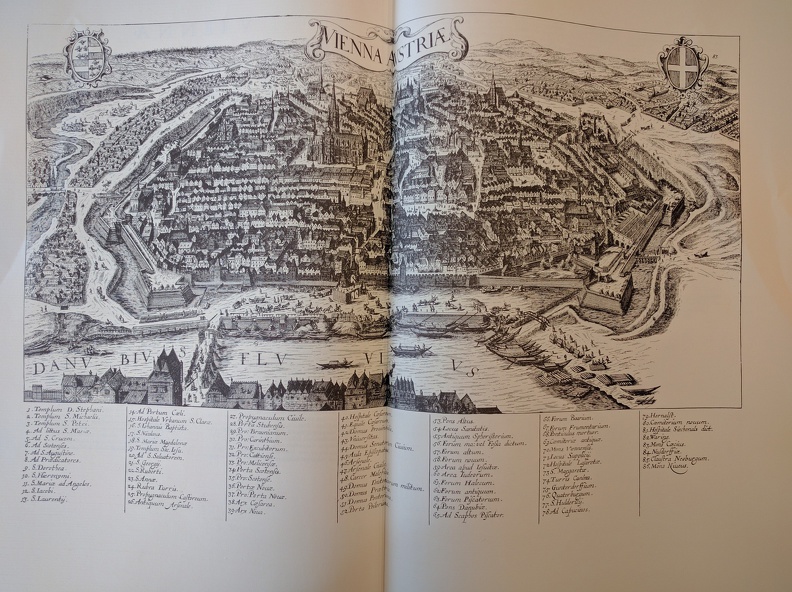
In one of the books I found by chance a map of my hometown of Vienna. Looking at this map from very old times, the place where I grew up is still uninhabited somewhere in the far upper right corner of the map. Times have changed.
Map op Vienna found in the Toronto Reference Library
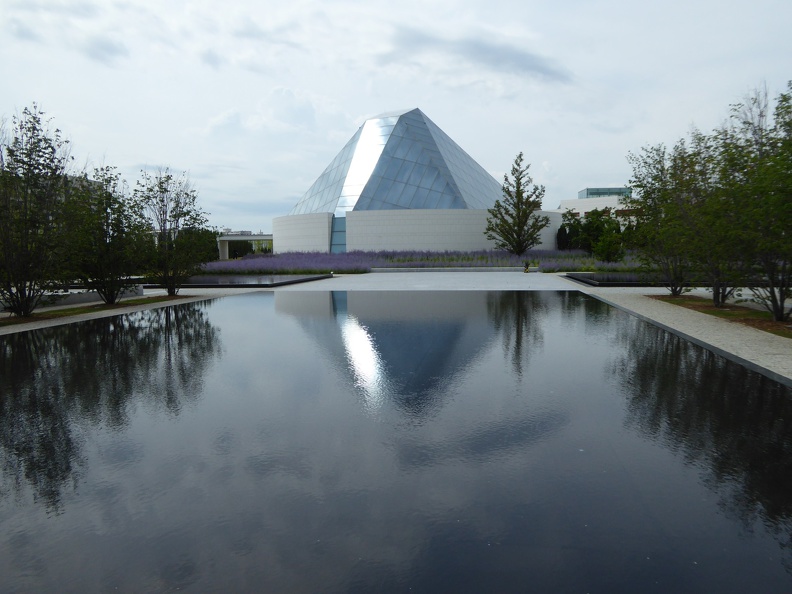
After we left this open and welcoming treasure house of beautiful books, we moved to the Aga Khan Museum and Ismaili Centre Toronto, which are standing face-to-face separated by some water ponds in the Aga Khan park a bit outside of central Toronto. Here we see the Ismaili Centre from the Aga Khan Museum entrance. The big glass dome is the central prayer room, and is illuminated at night. Just one detail one can see in the outer wall one part that looks like glass, too. This is the prayer alcove in the back of the prayer hall, and is made from huge slabs of Onyx that are also lit up in the night.
View onto the Ismaili Centre's Prayer Hall formed by a glass dome
The Ismaili Centre, designed by Charles Correa combines modern functional and simple style with the wonderful ornamental art of the Islam heritage. The inside of the Ismaili Centre features many pieces of exquisite art calligraphy, murals, stone work, etc here is a medallion made from precious stone and set onto a hand-carved wall.
Medaillon made of precious stones in hand carved wall, Ismaili Centre Toronto
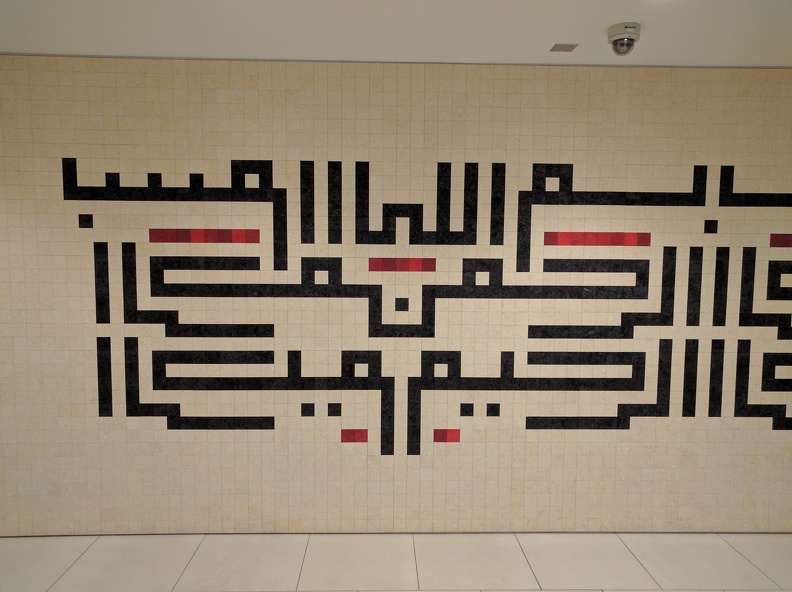
A calligraphy on the wall in the Ismaili Centre
Wall Calligraphy in the Ismaili Centre Toronto
Following the Ismaili Centre we turned to the Aga Khan museum which documents Islamic art, science, and history with an extensive collection. We didn t have much time, and in addition I had to do some fire-fighting over the phone, but the short trip through the permanent collection with samples of excellent calligraphy was amazing.
Koran Calligraphy, Aga Khan Museum Toronto
After returning from this lovely excursion and a short break, we set off for the last stop for tonight, the dinner cruise. After a short bus ride we could board our ship and off we go. Although the beer selection was not on par with what we are used from carft breweries, the perfectly sized boat with two decks and lots of places to hang around invited us to many discussions and chitchats. And finally I could enjoy also the skyline of Toronto.
View onto Toronto from the boat
After the dinner we had some sweets, one of which was a specially made cake with the TUG 2016 logo on it. I have to say, it was not only this cake but the whole excellent and overboarding food we had during all these days, that will make me go on diet when I am back in Japan. Pavneet organized for the lunch breaks three different style of kitchens (Thai, Indian, Italian), then the excursions to local brewers and and and If it wouldn t be for TeX, I would call it a Mastkur .
TUG 2016 cake
During the cruise we also had a little ceremony thanking Jim for his work as president of the TUG, but above all Pavneet for this incredible well organized conference. I think everyone agreed that this was the best TUG conference since long.
Sunset near Toronto
pensDuring the ceremony, Pavneet also announced the winners of the TUG 2016 fountain pen auction. These pens have a long history/travel behind them, see details on the linked page, and were presented to the special guests of the conference. Two remaining pens were auctioned with funds going to the TUG. The first one was handed over to Steve Grathwohl, and to my utter surprise the second one to myself. So now I am a happy owner of a TUG 2016 fountain pen. What a special feature! Just one more detail about these pens: They are traditional style, so without ink capsules, but one needs to insert the ink with a syringe. I guess I need to stack up a bit at home, and more importantly, train my really ugly hand-writing, otherwise it would be a shame to use this exquisite tool. We returned to the harbor around 10pm, and back to the hotel, where there was much greeting and thanking, as many people will return the following day.

Heading back to Toronto
I will also leave on Friday morning to meet with friends, thus I will not be participating in (and not reporting on) the last excursion of the TUG 2016. I will leave Toronto and the TUG 2016 with (nearly) exclusively good memories of excellent talks, great presentations, wonderful excursions, and lots of things I have learned. I hope to see all of the participants on next year s TUG meeting and I hope I will be able to attend it. Thanks a lot to Pavneet, you have done an incredible job. And last but not least, thanks to your lovely wife for letting you do all this, I know how much time we did steal from her. A few more photos can be found at the album Day 4 Books, ooh books.

26 July 2016

Rhonda D'Vine: Debian LGBTIQA+

I have a long overdue blog entry about what happened in recent times. People that follow my tweets did catch some things. Most noteworthy there was the Trans*Inter*Congress in Munich at the start of May. It was an absolute blast. I met so many nice and great people, talked and experienced so many great things there that I'm still having a great motivational push from it every time I think back. It was also the time when I realized that I in fact do have body dysphoria even though I thought I'm fine with my body in general: Being tall is a huge issue for me. Realizing that I have a huge issue (yes, pun intended) with my length was quite relieving, even though it doesn't make it go away. It's something that makes passing and transitioning for me harder. I'm well aware that there are tall women, and that there are dedicated shops for lengthy women, but that's not the only thing that I have trouble with. What bothers me most is what people read into tall people: that they are always someone they can lean on for comfort, that tall people are always considered to be self confident and standing up for themselves (another pun, I know ... my bad). And while I'm fine with people coming to me for leaning on to, I rarely get the chance to do so myself. And people don't even consider it. When I was there in Munich, talking with another great (... pun?) trans woman who was as tall as me I finally had the possibility to just rest my head on her shoulder and finally feel the comfort I need just as much as everyone else out there, too. Probably that's also the reason why I'm so touchy and do go Free Hugging as often as possible. But being tall also means that you are usually only the big spoon when cuddling up. Having a small mental breakdown because of realizing that didn't change the feeling directly but definitely helped with looking for what I could change to fix that for myself. Then, at the end of may, the movie FtWTF - female to what the fuck came to cinema. It's a documentary about six people who got assigned female at birth. And it's absolutely charming, and has great food for thoughts in it. If you ever get the chance to watch it you definitely should. And then came debconf16 in Capetown. The flight to there was canceled and we had to get rebooked. The first offer was to go through Dubai, and gladly a colleague did point out to the person behind the desk that that wouldn't be safe for myself and thus out of scope. In the end we managed to get to Capetown quite nice, and even though it was winter when the sun was shining it was quite nice. Besides the cold nights that is. Or being stuck on the way up to table mountain because a colleague had cramps in his lags and we had to call mountain rescue. Gladly the night was clear, and when the mountain rescue finally got us to top and it was night already we had one of the nicest views from up there most people probably never will experience. And then ... I got invited to a trans meetup in Capetown. I was both excited and nervous about it, what to expect there. But it was simply great. The group there was simply outstandingly great. The host gave update information on progress on clinical support within south Africa, from what I took with me is that there is only one clinic there for SRS which manages only two people a year which is simply ... yuck. Guess you can guess how many years (yes, decades) the waiting line is ... I was blown away though by the diversity of the group, on so many levels, most notably on the age spectrum. It was a charm to meet you all there! If you ever stop by in Capetown and you are part of the LGBTIQ community, make sure you get in contact with the Triangle Project. But, about the real reason to write this entry: I was approached at Debconf by at least two people who asked me what I thought about creating an LGBTIQA+ group within Debian, and if I'd like to push for that. Actually I think it would be a good idea to have some sort of exchange between people on the queer spectrum (and I hope I don't offend anyone with just saying queer for LGBTIQA+ people). Given that I'm quite outspoken people approach me every now and then so I'm aware that there is a fair amount of people that would fall into that category. On the other hand some of them wouldn't want to have it publicly known because it shouldn't matter and isn't really the business of others. So I'm uncertain. If we follow that path I guess something that is closed or at least offers the possibility to have a closed communication would be needed to not out someone by just joining in the discussion. It's was easier with Debian Women where it was (somewhat) clear that male participants are allies supporting the cause and not considered being women themselves, but often enough (mostly cis hetero male) people are afraid to join a dedicated LGBTIQA+ group because they have the fear of having their identity judged. These things should be considered before creating such a place so that people can feel comfortable when joining and know what to expect beforehand. For the time being I created #debian-diversity on irc.debian.org to discuss how to move forward. Please bear in mind that even the channel name is up for discussion. Acronyms might not be the way to go in my opinion, just read back up the discussion that lead to the Diversity Statement of Debian where the original approach was to start listing groups for inclusiveness but it was quickly clear that it can get outdated too easily. I am willing to be part of that effort, but right now I have some personal things to deal which eat up a fair amount of my time. My kid starts school in September (yes, it's that long already, time flies ...). And it looks like I'll have to move a second time in the near future: I'll have to leave my current flat by the end of the year and the Que[e]rbau I'm moving into won't be ready by that time to host me yet ... F*ck. :(

/personal permanent link Comments: 1 Flattr this

Next.

Previous.