Search Results: "angel"

18 November 2010

John Goerzen: The TSA: Stupid, Owned, or Complicit?

I have long been in Bruce Schneier s camp, thinking that the TSA is a joke: nothing but security theater. A few recent examples come to mind: I don t get it. They have been completely reactionary since they began. They have a complete failure of institutional imagination. Something happens, and then a new rule comes out to prevent the thing that everybody is now expecting. And what happens about the thing that people aren t expecting yet? Nothing. So we now have to take off our shoes because one guy tried to use them for something nefarious. OK, fine, but the next guy is probably going to try something other than shoes. Which is why, I m sure, many people are pointing out that the TSA is over-reliant on technology and device detection and completely underemphasizing evildoer detection as, we are repeatedly reminded, the Israelis excel at. The TSA s attempt to remedy that was foolish at best, and, according to a recent report, not grounded in science. Which is why I am heartened that, almost a decade after 9/11, Americans are starting to let go of their fear and be ready to reclaim some sense of intelligence at the security line. The fact that politicians think there is something to be gained by being tough on TSA s invasive screening procedures, rather than risk looking soft on terrorism, is evidence of this. So, what I haven t yet worked out is this: What gives, TSA? Are they: (Note: this criticism is directed mostly at the upper levels of TSA management; I do not believe the people most of us see have the ability to change the system, even if they wanted to.) One final word: I also get annoyed at all the people that grouse at the TSA checking 80-year-olds as thoroughly as everyone else. An 80-year-old could be wearing a hidden device just as much as anyone else could, and if we don t check them, then someday they probably will. The key is to be smart about who we check carefully. Use data, behavioral analysis, simple questioning, etc it works, and is a lot better than exempting people under 13 and over 80 from screening on arbitrary grounds. Also, it might help anyone with a blurry groin. And it might just save a bunch of us from getting cancer.

16 November 2010

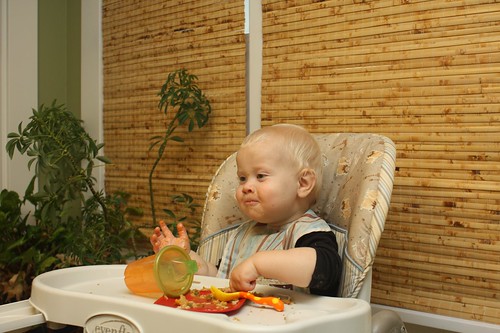
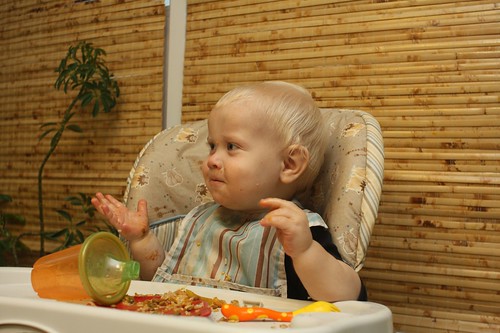
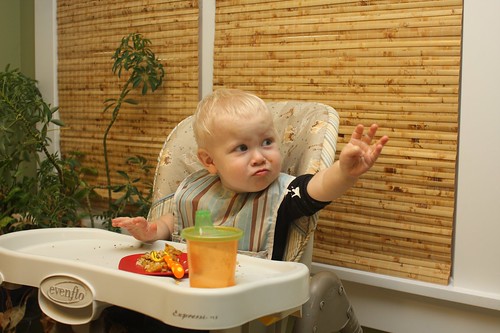
John Goerzen: Baby Yoda

Shifting gears from serious tractor injury stuff to the more humorous We re all used to seeing Yoda 900 years old. I ve noticed over the past couple of months that Oliver, while eating supper, seems to resemble a 1-year-old Yoda. So I got out my camera one evening, with the results below: IMG_4876.JPG Or this what s so hard about lifting an X-wing pose? IMG_4885.JPG And of course: IMG_4852.JPG

John Goerzen: Misc. Jacob Tidbits

A few random other thoughts about our recent experience with Jacob. Doc: You should know I m making this up as I go. There are no studies about kids that survive being driven over by a tractor because it doesn t happen. Jacob is a sample size of one. Jacob: I slept at the hospital last night. I did not like that. Nurse: Jacob, this IV is like a hose. We ll put water through it to give you a drink through your hand.
Jacob: Hmmmm! (very intrigued look) [a few hours later] Me: OK Jacob, let me get that IV tube untangled
Jacob, exasperated: Dad, that is not a TUBE. It is a HOSE! [ looking at the bowl that collects his urine for flow measurement, which has a scale labeled in ounces on one side and ml on the other ] Jacob: Dad! Look at that! I had 6 ounces of pee .. and also 200 ounces! This was probably the most intriguing thing to him about his stay. I didn t realize until the other evening what it meant that Jacob was admitted to the surgical instead of general medical floor. I had thought that odd but hadn t really processed what it meant. Terah pointed out that it meant that the doctor expected the tests they were running on Jacob to indicate what kind of surgery he would need, not that he wouldn t need surgery at all.

15 November 2010

Neil Williams: Documenting Emdebian - intro

Developers are not usually the right people to write documentation, but in an effort to encourage more Debian folk to consider Emdebian, I'm starting an intermittent series of blog posts to describe how Emdebian works and how it fits with Debian. Emdebian has a variety of ideas and experiments but the principle distribution, to be released alongside Debian Squeeze, is Emdebian Grip. This post, I'll cover the basic stuff. Feel free to let me know if there are particular issues you'd like covered. In particular, if the documentation on the Emdebian Grip website needs improving, let us know.
What's Emdebian Grip all about?
Simply a smaller Debian. Smaller packages, smaller downloads, smaller sets of packages, smaller installation sizes and smaller update sizes; yet always and completely binary compatible with Debian. Every backtrace from an Emdebian Grip device will match the backtrace on a Debian machine of the same architecture, package version etc. Packages can be mixed trivially (with some allowances for strict dependencies like -dbg packages). The name is a derivative of Squeeze - to make Debian smaller, we take a hold of it; Grip it.
Is it cross-building?
NO. Emdebian Grip is not recompiled (natively or cross), it is processed. Packages natively built in Debian are unpacked, files removed and repacked on the server before being included into the Emdebian repositories. dpkg and perl do all the work, not gcc.
What gets taken out?
Translations move out of the source packages and into TDebs (organised by locale) and compiled .mo files are then removed from the binary packages. Manpages and other documentation is lost entirely, copyright is compressed and changelogs are removed. None of the binary files are touched. The SHA256 sum of your /usr/bin/foo executable in Debian will be precisely the same in Emdebian, the same applies to libraries.
How is it done?
The emdebian-grip-server package in Debian processes the package and treats every architecture in the same way. (This allows Emdebian to carry unofficial ports like SH4, armhf etc.)
Why not filter stuff with dpkg?
The straight answer is that there usually isn't room to download the large package first in order to strip it on device. Also, filtering on device is slow. Stripping the package on the server means that the work is only done once. Every Emdebian device is saved the effort of filtering the files one machine at a time. Grip effectively does what dpkg filtering does, just it does it on the server, repacking the results into a new .deb. Instead of every device doing the task again and again, the server does it once.
Why is my pet package not included?
Emdebian restricts the number of packages which are included in the repositories (less than 10% of Debian packages will be included in Emdebian Grip 2.0 which is based on Debian 6.0 "squeeze") but provides tools which can be used (on device or on the desktop) to prepare any other package for installation on an Emdebian Grip device. There is no need for the machine preparing the package to be of the same architecture as the intended device because all processing is architecture-neutral.
Who decides which packages get included?
Me, basically. The merits of adding particular packages is usually discussed on the debian-embedded mailing list. Typical criteria (in rough order) include:
  1. Subjectively suitable for an embedded device (so OpenOffice.org does not qualify)

  2. most, if not all, dependencies already included in Grip

  3. already available in Debian testing

  4. not in a state of churn in Debian (rapid upload cycles, frequent library transitions etc.)
  5. not particularly buggy in Debian

Can I convert Debian to Emdebian Grip
Yes - simply add Emdebian to your apt sources list and watch as your next upgrade releases tens of megabytes of space.
What are these em1 version suffixes?
Emdebian modifies Debian packages, albeit in an architecture-independent manner, by removing files. The resulting packages are therefore different to the originals, albeit containing compatible binaries. Hence, the Emdebian processing adds the em1 version suffix to show which version is installed. Adding the suffix also means that every Emdebian package is considered to be an upgrade compared to the equivalent Debian package, if both exist in your apt sources.
How is Emdebian Grip installed?
It is possible to use Debian Installer (we provide pre-seeding files to help this process) or create a simple tarball using multistrap if that is more suitable for your device.
What about Recommends: ?
Debian defaults to installing all packages listed as Recommends in the package metadata. Emdebian simply drops the entire Recommends field when processing the package. Suggests is also omitted. This dramatically shortens dependency chains and gives developers full control over which packages are installed. It is important here to consider the embedded device user interface. Recommends exists to support those users who need the extra parts of the package, the bells and whistles. Embedded devices strictly control which parts of the package is actually exposed to the user - there is no need for a menu or a desktop. Users can only access the functionality exposed by the device, so no bells and whistles - just the base system and whatever you choose to expose as part of the interface. Rather than require all Emdebian devices to turn off Recommends individually, Emdebian simply drops Recommends at the server and allows the developer to cherry-pick which packages to add.

More to follow . . .

10 November 2010

John Goerzen: We re All Home

I wrote yesterday about our scare with Jacob. It s been quite the day. Before I go into it, I want to say thank you to all the many of you that have sent comments and support our way. Terah and I haven t had the chance to reply to many of them, but we have read every one, and very much appreciate it! Terah spent the night with Jacob, and I spent the day with him today (others were present for parts of it too). Jacob was mostly in good spirits. He was up and around, pushed his IV around himself in the room and to the bathroom. He called it my VI machine (not a typo take that, Emacs, eh?) He continued to enjoy measuring his trips to the bathroom. We went exploring a few times. He would walk or run down one of the long corridors in the hospital, holding my hand, while I pulled the IV along. We often went by the cafeteria, which he called the kitchen. One time he insisted that I get a cup of coffee from the free coffee dispenser. I insisted that I didn t want to, but eventually asked, Shall I get a pretend cup of coffee? Yeah! So he watched me get a pretend cup, pretend to fill it, and pretend to drink it and smiled and clapped for me after. He spent hours watching videos of trains on YouTube. This is a favorite activity at home too, but we obviously limit the amount of time he can spend doing it. I had to limit the amount of time he spent with it today too, of course, but he got rather more time with it than usual. Jacob had his usual books, but I thought we might try something new today. This morning, I loaded The Tale of Peter Rabbit (with illustrations) onto my Kindle. Jacob loved it, and enjoyed pressing the Next Page button in the Kindle. We read it twice, and he is interested by the promise of other stories about rabbits. It also probably didn t hurt that his grandma had given him a rabbit in the hospital yesterday. As we got on towards evening, I told him that tomorrow could be a normal day. His response: enthusiastic applause and a big grin, plus YAY! Jacob loved eating today. He wolfed down breakfast and lunch. He enjoyed the lemonade I brought for him again, and played with some toys, and yes, watched some more train videos in the afternoon. He also pretended to ignore the visitors he got as much as possible (pretty typical for him actually). The doctor came by at about 6:00PM and again was just stunned at how well he s doing. Jacob neither complained of any pain nor acted like he had any even when the nurses would rub neosporin on his wounds. The doctor was still just stunned at how well he was doing. He told us his last tractor accident resulted in a death before LifeWatch could arrive, and the one before that turned a good student and a promising athlete into a wheelchair-bound person with a vocabulary of 20 words. I can t believe I m discharging him today, but try as I might, as I go over all the details, there s no reason for him to stay. I thanked him for all his help, and he said, I didn t do anything for him. All I did was figure out what had happened to him . I guess we have the CT to prove that something really did happen, but the fact that he showed up at my office in the first place was stunning enough. Jacob started to get more excited after the IV was unhooked from him. He didn t particularly like having the needle removed, due to the pain of taking off the tape, but was happy to have it gone. He was making plans: will we stop by the train station on the way home? It s the middle of the night maybe a train will be there! (If it s dark outside, it s middle of the night to him) We agreed to stop by the cafeteria to pick him up one last lemonade, than stop at the train station. The nurses offered a wheelchair to take him out to the car with. I said I didn t think he d want it. One of them said, Wouldn t you like a FUN ride in a WHEELCHAIR? Jacob: No. Me: I suspect he will want to run out of here. Nurse: OK then. We walked, or half ran, to the cafeteria to get his lemonade. Then we went out to the car. He was excitedly jabbering about everything: the car, my radio, and especially the train station. We did drive by, and at least got to see a freight engine go past. He noticed the Christmas lights starting to be set out along Main Street, and said, Dad, it s CHRISTMAS! Well, almost Then he got quiet, and eventually fell asleep in the car. He had almost fallen asleep while eating his lunch, but stayed awake, and then got interested in other things so he had no nap today. When we got home, I unbuckled him and pulled him out of his seat. He opened his eyes for just a second, wrapped his arms tightly around my neck, put his head on my shoulder, and fell back asleep while I carried him up to his room. I put him down on his own bed. He had a contented sigh, pulled his favorite blanket up to his neck like he loves to do, and was back asleep in no time. Our little boy is home, safe and sound. It s a happy day.

9 November 2010

John Goerzen: A Scary Day, and A Walking Miracle

I had been planning to write today about my great uncle Milt Goerzen. Milt passed away last Thursday after a long struggle with dementia, and his funeral was this morning. I was there, and was inspired by a few things I heard. But that will have to wait, because today brought one of those few moments in life that s a sense of an impending possible great loss. I can remember two others: one was when Terah passed out, and the other was when we heard that our place was on fire and our house had burned down (it turned out the house hadn t, but much of the rest had). I got a call during Milt s funeral. I didn t answer because I was, well, at a funeral, and the phone was on vibrate. When I had the chance to check the voicemail, it went something like this: I think we have an emergency with Jacob. He got run over by a tractor. He says he s OK, but I m taking him to the doctor right now. I tried to return the call, but cell phone reception wasn t cooperating. The most I got was he s OK . It s hard to describe how a moment like that feels. My mind jumped to telling Jacob I love you , and how lately when he hears that, he will snuggle in for a big hug, and say, Dad, I love you toooooooooo! On the one hand, I heard the he s OK part, and on the other hand I couldn t forget the tractor running over him part, and my mind leapt at the worst. It turns out that, while I was at the funeral, Jacob had been standing on his usual spot on the tractor, sort of to the side of the driver. He was enjoying himself like usual. The tractor hit a large hole that wasn t really visible. The combination of the jolt and the dip the tractor took towards Jacob s side knocked him off and he went directly under the big rear wheel before the tractor could be brought to a stop. I caught up with him and his grandpa after he had seen the doctor and just as he was being admitted to the hospital. He saw me and crawled over, making his sort of sad and scared sound he sometimes doesn t want to verbalize things when he s in that mood. I held him close and he seemed to appreciate it. He had to have blood drawn, and he was scared of that. I remembered his inquisitive mind, and reminded him how much he liked watching the tube fill up with blood last time he had a blood test (which he calls a blood shot ). That wasn t helping, until the actual blood test started. He cried when the needle went in, but then calmed down as the nurse, getting into the act, pointed out that there was blood filling up the tube. Hmmm! said Jacob. Then she gave him a band-aid. It has an airplane, said the nurse. Um-hmm! said Jacob. I pointed out that it looked like the airplane we were on when we flew home from New York. Jacob got a big smile and said, Yes, it IS that one! He got a sticker there too. Then it was off for an x-ray to check for broken bones and a CT scan to check for internal injuries the tractor had gone right over his abdomen. He had to get an IV at the CT scan, which he certainly didn t like. After it happened, however, he found it very interesting especially when the nurses explained that they would give him a drink through the hose attached to his hand. After that, we went to his room, with orders for him not to eat or drink anything until it was clear he didn t have digestive problems. While we waited at various steps along the way, Jacob wanted to sit on my lap and watch train videos on YouTube on my phone. He loves train videos, and brought my phone s battery nearly to depletion through the course of the afternoon. Jacob eventually seemed to get back to a bit of his usual self. At one point, while Terah had made a run home to pack an overnight bag and grandpa ran some errands of his own, Jacob wanted to leave the room. He had gone exploring in the hospital with me before: when Oliver was born, and when Terah had her thyroid surgery. So this was something he just associated with the hospital. That and lemonade, which is free any time of the day or night in the cafeteria. So we went exploring, even ventured outside into a courtyard for a bit. He was walking fast and seemed good. We had several visitors: grandparents and his aunt and uncle. Jacob got a stuffed rabbit and a colorful bug box with windows (for putting bugs inside for observation). Eventually the doctor came by and gave us the results: the x-rays showed no problems. The labs showed some elevated liver enzymes, which he expected, but no serious trouble. The CT showed contusions on his lung and bruising on his heart which would heal completely in time. He allowed Jacob to have a liquid supper (so I quickly got him the lemonade he had been wanting while the nurses got him some Jello). The doctor examined Jacob, pushing at various places, asking Does it hurt here? No. Does it hurt here? No. Here? No. Are you hungry? Yes. Does it hurt here? No. He gave me a look that said: really? It doesn t hurt ANYWHERE? What could I do but shrug my shoulders? Jacob has some abrasions on his face, arms, and back, which will probably eventually hurt (and sure enough, about 10 minutes later he started getting a little pain when he tried to move, which the doctor checked out) Then the doctor said, I hope you know you have a walking miracle today. This is just amazing. You have some thanking to whatever guardian angels you like tonight all I can say about this is that the Lord must have had some other plan for him. There s no way he could have survived that. Jacob s doctor is one that we really respect: he s scientific in his analysis, cites studies as a matter of routine, doesn t prescribe antibiotics for things that he knows they have a small chance of helping, is common-sense about not over-treating things and yet always engaged in an emergency. That little speech from him was something I d never expected to hear from him. He went on to add that I always visit my sickest patients first. You were my last visit this evening, so that should tell you something. Any other kid as healthy as he is, I might discharge already but I m just not justified doing that with a boy that s, well, been driven over by a tractor this morning. He also wanted to monitor Jacob s progress throughout the coming day, especially his digestive system. They wanted to measure his urine output, which he, predictably, found to be very interesting. Terah said I think it is about 150 ml. Jacob said, No mom, it is closer to the two hundred line. Me: Since when does Jacob know about the number 200? Terah: I don t know . he s 4, where would he have gotten it? Between that, and using every opportunity to tell people that there were not one but TWO red light switches in the x-ray room, Jacob s definitely himself in some ways already. So, that feeling of some impeding great loss is gone, replaced by being more than a bit overwhelmed by how fortunate we were today. We also appreciate all the help we ve had with Jacob and Oliver today.

7 November 2010

Martin-Éric Racine: Ubuntu no longer ships debian/changelog since Natty?

Since a few days, I have started to notice that the "Debian" changelog that normally ships with packages no longer appears with a number of recent package updates. Is this intentional?

3 November 2010

Dirk Eddelbuettel: Rcpp 0.8.8

A bug-fix release 0.8.8 of Rcpp is now available. It is awaiting processing at CRAN, and will be uploaded to Debian once processed at CRAN. In the meantime, sources are available from my local directory here. This release follows on the heels of 0.8.7, but contains fixes for a few small things Romain and I had noticed over the last two weeks since releasing 0.8.7 and contains only a small number of new tweaks. The NEWS entry follows below:
0.8.8   2010-11-01
    o   New syntactic shortcut to extract rows and columns of a Matrix. 
        x(i,_) extracts the i-th row and x(_,i) extracts the i-th column. 
    
    o   Matrix indexing is more efficient. However, faster indexing is
        disabled if g++ 4.5.0 or later is used.
    o   A few new Rcpp operators such as cumsum, operator=(sugar)
    o   Variety of bug fixes:
        - column indexing was incorrect in some cases
        - compilation using clang/llvm (thanks to Karl Millar for the patch)
        - instantation order of Module corrected
        - POSIXct, POSIXt now correctly ordered for R 2.12.0 
As always, even fuller details are on the Rcpp Changelog page and the Rcpp page which also leads to the downloads, the browseable doxygen docs and zip files of doxygen output for the standard formats. A local directory has source and documentation too. Questions, comments etc should go to the rcpp-devel mailing list off the R-Forge page

1 November 2010

John Goerzen: Some Amateur Radio Statistics

I ve had a lot of fun with amateur radio since I got licensed in July! Here are some numbers regarding my HF contacts. Not included in this are probably hundreds of more contacts on VHF or UHF, which are more local bands and not typically logged. One of my favorite moments happened recently when I turned on my digital program (fldigi) and happened to tune to 17m. I don t have antennas there and don t usually bother, since there s rarely something I can receive. But I saw two PSK-31 (digital) signals. One of them was a Japenese station calling CQ. I replied, and although we had some noise (perhaps due to my lack of a 17m antenna), made my first contact with Japan! Things like this are part of the fun of amateur radio. Sometimes things that have no business working actually do, and I get a surprise like this.

28 October 2010

John Goerzen: Rudy Schmidt & Time Capsules

This evening, I arrived at church for mens chorus practice. I was surprised to see this sign on the door:
Rudy Schmidt died rather unexpectedly, but peacefully on Wednesday morning at his home .
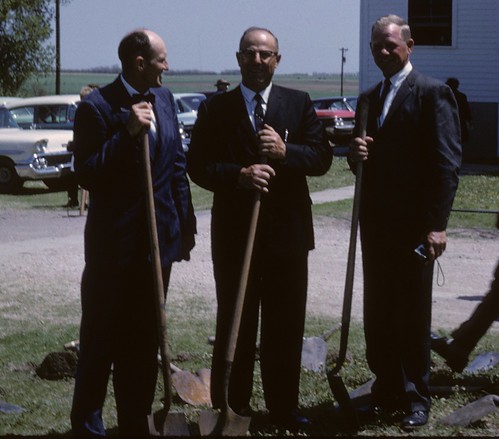
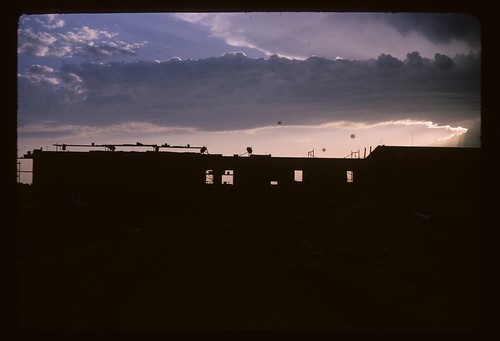
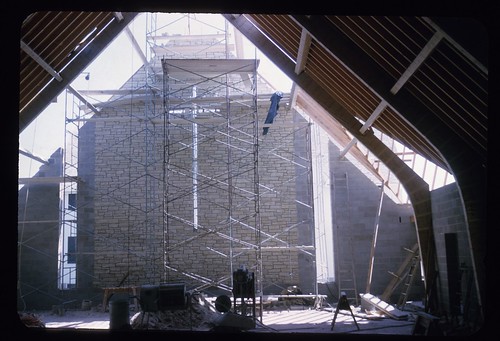
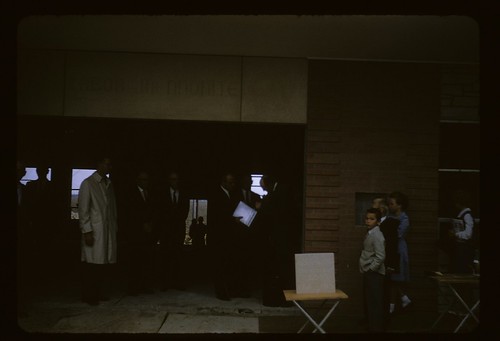
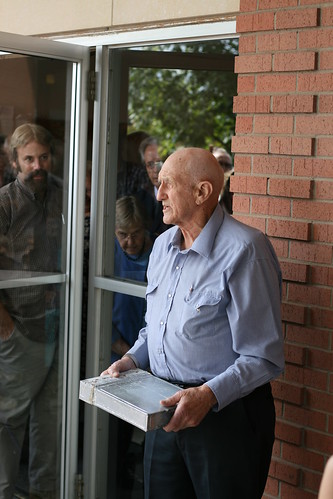
One of the benefits of living in a small community is that I get to know people of all ages around here. Not just people my own age, or coworkers. A few years ago, I worked on a history project for our church s centennial. Back in the 1960s, Rudy was one of the people in charge of building our current church. So he was a person I was interested in visiting with. Here he is, on the left, during the 1964 groundbreaking ceremony for the new building (the old one is visible in the background). 022 stamped may 1964cropped.jpg I and a few others went to his home one time a few years ago and we had a wonderful evening. Rudy shared all sorts of stories with us which I am happy to say I recorded. But moreover, Rudy was an avid photographer. There were some rare and brilliant color slides of the church being built in his collection. He let me borrow and scan some of them. Here are my two favorites: 015 stamped july 1964.jpg 016 stamped oct 1964.jpg Back in 1965, there was a ceremony at the setting of the cornerstone of Tabor Church. The people at the time assembled some papers and memorabilia and put them in a time capsule. Rudy Schmidt sealed the capsule and it was placed in the spot for it behind the cornerstone. Here is a photo of that ceremony. 013 stamped nov 1964.jpg 44 years later, on the occasion of Tabor s centennial, it was time to open the time capsule. The other building committee people, such as Jake Koehn, had passed away, so Rudy was the one to open it. He gave a few words in front of the large crowd, and mentioned that when he sealed it away, he smelled some smoke when he soldered it shut. Jake Koehn told him, Don t worry, nobody will ever see it again anyway and they had a little laugh about it. Now he was going to open it up and see if anything survived. img_6173.jpg It all did just a few minor burn marks. We enjoyed looking at all the items. Then the church placed some new items into the capsule. It was closed up again, to be opened in maybe 50 years. With luck, I ll still be around to see it opened again. Even if I m not, maybe Jacob and Oliver will be able to. And so it seems very fitting that the last hands to touch that box for the next 50 years were Rudy Schmidt s, when he placed it back in its spot on Oct. 12, 2008. img_6243.jpg

24 October 2010

Gregor Herrmann: RC bugs 2010/41 - 2010/42

it seems I was a bit busy & lazy in the last two weeks. luckily diocles & evgeni were more active than me kudos!

here are my small contributions:

21 October 2010

Axel Beckert: New upstream versions of xrootconsole and keynav in Debian Experimental

I recently uploaded new upstream versions of two neat small X tools to Debian Experimental: Both packages introduce several new features and I d be happy if users of these packages in Debian Sid or Debian Sid users curious about them could test the versions in Debian Experimental. xrootconsole 0.6 + patches xrootconsole saw no love since 2006 with the last maintainer upload having been in 2002. Nevertheless it never got kicked out of Debian just because of this. The package had been forcibly orphaned just less than a year ago. So it s no big wonder that this new upstream version I packaged was released already back in 2004. :-) But besides packaging a new upstream version, bumping Standards-Version and debhelper compatibility, fixing tons of lintian warnings and some bugs, I also added two patches which add new features not (yet) available upstream: Of course I informed upstream about these feature patches, but I haven t got any feedback yet. But I got feedback from Julien Viard de Galbert, and he ll join me in packaging xrootconsole as co-maintainer. keynav 0.20101014.3067 I adopted the Debian package of keynav recently, subscribed to the keynav mailing list (well, it s a Google group), got a nice welcome mail from the very friendly upstream developer Jordan Sissel who offered to help with any keynav issues. I told him what features I d like to see in keynav to fit better the setup where I m using it. And just a few days later there was a new upstream release including both features I suggested, some more neat new features, and one bug fix. Jordan Sissel writes in the upstream changelog (emphasis and italic text by me): Both packages will be reuploaded to Debian Sid (Unstable) after the release of Debian Squeeze (currently testing ).

16 October 2010

Dirk Eddelbuettel: RcppArmadillo 0.2.8

Version 0.2.8 of RcppArmadillo is now on CRAN. This updates the included Armadillo template library to version 0.9.90 which Conrad released two few days ago. RcppArmadillo makes it easy to write highly efficient and highly readable C++ code for linear algebra (based on Armadillo) in R extensions (using Rcpp for the interface). The short NEWS file extract follows, also containing Conrad's entry for 0.9.90::
    o   Upgraded to Armadillo 0.9.90 "Water Dragon":
         * Added unsafe_col()
         * Speedups and bugfixes in lu()
         * Minimisation of pedantic compiler warnings
    o   Switched NEWS and ChangeLog between inst/ and the top-level directory
        so that NEWS (this file) gets installed with the package
More information is on the RcppArmadillo page. Questions, comments etc should go to the rcpp-devel mailing list off the R-Forge page.

Siegfried Gevatter: Debious A dubious Debian packaging GUI

Just some little (unfinished) concept mockup. Seeing that much of it still ends up as a text box with syntax highlighting it d probably make sense to implement it as a gedit plugin.

Balsamiq source XML Related posts:

  1. One week with Debian
  2. Packaging: Test-building your packages
  3. Arreglant paquets que no compilen: necpp

8 comments
Siegfried-Angel Gevatter Pujals, 2010. Permalink License Post tags: , ,

15 October 2010

Dirk Eddelbuettel: Rcpp 0.8.7

With the scheduled R release of version 2.12.0 this morning, we have just uploaded version 0.8.7 of Rcpp to CRAN; Debian will follow shortly once the autobuilders have processed R 2.12.0 This Rcpp release depends on R 2.12.0 as two things have changed. First, we play along with change in R concerning the ordering of inheritance for time classes. But secondly, and more importantly, we support in Rcpp the corresponding change R itself which brings the new ReferenceClasses. Here is corresponding bit from R's NEWS file for R 2.12.0:
    o A facility for defining reference-based S4 classes (in the OOP
      style of Java, C++, etc.) has been added experimentally to
      package methods; see ?ReferenceClasses.
[...]
    o An experimental new programming model has been added to package
      methods for reference (OOP-style) classes and methods.  See
      ?ReferenceClasses.
This was made possible in large part by code committed by John Chambers (whom we had welcomed recently as a co-author to Rcpp) building on the changes he made to R 2.12.0 itself, as well on the work Romain had done with 'Rcpp Modules'. The R help page for ReferenceClasses carries a reference (bad pun) to Rcpp 0.8.7 so these two releases do go together. This should be a lot of fun over the next little while: S3, S4, and now ReferenceClasses. We also made a number of internal changes some of which leads to speed-ups and internal improvement. The NEWS entry follows below:
0.8.7   2010-10-15
    o   As of this version, Rcpp depends on R 2.12 or greater as it interfaces 
        the new reference classes (see below) and also reflects the POSIXt class
        reordering both of which appeared with R version 2.12.0
    o   new Rcpp::Reference class, that allows internal manipulation of R 2.12.0
        reference classes. The class exposes a constructor that takes the name
        of the target reference class and a field(string) method that implements
        the proxy pattern to get/set reference fields using callbacks to the 
        R operators "$" and "$<-" in order to preserve the R-level encapsulation
    o   the R side of the preceding item allows methods to be written
        in R as per ?ReferenceClasses, accessing fields by name and
        assigning them using "<<-".  Classes extracted from modules
        are R reference classes.  They can be subclassed in R, and/or R methods
        can be defined using the $methods(...) mechanism.
    o   internal performance improvements for Rcpp sugar as well as an added
        'noNA()' wrapper to omit tests for NA values -- see the included
        examples in inst/examples/convolveBenchmarks for the speedups
    o   more internal performance gains with Functions and Environments
As always, even fuller details are in Rcpp Changelog page and the Rcpp page which also leads to the downloads, the browseable doxygen docs and zip files of doxygen output for the standard formats. A local directory has source and documentation too. Questions, comments etc should go to the rcpp-devel mailing list off the R-Forge page

11 October 2010

John Goerzen: Pump Organs and Music

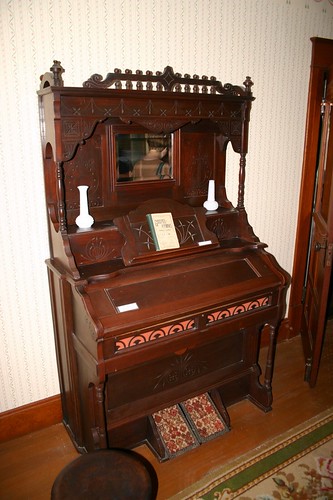
Two years ago, I wrote about Elvera Voth and the power of love. Back then I wrote about her memories of seeing of service workers, who would be away from their home for 7 years at a time. Elvera remembered a gathering of people at the train station to see them off, and how they sang some German hymns at the occasion. Elvera s done a lot since, including starting an arts in prison program. And today, she hosted a hymn sing at the pump organ in the Friesen House parlor. img_4305.jpg The Friesen House is nearly 100 years old, and was on my parents property before it got moved to the Mennonite Heritage and Agricultural Museum. We were among maybe 20 people that showed up for the event. We walked in a few minutes early and Elvera was sitting at the organ already, along with a few other early arrivals. Many of the people there were over 70, and the moment we walked in, she said, Oh good! Another generation! And, of course, asked about us, where we live, who we are related to, etc. The announcement in our church bulletin said to bring a copy of Gesangbuch mit Noten if you have one. That was a common hymn book in Mennonite churches in Kansas (songbook with notes and yes, there was one without notes that had only words.) I pulled out my copy, and just opened it up. I saw my grandma s beautiful handwriting saying it belonged to Mr. and Mrs. R. A. Klassen . This I brought along, but was perhaps the only one. Elvera recognized it and was pleased to hear where it came from. We had a great time, and it turned out to feel like the kind of afternoon people around here used to have: time with friends and family visiting and maybe singing on occasion. After some introduction and some stories, we got to the singing and started with hymn #1 in the 1969 (English) Mennonite Hymnal. That song had German words below as well, which we sang: Grosser Gott, wir loben dich! (Holy God, We Praise Thy Name) Elvera played the organ while we all sang. And then we turned to #556, O Have You Not Heard. We read through the German lyrics (to help those that don t speak German):
Ich weiss einen Strom, dessen herrliche Flut
fliesst wunderbar stille durchs Land,
doch strahlet und gl nzt er wie feurige Glut,
wem ist dieses W sser bekannt? O Seele, ich bitte dich: Komm!
Und such diesen herrlichen Strom!
Sein Wasser fliesst frei und m chtiglich,
o glaub s, es fliesset f r dich!
Elvera translated this herself, a much more powerful translation than we usually get in English. And then we sang, this time a cappella. Elvera told the story about the train station to this group, and then, of course, we sang O Power of Love, one of the songs sung on that occasion. For that, she asked us to stand up and form a circle around the organ, and again we sang mostly a cappella. Singing that song with Elvera left few dry eyes in the room for sure. Someone brought up Nun Ist Sie Erschienen, and so of course we sang that. It wasn t in any hymnal, but I suspect we were the only ones there that didn t have it completely memorized. Elvera told us the story of the museum s pump organ; it had been in her family, and she had paid to have it restored and eventually donated it to the museum. It had been used every evening at twilight for singing and devotions in the family. She also told us that the singing at the Newton train station the same one our family uses a few times a year was what inspired her to a career of choral music. In the end, we probably spent more time visiting than singing, but that was just fine. Next the group went over to the Preparatory School, an old schoolhouse also on the museum grounds. There we had a traditional Faspa, an afternoon meal with coffee, Zwieback and jam, cheese, and various cookies. We all visited for awhile longer and then went on our way. It was a wonderful afternoon, and I hope to have a chance to do that sort of thing again.

9 October 2010

Sylvain Le Gall: LLVM, OCaml and Debian

I hope some people from the OCaml community will enjoy this changelog, extracted from llvm 2.6-7, which has just been uploaded:
  [ Arthur Loiret ]
   
  [...]
  [ Sylvain Le Gall ]
  * Build a libllvm-ocaml-dev package, which contains the OCaml binding:
    Closes: #568556.
    - debian/debhelper.in/libllvm-ocaml-dev. dirs,doc-base,install,META : Add.
    - debian/control.in/source: Build-Depends on ocaml-nox (>= 3.11.2),
      ocaml-best-compilers   ocaml-nox, dh-ocaml (>= 0.9.1).
    - debian/packages.d/llvm.mk:
      + (llvm_packages): Add libllvm-ocaml-dev.
      + (libllvm-ocaml-dev_extra_binary): Define, install META file.
    - debian/rules.d/binary.mk: Add dh_installdirs and dh_ocaml.
    - debian/rules.d/vars.mk:
      + include /usr/share/ocaml/ocamlvars.mk.
      + Configure with --with-ocaml-libdir=$(OCAML_STDLIB_DIR)/llvm.
  * debian/rules.d/build.mk: Fix symlinks pointing to the $DESTDIR.
In other words: LLVM is now built with its OCaml bindings and a META file for findlib. It will take some days before reaching every architectures, but hopefully it will be in Squeeze (next Debian stable release). Thanks to Arthur Loiret for the quick upload.

7 October 2010

Debian News: Neuroimaging research in Debian

Debian 6.0 squeeze will be the first GNU/Linux distribution release ever to offer comprehensive support for magnetic resonance imaging (MRI) based neuroimaging research. It comes with up-to-date software for structural image analysis (e.g. ants), diffusion imaging and tractography (e.g. mrtrix), stimulus delivery (e.g. psychopy), MRI sequence development (e.g. odin), as well as a number of versatile data processing and analysis suites (e.g. nipype). Moreover, this release will have built-in support for all major neuroimaging data formats.

Please see the Debian Science and Debian Med task pages for a comprehensive list of included software and the NeuroDebian webpage for further information.

NeuroDebian at the Society for Neuroscience meeting 2010

The NeuroDebian team will run a Debian booth at the Society for Neuroscience meeting (SfN2010) that will take place November 13-17 in San Diego, USA. The annual meeting of the Society for Neuroscience is one of the largest neuroscience conferences in the world, with over 30,000 attendees. Researchers, clinicians, and leading experts discuss the latest findings about the brain, nervous system, and related disorders.

If you are a Debian enthusiast (developer, contributor, evangelist) and reside near San Diego (or have time and funds for travel/lounge), or already planing to attend SfN 2010, please help us to make the Debian booth at SfN shine. Please contact the NeuroDebian team at team@neuro.debian.net

If you are going to SfN2010, come talk to us at booth #3815.

Michael Hanke and Yaroslav Halchenko

John Goerzen: Why all the Obama hate?

I am really struggling with all this anti-Obama rhetoric, coming from both the right and the left. From where I sit, while he hasn t been perfect, he s accomplished quite a bit for us since he s been president. Consider: I don t get it. Liberals are claiming he s not doing enough, but look at what he s got to work with: Republicans filibustering just about everything in the Senate. I don t think that s Obama s fault. And the conservatives, as far as I can tell, are just yelling. I can t figure this out. They want to cut taxes, cut the deficit, and increase defense spending. Good luck with that.

6 October 2010

John Goerzen: Amateur Radio Excitement

I ve been keeping up with my amateur radio activities lately. The big news is that I passed the amateur extra exam at a hamfest in Wichita on Saturday. That s the highest level of amateur radio licensing available, and only about 17% of hams have it. I passed it with 100% correct, as I did with my other two exams as well. Pretty happy with that. I m also getting ready to get a radio installed in my car. My FT-857D, which I ve been using in the house, is really a mobile. I picked up antennas and cables for that at the Wichita hamfest. My brother, who is great with cars, will probably help me do that. I m excited about that. I also think I can get radio going on my bicycle. I need a half-wave vertical antenna to mount on it. Really the only challenge is how to attach that to the bicycle, as there isn t exactly a thriving antenna mount industry for bicyclists.

Next.

Previous.