Search Results: "ag"

4 May 2025

Dirk Eddelbuettel: #47: r2u at its Third Birthday

Welcome to post 47 in the $R^4 series! r2u provides Ubuntu binaries for all CRAN packages for the R system. It started three years ago, and offers for Linux users on Ubuntu what windows and macOS users already experience: fast, easy and reliable installation of binary packages. But by integrating with the system package manager (which is something that cannot be done on those other operating systems) we can fully and completely integrate it with underlying system. External libraries are resolved as shared libraries and handled by the system package manager. This offers fully automatic installation both at the initial installation and all subsequent upgrades. R users just say, e.g., install.packages("sf") and spatial libraries proj, gdal, geotiff (as well as several others) are automatically installed as dependencies in the correct versions. And they remain installed along with sf as the system manager now knows of the dependency. Work on r2u began as a quick weekend experiment in March 2022, and by May 4 a first release was marked in the NEWS file after a few brave alpha testers kicked tires quite happily. This makes today the third anniversary of that first release, and marks a good time to review where we are. This short post does this, and stresses three aspects: overall usage, current versions, and new developments.

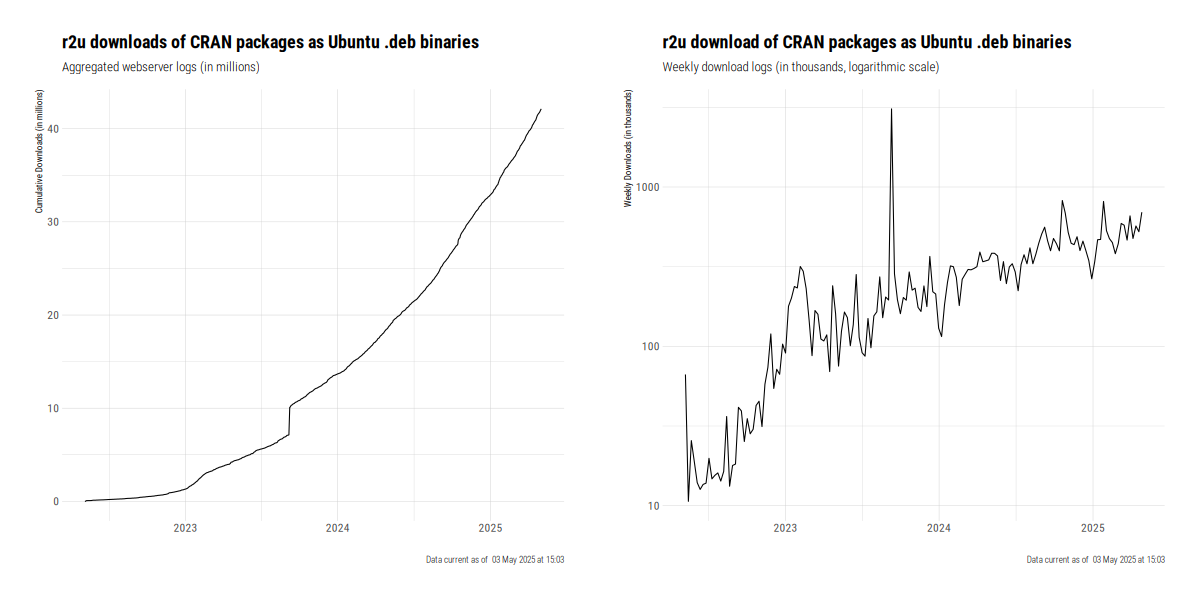
Steadily Growing Usage at 42 Million Packages Shipped r2u ships from two sites. Its main repository is at the University of Illinois campus providing ample and heavily redundant bandwidth. We remain very grateful for the sponsorship from Atlas. It also still ships from my own server though that may be discontinued or could be spotty as it is on retail fiber connectivity. As we have access to the both sets of server logs, we can tabulate and chart usage. As of yesterday, total downloads were north of 42 million with current weekly averages around 500 thousand. These are quite staggering numbers for what started as a small hobby project, and are quite humbling. Usage is driven by deployment in continuous integration (as for example the Ubuntu-use at GitHub makes this both an easy and obvious choice), cloud computing (as it is easy to spin up Ubuntu instances, it is as easy to add r2u via four simple commands or one short script), explorative use (for example on Google Colab) or of course in general laptop, desktop, or server settings.
Current Versions Since r2u began, we added two Ubuntu LTS releases, three annual R releases as well as multiple BioConductor releases. BioConductor support is on a best-efforts basis motivated primarily to support the CRAN packages having dependencies. It has grown to around 500 packages and includes the top-250 by usage. Right now, current versions R 4.5.0 and BioConductor 3.21, both released last month, are supported.

New Development: arm64 A recent change is the support of the arm64 platform. As discussed in the introductory post, it is a popular and increasingly common CPU choice seen anywhere from the Raspberry Pi 5 and it Cortex CPU to in-house cloud computing platforms (called, respectively, Graviton at AWS and Axiom at GCS), general server use via Ampere CPUs, Cortex-based laptops that start to appears and last but not least on the popular M1 to M4-based macOS machines. (For macOS, one key appeal is in use of lighterweight Docker use as these M1 to M4 cpus can run arm64-based containers without a translation layer making it an attractive choice.) This is currently supported only for the noble aka 24.04 release. GitHub Actions, where we compile these packages, now also supports jammy aka 22.04 but it may not be worth it to expand there as the current latest release is available. We have not yet added BioConductor support but may do so. Drop us a line (maybe via an issue) if this of interest. With the provision of arm64 binaries, we also started to make heavier use of GitHub Actions. The BioConductor 3.21 release binaries were also created there. This makes the provision more transparent as well as the configuration repo as well as the two builder repos (arm64, bioc) are public, as is of course the main r2u repo.

Summing Up This short post summarised the current state of r2u along with some recent news. If you are curious, head over to the r2u site and try it, for example in a rocker/r2u container.

This post by Dirk Eddelbuettel originated on his Thinking inside the box blog. If you like this or other open-source work I do, you can now sponsor me at GitHub.

Colin Watson: Free software activity in April 2025

About 90% of my Debian contributions this month were sponsored by Freexian. You can also support my work directly via Liberapay. Request for OpenSSH debugging help Following the OpenSSH work described below, I have an open report about the sshd server sometimes crashing when clients try to connect to it. I can t reproduce this myself, and arm s-length debugging is very difficult, but three different users have reported it. For the time being I can t pass it upstream, as it s entirely possible it s due to a Debian patch. Is there anyone reading this who can reproduce this bug and is capable of doing some independent debugging work, most likely involving bisecting changes to OpenSSH? I d suggest first seeing whether a build of the unmodified upstream 10.0p2 release exhibits the same bug. If it does, then bisect between 9.9p2 and 10.0p2; if not, then bisect the list of Debian patches. This would be extremely helpful, since at the moment it s a bit like trying to look for a needle in a haystack from the next field over by sending instructions to somebody with a magnifying glass. OpenSSH I upgraded the Debian packaging to OpenSSH 10.0p1 (now designated 10.0p2 by upstream due to a mistake in the release process, but they re the same thing), fixing CVE-2025-32728. This also involved a diffoscope bug report due to the version number change. I enabled the new --with-linux-memlock-onfault configure option to protect sshd against being swapped out, but this turned out to cause test failures on riscv64, so I disabled it again there. Debugging this took some time since I needed to do it under emulation, and in the process of setting up a testbed I added riscv64 support to vmdb2. In coordination with the wtmpdb maintainer, I enabled the new Y2038-safe native wtmpdb support in OpenSSH, so wtmpdb last now reports the correct tty. I fixed a couple of packaging bugs: I reviewed and merged several packaging contributions from others: dput-ng Since we added dput-ng integration to Debusine recently, I wanted to make sure that it was in good condition in trixie, so I fixed dput-ng: will FTBFS during trixie support period. Previously a similar bug had been fixed by just using different Ubuntu release names in tests; this time I made the tests independent of the current supported release data returned by distro_info, so this shouldn t come up again. We also ran into dput-ng: override doesn t override profile parameters, which needed somewhat more extensive changes since it turned out that that option had never worked. I fixed this after some discussion with Paul Tagliamonte to make sure I understood the background properly. man-db I released man-db 2.13.1. This just included various small fixes and a number of translation updates, but I wanted to get it into trixie in order to include a contribution to increase the MAX_NAME constant, since that was now causing problems for some pathological cases of manual pages in the wild that documented a very large number of terms. debmirror I fixed one security bug: debmirror prints credentials with progress. Python team I upgraded these packages to new upstream versions: In bookworm-backports, I updated these packages: I dropped a stale build-dependency from python-aiohttp-security that kept it out of testing (though unfortunately too late for the trixie freeze). I fixed or helped to fix various other build/test failures: I packaged python-typing-inspection, needed for a new upstream version of pydantic. I documented the architecture field in debian/tests/autopkgtest-pkg-pybuild.conf files. I fixed other odds and ends of bugs: Science team I fixed various build/test failures:

Russ Allbery: Review: The Book That Held Her Heart

Review: The Book That Held Her Heart, by Mark Lawrence
Series: Library Trilogy #3
Publisher: ACE
Copyright: 2025
ISBN: 0-593-43799-3
Format: Kindle
Pages: 367
The Book That Held Her Heart is the third and final book of the Library fantasy trilogy and a direct sequel to The Book That Broke the World. Lawrence provides a much-needed summary of the previous volumes at the start of this book (thank you to every author who does this!), but I was still struggling a bit with the blizzard of character names. I recommend reading this series entry in relatively close proximity to the other two. At the end of the previous book, and following some rather horrific violence, the cast split into four groups. Three of those are pursuing different resolutions to the moral problem of the Library's existence. The fourth group opens the book still stuck with the series villains, who were responsible for the over-the-top morality that undermined my enjoyment of The Book That Broke the World. Lawrence follows all four groups in interwoven chapters, maintaining that complex structure through most of this book. I thought this was a questionable structural decision that made this book feel choppy, disconnected, and unnecessarily confusing. The larger problem, though, is that this is the payoff book, the book where we find out if Lawrence is equal to the tricky ethical questions he's raised and the world-building masterpiece that The Book That Wouldn't Burn kicked off. The answer, unfortunately, is "not really." This is not a total failure; there are some excellent set pieces and world-building twists, and the characters remain likable and enjoyable to read about (although the regrettable sidelining of Livira continues). But the grand finale is weirdly conservative and not particularly grand, and Lawrence's answer to the moral questions he raised is cliched and wholly unsatisfying. I was really hoping Lawrence was going somewhere more interesting than "Nazis bad." I am entirely sympathetic to this moral position, but so is every other likely reader of this series, and we all know how that story goes. What a waste of a compelling setup. Sadly, "Nazis bad" isn't even a metaphor for the black-and-white morality that Lawrence first introduced at the end of the previous book. It's a literal description of the main moral thrust of this book. Lawrence introduces yet another new character and timeline so that he can write about thinly-disguised Nazis persecuting even more thinly-disguised Jews, and this conflict is roughly half this book. It's also integral to the ending, which uses obvious, stock secular sainthood as a sort of trump card to resolve ideological conflicts at the heart of the series. This is one of the things I was worried about after I read the short stories that Lawrence published between the volumes of this series. All of them were thuddingly trite, which did not make me optimistic that Lawrence would find a sufficiently interesting answer to his moral trilemma to satisfy the high expectations created by the build-up. That is, I am sad to report, precisely the failure mode of this book. The resolution of the moral question of the series is arguably radical within the context of the prior world-building, but in a way that effectively reduces it to the boring, small-c conservative bromides of everyday reality. This is precisely the opposite of why I read fantasy, and I did not find Lawrence's arguments for it at all convincing. Neither, I think, did Lawrence, given that the critical debate takes place off camera so that he could avoid having to present the argument. This is, unfortunately, another series where the author's reach exceeded their grasp. The world-building of The Book That Wouldn't Burn is a masterpiece that created one of the most original and compelling settings that I have read in fantasy for a long time, but unfortunately Lawrence did not have an equally original plan for how to use the setting. This is a common problem and I'm not going to judge it too harshly; it's much harder to end a series than it is to start one. I thought the occasional flashes of brilliance was worth the journey, and they continue into this book with some elaborations on the Library's mythic structure that are going to stick in my mind. You can sense the story slipping away from the hoped-for conclusion as you read, though. The story shifts more and more away from the setting and the world-building and towards character stories, and while Lawrence's characters are fine, they're not that novel. I am happy to read about Clovis and Arpix, but I can read variations of that story in a lot of places. Livira never recovers her dynamism and drive from the first book, and there is much less beneath Yute's thoughtful calm than I was hoping to find. I think Lawrence knows that the story was not entirely working because the narrative voice becomes more strident as the morality becomes less interesting. I know of only one fantasy author who can make this type of overbearing and freighted narrative style work, and Lawrence is sadly not Guy Gavriel Kay. This is not a bad book. It is an enjoyable adventure story on its own terms, with some moments of real beauty and awe and a handful of memorable characters, somewhat undermined by a painfully obvious and unoriginal moral frame. It's only a disappointment in the context of what came before it, and it is far from the first series conclusion that doesn't quite live up to the earlier volumes. I'm glad that I read it, and the series as a whole, and I do appreciate that Lawrence brought the whole series to a firm and at least somewhat satisfying conclusion in the promised number of volumes. But I do wish the series as a whole had been as special as the first book. Rating: 6 out of 10

3 May 2025

Russell Coker: Silly Job Titles

Many years ago I was on a programming project porting code from OS/2 1.x to NT. When I was there they suddenly decided to make a database of all people and get job titles for everyone apparently the position description used when advertising the jobs wasn t sufficient. When I got given a clipboard with a form to write my details I looked at what everyone else had done, It was a heap of ridiculous propaganda with everyone trying to put in synonyms for senior or skillful and listing things that they were allegedly in charge of. There were even some people trying to create impressive titles for their managers to try and suck up. I chose the job title coder as the shortest and most accurate description of what I was doing. I had to confirm that yes I really did want to put a one word title and not a paragraph of frippery. Part of my intent was to mock the ridiculously long job titles used by others but I don t think anyone realised that. I was reminded of that company when watching a video of a Trump cabinet meeting where everyone had to tell Trump how great he is. I think that a programmer who wants to be known as a Principal Solutions Architect of Advanced Algorithmic Systems and Digital Innovation Strategy (suggested by ChatGPT because I can t write such ridiculous things) is showing a Trump level of lack of self esteem. When job titles are discussed there s always someone who will say what if my title isn t impressive enough and I don t get a pay rise . If a company bases salaries on how impressive job titles are and not on whether people actually do good work then it s a very dysfunctional workplace. But dysfunctional companies aren t uncommon so it s something you might reasonably have to do. In the company in question I could have described my work as lead debugger as I ended up doing most of the debugging on that project (as on many programming projects). The title lead debugger accurately described a significant part of my work and it s work that is essential to project completion. What do you think are the worst job titles?

Russ Allbery: Review: Paper Soldiers

Review: Paper Soldiers, by Saleha Mohsin
Publisher: Portfolio
Copyright: 2024
ISBN: 0-593-53912-5
Format: Kindle
Pages: 250
The subtitle of Paper Soldiers is "How the Weaponization of the Dollar Changed the World Order," which may give you the impression that this book is about US use of the dollar system for political purposes such as sanctions. Do not be fooled like I was; this subtitle is, at best, deceptive. Coverage of the weaponization of the dollar is superficial and limited to a few chapters. This book is, instead, a history of the strong dollar policy told via a collection of hagiographies of US Treasury Secretaries and written with all of the skeptical cynicism of a poleaxed fawn. There is going to be some grumbling about the state of journalism in this review. Per the author's note, Saleha Mohsin is the Bloomberg News beat reporter for the US Department of the Treasury. That is, sadly, exactly what this book reads like: routine beat reporting. Mohsin asked current and former Treasury officials what they were thinking at various points in history and then wrote down their answers without, so far as I can tell, considering any contradictory evidence or wondering whether they were telling the truth. Paper Soldiers does contain extensive notes (those plus the index fill about forty pages), so I guess you could do the cross-checking yourself, although apparently most of the interviews for this book were "on background" and are therefore unattributed. (Is this weird? I feel like this is weird.) Mohsin adds a bit of utterly conventional and uncritical economic framing and casts the whole project in the sort of slightly breathless and dramatized prose style that infests routine news stories in the US. I find this style of book unbelievably frustrating because it represents such a wasted opportunity. To me, the point of book-length journalism is precisely to not write in this style. When you're trying to crank out two or three articles a week covering current events, I understand why there isn't always space or time to go deep into background, skepticism, and contrary opinions. But when you expand that material into a book, surely the whole point is to take the time to do some real reporting. Dig into what people told you, see if they're lying, talk to the people who disagree with them, question the conventional assumptions, and show your work on the page so that the reader is smarter after finishing your book than they were before they started. International political economics is not a sequence of objective facts. It's a set of decisions made in pursuit of economic and political theories that are disputed and arguable, and I think you owe the reader some sense of the argument and, ideally, some defensible position on the merits that is more than a transcription of your interviews. This is... not that.
It's a power loop that the United States still enjoys today: trust in America's dollar (and its democratic government) allows for cheap debt financing, which buys health care built on the most advanced research and development and inventions like airplanes and the iPhone. All of this is propelled by free market innovation and the superpowered strength to keep the nation safe from foreign threats. That investment boosts the nation's economic, military, and technological prowess, making its economy (and the dollar) even more attractive.
Let me be precise about my criticism. I am not saying that every contention in the above excerpt is wrong. Some of them are probably correct; more of them are at least arguable. This book is strictly about the era after Bretton Woods, so using airplanes as an example invention is a bizarre choice, but sure, whatever, I get the point. My criticism is that paragraphs like this, as written in this book, are not introductions to deeper discussions that question or defend that model of economic and political power. They are simple assertions that stand entirely unsupported. Mohsin routinely writes paragraphs like the above as if they are self-evident, and then immediately moves on to the next anecdote about Treasury dollar policy. Take, for example, the role of the US dollar as the world's reserve currency, which roughly means that most international transactions are conducted in dollars and numerous countries and organizations around the world hold large deposits in dollars instead of in their native currency. The conventional wisdom holds that this is a great boon to the US economy, but there are also substantive critiques and questions about that conventional wisdom. You would never know that from this book; Mohsin asserts the conventional wisdom about reserve currencies without so much as a hint that anyone might disagree. For example, one common argument, repeated several times by Mohsin, is that the US can only get away with the amount of deficit spending and cheap borrowing that it does because the dollar is the world's reserve currency. Consider two other countries whose currencies are clearly not the international reserve currency: Japan and the United Kingdom. The current US debt to GDP ratio is about 125% and the current interest rate on US 10-year bonds is about 4.2%. The current Japanese debt to GDP ratio is about 260% and the current interest rate on Japanese 10-year bonds is about 1.2%. The current UK debt to GDP ratio is 160% and the current interest rate on UK 10-year bonds is 4.5%. Are you seeing the dramatic effects of the role of the dollar as reserve currency? Me either. Again, I am not saying that this is a decisive counter-argument. I am not an economist; I'm just some random guy on the Internet who finds macroeconomics interesting and reads a few newsletters. I know the Japanese bond market is unusual in ways I'm not accounting for. There may well be compelling arguments for why reserve currency status matters immensely for US borrowing capacity. My point is not that Mohsin is wrong; my point is that you have to convince me and she doesn't even try. Nowhere in this book is a serious effort to view conventional wisdom with skepticism or confront it with opposing arguments. Instead, this book is full of blithe assertions that happen to support the narrative the author was fed by a bunch of former Treasury officials and does not appear to question in any way. I want books like this to increase my understanding of the world. To do that, they need to show me multiple sides of debates and teach me how to evaluate evidence, not simply reinforce a superficial conventional wisdom. It doesn't help that whatever fact-checking process this book went through left some glaring errors. For example, on the Plaza Accord:
With their central banks working in concert, enough dollars were purchased on the open market to weaken the currency, making American goods more affordable for foreign buyers.
I don't know what happened after the Plaza Accord (I read books like this to find out!), but clearly it wasn't that. This is utter nonsense. Buying dollars on the open market would increase the value of the dollar, not weaken it; this is basic supply and demand that you learn in the first week of a college economics class. This is the type of error that makes me question all the other claims in the book that I can't easily check. Mohsin does offer a more credible explanation of the importance of a reserve currency late in the book, although it's not clear to me that she realizes it: The widespread use of the US dollar gives US government sanctions vast international reach, allowing the US to punish and coerce its enemies through the threat of denying them access to the international financial system. Now we're getting somewhere! This is a more believable argument than a small and possibly imaginary effect on government borrowing costs. It is clear why a bellicose US government, particularly one led by advocates of a unitary executive theory that elevates the US president to a status of near-emperor, want to turn the dollar into a weapon of international control. It's much less obvious how comfortable the rest of the world should be with that concentration of power. This would be a fascinating topic for a journalistic non-fiction book. Some reporter should dive deep into the mechanics of sanctions and ask serious questions about the moral, practical, and diplomatic consequences of this aggressive wielding of US power. One could give it a title like Paper Soldiers that reflected the use of banks and paper currency as foot soldiers enforcing imperious dictates on the rest of the world. Alas, apart from a brief section in which the US scared other countries away from questioning the dollar, Mohsin does not tug at this thread. Maybe someone should write that book someday. As you will have gathered by now, I think this is a bad book and I do not recommend that you read it. Its worst flaw is one that it shares with far too much mainstream US print and TV journalism: the utter credulity of the author. I have the old-fashioned belief that a journalist should be more than a transcriptionist for powerful people. They should be skeptical, they should assume public figures may be lying, they should look for ulterior motives, and they should try to bring the reader closer to some objective truths about the world, wherever they may lie. I have no solution for this degradation of journalism. I'm not even sure that it's a change. There were always reporters eager to transcribe the voice of power into the newspaper, and if we remember the history of journalism differently, that may be because we have elevated the rare exceptions and forgotten the average. But after watching too many journalists I once respected start parroting every piece of nonsense someone tells them, from NFTs to UFOs to the existential threat of AI, I've concluded that the least I can do as a reader is to stop rewarding reporters who cannot approach powerful subjects with skepticism, suspicion, and critical research. I failed in this case, but perhaps I can serve as a warning to others. Rating: 3 out of 10

2 May 2025

Jonathan Dowland: Korg Minilogue XD

I didn't buy the Arturia Microfreak or the Behringer Model-D; I bought a Korg Minilogue XD.
Korg Minilogue XD, and Zoom R8 Korg Minilogue XD, and Zoom R8
I wanted an all-in-one unit which meant a built-in keyboard. I was keen on analogue oscillators, partly for the sound, but mostly to ensure that most of the controls were immediately accessible. The Minilogue-XD has two analogue oscillators and an analogue filter. It also has some useful, pure digital stuff: post-effects (chorus, flanger, echo, etc.); and a third, digital oscillator. The digital oscillator is programmable. There's an SDK, shared between the Minilogue-XD and some other Korg synths (at least the Prologue and NTS-1). There's a cottage industry of independent musicians writing and selling digital patches, e.g. STRING User Oscillator. Here's an example of a drone programmed using the SDK for the NTS-1:
Eventually I expect to have fun exploring the SDK, but for now I'm keeping it firmly away from computers (hence the Zoom R8 multitrack recorder in the above image: more on that in a future blog post). The Korg has been gathering dust whilst I was writing up, but now I hope to find some time to play.

Daniel Lange: Compiling and installing the Gentoo Linux kernel on emerge without genkernel (part 2)

The first install of a Gentoo kernel needs to be somewhat manual if you want to optimize the kernel for the (virtual) system it boots on. In part 1 I laid out how to improve the subsequent emerges of sys-kernel/gentoo-sources with a small drop in script to build the kernel as part of the ebuild. Since end of last year Gentoo also supports a less manual way of emerging a kernel: The following kernel blends are available: So a quick walk-through for the gentoo-kernel variant: 1. Set up the correct package USE flags We do not want an initrd and we want our own config to be re-used so:
echo "sys-kernel/gentoo-kernel -initramfs savedconfig" >> /etc/portage/package.use/gentoo-kernel
2. Preseed the saved config The current kernel config needs to be saved as the initial savedconfig so it is found and applied for our emerge below:
mkdir -p /etc/portage/savedconfig/sys-kernel
cp -n "/usr/src/linux-$(uname -r)/.config" /etc/portage/savedconfig/sys-kernel/gentoo-kernel
3. Emerge the new kernel
emerge sys-kernel/gentoo-kernel
4. Update grub and reboot Unfortunately this ebuild does not update grub, so we have to run grub-mkconfig manually. This can again be automated via a post_pkg_postinst() script. See the step 7 below. But for now, let's do it manually:
grub-mkconfig -o /boot/grub/grub.cfg
# All fine? Time to reboot the machine:
reboot
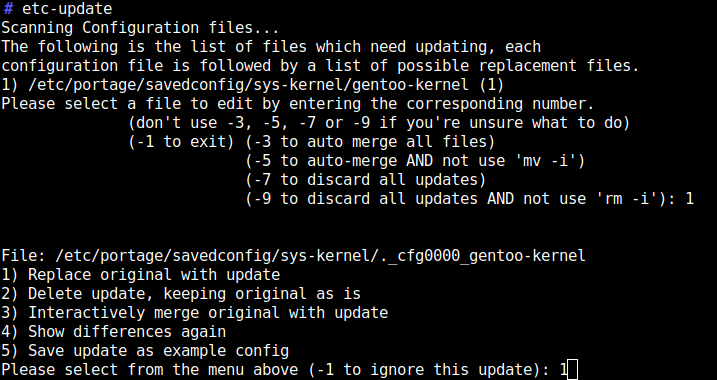
5. (Optional) Prepare for the next kernel build Run etc-update and merge the new kernel config entries into your savedconfig. Screenshot of etc-update The kernel should auto-build once new versions become available via portage. Again the etc-update can be automated if you feel that is sufficiently safe to do in your environment. See step 7 below for details. 6. (Optional) Remove the old kernel sources If you want to switch from the method based on gentoo-sources to the gentoo-kernel one, you can remove the kernel sources:
emerge -C "=sys-kernel/gentoo-sources-5*"
Be sure to update the /usr/src/linux symlink to the new kernel sources directory from gentoo-kernel, e.g.:
rm /usr/src/linux; ln -s "/usr/src/$(uname -r)" /usr/src/linux
This may be a good time for a bit more house-keeping: Clean up a bit in /usr/src/ to remove old build artefacts, /boot/ to remove old kernels and /lib/modules/ to get rid of old kernel modules. 7. (Optional) Further automate the ebuild In part 1 we automated the kernel compile, install and a bit more via a helper function for post_pkg_postinst(). We can do the similarly for what is (currently) missing from the gentoo-kernel ebuilds: Create /etc/portage/env/sys-kernel/gentoo-kernel with the following:
post_pkg_postinst()
etc-update --automode -5 /etc/portage/savedconfig/sys-kernel
grub-mkconfig -o /boot/grub/grub.cfg
The upside of gentoo-kernel over gentoo-sources is that you can put "config override files" in /etc/kernel/config.d/. That way you theoretically profit from config improvements made by the upstream developers. See the Gentoo distribution kernel documentation for a sample snippet. I am fine with savedconfig for now but it is nice that Gentoo provides the flexibility to support both approaches.

Daniel Lange: Netatalk 3.1.9 .debs for Debian Jessie available (Apple Timemachine backup to Linux servers)

Netatalk 3.1.9 has been released with two interesting fixes / amendments: Here are the full release notes for 3.1.9 for your reading pleasure. Due to upstream now differentiating between SysVinit and systemd packages I've followed that for simplicity's sake and built libgcrypt-only builds. If you need the openssl-based tools continue to use the 3.1.8 openssl build until you have finished your migration to a safer password storage.
Warning: Read the original blog post before installing for the first time. Be sure to read the original blog post if you are new to Netatalk3 on Debian Jessie!
You'll get nowhere if you install the .debs below and don't know about the upgrade path. So RTFA.
Now with that out of the way: Continue reading "Netatalk 3.1.9 .debs for Debian Jessie available (Apple Timemachine backup to Linux servers)"

Daniel Lange: Creating iPhone/iPod/iPad notes from the shell

I found a very nice script to create Notes on the iPhone from the command line by hossman over at Perlmonks. For some weird reason Perlmonks does not allow me to reply with amendments even after I created an account. I can "preview" a reply at Perlmonks but after "create" I get "Permission Denied". Duh. vroom, if you want screenshots, contact me on IRC :-). As I wrote everything up for the Perlmonks reply anyways, I'll post it here instead. Against hossman's version 32 from 2011-02-22 I changed the following: I /msg'd hossman the URL of this blog entry. Continue reading "Creating iPhone/iPod/iPad notes from the shell"

Daniel Lange: The Stallman wars

So, 2021 isn't bad enough yet, but don't despair, people are working to fix that:

Welcome to the Stallman wars Team Cancel: https://rms-open-letter.github.io/ (repo) Team Support: https://rms-support-letter.github.io/ (repo) Current Final stats are:

Team Cancel:  3019 signers from 1415 individual commit authors
Team Support: 6853 signers from 5418 individual commit authors
Git shortlog (Top 10):
rms_cancel.git (Last update: 2021-08-16 00:11:15 (UTC))
  1230  Neil McGovern
   251  Joan Touzet
    99  Elana Hashman
    73  Molly de Blanc
    36  Shauna
    19  Juke
    18  Stefano Zacchiroli
    17  Alexey Mirages
    16  Devin Halladay
    14  Nader Jafari
rms_support.git (Last update: 2021-09-29 07:14:39 (UTC))
  1821  shenlebantongying
  1585  nukeop
  1560  Ivanq
  1057  Victor
   880  Job Bautista
   123  nekonee
   101  Victor Gridnevsky
    41  Patrick Spek
    25  Borys Kabakov
    17  KIM Taeyeob
(data as of 2021-10-01) Technical info:
Signers are counted from their "Signed / Individuals" sections. Commits are counted with git shortlog -s.
Team Cancel also has organizational signatures with Mozilla, Suse and X.Org being among the notable signatories. The 16 original signers of the Cancel petition are added in their count. Neil McGovern, Juke and shenlebantongying need .mailmap support as they have committed with different names. Further reading: 12.04.2021 Statements from the accused 18.04.2021 Debian General Resolution The Debian General Resolution (GR) vote of the developers has concluded to not issue a public statement at all, see https://www.debian.org/vote/2021/vote_002#outcome for the results.
It is better to keep quiet and seem ignorant than to speak up and remove all doubt.
See Quote Investigator for the many people that rephrased these words over the centuries. They still need to be recalled more often as too many people in the FLOSS community have forgotten about that wisdom... 01.10.2021 Final stats It seems enough dust has settled on this unfortunate episode of mob activity now. Hence I stopped the cronjob that updated the stats above regularly. Team Support has kept adding signature all the time while Team Cancel gave up very soon after the FSF decided to stand with Mr. Stallman. So this battle was decided within two months. The stamina of the accused and determined support from some dissenting web devs trumped the orchestrated outrage of well known community figures and their publicity power this time. But history teaches us that does not mean the war is over. There will a the next opportunity to call for arms. And people will call. Unfortunately. 01.11.2024 Team Cancel is opening a new round; Team Support responds with exposing the author of "The Stallman report" I hate to be right. Three years later than the above: An anonymous member of team Cancel has published https://stallman-report.org/ [local pdf mirror, 504kB] to "justify our unqualified condemnation of Richard Stallman". It contains a detailed collection of quotes that are used to allege supporting (sexual) misconduct. The demand is again that Mr. Stallman "step[s] down from all positions at the FSF and the GNU project". Addressing him: "the scope and extent of your misconduct disqualifies you from formal positions of power within our community indefinitely". Team Support has not issues a rebuttal (yet?) but has instead identified the anonymous author as Drew "sircmpwn" DeVault, a gifted software developer, but also a vocal and controversial figure in the Open Source / Free Software space. Ironically quite similar to Richard "rms" Stallman. Their piece is published at https://dmpwn.info/ [local pdf mirror, 929kB]. They also allege a proximity of Mr. DeVault to questionable "Lolita" anime preferences and societal positions to disqualify him.

Ben Hutchings: FOSS activity in April 2025

I also co-organised a Debian BSP (Bug-Squashing Party) last weekend, for which I will post a separate report later.

Daniel Lange: Cleaning a broken GnuPG (gpg) key

I've long said that the main tools in the Open Source security space, OpenSSL and GnuPG (gpg), are broken and only a complete re-write will solve this. And that is still pending as nobody came forward with the funding. It's not a sexy topic, so it has to get really bad before it'll get better. Gpg has a UI that is close to useless. That won't substantially change with more bolted-on improvements. Now Robert J. Hansen and Daniel Kahn Gillmor had somebody add ~50k signatures (read 1, 2, 3, 4 for the g l ory details) to their keys and - oops - they say that breaks gpg. But does it? I downloaded Robert J. Hansen's key off the SKS-Keyserver network. It's a nice 45MB file when de-ascii-armored (gpg --dearmor broken_key.asc ; mv broken_key.asc.gpg broken_key.gpg). Now a friendly:
$ /usr/bin/time -v gpg --no-default-keyring --keyring ./broken_key.gpg --batch --quiet --edit-key 0x1DCBDC01B44427C7 clean save quit

pub rsa3072/0x1DCBDC01B44427C7
erzeugt: 2015-07-16 verf llt: niemals Nutzung: SC
Vertrauen: unbekannt G ltigkeit: unbekannt
sub ed25519/0xA83CAE94D3DC3873
erzeugt: 2017-04-05 verf llt: niemals Nutzung: S
sub cv25519/0xAA24CC81B8AED08B
erzeugt: 2017-04-05 verf llt: niemals Nutzung: E
sub rsa3072/0xDC0F82625FA6AADE
erzeugt: 2015-07-16 verf llt: niemals Nutzung: E
[ unbekannt ] (1). Robert J. Hansen <rjh@sixdemonbag.org>
[ unbekannt ] (2) Robert J. Hansen <rob@enigmail.net>
[ unbekannt ] (3) Robert J. Hansen <rob@hansen.engineering>

User-ID "Robert J. Hansen <rjh@sixdemonbag.org>": 49705 Signaturen entfernt
User-ID "Robert J. Hansen <rob@enigmail.net>": 49704 Signaturen entfernt
User-ID "Robert J. Hansen <rob@hansen.engineering>": 49701 Signaturen entfernt

pub rsa3072/0x1DCBDC01B44427C7
erzeugt: 2015-07-16 verf llt: niemals Nutzung: SC
Vertrauen: unbekannt G ltigkeit: unbekannt
sub ed25519/0xA83CAE94D3DC3873
erzeugt: 2017-04-05 verf llt: niemals Nutzung: S
sub cv25519/0xAA24CC81B8AED08B
erzeugt: 2017-04-05 verf llt: niemals Nutzung: E
sub rsa3072/0xDC0F82625FA6AADE
erzeugt: 2015-07-16 verf llt: niemals Nutzung: E
[ unbekannt ] (1). Robert J. Hansen <rjh@sixdemonbag.org>
[ unbekannt ] (2) Robert J. Hansen <rob@enigmail.net>
[ unbekannt ] (3) Robert J. Hansen <rob@hansen.engineering>

Command being timed: "gpg --no-default-keyring --keyring ./broken_key.gpg --batch --quiet --edit-key 0x1DCBDC01B44427C7 clean save quit"
User time (seconds): 3911.14
System time (seconds): 2442.87
Percent of CPU this job got: 99%
Elapsed (wall clock) time (h:mm:ss or m:ss): 1:45:56
Average shared text size (kbytes): 0
Average unshared data size (kbytes): 0
Average stack size (kbytes): 0
Average total size (kbytes): 0
Maximum resident set size (kbytes): 107660
Average resident set size (kbytes): 0
Major (requiring I/O) page faults: 1
Minor (reclaiming a frame) page faults: 26630
Voluntary context switches: 43
Involuntary context switches: 59439
Swaps: 0
File system inputs: 112
File system outputs: 48
Socket messages sent: 0
Socket messages received: 0
Signals delivered: 0
Page size (bytes): 4096
Exit status: 0
And the result is a nicely useable 3835 byte file of the clean public key. If you supply a keyring instead of --no-default-keyring it will also keep the non-self signatures that are useful for you (as you apparently know the signing party). So it does not break gpg. It does break things that call gpg at runtime and not asynchronously. I heard Enigmail is affected, quelle surprise. Now the main problem here is the runtime. 1h45min is just ridiculous. As Filippo Valsorda puts it:
Someone added a few thousand entries to a list that lets anyone append to it. GnuPG, software supposed to defeat state actors, suddenly takes minutes to process entries. How big is that list you ask? 17 MiB. Not GiB, 17 MiB. Like a large picture. https://dev.gnupg.org/T4592
If I were a gpg / SKS keyserver developer, I'd That way another key can only be added to the keyserver network if it contains at least one signature from a previously known strong-set key. Attacking the keyserver network would become at least non-trivial. And the web-of-trust thing may make sense again. Updates 09.07.2019 GnuPG 2.2.17 has been released with another set of quickly bolted together fixes:
   gpg: Ignore all key-signatures received from keyservers.  This
    change is required to mitigate a DoS due to keys flooded with
    faked key-signatures.  The old behaviour can be achieved by adding
    keyserver-options no-self-sigs-only,no-import-clean
    to your gpg.conf.  [#4607]
   gpg: If an imported keyblocks is too large to be stored in the
    keybox (pubring.kbx) do not error out but fallback to an import
    using the options "self-sigs-only,import-clean".  [#4591]
   gpg: New command --locate-external-key which can be used to
    refresh keys from the Web Key Directory or via other methods
    configured with --auto-key-locate.
   gpg: New import option "self-sigs-only".
   gpg: In --auto-key-retrieve prefer WKD over keyservers.  [#4595]
   dirmngr: Support the "openpgpkey" subdomain feature from
    draft-koch-openpgp-webkey-service-07. [#4590].
   dirmngr: Add an exception for the "openpgpkey" subdomain to the
    CSRF protection.  [#4603]
   dirmngr: Fix endless loop due to http errors 503 and 504.  [#4600]
   dirmngr: Fix TLS bug during redirection of HKP requests.  [#4566]
   gpgconf: Fix a race condition when killing components.  [#4577]
Bug T4607 shows that these changes are all but well thought-out. They introduce artificial limits, like 64kB for WKD-distributed keys or 5MB for local signature imports (Bug T4591) which weaken the web-of-trust further. I recommend to not run gpg 2.2.17 in production environments without extensive testing as these limits and the unverified network traffic may bite you. Do validate your upgrade with valid and broken keys that have segments (packet groups) surpassing the above mentioned limits. You may be surprised what gpg does. On the upside: you can now refresh keys (sans signatures) via WKD. So if your buddies still believe in limiting their subkey validities, you can more easily update them bypassing the SKS keyserver network. NB: I have not tested that functionality. So test before deploying. 10.08.2019 Christopher Wellons (skeeto) has released his pgp-poisoner tool. It is a go program that can add thousands of malicious signatures to a GNUpg key per second. He comments "[pgp-poisoner is] proof that such attacks are very easy to pull off. It doesn't take a nation-state actor to break the PGP ecosystem, just one person and couple evenings studying RFC 4880. This system is not robust." He also hints at the next likely attack vector, public subkeys can be bound to a primary key of choice.

Russ Allbery: Review: Sixteen Ways to Defend a Walled City

Review: Sixteen Ways to Defend a Walled City, by K.J. Parker
Series: Siege #1
Publisher: Orbit
Copyright: April 2019
ISBN: 0-316-27080-6
Format: Kindle
Pages: 349
Sixteen Ways to Defend a Walled City is... hm, honestly, I'm not sure what the genre of this novel is. It is a story about medieval engineering and siege weapons in a Rome-inspired secondary world that so far as I can tell is not meant to match ours. There is not a hint of magic. It's not technically a fantasy, but it's marketed like a fantasy, and it's not historical fiction nor is it attempting to be alternate history. The most common description is a fantasy of logistics, so I guess I'll go with that, as long as you understand that the fantasy here is of the non-magical sort. K.J. Parker is a pen name for Tom Holt. Orhan is Colonel-in-Chief of the Engineers for the Robur empire, even though he's a milkface, not a blueskin like a proper Robur. (Both of those racial terms are quite offensive.) He started out as a slave, learned a trade, joined the navy as a shipwright, and worked his way up the ranks through luck and enemy action. He's canny, practical, highly respected by his men, happy to cheat and steal to get material for his projects and wages for his people, and just wants to build literal bridges. Nice, sturdy bridges that let people get from one place to another the short way. When this book opens, Orhan is in Classis trying to requisition some rope. He is saved from discovery of his forged paperwork by pirates burning down the warehouse that held all of the rope, and then saved from the pirates by the sorts of coincidences that seem to happen to Orhan all the time. A few subsequent discoveries about what the pirates were after, and news of another unexpected attack on the empire, make Orhan nervous enough that he takes his men to do a job as far away from the City at the heart of the empire as possible. It's just his luck to return in time to find slaughtered troops and to have to sneak his men into a City already under siege. Sixteen Ways to Defend a Walled City is told in the first person by Orhan, with an internal justification that the reader only discovers at the end of the book. That means your enjoyment of this book is going to depend a lot on how much you like Orhan's voice. This mostly worked for me; his voice is an odd combination of chatty, self-deprecating, and brusque, and it took a bit for me to get used to it, but I came around. This book is clearly competence porn nearly all the fun of this book is seeing what desperate plan Orhan will come up with next so it helps that Orhan does indeed come across as competent. The part that did not work for me was the morality. You would think from the title that would be straightforward: The City is under siege, people want to capture it and kill everyone, Orhan is on the inside, and his job is to keep them out. That would have been the morality of simplistic military fiction, but most of the appeal was in watching the problem-solving anyway. That's how the story starts, but then Parker started dropping hints of more complexity. Orhan is a disfavored minority and the Robur who run the empire are racist assholes, even though Orhan mostly gets along with the ones who work with him closely. Orhan says a few things that make the reader wonder whether the City warrants defending, and it becomes less clear whether Orhan's loyalties were as solid as they appeared to be. Parker then offers a few moral dilemmas and has Orhan not follow them in the expected directions, making me wonder where Parker was going with the morality of this story. And then we find out that the answer is nowhere. Parker is going nowhere. None of that setup has a payoff, and the ending is deeply unsatisfying and arguably pointless. I am not sure this is an objective analysis. This is one of those books where I would not be surprised to see someone else praise its realism. Orhan is in some ways a more likely figure than the typical hero of a book. He likes accomplishing things, he's a cheat and a liar when that serves his purposes, he's loyal to the people he considers friends in a way that often doesn't involve consulting them about what they want, and he makes decisions mostly on vibes and stubbornness. Both his cynicism and his idealism are different types of masks; beneath both, he's an incoherent muddle. You could argue that we're all that sort of muddle, deep down, and the consistent idealists are the unrealistic (and frightening) ones, and I think Parker may be attempting exactly that argument. I know some readers like this sort of fallibly human incoherence. But wow did I ever loathe this ending because I was not reading this book for a realistic psychological profile of an average guy. I was here for the competence porn, for the fantasy of logistics, for the experience of watching someone have a plan and get shit done. Apparently that extends to needing him to be competent at morality as well, or at least think about it as hard as he thinks about siege weapons. One of the reasons why I am primarily a genre reader is that I don't read books for depressing psychological profiles. There are enough of those in the news. I read books to spend some time in a world better than mine, where things work out the way that they are supposed to, or at least in a way that's satisfying. The other place where this book interfered with my vibes is that it's about a war, and a lot of Orhan's projects are finding more efficient ways to kill people. Parker takes a "war is hell" perspective, and Orhan gets deeply upset at the graphic sights of mangled human bodies that are the frequent results of his plans. I feel weird complaining about this because yes, it's good to be aware of the horrific things that we do to other people in wars, but man, I just wanted to watch some effective project management. I want to enjoy unexpected lateral thinking, appreciate the friendly psychological manipulation involved in getting a project to deliver on deadline, and watch someone solve logistical problems. Battlefields provide an endless supply of interesting challenges, but then Parker feels compelled to linger on the brutal consequences of Orhan's ideas and now I'm depressed and sickened rather than enjoying myself. I really wanted to like this book, and for a lot of the book I did, but that ending was a bottomless pit that sucked away all my enjoyment and retroactively made the rest of the book feel worse. I so wanted Parker to be going somewhere clever and surprising, and the disappointment when none of that happened was intense. This is probably an excessively negative reaction, and I will not be surprised when other people get along with this book better than I did, but not only will I not be recommending it, I'm now rather dubious about reading any more Parker. Followed by How to Rule an Empire and Get Away With It. Rating: 5 out of 10

1 May 2025

Ian Jackson: Free Software, internal politics, and governance

There is a thread of opinion in some Free Software communities, that we shouldn t be doing politics , and instead should just focus on technology. But that s impossible. This approach is naive, harmful, and, ultimately, self-defeating, even on its own narrow terms. Today I m talking about small-p politics In this article I m using politics in the very wide sense: us humans managing our disagreements with each other. I m not going to talk about culture wars, woke, racism, trans rights, and so on. I am not going to talk about how Free Software has always had explicitly political goals; or how it s impossible to be neutral because choosing not to take a stand is itself to take a stand. Those issues are all are important and Free Software definitely must engage with them. Many of the points I make are applicable there too. But those are not my focus today. Today I m talking in more general terms about politics, power, and governance. Many people working together always entails politics Computers are incredibly complicated nowadays. Making software is a joint enterprise. Even if an individual program has only a single maintainer, it fits into an ecosystem of other software, maintained by countless other developers. Larger projects can have thousands of maintainers and hundreds of thousands of contributors. Humans don t always agree about everything. This is natural. Indeed, it s healthy: to write the best code, we need a wide range of knowledge and experience. When we can t come to agreement, we need a way to deal with that: a way that lets us still make progress, but also leaves us able to work together afterwards. A way that feels OK for everyone. Providing a framework for disagreement is the job of a governance system. The rules say which people make which decisions, who must be consulted, how the decisions are made, and, how, if any, they can be reviewed. This is all politics. Consensus is great but always requiring it is harmful Ideally a discussion will converge to a synthesis that satisfies everyone, or at least a consensus. When consensus can t be achieved, we can hope for compromise: something everyone can live with. Compromise is achieved through negotiation. If every decision requires consensus, then the proponents of any wide-ranging improvement have an almost insurmountable hurdle: those who are favoured by the status quo and find it convenient can always object. So there will never be consensus for change. If there is any objection at all, no matter how ill-founded, the status quo will always win. This is where governance comes in. Governance is like backups: we need to practice it Governance processes are the backstop for when discussions, and then negotiations, fail, and people still don t see eye to eye. In a healthy community, everyone needs to know how the governance works and what the rules are. The participants need to accept the system s legitimacy. Everyone, including the losing side, must be prepared to accept and implement (or, at least not obstruct) whatever the decision is, and hopefully live with it and stay around. That means we need to practice our governance processes. We can t just leave them for the day we have a huge and controversial decision to make. If we do that, then when it comes to the crunch we ll have toxic rows where no-one can agree the rules; where determined people bend the rules to fit their outcome; and where afterwards people feel like the whole thing was horrible and unfair. So our decisionmaking bodies and roles need to be making decisions, as a matter of routine, and we need to get used to that. First-line decisionmaking bodies should be making decisions frequently. Last-line appeal mechanisms (large-scale votes, for example) are naturally going to be exercised more rarely, but they must happen, be seen as legitimate, and their outcomes must be implemented in full. Governance should usually be routine and boring When governance is working well it s quite boring. People offer their input, and are heard. Angles are debated, and concerns are addressed. If agreement still isn t reached, the committee, or elected leader, makes a decision. Hopefully everyone thinks the leadership is legitimate, and that it properly considered and heard their arguments, and made the decision for good reasons. Hopefully the losing side can still get their work done (and make their own computer work the way they want); so while they will be disappointed, they can live with the outcome. Many human institutions manage this most of the time. It does take some knowledge about principles of governance, and ideally some experience. Governance means deciding, not just mediating By making decisions I mean exercising their authority to rule on an actual disagreement: one that wasn t resolved by debate or negotiation. Governance processes by definition involve deciding, not just mediating. It s not governance if we re advising or cajoling: in that case, we re back to demanding consensus. Governance is necessary precisely when consensus is not achieved. If the governance systems are to mean anything, they must be able to (over)rule; that means (over)ruling must be normal and accepted. Otherwise, when the we need to overrule, we ll find that we can t, because we lack the collective practice. To be legitimate (and seen as legitimate) decisions must usually be made based on the merits, not on participants status, and not only on process questions. On the autonomy of the programmer Many programmers seem to find the very concept of governance, and binding decisionmaking, deeply uncomfortable. Ultimately, it means sometimes overruling someone s technical decision. As programmers and maintainers we naturally see how this erodes our autonomy. But we have all seen projects where the maintainers are unpleasant, obstinate, or destructive. We have all found this frustrating. Software is all interconnected, and one programmer s bad decisions can cause problems for many of the rest of us. We exasperate, why won t they just do the right thing . This is futile. People have never just ed and they re not going to start just ing now. So often the boot is on the other foot. More broadly, as software developers, we have a responsibility to our users, and a duty to write code that does good rather than ill in the world. We ought to be accountable. (And not just to capitalist bosses!) Governance mechanisms are the answer. (No, forking anything but the smallest project is very rarely a practical answer.) Mitigate the consequences of decisions retain flexibility In software, it is often possible to soften the bad social effects of a controversial decision, by retaining flexibility. With a bit of extra work, we can often provide hooks, non-default configuration options, or plugin arrangements. If we can convert the question from how will the software always behave into merely what should the default be , we can often save ourselves a lot of drama. So it is often worth keeping even suboptimal or untidy features or options, if people want to use them and are willing to maintain them. There is a tradeoff here, of course. But Free Software projects often significantly under-value the social benefits of keeping everyone happy. Wrestling software even crusty or buggy software is a lot more fun than having unpleasant arguments. But don t do decisionmaking like a corporation Many programmers experience of formal decisionmaking is from their boss at work. But corporations are often a very bad example. They typically don t have as much trouble actually making decisions, but the actual decisions are often terrible, and not just because corporations goals are often bad. You get to be a decisionmaker in a corporation by spouting plausible nonsense, sounding confident, buttering up the even-more-vacuous people further up the chain, and sometimes by sabotaging your rivals. Corporate senior managers are hardly ever held accountable typically the effects of their tenure are only properly felt well after they ve left to mess up somewhere else. We should select our leaders more wisely, and base decisions on substance. If you won t do politics, politics will do you As a participant in a project, or a society, you can of course opt out of getting involved in politics. You can opt out of learning how to do politics generally, and opt out of understanding your project s governance structures. You can opt out of making judgements about disputed questions, and tell yourself there s merit on both sides . You can hate politicians indiscriminately, and criticise anyone you see doing politics. If you do this, then you are abdicating your decisionmaking authority, to those who are the most effective manipulators, or the most committed to getting their way. You re tacitly supporting the existing power bases. You re ceding power to the best liars, to those with the least scruples, and to the people who are most motivated by dominance. This is precisely the opposite of what you wanted. If enough people won t do politics, and hate anyone who does, your discussion spaces will be reduced to a battleground of only the hardiest and the most toxic. If you don t see the politics, it s still happening If your governance systems don t work, then there is no effective redress against bad or even malicious decisions. Your roleholders and subteams are unaccountable power centres. Power radically distorts every human relationship, and it takes great strength of character for an unaccountable power centre not to eventually become an unaccountable toxic cabal. So if you have a reasonable sized community, but don t see your formal governance systems working people debating things, votes, leadership making explicit decisions that doesn t mean everything is fine, and all the decisions are great, and there s no politics happening. It just means that most of your community have given up on the official process. It also probably means that some parts of your project have formed toxic and unaccountable cabals. Those who won t put up with that will leave. The same is true if the only governance actions that ever happen are massive drama. That means that only the most determined victim of a bad decision, will even consider using such a process. Conclusions

comment count unavailable comments

Jonathan McDowell: Local Voice Assistant Step 2: Speech to Text and back

Having setup an ATOM Echo Voice Satellite and hooked it up to Home Assistant we now need to actually do something with the captured audio. Home Assistant largely deals with voice assistants using the Wyoming Protocol, which describes itself as essentially JSONL + PCM audio. It works nicely in terms of meaning everything can exist as separate modules that then just communicate over network sockets, and there are a whole bunch of Python implementations of the pieces necessary. The first bit I looked at was speech to text; how do I get what I say to the voice satellite into something that Home Assistant can try and parse? There is a nice self contained speech recognition tool called whisper.cpp, which is a low dependency implementation of inference using OpenAI s Whisper model. This is wrapped up for Wyoming as part of wyoming-whisper-cpp. Here we get into something that unfortunately seems common in this space; the repo contains a forked copy of whisper.cpp with enough differences that I couldn t trivially make it work with regular whisper.cpp. That means missing out on new development, and potential improvements (the fork appears to be at v1.5.4, upstream is up to v1.7.5 at the time of writing). However it was possible to get up and running easily enough. [I note there is a Wyoming Whisper API client that can use the whisper.cpp server, and that might be a cleaner way to go in the future, especially if whisper.cpp ends up in Debian.] I stated previously I wanted all of this to be as clean an installed on Debian stable as possible. Given most of this isn t packaged, that s meant I ve packaged things up as I go. I m not at the stage anything is suitable for upload to Debian proper, but equally I ve tried to make them a reasonable starting point. No pre-built binaries available, just Salsa git repos. https://salsa.debian.org/noodles/wyoming-whisper-cpp in this case. You need python3-wyoming from trixie if you re building for bookworm, but it doesn t need rebuilt. You need a Whisper model that s been converts to ggml format; they can be found on Hugging Face. I ve ended up using the base.en model. I found small.en gave more accurate results, but took a little longer, when doing random testing, but it doesn t seem to make much of a difference for voice control rather than plain transcribing. [One of the open questions about uploading this to Debian is around the use of a prebuilt AI model. I don t know what the right answer is here, and whether the voice infrastructure could ever be part of Debian proper, but the current discussion on the interpretation of the DFSG on AI models is very relevant.] I run this in the same container as my Home Assistant install, using a systemd unit file dropped in /etc/systemd/system/wyoming-whisper-cpp.service:
[Unit]
Description=Wyoming whisper.cpp server
After=network.target
[Service]
Type=simple
DynamicUser=yes
ExecStart=wyoming-whisper-cpp --uri tcp://localhost:10030 --model base.en
MemoryDenyWriteExecute=false
ProtectControlGroups=true
PrivateDevices=false
ProtectKernelTunables=true
ProtectSystem=true
RestrictRealtime=true
RestrictNamespaces=true
[Install]
WantedBy=multi-user.target
It needs the Wyoming Protocol integration enabled in Home Assistant; you can Add Entry and enter localhost + 10030 for host + port and it ll get added. Then in the Voice Assistant configuration there ll be a whisper.cpp option available. Text to speech turns out to be weirdly harder. The right answer is something like Wyoming Piper, but that turns out to be hard on bookworm. I ll come back to that in a future post. For now I took the easy option and used the built in Google Translate option in Home Assistant. That needed an extra stanza in configuration.yaml that wasn t entirely obvious:
media_source:
With this, and the ATOM voice satellite, I could now do basic voice control of my Home Assistant setup, with everything except the text-to-speech piece happening locally! Things such as Hey Jarvis, turn on the study light work out of the box. I haven t yet got into defining my own phrases, partly because I know some of the things I want ( What time is it? ) are already added in later Home Assistant versions than the one I m running. Overall I found this initially complicated to setup given my self-imposed constraints about actually understanding the building blocks and compiling them myself, but I ve been pretty impressed with the work that s gone into it all. Next step, running a voice satellite on a Debian box.

Guido G nther: Free Software Activities April 2025

Another short status update of what happened on my side last month. Notable might be the Cell Broadcast support for Qualcomm SoCs, the rest is smaller fixes and QoL improvements. phosh phoc phosh-mobile-settings pfs feedbackd feedbackd-device-themes gmobile Debian git-buildpackage wlroots ModemManager Libqmi gnome-clocks gnome-calls qmi-parse-kernel-dump xwayland-run osmo-cbc phosh-nightly Blog posts Bugs Reviews This is not code by me but reviews on other peoples code. The list is (as usual) slightly incomplete. Thanks for the contributions! Help Development If you want to support my work see donations. Comments? Join the Fediverse thread
Paul Wise: FLOSS Activities April 2025

Focus This month I didn't have any particular focus. I just worked on issues in my info bubble.

Changes

Issues

Review
  • Patches: notmuch-mutt patchset

Sponsors The SWH work was sponsored. All other work was done on a volunteer basis.

Russ Allbery: Review: Beyond Pain

Review: Beyond Pain, by Kit Rocha
Series: Beyond #3
Publisher: Kit Rocha
Copyright: December 2013
ASIN: B00GIA4GN8
Format: Kindle
Pages: 328
Beyond Pain is a science fiction dystopian erotic romance novel and a direct sequel to Beyond Control. Following the romance series convention, each book features new protagonists who were supporting characters in the previous book. You could probably start here if you wanted, but there are significant spoilers here for earlier books in the series. I read this book as part of the Beyond Series Bundle (Books 1-3), which is what the sidebar information is for. Six has had a brutally hard life. She was rescued from an awful situation in a previous book and is now lurking around the edges of the Sector Four gang, oddly fascinated (as are we all) with their constant sexuality and trying to decide if she wants to, and can, be part of their world. Bren is one of the few people she lets get close: a huge bruiser who likes cage fights and pain but treats Six with a protective, careful respect that she finds comforting. This book is the story of Six and Bren getting to the bottom of each other's psychological hangups while the O'Kanes start taking over Six's former sector. Yes, as threatened, I read another entry in the dystopian erotica series because I keep wondering how these people will fuck their way into a revolution. This is not happening very quickly, but it seems obvious that is the direction the series is going. It's been a while since I've reviewed one of these, so here's another variation of the massive disclaimer: I think erotica is harder to review than any other genre because what people like is so intensely personal and individual. This is not even an attempt at an erotica review. I'm both wholly unqualified and also less interested in that part of the book, which should lead you to question my reading choices since that's a good half of the book. Rather, I'm reading these somewhat for the plot and mostly for the vibes. This is not the most competent collection of individuals, and to the extent that they are, it's mostly because the men (who are, as a rule, charismatic but rather dim) are willing to listen to the women. What they are good at is communication, or rather, they're good about banging their heads (and other parts) against communication barriers until they figure out a way around them. Part of this is an obsession with consent that goes quite a bit deeper than the normal simplistic treatment. When you spend this much time trying to understand what other people want, you have to spend a lot of time communicating about sex, and in these books that means spending a lot of time communicating about everything else as well. They are also obsessively loyal and understand the merits of both collective action and in making space for people to do the things that they are the best at, while still insisting that people contribute when they can. On the surface, the O'Kanes are a dictatorship, but they're run more like a high-functioning collaboration. Dallas leads because Dallas is good at playing the role of leader (and listening to Lex), which is refreshingly contrary to how things work in the real world right now. I want to be clear that not only is this erotica, this is not the sort of erotica where there's a stand-alone plot that is periodically interrupted by vaguely-motivated sex scenes that you can skim past. These people use sex to communicate, and therefore most of the important exchanges in the book are in the middle of a sex scene. This is going to make this novel, and this series, very much not to the taste of a lot of people, and I cannot be emphatic enough about that warning. But, also, this is such a fascinating inversion. It's common in media for the surface plot of the story to be full of sexual tension, sometimes to the extent that the story is just a metaphor for the sex that the characters want to have. This is the exact opposite of that: The sex is a metaphor for everything else that's going on in the story. These people quite literally fuck their way out of their communication problems, and not in an obvious or cringy way. It's weirdly fascinating? It's also possible that my reaction to this series is so unusual as to not be shared by a single other reader. Anyway, the setup in this story is that Six has major trust issues and Bren is slowly and carefully trying to win her trust. It's a classic hurt/comfort setup, and if that had played out in the way that this story often does, Bren would have taken the role of the gentle hero and Six the role of the person he rescued. That is not at all where this story goes. Six doesn't need comfort; Six needs self-confidence and the ability to demand what she wants, and although the way Beyond Pain gets her there is a little ham-handed, it mostly worked for me. As with Beyond Shame, I felt like the moral of the story is that the O'Kane men are just bright enough to stop doing stupid things at the last possible moment. I think Beyond Pain worked a bit better than the previous book because Bren is not quite as dim as Dallas, so the reader doesn't have to suffer through quite as many stupid decisions. The erotica continues to mostly (although not entirely) follow traditional gender roles, with dangerous men and women who like attention. Presumably most people are reading these books for the sex, which I am wholly unqualified to review. For whatever it's worth, the physical descriptions are too mechanical for me, too obsessed with the precise structural assemblage of parts in novel configurations. I am not recommending (or disrecommending) these books, for a whole host of reasons. But I think the authors deserve to be rewarded for understanding that sex can be communication and that good communication about difficult topics is inherently interesting in a way that (at least for me) transcends the erotica. I bet I'm going to pick up another one of these about a year from now because I'm still thinking about these people and am still curious about how they are going to succeed. Followed by Beyond Temptation, an interstitial novella. The next novel is Beyond Jealousy. Rating: 6 out of 10

30 April 2025

Russell Coker: Links April 2025

Asianometry has an interesting YouTube video about elecrolytic capacitors degrading and how they affect computers [1]. Keep your computers cool people! Biella Coleman (famous for studying the Anthropology of Debian) and Eric Reinhart wrote an interesting article about MAHA (Make America Healthy Again) and how it ended up doing exactly the opposite of what was intended [2]. SciShow has an informative video about lung cancer cases among non-smokers, the risk factors are genetics, Radon, and cooking [3]. Ian Jackson wrote an insightful blog post about whether Rust is woke [4]. Bruce Schneier write an interesting blog post about research into making AIs Trusted Third Parties [5]. This has the potential to solve some cryptology problems. CHERIoT is an interesting project for controlling all jump statements in RISC-V among other related security features [6]. We need this sort of thing for IoT devices that will run for years without change. Brian Krebs wrote an informative post about how Trump is attacking the 1st Amendment of the US Constitution [7]. The Register has an interesting summary of the kernel enclave and exclave functionality in recent Apple OSs [8]. Dr Gabor Mate wrote an interesting psychological analysis of Hillary Clinton and Donald Trump [9]. ChoiceJacking is an interesting variant of the JuiceJacking attack on mobile phones by hostile chargers [10]. They should require input for security sensitive events to come from the local hardware not USB or Bluetooth.

Simon Josefsson: Building Debian in a GitLab Pipeline

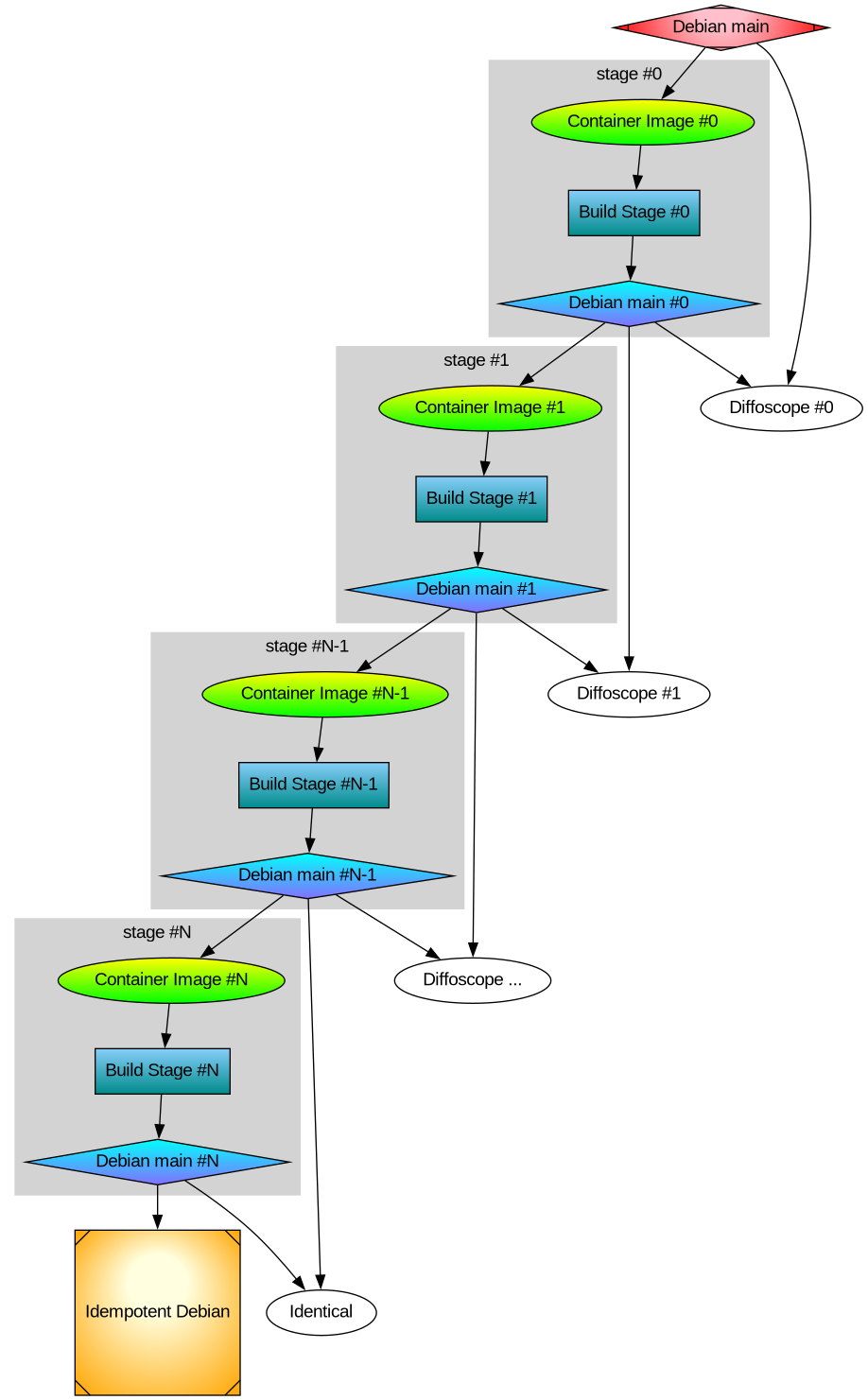
After thinking about multi-stage Debian rebuilds I wanted to implement the idea. Recall my illustration:
Earlier I rebuilt all packages that make up the difference between Ubuntu and Trisquel. It turned out to be a 42% bit-by-bit identical similarity. To check the generality of my approach, I rebuilt the difference between Debian and Devuan too. That was the debdistreproduce project. It only had to orchestrate building up to around 500 packages for each distribution and per architecture. Differential reproducible rebuilds doesn t give you the full picture: it ignore the shared package between the distribution, which make up over 90% of the packages. So I felt a desire to do full archive rebuilds. The motivation is that in order to trust Trisquel binary packages, I need to trust Ubuntu binary packages (because that make up 90% of the Trisquel packages), and many of those Ubuntu binaries are derived from Debian source packages. How to approach all of this? Last year I created the debdistrebuild project, and did top-50 popcon package rebuilds of Debian bullseye, bookworm, trixie, and Ubuntu noble and jammy, on a mix of amd64 and arm64. The amount of reproducibility was lower. Primarily the differences were caused by using different build inputs. Last year I spent (too much) time creating a mirror of snapshot.debian.org, to be able to have older packages available for use as build inputs. I have two copies hosted at different datacentres for reliability and archival safety. At the time, snapshot.d.o had serious rate-limiting making it pretty unusable for massive rebuild usage or even basic downloads. Watching the multi-month download complete last year had a meditating effect. The completion of my snapshot download co-incided with me realizing something about the nature of rebuilding packages. Let me below give a recap of the idempotent rebuilds idea, because it motivate my work to build all of Debian from a GitLab pipeline. One purpose for my effort is to be able to trust the binaries that I use on my laptop. I believe that without building binaries from source code, there is no practically feasible way to trust binaries. To trust any binary you receive, you can de-assemble the bits and audit the assembler instructions for the CPU you will execute it on. Doing that on a OS-wide level this is unpractical. A more practical approach is to audit the source code, and then confirm that the binary is 100% bit-by-bit identical to one that you can build yourself (from the same source) on your own trusted toolchain. This is similar to a reproducible build. My initial goal with debdistrebuild was to get to 100% bit-by-bit identical rebuilds, and then I would have trustworthy binaries. Or so I thought. This also appears to be the goal of reproduce.debian.net. They want to reproduce the official Debian binaries. That is a worthy and important goal. They achieve this by building packages using the build inputs that were used to build the binaries. The build inputs are earlier versions of Debian packages (not necessarily from any public Debian release), archived at snapshot.debian.org. I realized that these rebuilds would be not be sufficient for me: it doesn t solve the problem of how to trust the toolchain. Let s assume the reproduce.debian.net effort succeeds and is able to 100% bit-by-bit identically reproduce the official Debian binaries. Which appears to be within reach. To have trusted binaries we would only have to audit the source code for the latest version of the packages AND audit the tool chain used. There is no escaping from auditing all the source code that s what I think we all would prefer to focus on, to be able to improve upstream source code. The trouble is about auditing the tool chain. With the Reproduce.debian.net approach, that is a recursive problem back to really ancient Debian packages, some of them which may no longer build or work, or even be legally distributable. Auditing all those old packages is a LARGER effort than auditing all current packages! Doing auditing of old packages is of less use to making contributions: those releases are old, and chances are any improvements have already been implemented and released. Or that improvements are no longer applicable because the projects evolved since the earlier version. See where this is going now? I reached the conclusion that reproducing official binaries using the same build inputs is not what I m interested in. I want to be able to build the binaries that I use from source using a toolchain that I can also build from source. And preferably that all of this is using latest version of all packages, so that I can contribute and send patches for them, to improve matters. The toolchain that Reproduce.Debian.Net is using is not trustworthy unless all those ancient packages are audited or rebuilt bit-by-bit identically, and I don t see any practical way forward to achieve that goal. Nor have I seen anyone working on that problem. It is possible to do, though, but I think there are simpler ways to achieve the same goal. My approach to reach trusted binaries on my laptop appears to be a three-step effort: How to go about achieving this? Today s Debian build architecture is something that lack transparency and end-user control. The build environment and signing keys are managed by, or influenced by, unidentified people following undocumented (or at least not public) security procedures, under unknown legal jurisdictions. I always wondered why none of the Debian-derivates have adopted a modern GitDevOps-style approach as a method to improve binary build transparency, maybe I missed some project? If you want to contribute to some GitHub or GitLab project, you click the Fork button and get a CI/CD pipeline running which rebuild artifacts for the project. This makes it easy for people to contribute, and you get good QA control because the entire chain up until its artifact release are produced and tested. At least in theory. Many projects are behind on this, but it seems like this is a useful goal for all projects. This is also liberating: all users are able to reproduce artifacts. There is no longer any magic involved in preparing release artifacts. As we ve seen with many software supply-chain security incidents for the past years, where the magic is involved is a good place to introduce malicious code. To allow me to continue with my experiment, I thought the simplest way forward was to setup a GitDevOps-centric and user-controllable way to build the entire Debian archive. Let me introduce the debdistbuild project. Debdistbuild is a re-usable GitLab CI/CD pipeline, similar to the Salsa CI pipeline. It provide one build job definition and one deploy job definition. The pipeline can run on GitLab.org Shared Runners or you can set up your own runners, like my GitLab riscv64 runner setup. I have concerns about relying on GitLab (both as software and as a service), but my ideas are easy to transfer to some other GitDevSecOps setup such as Codeberg.org. Self-hosting GitLab, including self-hosted runners, is common today, and Debian rely increasingly on Salsa for this. All of the build infrastructure could be hosted on Salsa eventually. The build job is simple. From within an official Debian container image build packages using dpkg-buildpackage essentially by invoking the following commands.
sed -i 's/ deb$/ deb deb-src/' /etc/apt/sources.list.d/*.sources
apt-get -o Acquire::Check-Valid-Until=false update
apt-get dist-upgrade -q -y
apt-get install -q -y --no-install-recommends build-essential fakeroot
env DEBIAN_FRONTEND=noninteractive \
    apt-get build-dep -y --only-source $PACKAGE=$VERSION
useradd -m build
DDB_BUILDDIR=/build/reproducible-path
chgrp build $DDB_BUILDDIR
chmod g+w $DDB_BUILDDIR
su build -c "apt-get source --only-source $PACKAGE=$VERSION" > ../$PACKAGE_$VERSION.build
cd $DDB_BUILDDIR
su build -c "dpkg-buildpackage"
cd ..
mkdir out
mv -v $(find $DDB_BUILDDIR -maxdepth 1 -type f) out/
The deploy job is also simple. It commit artifacts to a Git project using Git-LFS to handle large objects, essentially something like this:
if ! grep -q '^pool/**' .gitattributes; then
    git lfs track 'pool/**'
    git add .gitattributes
    git commit -m"Track pool/* with Git-LFS." .gitattributes
fi
POOLDIR=$(if test "$(echo "$PACKAGE"   cut -c1-3)" = "lib"; then C=4; else C=1; fi; echo "$DDB_PACKAGE"   cut -c1-$C)
mkdir -pv pool/main/$POOLDIR/
rm -rfv pool/main/$POOLDIR/$PACKAGE
mv -v out pool/main/$POOLDIR/$PACKAGE
git add pool
git commit -m"Add $PACKAGE." -m "$CI_JOB_URL" -m "$VERSION" -a
if test "$ DDB_GIT_TOKEN:- " = ""; then
    echo "SKIP: Skipping git push due to missing DDB_GIT_TOKEN (see README)."
else
    git push -o ci.skip
fi
That s it! The actual implementation is a bit longer, but the major difference is for log and error handling. You may review the source code of the base Debdistbuild pipeline definition, the base Debdistbuild script and the rc.d/-style scripts implementing the build.d/ process and the deploy.d/ commands. There was one complication related to artifact size. GitLab.org job artifacts are limited to 1GB. Several packages in Debian produce artifacts larger than this. What to do? GitLab supports up to 5GB for files stored in its package registry, but this limit is too close for my comfort, having seen some multi-GB artifacts already. I made the build job optionally upload artifacts to a S3 bucket using SHA256 hashed file hierarchy. I m using Hetzner Object Storage but there are many S3 providers around, including self-hosting options. This hierarchy is compatible with the Git-LFS .git/lfs/object/ hierarchy, and it is easy to setup a separate Git-LFS object URL to allow Git-LFS object downloads from the S3 bucket. In this mode, only Git-LFS stubs are pushed to the git repository. It should have no trouble handling the large number of files, since I have earlier experience with Apt mirrors in Git-LFS. To speed up job execution, and to guarantee a stable build environment, instead of installing build-essential packages on every build job execution, I prepare some build container images. The project responsible for this is tentatively called stage-N-containers. Right now it create containers suitable for rolling builds of trixie on amd64, arm64, and riscv64, and a container intended for as use the stage-0 based on the 20250407 docker images of bookworm on amd64 and arm64 using the snapshot.d.o 20250407 archive. Or actually, I m using snapshot-cloudflare.d.o because of download speed and reliability. I would have prefered to use my own snapshot mirror with Hetzner bandwidth, alas the Debian snapshot team have concerns about me publishing the list of (SHA1 hash) filenames publicly and I haven t been bothered to set up non-public access. Debdistbuild has built around 2.500 packages for bookworm on amd64 and bookworm on arm64. To confirm the generality of my approach, it also build trixie on amd64, trixie on arm64 and trixie on riscv64. The riscv64 builds are all on my own hosted runners. For amd64 and arm64 my own runners are only used for large packages where the GitLab.com shared runners run into the 3 hour time limit. What s next in this venture? Some ideas include: What do you think?

Next.

Previous.

