Search Results: "sto"

23 March 2008

Enrico Zini: Italian National Anthem

Italian National Anthem Christian mentions that he likes the Italian National Anthem, although not the words. No Italian in their right mind likes the words; luckily we are generally not forced to learn them, so we can allow ourselves to not give a damn about it. Which is our general strategy to deal with all the insanity we get every day. What's the point of a nationalist anthem anyway, when the people who care most about the country are wishing for the Germans to invade us? Anyway, here's my attempt at national anthem lyrics that suck less, for the benefit of those, like Christian, who like the music but not the words.
Fratelli d'Italia
L'Italia s' desta,
Chi cazzo sto Scipio
Che ci han messo in testa.
Non c' la Vittoria
che porge la chioma,
Siam schiavi di Roma
E del Vatican.
Scongiuri alla sorte
Si rischia la morte
Si spera di no.
Noi siamo da secoli
Calpesti, derisi,
Perch siam mafiosi
ladroni e collusi.
Si rischia di nuovo
di aver Berluscone
Dell'emigrazione
Gi l'ora suon .
Scongiuri alla sorte
Si rischia la morte
Si spera di no.
Uniamoci, amiamoci,
l'unione, e l'amore
Ridanno alla gente
Il suo buonumore;
Giuriamo far sesso
sul suolo nat o:
Chiaviamo, perd o,
Chi dice di no?
Scongiuri alla sorte
Si rischia la morte
Si spera di no.
Dall'Alpi a Sicilia
Noi ti condoniamo,
Ogn'uom di Bettino
Ha il core, ha la mano,
I bimbi d'Italia
Fan calcio balilla,
Bastardo chi frulla
Gancin non si pu .
Scongiuri alla sorte
Si rischia la morte
Si spera di no.
I nostri politici
Son tutti venduti:
Si sente dall'Austria
L'odor dei rifiuti.
Lavora in Italia,
Il nero, il Polacco,
In nero, perbacco,
Io lo pagher .

Scongiuri alla sorte
Si rischia la morte
Si spera di no.

Pierre Habouzit: experimental. ftbfs.de,debian.net

The interface was subtly broken for quite some time, because of a broken w-b synchronization script. It's fixed again, so those who stopped using it because it lagged for months can use it again, and know that I'm the one to prod if it's broken. Also, a nice unknown feature is that if you want the state of $package in experimental, the following alias DWYM[1]:

 http://experimental.debian.net/$package
Notes [1] It's not a new feature, it's here for a long time, but few people actually know about it

Christian Perrier: [rant] Uncoordinated debconf templates introduction

That time of the release process now came where I will rant about uncoordinated introduction of debconf templates. Given the release timeframe, I started the very same work I did for etch: try to get as many debconf translations as possible in place. Of course, in the same time, these efforts are balanced by maintainers of packages who introduced new debconf templates without coordinating with debian-i18n for their localization and without sending calls for translations first. The answer is easy: use podebconf-report-po! This nice utility comes along with po-debconf and should indeed be marked Essential..:-) The bad guys of the day: citadel and ttf-mathematica4.1. Both combined add 18 strings without any effort to get translatons in. The bad guys of last days: bgoffice-dict-download, movabletype-opensource. As expected, most languages statistics will go down by tomorrow despite the simultaneous efforts of maintainers and /me to complete most other packages. Please, fellow Debian developers: it is now time to stop changing the bloody debconf templates.

21 March 2008

Christoph Berg: Tenace

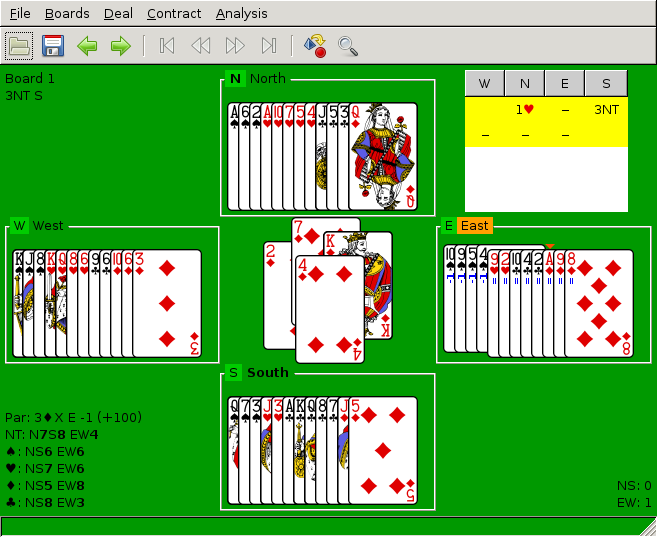
In contrast to chess, there is very little free software for bridge players. Some deal generators have been around for years, but basically, that was all. Nowadays major online bridge site is bridgebase.com. Their windows client actually runs quite well in cedega (and wine), with the notable exception that the built-in double dummy solver doesn't work there. (A double dummy solver is a program that computes the optimal line of play with all four hands open (both sides dummy), and hence can compute the theoretically optimal score for a given board.) Furthermore, viewing records of played boards is a bit tedious as launching the viewer of course requires wine as well. Editing boards is not possible. This is where I started writing some perl scripts that would at least dump the board records as text files. At the same time I thought about doing something interesting with Gnome's glade UI builder. Over the past two years, I have been working on a GTK+ version of a bridge hand viewer and editor I called tenace. When Bo Haglund released his double dummy solver library as GPL software, I packaged it for Debian and worked on integration into tenace. It will compute "best" cards to play, determine par scores. Now tenace should be stable enough so I can risk announcing it to the world. Coincidentally, the screenshot shows a board from last week's club championships. East can beat 3NT by returning a Spade, but at my table they didn't and so the board became my first squeeze hand :)

Matthew Garrett

I'm moving to London in a bit over a week, which means disposing of some quantity of junk, moving some more to London and hiding the rest (anyone got any recommendations for storage? I don't need regular access, but life would be immeasurably easier if they can pick stuff up and take it away). It also means the end of almost 10 years of living in Cambridge, and as a consequence there will be a party in the usual location on Friday the 28th. And possibly also on Saturday the 29th, depending on how much alcohol there still is lying around.

Also, if anyone in the Cambridge area wants some junk, the current list is here. I'll update stuff here as necessary.

Holger Levsen: Hardware and the magic of forth

Last week, while I was already busier than I like, the cpu fan of my pegasos powerpc server blew off, and the resulting heat then killed the CPU. Which was quite a pain, as I used powerpc vservers on it, for which I had no replacement hardware. Or so I thought.

Time for an advertisment break: I'm giving away my oldworld powerpc macs, if you are interested in a beige G3, a 7200 or 4400 powermac, contact me. I doubt anyone will, these machines are more then ten years old. So I will probably give them to recycling next week. Be fast!

I'll also give away my pegasos2 board (and case) to the first person asking.

To make a two day story very short, I now run my vserver on a ten year old iMac, the very first model in a translucent case with build-in monitor, with 160 megabytes of RAM and 233 Mhz powerpc CPU. Yay. It's actually ok for what I need it.

The insane part is the booting. The hard disc has a MSDOS partition layout, as this is what the pegasos uses. But the iMac of course needs a HFS layout, so I need to use a boot CD, for which I've used a modified installer CD, where I replaced the kernel and initrd with the one I want. (Mostly because I didn't remember how to create a bootable CD on macs.) For some reason, the mac wouldnt boot this CD directly, so I've decided to use OpenFirmware (OF) to load yaboot (the bootloader) from CD manually and then yaboot will boot the kernel which can mount its root filesystem even from a disk with msdos partition layout :-)

And now I'll tell you about the magic of forth in OpenFirmware - which was only needed because I was stubborn and kept the kernel inside the directory install/powerpc on the CD... In OF you need to seperate pathes with backslashes, but with the OF installed on this iMac you can't type them! (No comment on that.) But you can use forth to evaluate them...

And so I use '" boot cd:,"(5C)install"(5C)yaboot" evaluate' in OpenFirmware, in which I get a prompt through pressing alt-windows-O-F while powering the machine on, to boot my main server at home. Easy.

I don't intend to do this very often (it runs 24/7), my new server has a XScale IXP422 266 mhz CPU and runs Debian armel :-)

But more on this later, now I need to throw out more old hardware, stuff I will never use again and which just takes physical space. Modern hardware is tiny - as can be seen on this huge pic! :-))

Oh, I almost stayed with powerpc: The "Conceptronic Grab'n'GO CH3WNAS" has nice specs too, is a bit cheaper and should be able to run Debian as well, but there are some missing bits until a 2.6 kernel will run and I wanted a solution which works today. And the FSG-3 (has better specs, that is, more RAM and more ethernet ports, allowing 4 vlans and) runs the new armel port already, the sub architecture patches "just" needs kernel mainline inclusion and there is no d-i support yet. But if you press the reset button on poweron, it will query a bootp server for its own IP address and for a file called zImage-recovery... :-)

And for those who care about the finished FOSDEM 2008 videos: unfortunatly I had even more hardware issues (which I refered to in the ... blog posting last week), which blocked me from working on them. But I will resume this work now (most of it is done by the computer anyway). Now, that I brought my laptop to warranty repair and put the disk into my desktop... To be clear: the laptop incident now is not the case I blogged about last week when I just wrote "..." - that was another machine where I intended to postprocess the videos on and now use as my laptop and to postprocess the videos on. I guess now you can somewhat imagine what I thought when my laptop broke two days ago on a harmless wednesday evening?

Hardware. It's great when it works.

20 March 2008

Jan Wagner: selfnote: How to handle multiple domains with one apache vhost in a smart way

Today a customer asked for hosting several domains with different content on one apache virtual host. The little tricky part was, that the sites should not be accessed by subdirs like http://domain20.org/subdir20/ and http://domain21.org/subdir21/ which can be done with a little script which parses the $_SERVER[’HTTP_HOST’]. So mod_rewrite is an option.
To make it user accessable, we use .htaccess. This requires “AllowOverride +FileInfo” to be set for the DocumentRoot in the vhost config. The .htaccess in DocumentRoot could look something like:

RewriteEngine On
RewriteBase /
RewriteCond % HTTP_HOST domain10.org$ [OR]
RewriteCond % HTTP_HOST domain11.org$
RewriteCond % REQUEST_FILENAME !dir1/
RewriteCond % REQUEST_FILENAME -f [OR]
RewriteCond % REQUEST_FILENAME -d
RewriteRule (.*) dir1/$1 [L]
RewriteCond % HTTP_HOST domain20.org$ [OR]
RewriteCond % HTTP_HOST domain21.org$
RewriteCond % REQUEST_FILENAME !dir2/
RewriteCond % REQUEST_FILENAME -f [OR]
RewriteCond % REQUEST_FILENAME -d
RewriteRule (.*) dir2/$1 [L]

Neil Williams: Death of the HP laptop

OK, the misery of the HP laptop continues.
In hibernated mode, picked up the laptop, open the lid, tap the power button and the lights come on then the lights go off. Followed by the fan and the screen. Try the power button again - nothing.
Power is still getting into the machine - the power indicator works.
Power does not appear to be getting any further. Bugger.
(That's a nice present on my birthday isn't it!) :-(
Only option now is to remove the hard drive and take the disasterous road labelled "Customer Service" as it's under warranty. (That way I can avoid having to revoke my laptop key - it's not my main key but it's got a lot of signatures that I'd rather not loose.)
Damn and double damn. Waste of money, feeling miserable and $%^@& annoyed. I'm almost tempted not to bother getting the useless thing repaired.
So, I'm back on my iBook laptop which will probably now have to go back to running unstable.

19 March 2008

Stefano Zacchiroli: git-buildpackage from debian-only to debian+upstream

Moving a git layout from debian-only to debian+upstream ... and live happily with git-buildpackage Let's say you have a git repository you have used thus far to maintain only the Debian part of some package (i.e. no upstream sources on sight). OK, you're right, that would be quite an uncommon scenario for a git repository. In fact the truth is that you are in such a situation because the git repo was obtained converting from a subversion repo which was using the mergeWithUpstream stuff of svn-buildpackage. Now that you have git's space efficiency you want to change this, import upstream sources, and possibly adhere to a branch layout which is compatible with git-buildpackage (which is very simple in its minimal requirements: an upstream branch containing just upstream sources and a master branch containing a debianized source tree). Out of the box git-import-orig won't work since don't have the upstream branch. Creating it branching from master (or somewhere else) won't work either unfortunately. Indeed after branching you will need to remove the debian/ dir from upstream and when you will merge upstream with master you will be merging the removal as well, bad idea. By myself I've found some horrifying solutions involving using git-filter-branch on the upstream branch merged from master and then squashing all the history of that branch with git-rebase, but they are so horrible that I won't mention them here more than this. The nice solution came from a hint by madduck on the creation of branches without ancestry. Here is the complete recipe (assumed to be run from the master branch of the repo, before creating any upstream branch):
$ git-symbolic-ref HEAD refs/heads/upstream
$ git rm --cached -r .
$ git commit --allow-empty -m 'initial upstream branch'
$ git checkout -f master
$ git merge upstream
$ git-import-orig --no-dch ../foo_1.2.3.orig.tar.gz

In short: you should create an upstream branch without any ancestry, in it you should create an empty commit, then merge it (vacuously) in master, and now you're ready to call git-import-orig to the rescue. Feature request on git-buildpackage to support this out of the box is on the go: bug #471560.

Jaldhar Vyas: Arthur C. Clarke Has Rendevouz With Rama

:-(

Russell Coker: The Inevitability of Victory

I just read an interesting blog post about Montenegro [1]. Apparently a key to the process of becoming a country was acting like it was inevitable. It seems that this method can be applied to many areas, one of which is the contest between Linux and some proprietary OSs. For many years monopolists have convinced people that it was inevitable that they would monopolise all areas of software development. Why use any other software (even if it is more reliable, faster, has more features, and is cheaper) if a monopolist is about to dominate the market? The monopolist changes sometimes, the monopolist from ~1990 to now is different from the monopolist of the 1970’s, but the tactics of a computer monopolist remain the same. The way to beat this is largely to just ignore them. There is an ongoing debate in some circles about when Linux will be “ready for the desktop“. I’ve been running Linux as my primary desktop environment since about July 1998, it’s almost 10 years of having Linux as my primary desktop environment. It seems inevitable that the Linux will take over the desktop - it’s far better for desktop use than it was 10 years ago when I switched. Some people claim that Linux lacks driver support. Every piece of hardware that I’ve wanted to use over the last 10 years has had adequate support. Often second-hand hardware works best with Linux, hardware vendors have no reason to continue to support their old products on newer operating systems (they make more money if you buy new hardware to run the new OS). Not only is hardware support for Linux adequate, but long-term support is far superior (and I often get to use cheap second-hand hardware). Now that an increasing number of hardware vendors are supporting Linux for their new hardware (Intel, AMD, and most laptop vendors are doing some good work in this regard). It seems that everyone who has tried both says that writing drivers for Linux is easier than writing drivers for proprietary OSs, so it seems inevitable that Linux will end up with better driver support by all metrics. Linux is designed for users. DRM (Digital Restrictions Management) is not something that interests Linux developers. Run Linux and your computer will obey you and give full quality audio and video. It seems inevitable that Linux will dominate the AV section of the market (it already dominates the computer work involved with creating movies). Free software (of which Linux is merely the most famous and popular example) is based on the principles of open design and open standards. When you use a free software program to save a file then you can be reasonably sure that you will be able to read it back again in a few decades. Most free software uses file formats that are well documented and standardised. Sometimes there are bugs in programs and new versions will use files in a different way, this is sometimes a case when you rely on a bug in an old version. Using the older version of the software is sometimes required to properly access old data. Fortunately when you have the source to the older programs they can be compiled on new systems (so different types of CPU won’t matter). Also the lack of DRM means that an OS image can be virtualised. One thing that is on my todo list is to create a set of virtual machine images of some of the most commonly used distributions of Linux so I can easily compare distributions of 10 years ago with modern distributions - it’s not technically challenging and there is no particular technical or legal obstacle to doing this. This would also mean that if someone gave me a file in some strange format from 10 years ago I would have a better chance of reading it. It seems inevitable that as the value of data increases the desire to avoid OSs that prevent people from accessing their own data will also increase, and that will eventually squeeze out most closed software from the market. This doesn’t mean the end of proprietary software, merely the end of software that holds user’s data hostage. The majority of the world’s population does not use computers. The computers that they end up using will be cheap because they can’t afford to waste so much money on new hardware. To make cheap machines means that there will be limited resources in terms of RAM, mass storage, and CPU power which require more efficient software. Also to properly take advantage of machines with small screens and other limitations changes to the design of the software will be required. It seems inevitable that the most open software will be adapted to such environments more readily than proprietary software. Now this doesn’t mean that we can take a break from development. In the free software community there are usually many different programs to perform a particular task with competition between the developers of the various projects. The fact that a monopolist is inevitably going to lose it’s position is of little relevance to the competition between the various free alternatives.

18 March 2008

Axel Beckert: MicroClient Sr.

About a year ago, I bought a Norhtec MicroClient Jr., a complete 200 MHz MMX-compatible SoC (“Vortex86”) PC so small that it fits into your hand or onto VESA mountings. Althought thought as thin client, the machine has 128 MB RAM and runs Debian from either netboot, USB stick, CF card or 2.5” harddisk without problems and not even that slow. Later last year, we needed more MicroClient Jrs. at work and since the MicroClient JrSX had a 300 MHz 486SX-compatible SoC processor (“Vortex86SX”) from MSTi and 128 MB DDR RAM instead of SD RAM, we expected them at least in the same performance range and bought a few for ETH and I also bought one for myself. Well, they were about three times slower, since the FPU is missing, not all programs from Debian Etch work fine, e.g. X doesn’t work without patching and recompiling (with Sid, X works, but not the kernel anymore)… BTW: I had both machines with me at FOSDEM ‘08 at the Debian booth and the MMX-compatible machine also at Chemnitzer Linux-Tage (CLT) at the Symlink booth and in Kurt Gramlich’s talk about ecological computers. So if you saw them there, just imagine the same case, with a twice to three times faster CPU and four times the amount of RAM, but with roughly the same carbon foot-print! For our thin client purposes at work we now use ALIX boards from PC Engines (Mini-ITX format) with 500 MHz AMD Geode processors. They’re much faster than the MicroClient Jr. and need even less power. Today, while surfing around on some Mini-ITX shops, I found some computer in obviously MicroClient Jr. case, but with 500 MHz VIA Eden processor and 512 MB of RAM. I first couldn’t believe it. They are selling it as eTC-2500. Since eTC-2300 was one of the brandings of the MicroClient Jr. which is called eBox-2300 officially by the manufacturer DM&P, I searched for eBox-2500, but didn’t find anything useful. Then I looked at the manufacturer’s product page at CompactPC.com.tw and found the eBox-4300 — so it’s really true, they managed to fit a board with 500 MHz VIA processor and half a Gig of RAM into the already fscking small space inside the MicroClient Jr. case, and even without needing more power: Still 15W from the power adaptor. Next stop was Norhtec’s Website. And yes, they also have a new MicroClient product: The MicroClient Sr.. I really need to have one of those for my MicroClient collection! ;-)

Wouter Verhelst: Public service announcement.

The "Data Display Debugger" sometimes is a great tool in, well, debugging stuff. Those who have never met it before, please take a look—it has some nice qualities not found in any other debuggers (or gdb wrappers). However, here is a public service announcement to the ddd developers: STOP MESSING WITH MY LAYOUT, DAMMIT! Here ends this public service announcement. I mean, seriously. Why the fuck do these widgets need to dance around on my screen?

Patrick Winnertz: switched from kde3 to kde4

Yesterday I made the switch from kde3 to kde4. But before I dumped all installed packages into a file ( if I have to restore) and backuped my configuration files for kde. After some fiddeling with kde4 and the dependencies I had a full kde4 installed. My problem was that:
apt-get -t experimental install kde4

won't resolve all dependencies... So my apt-get line was quite long. (After I was finished, I thought that maybe pinning would be a better idea). In general kde4 is usable, but there are some quite annoying things: But of course there are quite many improvements, I'll list here only those which I consider very useful :) Some things which are definitly missing in kde4 (which have to be ported to qt4) are kpowersave and knetworkmanager. Furthermore kontact and amarok, but there is work in progress.

Steve Kemp: I feel like Wedding-Day Barbie

I spent a while yesterday playing with an OpenGear serial console device. It presents an interface to a number of devices via TCP. Unfortunately it is a little flawed for our purposes. We'd like to be able to telnet directly to a serial console of a connected device, like so:
telnet $ip 2000+N
That would give us the serial console of the device in port N. However rather than dropping us straight into the serial console it instead presents a login: + password: prompt. We'd like that removed. The solution according to the manual is to enable the use of RFC 2217 - but that will be a pain. Apparently downloading the CDK will allow a new firmware to be built, and I could fix this problem. Unfortunately the firmware produced by this built fails to flash - failing with an error "Error: Firmware is for a different product". Sigh. Still I have got a partial solution. / is mounted read-only. But /etc/config is writable and /etc/config/rc.local is executed at boot-time. My file contains this:
#!/bin/sh
if [ ! -d /tmp/bin ]; then
  mkdir /tmp/bin
fi
# fake login which won't prompt for username / password
echo '#!/bin/sh' > /tmp/bin/login
echo 'pmshell -l $4' >> /tmp/bin/login
chmod 755 /tmp/bin/login
# fake inetd which exists with the modified PATH so our
# fake login will be invoked.
echo '#!/bin/sh' > /tmp/bin/inetd
echo 'PATH=/tmp/bin:$PATH /bin/inetd $*' >> /tmp/bin/inetd
chmod 755 /tmp/bin/inetd
# use our inetd
kill -9  $(ps -f   grep [i]net  awk ' print $1 ')
/tmp/bin/inetd &
Suprisingly this solution works, but it is nasty. If anybody has any success rebuilding firmware for a CM4148 (running stock 2.3.1u3 firmware currently) I'd appreciate pointers. Unfortunately the source contained upon the opengearweb.org website also fail to flash, when rebuilt. ObQuote: Shooting Fish

Julien Danjou: Are chickens hacking?

I was just taking a look at #awesome IRC stats, and I saw that there was a huge traffic 2 days ago. That was weird, so I did take a look in my log files. And yes, in fact, something happened. At 03:26 GMT+1, suddenly, several hundreds of users joined the channel in somethng like 1-2 minutes, and then just left in same timeline. Some minutes after that, some guys began to talk with one of the real awesome user who was hanging out there. It seems that these guys describe themselves as a "Turkey Hack Team". I've seen a lot of hacked box in my (short) sysadmin life. Many of my customers have no idea of what security is, and this week I'm still working for a customer with an hacked box. And one of the thing I never got was why all these "hackers" were downloading and installing IRC bot or IRC proxy on these compromised boxes. I say "hackers" with big quotes, because when I see in their command line history somethings like "rm .bash_history; logout" or "./exploit_of_dead_to_become_root" when the user they got the password has sudo right, I must laugh. Now, I understand: it seems there are doing some sort of "parade", making all their bots joining an IRC channel and then left. That's so amazing. that I can say for sure: if I'd be a chick, I'll be stripping my shirt vehemently. But the thing is that so far I've no idea if a turkey hack team is somehow related to chickens.

17 March 2008

Joey Hess: two cents

I just bought 5 copies of the Official Catholic Directory Anno Domini 2005. It's a big book - 4 pounds. Sadly it's the paperback, not the fancy hardbound version. But I own Amazon's entire stock. Because it cost 2 cents a book, and I needed exactly 10 cents added to my order to get free shipping. To make up for this gross excess, I'd really like to find something useful to do with the 4 copies of this book I won't use. Yeah, I'm actually interested enough in looking up obscure Honduran churches and poring over province maps and necrology indexes to maybe justify one copy. (No, not Catholic!) For the rest, I need something better than trying to resell it on Amazon for $578.54 as several other people are cunningly attempting to do. Something better than, well, TP. I suppose I could hollow it out and hide a computer in it, and sell that for $578.54. Still brainstorming...

Russell Coker: Barack Obama wants a National CTO

I am just watching US Senator Barack Obama speaking at Google about his bid to become the next US president [1]. He has announced plans for allowing greater citizen oversight of the government including having all government data in open file formats (a great idea - the Australian Bureau of Statistics has a large amount of data online in Excel format). But his most significant item so far is to have a National CTO (Chief Technology Officer). It’s an idea that seems totally obvious now that I’ve heard it and leaves me wondering why I never thought of it before! Barack understand technology, wants a functioning democracy, and gets a +5 Insightful from me for the CTO idea! He also announced a plan to double federal funding for basic scientific research as part of a measure to make the US more competitive with other countries. He mentioned the US standing in the world as a problem (it’s the first mention of this that I’ve heard from anyone in the US government) and notes this as an issue which limits the ability of the US to save lives in regions such as the Darfur. He also claims that there is no clash of civilisations and cites his experience living in a Muslim country as helping to build bridges. When discussing his reasons for running he said that he believes that he can bring his country together to solve problems better than other candidates. That’s the type of thing you often hear and ignore in political campaigns. It is often difficult to believe that someone wants to be famous and powerful for anything other than the most selfish reasons. But Barack gives me the strong impression that he is genuine. He stated a plan to shut down Guantanamo bay (presumably just the prison and torture aspect - I’m guessing that he is not intending to close the military base) and to stop “rendition” (sending prisoners to other countries to be tortured). His plans for education are innovative, as part of educating young children (0-3 years old) he stated an aim to teach parents to read so that they can read to their children! It’s sensible and obvious once you have heard it, but no-one seems to have publicised that idea before. He announced that he will increase teachers’ salaries. He describes the US as having an “empathy deficit“, it’s obvious to almost everyone outside the US but not something that many people in the US realise. He wants decisions to be based on facts and is determined to use facts when dealing with health insurance companies. I just wish that we had some politicians like him in Australia. In terms of policy the Greens politicians would agree with him, but the combination of great policies, insight, and excellent delivery seems a lot better than any of the options in Australia. Update: Changed the post (including the permalink) to have the correct spelling of Barack. Mental note - double check the spelling of everything in the permalink.

Russell Coker: Barak Obama wants a National CTO

I am just watching US Senator Barak Obama speaking at Google about his bid to become the next US president [1]. He has announced plans for allowing greater citizen oversight of the government including having all government data in open file formats (a great idea - the Australian Bureau of Statistics has a large amount of data online in Excel format). But his most significant item so far is to have a National CTO (Chief Technology Officer). It’s an idea that seems totally obvious now that I’ve heard it and leaves me wondering why I never thought of it before! Barak understand technology, wants a functioning democracy, and gets a +5 Insightful from me for the CTO idea! He also announced a plan to double federal funding for basic scientific research as part of a measure to make the US more competitive with other countries. He mentioned the US standing in the world as a problem (it’s the first mention of this that I’ve heard from anyone in the US government) and notes this as an issue which limits the ability of the US to save lives in regions such as the Darfur. He also claims that there is no clash of civilisations and cites his experience living in a Muslim country as helping to build bridges. When discussing his reasons for running he said that he believes that he can bring his country together to solve problems better than other candidates. That’s the type of thing you often hear and ignore in political campaigns. It is often difficult to believe that someone wants to be famous and powerful for anything other than the most selfish reasons. But Barak gives me the strong impression that he is genuine. He stated a plan to shut down Guantanamo bay (presumably just the prison and torture aspect - I’m guessing that he is not intending to close the military base) and to stop “rendition” (sending prisoners to other countries to be tortured). His plans for education are innovative, as part of educating young children (0-3 years old) he stated an aim to teach parents to read so that they can read to their children! It’s sensible and obvious once you have heard it, but no-one seems to have publicised that idea before. He announced that he will increase teachers’ salaries. He describes the US as having an “empathy deficit“, it’s obvious to almost everyone outside the US but not something that many people in the US realise. He wants decisions to be based on facts and is determined to use facts when dealing with health insurance companies. I just wish that we had some politicians like him in Australia. In terms of policy the Greens politicians would agree with him, but the combination of great policies, insight, and excellent delivery seems a lot better than any of the options in Australia.

Neil Williams: Redesigning the SQL integration for libqof2

Unsurprisingly, there is a deal of common ground between a SQLite backend and a GDA backend. Both need simple routines that convert library data into SQL statements but each has very different ways of reading that data back from storage.
I've spent today doing upstream work (whilst also getting my central heating system replaced). Gutted the house, gutted the library - what's wrong with that? :-)
However, I've decided to make these new functions private to the library rather than exporting them. Simple reason really - they are one-way routines.
One day, QOF will support UPDATE statements and one day a bit later it will also support DELETE and even DROP but those require changes within the library like "unregistering" objects that the current code simply doesn't expect.
Eventually, this kind of SQL support can make a usable query interface for quicklist and a few other stalled projects (like DWI). The principle gain is to allow QOF objects to evolve and adapt but retaining compatibility will be a challenge. (QuickList is likely to only support a read-only mode for some objects and require that others are renamed before being amended.)
The other advantage of this refactoring is that the SQLite backend in libqof2 will be a lot smaller than before. Migrating the code hasn't increased the size of libqof2 either because so much deprecated code has been removed when bumping the SONAME.
I'm sticking with the roadmap of not looking to release libqof2 until after Lenny but that gives me plenty of time for internal reworking to get the GDA backend functional.
So far, I have been able to create a test GDA data source, add a table and data, delete the data and drop the data source. Not bad! (I test with SQLite but XML, MySQL, PostgreSQL and other ODBC connections are supported by GDA without changes to the QOF code.)
As ever, implementing new functionality needs a new test case so that has also been started - only 20 tests so far but worth doing.
Other changes before libqof2 - at the request of the original developer - will include updating QOF-Generator to work with libqof2, updating the old HTML example pages to provide a "QuickStart Guide" and other introductory documentation. Whilst I'm doing that, I'll probably also work on the Emdebian website documentation that also needs improved coordination.
Also note that pilot-qof and gpe-expenses are already libqof2 compatible. All that will be needed is some way for those to provide the username and password variables that some GDA connections would need. (The QOF GDA code already has support for such settings, it just needs to be implemented in the respective frontends.)
First set of changes are now in QOF CVS.
(Yes, CVS - I just don't see the appeal of all those new-fangled RCS versions - subversion is about as "modern" as I need. I just don't need the hassle that comes from git fanboys (or any of the other RCS versions) - nor do I need the hassle of migrating CVS to SVN.)
What I would say is that of the various SVN WWW interfaces, websvn stinks, view svn is a bit better but the only one I really like is Trac. For a single large project, Trac is much more friendly IMHO.

Next.

Previous.

