Search Results: "ed"

15 September 2014

Gergely Nagy: Looking ahead

A little more than a year ago, I started working as a syslog-ng OSE developer full-time. That was a tremendously important milestone in my career, as one of the goals I wanted to achieve in life - to work on free software for a living - became a reality. Rocket boots were fired up, and we accomplised quite a lot in the past year, and I'm very, very proud of the work we did - we, the whole community. I enjoyed every bit of it, but as it turns out, some of the other desires I wish to pursue, and new challenges I am looking for, will lead me in a different direction. At the end of August, I handed in my resignation, and the past friday was my last work day at BalaBit.There are a few questions that will likely be asked, and I'll try my best to answer them beforehand. Questions such as: What will happen to syslog-ng?, Who will be the new maintainer?, How does this affect your Debian work?, and so on, and so forth.syslog-ngWhat will happen to syslog-ng?After careful consideration, with the syslog-ng team at BalaBit, we decided that they will take over OSE-related responsibilities as well. They will do releases, they will engage the people on GitHub and the mailing list, they will take care of the @sngOSE twitter account.During the past few months, we've been working on pushing the team closer to the community: we moved issues to GitHub, the team submitted pull requests, and in general, we moved closer to each other in every possible way.While they may not have the open source maintainer experience I had, they are all capable folk, and will quickly learn on the job. The team taking over also has the advantage of having more manpower, and better collaboration between the premium edition and OSE.Who will be the syslog-ng maintainer?There will be no single bottle neck. This has both good and bad implications, but I believe the good ones outweigh the disadvantages.What about the roadmap? When will 3.6.1 happen?The roadmap is already laid out for 3.6, but it is the team's judgement when it will be released. The latest 3.6.0beta2 was released together with the team, too. I expect there will be delays (I planned 3.6.1 to be released on September 27th), but not much; a few weeks, perhaps.What will your involvement in syslog-ng development be?With changing jobs, my involvement will drastically decrease. I will remain a syslog-ng user, and I will continue packaging it for Debian and Ubuntu, and will keep my unofficial repository running. I do not see myself contributing much, perhaps bug reports, opinions and an occasional idea.Nevertheless, my expertise is still considerable, and I will help the team and the community in whatever way I can - but I will be severely time constrained.DebianWhile BalaBit were very free software friendly, and allowed me to work on Debian tasks from time to time, my other activities took up an increasingly big chunk of my paid time, and I had to cut back a little. At the new job, things will be a bit different: while I won't have as much time to do Debian work on the job, I will have a lot more free time, in which I hope to do more for Debian.I will - as promised above - continue maintaining syslog-ng, and all other packages I currently maintain. Apart from those, I wish to make myself more useful within the Clojure and Hy teams.MiscellaneousWhere to are you moving?This is something I will answer in due time. For now, I will have two weeks off, which I wish to spend my way, picking up projects I neglected for far too long.

Martin Pitt: autopkgtest 3.5: Reboot support, Perl/Ruby implicit tests

Last week s autopkgtest 3.5 release (in Debian sid and Ubuntu Utopic) brings several new features which I d like to announce. Tests that reboot For testing low-level packages like init or the kernel it is sometimes desirable to reboot the testbed in the middle of a test. For example, I added a new boot_and_services systemd autopkgtest which configures grub to boot with systemd as pid 1, reboots, and then checks that the most important services like lightdm, D-BUS, NetworkManager, and cron come up as expected. (This test will be expanded a lot in the future to cover other areas like the journal, logind, etc.) In a testbed which supports rebooting (currently only QEMU) your test will now find an autopkgtest-reboot command which the test calls with an arbitrary marker string. autopkgtest will then reboot the testbed, save/restore any files it needs to (like the tests file tree or previously created artifacts), and then re-run the test with ADT_REBOOT_MARK=mymarker. The new Reboot during a test section in README.package-tests explains this in detail with an example. Implicit test metadata for similar packages The Debian pkg-perl team recently discussed how to add package tests to the ~ 3.000 Perl packages. For most of these the test metadata looks pretty much the same, so they created a new pkg-perl-autopkgtest package which centralizes the logic. autopkgtest 3.5 now supports an implicit debian/tests/control control file to avoid having to modify several thousand packages with exactly the same file. An initial run already looked quite promising, 65% of the packages pass their tests. There will be a few iterations to identify common failures and fix those in pkg-perl-autopkgtest and autopkgtestitself now. There is still some discussion about how implicit test control files go together with the DEP-8 specification, as other runners like sadt do not support them yet. Most probably we ll declare those packages XS-Testsuite: autopkgtest-pkg-perl instead of the usual autopkgtest. In the same vein, Debian s Ruby maintainer (Antonio Terceiro) added implicit test control support for Ruby packages. We haven t done a mass test run with those yet, but their structure will probably look very similar.

14 September 2014

Gregor Herrmann: RC bugs 2014/34-37

the perl 5.20 transition is over, debconf14 is over, so I should have more time for RC bugs? yes & no: I fixed some, but only in "our" (as in: pkg-perl) packages:

13 September 2014

Ben Armstrong: Bluff Wilderness Trail Hike, Summer 2014

Happy to be back from our yearly hike with my friend, Ryan Neily, on the Bluff Wilderness Trail. We re proud of our achievement, hiking all four loops. Including the trip to and from the head of the trail, that was 30 km in all. Exhausting, but well worth it. On the trip we bumped into one of the people from WRWEO who helps to maintain the trail, and stopped for a bit to talk to swap stories and tips about hiking the trail. Kudos to Nancy for helping keep this trail beautiful and accessible. We really appreciate the tireless work of this organization, and the thought they ve put into it. It s a treasure!

Keith Packard: Altos1.5

AltOS 1.5 EasyMega support, features and bug fixes Bdale and I are pleased to announce the release of AltOS version 1.5. AltOS is the core of the software for all of the Altus Metrum products. It consists of firmware for our cc1111, STM32L151, LPC11U14 and ATtiny85 based electronics and Java-based ground station software. This is a major release of AltOS, including support for our new EasyMega board and a host of new features and bug fixes AltOS Firmware EasyMega added, new features and fixes Our new flight computer, EasyMega, is a TeleMega without any radios: AltOS Changes We've made a few improvements in the firmware: AltOS Bug Fixes We also fixed a few bugs in the firmware: AltosUI and TeleGPS EasyMega support, OS integration and more The AltosUI and TeleGPS applications have a few changes for this release:

Laura Arjona: Disabling comments in the blog

I m getting more spam than the amount that I can stand in this blog. Comments are moderated, so the public is not suffering that, only me. From time to time I go to my dashboard and clean the spam. I m afraid that I delete some legit comment in these spam-cleaning-fevers, or, more probably, that a legit comment waits in the queue for several days (weeks?), just because I m lazy to deal with spam and let days pass by (until the fever comes). I think I m going to follow the wisdom of Bradley M. Kuhn and link to a pump.io note for comments on my blog posts (disabling them here in WordPress.com). I usually post a notice when I write something in my blog, so the only task is to update the blog post with the pump.io URL of the thread for comments. While WordPress.com allows to write comments quickly, without need of an account (you write just a name and an email, and the comment), in pump you need to have an account and sign in to comment. That looks as a bad thing, a barrier for people to participate. But of course, it stops spam :) After thinking about it a bit, pump.io it s a federated network, you can choose the pump server that they want, you can create a fake account, you don t need to provide personal information and it s another way to promote one of the social networks where I live. Other systems link to facebook, twitter, or other places, and nobody complains! Even when those services don t have any of the advantages of being in a federated free-software powered social network :) If anybody don t want to use pump.io but wants to comment, other ways to reach me or the related blog post are: So now it s decided, and this is the first post of this new experiment. This text is posted in pump.io too, and you can comment there :)
Filed under: My experiences and opinion, Tools Tagged: Blog, English, federation, pump.io, social networks, Wordpress

12 September 2014

Steve Kemp: Storing and distributing secrets.

I run a number of hosts, and they are controlled via a server automation tool I wrote called slaughter [Documentation]. The policies I use to control my hosts are public and I don't want to make them private because they server as good examples. Because the roles are public I don't want to embed passwords in them, which means I need something to hold secrets securely. In my case secrets are things like plaintext-passwords. I want those secrets to be secure and unavailable from untrusted hosts. The simplest solution I could think of was an IP-address based ACL and a simple webserver. A client requests something like: That returns a JSON object, if the requesting host is permitted to read the data. Otherwise it returns a HTTP 403 error. The layout is very simple:
 -- secrets
     -- 206.190.139.148
         -- auth.json
     -- 127.0.0.1
         -- example.json
     -- 80.68.84.109
         -- chat.json
Each piece of data is beneath a directory/symlink which controls the read-only access. If the request comes in from the suitable IP it is granted, if not it is denied. For example a failing case:
skx@desktop ~ $ curl  http://sss.steve.org.uk/chat
missing/permission denied
A working case :
root@chat ~ # curl  http://sss.steve.org.uk/chat
  "steve": "haha", "bot": "notreally"  
(The JSON suffix is added automatically.) It is hardly rocket-science, but I couldn't find anything else packaged neatly for this - only things like auth/secstore and factotum. So I'll share if it is useful. Simple Secret Sharing, or Steve's secret storage.

Richard Hartmann: Release Critical Bug report for Week 37

Remember, remember; the fifth of November. The UDD bugs interface currently knows about the following release critical bugs: Graphical overview of bug stats thanks to azhag:

Jonathan McDowell: Back from DebConf 14

I previously forgot to mention that I was planning to attend DebConf14, having missed DebConf13. This year the conference was held in Portland, OR. This is a city I've been to many times before, and enjoy, but I hadn't spent any time wandering around its city centre as a pedestrian. I have to say I really prefer DebConfs that are held in middle of city. It always seems a bit of a shame to travel some distance to somewhere new and spend all the time there in a conference venue. Plus these days I have the added lure of going out and playing Ingress in a new location. DebConf14 didn't disappoint in these respects; the location was super easy to get to from the airport via public transportation, all of the evening social events were within reasonable walking distance (I'll tend to default to walking when possible) and the talk venue/accommodation were close to each other and various eating + drinking options. Throw in the fact at Portland managed to produce some excellent weather (modulo my Ingress session on the last Saturday morning, when rained on me) and it's impossible to fault the physicalities of DebConf this year. This year the conference format was a bit different; previous years have had a week long DebConf before the week of the conference itself. This year went for a 9 day talk schedule (Saturday -> Sunday) with various gaps of hacking time interspersed. I've found it hard to justify a full two weeks away in the past, so this setup worked a lot better from my viewpoint. Also I rarely go to DebConf with a predetermined list of things to do; the stuff I work on naturally falls out of talks I attend and informal discussions I have. Having hack time throughout the conference helped me avoid feeling I was having to trade off hacking vs talks. Naturally enough a lot of my involvement at DebConf was around OpenPGP. Gunnar and I spent a fair bit of time getting Daniel up to speed with the keyring-maint team (Gunnar more than I, I'll confess). We finally set a hard timeframe for freeing Debian of older 1024 bit keys. I was introduced to the Gnuk, which is a particularly interesting piece of open specification hardware with a completely Free software stack on top if it that implements the OpenPGP smartcard spec. Currently it's limited to 2K keys but it's hoped that 4K support can be added (and I ended up spending a couple of hours after the closing talk hacking on the source and seeing how much needs to change for 4K support, aided by the very patient Niibe). These are the sort of things that really benefit from the face time that DebConf offers to the Debian project. I've said it before, but I think it's worth saying again: Debian is a bit like a huge telecommuting organization and it's my opinion that any such organization should try and ensure its members actually spend some time together on a regular basis. It improves the ability to work remotely a hell of a lot if you can actually put a face to the entity you're emailing / IRCing and have some sort of idea where they're coming from because you've spent some time with them, whether that's in talks or over dinner or just casual hallway chats. For once I also found myself considering alternative employment while at DebConf and it was incredibly useful to be able to have various conversations with both old friends and people who were there with an eye on recruitment. Thanks to all those whose ears I bent about the subject (and more on the outcome in a future post). Thank you also to the many people involved with the organization of DebConf; I've been on the periphery a few times over the years and it's given me a glimpse into the amount of hard work all of the volunteers (be they global team, local organizing team, video team or just random volunteers) put into making DebConf one of my must-attend yearly conferences. If you're at all involved in Debian and haven't attended I strongly urge you to do so - I'll see you all next year at DebConf15 in Heidelberg!

Dariusz Dwornikowski: forwarding messages with attachments in mutt

This is a pain for every mutt user. I do not know why this solution is so hard to find. Just add these two lines to your .muttrc.
set mime_forward
set mime_forward_rest=yes
This will forward an email with all the attachments, no scripts needed, no fancy tagging or reediting.

Elena 'valhalla' Grandi: Sometimes apologies are the worst part

I am sick of hearing apologies directed to me just after a dirty joke.

Usually, I don't mind dirty jokes in themselves: I *do* have a dirty mind and make my share of those, or laugh for the ones my friends with even dirtier minds make.

There are of course times and places where they aren't appropriate, but I'd rather live in a world where they are the exception (although a common one) rather than the norm.

Then there is the kind of dirty jokes strongly based on the assumptions that women are sexual objects, a nuisance that must be tolerated because of sex or both: of course I don't really find them fun, but that's probably because I'm a nuisance and I don't even give them reason to tolerate me. :)

Even worse that those, however, is being singled out as the only women in the group with an empty apology for the joke (often of the latter kind): I know you are not really sorry, you probably only want to show that your parents taught you not to speak that way in front of women, but since I'm intruding in a male-only group I have to accept that you are going to talk as appropriate for it.

P.S. no, the episode that triggered this post didn't happen in a Debian environment, it happened in Italy, in a tech-related environment (and not in a wanking club for penis owners, where they would have every right to consider me an intruder).

Dariusz Dwornikowski: profanity and libstrophe status in Debian

profanity is a great console based XMPP client written in ncurses and C by James Booth. The code has a great quality, upstream is super collaborative, and willing, so packaging should be pretty straightforward. This post will show that this was not the case here. profanity First obstacle was that profanity depended on libstrophe, an XMPP library, which was not in Debian. As it occurred libstrophe's upstream was not responsive, so any changes that were needed to prepare libstrophe for high quality packaging could not be met.
  1. First of all libstrophe's build system (automake and friends) built only a static library.
  2. The second problem was that libstrophe did not tag releases on github, this was needed to make Debian watch file work.
  3. A third, smaller problem was the presence of debian/ directory in upstream's source. It can be neglected most of the time, since you can tell git-import-orig to delete it.
To solve those 3 problems I created a pull request fixing the build system to build also a shared library, deleting debian/ directory and politely asking for tagging releases. You can see my pull request here dated on April 26th. There was no answer for the libstrophe's upstream but I has some support from profanity's developers and other users wanting to make those changes. Finally metajack (libstrophe upstream) gave us right to the repo and we could merge the pull request on August 6th. The lesson learned - be patient and know autotools (a great tutorial is here). With profanity there were less changes to do. The most important one was that it linked to OpenSSL and due to the license incompatibility with GPL it could not go into Debian. Fortunately upstream added the OpenSSL exception, and profanity could be finally packaged. Now both profanity and libstrophe are in NEW queue and hopefully they will be accepted by ftp masters. When they are, there is plenty to do with them in the future, upstream closed some bugs, new upstream versions are tagged.

John Goerzen: The Thrill and Stress of Too Many Hobbies

Today, 4PM. Jacob and Oliver excitedly peer at the box in our kitchen a really big box, taller than them. Inside is is the first model airplane I d ever purchased. The three of us hunkered down on the kitchen floor, opened the box, unpacked the parts, examined the controller, and found the manual with cryptic assembly directions. Oliver turned some screws while Jacob checked out the levers on the controllers. Then they both left for a bit to play with their toy buses. A little while later, the three of us went outside. It was too windy to fly. I had never flied an RC plane before only RC quadcopters (much easier to fly), and some practice time on an RC simulator. But the excitement was too much. So out we went, and the plane took off perfectly, climbed, flew over the trees, and circled above our heads at my command. I even managed a good landing in the wind, despite about 5 aborted attempts due to coming in too high, wrong angle, too fast, or last-minute gusts of wind throwing everything off. I am not sure how I pulled that all off on my first flight, but somehow I did! It was thrilling! I ve had a lot of hobbies in my life. Computers have run through many of them; I learned Pascal (a programming language) at about the same time I learned cursive handwriting and started with C at around age 10. It was all fun. I ve been a Debian developer for some 18 years now, and have written a lot of code, and even books about code, over the years. Photography, music, literature, history, philosophy, and theology have been interests for quite some time as well. In the last few years, I ve picked up amateur radio, model aircraft, etc. And last month, Laura led me into Ada s Technical Books during our visit to Seattle, resulting in me getting interested in Arduino. (The boys and I have already built a light-activated crossing gate for their HO-gauge model trains, and Jacob can now say he s edited a few characters of C!) Sometimes I find ways to merge hobbies; I ve set up all sorts of amateur radio systems on Linux, take aerial photographs, and set up systems to stream music in my house. But I also have a lot less time for hobbies overall than I once did; other things in life, such as my children, are more important. Some of the code I once worked on actively I no longer use or maintain, and I feel guilty about that when people send bug reports that I have no interest in fixing anymore. Sometimes I feel a need to cut down, and perhaps have; and then, I get an interest in RC aircraft and find an airplane that is great for a beginner and fairly inexpensive. Perhaps it is the curse of being a curious person living in an interesting world. Do any of the rest of you have a large number of hobbies? How do you feel about that?

11 September 2014

Stefano Zacchiroli: debsources bugs and easy hacks

debsources debbugs oh My ongoing quest for lowering the barrier for contributing to Debsources continues.
In this chapter: What's your excuse for not contributing to Debsources, again?

Dirk Eddelbuettel: pkgKitten 0.1.2: Still creating R Packages that purr

A brown bag release 0.1.2 of pkgKitten is now on CRAN, following yesterday's 0.1.1 upload Next time I'll try to remember that when I have parameters name and path, it won't work so well to call them as path and name ...
Changes in version 0.1.2 (2014-09-11)
  • Brown-bag fix of calling the new helper function with then correct order of arguments.
More details about the package are at the pkgKitten webpage and the pkgKitten GitHub repo. Courtesy of CRANberries, there is also a diffstat report for this release

This post by Dirk Eddelbuettel originated on his Thinking inside the box blog. Please report excessive re-aggregation in third-party for-profit settings.

Enrico Zini: suspend-i-really-mean-it

Laptop, I demand that you suspend! Dear Lazyweb, Sometimes some application prevents suspend on my laptop. I want to disable that feature: how? I understand that there may exist some people who like that feature. I, on the other hand, consider a scenario like this inconceivable:
  1. I'm on a plane working with my laptop, the captain announces preparations for landing, so I quickly hit the suspend button (or close the lid) on my laptop and stow it away.
  2. One connecting flight later, I pick up my backpack, I feel it unusually hot and realise that my laptop has been on all along, and is now dead from either running out of battery or thermal protection.
  3. I think things that, if spoken aloud in front of a pentacle, might invoke major lovecraftian horrors.
I do not want this scenario to ever be possible. I want my suspend button to suspend the laptop no matter what. If a process does not agree, I'm fine with suspending it anyway, or killing it. If I want my laptop to suspend, I generally have a good enough real-world reason for it, and I cannot conceive that a software could ever be allowed to override my command. How do I change this? I don't know if I should look into systemd, upowerd, pm-utils, the kernel, the display manager or something else entirely. I worry that I cannot even figure where to start looking for a solution. This happened to me multiple times already, and I consider it ridiculous. I know that it can cause me data loss. I know that it can cause me serious trouble in case I was relying on having some battery or state left at my arrival. I know that depending on what is in my backpack, this could also be physically dangerous. So, what knob do I tweak for this? How do I make suspend reliable? Update Systemd has an inhibitor system, and systemd-inhibit --list only lists 'delay' blocks in my system. It is an interesting feature that seems to be implemented in the right way, and it could mean that I finally can get my screen to be locked before the system is suspended. It is possible to configure the inhibitor system in /etc/systemd/logind.conf, including ways to ignore inhibitors, and a maximum time after which inhibitors are ignored if not yet released. Try as I might to run everything that I was running on the plane that time, I could not manage to see anything take an inhibitor block that could have prevented my suspend. I now suspect that what happened to me was a glitch caused by something else (hardware? kernel? cosmic rays!) during that specific suspend. When I had this issue in the past it looks like the infrastructure at the time was far more primitive that what we have now with systemd, so I guess that when writing my blog post I had simply correlated my old experiences with a one-off suspend glitch. If I want to investigate or tune further, to test the situation with a runaway block, I can use commands like systemd-inhibit --mode=block sleep 3600. I'm quite happy to see that we're moving to a standard and sane system for this. In the meantime, I have learnt that pm-utils has now become superfluous and can be deinstalled, and so can acpi-support and acpi-support-base. Thanks vbernat, mbiebl, and ah, on #debian-devel for all the help.

Sylvestre Ledru: Rebuild of Debian using Clang 3.5.0

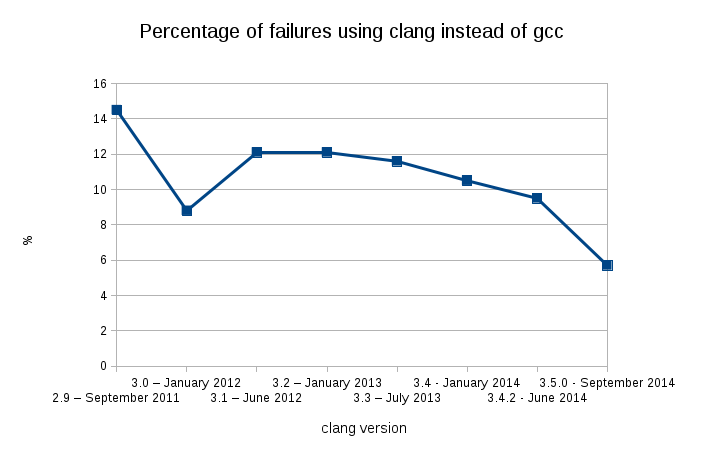
Clang 3.5.0 has just been released. A new rebuild has been done highlight the progress to get Debian built with clang. tl;dr: Great progress. We decreased from 9.5% to 5.7% of failures. Full results are available on http://clang.debian.net At time of the rebuild with 3.4.2, we had 2040 packages failing to build with clang. With 3.5.0, this dropped to 1261 packages. Fixes With Arthur Marble and Alexander Ovchinnikov, both GSoC students, we worked on various ways to decrease the number of errors. Upstream fixes First, the most obvious way, we fixed programming bugs/mistakes in upstream sources. Basically, we took categories of failure and fixed issues one after the other. We started with simple bugs like 'Wrong main declaration', 'non-void function should return a value' or 'Void function should not return a value'.

They are trivial to fix. We continued with harder fixes like ' Undefined reference' or 'Variable length array for a non POD (plain old data) element'.

So, besides these one, we worked on:
In total, we reported 295 bugs with patches. 85 of them have been fixed (meaning that the Debian maintainer uploaded a new version with the fix).

In parallel, I think that the switch by FreeBSD and Mac OS X to Clang also helped to fix various issues by upstreams. Hacking in clang As a parallel approach, we started to implement a suggestion from Linus Torvalds and a few others. Instead of trying to fix all upstream, where we can, we tried to update clang to improve the gcc compatibility.

gcc has many flags to disable or enable optimizations. Some of them are legacy, others have no sense in clang, etc. Instead of failing in clang with an error, we create a new category of warnings (showing optimization flag '%0' is not supported) and moved all relevant flags into it. Some examples, r212805, r213365, r214906 or r214907

We also updated clang to silent some useless arguments like -finput_charset=UTF-8 (r212110), clang being UTF-8 compliant.

Finally, we worked on the forwarding of linker flags. Clang and gcc have a very different behavior: when gcc does not know an argument, it is going to forward the argument to the linker. Clang, in this case, is going to reject the argument and fail with an error. In clang, we have to explicitly declare which arguments are going to be transfer to the linker. Of course, the correct way to pass arguments to the linker is to use -Xlinker or -Wl but the Debian rebuild proved that these shortcuts are used. Two of these arguments are now forwarded: New errors Just like in other releases, new warnings are added in clang. With (bad) usage of -Werror by upstream software, this causes new build failures: I also took the opportunity to add some further categorizations in the list of errors. Some examples: Next steps The Debile project being close to ready with Cl ment Schreiner's GSoC, we will now have an automatic and transparent way to rebuild packages using clang. Conclusion As stated, we can see a huge drop in term of number of failures over time:
Hopefully, Clang getting better and better, more and more projects adopting it as the default compiler or as a base for plugin/extension developments, this percentage will continue to decrease.
Having some kind of release goal with clang for Jessie+1 can now be considered as potentially reachable. Want to help? There are several things which can be done to help: Acknowledgments Thanks to David Suarez for the rebuilds of the archive, Arthur Marble and Alexander Ovchinnikov for their GSoC works and Nicolas S velin-Radiguet for the few fixes.

Steve Kemp: A small email utility and other updates.

Last night I was looking for an image I knew a model had mailed me a few months ago, as we were talking about rescheduling a shoot at the weekend. I couldn't find it, even with my awesome mail client and filing system. With some free time I figured I could write a little utility to dump all attachments from email folders, and find it that way. It did cross my mind that there is the simple mail-utility for dumping headers, etc, called formail, which is distributed alongside procmail, but it doesn't handle attachments .. I was tempted to write a general purpose script to dump attachments, email header values, etc, etc but given the lack of time I merely solved my own problem. I suspect there is room for a "mail utilities" package, similar to Joey's "moreutils" and my "sysadmin utils". However I note that there is a GNU Mailutils which does things differently than I'd expect - i.e. it contains a POP3 server. Still if you want to dump attachments from emails, have GMIME installed, and want to filter by attachment-name, or MIME-type, you might look at my trivial attachment-dump program. Related to that I spent some time last night updating my photography site, so the animals & pets section has updated images at least. During the course of that I found a bug in my static-site generator, templer which stopped it from automatically populating image height/widths when called in a glob:
Title: Pets & Animals
Images: file_glob( "*.jpg" )
---
This is the page body, it now has access to a variable called 'images'
which is a HTML::Template loop-structure containing name/height/width/etc
for each image in the current directory.
That should now be resolved, and life should once again be good.

Matthias Klumpp: Listaller: Back to the future!

Listaller-Logo (with text)It is time for another report on Listaller, the cross-distro 3rd-party package installer, which is now in development for depending how you count 5-6 years. This will become a longer post, so you might grab some coffee or tea ;-) The original idea The Listaller project was initially started with the goal to make application deployment on Linux distributions as simple as possible, by providing a unified package installation format and tools which make building apps for multiple distributions easier and deployment of updates simple. The key ideas were: The current state The current release of Listaller handles all of this with a plugin for PackageKit, the cross-distro package-management abstraction layer. It hooks into PackageKit and reads information passing through to the native distributor backend, and if it encounters Listaller software, it handles it appropriately. It can also inject update information. This results in all Listaller software being shown in any PackageKit frontends, and people can work with it just like if the packages were native packages. Listaller package installations are controlled by a machine policy, so the administrator can decide that e.g. only packages from a trusted source (= GPG signature in trusted database) can be installed. Dependencies can be pulled from the distributor s repositories, or optionally from external sources, like the PyPI. This sounds good on paper, but the current implementation has various problems. The issues The current Listaller approach has some problems. The biggest one lies in the future: Soon, there will be no PackageKit plugins anymore! PackageKit 1.0 will remove support for them, because they appear to be a major source for crashes, even the in-tree plugins cause problems. Also, the PackageKit service itself is currently being trimmed of unneeded features and less-used code. These changes in PackageKit are great and needed for the project (and I support these efforts), but they cause a pretty huge problem for Listaller: The project relies on the PackageKit plugin if used without it, you loose the system-integration part, which is one of the key concepts of Listaller, and a primary goal. But this issue is not the only one. There are more. One huge problem for Listaller is dependency-solving: It needs to know where to get software from in case it isn t installed already. And that has to be done in a cross-distributional way. This is an incredibly complex task, and Listaller contains lots of workarounds for various quirks. It contains so much hacks for distro-specific stuff, that it became really hard to understand. The Listaller dependency model also became very complex, because it tried to handle many corner-cases. This is bad, of course. But the workarounds weren t added for fun, but because it was assumed to be easier than to fixing the root cause, which would have required collaboration between distributors and some changes on the stack, which seemed unlikely to happen at the time the code was written. The systemd effort Also a thing which affects Listaller, is the latest push from the systemd team to allow cross-distro 3rd-party installations to happen. I definitively recommend reading the linked blogpost from Lennart, if you have some spare time! The identified problems are the same as for Listaller, but the solution they propose is completely different, and about three orders of magnitude more invasive than whatever the Listaller project had in mind (I make these numbers up, so don t ask!). There are also a few issues I see with Lennarts approach, I will probably go into detail about that in another blogpost (e.g. it requires multiple copies of a library lying around, where one version might have a security vulnerability, and another one doesn t it s hard to ensure everything is up to date and secure that way, even if you have a top-notch sandbox). I have great respect for the systemd crew and especially Lennart, and I hope them to succeed with their efforts. However, I also think Listaller can achieve a similar things with a less-invasive solution, at least for the 3rd-party app-installations (Listaller is one of the partial-fix solutions with strict focus, so not a direct competitor to the holistic systemd approach. Both solutions could happily live together.) A step into the future Some might have guessed it already: There are some bigger changes coming to Listaller! The most important one is that there will be no Listaller anymore, at least not in its old form. Since the current code relies heavily on the PackageKit plugin, and contains some ugly workarounds, it doesn t make much sense to continue working on it. Instead, I started the Listaller.NEXT project, which is a rewrite of Listaller in C. There are a some goals for the rewrite: I made a last release of the 0.5.x series of Listaller, to work with PackageKit 0.9.x the future lies in the C port. If you are using Listaller (and I know of people who do, for example some deploy statically-linked stuff on internal test-setups with it), stay tuned. The packaging format will stay mostly compatible with the current version, so you will not see many changes there (the plan is to freeze it very soon, so no backwards-incompatible changes are made anymore). The o.5.x series will receive critical bugfixes if necessary. Help needed! As always, there is help needed! Writing C is not that difficult ;-) But user feedback is welcome as well, in case you have an idea. The new code will be hosted on Github in the new listaller-next branch (currently not that much to find there). Long-term, we will completely migrate away from Launchpad. You can expect more blogposts about the Listaller concepts and progress in the next months (as soon as I am done with some AppStream-related things, which take priority).

Dirk Eddelbuettel: pkgKitten 0.1.1: Still creating R Packages that purr

A maintenance release 0.1.1 of pkgKitten is now on CRAN. It has only one small change: the function playWithPerPackageHelpPage() was factored out of the main function kitten() as I happened to be needing something just like playWithPerPackageHelpPage() to make packages created by the Rcpp function Rcpp.package.skeleton() a little nicer. We also added a NEWS.Rd file which restates major release features. As it is so short, we include it in its entirety.
Changes in version 0.1.1 (2014-09-09)
  • New (exported) function playWithPerPackageHelpPage() which lets other packages create a non-complaint-generating package help page
Changes in version 0.1.0 (2014-06-13)
  • Initial public version and CRAN upload
More details about the package are at the pkgKitten webpage and the pkgKitten GitHub repo. Courtesy of CRANberries, there is also a diffstat report for this release

This post by Dirk Eddelbuettel originated on his Thinking inside the box blog. Please report excessive re-aggregation in third-party for-profit settings.

Next.

Previous.