Sylvestre Ledru: Status of LLVM in Debian
Here is some updates on the LLVM world into Debian.
LLVM and CLANG getting better and better after each release. After some lag, it is now time to have all these packages up-to-date into the archive. Here is an update of their status in Debian:
LLVM and CLANG getting better and better after each release. After some lag, it is now time to have all these packages up-to-date into the archive. Here is an update of their status in Debian:
- LLVM
LLVM 2.8 and 2.9 are now available into the archive.
For version 2.8, Matthias Klose deserves most of the credit.
Version 2.9 is available in experimental. They both build pretty well on most of the architectures besides kfreebsd. It is on my TODO list. -
Clang. A C/C++ compiler.
clang 2.8 and 2.9 are respectively available in unstable and experimental.
These versions cover most of C/C++ specifications and more and more big software (Qt, Boost, Scilab, etc) succeed to be built with it. Like LLVM, it is available under most of the Debian architectures (but I haven't tested the quality of the ASM generated). clang can be used just like gcc. With most of software, calling configure/make with CC="clang" or CXX="clang" should be enought. -
* Dragonegg
Dragonegg is a gcc plugin (llvm-gcc-4.5) which allows gcc to use optimizer and code generators of LLVM.
It is now straightforward to use:
llvm-gcc -o foo foo.c
It required the exact same version of gcc (even if the sources say it is probably a too strong requirement). Now, a warning like this one is displayed:
Potential incompatible plugin version. GCC: 4.5.3. Expected: 4.5.2

Defines 'dragonegg_disable_version_check' as env variable to remove this warning

Please note that unexpected errors might occur.
-
llvm-defaults
Last but not least, I uploaded llvm-defaults, a work of Arthur Loiret. This package allows a similar behavior to gcc-defaults. The installation of llvm will provide the default version of llvm.
- llvm
The llvm package has been removed. Actually, it was just the version 2.6 of llvm (see bug #625729). llvm (from llvm-defaults) is now providing the favorite version of llvm. - llvm-gcc-4.2
Upstream stopped the development of this plugin.
It has been removed from the archive (see bug #626007) and dragonegg is taking the relay. - llvm-snapshot
llvm-snapshot (see bug #626083) followed the same direction as llvm-gcc-4.2 - llvm-2.7
llvm-2.7 is still in the archive (see bug #626081) because of some reverse dependencies...
 As previously announced in
 My
 I was hosting my
 A while ago, MusicBrainz used a technique called
 That was a damn busy week.
It was mostly centered about attending
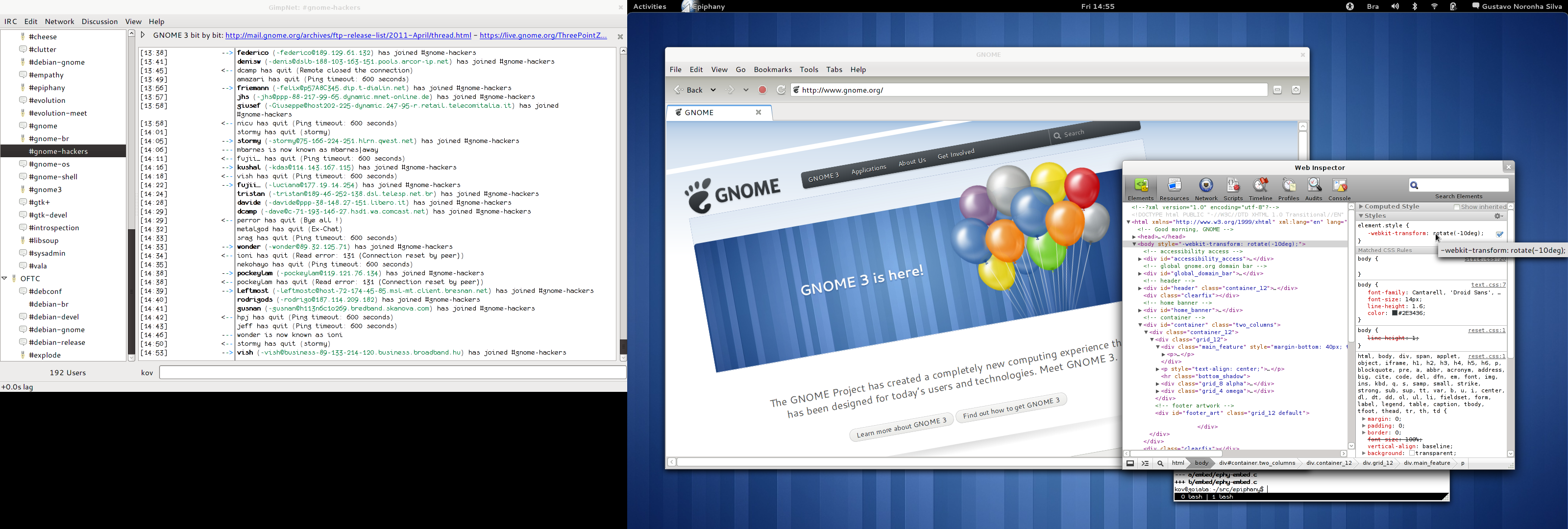
 You know, GNOME Shell and I are not really strangers to each other for a long time now. I have been using it almost daily as my main desktop since late 2009, when I started shipping it to Debian experimental. That means that I had ample opportunity to both get used to it and witness the huge improvements it had with every new release.
My general feeling towards GNOME 3 is this: . Yes, I love it! I love the new themes, I love the window borders, I love the top panel, the overview, the dynamic workspaces, I love the Me menu, I love the clock and the calendar, the system indicators with the beautiful symbolic icons, being able to search for applications in such a nice way, the window animations, the multi-screen support, the new nautilus, the dash, looking glass. It s hard for me to even express how thankful I am and how much admiration I have for the awesome folks who helped bring this to life. Thanks so much!

 Today was Bike to Work Day, and I biked to work, just like I do most other
days.
I missed out on it last year because I was still out on paternity leave at
the time. That means I've almost been back at work a year.
Since we only have one car, and when Zoe was little and sleeping a lot, it
made most sense for me to start biking to work again. I'm really glad I did,
because not only is it faster compared to the round trip time that Sarah
would need to take to drop me off and pick me up, it's a lot easier on her
and Zoe. It used to be a challenge for Sarah to get from home to work and
back in the mornings without Zoe falling asleep in the car.
The only times I've needed a lift have been in wet weather during winter,
and when I've been sick. Now that we're out of winter, we should have
endless sunshine for months, and it's starting to warm up, which makes
biking so much more pleasant.
It takes about 10-12 minutes door to door, which is short and sweet, and
most of that is on the lovely
 LightDM's a from-scratch implementation of an X display manager, ie the piece of software that handles remote X connections, starts any local X servers, provides a login screen and kicks off the initial user session. It's split into a nominally desktop-agnostic core (built directly on xcb and glib) and greeters, the idea being that it's straightforward to implement an environment-specific greeter that integrates nicely with your desktop session. It's about 6500 lines of code in the core, 3500 lines of code in the gtk bindings to the core and about 1000 in the sample gtk greeter, for a total of about 11,000 lines of code for a full implementation. This compares to getting on for 60,000 in gdm. Ubuntu plan to switch to LightDM in their next release (11.10).
 IPv6 adoption is increasing, and along with it come a new set of behaviours and defaults that system administrators and users must learn and become familiar with. I was recently caught out by Linux s handling of IPv6 router advertisements (RAs) when forwarding is also enabled on the interface. It took me a while to figure out and searching for obvious terms (such as those in the first half of the title of this post) didn t immediately yield useful answers, so here is my attempt to help shed some light on the subject.
By default Linux will ignore IPv6 RAs if the interface is configured to forward traffic. This is in line with
 [0] Arguably you really don t want to be autoconfiguring addresses on your router ever, but that s a philosophical debate that isn t really relevant to this post.


 Two weeks ago,

