Search Results: "tim"

4 June 2011

Russell Coker: Leaving Three

In February I started the process of moving my phone and my wife s phone to Virgin from Three [1]. The reason is that Three didn t offer any good phones on affordable contracts, the cheapest that was suitable was a HTC Desire HD which would have cost me $55 per month, while I could justify spending that for my own phone (which is used for responding to SMS from Nagios to fix client servers) I didn t have the budget to spend that much on my wife s phone too and I really want us to have the same type of phone for ease of support. So I chose Virgin who offers the Sony Ericsson Xperia X10 for as little as $29 per month I chose a $39 per month deal that included 1500MB of data transfer and also had three months free which makes it effectively $34.12 per month. When using previous phones that weren t particularly smart I had also carried a Netbook and a 3G modem with me most of the time. Now that I have a phone that is a ssh client I don t need that so I tried to cancel the contract today. Three allows you to do almost everything over the Internet except cancel a contract their web site doesn t even give a phone number to call for that purpose. This must keep their support people busy, Vodaphone (which has just merged with Three) has recently had a horrible security breach because their sales booths used public Internet access for all customer data [2]. Also there is currently a law suit against Vodafone for poor network performance and misleading claims about service areas [3]. My experience with Three performance has been reasonably good apart from the fact that they advertised 3G service in Bendigo and provided none. As Three are apparently desperate to retain customers they offered me free service for 6 months if I don t close the account now. So I have a SIM that supports 1G of 3G data transfer per month for no charge until December (worth $90). What can I do with it? I don t own a 3G modem as I gave that to my parents (who are quite happy with pre-paid 3G net access via Three) and the phones that I have which can be used for tethering are a little slow (usable for ssh and basic web access but not for Youtube etc). Is there a way of selling such a SIM? Note that my name is still on the contract and any excess data or roaming fees will be billed to me so I can t just put it on ebay. I guess that one thing I can do is to use the SIM for receiving phone calls. For example if a friend was visiting from another country and wanted to receive calls without paying roaming fees I could lend them a phone. Any ideas?

Rudy Godoy: GSoC: Status report 01

Hello, this is the official project report for the Debian GSoC admins and everyone. It s been few days since the official coding phase started. Most of the time I ve been figuring out the details regarding integration of non-x86 images to the Eucalyptus IaaS and working on the ARM image, as you ll learn later. I m also in the process of starting to design the set of tools we ll be delivering as part of the project. The project s goal is to be a useful resource for Debian developers and porters. I ve joined some porters list in order to learn what are the things they are struggling with and how the project can help to address them. I ll be starting a wiki page with such topics. Bonding period:
Bonding period has been more fruitful than I expected. As mentioned in my previous post, Steffen and I got in touch with the Eucalyptus team, since they show their early interest on the project. We are coordinating cooperation between our teams. Besides my mentor and I defined to start working on the ARM image. Coordination went OK. We ll be having meetings every two weeks. Project Status:
Resuming Dominique s work I began working on the ARM image. Aur lien s work was a great resource. Currently I have a working and updated Debian testing ARM image using the versatile kernel that can be used under qemu-arm. I m currently making tests and figuring out the next phase which is cloudify it. Over this weekend I expect to finish on that side and then began on the design and implementation of the tools that will be the project s result.
Until now I haven t faced much issues, but the Eucalyptus part since the docs are targeting x86 and amd_64 archs. However I think I can run qemu-arm on top. I ll talk to them about the idea.
Future plans: week 3: - Finish tests with the ARM image. - Design the base tool-set, thinking integration with dpkg-buildpackage and qemubuilder. week 4-8: - Write the necessary code. mid-term evaluation. Other bits: Latest days have been quite busy for me, since I m still have to attend class, my semester ends in five weeks. This week was quite overwhelming with media , my University published an article (Spanish) about me and the program. I m the third student of the CS school participating in GSoC, in the past we had Gentoo Project and KDE students. Later, a local Cable TV program interview me on the same matter, it went fine. I managed to talk about Debian and what we do (we get free Advertising yay!) :) also about Google s Summer of Code program and invited students to participate both in FLOSS projects and the program. Still don t know if they have put it on air, I think it will be next week.

3 June 2011

Raphaël Hertzog: My Debian activities in May 2011

This is my monthly summary of my Debian related activities. If you re among the people who made a donation to support my work, then you can learn how I spent your money. Otherwise it s just an interesting status update on my various projects. I have been Doing some work towards Debian Rolling At the start of the month, the discussions about Debian rolling were still very active on debian-devel. Declaring that testing would be rolling did not make it (as I hoped), the argument that some RC bugs last for far too long in that distribution carried the discussion and thus the most consensual proposition ended up being the one of Josselin Mouette were rolling would be testing plus a few selected cherry-picked packages from unstable. I believe it s a workable solution if we only care about a subset of architectures. Otherwise the same reasons that keep the fixed packages out of testing would probably also apply for rolling. Given this, I did setup britney (the software that controls testing) on my laptop to investigate how we can create rolling. It turns out britney is a very specialized software with very few configuration knobs. At the same time Joachim Breitner made a proposition that immediately grabbed my attention. He suggests to use SAT solvers to find out the set of packages that should migrate from unstable to testing. I thought that rolling would be a good testbed for this new implementation of britney (which he calls SAT-britney) so I jumped right in this project. I was not at all familiar with this science field, so I looked up quite some documentation: I learned that all SAT solvers expect the problem to be presented in CNF form, and that DIMACS was the file format of choice to represent those boolean constraints. Several SAT solvers are available in Debian and picosat appears to be one of the best. Then I started some early coding/prototyping to play with the concept. You can find the result in this git repository, you can grab a copy with git clone git://git.debian.org/~hertzog/sat-britney.git. There s not much yet, except some Python code to generate a SAT problem that can be fed to a SAT solver. But I really look forward to this project. Representing Debian during Solutions Linux During the second week, I spent 3 days in Paris to help manage the Debian booth at Solutions Linux. We have responded to lots of queries but most visitors already knew Debian, and many of them use it at work and/or at home. We tried to recruit those people as new members for Debian France, the local association. We also sold all our remaining goodies. The Ubuntu people were interviewed by France 3 (an important TV channel) and we took this opportunity (with the consent of the Ubuntu guys) to show our Debian t-shirts in the background: you can watch the video here (in French), you can see me with Carl Chenet at 1:21. We have also been interviewed by Intelli n TV: here and here (both in French). I m not very good at this exercise. :-) Improving dpkg triggers The third week was a vacation week, in theory I should have stayed away from my computer but I really wanted to take this opportunity to improve the state of dpkg triggers in Debian. I already covered my work in another article: Trying to make dpkg triggers more useful and less painful. The result is not merged yet, I just asked a question to all package maintainers who are using triggers to be able to decide whether I ll merge it as is, or if I can make the new behavior the default one. Supporting users after Alioth s migration When I came back from my vacation, many services provided by Alioth.debian.org were non-functional after a migration to a new setup that involves two machines instead of one. Given that I used to be an Alioth admin, I know that in those periods you tend to be get bogged down on many user support requests. So I re-joined #alioth on IRC and tried to help a bit. I did investigate some of the reported problems and prepared fixes (updated scripts, configuration files, etc.) for some of the issues. I also created a list of remaining issues that should have lasted only a few days but that s still active because there are still regressions left. The most important things still missing are: Improving the 3.0 (quilt) source format I have made some proposals to change the way the new source format would work. The goals are to be less painful for packagers who are using a VCS, and to avoid unexpected changes slipping through a new patch generated by dpkg-source. It seems that the proposals are relatively consensual so I ll implement them at some point. Missing in action on my blog I did a lots of stuff for Debian between travel and vacation, and in the remaining time, I did not manage to write many articles for my blog. In fact, besides the article on my triggers work mentioned above I only published one interview: People behind Debian: Steve Langasek, release wizard. I ll try to do better this month! Thanks Many thanks to the people who gave me 151.61 in May. See you next month for a new summary of my activities.

One comment Liked this article? Click here. My blog is Flattr-enabled.

Josselin Mouette: Google Apps knows better what browser you can use

So I just read that Google will only support modern browsers starting 2 months from now.
As of August 1st, we will discontinue support for the following browsers and their predecessors: Firefox 3.5, Internet Explorer 7, and Safari 3. In these older browsers you may have trouble using certain features in Gmail, Google Calendar, Google Talk, Google Docs and Google Sites, and eventually these apps may stop working entirely.
Given the importance of Google, the impact is huge. This company has acquired the power to basically dictate what browser you can provide to your users - otherwise they won t be able to access what many of them now consider vital functionality. Such a decision denotes a grave misunderstanding of the workstation ecosystem from the Google people. It means they consider their only target to be nerdy users with home computers they can (and want to) upgrade and break every 3 months with the latest version of Windows or Fedora. What about corporate computers? What about non-techy people who buy a computer and stick with the OS that was sold with it for 4 years? I m afraid they are still the vast majority of web users. You can t decide to deploy a new version of IE of Firefox on a large number of computers for next month. Sometimes, this is not even possible (hello Windows 2000/XP users). For Debian squeeze, this means no more Firefox for you. Epiphany and Konqueror might still work, but Google loves sending JavaScript that make old versions of Webkit struggle. And anyway, this is just the beginning. In a few months they will tell us to upgrade again to Firefox 4.2 and IE 12. One week after their release, yeah! Let s quote a comment which should help understanding the reasoning behind such decisions.
Andy, while I understand staying on LTS, I think it's a little bit silly to use a mission critical machine for web browsing in that way. Also, there is no reason your browser has to be tied in lockstep to your OS. Two simple solutions:
1. Don't use the built-in browser for your main web browsing. Install Chrome, for example. or,
2. Since LTS is designed for servers and other "can't have any chance of downtime" machines, quit using that machine as your web browsing box and use a personal laptop for such things, which you can keep up to date with the current OS release instead of waiting 2 years.
Belief #1: the browser can (and should) be independent from the OS . It s interesting to note that the same people who say this are the ones who also jerk off at the idea of desktops and phones with tight web integration. This integration comes at a cost: this restricts your ability to change everything in the browser from one day to another. Belief #2: long-term OSes are for mission-critical servers only . Yeah sure, that s why Windows has a lifecycle of 3 years. Desktops are no different at all from servers on this matter. You don t upgrade your desktop every 6 months when you do serious work with it; the cost and the risk are just too high. And anyway, this comes again from the same people who want to upgrade every single component of said mission-critical servers every 2 months to install the latest version of their preferred web framework. Belief #3: people can upgrade their browsers or OSes . No really they can t. Many people wouldn t know how to do this, even with a step-by-step documentation. And in enterprise deployments, they are restricted from doing so. Thanks for spreading the clich that web developers are clueless, spotty nerds, incapable of understanding the needs of production environments. Apparently Google is not exempt from this disease.

2 June 2011

Russell Coker: Ziggy s Lecture about Nuclear Power

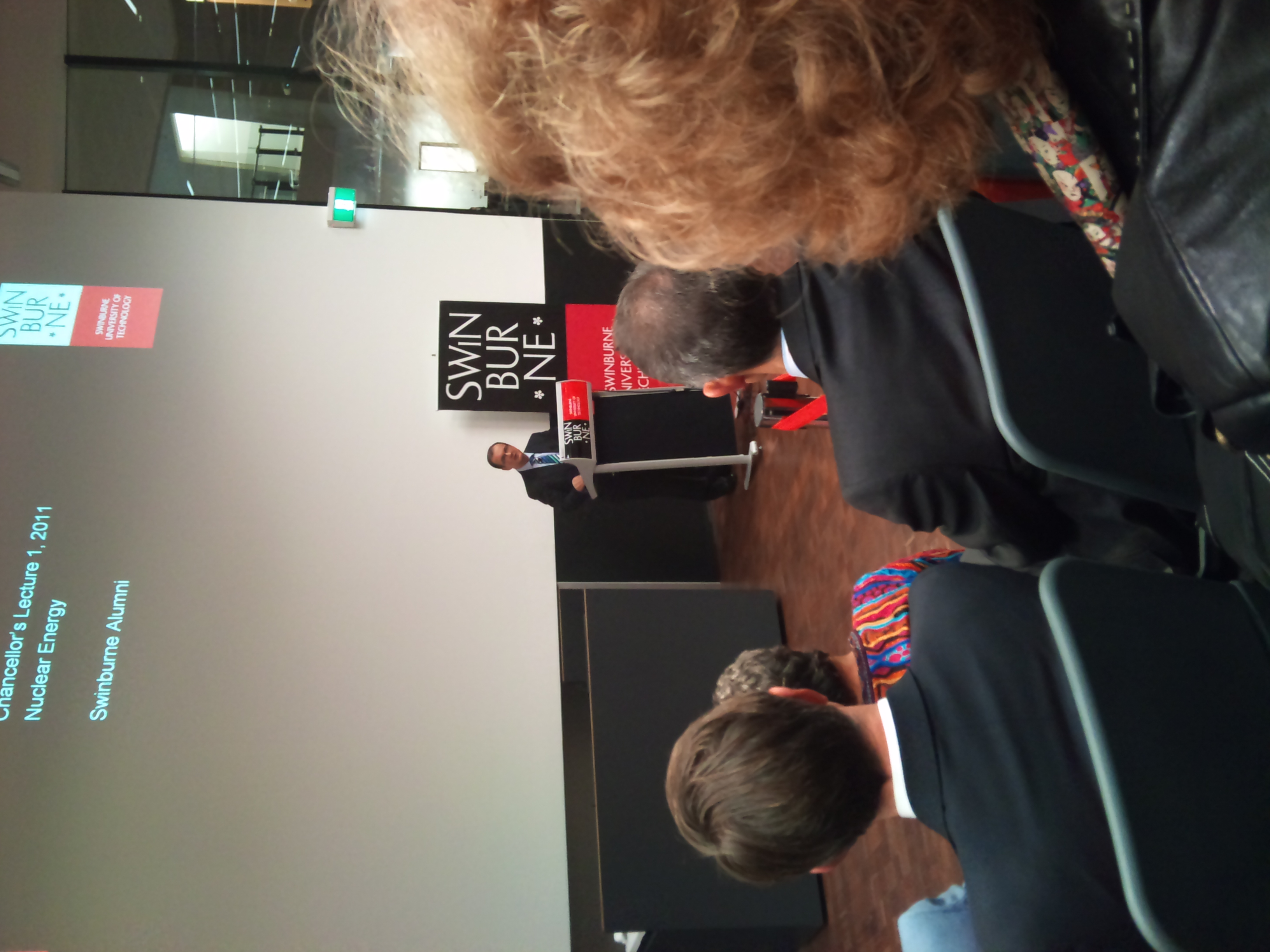
The Event Dr Ziggy Switkowski giving his lecture I just attended a lecture by Dr Ziggy Switkowski (see the above picture) on the topic of nuclear power, for a long time Ziggy has been the most prominent advocate of nuclear power in Australia, so naturally the talk was pro-nuclear. The lecture was free for alumni of Swinburne University and introduced by Swinburne s Chancellor who described Ziggy as a friend. Before the lecture started I handed out flyers for Beyond Zero Emissions [1] with a plan for zero carbon use in Australia by 2020. That was more difficult than handing out Greens polling cards on election day. The people who attended were there for a purpose and they could see the free food and wine on offer inside the building so getting them to stop and take a brochure wasn t easy. There were also people from Friends of the Earth [2] and some other anti-nuclear organisations giving out brochures. specter of nuclear contamination There were also some anti-nuclear protesters dressed as Uranium miners and the specter of nuclear contamination, they made for an interesting picture (which is amazingly good for a phone camera 20 minutes after sunset), but got in the way when I was handing out brochures. There were a few university security people at the door trying to keep the opposition away who were a bit annoying. There was also one policeman in attendance who was quite friendly, he asked whether there was a competition between the different groups as there is when handing out how-to-vote cards on election day. 15 minutes before the lecture was due to start I quit handing out the brochures and went inside for free food and drink (food always tastes better when the other team pays the bill). The Lecture I felt that Ziggy did a poor job of advocating nuclear power. There were a number of gaping flaws in his argument, but I have to commend him for his honesty in his appraisal of how hard it would be to develop a nuclear industry in Australia. Most nuclear advocates are a lot more optimistic about the process of building nuclear power plants and training all the people to run them. I will write a post tomorrow rebutting some of Ziggy s arguments. After the Lecture Immediately after the lecture the vice-chancellor stated that 500 people registered which made it the best attended such lecture that they have held. I don t know how many of the 500 attended, but I did notice that about 1/4 of the seats in the lecture hall were empty. It s rather sad that they can t get more people to such lectures, is TED.com stealing the audience? When I got out of the building I started handing out brochures to people as they left. I noticed that they were a lot friendlier than they were on the way in. I believe that people who left the lecture had greater interest in renewable energy because Ziggy just failed to make a good case for nuclear power. I expect that anyone who hadn t already made up their mind would immediately want to research the alternatives after watching Ziggy s lecture.

Joey Hess: managing network effects through parasitism

Network effects are such a pernicious thing. They give us the internet, but they also give us an internet full of monopolistic worse-is-better players that use network effects to stifle improvements and competition. Sometimes the best you can manage is to be a parasite. facebook So I'm back on facebook ... sort of. a nearly empty facebook profile encouraging use of email or blog My strategy for facebook is to be as near to a featureless datapoint as I can. I won't post anything. I entered as bad quality information as I could get away with. I turned all privacy controls off, on the theory that this way I don't have to worry about facebook eroding privacy since everything about me on facebook is aggressively public. By never posting anything to facebook, I am trying to fight the network effect; trying to avoid increasing the value of facebook due to me being on it. I've adblocked the text entry field on facebook just to avoid the temptation. I want to erase the Like buttons too. Technologically, I think a good approach would be a browser plugin that does these things while extracting all available content and optionally sending it to a RECAP-type system. I only friend people who I need to keep up with and who have little or no other internet presence. This is because I am aware that each person I friend still propels facebook's network effect a little bit; even though they'll never see any useful information from me, they will know that they are able to talk to me via facebook. I only log into facebook once a week or so (this is easy when you're not interacting with it anyway), and read whatever sample of farmville and other posts facebook selects as "important" (worse than usual probably since I never give it feedback). So people I friend can't rely on me reading everything they do, which reduces the value a little more. I will probably delete this account occasionally, and then re-add it later. Just often enough to be really annoying. twitter Similarly, I no longer gate my identi.ca account to twitter, and have deleted as many tweets as I could stand to (one click and one keypress per tweet; no mass-delete; ugh!), and protected my account to avoid accidential new tweets leaking out. Since twitter is not quite as evil as facebook I feel slightly less bad about exposing more of my social graph there. Only the folks who are too lame to get on an OpenMicroBlogging site like identi.ca. phone Of course there was a network effect with the telephone as well, and while it got deregulated it's still pretty bad, and also a technology that I mostly dislike using. Oddly my phone behavior is backwards to the other two networks; I only make outgoing phone calls, never answering the phone (unless real life intervenes very severely). I listen to some random fraction of my voice mail and read whatever ones manage to get machine-transcribed.

1 June 2011

Vincent Bernat: GNOME Power Manager without GNOME desktop

When I installed my new laptop, I decided to switch from sleepd to GNOME Power Manager (GPM). The rationale behind this decision was to get screen dimming for free while keeping other features because GPM uses UPower which uses pm-suspend and pm-powersave behind the scene. This means that it is easy to execute scripts on suspend or when the AC is unplugged by putting them in /etc/pm. I don t use a full GNOME desktop. My desktop is running FVWM which is just a window manager. However, I already use some parts of the GNOME environment:

What s working It happens that most of the features just do not work. However, suspend when closing the lid works fine. The icon in the systray works fine too (but there is a small bug). The screen dimming feature on idle also works (but there are annoying bugs with it). The visual feedback when pressing brightness keys works too.

What s not working It seems that I am not the only one to have problem with GPM: there are currently 115 bugs opened in the Debian BTS. If you want to get some debug output from gnome-power-manager, run it with --verbose flag. --debug flag does nothing (and supersedes --verbose).

Nothing happens when pressing the power button I have configured GPM to ask me what to do when I press the power button. But when I press the button, nothing happens. Looking at the source, here is the snippet of code that is executed:
1
2
3
4
5
6
7
if (policy == GPM_ACTION_POLICY_INTERACTIVE)  
    GpmSession *session;
    egg_debug ("logout, reason: %s", reason);
    session = gpm_session_new ();
    gpm_session_logout (session);
    g_object_unref (session);
 
In fact, this is not GPM that will ask you the question, but GNOME session manager because GPM triggers logout. If you don t run a full GNOME session, nothing will happen. My workaround is just to set the action to Suspend .

Does not sleep when idle GPM is configured to go to sleep after 2 hours on AC or 30 minutes on battery. This does not work for me because idle detection is delegated to external programs. There are four variables used by GPM to determine if we are idle:
  • session_idle which is the idle hint from ConsoleKit,
  • idle_inhibited which is set when another program asks to disable idle detection (a video player which does not want the screen to be dimmed),
  • suspend_inhibited which means a program do not want we going to sleep (a music player for example)
  • x_idle which tells if X is idle or not (someone is moving the mouse or typing on the keyboard).
To allow GPM to suspend when we are idle, x_idle and session_idle must be true while suspend_inhibited and idle_inhibited must be false. For screen dimming purpose, you just need to have x_idle set to true and idle_inhibited set to false. Currently, only GNOME Screensaver seems to tell ConsoleKit if the session is idle or not. XScreenSaver does not contain anything about this. I am using xautolock with xlock and I am pretty sure they won t tell GPM if I am idle. You can use dbus-send to circumvent this problem:
 1
 2
 3
 4
 5
 6
 7
 8
 9
10
11
$ dbus-send --system --dest=org.freedesktop.ConsoleKit \
>   --type=method_call --print-reply --reply-timeout=2000 \
>   /org/freedesktop/ConsoleKit/Manager \
>   org.freedesktop.ConsoleKit.Manager.GetCurrentSession
method return sender=:1.6 -> dest=:1.106 reply_serial=2
   object path "/org/freedesktop/ConsoleKit/Session1"
$ dbus-send --system --dest=org.freedesktop.ConsoleKit \
>   --type=method_call --print-reply --reply-timeout=2000 \
>   /org/freedesktop/ConsoleKit/Session1 \
>   org.freedesktop.ConsoleKit.Session.SetIdleHint boolean:true          
method return sender=:1.6 -> dest=:1.108 reply_serial=2
While I understand what is the rationale behind those choices (no code duplicate and allowing external programs to hinder power management), it lacks some fallback in case you don t use GNOME Screensaver (which is the key component here). I first though this was bug #594706 but this is not the case. I have opened (and closed) bug #628755. UPDATED: Jump to the conclusion for an updated solution for this problem.

Brightness is not restored to the previous value after idle When GPM undims the screen, it does not restore the previous value. It seems to be bug #617310 which is marked as fixed in upstream. I did not investigate it.

Wrong number of batteries reported I only have one battery but after one suspend/resume cycle, GPM thinks I have two. Maybe this is a bug of UPower. Maybe this is bug #606434. I did not investigate it. Maybe there is an happy interaction with bug #456280.

Inability to set configure actions when the UPS runs out of battery This is bug #390602. In addition to laptop batteries, UPower also supports UPS. In this case, GPM displays a special icon to tell if the UPS is fully charged. However, there is no possibility to execute special actions when the UPS is unplugged, like hibernate after 10 minutes or something like this. This seems to be a problem with the interface because looking with gconftool-2, we can spot variables like low_ups or critical_ups which allow to set actions when the UPS is almost out of battery. Moreover, the UPS icon only displays after one suspend/resume cycle but I am too lazy to report and debug this issue. Since, the icon disappear if I restart GPM, I am confident that the bug is in GPM.

Conclusion The conclusion is that GPM is not really that buggy but it really needs to be run in a full-blown GNOME desktop. The main problem is not really GPM. New technologies like UPower and ConsoleKit get pushed by freedesktop.org initiative, they get implemented by GNOME (and, I suppose, KDE) because they have tons of people following the appropriate mailing lists and any alternative just gets crushed by all those unpublicized changes. UPDATED: I got several helpful comments about this problem. There are two possible solutions:
  1. Use xfce4-power-manager. It handles brightness control in a better way and don t need an external program to tell when the current session is idle. It still needs a session manager to ask what to do when using the power button. The drawback to this solution is that you start to pull another desktop environment into your environment. You had some parts of GNOME and now you have some parts of XFCE. This solution was proposed by Sylvain Collilieux.
  2. Use gnome-session, gnome-screensaver and keep gnome-power-manager. As pointed by Julien Valroff, gnome-screensaver needs gnome-session to detect idleness. However, gnome-session starts a whole GNOME desktop. Again, there are two solutions. The first one is to replace gnome-session by something lighter implementing the bare minimum to make gnome-screensaver happy. Another suggestion is to configure gnome-session to start your favorite environment.
I start mine from ~/.xsession and here is what I have added at the top of it:
 1
 2
 3
 4
 5
 6
 7
 8
 9
10
11
12
13
14
15
16
17
# If not done, restart ourself with gnome-session
if [ -z "$SESSION_MANAGER" ]; then
    [ -d ~/.config/autostart ]   mkdir ~/.config/autostart
    rm -f ~/.config/autostart/*
    cat <<EOF > ~/.config/autostart/xsession.desktop
[Desktop Entry]
Name=Xsession
Comment=Start .xsession
Exec=$(readlink -f $0)
Type=Application
X-GNOME-Autostart-enabled=true
EOF
    exec gnome-session --autostart=$HOME/.config/autostart
fi
# Otherwise, keep starting stuff
# [...]
exec fvwm-crystal

Stephan Peijnik: How to force a local DNS resolver to be used using resolvconf

I know it has been a while, but after reading a blog post by Anand Kumria over at planet.debian.org I decided to have a quick look at one of the problems he described.

Basically, Anand wants to force the local resolver to be used for each and every network connection, may that connection be established manually or via NetworkManager. He wrote that fixing this configuration for every new connection manually is tedious, and I fully agree on that. So here is a solution to do this all automatically, using resolvconf:

After installing the resolvconf package every time /etc/resolv.conf is to be updated resolvconf takes care of that. Using the files in /etc/resolvconf this process can be controlled and the resulting file modified to fit one own's needs.

So at first we would like the local resolver to be used for every connection. This works by simply adding the "nameserver 127.0.0.1" directive to the /etc/resolvconf/resolv.conf.d/head file. Simple as that. Every time /etc/resolv.conf gets generated the contents of the head file are actually used as /etc/resolv.conf's header.

Using this method the local resolver is used for every connection. But Anand wanted to use only the local resolver and discard any resolvers possibly obtained via DHCP for example. Guess what, this is also possible using resolvconf.

Adding TRUNCATE_NAMESERVER_LIST_AFTER_127="yes" to /etc/default/resolvconf does exactly that. Now every nameserver directive after the 127.0.0.1 one is ignored and will not make it into /etc/resolv.conf. You can of course add more nameservers to the head file above the 127.0.0.1 directive.

Problem fixed I guess.
Don't forget to re-connect to the network or manually force re-creation of /etc/resolv.conf so the changes you made get populated. I really hope this is of use to some of you facing similar problems.

Andrew Cater: /etc/apt/sources.list

Since we have people posting to various lists for the correct format for an /etc/apt/sources.list file, here's one including the non-free repositories (which are not part of Debian proper but provided for the convenience of Debian users). Hope this helps somebody sometime.

#

deb http://ftp.uk.debian.org/debian/ squeeze main contrib non-free
deb-src http://ftp.uk.debian.org/debian/ squeeze main contrib non-free

deb http://ftp.uk.debian.org/debian/ squeeze-updates main contrib non-free
deb-src http://ftp.uk.debian.org/debian/ squeeze-updates main contrib non-free

deb http://security.debian.org/ squeeze/updates main contrib non-free
deb-src http://security.debian.org/ squeeze/updates main contrib non-free

and, of course, it wrapped in the browser. There's a single space between squeeze and main and between main and contrib and between contrib and non-free for example. There are six lines in total - three pairs.

Anand Kumria: First steps with DNSSEC

As you all probably know by know, DNSSEC has been enabled on the root ('.') since July 2010. And on most TLDs like .com shortly thereafter (in the specific case of .com, since March 2011). The Debian guide to turning on DNSSEC is useful but some things you need to know (after using it for a week or so).
BIND loves IPv6.
If you have 'listen-on-v6', set to yes and you roam to a non-IPv6 network. Your name resolutions can take 30+ seconds.Since I roam from a some networks they do have IP6 and some that do not, I have had to turn this setting off to achieve reasonable performance
Each new network requires manual intervention
Just like Andrew Cowie, I'm trying to get new features in NetworkManager. by blogging.My use case is simple if a bit geeky use the local resolver on my system irregardless of what I get dynamically (via DHCP) or automagically (via SLAAC).I can do this manually for each network I connect to, but it quickly looses its appeal.
Very little software takes advantage of DNSSEC (yet).
Apart from the happy DNSSEC campers, very little takes advantage of DNSSEC yet.Kind of like the early days of IP6. It would be nicer if websites stored the fingerprint of the SSL website in DNS and it could be cross-checked against what was sent.The effort to do so is underway at the IETF by the name of DANE.In fact publishing SSH key fingerprints via DNS is already possible RFC4255 but I am unaware of deployed support.
Things are progressing, and I suspect now is a great moment to get involved if you have spare time, in making it significantly harder for 3rd-parties to censor the Internet for everyone.

31 May 2011

Matthew Garrett: Rebooting

You'd think it'd be easy to reboot a PC, wouldn't you? But then you'd also think that it'd be straightforward to convince people that at least making some effort to be nice to each other would be a mutually beneficial proposal, and look how well that's worked for us.

Linux has a bunch of different ways to reset an x86. Some of them are 32-bit only and so I'm just going to ignore them because honestly just what are you doing with your life. Also, they're horrible. So, that leaves us with five of them.

Now, I'll admit that this all sounds pretty depressing. But people clearly sell computers with the expectation that they'll reboot correctly, so what's going on here?

A while back I did some tests with Windows running on top of qemu. This is a great way to evaluate OS behaviour, because you've got complete control of what's handed to the OS and what the OS tries to do to the hardware. And what I discovered was a little surprising. In the absence of an ACPI reboot vector, Windows will hit the keyboard controller, wait a while, hit it again and then give up. If an ACPI reboot vector is present, windows will poke it, try the keyboard controller, poke the ACPI vector again and try the keyboard controller one more time.

This turns out to be important. The first thing it means is that it generates two writes to the ACPI reboot vector. The second is that it leaves a gap between them while it's fiddling with the keyboard controller. And, shockingly, it turns out that on most systems the ACPI reboot vector points at 0xcf9 in system IO space. Even though most implementations nominally require two different values be written, it seems that this isn't a strict requirement and the ACPI method works.

3.0 will ship with this behaviour by default. It makes various machines work (some Apples, for instance), improves things on some others (some Thinkpads seem to sit around for extended periods of time otherwise) and hopefully avoids the need to add any more machine-specific quirks to the reboot code. There's still some divergence between us and Windows (mostly in how often we write to the keyboard controller), which can be cleaned up if it turns out to make a difference anywhere.

Now. Back to EFI bugs.

( Comments Comment on this)

Gunnar Wolf: Invitation Free Software in Mexico: Reflections and Opportunities

I was invited to be part of one of the panels to be present this Thursday (June 2) in a forum that promises to be interesting. The forum is organized by the Science and Technology comission of the Senate of the Republic (of Mexico ;-) ), Universidad Aut noma Metropolitana and Mozilla M xico. The day will be opened by Sen. Francisco Javier Castell n Fonseca and Richard Stallman; starting at 10:00, we will have thematic panels on: The full program (as well as details of interest of those that can physically attend) is attached to this post. I am looking forward to this forum. Not only it is a good opportunity to get our work known in one of those places where it matters, but it's also being organized by several interesting people I'm sure will have something interesting to contribute. And of course, we lacked time to build a better, more complete and more coherent proposal but there is a good probability we will have further such contacts. You might find interesting to read on the list we have been discussing; subscription seems to be open (although access to the archives is not Maybe it will be later on? In any case, I'm saving a mbox ;-) )
AttachmentSize
Activity program352.37 KB

Jamie McClelland: Puppet Without Masters

Puppet labs's use of the term puppetmaster is rather clever (in contrast to other un-necessarily offensive uses of "master" in the software world). While I appreciate the clever name, I'm less impressed with the concept. At May First/People Link we've spent the last several years (including the last couple months in earnest) working to transition management of our 90-some servers from a collection of hand-written bash scripts to puppet. Over the years, we've worked hard to keep our servers as secure as possible. We have a team of about a half dozen people who all have root access on all servers. It's all key-based access. To help mitigate a disaster if one person's keys were compromised, we've implemented monkeysphere on all servers, allowing us to easily revoke access. After spending so much time thinking through our root-access strategy and fully implementing the monkeysphere to reduce our exposure to a single point of vulnerability, I was disappointed by puppet's use of a puppet master. For those less familiar with puppet, it goes something like this: One server (or god forbid multiple servers), run an externally accessible daemon. Each and every server on your network runs a daemon as root that periodically communicates with the puppet master, receives new instructions, and then (again, as root) executes these instructions. In other words, if your puppet master is compromised, I'm not sure exactly what you would need to do, short of rebuilding every server in your network. To make matters worse, it seems as though some users generate and store all server ssh keys (private and public) on the puppet master and then push the private keys to their respective nodes. That means an intruder doesn't need to write to the puppet master, just reading these keys would be enough to compromise all servers in your network. There must be a better way. Puppet without masters After some web-searching, I found a promising thread on the puppet list asking what's lost without a puppet master. This thread lead to a couple other blogs by people who have worked out a system for using puppet without a master. It turns out that there are two distinct points of centralization with puppet. One is the puppet master (as described above). In addition, there is a concept called storeconfigs - which allows each node in the network to store information in a central database. For example, one server can store a request for an account to be setup on a backup server. The next time the backup server runs, it checks the storeconfigs, finds the request, and creates the user. It's possible to run puppet with storeconfigs but without running a puppet master (that avoids the hassle of running the puppet daemons, while providing the convenience of centralization). For our purposes, however, we decided to forego both the puppet master and storeconfigs. We did not want any form of centralization that would provide an additional point of vulnerability. As is common with puppet, we are storing our puppet recipes in a git repository. And, we are publishing to a single, canonical git repository on the Internet. On each node, we have two git repositories - one is a bare repo (that we can push to) and the other is a checked out repo (in /etc/puppet) that is read by puppet. The bare repo has a post-update hook the changes into the /etc/puppet directory, pulls in the changes from the bare repository, and runs puppet against the newly checked out files. Therefore, we can apply new puppet recipes to any server on the network with
git push <server>
No daemons: neither a master daemon nor a puppet daemon running on the node using up memory or providing a potential security hole. The git push happens over an ssh connection - since all system administrators already have root-level ssh access on every server - there is no need to grant any additional access above what we already have. Pushing works great - but with 90 nodes we don't want to have to push to 90 servers everytime we want a change made. That's where the canonical git repository comes in. A cron job runs a script on each node once an hour that runs git remote update from /etc/puppet. The script then checks the time stamp on the most recent gpg-signed tag and compares it with the time stamp of the current commit. If the most recent gpg-signed tag is newer, it verifies that the tag came from a list of authorized gpg keys (the very same gpg keys used by the monkeysphere to grant root level ssh access). If the gpg signature of the tag can be properly verified, then the changes are merged and puppet is run on the new recipes. What about privacy? One of the benefits of a puppet master setup is that nodes get configuration details on a need-to-know basis. The puppet master doesn't share the entire puppet repo - only the compiled manifest for the node with which it's communicating. Our solution to this problem was to go screaming in the other direction. As you might notice from our support wiki and ticket system, we generally favor transparency. Since we are publishing our entire puppet git repo publicly, there seems little point in trying to hide one node's configuration details from another node. That also means each node carries around about 4Mb of extra weight in the form of disk space for the git repo. That seems like a small price to pay for the resource savings of not running a puppetd process all the time. More differences As I've read the puppet lists, faqs and documentation, I've found yet more ways our use of puppet diverges from the norm. The first is a little thing really - most people seem to store all their node configurations in a single nodes.pp file. I'm not sure why. Fortunately, puppet's include syntax allows globbing, so we've created a directory and gave each server it's own .pp file. This arrangement makes it much easier to parse the configuration with tools other than puppet (like, Q. How many servers do we have? A. ls wc -l). Backup and Nagios monitoring without storeconfigs More significantly - there are some things we can't do since we are not using storeconfigs. While many puppet users add a variable, like $nagios = true before including their sshd class (which then causes the sshd class to store a configuration for the nagios server to monitor ssh on the node in question), we were forced to come up with alternatives. My first solution was to simply list all the servers that needed to be monitored in the server node configuration file for the nagios server. Ditto for the backup servers. This approach, however, proved cumbersome and error prone. When adding a new node, I now have to edit three files instead of one. And, how can I easily tell if all nodes have their nagios and/or backup configurations set? The solution was rather simple - there's more than one way to store a config for another node. Our nagios server is called jojobe.mayfirst.org and our backup server is luisa.mayfirst.org. A typical node.pp file looks like this:
node pietri.mayfirst.org  
  # node config goes here
 
if ( $fqdn == "jojobe.mayfirst.org )  
  nagios_montior   "pietri":  
 
if ( $fqdn == "luisa.mayfirst.org )  
  backup_access   "pietri":  
 
This way all configuration related to pietri stays in a single file. Host keys and granting access between servers storeconfigs is commonly used to distribute host ssh keys. Every node that is added to puppet has it's ssh host key stored centrally and then re-distributed to every other node. That way, you can ssh from node to node without ever getting the ssh fingerprint verification. Avoiding that prompt is particularly important when backing up from one server to another via automated scripts. storeconfigs can additionally be used to copy user's public ssh keys - thus granting user access between servers. Our solution to this problem: monkeysphere. Rather than maintaining our own private data store of keys, we publish (and sign) our ssh keys via the web of trust. In addition to server keys, each one of our servers' root user has an ssh-enabled gpg key (also publicly signed by us). By configuring each server to trust our system administrators' gpg keys for verifying other keys, we can both avoid the ssh fingerprint manual verification step and we can grant a root user on one server access to another server by simply dropping root@$server.mayfirst.org into an authorizeduserids file on the target server. There's no question - the setup was rather tedious (we're using runit to maintain an ssh-agent for each root user), however, now that's in place (and configured via puppet), it's a breeze to add new servers. The only extra step we have to take is to confirm and sign each new server's keys. This "extra" step not only allows our servers to verify each other, but also allows our users to verify the servers as well, so it's hardly an extra step at all. Shared modules There's a vibrant community of third party module developers for puppet. Rather than figure out the intricacies of having puppet configure sshd, for example, you can install a contributed sshd module and then you simply add:
include sshd
And you get a default sshd setup. Many of these modules are fairly well developed, offering the ability to easily customize your setup in a number of different ways. Unfortunately, most of the modules assume you are using storeconfigs and if you are not, they will either fail to work right or you will get noisy errors. At first, this seemed like a problem. However, as I built our puppet recipes, I found myself increasingly frustrated with the third party modules that we could use. Configuring servers is hard - and requires constant debugging and trouble shooting. puppet already provides a layer of abstraction between you and the server you are setting up. Given the benefits of puppet, I'm willing to spend the time learning the puppet syntax and asking the rest of our system administrators to do the same. This layer of abstraction is further compounded by our use of git to store the configurations (not a problem if you are git hero - but most of us are already struggling to get a handle on using git). Again, all seems worth it for the pay off. Now enter the puppet module. In addition to learning puppet syntax (and struggling with git) you now need to understand how the third party module works. With software programming, I typically don't need or want to learn how a library or class does what it does - that's the beauty of object-oriented programming: it hides the complexity. But when it comes to configuring the servers that I will be responsible for debugging and maintaining, I really need to know exactly what is happening. To further compound the problem, I found myself wading through third party module code designed to work on Debian, Ubuntu, CentOS, Redhat, gentoo... and more. We run entirely on Debian - we don't need any of this extra code. And, once I got rid of all the other operating systems, I was still left with a complex module that allows you to configure software in ways we'll never need. In the end, we tore out most of these third party modules and replaced them with file and exec puppet resources that did exactly what we needed them to do. Our code base is now much smaller and simpler. Not just a whiner I have a lot more to whine about (like why native resources for things like nagios that are so easily handled with the file resource?). However - the remarkable thing about puppet is that it's flexible. Despite some fairly substantial problems with the "typical" use of puppet, the program provides enough flexibility for us to use it in a way that fully meets our needs. After having built my own bash-based set of configuration scripts and deeply exploring puppet, I have a great appreciation for the difficulty of building system configuration software (we considered and rejected cf-engine and chef as not being any better). And, if you are still not convinced that puppet will work fo you ... you might consider a package I learned about after going down the puppet route: slack.

Vincent Sanders: Can you just...

I should have learned by now, no sentence that starts "Can you just" ever ends well. In my experience it means someone else has misunderstood the problem at hand. Then we proceed to the part of the project where (according to my lovely wife) I end up using my condescending voice.

I work through what I have been asked for and eventually, if it goes well you end up defining what the actual, real job needs to be done is. And almost envitably the "Can you just" has become a major job.

Most of us I fear recognise this "pattern" from our working lives with software. Well I am glad to report this pattern exists in real, physical world too.

Last week we took a trip to my parents in law, two thoroughly nice people (I lucked out, no evil mother in law here). I had been asked before I went "Can you just fix the garage door, it sticks". So I took along some basic tools expecting to lubricate a hinge or something.

Turns out it was the garage back door (for humans to get in and out) and...well there were bigger issues. The door frame was rotten and the door had pulled it away from the wall. So a new door frame you say? ah, well, yes

At some point in the past someone had fitted a double glazed window and had, kinda removed the lintle above the door and window! Yes there were several courses of brick masonry wall resting on top of a upvc window frame. The door frame had provided some support till it rotted and fell apart.

The window was under a huge strain and was actually 5cm shorter at one end than the other. The brickwork was no longer mortared and could better be described as a pile of bricks held together with caulking.

Vincent fitting the latch to the new door frame
So my bank holiday weekend was spent removing those bricks, making good, building a frame from 44x97mm planed timber bolted into the walls and covering it with weatherboard. OK it is not masonry but on the other hand it will not be falling on anyone's head any-time soon.

And before anyone comments, yes that frame is true, the spirit level says so. Alas that window frame is very, very wonky indeed and the wall it is sitting on is 4cm out too, so It looks a bit off.

Possibly not my best work but you can hang a couple of hundred kilos from the frame and it not budge so I think its solid enough for this purpose.

Providing my father in law keeps treating it with the wood preserver every couple of years it will not go rotten either and should last a long time.

30 May 2011

John Goerzen: War and Peace

I doubt I have ever read a book that had as significant an impact on me, and my act of reading it had on others, as this one. Conversations like this were frequent: Someone, upon seeing me reading my Kindle, would ask what I am reading. War and Peace. Oh. . . uhm, wow. Yeah, it s great. I m reading it for fun. Uhm, OK then, see you later. . . It seems to be so revered, and also so loathed, that I had to read it. At 1400 pages, it took me 8 months to finish, though I read several other entire books in that time. I feel rather unequal to the task of expressing how this book impacted me, let alone a review of it. And nonetheless, I also feel I would be remiss if I let it go past saying nothing. I was struck by so many things as I read War and Peace. Some of them I won t mention here and hope to turn into their own blog posts. Of the others, I felt I gained some sense of how the nobility and serfs in Russia (and, to a certain extent, Europe) thought about life, their position, and how things ran. Being a modern Kansan, this thought process was not familiar to me, and though I head read about it in history texts before, felt far more informed having read it in Tolstoy s novel. Although much of the novel centers around Napoleon s invasion of Russia in 1812, the work as a whole spans nearly two decades of time. Tolstoy s characters aren t static; they change over time. Some, yes, die; others go through hardships and triumphs that change them to their core. It evoked a feeling of nostalgia in me at times for the younger, childlike Natasha who was so full of simple delight in life. But then, a thousand pages later, the older Pierre finally was able to find simple delight in life too. Sometimes I have missed on the simple joy of being, and Jacob or Oliver or Terah remind me of that. Today Oliver and I read a book together, one that we read often, and we discovered an illustration of a tiny worm we had never noticed before. And the worm had a red hat ( hat is one of Oliver s favorite words right now.) The happy laughter as he pointed at the tiny hat, saying hat over and over, reminds me that sometimes children know how to live better than adults. Jacob later asked me how my day was, and I told him how I read a book on my Kindle, where I sat, and how I even read it lying down on the couch for a bit. At that he too laughed. As with some other wonderful, engrossing books, I was sad to reach the end of this one. I felt as if I was leaving a conversation early; fictional characters, yes, but their story wasn t over. And really, that was part of Tolstoy s point: things don t happen in isolation, and stories don t have clearly-defined start and end points. The novel touched on politics, religion, philosophy, free will, and just about every topic imaginable. It is, really, unfair to call it a just a novel. Here are some random quotes from the book, which I highlighted:
his heart was now overflowing with love, and by loving people without cause he discovered indubitable causes for loving them. How often we sin, how much we deceive, and all for what? All will end in death, all! A pleasant humming and whistling of bullets were often heard. Looking into Napoleon s eyes Prince Andrew thought of the insignificance of greatness, the unimportance of life which no one could understand, and the still greater unimportance of death, the meaning of which no one alive could understand or explain. If there is a God and future life, there is truth and good, and man s highest happiness consists in striving to attain them. We must live, we must love, and we must believe that we live not only today on this scrap of earth, but have lived and shall live forever, there, in the Whole, said Pierre, and he pointed to the sky. Prince Andrew stood leaning on the railing of the raft listening to Pierre, and he gazed with his eyes fixed on the red reflection of the sun gleaming on the blue waters. There was perfect stillness. Pierre became silent. The raft had long since stopped and only the waves of the current beat softly against it below. Prince Andrew felt as if the sound of the waves kept up a refrain to Pierre s words, whispering: It is true, believe it. He sighed, and glanced with a radiant, childlike, tender look at Pierre s face, flushed and rapturous, but yet shy before his superior friend. In Natasha Prince Andrew was conscious of a strange world completely alien to him and brimful of joys unknown to him, a different world, that in the Otradnoe avenue and at the window that moonlight night had already begun to disconcert him. Now this world disconcerted him no longer and was no longer alien to him, but he himself having entered it found in it a new enjoyment. All the kings, except the Chinese, wear military uniforms, and he who kills most people receives the highest rewards. But what is war? What is needed for success in warfare? What are the habits of the military? The aim of war is murder; the methods of war are spying, treachery, and their encouragement, the ruin of a country s inhabitants, robbing them or stealing to provision the army, and fraud and falsehood termed military craft. The habits of the military class are the absence of freedom, that is, discipline, idleness, ignorance, cruelty, debauchery, and drunkenness. And in spite of all this it is the highest class, respected by everyone. From the moment Pierre had witnessed those terrible murders committed by men who did not wish to commit them, it was as if the mainspring of his life, on which everything depended and which made everything appear alive, had suddenly been wrenched out and everything had collapsed into a heap of meaningless rubbish. Though he did not acknowledge it to himself, his faith in the right ordering of the universe, in humanity, in his own soul, and in God, had been destroyed. He had experienced this before, but never so strongly as now. When similar doubts had assailed him before, they had been the result of his own wrongdoing, and at the bottom of his heart he had felt that relief from his despair and from those doubts was to be found within himself. But now he felt that the universe had crumbled before his eyes and only meaningless ruins remained, and this not by any fault of his own. He felt that it was not in his power to regain faith in the meaning of life. When Princess Mary began to cry, he understood that she was crying at the thought that little Nicholas would be left without a father. With a great effort he tried to return to life and to see things from their point of view. Yes, to them it must seem sad! he thought. But how simple it is. The fowls of the air sow not, neither do they reap, yet your Father feedeth them, he said to himself and wished to say to Princess Mary; but no, they will take it their own way, they won t understand! They can t understand that all those feelings they prize so all our feelings, all those ideas that seem so important to us, are unnecessary. We cannot understand one another, and he remained silent. Love hinders death. Love is life. All, everything that I understand, I understand only because I love. Everything is, everything exists, only because I love. Everything is united by it alone. Love is God, and to die means that I, a particle of love, shall return to the general and eternal source. These thoughts seemed to him comforting. People speak of misfortunes and sufferings, remarked Pierre, but if at this moment I were asked: Would you rather be what you were before you were taken prisoner, or go through all this again? then for heaven s sake let me again have captivity and horseflesh! We imagine that when we are thrown out of our usual ruts all is lost, but it is only then that what is new and good begins. While there is life there is happiness. There is much, much before us. I say this to you, he added, turning to Natasha. During that twenty-year period an immense number of fields were left untilled, houses were burned, trade changed its direction, millions of men migrated, were impoverished, or were enriched, and millions of Christian men professing the law of love of their fellows slew one another. What does all this mean? Why did it happen? What made those people burn houses and slay their fellow men? What were the causes of these events? What force made men act so? These are the instinctive, plain, and most legitimate questions humanity asks itself when it encounters the monuments and tradition of that period.

Cyril Brulebois: Domain name update

Almost 4 years ago, I decided to set up a tiny website, mostly for blogging purposes. Given I was using ikiwiki and my nickname s KiBi, ikibiki.org sounded fun, so I picked that one. Now, it s a bit long to type, error-prone (how many times did I type ikiwiki instead ), and even my family has troubles remembering it. Other kibi.* domain names weren t released in the meanwhile, so looking into stuff I care about, something cat-related could do the job. And since I ve been using mraw in my signature for a while, I picked that one. So my blog lives at http://blog.mraw.org/ now. The old domain name will be kept for a while though.

Christian Perrier: 2011 week 21 Debian work

This week saw again some progress for samba packages. May is indeed my samba month..:-). So, I uploaded samba 3.5.8~dfsg-3 and -4. For whatever reason, -3 was rejected three times and, as I already tagged it in our SVN then started adding changes for an upcoming -4, I finally uploaded that -4. It fixed about 10 more bugs and the bug count is now 62. Upstream also release 3.6.0-rc1, which I uploaded in experimental and which fixed an RC bug. I also began working on Pootle 2.1.6 as an attempt to resync with upstream. I integrated patches by Alaa Abd El Fattah to have it use dbconfig-common to setup a database. However, this revealed that more invasive work is needed to satisfy dependencies...that may depend on the database backend chosen by users. As I'm quite ignorant with these things, I might need some help, here. I uploaded a new release of xgridfit to fix an important bug and avoid an NMU. xgridfit is team-maintained in pkg-fonts. I'm not very active in this team ATM. I shoul dresume work for it as I proposed a talk about it at Debconf11..:-) I continued hard work on French DDTP. Martijn made changes to stats pages and it makes interesting challenges to complete. You know I like challenges.. Smith reviews continue to go on: I launched a call for translations for slapos.tool.format and started the review of ntfs-3g. Finally, on Saturday....I upgraded churro (aka i18n.debian.net) to squeeze. Really. All alone..:-)...on a server that lies in Spain. "Meme pas peur" (not even scared) as we say in French. I'm really highly confident in squeeze upgrades now....and I was right. After only 5 hours work (mostly looking at packages downloads and configuration), nearly everything was back to work. As of now, we got three glitches, with only one bignot yet fixed: Quite active week, finally. This week should be quieter as I'm on holidays with Elizabeth in our country house in Normandy, in Seine valley (this house belonged to Elizabeth parents and she inherited it). I'm in deep love with this house and there are tons of things to do there...which leaves few room for hacking. We'll see what will be next weekly summary!

Julian Andres Klode: 0x15 + 1/365

Yesterday was my 21st birthday, and I received all Hitchhiker s Guide to the Galaxy novels, the five ones in one book, and the sixth one written by Eoin Colfer in another book. Needless to say, the first book weights more than an N900. I did not read them yet, so now is the perfect chance to do so. Yes, I did not know that 25th is towel day, sorry for that. I also bought a Toshiba AC100 before my birthday, a Tegra 2 based notebook/netbook/ web companion with 1 GHz dual core ARM Cortex A9 chip and 512 MB RAM. It runs Android by default, and had a price of 160 which is low compared to anything else with Cortex A9. It currently runs Ubuntu 11.04 with a specialised kernel 2.6.37 from time to time, without sound and accelerated video (and not functioning HDMI). Mostly waiting for Nvidia to release a new binary blob for the video part (And yes, if you just want to build packages, you can probably get happy without those things). Another thing happening last week is the upload of python-apt 0.8.0 to unstable, marking the beginning (or end) of the API transition I started more than a year ago. Almost all packages not supporting it have proper Breaks in python-apt [most of them already fixed, only 2 packages remaining, one of which is "maintained" (well, not really maintained right now) by me], but there may be some which do not work correctly despite being fixed (or at least thought to be fixed). If you know any other interesting thing I did last week, leave a comment, I wrote enough now. And yes, WordPress wants to write a multiplication sign instead of an x, so I had to use &#120 instead.
Filed under: Debian, General, Ubuntu

Rapha&#235;l Hertzog: Trying to make dpkg triggers more useful and less painful

Lately I have been working on the triggers feature of dpkg. I would like to share my plan and what I have done so far. I ll first explain what triggers are, the current problems, and the work I did to try to improve the situation. Introduction Dpkg triggers are a neat feature of dpkg that package can use to send/receive notifications to/from other installed packages. Those notifications take the form a simple string. This feature is heavily used to track changes of packaged files in a list of predefined directories, and to update other files based on this. For instance, man-db is watching the directories containing manual pages so that it can update its cache (in /var/cache/man/). install-info is updating the index of info pages when there have been changes in /usr/share/info. gnome-menus is updating its own copy of the menu hierarchy (with entries from /etc/gnome/menus.blacklist blacklisted) every time that a .desktop file is installed/updated/removed. From a user s perspective You see triggers in action very often during upgrades (in fact too often as we ll see it later):
Preparing to replace zim 0.52-1 (using .../archives/zim_0.52-1_all.deb) ...
Unpacking replacement zim ...
Processing triggers for shared-mime-info ...
Processing triggers for menu ...
Processing triggers for desktop-file-utils ...
Processing triggers for man-db ...
Processing triggers for hicolor-icon-theme ...
Processing triggers for python-support ...
Processing triggers for gnome-menus ...
Setting up zim (0.52-1) ...
Processing triggers for python-support ...
Processing triggers for menu ...
As you guessed it, those Processing triggers lines correspond to the packages which received (one or more) trigger notifications and which are doing the corresponding task. By default the triggers are processed at the end of the dpkg --unpack invocation which is often too soon because APT will often call dpkg --unpack repeatedly during important upgrades. There are some options to ask APT to use dpkg s --no-triggers option in order to defer the trigger processing at the end of the APT run. You can put this in /etc/apt/apt.conf.d/triggers:
// Trigger deferred
DPkg::NoTriggers "true";
PackageManager::Configure "smart";
DPkg::ConfigurePending "true";
DPkg::TriggersPending "true";
I have now asked APT maintainers to use those options by default, I filed bug #626599 to track this. At the same time I fixed bug #526774 reported by APT maintainers. This bug forced them to put a work-around in APT which resulted in running triggers sooner than expected. (And while writing this article I filed bug #628564 and #628574 because it was clearly not normal that the menu triggers was executed twice for the installation of a single package) From a packager s perspective The implementation of triggers has several consequences on the status that packages can have. Let s assume that the package A installs a file in a directory that is watched by package B (and that B is currently in the installed state). When A is unpacked, dpkg adds B to its Triggers-Awaited field and lists the activated trigger in B s Triggers-Pending field. Package A is in unpacked state, but B has been changed to triggers-pending . When A is configured, instead of going to the installed state, it will go to the triggers-awaited state. In that state the package is assumed to NOT fulfill dependencies. However, B which is still in triggers-pending state does fulfill dependencies. A and B will switch to installed at the same time when the trigger has been processed. The fact that the triggers-awaited status does not fulfill dependencies means that some common triggers like man-db have to be processed regularly just to be able to ensure dependencies are satisfied before running the postinst of other installed packages. But a package which ships a manual page can certainly be considered as configured when its postinst has been run even if man-db has not yet updated its cache to know about the new/updated manual page. When you activate a trigger with the dpkg-trigger command you have an option --no-await to avoid awaiting the trigger processing (and thus to go directly to installed state after the postinst has been run). But with file triggers or activate trigger directives, you do not have this option. My proposal to improve the situation This is the problem that I tried to solve during my last vacation. But before changing the inner working of triggers, I wrote a non-regression test suite for that feature (commit here) so I could hack with some confidence that I did not break everything. The result has been presented on the debian-dpkg mailling list: see the discussion here. I added new directives that can be used in triggers files that work exactly like the current triggers except that they do not put triggering packages in trigger-awaited status. I believe the code to be mostly ready, but in its current form the patch brings zero benefits until all packages have been converted to use the trigger variants that do not require awaiting trigger processing (and the change requires a pre-dependency on dpkg to ensure we have the required dpkg that understands the new kind of trigger directives). Remaining question Thus I wonder if I should not change the default semantic of triggers. The packages which really provide crucial functionality to awaiting packages through triggers would then have to be updated to switch to the new directives. If you re a packager using triggers, you can thus help me by answering this question: do you know some triggers where it s important that the awaiting packages are not considered as configured before the trigger processing? In most of the cases I checked, it s important for the triggered package rather than for the triggering package. In truth, a package in triggers-awaited status is usually in a good enough shape to be able to satisfy dependencies (i.e. requirements that other packages can have), but it would still be worth to record the fact that it s not entirely configured yet because it might be true from the user s point of view: for example if the menu trigger has not yet been processed, the software might not yet be visible in the application menu.

If you appreciate this kind of groundwork that benefits to the whole Debian ecosystem, please consider supporting my work. Click here and give it a look, there are many ways to contribute and to make a difference for me.

3 comments Liked this article? Click here. My blog is Flattr-enabled.

Christoph Egger: Maintaining kFreeBSD buildds since one month

At April 30, I took over maintenance of of Debian's kFreeBSD autobuilders. Means getting something like 4,5k e-Mails this month (gladly no need to sign all those 4k successful builds any more!), filling nearly 30 RC Bugs (quite a lot of which got fixed just within hours after filling, wow!), investigating some of the more strange build failures and such stuff. In general it turned out to be quite some fun. Quite interesting which libraries turn out to be rather central to the Archive. I wouldn't have guessed that a uninstallable libmtp would prevent a reasonable fraction of the builds to fail -- including packages like subversion. Packages builds failing because the disk space is exhausted may be something most of us have already witnessed, especially those here that use one of these small notebook hard drives. Build failures caused by a lack of RAM might certainly be imaginable as well, especially on highly parallel builds. But have you ever seen gcc fail because the virtual address space was exhausted on 32 bit architectures? Also there's a interesting lot of packages with misspelled build dependencies which sbuild can't find and therefore can't build the package. Maybe having a lintian check for some of these problems would be a good idea? I'm also regularly seeing build failures that look easy enough to fix -- like some glob in a *.install for some python package matching lib.linux*. I try to fix some of these as I see them but my time is unfortunately limited as well. Someone interested in quick&easy noticed about these kind of issues? I could put URLs to build-logs on identi.ca or somewhere on IRC. There are also some really strange failures like llvm, which builds flawlessly on my local kFreeBSD boxes all the time, inside and outside schroot but hangs all the time in the same testcase when building on any of the autobuilders (any hints welcome!) or perl failing on kfreebsd-amd64 selectively but all the time.

Next.

Previous.