Search Results: "tb"

27 February 2021

Petter Reinholdtsen: Updated Valutakrambod, now also with information from NBX

I have neglected the Valutakrambod library for a while, but decided this weekend to give it a face lift. I fixed a few minor glitches in several of the service drivers, where the API had changed since I last looked at the code. I also added support for fetching the order book from the newcomer Norwegian Bitcoin Exchange. I alsod decided to migrate the project from github to gitlab in the process. If you want a python library for talking to various currency exchanges, check out code for valutakrambod. This is what the output from 'bin/btc-rates-curses -c' looked like a few minutes ago:
           Name Pair           Bid         Ask Spread Ftcd    Age   Freq
       Bitfinex BTCEUR  39229.0000  39246.0000   0.0%   44     44    nan
        Bitmynt BTCEUR  39071.0000  41048.9000   4.8%   43     74    nan
         Bitpay BTCEUR  39326.7000         nan   nan%   39    nan    nan
       Bitstamp BTCEUR  39398.7900  39417.3200   0.0%    0      0      1
           Bl3p BTCEUR  39158.7800  39581.9000   1.1%    0    nan      3
       Coinbase BTCEUR  39197.3100  39621.9300   1.1%   38    nan    nan
         Kraken+BTCEUR  39432.9000  39433.0000   0.0%    0      0      0
        Paymium BTCEUR  39437.2100  39499.9300   0.2%    0   2264    nan
        Bitmynt BTCNOK 409750.9600 420516.8500   2.6%   43     74    nan
         Bitpay BTCNOK 410332.4000         nan   nan%   39    nan    nan
       Coinbase BTCNOK 408675.7300 412813.7900   1.0%   38    nan    nan
        MiraiEx BTCNOK 412174.1800 418396.1500   1.5%   34    nan    nan
            NBX BTCNOK 405835.9000 408921.4300   0.8%   33    nan    nan
       Bitfinex BTCUSD  47341.0000  47355.0000   0.0%   44     53    nan
         Bitpay BTCUSD  47388.5100         nan   nan%   39    nan    nan
       Coinbase BTCUSD  47153.6500  47651.3700   1.0%   37    nan    nan
         Gemini BTCUSD  47416.0900  47439.0500   0.0%   36    336    nan
         Hitbtc BTCUSD  47429.9900  47386.7400  -0.1%    0      0      0
         Kraken+BTCUSD  47401.7000  47401.8000   0.0%    0      0      0
  Exchangerates EURNOK     10.4012     10.4012   0.0%   38  76236    nan
     Norgesbank EURNOK     10.4012     10.4012   0.0%   31  76236    nan
       Bitstamp EURUSD      1.2030      1.2045   0.1%    2      2      1
  Exchangerates EURUSD      1.2121      1.2121   0.0%   38  76236    nan
     Norgesbank USDNOK      8.5811      8.5811   0.0%   31  76236    nan
Yes, I notice the negative spread on Hitbtc. Either I fail to understand their Websocket API or they are sending bogus data. I've seen the same with Kraken, and suspect there is something wrong with the data they send. As usual, if you use Bitcoin and want to show your support of my activities, please send Bitcoin donations to my address 15oWEoG9dUPovwmUL9KWAnYRtNJEkP1u1b.

22 February 2021

Russ Allbery: Review: Finder

Review: Finder, by Suzanne Palmer
Series: Finder Chronicles #1
Publisher: DAW Books
Copyright: 2019
ISBN: 0-7564-1511-X
Format: Kindle
Pages: 391
Fergus Ferguson is a repo man, or professional finder as he'd prefer. He locates things taken by people who don't own them and returns them to their owners. In this case, the thing in question is a sentient starship, and the person who stole it is Arum Gilger, a warlord in a wired-together agglomeration of space habitats and mined-out asteroids named Cernekan. Cernee, as the locals call it, is in the backwaters of human space near the Gap between the spiral arms of the galaxy. One of Fergus's first encounters in Cernee is with an old lichen farmer named Mattie Vahn who happens to take the same cable car between stations that he does. Bad luck for Fergus, since that's also why Gilger's men first disable and then blow up the cable car, leaving Mattie dead and Fergus using the auto-return feature of Mattie's crates to escape to the Vahns' home station. The Vahns are not a power in Cernee, not exactly, but they do have some important alliances and provide an inroads for Fergus to get the lay of the land and map out a plan to recover the Venetia's Sword. This is a great hook. I would happily read a whole series about an interstellar repo man, particularly one like Fergus who only works for the good guys and recovers things from petty warlords. Fergus is a thoughtful, creative loner whose style is improvised plans, unexpected tactics, and thinking on his feet rather than either bluster or force (although there is a fair bit of death in this book, some of which is gruesome). About two-thirds of the book is in roughly that expected shape. Fergus makes some local contacts, maps out the political terrain, and maneuvers himself towards his target through a well-crafted slum of wired-together habitats and working-class miners. Also, full points for the creative security system on the starship that tries to solve a nearly impossible problem (a backdoor supplementing pre-shared keys with a cultural authentication scheme that can't be vulnerable to brute force or database searches). Halfway through, though, Palmer throws a curve ball at the reader that involves the unexplained alien presence that's been lurking around the system. That part of the plot shifts focus somewhat abruptly from the local power struggle Fergus has been navigating to something far more intrusive and personal. Fergus has to both reckon with a drastic change in his life and deal with memories of his early life on an Earth drowning in climate change, his abusive childhood, and his time spent in the Martian resistance. This is also a fine topic for an SF novel, but I think Finder suffered a bit from falling between two stools. The fun competence drama of the lone repossession agent striking back against petty tyrants by taking away their toys is derailed by the sudden burst of introspection and emotional processing, but the processing is not deep or complex enough to carry the story on its own. Fergus had an awful and emotionally alienated childhood followed by some nasty trauma, to which he has responded by carefully never getting close to anyone so that he never hurts anyone who relies on him. And yet, he's a fundamentally decent person and makes friends despite himself, and from there you can probably write the rest of the arc yourself. There's nothing wrong with this as the emotional substrate of a book that's primarily focused on an action plot, but the screeching change of focus threw me off. The good news is that the end of the book returns to the bits that I liked about the first half. The mixed news is that I thought the political situation in Cernee resolved much too easily and much too straightforwardly. I would have preferred the twisty alliances to stay twisty, rather than collapse messily into a far simpler moral duality. I will also speak on behalf of all the sentient starship lovers out there and complain that the Venetia's Sword was woefully underused. It had better show up in a future volume! This unsteadiness and a few missed opportunities make Finder a good book rather than a great one, but I was still happily entertained and willing to write that off as first-novel unevenness. There are a lot of background elements left unresolved for a future volume, but Finder comes to a satisfying conclusion. Recommended if you're looking for an undemanding space action story with a quick pace and decent, if not very deep, characters. Followed by Driving the Deep. Rating: 7 out of 10

21 February 2021

Russ Allbery: Review: The Fated Sky

Review: The Fated Sky, by Mary Robinette Kowal
Series: Lady Astronaut #2
Publisher: Tor
Copyright: August 2018
ISBN: 0-7653-9893-1
Format: Kindle
Pages: 380
The Fated Sky is a sequel to The Calculating Stars, but you could start with this book if you wanted to. It would be obvious you'd missed a previous book in the series, and some of the relationships would begin in medias res, but the story is sufficiently self-contained that one could puzzle through. Mild spoilers follow for The Calculating Stars, although only to the extent of confirming that book didn't take an unexpected turn, and nothing that wouldn't already be spoiled if you had read the short story "The Lady Astronaut of Mars" that kicked this series off. (The short story takes place well after all of the books.) Also some minor spoilers for the first section of the book, since I have to talk about its outcome in broad strokes in order to describe the primary shape of the novel. In the aftermath of worsening weather conditions caused by the Meteor, humans have established a permanent base on the Moon and are preparing a mission to Mars. Elma is not involved in the latter at the start of the book; she's working as a shuttle pilot on the Moon, rotating periodically back to Earth. But the political situation on Earth is becoming more tense as the refugee crisis escalates and the weather worsens, and the Mars mission is in danger of having its funding pulled in favor of other priorities. Elma's success in public outreach for the space program as the Lady Astronaut, enhanced by her navigation of a hostage situation when an Earth re-entry goes off course and is met by armed terrorists, may be the political edge supporters of the mission need. The first part of this book is the hostage situation and other ground-side politics, but the meat of this story is the tense drama of experimental, pre-computer space flight. For those who aren't familiar with the previous book, this series is an alternate history in which a huge meteorite hit the Atlantic seaboard in 1952, potentially setting off runaway global warming and accelerating the space program by more than a decade. The Calculating Stars was primarily about the politics surrounding the space program. In The Fated Sky, we see far more of the technical details: the triumphs, the planning, and the accidents and other emergencies that each could be fatal in an experimental spaceship headed towards Mars. If what you were missing from the first book was more technological challenge and realistic detail, The Fated Sky delivers. It's edge-of-your-seat suspenseful and almost impossible to put down. I have more complicated feelings about the secondary plot. In The Calculating Stars, the heart of the book was an incredibly well-told story of Elma learning to deal with her social anxiety. That's still a theme here but a lesser one; Elma has better coping mechanisms now. What The Fated Sky tackles instead is pervasive sexism and racism, and how Elma navigates that (not always well) as a white Jewish woman. The centrality of sexism is about the same in both books. Elma's public outreach is tied closely to her gender and starts as a sort of publicity stunt. The space program remains incredibly sexist in The Fated Stars, something that Elma has to cope with but can't truly fix. If you found the sexism in the first book irritating, you're likely to feel the same about this installment. Racism is more central this time, though. In The Calculating Stars, Elma was able to help make things somewhat better for Black colleagues. She has a much different experience in The Fated Stars: she ends up in a privileged position that hurts her non-white colleagues, including one of her best friends. The merits of taking a stand on principle are ambiguous, and she chooses not to. When she later tries to help Black astronauts, she does so in a way that's focused on her perceptions rather than theirs and is therefore more irritating than helpful. The opportunities she gets, in large part because she's seen as white, unfairly hurt other people, and she has to sit with that. It's a thoughtful and uncomfortable look at how difficult it is for a white person to live with discomfort they can't fix and to not make it worse by trying to wave it away or point out their own problems. That was the positive side of this plot, although I'm still a bit wary and would like to read a review by a Black reviewer to see how well this plot works from their perspective. There are some other choices that I thought landed oddly. One is that the most racist crew member, the one who sparks the most direct conflict with the Black members of the international crew, is a white man from South Africa, which I thought let the United States off the hook too much and externalized the racism a bit too neatly. Another is that the three ships of the expedition are the Ni a, the Pinta, and the Santa Maria, and no one in the book comments on this. Given the thoughtful racial themes of the book, I can't imagine this is an accident, and it is in character for United States of this novel to pick those names, but it was an odd intrusion of an unremarked colonial symbol. This may be part of Kowal's attempt to show that Elma is embedded in a racist and sexist world, has limited room to maneuver, and can't solve most of the problems, which is certainly a theme of the series. But it left me unsettled on whether this book was up to fully handling the fraught themes Kowal is invoking. The other part of the book I found a bit frustrating is that it never seriously engaged with the political argument against Mars colonization, instead treating most of the opponents of space travel as either deluded conspiracy believers or cynical villains. Science fiction is still arguing with William Proxmire even though he's been dead for fifteen years and out of office for thirty. The strong argument against a Mars colony in Elma's world is not funding priorities; it's that even if it's successful, only a tiny fraction of well-connected elites will escape the planet to Mars. This argument is made in the book and Elma dismisses it as a risk she's trying to prevent, but it is correct. There is no conceivable technological future that leads to evacuating the Earth to Mars, but The Fated Sky declines to grapple with the implications of that fact. There's more that I haven't remarked on, including an ongoing excellent portrayal of the complicated and loving relationship between Elma and her husband, and a surprising development in her antagonistic semi-friendship with the sexist test pilot who becomes the mission captain. I liked how Kowal balanced technical problems with social problems on the long Mars flight; both are serious concerns and they interact with each other in complicated ways. The details of the perils and joys of manned space flight are excellent, at least so far as I can tell without having done the research that Kowal did. If you want a fictionalized Apollo 13 with higher stakes and less ground support, look no further; this is engrossing stuff. The interpersonal politics and sociology were also fascinating and gripping, but unsettling, in both good ways and bad. I like the challenge that Kowal presents to a white reader, although I'm not sure she was completely in control of it. Cautiously recommended, although be aware that you'll need to grapple with a sexist and racist society while reading it. Also a content note for somewhat graphic gastrointestinal problems. Followed by The Relentless Moon. Rating: 8 out of 10

18 February 2021

Jonathan McDowell: Hacking and Bricking the EE Opsrey 2 Mini

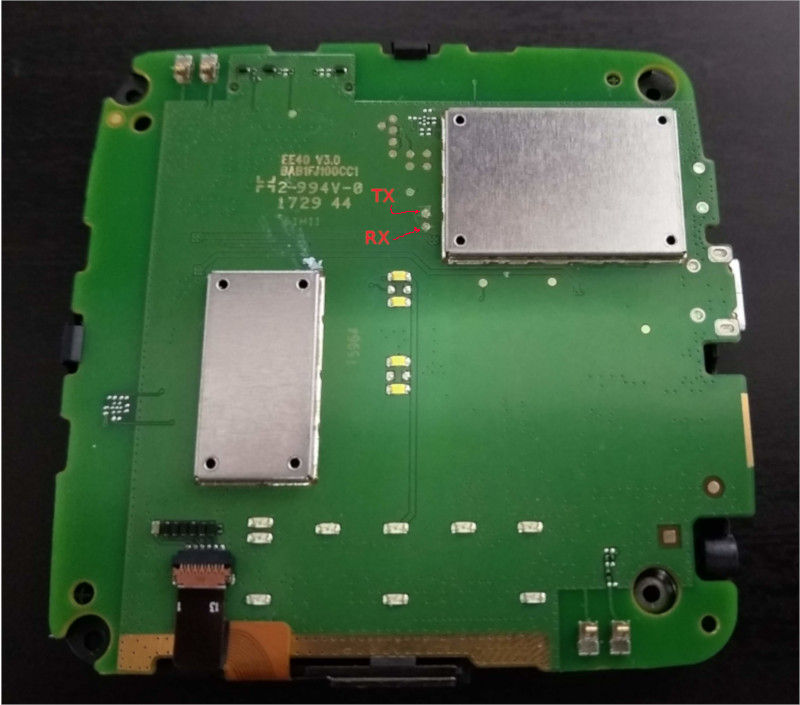
I ve mentioned in the past my twisted EE network setup from when I moved in to my current house. The 4GEE WiFi Mini (also known as the EE Osprey 2 Mini or the EE40VB, and actually a rebadged Alcatel Y853VB) has been sitting unused since then, so I figured I d see about trying to get a shell on it. TL;DR: Of course it s running Linux, there s a couple of test points internally which bring out the serial console, but after finding those and logging in I discovered it s running ADB on port 5555 quite happily available without authentication both via wifi and the USB port. So if you have physical or local network access, instant root shell. Well done, folks. And then I bricked it before I could do anything more interesting. There s a lack of information about this device out there - most of the links I can find are around removing the SIM lock - so I thought I d document the pieces I found just in case anyone else is trying to figure it out. It s based around a Qualcomm MDM9607 SoC, paired with 64M RAM and 256M NAND flash. Wifi is via an RTL8192ES. Kernel is 3.18.20. Busybox is v1.23.1. It s running dnsmasq but I didn t grab the version. Of course there s no source or offer of source provided. Taking it apart is fairly easy. There s a single screw to remove, just beside the SIM slot. The coloured rim can then be carefully pried away from the back, revealing the battery. There are then 4 screws in the corners which need removed in order to be able to lift out the actual PCB and gain access to the serial console test points. EE40VB PCB serial console test points My mistake was going poking around trying to figure out where the updates are downloaded from - I know I m running a slightly older release than what s current, and the device can do an automatic download + update. Top tip; don t run Jrdrecovery. It ll error on finding /cache/update.zip and wipe the main partition anyway. That ll leave you in a boot loop where the device boots the recovery partition which tries to install /cache/update.zip which of course still doesn t exist. So. Where next? First, I need to get the device into a state where I can actually do something other than watch it boot into recovery, fail to flash and reboot. Best guess at present is to try and get it to enter the Qualcomm EDL (Emergency Download) mode. That might be possible with a custom USB cable that grounds D+ on boot. Alternatively I need to probe some of the other test points on the PCB and see if grounding any of those helps enter EDL mode. I then need a suitable firehose OEM-signed programmer image. And then I need to actually get hold of a proper EE40VB firmware image, either via one of the OTA update files or possibly via an Alcatel ADSU image (though no idea how to get hold of one, other than by posting to a random GSM device forum and hoping for the kindness of strangers). More updates if/when I make progress
Qualcomm bootloader log
Format: Log Type - Time(microsec) - Message - Optional Info
Log Type: B - Since Boot(Power On Reset),  D - Delta,  S - Statistic
S - QC_IMAGE_VERSION_STRING=BOOT.BF.3.1.2-00053
S - IMAGE_VARIANT_STRING=LAATANAZA
S - OEM_IMAGE_VERSION_STRING=linux3
S - Boot Config, 0x000002e1
B -    105194 - SBL1, Start
D -     61885 - QSEE Image Loaded, Delta - (451964 Bytes)
D -     30286 - RPM Image Loaded, Delta - (151152 Bytes)
B -    459330 - Roger:boot_jrd_oem_main
B -    461526 - Welcome to key_check_poweron!!!
B -    466436 - REG0x00, rc=47
B -    469120 - REG0x01, rc=1f
B -    472018 - REG0x02, rc=1c
B -    474885 - REG0x03, rc=47
B -    477782 - REG0x04, rc=b2
B -    480558 - REG0x05, rc=
B -    483272 - REG0x06, rc=9e
B -    486139 - REG0x07, rc=
B -    488854 - REG0x08, rc=a4
B -    491721 - REG0x09, rc=80
B -    494130 - bq24295_probe: vflt/vsys/vprechg=0mV/0mV/0mV, tprechg/tfastchg=0Min/0Min, [0C, 0C]
B -    511546 - come to calculate vol and temperature!!
B -    511637 - ##############battery_core_convert_vntc: NTC_voltage=1785690
B -    517280 - battery_core_convert_vntc: <-44C, 1785690uV>, present=0
B -    529358 - bq24295_set_current_limit: setting=0mA, mode=-1, input/fastchg/prechg/termchg=-1mA/0mA/0mA/0mA
B -    534360 - bq24295_set_charge_current, rc=0,reg_val=0,i=0
B -    539636 - bq24295_enable_charge: setting=0, chg_enable=-1, otg_enable=0
B -    546072 - bq24295_enable_charging: enable_charging=0
B -    552172 - bq24295_set_current_limit: setting=0mA, mode=-1, input/fastchg/prechg/termchg=-1mA/0mA/0mA/0mA
B -    561566 - bq24295_set_charge_current, rc=0,reg_val=0,i=0
B -    567056 - bq24295_enable_charge: setting=0, chg_enable=0, otg_enable=0
B -    579286 - come to calculate vol and temperature!!
B -    579378 - ##############battery_core_convert_vntc: NTC_voltage=1785777
B -    585539 - battery_core_convert_vntc: <-44C, 1785777uV>, present=0
B -    597617 - charge_main: battery is plugout!!
B -    597678 - Welcome to pca955x_probe!!!
B -    601063 - pca955x_probe: PCA955X probed successfully!
D -     27511 - APPSBL Image Loaded, Delta - (179348 Bytes)
B -    633271 - QSEE Execution, Start
D -       213 - QSEE Execution, Delta
B -    638944 - >>>>>>>>>>>>>>>>>>>>>>>>>>>>>>>>>Start writting JRD RECOVERY BOOT
B -    650107 - >>>>>>>>>>>>>>>>>>>>>>>>>>>>>>>>>Start writting  RECOVERY BOOT
B -    653218 - >>>>>>>>>>>>>>>>>>>>>>>>>>>>>>>>>read_buf[0] == 0
B -    659044 - SBL1, End
D -    556137 - SBL1, Delta
S - Throughput, 2000 KB/s  (782884 Bytes,  278155 us)
S - DDR Frequency, 240 MHz
littlekernel aboot log
Android Bootloader - UART_DM Initialized!!!
[0] welcome to lk
[0] SCM call: 0x2000601 failed with :fffffffc
[0] Failed to initialize SCM
[10] platform_init()
[10] target_init()
[10] smem ptable found: ver: 4 len: 17
[10] ERROR: No devinfo partition found
[10] Neither 'config' nor 'frp' partition found
[30] voltage of NTC  is 1789872!
[30] voltage of BAT  is 3179553!
[30] usb present is 1!
[30] Loading (boot) image (4171776): start
[530] Loading (boot) image (4171776): done
[540] DTB Total entry: 25, DTB version: 3
[540] Using DTB entry 0x00000129/00010000/0x00000008/0 for device 0x00000129/00010000/0x00010008/0
[560] JRD_CHG_OFF_FEATURE!
[560] come to jrd_target_pause_for_battery_charge!
[570] power_on_status.hard_reset = 0x0
[570] power_on_status.smpl = 0x0
[570] power_on_status.rtc = 0x0
[580] power_on_status.dc_chg = 0x0
[580] power_on_status.usb_chg = 0x0
[580] power_on_status.pon1 = 0x1
[590] power_on_status.cblpwr = 0x0
[590] power_on_status.kpdpwr = 0x0
[590] power_on_status.bugflag = 0x0
[590] cmdline: noinitrd  rw console=ttyHSL0,115200,n8 androidboot.hardware=qcom ehci-hcd.park=3 msm_rtb.filter=0x37 lpm_levels.sleep_disabled=1  earlycon=msm_hsl_uart,0x78b3000  androidboot.serialno=7e6ba58c androidboot.baseband=msm rootfstype=ubifs rootflags=b
[620] Updating device tree: start
[720] Updating device tree: done
[720] booting linux @ 0x80008000, ramdisk @ 0x80008000 (0), tags/device tree @ 0x81e00000
Linux kernel console boot log
[    0.000000] Booting Linux on physical CPU 0x0
[    0.000000] Linux version 3.18.20 (linux3@linux3) (gcc version 4.9.2 (GCC) ) #1 PREEMPT Thu Aug 10 11:57:07 CST 2017
[    0.000000] CPU: ARMv7 Processor [410fc075] revision 5 (ARMv7), cr=10c53c7d
[    0.000000] CPU: PIPT / VIPT nonaliasing data cache, VIPT aliasing instruction cache
[    0.000000] Machine model: Qualcomm Technologies, Inc. MDM 9607 MTP
[    0.000000] Early serial console at I/O port 0x0 (options '')
[    0.000000] bootconsole [uart0] enabled
[    0.000000] Reserved memory: reserved region for node 'modem_adsp_region@0': base 0x82a00000, size 56 MiB
[    0.000000] Reserved memory: reserved region for node 'external_image_region@0': base 0x87c00000, size 4 MiB
[    0.000000] Removed memory: created DMA memory pool at 0x82a00000, size 56 MiB
[    0.000000] Reserved memory: initialized node modem_adsp_region@0, compatible id removed-dma-pool
[    0.000000] Removed memory: created DMA memory pool at 0x87c00000, size 4 MiB
[    0.000000] Reserved memory: initialized node external_image_region@0, compatible id removed-dma-pool
[    0.000000] cma: Reserved 4 MiB at 0x87800000
[    0.000000] Memory policy: Data cache writeback
[    0.000000] CPU: All CPU(s) started in SVC mode.
[    0.000000] Built 1 zonelists in Zone order, mobility grouping on.  Total pages: 17152
[    0.000000] Kernel command line: noinitrd  rw console=ttyHSL0,115200,n8 androidboot.hardware=qcom ehci-hcd.park=3 msm_rtb.filter=0x37 lpm_levels.sleep_disabled=1  earlycon=msm_hsl_uart,0x78b3000  androidboot.serialno=7e6ba58c androidboot.baseband=msm rootfstype=ubifs rootflags=bulk_read root=ubi0:rootfs ubi.mtd=16
[    0.000000] PID hash table entries: 512 (order: -1, 2048 bytes)
[    0.000000] Dentry cache hash table entries: 16384 (order: 4, 65536 bytes)
[    0.000000] Inode-cache hash table entries: 8192 (order: 3, 32768 bytes)
[    0.000000] Memory: 54792K/69632K available (5830K kernel code, 399K rwdata, 2228K rodata, 276K init, 830K bss, 14840K reserved)
[    0.000000] Virtual kernel memory layout:
[    0.000000]     vector  : 0xffff0000 - 0xffff1000   (   4 kB)
[    0.000000]     fixmap  : 0xffc00000 - 0xfff00000   (3072 kB)
[    0.000000]     vmalloc : 0xc8800000 - 0xff000000   ( 872 MB)
[    0.000000]     lowmem  : 0xc0000000 - 0xc8000000   ( 128 MB)
[    0.000000]     modules : 0xbf000000 - 0xc0000000   (  16 MB)
[    0.000000]       .text : 0xc0008000 - 0xc07e6c38   (8060 kB)
[    0.000000]       .init : 0xc07e7000 - 0xc082c000   ( 276 kB)
[    0.000000]       .data : 0xc082c000 - 0xc088fdc0   ( 400 kB)
[    0.000000]        .bss : 0xc088fe84 - 0xc095f798   ( 831 kB)
[    0.000000] SLUB: HWalign=64, Order=0-3, MinObjects=0, CPUs=1, Nodes=1
[    0.000000] Preemptible hierarchical RCU implementation.
[    0.000000] NR_IRQS:16 nr_irqs:16 16
[    0.000000] GIC CPU mask not found - kernel will fail to boot.
[    0.000000] GIC CPU mask not found - kernel will fail to boot.
[    0.000000] mpm_init_irq_domain(): Cannot find irq controller for qcom,gpio-parent
[    0.000000] MPM 1 irq mapping errored -517
[    0.000000] Architected mmio timer(s) running at 19.20MHz (virt).
[    0.000011] sched_clock: 56 bits at 19MHz, resolution 52ns, wraps every 3579139424256ns
[    0.007975] Switching to timer-based delay loop, resolution 52ns
[    0.013969] Switched to clocksource arch_mem_counter
[    0.019687] Console: colour dummy device 80x30
[    0.023344] Calibrating delay loop (skipped), value calculated using timer frequency.. 38.40 BogoMIPS (lpj=192000)
[    0.033666] pid_max: default: 32768 minimum: 301
[    0.038411] Mount-cache hash table entries: 1024 (order: 0, 4096 bytes)
[    0.044902] Mountpoint-cache hash table entries: 1024 (order: 0, 4096 bytes)
[    0.052445] CPU: Testing write buffer coherency: ok
[    0.057057] Setting up static identity map for 0x8058aac8 - 0x8058ab20
[    0.064242]
[    0.064242] **********************************************************
[    0.071251] **   NOTICE NOTICE NOTICE NOTICE NOTICE NOTICE NOTICE   **
[    0.077817] **                                                      **
[    0.084302] ** trace_printk() being used. Allocating extra memory.  **
[    0.090781] **                                                      **
[    0.097320] ** This means that this is a DEBUG kernel and it is     **
[    0.103802] ** unsafe for produciton use.                           **
[    0.110339] **                                                      **
[    0.116850] ** If you see this message and you are not debugging    **
[    0.123333] ** the kernel, report this immediately to your vendor!  **
[    0.129870] **                                                      **
[    0.136380] **   NOTICE NOTICE NOTICE NOTICE NOTICE NOTICE NOTICE   **
[    0.142865] **********************************************************
[    0.150225] MSM Memory Dump base table set up
[    0.153739] MSM Memory Dump apps data table set up
[    0.168125] VFP support v0.3: implementor 41 architecture 2 part 30 variant 7 rev 5
[    0.176332] pinctrl core: initialized pinctrl subsystem
[    0.180930] regulator-dummy: no parameters
[    0.215338] NET: Registered protocol family 16
[    0.220475] DMA: preallocated 256 KiB pool for atomic coherent allocations
[    0.284034] cpuidle: using governor ladder
[    0.314026] cpuidle: using governor menu
[    0.344024] cpuidle: using governor qcom
[    0.355452] msm_watchdog b017000.qcom,wdt: wdog absent resource not present
[    0.361656] msm_watchdog b017000.qcom,wdt: MSM Watchdog Initialized
[    0.371373] irq: no irq domain found for /soc/pinctrl@1000000 !
[    0.381268] spmi_pmic_arb 200f000.qcom,spmi: PMIC Arb Version-2 0x20010000
[    0.389733] platform 4080000.qcom,mss: assigned reserved memory node modem_adsp_region@0
[    0.397409] mem_acc_corner: 0 <--> 0 mV
[    0.401937] hw-breakpoint: found 5 (+1 reserved) breakpoint and 4 watchpoint registers.
[    0.408966] hw-breakpoint: maximum watchpoint size is 8 bytes.
[    0.416287] __of_mpm_init(): MPM driver mapping exists
[    0.420940] msm_rpm_glink_dt_parse: qcom,rpm-glink compatible not matches
[    0.427235] msm_rpm_dev_probe: APSS-RPM communication over SMD
[    0.432977] smd_open() before smd_init()
[    0.437544] msm_mpm_dev_probe(): Cannot get clk resource for XO: -517
[    0.445730] smd_channel_probe_now: allocation table not initialized
[    0.453100] mdm9607_s1: 1050 <--> 1350 mV at 1225 mV normal idle
[    0.458566] spm_regulator_probe: name=mdm9607_s1, range=LV, voltage=1225000 uV, mode=AUTO, step rate=4800 uV/us
[    0.468817] cpr_efuse_init: apc_corner: efuse_addr = 0x000a4000 (len=0x1000)
[    0.475353] cpr_read_fuse_revision: apc_corner: fuse revision = 2
[    0.481345] cpr_parse_speed_bin_fuse: apc_corner: [row: 37]: 0x79e8bd327e6ba58c, speed_bits = 4
[    0.490124] cpr_pvs_init: apc_corner: pvs voltage: [1050000 1100000 1275000] uV
[    0.497342] cpr_pvs_init: apc_corner: ceiling voltage: [1050000 1225000 1350000] uV
[    0.504979] cpr_pvs_init: apc_corner: floor voltage: [1050000 1050000 1150000] uV
[    0.513125] i2c-msm-v2 78b8000.i2c: probing driver i2c-msm-v2
[    0.518335] i2c-msm-v2 78b8000.i2c: error on clk_get(core_clk):-517
[    0.524478] i2c-msm-v2 78b8000.i2c: error probe() failed with err:-517
[    0.531111] i2c-msm-v2 78b7000.i2c: probing driver i2c-msm-v2
[    0.536788] i2c-msm-v2 78b7000.i2c: error on clk_get(core_clk):-517
[    0.542886] i2c-msm-v2 78b7000.i2c: error probe() failed with err:-517
[    0.549618] i2c-msm-v2 78b9000.i2c: probing driver i2c-msm-v2
[    0.555202] i2c-msm-v2 78b9000.i2c: error on clk_get(core_clk):-517
[    0.561374] i2c-msm-v2 78b9000.i2c: error probe() failed with err:-517
[    0.570613] msm-thermal soc:qcom,msm-thermal: msm_thermal:Failed reading node=/soc/qcom,msm-thermal, key=qcom,core-limit-temp. err=-22. KTM continues
[    0.583049] msm-thermal soc:qcom,msm-thermal: probe_therm_reset:Failed reading node=/soc/qcom,msm-thermal, key=qcom,therm-reset-temp err=-22. KTM continues
[    0.596926] msm_thermal:msm_thermal_dev_probe Failed reading node=/soc/qcom,msm-thermal, key=qcom,online-hotplug-core. err:-517
[    0.609370] sps:sps is ready.
[    0.613137] msm_rpm_glink_dt_parse: qcom,rpm-glink compatible not matches
[    0.619020] msm_rpm_dev_probe: APSS-RPM communication over SMD
[    0.625773] mdm9607_s2: 750 <--> 1275 mV at 750 mV normal idle
[    0.631584] mdm9607_s3_level: 0 <--> 0 mV at 0 mV normal idle
[    0.637085] mdm9607_s3_level_ao: 0 <--> 0 mV at 0 mV normal idle
[    0.643092] mdm9607_s3_floor_level: 0 <--> 0 mV at 0 mV normal idle
[    0.649512] mdm9607_s3_level_so: 0 <--> 0 mV at 0 mV normal idle
[    0.655750] mdm9607_s4: 1800 <--> 1950 mV at 1800 mV normal idle
[    0.661791] mdm9607_l1: 1250 mV normal idle
[    0.666090] mdm9607_l2: 1800 mV normal idle
[    0.670276] mdm9607_l3: 1800 mV normal idle
[    0.674541] mdm9607_l4: 3075 mV normal idle
[    0.678743] mdm9607_l5: 1700 <--> 3050 mV at 1700 mV normal idle
[    0.684904] mdm9607_l6: 1700 <--> 3050 mV at 1700 mV normal idle
[    0.690892] mdm9607_l7: 1700 <--> 1900 mV at 1700 mV normal idle
[    0.697036] mdm9607_l8: 1800 mV normal idle
[    0.701238] mdm9607_l9: 1200 <--> 1250 mV at 1200 mV normal idle
[    0.707367] mdm9607_l10: 1050 mV normal idle
[    0.711662] mdm9607_l11: 1800 mV normal idle
[    0.716089] mdm9607_l12_level: 0 <--> 0 mV at 0 mV normal idle
[    0.721717] mdm9607_l12_level_ao: 0 <--> 0 mV at 0 mV normal idle
[    0.727946] mdm9607_l12_level_so: 0 <--> 0 mV at 0 mV normal idle
[    0.734099] mdm9607_l12_floor_lebel: 0 <--> 0 mV at 0 mV normal idle
[    0.740706] mdm9607_l13: 1800 <--> 2850 mV at 2850 mV normal idle
[    0.746883] mdm9607_l14: 2650 <--> 3000 mV at 2650 mV normal idle
[    0.752515] msm_mpm_dev_probe(): Cannot get clk resource for XO: -517
[    0.759036] cpr_efuse_init: apc_corner: efuse_addr = 0x000a4000 (len=0x1000)
[    0.765807] cpr_read_fuse_revision: apc_corner: fuse revision = 2
[    0.771809] cpr_parse_speed_bin_fuse: apc_corner: [row: 37]: 0x79e8bd327e6ba58c, speed_bits = 4
[    0.780586] cpr_pvs_init: apc_corner: pvs voltage: [1050000 1100000 1275000] uV
[    0.787808] cpr_pvs_init: apc_corner: ceiling voltage: [1050000 1225000 1350000] uV
[    0.795443] cpr_pvs_init: apc_corner: floor voltage: [1050000 1050000 1150000] uV
[    0.803094] cpr_init_cpr_parameters: apc_corner: up threshold = 2, down threshold = 3
[    0.810752] cpr_init_cpr_parameters: apc_corner: CPR is enabled by default.
[    0.817687] cpr_init_cpr_efuse: apc_corner: [row:65] = 0x15000277277383
[    0.824272] cpr_init_cpr_efuse: apc_corner: CPR disable fuse = 0
[    0.830225] cpr_init_cpr_efuse: apc_corner: Corner[1]: ro_sel = 0, target quot = 631
[    0.837976] cpr_init_cpr_efuse: apc_corner: Corner[2]: ro_sel = 0, target quot = 631
[    0.845703] cpr_init_cpr_efuse: apc_corner: Corner[3]: ro_sel = 0, target quot = 899
[    0.853592] cpr_config: apc_corner: Timer count: 0x17700 (for 5000 us)
[    0.860426] apc_corner: 0 <--> 0 mV
[    0.864044] i2c-msm-v2 78b8000.i2c: probing driver i2c-msm-v2
[    0.869261] i2c-msm-v2 78b8000.i2c: error on clk_get(core_clk):-517
[    0.875492] i2c-msm-v2 78b8000.i2c: error probe() failed with err:-517
[    0.882225] i2c-msm-v2 78b7000.i2c: probing driver i2c-msm-v2
[    0.887775] i2c-msm-v2 78b7000.i2c: error on clk_get(core_clk):-517
[    0.893941] i2c-msm-v2 78b7000.i2c: error probe() failed with err:-517
[    0.900719] i2c-msm-v2 78b9000.i2c: probing driver i2c-msm-v2
[    0.906256] i2c-msm-v2 78b9000.i2c: error on clk_get(core_clk):-517
[    0.912430] i2c-msm-v2 78b9000.i2c: error probe() failed with err:-517
[    0.919472] msm-thermal soc:qcom,msm-thermal: msm_thermal:Failed reading node=/soc/qcom,msm-thermal, key=qcom,core-limit-temp. err=-22. KTM continues
[    0.932372] msm-thermal soc:qcom,msm-thermal: probe_therm_reset:Failed reading node=/soc/qcom,msm-thermal,
key=qcom,therm-reset-temp err=-22. KTM continues
[    0.946361] msm_thermal:get_kernel_cluster_info CPU0 topology not initialized.
[    0.953824] cpu cpu0: dev_pm_opp_get_opp_count: device OPP not found (-19)
[    0.960300] msm_thermal:get_cpu_freq_plan_len Error reading CPU0 freq table len. error:-19
[    0.968533] msm_thermal:vdd_restriction_reg_init Defer vdd rstr freq init.
[    0.975846] cpu cpu0: dev_pm_opp_get_opp_count: device OPP not found (-19)
[    0.982219] msm_thermal:get_cpu_freq_plan_len Error reading CPU0 freq table len. error:-19
[    0.991378] cpu cpu0: dev_pm_opp_get_opp_count: device OPP not found (-19)
[    0.997544] msm_thermal:get_cpu_freq_plan_len Error reading CPU0 freq table len. error:-19
[    1.013642] qcom,gcc-mdm9607 1800000.qcom,gcc: Registered GCC clocks
[    1.019451] clock-a7 b010008.qcom,clock-a7: Speed bin: 4 PVS Version: 0
[    1.025693] a7ssmux: set OPP pair(400000000 Hz: 1 uV) on cpu0
[    1.031314] a7ssmux: set OPP pair(1305600000 Hz: 7 uV) on cpu0
[    1.038805] i2c-msm-v2 78b8000.i2c: probing driver i2c-msm-v2
[    1.043587] AXI: msm_bus_scale_register_client(): msm_bus_scale_register_client: Bus driver not ready.
[    1.052935] i2c-msm-v2 78b8000.i2c: msm_bus_scale_register_client(mstr-id:86):0 (not a problem)
[    1.062006] irq: no irq domain found for /soc/wcd9xxx-irq !
[    1.069884] i2c-msm-v2 78b7000.i2c: probing driver i2c-msm-v2
[    1.074814] AXI: msm_bus_scale_register_client(): msm_bus_scale_register_client: Bus driver not ready.
[    1.083716] i2c-msm-v2 78b7000.i2c: msm_bus_scale_register_client(mstr-id:86):0 (not a problem)
[    1.093850] i2c-msm-v2 78b9000.i2c: probing driver i2c-msm-v2
[    1.098889] AXI: msm_bus_scale_register_client(): msm_bus_scale_register_client: Bus driver not ready.
[    1.107779] i2c-msm-v2 78b9000.i2c: msm_bus_scale_register_client(mstr-id:86):0 (not a problem)
[    1.167871] KPI: Bootloader start count = 24097
[    1.171364] KPI: Bootloader end count = 48481
[    1.175855] KPI: Bootloader display count = 3884474147
[    1.180825] KPI: Bootloader load kernel count = 16420
[    1.185905] KPI: Kernel MPM timestamp = 105728
[    1.190286] KPI: Kernel MPM Clock frequency = 32768
[    1.195209] socinfo_print: v0.10, id=297, ver=1.0, raw_id=72, raw_ver=0, hw_plat=8, hw_plat_ver=65536
[    1.195209]  accessory_chip=0, hw_plat_subtype=0, pmic_model=65539, pmic_die_revision=131074 foundry_id=0 serial_number=2120983948
[    1.216731] sdcard_ext_vreg: no parameters
[    1.220555] rome_vreg: no parameters
[    1.224133] emac_lan_vreg: no parameters
[    1.228177] usbcore: registered new interface driver usbfs
[    1.233156] usbcore: registered new interface driver hub
[    1.238578] usbcore: registered new device driver usb
[    1.244507] cpufreq: driver msm up and running
[    1.248425] ION heap system created
[    1.251895] msm_bus_fabric_init_driver
[    1.262563] qcom,qpnp-power-on qpnp-power-on-c7303800: PMIC@SID0 Power-on reason: Triggered from PON1 (secondary PMIC) and 'cold' boot
[    1.273747] qcom,qpnp-power-on qpnp-power-on-c7303800: PMIC@SID0: Power-off reason: Triggered from UVLO (Under Voltage Lock Out)
[    1.285430] input: qpnp_pon as /devices/virtual/input/input0
[    1.291246] PMIC@SID0: PM8019 v2.2 options: 3, 2, 2, 2
[    1.296706] Advanced Linux Sound Architecture Driver Initialized.
[    1.302493] Add group failed
[    1.305291] cfg80211: Calling CRDA to update world regulatory domain
[    1.311216] cfg80211: World regulatory domain updated:
[    1.317109] Switched to clocksource arch_mem_counter
[    1.334091] cfg80211:  DFS Master region: unset
[    1.337418] cfg80211:   (start_freq - end_freq @ bandwidth), (max_antenna_gain, max_eirp), (dfs_cac_time)
[    1.354087] cfg80211:   (2402000 KHz - 2472000 KHz @ 40000 KHz), (N/A, 2000 mBm), (N/A)
[    1.361055] cfg80211:   (2457000 KHz - 2482000 KHz @ 40000 KHz), (N/A, 2000 mBm), (N/A)
[    1.370545] NET: Registered protocol family 2
[    1.374082] cfg80211:   (2474000 KHz - 2494000 KHz @ 20000 KHz), (N/A, 2000 mBm), (N/A)
[    1.381851] cfg80211:   (5170000 KHz - 5250000 KHz @ 80000 KHz), (N/A, 2000 mBm), (N/A)
[    1.389876] cfg80211:   (5250000 KHz - 5330000 KHz @ 80000 KHz), (N/A, 2000 mBm), (N/A)
[    1.397857] cfg80211:   (5490000 KHz - 5710000 KHz @ 80000 KHz), (N/A, 2000 mBm), (N/A)
[    1.405841] cfg80211:   (5735000 KHz - 5835000 KHz @ 80000 KHz), (N/A, 2000 mBm), (N/A)
[    1.413795] cfg80211:   (57240000 KHz - 63720000 KHz @ 2160000 KHz), (N/A, 0 mBm), (N/A)
[    1.422355] TCP established hash table entries: 1024 (order: 0, 4096 bytes)
[    1.428921] TCP bind hash table entries: 1024 (order: 0, 4096 bytes)
[    1.435192] TCP: Hash tables configured (established 1024 bind 1024)
[    1.441528] TCP: reno registered
[    1.444738] UDP hash table entries: 256 (order: 0, 4096 bytes)
[    1.450521] UDP-Lite hash table entries: 256 (order: 0, 4096 bytes)
[    1.456950] NET: Registered protocol family 1
[    1.462779] futex hash table entries: 256 (order: -1, 3072 bytes)
[    1.474555] msgmni has been set to 115
[    1.478551] Block layer SCSI generic (bsg) driver version 0.4 loaded (major 251)
[    1.485041] io scheduler noop registered
[    1.488818] io scheduler deadline registered
[    1.493200] io scheduler cfq registered (default)
[    1.502142] msm_rpm_log_probe: OK
[    1.506717] msm_serial_hs module loaded
[    1.509803] msm_serial_hsl_probe: detected port #0 (ttyHSL0)
[    1.515324] AXI: get_pdata(): Error: Client name not found
[    1.520626] AXI: msm_bus_cl_get_pdata(): client has to provide missing entry for successful registration
[    1.530171] msm_serial_hsl_probe: Bus scaling is disabled                      [    1.074814] AXI: msm_bus_scale_register_client(): msm_bus_scale_register_client: Bus driver not ready.
[    1.083716] i2c-msm-v2 78b7000.i2c: msm_bus_scale_register_client(mstr-id:86):0 (not a problem)
[    1.093850] i2c-msm-v2 78b9000.i2c: probing driver i2c-msm-v2
[    1.098889] AXI: msm_bus_scale_register_client(): msm_bus_scale_register_client: Bus driver not ready.
[    1.107779] i2c-msm-v2 78b9000.i2c: msm_bus_scale_register_client(mstr-id:86):0 (not a problem)
[    1.167871] KPI: Bootloader start count = 24097
[    1.171364] KPI: Bootloader end count = 48481
[    1.175855] KPI: Bootloader display count = 3884474147
[    1.180825] KPI: Bootloader load kernel count = 16420
[    1.185905] KPI: Kernel MPM timestamp = 105728
[    1.190286] KPI: Kernel MPM Clock frequency = 32768
[    1.195209] socinfo_print: v0.10, id=297, ver=1.0, raw_id=72, raw_ver=0, hw_plat=8, hw_plat_ver=65536
[    1.195209]  accessory_chip=0, hw_plat_subtype=0, pmic_model=65539, pmic_die_revision=131074 foundry_id=0 serial_number=2120983948
[    1.216731] sdcard_ext_vreg: no parameters
[    1.220555] rome_vreg: no parameters
[    1.224133] emac_lan_vreg: no parameters
[    1.228177] usbcore: registered new interface driver usbfs
[    1.233156] usbcore: registered new interface driver hub
[    1.238578] usbcore: registered new device driver usb
[    1.244507] cpufreq: driver msm up and running
[    1.248425] ION heap system created
[    1.251895] msm_bus_fabric_init_driver
[    1.262563] qcom,qpnp-power-on qpnp-power-on-c7303800: PMIC@SID0 Power-on reason: Triggered from PON1 (secondary PMIC) and 'cold' boot
[    1.273747] qcom,qpnp-power-on qpnp-power-on-c7303800: PMIC@SID0: Power-off reason: Triggered from UVLO (Under Voltage Lock Out)
[    1.285430] input: qpnp_pon as /devices/virtual/input/input0
[    1.291246] PMIC@SID0: PM8019 v2.2 options: 3, 2, 2, 2
[    1.296706] Advanced Linux Sound Architecture Driver Initialized.
[    1.302493] Add group failed
[    1.305291] cfg80211: Calling CRDA to update world regulatory domain
[    1.311216] cfg80211: World regulatory domain updated:
[    1.317109] Switched to clocksource arch_mem_counter
[    1.334091] cfg80211:  DFS Master region: unset
[    1.337418] cfg80211:   (start_freq - end_freq @ bandwidth), (max_antenna_gain, max_eirp), (dfs_cac_time)
[    1.354087] cfg80211:   (2402000 KHz - 2472000 KHz @ 40000 KHz), (N/A, 2000 mBm), (N/A)
[    1.361055] cfg80211:   (2457000 KHz - 2482000 KHz @ 40000 KHz), (N/A, 2000 mBm), (N/A)
[    1.370545] NET: Registered protocol family 2
[    1.374082] cfg80211:   (2474000 KHz - 2494000 KHz @ 20000 KHz), (N/A, 2000 mBm), (N/A)
[    1.381851] cfg80211:   (5170000 KHz - 5250000 KHz @ 80000 KHz), (N/A, 2000 mBm), (N/A)
[    1.389876] cfg80211:   (5250000 KHz - 5330000 KHz @ 80000 KHz), (N/A, 2000 mBm), (N/A)
[    1.397857] cfg80211:   (5490000 KHz - 5710000 KHz @ 80000 KHz), (N/A, 2000 mBm), (N/A)
[    1.405841] cfg80211:   (5735000 KHz - 5835000 KHz @ 80000 KHz), (N/A, 2000 mBm), (N/A)
[    1.413795] cfg80211:   (57240000 KHz - 63720000 KHz @ 2160000 KHz), (N/A, 0 mBm), (N/A)
[    1.422355] TCP established hash table entries: 1024 (order: 0, 4096 bytes)
[    1.428921] TCP bind hash table entries: 1024 (order: 0, 4096 bytes)
[    1.435192] TCP: Hash tables configured (established 1024 bind 1024)
[    1.441528] TCP: reno registered
[    1.444738] UDP hash table entries: 256 (order: 0, 4096 bytes)
[    1.450521] UDP-Lite hash table entries: 256 (order: 0, 4096 bytes)
[    1.456950] NET: Registered protocol family 1
[    1.462779] futex hash table entries: 256 (order: -1, 3072 bytes)
[    1.474555] msgmni has been set to 115
[    1.478551] Block layer SCSI generic (bsg) driver version 0.4 loaded (major 251)
[    1.485041] io scheduler noop registered
[    1.488818] io scheduler deadline registered
[    1.493200] io scheduler cfq registered (default)
[    1.502142] msm_rpm_log_probe: OK
[    1.506717] msm_serial_hs module loaded
[    1.509803] msm_serial_hsl_probe: detected port #0 (ttyHSL0)
[    1.515324] AXI: get_pdata(): Error: Client name not found
[    1.520626] AXI: msm_bus_cl_get_pdata(): client has to provide missing entry for successful registration
[    1.530171] msm_serial_hsl_probe: Bus scaling is disabled
[    1.535696] 78b3000.serial: ttyHSL0 at MMIO 0x78b3000 (irq = 153, base_baud = 460800 [    1.544155] msm_hsl_console_setup: console setup on port #0
[    1.548727] console [ttyHSL0] enabled
[    1.548727] console [ttyHSL0] enabled
[    1.556014] bootconsole [uart0] disabled
[    1.556014] bootconsole [uart0] disabled
[    1.564212] msm_serial_hsl_init: driver initialized
[    1.578450] brd: module loaded
[    1.582920] loop: module loaded
[    1.589183] sps: BAM device 0x07984000 is not registered yet.
[    1.594234] sps:BAM 0x07984000 is registered.
[    1.598072] msm_nand_bam_init: msm_nand_bam_init: BAM device registered: bam_handle 0xc69f6400
[    1.607103] sps:BAM 0x07984000 (va:0xc89a0000) enabled: ver:0x18, number of pipes:7
[    1.616588] msm_nand_parse_smem_ptable: Parsing partition table info from SMEM
[    1.622805] msm_nand_parse_smem_ptable: SMEM partition table found: ver: 4 len: 17
[    1.630391] msm_nand_version_check: nand_major:1, nand_minor:5, qpic_major:1, qpic_minor:5
[    1.638642] msm_nand_scan: NAND Id: 0x1590aa98 Buswidth: 8Bits Density: 256 MByte
[    1.646069] msm_nand_scan: pagesize: 2048 Erasesize: 131072 oobsize: 128 (in Bytes)
[    1.653676] msm_nand_scan: BCH ECC: 8 Bit
[    1.657710] msm_nand_scan: CFG0: 0x290408c0,           CFG1: 0x0804715c
[    1.657710]             RAWCFG0: 0x2b8400c0,        RAWCFG1: 0x0005055d
[    1.657710]           ECCBUFCFG: 0x00000203,      ECCBCHCFG: 0x42040d10
[    1.657710]           RAWECCCFG: 0x42000d11, BAD BLOCK BYTE: 0x000001c5
[    1.684101] Creating 17 MTD partitions on "7980000.nand":
[    1.689447] 0x000000000000-0x000000140000 : "sbl"
[    1.694867] 0x000000140000-0x000000280000 : "mibib"
[    1.699560] 0x000000280000-0x000000e80000 : "efs2"
[    1.704408] 0x000000e80000-0x000000f40000 : "tz"
[    1.708934] 0x000000f40000-0x000000fa0000 : "rpm"
[    1.713625] 0x000000fa0000-0x000001000000 : "aboot"
[    1.718582] 0x000001000000-0x0000017e0000 : "boot"
[    1.723281] 0x0000017e0000-0x000002820000 : "scrub"
[    1.728174] 0x000002820000-0x000005020000 : "modem"
[    1.732968] 0x000005020000-0x000005420000 : "rfbackup"
[    1.738156] 0x000005420000-0x000005820000 : "oem"
[    1.742770] 0x000005820000-0x000005f00000 : "recovery"
[    1.747972] 0x000005f00000-0x000009100000 : "cache"
[    1.752787] 0x000009100000-0x000009a40000 : "recoveryfs"
[    1.758389] 0x000009a40000-0x00000aa40000 : "cdrom"
[    1.762967] 0x00000aa40000-0x00000ba40000 : "jrdresource"
[    1.768407] 0x00000ba40000-0x000010000000 : "system"
[    1.773239] msm_nand_probe: NANDc phys addr 0x7980000, BAM phys addr 0x7984000, BAM IRQ 164
[    1.781074] msm_nand_probe: Allocated DMA buffer at virt_addr 0xc7840000, phys_addr 0x87840000
[    1.791872] PPP generic driver version 2.4.2
[    1.801126] cnss_sdio 87a00000.qcom,cnss-sdio: CNSS SDIO Driver registered
[    1.807554] msm_otg 78d9000.usb: msm_otg probe
[    1.813333] msm_otg 78d9000.usb: OTG regs = c88f8000
[    1.820702] gbridge_init: gbridge_init successs.
[    1.826344] msm_otg 78d9000.usb: phy_reset: success
[    1.830294] qcom,qpnp-rtc qpnp-rtc-c7307000: rtc core: registered qpnp_rtc as rtc0
[    1.838474] i2c /dev entries driver
[    1.842459] unable to find DT imem DLOAD mode node
[    1.846588] unable to find DT imem EDLOAD mode node
[    1.851332] unable to find DT imem dload-type node
[    1.856921] bq24295-charger 4-006b: bq24295 probe enter
[    1.861161] qcom,iterm-ma = 128
[    1.864476] bq24295_otg_vreg: no parameters
[    1.868502] charger_core_register: Charger Core Version 5.0.0(Built at 20151202-21:36)!
[    1.877007] i2c-msm-v2 78b8000.i2c: msm_bus_scale_register_client(mstr-id:86):0x3 (ok)
[    1.885559] bq24295-charger 4-006b: bq24295_set_bhot_mode 3
[    1.890150] bq24295-charger 4-006b: power_good is 1,vbus_stat is 2
[    1.896588] bq24295-charger 4-006b: bq24295_set_thermal_threshold 100
[    1.902952] bq24295-charger 4-006b: bq24295_set_sys_min 3700
[    1.908639] bq24295-charger 4-006b: bq24295_set_max_target_voltage 4150
[    1.915223] bq24295-charger 4-006b: bq24295_set_recharge_threshold 300
[    1.922119] bq24295-charger 4-006b: bq24295_set_terminal_current_limit iterm_disabled=0, iterm_ma=128
[    1.930917] bq24295-charger 4-006b: bq24295_set_precharge_current_limit bdi->prech_cur=128
[    1.940038] bq24295-charger 4-006b: bq24295_set_safty_timer 0
[    1.945088] bq24295-charger 4-006b: bq24295_set_input_voltage_limit 4520
[    1.972949] sdhci: Secure Digital Host Controller Interface driver
[    1.978151] sdhci: Copyright(c) Pierre Ossman
[    1.982441] sdhci-pltfm: SDHCI platform and OF driver helper
[    1.989092] sdhci_msm 7824900.sdhci: sdhci_msm_probe: ICE device is not enabled
[    1.995473] sdhci_msm 7824900.sdhci: No vreg data found for vdd
[    2.001530] sdhci_msm 7824900.sdhci: sdhci_msm_pm_qos_parse_irq: error -22 reading irq cpu
[    2.009809] sdhci_msm 7824900.sdhci: sdhci_msm_pm_qos_parse: PM QoS voting for IRQ will be disabled
[    2.018600] sdhci_msm 7824900.sdhci: sdhci_msm_pm_qos_parse: PM QoS voting for cpu group will be disabled
[    2.030541] sdhci_msm 7824900.sdhci: sdhci_msm_probe: sdiowakeup_irq = 353
[    2.036867] sdhci_msm 7824900.sdhci: No vmmc regulator found
[    2.042027] sdhci_msm 7824900.sdhci: No vqmmc regulator found
[    2.048266] mmc0: SDHCI controller on 7824900.sdhci [7824900.sdhci] using 32-bit ADMA in legacy mode
[    2.080401] Welcome to pca955x_probe!!
[    2.084362] leds-pca955x 3-0020: leds-pca955x: Using pca9555 16-bit LED driver at slave address 0x20
[    2.095400] sdhci_msm 7824900.sdhci: card claims to support voltages below defined range
[    2.103125] i2c-msm-v2 78b7000.i2c: msm_bus_scale_register_client(mstr-id:86):0x5 (ok)
[    2.114183] msm_otg 78d9000.usb: Avail curr from USB = 1500
[    2.120251] come to USB_SDP_CHARGER!
[    2.123215] Welcome to sn3199_probe!
[    2.126718] leds-sn3199 5-0064: leds-sn3199: Using sn3199 9-bit LED driver at slave address 0x64
[    2.136511] sn3199->led_en_gpio=21
[    2.139143] i2c-msm-v2 78b9000.i2c: msm_bus_scale_register_client(mstr-id:86):0x6 (ok)
[    2.150207] usbcore: registered new interface driver usbhid
[    2.154864] usbhid: USB HID core driver
[    2.159825] sps:BAM 0x078c4000 is registered.
[    2.163573] bimc-bwmon 408000.qcom,cpu-bwmon: BW HWmon governor registered.
[    2.171080] devfreq soc:qcom,cpubw: Couldn't update frequency transition information.
[    2.178513] coresight-fuse a601c.fuse: QPDI fuse not specified
[    2.184242] coresight-fuse a601c.fuse: Fuse initialized
[    2.192407] coresight-csr 6001000.csr: CSR initialized
[    2.197263] coresight-tmc 6026000.tmc: Byte Counter feature enabled
[    2.203204] sps:BAM 0x06084000 is registered.
[    2.207301] coresight-tmc 6026000.tmc: TMC initialized
[    2.212681] coresight-tmc 6025000.tmc: TMC initialized
[    2.220071] nidnt boot config: 0
[    2.224563] mmc0: new ultra high speed SDR50 SDIO card at address 0001
[    2.231120] coresight-tpiu 6020000.tpiu: NIDnT on SDCARD only mode
[    2.236440] coresight-tpiu 6020000.tpiu: TPIU initialized
[    2.242808] coresight-replicator 6024000.replicator: REPLICATOR initialized
[    2.249372] coresight-stm 6002000.stm: STM initialized
[    2.255034] coresight-hwevent 606c000.hwevent: Hardware Event driver initialized
[    2.262312] Netfilter messages via NETLINK v0.30.
[    2.266306] nf_conntrack version 0.5.0 (920 buckets, 3680 max)
[    2.272312] ctnetlink v0.93: registering with nfnetlink.
[    2.277565] ip_set: protocol 6
[    2.280568] ip_tables: (C) 2000-2006 Netfilter Core Team
[    2.285723] arp_tables: (C) 2002 David S. Miller
[    2.290146] TCP: cubic registered
[    2.293915] NET: Registered protocol family 10
[    2.298740] ip6_tables: (C) 2000-2006 Netfilter Core Team
[    2.303407] sit: IPv6 over IPv4 tunneling driver
[    2.308481] NET: Registered protocol family 17
[    2.312340] bridge: automatic filtering via arp/ip/ip6tables has been deprecated. Update your scripts to load br_netfilter if you need this.
[    2.325094] Bridge firewalling registered
[    2.328930] Ebtables v2.0 registered
[    2.333260] NET: Registered protocol family 27
[    2.341362] battery_core_register: Battery Core Version 5.0.0(Built at 20151202-21:36)!
[    2.348466] pmu_battery_probe: vbat_channel=21, tbat_channel=17
[    2.420236] ubi0: attaching mtd16
[    2.723941] ubi0: scanning is finished
[    2.732997] ubi0: attached mtd16 (name "system", size 69 MiB)
[    2.737783] ubi0: PEB size: 131072 bytes (128 KiB), LEB size: 126976 bytes
[    2.744601] ubi0: min./max. I/O unit sizes: 2048/2048, sub-page size 2048
[    2.751333] ubi0: VID header offset: 2048 (aligned 2048), data offset: 4096
[    2.758540] ubi0: good PEBs: 556, bad PEBs: 2, corrupted PEBs: 0
[    2.764305] ubi0: user volume: 3, internal volumes: 1, max. volumes count: 128
[    2.771476] ubi0: max/mean erase counter: 192/64, WL threshold: 4096, image sequence number: 35657280
[    2.780708] ubi0: available PEBs: 0, total reserved PEBs: 556, PEBs reserved for bad PEB handling: 38
[    2.789921] ubi0: background thread "ubi_bgt0d" started, PID 96
[    2.796395] android_bind cdev: 0xC6583E80, name: ci13xxx_msm
[    2.801508] file system registered
[    2.804974] mbim_init: initialize 1 instances
[    2.809228] mbim_init: Initialized 1 ports
[    2.815074] rndis_qc_init: initialize rndis QC instance
[    2.819713] jrd device_desc.bcdDevice: [0x0242]
[    2.823779] android_bind scheduled usb start work: name: ci13xxx_msm
[    2.830230] android_usb gadget: android_usb ready
[    2.834845] msm_hsusb msm_hsusb: [ci13xxx_start] hw_ep_max = 32
[    2.840741] msm_hsusb msm_hsusb: CI13XXX_CONTROLLER_RESET_EVENT received
[    2.847433] msm_hsusb msm_hsusb: CI13XXX_CONTROLLER_UDC_STARTED_EVENT received
[    2.855851] input: gpio-keys as /devices/soc:gpio_keys/input/input1
[    2.861452] qcom,qpnp-rtc qpnp-rtc-c7307000: setting system clock to 1970-01-01 06:36:41 UTC (23801)
[    2.870315] open file error /usb_conf/usb_config.ini
[    2.876412] jrd_usb_start_work open file erro /usb_conf/usb_config.ini, retry_count:0
[    2.884324] parse_legacy_cluster_params(): Ignoring cluster params
[    2.889468] ------------[ cut here ]------------
[    2.894186] WARNING: CPU: 0 PID: 1 at /home/linux3/jrd/yanping.an/ee40/0810/MDM9607.LE.1.0-00130/apps_proc/oe-core/build/tmp-glibc/work-shared/mdm9607/kernel-source/drivers/cpuidle/lpm-levels-of.c:739 parse_cluster+0xb50/0xcb4()
[    2.914366] Modules linked in:
[    2.917339] CPU: 0 PID: 1 Comm: swapper Not tainted 3.18.20 #1
[    2.923171] [<c00132ac>] (unwind_backtrace) from [<c0011460>] (show_stack+0x10/0x14)
[    2.931092] [<c0011460>] (show_stack) from [<c001c6ac>] (warn_slowpath_common+0x68/0x88)
[    2.939175] [<c001c6ac>] (warn_slowpath_common) from [<c001c75c>] (warn_slowpath_null+0x18/0x20)
[    2.947895] [<c001c75c>] (warn_slowpath_null) from [<c034e180>] (parse_cluster+0xb50/0xcb4)
[    2.956189] [<c034e180>] (parse_cluster) from [<c034b6b4>] (lpm_probe+0xc/0x1d4)
[    2.963527] [<c034b6b4>] (lpm_probe) from [<c024857c>] (platform_drv_probe+0x30/0x7c)
[    2.971380] [<c024857c>] (platform_drv_probe) from [<c0246d54>] (driver_probe_device+0xb8/0x1e8)
[    2.980118] [<c0246d54>] (driver_probe_device) from [<c0246f30>] (__driver_attach+0x68/0x8c)
[    2.988467] [<c0246f30>] (__driver_attach) from [<c02455d0>] (bus_for_each_dev+0x6c/0x90)
[    2.996626] [<c02455d0>] (bus_for_each_dev) from [<c02465a4>] (bus_add_driver+0xe0/0x1c8)
[    3.004786] [<c02465a4>] (bus_add_driver) from [<c02477bc>] (driver_register+0x9c/0xe0)
[    3.012739] [<c02477bc>] (driver_register) from [<c080c3d8>] (lpm_levels_module_init+0x14/0x38)
[    3.021459] [<c080c3d8>] (lpm_levels_module_init) from [<c0008980>] (do_one_initcall+0xf8/0x1a0)
[    3.030217] [<c0008980>] (do_one_initcall) from [<c07e7d4c>] (kernel_init_freeable+0xf0/0x1b0)
[    3.038818] [<c07e7d4c>] (kernel_init_freeable) from [<c0582d48>] (kernel_init+0x8/0xe4)
[    3.046888] [<c0582d48>] (kernel_init) from [<c000dda0>] (ret_from_fork+0x14/0x34)
[    3.054432] ---[ end trace e9ec50b1ec4c8f73 ]---
[    3.059012] ------------[ cut here ]------------
[    3.063604] WARNING: CPU: 0 PID: 1 at /home/linux3/jrd/yanping.an/ee40/0810/MDM9607.LE.1.0-00130/apps_proc/oe-core/build/tmp-glibc/work-shared/mdm9607/kernel-source/drivers/cpuidle/lpm-levels-of.c:739 parse_cluster+0xb50/0xcb4()
[    3.083858] Modules linked in:
[    3.086870] CPU: 0 PID: 1 Comm: swapper Tainted: G        W      3.18.20 #1
[    3.093814] [<c00132ac>] (unwind_backtrace) from [<c0011460>] (show_stack+0x10/0x14)
[    3.101575] [<c0011460>] (show_stack) from [<c001c6ac>] (warn_slowpath_common+0x68/0x88)
[    3.109641] [<c001c6ac>] (warn_slowpath_common) from [<c001c75c>] (warn_slowpath_null+0x18/0x20)
[    3.118412] [<c001c75c>] (warn_slowpath_null) from [<c034e180>] (parse_cluster+0xb50/0xcb4)
[    3.126745] [<c034e180>] (parse_cluster) from [<c034b6b4>] (lpm_probe+0xc/0x1d4)
[    3.134126] [<c034b6b4>] (lpm_probe) from [<c024857c>] (platform_drv_probe+0x30/0x7c)
[    3.141906] [<c024857c>] (platform_drv_probe) from [<c0246d54>] (driver_probe_device+0xb8/0x1e8)
[    3.150702] [<c0246d54>] (driver_probe_device) from [<c0246f30>] (__driver_attach+0x68/0x8c)
[    3.159120] [<c0246f30>] (__driver_attach) from [<c02455d0>] (bus_for_each_dev+0x6c/0x90)
[    3.167285] [<c02455d0>] (bus_for_each_dev) from [<c02465a4>] (bus_add_driver+0xe0/0x1c8)
[    3.175444] [<c02465a4>] (bus_add_driver) from [<c02477bc>] (driver_register+0x9c/0xe0)
[    3.183398] [<c02477bc>] (driver_register) from [<c080c3d8>] (lpm_levels_module_init+0x14/0x38)
[    3.192107] [<c080c3d8>] (lpm_levels_module_init) from [<c0008980>] (do_one_initcall+0xf8/0x1a0)
[    3.200877] [<c0008980>] (do_one_initcall) from [<c07e7d4c>] (kernel_init_freeable+0xf0/0x1b0)
[    3.209475] [<c07e7d4c>] (kernel_init_freeable) from [<c0582d48>] (kernel_init+0x8/0xe4)
[    3.217542] [<c0582d48>] (kernel_init) from [<c000dda0>] (ret_from_fork+0x14/0x34)
[    3.225090] ---[ end trace e9ec50b1ec4c8f74 ]---
[    3.229667] /soc/qcom,lpm-levels/qcom,pm-cluster@0: No CPU phandle, assuming single cluster
[    3.239954] qcom,cc-debug-mdm9607 1800000.qcom,debug: Registered Debug Mux successfully
[    3.247619] emac_lan_vreg: disabling
[    3.250507] mem_acc_corner: disabling
[    3.254196] clock_late_init: Removing enables held for handed-off clocks
[    3.262690] ALSA device list:
[    3.264732]   No soundcard [    3.274083] UBIFS (ubi0:0): background thread "ubifs_bgt0_0" started, PID 102
[    3.305224] UBIFS (ubi0:0): recovery needed
[    3.466156] UBIFS (ubi0:0): recovery completed
[    3.469627] UBIFS (ubi0:0): UBIFS: mounted UBI device 0, volume 0, name "rootfs"
[    3.476987] UBIFS (ubi0:0): LEB size: 126976 bytes (124 KiB), min./max. I/O unit sizes: 2048 bytes/2048 bytes
[    3.486876] UBIFS (ubi0:0): FS size: 45838336 bytes (43 MiB, 361 LEBs), journal size 9023488 bytes (8 MiB, 72 LEBs)
[    3.497417] UBIFS (ubi0:0): reserved for root: 0 bytes (0 KiB)
[    3.503078] UBIFS (ubi0:0): media format: w4/r0 (latest is w4/r0), UUID 4DBB2F12-34EB-43B6-839B-3BA930765BAE, small LPT model
[    3.515582] VFS: Mounted root (ubifs filesystem) on device 0:12.
[    3.520940] Freeing unused kernel memory: 276K (c07e7000 - c082c000)
INIT: version 2.88 booting

Russ Allbery: Review: Solutions and Other Problems

Review: Solutions and Other Problems, by Allie Brosh
Publisher: Gallery Books
Copyright: September 2020
ISBN: 1-9821-5694-5
Format: Hardcover
Pages: 519
Solutions and Other Problems is the long-awaited second volume of Allie Brosh's work, after the amazing Hyperbole and a Half. The first collection was a mix of original material and pieces that first appeared on her blog. This is all new work, although one of the chapters is now on her blog as a teaser. As with all of Brosh's previous work, Solutions and Other Problems is mostly drawings (in her highly original, deceptively simple style) with a bit of prose in between. It's a similar mix of childhood stories, off-beat interpretations of day-to-day life, and deeper and more personal topics. But this is not the same type of book as Hyperbole and a Half, in a way that is hard to capture in a review. When this book was postponed and then temporarily withdrawn, I suspected that something had happened to Brosh. I was hoping that it was just the chaos of her first book publication, but, sadly, no. We find out about some of what happened in Solutions and Other Problems, in varying amounts of detail, and it's heart-wrenching. That by itself gives the book a more somber tone. But, beyond that, I think Solutions and Other Problems represents a shift in mood and intention. The closest I can come to it is to say that Hyperbole and a Half felt like Brosh using her own experiences as a way to tell funny stories, and this book feels like Brosh using funny stories to talk about her experiences. There are still childhood hijinks and animal stories mixed in, but even those felt more earnest, more sad, and less assured or conclusive. This is in no way a flaw, to be clear; just be aware that if you were expecting more work exactly like Hyperbole and a Half, this volume is more challenging and a bit more unsettling. This does not mean Brosh's trademark humor is gone. Chapter seventeen, "Loving-Kindness Exercise," is one of the funniest things I've ever read. "Neighbor Kid" captures my typical experience of interacting with children remarkably well. And there are, of course, more stories about not-very-bright pets, including a memorable chapter ("The Kangaroo Pig Gets Drunk") on just how baffling our lives must be to the animals around us. But this book is more serious, even when there's humor and absurdity layered on top, and anxiety felt like a constant companion. As with her previous book, many of the chapters are stories from Brosh's childhood. I have to admit this is not my favorite part of Brosh's work, and the stories in this book in particular felt a bit less funny and somewhat more uncomfortable and unsettling. This may be a very individual reaction; you can judge your own in advance by reading "Richard," the second chapter of the book, which Brosh posted to her blog. I think it's roughly typical of the childhood stories here. The capstone of Hyperbole and a Half was Brosh's fantastic two-part piece on depression, which succeeded in being hilarious and deeply insightful at the same time. I think the capstone of Solutions and Other Problems is the last chapter, "Friend," which is about being friends with yourself. For me, it was a good encapsulation of both the merits of this book and the difference in tone. It's less able to find obvious humor in a psychological struggle, but it's just as empathetic and insightful. The ending is more ambiguous and more conditional; the tone is more wistful. It felt more personal and more raw, and therefore a bit less generalized. Her piece on depression made me want to share it with everyone I knew; this piece made me want to give Brosh a virtual hug and tell her I'm glad she's alive and exists in the world. That about sums up my reaction to this book. I bought Solutions and Other Problems in hardcover because I think this sort of graphic work benefits from high-quality printing, and I was very happy with that decision. Gallery Books used heavy, glossy paper and very clear printing. More of the text is outside of the graphic panels than I remember from the previous book. I appreciated that; I thought it made the stories much easier to read. My one quibble is that Brosh does use fairly small lettering in some of the panels and the color choices and the scrawl she uses for stylistic reasons sometimes made that text difficult for me to read. In those few places, I would have appreciated the magnifying capabilities of reading on a tablet. I don't think this is as good as Hyperbole and a Half, but it is still very good and very worth reading. It's harder reading, though, and you'll need to brace yourself more than you did before. If you're new to Brosh, start with Hyperbole and a Half, or with the blog, but if you liked those, read this too. Rating: 8 out of 10

15 February 2021

Rapha&#235;l Hertzog: Freexian s report about Debian Long Term Support, January 2020

A Debian LTS logo Like each month, have a look at the work funded by Freexian s Debian LTS offering. Debian project funding In January, we put aside 2175 EUR to fund Debian projects. As part of this Carles Pina i Estany started to work on better no-dsa support for the PTS which recently resulted in two merge requests which will hopefully be deployed soon. We re looking forward to receive more projects from various Debian teams! Learn more about the rationale behind this initiative in this article. Debian LTS contributors In January, 13 contributors have been paid to work on Debian LTS, their reports are available: Evolution of the situation In January we released 28 DLAs and held our first LTS team meeting for 2021 on IRC, with the next public IRC meeting coming up at the end of March. During that meeting Utkarsh shared that after he rolled out the python-certbot update (on December 8th 2020) the maintainer told him: I just checked with Let s Encrypt, and the stats show that you just saved 142,500 people from having their certificates start failing next month. I didn t know LTS was still that used!

Finally, we would like to welcome sipgate GmbH as a new silver sponsor. Also remember that we are constantly looking for new contributors. Please contact Holger if you are interested. The security tracker currently lists 43 packages with a known CVE and the dla-needed.txt file has 23 packages needing an update. Thanks to our sponsors Sponsors that joined recently are in bold.

Russ Allbery: Review: Spheres of Influence

Review: Spheres of Influence, by Ryk E. Spoor
Series: Arenaverse #2
Publisher: Baen
Copyright: November 2013
ISBN: 1-4516-3937-6
Format: Kindle
Pages: 576
Spheres of Influence is a direct sequel to Grand Central Arena, which introduces the world background and is also a much better book. There is a detailed recap of the previous volume (thank you!) and a summary of things that happened between the volumes (that was odd), so it's easy to refresh your memory, but there's no point in reading this book if you've not read the first one. In this series, Spoor is explicitly writing a throw-back space adventure inspired by E.E. "Doc" Smith and similar SF from the 1920s to the 1950s. Grand Central Arena was the discovery and exploration story, which in my opinion is where that literary tradition is at its strongest. Spheres of Influence veers into a different and less appealing part of that tradition: the moment when the intrepid space explorer is challenged by the ignorant Powers That Be at home, who don't understand the importance of anything that's happening. Captain Ariane Austin and her crew made a stunning debut into the Arena, successfully navigated its politics (mostly via sheer audacity and luck), and achieved a tentatively strong position for humanity. However, humanity had never intended them to play that role. There isn't much government in Spoor's (almost entirely unexplained) anarcho-libertarian future, but there is enough for political maneuvering and the appointment of a more official ambassador to the Arena who isn't Ariane. But the Arena has its own rules that care nothing about human politics, which gives Ariane substantial leverage to try to prevent Earth politicians from making a mess of things. This plot could be worse. Unlike his source material, Spoor is not entirely invested in authoritarian politics, and the plot resolution is a bit friendlier to government oversight than one might expect. (It's disturbing, though, that this oversight seems to consist mostly of the military, and it's not clear how those people are selected.) But the tradition of investing vast powers in single people of great moral character is one of the less defensible tropes of early American SF, and Spoor chooses to embrace it to an unfortunate degree. Clearing out all the bureaucratic second-guessing to let the honorable person who has stumbled across vast power make all the decisions is a type of simplistic politics with a long, bad history in US fiction. The author can make it look like a good idea by yanking hard on the scales; Ariane makes all the right decisions because she's the heroine and therefore of course she does. I was unsettled, in this year of 2021, by the book's apparent message that her major failing is her unwillingness to consolidate her power. This isn't the only problem I had with this book. Before we get to the political maneuvering, the plot takes a substantial digression into the Hyperion Project. The Hyperion Project showed up in the first book as part of the backstory of one of the characters. I'll omit the details to avoid spoilers, but in the story it functioned as an excuse to model a character directly on E.E. "Doc" Smith characters. The details never seemed that interesting, but as background it was easy to read past, and the character in question was still moderately enjoyable. Unfortunately, the author was more invested in this bit of background than I was. Spheres of Influence introduces four more characters from the same project, including Wu Kong, a cliched mash-up of numerous different Monkey King stories who becomes a major viewpoint character. (The decision to focus on a westernized, exoticized version of a Chinese character didn't seem that wise to me.) One problem is that Spoor clearly thinks Wu Kong is a more interesting character than I do, but my biggest complaint is that introducing these new characters was both unnecessary and pulled the story away from the pieces I was interested in. I want to read more about the Arena and its politics, alien technology, and awesome vistas, not about some significantly less interesting historical human project devoted to bringing fictional characters to life. And that's the third problem with this book: not enough happens. Grand Central Arena had a good half-dozen significant plot developments set among some great sense-of-wonder exploration and alien first contact. There are only two major plot events in Spheres of Influence, both are dragged out with unnecessary description and posturing, and neither show us much that's exciting or new. The exploration of the Arena grinds nearly to a halt, postponing the one offered bit of deep exploration for the third book. There are some satisfying twists and turns in the bits of plot we do get, but nothing that justifies nearly 600 pages. This is not a very good book, and huge step down from the first book of the series. In its defense, it still offers the sort of optimistic (and, to be honest, simplistic) adventure that I was looking for after reading a book full of depressing politics. It's hard not to enjoy the protagonists taking audacious risks, revealing hidden talents, and winning surprising victories. But I wanted the version with more exploration, more new sights, less authoritarian and militaristic politics, and less insertion of fictional characters. Also, yes, we know that one of the characters is an E.E. "Doc" Smith character. Please give the cliched Smith dialogue tics a rest. All of the "check to nine decimal places" phrases are hard enough to handle in Smith's short and fast-moving books. They're agonizing in a slow-moving book three times as long. Not recommended, although I'm still invested enough in the setting that I'll probably read the third book when I'm feeling in the mood for some feel-good adventure. It appears to have the plot developments I was hoping would be in this one. Followed by Challenges of the Deeps. Rating: 5 out of 10

8 February 2021

Russ Allbery: Review: The Future of Another Timeline

Review: The Future of Another Timeline, by Annalee Newitz
Publisher: Tor
Copyright: September 2019
ISBN: 0-7653-9212-7
Format: Kindle
Pages: 350
Tess is a time traveler from 2022, a member of the semi-secret Daughters of Harriet who are, under the cover of an academic research project, attempting to modify the timeline to improve women's rights in the United States. Beth is a teenager in suburban Irvine in Alta California, with an abusive father, a tight-knit group of friends, and a love of feminist punk rock. The story opens with both of them at a Grape Ape concert in 1992. Beth is hanging out with her friends, and Tess is looking for signs of a conspiracy to alter the timeline to further restrict the rights of women. The Future of Another Timeline has a great science fiction premise. There are time machines buried in geologically-stable bedrock that have been there since before any current species evolved. The first was discovered by humans thousands of years before the start of the story. They can be controlled with vibrations in the rock and therefore don't need any modern technology to operate. Humanity has therefore lived with time travel for much of recorded history, albeit with a set of rules strictly imposed by these mysterious machines: individuals can only travel to their own time or earlier, and cannot carry any equipment with them. The timeline at the start of the book is already not ours, and it shifts further over the course of the plot. Time travel has a potentially devastating effect on the foundations of narrative, so most SF novels that let the genie of time travel out of the bottle immediately start trying to stuff it back in again. Newitz does not, which is a refreshing change. The past is not immutable, there is no scientific or magical force that prevents history from changing, and people do not manage to keep something with a history of thousands of years either secret or well-controlled. It's not a free-for-all: There is a Chronology Academy that sets some rules for time travelers, the Machines themselves have rules that prevent time travel from being too casual, and most countries have laws about what time travelers are allowed to do. But it's also not horribly difficult to travel in time, not horribly uncommon to come across someone from the future, and most of the rules are not strictly enforced. This does mean there are some things that one has to agree to not think about. (To take the most obvious example, the lack of government and military involvement in time travel is not believable, even given its constraints. One has to accept this as a story premise.) But it removes the claustrophobic rules-lawyering that's so common in time travel stories and lets Newitz tell a more interesting political story about the difficulty of achieving lasting social change. Unfortunately, this is also one of those science fiction novels that is much less interested in its premise and machinery than I was as a reader. The Machines are fascinating objects: ancient, mysterious, and as we learn more about them over the course of the story, rich with intriguing detail. After reading this summary, you're probably curious where they came from, what they can do, and how they work. So am I, after reading the book. The Future of Another Timeline is completely uninterested in that or any related question. About halfway through the book, a time traveler from the future demonstrates interfaces in the time machines that no one knew existed, the characters express some surprise, and then no one asks any meaningful questions for the rest of the book. At another point, the characters have the opportunity to see a Machine in something closer to its original form before aspects of its interface have eroded away. They learn just enough to solve their immediate plot problem and show no further curiosity. I found this immensely frustrating, in part due to the mixed signaling. Normally if an author is going to use a science fiction idea as pure plot device, they avoid spending much time on it, implicitly warning the reader that this isn't where the story is going. Newitz instead provides the little details and new revelations that normally signal that understanding these objects will be a key to the plot, and then shrugs and walks away, leaving every question unanswered. Given how many people enjoyed Rendezvous with Rama, this apparently doesn't bother other readers as much as it bothers me. If you are like me, though, be warned. But, fine, this is a character story built around a plot device rather than a technology story. That's a wholly valid mode of science fiction, and that part of the book has heft. It reminded me of the second-wave feminist science fiction of authors like Russ and Charnas, except updated to modern politics. The villains are a projection forward of the modern on-line misogynists (incels, specifically), but Newitz makes the unusual choice of not focusing on their motives or interior lives. They simply exist as a malevolent hostile force, much the way that women experience them today on-line. They have to be defeated, the characters of the book set out to defeat them, and this is done without melodrama, hand-wringing, or psychoanalysis. It's refreshingly straightforward and unambiguous, and it keeps the focus on the people trying to make the world a better place rather than on the redemption arc of some screaming asshole. The part I was less enamored of is that these are two of the least introspective first-person protagonists that I've seen in a book. Normally, first-person perspective is used to provide a rich internal monologue about external events, but both Tess and Beth tell their stories as mostly-dry sequences of facts. Sometimes this includes a bit of what they're feeling, but neither character delves much into the why or how. This improves somewhat towards the end of the book, but I found the first two-thirds of the story oddly flat and had a hard time generating much interest in or sympathy for the characters. There are good in-story reasons for both Tess and Beth to heavily suppress their emotions, so I will not argue this is unrealistic, but character stories work better for me with more of an emotional hook. Hand-in-hand with that is the problem that the ending didn't provide the catharsis that I was hoping for. Beth goes through absolute hell over the course of the book, and while that does reach a resolution that I know intellectually is the best type of resolution that her story can hope for, it felt wholly insufficient. Tess's story reaches a somewhat more satisfying conclusion, but one that reverses an earlier moral imperative in a way that I found overly sudden. And everything about this book is highly contingent and temporary in a way that is true to its theme and political statement but that left me feeling more weary than satisfied. That type of ending is a valid authorial choice, and to some extent my complaint is only that this wasn't the book for me at the time I read it. But I have read other books with similarly conditional endings and withdrawn characters that still carried me along with the force and power of the writing (Daughters of the North comes to mind). The Future of Another Timeline is not poorly written, but neither do I think it achieves that level of skill. The writing is a bit wooden, the flow of sentences is a touch cliched and predictable, and the characters are a bit thin. It's serviceable writing had there been something else (such as a setting-as-character exploration of the origins and purpose of the Machines) to grab my attention and pull me along. But if the weight of the story has to be born by the quality of the writing, I don't think it was quite up to the task. Overall, I think The Future of Another Timeline has a great premise that it treats with frustrating indifference, a satisfyingly different take on time travel with some obvious holes, some solid political ideas reminiscent of an earlier age of feminist SF, a refreshing unwillingness to center evil on its own terms, characters that took more than half the book to develop much depth, and a suitable but frustrating ending. I can see why other people liked it more than I did, but I can't recommend it. Content warning: Rape, graphic violence, child abuse, gaslighting, graphic medical procedure, suicide, extreme misogyny, and mutilation, and this is spread throughout the book, not concentrated in one scene. I'm not very squeamish about non-horror fiction and it was still rather a lot, so please read with care. Rating: 6 out of 10

4 February 2021

Ulrike Uhlig: On anger, misunderstandings, and hearing with different ears

Anger Anger is a feeling that is mostly taboo in our society. People tend to think that anger and rage are the same thing and reject anger. We are taught to suppress it. But: The suppression of anger can cause a lot of trouble, giving rise to virulent progeny such as malice, passive aggression, hostility, rage, sabotage, hate, blame, guilt, controlling behavior, shame, self-blame, and self-destruction. (Quoted from: Anne Katherine, Where to draw the line ). When we talk about anger, we need to distinguish between acting out anger, and feeling anger. In general, when you hear me talking about anger, I m talking about the feeling named anger in English. Anger is a normal feeling with a super power: it gives us the energy to change a situation that we consider to be unsustainable. We can express the feeling of anger verbally by saying for example: That thing makes me really angry , I can t talk right now, I am very angry about what I just heard . Let s also note that there may be other feelings lying below anger, such as sadness, frustration, grief, fear, etc. Mixing emotions This is a page from the wonderful Making Comics by Scott McCloud. (Yes, emotions are complex! See some more of Scott McCloud s pages about emotion in comics)

Bottling up feelings Most of the time, people don t get angry suddenly, even though it might seem like that from the outside. Instead, they ve been bottling up feelings for a while, and at some point, a small trigger is enough to make the bottle overflow. The reasons for bottling up feelings can be as diverse as people:
  • Low self-esteem: not thinking one has the right and the capacity to express unpleasant feelings
  • Not knowing how to express unpleasant feelings. For example not having learnt to say: I am not comfortable, I ll leave now, I ll get back to you once I know what s going on / if this is about me / if I feel like it.
  • Not trusting one s own feelings, specifically common in people who have been victims of gaslighting
  • Repressing emotions, specifically anger, sometimes to the point of not being able to feel one s own feelings anymore
  • Not being able to express disagreement and instead applying the fawn response: trying to please the other in order to avoid further conflict. See: Fight, flight, freeze, or fawn
  • Not being able to express boundaries: stop , this is enough , I don t accept this , etc.
  • Not being in a situation or a space in which feelings can be expressed freely, for example a workplace or a hierarchical situation where this might be disadvantageous
These are just some examples I can come up with in 3 minutes, the list is non exhaustive. When someone s bottle overflows, their peers can be confused and not know how to react to what they perceive as a sudden outburst while what they are seeing might just be the other person s first time tentative of saying no or stop . Oftentimes, the responsibility for the situation is then put on the shoulders of the person who supposedly exploded : they have been behaving differently than usual or not within the expectations, right? Well, it s not that simple. Conflicts are relational. The other party might have ignored signs, requests, feelings, and needs of the angry person for a while. Maybe the relationship has been deteriorating since some time? Maybe there was a power imbalance, that has never been revisited, updated, questioned? Or maybe their bottle is being filled by something else in their life and getting too small to contain all the drops of suppressed emotions. People change, and relationships change. We cannot assume that because a person has accepted something for months or years, that they always will. I think that anger can be a sign of such change or need thereof.

A message has four sides and that creates misunderstandings Friedemann Schulz von Thun has created a theory, the four-sides model, that establishes four facets of a message:
  • Fact: What is the message about?
  • Self-disclosure: What does the speaker reveal about herself (with or without intention)?
  • Relation: What is the speaker s relationship towards the receiver of the message?
  • Appeal: What does the speaker want to obtain?
Let me adapt Schulz von Thun s example to a situation that happened to me once: I came to a friend s house and I smelled some unknown thing when I entered the apartment. I asked: what s that smell? I actually never bake, so I don t know anything about whatever it is people put into cakes. I wanted to say: I don t know what that smell is, tell me what it is? She replied: You never like anything I do, my furniture gets criticized, my cake s not right, and you criticize me all the time. We ended up in such a big misunderstanding that I left her house 5 minutes after I arrived. With Schulz von Thun s model we can understand what happened here: The speaker s question What s that smell in the kitchen? has four sides:
  1. Factual: There is a smell.
  2. Self-disclosure: I don t know what it is.
  3. Relational: You know what it is.
  4. Appeal: Tell me what it is!
The receiver can hear the question with 4 different ears:
  1. Factual part: There is a smell.
  2. Self-disclosure: I don t like the smell.
  3. Relationship: You re not good at baking cake.
  4. Appeal: Don t bake cake anymore.
At this point, the receiver will probably reply: Bake the cake yourself next time!

Behind the message Sometimes, we hear more strongly with one ear than with the other ears. For example, some people hear more on the relational side and they will always hear You re not good at . Other people hear more on the appeal side and will always try to guess into a message what the other person wants or expects of them.

Form and contents of a message Getting back to anger, I think that it s often not the contents i.e. the factual facet of a message that triggers our bottle to overflow, but the (perceived) intention of the speaker, i.e. the appeal facet. For example, a speaker might have an intention to silence us by using gaslighting, or tone policing. Or a speaker wants to explicitly hurt us because that s how they learnt to deal with their own feelings of hurt. The actual relation between speaker and receiver also seems to play a role in how anger can get triggered, when we hear with the relational ear. There are many nonverbal underlying layers to our communication:
  • The position of both speaker and receiver to each other: are they equals or is there any kind of power imbalance between them? A power imbalance can be a (perceived) dependency: For example, one person in a friendship has a kid and the other one regularly helps them so that the parent has some time to advance their work or career: this can create a feeling of not being good enough by oneself and having to rely on others. Or there is indeed a dependency in which the speaker is a team lead and the receiver a subordinate.
  • The needs of each person: a need to solve problems quickly for one person might conflict with the need to be involved in decision making of the other person. (See Taibi Kahler s drivers)
  • The inner beliefs of each person: in childhood we might have constructed the inner belief: You re okay, I m not okay , or Nobody cares about what I want , or I have to be nice (friendly, hardworking, strong, etc.) all the time otherwise nobody loves me - as some examples.
So, suppose person A offers to help person B, and what person B hears instead is their overprotective mother instead of their friend. Person A might be surprised to see B overreact or disappear for a while to get back their feelings of autonomy and integrity as an adult. Or person C expresses she d like to handle problem X like this while person D might well not hear this as a proposal to handle a problem, but as a decision made without involving her. Which might propel D back to her childhood in which she could also not take decisions autonomously. Then D might react like she would react as a child, slamming a door, shout, run away, freeze, or fawn.

Communication is complex! So, whenever we hear a message, not only do we hear the message with four ears, but also, we hear it with our position, our needs, and our inner beliefs. And sometimes, our bottle is already full, and then it overflows. At that point, I find it important that both sides reflect on the situation and stay in contact. Using empathy and compassion, we can try to better understand what s going on, where we might have hurt the other person, for example, or what was being misunderstood. Did we hear only one side of the message? Do our respective strategies conflict with each other? If we cannot hear each other anymore or always hear only one side of the message, we can try to do a mediation. Obviously, if at that point one side does not actually want to solve the problem, or thinks it s not their problem, then there s not much we can do, and mediation would not help. The examples above might sound familiar to you. I chose them because I ve seen them happen around me often, and I understand them as shared patterns. While all beings on this planets are unique, we share a common humanity, for example through such patterns and common experiences.

1 February 2021

Utkarsh Gupta: FOSS Activites in January 2021

Here s my (sixteenth) monthly update about the activities I ve done in the F/L/OSS world.

Debian
This was my 25th month of contributing to Debian. I became a DM in late March 2019 and a DD on Christmas 19! \o/ This month was bat-shit crazy. Why? We ll come to it later, probably 15th of this month?
Anyway, besides being crazy, hectic, adventerous, and the first of 2021, this month I was super-insanely busy. With what? Hm, more about this later this month! ^_^ However, I still did some Debian stuff here and there. Here are the following things I worked on:

Uploads and bug fixes:

Other $things:
  • Attended the Debian Ruby team meeting.
  • Mentoring for newcomers.
  • Moderation of -project mailing list.
  • Sponsored golang-github-gorilla-css for Fedrico.

Debian (E)LTS
Debian Long Term Support (LTS) is a project to extend the lifetime of all Debian stable releases to (at least) 5 years. Debian LTS is not handled by the Debian security team, but by a separate group of volunteers and companies interested in making it a success. And Debian Extended LTS (ELTS) is its sister project, extending support to the Jessie release (+2 years after LTS support). This was my sixteenth month as a Debian LTS and seventh month as a Debian ELTS paid contributor.
I was assigned 26.00 hours for LTS and 36.75 hours for ELTS and worked on the following things:
(however, I worked extra for 9 hours for LTS and 9 hours for ELTS this month, which I intend to balance from the next month!)

LTS CVE Fixes and Announcements:

ELTS CVE Fixes and Announcements:

Other (E)LTS Work:
  • Front-desk duty from 28-12 until 03-01 and from 25-01 until 31-01 for both LTS and ELTS.
  • Triaged dropbear, gst-plugins-bad1.0, phpmyadmin, qemu, firefox-esr, thunderbird, openldap, libdatetime-timezone-perl, tzdata, jasper, ckeditor, liblivemedia, wavpack, and ruby-redcarpet.
  • Marked CVE-2019-12953/dropbear as postponed for jessie.
  • Marked CVE-2019-12953/dropbear as postponed for stretch.
  • Marked CVE-2018-19841/wavpack as not-affected for jessie.
  • Marked CVE-2019-1010315/wavpack as not-affected for jessie.
  • Marked CVE-2019-1010317/wavpack as not-affected for jessie.
  • Marked CVE-2021-21252/phpmyadmin as no-dsa for stretch.
  • Marked CVE-2021-20196/qemu as postponed for stretch.
  • Marked CVE-2021-21252/phpmyadmin as no-dsa for jessie.
  • Marked CVE-2021-20196/qemu as postponed for jessie.
  • Marked CVE-2020-11947/qemu as postponed for jessie.
  • Marked CVE-2021-3326/glibc as no-dsa for jessie.
  • Marked CVE-2021-3326/glibc as no-dsa for stretch.
  • Marked CVE-2020-35517/qemu as not-affected instead of postponed for jessie.
  • Marked CVE-2021-2627 1,2 /ckeditor as postponed for jessie.
  • Marked CVE-2020-24027/liblivemedia as no-dsa for stretch.
  • Marked CVE-2021-2627 1,2 /ckeditor as postponed for stretch.
  • Auto EOL ed csync2, firefox-esr, linux, thunderbird, collabtive, activemq, and xen for jessie.
  • Got my first ever CVE assigned - CVE-2021-3181 for mutt. Weeeehooooo! \o/
  • Attended the monthly LTS meeting. Logs here.
  • General discussion on LTS private and public mailing list.

Interesting Bits!
  • This January, on 23rd and 24th, we had Mini DebConf India 2021 online.
    I had a talk as well, titled, Why Point Releases are important and how you can help prepare them?". It was a fun and a very short talk, where I just list out the reasons and ways to help in the preparation of point releases . I did some experimentation with this talk, figuring out what works for the audience and what doesn t and where can I improve for the next time I talk about this topic! \o/
    You can listen to the talk here and let me know if you have any feedback! Anyway, the conference lasted for 2 days and I also did some volunteering (talk director, talk miester) in Hindi and English, both! It was all so fun and new. Anyway, here s the picture we took:
  • In another exciting news, I got my first CVE assigned!!! \o/
    No, it is not something that I found, it was discovered by Tavis Ormandy. I just assigned this a CVE ID, CVE-2021-3181.
    This is my first, so I am very excited about this! ^_^
  • Besides, there s something more that is in the pipelines. Can t talk about it now, shh. But hopefully very sooooooon!

Other $things! \o/ This month was tiresome, with most of the time being spent on the Debian stuff, I did very little work outside it, really. The issues and patches that I sent are:
  • Issue #700 for redcarpet, asking for a reproducer for CVE-2020-26298 and some additional patch related queries.
  • Issue #7 for in-parallel, asking them to not use relative paths for tests.
  • Issue #8 for in-parallel, reporting a test failure for the library.
  • Issue #2 for rake-ant, asking them to bump their dependencies to a newer version.
  • PR #3 for rake-ant, bumping the dependencies to a newer version, fixing the above issue, heh.
  • Issue #4 for rake-ant, requesting to drop git from their gemspec.
  • PR #5 for rake-ant, dropping git from gemspec, fixing the above issue, heh.
  • Issue #95 for WavPack, asking for a review of past security vulnerabilites wrt v4.70.0.
  • Reviewed PR #128 for ruby-openid, addressing the past regression with CVE fix merge.
  • Reviewed PR #63 for cocoapods-acknowledgements, updating redcarpet to v3.5.1, as a safety measure due to recently discovered vulnerability.
  • Issue #1331 for bottle, asking for relevant commits for CVE-2020-28473 and clarifying other things.
  • Issue #5 for em-redis, reporting test failures on IPv6-only build machines.
  • Issue #939 for eventmachine, reporting test failures for em-redis on IPv6-only build machines.

Until next time.
:wq for today.

31 January 2021

Paul Wise: FLOSS Activities January 2021

Focus This month I didn't have any particular focus. I just worked on issues in my info bubble.

Changes

Issues

Review

Administration
  • Debian ports: fix header on incoming.ports.d.o/buildd
  • Debian wiki: unblock IP addresses, approve accounts

Communication
  • Initiate discussions about aptly, Linux USB gadgets maintenance
  • Respond to queries from Debian users and contributors on the mailing lists and IRC
  • Invite organisations to post on FOSSjobs

Sponsors The samba work, apt-listchanges work, pytest-rerunfailures upload, python-testfixtures/python-scrapy bugs and python-scrapy related backports were sponsored by my employer. All other work was done on a volunteer basis.

27 January 2021

Russ Allbery: Review: A Deadly Education

Review: A Deadly Education, by Naomi Novik
Series: The Scholomance #1
Publisher: Del Rey
Copyright: 2020
ISBN: 0-593-12849-4
Format: Kindle
Pages: 319
Some children are born with magic, which grows as they mature. Magic attracts maleficaria: extremely deadly magical beasts that want to feast on that magic. Having innate magical ability is therefore a recipe for endless attacks from monsters and a death at a young age. This was true even for the enclaves, which are the rich, gated communities of the magical world. Hence, the Scholomance. This is a boarding school for magic users placed in the Void and protected against maleficaria as completely as possible while still letting the students graduate and leave after their senior year. Students are sent there via a teleportation spell with a weight allowance, taught magic by automated systems and magical artifacts, and left on their own to make alliances and survive. Or not survive; protected as well as possible still means that there are maleficaria everywhere, sneaking past the wards of the graduation hall and looking for snacks. The school sends cleansing fire through the halls at certain times; the rest of the time, the students either learn enough magic to defeat maleficaria themselves, form alliances with those who can, or die to feed the magic of the school. Enter Galadriel, or El as she prefers. She's not an enclave kid; she's the grumpy, misfit daughter of a hippie mother whose open-hearted devotion to healing and giving away her abilities make her the opposite of the jealously guarded power structures of the enclaves. El has no resources other than what she can muster on her own. She also has her mother's ethics, which means that although she has an innate talent for malia, drawing magic from the death of other living things, she forces herself to build her mana through rigorously ethical means. Like push-ups. Or, worse, crochet. At the start of the book, El is in her third year of four, and significantly more of her classmates are alive than normally would be. That's because of her classmate, Orion Lake, who has made a full-time hobby of saving everyone from maleficaria. His unique magical ability frees him from the constraints of mana or malia that everyone else is subject to, and he uses that to be a hero, surrounded by adoring fans. And El is thoroughly sick of it. This book is so good in so many different ways that I don't know where to start. Obviously, A Deadly Education is a twist on the boarding school novel, both the traditional and the magical kind. This is not a genre in which I'm that well-read, but even with my lack of familiarity, I noticed so many things Novik does to improve the genre tropes, starting with not making the heroic character with the special powers the protagonist. And getting rid of all the adults, which leaves way more space for rich social dynamics between the kids (complex and interesting ones that are entangled with the social dynamics outside of the school, not some simplistic Lord of the Flies take). Going alone anywhere in the school is dangerous, as is sitting at the bad tables in the cafeteria, so social cliques become a matter of literal life and death. And the students aren't just trying to survive; the ones who aren't part of enclaves are jockeying for invitations or trying to build the power to help their family and allies form their own. El is the first-person narrator of the story and she's wonderful. She's grumpy, cynical, and sarcastic, which is often good for first-person narrators, but she also has a core of ethics from her mother, and from her own decisions, that gives her so much depth. She is the type of person who knows exactly how much an ethical choice will cost her and how objectively stupid it is, and then will make it anyway out of sheer stubbornness and refuse to take credit for it. I will happily read books about characters like El until the end of time. Her mother never appears in this book, and yet she's such a strong presence because El's relationship with her matters, to both El and to the book. El could not be more unlike her mother in both personality and in magical focus, and she's exasperated by the sheer impracticality of some of her mother's ideals. And yet there's a core of love and understanding beneath that, a level at which El completely understands her mother's goals, and El relies on it even when she doesn't realize she's doing so. I don't think I've ever read a portrayal of a mother-daughter relationship this good where one of the parties isn't even present. And I haven't even gotten to the world-building, and the level to which Novik chases down and explores all the implications of this ridiculous murder machine of a school. I will offer this caveat: If you poke at the justification for creating this school in the way it was built, it's going to teeter a lot. That society thought this school was the best solution to its child mortality problem is just something you have to roll with. But once you accept that, the implications are handled so very well. The school is an inhuman character in its own right, with exasperating rules that the students learn and warn each other about. It tries to distract you with rare spellbooks or artifact materials because it's trying to kill you. The language tapes whisper horrific stories of your death. The back wall of your room is a window to the Void, from which you can demand spellbooks. You'll even get them in languages that you understand, for a generous definition of understand that may have involved glancing at one page of text, so be careful not to do that! The school replaces all of the adult teachers in the typical boarding school novel and is so much more interesting than any of them because it adds the science fiction thrill of setting as character. The world-building does mean a lot of infodumping, so be prepared for that. El likes to explain things, tell stories, and over-analyze her life, and reading this book is a bit like reading the journal of a teenage girl. For me, El's voice is so strong, authentic, stubborn, and sarcastically funny that I scarcely noticed the digressions into background material. And the relationships! Some of the turns will be predictable, since of course El's stubborn ethics will be (eventually) rewarded by the story, but the dynamic that develops between El and Orion is something special. It takes a lot to make me have sympathy with the chosen one boy hero, but Novik pulls it off without ever losing sight of the dynamics of class and privilege that are also in play. And the friendships El develops almost accidentally by being stubbornly herself are just wonderful, and the way she navigates them made me respect her even more. The one negative thing I will say about this book is that I don't think Novik quite nailed the climax. Some of this is probably because this is the first book of a series and Novik wanted to hold some social developments in reserve, but I thought El got a bit sidelined and ended up along for the ride in an action-movie sequence. Still, it's a minor quibble, and it's clear from the very end of the book that El is going to get more attention and end up in a different social position in the next book. This was a wholly engrossing and enjoyable story with a satisfying climax and only the barb of a cliffhanger in the very last line. It's the best SFF novel published in 2020 that I've read so far (yes, even better than Network Effect). Highly recommended, and I hope it gets award recognition this year. Followed by The Last Graduate (not yet published at the time of this review). Rating: 9 out of 10

26 January 2021

Russ Allbery: Review: The City We Became

Review: The City We Became, by N.K. Jemisin
Series: The Great Cities Trilogy #1
Publisher: Orbit
Copyright: March 2020
ISBN: 0-316-50985-X
Format: Kindle
Pages: 449
At an unpredictable point after a city has accumulated enough history, character, and sense of itself, it is born as a living creature. It selects an avatar who both embodies the city and helps it be born. But in that moment of birth, a city is at its most vulnerable, and that is when the Enemy attacks. The birth of cities and the Enemy attacks have happened for millennia, so the cities that have survived the process have developed a system. The most recently born goes to assist the avatar with the birthing process and help fight off Enemy attacks. But the process has become riskier and the last two cities have failed to be born, snuffed out in natural disasters despite that support. Now, it's New York City's turn. It selects its avatar and survives the initial assault with the help of S o Paulo. But something still goes wrong, and it is severely injured in the process. Complicating matters, now there are five more avatars, one for each borough, who will have to unite to fight off the Enemy. And, for the first time, the Enemy has taken human form and is attacking with reason and manipulation and intelligence, not just force. The City We Became has a great premise: take the unique sense of place that defines a city and turn it into a literalized character in a fantasy novel. The avatars are people who retain their own lives and understanding (with one exception that I'll get to in a moment), but gain an awareness of the city they represent. They can fight and repair their city through sympathetic magic and metaphor made real. The prelude that introduces this concept (adapted from Jemisin's earlier short story "The City Born Great") got too gonzo for me, but once Jemisin settles into the main story and introduces avatars with a bit more distance from the city they represent, the premise clicked. The execution, on the other hand, I thought was strained. The biggest problem is that the premise requires an ensemble cast of five borough avatars, the primary avatar, S o Paulo, and the Enemy. That's already a lot, but for the story to work each avatar has to be firmly grounded in their own unique experience of New York, which adds family members, colleagues, and roommates. That's too much to stuff into one novel, which means characters get short shrift. For example, Padmini, the avatar of Queens, gets a great introductory scene and a beautiful bit of characterization that made her one of my favorite characters, but then all but disappears for the remainder of the book. She's in the scenes, but not in a way that matters. Brooklyn and Aislyn get moments of deep characterization, but there's so much else going on that they felt rushed. And what ever happened to Manny's roommate? The bulk of the characterization in this book goes to Broncha, the Bronx avatar, a Lenape woman and a tough-as-nails administrator of a community art museum and maker space. The dynamics between her and her co-workers, her mentorship of Veneza, and her early encounters with the Woman in White are my favorite parts of the book. I thought she and Brooklyn were a useful contrast: two very different ways of finding a base of power in the city without letting go of one's ideals. But before we get to Broncha, we first meet Manny, the Manhattan avatar. Thematically, I thought what Jemisin did here was extremely clever. Manny's past is essentially erased at the start of the book, so he's making sense of this world in the same way the reader is. It makes him a useful reader insert character and parallels the typical tourist experience of arriving in Manhattan and trying to use it to make sense of New York. He's disconnected from the rest of the city because he's the dangerous newcomer with power but not a lot of understanding, which works with my model of the political dynamics of Manhattan. Unfortunately, he's not an interesting person. I appreciated what was happening at the metaphorical layer, but Manny veers between action hero and exposition prompt, and his amnesia meant I never got enough sense of him as a character to care that much about what happened to him. I thought his confrontation with the Woman in White near the start of the book, which establishes the major villain of the book, felt clunky and forced compared to her later encounters with the other characters. The Woman in White, though, is a great villain. It's clear from earlier on that the Enemy is Lovecraftian, but the Woman in White mixes mad scientist glee, manic enthusiasm, and a child-like amusement at the weirdness of humanity into the more typical tropes of tentacles, corruption, and horrific creatures. One of my qualms about reading this book is that I'm not a horror fan and don't enjoy the mental images of unspeakable monsters, but the Woman in White puts such a fascinating spin on them that I enjoyed the scenes in which she appeared. I think the book was at its best when she was trying to psychologically manipulate the characters or attack them with corrupted but pre-existing power structures. I was less interested when it turned into an action-movie fight against animated monsters. The other place Jemisin caught me by surprise is too much of a spoiler to describe in detail (and skip the next paragraph in its entirety if you want to avoid all spoilers): Jemisin didn't take the moral conflict of the book in the direction I was expecting. This book is more interested in supporting the people who are already acting ethically than in redeeming people who make bad choices. That produces a deus ex machina ending that's a bit abrupt, but I appreciated the ethical stance. Overall, I thought the premise was great but the execution was unsteady and a bit overstuffed. There are some great characters and some great scenes, but to me they felt disjointed and occasionally rushed. You also need to enjoy characters taking deep pride in the feel of a specific place and advocating for it with the vigor of a sports rivalry, along with loving descriptions of metaphors turned into magical waves of force. But, if you can roll with that, there are moments of real awe. Jemisin captured for me the joy that comes from a deeply grounded sense of connection to a place. Recommended, albeit with caveats, if you're in the mood for reading about people who love the city they live in. This is the first book of a planned trilogy and doesn't resolve the main conflict, but it reaches a satisfying conclusion. The title of the next book has not yet been announced at the time of this review. Rating: 7 out of 10

25 January 2021

Russ Allbery: Review: Laziness Does Not Exist

Review: Laziness Does Not Exist, by Devon Price
Publisher: Atria Books
Copyright: January 2021
ISBN: 1-9821-4013-5
Format: Kindle
Pages: 216
The premise of Laziness Does Not Exist is in the title: Laziness as a moral failing does not exist. It is a misunderstanding of other problems with physical or psychological causes, a belief system that is used to extract unsustainable amounts of labor, an excuse to withdraw our empathy, and a justification for not solving social problems. Price refers to this as the Laziness Lie, which they define with three main tenets:
  1. Your worth is your productivity.
  2. You cannot trust your own feelings and limits.
  3. There is always more you could be doing.
This book (an expansion of a Medium article) makes the case against all three tenets using the author's own burnout-caused health problems as the starting argument. They then apply that analysis to work, achievements, information overload, relationships, and social pressure. In each case, Price's argument is to prioritize comfort and relaxation, listen to your body and your limits, and learn who you are rather than who the Laziness Lie is trying to push you to be. The reader reaction to a book like this will depend on where the reader is in thinking about the problem. That makes reviewing a challenge, since it's hard to simulate a reader with a different perspective. For myself, I found the content unobjectionable, but largely repetitive of other things I've read. The section on relationships in particular will be very familiar to Captain Awkward readers, just not as pointed. Similarly, the chapter on information overload is ground already covered by Digital Minimalism, among other books. That doesn't make this a bad book, but it's more of a survey, so if you're already well-read on this topic you may not get much out of it. The core assertion is aggressive in part to get the reader to argue with it and thus pay attention, but I still came away convinced that laziness is not a useful word. The symptoms that cause us to call ourselves lazy procrastination, burnout, depression, or executive function problems, for example are better understood without the weight of moral reproach that laziness carries. I do think there is another meaning of laziness that Price doesn't cover, since they are aiming this book exclusively at people who are feeling guilty about possibly being lazy, and we need some term for people who use their social power to get other people to do all their work for them. But given how much the concept of laziness is used to attack and belittle the hard-working or exhausted, I'm happy to replace "laziness" with "exploitation" when talking about that behavior. This is a profoundly kind and gentle book. Price's goal is to help people be less hard on themselves and to take opportunities to relax without guilt. But that also means that it stays in the frame of psychological analysis and self-help, and only rarely strays into political or economic commentary. That means it's more useful for taking apart internalized social programming, but less useful for thinking about the broader political motives of those who try to convince us to work endlessly and treat all problems as personal responsibilities rather than political failures. For that, I think Anne Helen Peterson's Can't Even is the more effective book. Price also doesn't delve much into history, and I now want to read a book on the origin of a work ethic as a defining moral trait. One truly lovely thing about this book is that it's quietly comfortable with human variety of gender and sexuality in a way that's never belabored but that's obvious from the examples that Price uses. Laziness Does Not Exist felt more inclusive in that way, and to some extent on economic class, than Can't Even. I was in the mood for a book that takes apart the political, social, and economic motivations behind convincing people that they have to constantly strive to not be lazy, so the survey nature of this book and its focus on self-help made it not the book for me. It also felt a bit repetitive despite its slim length, and the chapter structure didn't click for me. But it's not a bad book, and I suspect it will be the book that someone else needs to read. Rating: 6 out of 10

21 January 2021

Russell Coker: Links January 2021

Krebs on Security has an informative article about web notifications and how they are being used for spamming and promoting malware [1]. He also includes links for how to permanently disable them. If nothing else clicking no on each new site that wants to send notifications is annoying. Michael Stapelberg wrote an insightful posts about inefficiencies in the Debian development processes [2]. While I agree with most of his assessment of Debian issues I am not going to decrease my involvement in Debian. Of the issues he mentions the 2 that seem to have the best effort to reward ratio are improvements to mailing list archives (to ideally make it practical to post to lists without subscribing and read responses in the archives) and the issues of forgetting all the complexities of the development process which can be alleviated by better Wiki pages. In my Debian work I ve contributed more to the Wiki in recent times but not nearly as much as I should. Jacobin has an insightful article Ending Poverty in the United States Would Actually Be Pretty Easy [3]. Mark Brown wrote an interesting blog post about the Rust programming language [4]. He links to a couple of longer blog posts about it. Rust has some great features and I ve been meaning to learn it. Scientific America has an informative article about research on the spread of fake news and memes [5]. Something to consider when using social media. Bruce Schneier wrote an insightful blog post on whether there should be limits on persuasive technology [6]. Jonathan Dowland wrote an interesting blog post about git rebasing and lab books [7]. I think it s an interesting thought experiment to compare the process of developing code worthy of being committed to a master branch of a VCS to the process of developing a Ph.D thesis. CBS has a disturbing article about the effect of Covid19 on people s lungs [8]. Apparently it usually does more lung damage than long-term smoking and even 70%+ of people who don t have symptoms of the disease get significant lung damage. People who live in heavily affected countries like the US now have to worry that they might have had the disease and got lung damage without knowing it. Russ Allbery wrote an interesting review of the book Because Internet about modern linguistics [9]. The topic is interesting and I might read that book at some future time (I have many good books I want to read). Jonathan Carter wrote an interesting blog post about CentOS Streams and why using a totally free OS like Debian is going to be a better option for most users [10]. Linus has slammed Intel for using ECC support as a way of segmenting the market between server and desktop to maximise profits [11]. It would be nice if a company made a line of Ryzen systems with ECC RAM support, but most manufacturers seem to be in on the market segmentation scam. Russ Allbery wrote an interesting review of the book Can t Even about millenials as the burnout generation and the blame that the corporate culture deserves for this [12].

20 January 2021

Molly de Blanc: Inauguration Pie

How can I put four years into a pie? I m thinking of Inauguration Day 2017 through to today, Inauguration Day 2021. In truth things started back in 2015, when Donald Trump announced his run for the United States presidency, and I don t know how long things will continue past the moment when President-Elect Joe Biden becomes President Joe Biden. For the United States, it s been a hell of a time. For the world, it d been even worse. Every generation thinks that they lived through more than anyone else, that they had it worse. I had a Boomer tell me that the existential stress of COVID is nothing compared to the Vietnam War. I m sure when we are living through a global water crisis, I ll tell the kids that we had it bad too. Everyday I listen to the radio and read Twitter, aware that the current state of endless wars wars against terrorism and drugs, organized crime and famine, climate change and racism is global, and not limited to just what s happening to and around me. That makes it feel worse and bigger and I wonder if earlier generations can really grasp how big that is. The last four years brought me in closer working relationships with people in India and Nigeria. I would call these people my friends in that if they were in town I would want to see them and show them around. Most of them I would offer a space in my small apartment, in case they needed somewhere to sleep and wanted to save the money. We chat, though we only have the internet as opposed to elevator rides in tall office buildings and slow walks down to the shops during lunch breaks. From these relationships I have learned very little about life in India or Nigeria, and I only visited India separately from any of my colleagues there. (I went for a wedding. My visa to Nigeria was denied on account of a medical issue.) But, I follow these people on social media and see what they share, the same political and social utterances that could be the same here or virtually any other place, as long as we replace the right keywords. Exchange the name of one leader, conservative party, or government unit for another. When I first saw the #EndSARS hashtag show up, I thought the images were from Black Lives Matter protests. Stop police brutality. And that was only in the last few months. I ve had three jobs since Trump first announced his candidacy in three very different places. In the first I felt like I wasn t able to talk about the sexism and discrimination I was dealing with in the office, and how much more so my views on an organizational partnership with a government whose policies I strongly disagreed with. In the second I was able to talk about these things, but there was nothing to do about them. I ve been in love and had my heart broken three times in three very different ways that all came down to someone valuing someone else more than they valued me. Can I bake heartbreak into a pie? Is it even fair to distract from the political world with my own loss? What about COVID-19? There s bitterness and anger and tears and pain emotional and physical. There is desperation and desolation and loneliness. Covid has colored everything during the past year. It is a burden our new political leaders will take on. Biden and Harris, all of the new people in Congress, and everyone else who has taken on an elected position now must content with Covid with new levels of responsibility. Not only do their decisions affect the people they come into contact with, they now affect everyone their policies touch and perhaps even more than that. The government hired people to build walls. Our government approved it and people willingly took on the job of building those walls. Families were separated. Children were placed in inhumane conditions; children were tortured. Remember when the guards at border detention facilities were raping children? Remember when children had guards? Women were forcefully operated upon and had their bodies permanently changed without their permission, against their desires. People were executed by the state. There were so many things I ve lost track of them all. I remember bits and pieces as I write this, coming back to me like singing a song I haven t thought about in years. With each line, I remember another one. Being worried about coming home from Cuba, when the visitation rules were changed in the middle of my trip. Climate change, again and again. Pollution and microplastics and watching the country being broken into pieces and sold off in the name of economy and progress. People losing their access to healthcare, through clinics closing down and loss of insurance. What do you bake into a pie that tastes like sedition? What are the flavors of loss and racism and hate? How to you balance the sourness with subtle hints of hope, which feels to tender and fragile? Do we pair equal parts of the palatable with the unpalatable, in the name of our neatly divided senate? I have hope, of course I have hope, and I have always had hope, but now it feels thinner than ever, like a ganache or a caramel after your hand slips and you pour too much cream in. A custard or compote or curd that that refuses to thicken no matter how long you cook it. I see that things could be better, but better does not mean good and better does not mean enough. So I will put my hope into this pie. I put my pain and anger into the dough. I will put my tears and helplessness and bitterness into the filling. I will cover it sweetness and the delicate hope I ve spun out of sugar. Soon I will bake it and share it with the three other people I see because the most important thing about surviving these past years, these past months and weeks and days, is that we did it together. We will commiserate on what we ve overcome, and we will share our hope and the sweetness of the moment, as the spun sugar dissolves on our tongues. There is so much we have left to do, so much we must do. We will be angry in the future, we may be angry later today, but until then, we have pie.

19 January 2021

Russ Allbery: Review: The Secret Barrister

Review: The Secret Barrister, by The Secret Barrister
Publisher: Picador
Copyright: 2018
Printing: 2019
ISBN: 1-5098-4115-6
Format: Kindle
Pages: 344
The Secret Barrister is a survey and critique of the criminal legal system of England and Wales. The author is an anonymous barrister who writes a legal blog of the same name (which I have not read). A brief and simplified primer for those who, like me, are familiar with the US legal system but not the English one: A barrister is a lawyer who argues cases in court, as distinct from a solicitor who does all the other legal work (and may make limited court appearances). If you need criminal legal help in England and Wales, you hire a solicitor, and they are your primary source of legal advise. If your case goes to court, your solicitor will generally (not always) refer the work of arguing your case before a judge and jury to a barrister and "instruct" them in the details of your argument. The job of the barrister is then to handle the courtroom trial, offer trial-specific legal advice, and translate your defense (or the crown's prosecution) into persuasive courtroom arguments. Unlike the United States, with its extremely sharp distinction between prosecutors and criminal defense attorneys, criminal barristers in England and Wales argue both prosecutions and defenses depending on who hires them. (That said, the impression I got from this book is that the creation of the Crown Prosecution Service is moving England closer to the US model and more prosecutions are now handled by barristers employed directly by the CPS, whom I assume do not take defense cases.) Barristers follow the cab-rank rule, which means that, like a taxicab, they are professionally obligated to represent people on a first-come, first-serve basis and are not allowed to pick and choose clients. (Throughout, I'm referencing the legal system of England and Wales because the author restricts his comments to it. Presumably this is because the Scottish and Northern Irish? legal systems are different yet again in ways I do not know.) If details like this sound surprising, you can see the appeal of this book to me. It's easy, in the US, to have a vast ignorance about the legal systems of other countries or even the possibility of different systems, which makes it hard to see how our system could be improved. I had a superficial assumption that since US law started as English common law, the US and English legal systems would be substantially similar. And they are to an extent; they're both adversarial rather than inquisitorial, for example (more on that in a moment). But the current system of criminal prosecution evolved long after US independence and thus evolved differently despite similar legal foundations. Those differences are helpful for this American to ponder the road not taken and the impact of our respective choices. That said, explaining the criminal legal system to Americans isn't the author's purpose. The first fifty pages are that beginner's overview, since apparently even folks who live in England are confused by the ubiquity of US legal dramas (not that those are very accurate representations of the US legal system either). The rest of the book, and its primary purpose, is an examination of the system's failings, starting with the magistrates' courts (which often use lay judges and try what in the US would be called misdemeanors, although as discussed in this book their scope is expanding). Other topics include problems with bail, how prosecution is structured, how victims and witnesses are handled, legal aid, sentencing, and the absurd inadequacy of compensation for erroneous convictions. The most useful part of this book for me, apart from the legal system introduction, was the two chapters the author spends arguing first for and then against replacing an adversarial system with an inquisitorial system (the French criminal justice system, for example). When one is as depressed about the state of one's justice system as both I and the author are, something radically different sounds appealing. The author first makes a solid case for the inquisitorial system and then tries to demolish it, still favoring the adversarial system, and I liked that argument construction. The argument in favor of an adversarial system is solid and convincing, but it's also depressing. It's the argument of someone who has seen the corruption, sloppiness, and political motivations in an adversarial system and fears what would happen if they were able to run rampant under a fig leaf of disinterested objectivity. I can't disagree, particularly when starting from an adversarial system, but this argument feels profoundly cynical. It reminds me of the libertarian argument for capitalism: humans are irredeemably awful, greed and self-interest are the only reliable or universal human motives, and therefore the only economic system that can work is one based on and built to harness greed, because expecting any positive characteristics from humans collectively is hopelessly naive. The author of this book is not quite that negative in their argument for an adversarial system, but it's essentially the same reasoning: the only way a system can be vaguely honest is if it's constantly questioned and attacked. It can never be trusted to be objective on its own terms. I wish the author had spent more time on the obvious counter-argument: when the system is designed for adversarial combat, it normalizes and even valorizes every dirty tactic that might result in a victory. The system reinforces our worst impulses, not to mention grinding up and destroying people who cannot afford their own dirty tricks. The author proposes several explanations for the problems they see in the criminal legal system, including "tough on crime" nonsense from politicians that sounds familiar to this American reader. Most problems, though, they trace back to lack of funding: of the police, of the courts, of the prosecutors, and of legal aid. I don't know enough about English politics to have an independent opinion on this argument, but the stories of outsourcing to the lowest bidder, overworked civil servants, ridiculously low compensation rates, flawed metrics like conviction rates, and headline-driven political posturing that doesn't extend to investing in necessary infrastructure like better case-tracking systems sounds depressingly familiar. This is one of those books where I appreciated the content but not the writing. It's not horrible, but the sentences are ponderous and strained and the author is a bit too fond of two-dollar words. They also have a dramatic and self-deprecating way of describing their own work that I suspect they thought was funny but that I found grating. By the end of this book, I was irritated enough that I can't recommend it. But the content was interesting, even the critique of a political system that isn't mine, and it prompted some new thoughts on the difficulties of creating a fair justice system. If you can deal with the author's writing style, you may also enjoy it. Rating: 6 out of 10

15 January 2021

Mike Gabriel: UBports: Packaging of Lomiri Operating Environment for Debian (part 04)

Before and during FOSDEM 2020, I agreed with the people (developers, supporters, managers) of the UBports Foundation to package the Unity8 Operating Environment for Debian. Since 27th Feb 2020, Unity8 has now become Lomiri. Things got delayed a little recently as my main developer contact on the upstream side was on sick leave for a while. Fortunately, he has now fully recovered and work is getting back on track. Recent Uploads to Debian related to Lomiri Over the past 3 months I worked on the following bits and pieces regarding Lomiri in Debian: The next projects / packages ahead are lomiri-ui-toolkit, integrating changes required for Lomiri into Ayatana Indicators and then moving on with several other, smaller packages. Credits Many big thanks go to Marius and Dalton for their work on the UBports project and being always available for questions, feedback, etc. Thanks to Florian Leeber for being my point of contact for topcis regarding my cooperation with the UBports Foundation.

12 January 2021

John Goerzen: Remote Directory Tree Comparison, Optionally Asynchronous and Airgapped

Note: this is another article in my series on asynchronous communication in Linux with UUCP and NNCP. In the previous installment on store-and-forward backups, I mentioned how easy it is to do with ZFS, and some of the tools that can be used to do it without ZFS. A lot of those tools are a bit less robust, so we need some sort of store-and-forward mechanism to verify backups. To be sure, verifying backups is good with ANY scheme, and this could be used with ZFS backups also. So let s say you have a shiny new backup scheme in place, and you d like to verify that it s working correctly. To do that, you need to compare the source directory tree on machine A with the backed-up directory tree on machine B. Assuming a conventional setup, here are some ways you might consider to do that: The first two options are not particularly practical for large datasets, though I note that the second is compatible with airgapping. Using rsync requires both systems to be online at the same time to perform the comparison. What would be really nice here is a tool that would write out lots of information about the files on a system: their names, sizes, last modified dates, maybe even sha256sum and other data. This file would be far smaller than the directory tree itself, would compress nicely, and could be easily shipped to an airgapped system via NNCP, UUCP, a USB drive, or something similar. Tool choices It turns out there are already quite a few tools in Debian (and other Free operating systems) to do this, and half of them are named mtree (though, of course, not all mtrees are compatible with each other.) We ll look at some of the options here. I ve made a simple test directory for illustration purposes with these commands:
mkdir test
cd test
echo hi > hi
ln -s hi there
ln hi foo
touch empty
mkdir emptydir
mkdir somethingdir
cd somethingdir
ln -s ../there
I then also used touch to set all files to a consistent timestamp for illustration purposes. Tool option: getfacl (Debian package: acl) This comes with the acl package, but can be used with other than ACL purposes. Unfortunately, it doesn t come with a tool to directly compare its output with a filesystem (setfacl, for instance, can apply the permissions listed but won t compare.) It ignores symlinks and doesn t show sizes or dates, so is ineffective for our purposes. Example output:
$ getfacl --numeric -R test
...
# file: test/hi
# owner: 1000
# group: 1000
user::rw-
group::r--
other::r--
...
Tool option: fmtree, the FreeBSD mtree (Debian package: freebsd-buildutils) fmtree can prepare a specification based on a directory tree, and compare a directory tree to that specification. The comparison also is aware of files that exist in a directory tree but not in the specification. The specification format is a bit on the odd side, but works well enough with fmtree. Here s a sample output with defaults:
$ fmtree -c -p test
...
# .
/set type=file uid=1000 gid=1000 mode=0644 nlink=1
.               type=dir mode=0755 nlink=4 time=1610421833.000000000
    empty       size=0 time=1610421833.000000000
    foo         nlink=2 size=3 time=1610421833.000000000
    hi          nlink=2 size=3 time=1610421833.000000000
    there       type=link mode=0777 time=1610421833.000000000 link=hi
... skipping ...
# ./somethingdir
/set type=file uid=1000 gid=1000 mode=0777 nlink=1
somethingdir    type=dir mode=0755 nlink=2 time=1610421833.000000000
    there       type=link time=1610421833.000000000 link=../there
# ./somethingdir
..
..
You might be wondering here what it does about special characters, and the answer is that it has octal escapes, so it is 8-bit clean. To compare, you can save the output of fmtree to a file, then run like this:
cd test
fmtree < ../test.fmtree
If there is no output, then the trees are identical. Change something and you get a line of of output explaining each difference. You can also use fmtree -U to change things like modification dates to match the specification. fmtree also supports quite a few optional keywords you can add with -K. They include things like file flags, user/group names, various tipes of hashes, and so forth. I'll note that none of the options can let you determine which files are hardlinked together. Here's an excerpt with -K sha256digest added:
    empty       size=0 time=1610421833.000000000 \
                sha256digest=e3b0c44298fc1c149afbf4c8996fb92427ae41e4649b934ca495991b7852b855
    foo         nlink=2 size=3 time=1610421833.000000000 \
                sha256digest=98ea6e4f216f2fb4b69fff9b3a44842c38686ca685f3f55dc48c5d3fb1107be4
If you include a sha256digest in the spec, then when you verify it with fmtree, the verification will also include the sha256digest. Obviously fmtree -U can't correct a mismatch there, but of course it will detect and report it. Tool option: mtree, the NetBSD mtree (Debian package: mtree-netbsd) mtree produces (by default) output very similar to fmtree. With minor differences (such as the name of the sha256digest in the output), the discussion above about fmtree also applies to mtree. There are some differences, and the most notable is that mtree adds a -C option which reads a spec and converts it to a "format that's easier to parse with various tools." Here's an example:
$ mtree -c -K sha256digest -p test   mtree -C
. type=dir uid=1000 gid=1000 mode=0755 nlink=4 time=1610421833.0 flags=none 
./empty type=file uid=1000 gid=1000 mode=0644 nlink=1 size=0 time=1610421833.0 flags=none 
./foo type=file uid=1000 gid=1000 mode=0644 nlink=2 size=3 time=1610421833.0 flags=none 
./hi type=file uid=1000 gid=1000 mode=0644 nlink=2 size=3 time=1610421833.0 flags=none 
./there type=link uid=1000 gid=1000 mode=0777 nlink=1 link=hi time=1610421833.0 flags=none 
./emptydir type=dir uid=1000 gid=1000 mode=0755 nlink=2 time=1610421833.0 flags=none 
./somethingdir type=dir uid=1000 gid=1000 mode=0755 nlink=2 time=1610421833.0 flags=none 
./somethingdir/there type=link uid=1000 gid=1000 mode=0777 nlink=1 link=../there time=1610421833.0 flags=none 
Most definitely an improvement in both space and convenience, while still retaining the relevant information. Note that if you want the sha256digest in the formatted output, you need to pass the -K to both mtree invocations. I could have done that here, but it is easier to read without it. mtree can verify a specification in either format. Given what I'm about to show you about bsdtar, this should illustrate why I bothered to package mtree-netbsd for Debian. Unlike fmtree, the mtree -U command will not adjust modification times based on the spec, but it will report on differences. Tool option: bsdtar (Debian package: libarchive-tools) bsdtar is a fascinating program that can work with many formats other than just tar files. Among the formats it supports is is the NetBSD mtree "pleasant" format (mtree -C compatible). bsdtar can also convert between the formats it supports. So, put this together: bsdtar can convert a tar file to an mtree specification without extracting the tar file. bsdtar can also use an mtree specification to override the permissions on files going into tar -c, so it is a way to prepare a tar file with things owned by root without resorting to tools like fakeroot. Let's look at how this can work:
$ cd test
$ bsdtar --numeric -cf - --format=mtree .

. time=1610472086.318593729 mode=755 gid=1000 uid=1000 type=dir
./empty time=1610421833.0 mode=644 gid=1000 uid=1000 type=file size=0
./foo nlink=2 time=1610421833.0 mode=644 gid=1000 uid=1000 type=file size=3
./hi nlink=2 time=1610421833.0 mode=644 gid=1000 uid=1000 type=file size=3
./ormat\075mtree time=1610472086.318593729 mode=644 gid=1000 uid=1000 type=file size=5632
./there time=1610421833.0 mode=777 gid=1000 uid=1000 type=link link=hi
./emptydir time=1610421833.0 mode=755 gid=1000 uid=1000 type=dir
./somethingdir time=1610421833.0 mode=755 gid=1000 uid=1000 type=dir
./somethingdir/there time=1610421833.0 mode=777 gid=1000 uid=1000 type=link link=../there
You can use mtree -U to verify that as before. With the --options mtree: set, you can also add hashes and similar to the bsdtar output. Since bsdtar can use input from tar, pax, cpio, zip, iso9660, 7z, etc., this capability can be used to create verification of the files inside quite a few different formats. You can convert with bsdtar -cf output.mtree --format=mtree @input.tar. There are some foibles with directly using these converted files with mtree -U, but usually minor changes will get it there. Side mention: stat(1) (Debian package: coreutils) This tool isn't included because it won't operate recursively, but is a tool in the similar toolbox. Putting It Together I will still be developing a complete non-ZFS backup system for NNCP (or UUCP) in a future post. But in the meantime, here are some ideas you can reflect on: I will further develop at least one of these ideas in a future post. Bonus: cross-tool comparisons In my mtree-netbsd packaging, I added tests like this to compare between tools:
fmtree -c -K $(MTREE_KEYWORDS)   mtree
mtree -c -K $(MTREE_KEYWORDS)   sed -e 's/\(md5\ sha1\ sha256\ sha384\ sha512\)=/\1digest=/' -e 's/rmd160=/ripemd160digest=/'   fmtree
bsdtar -cf - --options 'mtree:uname,gname,md5,sha1,sha256,sha384,sha512,device,flags,gid,link,mode,nlink,size,time,uid,type,uname' --format mtree .   mtree

Russell Coker: PSI and Cgroup2

In the comments on my post about Load Average Monitoring [1] an anonymous person recommended that I investigate PSI. As an aside, why do I get so many great comments anonymously? Don t people want to get credit for having good ideas and learning about new technology before others? PSI is the Pressure Stall Information subsystem for Linux that is included in kernels 4.20 and above, if you want to use it in Debian then you need a kernel from Testing or Unstable (Bullseye has kernel 4.19). The place to start reading about PSI is the main Facebook page about it, it was originally developed at Facebook [2]. I am a little confused by the actual numbers I get out of PSI, while for the load average I can often see where they come from (EG have 2 processes each taking 100% of a core and the load average will be about 2) it s difficult to work out where the PSI numbers come from. For my own use I decided to treat them as unscaled numbers that just indicate problems, higher number is worse and not worry too much about what the number really means. With the cgroup2 interface which is supported by the version of systemd in Testing (and which has been included in Debian backports for Buster) you get PSI files for each cgroup. I ve just uploaded version 1.3.5-2 of etbemon (package mon) to Debian/Unstable which displays the cgroups with PSI numbers greater than 0.5% when the load average test fails.
System CPU Pressure: avg10=0.87 avg60=0.99 avg300=1.00 total=20556310510
/system.slice avg10=0.86 avg60=0.92 avg300=0.97 total=18238772699
/system.slice/system-tor.slice avg10=0.85 avg60=0.69 avg300=0.60 total=11996599996
/system.slice/system-tor.slice/tor@default.service avg10=0.83 avg60=0.69 avg300=0.59 total=5358485146
System IO Pressure: avg10=18.30 avg60=35.85 avg300=42.85 total=310383148314
 full avg10=13.95 avg60=27.72 avg300=33.60 total=216001337513
/system.slice avg10=2.78 avg60=3.86 avg300=5.74 total=51574347007
/system.slice full avg10=1.87 avg60=2.87 avg300=4.36 total=35513103577
/system.slice/mariadb.service avg10=1.33 avg60=3.07 avg300=3.68 total=2559016514
/system.slice/mariadb.service full avg10=1.29 avg60=3.01 avg300=3.61 total=2508485595
/system.slice/matrix-synapse.service avg10=2.74 avg60=3.92 avg300=4.95 total=20466738903
/system.slice/matrix-synapse.service full avg10=2.74 avg60=3.92 avg300=4.95 total=20435187166
Above is an extract from the output of the loadaverage check. It shows that tor is a major user of CPU time (the VM runs a ToR relay node and has close to 100% of one core devoted to that task). It also shows that Mariadb and Matrix are the main users of disk IO. When I installed Matrix the Debian package told me that using SQLite would give lower performance than MySQL, but that didn t seem like a big deal as the server only has a few users. Maybe I should move Matrix to the Mariadb instance. to improve overall system performance. So far I have not written any code to display the memory PSI files. I don t have a lack of RAM on systems I run at the moment and don t have a good test case for this. I welcome patches from people who have the ability to test this and get some benefit from it. We are probably about 6 months away from a new release of Debian and this is probably the last thing I need to do to make etbemon ready for that.

Next.

Previous.