Search Results: "pm"

25 September 2020

Reproducible Builds: ARDC sponsors the Reproducible Builds project

The Reproducible Builds project is pleased to announce a donation from Amateur Radio Digital Communications (ARDC) in support of its goals. ARDC s contribution will propel the Reproducible Builds project s efforts in ensuring the future health, security and sustainability of our increasingly digital society.

About Amateur Radio Digital Communications (ARDC) Amateur Radio Digital Communications (ARDC) is a non-profit that was formed to further research and experimentation with digital communications using radio, with a goal of advancing the state of the art of amateur radio and to educate radio operators in these techniques. It does this by managing the allocation of network resources, encouraging research and experimentation with networking protocols and equipment, publishing technical articles and number of other activities to promote the public good of amateur radio and other related fields. ARDC has recently begun to contribute funding to organisations, groups, individuals and projects towards these and related goals, and their grant to the Reproducible Builds project is part of this new initiative. Amateur radio is an entirely volunteer activity performed by knowledgeable hobbyists who have proven their ability by passing the appropriate government examinations. No remuneration is permitted. Ham radio, as it is also known, has proven its value in advancements of the state of the communications arts, as well as in public service during disasters and in times of emergency. For more information about ARDC, please see their website at ampr.org.

About the Reproducible Builds project One of the original promises of open source software was that peer review would result in greater end-user security and stability of our digital ecosystem. However, although it is theoretically possible to inspect and build the original source code in order to avoid maliciously-inserted flaws, almost all software today is distributed in prepackaged form. This disconnect allows third-parties to compromise systems by injecting code into seemingly secure software during the build process, as well as by manipulating copies distributed from app stores and other package repositories. In order to address this, Reproducible builds are a set of software development practices, ideas and tools that create an independently-verifiable path from the original source code, all the way to what is actually running on our machines. Reproducible builds can reveal the injection of backdoors introduced by the hacking of developers own computers, build servers and package repositories, but can also expose where volunteers or companies have been coerced into making changes via blackmail, government order, and so on. A world without reproducible builds is a world where our digital infrastructure cannot be trusted and where online communities are slower to grow, collaborate less and are increasingly fragile. Without reproducible builds, we leave space for greater encroachments on our liberties both by individuals as well as powerful, unaccountable actors such as governments, large corporations and autocratic regimes. The Reproducible Builds project began as a project within the Debian community, but is now working with many crucial and well-known free software projects such as Coreboot, openSUSE, OpenWrt, Tails, GNU Guix, Arch Linux, Tor, and many others. It is now an entirely Linux distribution independent effort and serves as the central clearing house for all issues related to securing build systems and software supply chains of all kinds. For more about the Reproducible Builds project, please see their website at reproducible-builds.org.
If you are interested in ensuring the ongoing security of the software that underpins our civilisation, and wish to sponsor the Reproducible Builds project, please reach out to the project by emailing contact@reproducible-builds.org.

20 September 2020

Dirk Eddelbuettel: RcppSpdlog 0.0.2: New upstream, awesome new stopwatch

Following up on the initial RcppSpdlog 0.0.1 release earlier this week, we are pumped to announce release 0.0.2. It contains upstream version 1.8.0 for spdlog which utilizes (among other things) a new feature in the embedded fmt library, namely completely automated formatting of high resolution time stamps which allows for gems like this (taken from this file in the package and edited down for brevity):
    spdlog::stopwatch sw;                                   // instantiate a stop watch

    // some other code

    sp->info("Elapsed time:  ", sw);
What we see is all there is: One instantiates a stopwatch object, and simply references it. The rest, as they say, is magic. And we get tic / toc alike behaviour in modern C++ at essentially no cost us (as code authors). So nice. Output from the (included in the package) function exampleRsink() (again edited down just a little):
R> RcppSpdlog::exampleRsink()
[13:03:23.845114] [fromR] [I] [thread 793264] Welcome to spdlog!
[...]
[13:03:23.845205] [fromR] [I] [thread 793264] Elapsed time: 0.000103611
[...]
[13:03:23.845281] [fromR] [I] [thread 793264] Elapsed time: 0.00018203
R> 
We see that the two simple logging instances come 10 and 18 microseconds into the call. RcppSpdlog bundles spdlog, a wonderful header-only C++ logging library with all the bells and whistles you would want that was written by Gabi Melman, and also includes fmt by Victor Zverovic. The NEWS entry for this release follows.

Changes in RcppSpdlog version 0.0.2 (2020-09-17)
  • Upgraded to upstream release 1.8.0
  • Switched Travis CI to using BSPM, also test on macOS
  • Added 'stopwatch' use to main R sink example

Courtesy of my CRANberries, there is a diffstat report relative to previous release. More detailed information is on the RcppSpdlog page. The only sour grapes, again, are once more over the CRAN processing. And just how 0.0.1 was delayed for no good reason for three weeks, 0.0.2 was delayed by three days just because well that is how CRAN rules sometimes. I d be even more mad if I had an alternative but I don t. We remain grateful for all they do but they really could have let this one through even at one-day update delta. Ah well, now we re three days wiser and of course nothing changed in the package. If you like this or other open-source work I do, you can now sponsor me at GitHub. For the first year, GitHub will match your contributions.

This post by Dirk Eddelbuettel originated on his Thinking inside the box blog. Please report excessive re-aggregation in third-party for-profit settings.

18 September 2020

Daniel Lange: Fixing the Nextcloud menu to show more than eight application icons

I have been late to adopt an on-premise cloud solution as the security of Owncloud a few years ago wasn't so stellar (cf. my comment from 2013 in Encryption files ... for synchronization across the Internet). But the follow-up product Nextcloud has matured quite nicely and we use it for collaboration both in the company and in FLOSS related work at multiple nonprofit organizations. There is a very annoying "feature" in Nextcloud though that the designers think menu items for apps at the top need to be limited to eight or less to prevent information overload in the header. The whole item discussion is worth reading as it it an archetypical example of design prevalence vs. user choice. And of course designers think they are right. That's a feature of the trade.
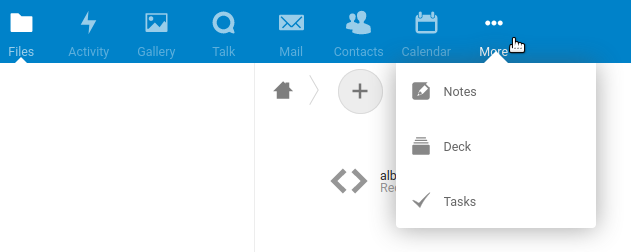
And because they know better there is no user configurable option to extend that 8 items to may be 12 or so which would prevent the annoying overflow menu we are seeing with 10 applications in use: Screenshot of stock Nextcloud menu Luckily code can be changed and there are many comments floating around the Internet to change const minAppsDesktop = 8. In this case it is slightly complicated by the fact that the javascript code is distributed in compressed form (aka "minified") as core/js/dist/main.js and you probably don't want to build the whole beast locally to change one constant. Basically
const breakpoint_mobile_width = 1024;

const resizeMenu = () =>
const appList = $('#appmenu li')
const rightHeaderWidth = $('.header-right').outerWidth()
const headerWidth = $('header').outerWidth()
const usePercentualAppMenuLimit = 0.33
const minAppsDesktop = 8
let availableWidth = headerWidth - $('#nextcloud').outerWidth() - (rightHeaderWidth > 210 ? rightHeaderWidth : 210)
const isMobile = $(window).width() < breakpoint_mobile_width
if (!isMobile)
availableWidth = availableWidth * usePercentualAppMenuLimit

let appCount = Math.floor((availableWidth / $(appList).width()))
if (isMobile && appCount > minAppsDesktop)
appCount = minAppsDesktop

if (!isMobile && appCount < minAppsDesktop)
appCount = minAppsDesktop


// show at least 2 apps in the popover
if (appList.length - 1 - appCount >= 1)
appCount--


$('#more-apps a').removeClass('active')
let lastShownApp
for (let k = 0; k < appList.length - 1; k++)
const name = $(appList[k]).data('id')
if (k < appCount)
$(appList[k]).removeClass('hidden')
$('#apps li[data-id=' + name + ']').addClass('in-header')
lastShownApp = appList[k]
else
$(appList[k]).addClass('hidden')
$('#apps li[data-id=' + name + ']').removeClass('in-header')
// move active app to last position if it is active
if (appCount > 0 && $(appList[k]).children('a').hasClass('active'))
$(lastShownApp).addClass('hidden')
$('#apps li[data-id=' + $(lastShownApp).data('id') + ']').removeClass('in-header')
$(appList[k]).removeClass('hidden')
$('#apps li[data-id=' + name + ']').addClass('in-header')


// show/hide more apps icon
if ($('#apps li:not(.in-header)').length === 0)
$('#more-apps').hide()
$('#navigation').hide()
else
$('#more-apps').show()

gets compressed during build time to become part of one 15,000+ character line. The relevant portion reads:
var f=function() var e=s()("#appmenu li"),t=s()(".header-right").outerWidth(),n=s()("header").outerWidth()-s()("#nextcloud").outerWidth()-(t>210?t:210),i=s()(window).width()<1024;i (n*=.33);var r,o=Math.floor(n/s()(e).width());i&&o>8&&(o=8),!i&&o<8&&(o=8),e.length-1-o>=1&&o--,s()("#more-apps a").removeClass("active");for(var a=0;a<e.length-1;a++) var l=s()(e[a]).data("id");a<o?(s()(e[a]).removeClass("hidden"),s()("#apps li[data-id="+l+"]").addClass("in-header"),r=e[a]):(s()(e[a]).addClass("hidden"),s()("#apps li[data-id="+l+"]").removeClass("in-header"),o>0&&s()(e[a]).children("a").hasClass("active")&&(s()(r).addClass("hidden"),s()("#apps li[data-id="+s()(r).data("id")+"]").removeClass("in-header"),s()(e[a]).removeClass("hidden"),s()("#apps li[data-id="+l+"]").addClass("in-header"))) 0===s()("#apps li:not(.in-header)").length?(s()("#more-apps").hide(),s()("#navigation").hide()):s()("#more-apps").show()
Well, we can still patch that, can we? Continue reading "Fixing the Nextcloud menu to show more than eight application icons"

13 September 2020

Russell Coker: Setting Up a Dell T710 Server with DRAC6

I ve just got a Dell T710 server for LUV and I ve been playing with the configuration options. Here s a list of what I ve done and recommendations on how to do things. I decided not to try to write a step by step guide to doing stuff as the situation doesn t work for that. I think that a list of how things are broken and what to avoid is more useful. BIOS Firstly with a Dell server you can upgrade the BIOS from a Linux root shell. Generally when a server is deployed you won t want to upgrade the BIOS (why risk breaking something when it s working), so before deployment you probably should install the latest version. Dell provides a shell script with encoded binaries in it that you can just download and run, it s ugly but it works. The process of loading the firmware takes a long time (a few minutes) with no progress reports, so best to plug both PSUs in and leave it alone. At the end of loading the firmware a hard reboot will be performed, so upgrading your distribution while doing the install is a bad idea (Debian is designed to not lose data in this situation so it s not too bad). IDRAC IDRAC is the Integrated Dell Remote Access Controller. By default it will listen on all Ethernet ports, get an IP address via DHCP (using a different Ethernet hardware address to the interface the OS sees), and allow connections. Configuring it to be restrictive as to which ports it listens on may be a good idea (the T710 had 4 ports built in so having one reserved for management is usually OK). You need to configure a username and password for IDRAC that has administrative access in the BIOS configuration. Web Interface By default IDRAC will run a web server on the IP address it gets from DHCP, you can connect to that from any web browser that allows ignoring invalid SSL keys. Then you can use the username and password configured in the BIOS to login. IDRAC 6 on the PowerEdge T710 recommends IE 6. To get a ssl cert that matches the name you want to use (and doesn t give browser errors) you have to generate a CSR (Certificate Signing Request) on the DRAC, the only field that matters is the CN (Common Name), the rest have to be something that Letsencrypt will accept. Certbot has the option --config-dir /etc/letsencrypt-drac to specify an alternate config directory, the SSL key for DRAC should be entirely separate from the SSL key for other stuff. Then use the --csr option to specify the path of the CSR file. When you run letsencrypt the file name of the output file you want will be in the format *_chain.pem . You then have to upload that to IDRAC to have it used. This is a major pain for the lifetime of letsencrypt certificates. Hopefully a more recent version of IDRAC has Certbot built in. When you access RAC via ssh (see below) you can run the command racadm sslcsrgen to generate a CSR that can be used by certbot. So it s probably possible to write expect scripts to get that CSR, run certbot, and then put the ssl certificate back. I don t expect to use IDRAC often enough to make it worth the effort (I can tell my browser to ignore an outdated certificate), but if I had dozens of Dells I d script it. SSH The web interface allows configuring ssh access which I strongly recommend doing. You can configure ssh access via password or via ssh public key. For ssh access set TERM=vt100 on the host to enable backspace as ^H. Something like TERM=vt100 ssh root@drac . Note that changing certain other settings in IDRAC such as enabling Smartcard support will disable ssh access. There is a limit to the number of open sessions for managing IDRAC, when you ssh to the IDRAC you can run racadm getssninfo to get a list of sessions and racadm closessn -i NUM to close a session. The closessn command takes a -a option to close all sessions but that just gives an error saying that you can t close your own session because of programmer stupidity. The IDRAC web interface also has an option to close sessions. If you get to the limits of both ssh and web sessions due to network issues then you presumably have a problem. I couldn t find any documentation on how the ssh host key is generated. I Googled for the key fingerprint and didn t get a match so there s a reasonable chance that it s unique to the server (please comment if you know more about this). Don t Use Graphical Console The T710 is an older server and runs IDRAC6 (IDRAC9 is the current version). The Java based graphical console access doesn t work with recent versions of Java. The Debian package icedtea-netx has has the javaws command for running the .jnlp command for the console, by default the web browser won t run this, you download the .jnlp file and pass that as the first parameter to the javaws program which then downloads a bunch of Java classes from the IDRAC to run. One error I got with Java 11 was Exception in thread Timer-0 java.util.ServiceConfigurationError: java.nio.charset.spi.CharsetProvider: Provider sun.nio.cs.ext.ExtendedCharsets could not be instantiated , Google didn t turn up any solutions to this. Java 8 didn t have that problem but had a connection failed error that some people reported as being related to the SSL key, but replacing the SSL key for the web server didn t help. The suggestion of running a VM with an old web browser to access IDRAC didn t appeal. So I gave up on this. Presumably a Windows VM running IE6 would work OK for this. Serial Console Fortunately IDRAC supports a serial console. Here s a page summarising Serial console setup for DRAC [1]. Once you have done that put console=tty0 console=ttyS1,115200n8 on the kernel command line and Linux will send the console output to the virtual serial port. To access the serial console from remote you can ssh in and run the RAC command console com2 (there is no option for using a different com port). The serial port seems to be unavailable through the web interface. If I was supporting many Dell systems I d probably setup a ssh to JavaScript gateway to provide a web based console access. It s disappointing that Dell didn t include this. If you disconnect from an active ssh serial console then the RAC might keep the port locked, then any future attempts to connect to it will give the following error:
/admin1-> console com2
console: Serial Device 2 is currently in use
So far the only way I ve discovered to get console access again after that is the command racadm racreset . If anyone knows of a better way please let me know. As an aside having racreset being so close to racresetcfg (which resets the configuration to default and requires a hard reboot to configure it again) seems like a really bad idea. Host Based Management
deb http://linux.dell.com/repo/community/ubuntu xenial openmanage
The above apt sources.list line allows installing Dell management utilities (Xenial is old but they work on Debian/Buster). Probably the packages srvadmin-storageservices-cli and srvadmin-omacore will drag in enough dependencies to get it going. Here are some useful commands:
# show hardware event log
omreport system esmlog
# show hardware alert log
omreport system alertlog
# give summary of system information
omreport system summary
# show versions of firmware that can be updated
omreport system version
# get chassis temp
omreport chassis temps
# show physical disk details on controller 0
omreport storage pdisk controller=0
RAID Control The RAID controller is known as PERC (PowerEdge Raid Controller), the Dell web site has an rpm package of the perccli tool to manage the RAID from Linux. This is statically linked and appears to have different versions of libraries used to make it. The command perccli show gives an overview of the configuration, but the command perccli /c0 show to give detailed information on controller 0 SEGVs and the kernel logs a vsyscall attempted with vsyscall=none message. Here s an overview of the vsyscall enmulation issue [2]. Basically I could add vsyscall=emulate to the kernel command line and slightly reduce security for the system to allow system calls from perccli that are called from old libc code to work, or I could run code from a dubious source as root. Some versions of IDRAC have a racadm raid command that can be run from a ssh session to perform RAID administration remotely, mine doesn t have that. As an aside the help for the RAC system doesn t list all commands and the Dell documentation is difficult to find so blog posts from other sysadmins is the best source of information. I have configured IDRAC to have all of the BIOS output go to the virtual serial console over ssh so I can see the BIOS prompt me for PERC administration but it didn t accept my key presses when I tried to do so. In any case this requires downtime and I d like to be able to change hard drives without rebooting. I found vsyscall_trace on Github [3], it uses the ptrace interface to emulate vsyscall on a per process basis. You just run vsyscall_trace perccli and it works! Thanks Geoffrey Thomas for writing this! Here are some perccli commands:
# show overview
perccli show
# help on adding a vd (RAID)
perccli /c0 add help
# show controller 0 details
perccli /c0 show
# add a vd (RAID) of level RAID0 (r0) with the drive 32:0 (enclosure:slot from above command)
perccli /c0 add vd r0 drives=32:0
When a disk is added to a PERC controller about 525MB of space is used at the end for RAID metadata. So when you create a RAID-0 with a single device as in the above example all disk data is preserved by default except for the last 525MB. I have tested this by running a BTRFS scrub on a disk from another system after making it into a RAID-0 on the PERC.

12 September 2020

Markus Koschany: My Free Software Activities in August 2020

Welcome to gambaru.de. Here is my monthly report (+ the first week in September) that covers what I have been doing for Debian. If you re interested in Java, Games and LTS topics, this might be interesting for you. Debian Games

teeworlds
Debian Java Misc Debian LTS This was my 54. month as a paid contributor and I have been paid to work 20 hours on Debian LTS, a project started by Rapha l Hertzog. In that time I did the following: ELTS Extended Long Term Support (ELTS) is a project led by Freexian to further extend the lifetime of Debian releases. It is not an official Debian project but all Debian users benefit from it without cost. The current ELTS release is Debian 8 Jessie . This was my 27. month and I have been paid to work 14,25 hours on ELTS. Thanks for reading and see you next time.

11 September 2020

Louis-Philippe V ronneau: Hire me!

I'm happy to announce I handed out my Master's Thesis last Monday. I'm not publishing the final copy just yet1, as it still needs to go through the approval committee. If everything goes well, I should have my Master of Economics diploma before Christmas! It sure hasn't been easy, and although I regret nothing, I'm also happy to be done with university. Looking for a job What an odd time to be looking for a job, right? Turns out for the first time in 12 years, I don't have an employer. It's oddly freeing, but also a little scary. I'm certainly not bitter about it though and it's nice to have some time on my hands to work on various projects and read things other than academic papers. Look out for my next blog posts on using the NeTV2 as an OSHW HDMI capture card, on hacking at security tokens and much more! I'm not looking for anything long term (I'm hoping to teach Economics again next Winter), but for the next few months, my calendar is wide open. For the last 6 years, I worked as Linux system administrator, mostly using a LAMP stack in conjunction with Puppet, Shell and Python. Although I'm most comfortable with Puppet, I also have decent experience with Ansible, thanks to my work in the DebConf Videoteam. I'm not the most seasoned Debian Developer, but I have some experience packaging Python applications and libraries. Although I'm no expert at it, lately I've also been working on Clojure packages, as I'm trying to get Puppet 6 in Debian in time for the Bullseye freeze. At the rate it's going though, I doubt we're going to make it... If your company depends on Puppet and cares about having a version in Debian 11 that is maintained (Puppet 5 is EOL in November 2020), I'm your guy! Oh, and I guess I'm a soon-to-be Master of Economics specialising in Free and Open Source Software business models and incentives theory. Not sure I'll ever get paid putting that in application, but hey, who knows. If any of that resonates with you, contact me and let's have a chat! I promise I don't bite :)

  1. The title of the thesis is What are the incentive structures of Free Software? An economic analysis of Free Software's specific development model. Once the final copy is approved, I'll be sure to write a longer blog post about my findings here.

9 September 2020

Reproducible Builds: Reproducible Builds in August 2020

Welcome to the August 2020 report from the Reproducible Builds project. In our monthly reports, we summarise the things that we have been up to over the past month. The motivation behind the Reproducible Builds effort is to ensure no flaws have been introduced from the original free software source code to the pre-compiled binaries we install on our systems. If you re interested in contributing to the project, please visit our main website.


This month, Jennifer Helsby launched a new reproduciblewheels.com website to address the lack of reproducibility of Python wheels. To quote Jennifer s accompanying explanatory blog post:
One hiccup we ve encountered in SecureDrop development is that not all Python wheels can be built reproducibly. We ship multiple (Python) projects in Debian packages, with Python dependencies included in those packages as wheels. In order for our Debian packages to be reproducible, we need that wheel build process to also be reproducible
Parallel to this, transparencylog.com was also launched, a service that verifies the contents of URLs against a publicly recorded cryptographic log. It keeps an append-only log of the cryptographic digests of all URLs it has seen. (GitHub repo) On 18th September, Bernhard M. Wiedemann will give a presentation in German, titled Wie reproducible builds Software sicherer machen ( How reproducible builds make software more secure ) at the Internet Security Digital Days 2020 conference.

Reproducible builds at DebConf20 There were a number of talks at the recent online-only DebConf20 conference on the topic of reproducible builds. Holger gave a talk titled Reproducing Bullseye in practice , focusing on independently verifying that the binaries distributed from ftp.debian.org are made from their claimed sources. It also served as a general update on the status of reproducible builds within Debian. The video (145 MB) and slides are available. There were also a number of other talks that involved Reproducible Builds too. For example, the Malayalam language mini-conference had a talk titled , ? ( I want to join Debian, what should I do? ) presented by Praveen Arimbrathodiyil, the Clojure Packaging Team BoF session led by Elana Hashman, as well as Where is Salsa CI right now? that was on the topic of Salsa, the collaborative development server that Debian uses to provide the necessary tools for package maintainers, packaging teams and so on. Jonathan Bustillos (Jathan) also gave a talk in Spanish titled Un camino verificable desde el origen hasta el binario ( A verifiable path from source to binary ). (Video, 88MB)

Development work After many years of development work, the compiler for the Rust programming language now generates reproducible binary code. This generated some general discussion on Reddit on the topic of reproducibility in general. Paul Spooren posted a request for comments to OpenWrt s openwrt-devel mailing list asking for clarification on when to raise the PKG_RELEASE identifier of a package. This is needed in order to successfully perform rebuilds in a reproducible builds context. In openSUSE, Bernhard M. Wiedemann published his monthly Reproducible Builds status update. Chris Lamb provided some comments and pointers on an upstream issue regarding the reproducibility of a Snap / SquashFS archive file. [ ]

Debian Holger Levsen identified that a large number of Debian .buildinfo build certificates have been tainted on the official Debian build servers, as these environments have files underneath the /usr/local/sbin directory [ ]. He also filed against bug for debrebuild after spotting that it can fail to download packages from snapshot.debian.org [ ]. This month, several issues were uncovered (or assisted) due to the efforts of reproducible builds. For instance, Debian bug #968710 was filed by Simon McVittie, which describes a problem with detached debug symbol files (required to generate a traceback) that is unlikely to have been discovered without reproducible builds. In addition, Jelmer Vernooij called attention that the new Debian Janitor tool is using the property of reproducibility (as well as diffoscope when applying archive-wide changes to Debian:
New merge proposals also include a link to the diffoscope diff between a vanilla build and the build with changes. Unfortunately these can be a bit noisy for packages that are not reproducible yet, due to the difference in build environment between the two builds. [ ]
56 reviews of Debian packages were added, 38 were updated and 24 were removed this month adding to our knowledge about identified issues. Specifically, Chris Lamb added and categorised the nondeterministic_version_generated_by_python_param and the lessc_nondeterministic_keys toolchain issues. [ ][ ] Holger Levsen sponsored Lukas Puehringer s upload of the python-securesystemslib pacage, which is a dependency of in-toto, a framework to secure the integrity of software supply chains. [ ] Lastly, Chris Lamb further refined his merge request against the debian-installer component to allow all arguments from sources.list files (such as [check-valid-until=no]) in order that we can test the reproducibility of the installer images on the Reproducible Builds own testing infrastructure and sent a ping to the team that maintains that code.

Upstream patches The Reproducible Builds project detects, dissects and attempts to fix as many currently-unreproducible packages as possible. We endeavour to send all of our patches upstream where appropriate. This month, we wrote a large number of these patches, including:

diffoscope diffoscope is our in-depth and content-aware diff utility that can not only locate and diagnose reproducibility issues, it provides human-readable diffs of all kinds. In August, Chris Lamb made the following changes to diffoscope, including preparing and uploading versions 155, 156, 157 and 158 to Debian:
  • New features:
    • Support extracting data of PGP signed data. (#214)
    • Try files named .pgp against pgpdump(1) to determine whether they are Pretty Good Privacy (PGP) files. (#211)
    • Support multiple options for all file extension matching. [ ]
  • Bug fixes:
    • Don t raise an exception when we encounter XML files with <!ENTITY> declarations inside the Document Type Definition (DTD), or when a DTD or entity references an external resource. (#212)
    • pgpdump(1) can successfully parse some binary files, so check that the parsed output contains something sensible before accepting it. [ ]
    • Temporarily drop gnumeric from the Debian build-dependencies as it has been removed from the testing distribution. (#968742)
    • Correctly use fallback_recognises to prevent matching .xsb binary XML files.
    • Correct identify signed PGP files as file(1) returns data . (#211)
  • Logging improvements:
    • Emit a message when ppudump version does not match our file header. [ ]
    • Don t use Python s repr(object) output in Calling external command messages. [ ]
    • Include the filename in the not identified by any comparator message. [ ]
  • Codebase improvements:
    • Bump Python requirement from 3.6 to 3.7. Most distributions are either shipping with Python 3.5 or 3.7, so supporting 3.6 is not only somewhat unnecessary but also cumbersome to test locally. [ ]
    • Drop some unused imports [ ], drop an unnecessary dictionary comprehensions [ ] and some unnecessary control flow [ ].
    • Correct typo of output in a comment. [ ]
  • Release process:
    • Move generation of debian/tests/control to an external script. [ ]
    • Add some URLs for the site that will appear on PyPI.org. [ ]
    • Update author and author email in setup.py for PyPI.org and similar. [ ]
  • Testsuite improvements:
    • Update PPU tests for compatibility with Free Pascal versions 3.2.0 or greater. (#968124)
    • Mark that our identification test for .ppu files requires ppudump version 3.2.0 or higher. [ ]
    • Add an assert_diff helper that loads and compares a fixture output. [ ][ ][ ][ ]
  • Misc:
In addition, Mattia Rizzolo documented in setup.py that diffoscope works with Python version 3.8 [ ] and Frazer Clews applied some Pylint suggestions [ ] and removed some deprecated methods [ ].

Website This month, Chris Lamb updated the main Reproducible Builds website and documentation to:
  • Clarify & fix a few entries on the who page [ ][ ] and ensure that images do not get to large on some viewports [ ].
  • Clarify use of a pronoun re. Conservancy. [ ]
  • Use View all our monthly reports over View all monthly reports . [ ]
  • Move a is a suffix out of the link target on the SOURCE_DATE_EPOCH age. [ ]
In addition, Javier Jard n added the freedesktop-sdk project [ ] and Kushal Das added SecureDrop project [ ] to our projects page. Lastly, Michael P hn added internationalisation and translation support with help from Hans-Christoph Steiner [ ].

Testing framework The Reproducible Builds project operate a Jenkins-based testing framework to power tests.reproducible-builds.org. This month, Holger Levsen made the following changes:
  • System health checks:
    • Improve explanation how the status and scores are calculated. [ ][ ]
    • Update and condense view of detected issues. [ ][ ]
    • Query the canonical configuration file to determine whether a job is disabled instead of duplicating/hardcoding this. [ ]
    • Detect several problems when updating the status of reporting-oriented metapackage sets. [ ]
    • Detect when diffoscope is not installable [ ] and failures in DNS resolution [ ].
  • Debian:
    • Update the URL to the Debian security team bug tracker s Git repository. [ ]
    • Reschedule the unstable and bullseye distributions often for the arm64 architecture. [ ]
    • Schedule buster less often for armhf. [ ][ ][ ]
    • Force the build of certain packages in the work-in-progress package rebuilder. [ ][ ]
    • Only update the stretch and buster base build images when necessary. [ ]
  • Other distributions:
    • For F-Droid, trigger jobs by commits, not by a timer. [ ]
    • Disable the Archlinux HTML page generation job as it has never worked. [ ]
    • Disable the alternative OpenWrt rebuilder jobs. [ ]
  • Misc;
Many other changes were made too, including:
  • Chris Lamb:
    • Use <pre> HTML tags when dumping fixed-width debugging data in the self-serve package scheduler. [ ]
  • Mattia Rizzolo:
  • Vagrant Cascadian:
    • Mark that the u-boot Universal Boot Loader should not build architecture independent packages on the arm64 architecture anymore. [ ]
Finally, build node maintenance was performed by Holger Levsen [ ], Mattia Rizzolo [ ][ ] and Vagrant Cascadian [ ][ ][ ][ ]

Mailing list On our mailing list this month, Leo Wandersleb sent a message to the list after he was wondering how to expand his WalletScrutiny.com project (which aims to improve the security of Bitcoin wallets) from Android wallets to also monitor Linux wallets as well:
If you think you know how to spread the word about reproducibility in the context of Bitcoin wallets through WalletScrutiny, your contributions are highly welcome on this PR [ ]
Julien Lepiller posted to the list linking to a blog post by Tavis Ormandy titled You don t need reproducible builds. Morten Linderud (foxboron) responded with a clear rebuttal that Tavis was only considering the narrow use-case of proprietary vendors and closed-source software. He additionally noted that the criticism that reproducible builds cannot prevent against backdoors being deliberately introduced into the upstream source ( bugdoors ) are decidedly (and deliberately) outside the scope of reproducible builds to begin with. Chris Lamb included the Reproducible Builds mailing list in a wider discussion regarding a tentative proposal to include .buildinfo files in .deb packages, adding his remarks regarding requiring a custom tool in order to determine whether generated build artifacts are identical in a reproducible context. [ ] Jonathan Bustillos (Jathan) posted a quick email to the list requesting whether there was a list of To do tasks in Reproducible Builds. Lastly, Chris Lamb responded at length to a query regarding the status of reproducible builds for Debian ISO or installation images. He noted that most of the technical work has been performed but there are at least four issues until they can be generally advertised as such . He pointed that the privacy-oriented Tails operation system, which is based directly on Debian, has had reproducible builds for a number of years now. [ ]

If you are interested in contributing to the Reproducible Builds project, please visit our Contribute page on our website. However, you can get in touch with us via:

6 September 2020

Thorsten Alteholz: My Debian Activities in August 2020

FTP master This month I accepted 159 packages and rejected 16. The overall number of packages that got accepted was 172. Debian LTS This was my seventy-fourth month that I did some work for the Debian LTS initiative, started by Raphael Hertzog at Freexian. This month my all in all workload has been 21.75h. During that time I did LTS uploads of: I also started to work on curl but did not upload a fixed version yet. As usual, testing the package takes up some time. Last but not least I did some days of frontdesk duties. Debian ELTS This month was the twenty sixth ELTS month. During my allocated time I uploaded: Like in LTS, I also started to work on curl and encountered the same problems as in LTS above. Last but not least I did some days of frontdesk duties. Other stuff This month I found again some time for other Debian work and uploaded packages to fix bugs, mainly around gcc10: I also uploaded new upstream versions of: All package called *osmo* are developed by the Osmocom project, that is about Open Source MObile COMmunication. They are really doing a great job and I apologize that my uploads of new versions are mostly far behind their development. Some of the uploads are related to new packages:

Ben Armstrong: Dronefly relicensed under copyleft licenses

To ensure Dronefly always remains free, the Dronefly project has been relicensed under two copyleft licenses. Read the license change and learn more about copyleft at these links. I was prompted to make this change after a recent incident in the Red DiscordBot development community that made me reconsider my prior position that the liberal MIT license was best for our project. While on the face of it, making your license as liberal as possible might seem like the most generous and hassle-free way to license any project, I was shocked into the realization that its liberality was also its fatal flaw: all is well and good so long as everyone is being cooperative, but it does not afford any protection to developers or users should things suddenly go sideways in how a project is run. A copyleft license is the best way to avoid such issues. In this incident a sad story of conflict between developers I respect on both sides of the rift, and owe a debt to for what they ve taught me three cogs we had come to depend on suddenly stopped being viable for us to use due to changes to the license & the code. Effectively, those cogs became unsupported and unsupportable. To avoid any such future disaster with the Dronefly project, I started shopping for a new license that would protect developers and users alike from similarly losing support, or losing control of their contributions. I owe thanks to Dale Floer, a team member who early on advised me the AGPL might be a better fit, and later was helpful in selecting the doc license and encouraging me to follow through. We ran the new licenses by each contributor and arrived at this consensus: the AGPL is best suited for our server-based code, and CC-BY-SA is best suited for our documentation. The relicensing was made official this morning. On Discord platform alternatives You might well question what I, a Debian developer steeped in free software culture and otherwise in agreement with its principles, am doing encouraging a community to grow on the proprietary Discord platform! I have no satisfying answer to that. I explained when I introduced my project here some of the backstory, but that s more of an account of its beginnings than justification for it to continue on this platform. Honestly, all I can offer is a rather dissatisfying it seemed like the right thing to do at the time. Time will tell whether we could successfully move off of it to a freedom-respecting and privacy-respecting alternative chat platform that is both socially and technically viable to migrate to. That platform would ideally: I m intrigued by Matrix and wonder if it provides some or all of the above in its current form. Are you a developer writing bots for this platform? If so, I especially want to hear from you in the comments about your experience. Or in any case, if you ve been there before if you ve faced the same issue with your community and have a success story to share, I would love to hear from you.

2 September 2020

Vincent Bernat: Writing a custom Ansible module

Ansible ships a lot of modules you can combine for your configuration management needs. However, the quality of these modules may vary widely. Sometimes, it may be quicker and more robust to write your own module instead of shopping and assembling existing ones.1 In my opinion, a robust module exhibits the following characteristics: In a nutshell, it means the module can run with --diff --check and shows the changes it would apply. When run twice in a row, the second run won t apply or signal changes. The last bullet point suggests the module should be able to delete outdated objects configured during previous runs.2 The module code should be minimal and tailored to your needs. Making the module generic for use by other users is a non-goal. Less code usually means less bugs and easier to understand. I do not cover testing here. It is undeniably a good practice, but it requires a significant effort. In my opinion, it is preferable to have a well written module matching the above characteristics rather than a module that is well tested but without them or a module requiring further (untested) assembly to meet your needs.

Module skeleton Ansible documentation contains instructions to build a module, along with some best practices. As one of our non-goal is to distribute it, we choose to take some shortcuts and skip some of the boilerplate. Let s assume we build a module with the following signature:
custom_module:
  user: someone
  password: something
  data: "some random string"
There are various locations you can put a module in Ansible. A common possibility is to include it into a role. In a library/ subdirectory, create an empty __init__.py file and a custom_module.py file with the following code:3
#!/usr/bin/python
import yaml
from ansible.module_utils.basic import AnsibleModule
def main():
    # Define options accepted by the module.  
    module_args = dict(
        user=dict(type='str', required=True),
        password=dict(type='str', required=True, no_log=True),
        data=dict(type='str', required=True),
    )
    module = AnsibleModule(
        argument_spec=module_args,
        supports_check_mode=True
    )
    result = dict(
        changed=False
    )
    got =  
    wanted =  
    # Populate both  got  and  wanted .  
    # [...]
    if got != wanted:
        result['changed'] = True
        result['diff'] = dict(
            before=yaml.safe_dump(got),
            after=yaml.safe_dump(wanted)
        )
    if module.check_mode or not result['changed']:
        module.exit_json(**result)
    # Apply changes.  
    # [...]
    module.exit_json(**result)
if __name__ == '__main__':
    main()
The first part, in , defines the module, with the accepted options. Refer to the documentation on argument_spec for more details. The second part, in , builds the got and wanted variables. got is the current state while wanted is the target state. For example, if you need to modify records in a database server, got would be the current rows while wanted would be the modified rows. Then, we compare got and wanted. If there is a difference, changed is switched to True and we prepare the diff object. Ansible uses it to display the differences between the states. If we are running in check mode or if no change is detected, we stop here. The last part, in , applies the changes. Usually, it means iterating over the two structures to detect the differences and create the missing items, delete the unwanted ones and update the existing ones.

Documentation Ansible provides a fairly complete page on how to document a module. I advise you to take a more minimal approach by only documenting each option sparingly,4 skipping the examples and only documenting return values if it needs to. I usually limit myself to something like this:
DOCUMENTATION = """
---
module: custom_module.py
short_description: Pass provided data to remote service
description:
  - Mention anything useful for your workmate.
  - Also mention anything you want to remember in 6 months.
options:
  user:
    description:
      - user to identify to remote service
  password:
    description:
      - password for authentication to remote service
  data:
    description:
      - data to send to remote service
"""

Error handling If you run into an error, you can stop the execution with module.fail_json():
module.fail_json(
    msg=f"remote service answered with  code :  message ",
    **result
)
There is no requirement to intercept all errors. Sometimes, not swallowing an exception provides better information than replacing it with a generic message.

Returning additional values A module may return additional information that can be captured to be used in another task through the register directive. For this purpose, you can add arbitrary fields to the result dictionary. Have a look at the documentation for common return values. You should try to add these fields before exiting the module when in check mode. The returned values can be documented.

Examples Here are several examples of custom modules following the previous skeleton. Each example highlight why a custom module was written instead of assembling existing modules.

  1. Also, when using modules from Ansible Galaxy, you introduce a dependency to a third-party. This is not something that should be decided lightly: it may break later, it may only meet 80% of the needs, it may add bugs.
  2. Some declarative systems, like Terraform, exhibits all these behaviors.
  3. Do not worry about the shebang. It is hardcoded to /usr/bin/python. Ansible will modify it to match the chosen interpreter on the remote host. You can write Python 3 code if ansible_python_interpreter evaluates to a Python 3 interpreter.
  4. The main issue I have with this non-programmatic approach to documentation is that it partly repeats the information contained in argument_spec. I think an auto-documenting structure would avoid this.

1 September 2020

Utkarsh Gupta: FOSS Activites in August 2020

Here s my (eleventh) monthly update about the activities I ve done in the F/L/OSS world.

Debian
This was my 20th month of contributing to Debian. I became a DM in late March last year and a DD last Christmas! \o/ Well, this month we had DebConf! \o/
(more about this later this week!) Anyway, here are the following things I did in Debian this month:

Uploads and bug fixes:

Other $things:
  • Mentoring for newcomers.
  • FTP Trainee reviewing.
  • Moderation of -project mailing list.
  • Sponsored php-dasprid-enum and php-bacon-baconqrcode for William and ruby-unparser, ruby-morpher, and ruby-path-exapander for Cocoa.

Goodbye GSoC! \o/ In May, I got selected as a Google Summer of Code student for Debian again! \o/
I am working on the Upstream-Downstream Cooperation in Ruby project. The other 5 blogs can be found here: Also, I log daily updates at gsocwithutkarsh2102.tk. Since this is a wrap and whilst the daily updates are already available at the above site^, I ll quickly mention the important points and links here.

Debian (E)LTS
Debian Long Term Support (LTS) is a project to extend the lifetime of all Debian stable releases to (at least) 5 years. Debian LTS is not handled by the Debian security team, but by a separate group of volunteers and companies interested in making it a success. And Debian Extended LTS (ELTS) is its sister project, extending support to the Jessie release (+2 years after LTS support). This was my eleventh month as a Debian LTS and my second as a Debian ELTS paid contributor.
I was assigned 21.75 hours for LTS and 14.25 hours for ELTS and worked on the following things:

LTS CVE Fixes and Announcements:

ELTS CVE Fixes and Announcements:
  • Issued ELA 255-1, fixing CVE-2020-14344, for libx11.
    For Debian 8 Jessie, these problems have been fixed in version 2:1.6.2-3+deb8u3.
  • Issued ELA 259-1, fixing CVE-2020-10177, for pillow.
    For Debian 8 Jessie, these problems have been fixed in version 2.6.1-2+deb8u5.
  • Issued ELA 269-1, fixing CVE-2020-11985, for apache2.
    For Debian 8 Jessie, these problems have been fixed in version 2.4.10-10+deb8u17.
  • Started working on clamAV update, it s a major bump from v0.101.5 to v0.102.4. There were lots of movings parts. Contacted upstream maintainers to help reduce the risk of regression. Came up with a patch to loosen the libcurl version requirement. Hopefully, the update could be rolled out soon!

Other (E)LTS Work:
  • I spent an additional 11.15 hours working on compiling the responses of the LTS survey and preparing a gist of it for its presentation during the Debian LTS BoF at DebConf20.
  • Triaged qemu, pillow, gupnp, clamav, apache2, and uwsgi.
  • Marked CVE-2020-11538/pillow as not-affected for Stretch.
  • Marked CVE-2020-11984/apache2 as not-affected for Stretch.
  • Marked CVE-2020-10378/pillow as not-affected for Jessie.
  • Marked CVE-2020-11538/pillow as not-affected for Jessie.
  • Marked CVE-2020-3481/clamav as not-affected for Jessie.
  • Marked CVE-2020-11984/apache2 as not-affected for Jessie.
  • Marked CVE-2020- 9490,11993 /apache2 as not-affected for Jessie.
  • Hosted Debian LTS BoF at DebConf20. Recording here.
  • General discussion on LTS private and public mailing list.

Until next time.
:wq for today.

31 August 2020

Chris Lamb: Free software activities in August 2020

Here is another monthly update covering what I have been doing in the free software world during August 2020 (previous month): I uploaded Lintian versions 2.86.0, 2.87.0, 2.88.0, 2.89.0, 2.90.0, 2.91.0 and 2.92.0, as well as made the following changes:

Reproducible Builds One of the original promises of open source software is that distributed peer review and transparency of process results in enhanced end-user security. However, whilst anyone may inspect the source code of free and open source software for malicious flaws, almost all software today is distributed as pre-compiled binaries. This allows nefarious third-parties to compromise systems by injecting malicious code into ostensibly secure software during the various compilation and distribution processes. The motivation behind the Reproducible Builds effort is to ensure no flaws have been introduced during this compilation process by promising identical results are always generated from a given source, thus allowing multiple third-parties to come to a consensus on whether a build was compromised. The project is proud to be a member project of the Software Freedom Conservancy. Conservancy acts as a corporate umbrella allowing projects to operate as non-profit initiatives without managing their own corporate structure. If you like the work of the Conservancy or the Reproducible Builds project, please consider becoming an official supporter. This month, I:

diffoscope I made the following changes to diffoscope, including preparing and uploading versions 155, 156, 157 and 158 to Debian:

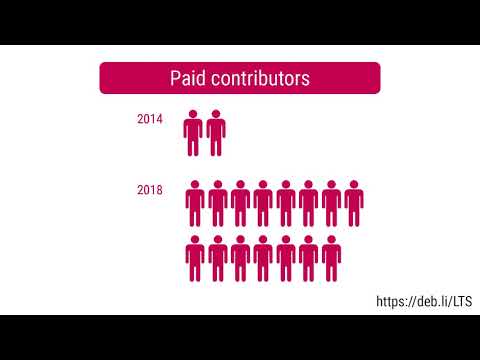
Debian Debian LTS This month I have worked 18 hours on Debian Long Term Support (LTS) and 12 hours on its sister Extended LTS project. You can find out more about the project via the following video:


Uploads to Debian

30 August 2020

Bits from Debian: DebConf20 online closes

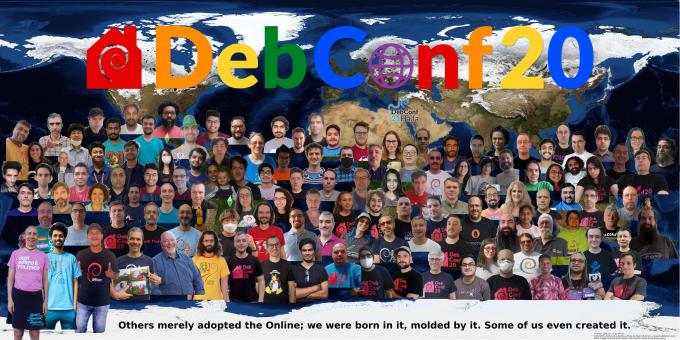
DebConf20 group photo - click to enlarge On Saturday 29 August 2020, the annual Debian Developers and Contributors Conference came to a close. DebConf20 has been held online for the first time, due to the coronavirus (COVID-19) disease pandemic. All of the sessions have been streamed, with a variety of ways of participating: via IRC messaging, online collaborative text documents, and video conferencing meeting rooms. With more than 850 attendees from 80 different countries and a total of over 100 event talks, discussion sessions, Birds of a Feather (BoF) gatherings and other activities, DebConf20 was a large success. When it became clear that DebConf20 was going to be an online-only event, the DebConf video team spent much time over the next months to adapt, improve, and in some cases write from scratch, technology that would be required to make an online DebConf possible. After lessons learned from the MiniDebConfOnline in late May, some adjustments were made, and then eventually we came up with a setup involving Jitsi, OBS, Voctomix, SReview, nginx, Etherpad, and a newly written web-based frontend for voctomix as the various elements of the stack. All components of the video infrastructure are free software, and the whole setup is configured through their public ansible repository. The DebConf20 schedule included two tracks in other languages than English: the Spanish language MiniConf, with eight talks in two days, and the Malayalam language MiniConf, with nine talks in three days. Ad-hoc activities, introduced by attendees over the course of the entire conference, have been possible too, streamed and recorded. There have also been several team gatherings to sprint on certain Debian development areas. Between talks, the video stream has been showing the usual sponsors on the loop, but also some additional clips including photos from previous DebConfs, fun facts about Debian and short shout-out videos sent by attendees to communicate with their Debian friends. For those who were not able to participate, most of the talks and sessions are already available through the Debian meetings archive website, and the remaining ones will appear in the following days. The DebConf20 website will remain active for archival purposes and will continue to offer links to the presentations and videos of talks and events. Next year, DebConf21 is planned to be held in Haifa, Israel, in August or September. DebConf is committed to a safe and welcome environment for all participants. During the conference, several teams (Front Desk, Welcome team and Community team) have been available to help so participants get their best experience in the conference, and find solutions to any issue that may arise. See the web page about the Code of Conduct in DebConf20 website for more details on this. Debian thanks the commitment of numerous sponsors to support DebConf20, particularly our Platinum Sponsors: Lenovo, Infomaniak, Google and Amazon Web Services (AWS). About Debian The Debian Project was founded in 1993 by Ian Murdock to be a truly free community project. Since then the project has grown to be one of the largest and most influential open source projects. Thousands of volunteers from all over the world work together to create and maintain Debian software. Available in 70 languages, and supporting a huge range of computer types, Debian calls itself the universal operating system. About DebConf DebConf is the Debian Project's developer conference. In addition to a full schedule of technical, social and policy talks, DebConf provides an opportunity for developers, contributors and other interested people to meet in person and work together more closely. It has taken place annually since 2000 in locations as varied as Scotland, Argentina, and Bosnia and Herzegovina. More information about DebConf is available from https://debconf.org/. About Lenovo As a global technology leader manufacturing a wide portfolio of connected products, including smartphones, tablets, PCs and workstations as well as AR/VR devices, smart home/office and data center solutions, Lenovo understands how critical open systems and platforms are to a connected world. About Infomaniak Infomaniak is Switzerland's largest web-hosting company, also offering backup and storage services, solutions for event organizers, live-streaming and video on demand services. It wholly owns its datacenters and all elements critical to the functioning of the services and products provided by the company (both software and hardware). About Google Google is one of the largest technology companies in the world, providing a wide range of Internet-related services and products such as online advertising technologies, search, cloud computing, software, and hardware. Google has been supporting Debian by sponsoring DebConf for more than ten years, and is also a Debian partner sponsoring parts of Salsa's continuous integration infrastructure within Google Cloud Platform. About Amazon Web Services (AWS) Amazon Web Services (AWS) is one of the world's most comprehensive and broadly adopted cloud platforms, offering over 175 fully featured services from data centers globally (in 77 Availability Zones within 24 geographic regions). AWS customers include the fastest-growing startups, largest enterprises and leading government agencies. Contact Information For further information, please visit the DebConf20 web page at https://debconf20.debconf.org/ or send mail to press@debian.org.

28 August 2020

Bits from Debian: DebConf20 welcomes its sponsors!

DebConf20 logo DebConf20 is taking place online, from 23 August to 29 August 2020. It is the 21st Debian conference, and organizers and participants are working hard together at creating interesting and fruitful events. We would like to warmly welcome the 17 sponsors of DebConf20, and introduce them to you. We have four Platinum sponsors. Our first Platinum sponsor is Lenovo. As a global technology leader manufacturing a wide portfolio of connected products, including smartphones, tablets, PCs and workstations as well as AR/VR devices, smart home/office and data center solutions, Lenovo understands how critical open systems and platforms are to a connected world. Our next Platinum sponsor is Infomaniak. Infomaniak is Switzerland's largest web-hosting company, also offering backup and storage services, solutions for event organizers, live-streaming and video on demand services. It wholly owns its datacenters and all elements critical to the functioning of the services and products provided by the company (both software and hardware). Google is our third Platinum sponsor. Google is one of the largest technology companies in the world, providing a wide range of Internet-related services and products such as online advertising technologies, search, cloud computing, software, and hardware. Google has been supporting Debian by sponsoring DebConf for more than ten years, and is also a Debian partner. Amazon Web Services (AWS) is our fourth Platinum sponsor. Amazon Web Services is one of the world's most comprehensive and broadly adopted cloud platforms, offering over 175 fully featured services from data centers globally (in 77 Availability Zones within 24 geographic regions). AWS customers include the fastest-growing startups, largest enterprises and leading government agencies. Our Gold sponsors are Deepin, the Matanel Foundation, Collabora, and HRT. Deepin is a Chinese commercial company focusing on the development and service of Linux-based operating systems. They also lead research and development of the Deepin Debian derivative. The Matanel Foundation operates in Israel, as its first concern is to preserve the cohesion of a society and a nation plagued by divisions. The Matanel Foundation also works in Europe, in Africa and in South America. Collabora is a global consultancy delivering Open Source software solutions to the commercial world. In addition to offering solutions to clients, Collabora's engineers and developers actively contribute to many Open Source projects. Hudson-Trading is a company led by mathematicians, computer scientists, statisticians, physicists and engineers. They research and develop automated trading algorithms using advanced mathematical techniques. Our Silver sponsors are: Linux Professional Institute, the global certification standard and career support organization for open source professionals, Civil Infrastructure Platform, a collaborative project hosted by the Linux Foundation, establishing an open source base layer of industrial grade software, Ubuntu, the Operating System delivered by Canonical, and Roche, a major international pharmaceutical provider and research company dedicated to personalized healthcare. Bronze sponsors: IBM, MySQL, Univention. And finally, our Supporter level sponsors, ISG.EE and Pengwin. Thanks to all our sponsors for their support! Their contributions make it possible for a large number of Debian contributors from all over the globe to work together, help and learn from each other in DebConf20. Participating in DebConf20 online The 21st Debian Conference is being held online, due to COVID-19, from August 23 to 29, 2020. Talks, discussions, panels and other activities run from 10:00 to 01:00 UTC. Visit the DebConf20 website at https://debconf20.debconf.org to learn about the complete schedule, watch the live streaming and join the different communication channels for participating in the conference.

Rapha&#235;l Hertzog: Freexian s report about Debian Long Term Support, July 2020

A Debian LTS logo Like each month, albeit a bit later due to vacation, here comes a report about the work of paid contributors to Debian LTS. Individual reports In July, 249.25 work hours have been dispatched among 14 paid contributors. Their reports are available: Evolution of the situation July was our first month of Stretch LTS! Given this is our fourth LTS release we anticipated a smooth transition and it seems everything indeed went very well. Many thanks to the members of the Debian ftpmaster-, security, release- and publicity- teams who helped us make this happen!
Stretch LTS begun on July 18th 2020 after the 13th and final Stretch point release. and is currently scheduled to end on June 30th 2022. Last month, we asked you to participate in a survey and we got 1764 submissions, which is pretty awesome. Thank you very much for participating!. Right now we are still busy crunching the results, but we already shared some early analysis during the Debconf LTS bof this week. The security tracker currently lists 54 packages with a known CVE and the dla-needed.txt file has 52 packages needing an update. Thanks to our sponsors New sponsors are in bold.

No comment Liked this article? Click here. My blog is Flattr-enabled.

26 August 2020

Dirk Eddelbuettel: #29: Easy, Reliable, Fast Linux CRAN Binaries via BSPM

Welcome to the 29th post in the randomly repeating R recommendations series or R4 for short. Our last post #28 introduced RSPM, and just before that we also talked in #27 about binary installations on Ubuntu (which was also a T4 video). This post is joined with I aki Ucar and mainly about work we have done with his bspm package.

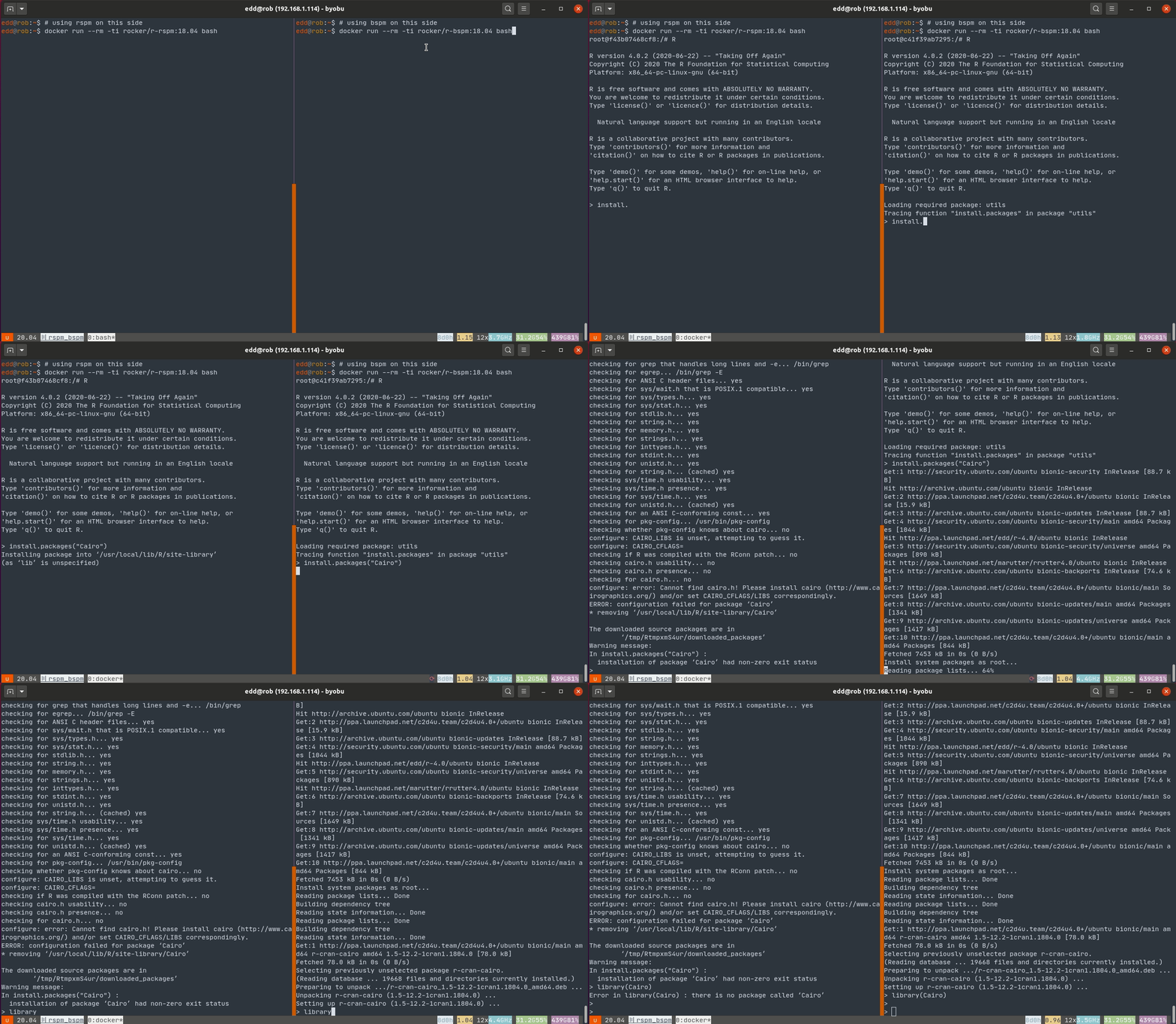
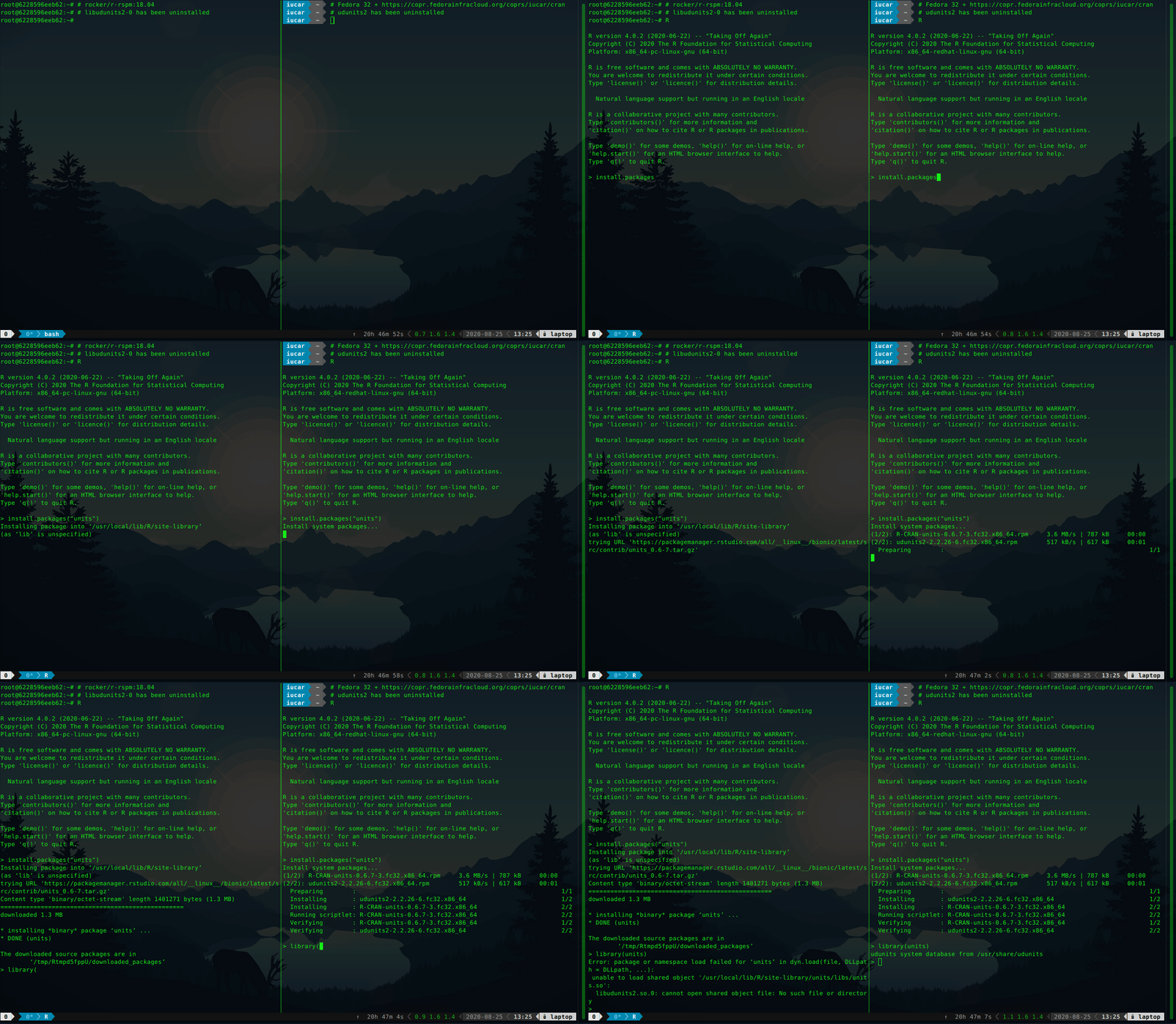
Background CRAN has been a cornerstone of the success of R in recent years. As a well-maintained repository with stringent quality control, it ensures users have access to highest-quality statistical / analytical software that just works . Users on Windows and macOS also benefit from faster installation via pre-compiled binary packages. Linux users generally install from source, which can be more tedious and, often, much slower. Those who know where to look have had access to (at least some) binaries for years as well (and one of us blogged and vlogged about this at length). Debian users get close to 1000 CRAN and BioConductor packages (and, true to Debian form, for well over a dozen hardware platforms). Michael Rutter maintains a PPA with 4600 binaries for three different Ubuntu flavors (see c2d4u4.0+). More recently, Fedora joined the party with 16000 (!!) binaries, essentially all of CRAN, via a Copr repository (see iucar/cran). The buzz currently is however with RSPM, a new package manager by RStudio. An audacious project, it provides binaries for several Linux distributions and releases. It has already been tested in many RStudio Cloud sessions (including with some of our students) as well as some CI integrations. RSPM cuts across and takes the breadth of CRAN across several Linux distributions, bringing installation of pre-built CRAN packages a binaries under their normal CRAN package names. Another nice touch is the integration with install.packages(): these binaries are installed in a way that is natural for R users but as binaries. It is however entirely disconnected from the system package management. This means that the installation of a package requiring an external library may succeed and still fail, as a required library simply cannot be pulled in directly by RSPM. So what is needed is a combination. We want binaries that are aware of their system dependencies but accessible directly from R just like RSPM offers it. Enter BSPM the Bridge to System Package Manager package (also on CRAN). The first illustration (using Ubuntu 18.04) shows RSPM on the left, and BSPM on the right, both installing the graphics package Cairo (and both using custom Rocker containers). This fails for RSPM as no binary is present and a source build fails for the familiar lack of a -dev package. It proceeds just fine on the right under BSPM. A second illustration shows once again RSPM on the left, and BSPM on the right (this time on Fedora), both installing the units package without a required system dependency. The installation of units works for BSPM as the dependency libudunits is brought in, but fails under RSPM. The binary installation succeeds in both cases, but the missing dependency (the UDUNITS2 library) is brought in only by BSPM. Consequently, the package fails to load under RSPM.
Summary To conclude, highlights of BSPM are:
  • direct installation of binary packages from R via R commands under their normal CRAN names (just like RSPM);
  • full integration with the system package manager, delivering system installations (improving upon RSPM);
  • full dependency resolution for R packages, including system requirements (improving upon RSPM).
This offers easy, reliable, fast installation of R packages, and we invite you to pick all three. We recommend usage with either Ubuntu with the 4.6k packages via the Rutter PPA, or Fedora via the even more complete Copr repository (which already includes a specially-tailored version of BSPM called CoprManager). We hope this short note wets your appetite to learn more about bspm (which is itself on CRAN) and the two sets of Rocker containers shown. The rocker/r-rspm container comes in two two flavours for Ubuntu 18.04 and 20.04. Similarly, the rocker/r-bspm container comes in the same two two flavours for Ubuntu 18.04 and 20.04, as well as in a Debian testing variant. Feedback is appreciated at the bspm or rocker issue trackers. If you like this or other open-source work I do, you can now sponsor me at GitHub. For the first year, GitHub will match your contributions.

This post by Dirk Eddelbuettel originated on his Thinking inside the box blog. Please report excessive re-aggregation in third-party for-profit settings.

24 August 2020

Norbert Preining: Social Equality and Free Software BoF at DebConf20

Shortly after yesterday s start of the Debian Conference 2020, I had the honor to participate in a BoF on social equality in free software, led by the OSI vice president and head of the FOSSASIA community, Hong Phuc Dang. The group of discussants consisted of OSS representatives from a wide variety of countries (India, Indonesia, China, Hong Kong, Germany, Vietnam, Singapore, Japan). After a short introduction by Hong Phuc we turned to a self-introduction and what is equality for me round. This brought up already a wide variety of issues that need to be addressed if we want to counter inequality in free software (culture differences, language barriers, internet connection, access to services, onboarding difficulties, political restrictions, ). Unfortunately, on-air time was rather restricted, but even after the DebConf related streaming time slot was finished, we continued discussing problems and possible approaches for another two hours. We have agreed to continue our collaboration and meetings in the hope that we, in particular the FOSSASIA community, can support those in need to counter inequality. Concluding, I have to say I am very happy to be part of the FOSSASIA community where real diversity is lived and everyone strives for and tries to increase social equality. In the DebConf IRC chat I was asked why at FOSSASIA we have about a 50:50 quote between women and men, in contrast to the usual 10:90 predominant in most software communities including Debian. For me this boils down to many reasons, one being competent female leadership, Hong Phuc is inspiring and competent to a degree I haven t seen in anyone else. Another reason is of course that software development is, especially in developing countries, one of the few escape pods for any gender, and thus fully embraced by normally underrepresented groups. Finally, but this is a typical chicken-egg problem, the FOSSASIA community is not doing any specific gender politics, but simply remains open and friendly to everyone. I think Debian, and in particular the diversity movement in Debian can learn a lot from the FOSSASIA community. At the end we are all striving for more equality in our projects and in the realm of free software as a whole! Thanks again for all the participants for the very inspiring discussion, and I am looking forward to our next meetings!

23 August 2020

Philipp Kern: Self-service buildd givebacks now use Salsa auth

As client certificates are on the way out and Debian's SSO solution is effectively not maintained any longer, I switched self-service buildd givebacks over to Salsa authentication. It lives again at https://buildd.debian.org/auth/giveback.cgi. For authorization you still need to be in the "debian" group for now, i.e. be a regular Debian member.For convenience the package status web interface now features an additional column "Actions" with generated "giveback" links.Please remember to file bugs if you give builds back because of flakiness of the package rather than the infrastructure and resist the temptation to use this excessively to let your package migrate. We do not want to end up with packages that require multiple givebacks to actually build in stable, as that would hold up both security and stable updates needlessly and complicate development.

22 August 2020

Norbert Preining: Converting html to mp4

Such an obvious problem, convert a piece of html/js/css, often with animations, to a video (mp4 or similar). We were just put before this problem for the TUG 2020 online conference. Searching the internet it turned up mostly web services, some of them even with lots of money to pay. At the end (below I will give a short history) it turned out to be rather simple.

The key is to use timesnap, a tool to take screenshots from web pages. It is actively maintained, and internally uses puppeteer, which in turn uses Google Chrome browser headless. This also means that rendering quality is very high. So having an html file available, with all the necessary assets, either online or local, one simply creates enough single screenshots per second so that they can be assembled later on into a video with ffmpeg. In our case, we wanted our leaders to last 10secs before the actual presentation video starts. I decided to render at 30fps, which left me with the simple invocation:
timesnap Leader.html --viewport=1920,1080 --fps=30 --duration=10 --output-pattern="leader-%03d.png"
followed by conversion of the various png images to an mp4:
ffmpeg -r 30 -f image2 -s 1920x1080 -i leader-%03d.png -vcodec libx264 -crf 25 -pix_fmt yuv420p leader.mp4
The -r is the fps, so needs to agree with the --fps above. Also the --viewport and -s values should better agree. -crf is the video quality, and -pix_fmt the pixel format. With that very simple and quick invocation a nice leader video was ready! History It was actually more complicated than normal. For similar problems, it usually takes me about 5min of googling and a bit of scripting, but this time, it was actually a long way. Simply searching for convert html to mp4 doesn t give a lot but web services, often paid for. At some point I came up with the idea to use Electron and led to Electron Recorder, which looked promising, but didn t work. A bit more searching led me to PhantomJS, which is not developed anymore, but there was some explanation how to dump frames using phantomjs and merge them using ffmpeg, very similar to the above. Unfortunately, the rendering of the html page by phantomjs was broken, and thus not usable. Thus I ventured off into searching for alternatives of PhantomJS, which brought me to puppeteer, and from there it wasn t too long a way that pointed me at timesnap. Till now it is surprising to me that such a basic task is neither well documented, so hopefully this page helps some users.

18 August 2020

Lisandro Dami n Nicanor P rez Meyer: Stepping down as Qt 6 maintainers

After quite some time maintaining Qt in Debian both Dmitry Shachnev and I decided to not maintain Qt 6 when it's published (expected in December 2020, see https://wiki.qt.io/Qt_6.0_Release). We will do our best to keep the Qt 5 codebase up and running.

We **love** Qt, but it's a huge codebase and requires time and build power, both things that we are currently lacking, so we decided it's time for us to step down and pass the torch. And a new major version seems the right point to do that.

We will be happy to review and/or sponsor other people's work or even occasionally do uploads, but we can't promise to do it regularly.

Some things we think potential Qt 6 maintainers should be familiar with are, of course, C++ packaging (specially symbols files) and CMake, as Qt 6 will be built with it.

We also encourage prospective maintainers to remove the source's -everywhere-src suffixes and just keep the base names as source package names: qtbase6, qtdeclarative6, etc.

It has been an interesting ride all these years, we really hope you enjoyed using Qt.

Thanks for everything,

Dmitry and Lisandro.Note 20200818 12:12 ARST: I was asked if the move has anything to do with code quality or licensing. The answer is a huge no, Qt is a **great** project which we love. As stated before it's mostly about lack of free time to properly maintain it.


Next.

Previous.