Search Results: "jan"

18 December 2012

Russ Allbery: Review: Liars and Outliers

Review: Liars and Outliers, by Bruce Schneier
Publisher: John Wiley
Copyright: 2012
ISBN: 1-118-14330-2
Format: Hardcover
Pages: 285
One of the perils of buying a book written by a blogger one reads regularly is that the book may be little more than a rehashing of their blog, with insufficient original material to warrant the time investment. Sometimes it's still nice to support them financially, but it may not make sense to read the book. I've been following Schneier's blog for years (as should anyone with an interest in security), including through the entire process of writing Liars and Outliers, and was a bit worried that might be the case here. Thankfully, I can reassure any other worried potential readers that is not the case. This is substantial new material establishing a firm framework for thinking about incentives and controls in any society or organization. Liars and Outliers talks about security mechanisms, but it's not, at its core, a book about security. Rather, it's a book about incentives, order, and how order is established. It's a comprehensive reductionist analysis of how societies create predictability and compliance to allow us to trust other people who we have never met before and will never meet again. It's a unique (at least in my experience) combination of anthropology, sociology, security analysis, and political science. Schneier cuts across fields in an idiosyncratic but illuminating way that reminded me of (on an entirely separate topic) Jane Jacobs. This is not a prescriptive book, nor is a collection of answers, solutions, or even deep analysis of particular problems. Rather, it's an attempt to construct a general framework for analyzing societal dilemmas: conflicts between individual desires and social good, how those conflicts are resolved, and how societies can weigh the scales and influence the statistical outcomes. The closest Schneier comes to telling the reader how to solve problems is a checklist, at the end of the book, for designing effective societal pressures. Its primary contribution is vocabulary and structure. It also passes one of my litmus tests for any book about human behavior: Schneier complicates, broadens, deepens, and expands understanding, and points out complex interactions and complex feedback in effects we're inclined to consider simple, rather than simplifying or eliminating human complexity. One point I found refreshing about this book is that Schneier is scrupulous in refusing to define either society or individuals as good or bad, to the point of carefully defining terminology used in all of the social dilemmas. Following societal rules is called compliance; not following those rules is called defection. In some cases, defection is morally correct (Schneier's most frequent example is in the civil rights struggles of the 1960s in the United States). In all cases, social pressures are tools, which can be used to encourage compliance with moral or immoral systems, and which are deployed by totalitarian dictatorships and utopian communes alike. Schneier explicitly puts out of scope for this book the questions of how societal goals should be determined, how they change, and whether any given societal rule or interest is moral or immoral. He focuses, rather, only on the mechanisms, with a primary goal of informing and deepening debates over how best to encourage behavior that societies want to encourage and discourage behavior societies want to discourage. He also emphasizes discourage, as opposed to eliminate. Early on, Schneier shows some of the results of game theory, as well as basic common sense, that indicate that no healthy society can totally eliminate defection. Not only would that stifle valuable and important reform, such as changes in civil rights, but the degree of pressure required is immense. Defectors are natural and will always exist, and are sometimes valuable and necessary. Rather, the goal of a society is to reduce defectors to a level where most people can ignore their existence most of the time, a state that leads to the level of risk and trust required to have a functioning and healthy society. The word society, similarly, is intentionally broad, and can refer to just about any collection of people, from a circle of friends to a corporation, institution, or country. However, as Schneier points out early in the book, small societies rarely need much in the way of formal pressure and appear almost magically self-governing. That's the first property that he disassembles, resulting in a general classification of societal pressures into four categories: moral, reputational, institutional, and security systems. The last is an odd category that's partly orthagonal to the other three. Moral pressure is internalized conscience: the normal tendency of nearly everyone to follow their own moral code, a code that's at least partly constructed and certainly heavily influenced by the surrounding society. Reputational pressure is, in a sense, externalized morality: it's the informal reactions of others around one to one's past actions. Included in reputational pressure is shunning of every kind, from cutting off a friendship to boycotts against corporations, but it also includes confrontation from another member of one's society, the more subtle effects of our individual desires to be liked and respected, and all the various aspects of "face", honor, and respect within a community. Small communities are frequently self-governing, in Schneier's model, because they're small enough that moral and reputational pressures are sufficient and no other pressures are required. We're so used to applying moral and reputational pressure to other humans almost unconsciously that we sometimes don't even notice its existence, leading to that "magical" self-governing property. But Schneier puts pressures in a sequence: pressures that work extremely well with small groups often don't scale. Moral pressure works best with small groups and reputational pressure with somewhat larger groups, but when societies scale beyond the limits of reputational pressure when, for example, one frequently interacts with people whose reputations are unknown to you and whose subsequent opinion of you will not be relevant institutional pressure is required to force compliance. Institutional pressure is the sort of pressure that we all tend to think of first when we look for ways to enforce rules: laws, policies, contracts, and other codes of behavior that carry with them formal punishments and some enforcement mechanism. But even in societies so large that institutional pressures are frequently required, such as whole countries, moral and reputational pressures still exist and are extremely important. One of Schneier's most interesting points is his analysis of how institutional pressures can paradoxically undermine reputational and moral pressures, resulting in more defection than if the institutional pressure hadn't existed. This is just the basic framework of Schneier's analysis, hopefully giving you a feel for the structure of the book. He goes much deeper into the complicated interactions between the various levels of pressure, and then dives into an extensive look at competing societal dilemmas: cases where there is more than one society in play simultaneously, possibly demanding contradictory actions. Liars and Outliers also includes a wonderful analysis of organizational entities within the same framework, including their much-different reactions to moral, reputational, and institutional pressures. One of the most cogent analyses of the difficulties of regulating both corporations and governmental institutions falls out of that analysis, once one looks at them in light of Schneier's basic framework. Pressures quickly become complex and multi-layered, and human reactions to pressures are frequently counter-intuitive. Schneier draws extensively on game theory to show that some counter-intuitive responses are actually emergent properties of logical analysis of the situation, but that others are more uniquely human and have little or nothing to do with a mathematical cost-benefit analysis. I haven't even mentioned his discussion of security systems, and how they can extend moral, reputational, and institutional pressures, as well as add a new type of pressure (making a defecting action impossible) that scales even better than institutional pressures. Liars and Outliers has all of the supporting infrastructure you would expect in a scholarly book: notes, extensive references, and a good index. I suspect it will end up being used as at least additional reading in college classes. The notes are, unfortunately, end notes, making the full context of the book much harder to read than was necessary, but at least Schneier does separate the notes from the references so that one doesn't chase notes for further explanation and find a simple citation. As with any book like this, one always wishes it could end in a simple prescription to fix everything, but of course it doesn't. But that's also a measure of a good scholarly work. Human and organizational motivations are complex and tricky, and any framework for analyzing them needs to be able to represent that complexity. Schneier here has constructed a very powerful one, one that I started using in discussions before I'd even finished the book. Perhaps the most valuable contribution of Liars and Outliers to public discussion is clear terminology and categories, which can be of great help in finding the core components of a problem. Liars and Outliers can be slow going, particularly early on when Schneier is still defining terms and setting up the background of his analysis. One can get a bit tired of the analysis matrices of societal dilemmas. But stick with it through the groundwork, since the analyses of competing societal dilemmas and of the impact of societal pressures on organizations are exceptional. Highly recommended, particularly for anyone who is designing or implementing societal pressures: managers, political activists, or anyone in a security-related field. Rating: 8 out of 10

14 December 2012

Gunnar Wolf: Goodbye, LastFM - Again

I started using LastFM probably around 6 years ago, and loved its offering. I discovered a huge amount of music I would have never found otherwise. Then, some time later, it changed its terms of use, and those of us not in some selected countries lost the ability to stream them for free. Bummer. About one year ago, I decided to purchase a subscription. After all, getting to know new music is always good And listening to recommendations for friends with interesting music tastes is fun as well! Of my last music purchases, both in CD and as MP3 downloads (not a spectacular volume, probably some 15 albums in the last year), I can only point to two that I knew the interpreter beforehand. So, we could say I have bought approx. 1 album per month completely thanks to LastFM. But, as of January 15, they are changing their licensing terms, and LastFM streaming service will no longer be available in Mexico. All it will continue to give me is recommendations based on my listening habits, given I continue "scrobbling" - Much less useful, not to say completely useless given my usual patterns. So, I'm sadly cancelling my subscription, and quite probably will stop using the service altogether. And yes, this will make me reevaluate freely licensed music services. But while I know of several free music distribution sites such as Jamendo, I will long for this LastFM abililty to deliver me music that is aligned to my current tastes (instead of looking them up by myself) Any suggestions on where to look for a similar service?

7 December 2012

Christoph Berg: apt.postgresql.org

So we finally made it, and sent out an official announcement for apt.postgresql.org. This new repository hosts packages for all PostgreSQL server versions (at the moment 8.3, 8.4, 9.0, 9.1, 9.2) for several Debian/Ubuntu distributions (squeeze, wheezy, sid, precise) on two architectures (amd64, i386). Now add packages for extension modules on top of all these, and you get a really large amount of binaries from a small number of sources. Right now there's 1670 .deb files and 148 .dsc files, but the .dsc count includes variants that only differ in the version number per distribution (we attach .pgdg60+1 for squeeze packages, .pgdg70+1 for wheezy and so on), so the real number of different sources is rather something like 81, with 38 distinct source package names. Dimitri Fontaine, Magnus Hagander, and I have been working on this since I first presented the idea at PGconf.EU 2011 in Amsterdam. We now have a Jenkins server building all the packages, an archive server with the master repository, and a feed that syncs the repository to the postgresql.org FTP (well, mostly http) server. If you were previously using pgapt.debian.net, that's the same archive as on apt.postgresql.org (one rsync away). Please update your sources.list to point to apt.postgresql.org, I'll shut down the archive at that location at the end of January. Here's the Quickstart instructions from the Wiki page: Import the repository key from http://apt.postgresql.org/pub/repos/apt/ACCC4CF8.asc:

wget -O - http://apt.postgresql.org/pub/repos/apt/ACCC4CF8.asc   sudo apt-key add -
Edit /etc/apt/sources.list.d/pgdg.list. The distributions are called codename-pgdg. In the example, replace squeeze with the actual distribution you are using:
deb http://apt.postgresql.org/pub/repos/apt/ squeeze-pgdg main
Configure apt's package pinning to prefer the PGDG packages over the Debian ones in /etc/apt/preferences.d/pgdg.pref:
Package: *
Pin: release o=apt.postgresql.org
Pin-Priority: 500
Note: this will replace all your Debian/Ubuntu packages with available packages from the PGDG repository. If you do not want this, skip this step. Update the package lists, and install the pgdg-keyring package to automatically get repository key updates:
apt-get update
apt-get install pgdg-keyring

5 December 2012

Russell Coker: Ingress

Today Google sent me an invite for Ingress their latest augmented reality game [1]. The fact that they sent me the invitation while the Google Play store page for Ingress [2] tells me that it s not available in my country (Australia) is interesting. Google obviously aren t using their Big Brother powers effectively! The way to install Ingress if you are in Australia, New Zealand, or other countries where it s not supported is to do a Google search on the words Ingress and APK and take the highest available version (1.08 at the moment). Then you will find a web site that offers it with no authentication and the potential of getting a trojan version. Forcing people to install the software in an insecure manner doesn t seem to be in the best interests of Google. I first installed the game on my Sony Ericsson Xperia X10 which has a 1 GHz Qualcomm Snapdragon QSD8250 CPU and runs Android 2.3.3 compiled by Sony-Ericsson and performance was terrible. It often would fail to respond to the UI effectively, it would process touch actions after I had repeated them because they didn t seem to have registered, scrolling text at the same speed as playing audio was apparently impossible. Then I briefly tried running it on my Samsung Galaxy S which has a 1 GHz (ARM Cortex A8) CPU and runs Android 2.3.7 with a CyanogenMod-7.1.0-GalaxyS build. It seemed to be a bit faster but the difference was small enough that I could have imagined it. I tried it on the cheap Onix tablet I bought from Aldi this morning [3] but it refused to work every time I tried and eventually crashed the tablet and forced me to use the reset button. Finally I tried it on a Kogan Agora 10 tablet running Android 4.0.4 with what Kogan describes as a 1GHz ARMv7 CPU and it seemed a lot more usable. I haven t yet tried actually playing the game on the Kogan Agora tablet, but the fact that I can read the messages from other players is a significant improvement over the experience on the phones. On the phones the poor performance of the UI made it almost impossible to read messages from other players, now it s merely extremely annoying. I m very disappointed with this. Almost three years ago I reviewed the Seer augmented reality software from IBM that performed tasks that are more demanding and did it well [4]. The IBM Seer software ran on a HTC Hero which had a 528 MHz Qualcomm MSM7600A CPU, it s really disappointing that Ingress can t run well on modern phones particularly as the augmented reality part of the game which I ve seen so far is not much different to what Google Maps, Osmand, and other mapping programs do. The IBM Seer software was good enough to drive the purchase of new phones. When I first got an Android phone almost two years ago I wanted to run such augmented reality software and it was a factor that determined my choice of phone. Unfortunately I still haven t found anything to live up to that promise. IBM s software was tailored to the Australian Open even a tennis fan would find it to be of little interest for about 360 days of the year and I haven t found any other augmented reality software that is useful and works well (please let me know if there s something I ve missed). I find it difficult to imagine that anyone would be inspired to change their phone purchase plans after seeing a demo of Ingress on any hardware that I own. It seems that it will probably be usable on my Xperia X10 and all features should work on the Kogan Agora tablet, but I don t think that any of them will allow the game to live up to the hype.

30 November 2012

Gunnar Wolf: Becoming a teacher!

For many years, I have aspired being a university teacher. I remember asking at different universities as early as ten years ago But I didn't have the needed papers. And yes, I have been a "Licenciado en Ingenier a en Software" for one year already. Anyway, I won't go into the details on why I didn't do this earlier on. But this time, I did get my act together in time, and by mid October, I contacted Juan Carre n, an enthusiastic teacher I met a long time ago as he helped a lot for the formation and cohesion of the (now defunct?) LIDSOL group (Laboratorio de Investigaci n en Software Libre, Free Software Research Laboratory), a group of very worthy students, mostly from the Engineering careers. Juan Carre n had long offered me help in getting to the right people in Facultad de Ingenier a as soon as I had my formal requirements ready. I just didn't expect it to be so swift! Within two days of my initial mail, he contacted me back asking me to look at the subjects in Computing Engineering and choosing some I would be willing to teach Yes, understanding that due to my time (as I'm already full-time employed in UNAM) would allow me to take only one group. Rush of excitement, of course. I promptly looked at the program, and answered with a list of 12 subjects I would be confident to teach. Next day I was contacted by the Chief of Computing Engineering Department, offering me to dictate the Operating Systems course. A subject that has always motivated me, and towards which I feel confident. A fifth semester course (from 9 semesters in the career), with around 30 students in the classroom. And I'm very happy with this! Yes, this will be my first formal university course experience (either as a student or a teacher), and I'm quite nervous on how this will turn out. But I'm already reading again my books on the subject, starting to structure a set of teaching notes, and... Lets see what comes next! So, I will be teaching this course starting January 28, three times a week for 1.5hr, for a formal theric total of 72 hours. We shall see how this results six months from today! :-D

17 November 2012

Antoine Beaupr : First stable release of the Drupal OpenID Provider

A short announcement to mark the release of the first stable OpenID provider for Drupal. Started by James Walker around 4 years ago, I have since then got commit access and taken care of the module for the last 2 years. And while it was not an easy task, with the help of the community, this module was able to mature to a fully featured, flexible and standard implementation during that time. One has to wonder however, is it too late for OpenID?

A bit of history Drupal was one of the pioneers in OpenID support. Back in 2006 when the protocol was still in its infancy (less than a year old!), Drupal was adding OpenID support to its 4.7 release through a contrib module and two years later, the Drupal 6.0 release was sporting OpenID in core, although not without significant interoperability issues. Still, we could say that rapid adoption by such a popular CMS as Drupal really boosted OpenID's adoption. At about the same time, Yahoo, Sourceforge, Myspace, Microsoft and Google would all join the OpenID bandwagon. On the OpenID "provider" side of things, things were not so great however. Back when I started experimenting with this, it wasn't actually that easy to host your own OpenID provider, to allow your users to login to other OpenID-enabled sites. While there are a lot of different libraries to provide OpenID support in your application there was not (and still isn't) any software that gives you an OpenID provider and is dedicated to that. No official reference implementation either, other than the code from the one of the founding companies of OpenID, JanRain. There was an OpenID provider module in Drupal, but there was no official release done until a two beta releases in 2010.

Koumbit's community involvement It is about that time I started getting involved in the project. Koumbit needed an easy way for our workers to log into multiple sites without too much trouble, so I started looking at OpenID provider implementations. The lack of dedicated software somehow made the Drupal implementation a natural fit, and I started experimenting with the module, filing bugs and reviewing patches, as there were a lot of interoperability and design issues with the provider. After a while, walkah was kind enough to give me full access to the project and I started doing regular releases (every few months), culminating in today's official 1.0 release for both Drupal 6 and Drupal 7, which I am very proud and happy about. While I am here, I want to send many thanks to the people behind the Drupal 7 port: paranojik, mikecar, xamanu and testing from neizod. A lot of issues were also patched, reviewed and tested by numerous contributors that are unfortunately difficult to track down other than reading the commit log. So we at Koumbit have been running our own OpenID provider for a good while now, and it has the key advantage of being connected to our LDAP directory (with the D6 LDAP integration module so it is, in a sense, a central point for authentication at Koumbit. Very often people don't clearly understand what their LDAP password does, and I can easily remind them "it's the OpenID thing", or "try your password in the OpenID site" if they think they have forgotten it. So much goes on in the web browser these days that it makes everything much easier.

The problem with Drupal's OpenID provider However, it is kind of embarrassing that it took so long. More than 6 years after the OpenID protocol was written, we have a stable OpenID provider. Now, this may be because I am overly conservative about stable releases, but I don't think so: the OpenID provider module had, for a long time, serious interoperability issues with OpenID sites. There was also a clear lack of features on the OpenID provider, a gap that various third party modules, now documented on the OpenID provider homepage are now trying to fill. There is also serious security issues with the protocol itself. The complexity and lack of clarity of the OpenID specification have rendered my work quite difficult at time, as the protocol has significant ambiguities and no clear reference implementation. OpenID is unfortunately renowned to be vulnerable to phishing and while Koumbit's use of the HTTPS protocol alleviates some of those issues (especially the redirect session hijack), tools like sslstrip can bypass those protections easily. The privacy aspect is also problematic, as the user is usually not free to choose which information from his or her profile is divulged to the site they are logging into. Of course those issues may be overlooked if the security trade off is not worth it. In the case of Koumbit, we use OpenID on a lot of client sites, but usually nothing critical, and we train our users to pay attention to the HTTPS icon when login in their OpenID account.

Are there alternatives? But unfortuantely, the reality is that there are not really any alternatives to OpenID out there. Mozilla's new BrowserID initiative (now rebranded Persona, boy those guys sure love rebranding..) is interesting, but actually has even more flaws than OpenID itself. Not only is it not resolving the phishing problem, it actually creates new problems, including my personal favorite, trusting server-side Javascript code, which OpenID is not using that much. I should also mention the Shibboleth module which has a surprising number of installs recorded on Drupal.org, but that depends on the much more complicated Shibboleth federation, for which there is no server implementation for Drupal, from what I understand. Oauth, on the other end, is even more widely used, and has server-side components like Oauth Login Provider and Services 3.x. We could also simply give up and use our souls stored at Facebook, Google and Twitter for authentication everywhere. Maybe OpenID opened the door for those corporations to see that there is a real opportunity in leveraging user's profile to track their online activity. It is not something that OpenID was necessarily designed for but it's an idea that certainly permeates Facebook connect and "like" buttons or Twitter and Google online business strategies, where you are the product sold to advertisers. I personally believe we should keep the struggle for distributed and standard identity mechanisms for the web that respect users' privacy. With Drupal's OpenID Provider, it is possible to create a secure, privacy-aware identity provider, although I still have to perform that damn security audit. Experiments with those third party modules should also be encouraged and I welcome any feedback on those modules. While I do not plan to attend OpenID conferences or do significant development on the OpenID provider right now, I will certainly make sure Koumbit keeps its commitment to maintaining stewardship on the OpenID provider module in Drupal. I encourage people to try it out, submit issues and patches to make it even better. Long life to OpenID! PS: if people are interested in funding that security audit, I would be happy to perform this through my regular work at Koumbit.org, just file a request at services@koumbit.org.

12 November 2012

Stefano Zacchiroli: Debian newcomer experience survey

In recent times we have worked quite a bit to improve the NM process, i.e. the process newcomers go through to become members of the Debian Project. As it happens, I've just read Nathan's recent post on his NM experience and I think it is a perfect example of the joining experience we are trying to offer to all newcomers. But examples, be them positive or negative, are only anecdotal. To evaluate a process one needs actual data and someone analyzing them, ideally with a scientific approach. This is why I'm happy to host below a guest blog post by Kevin Carillo, who is doing a pretty thorough scientific study about how newcomers join a wide range of Free Software projects, including KDE, OpenSUSE, GNOME, and Debian, of course! TL;DR: if you started contributing to Debian after January 2010, there's a survey for you; participating will help us improving the NM process even further. Kevin's guest blog post follows.
Newcomer experience in Debian and other FOSS communities - Survey My name is Kevin Carillo. I am a PhD student currently living in Wellington (New Zealand) and I am doing some research on Free/Open Source Software communities. If you have started contributing to the Debian project after January 2010 (within approximately the last 3 years), I would like to kindly request your help. I am interested in hearing from people who are either technical or non-technical contributors, and who have had either positive or negative newcomer experiences. The purpose of the research is to work out how newcomers to a FOSS community become valued sustainable contributors. The survey is online and will be available until Tuesday, 27 November, 2012. Inspiration from Debian New Member Debian is a successful community that keeps attracting new contributors and that relies on a very unique way to handle the integration of new contributors: the New Member process. The idea behind the NM process is that it is some sort of filtering procedure allowing to only retain the individuals who have the potential to become valued sustainable contributors in Debian. Within Debian, there is a lot of enthusiasm and pride around the NM process as it seems to be functioning pretty well but the question is: Is this really enough to ensure that Debian remains a healthy and growing community? How does it compare to the way newcomers are integrated in other large projects such as KDE, GNOME, or in other non-Linux related communities such as Mozilla? I have to admit that the Debian NM process has been among the main sources of inspiration that made me embark in this research project. I have kept being quite impressed when talking to people who had gone through the process as all of them came out of it with a real passion for the project and love for its community. When reflecting on the reasons why the NM process succeeds, I have a feeling it is some instance of ritualized socialization. In other words, barriers and initiation rituals that require some effort from newcomers, generate members with higher commitment and sense of identification towards the Debian community. What do newcomers really experience? The main assumption that motivated this project is that attracting new members has become crucial for a large majority of FOSS communities but this is not a sufficient condition to ensure the success and prosperity of a project. A proportion of a community's newcomers must contribute to the well-being and growth of the community. Keeping all that in mind, FOSS projects have thus to do a good job at "socializing" their newcomers and turning them into 'good' contributors. Doing a good job here means that FOSS projects shall ensure that they help generate citizenship-like behaviors from newcomers by designing appropriate newcomer programs and procedures. FOSS communities rely on a wide array of initiatives to facilitate the integration of newcomers but it seems like the other side of the coin is less understood: What do newcomers really experience? And how does this influence their contributions and actions within a project? How is this study going to help Debian? The data will help gain insights about the experience of newcomers within the Debian community. In addition, it will allow to understand how to design effective newcomer initiatives to ensure that Debian will remain a successful and healthy community. The dataset will be released under a share-alike ODbL license so that Debian contributors can extract as much value as possible from the data. Since this survey also involves other large FOSS projects such as Mozilla, KDE, Gnome, Ubuntu, Gentoo, OpenSUSE, and NetBSD, it will also be possible to compare practices across projects in order to identify what works from what does not work when facilitating the integration of newcomers. About the survey This survey is anonymous. The raw dataset of everything one fills in the survey will be released under the ODbL. Since all the questions but one are optional, one is free to control the amount of information they are giving away about themselves. I expect the survey to take around 20 minutes of your time. If you know members of the Debian community who you think would be interested in completing it, please do not hesitate to let them know about this research. I will post news about my progress with this research, and the results on my blog. Don't hesitate to contact me. --- Kevin Carillo

11 November 2012

Andrew Pollock: [life] If you love someone, set them free

I'm going to spare everyone all the gory details at this time, but I guess it's time to acknowledge the facts. Sarah has left me. This has all come to a head extremely quickly (for me), but Sarah has been sitting on a horrible pile of emotions for months, so it's probably been an eternity for her. I still love Sarah and I'm desperately trying to reconcile, but Sarah just wants to move on. Throw a child in the mix and the fact that we're married in Australia but most of our on-paper shared property is in California, and I just don't want to think about it. I ask that our mutual friends not take sides (which I realise is difficult) and to please give Sarah all the support you can. This can't have been an easy decision for her. Of course, I'll also take any support you want to send my way. I start my sabbatical from work on Thursday (I don't return to work until January), and my parents have a prearranged visit for pretty much all of December. I had all this planned before this came out of left field. I'd debated telling my parents not to come, so I could use the time off work to try and repair things, but Zoe needs time with her grandparents, and I can probably do with having them around.

6 November 2012

Raphaël Hertzog: My Free Software Activities in October 2012

This is my monthly summary of my free software related activities. If you re among the people who made a donation to support my work (120.46 , thanks everybody!), then you can learn how I spent your money. Otherwise it s just an interesting status update on my various projects. Dpkg At the start of the month, I reconfigured dpkg s git repository to use KGB instead of the discontinued CIA to send out commit notices to IRC (on #debian-dpkg on OFTC, aka irc.debian.org). I didn t do anything else that affects dpkg and I must say that Guillem does not make it easy for others to get involved. He keeps all his work hidden in his private for 1.17.x branch and refuses to open an official jessie branch as can be seen from the lack of answer to this mail. On the bright side, he deals with almost all incoming bugs even before I have a chance to take care of them. But it s a pity that I can never review any of his fixes because they are usually pushed shortly before an upload. Misc packaging I helped to get #689336 fixed so that the initrd properly setups the keymap before asking for a passphrase for an encrypted partition. Related to this I filed #689722 so that cryptsetup gains a dependency ensuring that the required tools for keymap setup are available. I packaged a new upstream version of zim (0.57) and also a security update for python-django that affected both Squeeze and Wheezy. I uploaded an NMU of revelation (0.4.13-1.2) so that it doesn t get dropped from Wheezy (it was on the release team list of leaf packages that would be removed if unfixed) since my wife is using it to store her passwords. I sponsored a new upstream version of ledgersmb. Debian France We managed to elect new officers for Debian France. I m taking over the role of president, Sylveste Ledru is the new treasurer and Julien Danjou is the new secretary. Thank you very much to the former officers: Carl Chenet, Aur lien Jarno and Julien Cristau. We re in the process of managing this transition which will be completed during the next mini-Debconf in Paris so that we can exchange some papers and the like. In the first tasks that I have set myself, there s recruiting two new members for the boards of directors since we re only 7 and there are 9 seats. I made a call for volunteers and we have two volunteers. If you want to get involved and help Debian France, please candidate by answering that message as soon as possible. The Debian Handbook I merged the translations contributed on debian.weblate.org (which led me to file this wishlist bug on Weblate itself) and I fixed a number of small issues that had been reported. I made an upload to Debian to incorporate all those fixes But this is still the book covering Squeeze so I started to plan the work to update it for Wheezy and with Roland we have decided who is going to take care of updating each chapter. Librement Progress is annoyingly slow on this project. Handling money for others is highly regulated, at least in the EU apparently. I only wanted an escrow account to secure the money of users of the service but opening this account requires either to be certified as a payment institution by the Autorit de contr le prudentiel or to get an exemption from the same authority (covering only some special cases) or to sign a partnership with an established payment institution. Being certified is out of scope for now since it requires a minimum of 125000 EUR in capital (which I don t have). My bank can t sign the kind of partnership that I would need. So I have to investigate whether I can make it fit in the limited cases of exemption or I need to find another payment institution that is willing to work with me. Gittip uses Balanced a payment service specialized in market places but unfortunately it s US-only if you want to withdraw money from the system. I would love a similar service in Europe If I can t position Librement as a market place for the free software world (and save each contributor the hassle to open a merchant account), then I shall fallback to the solution where Librement only provides the infrastructure but no account, and developers who want to collect donations will have to use either Paypal or any other supported merchant account to collect funds. That s why my latest spec updates concerning the donation service and the payment service mentions Paypal and the possibility of choosing your payment service for your donation form. Thanks See you next month for a new summary of my activities.

5 comments Liked this article? Click here. My blog is Flattr-enabled.

19 October 2012

Lior Kaplan: LibreOffice conference 2012 (day 2)

I ve started the morning with the easy hacks for non developers talks, which for my opinion lacked some code related tasks that even non developers can do like fixing translation problems in the source (in the English strings), fixing some simple logic bugs which doesn t require reading complex code (e.g. traversing records and first/last special cases). The other options mentioned in the talk aren t less important, but I think people shouldn t be afraid reading/touching the code to some level even with very limited coding skills. Later I ve used Rene s 3.7/master builds for Debian to verify two RTL bugs (fdo#43210, fdo#44925) fixed by the Motah guys from Saudi Arabia. After the verification, I pushed the changes to the 3.6 branch (should appear in 3.6.4).
Katya, which I ve met in the last conference, told me see watched my talked remotely, and took interest in RTL ui forcing right alignment to non aligned text. While reproducing the bug on her computer we were able to narrow the problem a bit, to be related to the locale and not only to the RTL interface. Till the end of the day she d identified the problem in the odp file and I hope a fix will be available by tomorrow. Jan (kendy) had a good progress with fdo#44657 (RTL problem #1). Checking the fix is quite confusing, and we had to use two laptops to understand and compare the right and desired behavior. Hopefully this problem will end soon, which will make coming to the conference worthwhile (as for the RTL status and efforts). Later I started working on moving the RTL status page from a wiki in Hebrew to the TDF wiki RTL Bugs page in English . By this I hope to get more visibility to the current status, and as a base to collaboration, let others help with RTL more easily. During one of the breaks I heard Lionel encourages someone to do builds on his own, and I decided that after avoiding this tasks for two years, it s about time. By the evening I got a build running according to the native build guide in the wiki (which took half the night on my laptop). There are still a few things to learn how to do with this build, but I how to now be more active in testing things without waiting for official Debian builds (which are quite hard when Debian is frozen). Thanks to Lionel for the encouragement. http://cgit.freedesktop.org/libreoffice/core/commit/?id=a662d6d8c00f5a1cff724db51b0914aab36e201b
Filed under: LibreOffice

18 October 2012

Lior Kaplan: LibreOffice conference 2012 (day 1)

Most of the day before the conference, and the conference morning spent working and finalizing my RTL status presentation. My apologies to the lecturers whose lectures I attend only physically (sorry, I can t split my attention too well). To my disappointment I had very few attendees in the talk, but I can understand the competition, as the other parallel talks were quite interesting. In at least one of them I wished to attend my self (if I could only be in two places in the same time ). Maybe next year we should have less parallel talks (4 tacks is a lot). To still push some of the RTL issues, I ve done a private talk over RTL issues for Caolan and Jan (kendy), which was interesting with some feedback. Jan took fdo#44657 on himself, and by the evening he showed me a great improvement in the status of things, so at least there s horizontal scrolling in Calc with RTL interface. With the help of Rene, I got master builds for Debian, and would spend the rest of the conference to check some bugs with it. During the evening dinner and social event I wanted to thank Miklos personally for really improving the RTF support for RTL and Hebrew documents, and he showed me a few of the new stuff he d done in master/3.7. While working I ve noticed a few regressions, and I m glad they were caught early. Cedric told me that after last years talk, he started to check his features also in RTL interface, which for me was the best feedback on my efforts. Having developers keeping RTL in mind (even only nce in a while) saves a lot of trouble along the road. I would prefer to check and double check features while they re being created instead of trying to get bugs fixed later on the release process. Another thing which I enjoyed noticing is the fresh blood the GSoC project brings to LibreOffice. I ve met with Miklos and Eilidh and got impressed with how a successful internship was used as a springboard into a good job. As there almost aren t any Israelis who take part in GSoC, I m not used to notice the effect closely. The event dinner and mingling was very successful for me, I ve got a chance to talk with old friends and meet some of the new attendees (and even get some technical work done by talking with people) Thanks again for the organizational team.
Filed under: LibreOffice

17 October 2012

Gunnar Wolf: Cycling: Atzcapozalco's cycle path; @p00k4 sends me rail-riding!

Yesterday I went to FES Iztacala, the faculty where I worked between 1999 and 2003. It's nice to go visit some good friends (even if to talk for work issues). It is somewhat far from my usual roaming area (~25Km straight to the North), so I cannot do it as often as I'd like. But anyway - I had to be at work early in the morning, but leaving from here a bit early for lunchtime, and leaving home at ~14:30, I managed to arrive to Iztacala in ~75 minutes. Sustained cycling for 20 Km/h, even counting stops at traffic lights on the way, yay! Anyway, had a productive and fun evening there, but around 18:00 I decided to head back before night got me Specially for the first part of the way, as I'm not familiar with Atzcapozalco. Alejandro suggested me to go by the recently (some months ago) opened cycle path that covers 4Km and almost exactly crosses the delegation (each of the 16 constitutive parts of Distrito Federal, where an important part of Mexico City is located). The cycle path is a good initiative... But I must say, I'm very very glad I took it still with good daylight. As well as the Recreative cyclepath that goes to the South, until the border of Morelos state, this one was built over abandoned rail tracks. Good use for a vacant and useless public space Rail tracks which lay unclaimed in the city are uncomfortable to walk, and useless for anything else, so they basically mean a useless 2m-wide strip of common grounds. So, I welcome any initiatives that make it into a useful space again! And two meters are just enough for a comfortable cycling path - Yes, which will surely be shared with pedestrians, and sometimes becomes uncomfortable. But lets try it! However... When rail tracks are decomissioned and cycle paths built over them... the metal should be dismounted! Not only because of economic concerns (good metal used for rail tracks is much more expensive and useful than asphalt), but because if it stays there, it just becomes a danger. Specially, as is the case, if the asphalt is just deep enough to sometimes cover the tracks And sometimes not. Had I known, I would have taken several photographs of important mistakes in the rail layout. I know I was very close to having an accident at least once (this means, I lost balance and miraclously managed to slow down from ~15Km/h by running with the bike between my legs!), and got in uncomfortable situations several more times. For a good portion of the track, there is a train track running at about of its width, so I had to constantly ring the bell or shout whenever I saw pedestrians As changing from side to side to route around them would put both them and me in danger. Towards the Southern part of the cycle path, as it is a much more active industrial area, there are many places where multiple tracks cross each other under the thin asphalt, sometimes completely unpaved. In one of those points I even decided to step down of the bike and make ~20m walking. This cycle path seems like it was done in a great hurry to present a successful project to the Politicians in Charge, without much thought on what it requires to be really a good project. It provides, yes, a very useful and good mobility solution for cyclists in the North-West. But it is too dangerous... And I am not sure whether I'd take it again. Probably not. So, all in all... Oh, and lastly: Some might be surprised I'm using bits of Twitterspeak here. But well, I now have presence a bot repeating my posts over there, so I'd better get Alejandro to read this using the proper channels ;-)

15 October 2012

Kartik Mistry: [Life] Relocation and running

* In case you re not watching my twitter (and other social medias), I ve moved to none other than Bangalore. I m working with credativ. So, hello all DDs there! * On running front, I m back to track from today. Planning to run Bangalore Ultra 50K next month and then Mumbai Marathon (SCMM) in January 2013. BLR Ultra registration should be done in next 1-2 days. * It is challenging to stay along after four and half years of staying with family (and out of it 3 years of working from home!). I hope to move them here as soon as some things are fixed and start enjoying real life.

12 October 2012

Matthew Garrett: Further UEFI bootloader work

I've been continuing to work on Shim this week, and it's now getting pretty close to feature complete. The biggest change has been migrating the MokList variable from a custom format to the one used by the UEFI spec databases, which means it's easier for the kernel to import the MOK entries and use them for validating module signatures.

The other benefit of this format is that it supports hashes as well as certificates, and so I've added support for enrolling hashes through the MokManager UI. This means that distributions can now ship with a signed copy of Shim without having to sign any other components of their distribution. When the user attempts to boot off the media they'll be faced with a menu and a countdown. If the countdown reaches 0, the system will simply fall back to the next entry in the bootlist. If they hit a key, they can choose to enrol a hash. The user then navigates the filesystem explorer, chooses the bootloader, confirms that they want to enrol it and then exits. Shim then verifies the bootloader against the hash and boots successfully.

The big advantage of this over the Linux Foundation approach is that once a hash has been enrolled the need for physical end-user presence is removed - ie, if you enrol the hash, you don't need to hit a key every time you boot. This is still slightly sub-optimal in that if you update your bootloader you'll need to enrol a new hash, but that can be partially automated by calling MokUtil in the postinst - the user then simply needs to confirm that they want to enrol the hash, rather than having to choose it manually. Completely transparent updates are going to require a signed bootloader and an enrolled signing key.

A couple of people have asked whether we're planning on implementing the Linux Foundation approach of simply asking the user whether they want to boot an unsigned file. We've considered it, but at the moment are leaning towards "no" - it's simply too easy to use to trick naive users into running untrusted code. Users are trained to click through pretty much any security prompt that they see, and if an attacker replaces a legitimate bootloader with one that asks them to press "y" to make their computer work, they'll press "y". If that bootloader then launches a trojaned Windows bootloader that launches a trojaned Windows kernel, that's kind of a problem. This could be somewhat mitigated by limiting this feature to removable media, and we're seriously considering that, but there are still some risks associated. We might just end up writing the code but disabling it at build time, and then anyone who wants to distribute with that policy can do so at their own risk.

Meanwhile, Peter Jones is working on tidying up the code we're using for the actual signing and will be publishing that once the last couple of kinks are worked out. We're using hardware cryptography, so even if someone compromises the build systems they won't be able to obtain the private key that we use. However, should something disastrous and unanticipated happen, we do have a plan in place for migrating to new keys with minimal user impact. We'll document the code and infrastructure we're using in order to make it as easy as possible for other distributions to implement equivalent functionality.

As I've mentioned before, our goal is to make it as easy as possible for distributions to implement whatever level of Secure Boot policy they want without having to engage with Microsoft themselves. Shim allows distributions to ship an OS that has no signed binaries at all, or alternatively to ship an OS that uses filesystem-level cryptography to ensure that even userspace is completely signed. I'm expecting to see a range of options available, and I hope that the majority of users will find something to suit their needs.

comment count unavailable comments

5 September 2012

Raphaël Hertzog: My Debian Activities in August 2012

This is my monthly summary of my Debian related activities. If you re among the people who made a donation to support my work (88.41 , thanks everybody!), then you can learn how I spent your money. Otherwise it s just an interesting status update on my various projects. This month has again been a short one since I have mostly been in vacation during the last 2 weeks. Dpkg Things are relatively quiet during the freeze. I only took care of fixing 3 bugs: a regression of 3.0 (quilt) (#683547), a segfault of dpkg-query -W -f (commit) and a bad auto-completion for French users (#685863). Testing the upgrade to wheezy We got several reports of wheezy upgrade that failed because dpkg ran the trigger while the dependencies of the package with pending triggers are not satisfied. Unfortunately fixing this in dpkg is not without problems (see #671711 for details) so Guillem decided to defer this fix for Jessie. My suggestion of an intermediary solution has fallen in limbo. Instead we now have to find solutions for each case where this can fail (example of failure: 680626). Another way to avoid those errors is to ensure that triggers are run as late as possible. We can improve this in multiple ways. The first way is to modify most triggers so that they use the interest-noawait directive. In that case, the packages activating the trigger will be immediately marked as configured (instead of triggers-awaited ) and the trigger will thus not need to be run as part of further dependency solving logic. But as of today, there s no package using this new feature yet despite a nudge on debian-devel-announce. :-( The second way is to modify APT to use dpkg no-triggers, and to let the trigger processing for the end (with a last dpkg configure -a call). I requested this early in the wheezy timeframe but for various reasons, the APT maintainers did not act on it. I pinged them again in #626599 but it s now too late for wheezy. I find this a bit sad because I have been using those options for the entire wheezy cycle and it worked fine for me (and I used them for a dist-upgrade on my wife s laptop too). It would have been good to have all this in place for wheezy so that we don t have to suffer from the same problems during the jessie upgrade, but unless someone steps up to steer those changes, it seems unlikely to happen. Instead, we re back to finding klumsy work-arounds in individual packages. Packaging I prepared security updates for python-django (1.4.1 for unstable,
1.2.3-3+squeeze3 for stable). I packaged a new upstream version for cpputest (3.2-1). I reviewed ledgersmb 1.3.21-1 prepared by Robert James Clay and asked him to prepare another version with further fixes. I released nautilus-dropbox 1.4.0-2 with supplementary changes of my own to support https_proxy and to display better diagnostic information when the download fails. With the help of Paul van der Vlis and Michael Ziegler, we did what was required to be able to migrate python-django-registration 0.8 to Wheezy even though it s a new upstream version with backwards incompatible changes. Thanks to Adam D. Barratt who unblocked the package, we now have the right version in Wheezy despite the fact that I missed the freeze deadline. Debian France Julien Cristau reminded the board of Debian France that we have to elect officers (President, Secretary, Treasurer) as the current officers have withdrawn. I was somewhat afraid that nobody would take over so I pinged each member to try to get new volunteers. We now have volunteers (me, Julien Danjou and Sylvestre Ledru) and we re waiting until Julien finds some time to run the election. Misc With the help of DSA, I setup antispam rules for the owner@packages.qa.debian.org alias because I was getting tired by the amount of spam. In the process, they asked me to write a wiki page for dsa.debian.org to document everything so that they can refer to it for future queries. I did it but it looks like that they did not apply my patch yet. I also tested an upstream patch for gnome-keyring (see bugzilla #681081) that reintroduces the support of forgetting GPG passphrases after a specified amount of time. Thanks See you next month for a new summary of my activities.

No comment Liked this article? Click here. My blog is Flattr-enabled.

2 September 2012

Gregor Herrmann: RC bugs 2012/35

not my Best RCBW Week Ever. anyway, here's what I've done:
31 August 2012

Russell Coker: Links August 2012

Google are providing some really good employee benefits including benefits to a life partner of a deceased employee [1]. It s not known if all those benefits are available outside the US, in any case the US is the first world country with the least social security so they need it most there. A recent Australian legal case had a father petitioning the court to have his kids take his family name [2]. According to the news report no good reason was given for renaming the kids, merely tradition. The mother won. GlassDoor.com is a site for reviewing companies [3]. It also has job adverts, it seems that they get people in to read the reviews and then advertise jobs. Sarah Resnick interviewed Jacob Appelbaum (of Tor fame) about privacy issues and published the article as Leave Your Cellphone at Home [4]. It s very interesting and references some resources such as riseup.net that I have to try using. Systemd in Fedora 17 has multi-seat support [5]. They support plugging USB terminals in at run-time to dynamically add new consoles for GNOME sessions. The Coding Horror blog has an amusing and informative post about why people shouldn t learn to code [6]. Related posts:
  1. Links June 2012 This Youtube video is an amusing satire of EULAs and...
  2. Links January 2012 Cops in Tennessee routinely steal cash from citizens [1]. They...
  3. Links August 2008 Michael Janke is writing a series of posts about estimating...

21 August 2012

Gunnar Wolf: Impromptu session on information freedom, network neutrality, etc. COSIT 2011, Mexico

TitleImpromptu session on information freedom, network neutrality, etc. COSIT 2011, Mexico
Publication TypeFilm
Year Released2011
AuthorsWolf G, Romo F, Miranda A, M ndez O, Hern ndez C, Araico S
Refereed DesignationNon-Refereed
Running Time0:56:00
Date Released2011-03-30
PublisherCongreso Mexicano de la Sociedad de la Informaci n y Conocimiento Libre (COSIT)
CountryMexico
Full TextDuring the COSIT 2011 conference, we held a very celebrated and fun impromptu talk. This was a very interesting session where many of the long-time Free Software activists in Mexico took the stage (we were waiting for a speaker who was late, so the audience was bored and waiting) and started talking in a completely irreverent, disorganized way about the status of network neutrality, ACTA, Free Software, Free Culture, legal issues regarding copyright and many other similar points.
At some point or another, we had on stage: Fernando Romo "el Pop", Alejandro Miranda "Pooka", Sandino Araico, Claudia Hern ndez, Octavio M ndez... Anybody else?
Regarding the quality of the recording: Regina just found this file in her cheap, aging hand-held, photo camera. Again, this was not a planned session, so don't expect a high quality recording. It is hard to follow the audio at points, and the video is not steady. Anyway, it's worth following!
Great thanks to Regina, and to her quick sense of opportunity, for reaching for her camera and filming this, as it would otherwise just get lost and stay only in our memory!
AttachmentSize
Full video (Ogg Vorbis+Theora encoded)81.19 MB

20 August 2012

Anand Kumria: Finding forks.

github has become the place where a lot of code is made available. It turns out that not everyone has the time or inclination to answer queries / questions or apply pull requests. So, whenever I am investigating using something I've found, I always look to see what the forks are; if there are common issues, etc. In the past, I've done this by hand, for small repositories it isn't too time consuming. Today, though, I sat down and wrote find-forks.py which will do this automatically. Now, I find a project, clone it, run ./find-forks.py and settle down with gitk to examine the history and various other forks. <script src="http://gist.github.com/3405534.js"></script> This works well for me, feel free to use or improve as you like. I hereby place this in the Public Domain.

16 August 2012

Gunnar Wolf: 19 years of Debian

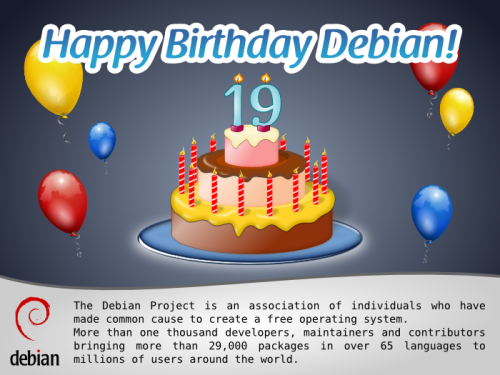
Happy 19th birthday, Debian! The Debian project is 19 years old now. Following Francesca's invitation (and Rapha l's lead, and using Leandro's image, collaboratively as it always happens here), I will tell a bit of my memories: How I got to Debian. I am a Debian user since ~2000, and a Debian Developer since April 2003. But, just as Rapha l's, my history must go somewhat further back in time. In 1992, I got my first 1200bps modem, and almost immediately became an avid BBS user (what's that? Javier Matuk talks [in Spanish] about BBSes in his newspaper column back in 1994). By mid 1993 I started operating my own BBS, CatarSYS. One of the key points that defined CatarSYS is that my focus was large-scale communication. I started connecting to several BBS networks, allowing messages to be relayed to distant people, mainly in the USA and Spain, and getting some feeds that could be seen as the poor man's Usenet. At some point during the year I kept CatarSYS going, I got connected through a strange set of gateways to pure gold: A UUCP feed! This means, during some months, I operated the first (free, hobbyist) service that offered its users a free Internet mail address in Mexico. Yes, it was completely different to what we are used to today. I tried to connect to my provider at least three times a week, but this meant less than one week turnover time for messages sent to people anywhere in the world! But, back to Debian: Via this UUCP feed, I also got some real Usenet newsgroups Including several on the comp.os category. I remember reading about Linux back then, and learning some commands, but didn't really get hooked into it. I was in Israel from July 1994 to June 1995, doing completely non-computer-related tasks. Came back in 1995, and due to my father being an academic, got dialup internet access at home. WOW, *real* Internet! It didn't take me long to start downloading Linux information and floppy images. One failed after another. But before the end of the year, I found in a bookshop a book (that included a CD-ROM) called "Build your own web server with Linux". WOW again Remember this was still 1995! I bought it, and shortly afterwards, I had a Slackware system (Linux kernel 1.0.9) running. That meant many sleepless nights full of joy and frustration (as getting hardware to work was cloe to impossible). By 1996, I got (within one week) my two first real jobs: A systems administrator at a small ISP and a highschool teacher. At the ISP, I got a spare computer to play with Linux, as of course the Big Server was running with Windows NT 3.51. Poor little machine... By then I was already a part of the Mexican Linux User Group. This group had just printed a batch of Linux CDs RedHat 4.0. This was the first release that really made me happy and allowed me to do good work. Together with a friend I took to work with us, Juan Pablo Romero, we installed over a weekend a full replacement for our buggy NT machine, in much cheaper hardware. Of course, Linux was nowhere near corporate-recognition, and our project remained a project, not touching the Windows machine. Anyway... Several years passed, and I was happy with my RedHat choice. I won't mention the milestones and job changes, as it would get boring and leave the point completely aside. By the year 2000, I was quite more involved with the LUG, as well as with the computer security group in DGSCA-UNAM. I became also an OpenBSD user, and had got so hooked up in free software that I felt the need to collaborate: To be a little part of one of those Big Projects that had given me so much. But which one? I have never been much of a programmer Yes, I can solve my everyday needs and have fun with it, and sometimes a bit beyond that. I enjoy programming. But all of my projects have begun little and stayed little. I wanted to join OpenBSD, as it was a community I really believed in, but given my skillset (and given a flame-prone, aggressive developer community), I lost motivation to do so. By 2000, I had also lost faith in RedHat. I don't have the exact dates, so I might be some months off But after RedHat's IPO, I felt a sharp change. Version 7.0 was really demotivating It tried to offer a polished desktop experience, but was really buggy, unstable, and full of bad decisions. In Mexico, Pepe Neif had taken up the job of making a derivative distribution of RedHat (called LinuxPPP), pressing hundreds of CDs and making a teaching program I was part of several times. Talking with Pepe (who continued to release based on RedHat 6), he told me he was interested in switching over to become a Debian-based distribution, but the job of migrating his installed base made the project stall LinuxPPP reached only version 6.4. But I installed Debian in early 2000, and loved it. I started getting familiar with its social philosophy and foundation documents at the same time I started migrating my servers from RedHat to Debian This must have been by Spring 2000, as I installed Potato while it was frozen but not yet stable. By January 2002 I applied for NM. My process took a long time, as my AM got MIA when he had already approved me (but before sending the AM report), so basically I had to go through AM twice And by April 16, 2003, I got accepted as a DD. Contrary to what is acceptable today, I requested the full process to be done before starting to maintain any packages, as I didn't want to bother people with package sponsorship requests, so my whole process was done evaluating packages I would eventually upload. Since becoming a DD, my main involvement in the project has been in packaging groups (I was a pkg-perl founder and member for many years, and am currently working in the pkg-ruby-extras group). But, as I said, my main strength is not programming So my main involvement in Debian has been more social than technical: I have been a DebConf organizer since 2005, a very interesting, stressing, rewarding and (for some months) time-demanding role, and since 2009 I am part of the keyring maintainence team, which is much easier workload, although carries important ramifications. So, after 19 years of Debian, and after nine years of me being part of it, Debian is clearly my strongest link to the Free Software community, a project I have grown to love and whose way of being I share and enjoy studying and explaining. And it is a technically excellent product, and a great place to start and keep learning both about how every aspect and layer of an operating system works, and how human-to-human interaction works in such a diverse, almost impossible environment happens. Congratulations, Debian!
AttachmentSize
debian-19_500.png149.81 KB

Next.

Previous.

