Search Results: "eric"

11 December 2012

Russell Coker: Links December 2012

Steven Johnson gave an interesting TED talk about where good ideas come from [1]. He starts by attributing coffee replacing alcohol as a standard drink for some good ideas and then moves on to how ideas develop. Erez Lieberman Aiden and Jean-Baptiste Michel gave an interesting and amusing TED talk about the ngram analysis of books that Google scanned [2]. Here is the link for the Google Books ngram search [3]. Clay Shirky gave an insightful TED talk about how the Internet is changing the world [4]. He cites Open Source programmers as the modern day equivalent to the Invisible College based on our supposed great ability to get along with other people on the Internet. If we really are so much better than the rest of the Internet then things must be bad out there. He ends with ways of using Git to draft legislation. Hans Rosling gave an interesting TED talk about religion and the number of babies that women have [5]. His conclusion is that it s more about income and social stability and that the world s population can stabilise at 10 billion if we provide family planning to everyone. Alexis C. Madrigal wrote an interesting interview with Genevieve Bell about her work at Intel and the way people use technology [6]. Indigogo is raising funds for the Cuddle Mattress , it s a mattress with foam slats and a special fitted sheet to allow your arm to slide between the slats [7]. So you could have your arm underneath your SO for an extended period of time without risking nerve damage. They also show that when sleeping on your side your shoulder can go between the slats to avoid back problems. Nate Silver (who is famous for predicting US elections gave an interesting TED talk about racism and politics [8]. One of his main points is to show the correlation between racism and lack of contact of members of other races. Sociological Images has an interesting article by Lisa Wade about whether marriage is a universal human value [9]. In regard to historical marriage she says women were human property, equivalent to children, slaves, servants, and employees . The general trend in the comments seems to be that there are so many types of marriage that it s difficult to make any specific claims to traditional marriage unless you count a tradition of a short period in a single geographic region. Plurality is an excellent sci-fi short movie on youtube [10]. TED has an interesting interview with Hakeem Oluseyi about his research about astrophysics and how he achieved a successful career after being a gangster as a teenager [11]. He has some good ideas about helping other children from disadvantaged environments become successful. Paul Dwerryhouse wrote an interesting blog post about his work in designing and implementing a filesystem based on a Cassandra data store with FUSE [12]. Paul also wrote a post about using Apache Zookeeper to lock metadata to permit atomic operations [13]. The documentary Monumental Myths provides an interesting and insightful analysis of the processes of creating, maintaining, and explaining monuments [14]. It focusses on some significant monuments in the US and explains both sides to each story. Howard Zinn makes the insightful point that when people present a certain point of view of history it s not controversial, as soon as you present the other side they call it controversial . That happens even in debates about current issues. Howard also says to criticise whatever the government does is not anti-America, it s anti-government, it s pro-America, it s pro the people, it s pro the country . The song that plays during the closing credits is interesting too. The music video Same Love is one of the best presentations of the argument for marriage equality [15]. Chris Samuel wrote an interesting post about systems locked down for Windows 8 and options for purchasing PCs for running Linux [16]. His solution is to buy from ZaReason. I saw his laptop in action at the last LUV meeting and it looks really nice. Unfortunately a byproduct of the extremely thin form factor is the fact that it lacks a VGA port, this meant that Chris had to use my Thinkpad T61 (which is rather clunky by comparison) for his presentation.

8 December 2012

Dirk Eddelbuettel: Rcpp attributes: Even easier integration of GSL code into R

Following the Rcpp 0.10.0 release, I had written about simulating pi easily by using the wonderful new Rcpp Attributes feature. Now with Rcpp 0.10.1 released a good week ago, it is time to look at how Rcpp Attributes can help with external libraries. As this posts aims to show, it is a breeze! One key aspect is the use of the plugins for the inline package. They provide something akin to a callback mechanism so that compilation and linking steps can be informed about header and library locations and names. We are going to illustrate this with an example from GNU Scientific Library (GSL). The example I picked uses B-Spline estimation from the GSL. This is a little redundant as R has its own spline routines and package, but serves well as a simple illustration---and, by reproducing an existing example, followed an established path. So we will look at Section 39.7 of the GSL manual which has a complete example as a standalone C program, generating both the data and the fit via cubic B-splines. We can decompose this two parts: data generation, and fitting. We will provide one function each, and then use both from R. These two function will follow the aforementioned example from Section 39.7 somewhat closely. We start with the first function to generate the data.
// [[Rcpp::depends(RcppGSL)]]
#include <RcppGSL.h>
#include <gsl/gsl_bspline.h>
#include <gsl/gsl_multifit.h>
#include <gsl/gsl_rng.h>
#include <gsl/gsl_randist.h>
#include <gsl/gsl_statistics.h>
const int N = 200;                              // number of data points to fit 
const int NCOEFFS = 12;                         // number of fit coefficients */
const int NBREAK = (NCOEFFS - 2);               // nbreak = ncoeffs + 2 - k = ncoeffs - 2 since k = 4 */
// [[Rcpp::export]]
Rcpp::List genData()  
    const size_t n = N;
    size_t i;
    double dy;
    gsl_rng *r;
    RcppGSL::vector<double> w(n), x(n), y(n);
    gsl_rng_env_setup();
    r = gsl_rng_alloc(gsl_rng_default);
    //printf("#m=0,S=0\n");
    /* this is the data to be fitted */
    for (i = 0; i < n; ++i)  
        double sigma;
        double xi = (15.0 / (N - 1)) * i;
        double yi = cos(xi) * exp(-0.1 * xi);
        sigma = 0.1 * yi;
        dy = gsl_ran_gaussian(r, sigma);
        yi += dy;
        gsl_vector_set(x, i, xi);
        gsl_vector_set(y, i, yi);
        gsl_vector_set(w, i, 1.0 / (sigma * sigma));
                
        //printf("%f %f\n", xi, yi);
     
    Rcpp::DataFrame res = Rcpp::DataFrame::create(Rcpp::Named("x") = x,
                                                  Rcpp::Named("y") = y,
                                                  Rcpp::Named("w") = w);
    x.free();
    y.free();
    w.free();
    gsl_rng_free(r);
    return(res);
 
We include a few header files, define (in what is common for C programs) a few constants and then define a single function genData() which returns and Rcpp::List as a list object to R. A primary importance here are the two attributes: one to declare a dependence on the RcppGSL package, and one to declare the export of the data generator function. That is all it takes! The plugin of the RcppGSL will provide information about the headers and library, and Rcpp Attributes will do the rest. The core of the function is fairly self-explanatory, and closely follows the original example. Space gets allocated, the RNG is setup and a simple functional form generates some data plus noise (see below). In the original, the data is written to the standard output; here we return it to R as three columns in a data.frame object familiar to R users. We then free the GSL vectors; this manual step is needed as they are implemented as C vectors which do not have a destructor. Next, we can turn the fitting function.
// [[Rcpp::export]]
Rcpp::List fitData(Rcpp::DataFrame ds)  
    const size_t ncoeffs = NCOEFFS;
    const size_t nbreak = NBREAK;
    const size_t n = N;
    size_t i, j;
    Rcpp::DataFrame D(ds);              // construct the data.frame object
    RcppGSL::vector<double> y = D["y"]; // access columns by name, 
    RcppGSL::vector<double> x = D["x"]; // assigning to GSL vectors
    RcppGSL::vector<double> w = D["w"];
    gsl_bspline_workspace *bw;
    gsl_vector *B;
    gsl_vector *c; 
    gsl_matrix *X, *cov;
    gsl_multifit_linear_workspace *mw;
    double chisq, Rsq, dof, tss;
    bw = gsl_bspline_alloc(4, nbreak);      // allocate a cubic bspline workspace (k = 4)
    B = gsl_vector_alloc(ncoeffs);
    X = gsl_matrix_alloc(n, ncoeffs);
    c = gsl_vector_alloc(ncoeffs);
    cov = gsl_matrix_alloc(ncoeffs, ncoeffs);
    mw = gsl_multifit_linear_alloc(n, ncoeffs);
    gsl_bspline_knots_uniform(0.0, 15.0, bw);   // use uniform breakpoints on [0, 15] 
    for (i = 0; i < n; ++i)                     // construct the fit matrix X 
        double xi = gsl_vector_get(x, i);
        gsl_bspline_eval(xi, B, bw);            // compute B_j(xi) for all j 
        for (j = 0; j < ncoeffs; ++j)           // fill in row i of X 
            double Bj = gsl_vector_get(B, j);
            gsl_matrix_set(X, i, j, Bj);
         
     
    gsl_multifit_wlinear(X, w, y, c, cov, &chisq, mw);  // do the fit 
    
    dof = n - ncoeffs;
    tss = gsl_stats_wtss(w->data, 1, y->data, 1, y->size);
    Rsq = 1.0 - chisq / tss;
    
    Rcpp::NumericVector FX(151), FY(151);       // output the smoothed curve 
    double xi, yi, yerr;
    for (xi = 0.0, i=0; xi < 15.0; xi += 0.1, i++)  
        gsl_bspline_eval(xi, B, bw);
        gsl_multifit_linear_est(B, c, cov, &yi, &yerr);
        FX[i] = xi;
        FY[i] = yi;
     
    Rcpp::List res =
      Rcpp::List::create(Rcpp::Named("X")=FX,
                         Rcpp::Named("Y")=FY,
                         Rcpp::Named("chisqdof")=Rcpp::wrap(chisq/dof),
                         Rcpp::Named("rsq")=Rcpp::wrap(Rsq));
    gsl_bspline_free(bw);
    gsl_vector_free(B);
    gsl_matrix_free(X);
    gsl_vector_free(c);
    gsl_matrix_free(cov);
    gsl_multifit_linear_free(mw);
    
    y.free();
    x.free();
    w.free();
    return(res);   
 
The second function closely follows the second part of the GSL example and, given the input data, fits the output data. Data structures are setup, the spline basis is created, data is fit and then the fit is evaluated at a number of points. These two vectors are returned along with two goodness of fit measures. We only need to load the Rcpp package and source a file containing the two snippets shown above, and we are ready to deploy this:
library(Rcpp)
sourceCpp("bSpline.cpp")                # compile two functions
dat <- genData()                        # generate the data
fit <- fitData(dat)                     # fit the model, returns matrix and gof measures
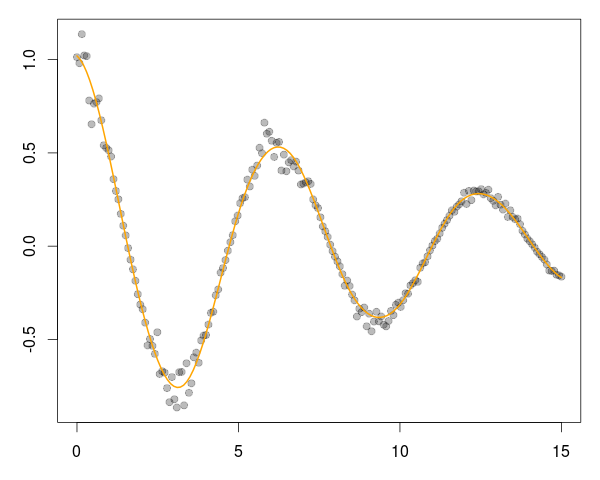
And with that, we generate a chart such as Spline fitting example from GSL manual redone with Rcpp Attributes via a simple four lines, or as much as it took to create the C++ functions, generate the data and fit it!
op <- par(mar=c(3,3,1,1))
plot(dat[,"x"], dat[,"y"], pch=19, col="#00000044")
lines(fit[[1]], fit[[2]], col="orange", lwd=2)
par(op)
The RcppArmadillo and RcppEigen package support plugin use in the same way. Add an attribute to export a function, and an attribute for the depends -- and you're done. Extending R with (potentially much faster) C++ code has never been easier, and opens a whole new set of doors.

7 December 2012

Thorsten Glaser: Collision resolution in open addressing hashtables

Before we begin, everyone should read up on hashtables and what open addressing / closed hashing is. The context is lines 111 190 of Python s Objects/dictobject.c as of today (so we get the line numbers straight). (I ve reworded this wlog entry a bit; I originally wrote it too late at night for it to read coherent.) Basically, I ve got an application where I d like to use a hashtable for a number of things not as generic as Python, and with focus on small footprint. I d like to offer associative arrays in a scripting language, where the keys are always arbitrary byte strings excluding NUL. Also, I d like to use the hashtable as backend for indexed arrays, where the keys are uint32_t and the usual use case is sequential. Finally, I m using it for several internal tables, such as a list of keywords, one of builtins, one of special variables, etc. which is a reason for me to not use a self-balancing binary tree as data structure (reading further below might suggest that, but getting a sorted list of hashtable keys is not the focus, though not unimportant).

My questions on this are:

Why is the shift on perturb done after its first use? In my experiments (using 32-bit width everywhere), for the pathological case of an 8-element (i = 3) table with three entries 0, 0x40000000 and 0x800000000, the second round yields 1 for all three, so it cannot have to do with the upper bits. My lookup looks like:

	mask = 2  - 1;
	j = perturb = hash(key);
	goto find_first_slot;
	 find_next_slot:
	j = (j << 2) + j + perturb + 1;
	perturb >>= PERTURB_SHIFT;
	/* FALLTHROUGH */
	 find_first_slot:
	entry = table[j & mask];
	if (!match(entry)) goto find_next_empty_slot;
 

This means that my first check is always the bare hash (so only do it if needed is no reason) and, since I m using gotos, I could just move the perturb >>= PERTURB_SHIFT; line before the line recalculating the next j to use. This seems to make more sense, even in the face of Python. (I actually looked at the Python file s comments again today because I thought to use a different resolution, but they have a good rationale for using the multiplication by 5.) Why can t we just use i as the PERTURB_SHIFT? Sure, this changes a shift-right by a constant, which can possibly be encoded as immediate value in assembly (unless you re on a pre-80186, which can only do SHR AX,1 and SHR AX,CL but not SHR AX,4, but that s outside of mksh s scope) into a right-shift by a variable, but i is already known, and I think the behaviour is better (it wouldn t eat any bits; assume the same 8-entry hashtable and pathologic keys 0, 8 and 16). Again: who do I think I am to go against the wisdom of the Python people, who seem to have shed more thought on this than everyone else I saw, asked, read about (including Spammipedia). That s why I m asking here. On that reference: I don t support spammers or people nagging for donations or premium accounts, like Xing and Groundspeak/Geocaching.COM, at all. In fact, I urge others to do the same, so it really hurts them; it may be their business model, but not if they spam me. Besides, OpenCaching.DE exists. Another thing is: to avoid CVE-2011-4815, I m randomising the hash used, with one seed value per hashtable, changed before a resize operation. I originally thought to seed it with nonzero, but then I have to rehash on hashtable resize, so I ll be XORing the final hash value instead (thanks ciruZ for the idea). I m thinking of omitting that for indexed arrays, as an attacker almost certainly cannot determine the keys there. (To directly use the indexed array keys, which are already uint32_t, as hashes makes using i from even more important.) The hash I m using is a modified Jenkins one-at-a-time called NZAAT: it s my new generic standard n n-cryptographic hash, and the changes are thus: while adding a byte, another increment of the hash is done (so NUL counts), and the finaliser got prefixed with the shift-left-add+shift-right-xor sequence of the adder (but not adding any value or the +1), to get best avalanche for all bytes. I actually compiled several versions of Hash.cs on a Windows VM at work to analyse the original one-at-a-time and all of my modifications; these turned out to be the simplest ones (I originally had added 0x100 instead of 1, but the effect was the same, and +1 is usually cheaper on most CPUs). Also, to avoid people being able to get to the seed, a user will always get only a sorted list of hashtable keys (numeric for indexed arrays, ASCIIbetically otherwise; see also my thoughts on JSON from the previous wlog entry). What algorithm do I use? For strings, comparisons are much more expensive, so I d like to keep them low. Memory use is also a factor; allocating one large(r) block is better than many small ones due to the pool allocator overhead and due to portability to ancient Unic s (which is another reason for me to use a hashtable which is a small struct plus an array of pointers, and then pass the list of keys as array of string pointers, instead of a tree). For both reasons, I m thinking a relatively simple MergeSort: I need to allocate the result array anyway, so I can just get two and free the one that isn t the end result, and it s AFAICT the cheapest on comparisons other than Tree Sort (which nobody really seems to use, and which would effect to using a balanced binary tree again). Since keys are unique, stability and duplicate handling is never an issue. I d like to use only one algorithm and one data structure, not a combination, as compactness is a design goal. Please drop your thoughts on Freenode, e.g. by /msg MemoServ send mirabilos your text here or per eMail to the domains debian, freewrt or mirbsd, which are organisations, with the localpart tg. Or just contact me as usual, if you re already acquainted. Or lookup 0xE99007E0. Thanks in advance! (Especially, Python Developers thoughts are welcome.)

5 December 2012

Russell Coker: Ingress

Today Google sent me an invite for Ingress their latest augmented reality game [1]. The fact that they sent me the invitation while the Google Play store page for Ingress [2] tells me that it s not available in my country (Australia) is interesting. Google obviously aren t using their Big Brother powers effectively! The way to install Ingress if you are in Australia, New Zealand, or other countries where it s not supported is to do a Google search on the words Ingress and APK and take the highest available version (1.08 at the moment). Then you will find a web site that offers it with no authentication and the potential of getting a trojan version. Forcing people to install the software in an insecure manner doesn t seem to be in the best interests of Google. I first installed the game on my Sony Ericsson Xperia X10 which has a 1 GHz Qualcomm Snapdragon QSD8250 CPU and runs Android 2.3.3 compiled by Sony-Ericsson and performance was terrible. It often would fail to respond to the UI effectively, it would process touch actions after I had repeated them because they didn t seem to have registered, scrolling text at the same speed as playing audio was apparently impossible. Then I briefly tried running it on my Samsung Galaxy S which has a 1 GHz (ARM Cortex A8) CPU and runs Android 2.3.7 with a CyanogenMod-7.1.0-GalaxyS build. It seemed to be a bit faster but the difference was small enough that I could have imagined it. I tried it on the cheap Onix tablet I bought from Aldi this morning [3] but it refused to work every time I tried and eventually crashed the tablet and forced me to use the reset button. Finally I tried it on a Kogan Agora 10 tablet running Android 4.0.4 with what Kogan describes as a 1GHz ARMv7 CPU and it seemed a lot more usable. I haven t yet tried actually playing the game on the Kogan Agora tablet, but the fact that I can read the messages from other players is a significant improvement over the experience on the phones. On the phones the poor performance of the UI made it almost impossible to read messages from other players, now it s merely extremely annoying. I m very disappointed with this. Almost three years ago I reviewed the Seer augmented reality software from IBM that performed tasks that are more demanding and did it well [4]. The IBM Seer software ran on a HTC Hero which had a 528 MHz Qualcomm MSM7600A CPU, it s really disappointing that Ingress can t run well on modern phones particularly as the augmented reality part of the game which I ve seen so far is not much different to what Google Maps, Osmand, and other mapping programs do. The IBM Seer software was good enough to drive the purchase of new phones. When I first got an Android phone almost two years ago I wanted to run such augmented reality software and it was a factor that determined my choice of phone. Unfortunately I still haven t found anything to live up to that promise. IBM s software was tailored to the Australian Open even a tennis fan would find it to be of little interest for about 360 days of the year and I haven t found any other augmented reality software that is useful and works well (please let me know if there s something I ve missed). I find it difficult to imagine that anyone would be inspired to change their phone purchase plans after seeing a demo of Ingress on any hardware that I own. It seems that it will probably be usable on my Xperia X10 and all features should work on the Kogan Agora tablet, but I don t think that any of them will allow the game to live up to the hype.

3 December 2012

Erich Schubert: ResearchGate Spam

Update Dec 2012: ResearchGate still keeps on sending me their spam. Most of the colleagues I had that tried out RG now deleted their account there, apparently, so the invitation mails become fewer. Please do not try to push this link on Wikipedia just because you are also annoyed by their emails. My blog is not a "reliable source" by Wikipedia standards. It solely reflects my personal view of that web site, not journalistic or scientific research. The reason why I call ResearchGate spam is the weasel words they use to trick authors into sending the invitation spam. Here's the text coming with the checkbox you need to uncheck (from the ResearchGate "blog")
Add my co-authors that are already using ResearchGate as contacts and invite those who are not yet members.
See how it is worded so it sounds much more like "link my colleagues that are already on researchgate" instead of "send invitation emails to my colleagues"? It deliberately avoids the mentioning of "email", too. And according to the researchgate news post, this is hidden in "Edit Settings", too (I never bothered to try it -- I do not see any benefit to me in their offers, so why should I?). Original post below:
If you are in science, you probably already received a couple of copies of the ResearchGate spam. They are trying to build a "Facebook for scienctists", and so far, their main strategy seems to be aggressive inivitation spam. So far, I've received around 5 of their "inivitations", which essentially sound like "Claim your papers now!" (without actually getting any benefit). When I asked my colleagues about these invitations none actually meant to invite me! This is why I consider this behaviour of ResearchGate to be spam. Plus, at least one of these messages was a reminder, not triggered by user interaction. Right now, they claim to have 1.9 million users. They also claim "20% interact at least once a month". However, they have around 4000 Twitter followers and Facebook fans, and their top topics on their network are at like 10000-50000 users. That is probably a much more real user count estimation: 4k-40k. And these "20%" that interact, might just be those 20% the site grew in this timeframe and that happened to click on the sign up link. For a "social networking" site, these numbers are pointless anyway. That is probably even less than MySpace. Because I do not see any benefit in their offers! Before going on an extremely aggressive marketing campaign like this, they really should consider to actually have something to offer... And the science community is a lot about not wasting their time. It is a dangerous game that ResearchGate is playing here. It may appeal to their techies and investors to artificially inflate their user numbers in the millions. But if you pay for the user numbers with your reputation, that is a bad deal! Once you have the reputation as being a spammer (and mind it, every scientist I've talked to so far complained about the spam and "I clicked on it only to make it stop sending me emails") it's hard to be taken serious again. The scientific community is a lot about reputation, and ResearchGate is screwing up badly on this. In particular, according to researchgate founder on quora, the invitations are opt-out on "claiming" a paper. Sorry, this is wrong. Don't make users annoy other users by sending them unwanted invitations to a worthless service! And after all, there are alternatives such as Academia and Mendeley that do offer much more benefit. (I do not use these either, though. In my opinion, they also do not offer enough benefit to bother going to their website. I've mentioned the inaccuracy of Mendeleys data - and the lack of an option to get them corrected - before in an earlier blog post. Don't rely on Mendeley as citation manager! Their citation data is unreviewed. I'm considering to send ResearchGate (they're Berlin based, but there maybe also is a US office you could direct this to) a cease and desist letter, denying them to store personal information on me, and to use my name on their websites to promote their "services". They may have visions of a more connected and more collaborative science, but they actually don't have new solutions. You can't solve everything by creating yet another web forum and "web2.0izing" everything. Although many of the web 2.0 bubble boys don't want to hear it: you won't solve world hunger and AIDS by doing another website. And there is a life outside the web.

2 December 2012

Dirk Eddelbuettel: RQuantLib 0.3.9

A minor feature release RQuantLib 0.3.9 is now on CRAN and in Debian. RQuantLib combines (some of) the quantitative analytics of QuantLib with the R statistical computing environment and language. Bryan Lewis had suggested to enable another pricing engine for American Options in order to get (at least some) Greeks. This is now supported by picking engine="CrankNicolson" as shown in the default example for the AmericanOption function:
R> library(RQuantLib)
R> example(AmericanOption)
AmrcnOR> # simple call with unnamed parameters
AmrcnOR> AmericanOption("call", 100, 100, 0.02, 0.03, 0.5, 0.4)
Concise summary of valuation for AmericanOption 
  value   delta   gamma    vega   theta     rho  divRho 
11.3648      NA      NA      NA      NA      NA      NA 
AmrcnOR> # simple call with some explicit parameters
AmrcnOR> AmericanOption("put", strike=100, volatility=0.4, 100, 0.02, 0.03, 0.5)
Concise summary of valuation for AmericanOption 
  value   delta   gamma    vega   theta     rho  divRho 
10.9174      NA      NA      NA      NA      NA      NA 
AmrcnOR> # simple call with unnamed parameters, using Crank-Nicolons
AmrcnOR> AmericanOption("put", strike=100, volatility=0.4, 100, 0.02, 0.03, 0.5, engine="CrankNicolson")
Concise summary of valuation for AmericanOption 
  value   delta   gamma    vega   theta     rho  divRho 
10.9173 -0.4358  0.0140      NA      NA      NA      NA 
R> 
Thanks to CRANberries, there is also a diff to the previous release 0.3.8. Full changelog details, examples and more details about this package are at my RQuantLib page.

30 November 2012

Gunnar Wolf: Becoming a teacher!

For many years, I have aspired being a university teacher. I remember asking at different universities as early as ten years ago But I didn't have the needed papers. And yes, I have been a "Licenciado en Ingenier a en Software" for one year already. Anyway, I won't go into the details on why I didn't do this earlier on. But this time, I did get my act together in time, and by mid October, I contacted Juan Carre n, an enthusiastic teacher I met a long time ago as he helped a lot for the formation and cohesion of the (now defunct?) LIDSOL group (Laboratorio de Investigaci n en Software Libre, Free Software Research Laboratory), a group of very worthy students, mostly from the Engineering careers. Juan Carre n had long offered me help in getting to the right people in Facultad de Ingenier a as soon as I had my formal requirements ready. I just didn't expect it to be so swift! Within two days of my initial mail, he contacted me back asking me to look at the subjects in Computing Engineering and choosing some I would be willing to teach Yes, understanding that due to my time (as I'm already full-time employed in UNAM) would allow me to take only one group. Rush of excitement, of course. I promptly looked at the program, and answered with a list of 12 subjects I would be confident to teach. Next day I was contacted by the Chief of Computing Engineering Department, offering me to dictate the Operating Systems course. A subject that has always motivated me, and towards which I feel confident. A fifth semester course (from 9 semesters in the career), with around 30 students in the classroom. And I'm very happy with this! Yes, this will be my first formal university course experience (either as a student or a teacher), and I'm quite nervous on how this will turn out. But I'm already reading again my books on the subject, starting to structure a set of teaching notes, and... Lets see what comes next! So, I will be teaching this course starting January 28, three times a week for 1.5hr, for a formal theric total of 72 hours. We shall see how this results six months from today! :-D

29 November 2012

Roland Mas: Wii(gh2)midi yet again

Not that I'm bored or anything, but I spent some more time on this since last month, and apparently some people are interested enough, so here's the recent news about wiigh2midi. Also, since the code moved (and it doesn't harm mentioning it again): Wiimidi is developed with Bazaar, and the public branch is at https://alioth.debian.org/~lolando/bzr/wiimidi/trunk/. So, to grab a copy:
 bzr checkout https://alioth.debian.org/~lolando/bzr/wiimidi/trunk/
Patches welcome, of course! Also, I'll be interested to hear about your applications. I've been told about a Wiimote-powered foot controller, which is exactly the kind of unpredictable results I was hoping to achieve by publishing my code. Keep it up, I want to hear about Wiimote-controlled robot dinosaurs next! Update: Wiimidi now has its dedicated page at Wiimidi.

Russ Allbery: Review: American Gods

Review: American Gods, by Neil Gaiman
Publisher: HarperTorch
Copyright: July 2001
Printing: May 2002
ISBN: 0-380-78903-5
Format: Mass market
Pages: 588
At the start of American Gods, Shadow is in prison. He's done three years of a sentence of six and is about to get released on parole. He has a wife and a job waiting for him and every hope of getting back to a good life. None of that happens. The day he's released, he finds out his wife died in a car accident. The job is gone too; it was an offer from his best friend, who died in the same accident. Numb, an ex-con, with no job prospects, he's recruited by a strange man named Wednesday, with the help of a leprechaun named Mad Sweeney, to drive Wednesday around the country, run errands for him, hurt people if absolutely necessary, and hold his vigil if he dies. And that's how Shadow is drawn into the conflict between old gods and young, between the gods that immigrants brought to America from the old world and the flashy new gods of technology and media that America is creating for itself. With native American gods and cultural legends watching around the edges. I first read American Gods shortly after it came out and before I started writing reviews, so this is a re-read. It's a book I'm glad I re-read before reviewing. The first time I read it, I was thoroughly engrossed and thought it was excellent. This time, I was entertained, but surprised at how slowly it moved, how disconnected it sometimes felt, and how little substance there was to the plot. Reading American Gods involves spending lots of time with Shadow, and I think one's reactions to this book will vary a lot based on how much one likes him as a character. Shadow is very withdrawn, very detached from the world, and quietly matter-of-fact in how he goes through his life. He's been through some major shocks and has been severed fairly thoroughly from society by three years in prison, and he doesn't reconnect easily. To some readers, such as myself, this comes across as taciturn competence and quiet observation, two things that I greatly enjoy reading about. I liked Shadow, liked reading between the lines for hints at his feelings, and sympathized a lot with his emotional state. But I can easily see an alternative reading that makes him a cipher or, worse, a blank spot in the book into which the reader has to insert themselves. One has to work at seeing Shadow's character and finding some sympathy for the degree to which he stays separate from the world. American Gods does have a plot, but it's the sort of plot that allows for endless digressions, background stories, and side meetings. In that, it reminded me less of Gaiman's other novels and more of several arcs of Sandman. I think it's worthwhile to think of this less as a novel and more as an extended ramble through the world as Gaiman sees it, full of mythology, stories, quirky people understanding the world in their own ways, and upwellings of the sacred and significant in the most unexpected of places. For example, the holy places of America in American Gods, analogous to the multiple small sacred places and old ruins in Europe, are roadside attractions, via a line of argument that makes much more sense than it has any right to and demonstrates a canny understanding of the expression of American entrepreneurial culture. As with much Gaiman, reading with Wikipedia or another mythological resource at hand is a good idea. Even if you have a good general knowledge of the most common mythology studied in the US, you probably won't recognize many of the figures Gaiman draws on: Czernobog, for example, or Wisakedjak. Part of the fun of this book is seeing Gaiman humanize them and embed them in modern culture and modern concerns while retaining their mythological edge and strangeness. As any reader of Sandman can tell you, this is one of Gaiman's strengths as a writer, and he does it well here. The bits with the undertakers Mr. Ibis and Mr. Jacquel (Thoth and Anubis) are absolutely brilliant and probably the best sections of the book (although Sam's exchange with the Men in Black is a strong contender).
"Back in my day, we had it all set up. You lined up when you died, and you'd answer for your evil deeds and for your good deeds, and if your evil deeds outweighed a feather, we'd feed your soul and your heart to Ammet, the Eater of Souls." "He must have eaten a lot of people." "Not as many as you'd think. It was a really heavy feather. We had it made special. You had to be pretty damn evil to tip the scales on that baby."
Like so much of Gaiman's work, this is the sort of book that contributed a half-dozen quotes to my quote file during my first reading. Gaiman always impresses me by not only managing to portray gods as human without losing the numinous edge, but sustaining that portrayal through very extended contact with the same god. And despite the interlude with the undertakers, the long interlude in small-town life in Lakeside, and the numerous other digressions and meanderings of a book that's not in much of a hurry to get anywhere, there is a plot and a definite conclusion, and Gaiman has some interesting twists in store at the end of that road. There's a lot of philosophical currents going on under the surface, not all of which cohere, but Gaiman does pull a lot of them together. The resolution can be a bit of an anticlimax, but I think it's a fitting one that's true to the nature of the story. I didn't enjoy this as much on the second reading as I did on the first. It didn't feel quite as coherent as I'd remembered it, and the meandering pace occasionally made the story feel stretched. But I do like Shadow, I love spending time in Gaiman's head and with his portrayals of deities, and American Gods is a treasure of great quotes. If you enjoy Gaiman's other work and aren't looking for a lot of plot and forward-moving energy, this is definitely recommended. Rating: 7 out of 10

28 November 2012

Dirk Eddelbuettel: Rcpp 0.10.1

A the new Rcpp release 0.10.1 arrived this morning on CRAN (as already has Windows binaries) and in Debian. This is a follow-up to the recent 0.10.0 release which extends the exciting new Rcpp-attributes and Rcpp-sugar work further, and as in a number of other areas as detailed below in the NEWS sections. This release brings an change to some of the binary interfaces. If you have packages using Rcpp, you will most likely have to reinstall them from source. Some change were made to const correctness as well as other aspects, and it seems that we have temporarily broken the excellent RcppEigen and RcppOctave packages. We are looking into this, and are sorry about the bug. The complete NEWS entry for 0.10.1 is below; more details are in the ChangeLog file in the package and on the Rcpp Changelog page.
Changes in Rcpp version 0.10.1 (2012-11-26)
  • Changes in Rcpp sugar:
    • New functions: setdiff, union_, intersect setequal, in, min, max, range, match, table, duplicated
    • New function: clamp which combines pmin and pmax, e.g. clamp( a, x, b) is the same as pmax( b, pmin(x, a) )
    • New function: self_match which implements something similar to match( x, unique( x ) )
  • Changes in Rcpp API:
    • The Vector template class (hence NumericVector ...) get the is_na and the get_na static methods.
    • New helper class no_init that can be used to create a vector without initializing its data, e.g. : IntegerVector out = no_init(n) ;
    • New exception constructor requiring only a message; stop function to throw an exception
    • DataFrame gains a nrows method
  • Changes in Rcpp attributes:
    • Ability to embed R code chunks (via specially formatted block comments) in C++ source files.
    • Allow specification of argument defaults for exported functions.
    • New scheme for more flexible mixing of generated and user composed C++ headers.
    • Print warning if no export attributes are found in source file.
    • Updated vignette with additional documentation on exposing C++ interfaces from packages and signaling errors.
  • Changes in Rcpp modules:
    • Enclose .External invocations in BEGIN_RCPP/END_RCPP
  • Changes in R code :
    • New function areMacrosDefined
    • Additions to Rcpp.package.skeleton:
      • attributes parameter to generate a version of rcpp_hello_world that uses Rcpp::export.
      • cpp_files parameter to provide a list of C++ files to include the in the src directory of the package.
  • Miscellaneous changes:
    • New example 'pi simulation' using R and C++ via Rcpp attributes
Thanks to CRANberries, you can also look at a diff to the previous release 0.10.0. As always, even fuller details are on the Rcpp Changelog page and the Rcpp page which also leads to the downloads, the browseable doxygen docs and zip files of doxygen output for the standard formats. A local directory has source and documentation too. Questions, comments etc should go to the rcpp-devel mailing list off the R-Forge page

26 November 2012

Russell Coker: Links November 2012

Julian Treasure gave an informative TED talk about The 4 Ways Sound Affects US [1]. Among other things he claims that open plan offices reduce productivity by 66%! He suggests that people who work in such offices wear headphones and play bird-songs. Naked Capitalism has an interesting interview between John Cusack and Jonathan Turley about how the US government policy of killing US citizens without trial demonstrates the failure of their political system [2]. Washington s blog has an interesting article on the economy in Iceland [3]. Allowing the insolvent banks to go bankrupt was the best thing that they have ever done for their economy. Clay Shirky wrote an insightful article about the social environment of mailing lists and ways to limit flame-wars [4]. ZRep is an interesting program that mirrors ZFS filesystems via regular snapshots and send/recv operations [5]. It seems that it could offer similar benefits to DRBD but at the file level and with greater reliability. James Lockyer gave a movingTEDx talk about his work in providing a legal defence for the wrongly convicted [6]. This has included overturning convictions after as much as half a century in which the falsely accused had already served a life sentence. Nathan Myers wrote an epic polemic about US government policy since 9-11 [7]. It s good to see that some Americans realise it s wrong. There is an insightful TED blog post about TED Fellow Salvatore Iaconesi who has brain cancer [8]. Apparently he had some problems with medical records in proprietary formats which made it difficult to get experts to properly assess his condition. Open document standards can be a matter of life and death and should be mandated by federal law. Paul Wayper wrote an interesting and amusing post about Emotional Computing which compares the strategies of Apple, MS, and the FOSS community among other things [9]. Kevin Allocca of Youtube gave an insightful TED talk about why videos go viral [10]. Jason Fried gave an interesting TED talk Why Work Doesn t Happen at Work [11]. His main issues are distraction and wasted time in meetings. He gives some good ideas for how to improve productivity. But they can also be used for sabotage. If someone doesn t like their employer then they could call for meetings, incite managers to call meetings, and book meetings so that they don t follow each other and thus waste more of the day (EG meetings at 1PM and 3PM instead of having the second meeting when the first finishes). Shyam Sankar gave an interesting TED talk about human computer cooperation [12]. He describes the success of human-computer partnerships in winning chess tournaments, protein folding, and other computational challenges. It seems that the limit for many types of computation will be the ability to get people and computers to work together efficiently. Cory Doctorow wrote an interesting and amusing article for Locus Magazine about some of the failings of modern sci-fi movies [13]. He is mainly concerned with pointless movies that get the science and technology aspects wrong and the way that the blockbuster budget process drives the development of such movies. Of course there are many other things wrong with sci-fi movies such as the fact that most of them are totally implausible (EG aliens who look like humans). The TED blog has an interesting interview with Catarina Mota about hacker spaces and open hardware [14]. Sociological Images has an interesting article about sporting behaviour [15]. They link to a very funny youtube video of a US high school football team who make the other team believe that they aren t playing until they win [16] Related posts:
  1. Links April 2012 Karen Tse gave an interesting TED talk about how to...
  2. Links March 2012 Washington s Blog has an informative summary of recent articles about...
  3. Links November 2011 Forbes has an interesting article about crowd-sourcing by criminals and...

23 November 2012

Benjamin Mako Hill: Cultivated Disinterest in Professional Sports

Like many of my friends, I have treated professional sports with cultivated indifference. But a year and a half ago, I decided to become a football fan. Several years ago, I was at a talk by Michael Albert at MIT where he chastised American intellectuals for what he claimed was cultivated disdain of professional sports. Albert suggested that sports reflect the go-to topic for small talk and building rapport across class and context. But he suggested that almost everybody who used the term "working class struggle" was incapable of making small talk with members of the working class because unlike most working class people (and most people in general) educated people systematically cultivate ignorance in sports. Professional sports are deeply popular. In the US, Sunday Night Football is now the most popular television show among women in its time slot and the third most popular television in America among 18-49 year old women. That it is also the most popular television show in general is old news. There are very few things that anywhere near half of Americans have in common. Interest in football is one of them. An enormous proportion of the US population watches the Superbowl each year. I recognized myself in Albert's critique. So I decided to follow a local team. I picked football because it is the most popular sport in America and because their strong revenue sharing system means that either team has a chance to win any given match. My local team is the New England Patriots and I've watched many of the team's games or highlights over the last season and a half. I've also followed a couple football blogs. A year and half in, I can call myself a football fan. And I've learned a few things in the process:

  1. With a little effort, getting into sports is easy. Although learning the rules of a sport can be complicated, sports are popular because people, in general, find them fun to watch. If you watch a few games with someone who can explain the rules, and if you begin to cheer for a team, you will find yourself getting emotionally invested and excited.
  2. Sports really do, as Albert implied, allow one to build rapport and small talk across society. I used to dread the local cab driver who would try to make small talk by mentioning Tom Brady or the Red Sox. No more! Some of these conversations turn into broader conversations about life and politics.
  3. Interest in sports can expand or shrink to fill the time you're willing to give it. It can mean just glancing through the sports sections of the paper and watching some highlights here or there. Or it can turn into a lifestyle.
  4. It's not all great. Football, like most professional sports, is deeply permeated with advertisements, commercialism, and money. Like other sports, it is also violent. I don't think I could ever get behind a fight sport where the goal is to hurt someone else. The machoness and absence of women in the highest levels of most professional sports bothers me deeply.
I've also tried to think a lot about why I, like most of my friends, avoided sports in the past. Disinterest in sports among academics and the highly educated is, in my experience, far from passive. I've heard people almost compete to explain the depth of their ignorance in sports one doesn't even know the rules, one doesn't own a television, one doesn't know the first thing about the game. I did the same thing myself. Bethany Bryson, a sociologist at JMU has shown that increased education is associated with increased inclusiveness in musical taste (i.e., highly educated people like more types of music) but that these people are most likely to reject music that is highly favored by the least educated people. Her paper's title sums up the attitude: "Anything But Heavy Metal". For highly educated folks, it's a sign of cultivation to be eclectic in one's tastes. But to signal to others that you belong in the intellectual elite, it can pay in cultural capital to dislike things, like sports, that are enormously popular among the least educated parts of society. This ignorance among highly educated people limits our ability to communicate, bond, and build relationships across different segments of society. It limits our ability to engage in conversations and build a common culture that crosses our highly stratified and segmented societies. Sports are not politically or culturally unproblematic. But they provide an easy and enjoyable way to build common ground with our neighbors and fellow citizens that transcend social boundaries.

21 November 2012

Axel Beckert: Suggestions for the GNOME Team

Thanks to Erich Schubert s blog posting on Planet Debian I became aware of the 2012 GNOME User Survey at Phoronix. Like back in 2006 I still use some GNOME applications, so I do consider myself as GNOME user in the widest sense and hence I filled out that survey. Additionally I have to live with GNOME 3 as a system administrator of workstations, and that s some kind of usage, too. ;-) The last question in the survey was Do you have any comments or suggestions for the GNOME team? Sure I have. And since I tried to give constructive feedback instead of only ranting, here s my answer to that question as I submitted it in the survey, too, just spiced up with some hyperlinks and highlighting:
Don t try to change the users. Give the users more possibilities to change GNOME if they don t agree with your own preferences and decisions. (The trend to castrate the user was already starting with GNOME 2 and GNOME 3 made that worse IMHO.) If you really think that you need less configurability because some non-power-users are confused or challenged by too many choices, then please give the other users at least the chance to enable more configuration options. A very good example in that hindsight was Kazehakase (RIP) who offered several user interfaces (novice, intermediate and power user or such). The popular text-mode web browser Lynx does the same, too, btw. GNOME lost me mostly with the change to GNOME 2. The switch from Galeon 1.2 to 1.3/2.0 was horrible and the later switch to Epiphany made things even worse on the browser side. My short trip to GNOME as desktop environment ended with moving back to FVWM (configurable without tons of clicking, especially after moving to some other computer) and for the browser I moved on to Kazehakase back then. Nowadays I m living very well with Awesome and Ratpoison as window managers, Conkeror as web browser (which are all very configurable) and a few selected GNOME applications like Liferea (luckily still quite configurable despite I miss Gecko s about:config since the switch to WebKit), GUCharmap and Gnumeric. For people switching from Windows I nowadays recommend XFCE or maybe LXDE on low-end computers. I likely would recommend GNOME 2, too, if it still would exist. With regards to MATE I m skeptical about its persistance and future, but I m glad it exists as it solves a lot of problems and brings in just a few new ones. Cinnamon as well as SolusOS are based on the current GNOME libraries and are very likely the more persistent projects, but also very likely have the very same multi-head issues we re all barfing about at work with Ubuntu Precise. (Heck, am I glad that I use Awesome at work, too, and all four screens work perfectly as they did with FVWM before.)
Thanks to Dirk Deimeke for his (German written) pointer to Marcus Moeller s interview with Ikey Doherty (in German, too) about his Debian-/GNOME-based distribution SolusOS.

Erich Schubert: Phoronix GNOME user survey

While not everybody likes Phoronix (common complaints include tabloid journalism), they are doing a GNOME user survey again this year. If you are concerned about Linux on the desktop, you might want to participate; it is not particularly long.
Unfortunately, "the GNOME Foundation still isn't interested in having a user survey", and may again ignore the results; and already last year you could see a lot of articles along the lines of The Survey That GNOME Would Rather Ignore. One more reason to fill it out.

Dirk Eddelbuettel: Rcpp attributes: A simple example 'making pi'

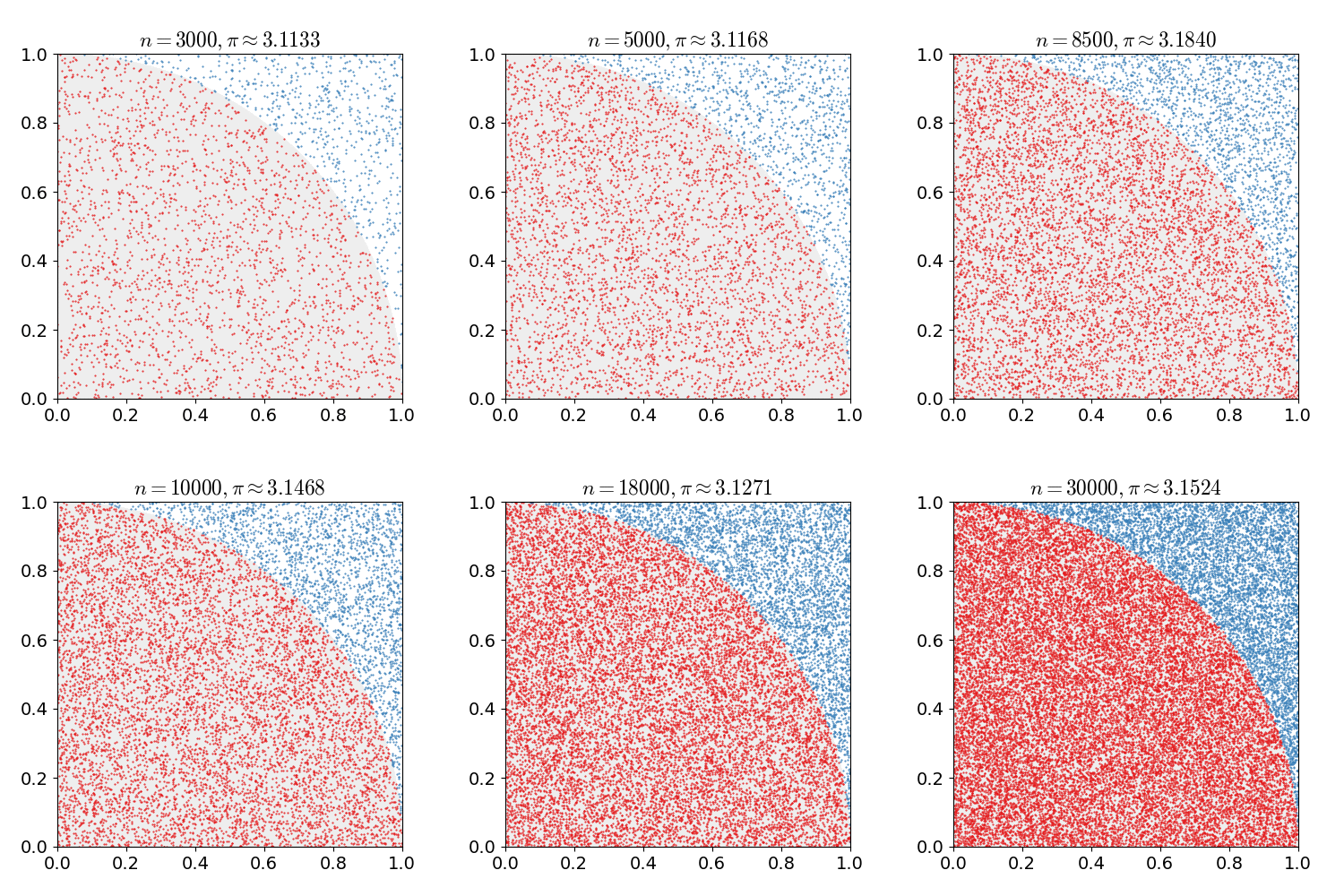
We introduced Rcpp 0.10.0 with a number of very nice new features a few days ago, and the activity on the rcpp-devel mailing list has been pretty responsive which is awesome. But because few things beat a nice example, this post tries to build some more excitement. We will illustrate how Rcpp attributes makes it really easy to add C++ code to R session, and that that code is as easy to grasp as R code. Our motivating example is everybody's favourite introduction to Monte Carlo simulation: estimating . A common method uses the fact the unit circle has a surface area equal to . We draw two uniform random numbers x and y, each between zero and one. We then check for the distance of the corresponding point (x,y) relative to the origin. If less than one (or equal), it is in the circle (or on it); if more than one it is outside. As the first quadrant is a quarter of a square of area one, the area of the whole circle is -- so our first quadrant approximates over four. The following figure, kindly borrowed from Wikipedia with full attribution and credit, illustrates this: Example of simulating pi Now, a vectorized version (drawing N such pairs at once) of this approach is provided by the following R function.
piR <- function(N)  
    x <- runif(N)
    y <- runif(N)
    d <- sqrt(x^2 + y^2)
    return(4 * sum(d < 1.0) / N)
 
And in C++ we can write almost exactly the same function thanks the Rcpp sugar vectorisation available via Rcpp:
#include <Rcpp.h>
using namespace Rcpp;
// [[Rcpp::export]]
double piSugar(const int N)  
    RNGScope scope;		// ensure RNG gets set/reset
    NumericVector x = runif(N);
    NumericVector y = runif(N);
    NumericVector d = sqrt(x*x + y*y);
    return 4.0 * sum(d < 1.0) / N;
 
Sure, there are small differences: C++ is statically typed, R is not. We need one include file for declaration, and we need one instantiation of the RNGScope object to ensure random number draws remain coordinated between the calling R process and the C++ function calling into its (compiled C-code based) random number generators. That way we even get the exact same draws for the same seed. But the basic approach is identical: draw a vector x and vector y, compute the distance to the origin and then obtain the proportion within the unit circle -- which we scale by four. Same idea, same vectorised implementation in C++. But the real key here is the one short line with the [[Rcpp::export]] attribute. This is all it takes (along with sourceCpp() from Rcpp 0.10.0) to get the C++ code into R. The full example (which assumes the C++ file is saved as piSugar.cpp in the same directory) is now:
#!/usr/bin/r
library(Rcpp)
library(rbenchmark)
piR <- function(N)  
    x <- runif(N)
    y <- runif(N)
    d <- sqrt(x^2 + y^2)
    return(4 * sum(d < 1.0) / N)
 
sourceCpp("piSugar.cpp")
N <- 1e6
set.seed(42)
resR <- piR(N)
set.seed(42)
resCpp <- piSugar(N)
## important: check results are identical with RNG seeded
stopifnot(identical(resR, resCpp))
res <- benchmark(piR(N), piSugar(N), order="relative")
print(res[,1:4])
and it does a few things: set up the R function, source the C++ function (and presto: we have a callable C++ function just like that), compute two simulations given the same seed and ensure they are in fact identical -- and proceed to compare the timing in a benchmarking exercise. That last aspect is not even that important -- we end up being almost-but-not-quite twice as fast on my machine for different values of N. The real takeaway here is the ease with which we can get a C++ function into R --- and the new process completely takes care of passing parameters in, results out, and does the compilation, linking and loading. More details about Rcpp attributes are in the new vignette. Now enjoy the .

Update:One somewhat bad typo fixed.

Update:Corrected one background tag.

20 November 2012

Jon Dowland: Waterstones

In May this year, in a desperate bid to bail water out of a sinking ship, HMV group sold off the Waterstones chain of bookstores. I'm fond of reading so naturally I visit Waterstones from time to time. (but not exclusively.) For many years, their promotions were unanimously structured as "3 for 2" offers: find three books in the promotion, in-store, and get the cheapest of the three for free. I hated these promotions. I always found it very challenging to find three books in the promotion that I wanted. If I was visiting to buy a specific book and found it in the promotion, on more than one occasion I left the shop empty handed: I wasn't prepared to pay full price for a book in a promotion and not get the benefit of the promotion. Since being sold, Waterstones seem to have made a lot of changes. Many new hardbacks from popular authors have debuted at a discount for a short period (Rowling, Pratchett). I've found many more discounted books not tied to others in 3-for-2-style offers, sometimes window-display stock at half price, a month or so after release. They started a loyalty-card scheme, with a 10 gift card the prize you reach once you've spent 100. (I wonder if such schemes are examples of a token economy?) Finally, they've tentatively started to explore putting cafes in their branches. The one in Newcastle is best described as 'fledgling', but it's nice to have one more place to escape for a cup of tea at lunchtimes. The cafe, as well as a very well stocked collection of magazines, were the two killer features of the sadly- defunct Borders bookseller chain. For years before we got our own Borders in the North East, I used to enjoy the York branch if I was passing. I actually managed to fill a loyalty card this year, so clearly their change in attitude has worked on me! I'm generally not a fan of gift cards, especially in today's climate, so I quickly spent it. I hold an American Express credit card, which earns me cashbask on purchases which I make with it. I think the rate is about 1%. However, I can opt to receive the cashback in the form of gift vouchers. If I do so, I get them to the value of 110% my cashback balance. One of the retailers in on the scheme are Waterstones. I'm tempted

19 November 2012

Steve Langasek: Pflaumenkuchen

This was a good year for plums in the garden, both for the yellow plums and for the Italian prunes - enough so that it took some doing to figure out what to do with them all. Since I'm not in a hurry to set up a still and make slivovic, and you can only pawn so many plums off on friends and neighbors, I had on the order of 15 pounds of Italian prunes to dispense with. With our change of diet to eliminate extra carbs, Patty and I have both been experimenting with reduced-carb desserts in the kitchen. And I've always been fond of central European (e.g., German) desserts, which tend to be sweetened much more lightly than American equivalents. Indeed, my earliest impression of "coffee cake" comes from the home of an elderly couple who were friends of the family, who served a delicious plum cake in their home. She was from Bavaria, so I guess she probably wouldn't have called it Zwetchgendatschi like the Austrians do (if they even really call it that; I have my suspicions that this is a made-up name designed to poke fun at the foreigners). Maybe she would have called it Pflaumenkuchen. The Internet calls it "Polish plum cake". Whatever you call it, it's tasty, and I aimed to recreate it at home. The plums are now nearly a month gone, but after multiple iterations the cake turned out well enough that I feel compelled to share it with the Internet. Since we have friends who are dairy-intolerant, this particular recipe is tailored to be low-carb and dairy-free. It doesn't lose anything in the taste for being made with a restricted set of ingredients. The original recipe did call for a streusel, and a non-dairy streusel is pretty pointless so this recipe simply omits it. Metric cooks, avert your eyes. ;)

  • 1 c almond flour
  • 1 tsp baking powder
  • tsp salt
  • c Steviva blend
  • 3 tbsp grapeseed oil
  • c milk
  • 1 large egg
  • 12 fresh plums, pitted and halved
  • tsp cloves
Lightly coat an 8"x8" pan with cooking spray. Heat oven to 350 degrees. In medium bowl, combine flour, baking powder, salt and Steviva. Add grapeseed oil, milk and egg. Beat at medium speed 4 minutes. Pour batter into prepared pan. Place plums on top, cut side up, pushing down slightly into batter. Sprinkle cloves over the plums. Bake about 50 minutes or until a toothpick tests clean. Let the cake cool in the pan so the plum juices will be reabsorbed to create a moist cake. Sprinkle with confectioners' sugar, if desired, and cut into 16 squares.
[edit: the Internet is bad at me for my badly spelled german. Spelling corrected. ;)]

Steve Langasek: Pflaumkuchen

This was a good year for plums in the garden, both for the yellow plums and for the Italian prunes - enough so that it took some doing to figure out what to do with them all. Since I'm not in a hurry to set up a still and make slivovic, and you can only pawn so many plums off on friends and neighbors, I had on the order of 15 pounds of Italian prunes to dispense with. With our change of diet to eliminate extra carbs, Patty and I have both been experimenting with reduced-carb desserts in the kitchen. And I've always been fond of central European (e.g., German) desserts, which tend to be sweetened much more lightly than American equivalents. Indeed, my earliest impression of "coffee cake" comes from the home of an elderly couple who were friends of the family, who served a delicious plum cake in their home. She was from Bavaria, so I guess she probably wouldn't have called it Zwetchgendatschi like the Austrians do (if they even really call it that; I have my suspicions that this is a made-up name designed to poke fun at the foreigners). Maybe she would have called it Pflaumkuchen. The Internet calls it "Polish plum cake". Whatever you call it, it's tasty, and I aimed to recreate it at home. The plums are now nearly a month gone, but after multiple iterations the cake turned out well enough that I feel compelled to share it with the Internet. Since we have friends who are dairy-intolerant, this particular recipe is tailored to be low-carb and dairy-free. It doesn't lose anything in the taste for being made with a restricted set of ingredients. The original recipe did call for a streusel, and a non-dairy streusel is pretty pointless so this recipe simply omits it. Metric cooks, avert your eyes. ;)
  • 1 c almond flour
  • 1 tsp baking powder
  • tsp salt
  • c Steviva blend
  • 3 tbsp grapeseed oil
  • c milk
  • 1 large egg
  • 12 fresh plums, pitted and halved
  • tsp cloves
Lightly coat an 8"x8" pan with cooking spray. Heat oven to 350 degrees. In medium bowl, combine flour, baking powder, salt and Steviva. Add grapeseed oil, milk and egg. Beat at medium speed 4 minutes. Pour batter into prepared pan. Place plums on top, cut side up, pushing down slightly into batter. Sprinkle cloves over the plums. Bake about 50 minutes or until a toothpick tests clean. Let the cake cool in the pan so the plum juices will be reabsorbed to create a moist cake. Sprinkle with confectioners' sugar, if desired, and cut into 16 squares.

Vasudev Kamath: Weekly Log - 17/23 - 112012

The last week was quite productive as I was on vacation and at home town but sadly I couldn't complete this post so again merging the work with this week but this week ain't much productive as I was tired from journey back and didn't get enough time to recover. So here it goes. Debian Related Upstream Related I raised a pull request #8 on Gubbi fixing the Makefile to more organized and introducing xz compression in it. Additionally I removed distribution specific stuffs from Makefile and made it generic. That's all for the two weeks. This week there will be foss.in and we will be having some Debian specific mini conference, including some Debian basics to newbies and some bug squashing if any :-). So more to report next week, till then Cya.

15 November 2012

Matthew Garrett: More in the series of bizarre UEFI bugs

A (well, now former) coworker let me know about a problem he was having with a Lenovo Thinkcentre M92p. It booted Fedora UEFI install media fine, but after an apparently successful installation refused to boot. UEFI installs on Windows worked perfectly. Secure Boot was quickly ruled out, but this could still have been a number of things. The most interesting observation was that the Fedora boot option didn't appear in the firmware boot menu at all, but Windows did. We spent a little while comparing the variable contents, gradually ruling out potential issues - Linux was writing an entry that had an extra 6 bytes in a structure, for instance[1], and a sufficiently paranoid firmware implementation may have been tripping up on that. Fixing that didn't help, though. Finally we tried just taking the Windows entry and changing the descriptive string. And it broke.

Every UEFI boot entry has a descriptive string. This is used by the firmware when it's presenting a menu to users - instead of "Hard drive 0" and "USB drive 3", the firmware can list "Windows Boot Manager" and "Fedora Linux". There's no reason at all for the firmware to be parsing these strings. But the evidence seemed pretty strong - given two identical boot entries, one saying "Windows Boot Manager" and one not, only the first would work. At this point I downloaded a copy of the firmware and started poking at it. Turns out that yes, actually, there is a function that compares the descriptive string against "Windows Boot Manager" and appears to return an error if it doesn't match. What's stranger is that it also checks for "Red Hat Enterprise Linux" and lets that one work as well.

This is, obviously, bizarre. A vendor appears to have actually written additional code to check whether an OS claims to be Windows before it'll let it boot. Someone then presumably tested booting RHEL on it and discovered that it didn't work. Rather than take out that check, they then addded another check to let RHEL boot as well. We haven't yet verified whether this is an absolute string match or whether a prefix of "Red Hat Enterprise Linux" is sufficient, and further examination of the code may reveal further workarounds. For now, if you want to run Fedora[2] on these systems you're probably best off changing the firmware to perform a legacy boot.

[1] src/include/efi.h: uint8_t padding[6]; /* Emperically needed */, says the efibootmgr source code. Unhelpful.
[2] Or Ubuntu, or Suse, or

comment count unavailable comments

Next.

Previous.