Search Results: "edd"

6 May 2017

Dirk Eddelbuettel: RcppEigen 0.3.3.3.0

A new RcppEigen release 0.3.3.3.0 was put into CRAN (and Debian) a few days ago. It brings Eigen 3.3.* to R. Once again, Yixuan Qiu did most of the heavy lifting over a multi-month period as some adjustments needed to be made in the package itself, along with coordination downstream. The complete NEWS file entry follows.

Changes in RcppEigen version 0.3.3.3.0 (2017-04-29)
  • Updated to version 3.3.3 of Eigen
  • Fixed incorrect function names in the examples, thanks to Ching-Chuan Chen
  • The class MappedSparseMatrix<T> has been deprecated since Eigen 3.3.0. The new structure Map<SparseMatrix<T> > should be used instead
  • Exporters for the new type Map<SparseMatrix<T> > were added
  • Travis CI is now driven via run.sh from our forked r-travis
Courtesy of CRANberries, there is also a diffstat report for the most recent release.

This post by Dirk Eddelbuettel originated on his Thinking inside the box blog. Please report excessive re-aggregation in third-party for-profit settings.

3 May 2017

Reproducible builds folks: Reproducing R packages

In the past couple of weeks, Ximin Luo worked on making R generate reproducible output. This is now mostly complete, and we're waiting on feedback from upstream about our patch. In the meantime, there are a few packages that remain unreproducible, but the issue probably lies in those specific packages rather than the R toolchain. Perhaps you can help out with them, after reading this!
R packages compile into a .rdb database format that contains the package's definitions, plus a .rdx index file for easy lookup in the .rdb file. Usually, there is a main rdb with the package contents, plus another rdb that stores the help data. There is also a paths.rds (same format as .rdx) that contains some more stuff. One can actually read these files by hand using Rscript, see the diffoscope code in rdata.py. If you run that, you can see that path.rds contains some obvious paths, but the other files contain less obvious stuff, and in fact these scripts give identical output for the .rdb files, even though they are bitwise different. To get to the bottom of this, we'll have to use the R debugger. Attached to this post is a script that smooths this process. I ran this against Debian's R packages, but it probably also works with other distros' R packages - try it and see. You run it like ./r-mini-repro-test.sh $pkgdir $builddir and it will output some hashes for you; make sure to install the build dependencies first. You should manually vary both $pkgdir and $builddir to introduce the build-path variations; $builddir can be an arbitrary string but $pkgdir should point to the actual R package's source directory, so I just copy that to two locations and point the script at each of them in turn. Now, we can begin debugging. Before I did this, we had 478 unreproducible R packages so the biggest problem was likely with R itself. I downloaded the source code of both R and a small example package (r-cran-tensor), then figured out how the R packages were actually being built. This resulted in me writing the script above, to speed up debugging. You can read about R's debugger here (no HTTPS), it's a bit primitive but it supports the basic stuff (step, continue, where, print/eval) and that was adequate for me. Debugging R core So let's take a small example with Debian R 3.4.0-1:
$ ../r-mini-repro-test.sh r-cran-tensor-1.5 123
[..]
* installing *source* package  tensor  ...
** package  tensor  successfully unpacked and MD5 sums checked
** R
** preparing package for lazy loading
** help
*** installing help indices
** building package indices
** testing if installed package can be loaded
* DONE (tensor)
[..]
c71a766429151a13e46039f3c37a14edc704004f410c34f8f37a2f098506421d  ./debian/123/usr/lib/R/site-library/tensor/R/tensor.rdx
736b5b4a885db71fb3fe2a538faeefe43c500c4080dbf2c75b97135b98401acd  ./debian/123/usr/lib/R/site-library/tensor/R/tensor.rdb
8a3f9616de7ee78a83b07395dd6ec43c5259d3f1b1b653d397808fc9fc5d96c2  ./debian/123/usr/lib/R/site-library/tensor/help/tensor.rdx
d1ac634987b24606a5da627ec073f45edce2bddf071391dd17c246a0a01eba63  ./debian/123/usr/lib/R/site-library/tensor/help/tensor.rdb
80796cc1a2cfcac40c394153f67617d575e103a405430b8483c2261a903db046  ./debian/123/usr/lib/R/site-library/tensor/help/paths.rds
$ ../r-mini-repro-test.sh r-cran-tensor-1.5 1234
[..]
5f081f4d6f9da1fbe06e374067e6636d926de4cdf09886058b15c5928c636c0d  ./debian/1234/usr/lib/R/site-library/tensor/R/tensor.rdx
7145669891e1b766ca0d8d89fa9c317af716e61a62650abe3a11a848240f1d57  ./debian/1234/usr/lib/R/site-library/tensor/R/tensor.rdb
8a3f9616de7ee78a83b07395dd6ec43c5259d3f1b1b653d397808fc9fc5d96c2  ./debian/1234/usr/lib/R/site-library/tensor/help/tensor.rdx
d1ac634987b24606a5da627ec073f45edce2bddf071391dd17c246a0a01eba63  ./debian/1234/usr/lib/R/site-library/tensor/help/tensor.rdb
80796cc1a2cfcac40c394153f67617d575e103a405430b8483c2261a903db046  ./debian/1234/usr/lib/R/site-library/tensor/help/paths.rds
The files are created by the ** preparing package for lazy loading and ** help steps. In retrospect this seems somewhat obvious from the output, but I had never done R before so I spent a while using strace to be sure; one can see that those files are indeed written to after those strings are printed. Then we can grep the R source code for these strings.
r-base-3.4.0$ grep -Ri "preparing package for lazy loading" src
src/library/tools/R/install.R:                starsmsg(stars, "preparing package for lazy loading")
Reading the file, we see that this happens in the tools:::.install_packages function, and reading it further we see that it calls makeLazyLoading then code2LazyLoadDB then makeLazyLoadDB. Seems promising, let's confirm it before chasing potential wild geese. Important: In the rest of these command-line outputs I'll prepend what I input with >>> but this doesn't actually get printed by Rscript. So don't be surprised that you don't see these, when you're trying to recreate my steps. Also I am a total R noob so possibly there are more elegant ways to do what I'm about to show you; this is what I came up with after 2-3 hours of research.
$ DEBUG=1 ../r-mini-repro-test.sh r-cran-tensor-1.5 123
enter (some or all of) the following into R:
[.. helpful commands ..]
+ R_DEFAULT_PACKAGES= LC_COLLATE=C /usr/lib/R/bin/R --no-restore --slave --args nextArg-lnextArgdebian/123/usr/lib/R/site-librarynextArg-dnextArg.nextArg--built-timestamp="Thu, 01 Jan 1970 00:00:00 +0000"
>>> debug(tools:::makeLazyLoadDB)
>>> tools:::.install_packages()
processing  . 
[..]
** preparing package for lazy loading
debugging in: makeLazyLoadDB(ns, dbbase, compress = compress)
debug:  
[.. source code of makeLazyLoadDB, not yet run ..]
 
OK so we just entered the function and it's paused, in a separate shell let's check what it's doing:
$ find r-cran-tensor-1.5 -name '*.rdb'
[ no output ]
So, no files have been written yet, which means none of the parent functions did anything, we are in the right function (or it's in a child). If we continue the function, we get:
>>> c
exiting from: makeLazyLoadDB(ns, dbbase, compress = compress)
** help
debugging in: makeLazyLoadDB(db, file.path(manOutDir, basename(outDir)))
debug:  
[.. source code of makeLazyLoadDB, not yet run ..]
 
$ find r-cran-tensor-1.5 -name '*.rdb'
r-cran-tensor-1.5/debian/123/usr/lib/R/site-library/tensor/R/tensor.rdb
Then continuing again:
>>> c
exiting from: makeLazyLoadDB(db, file.path(manOutDir, basename(outDir)))
*** installing help indices
** building package indices
** testing if installed package can be loaded
* DONE (tensor)
$ find r-cran-tensor-1.5 -name '*.rdb'
r-cran-tensor-1.5/debian/123/usr/lib/R/site-library/tensor/help/tensor.rdb
r-cran-tensor-1.5/debian/123/usr/lib/R/site-library/tensor/R/tensor.rdb
So it seems likely this function is the correct one. After reading the source code of makeLazyLoadDB, even though I don't understand the whole thing, it looks like possibly this part is the one that does the actual writing:
    for (i in seq_along(vars))  
        key <- if (is.null(from)   is.environment(from))
            lazyLoadDBinsertVariable(vars[i], from, datafile,
                                     ascii, compress,  envhook)
        else lazyLoadDBinsertListElement(from, i, datafile, ascii,
                                         compress, envhook)
        assign(vars[i], key, envir = varenv)
     
So let's step through it and see if the data contains any paths.
$ DEBUG=1 ../r-mini-repro-test.sh r-cran-tensor-1.5 123
[..]
>>> debug(tools:::makeLazyLoadDB)
>>> tools:::.install_packages()
processing  . 
[..]
** preparing package for lazy loading
debugging in: makeLazyLoadDB(ns, dbbase, compress = compress)
debug:  
[.. source code of makeLazyLoadDB, not yet run ..]
 
>>>                                                                             # pressing <Enter> just means "step"
debug: ascii <- as.logical(ascii)                                               # this is the first line of the function
>>>                                                                             # keep stepping
[..]
>>>
debug: for (i in seq_along(vars))  
[.. source code of the inside of the block, not yet run ..]
 
>>>
debug: key <- if (is.null(from)   is.environment(from)) lazyLoadDBinsertVariable(vars[i],
    from, datafile, ascii, compress, envhook) else lazyLoadDBinsertListElement(from,
    i, datafile, ascii, compress, envhook)
>>>
debug: lazyLoadDBinsertVariable(vars[i], from, datafile, ascii, compress,
    envhook)                                                                    # not yet run
If we look at the source code we see that it will try to insert the value of .Internal(getVarsFromFrame(vars[i], from, FALSE))[[1L]] into the file, so let's evaluate it:
>>> .Internal(getVarsFromFrame(vars[i], from, FALSE))[[1L]]
function (x, y)
tensor(x, y, 2, 2)
<environment: namespace:tensor>
>>> typeof(.Internal(getVarsFromFrame(vars[i], from, FALSE))[[1L]])
[1] "closure"
>>> environment(.Internal(getVarsFromFrame(vars[i], from, FALSE))[[1L]])        # get the environment of a closure
<environment: namespace:tensor>
>>> envlist(environment(.Internal(getVarsFromFrame(vars[i], from, FALSE))[[1L]])) # environment as an envlist, more detailed output
$ %*t% 
function (x, y)
tensor(x, y, 2, 2)
<environment: namespace:tensor>
$ %t*% 
function (x, y)
tensor(x, y, 1, 1)
<environment: namespace:tensor>
$ %t*t% 
function (x, y)
tensor(x, y, 1, 2)
<environment: namespace:tensor>
$.__NAMESPACE__.
<environment: 0x55eb55d00be0>
$.__S3MethodsTable__.
<environment: 0x55eb55d166e8>
$.packageName
[1] "tensor"
$tensor
function (A, B, alongA = integer(0), alongB = integer(0))
 
[.. function definition ..]
 
<environment: namespace:tensor>
Nothing obviously containing paths so far, let's keep stepping and dumping the objects
>>>
debug: assign(vars[i], key, envir = varenv)
>>>                                                                             # next iteration now
debug: key <- if (is.null(from)   is.environment(from)) lazyLoadDBinsertVariable(vars[i],
    from, datafile, ascii, compress, envhook) else lazyLoadDBinsertListElement(from,
    i, datafile, ascii, compress, envhook)
>>>
debug: lazyLoadDBinsertVariable(vars[i], from, datafile, ascii, compress,
    envhook)
>>> .Internal(getVarsFromFrame(vars[i], from, FALSE))[[1L]]
function (x, y)
tensor(x, y, 1, 1)
<environment: namespace:tensor>
>>>
[.. more stepping ..]
debug: lazyLoadDBinsertVariable(vars[i], from, datafile, ascii, compress,
    envhook)
>>> .Internal(getVarsFromFrame(vars[i], from, FALSE))[[1L]]
<environment: 0x55eb55d00be0>
>>> envlist(.Internal(getVarsFromFrame(vars[i], from, FALSE))[[1L]])
$S3methods
     [,1] [,2] [,3]
$dynlibs
NULL
$exports
<environment: 0x55eb55d0a4f8>
$imports
$imports$base
[1] TRUE
$lazydata
<environment: 0x55eb55d0a178>
attr(,"name")
[1] "lazydata:tensor"
$path
[1] "/mystupidbuildpath/r-tests/r-cran-tensor-1.5/debian/123/usr/lib/R/site-library/tensor"
$spec
    name  version
"tensor"    "1.5"
Oh, here we go. (In fact we could have got this earlier, it was part of the .__NAMESPACE__. key of the first environment that we examined.) Naturally, you'll sometimes miss stuff, and sometimes go down dead ends when doing something like this, perseverence is important. The names are also a hint, after grepping the R source code for names like "S3methods" and "lazydata" we see that src/library/base/R/namespace.R is the only one that contains all of them, then reading that code in more depth reveals this. After patching it, rebuilding r-base, installing this patched version, then running our tests again, we see that we've eliminated differences in the main rdb file but not the help rdb file. :( In fact, after some more time stepping through the loop repeatedly and printing out all the objects, nothing obvious shows up. Time to re-read the source code of makeLazyLoadDB. We notice that all the lazyLoadDBinsert* functions have a hook parameter that we haven't been stepping through because it's in a separate function. So let's do that. Since it's an inner function, one has to call debug() inside makeLazyLoadDB:
$ DEBUG=1 ../r-mini-repro-test.sh r-cran-tensor-1.5 123
[..]
>>> debug(tools:::makeLazyLoadDB)
>>> tools:::.install_packages()
processing  . 
[..]
** preparing package for lazy loading
debugging in: makeLazyLoadDB(ns, dbbase, compress = compress)
debug:  
[.. source code of makeLazyLoadDB, not yet run ..]
 
>>> c
exiting from: makeLazyLoadDB(ns, dbbase, compress = compress)
** help
debugging in: makeLazyLoadDB(db, file.path(manOutDir, basename(outDir)))
debug:  
[.. source code of makeLazyLoadDB, not yet run ..]
 
[.. stepping through the function ..]
debug: envhook <- function(e)  
[.. function definition ..]
 
>>>                                                                             # step next, to define that function
[.. next statement, we don't care about it ..]
>>> debug(envhook)
[.. then keep stepping through makeLazyLoadDB ..]
>>>
debug: lazyLoadDBinsertVariable(vars[i], from, datafile, ascii, compress,
    envhook)
[.. then keep stepping through makeLazyLoadDB ..]
debug: lazyLoadDBinsertVariable(vars[i], from, datafile, ascii, compress,
    envhook)
[.. hook wasn't run for these previous iterations for some reason, but keep stepping ..]
[.. eventually we get ..]
debugging in: (function (e)
 
[.. function definition ..]
 )(<environment>)                                                               # "(..)(<environment>)" is R's name for that function (actually a closure)
debug:  
[.. source code, not yet run ..]
 
>>> e
/mystupidbuildpath/r-tests/r-cran-tensor-1.5/man/tensor.Rd
>>> typeof(e)
[1] "environment"
>>> envlist(e)
$Enc
[1] "UTF-8"
$encoding
[1] ""
$filename
[1] "/mystupidbuildpath/r-tests/r-cran-tensor-1.5/man/tensor.Rd"
$timestamp
[1] "2002-01-16 11:51:14 CET"
$wd
[1] "/mystupidbuildpath/r-tests/r-cran-tensor-1.5"
After doing the same thing as before, i.e. grepping the R source code for "Enc" "timestamp" etc, we spot a few different places that are setting the wd field. Then after some experimenting, we find that overwriting this in a different file (src/library/tools/R/parseRd.R) seems to work to get rid of this irreproducibility. (This may not be the best; our exact strategy is still being discussed with upstream, but at least we know which areas of the code are responsible.) Exercise for the reader to figure out how to get rid of the paths.rds difference. After doing the previous two, this one is fairly easy. These three issues allowed us to write a preliminary patch that enabled us to reproduce r-cran-tensor.
$ ./r-mini-repro-test.sh r-cran-tensor-1.5 123
[..]
bca9de1351ab265475cf6f1af3f6aff49bde1d209e8fafb33954caa8d90f3462  ./debian/123/usr/lib/R/site-library/tensor/R/tensor.rdx
ac7fffeb751ffc2d13c5317704b19787a7078446d97d1c6f259c93f282e04cef  ./debian/123/usr/lib/R/site-library/tensor/R/tensor.rdb
d989603340d1e8f14c35551ef379956653bf3b6e7b1868b4bf9a66d85820998e  ./debian/123/usr/lib/R/site-library/tensor/help/tensor.rdx
30e543cda9f97c202dc9c0291933940dfe71b94d352f66d8ed6c035c1a722b41  ./debian/123/usr/lib/R/site-library/tensor/help/tensor.rdb
e9f78ba2cca39a6face1ed88fce4bb718d911d567d01db49bc00a3011720ac50  ./debian/123/usr/lib/R/site-library/tensor/help/paths.rds
$ ./r-mini-repro-test.sh r-cran-tensor-1.5 1234
[..]
bca9de1351ab265475cf6f1af3f6aff49bde1d209e8fafb33954caa8d90f3462  ./debian/1234/usr/lib/R/site-library/tensor/R/tensor.rdx
ac7fffeb751ffc2d13c5317704b19787a7078446d97d1c6f259c93f282e04cef  ./debian/1234/usr/lib/R/site-library/tensor/R/tensor.rdb
d989603340d1e8f14c35551ef379956653bf3b6e7b1868b4bf9a66d85820998e  ./debian/1234/usr/lib/R/site-library/tensor/help/tensor.rdx
30e543cda9f97c202dc9c0291933940dfe71b94d352f66d8ed6c035c1a722b41  ./debian/1234/usr/lib/R/site-library/tensor/help/tensor.rdb
e9f78ba2cca39a6face1ed88fce4bb718d911d567d01db49bc00a3011720ac50  ./debian/1234/usr/lib/R/site-library/tensor/help/paths.rds
$ ./r-mini-repro-test.sh r-cran-tensor 1234
[..]
bca9de1351ab265475cf6f1af3f6aff49bde1d209e8fafb33954caa8d90f3462  ./debian/1234/usr/lib/R/site-library/tensor/R/tensor.rdx
ac7fffeb751ffc2d13c5317704b19787a7078446d97d1c6f259c93f282e04cef  ./debian/1234/usr/lib/R/site-library/tensor/R/tensor.rdb
d989603340d1e8f14c35551ef379956653bf3b6e7b1868b4bf9a66d85820998e  ./debian/1234/usr/lib/R/site-library/tensor/help/tensor.rdx
30e543cda9f97c202dc9c0291933940dfe71b94d352f66d8ed6c035c1a722b41  ./debian/1234/usr/lib/R/site-library/tensor/help/tensor.rdb
e9f78ba2cca39a6face1ed88fce4bb718d911d567d01db49bc00a3011720ac50  ./debian/1234/usr/lib/R/site-library/tensor/help/paths.rds
Testing the patch Of course r-cran-tensor is just 1 package, so then we tested this patch on all 478 tagged R packages. Before the patch, all of these were unreproducible. Now 463/478 are reproducible, hurray! The first version of the patch made 2 packages FTBFS ("fail to build from source"), r-bioc-biobase and r-cran-shinybs; this was fixed in a subsequent version of the patch. (Some other packages, r-cran-randomfields r-cran-randomfieldsutils, FTBFS even with an unpatched r-base, due to differences between 3.3.3 and 3.4.0 (#861333), and not because of our patch.) Given the overwhelming proportion of packages that did reproduce, the other 14 packages that are still unreproducible, are quite probably due to issues in those specific packages. Only 2 of these are certainly due to build-path differences: r-cran-runit r-cran-rinside. This is because, we currently see they are reproducible in Debian testing but not Debian unstable. This is slightly misleading, the real reason is not testing vs unstable directly; rather the fact that we (at the time of writing) use the same build path when trying to reproduce Debian testing packages, and different paths for unstable. The other 12 are unreproducible in both testing and unstable, so it either suffers from a non-build-path issue as well as a build-path issue, or only a non-build-path issue. So, further investigation of each package is needed. This is where you can help. :) Debugging R packages To investigate why (for example) r-cran-runit doesn't reproduce despite our patches, we just do the above process again:
$ DEBUG=1 ../r-mini-repro-test.sh r-cran-runit
[..]
>>> debug(tools:::makeLazyLoadDB)
>>> tools:::.install_packages()
processing  . 
a directory
* build_help_types=
* DBG: 'R CMD INSTALL' now doing do_install()
* created lock directory  /mystupidbuildpath/r-tests/r-cran-runit/debian/r-cran-runit/usr/lib/R/site-library/00LOCK-r-cran-runit 
* installing *source* package  RUnit  ...
** package  RUnit  successfully unpacked and MD5 sums checked
** backing up earlier installation
** R
** inst
** preparing package for lazy loading
debugging in: makeLazyLoadDB(ns, dbbase, compress = compress)
debug:  
[.. source code of makeLazyLoadDB ..]
 
We know our irreproducibility is with the help files and not the main package, so c to skip this part:
>>> c
exiting from: makeLazyLoadDB(ns, dbbase, compress = compress)
** help
debugging in: makeLazyLoadDB(db, file.path(manOutDir, basename(outDir)))
debug:  
[.. source code of makeLazyLoadDB ..]
 
Examine the "from" object, grep the output for our builddir
>>> from
$ RUnit-internal 
[..]
$ RUnit-intro 
[..]
[.. etc ..]
[..]
$checkFuncs
\title RUnit check [..]
[..]
  For a simple example see the provided test cases in
  /mystupidbuildpath/r-tests/r-cran-runit/debian/r-cran-runit/usr/lib/R/site-library/RUnit/examples/runitVirtualClassTest.r.
[..]
Found it, now we quit, patch the source code, and try again.
>>> Q
[..]
exit code 1
[.. hack hack hack ..]
$ ../r-mini-repro-test.sh r-cran-runit-0.4.31/ 123
[..]
01347305351a45bb88dab909c56942498e97f5edbe583cf6ab1327138914e315  ./debian/123/usr/lib/R/site-library/RUnit/R/RUnit.rdx
ecde40bdfac5b070acc30a0d5889d9d7f65418844d14312aceff6af5b9d0bf7a  ./debian/123/usr/lib/R/site-library/RUnit/R/RUnit.rdb
182d38ac5adc160eb9edd40d5bd7e27b95b756b8f14cee7d912ba4745ae81bdc  ./debian/123/usr/lib/R/site-library/RUnit/help/RUnit.rdx
f8a9f22acc9f937cb47a92f3979d619e83a791ad734796c2fcd9d0a34e1f11ca  ./debian/123/usr/lib/R/site-library/RUnit/help/RUnit.rdb
5c37672fdc1f325b8a3846f4eafd2624b246ec70ce01d197134fa1b97a9ee849  ./debian/123/usr/lib/R/site-library/RUnit/help/paths.rds
$ ../r-mini-repro-test.sh r-cran-runit-0.4.31/ 1234
[..]
01347305351a45bb88dab909c56942498e97f5edbe583cf6ab1327138914e315  ./debian/1234/usr/lib/R/site-library/RUnit/R/RUnit.rdx
ecde40bdfac5b070acc30a0d5889d9d7f65418844d14312aceff6af5b9d0bf7a  ./debian/1234/usr/lib/R/site-library/RUnit/R/RUnit.rdb
182d38ac5adc160eb9edd40d5bd7e27b95b756b8f14cee7d912ba4745ae81bdc  ./debian/1234/usr/lib/R/site-library/RUnit/help/RUnit.rdx
f8a9f22acc9f937cb47a92f3979d619e83a791ad734796c2fcd9d0a34e1f11ca  ./debian/1234/usr/lib/R/site-library/RUnit/help/RUnit.rdb
5c37672fdc1f325b8a3846f4eafd2624b246ec70ce01d197134fa1b97a9ee849  ./debian/1234/usr/lib/R/site-library/RUnit/help/paths.rds
Works! All finished. :) If yours doesn't, just repeat the above loop; hopefully eventually you'll get there.

2 May 2017

Shirish Agarwal: Advice for people registering for debconf

Let me start by sharing the nice offer I got from Qatar airways today Qatar airways discount offer Unfortunately it doesn t work for me as the offer ends way before the conference will happen. I am guessing this is slack time for Qatar airways hence they are introduced this offer. I would have gladly taken this up if it was there in July end, August mid-week but guess that s when international tourist season might start :(. Now onto other business, while I m glad of the response generated by my blog post about Debconf which was published about a week back I am in much the same boat as everybody else so connecting with me wouldn t be beneficial at all. While I know the rough criteria that is used to evaluate applications, everybody has a fair chance. While I have shared some advice/insight for new people making proposals and a somewhat longer version in a mail the best way IMO is to take lots of care during the registration process. Think of the registration process as making a GSOC application, rework and reiterate the application as many times as possible till you yourself are not satisfied with the application although May 10th is the cut-off date for bursary applications. Having shared that, Debconf and Debian likes to have varied crowd, hence both fresh people who may be curious and have shown a slant of contributing towards free software has as much as a chance as seasoned Debian Developers. From the numbers shared, it seems something like 109 odd bursary requests till about 2 days back and while around 28-30 odd bursary requests would be fulfilled. So it s a pretty unenvious position for the people who are going to be making the choices. That does not mean one should lose hope as some people cancel their bursaries, the easiest being if the visa is denied then obviously the person whose visa is denied can t travel, other reasons might be work/business plans changing, death in the family etc. everything and anything that life can throw on you. Usually then the bursary moves on the next person on the list. Even if you are not selected this year, don t lose heart and try again next year. The beautiful thing about Debconf is each time the circumstances differ, for e.g. next year in Taiwan the accommodation is free from the University so it s possible that more people would be there in Debconf18. One contribution that people can easily do/make and doesn t need a lot of Unix skills is the Debian SSO documentation , you could do in the Debian wiki or if mediawiki is your tea then the Debconf wiki is also welcoming which uses mediawiki. The current documentation is text-based, it would be an improvement if we have the same thing with help of pictures showing how you get the certificate and add it to your favourite browser. Let somebody who is new try it, if nobody steps up say in a week, then will do that documentation myself. So best of luck on your applications and hopefully we will all meet either in Debconf17 or Debconf18. Till later.
Filed under: Miscellenous Tagged: #Advice, #applicaiton, #Bursary requests, #contribution, #debconf17, #Debconf18, #planet-debian, #QatarAirways, #variety, Documentation

30 April 2017

Dirk Eddelbuettel: #6: Easiest package registration

Welcome to the sixth post in the really random R riffs series, or R4 for short. Posts #1 and #2 discussed how to get the now de rigeur package registration information computed. In essence, we pointed to something which R 3.4.0 would have, and provided tricks for accessing it while R 3.3.3 was still R-released. But now R 3.4.0 is out, and life is good! Or at least this is easier. For example, a few days ago I committed this short helper script pnrrs.r to littler:
#!/usr/bin/r
if (getRversion() < "3.4.0") stop("Not available for R (< 3.4.0). Please upgrade.", call.=FALSE)
tools::package_native_routine_registration_skeleton(".")
So with this example script pnrrs.r soft-linked to /usr/local/bin (or ~/bin) as I commonly do with littler helpers, all it takes is
cd some/R/package/source
pnrrs.r
and the desired file usable as src/init.c is on stdout. Editing NAMESPACE is quick too, and we're all done. See the other two posts for additional context. If you don't have littler, the above also works with Rscript.

This post by Dirk Eddelbuettel originated on his Thinking inside the box blog. Please report excessive re-aggregation in third-party for-profit settings.

Paul Wise: FLOSS Activities April 2017

Changes

Issues

Review

Administration
  • Debian systems: quiet a logrotate warning, investigate issue with DNSSEC and alioth, deploy fix on our first stretch buildd, restore alioth git repo after history rewrite, investigate iptables segfaults on buildd and investigate time issues on a NAS
  • Debian derivatives census: delete patches over 5 MiB, re-enable the service
  • Debian wiki: investigate some 403 errors, fix alioth KGB config, deploy theme changes, close a bogus bug report, ping 1 user with bouncing email, whitelist 9 email addresses and whitelist 2 domains
  • Debian QA: deploy my changes
  • Debian mentors: security upgrades and service restarts
  • Openmoko: debug mailing list issue, security upgrades and reboots

Communication
  • Invite Wazo to the Debian derivatives census
  • Welcome ubilinux, Wazo and Roopa Prabhu (of Cumulus Linux) to the Debian derivatives census
  • Discuss HP/ProLiant wiki page with HPE folks
  • Inform git history rewriter about the git mailmap feature

Sponsors The libconfig-crontab-perl backports and pyvmomi issue were sponsored by my employer. All other work was done on a volunteer basis.

29 April 2017

Shirish Agarwal: India and the Agricultural Economy

Indian farmer ploughing a field in traditional style - Wikimedia commons I was in two minds when I read Ritesh s blog post about the Indian Economy. I was angry with Ritesh as he seemed to selectively take facts and present it rather than taking it whole. Even if he had searched even a little bit, he would have got much more better material and everybody would have been the gainer. I have to also admit, I feel very much like a hypocrite as I have never slaved in a farm so my understanding and conclusions are a mix of media and limited interaction with farmers some years ago. There is also lots of local customs and politics that come into the picture and it s not as straight-forward as Ritesh thinks. What he has failed to share/account for is the far worse bad and stressed debts for the industry so just saying farm loan waivers are bad without sharing any of the context makes it seem much more worse. This is when our Current Chief Economic Adviser states about loan waivers to corporates You need to be able to forgive those debts because this is how capitalism works. People make mistakes, those have to be forgiven to some extent Let me start though with words from a book I read sometime back On a peasant uprising erupted in . The farmers were angry with high interest rates, high taxes, high inflation and low-government prices for their crops. The system had let them into debt, and debt had meant foreclosure and loss of their fields to the land barons. I intentionally have made a fill in the blanks as both the dates and places was true in India 100 years back and even today, the only difference between the two is the absence of taxes. Many people would think I m talking about Champaran whose tale while well-known in India is sadly a stub-class article in wikipedia  with quite a few citation needed tags as well  but is also true today as will be seen below. Interestingly, there is/was a remark by some unknown person who said gora sahab gays, bhura sahab aaya meaning the white officer has gone, in his place the brown officer has come. The evidence of this is very much in the Telegraph Act and the story about its usage and its place in Indian politics Surprisingly, sadly and coincidentally, the quote minus the dates and place didn t happen in India but also in Cambodia. The above quote has been taken from for the sake of all living things by John M. Del Vecchio. The quote itself appears in the first 10 odd pages (historical summation) of the somewhat 1200 odd pages book. I actually got an old edition which tops out at 900 pages so probably some more updated input/news isn t available but it still packs a powerful wallop. I want to dedicate a separate blog post for the book itself so will not say more on that book and what it shares. Sadly and coincidentally, there were news reports yesterday itself of farmers agitating for better prices just yesterday. Some of the interesting work if you want to understand the farmer s indebtedness is to study the Income, Expenditure, Productive Assets and Indebtedness of Agricultural Households in India done by NSSO. Again, one does not need to read the whole report, there were some of the analysis shared by the Hindu here and here. This was also echoed by Logical Indian It really boggles the mind to know than an average farming household earns around INR 200 per day. Even if you take a family of four people that comes to INR 50/- per person. Most rural joint families at the very least have 3-4 kids at the very least. Sadly Agricultural incomes do not keep sync even with the inflation index as there is no fair minimum age and wage for the Indian farmer, the concept does not exist for her(im)  . Just me and mum going onto a restaurant and having one dish each easily can run anywhere between INR 200~250 easily . Cooking in the house is the same if you add/input the labor (which is usually not calculated) used to make lunch/dinner. There was the idea that contract farming might be a solution but even that was corrupted by Multi-national companies such as Pepsi and others that the Government is showing movement to have a model contracting law . There are loads of stories on downtoearth magazine which deals with the above and all sorts of issues the farmer faces. I should talk about Maharashtra and even here there was/has been an irrigation scam with figures given from 35k to 70k crores or 350 to 700 billion INR . The latest finding by the PAC has been shared here. I will cut the blog post short as I find the whole thing personally very depressing. As far as local customs go this was from one of the farmers interaction some years ago where me and some other friends had gone across a village and came to know that all of them grew the same crop with some minor variances. When asked why is it so, while many said its fate, one of the elderly gentleman shared an experience where a farmer had planted some other thing. The gentleman prospered while the other villagers were suffering from glut of whatever they produced. Knowing he prospered, the other villagers damaged his crops and all sorts of unlucky things started happening for the farmer. In the end he realized his best bet is to follow the ways of the other villagers, at least they would be in peace. What I have shared isn t either unique or even unknown, even Toronto Star of Canada reported on the issue some years ago. At the end of it all, the story is one of no education and limited skill-set and I don t see it changing any time soon. There are some who are earning big figures, but majority of the farmers will always be in the red
Filed under: Miscellenous Tagged: #Agricultal Economy, #Champaran, #Contract farming, #Corruption, #farmer suicide, #irrigation scam, #Loan waivers, #planet-debian, poverty

Russ Allbery: Review: Neverness

Review: Neverness, by David Zindell
Publisher: Bantam Spectra
Copyright: May 1988
Printing: July 1989
ISBN: 0-553-27903-3
Format: Mass market
Pages: 552
Mallory Ringess is a Pilot, one of the people who can guide a lightship through interstellar space from inside the dark cocoon and biotech interface that allows visualization of the mathematics of interstellar travel. At the start of the book, he's young, arrogant, impulsive, and has a deeply unhealthy relationship with Leopold Soli, the Lord Pilot and supposedly his uncle by marriage (although they share a remarkable physical resemblance). An encounter with his uncle in a bar provokes a rash promise, and Ringess finds himself promising to attempt to map the Solid State Entity in search of the Elder Eddas, a secret of life from the mythical Ieldra that might lead to mankind's immortality. The opening of Neverness is Ringess's initial voyage and brash search, in which he proves to be a capable mathematician who can navigate a region of space twisted and deformed by becoming part of a transcendent machine intelligence. The knowledge he comes away with, though, is scarcely more coherent than the hints Soli relates at the start of the story: the secret of mankind is somehow hidden in its deepest past. That, in turn, provokes a deeply bizarre trip into the ice surrounding his home city of Neverness to attempt to steal biological material from people who have recreated themselves as Neanderthals. Beyond that point, I would say that things get even weirder, but weird still implies some emotional connection with the story. I think a more accurate description is that the book gets more incoherently mystical, more hopelessly pretentious, and more depressingly enthralled by childish drama. It's the sort of thing that one writes if one is convinced that the Oedipal complex is the height of subtle characterization. I loathed this book. I started loathing this book partway through Ringess's trip through the Solid State Entity, when Zindell's prose reached for transcendent complexity, tripped over its own shoelaces, and fell headlong into overwrought babbling. I continued reading every page because there's a perverse pleasure in hate-reading a book one dislikes this intensely, and because I wanted to write a review on the firm foundation of having endured the entire experience. The paperback edition I have has a pull quote from Orson Scott Card on the cover, which includes the phrase "excellent hard science fiction." I'm not sure what book Card read, because if this is hard science fiction, Lord of the Rings is paranormal romance. Even putting aside the idea that one travels through interstellar space by proving mathematical theorems in artificially dilated time (I don't think Zindell really understands what a proof is or why you write one), there's the whole business with stopping time with one's mind, reading other people's minds, and remembering one's own DNA. The technology, such as it is, makes considerably less sense than Star Wars. The hard SF requirement to keep technology consistent with extrapolated science is nowhere to be found here. The back-cover quote from the St. Louis Post-Dispatch is a bit more on-target: "Reminiscent of Gene Wolfe's New Sun novels... really comes to life among the intrigues of Neverness." This is indeed reminiscent of Gene Wolfe, in that it wouldn't surprise me at all if Zindell fell in love with the sense of antiquity, strangeness, and hints of understood technology that Wolfe successfully creates and attempted to emulate Wolfe in his first novel. Sadly, Zindell isn't Wolfe. Almost no one is, which is why attempting to emulate the extremely difficult feat Wolfe pulls off in the Book of the New Sun in your first novel is not a good idea. The results aren't pretty. There is something to be said for resplendent descriptions, rich with detail and ornamental prose. That something is "please use sparingly and with an eye to the emotional swings of the novel." Wolfe does not try to write most of a novel that way, which is what makes those moments of description so effective. Wolfe is also much better at making his mysteries and allusions subtle and unobtrusive, rather than having the first-person protagonist beat the reader over the head with them for pages at a time. This is a case where showing is probably better than telling. Let me quote a bit of description from the start of the book:
She shimmers, my city, she shimmers. She is said to be the most beautiful of all the cities of the Civilized Worlds, more beautiful even than Parpallaix or the cathedral cities of Vesper. To the west, pushing into the green sea like a huge, jewel-studded sleeve of city, the fragile obsidian cloisters and hospices of the Farsider's Quarter gleamed like black glass mirrors. Straight ahead as we skated, I saw the frothy churn of the Sound and their whitecaps of breakers crashing against the cliffs of North Beach and above the entire city, veined with purple and glazed with snow and ice, Waaskel and Attakel rose up like vast pyramids against the sky. Beneath the half-ring of extinct volcanoes (Urkel, I should mention, is the southernmost peak, and though less magnificent than the others, it has a conical symmetry that some find pleasing) the towers and spires of the Academy scattered the dazzling false winter light so that the whole of the Old City sparkled.
That's less than half of that paragraph, and the entire book is written like that, even in the middle of conversations. Endless, constant words piled on words about absolutely everything, whether important or not, whether emotionally significant or not. And much of it isn't even description, but philosophical ponderings that are desperately trying to seem profound. Here's another bit:
Although I knew I had never seen her before, I felt as if I had known her all my life. I was instantly in love with her, not, of course, as one loves another human being, but as a wanderer might love a new ocean or a gorgeous snowy peak he has glimpsed for the first time. I was practically struck dumb by her calmness and her beauty, so I said the first stupid thing which came to mind. "Welcome to Neverness," I told her.
Now, I should be fair: some people like this kind of description, or at least have more tolerance for it than I do. But that brings me to the second problem: there isn't a single truly likable character in this entire novel. Ringess, the person telling us this whole story, is a spoiled man-child, the sort of deeply immature and insecure person who attempts to compensate through bluster, impetuousness, and refusing to ever admit that he made a mistake or needed to learn something. He spends a good portion of the book, particularly the deeply bizarre and off-putting sections with the fake Neanderthals, attempting to act out some sort of stereotyped toxic masculinity and wallowing in negative emotions. Soli is an arrogant, abusive asshole from start to finish. Katherine, Ringess's love interest, is a seer who has had her eyes removed to see the future (I cannot express how disturbing I found Zindell's descriptions of this), has bizarre and weirdly sexualized reactions to the future she never explains, and leaves off the ends of all of her sentences, which might be be the most pointlessly irritating dialogue quirk I've seen in a novel. And Ringess's mother is a man-hating feminist from a separatist culture who turns into a master manipulator (I'm starting to see why Card liked this book). I at least really wanted to like Bardo, Ringess's closest friend, who has a sort of crude loyalty and unwillingness to get pulled too deep into the philosophical quicksand lurking underneath everything in this novel. Alas, Zindell insists on constantly describing Bardo's odious eating, belching, and sexual habits every time he's on the page, thus reducing him to the disgusting buffoon who gets drunk a lot and has irritating verbal ticks. About the only person I could stand by the end of the book was Justine, who at least seems vaguely sensible (and who leaves the person who abuses her), but she's too much of a non-entity to carry sustained interest. (There is potential here for a deeply scathing and vicious retelling of this story from Justine's point of view, focusing on the ways she was belittled, abused, and ignored, but I think Zindell was entirely unaware of why that would be so effective.) Oh, and there's lots of gore and horrific injury and lovingly-described torture, because of course there is. And that brings me back to the second half of that St. Louis Post-Dispatch review quote: "... really comes to life among the intrigues of Neverness." I would love to know what was hiding behind the ellipses in this pull quote, because this half-sentence is not wrong. Insofar as Neverness has any real appeal, it's in the intrigues of the city of Neverness and in the political structure that rules it. What this quote omits is that these intrigues start around page 317, more than halfway through the novel. That's about the point where faux-Wolfe starts mixing with late-career Frank Herbert and we get poet-assassins, some revelations about the leader of the Pilot culture, and some more concrete explanations of what this mess of a book is about. Unfortunately, you have to read through the huge and essentially meaningless Neanderthal scenes to get there, scenes that have essentially nothing to do with the interesting content of this book. (Everything that motivates them turns out to be completely irrelevant to the plot and useless for the characters.) The last 40% of the book is almost passable, and characters I cared about might have even made it enjoyable. Still, a couple of remaining problems detract heavily, chief among them the lack of connection of the great revelation of the story to, well, anything in the story. We learn at the very start of the novel that the stars of the Vild are mysteriously exploding, and much of the novel is driven by uncovering an explanation and solution. The characters do find an explanation, but not through any investigation. Ringess is simply told what is happening, in a wad of exposition, as a reward for something else entirely. It's weirdly disconnected from and irrelevant to everything else in the story. (There are some faint connections to the odd technological rules that the Pilot society lives under, but Zindell doesn't even draw attention to those.) The political intrigue in Neverness is similar: it appears out of nowhere more than halfway through the book, with no dramatic foundation for the motives of the person who has been keeping most of the secrets. And the final climax of the political machinations involves a bunch of mystical nonsense masquerading as science, and more of the Neanderthal bullshit that ruins the first half of the book. This is a thoroughly bad book: poorly plotted, poorly written, clotted and pretentious in style, and full of sociopaths and emotionally stunted children. I read the whole thing because I'm immensely stubborn and make poor life choices, but I was saying the eight deadly words ("I don't care what happens to these people") by a hundred pages in. Don't emulate my bad decisions. (Somehow, this novel was shortlisted for the Arthur C. Clarke award in 1990. What on earth could they possibly have been thinking?) Neverness is a stand-alone novel, but the ending sets up a subsequent trilogy that I have no intention of reading. Followed by The Broken God. Rating: 2 out of 10

26 April 2017

Dirk Eddelbuettel: RcppTOML 0.1.3

A bug fix release of RcppTOML arrived on CRAN today. Table arrays were (wrongly) not allowing for nesting; a simply recursion fix addresses this. RcppTOML brings TOML to R. TOML is a file format that is most suitable for configurations, as it is meant to be edited by humans but read by computers. It emphasizes strong readability for humans while at the same time supporting strong typing as well as immediate and clear error reports. On small typos you get parse errors, rather than silently corrupted garbage. Much preferable to any and all of XML, JSON or YAML -- though sadly these may be too ubiquitous now. TOML is making good inroads with newer and more flexible projects such as the Hugo static blog compiler, or the Cargo system of Crates (aka "packages") for the Rust language.

Changes in version 0.1.3 (2017-04-25)
  • Nested TableArray types are now correctly handled (#16)

Courtesy of CRANberries, there is a diffstat report for this release. More information is on the RcppTOML page page. Issues and bugreports should go to the GitHub issue tracker.

This post by Dirk Eddelbuettel originated on his Thinking inside the box blog. Please report excessive re-aggregation in third-party for-profit settings.

23 April 2017

Shirish Agarwal: Debconf 17 in Montreal

Debconf Montreal 17 logo Before I start, debconf registration opened about a week back depending upon what time-frame you are in. So, if you have used and contributed to Debian or are curious to know and try out Debian, this would be right time to register for the conference. For those who are either financially weak (like yours truly) or those who are a minority in any way can avail those
sponsorships, more information about the sponsorship/travel bursary can be found here. Also make sure that you read, understand and accept the Debconf Code of conduct before trying to register. Even if Debconf does give the bursary, getting a visa for Canada might be tricky but then what would be life without any challenges. In the hierarchy of wants and needs, I would say attending debconf would come in the want category and not the needs category as needs are simply food, clothes and roof over one s head, thankfully all of which have been there for as long as I remember or know. To dream is necessary for life and being part of debconf would be part of that dream. While I have put up couple of talks, I have asked if somebody would be willing to tackle/share some basic things in Debconf 17 as well. Let s see if I m able to get any response to that. There was a recent Debian BSP in Montreal. While I don t know how many bugs were fixed, although UDD shows only 32 bugs remain to be fixed before Stretch could be released. Indian cricket team To put things into perspective, I had gone to a friend s place at Market Yard and came to know of a local cricket league which is being played in the city on the likes/basis of the IPL . The amount they will get is INR 88,000 (which is 1,361 USD, around the cost of ticket to and fro from Pune to Montreal and back as of date) and similar and 10 teams of 11-15 people are vying from it. The winning team will get that amount along with a trophy and signed certificates. Of course at the highest level i.e. the IPL, each night the players would probably earn a million or more for each play. One IPL season pay is what 90% of the people don t/can t earn in their whole lifetime. Montreal Metro image from Wikimedia Commons Apart from the conference, I have shared about the northern lights and the snacks on stand thing, there is one thing more to explore and that is the Montreal Metro . While I was re-reading the wiki entry today I was very much reminded about Pune Metro and Metro Samvaad that I attended couple of weeks before. That too as it was not held too far from my house, around 500 metres so could attend. The only hitch I see is the question mark on fate of 6,133 trees . I have shared one probable solution but then it has its own challenges . In the end, Metro is the need of the hour as vehicles in pune are reaching the 5 million mark while residents are around 3 million plus something depending on whether you chose to believe the 2011 census or the more recentish world population review . In either case/scenario I do not see any improvement unless consistent public transport is available. While Buses don t run on time, it is hoped that the metro would run on time. Some of the similarities between the two system, apart from the fact that from what I read Montreal Metro is mostly subway while Pune Metro would be mostly elevated. There is the idea/thought of having POI (Points of Interest) and free shows etc. in order to attract young and old to travel to destinations to and fro. There are a lot of theatre groups, stand-up comedians, rock and roll as well as classical musical concerts for which people like me would be willing to travel week-ends to attend such shows. Of course, this is all in the head, we will know the reality starting this May and commercial journeys if everything goes as planned in end 2018.
Filed under: Miscellenous Tagged: #Canadian Visa, #Debconf Montreal 2017, #Debconf registration, #Debian BSP, #Debian Stretch, #Environment, #Montreal Metro, #Montreal Subway, #planet-debian, #Points of Interest, #Pune Metro, #travel bursary, Debian, Economics

21 April 2017

Dirk Eddelbuettel: Rblpapi 0.3.6

Time for a new release of Rblpapi -- version 0.3.6 is now on CRAN. Rblpapi provides a direct interface between R and the Bloomberg Terminal via the C++ API provided by Bloomberg Labs (but note that a valid Bloomberg license and installation is required). This is the seventh release since the package first appeared on CRAN last year. This release brings a very nice new function lookupSecurity() contributed by Kevin Jin as well as a number of small fixes and enhancements. Details below:

Changes in Rblpapi version 0.3.6 (2017-04-20)
  • bdh can now store in double preventing overflow (Whit and John in #205 closing #163)
  • bdp documentation has another ovveride example
  • A new function lookupSecurity can search for securities, optionally filtered by yellow key (Kevin Jin and Dirk in #216 and #217 closing #215)
  • Added file init.c with calls to R_registerRoutines() and R_useDynamicSymbols(); also use .registration=TRUE in useDynLib in NAMESPACE (Dirk in #220)
  • getBars and getTicks can now return data.table objects (Dirk in #221)
  • bds has improved internal protect logic via Rcpp::Shield (Dirk in #222)

Courtesy of CRANberries, there is also a diffstat report for the this release. As always, more detailed information is on the Rblpapi page. Questions, comments etc should go to the issue tickets system at the GitHub repo.

This post by Dirk Eddelbuettel originated on his Thinking inside the box blog. Please report excessive re-aggregation in third-party for-profit settings.

20 April 2017

Dirk Eddelbuettel: RcppQuantuccia 0.0.1

New package! And, as it happens, a effectively a subset or variant of one my oldest packages, RQuantLib. Fairly recently, Peter Caspers started to put together a header-only subset of QuantLib. He called this Quantuccia, and, upon me asking, said that it stands for "little sister" of QuantLib. Very nice. One design goal is to keep Quantuccia header-only. This makes distribution and deployment much easier. In the fifteen years that we have worked with QuantLib by providing the R bindings via RQuantLib, it has always been a concern to provide current QuantLib libraries on all required operating systems. Many people helped over the years but it is still an issue, and e.g. right now we have no Windows package as there is no library build it against. Enter RcppQuantuccia. It only depends on R, Rcpp (for seamless R and C++ integrations) and BH bringing Boost headers. This will make it much easier to have Windows and macOS binaries. So what can it do right now? We started with calendaring, and you can compute date pertaining to different (ISDA and other) business day conventions, and compute holiday schedules. Here is one example computing inter alia under the NYSE holiday schedule common for US equity and futures markets:
R> library(RcppQuantuccia)
R> fromD <- as.Date("2017-01-01")
R> toD <- as.Date("2017-12-31")
R> getHolidays(fromD, toD)        # default calender ie TARGET
[1] "2017-04-14" "2017-04-17" "2017-05-01" "2017-12-25" "2017-12-26"
R> setCalendar("UnitedStates")
R> getHolidays(fromD, toD)        # US aka US::Settlement
[1] "2017-01-02" "2017-01-16" "2017-02-20" "2017-05-29" "2017-07-04" "2017-09-04"
[7] "2017-10-09" "2017-11-10" "2017-11-23" "2017-12-25"
R> setCalendar("UnitedStates::NYSE")
R> getHolidays(fromD, toD)        # US New York Stock Exchange
[1] "2017-01-02" "2017-01-16" "2017-02-20" "2017-04-14" "2017-05-29" "2017-07-04"
[7] "2017-09-04" "2017-11-23" "2017-12-25"
R>
The GitHub repo already has a few more calendars, and more are expected. Help is of course welcome for both this, and for porting over actual quantitative finance calculations. More information is on the RcppQuantuccia page. Issues and bugreports should go to the GitHub issue tracker.

This post by Dirk Eddelbuettel originated on his Thinking inside the box blog. Please report excessive re-aggregation in third-party for-profit settings.

16 April 2017

Shirish Agarwal: single person cult-based political parties

Summer heat

Summer heat

I would like to start with sharing is the mercury has been shot in recent times to record temperatures. For instance, Pune has been recording temperatures between 41 and 43 degrees consistently. The result of that has been a massive reduction in volunteer activity on my part as well as some reduction in work activity. The body wants and needs to conserve energy. Even my mobile phone s lithium-ion battery becomes too hot and I have to turn it off in the crucial time from 12 17:00 hrs after which the weather cools down a bit. I am curious to know if I m the only one or there are others like me. I have seen quite a few construction, re-construction and renovation projects taking quite a hit by this incredible heat wave. If it isn t climate change then I don t know what is. And this is not limited to Pune but the whole of Western Maharashtra, Gujarat, Madhya Pradesh and quite a few parts of North India too. In Pune we are expecting it to hit 45 degrees pretty soon. And I don t see this ending anytime soon, at least till July when the rains comes and we have some relief from this weather. Balasaheb Thackeray, Founder Shiv Sena Balasaheb Thakre/Thackeray founded the Shiv Sena in/around 1966. While he was cartoonist by trade, most of his cartoons were anti-migrant in nature. The target was the urban, unemployed Marathi youth based mostly in Mumbai and the suburbs. The Shiv Sena vandalized properties run by South Indian businessman, Gujaratis. The Shiv Sena and Balasaheb Thackeray were also responsible in part due to the massive closure of cloth mills in South Mumbai. While the workers struggled to make ends meet, some whose wife and children died, fell into prostitution, drugs or whatever they could to make ends meet while the party and more important Mr. Balasahab Thackeray prospered. In spite of the many threats, there are and were many South Indians who prospered inspite of Shiv Sena s threats. Gujaratis on the other hand went back to Gujarat and now Surat rivals Mumbai. Another decade or so and Surat and not Mumbai would be the financial capital of India, the way Gujaratis are working towards it. Then in the 90 s people from U.P. and Bihar came in search of livelihood, again the same rhetoric and even attacks were done against people from U.P. and Bihar. The only thing that was missing for all these people is a domicile certificate which you can get only after living 15 years in Mumbai. The only thing that they and other political parties have been successful is murdering journalists. I m sad to report that Maharashtra, my home state has a very bad report card in preventing such murders. And it s both the State and the Centre who have to share the blame equally. Come to 2017 and Shiv Sena doesn t have a leg to stand on. Balasaheb Thackeray is no more, his son didn t inherit Balasaheb s fiery character and the nephew has now another outfit called Maha Navnirman Sena. Also, all those who were one-time outsiders are now residents of Mumbai (with the domicile certificate) and hence registered voters. There is another angle to it as well, Marathas for far too long thought that people they will elect from their community will do something from their community just like auto rickshaw drivers thought that educated unemployed youth from their community would be better than the agents who rip them off whenever they have some work in the local R.T.O. (Road Transport Office) . Similar to auto rickshaw drivers, the Marathas realized that none of the leaders whom they elected would ever do the work. This is why when last year there were huge Maratha rallies all over the state (peaceful demonstrations all around though). I just shared Pune as am most concerned with my city although similar rallies were held in Mumbai (Khargar), Nagpur, Solapur among other places that I know of. But as shown on youtube there was no central leadership (a.k.a. leaders) and still they were the most disciplined lot. While the Marathas may say one thing, in part they are also culprits of their own past. My interactions with few Marathas was that they are still smitten by what happened in the second and the third Anglo-Maratha War . It is sad because I do see them adding lot of value provided they keep a cool head as I have seen some do. Business or service is the game only for cooler heads. Things came to a head though about couple of weeks back when Mr. Ravindra Gaikwad, a Shiv Sena M.P. assaulted some elderly Air India Staff. While things have cooled down since then, it only belittles both the person and the party. If anything, Air India can be accused of being to gentleman like in the whole case. The only crime of its own making is it has been looted since the beginning by Indian MP s and their relatives with over-staffing and old age of the planes and being over-priced in an extremely price sensitive market. It doesn t have any low-cost options but all of that is another story altogether. Converse to this, the current Prime Minister, Mr. Narendra Modi and Malcolm Turnbull enjoyed the ride of the Delhi Metro. In Politics as well as in life, symbolism scores big. That showed where Mr. Modi s priorities lie and where Mr. Gaikwad s. In the end, the writing seems to be on the wall for not just the Shiv Sena but I would say all single-personality based parties. They need to widen both their political scope and activities and have prominent personalities with strong leadership taking the country along rather than being petty-minded.
Filed under: Miscellenous Tagged: #17th century, #Air India, #anti-migrant policy, #Indian Summer, #Maratha, #Maratha History, #Me Maratha, #Me Maratha rallies, #planet-debian

15 April 2017

Dirk Eddelbuettel: Rcpp now used by 1000 CRAN packages

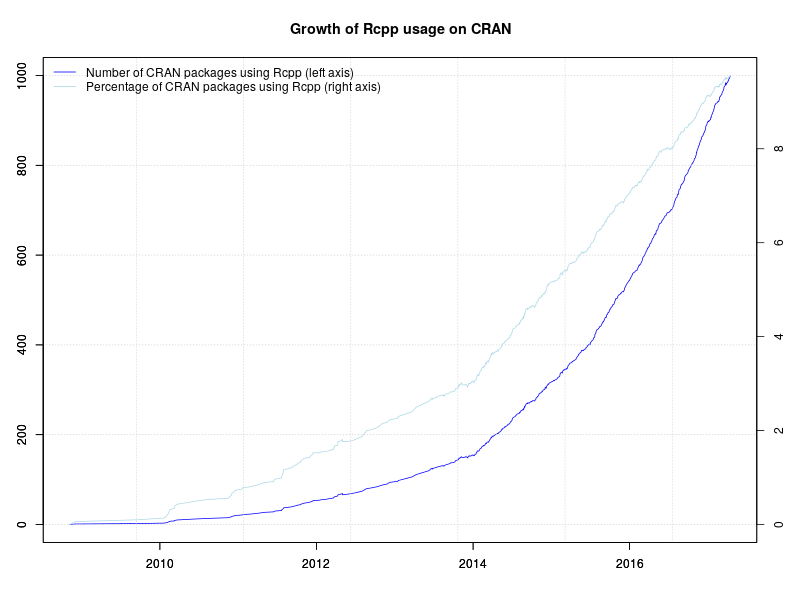
800 Rcpp packages Moments ago Rcpp passed a big milestone as there are now 1000 packages on CRAN depending on it (as measured by Depends, Imports and LinkingTo, but excluding Suggests). The graph is on the left depicts the growth of Rcpp usage over time. One easy way to compute such reverse dependency counts is the tools::dependsOnPkgs() function that was just mentioned in yesterday's R^4 blog post. Another way is to use the reverse_dependencies_with_maintainers() function from this helper scripts file on CRAN. Lastly, devtools has a function revdep() but it has the wrong default parameters as it includes Suggests: which you'd have to override to get the count I use here (it currently gets 1012 in this wider measure). Rcpp cleared 300 packages in November 2014. It passed 400 packages in June 2015 (when I only tweeted about it), 500 packages in late October 2015, 600 packages last March, 700 packages last July, 800 packages last October and 900 packages early January. The chart extends to the very beginning via manually compiled data from CRANberries and checked with crandb. The next part uses manually saved entries. The core (and by far largest) part of the data set was generated semi-automatically via a short script appending updates to a small file-based backend. A list of packages using Rcpp is kept on this page. Also displayed in the graph is the relative proportion of CRAN packages using Rcpp. The four per-cent hurdle was cleared just before useR! 2014 where I showed a similar graph (as two distinct graphs) in my invited talk. We passed five percent in December of 2014, six percent July of 2015, seven percent just before Christmas 2015, eight percent last summer, and nine percent mid-December 2016. Ten percent is next; we may get there during the summer. 1000 user packages is a really large number. This puts a whole lot of responsibility on us in the Rcpp team as we continue to keep Rcpp as performant and reliable as it has been. And with that a very big Thank You! to all users and contributors of Rcpp for help, suggestions, bug reports, documentation or, of course, code.

This post by Dirk Eddelbuettel originated on his Thinking inside the box blog. Please report excessive re-aggregation in third-party for-profit settings.

Gunnar Wolf: On Dmitry Bogatov and empowering privacy-protecting tools

There is a thorny topic we have been discussing in nonpublic channels (say, the debian-private mailing list... It is impossible to call it a private list if it has close to a thousand subscribers, but it sometimes deals with sensitive material) for the last week. We have finally confirmation that we can bring this topic out to the open, and I expect several Debian people to talk about this. Besides, this information is now repeated all over the public Internet, so I'm not revealing anything sensitive. Oh, and there is a statement regarding Dmitry Bogatov published by the Tor project But I'll get to Tor soon. One week ago, the 25-year old mathematician and Debian Maintainer Dmitry Bogatov was arrested, accused of organizing riots and calling for terrorist activities. Every evidence so far points to the fact that Dmitry is not guilty of what he is charged of He was filmed at different places at the times where the calls for terrorism happened. It seems that Dmitry was arrested because he runs a Tor exit node. I don't know the current situation in Russia, nor his political leanings But I do know what a Tor exit node looks like. I even had one at home for a short while. What is Tor? It is a network overlay, meant for people to hide where they come from or who they are. Why? There are many reasons Uninformed people will talk about the evil wrongdoers (starting the list of course with the drug sellers or child porn distributors). People who have taken their time to understand what this is about will rather talk about people for whom free speech is not a given; journalists, political activists, whistleblowers. And also, about regular people Many among us have taken the habit of doing some of our Web surfing using Tor (probably via the very fine and interesting TAILS distribution The Amnesiac Incognito Live System), just to increase the entropy, and just because we can, because we want to preserve the freedom to be anonymous before it's taken away from us. There are many types of nodes in Tor; most of them are just regular users or bridges that forward traffic, helping Tor's anonymization. Exit nodes, where packets leave the Tor network and enter the regular Internet, are much scarcer Partly because they can be quite problematic to people hosting them. But, yes, Tor needs more exit nodes, not just for bandwidth sake, but because the more exit nodes there are, the harder it is for a hostile third party to monitor a sizable number of them for activity (and break the anonymization). I am coincidentially starting a project with a group of students of my Faculty (we want to breathe life again into LIDSOL - Laboratorio de Investigaci n y Desarrollo de Software Libre). As we are just starting, they are documenting some technical and social aspects of the need for privacy and how Tor works; I expect them to publish their findings in El Nigromante soon (which means... what? ), but definitively, part of what we want to do is to set up a Tor exit node at the university Well documented and with enough academic justification to avoid our network operation area ordering us to shut it down. Lets see what happens :) Anyway, all in all Dmitry is in for a heavy time. He has been detained pre-trial at least until June, and he faces quite serious charges. He has done a lot of good, specialized work for the whole world to benefit. So, given I cannot do more, I'm just speaking my mind here in this space. [Update] Dmitry's case has been covered in LWN. There is also a statement concerning the arrest of Dmitry Bogatov by the Debian project. This case is also covered at The Register.

Dirk Eddelbuettel: #5: Easy package information

Welcome to the fifth post in the recklessly rambling R rants series, or R4 for short. The third post showed an easy way to follow R development by monitoring (curated) changes on the NEWS file for the development version r-devel. As a concrete example, I mentioned that it has shown a nice new function (tools::CRAN_package_db()) coming up in R 3.4.0. Today we will build on that. Consider the following short snippet:
library(data.table)
getPkgInfo <- function()  
    if (exists("tools::CRAN_package_db"))  
        dat <- tools::CRAN_package_db()
      else  
        tf <- tempfile()
        download.file("https://cloud.r-project.org/src/contrib/PACKAGES.rds", tf, quiet=TRUE)
        dat <- readRDS(tf)              # r-devel can now readRDS off a URL too
     
    dat <- as.data.frame(dat)
    setDT(dat)
    dat
 
It defines a simple function getPkgInfo() as a wrapper around said new function from R 3.4.0, ie tools::CRAN_package_db(), and a fallback alternative using a tempfile (in the automagically cleaned R temp directory) and an explicit download and read of the underlying RDS file. As an aside, just this week the r-devel NEWS told us that such readRDS() operations can now read directly from URL connection. Very nice---as RDS is a fantastic file format when you are working in R. Anyway, back to the RDS file! The snippet above returns a data.table object with as many rows as there are packages on CRAN, and basically all their (parsed !!) DESCRIPTION info and then some. A gold mine! Consider this to see how many package have a dependency (in the sense of Depends, Imports or LinkingTo, but not Suggests because Suggests != Depends) on Rcpp:
R> dat <- getPkgInfo()
R> rcppRevDepInd <- as.integer(tools::dependsOnPkgs("Rcpp", recursive=FALSE, installed=dat))
R> length(rcppRevDepInd)
[1] 998
R>
So exciting---we will hit 1000 within days! But let's do some more analysis:
R> dat[ rcppRevDepInd, RcppRevDep := TRUE]  # set to TRUE for given set
R> dat[ RcppRevDep==TRUE, 1:2]
           Package Version
  1:      ABCoptim  0.14.0
  2: AbsFilterGSEA     1.5
  3:           acc   1.3.3
  4: accelerometry   2.2.5
  5:      acebayes   1.3.4
 ---                      
994:        yakmoR   0.1.1
995:  yCrypticRNAs  0.99.2
996:         yuima   1.5.9
997:           zic     0.9
998:       ziphsmm   1.0.4
R>
Here we index the reverse dependency using the vector we had just computed, and then that new variable to subset the data.table object. Given the aforementioned parsed information from all the DESCRIPTION files, we can learn more:
R> ## likely false entries
R> dat[ RcppRevDep==TRUE, ][NeedsCompilation!="yes", c(1:2,4)]
            Package Version                                                                         Depends
 1:         baitmet   1.0.0                                                           Rcpp, erah (>= 1.0.5)
 2:           bea.R   1.0.1                                                        R (>= 3.2.1), data.table
 3:            brms   1.6.0                     R (>= 3.2.0), Rcpp (>= 0.12.0), ggplot2 (>= 2.0.0), methods
 4: classifierplots   1.3.3                             R (>= 3.1), ggplot2 (>= 2.2), data.table (>= 1.10),
 5:           ctsem   2.3.1                                           R (>= 3.2.0), OpenMx (>= 2.3.0), Rcpp
 6:        DeLorean   1.2.4                                                  R (>= 3.0.2), Rcpp (>= 0.12.0)
 7:            erah   1.0.5                                                               R (>= 2.10), Rcpp
 8:             GxM     1.1                                                                              NA
 9:             hmi   0.6.3                                                                    R (>= 3.0.0)
10:        humarray     1.1 R (>= 3.2), NCmisc (>= 1.1.4), IRanges (>= 1.22.10),\nGenomicRanges (>= 1.16.4)
11:         iNextPD   0.3.2                                                                    R (>= 3.1.2)
12:          joinXL   1.0.1                                                                    R (>= 3.3.1)
13:            mafs   0.0.2                                                                              NA
14:            mlxR   3.1.0                                                           R (>= 3.0.1), ggplot2
15:    RmixmodCombi     1.0              R(>= 3.0.2), Rmixmod(>= 2.0.1), Rcpp(>= 0.8.0), methods,\ngraphics
16:             rrr   1.0.0                                                                    R (>= 3.2.0)
17:        UncerIn2     2.0                          R (>= 3.0.0), sp, RandomFields, automap, fields, gstat
R> 
There are a full seventeen packages which claim to depend on Rcpp while not having any compiled code of their own. That is likely false---but I keep them in my counts, however relunctantly. A CRAN-declared Depends: is a Depends:, after all. Another nice thing to look at is the total number of package that declare that they need compilation:
R> ## number of packages with compiled code
R> dat[ , .(N=.N), by=NeedsCompilation]
   NeedsCompilation    N
1:               no 7625
2:              yes 2832
3:               No    1
R>
Isn't that awesome? It is 2832 out of (currently) 10458, or about 27.1%. Just over one in four. Now the 998 for Rcpp look even better as they are about 35% of all such packages. In order words, a little over one third of all packages with compiled code (which may be legacy C, Fortran or C++) use Rcpp. Wow. Before closing, one shoutout to Dirk Schumacher whose thankr which I made the center of the last post is now on CRAN. As a mighty fine and slim micropackage without external dependencies. Neat.

This post by Dirk Eddelbuettel originated on his Thinking inside the box blog. Please report excessive re-aggregation in third-party for-profit settings.

14 April 2017

Dirk Eddelbuettel: RcppArmadillo 0.7.800.2.0

armadillo image A new RcppArmadillo version 0.7.800.2.0 is now on CRAN. Armadillo is a powerful and expressive C++ template library for linear algebra aiming towards a good balance between speed and ease of use with a syntax deliberately close to a Matlab. RcppArmadillo integrates this library with the R environment and language--and is widely used by (currently) 318 other packages on CRAN -- an increase of 20 just since the last CRAN release of 0.7.600.1.0 in December! Changes in this release relative to the previous CRAN release are as follows:

Changes in RcppArmadillo version 0.7.800.2.0 (2017-04-12)
  • Upgraded to Armadillo release 7.800.2 (Rogue State Redux)
    • The Armadillo license changed to Apache License 2.0
  • The DESCRIPTION file now mentions the Apache License 2.0, as well as the former MPL2 license used for earlier releases.
  • A new file init.c was added with calls to R_registerRoutines() and R_useDynamicSymbols()
  • Symbol registration is enabled in useDynLib
  • The fastLm example was updated

Courtesy of CRANberries, there is a diffstat report. More detailed information is on the RcppArmadillo page. Questions, comments etc should go to the rcpp-devel mailing list off the R-Forge page.

This post by Dirk Eddelbuettel originated on his Thinking inside the box blog. Please report excessive re-aggregation in third-party for-profit settings.

11 April 2017

Matthew Garrett: Disabling SSL validation in binary apps

Reverse engineering protocols is a great deal easier when they're not encrypted. Thankfully most apps I've dealt with have been doing something convenient like using AES with a key embedded in the app, but others use remote protocols over HTTPS and that makes things much less straightforward. MITMProxy will solve this, as long as you're able to get the app to trust its certificate, but if there's a built-in pinned certificate that's going to be a pain. So, given an app written in C running on an embedded device, and without an easy way to inject new certificates into that device, what do you do?

First: The app is probably using libcurl, because it's free, works and is under a license that allows you to link it into proprietary apps. This is also bad news, because libcurl defaults to having sensible security settings. In the worst case we've got a statically linked binary with all the symbols stripped out, so we're left with the problem of (a) finding the relevant code and (b) replacing it with modified code. Fortuntely, this is much less difficult than you might imagine.

First, let's find where curl sets up its defaults. Curl_init_userdefined() in curl/lib/url.c has the following code:
set->ssl.primary.verifypeer = TRUE;
set->ssl.primary.verifyhost = TRUE;
#ifdef USE_TLS_SRP
set->ssl.authtype = CURL_TLSAUTH_NONE;
#endif
set->ssh_auth_types = CURLSSH_AUTH_DEFAULT; /* defaults to any auth
type */
set->general_ssl.sessionid = TRUE; /* session ID caching enabled by
default */
set->proxy_ssl = set->ssl;

set->new_file_perms = 0644; /* Default permissions */
set->new_directory_perms = 0755; /* Default permissions */

TRUE is defined as 1, so we want to change the code that currently sets verifypeer and verifyhost to 1 to instead set them to 0. How to find it? Look further down - new_file_perms is set to 0644 and new_directory_perms is set to 0755. The leading 0 indicates octal, so these correspond to decimal 420 and 493. Passing the file to objdump -d (assuming a build of objdump that supports this architecture) will give us a disassembled version of the code, so time to fix our problems with grep:
objdump -d target grep --after=20 ,420 grep ,493

This gives us the disassembly of target, searches for any occurrence of ",420" (indicating that 420 is being used as an argument in an instruction), prints the following 20 lines and then searches for a reference to 493. It spits out a single hit:
43e864: 240301ed li v1,493
Which is promising. Looking at the surrounding code gives:
43e820: 24030001 li v1,1
43e824: a0430138 sb v1,312(v0)
43e828: 8fc20018 lw v0,24(s8)
43e82c: 24030001 li v1,1
43e830: a0430139 sb v1,313(v0)
43e834: 8fc20018 lw v0,24(s8)
43e838: ac400170 sw zero,368(v0)
43e83c: 8fc20018 lw v0,24(s8)
43e840: 2403ffff li v1,-1
43e844: ac4301dc sw v1,476(v0)
43e848: 8fc20018 lw v0,24(s8)
43e84c: 24030001 li v1,1
43e850: a0430164 sb v1,356(v0)
43e854: 8fc20018 lw v0,24(s8)
43e858: 240301a4 li v1,420
43e85c: ac4301e4 sw v1,484(v0)
43e860: 8fc20018 lw v0,24(s8)
43e864: 240301ed li v1,493
43e868: ac4301e8 sw v1,488(v0)

Towards the end we can see 493 being loaded into v1, and v1 then being copied into an offset from v0. This looks like a structure member being set to 493, which is what we expected. Above that we see the same thing being done to 420. Further up we have some more stuff being set, including a -1 - that corresponds to CURLSSH_AUTH_DEFAULT, so we seem to be in the right place. There's a zero above that, which corresponds to CURL_TLSAUTH_NONE. That means that the two 1 operations above the -1 are the code we want, and simply changing 43e820 and 43e82c to 24030000 instead of 24030001 means that our targets will be set to 0 (ie, FALSE) rather than 1 (ie, TRUE). Copy the modified binary back to the device, run it and now it happily talks to MITMProxy. Huge success.

(If the app calls Curl_setopt() to reconfigure the state of these values, you'll need to stub those out as well - thankfully, recent versions of curl include a convenient string "CURLOPT_SSL_VERIFYHOST no longer supports 1 as value!" in this function, so if the code in question is using semi-recent curl it's easy to find. Then it's just a matter of looking for the constants that CURLOPT_SSL_VERIFYHOST and CURLOPT_SSL_VERIFYPEER are set to, following the jumps and hacking the code to always set them to 0 regardless of the argument)

comment count unavailable comments

Sean Whitton: coffeereddit

Most people I know can handle a single coffee per day, sometimes even forgetting to drink it. I never could understand how they did it. Talking about this with a therapist I realised that the problem isn t necessary the caffeine, it s my low tolerance of less than razor sharp focus. Most people accept they have slumps in their focus and just work through them. binarybear on reddit

8 April 2017

Dirk Eddelbuettel: #4: Simpler shoulders()

Welcome to the fourth post in the repulsively random R ramblings series, or R4 for short. My twitter feed was buzzing about a nice (and as yet unpublished, ie not-on-CRAN) package thankr by Dirk Schumacher which compiles a list of packages (ordered by maintainer count) for your current session (or installation or ...) with a view towards saying thank you to those whose packages we rely upon. Very nice indeed. I had a quick look and run it twice ... and had a reaction of ewwww, really? as running it twice gave different results as on the second instance a boatload of tibblyverse packages appeared. Because apparently kids these day can only slice data that has been tidied or something. So I had another quick look ... and put together an alternative version using just base R (as there was only one subfunction that needed reworking):
source(file="https://raw.githubusercontent.com/dirkschumacher/thankr/master/R/shoulders.R")
format_pkg_df <- function(df)   # non-tibblyverse variant
    tb <- table(df[,2])
    od <- order(tb, decreasing=TRUE)
    ndf <- data.frame(maint=names(tb)[od], npkgs=as.integer(tb[od]))
    colpkgs <- function(m, df)   paste(df[ df$maintainer == m, "pkg_name"], collapse=",")  
    ndf[, "pkg"] <- sapply(ndf$maint, colpkgs, df)
    ndf
 
A nice side benefit is that the function is now free of external dependencies (besides, of course, base R). Running this in the ESS session I had open gives:
R> shoulders()  ## by Dirk Schumacher, with small modifications
                               maint npkgs                                                                 pkg
1 R Core Team <R-core@r-project.org>     9 compiler,graphics,tools,utils,grDevices,stats,datasets,methods,base
2 Dirk Eddelbuettel <edd@debian.org>     4                                  RcppTOML,Rcpp,RApiDatetime,anytime
3  Matt Dowle <mattjdowle@gmail.com>     1                                                          data.table
R> 
and for good measure a screenshot is below:
I think we need a catchy moniker for R work using good old base R. SoberVerse? GrumbyOldFolksR? PlainOldR? Better suggestions welcome. Edit on 2017-04-09: And by now Dirk Schumacher fixed that little bug in thankr which was at the start of this. His shoulders() function is now free of side effects, and thankr is now a clean micropackage free of external depends from any verse, be it tiddly or grumpy. I look forward to seeing it on CRAN soon!

This post by Dirk Eddelbuettel originated on his Thinking inside the box blog. Please report excessive re-aggregation in third-party for-profit settings.

7 April 2017

Dirk Eddelbuettel: #3: Follow R-devel

Welcome to the third post in the rarely relevant R recommendation series, or R4 for short. Today will be brief, but of some importance. In order to know where R is going next, few places provide a better vantage point than the actual ongoing development. A few years ago, I mentioned to Duncan Murdoch how straightforward the setup of my CRANberries feed (and site) was. After all, static blog compilers converting textual input to html, rss feed and whatnot have been around for fifteen years (though they keep getting reinvented). He took this to heart and built the (not too pretty) R-devel daily site (which also uses a fancy diff tool as it shows changes in NEWS) as well as a more general description of all available sub-feeds. I follow this mostly through blog aggregations -- Google Reader in its day, now Feedly. A screenshot is below just to show that it doesn't have to be ugly just because it is on them intertubes:
This shows a particularly useful day when R-devel folded into the new branch for what will be the R 3.4.0 release come April 21. The list of upcoming changes is truly impressive and quite comprehensive -- and the package registration helper, focus of posts #1 and #2 here, is but one of these many changes. One function I learned about that day is tools::CRAN_package_db(), a helper to get a single (large) data.frame with all package DESCRIPTION information. Very handy. Others may have noticed that CRAN repos now have a new top-level file PACKAGES.rds and this function does indeed just fetch it--which you could do with a similar one-liner in R-release as well. Still very handy. But do read about changes in R-devel and hence upcoming changes in R 3.4.0. Lots of good things coming our way.

This post by Dirk Eddelbuettel originated on his Thinking inside the box blog. Please report excessive re-aggregation in third-party for-profit settings.

Next.

Previous.