Search Results: "cas"

27 April 2023

Jonathan McDowell: Repurposing my C.H.I.P.

Way back at DebConf16 Gunnar managed to arrange for a number of Next Thing Co. C.H.I.P. boards to be distributed to those who were interested. I was lucky enough to be amongst those who received one, but I have to confess after some initial experimentation it ended up sitting in its box unused. The reasons for that were varied; partly about not being quite sure what best to do with it, partly due to a number of limitations it had, partly because NTC sadly went insolvent and there was less momentum around the hardware. I ve always meant to go back to it, poking it every now and then but never completing a project. I m finally almost there, and I figure I should write some of it up. TL;DR: My C.H.I.P. is currently running a mainline Linux 6.3 kernel with only a few DTS patches, an upstream u-boot v2022.1 with a couple of minor patches and an unmodified Debian bullseye armhf userspace.

Storage The main issue with the C.H.I.P. is that it uses MLC NAND, in particular mine has an 8MB H27QCG8T2E5R. That ended up unsupported in Linux, with the UBIFS folk disallowing operation on MLC devices. There s been subsequent work to enable an SLC emulation mode which makes the device more reliable at the cost of losing capacity by pairing up writes/reads in cells (AFAICT). Some of this hit for the H27UCG8T2ETR in 5.16 kernels, but I definitely did some experimentation with 5.17 without having much success. I should maybe go back and try again, but I ended up going a different route. It turned out that BytePorter had documented how to add a microSD slot to the NTC C.H.I.P., using just a microSD to full SD card adapter. Every microSD card I buy seems to come with one of these, so I had plenty lying around to test with. I started with ensuring the kernel could see it ok (by modifying the device tree), but once that was all confirmed I went further and built a more modern u-boot that talked to the SD card, and defaulted to booting off it. That meant no more relying on the internal NAND at all! I do see some flakiness with the SD card, which is possibly down to the dodgy way it s hooked up (I should probably do a basic PCB layout with JLCPCB instead). That s mostly been mitigated by forcing it into 1-bit mode instead of 4-bit mode (I tried lowering the frequency too, but that didn t make a difference). The problem manifests as:
sunxi-mmc 1c11000.mmc: data error, sending stop command
and then all storage access freezing (existing logins still work, if the program you re trying to run is in cache). I can t find a conclusive software solution to this; I m pretty sure it s the hardware, but I don t understand why the recovery doesn t generally work.

Random power offs After I had storage working I d see random hangs or power offs. It wasn t quite clear what was going on. So I started trying to work out how to find out the CPU temperature, in case it was overheating. It turns out the temperature sensor on the R8 is part of the touchscreen driver, and I d taken my usual approach of turning off all the drivers I didn t think I d need. Enabling it (CONFIG_TOUCHSCREEN_SUN4I) gave temperature readings and seemed to help somewhat with stability, though not completely. Next I ended up looking at the AXP209 PMIC. There were various scripts still installed (I d started out with the NTC Debian install and slowly upgraded it to bullseye while stripping away the obvious pieces I didn t need) and a start-up script called enable-no-limit. This turned out to not be running (some sort of expectation of i2c-dev being loaded and another failing check), but looking at the script and the data sheet revealed the issue. The AXP209 can cope with 3 power sources; an external DC source, a Li-battery, and finally a USB port. I was powering my board via the USB port, using a charger rated for 2A. It turns out that the AXP209 defaults to limiting USB current to 900mA, and that with wifi active and the CPU busy the C.H.I.P. can rise above that. At which point the AXP shuts everything down. Armed with that info I was able to understand what the power scripts were doing and which bit I needed - i2cset -f -y 0 0x34 0x30 0x03 to set no limit and disable the auto-power off. Additionally I also discovered that the AXP209 had a built in temperature sensor as well, so I added support for that via iio-hwmon.

WiFi WiFi on the C.H.I.P. is provided by an RTL8723BS SDIO attached device. It s terrible (and not just here, I had an x86 based device with one where it also sucked). Thankfully there s a driver in staging in the kernel these days, but I ve still found it can fall out with my house setup, end up connecting to a further away AP which then results in lots of retries, dropped frames and CPU consumption. Nailing it to the AP on the other side of the wall from where it is helps. I haven t done any serious testing with the Bluetooth other than checking it s detected and can scan ok.

Patches I patched u-boot v2022.01 (which shows you how long ago I was trying this out) with the following to enable boot from external SD:
u-boot C.H.I.P. external SD patch
diff --git a/arch/arm/dts/sun5i-r8-chip.dts b/arch/arm/dts/sun5i-r8-chip.dts
index 879a4b0f3b..1cb3a754d6 100644
--- a/arch/arm/dts/sun5i-r8-chip.dts
+++ b/arch/arm/dts/sun5i-r8-chip.dts
@@ -84,6 +84,13 @@
 		reset-gpios = <&pio 2 19 GPIO_ACTIVE_LOW>; /* PC19 */
 	 ;
 
+	mmc2_pins_e: mmc2@0  
+		pins = "PE4", "PE5", "PE6", "PE7", "PE8", "PE9";
+		function = "mmc2";
+		drive-strength = <30>;
+		bias-pull-up;
+	 ;
+
 	onewire  
 		compatible = "w1-gpio";
 		gpios = <&pio 3 2 GPIO_ACTIVE_HIGH>; /* PD2 */
@@ -175,6 +182,16 @@
 	status = "okay";
  ;
 
+&mmc2  
+	pinctrl-names = "default";
+	pinctrl-0 = <&mmc2_pins_e>;
+	vmmc-supply = <&reg_vcc3v3>;
+	vqmmc-supply = <&reg_vcc3v3>;
+	bus-width = <4>;
+	broken-cd;
+	status = "okay";
+ ;
+
 &ohci0  
 	status = "okay";
  ;
diff --git a/arch/arm/include/asm/arch-sunxi/gpio.h b/arch/arm/include/asm/arch-sunxi/gpio.h
index f3ab1aea0e..c0dfd85a6c 100644
--- a/arch/arm/include/asm/arch-sunxi/gpio.h
+++ b/arch/arm/include/asm/arch-sunxi/gpio.h
@@ -167,6 +167,7 @@ enum sunxi_gpio_number  
 
 #define SUN8I_GPE_TWI2		3
 #define SUN50I_GPE_TWI2		3
+#define SUNXI_GPE_SDC2		4
 
 #define SUNXI_GPF_SDC0		2
 #define SUNXI_GPF_UART0		4
diff --git a/board/sunxi/board.c b/board/sunxi/board.c
index fdbcd40269..f538cb7e20 100644
--- a/board/sunxi/board.c
+++ b/board/sunxi/board.c
@@ -433,9 +433,9 @@ static void mmc_pinmux_setup(int sdc)
 			sunxi_gpio_set_drv(pin, 2);
 		 
 #elif defined(CONFIG_MACH_SUN5I)
-		/* SDC2: PC6-PC15 */
-		for (pin = SUNXI_GPC(6); pin <= SUNXI_GPC(15); pin++)  
-			sunxi_gpio_set_cfgpin(pin, SUNXI_GPC_SDC2);
+		/* SDC2: PE4-PE9 */
+		for (pin = SUNXI_GPE(4); pin <= SUNXI_GPE(9); pin++)  
+			sunxi_gpio_set_cfgpin(pin, SUNXI_GPE_SDC2);
 			sunxi_gpio_set_pull(pin, SUNXI_GPIO_PULL_UP);
 			sunxi_gpio_set_drv(pin, 2);
 		 

I ve sent some patches for the kernel device tree upstream - there s an outstanding issue with the Bluetooth wake GPIO causing the serial port not to probe(!) that I need to resolve before sending a v2, but what s there works for me. The only remaining piece is patch to enable the external SD for Linux; I don t think it s appropriate to send upstream but it s fairly basic. This limits the bus to 1 bit rather than the 4 bits it s capable of, as mentioned above.
Linux C.H.I.P. external SD DTS patch diff diff --git a/arch/arm/boot/dts/sun5i-r8-chip.dts b/arch/arm/boot/dts/sun5i-r8-chip.dts index fd37bd1f3920..2b5aa4952620 100644 --- a/arch/arm/boot/dts/sun5i-r8-chip.dts +++ b/arch/arm/boot/dts/sun5i-r8-chip.dts @@ -163,6 +163,17 @@ &mmc0 status = "okay"; ; +&mmc2 + pinctrl-names = "default"; + pinctrl-0 = <&mmc2_4bit_pe_pins>; + vmmc-supply = <&reg_vcc3v3>; + vqmmc-supply = <&reg_vcc3v3>; + bus-width = <1>; + non-removable; + disable-wp; + status = "okay"; + ; + &ohci0 status = "okay"; ;

As for what I m doing with it, I think that ll have to be a separate post.

Simon Josefsson: A Security Device Threat Model: The Substitution Attack

I d like to describe and discuss a threat model for computational devices. This is generic but we will narrow it down to security-related devices. For example, portable hardware dongles used for OpenPGP/OpenSSH keys, FIDO/U2F, OATH HOTP/TOTP, PIV, payment cards, wallets etc and more permanently attached devices like a Hardware Security Module (HSM), a TPM-chip, or the hybrid variant of a mostly permanently-inserted but removable hardware security dongles. Our context is cryptographic hardware engineering, and the purpose of the threat model is to serve as as a thought experiment for how to build and design security devices that offer better protection. The threat model is related to the Evil maid attack. Our focus is to improve security for the end-user rather than the traditional focus to improve security for the organization that provides the token to the end-user, or to improve security for the site that the end-user is authenticating to. This is a critical but often under-appreciated distinction, and leads to surprising recommendations related to onboard key generation, randomness etc below.

The Substitution Attack
An attacker is able to substitute any component of the device (hardware or software) at any time for any period of time.
Your takeaway should be that devices should be designed to mitigate harmful consequences if any component of the device (hardware or software) is substituted for a malicious component for some period of time, at any time, during the lifespan of that component. Some designs protect better against this attack than other designs, and the threat model can be used to understand which designs are really bad, and which are less so.

Terminology The threat model involves at least one device that is well-behaving and one that is not, and we call these Good Device and Bad Device respectively. The bad device may be the same physical device as the good key, but with some minor software modification or a minor component replaced, but could also be a completely separate physical device. We don t care about that distinction, we just care if a particular device has a malicious component in it or not. I ll use terms like security device , device , hardware key , security co-processor etc interchangeably. From an engineering point of view, malicious here includes unintentional behavior such as software or hardware bugs. It is not possible to differentiate an intentionally malicious device from a well-designed device with a critical bug. Don t attribute to malice what can be adequately explained by stupidity, but don t na vely attribute to stupidity what may be deniable malicious.

What is some period of time ? Some period of time can be any length of time: seconds, minutes, days, weeks, etc. It may also occur at any time: During manufacturing, during transportation to the user, after first usage by the user, or after a couple of months usage by the user. Note that we intentionally consider time-of-manufacturing as a vulnerable phase. Even further, the substitution may occur multiple times. So the Good Key may be replaced with a Bad Key by the attacker for one day, then returned, and later this repeats a month later.

What is harmful consequences ? Since a security key has a fairly well-confined scope and purpose, we can get a fairly good exhaustive list of things that could go wrong. Harmful consequences include:
  • Attacker learns any secret keys stored on a Good Key.
  • Attacker causes user to trust a public generated by a Bad Key.
  • Attacker is able to sign something using a Good Key.
  • Attacker learns the PIN code used to unlock a Good Key.
  • Attacker learns data that is decrypted by a Good Key.

Thin vs Deep solutions One approach to mitigate many issues arising from device substitution is to have the host (or remote site) require that the device prove that it is the intended unique device before it continues to talk to it. This require an authentication/authorization protocol, which usually involves unique device identity and out-of-band trust anchors. Such trust anchors is often problematic, since a common use-case for security device is to connect it to a host that has never seen the device before. A weaker approach is to have the device prove that it merely belongs to a class of genuine devices from a trusted manufacturer, usually by providing a signature generated by a device-specific private key signed by the device manufacturer. This is weaker since then the user cannot differentiate two different good devices. In both cases, the host (or remote site) would stop talking to the device if it cannot prove that it is the intended key, or at least belongs to a class of known trusted genuine devices. Upon scrutiny, this solution is still vulnerable to a substitution attack, just earlier in the manufacturing chain: how can the process that injects the per-device or per-class identities/secrets know that it is putting them into a good key rather than a malicious device? Consider also the consequences if the cryptographic keys that guarantee that a device is genuine leaks. The model of the thin solution is similar to the old approach to network firewalls: have a filtering firewall that only lets through intended traffic, and then run completely insecure protocols internally such as telnet. The networking world has evolved, and now we have defense in depth: even within strongly firewall ed networks, it is prudent to run for example SSH with publickey-based user authentication even on locally physical trusted networks. This approach requires more thought and adds complexity, since each level has to provide some security checking. I m arguing we need similar defense-in-depth for security devices. Security key designs cannot simply dodge this problem by assuming it is working in a friendly environment where component substitution never occur.

Example: Device authentication using PIN codes To see how this threat model can be applied to reason about security key designs, let s consider a common design. Many security keys uses PIN codes to unlock private key operations, for example on OpenPGP cards that lacks built-in PIN-entry functionality. The software on the computer just sends a PIN code to the device, and the device allows private-key operations if the PIN code was correct. Let s apply the substitution threat model to this design: the attacker replaces the intended good key with a malicious device that saves a copy of the PIN code presented to it, and then gives out error messages. Once the user has entered the PIN code and gotten an error message, presumably temporarily giving up and doing other things, the attacker replaces the device back again. The attacker has learnt the PIN code, and can later use this to perform private-key operations on the good device. This means a good design involves not sending PIN codes in clear, but use a stronger authentication protocol that allows the card to know that the PIN was correct without learning the PIN. This is implemented optionally for many OpenPGP cards today as the key-derivation-function extension. That should be mandatory, and users should not use setups that sends device authentication in the clear, and ultimately security devices should not even include support for that. Compare how I build Gnuk on my PGP card with the kdf_do=required option.

Example: Onboard non-predictable key-generation Many devices offer both onboard key-generation, for example OpenPGP cards that generate a Ed25519 key internally on the devices, or externally where the device imports an externally generated cryptographic key. Let s apply the subsitution threat model to this design: the user wishes to generate a key and trust the public key that came out of that process. The attacker substitutes the device for a malicious device during key-generation, imports the private key into a good device and gives that back to the user. Most of the time except during key generation the user uses a good device but still the attacker succeeded in having the user trust a public key which the attacker knows the private key for. The substitution may be a software modification, and the method to leak the private key to the attacker may be out-of-band signalling. This means a good design never generates key on-board, but imports them from a user-controllable environment. That approach should be mandatory, and users should not use setups that generates private keys on-board, and ultimately security devices should not even include support for that.

Example: Non-predictable randomness-generation Many devices claims to generate random data, often with elaborate design documents explaining how good the randomness is. Let s apply the substitution threat model to this design: the attacker replaces the intended good key with a malicious design that generates (for the attacker) predictable randomness. The user will never be able to detect the difference since the random output is, well, random, and typically not distinguishable from weak randomness. The user cannot know if any cryptographic keys generated by a generator was faulty or not. This means a good design never generates non-predictable randomness on the device. That approach should be mandatory, and users should not use setups that generates non-predictable randomness on the device, and ideally devices should not have this functionality.

Case-Study: Tillitis I have warmed up a bit for this. Tillitis is a new security device with interesting properties, and core to its operation is the Compound Device Identifier (CDI), essentially your Ed25519 private key (used for SSH etc) is derived from the CDI that is computed like this:
cdi = blake2s(UDS, blake2s(device_app), USS)
Let s apply the substitution threat model to this design: Consider someone replacing the Tillitis key with a malicious key during postal delivery of the key to the user, and the replacement device is identical with the real Tillitis key but implements the following key derivation function:
cdi = weakprng(UDS , weakprng(device_app), USS)
Where weakprng is a compromised algorithm that is predictable for the attacker, but still appears random. Everything will work correctly, but the attacker will be able to learn the secrets used by the user, and the user will typically not be able to tell the difference since the CDI is secret and the Ed25519 public key is not self-verifiable.

Conclusion Remember that it is impossible to fully protect against this attack, that s why it is merely a thought experiment, intended to be used during design of these devices. Consider an attacker that never gives you access to a good key and as a user you only ever use a malicious device. There is no way to have good security in this situation. This is not hypothetical, many well-funded organizations do what they can to derive people from having access to trustworthy security devices. Philosophically it does not seem possible to tell if these organizations have succeeded 100% already and there are only bad security devices around where further resistance is futile, but to end on an optimistic note let s assume that there is a non-negligible chance that they haven t succeeded. In these situations, this threat model becomes useful to improve the situation by identifying less good designs, and that s why the design mantra of mitigate harmful consequences is crucial as a takeaway from this. Let s improve the design of security devices that further the security of its users!

Arturo Borrero Gonz lez: Kubecon and CloudNativeCon 2023 Europe summary

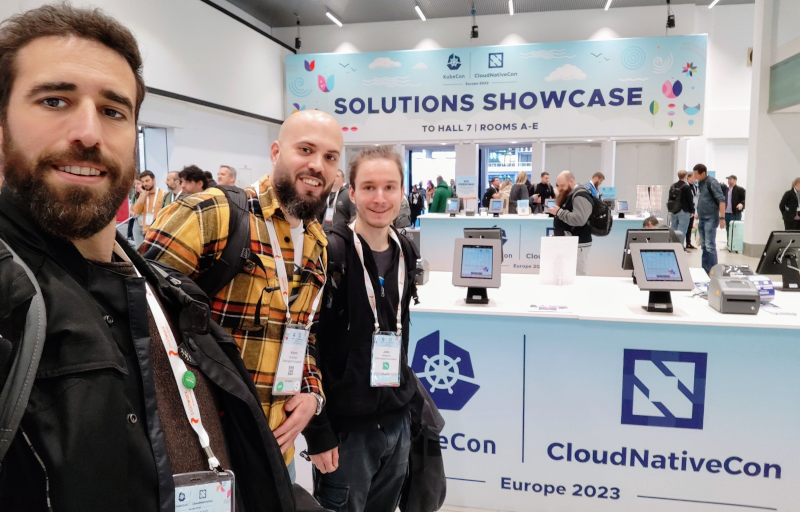
Post logo This post serves as a report from my attendance to Kubecon and CloudNativeCon 2023 Europe that took place in Amsterdam in April 2023. It was my second time physically attending this conference, the first one was in Austin, Texas (USA) in 2017. I also attended once in a virtual fashion. The content here is mostly generated for the sake of my own recollection and learnings, and is written from the notes I took during the event. The very first session was the opening keynote, which reunited the whole crowd to bootstrap the event and share the excitement about the days ahead. Some astonishing numbers were announced: there were more than 10.000 people attending, and apparently it could confidently be said that it was the largest open source technology conference taking place in Europe in recent times. It was also communicated that the next couple iteration of the event will be run in China in September 2023 and Paris in March 2024. More numbers, the CNCF was hosting about 159 projects, involving 1300 maintainers and about 200.000 contributors. The cloud-native community is ever-increasing, and there seems to be a strong trend in the industry for cloud-native technology adoption and all-things related to PaaS and IaaS. The event program had different tracks, and in each one there was an interesting mix of low-level and higher level talks for a variety of audience. On many occasions I found that reading the talk title alone was not enough to know in advance if a talk was a 101 kind of thing or for experienced engineers. But unlike in previous editions, I didn t have the feeling that the purpose of the conference was to try selling me anything. Obviously, speakers would make sure to mention, or highlight in a subtle way, the involvement of a given company in a given solution or piece of the ecosystem. But it was non-invasive and fair enough for me. On a different note, I found the breakout rooms to be often small. I think there were only a couple of rooms that could accommodate more than 500 people, which is a fairly small allowance for 10k attendees. I realized with frustration that the more interesting talks were immediately fully booked, with people waiting in line some 45 minutes before the session time. Because of this, I missed a few important sessions that I ll hopefully watch online later. Finally, on a more technical side, I ve learned many things, that instead of grouping by session I ll group by topic, given how some subjects were mentioned in several talks. On gitops and CI/CD pipelines Most of the mentions went to FluxCD and ArgoCD. At that point there were no doubts that gitops was a mature approach and both flux and argoCD could do an excellent job. ArgoCD seemed a bit more over-engineered to be a more general purpose CD pipeline, and flux felt a bit more tailored for simpler gitops setups. I discovered that both have nice web user interfaces that I wasn t previously familiar with. However, in two different talks I got the impression that the initial setup of them was simple, but migrating your current workflow to gitops could result in a bumpy ride. This is, the challenge is not deploying flux/argo itself, but moving everything into a state that both humans and flux/argo can understand. I also saw some curious mentions to the config drifts that can happen in some cases, even if the goal of gitops is precisely for that to never happen. Such mentions were usually accompanied by some hints on how to operate the situation by hand. Worth mentioning, I missed any practical information about one of the key pieces to this whole gitops story: building container images. Most of the showcased scenarios were using pre-built container images, so in that sense they were simple. Building and pushing to an image registry is one of the two key points we would need to solve in Toolforge Kubernetes if adopting gitops. In general, even if gitops were already in our radar for Toolforge Kubernetes, I think it climbed a few steps in my priority list after the conference. Another learning was this site: https://opengitops.dev/. Group On etcd, performance and resource management I attended a talk focused on etcd performance tuning that was very encouraging. They were basically talking about the exact same problems we have had in Toolforge Kubernetes, like api-server and etcd failure modes, and how sensitive etcd is to disk latency, IO pressure and network throughput. Even though Toolforge Kubernetes scale is small compared to other Kubernetes deployments out there, I found it very interesting to see other s approaches to the same set of challenges. I learned how most Kubernetes components and apps can overload the api-server. Because even the api-server talks to itself. Simple things like kubectl may have a completely different impact on the API depending on usage, for example when listing the whole list of objects (very expensive) vs a single object. The conclusion was to try avoiding hitting the api-server with LIST calls, and use ResourceVersion which avoids full-dumps from etcd (which, by the way, is the default when using bare kubectl get calls). I already knew some of this, and for example the jobs-framework-emailer was already making use of this ResourceVersion functionality. There have been a lot of improvements in the performance side of Kubernetes in recent times, or more specifically, in how resources are managed and used by the system. I saw a review of resource management from the perspective of the container runtime and kubelet, and plans to support fancy things like topology-aware scheduling decisions and dynamic resource claims (changing the pod resource claims without re-defining/re-starting the pods). On cluster management, bootstrapping and multi-tenancy I attended a couple of talks that mentioned kubeadm, and one in particular was from the maintainers themselves. This was of interest to me because as of today we use it for Toolforge. They shared all the latest developments and improvements, and the plans and roadmap for the future, with a special mention to something they called kubeadm operator , apparently capable of auto-upgrading the cluster, auto-renewing certificates and such. I also saw a comparison between the different cluster bootstrappers, which to me confirmed that kubeadm was the best, from the point of view of being a well established and well-known workflow, plus having a very active contributor base. The kubeadm developers invited the audience to submit feature requests, so I did. The different talks confirmed that the basic unit for multi-tenancy in kubernetes is the namespace. Any serious multi-tenant usage should leverage this. There were some ongoing conversations, in official sessions and in the hallway, about the right tool to implement K8s-whitin-K8s, and vcluster was mentioned enough times for me to be convinced it was the right candidate. This was despite of my impression that multiclusters / multicloud are regarded as hard topics in the general community. I definitely would like to play with it sometime down the road. On networking I attended a couple of basic sessions that served really well to understand how Kubernetes instrumented the network to achieve its goal. The conference program had sessions to cover topics ranging from network debugging recommendations, CNI implementations, to IPv6 support. Also, one of the keynote sessions had a reference to how kube-proxy is not able to perform NAT for SIP connections, which is interesting because I believe Netfilter Conntrack could do it if properly configured. One of the conclusions on the CNI front was that Calico has a massive community adoption (in Netfilter mode), which is reassuring, especially considering it is the one we use for Toolforge Kubernetes. Slide On jobs I attended a couple of talks that were related to HPC/grid-like usages of Kubernetes. I was truly impressed by some folks out there who were using Kubernetes Jobs on massive scales, such as to train machine learning models and other fancy AI projects. It is acknowledged in the community that the early implementation of things like Jobs and CronJobs had some limitations that are now gone, or at least greatly improved. Some new functionalities have been added as well. Indexed Jobs, for example, enables each Job to have a number (index) and process a chunk of a larger batch of data based on that index. It would allow for full grid-like features like sequential (or again, indexed) processing, coordination between Job and more graceful Job restarts. My first reaction was: Is that something we would like to enable in Toolforge Jobs Framework? On policy and security A surprisingly good amount of sessions covered interesting topics related to policy and security. It was nice to learn two realities:
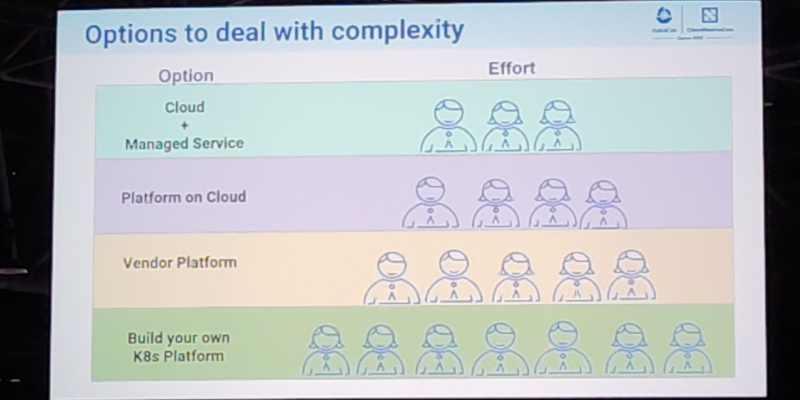

  1. kubernetes is capable of doing pretty much anything security-wise and create greatly secured environments.
  2. it does not by default. The defaults are not security-strict on purpose.
It kind of made sense to me: Kubernetes was used for a wide range of use cases, and developers didn t know beforehand to which particular setup they should accommodate the default security levels. One session in particular covered the most basic security features that should be enabled for any Kubernetes system that would get exposed to random end users. In my opinion, the Toolforge Kubernetes setup was already doing a good job in that regard. To my joy, some sessions referred to the Pod Security Admission mechanism, which is one of the key security features we re about to adopt (when migrating away from Pod Security Policy). I also learned a bit more about Secret resources, their current implementation and how to leverage a combo of CSI and RBAC for a more secure usage of external secrets. Finally, one of the major takeaways from the conference was learning about kyverno and kubeaudit. I was previously aware of the OPA Gatekeeper. From the several demos I saw, it was to me that kyverno should help us make Toolforge Kubernetes more sustainable by replacing all of our custom admission controllers with it. I already opened a ticket to track this idea, which I ll be proposing to my team soon. Final notes In general, I believe I learned many things, and perhaps even more importantly I re-learned some stuff I had forgotten because of lack of daily exposure. I m really happy that the cloud native way of thinking was reinforced in me, which I still need because most of my muscle memory to approach systems architecture and engineering is from the old pre-cloud days. List of sessions I attended on the first day: List of sessions I attended on the second day: List of sessions I attended on third day: The videos have been published on Youtube.

25 April 2023

B lint R czey: Improve build time of Rust, Java and Intel Fortran projects with Firebuild s new release!

Rust is a hugely popular compiled programming language and accelerating it was an important goal for Firebuild for some time. Firebuild s v0.8.0 release finally added Rust support in addition to numerous other improvements including support for Doxygen, Intel s Fortran compiler and restored javac and javadoc acceleration.

Firebuild s Rust + Cargo support Firebuild treats programs as black boxes intercepting C standard library calls and system calls. It shortcuts the program invocations that predictably generate the same outputs because the program itself is known to be deterministic and all inputs are known in advance. Rust s compiler, rustc is deterministic in itself and simple rustc invocations were already accelerated, but parallel builds driven by Cargo needed a few enhancements in Firebuild.

Cargo s jobserver Cargo uses the Rust variant of the GNU Make s jobserver to control the parallelism in a build. The jobserver creates a file descriptor from which descendant processes can read tokens and are allowed to run one extra thread or parallel process per token received. After the extra threads or processes are finished the tokens must be returned by writing to the other file descriptor the jobserver created. The jobserver s file descriptors are shared with the descendant processes via environment variables:
# rustc's environment variables
...
CARGO_MAKEFLAGS="-j --jobserver-fds=4,5 --jobserver-auth=4,5"
...
Since getting tokens from the jobserver involves reading them as nondeterministic bytes from an inherited file descriptor this is clearly an operation that would depend on input not known in advance. Firebuild needs to make an exception and ignore jobserver usage related reads and writes since they are not meant to change the build results. However, there are programs not caring at all about jobservers and their file descriptors. They happily close the inherited file descriptors and open new ones with the same id, to use them for entirely different purposes. One such program is the widely used ./configure script, thus the case is far from being theoretical. To stay on the safe side firebuild ignores jobserver fd usage only in programs which are known to use the jobserver properly. The list of the programs is now configurable in /etc/firebuild.conf and since rustc is on the list by default parallel Rust builds are accelerated out of the box!

Writable dependency dir The other issue that prevented highly accelerated Rust builds was rustc s -L dependency=<dir> parameter. This directory is populated in a not fully deterministic order in parallel builds. Firebuild on the other hand hashes directory listings of open()-ed directories treating them as inputs assuming that the directory content will influence the intercepted programs outputs. As rustc programs started in parallel scanned the dependency directory in different states depending on what other Rust compilations finished already Firebuild had to store the full directory content as an input for each rustc cache entry resulting low hit rate when rustc was started again with otherwise identical inputs. The solution here is ignoring rustc scanning the dependency directory, because the dependencies actually used are still treated as input and are checked when shortcutting rustc. With that implemented in firebuild, too, librsvg s build that uses Rust and Cargo can be accelerated by more than 90%, even on a system having 12 cores/24 threads!:
Firebuild accelerating librsvg s Rust + Cargo build from 38s to 2.8s on a Ryzen 5900X (12C/24T) system

On the way to accelerate anything Firebuild s latest release incorporated more than 100 changes just from the last two months. They unlocked acceleration of Rust builds with Cargo, fixed Firebuild to work with the latest Java update that slightly changed its behavior, started accelerating Intel s Fortran compiler in addition to accelerating gfortran that was already supported and included many smaller changes improving the acceleration of other compilers and tools. If your favorite toolchain is not mentioned, there is still a good chance that it is already supported. Give Firebuild a try and tell us about your experience! Update 1: Comparison to sccache came up in the reddit topic about Firebuild s Rust acceleration , thus by popular demand this is how sccache performs on the same project:
Firebuild 0.8.0 vs. sccache 0.4.2 accelerating librsvg s Rust + Cargo build
All builds took place on the same Ryzen 5900X system with 12 cores / 24 threads in LXC containers limited to using 1-12 virtual CPUs. A warm-up build took place before the vanilla (without any instrumentation) build to download and compile the dependency crates to measure only the project s build time. A git clean command cleared all the build artifacts from the project directory before each build and ./autogen.sh was run to measure only clean rebuilds (without autotools). See test configuration in the Firebuild performance test repository for more details and easy reproduction. Firebuild had lower overhead than sccache (2.83% vs. 6.10% on 1 CPU and 7.71% vs. 22.05% on 12 CPUs) and made the accelerated build finish much faster (2.26% vs. 19.41% of vanilla build s time on 1 CPU and 7.5% vs. 27.4% of vanilla build s time on 12 CPUs).

23 April 2023

Petter Reinholdtsen: Speech to text, she APTly whispered, how hard can it be?

While visiting a convention during Easter, it occurred to me that it would be great if I could have a digital Dictaphone with transcribing capabilities, providing me with texts to cut-n-paste into stuff I need to write. The background is that long drives often bring up the urge to write on texts I am working on, which of course is out of the question while driving. With the release of OpenAI Whisper, this seem to be within reach with Free Software, so I decided to give it a go. OpenAI Whisper is a Linux based neural network system to read in audio files and provide text representation of the speech in that audio recording. It handle multiple languages and according to its creators even can translate into a different language than the spoken one. I have not tested the latter feature. It can either use the CPU or a GPU with CUDA support. As far as I can tell, CUDA in practice limit that feature to NVidia graphics cards. I have few of those, as they do not work great with free software drivers, and have not tested the GPU option. While looking into the matter, I did discover some work to provide CUDA support on non-NVidia GPUs, and some work with the library used by Whisper to port it to other GPUs, but have not spent much time looking into GPU support yet. I've so far used an old X220 laptop as my test machine, and only transcribed using its CPU. As it from a privacy standpoint is unthinkable to use computers under control of someone else (aka a "cloud" service) to transcribe ones thoughts and personal notes, I want to run the transcribing system locally on my own computers. The only sensible approach to me is to make the effort I put into this available for any Linux user and to upload the needed packages into Debian. Looking at Debian Bookworm, I discovered that only three packages were missing, tiktoken, triton, and openai-whisper. For a while I also believed ffmpeg-python was needed, but as its upstream seem to have vanished I found it safer to rewrite whisper to stop depending on in than to introduce ffmpeg-python into Debian. I decided to place these packages under the umbrella of the Debian Deep Learning Team, which seem like the best team to look after such packages. Discussing the topic within the group also made me aware that the triton package was already a future dependency of newer versions of the torch package being planned, and would be needed after Bookworm is released. All required code packages have been now waiting in the Debian NEW queue since Wednesday, heading for Debian Experimental until Bookworm is released. An unsolved issue is how to handle the neural network models used by Whisper. The default behaviour of Whisper is to require Internet connectivity and download the model requested to ~/.cache/whisper/ on first invocation. This obviously would fail the deserted island test of free software as the Debian packages would be unusable for someone stranded with only the Debian archive and solar powered computer on a deserted island. Because of this, I would love to include the models in the Debian mirror system. This is problematic, as the models are very large files, which would put a heavy strain on the Debian mirror infrastructure around the globe. The strain would be even higher if the models change often, which luckily as far as I can tell they do not. The small model, which according to its creator is most useful for English and in my experience is not doing a great job there either, is 462 MiB (deb is 414 MiB). The medium model, which to me seem to handle English speech fairly well is 1.5 GiB (deb is 1.3 GiB) and the large model is 2.9 GiB (deb is 2.6 GiB). I would assume everyone with enough resources would prefer to use the large model for highest quality. I believe the models themselves would have to go into the non-free part of the Debian archive, as they are not really including any useful source code for updating the models. The "source", aka the model training set, according to the creators consist of "680,000 hours of multilingual and multitask supervised data collected from the web", which to me reads material with both unknown copyright terms, unavailable to the general public. In other words, the source is not available according to the Debian Free Software Guidelines and the model should be considered non-free. I asked the Debian FTP masters for advice regarding uploading a model package on their IRC channel, and based on the feedback there it is still unclear to me if such package would be accepted into the archive. In any case I wrote build rules for a OpenAI Whisper model package and modified the Whisper code base to prefer shared files under /usr/ and /var/ over user specific files in ~/.cache/whisper/ to be able to use these model packages, to prepare for such possibility. One solution might be to include only one of the models (small or medium, I guess) in the Debian archive, and ask people to download the others from the Internet. Not quite sure what to do here, and advice is most welcome (use the debian-ai mailing list). To make it easier to test the new packages while I wait for them to clear the NEW queue, I created an APT source targeting bookworm. I selected Bookworm instead of Bullseye, even though I know the latter would reach more users, is that some of the required dependencies are missing from Bullseye and I during this phase of testing did not want to backport a lot of packages just to get up and running. Here is a recipe to run as user root if you want to test OpenAI Whisper using Debian packages on your Debian Bookworm installation, first adding the APT repository GPG key to the list of trusted keys, then setting up the APT repository and finally installing the packages and one of the models:
curl https://geekbay.nuug.no/~pere/openai-whisper/D78F5C4796F353D211B119E28200D9B589641240.asc \
  -o /etc/apt/trusted.gpg.d/pere-whisper.asc
mkdir -p /etc/apt/sources.list.d
cat > /etc/apt/sources.list.d/pere-whisper.list <<EOF
deb https://geekbay.nuug.no/~pere/openai-whisper/ bookworm main
deb-src https://geekbay.nuug.no/~pere/openai-whisper/ bookworm main
EOF
apt update
apt install openai-whisper
The package work for me, but have not yet been tested on any other computer than my own. With it, I have been able to (badly) transcribe a 2 minute 40 second Norwegian audio clip to test using the small model. This took 11 minutes and around 2.2 GiB of RAM. Transcribing the same file with the medium model gave a accurate text in 77 minutes using around 5.2 GiB of RAM. My test machine had too little memory to test the large model, which I believe require 11 GiB of RAM. In short, this now work for me using Debian packages, and I hope it will for you and everyone else once the packages enter Debian. Now I can start on the audio recording part of this project. As usual, if you use Bitcoin and want to show your support of my activities, please send Bitcoin donations to my address 15oWEoG9dUPovwmUL9KWAnYRtNJEkP1u1b.

18 April 2023

Matt Brown: co2mon.nz: Ventilation monitoring as a service

Previously, I explained why ventilation monitoring is important, and the opportunity I see to help accelerate deployment of high quality ventilation monitoring for small businesses and organisations. In this post, I m going to discuss my plans to tackle that opportunity:

My journey to ventilation monitoring I started looking into ventilation monitoring in detail last year when I wanted to ensure that the classrooms of our local primary school were well ventilated during the Omicron outbreak. That research revealed that the existing products on offer were challenging to deploy in a school environment from a cost perspective while also not providing perfect functionality. I built and deployed a set of monitors to our local school, along with a corresponding set of software and web services that provide management of the monitors and visibility into the collected data and trends. The benefit of the monitoring is evident - CO2 concentration drops immediately after a notification occurs, indicating the intended action of increasing ventilation is taking place. Initially this occurred more frequently, but over time low concentrations of CO2, indicating good ventilation levels, are regularly achieved across the school day thanks to simple changes in routine being established, such as leaving windows cracked open. As the benefits of the project to the school became clear, my ambition and vision for ventilation monitoring grew from wanting to see my children learn in a safe and effective environment to desiring safe and effective learning, working, living and social spaces for everyone.

co2mon.nz: Ventilation monitoring as a service prototype co2mon.nz is the service that I have launched to explore this opportunity. Based on the same hardware and software that I used for the school deployment I am selling both a physical CO2 monitor and an ongoing subscription service for the management and monitoring. Together, the monitor and software provide an effective and affordable path to understanding indoor air quality and ventilation status that anyone can use.

CO2 monitor The CO2 monitor hardware and firmware are based on Oliver Seiler s design using a Sensirion SCD40 module for CO2 measurement and providing immediate in-room feedback via an on-monitor screen as well as a red/orange/green traffic light . In addition to the immediate feedback provided by the monitor itself, a WiFi connection can be configured allowing every measurement to be reported back to the supporting monitoring and management service. At the current prototype stage, I am building all the hardware, 3D printing the plastic cases and assembling the circuit board from purchased components through a production line in my home workshop. The monitor is powered via a standard USB cable and wall adaptor for simplicity. The first batch of monitors I built have been operating smoothly for nearly a year now. Further refinement and development of the design is required but already I am impressed with the potential this combination of easily accessible components provides to enable widespread adoption and deployment of ventilation monitoring.

Monitoring and management service The web service provides a historical record of CO2 levels from each monitor through a set of graphs and other dashboards and allows for this data to be shared or published. This is useful both for providing visibility into ventilation status to those not directly present in the space (e.g. across an entire school) and to allow insights into trends and patterns in ventilation to be observed and acted upon. When I began the project I approached the software side as an opportunity to explore the real-world equivalents of many of the internal tools and components that I was used to using within Google. That s been a fun process, even though it means I ve invested far more time on the software than the current number of customers or business state can really justify. Communication with the monitors occurs via MQTT into a custom Go service responsible for maintaining the fleet and exposing the measurement data to Prometheus which acts as the storage layer. A second service (based on the Buffalo web framework) is responsible for serving the web interface containing the dashboards and configuration options. Alongside these core components another small Golang service manages a private X509 certificate authority to provide monitor identity and encryption of the measurement data and an automated pipeline of scripts and triggers takes care of firmware provisioning, sensor calibration and burn-in/failure testing when building batches of monitors. While simple, the design is easy to manage and could scale to support many, many more monitors without significant effort. I m hosting the infrastructure on AWS, which I ve found pleasant and easy to use, and while not a typical choice, I m very pleased with the performance and flexibility that Prometheus offers as a data storage layer.

Areas of development The prototype has been effective in proving the feasibility of offering ventilation monitoring as a service, but to evolve the prototype into an actual business is going to require further effort in the following areas:

Finding product market fit I m confident that what co2mon.nz is offering could provide a useful and needed service for many small business owners and numerous others, but the question of whether it s sufficiently compelling that a sizeable group of customers see enough value that they re willing to regularly pay for it and therefore sustain a business providing the service is not yet proven. While initial feedback on the idea has been positive, much of it has been from family and friends and I ve spent more time building the software (which has been fun and educational) than I have talking to actual potential customers and understanding their needs and wants. This is a classic trap that technical founders fall into, and I m guilty despite my best intentions it s comfortable and easy for me to work on the parts where I have existing experience and neglect putting time into the customer-facing sales, marketing and research which are more uncomfortable, new and challenging!

Scaling monitor production Scaling from the current prototype batches I have built to even modest levels (e.g. hundreds) of sales will require outsourcing. There are several potential New Zealand and overseas providers I can work with which look very promising, but will require iteration of the hardware design (e.g. to remove through-hole components which add complexity and expense to the PCB assembly process). The lead times I ve been quoted for working with these outsourced providers are in the order of 1-2 months per batch, and on top of this there are a number of other risks in terms of component availability and regulatory compliance that may add additional delays or time to resolve, particularly as my experience leans towards the software rather than the hardware. It seems counter-intuitive to worry about how to scale to meet demand that doesn t yet provably exist, but given the potentially long lead times involved in establishing outsourced production I think it s worth taking some risk in starting this journey early.

Next steps My aim now is to intentionally change my focus from the software to learning about the market and finding the right product to offer via two channels:
  1. Via online marketing, to reach a wide range of potential customers and allow rapid iteration and testing of a variety of product/service combinations, including referral options for existing customers.
  2. In-person with small businesses in my local area to seek out direct feedback and thoughts on the general issue of ventilation monitoring and the specific service I m offering.
One concrete possibility I m keen to test via both channels is a simple monthly price for the combined service, rather than purchasing a monitor and separate software subscription. This has the potential to be both simpler to market and explain to customers, while also opening the possibility of short-term rental or evaluation to customers who are not willing to make a long-term investment or commitment. In parallel to the customer-focused discovery work, but as an explicit lower priority, I ll order an initial small batch of outsourced monitors to begin gaining experience with that process accepting the risk that the time and cost may turn out to be wasted if the product is wrong or not a good match for customers needs.

Matthew Garrett: PSA: upgrade your LUKS key derivation function

Here's an article from a French anarchist describing how his (encrypted) laptop was seized after he was arrested, and material from the encrypted partition has since been entered as evidence against him. His encryption password was supposedly greater than 20 characters and included a mixture of cases, numbers, and punctuation, so in the absence of any sort of opsec failures this implies that even relatively complex passwords can now be brute forced, and we should be transitioning to even more secure passphrases.

Or does it? Let's go into what LUKS is doing in the first place. The actual data is typically encrypted with AES, an extremely popular and well-tested encryption algorithm. AES has no known major weaknesses and is not considered to be practically brute-forceable - at least, assuming you have a random key. Unfortunately it's not really practical to ask a user to type in 128 bits of binary every time they want to unlock their drive, so another approach has to be taken.

This is handled using something called a "key derivation function", or KDF. A KDF is a function that takes some input (in this case the user's password) and generates a key. As an extremely simple example, think of MD5 - it takes an input and generates a 128-bit output, so we could simply MD5 the user's password and use the output as an AES key. While this could technically be considered a KDF, it would be an extremely bad one! MD5s can be calculated extremely quickly, so someone attempting to brute-force a disk encryption key could simply generate the MD5 of every plausible password (probably on a lot of machines in parallel, likely using GPUs) and test each of them to see whether it decrypts the drive.

(things are actually slightly more complicated than this - your password is used to generate a key that is then used to encrypt and decrypt the actual encryption key. This is necessary in order to allow you to change your password without having to re-encrypt the entire drive - instead you simply re-encrypt the encryption key with the new password-derived key. This also allows you to have multiple passwords or unlock mechanisms per drive)

Good KDFs reduce this risk by being what's technically referred to as "expensive". Rather than performing one simple calculation to turn a password into a key, they perform a lot of calculations. The number of calculations performed is generally configurable, in order to let you trade off between the amount of security (the number of calculations you'll force an attacker to perform when attempting to generate a key from a potential password) and performance (the amount of time you're willing to wait for your laptop to generate the key after you type in your password so it can actually boot). But, obviously, this tradeoff changes over time - defaults that made sense 10 years ago are not necessarily good defaults now. If you set up your encrypted partition some time ago, the number of calculations required may no longer be considered up to scratch.

And, well, some of these assumptions are kind of bad in the first place! Just making things computationally expensive doesn't help a lot if your adversary has the ability to test a large number of passwords in parallel. GPUs are extremely good at performing the sort of calculations that KDFs generally use, so an attacker can "just" get a whole pile of GPUs and throw them at the problem. KDFs that are computationally expensive don't do a great deal to protect against this. However, there's another axis of expense that can be considered - memory. If the KDF algorithm requires a significant amount of RAM, the degree to which it can be performed in parallel on a GPU is massively reduced. A Geforce 4090 may have 16,384 execution units, but if each password attempt requires 1GB of RAM and the card only has 24GB on board, the attacker is restricted to running 24 attempts in parallel.

So, in these days of attackers with access to a pile of GPUs, a purely computationally expensive KDF is just not a good choice. And, unfortunately, the subject of this story was almost certainly using one of those. Ubuntu 18.04 used the LUKS1 header format, and the only KDF supported in this format is PBKDF2. This is not a memory expensive KDF, and so is vulnerable to GPU-based attacks. But even so, systems using the LUKS2 header format used to default to argon2i, again not a memory expensive KDFwhich is memory strong, but not designed to be resistant to GPU attack (thanks to the comments pointing out my misunderstanding here). New versions default to argon2id, which is. You want to be using argon2id.

What makes this worse is that distributions generally don't update this in any way. If you installed your system and it gave you pbkdf2 as your KDF, you're probably still using pbkdf2 even if you've upgraded to a system that would use argon2id on a fresh install. Thankfully, this can all be fixed-up in place. But note that if anything goes wrong here you could lose access to all your encrypted data, so before doing anything make sure it's all backed up (and figure out how to keep said backup secure so you don't just have your data seized that way).

First, make sure you're running as up-to-date a version of your distribution as possible. Having tools that support the LUKS2 format doesn't mean that your distribution has all of that integrated, and old distribution versions may allow you to update your LUKS setup without actually supporting booting from it. Also, if you're using an encrypted /boot, stop now - very recent versions of grub2 support LUKS2, but they don't support argon2id, and this will render your system unbootable.

Next, figure out which device under /dev corresponds to your encrypted partition. Run

lsblk

and look for entries that have a type of "crypt". The device above that in the tree is the actual encrypted device. Record that name, and run

sudo cryptsetup luksHeaderBackup /dev/whatever --header-backup-file /tmp/luksheader

and copy that to a USB stick or something. If something goes wrong here you'll be able to boot a live image and run

sudo cryptsetup luksHeaderRestore /dev/whatever --header-backup-file luksheader

to restore it.

(Edit to add: Once everything is working, delete this backup! It contains the old weak key, and someone with it can potentially use that to brute force your disk encryption key using the old KDF even if you've updated the on-disk KDF.)

Next, run

sudo cryptsetup luksDump /dev/whatever

and look for the Version: line. If it's version 1, you need to update the header to LUKS2. Run

sudo cryptsetup convert /dev/whatever --type luks2

and follow the prompts. Make sure your system still boots, and if not go back and restore the backup of your header. Assuming everything is ok at this point, run

sudo cryptsetup luksDump /dev/whatever

again and look for the PBKDF: line in each keyslot (pay attention only to the keyslots, ignore any references to pbkdf2 that come after the Digests: line). If the PBKDF is either "pbkdf2" or "argon2i" you should convert to argon2id. Run the following:

sudo cryptsetup luksConvertKey /dev/whatever --pbkdf argon2id

and follow the prompts. If you have multiple passwords associated with your drive you'll have multiple keyslots, and you'll need to repeat this for each password.

Distributions! You should really be handling this sort of thing on upgrade. People who installed their systems with your encryption defaults several years ago are now much less secure than people who perform a fresh install today. Please please please do something about this.

comment count unavailable comments

17 April 2023

Simon Josefsson: More on Differential Reproducible Builds: Devuan is 46% reproducible!

Building on my work to rebuild Trisquel GNU/Linux 11.0 aramo, it felt simple to generalize the tooling to any two apt-repository pairs and I ve created debdistreproduce as a template-project for doing this through the infrastructure of GitLab CI/CD and meanwhile even set up my own gitlab-runner on spare hardware. I ve brought over reproduce/trisquel to using debdistreproduce as well, and archived the old reproduce-trisquel project. After fixing some quirks, building Devuan GNU+Linux 4.0 Chimaera was fairly quick since they do not modify that many packages, and I m now able to reproduce 46% of the packages that Devuan Chimaera add/modify on amd64. I have more work in progress here (hint: reproduce/pureos), but PureOS is considerably larger than both Trisquel and Devuan together. I m not sure how interested Devuan or PureOS are in reproducible builds though. Reflecting on this work made me realize that while the natural thing to do here was to differentiate two different apt-based distributions, I have realized the same way I did for debdistdiff that it would also be interesting to compare, say, Debian bookworm from Debian unstable, especially now that they should be fairly close together. My tooling should support that too. However, to really provide any benefit from the more complete existing reproducible testing of Debian, some further benefit from doing that would be useful and I can t articulate one right now. One ultimate goal with my effort is to improve trust in apt-repositories, and combining transparency-style protection a la apt-sigstore with third-party validated reproducible builds may indeed be one such use-case that would benefit the wider community of apt-repositories. Imagine having your system not install any package unless it can verify it against a third-party reproducible build organization that commits their results in a tamper-proof transparency ledger. But I m now on repeat here, so will stop.

Matthew Garrett: Booting modern Intel CPUs

CPUs can't do anything without being told what to do, which leaves the obvious problem of how do you tell a CPU to do something in the first place. On many CPUs this is handled in the form of a reset vector - an address the CPU is hardcoded to start reading instructions from when power is applied. The address the reset vector points to will typically be some form of ROM or flash that can be read by the CPU even if no other hardware has been configured yet. This allows the system vendor to ship code that will be executed immediately after poweron, configuring the rest of the hardware and eventually getting the system into a state where it can run user-supplied code.

The specific nature of the reset vector on x86 systems has varied over time, but it's effectively always been 16 bytes below the top of the address space - so, 0xffff0 on the 20-bit 8086, 0xfffff0 on the 24-bit 80286, and 0xfffffff0 on the 32-bit 80386. Convention on x86 systems is to have RAM starting at address 0, so the top of address space could be used to house the reset vector with as low a probability of conflicting with RAM as possible.

The most notable thing about x86 here, though, is that when it starts running code from the reset vector, it's still in real mode. x86 real mode is a holdover from a much earlier era of computing. Rather than addresses being absolute (ie, if you refer to a 32-bit address, you store the entire address in a 32-bit or larger register), they are 16-bit offsets that are added to the value stored in a "segment register". Different segment registers existed for code, data, and stack, so a 16-bit address could refer to different actual addresses depending on how it was being interpreted - jumping to a 16 bit address would result in that address being added to the code segment register, while reading from a 16 bit address would result in that address being added to the data segment register, and so on. This is all in order to retain compatibility with older chips, to the extent that even 64-bit x86 starts in real mode with segments and everything (and, also, still starts executing at 0xfffffff0 rather than 0xfffffffffffffff0 - 64-bit mode doesn't support real mode, so there's no way to express a 64-bit physical address using the segment registers, so we still start just below 4GB even though we have massively more address space available).

Anyway. Everyone knows all this. For modern UEFI systems, the firmware that's launched from the reset vector then reprograms the CPU into a sensible mode (ie, one without all this segmentation bullshit), does things like configure the memory controller so you can actually access RAM (a process which involves using CPU cache as RAM, because programming a memory controller is sufficiently hard that you need to store more state than you can fit in registers alone, which means you need RAM, but you don't have RAM until the memory controller is working, but thankfully the CPU comes with several megabytes of RAM on its own in the form of cache, so phew). It's kind of ugly, but that's a consequence of a bunch of well-understood legacy decisions.

Except. This is not how modern Intel x86 boots. It's far stranger than that. Oh, yes, this is what it looks like is happening, but there's a bunch of stuff going on behind the scenes. Let's talk about boot security. The idea of any form of verified boot (such as UEFI Secure Boot) is that a signature on the next component of the boot chain is validated before that component is executed. But what verifies the first component in the boot chain? You can't simply ask the BIOS to verify itself - if an attacker can replace the BIOS, they can replace it with one that simply lies about having done so. Intel's solution to this is called Boot Guard.

But before we get to Boot Guard, we need to ensure the CPU is running in as bug-free a state as possible. So, when the CPU starts up, it examines the system flash and looks for a header that points at CPU microcode updates. Intel CPUs ship with built-in microcode, but it's frequently old and buggy and it's up to the system firmware to include a copy that's new enough that it's actually expected to work reliably. The microcode image is pulled out of flash, a signature is verified, and the new microcode starts running. This is true in both the Boot Guard and the non-Boot Guard scenarios. But for Boot Guard, before jumping to the reset vector, the microcode on the CPU reads an Authenticated Code Module (ACM) out of flash and verifies its signature against a hardcoded Intel key. If that checks out, it starts executing the ACM. Now, bear in mind that the CPU can't just verify the ACM and then execute it directly from flash - if it did, the flash could detect this, hand over a legitimate ACM for the verification, and then feed the CPU different instructions when it reads them again to execute them (a Time of Check vs Time of Use, or TOCTOU, vulnerability). So the ACM has to be copied onto the CPU before it's verified and executed, which means we need RAM, which means the CPU already needs to know how to configure its cache to be used as RAM.

Anyway. We now have an ACM loaded and verified, and it can safely be executed. The ACM does various things, but the most important from the Boot Guard perspective is that it reads a set of write-once fuses in the motherboard chipset that represent the SHA256 of a public key. It then reads the initial block of the firmware (the Initial Boot Block, or IBB) into RAM (or, well, cache, as previously described) and parses it. There's a block that contains a public key - it hashes that key and verifies that it matches the SHA256 from the fuses. It then uses that key to validate a signature on the IBB. If it all checks out, it executes the IBB and everything starts looking like the nice simple model we had before.

Except, well, doesn't this seem like an awfully complicated bunch of code to implement in real mode? And yes, doing all of this modern crypto with only 16-bit registers does sound like a pain. So, it doesn't. All of this is happening in a perfectly sensible 32 bit mode, and the CPU actually switches back to the awful segmented configuration afterwards so it's still compatible with an 80386 from 1986. The "good" news is that at least firmware can detect that the CPU has already configured the cache as RAM and can skip doing that itself.

I'm skipping over some steps here - the ACM actually does other stuff around measuring the firmware into the TPM and doing various bits of TXT setup for people who want DRTM in their lives, but the short version is that the CPU bootstraps itself into a state where it works like a modern CPU and then deliberately turns a bunch of the sensible functionality off again before it starts executing firmware. I'm also missing out the fact that this entire process only kicks off after the Management Engine says it can, which means we're waiting for an entirely independent x86 to boot an entire OS before our CPU even starts pretending to execute the system firmware.

Of course, as mentioned before, on modern systems the firmware will then reprogram the CPU into something actually sensible so OS developers no longer need to care about this[1][2], which means we've bounced between multiple states for no reason other than the possibility that someone wants to run legacy BIOS and then boot DOS on a CPU with like 5 orders of magnitude more transistors than the 8086.

tl;dr why can't my x86 wake up with the gin protected mode already inside it

[1] Ha uh except that on ACPI resume we're going to skip most of the firmware setup code so we still need to handle the CPU being in fucking 16-bit mode because suspend/resume is basically an extremely long reboot cycle

[2] Oh yeah also you probably have multiple cores on your CPU and well bad news about the state most of the cores are in when the OS boots because the firmware never started them up so they're going to come up in 16-bit real mode even if your boot CPU is already in 64-bit protected mode, unless you were using TXT in which case you have a different sort of nightmare that if we're going to try to map it onto real world nightmare concepts is one that involves a lot of teeth. Or, well, that used to be the case, but ACPI 6.4 (released in 2021) provides a mechanism for the OS to ask the firmware to wake the CPU up for it so this is invisible to the OS, but you're still relying on the firmware to actually do the heavy lifting here

comment count unavailable comments

16 April 2023

Iustin Pop: Quick note: nftables and TCP MSS clamping

Another short note to myself, and whomever cares/searches later for nft or nftables, tcp mss clamping. Somewhat surprising, many/most of the instructions found by Google are still related to iptables. I guess people stopped writing blog posts by the time nftables became widely used? The only official documentation I can find is in the official wiki, but it doesn t list/explain exactly how does this work/in which conditions. I think this results in posts like this one that suggest additionally limiting the packets it acts on using a size limiter, in order to prevent changing small packets. Looking at the code that actually implements this, in net/netfilter/xt_TCPMSS.c (and not in the lower case-named file, which is about matching, TIL), in the function tcpmss_mangle_packet, first there is this comment:
/* Never increase MSS, even when setting it, as
 * doing so results in problems for hosts that rely
 * on MSS being set correctly.
 */
So at least the intent is that this always does the right thing (only decrease). Second, the code does correctly look at both directions of the packet when using auto-clamping (set rt mtu rather than set 1452), in the if branch for XT_TCPMSS_CLAMP_PMTU. This means, it s safer to use auto-clamping, rather than manually set the value. And finally, there is handling of some corner cases as well (syn packet with data, syn packet without the MSS option - unlikely for modern stacks - in which case it defaults to minimal values). All in all, it seems to me that it should always be correct to simply do what the wiki recommends, setting this for all packets traversing the host:
nft add rule ip filter forward tcp flags syn tcp option maxseg size set rt mtu
Of course, if you d rather not do it always, but only for external interfaces, make sure you set it in both directions:
nft add rule ip filter forward iifname ppp0 tcp flags syn tcp option maxseg size set rt mtu
nft add rule ip filter forward oifname ppp0 tcp flags syn tcp option maxseg size set rt mtu
And that should be it. Well, use iifgroup/oifgroup for better rules .

14 April 2023

Russ Allbery: Review: Babel

Review: Babel, by R.F. Kuang
Publisher: Harper Voyage
Copyright: August 2022
ISBN: 0-06-302144-7
Format: Kindle
Pages: 544
Babel, or the Necessity of Violence: An Arcane History of the Oxford Translators' Revolution, to give it its full title, is a standalone dark academia fantasy set in the 1830s and 1840s, primarily in Oxford, England. The first book of R.F. Kuang's previous trilogy, The Poppy War, was nominated for multiple awards and won the Compton Crook Award for best first novel. Babel is her fourth book. Robin Swift, although that was not his name at the time, was born and raised in Canton and educated by an inexplicable English tutor his family could not have afforded. After his entire family dies of cholera, he is plucked from China by a British professor and offered a life in England as his ward. What follows is a paradise of books, a hell of relentless and demanding instruction, and an unpredictably abusive emotional environment, all aiming him towards admission to Oxford University. Robin will join University College and the Royal Institute of Translation. The politics of this imperial Britain are almost precisely the same as in our history, but one of the engines is profoundly different. This world has magic. If words from two different languages are engraved on a metal bar (silver is best), the meaning and nuance lost in translation becomes magical power. With a careful choice of translation pairs, and sometimes additional help from other related words and techniques, the silver bar becomes a persistent spell. Britain's industrial revolution is in overdrive thanks to the country's vast stores of silver and the applied translation prowess of Babel. This means Babel is also the only part of very racist Oxford that accepts non-white students and women. They need translators (barely) more than they care about maintaining social hierarchy; translation pairs only work when the translator is fluent in both languages. The magic is also stronger when meanings are more distinct, which is creating serious worries about classical and European languages. Those are still the bulk of Babel's work, but increased trade and communication within Europe is eroding the meaning distinctions and thus the amount of magical power. More remote languages, such as Chinese and Urdu, are full of untapped promise that Britain's colonial empire wants to capture. Professor Lowell, Robin's dubious benefactor, is a specialist in Chinese languages; Robin is a potential tool for his plans. As Robin discovers shortly after arriving in Oxford, he is not the first of Lowell's tools. His predecessor turned against Babel and is trying to break its chokehold on translation magic. He wants Robin to help. This is one of those books that is hard to review because it does some things exceptionally well and other things that did not work for me. It's not obvious if the latter are flaws in the book or a mismatch between book and reader (or, frankly, flaws in the reader). I'll try to explain as best I can so that you can draw your own conclusions. First, this is one of the all-time great magical system hooks. The way words are tapped for power is fully fleshed out and exceptionally well-done. Kuang is a professional translator, which shows in the attention to detail on translation pairs. I think this is the best-constructed and explained word-based magic system I've read in fantasy. Many word-based systems treat magic as its own separate language that is weirdly universal. Here, Kuang does the exact opposite, and the result is immensely satisfying. A fantasy reader may expect exploration of this magic system to be the primary point of the book, however, and this is not the case. It is an important part of the book, and its implications are essential to the plot resolution, but this is not the type of fantasy novel where the plot is driven by character exploration of the magic system. The magic system exists, the characters use it, and we do get some crunchy details, but the heart of the book is elsewhere. If you were expecting the typical relationship of a fantasy novel to its magic system, you may get a bit wrong-footed. Similarly, this is historical fantasy, but it is the type of historical fantasy where the existence of magic causes no significant differences. For some people, this is a pet peeve; personally, I don't mind that choice in the abstract, but some of the specifics bugged me. The villains of this book assert that any country could have done what Britain did in developing translation magic, and thus their hoarding of it is not immoral. They are obviously partly lying (this is a classic justification for imperialism), but it's not clear from the book how they are lying. Technologies (and magic here works like a technology) tend to concentrate power when they require significant capital investment, and tend to dilute power when they are portable and easy to teach. Translation magic feels like the latter, but its effect in the book is clearly the former, and I was never sure why. England is not an obvious choice to be a translation superpower. Yes, it's a colonial empire, but India, southeast Asia, and most certainly Africa (the continent largely not appearing in this book) are home to considerably more languages from more wildly disparate families than western Europe. Translation is not a peculiarly European idea, and this magic system does not seem hard to stumble across. It's not clear why England, and Oxford in particular, is so dramatically far ahead. There is some sign that Babel is keeping the mechanics of translation magic secret, but that secret has leaked, seems easy to develop independently, and is simple enough that a new student can perform basic magic with a few hours of instruction. This does not feel like the kind of power that would be easy to concentrate, let alone to the extreme extent required by the last quarter of this book. The demand for silver as a base material for translation magic provides a justification for mercantilism that avoids the confusing complexities of currency economics in our actual history, so fine, I guess, but it was a bit disappointing for this great of an idea for a magic system to have this small of an impact on politics. I'll come to the actual thrust of this book in a moment, but first something else Babel does exceptionally well: dark academia. The remainder of Robin's cohort at Oxford is Remy, a dark-skinned Muslim from Calcutta; Victoire, a Haitian woman raised in France; and Letty, the daughter of a British admiral. All of them are non-white except Letty, and Letty and Victoire additionally have to deal with the blatant sexism of the time. (For example, they have to live several miles from Oxford because women living near the college would be a "distraction.") The interpersonal dynamics between the four are exceptionally well done. Kuang captures the dislocation of going away to college, the unsettled life upheaval that makes it both easy and vital to form suddenly tight friendships, and the way that the immense pressure from classes and exams leaves one so devoid of spare emotional capacity that those friendships become both unbreakable and badly strained. Robin and Remy almost immediately become inseparable in that type of college friendship in which profound trust and constant companionship happen first and learning about the other person happens afterwards. It's tricky to talk about this without spoilers, but one of the things Kuang sets up with this friend group is a pointed look at intersectionality. Babel has gotten a lot of positive review buzz, and I think this is one of the reasons why. Kuang does not pass over or make excuses for characters in a place where many other books do. This mostly worked for me, but with a substantial caveat that I think you may want to be aware of before you dive into this book. Babel is set in the 1830s, but it is very much about the politics of 2022. That does not necessarily mean that the politics are off for the 1830s; I haven't done the research to know, and it's possible I'm seeing the Tiffany problem (Jo Walton's observation that Tiffany is a historical 12th century women's name, but an author can't use it as a medieval name because readers think it sounds too modern). But I found it hard to shake the feeling that the characters make sense of their world using modern analytical frameworks of imperialism, racism, sexism, and intersectional feminism, although without using modern terminology, and characters from the 1830s would react somewhat differently. This is a valid authorial choice; all books are written for the readers of the time when they're published. But as with magical systems that don't change history, it's a pet peeve for some readers. If that's you, be aware that's the feel I got from it. The true center of this book is not the magic system or the history. It's advertised directly in the title the necessity of violence although it's not until well into the book before the reader knows what that means. This is a book about revolution, what revolution means, what decisions you have to make along the way, how the personal affects the political, and the inadequacy of reform politics. It is hard, uncomfortable, and not gentle on its characters. The last quarter of this book was exceptional, and I understand why it's getting so much attention. Kuang directly confronts the desire for someone else to do the necessary work, the hope that surely the people with power will see reason, and the feeling of despair when there are no good plans and every reason to wait and do nothing when atrocities are about to happen. If you are familiar with radical politics, these aren't new questions, but this is not the sort of thing that normally shows up in fantasy. It does not surprise me that Babel struck a nerve with readers a generation or two younger than me. It captures that heady feeling on the cusp of adulthood when everything is in flux and one is assembling an independent politics for the first time. Once I neared the end of the book, I could not put it down. The ending is brutal, but I think it was the right ending for this book. There are two things, though, that I did not like about the political arc. The first is that Victoire is a much more interesting character than Robin, but is sidelined for most of the book. The difference of perspectives between her and Robin is the heart of what makes the end of this book so good, and I wish that had started 300 pages earlier. Or, even better, I wish Victoire has been the protagonist; I liked Robin, but he's a very predictable character for most of the book. Victoire is not; even the conflicts she had earlier in the book, when she didn't get much attention in the story, felt more dynamic and more thoughtful than Robin's mix of guilt and anxiety. The second is that I wish Kuang had shown more of Robin's intellectual evolution. All of the pieces of why he makes the decisions that he does are present in this book, and Kuang shows his emotional state (sometimes in agonizing detail) at each step, but the sense-making, the development of theory and ideology beneath the actions, is hinted at but not shown. This is a stylistic choice with no one right answer, but it felt odd because so much of the rest of the plot is obvious and telegraphed. If the reader shares Robin's perspective, I think it's easy to fill in the gaps, but it felt odd to read Robin giving clearly thought-out political analyses at the end of the book without seeing the hashing-out and argument with friends required to develop those analyses. I felt like I had to do a lot of heavy lifting as the reader, work that I wish had been done directly by the book. My final note about this book is that I found much of it extremely predictable. I think that's part of why reviewers describe it as accessible and easy to read; accessibility and predictability can be two sides of the same coin. Kuang did not intend for this book to be subtle, and I think that's part of the appeal. But very few of Robin's actions for the first three-quarters of the book surprised me, and that's not always the reading experience I want. The end of the book is different, and I therefore found it much more gripping, but it takes a while to get there. Babel is, for better or worse, the type of fantasy where the politics, economics, and magic system exist primarily to justify the plot the author wanted. I don't think the societal position of the Institute of Translation that makes the ending possible is that believable given the nature of the technology in question and the politics of the time, and if you are inclined to dig into the specifics of the world-building, I think you will find it frustrating. Where it succeeds brilliantly is in capturing the social dynamics of hothouse academic cohorts, and in making a sharp and unfortunately timely argument about the role of violence in political change, in a way that the traditionally conservative setting of fantasy rarely does. I can't say Babel blew me away, but I can see why others liked it so much. If I had to guess, I'd say that the closer one is in age to the characters in the book and to that moment of political identity construction, the more it's likely to appeal. Rating: 7 out of 10

John Goerzen: Easily Accessing All Your Stuff with a Zero-Trust Mesh VPN

Probably everyone is familiar with a regular VPN. The traditional use case is to connect to a corporate or home network from a remote location, and access services as if you were there. But these days, the notion of corporate network and home network are less based around physical location. For instance, a company may have no particular office at all, may have a number of offices plus a number of people working remotely, and so forth. A home network might have, say, a PVR and file server, while highly portable devices such as laptops, tablets, and phones may want to talk to each other regardless of location. For instance, a family member might be traveling with a laptop, another at a coffee shop, and those two devices might want to communicate, in addition to talking to the devices at home. And, in both scenarios, there might be questions about giving limited access to friends. Perhaps you d like to give a friend access to part of your file server, or as a company, you might have contractors working on a limited project. Pretty soon you wind up with a mess of VPNs, forwarded ports, and tricks to make it all work. With the increasing prevalence of CGNAT, a lot of times you can t even open a port to the public Internet. Each application or device probably has its own gateway just to make it visible on the Internet, some of which you pay for. Then you add on the question of: should you really trust your LAN anyhow? With possibilities of guests using it, rogue access points, etc., the answer is probably no . We can move the responsibility for dealing with NAT, fluctuating IPs, encryption, and authentication, from the application layer further down into the network stack. We then arrive at a much simpler picture for all. So this page is fundamentally about making the network work, simply and effectively.

How do we make the Internet work in these scenarios? We re going to combine three concepts:
  1. A VPN, providing fully encrypted and authenticated communication and stable IPs
  2. Mesh Networking, in which devices automatically discover optimal paths to reach each other
  3. Zero-trust networking, in which we do not need to trust anything about the underlying LAN, because all our traffic uses the secure systems in points 1 and 2.
By combining these concepts, we arrive at some nice results:
  • You can ssh hostname, where hostname is one of your machines (server, laptop, whatever), and as long as hostname is up, you can reach it, wherever it is, wherever you are.
    • Combined with mosh, these sessions will be durable even across moving to other host networks.
    • You could just as well use telnet, because the underlying network should be secure.
  • You don t have to mess with encryption keys, certs, etc., for every internal-only service. Since IPs are now trustworthy, that s all you need. hosts.allow could make a comeback!
  • You have a way of transiting out of extremely restrictive networks. Every tool discussed here has a way of falling back on routing things via a broker (relay) on TCP port 443 if all else fails.
There might sometimes be tradeoffs. For instance:
  • On LANs faster than 1Gbps, performance may degrade due to encryption and encapsulation overhead. However, these tools should let hosts discover the locality of each other and not send traffic over the Internet if the devices are local.
  • With some of these tools, hosts local to each other (on the same LAN) may be unable to find each other if they can t reach the control plane over the Internet (Internet is down or provider is down)
Some other features that some of the tools provide include:
  • Easy sharing of limited access with friends/guests
  • Taking care of everything you need, including SSL certs, for exposing a certain on-net service to the public Internet
  • Optional routing of your outbound Internet traffic via an exit node on your network. Useful, for instance, if your local network is blocking tons of stuff.
Let s dive in.

Types of Mesh VPNs I ll go over several types of meshes in this article:
  1. Fully decentralized with automatic hop routing This model has no special central control plane. Nodes discover each other in various ways, and establish routes to each other. These routes can be direct connections over the Internet, or via other nodes. This approach offers the greatest resilience. Examples I ll cover include Yggdrasil and tinc.
  2. Automatic peer-to-peer with centralized control In this model, nodes, by default, communicate by establishing direct links between them. A regular node never carries traffic on behalf of other nodes. Special-purpose relays are used to handle cases in which NAT traversal is impossible. This approach tends to offer simple setup. Examples I ll cover include Tailscale, Zerotier, Nebula, and Netmaker.
  3. Roll your own and hybrid approaches This is a grab bag of other ideas; for instance, running Yggdrasil over Tailscale.

Terminology For the sake of consistency, I m going to use common language to discuss things that have different terms in different ecosystems:
  • Every tool discussed here has a way of dealing with NAT traversal. It may assist with establishing direct connections (eg, STUN), and if that fails, it may simply relay traffic between nodes. I ll call such a relay a broker . This may or may not be the same system that is a control plane for a tool.
  • All of these systems operate over lower layers that are unencrypted. Those lower layers may be a LAN (wired or wireless, which may or may not have Internet access), or the public Internet (IPv4 and/or IPv6). I m going to call the unencrypted lower layer, whatever it is, the clearnet .

Evaluation Criteria Here are the things I want to see from a solution:
  • Secure, with all communications end-to-end encrypted and authenticated, and prevention of traffic from untrusted devices.
  • Flexible, adapting to changes in network topology quickly and automatically.
  • Resilient, without single points of failure, and with devices local to each other able to communicate even if cut off from the Internet or other parts of the network.
  • Private, minimizing leakage of information or metadata about me and my systems
  • Able to traverse CGNAT without having to use a broker whenever possible
  • A lesser requirement for me, but still a nice to have, is the ability to include others via something like Internet publishing or inviting guests.
  • Fully or nearly fully Open Source
  • Free or very cheap for personal use
  • Wide operating system support, including headless Linux on x86_64 and ARM.

Fully Decentralized VPNs with Automatic Hop Routing Two systems fit this description: Yggdrasil and Tinc. Let s dive in.

Yggdrasil I ll start with Yggdrasil because I ve written so much about it already. It featured in prior posts such as:

Yggdrasil can be a private mesh VPN, or something more Yggdrasil can be a private mesh VPN, just like the other tools covered here. It s unique, however, in that a key goal of the project is to also make it useful as a planet-scale global mesh network. As such, Yggdrasil is a testbed of new ideas in distributed routing designed to scale up to massive sizes and all sorts of connection conditions. As of 2023-04-10, the main global Yggdrasil mesh has over 5000 nodes in it. You can choose whether or not to participate. Every node in a Yggdrasil mesh has a public/private keypair. Each node then has an IPv6 address (in a private address space) derived from its public key. Using these IPv6 addresses, you can communicate right away. Yggdrasil differs from most of the other tools here in that it does not necessarily seek to establish a direct link on the clearnet between, say, host A and host G for them to communicate. It will prefer such a direct link if it exists, but it is perfectly happy if it doesn t. The reason is that every Yggdrasil node is also a router in the Yggdrasil mesh. Let s sit with that concept for a moment. Consider:
  • If you have a bunch of machines on your LAN, but only one of them can peer over the clearnet, that s fine; all the other machines will discover this route to the world and use it when necessary.
  • All you need to run a broker is just a regular node with a public IP address. If you are participating in the global mesh, you can use one (or more) of the free public peers for this purpose.
  • It is not necessary for every node to know about the clearnet IP address of every other node (improving privacy). In fact, it s not even necessary for every node to know about the existence of all the other nodes, so long as it can find a route to a given node when it s asked to.
  • Yggdrasil can find one or more routes between nodes, and it can use this knowledge of multiple routes to aggressively optimize for varying network conditions, including combinations of, say, downloads and low-latency ssh sessions.
Behind the scenes, Yggdrasil calculates optimal routes between nodes as necessary, using a mesh-wide DHT for initial contact and then deriving more optimal paths. (You can also read more details about the routing algorithm.) One final way that Yggdrasil is different from most of the other tools is that there is no separate control server. No node is special , in charge, the sole keeper of metadata, or anything like that. The entire system is completely distributed and auto-assembling.

Meeting neighbors There are two ways that Yggdrasil knows about peers:
  • By broadcast discovery on the local LAN
  • By listening on a specific port (or being told to connect to a specific host/port)
Sometimes this might lead to multiple ways to connect to a node; Yggdrasil prefers the connection auto-discovered by broadcast first, then the lowest-latency of the defined path. In other words, when your laptops are in the same room as each other on your local LAN, your packets will flow directly between them without traversing the Internet.

Unique uses Yggdrasil is uniquely suited to network-challenged situations. As an example, in a post-disaster situation, Internet access may be unavailable or flaky, yet there may be many local devices perhaps ones that had never known of each other before that could share information. Yggdrasil meets this situation perfectly. The combination of broadcast auto-detection, distributed routing, and so forth, basically means that if there is any physical path between two nodes, Yggdrasil will find and enable it. Ad-hoc wifi is rarely used because it is a real pain. Yggdrasil actually makes it useful! Its broadcast discovery doesn t require any IP address provisioned on the interface at all (it just uses the IPv6 link-local address), so you don t need to figure out a DHCP server or some such. And, Yggdrasil will tend to perform routing along the contours of the RF path. So you could have a laptop in the middle of a long distance relaying communications from people farther out, because it could see both. Or even a chain of such things.

Yggdrasil: Security and Privacy Yggdrasil s mesh is aggressively greedy. It will peer with any node it can find (unless told otherwise) and will find a route to anywhere it can. There are two main ways to make sure you keep unauthorized traffic out: by restricting who can talk to your mesh, and by firewalling the Yggdrasil interface. Both can be used, and they can be used simultaneously. I ll discuss firewalling more at the end of this article. Basically, you ll almost certainly want to do this if you participate in the public mesh, because doing so is akin to having a globally-routable public IP address direct to your device. If you want to restrict who can talk to your mesh, you just disable the broadcast feature on all your nodes (empty MulticastInterfaces section in the config), and avoid telling any of your nodes to connect to a public peer. You can set a list of authorized public keys that can connect to your nodes listening interfaces, which you ll probably want to do. You will probably want to either open up some inbound ports (if you can) or set up a node with a known clearnet IP on a place like a $5/mo VPS to help with NAT traversal (again, setting AllowedPublicKeys as appropriate). Yggdrasil doesn t allow filtering multicast clients by public key, only by network interface, so that s why we disable broadcast discovery. You can easily enough teach Yggdrasil about static internal LAN IPs of your nodes and have things work that way. (Or, set up an internal gateway node or two, that the clients just connect to when they re local). But fundamentally, you need to put a bit more thought into this with Yggdrasil than with the other tools here, which are closed-only. Compared to some of the other tools here, Yggdrasil is better about information leakage; nodes only know details, such as clearnet IPs, of directly-connected peers. You can obtain the list of directly-connected peers of any known node in the mesh but that list is the public keys of the directly-connected peers, not the clearnet IPs. Some of the other tools contain a limited integrated firewall of sorts (with limited ACLs and such). Yggdrasil does not, but is fully compatible with on-host firewalls. I recommend these anyway even with many other tools.

Yggdrasil: Connectivity and NAT traversal Compared to the other tools, Yggdrasil is an interesting mix. It provides a fully functional mesh and facilitates connectivity in situations in which no other tool can. Yet its NAT traversal, while it exists and does work, results in using a broker under some of the more challenging CGNAT situations more often than some of the other tools, which can impede performance. Yggdrasil s underlying protocol is TCP-based. Before you run away screaming that it must be slow and unreliable like OpenVPN over TCP it s not, and it is even surprisingly good around bufferbloat. I ve found its performance to be on par with the other tools here, and it works as well as I d expect even on flaky 4G links. Overall, the NAT traversal story is mixed. On the one hand, you can run a node that listens on port 443 and Yggdrasil can even make it speak TLS (even though that s unnecessary from a security standpoint), so you can likely get out of most restrictive firewalls you will ever encounter. If you join the public mesh, know that plenty of public peers do listen on port 443 (and other well-known ports like 53, plus random high-numbered ones). If you connect your system to multiple public peers, there is a chance though a very small one that some public transit traffic might be routed via it. In practice, public peers hopefully are already peered with each other, preventing this from happening (you can verify this with yggdrasilctl debug_remotegetpeers key=ABC...). I have never experienced a problem with this. Also, since latency is a factor in routing for Yggdrasil, it is highly unlikely that random connections we use are going to be competitive with datacenter peers.

Yggdrasil: Sharing with friends If you re open to participating in the public mesh, this is one of the easiest things of all. Have your friend install Yggdrasil, point them to a public peer, give them your Yggdrasil IP, and that s it. (Well, presumably you also open up your firewall you did follow my advice to set one up, right?) If your friend is visiting at your location, they can just hop on your wifi, install Yggdrasil, and it will automatically discover a route to you. Yggdrasil even has a zero-config mode for ephemeral nodes such as certain Docker containers. Yggdrasil doesn t directly support publishing to the clearnet, but it is certainly possible to proxy (or even NAT) to/from the clearnet, and people do.

Yggdrasil: DNS There is no particular extra DNS in Yggdrasil. You can, of course, run a DNS server within Yggdrasil, just as you can anywhere else. Personally I just add relevant hosts to /etc/hosts and leave it at that, but it s up to you.

Yggdrasil: Source code, pricing, and portability Yggdrasil is fully open source (LGPLv3 plus additional permissions in an exception) and highly portable. It is written in Go, and has prebuilt binaries for all major platforms (including a Debian package which I made). There is no charge for anything with Yggdrasil. Listed public peers are free and run by volunteers. You can run your own peers if you like; they can be public and unlisted, public and listed (just submit a PR to get it listed), or private (accepting connections only from certain nodes keys). A peer in this case is just a node with a known clearnet IP address. Yggdrasil encourages use in other projects. For instance, NNCP integrates a Yggdrasil node for easy communication with other NNCP nodes.

Yggdrasil conclusions Yggdrasil is tops in reliability (having no single point of failure) and flexibility. It will maintain opportunistic connections between peers even if the Internet is down. The unique added feature of being able to be part of a global mesh is a nice one. The tradeoffs include being more prone to need to use a broker in restrictive CGNAT environments. Some other tools have clients that override the OS DNS resolver to also provide resolution of hostnames of member nodes; Yggdrasil doesn t, though you can certainly run your own DNS infrastructure over Yggdrasil (or, for that matter, let public DNS servers provide Yggdrasil answers if you wish). There is also a need to pay more attention to firewalling or maintaining separation from the public mesh. However, as I explain below, many other options have potential impacts if the control plane, or your account for it, are compromised, meaning you ought to firewall those, too. Still, it may be a more immediate concern with Yggdrasil. Although Yggdrasil is listed as experimental, I have been using it for over a year and have found it to be rock-solid. They did change how mesh IPs were calculated when moving from 0.3 to 0.4, causing a global renumbering, so just be aware that this is a possibility while it is experimental.

tinc tinc is the oldest tool on this list; version 1.0 came out in 2003! You can think of tinc as something akin to an older Yggdrasil without the public option. I will be discussing tinc 1.0.36, the latest stable version, which came out in 2019. The development branch, 1.1, has been going since 2011 and had its latest release in 2021. The last commit to the Github repo was in June 2022. Tinc is the only tool here to support both tun and tap style interfaces. I go into the difference more in the Zerotier review below. Tinc actually provides a better tap implementation than Zerotier, with various sane options for broadcasts, but I still think the call for an Ethernet, as opposed to IP, VPN is small. To configure tinc, you generate a per-host configuration and then distribute it to every tinc node. It contains a host s public key. Therefore, adding a host to the mesh means distributing its key everywhere; de-authorizing it means removing its key everywhere. This makes it rather unwieldy. tinc can do LAN broadcast discovery and mesh routing, but generally speaking you must manually teach it where to connect initially. Somewhat confusingly, the examples all mention listing a public address for a node. This doesn t make sense for a laptop, and I suspect you d just omit it. I think that address is used for something akin to a Yggdrasil peer with a clearnet IP. Unlike all of the other tools described here, tinc has no tool to inspect the running state of the mesh. Some of the properties of tinc made it clear I was unlikely to adopt it, so this review wasn t as thorough as that of Yggdrasil.

tinc: Security and Privacy As mentioned above, every host in the tinc mesh is authenticated based on its public key. However, to be more precise, this key is validated only at the point it connects to its next hop peer. (To be sure, this is also the same as how the list of allowed pubkeys works in Yggdrasil.) Since IPs in tinc are not derived from their key, and any host can assign itself whatever mesh IP it likes, this implies that a compromised host could impersonate another. It is unclear whether packets are end-to-end encrypted when using a tinc node as a router. The fact that they can be routed at the kernel level by the tun interface implies that they may not be.

tinc: Connectivity and NAT traversal I was unable to find much information about NAT traversal in tinc, other than that it does support it. tinc can run over UDP or TCP and auto-detects which to use, preferring UDP.

tinc: Sharing with friends tinc has no special support for this, and the difficulty of configuration makes it unlikely you d do this with tinc.

tinc: Source code, pricing, and portability tinc is fully open source (GPLv2). It is written in C and generally portable. It supports some very old operating systems. Mobile support is iffy. tinc does not seem to be very actively maintained.

tinc conclusions I haven t mentioned performance in my other reviews (see the section at the end of this post). But, it is so poor as to only run about 300Mbps on my 2.5Gbps network. That s 1/3 the speed of Yggdrasil or Tailscale. Combine that with the unwieldiness of adding hosts and some uncertainties in security, and I m not going to be using tinc.

Automatic Peer-to-Peer Mesh VPNs with centralized control These tend to be the options that are frequently discussed. Let s talk about the options.

Tailscale Tailscale is a popular choice in this type of VPN. To use Tailscale, you first sign up on tailscale.com. Then, you install the tailscale client on each machine. On first run, it prints a URL for you to click on to authorize the client to your mesh ( tailnet ). Tailscale assigns a mesh IP to each system. The Tailscale client lets the Tailscale control plane gather IP information about each node, including all detectable public and private clearnet IPs. When you attempt to contact a node via Tailscale, the client will fetch the known contact information from the control plane and attempt to establish a link. If it can contact over the local LAN, it will (it doesn t have broadcast autodetection like Yggdrasil; the information must come from the control plane). Otherwise, it will try various NAT traversal options. If all else fails, it will use a broker to relay traffic; Tailscale calls a broker a DERP relay server. Unlike Yggdrasil, a Tailscale node never relays traffic for another; all connections are either direct P2P or via a broker. Tailscale, like several others, is based around Wireguard; though wireguard-go rather than the in-kernel Wireguard. Tailscale has a number of somewhat unique features in this space:
  • Funnel, which lets you expose ports on your system to the public Internet via the VPN.
  • Exit nodes, which automate the process of routing your public Internet traffic over some other node in the network. This is possible with every tool mentioned here, but Tailscale makes switching it on or off a couple of quick commands away.
  • Node sharing, which lets you share a subset of your network with guests
  • A fantastic set of documentation, easily the best of the bunch.
Funnel, in particular, is interesting. With a couple of tailscale serve -style commands, you can expose a directory tree (or a development webserver) to the world. Tailscale gives you a public hostname, obtains a cert for it, and proxies inbound traffic to you. This is subject to some unspecified bandwidth limits, and you can only choose from three public ports, so it s not really a production solution but as a quick and easy way to demonstrate something cool to a friend, it s a neat feature.

Tailscale: Security and Privacy With Tailscale, as with the other tools in this category, one of the main threats to consider is the control plane. What are the consequences of a compromise of Tailscale s control plane, or of the credentials you use to access it? Let s begin with the credentials used to access it. Tailscale operates no identity system itself, instead relying on third parties. For individuals, this means Google, Github, or Microsoft accounts; Okta and other SAML and similar identity providers are also supported, but this runs into complexity and expense that most individuals aren t wanting to take on. Unfortunately, all three of those types of accounts often have saved auth tokens in a browser. Personally I would rather have a separate, very secure, login. If a person does compromise your account or the Tailscale servers themselves, they can t directly eavesdrop on your traffic because it is end-to-end encrypted. However, assuming an attacker obtains access to your account, they could:
  • Tamper with your Tailscale ACLs, permitting new actions
  • Add new nodes to the network
  • Forcibly remove nodes from the network
  • Enable or disable optional features
Of note is that they cannot just commandeer an existing IP. I would say the riskiest possibility here is that could add new nodes to the mesh. Because they could also tamper with your ACLs, they could then proceed to attempt to access all your internal services. They could even turn on service collection and have Tailscale tell them what and where all the services are. Therefore, as with other tools, I recommend a local firewall on each machine with Tailscale. More on that below. Tailscale has a new alpha feature called tailnet lock which helps with this problem. It requires existing nodes in the mesh to sign a request for a new node to join. Although this doesn t address ACL tampering and some of the other things, it does represent a significant help with the most significant concern. However, tailnet lock is in alpha, only available on the Enterprise plan, and has a waitlist, so I have been unable to test it. Any Tailscale node can request the IP addresses belonging to any other Tailscale node. The Tailscale control plane captures, and exposes to you, this information about every node in your network: the OS hostname, IP addresses and port numbers, operating system, creation date, last seen timestamp, and NAT traversal parameters. You can optionally enable service data capture as well, which sends data about open ports on each node to the control plane. Tailscale likes to highlight their key expiry and rotation feature. By default, all keys expire after 180 days, and traffic to and from the expired node will be interrupted until they are renewed (basically, you re-login with your provider and do a renew operation). Unfortunately, the only mention I can see of warning of impeding expiration is in the Windows client, and even there you need to edit a registry key to get the warning more than the default 24 hours in advance. In short, it seems likely to cut off communications when it s most important. You can disable key expiry on a per-node basis in the admin console web interface, and I mostly do, due to not wanting to lose connectivity at an inopportune time.

Tailscale: Connectivity and NAT traversal When thinking about reliability, the primary consideration here is being able to reach the Tailscale control plane. While it is possible in limited circumstances to reach nodes without the Tailscale control plane, it is a fairly brittle setup and notably will not survive a client restart. So if you use Tailscale to reach other nodes on your LAN, that won t work unless your Internet is up and the control plane is reachable. Assuming your Internet is up and Tailscale s infrastructure is up, there is little to be concerned with. Your own comfort level with cloud providers and your Internet should guide you here. Tailscale wrote a fantastic article about NAT traversal and they, predictably, do very well with it. Tailscale prefers UDP but falls back to TCP if needed. Broker (DERP) servers step in as a last resort, and Tailscale clients automatically select the best ones. I m not aware of anything that is more successful with NAT traversal than Tailscale. This maximizes the situations in which a direct P2P connection can be used without a broker. I have found Tailscale to be a bit slow to notice changes in network topography compared to Yggdrasil, and sometimes needs a kick in the form of restarting the client process to re-establish communications after a network change. However, it s possible (maybe even probable) that if I d waited a bit longer, it would have sorted this all out.

Tailscale: Sharing with friends I touched on the funnel feature earlier. The sharing feature lets you give an invite to an outsider. By default, a person accepting a share can make only outgoing connections to the network they re invited to, and cannot receive incoming connections from that network this makes sense. When sharing an exit node, you get a checkbox that lets you share access to the exit node as well. Of course, the person accepting the share needs to install the Tailnet client. The combination of funnel and sharing make Tailscale the best for ad-hoc sharing.

Tailscale: DNS Tailscale s DNS is called MagicDNS. It runs as a layer atop your standard DNS taking over /etc/resolv.conf on Linux and provides resolution of mesh hostnames and some other features. This is a concept that is pretty slick. It also is a bit flaky on Linux; dueling programs want to write to /etc/resolv.conf. I can t really say this is entirely Tailscale s fault; they document the problem and some workarounds. I would love to be able to add custom records to this service; for instance, to override the public IP for a service to use the in-mesh IP. Unfortunately, that s not yet possible. However, MagicDNS can query existing nameservers for certain domains in a split DNS setup.

Tailscale: Source code, pricing, and portability Tailscale is almost fully open source and the client is highly portable. The client is open source (BSD 3-clause) on open source platforms, and closed source on closed source platforms. The DERP servers are open source. The coordination server is closed source, although there is an open source coordination server called Headscale (also BSD 3-clause) made available with Tailscale s blessing and informal support. It supports most, but not all, features in the Tailscale coordination server. Tailscale s pricing (which does not apply when using Headscale) provides a free plan for 1 user with up to 20 devices. A Personal Pro plan expands that to 100 devices for $48 per year - not a bad deal at $4/mo. A Community on Github plan also exists, and then there are more business-oriented plans as well. See the pricing page for details. As a small note, I appreciated Tailscale s install script. It properly added Tailscale s apt key in a way that it can only be used to authenticate the Tailscale repo, rather than as a systemwide authenticator. This is a nice touch and speaks well of their developers.

Tailscale conclusions Tailscale is tops in sharing and has a broad feature set and excellent documentation. Like other solutions with a centralized control plane, device communications can stop working if the control plane is unreachable, and the threat model of the control plane should be carefully considered.

Zerotier Zerotier is a close competitor to Tailscale, and is similar to it in a lot of ways. So rather than duplicate all of the Tailscale information here, I m mainly going to describe how it differs from Tailscale. The primary difference between the two is that Zerotier emulates an Ethernet network via a Linux tap interface, while Tailscale emulates a TCP/IP network via a Linux tun interface. However, Zerotier has a number of things that make it be a somewhat imperfect Ethernet emulator. For one, it has a problem with broadcast amplification; the machine sending the broadcast sends it to all the other nodes that should receive it (up to a set maximum). I wouldn t want to have a lot of programs broadcasting on a slow link. While in theory this could let you run Netware or DECNet across Zerotier, I m not really convinced there s much call for that these days, and Zerotier is clearly IP-focused as it allocates IP addresses and such anyhow. Zerotier provides special support for emulated ARP (IPv4) and NDP (IPv6). While you could theoretically run Zerotier as a bridge, this eliminates the zero trust principle, and Tailscale supports subnet routers, which provide much of the same feature set anyhow. A somewhat obscure feature, but possibly useful, is Zerotier s built-in support for multipath WAN for the public interface. This actually lets you do a somewhat basic kind of channel bonding for WAN.

Zerotier: Security and Privacy The picture here is similar to Tailscale, with the difference that you can create a Zerotier-local account rather than relying on cloud authentication. I was unable to find as much detail about Zerotier as I could about Tailscale - notably I couldn t find anything about how sticky an IP address is. However, the configuration screen lets me delete a node and assign additional arbitrary IPs within a subnet to other nodes, so I think the assumption here is that if your Zerotier account (or the Zerotier control plane) is compromised, an attacker could remove a legit device, add a malicious one, and assign the previous IP of the legit device to the malicious one. I m not sure how to mitigate against that risk, as firewalling specific IPs is ineffective if an attacker can simply take them over. Zerotier also lacks anything akin to Tailnet Lock. For this reason, I didn t proceed much further in my Zerotier evaluation.

Zerotier: Connectivity and NAT traversal Like Tailscale, Zerotier has NAT traversal with STUN. However, it looks like it s more limited than Tailscale s, and in particular is incompatible with double NAT that is often seen these days. Zerotier operates brokers ( root servers ) that can do relaying, including TCP relaying. So you should be able to connect even from hostile networks, but you are less likely to form a P2P connection than with Tailscale.

Zerotier: Sharing with friends I was unable to find any special features relating to this in the Zerotier documentation. Therefore, it would be at the same level as Yggdrasil: possible, maybe even not too difficult, but without any specific help.

Zerotier: DNS Unlike Tailscale, Zerotier does not support automatically adding DNS entries for your hosts. Therefore, your options are approximately the same as Yggdrasil, though with the added option of pushing configuration pointing to your own non-Zerotier DNS servers to the client.

Zerotier: Source code, pricing, and portability The client ZeroTier One is available on Github under a custom business source license which prevents you from using it in certain settings. This license would preclude it being included in Debian. Their library, libzt, is available under the same license. The pricing page mentions a community edition for self hosting, but the documentation is sparse and it was difficult to understand what its feature set really is. The free plan lets you have 1 user with up to 25 devices. Paid plans are also available.

Zerotier conclusions Frankly I don t see much reason to use Zerotier. The virtual Ethernet model seems to be a weird hybrid that doesn t bring much value. I m concerned about the implications of a compromise of a user account or the control plane, and it lacks a lot of Tailscale features (MagicDNS and sharing). The only thing it may offer in particular is multipath WAN, but that s esoteric enough and also solvable at other layers that it doesn t seem all that compelling to me. Add to that the strange license and, to me anyhow, I don t see much reason to bother with it.

Netmaker Netmaker is one of the projects that is making noise these days. Netmaker is the only one here that is a wrapper around in-kernel Wireguard, which can make a performance difference when talking to peers on a 1Gbps or faster link. Also, unlike other tools, it has an ingress gateway feature that lets people that don t have the Netmaker client, but do have Wireguard, participate in the VPN. I believe I also saw a reference somewhere to nodes as routers as with Yggdrasil, but I m failing to dig it up now. The project is in a bit of an early state; you can sign up for an upcoming closed beta with a SaaS host, but really you are generally pointed to self-hosting using the code in the github repo. There are community and enterprise editions, but it s not clear how to actually choose. The server has a bunch of components: binary, CoreDNS, database, and web server. It also requires elevated privileges on the host, in addition to a container engine. Contrast that to the single binary that some others provide. It looks like releases are frequent, but sometimes break things, and have a somewhat more laborious upgrade processes than most. I don t want to spend a lot of time managing my mesh. So because of the heavy needs of the server, the upgrades being labor-intensive, it taking over iptables and such on the server, I didn t proceed with a more in-depth evaluation of Netmaker. It has a lot of promise, but for me, it doesn t seem to be in a state that will meet my needs yet.

Nebula Nebula is an interesting mesh project that originated within Slack, seems to still be primarily sponsored by Slack, but is also being developed by Defined Networking (though their product looks early right now). Unlike the other tools in this section, Nebula doesn t have a web interface at all. Defined Networking looks likely to provide something of a SaaS service, but for now, you will need to run a broker ( lighthouse ) yourself; perhaps on a $5/mo VPS. Due to the poor firewall traversal properties, I didn t do a full evaluation of Nebula, but it still has a very interesting design.

Nebula: Security and Privacy Since Nebula lacks a traditional control plane, the root of trust in Nebula is a CA (certificate authority). The documentation gives this example of setting it up:
./nebula-cert sign -name "lighthouse1" -ip "192.168.100.1/24"
./nebula-cert sign -name "laptop" -ip "192.168.100.2/24" -groups "laptop,home,ssh"
./nebula-cert sign -name "server1" -ip "192.168.100.9/24" -groups "servers"
./nebula-cert sign -name "host3" -ip "192.168.100.10/24"
So the cert contains your IP, hostname, and group allocation. Each host in the mesh gets your CA certificate, and the per-host cert and key generated from each of these steps. This leads to a really nice security model. Your CA is the gatekeeper to what is trusted in your mesh. You can even have it airgapped or something to make it exceptionally difficult to breach the perimeter. Nebula contains an integrated firewall. Because the ability to keep out unwanted nodes is so strong, I would say this may be the one mesh VPN you might consider using without bothering with an additional on-host firewall. You can define static mappings from a Nebula mesh IP to a clearnet IP. I haven t found information on this, but theoretically if NAT traversal isn t required, these static mappings may allow Nebula nodes to reach each other even if Internet is down. I don t know if this is truly the case, however.

Nebula: Connectivity and NAT traversal This is a weak point of Nebula. Nebula sends all traffic over a single UDP port; there is no provision for using TCP. This is an issue at certain hotel and other public networks which open only TCP egress ports 80 and 443. I couldn t find a lot of detail on what Nebula s NAT traversal is capable of, but according to a certain Github issue, this has been a sore spot for years and isn t as capable as Tailscale. You can designate nodes in Nebula as brokers (relays). The concept is the same as Yggdrasil, but it s less versatile. You have to manually designate what relay to use. It s unclear to me what happens if different nodes designate different relays. Keep in mind that this always happens over a UDP port.

Nebula: Sharing with friends There is no particular support here.

Nebula: DNS Nebula has experimental DNS support. In contrast with Tailscale, which has an internal DNS server on every node, Nebula only runs a DNS server on a lighthouse. This means that it can t forward requests to a DNS server that s upstream for your laptop s particular current location. Actually, Nebula s DNS server doesn t forward at all. It also doesn t resolve its own name. The Nebula documentation makes reference to using multiple lighthouses, which you may want to do for DNS redundancy or performance, but it s unclear to me if this would make each lighthouse form a complete picture of the network.

Nebula: Source code, pricing, and portability Nebula is fully open source (MIT). It consists of a single Go binary and configuration. It is fairly portable.

Nebula conclusions I am attracted to Nebula s unique security model. I would probably be more seriously considering it if not for the lack of support for TCP and poor general NAT traversal properties. Its datacenter connectivity heritage does show through.

Roll your own and hybrid Here is a grab bag of ideas:

Running Yggdrasil over Tailscale One possibility would be to use Tailscale for its superior NAT traversal, then allow Yggdrasil to run over it. (You will need a firewall to prevent Tailscale from trying to run over Yggdrasil at the same time!) This creates a closed network with all the benefits of Yggdrasil, yet getting the NAT traversal from Tailscale. Drawbacks might be the overhead of the double encryption and double encapsulation. A good Yggdrasil peer may wind up being faster than this anyhow.

Public VPN provider for NAT traversal A public VPN provider such as Mullvad will often offer incoming port forwarding and nodes in many cities. This could be an attractive way to solve a bunch of NAT traversal problems: just use one of those services to get you an incoming port, and run whatever you like over that. Be aware that a number of public VPN clients have a kill switch to prevent any traffic from egressing without using the VPN; see, for instance, Mullvad s. You ll need to disable this if you are running a mesh atop it.

Other

Combining with local firewalls For most of these tools, I recommend using a local firewal in conjunction with them. I have been using firehol and find it to be quite nice. This means you don t have to trust the mesh, the control plane, or whatever. The catch is that you do need your mesh VPN to provide strong association between IP address and node. Most, but not all, do.

Performance I tested some of these for performance using iperf3 on a 2.5Gbps LAN. Here are the results. All speeds are in Mbps.
Tool iperf3 (default) iperf3 -P 10 iperf3 -R
Direct (no VPN) 2406 2406 2764
Wireguard (kernel) 1515 1566 2027
Yggdrasil 892 1126 1105
Tailscale 950 1034 1085
Tinc 296 300 277
You can see that Wireguard was significantly faster than the other options. Tailscale and Yggdrasil were roughly comparable, and Tinc was terrible.

IP collisions When you are communicating over a network such as these, you need to trust that the IP address you are communicating with belongs to the system you think it does. This protects against two malicious actor scenarios:
  1. Someone compromises one machine on your mesh and reconfigures it to impersonate a more important one
  2. Someone connects an unauthorized system to the mesh, taking over a trusted IP, and uses the privileges of the trusted IP to access resources
To summarize the state of play as highlighted in the reviews above:
  • Yggdrasil derives IPv6 addresses from a public key
  • tinc allows any node to set any IP
  • Tailscale IPs aren t user-assignable, but the assignment algorithm is unknown
  • Zerotier allows any IP to be allocated to any node at the control plane
  • I don t know what Netmaker does
  • Nebula IPs are baked into the cert and signed by the CA, but I haven t verified the enforcement algorithm
So this discussion really only applies to Yggdrasil and Tailscale. tinc and Zerotier lack detailed IP security, while Nebula expects IP allocations to be handled outside of the tool and baked into the certs (therefore enforcing rigidity at that level). So the question for Yggdrasil and Tailscale is: how easy is it to commandeer a trusted IP? Yggdrasil has a brief discussion of this. In short, Yggdrasil offers you both a dedicated IP and a rarely-used /64 prefix which you can delegate to other machines on your LAN. Obviously by taking the dedicated IP, a lot more bits are available for the hash of the node s public key, making collisions technically impractical, if not outright impossible. However, if you use the /64 prefix, a collision may be more possible. Yggdrasil s hashing algorithm includes some optimizations to make this more difficult. Yggdrasil includes a genkeys tool that uses more CPU cycles to generate keys that are maximally difficult to collide with. Tailscale doesn t document their IP assignment algorithm, but I think it is safe to say that the larger subnet you use, the better. If you try to use a /24 for your mesh, it is certainly conceivable that an attacker could remove your trusted node, then just manually add the 240 or so machines it would take to get that IP reassigned. It might be a good idea to use a purely IPv6 mesh with Tailscale to minimize this problem as well. So, I think the risk is low in the default configurations of both Yggdrasil and Tailscale (certainly lower than with tinc or Zerotier). You can drive the risk even lower with both.

Final thoughts For my own purposes, I suspect I will remain with Yggdrasil in some fashion. Maybe I will just take the small performance hit that using a relay node implies. Or perhaps I will get clever and use an incoming VPN port forward or go over Tailscale. Tailscale was the other option that seemed most interesting. However, living in a region with Internet that goes down more often than I d like, I would like to just be able to send as much traffic over a mesh as possible, trusting that if the LAN is up, the mesh is up. I have one thing that really benefits from performance in excess of Yggdrasil or Tailscale: NFS. That s between two machines that never leave my LAN, so I will probably just set up a direct Wireguard link between them. Heck of a lot easier than trying to do Kerberos! Finally, I wrote this intending to be useful. I dealt with a lot of complexity and under-documentation, so it s possible I got something wrong somewhere. Please let me know if you find any errors.
This blog post is a copy of a page on my website. That page may be periodically updated.

12 April 2023

Russ Allbery: Review: The Last Hero

Review: The Last Hero, by Terry Pratchett
Illustrator: Paul Kidby
Series: Discworld #27
Publisher: Harper
Copyright: 2001, 2002
ISBN: 0-06-050777-2
Format: Graphic novel
Pages: 176
The Last Hero is the 27th Discworld novel and part of the Rincewind subseries. This is something of a sequel to Interesting Times and relies heavily on the cast that was built up in previous books. It's not a good place to start with the series. At last, the rare Rincewind novel that I enjoyed. It helps that Rincewind is mostly along for the ride. Cohen the Barbarian and his band of elderly heroes have decided they're tired of enjoying their spoils and are going on a final adventure. They're going to return fire to the gods, in the form of a giant bomb. The wizards in Ankh-Morpork get wind of this and realize that an explosion at the Hub where the gods live could disrupt the magical field of the entire Disc, effectively destroying it. The only hope seems to be to reach Cori Celesti before Cohen and head him off, but Cohen is already almost there. Enter Lord Vetinari, who has Leonard of Quirm design a machine that will get them there in time by slingshotting under the Disc itself. First off, let me say how much I love the idea of returning fire to the gods with interest. I kind of wish Pratchett had done more with their motivations, but I was laughing about that through the whole book. Second, this is the first of the illustrated Discworld books that I've read in the intended illustrated form (I read the paperback version of Eric), and this book is gorgeous. I enjoyed Paul Kidby's art far more than I had expected to. His style what I will call, for lack of better terminology due to my woeful art education, "highly detailed caricature." That's not normally a style that clicks with me, but it works incredibly well for Discworld. The Last Hero is richly illustrated, with some amount of art, if only subtle background behind the text, on nearly every page. There are several two-page spreads, but oddly I thought those (including the parody of The Scream on the cover) were the worst art of the book. None of them did much for me. The best art is in the figure studies and subtle details: Leonard of Quirm's beautiful calligraphy, his numerous sketches, the labeled illustration of the controls of the flying machine, and the portraits of Cohen's band and the people they encounter. The edition I got is printed on lovely, thick glossy paper, and the subtle art texture behind the writing makes this book a delight to read. I'm not sure if, like Eric, this book comes in other editions, but if so, I highly recommend getting or finding the high-quality illustrated edition for the best reading experience. The plot, like a lot of the Rincewind books, doesn't amount to much, but I enjoyed the mission to intercept Cohen. Leonard of Quirm is a great character, and the slow revelation of his flying machine design (which I will not spoil) is a delightful combination of Leonardo da Vinci parody, Discworld craziness, and NASA homage. Also, the Librarian is involved, which always improves a Discworld book. (The Luggage, sadly, is not; I would have liked to have seen a richly-illustrated story about it, but it looks like I'll have to find the illustrated version of Eric for that.) There is one of Pratchett's philosophical subtexts here, about heroes and stories and what it means for your story to live on. To be honest, it didn't grab me; it's mostly subtext, and this particular set of characters weren't quite introspective enough to make the philosophy central to the story. Also, I was perhaps too sympathetic to Cohen's goals, and thus not very interested in anyone successfully stopping him. But I had a lot more fun with this one than I usually do with Rincewind books, helped considerably by the illustrations. If you've been skipping Rincewind books in your Discworld read-through and have access to the illustrated edition of The Last Hero, consider making an exception for this one. Followed by The Amazing Maurice and His Educated Rodents in publication order and, thematically, by Unseen Academicals. Rating: 7 out of 10

11 April 2023

Russ Allbery: Review: Circe

Review: Circe, by Madeline Miller
Publisher: Little, Brown and Company
Copyright: April 2018
Printing: 2020
ISBN: 0-316-55633-5
Format: Kindle
Pages: 421
Circe is the story of the goddess Circe, best known as a minor character in Homer's Odyssey. Circe was Miller's third book if you count the short novella Galatea. She wrote it after Song of Achilles, a reworking of part of the Iliad, but as with Homer, you do not need to read Song of Achilles first. You will occasionally see Circe marketed or reviewed as a retelling of the Odyssey, but it isn't in any meaningful sense. Odysseus doesn't make an appearance until nearly halfway through the book, and the material directly inspired by the Odyssey is only about a quarter of the book. There is nearly as much here from the Telegony, a lost ancient Greek epic poem that we know about only from summaries by later writers and which picks up after the end of the Odyssey. What this is, instead, is Circe's story, starting with her childhood in the halls of Helios, the Titan sun god and her father. She does not have a happy childhood; her voice is considered weak by the gods (Homer describes her as having "human speech"), and her mother and elder siblings are vicious and cruel. Her father is high in the councils of the Titans, who have been overthrown by Zeus and the other Olympians. She is in awe of him and sits at his feet to observe his rule, but he's a petty tyrant who cares very little about her. Her only true companion is her brother Ae tes. The key event of the early book comes when Prometheus is temporarily chained in Helios's halls after stealing fire from the gods and before Zeus passes judgment on him. A young Circe brings him something to drink and has a brief conversation with him. That's the spark for one of the main themes of this book: Circe slowly developing a conscience and empathy, neither of which are common among Miller's gods. But it's still a long road from there to her first meeting with Odysseus. One of the best things about this book is the way that Miller unravels the individual stories of Greek myth and weaves them into a chronological narrative of Circe's life. Greek mythology is mostly individual stories, often contradictory and with only a loose chronology, but Miller pulls together all the ones that touch on Circe's family and turns them into a coherent history. This is not easy to do, and she makes it feel effortless. We get a bit of Jason and Medea (Jason is as dumb as a sack of rocks, and Circe can tell there's already something not right with Medea), the beginnings of the story of Theseus and Ariadne, and Daedalus (one of my favorite characters in the book) with his son Icarus, in addition to the stories more directly associated with Circe (a respinning of Glaucus and Scylla from Ovid's Metamorphoses that makes Circe more central). By the time Odysseus arrives on Circe's island, this world feels rich and full of history, and Circe has had a long and traumatic history that has left her suspicious and hardened. If you know some Greek mythology already, seeing it deftly woven into this new shape is a delight, but Circe may be even better if this is your first introduction to some of these stories. There are pieces missing, since Circe only knows the parts she's present for or that someone can tell her about later, but what's here is vivid, easy to follow, and recast in a narrative structure that's more familiar to modern readers. Miller captures the larger-than-life feel of myth while giving the characters an interiority and comprehensible emotional heft that often gets summarized out of myth retellings or lost in translation from ancient plays and epics, and she does it without ever calling the reader's attention to the mechanics. The prose, similarly, is straightforward and clear, getting out of the way of the story but still providing a sense of place and description where it's needed. This book feels honed, edited and streamlined until it maintains an irresistible pace. There was only one place where I felt like the story dragged (the raising of Telegonus), and then mostly because it's full of anger and anxiety and frustration and loss of control, which is precisely what Miller was trying to achieve. The rest of the book pulls the reader relentlessly forward while still delivering moments of beauty or sharp observation.
My house was crowded with some four dozen men, and for the first time in my life, I found myself steeped in mortal flesh. Those frail bodies of theirs took relentless attention, food and drink, sleep and rest, the cleaning of limbs and fluxes. Such patience mortals must have, I thought, to drag themselves through it hour after hour.
I did not enjoy reading about Telegonus's childhood (it was too stressful; I don't like reading about characters fighting in that way), but apart from that, the last half of this book is simply beautiful. By the time Odysseus arrives, we're thoroughly in Circe's head and agree with all of the reasons why he might receive a chilly reception. Odysseus talks the readers around at the same time that he talks Circe around. It's one of the better examples of writing intelligent, observant, and thoughtful characters that I have read recently. I also liked that Odysseus has real flaws, and those flaws do not go away even when the reader warms to him. I'll avoid saying too much about the very end of the book to avoid spoilers (insofar as one can spoil Greek myth, but the last quarter of the book is where I think Miller adds the most to the story). I'll just say that both Telemachus and Penelope are exceptional characters while being nothing like Circe or Odysseus, and watching the characters tensely circle each other is a wholly engrossing reading experience. It's a much more satisfying ending than the Telegony traditionally gets (although I have mixed feelings about the final page). I've mostly talked about the Greek mythology part of Circe, since that's what grabbed me the most, but it's quite rightly called a feminist retelling and it lives up to that label with the same subtlety and skill that Miller brings to the prose and characterization. The abusive gender dynamics of Greek myth are woven into the narrative so elegantly you'd think they were always noted in the stories. It is wholly satisfying to see Circe come into her own power in a defiantly different way than that chosen by her mother and her sister. She spends the entire book building an inner strength and sense of herself that allows her to defend her own space and her own identity, and the payoff is pure delight. But even better are the quiet moments between her and Penelope.
"I am embarrassed to ask this of you, but I did not bring a black cloak with me when we left. Do you have one I might wear? I would mourn for him." I looked at her, as vivid in my doorway as the moon in the autumn sky. Her eyes held mine, gray and steady. It is a common saying that women are delicate creatures, flowers, eggs, anything that may be crushed in a moment s carelessness. If I had ever believed it, I no longer did. "No," I said. "But I have yarn, and a loom. Come."
This is as good as everyone says it is. Highly recommended for the next time you're in the mood for a myth retelling. Rating: 8 out of 10

10 April 2023

Russell Coker: BTRFS Rebuild Time

In February I replaced a Dell T320 server with a HP Z640 workstation for a home server/workstation [1]. The T320 has 8*3.5 drive bays which I had used to put 3*4TB disks in a BTRFS RAID-10 array for 6TB of usable capacity. The Z640 has only 2*3.5 bays and 4*2.5 bays, so one option I could have taken was to buy a 4TB 2.5 SSD and keep the same 3*4TB array as before. Instead I chose to use an 8TB disk I had spare in an array with one of the original 4TB disks and some extra on NVMe devices (the system has 2*1TB NVMe devices which are used as a 380G RAID-1 for the root filesystem and the rest for the storage array). It s nice how BTRFS allows putting any storage you have in a RAID-10 configuration. Unfortunately it seems that I chose the wrong 4TB disk to use for this as it failed three days ago. It gave thousands of read and write errors and Linux decided that the drive no longer existed. I tried rebooting the system to get it in the BTRFS array again but it failed again and failed so quickly that it wasn t even possible to use the data on it as part of a RAID rebuild. So I removed that disk and put in one of the other 4TB disks. As the array is comprised of an 8TB disk and 3 other devices that don t add up to 8TB the layout is the 8TB disk having one copy of everything and the other devices having parts of it. So the rebuild process comprised of copying data from the 8TB disk to the 4TB disk. For a RAID array run in the manner of Linux software RAID the rebuild of a RAID-1 involves a linear copy of data which is the optimal case for hard disks, copying 4TB of data in that manner would have an average speed of a bit over 100MB/s and take about 11 hours. With BTRFS the source disk has to be updated for each block that is recreated so the process was bottlenecked on writing to the 8TB disk. It took 2 days 23 hours to complete. The process involved reading 3,478,031MB and writing 4,405,545MB. The system was live for the process and some cron jobs etc were writing to the array, but in the 12 hours since the rebuild completed the array has had 7,038MB written. So presumably during the rebuild time about 42G of actual data were written to the array and the other 4.3TB written to the 8TB disk were from the process of copying 3.5TB from it to another device. Iostat reported that there were 645.36 TPS for the duration of the rebuild which seems like a decent number for a hard drive, during the process iostat reported that the drive had 99%+ of IO capacity used for the duration. While waiting for this to complete I wrote a blog post about storage trends [2]. One thing I didn t mention in that post is that if you are the type of person who checks the rebuild process fifty times a day then that should be counted as part of the cost of using slow storage. If instead of an 8TB disk plus some SSD storage I had used 2*4TB disks and 1*4TB SSD as I had considered doing then instead of having 3.8TB on one device I would have had about 2.5TB and the reconstruct would have probably taken 2/3 of the time. If I had moved the array to 3*4TB SSDs then it would have taken a small fraction of the time. One thing to note is that I made a mistake in this operation by removing the failed device instead of doing a btrfs replace operation which can be significantly faster. If I had correctly done this then I would have written a blog post about the rebuild taking 2 days or something, the issues of hard drives being slow and me compulsively checking the progress would still apply.

8 April 2023

Evgeni Golov: Running autopkgtest with Docker inside Docker

While I am not the biggest fan of Docker, I must admit it has quite some reach across various service providers and can often be seen as an API for running things in isolated environments. One such service provider is GitHub when it comes to their Actions service. I have no idea what isolation technology GitHub uses on the outside of Actions, but inside you just get an Ubuntu system and can run whatever you want via Docker as that comes pre-installed and pre-configured. This especially means you can run things inside vanilla Debian containers, that are free from any GitHub or Canonical modifications one might not want ;-) So, if you want to run, say, lintian from sid, you can define a job to do so:
  lintian:
    runs-on: ubuntu-latest
    container: debian:sid
    steps:
      - [ do something to get a package to run lintian on ]
      - run: apt-get update
      - run: apt-get install -y --no-install-recommends lintian
      - run: lintian --info --display-info *.changes
This will run on Ubuntu (latest right now means 22.04 for GitHub), but then use Docker to run the debian:sid container and execute all further steps inside it. Pretty short and straight forward, right? Now lintian does static analysis of the package, it doesn't need to install it. What if we want to run autopkgtest that performs tests on an actually installed package? autopkgtest comes with various "virt servers", which are providing isolation of the testbed, so that it does not interfere with the host system. The simplest available virt server, autopkgtest-virt-null doesn't actually provide any isolation, as it runs things directly on the host system. This might seem fine when executed inside an ephemeral container in an CI environment, but it also means that multiple tests have the potential to influence each other as there is no way to revert the testbed to a clean state. For that, there are other, "real", virt servers available: chroot, lxc, qemu, docker and many more. They all have one in common: to use them, one needs to somehow provide an "image" (a prepared chroot, a tarball of a chroot, a vm disk, a container, , you get it) to operate on and most either bring a tool to create such an "image" or rely on a "registry" (online repository) to provide them. Most users of autopkgtest on GitHub (that I could find with their terrible search) are using either the null or the lxd virt servers. Probably because these are dead simple to set up (null) or the most "native" (lxd) in the Ubuntu environment. As I wanted to execute multiple tests that for sure would interfere with each other, the null virt server was out of the discussion pretty quickly. The lxd one also felt odd, as that meant I'd need to set up lxd (can be done in a few commands, but still) and it would need to download stuff from Canonical, incurring costs (which I couldn't care less about) and taking time which I do care about!). Enter autopkgtest-virt-docker, which recently was added to autopkgtest! No need to set things up, as GitHub already did all the Docker setup for me, and almost no waiting time to download the containers, as GitHub does heavy caching of stuff coming from Docker Hub (or at least it feels like that). The only drawback? It was added in autopkgtest 5.23, which Ubuntu 22.04 doesn't have. "We need to go deeper" and run autopkgtest from a sid container! With this idea, our current job definition would look like this:
  autopkgtest:
    runs-on: ubuntu-latest
    container: debian:sid
    steps:
      - [ do something to get a package to run autopkgtest on ]
      - run: apt-get update
      - run: apt-get install -y --no-install-recommends autopkgtest autodep8 docker.io
      - run: autopkgtest *.changes --setup-commands="apt-get update" -- docker debian:sid
(--setup-commands="apt-get update" is needed as the container comes with an empty apt cache and wouldn't be able to find dependencies of the tested package) However, this will fail:
# autopkgtest *.changes --setup-commands="apt-get update" -- docker debian:sid
autopkgtest [10:20:54]: starting date and time: 2023-04-07 10:20:54+0000
autopkgtest [10:20:54]: version 5.28
autopkgtest [10:20:54]: host a82a11789c0d; command line:
  /usr/bin/autopkgtest bley_2.0.0-1_amd64.changes '--setup-commands=apt-get update' -- docker debian:sid
Unexpected error:
Traceback (most recent call last):
  File "/usr/share/autopkgtest/lib/VirtSubproc.py", line 829, in mainloop
    command()
  File "/usr/share/autopkgtest/lib/VirtSubproc.py", line 758, in command
    r = f(c, ce)
        ^^^^^^^^
  File "/usr/share/autopkgtest/lib/VirtSubproc.py", line 692, in cmd_copydown
    copyupdown(c, ce, False)
  File "/usr/share/autopkgtest/lib/VirtSubproc.py", line 580, in copyupdown
    copyupdown_internal(ce[0], c[1:], upp)
  File "/usr/share/autopkgtest/lib/VirtSubproc.py", line 607, in copyupdown_internal
    copydown_shareddir(sd[0], sd[1], dirsp, downtmp_host)
  File "/usr/share/autopkgtest/lib/VirtSubproc.py", line 562, in copydown_shareddir
    shutil.copy(host, host_tmp)
  File "/usr/lib/python3.11/shutil.py", line 419, in copy
    copyfile(src, dst, follow_symlinks=follow_symlinks)
  File "/usr/lib/python3.11/shutil.py", line 258, in copyfile
    with open(dst, 'wb') as fdst:
         ^^^^^^^^^^^^^^^
FileNotFoundError: [Errno 2] No such file or directory: '/tmp/autopkgtest-virt-docker.shared.kn7n9ioe/downtmp/wrapper.sh'
autopkgtest [10:21:07]: ERROR: testbed failure: unexpected eof from the testbed
Running the same thing locally of course works, so there has to be something special about the setup at GitHub. But what?! A bit of digging revealed that autopkgtest-virt-docker tries to use a shared directory (using Dockers --volume) to exchange things with the testbed (for the downtmp-host capability). As my autopkgtest is running inside a container itself, nothing it tells the Docker deamon to mount will be actually visible to it. In retrospect this makes total sense and autopkgtest-virt-docker has a switch to "fix" the issue: --remote as the Docker deamon is technically remote when viewed from the place autopkgtest runs at. I'd argue this is not a bug in autopkgtest(-virt-docker), as the situation is actually cared for. There is even some auto-detection of "remote" daemons in the code, but that doesn't "know" how to detect the case where the daemon socket is mounted (vs being set as an environment variable). I've opened an MR (assume remote docker when running inside docker) which should detect the case of running inside a Docker container which kind of implies the daemon is remote. Not sure the patch will be accepted (it is a band-aid after all), but in the meantime I am quite happy with using --remote and so could you ;-)

Russell Coker: Storage Trends 2023

It s been 2 years since my last blog post about storage trends [1]. Minimum Storage <=2TB In 2021 I stated that as MSY had 2TB disks for $72 and 2TB SSD for $245 it was barely worth considering a 2TB disk and anything less than 2TB wasn t worth considering. Now for 2TB storage from MSY NVMe starts at $129, SATA SSD starts at $143, and hard disks start at $75. I guess that NVMe is slightly cheaper due to some combination of economies of scale for manufacture/sales and having less postage costs. It really doesn t make sense to consider hard disks for storing 2TB or less. For storage for a small system (PC or laptop) the cheapest storage device is $19 for a 128G SATA SSD. But it wouldn t make sense to buy that when you can get a 256G SATA SSD for $22 or a 240G NVMe device for $23, saving $3 on storage wouldn t make any sense. For 512G of storage the prices are $32 for NVMe and $33 for SATA SSD. For 1TB of storage the prices start at $68 for SATA SSD and $74 for NVMe. Probably for the vast majority of home users 1TB of SATA SSD or NVMe is the minimum storage capacity to consider, the $50 price difference isn t much when considering the entire price of a PC or laptop and anything less than 1TB will run out quickly with modern use. Larger Storage 4TB+ The price for 4TB of storage from MSY is NVMe starting at $349, SATA SSD starting at $369, and hard disks starting at $115. If you need 4TB of RAID-1 storage then it might be worth saving $470 and getting hard drives for a home user. For business use it wouldn t make sense. Some laptops have two NVMe sockets so 8TB of storage (or 4TB of RAID-1) in a laptop would be interesting. For 8TB of storage the MSY prices are SATA SSD for $739 and hard drives starting at $179. Probably hard drives are the best choice for most situations where there is a need to store 8TB or more of data. But the prices are low enough to make 8TB SSD something that can be considered for home use, it doesn t seem that long ago that the 4TB hard drives I bought for my home server were almost that expensive. Big Storage MSY doesn t have 8TB NVMe, such devices are on eBay for $1700 for regular M.2 NVMe and just under $1000 for U.2 (server hot-swap devices). So if you need more than 8TB of NVMe storage then probably buying a server with U.2 built in is the correct solution. For home users who need more than 8TB of storage hard drives are a good solution. One issue is that the more affordable and larger drives use Shingled Magnetic Recording (SMR) which has some different performance characteristics for certain workloads. Apparently SMR performs badly for anything other than large file storage. Why MSY? I primarily used MSY prices for this post because they are a reliable local store that has a list of prices that is easy to read. For everything in this post I can get better prices by using eBay, the StaticIce.com.au price comparison site [2], and the computing section of the OzBargain site that gamifies finding good prices [3]. But a good shopping strategy nowadays is to compare prices in a store to determine what items are in your price range and then shop around for price on the item you want. Checking all the different bargain sites for all these items would take much more time than I want to spend writing a blog post! Conclusion Hard drives don t make sense for the vast majority of systems. Not for laptops, not for typical desktop PCs, and not for small business servers (say 8TB or less of RAID storage). Hard drives only make sense for dozens or hundreds of TB of storage and even then finding out how to deal with SMR issues is going to increase the pain of deployment. Maybe using a combination of SSD and hard drives to deal with the SMR issues is going to be a competitive advantage for NAS vendors in future. NVMe looks like it s on the way to being cheaper than SATA SSD. There is likely to be a good market for systems with NVMe as the only internal storage option. The long term trend of systems without DVD drives and with maybe 2.5 SATA devices but no 3.5 SATA devices seems to lead to the GPU being the major part that needs to fit into a PC case that determines the overall size. Maybe there will be a new trend of GPUs connected to riser cards so they can be parallel to the motherboard for compact PCs. For business desktop systems (IE low powered graphics hardware as it s not for gaming) I expect that the trend will be towards NUC type devices which are already based around the M.2 as a storage device size.

7 April 2023

Matthew Palmer: Database Encryption: If It's So Good, Why Isn't Everyone Doing It?

a wordcloud of organisations who have been reported to have had data breaches in 2022 Just some of the organisations that leaked data in 2022

It seems like just about every day there s another report of another company getting hacked and having its sensitive data (or, worse, the sensitive data of its customers) stolen. Sometimes, people s most intimate information gets dumped for the world to see. Other times it s just used for identity theft, extortion, and other crimes. In the least worst case, the attacker gets cold feet, but people suffer stress and inconvenience from having to replace identity documents. A great way to protect information from being leaked is to encrypt it. We encrypt data while it s being sent over the Internet (with TLS), and we encrypt it when it s at rest (with disk or volume encryption). Yet, everyone s data seems to still get stolen on a regular basis. Why? Because the data is kept online in an unencrypted form, sitting in the database while its being used. This means that attackers can just connect to the database, or trick the application into dumping the database, and all the data is just lying there, waiting to be misused.

It s Not the Devs Fault, Though You may be thinking that leaving an entire database full of sensitive data unencrypted seems like a terrible idea. And you re right: it is a terrible idea. But it s seemingly unavoidable. The problem is that in order to do what a database does best (query, sort, and aggregate data), it needs to be able to know what the data is. When you encrypt data, however, all the database sees is a locked box.
a locked box Not very useful for a database
The database can t tell what s in the locked box whether it s a number equal to 42, or a date that s less than 2023-01-01, or a string that contains the substring foo . Every value is just an opaque blob of stuff , and the database is rendered completely useless. Since modern applications usually rely pretty heavily on their database, it s essentially impossible to build an application if you ve turned your database into a glorified flat-file by encrypting everything in it. Thus, it s hardly surprising that developers have to leave the data laying around unencrypted, for anyone to come along and take.

Introducing Enquo I said before that having data unencrypted in a database is seemingly unavoidable. That s because there are some innovative cryptographic techniques that can make it possible to query encrypted data.
Andy Dwyer being amazed Indeed
The purpose of the Enquo project is to provide a common set of cryptographic primitives that implement ENcrypted QUery Operations (ie Enquo ), and integrate those operations into databases, ORMs, and anywhere else that could benefit. The end goal is to provide the ability to encrypt all the data stored in any database server, while still allowing the data to be queried and aggregated. So far, the project consists of these components:
  • the enquo-core library, that implements queryable encrypted integers, dates, and text in Rust and Ruby;
  • a PostgreSQL extension, pg_enquo, that allows PostgreSQL to query encrypted data; and
  • a Rails ActiveRecord extension, ActiveEnquo, that augments ActiveRecord to do the encryption/decryption required.
Support for other languages and ORMs is designed to be as straightforward as possible, and integration with other databases is mostly dependent on their own extensibility. The project s core tenets emphasise both uncompromising security, and a friendly developer experience. Naturally, all Enquo code is open source, released under the MIT licence.

Would You Like To Know More?
Desire to know more intensifies Everyone who uses a database...

If all this sounds relevant to your interests:
  1. If you use Ruby on Rails and PostgreSQL, you re halfway home already. Follow the ActiveEnquo getting started tutorial and see how much of your data Enquo can already protect. When you find data you want to encrypt but can t, tell me about it.
    • If you use Ruby and PostgreSQL with another ORM, such as Sequel, writing a plugin to support Enquo shouldn t be too difficult. The ActiveEnquo code should give you a good start. If you get stuck, get in touch.
  2. If you use PostgreSQL with another programming language, tell me what language you use and we ll work together to get bindings for that library created.
  3. If you use another database server, support is coming for your database of choice eventually, but at present there s no timeline on support. On the off chance that you happen to be a hard-core database hacking expert, and would like to work on getting Enquo support in your preferred database server, I d love to talk to you.

6 April 2023

Reproducible Builds: Reproducible Builds in March 2023

Welcome to the March 2023 report from the Reproducible Builds project. In these reports we outline the most important things that we have been up to over the past month. As a quick recap, the motivation behind the reproducible builds effort is to ensure no malicious flaws have been introduced during compilation and distributing processes. It does this by ensuring identical results are always generated from a given source, thus allowing multiple third-parties to come to a consensus on whether a build was compromised. If you are interested in contributing to the project, please do visit our Contribute page on our website.

News There was progress towards making the Go programming language reproducible this month, with the overall goal remaining making the Go binaries distributed from Google and by Arch Linux (and others) to be bit-for-bit identical. These changes could become part of the upcoming version 1.21 release of Go. An issue in the Go issue tracker (#57120) is being used to follow and record progress on this.
Arnout Engelen updated our website to add and update reproducibility-related links for NixOS to reproducible.nixos.org. [ ]. In addition, Chris Lamb made some cosmetic changes to our presentations and resources page. [ ][ ]
Intel published a guide on how to reproducibly build their Trust Domain Extensions (TDX) firmware. TDX here refers to an Intel technology that combines their existing virtual machine and memory encryption technology with a new kind of virtual machine guest called a Trust Domain. This runs the CPU in a mode that protects the confidentiality of its memory contents and its state from any other software.
A reproducibility-related bug from early 2020 in the GNU GCC compiler as been fixed. The issues was that if GCC was invoked via the as frontend, the -ffile-prefix-map was being ignored. We were tracking this in Debian via the build_path_captured_in_assembly_objects issue. It has now been fixed and will be reflected in GCC version 13.
Holger Levsen will present at foss-north 2023 in April of this year in Gothenburg, Sweden on the topic of Reproducible Builds, the first ten years.
Anthony Andreoli, Anis Lounis, Mourad Debbabi and Aiman Hanna of the Security Research Centre at Concordia University, Montreal published a paper this month entitled On the prevalence of software supply chain attacks: Empirical study and investigative framework:
Software Supply Chain Attacks (SSCAs) typically compromise hosts through trusted but infected software. The intent of this paper is twofold: First, we present an empirical study of the most prominent software supply chain attacks and their characteristics. Second, we propose an investigative framework for identifying, expressing, and evaluating characteristic behaviours of newfound attacks for mitigation and future defense purposes. We hypothesize that these behaviours are statistically malicious, existed in the past, and thus could have been thwarted in modernity through their cementation x-years ago. [ ]

On our mailing list this month:
  • Mattia Rizzolo is asking everyone in the community to save the date for the 2023 s Reproducible Builds summit which will take place between October 31st and November 2nd at Dock Europe in Hamburg, Germany. Separate announcement(s) to follow. [ ]
  • ahojlm posted an message announcing a new project which is the first project offering bootstrappable and verifiable builds without any binary seeds. That is to say, a way of providing a verifiable path towards trusted software development platform without relying on pre-provided binary code in order to prevent against various forms of compiler backdoors. The project s homepage is hosted on Tor (mirror).

The minutes and logs from our March 2023 IRC meeting have been published. In case you missed this one, our next IRC meeting will take place on Tuesday 25th April at 15:00 UTC on #reproducible-builds on the OFTC network.
and as a Valentines Day present, Holger Levsen wrote on his blog on 14th February to express his thanks to OSUOSL for their continuous support of reproducible-builds.org. [ ]

Debian Vagrant Cascadian developed an easier setup for testing debian packages which uses sbuild s unshare mode along and reprotest, our tool for building the same source code twice in different environments and then checking the binaries produced by each build for any differences. [ ]
Over 30 reviews of Debian packages were added, 14 were updated and 7 were removed this month, all adding to our knowledge about identified issues. A number of issues were updated, including the Holger Levsen updating build_path_captured_in_assembly_objects to note that it has been fixed for GCC 13 [ ] and Vagrant Cascadian added new issues to mark packages where the build path is being captured via the Rust toolchain [ ] as well as new categorisation for where virtual packages have nondeterministic versioned dependencies [ ].

Upstream patches The Reproducible Builds project detects, dissects and attempts to fix as many currently-unreproducible packages as possible. We endeavour to send all of our patches upstream where appropriate. This month, we wrote a large number of such patches, including: In addition, Vagrant Cascadian filed a bug with a patch to ensure GNU Modula-2 supports the SOURCE_DATE_EPOCH environment variable.

Testing framework The Reproducible Builds project operates a comprehensive testing framework (available at tests.reproducible-builds.org) in order to check packages and other artifacts for reproducibility. In March, the following changes were made by Holger Levsen:
  • Arch Linux-related changes:
    • Build Arch packages in /tmp/archlinux-ci/$SRCPACKAGE instead of /tmp/$SRCPACKAGE. [ ]
    • Start 2/3 of the builds on the o1 node, the rest on o2. [ ]
    • Add graphs for Arch Linux (and OpenWrt) builds. [ ]
    • Toggle Arch-related builders to debug why a specific node overloaded. [ ][ ][ ][ ]
  • Node health checks:
    • Detect SetuptoolsDeprecationWarning tracebacks in Python builds. [ ]
    • Detect failures do perform chdist calls. [ ][ ]
  • OSUOSL node migration.
    • Install megacli packages that are needed for hardware RAID. [ ][ ]
    • Add health check and maintenance jobs for new nodes. [ ]
    • Add mail config for new nodes. [ ][ ]
    • Handle a node running in the future correctly. [ ][ ]
    • Migrate some nodes to Debian bookworm. [ ]
    • Fix nodes health overview for osuosl3. [ ]
    • Make sure the /srv/workspace directory is owned by by the jenkins user. [ ]
    • Use .debian.net names everywhere, except when communicating with the outside world. [ ]
    • Grant fpierret access to a new node. [ ]
    • Update documentation. [ ]
    • Misc migration changes. [ ][ ][ ][ ][ ][ ][ ][ ]
  • Misc changes:
    • Enable fail2ban everywhere and monitor it with munin [ ].
    • Gracefully deal with non-existing Alpine schroots. [ ]
In addition, Roland Clobus is continuing his work on reproducible Debian ISO images:
  • Add/update openQA configuration [ ], and use the actual timestamp for openQA builds [ ].
  • Moved adding the user to the docker group from the janitor_setup_worker script to the (more general) update_jdn.sh script. [ ]
  • Use the (short-term) reproducible source when generating live-build images. [ ]

diffoscope development diffoscope is our in-depth and content-aware diff utility. Not only can it locate and diagnose reproducibility issues, it can provide human-readable diffs from many kinds of binary formats as well. This month, Mattia Rizzolo released versions 238, and Chris Lamb released versions 239 and 240. Chris Lamb also made the following changes:
  • Fix compatibility with PyPDF 3.x, and correctly restore test data. [ ]
  • Rework PDF annotation handling into a separate method. [ ]
In addition, Holger Levsen performed a long-overdue overhaul of the Lintian overrides in the Debian packaging [ ][ ][ ][ ], and Mattia Rizzolo updated the packaging to silence an include_package_data=True [ ], fixed the build under Debian bullseye [ ], fixed tool name in a list of tools permitted to be absent during package build tests [ ] and as well as documented sending out an email upon [ ]. In addition, Vagrant Cascadian updated the version of GNU Guix to 238 [ and 239 [ ]. Vagrant also updated reprotest to version 0.7.23. [ ]

Other development work Bernhard M. Wiedemann published another monthly report about reproducibility within openSUSE


If you are interested in contributing to the Reproducible Builds project, please visit our Contribute page on our website. However, you can get in touch with us via:

2 April 2023

David Bremner: Installing Debian using the OVH rescue environment

Problem description(s) For some of its cheaper dedicated servers, OVH does not provide a KVM (in the virtual console sense) interface. Sometimes when a virtual console is provided, it requires a horrible java applet that won't run on modern systems without a lot of song and dance. Although OVH provides a few web based ways of installing,
  • I prefer to use the debian installer image I'm used to and trust, and
  • I needed some way to debug a broken install.
I have only tested this in the OVH rescue environment, but the general approach should work anywhere the rescue environment can install and run QEMU.

QEMU to the rescue Initially I was horrified by the ovh forums post but eventually I realized it not only gave a way to install from a custom ISO, but provided a way to debug quite a few (but not all, as I discovered) boot problems by using the rescue env (which is an in-memory Debian Buster, with an updated kernel). The original solution uses VNC but that seemed superfluous to me, so I modified the procedure to use a "serial" console.

Preliminaries
  • Set up a default ssh key in the OVH web console
  • (re)boot into rescue mode
  • ssh into root@yourhost (you might need to ignore changing host keys)
  • cd /tmp
  • You will need qemu (and may as well use kvm). ovmf is needed for a UEFI bios.
    apt install qemu-kvm ovmf
  • Download the netinstaller iso
  • Download vmlinuz and initrd.gz that match your iso. In my case: https://deb.debian.org/debian/dists/testing/main/installer-amd64/current/images/cdrom/

Doing the install
  • Boot the installer in qemu. Here the system has two hard drives visible as /dev/sda and /dev/sdb.
qemu-system-x86_64               \
   -enable-kvm                    \
   -nographic \
   -m 2048                         \
   -bios /usr/share/ovmf/OVMF.fd  \
   -drive index=0,media=disk,if=virtio,file=/dev/sda,format=raw  \
   -drive index=1,media=disk,if=virtio,file=/dev/sdb,format=raw  \
   -cdrom debian-bookworm-DI-alpha2-amd64-netinst.iso \
   -kernel ./vmlinuz \
   -initrd ./initrd.gz \
   -append console=ttyS0,9600,n8
  • Optionally follow Debian wiki to configure root on software raid.
  • Make sure your disk(s) have an ESP partition.
  • qemu and d-i are both using Ctrl-a as a prefix, so you need to C-a C-a 1 (e.g.) to switch terminals
  • make sure you install ssh server, and a user account

Before leaving the rescue environment
  • You may have forgotten something important, no problem you can boot the disks you just installed in qemu (I leave the apt here for convenient copy pasta in future rescue environments).
apt install qemu-kvm ovmf && \
qemu-system-x86_64               \
   -enable-kvm                    \
   -nographic \
   -m 2048                         \
   -bios /usr/share/ovmf/OVMF.fd  \
   -drive index=0,media=disk,if=virtio,file=/dev/sda,format=raw  \
   -drive index=1,media=disk,if=virtio,file=/dev/sdb,format=raw  \
   -nic user,hostfwd=tcp:127.0.0.1:2222-:22 \
   -boot c
  • One important gotcha is that the installer guess interface names based on the "hardware" it sees during the install. I wanted the network to work both in QEMU and in bare hardware boot, so I added a couple of link files. If you copy this, you most likely need to double check the PCI paths. You can get this information, e.g. from udevadm, but note you want to query in rescue env, not in QEMU, for the second case.
  • /etc/systemd/network/50-qemu-default.link
[Match]
Path=pci-0000:00:03.0
Virtualization=kvm
[Link]
Name=lan0
  • /etc/systemd/network/50-hardware-default.link
[Match]
Path=pci-0000:03:00.0
Virtualization=no
[Link]
Name=lan0
  • Then edit /etc/network/interfaces to refer to lan0

Next.

Previous.