Search Results: "bod"

9 April 2017

Antoine Beaupr : Contribute your skills to Debian in Montreal, April 14 2017

Join us in Montreal, on April 14 2017, and we will find a way in which you can help Debian with your current set of skills! You might even learn one or two things in passing (but you don't have to). Debian is a free operating system for your computer. An operating system is the set of basic programs and utilities that make your computer run. Debian comes with dozens of thousands of packages, precompiled software bundled up for easy installation on your machine. A number of other operating systems, such as Ubuntu and Tails, are based on Debian. The upcoming version of Debian, called Stretch, will be released later this year. We need you to help us make it awesome :) Whether you're a computer user, a graphics designer, or a bug triager, there are many ways you can contribute to this effort. We also welcome experience in consensus decision-making, anti-harassment teams, and package maintenance. No effort is too small and whatever you bring to this community will be appreciated. Here's what we will be doing:

Goals and principles This is a work in progress, and a statement of intent. Not everything is organized and confirmed yet. We want to bring together a heterogeneous group of people. This goal will guide our handling of sponsorship requests, and will help us make decisions if more people want to attend than we can welcome properly. In other words: if you're part of a group that is currently under-represented in computer communities, we would like you to be able to attend. We are committed to providing a friendly, safe and welcoming environment for all, regardless of level of experience, gender, gender identity and expression, sexual orientation, disability, personal appearance, body size, race, ethnicity, age, religion, nationality, or other similar personal characteristic. Attending this event requires reading and respecting the Debian Code of Conduct, that sets the standards in terms of behaviour for the whole event, including communication (public and private) before, while and after. The space where this event will take place is unfortunately not accessible to wheelchairs. Food (including vegetarian options) should be provided for lunch. If you have any specific needs regarding food, please let us know when registering, and we will do our best.

What we will be doing This will be an informal session to confirm and fix bugs in Debian. If you have never worked with Debian packages, this is a good opportunity to learn about packaging and bugtracker usage. Bugs flagged as Release Critical are blocking the release of the upcoming version of Debian. To fix them, it helps to make sure the bug report documents the up-to-date status of the bug, and of its resolution. One does not need to be a programmer to do this work! For example, you can try and reproduce bugs in software you use... or in software you will discover. This helps package maintainers better focus their work. We will also try to actually fix bugs by testing patches and uploading fixes into Debian itself. Antoine Beaupr , a seasoned Debian developer, will be available to sponsor uploads and teach people about basic Debian packaging skills.

Where? When? How to register? See https://wiki.debian.org/BSP/2017/04/ca/Montreal for the exact address and time.

7 April 2017

Arturo Borrero Gonz lez: openvpn deployment with Debian Stretch

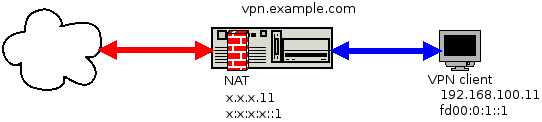
Debian Openvpn Debian Stretch feels like an excellent release by the Debian project. The final stable release is about to happen in the short term. Among the great things you can do with Debian, you could set up a VPN using the openvpn software. In this blog post I will describe how I ve deployed myself an openvpn server using Debian Stretch, my network environment and my configurations & workflow. Before all, I would like to reference my requisites and the characteristics of what I needed: I agree this is a rather complex scenario and not all the people will face these requirements. The service diagram has this shape: VPN diagram (DIA source file) So, it works like this:
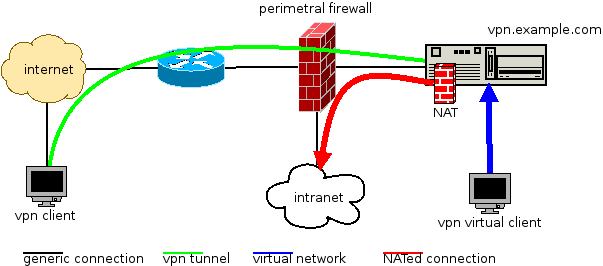
  1. clients connect via internet to our openvpn server, vpn.example.com
  2. the openvpn server validates the connection and the tunnel is established (green)
  3. now the client is virtually inside our network (blue)
  4. the client wants to access some intranet resource, the tunnel traffic is NATed (red)
Our datacenter intranet is using public IPv4 addressing, but the VPN tunnels use private IPv4 addresses. To don t mix public and private address NAT is used. Obviously we don t want to invest public IPv4 addresses in our internal tunnels. We don t have this limitations in IPv6, we could use public IPv6 addresses within the tunnels. But we prefer sticking to a hard dual stack IPv4/IPv6 approach and also use private IPv6 addresses inside the tunnels and also NAT the IPv6 from private to public. This way, there are no differences in how IPv4 and IPv6 network are managed. We follow this approach for the addressing: The NAT runs in the VPN server, since this is kind of a router. We use nftables for this task. As the final win, I will describe how we manage all this configuration using the git version control system. Using git we can track which admin made which change. A git hook will deploy the files from the git repo itself to /etc/ so the services can read them. The VPN server networking configuration is as follows (/etc/network/interfaces file, adjust to your network environments):
auto lo
iface lo inet loopback
# main public IPv4 address of vpn.example.com
allow-hotplug eth0
iface eth0 inet static
        address x.x.x.4
        netmask 255.255.255.0
        gateway x.x.x.1
# main public IPv6 address of vpn.example.com
iface eth0 inet6 static
        address x:x:x:x::4
        netmask 64
        gateway x:x:x:x::1
# NAT Public IPv4 addresses (used to NAT tunnel of client 1)
auto eth0:11
iface eth0:11 inet static
        address x.x.x.11
        netmask 255.255.255.0
# NAT Public IPv6 addresses (used to NAT tunnel of client 1)
iface eth0:11 inet6 static
        address x:x:x:x::11
        netmask 64
# NAT Public IPv4 addresses (used to NAT tunnel of client 2)
auto eth0:12
iface eth0:12 inet static
        address x.x.x.12
        netmask 255.255.255.0
# NAT Public IPv6 addresses (used to NAT tunnel of client 2)
iface eth0:12 inet6 static
        address x:x:x:x::12
        netmask 64
Thanks to the amazing and tireless work of the Alberto Gonzalez Iniesta (DD), the openvpn package in debian is in very good shape, ready to use. In vpn.example.com, install the required packages:
% sudo aptitude install openvpn openvpn-auth-ldap nftables git sudo
Two git repositories will be used, one for the openvpn configuration and another for nftables (the nftables config is described later):
% sudo mkdir -p /srv/git/vpn.example.com-nft.git
% sudo git init --bare /srv/git/vpn.example.com-nft.git
% sudo mkdir -p /srv/git/vpn.example.com-openvpn.git
% sudo git init --bare /srv/git/vpn.example.com-openvpn.git
% sudo chown -R :git /srv/git/*
% sudo chmod -R g+rw /srv/git/*
The repositories belong to the git group, a system group we create to let systems admins operate the server using git:
% sudo addgroup --system git
% sudo adduser admin1 git
% sudo adduser admin2 git
For the openvpn git repository, we need at least this git hook (file /srv/git/vpn.example.com-openvpn.git/hooks/post-receive with execution permission):
#!/bin/bash
NAME="hooks/post-receive"
OPENVPN_ROOT="/etc/openvpn"
export GIT_WORK_TREE="$OPENVPN_ROOT"
UNAME=$(uname -n)
info()
 
        echo "$ UNAME  $ NAME  $1 ..."
 
info "checkout latest data to $GIT_WORK_TREE"
sudo git checkout -f
info "cleaning untracked files and dirs at $GIT_WORK_TREE"
sudo git clean -f -d
For this hook to work, sudo permissions are required (file /etc/sudoers.d/openvpn-git):
User_Alias      OPERATORS = admin1, admin2
Defaults        env_keep += "GIT_WORK_TREE"
 
OPERATORS       ALL=(ALL) NOPASSWD:/usr/bin/git checkout -f
OPERATORS       ALL=(ALL) NOPASSWD:/usr/bin/git clean -f -d
Please review this sudoers file to match your environment and security requirements. The openvpn package deploys several systemd services:
% dpkg -L openvpn   grep service
/lib/systemd/system/openvpn-client@.service
/lib/systemd/system/openvpn-server@.service
/lib/systemd/system/openvpn.service
/lib/systemd/system/openvpn@.service
We don t need all of them, we can use the simple openvpn.service:
% sudo systemctl edit --full openvpn.service
And put a content like this:
% systemctl cat openvpn.service
# /etc/systemd/system/openvpn.service
[Unit]
Description=OpenVPN server
Documentation=man:openvpn(8)
Documentation=https://community.openvpn.net/openvpn/wiki/Openvpn23ManPage
Documentation=https://community.openvpn.net/openvpn/wiki/HOWTO
 
[Service]
PrivateTmp=true
KillMode=mixed
Type=forking
ExecStart=/usr/sbin/openvpn --daemon ovpn --status /run/openvpn/%i.status 10 --cd /etc/openvpn --config /etc/openvpn/server.conf --writepid /run/openvpn/server.pid
PIDFile=/run/openvpn/server.pid
ExecReload=/bin/kill -HUP $MAINPID
WorkingDirectory=/etc/openvpn
ProtectSystem=yes
CapabilityBoundingSet=CAP_IPC_LOCK CAP_NET_ADMIN CAP_NET_BIND_SERVICE CAP_NET_RAW CAP_SETGID CAP_SETUID CAP_SYS_CHROOT CAP_DAC_READ_SEARCH CAP_AUDIT_WRITE
LimitNPROC=10
DeviceAllow=/dev/null rw
DeviceAllow=/dev/net/tun rw
 
[Install]
WantedBy=multi-user.target
We can move on now to configure nftables to perform the NATs. First, it s good to load the NAT configuration at boot time, so you need a service file like this (/etc/systemd/system/nftables.service):
[Unit]
Description=nftables
Documentation=man:nft(8) http://wiki.nftables.org
 
[Service]
Type=oneshot
RemainAfterExit=yes
StandardInput=null
ProtectSystem=full
ProtectHome=true
WorkingDirectory=/etc/nftables.d
ExecStart=/usr/sbin/nft -f ruleset.nft
ExecReload=/usr/sbin/nft -f ruleset.nft
ExecStop=/usr/sbin/nft flush ruleset
 
[Install]
WantedBy=multi-user.target
The nftables git hooks are implemented as described in nftables managed with git. We are interested in the git hooks: (file /srv/git/vpn.example.com-nft.git/hooks/post-receive):
#!/bin/bash
NAME="hooks/post-receive"
NFT_ROOT="/etc/nftables.d"
RULESET="$ NFT_ROOT /ruleset.nft"
export GIT_WORK_TREE="$NFT_ROOT"
UNAME=$(uname -n)
info()
 
        echo "$ UNAME  $ NAME  $1 ..."
 
info "checkout latest data to $GIT_WORK_TREE"
sudo git checkout -f
info "cleaning untracked files and dirs at $GIT_WORK_TREE"
sudo git clean -f -d
info "deploying new ruleset"
set -e
cd $NFT_ROOT && sudo nft -f $RULESET
info "new ruleset deployment was OK"
This hook moves our nftables configuration to /etc/nftables.d and then applies it to the kernel. So a single commit changes the runtime configuration of the server. You could implement some QA using the git hook update, check this file! Remember, git hooks requires exec permissions to work. Of course, you will need again a sudo policy for these nft hooks. Finally, we can start configuring both openvpn and nftables using git. For the VPN you will require the configure the PKI side: server certificates, and the CA signing your client s certificates. You can check openvpn s own documentation about this. Your first commit for openvpn could be the server.conf file:
plugin		/usr/lib/openvpn/openvpn-plugin-auth-pam.so common-auth
mode		server
user		nobody
group		nogroup
port		1194
proto		udp6
daemon
comp-lzo
persist-key
persist-tun
tls-server
cert		/etc/ssl/private/vpn.example.com_pub.crt
key		/etc/ssl/private/vpn.example.com_priv.pem
ca		/etc/ssl/cacert/clients_ca.pem
dh		/etc/ssl/certs/dh2048.pem
cipher		AES-128-CBC
dev		tun
topology	subnet
server		192.168.100.0 255.255.255.0
server-ipv6	fd00:0:1:35::/64
ccd-exclusive
client-config-dir ccd
max-clients	100
inactive	43200
keepalive	10 360
log-append	/var/log/openvpn.log
status		/var/log/openvpn-status.log
status-version	1
verb		4
mute		20
Don t forget the ccd/ directory. This directory contains a file per user using the VPN service. Each file is named after the CN of the client certificate:
# private addresses for client 1
ifconfig-push		192.168.100.11 255.255.255.0
ifconfig-ipv6-push	fd00:0:1::11/64
# routes to the intranet network
push "route-ipv6 x:x:x:x::/64"
push "route x.x.3.128 255.255.255.240"
# private addresses for client 2
ifconfig-push		192.168.100.12 255.255.255.0
ifconfig-ipv6-push	fd00:0:1::12/64
# routes to the intranet network
push "route-ipv6 x:x:x:x::/64"
push "route x.x.3.128 255.255.255.240"
You end with at leats these files in the openvpn git tree:
server.conf
ccd/CN=CLIENT_1
ccd/CN=CLIENT_2
Please note that if you commit a change to ccd/, the changes are read at runtime by openvpn. In the other hand, changes to server.conf require you to restart the openvpn service by hand. Remember, the addressing is like this: Addressing (DIA source file) In the nftables git tree, you should put a ruleset like this (a single file named ruleset.nft is valid):
flush ruleset
table ip nat  
	map mapping_ipv4_snat  
		type ipv4_addr : ipv4_addr
		elements =  	192.168.100.11 : x.x.x.11,
				192.168.100.12 : x.x.x.12  
	 
	map mapping_ipv4_dnat  
		type ipv4_addr : ipv4_addr
		elements =  	x.x.x.11 : 192.168.100.11,
				x.x.x.12 : 192.168.100.12  
	 
	chain prerouting  
		type nat hook prerouting priority -100; policy accept;
		dnat to ip daddr map @mapping_ipv4_dnat
	 
	chain postrouting  
		type nat hook postrouting priority 100; policy accept;
		oifname "eth0" snat to ip saddr map @mapping_ipv4_snat
	 
 
table ip6 nat  
	map mapping_ipv6_snat  
		type ipv6_addr : ipv6_addr
		elements =  	fd00:0:1::11 : x:x:x::11,
				fd00:0:1::12 : x:x:x::12  
	 
	map mapping_ipv6_dnat  
		type ipv6_addr : ipv6_addr
		elements =  	x:x:x::11 : fd00:0:1::11,
				x:x:x::12 : fd00:0:1::12  
	 
	chain prerouting  
		type nat hook prerouting priority -100; policy accept;
		dnat to ip6 daddr map @mapping_ipv6_dnat
	 
	chain postrouting  
		type nat hook postrouting priority 100; policy accept;
		oifname "eth0" snat to ip6 saddr map @mapping_ipv6_snat
	 
 
table inet filter  
	chain forward  
		type filter hook forward priority 0; policy accept;
		# some forwarding filtering policy, if required, for both IPv4 and IPv6
	 
 
Since the server is in fact routing packets between the tunnel and the public network, we require forwarding enabled in sysctl:
net.ipv4.conf.all.forwarding = 1
net.ipv6.conf.all.forwarding = 1
Of course, the VPN clients will require a client.conf file which looks like this:
client
remote vpn.example.com 1194
dev tun
proto udp
resolv-retry infinite
comp-lzo
verb 5
nobind
persist-key
persist-tun
user nobody
group nogroup
 
tls-client
ca      /etc/ssl/cacert/server_ca.crt
pkcs12  /home/user/mycertificate.p12
verify-x509-name vpn.example.com name
cipher AES-128-CBC
auth-user-pass
auth-nocache
Workflow for the system admins:
  1. git clone the openvpn repo
  2. modify ccd/ and server.conf
  3. git commit the changes, push to the server
  4. if server.conf was modified, restart openvpn
  5. git clone the nftables repo
  6. modify ruleset
  7. git commit the changes, push to the server
Comments via email welcome!

4 April 2017

Ritesh Raj Sarraf: Fixing Hardware Bugs

Bugs can be annoying. Especially the ones that crash or hang and do not have a root cause. A good example of such annoyance can be kernel bugs, where a faulty hardware/device driver hinders the kernel's suspend/resume process. Because, as a user, while in the middle of your work, you suspend your machine hoping to resume your work, back when at your destination. But, during suspend, or during resume, randomly the bug triggers leaving you with no choice but a hardware reset. Ultimately, resulting in you losing the entire work state you were in. Such is a situation I encountered with my 2 year old, Lenovo Yoga 2 13. For 2 years, I had been living with this bug with all the side-effects mentioned.
Mar 01 18:43:28 learner kernel: usb 2-4: new high-speed USB device number 38 using xhci_hcd
Mar 01 18:43:54 learner kernel: usb 2-4: new high-speed USB device number 123 using xhci_hcd
Mar 01 18:44:00 learner kernel: usb 2-4: new high-speed USB device number 125 using xhci_hcd
Mar 01 18:44:11 learner kernel: usb 2-4: new high-speed USB device number 25 using xhci_hcd
Mar 01 18:44:16 learner kernel: usb 2-4: new high-speed USB device number 26 using xhci_hcd
Mar 01 18:44:22 learner kernel: usb 2-4: new high-speed USB device number 27 using xhci_hcd
Mar 01 18:44:22 learner kernel: usb 2-4: device descriptor read/64, error -71
Mar 01 18:44:22 learner kernel: usb 2-4: new high-speed USB device number 28 using xhci_hcd
Mar 01 18:44:23 learner kernel: usb 2-4: device descriptor read/64, error -71
Mar 01 18:44:23 learner kernel: usb 2-4: new high-speed USB device number 29 using xhci_hcd
Mar 01 18:44:23 learner kernel: usb 2-4: Device not responding to setup address.
Mar 01 18:44:23 learner kernel: usb 2-4: device not accepting address 29, error -71
Mar 01 18:44:24 learner kernel: usb 2-4: new high-speed USB device number 30 using xhci_hcd
Mar 01 18:44:24 learner kernel: usb 2-4: Device not responding to setup address.
Mar 01 18:44:24 learner kernel: usb 2-4: device not accepting address 30, error -71
Mar 01 18:44:24 learner kernel: usb usb2-port4: unable to enumerate USB device
Mar 01 18:44:24 learner kernel: usb 2-4: new high-speed USB device number 31 using xhci_hcd
Mar 01 18:44:24 learner kernel: usb 2-4: device descriptor read/64, error -71
Mar 01 18:44:25 learner kernel: usb 2-4: new high-speed USB device number 32 using xhci_hcd
Mar 01 18:44:30 learner kernel: usb 2-4: new high-speed USB device number 33 using xhci_hcd
Mar 01 18:44:30 learner kernel: usb 2-4: device descriptor read/64, error -71
Mar 01 18:44:31 learner kernel: usb 2-4: device descriptor read/64, error -71
Mar 01 18:44:31 learner kernel: usb 2-4: new high-speed USB device number 34 using xhci_hcd
Mar 01 18:44:36 learner kernel: usb 2-4: new high-speed USB device number 35 using xhci_hcd
Mar 01 18:44:36 learner kernel: usb 2-4: device descriptor read/64, error -71
Mar 01 18:44:37 learner kernel: usb 2-4: new high-speed USB device number 36 using xhci_hcd
Mar 01 18:44:37 learner kernel: usb 2-4: device descriptor read/64, error -71
Mar 01 18:44:37 learner kernel: usb 2-4: new high-speed USB device number 37 using xhci_hcd
Mar 01 18:44:37 learner kernel: usb 2-4: Device not responding to setup address.
Mar 01 18:44:38 learner kernel: usb 2-4: device not accepting address 37, error -71
Mar 01 18:44:38 learner kernel: usb 2-4: new high-speed USB device number 38 using xhci_hcd
Mar 01 18:44:38 learner kernel: usb 2-4: Device not responding to setup address.
Mar 02 13:34:05 learner kernel: usb 2-4: new high-speed USB device number 45 using xhci_hcd
Mar 02 13:34:05 learner kernel: usb 2-4: new high-speed USB device number 46 using xhci_hcd
Mar 02 13:34:05 learner kernel: usb 2-4: New USB device found, idVendor=0bda, idProduct=0129
Mar 02 13:34:05 learner kernel: usb 2-4: New USB device strings: Mfr=1, Product=2, SerialNumber=3
Mar 02 13:34:05 learner kernel: usb 2-4: Product: USB2.0-CRW
Mar 02 13:34:05 learner kernel: usb 2-4: Manufacturer: Generic
Mar 02 13:34:05 learner kernel: usb 2-4: SerialNumber: 20100201396000000
Mar 02 13:34:06 learner kernel: usb 2-4: USB disconnect, device number 46
Mar 02 13:34:16 learner kernel: usb 2-4: new high-speed USB device number 47 using xhci_hcd
Mar 02 13:34:21 learner kernel: usb 2-4: new high-speed USB device number 48 using xhci_hcd
Mar 02 13:34:26 learner kernel: usb 2-4: new high-speed USB device number 49 using xhci_hcd
Mar 02 13:34:32 learner kernel: usb 2-4: new high-speed USB device number 51 using xhci_hcd
Mar 02 13:34:37 learner kernel: usb 2-4: new high-speed USB device number 52 using xhci_hcd
Mar 02 13:34:43 learner kernel: usb 2-4: new high-speed USB device number 54 using xhci_hcd
Mar 02 13:34:43 learner kernel: usb 2-4: new high-speed USB device number 55 using xhci_hcd
Mar 02 13:34:49 learner kernel: usb 2-4: new high-speed USB device number 57 using xhci_hcd
Mar 02 13:34:55 learner kernel: usb 2-4: new high-speed USB device number 58 using xhci_hcd
Mar 02 13:35:00 learner kernel: usb 2-4: new high-speed USB device number 60 using xhci_hcd
Mar 02 13:35:06 learner kernel: usb 2-4: new high-speed USB device number 61 using xhci_hcd
Mar 02 13:35:11 learner kernel: usb 2-4: new high-speed USB device number 63 using xhci_hcd
Mar 02 13:35:17 learner kernel: usb 2-4: new high-speed USB device number 64 using xhci_hcd
Mar 02 13:35:22 learner kernel: usb 2-4: new high-speed USB device number 65 using xhci_hcd
Mar 02 13:35:28 learner kernel: usb 2-4: new high-speed USB device number 66 using xhci_hcd
Mar 02 13:35:33 learner kernel: usb 2-4: new high-speed USB device number 68 using xhci_hcd
Mar 02 13:35:39 learner kernel: usb 2-4: new high-speed USB device number 69 using xhci_hcd
Mar 02 13:35:44 learner kernel: usb 2-4: new high-speed USB device number 70 using xhci_hcd
Mar 02 13:35:50 learner kernel: usb 2-4: new high-speed USB device number 71 using xhci_hcd
Mar 02 13:35:50 learner kernel: usb 2-4: Device not responding to setup address.
Mar 02 13:35:50 learner kernel: usb 2-4: device not accepting address 71, error -71
Mar 02 13:35:50 learner kernel: usb 2-4: new high-speed USB device number 73 using xhci_hcd
Mar 02 13:35:51 learner kernel: usb 2-4: new high-speed USB device number 74 using xhci_hcd
Mar 02 13:35:56 learner kernel: usb 2-4: new high-speed USB device number 75 using xhci_hcd
Mar 02 13:35:57 learner kernel: usb 2-4: new high-speed USB device number 77 using xhci_hcd
Mar 02 13:36:03 learner kernel: usb 2-4: new high-speed USB device number 78 using xhci_hcd
Mar 02 13:36:08 learner kernel: usb 2-4: new high-speed USB device number 79 using xhci_hcd
Mar 02 13:36:14 learner kernel: usb 2-4: new high-speed USB device number 80 using xhci_hcd
Mar 02 13:36:20 learner kernel: usb 2-4: new high-speed USB device number 83 using xhci_hcd
Mar 02 13:36:26 learner kernel: usb 2-4: new high-speed USB device number 86 using xhci_hcd
Thanks to the Linux USB maintainers, we tried investigating the issue, which resulted in uncovering other bugs. Unfortunately, this bug was concluded as a possible hardware bug. The only odd bit is that this machine has a Windows 8.1 copy still lying on the spare partition, where the issue was not seen at all. It could very well be that it was not a hardware bug at all, or a hardware bug which had a workaround in the Windows driver. But, the results of the exercise weren't much useful to me because I use the machine under the Linux kernel most of the time. So, this March 2017, with 2 years completion on me purchasing the device, I was annoyed enough by the bugs. That led me trying out finding other ways to taming this issue. Lenovo has some variations of this device. I know that it comes with multiple options for the storgae and the wifi component. I'm not sure if there are more differences. The majority of the devices are connected over the xHCI bus on this machine. If a single device is faulty, or has faulty hardware; it could screw up the entire user experience for that machine. Such is my case. Hardware manufacturers could do a better job if they could provide a means to disable hardware, for example in the BIOS. HP shipped machines have such an option in the BIOS where you can disable devices that do not have an important use case for the user. Good example of such devices are Fingerprint Readers, SD Card Readers, LOMs and mabye Bluetooth too. At least the latter should apply for Linux users, as majority of us have an unpleasant time getting Bluetooth to work out of the box. But on my Lenovo Yoga, it came with a ridiculous BIOS/UEFI, with very very limited options for change. Thankfully, they did have an option to set the booting mode for the device, giving the choices of Legacy Boot and UEFI. Back to the topic, with 2 years of living with the bug, and no clarity on if and whether it was a hardware bug or a driver bug, it left me with no choice but to open up the machine. Next to the mSATA HDD sits the additional board, which houses the Power, USB, Audio In, and the SD Card reader. Opening that up, I got the small board. I barely use the SD Card reader, and given the annoyances I had to suffer because of it, there was no more mercy in killing that device. So, next was to unsolder the SD Card reader completely. Once done, and fitted back into the machine, everything has been working awesomely great in the last 2 weeks. This entire fix costed me 0. So sometimes, fixing a bug is all that matters. In the Hindi language, a nice phrase for such a scenario remnids me of the great Chanakya, " , , ".

Categories:

Keywords:

Like:

Matthias Klumpp: On Tanglu

It s time for a long-overdue blogpost about the status of Tanglu. Tanglu is a Debian derivative, started in early 2013 when the systemd debate at Debian was still hot. It was formed by a few people wanting to create a Debian derivative for workstations with a time-based release schedule using and showcasing new technologies (which include systemd, but also bundling systems and other things) and built in the open with a community using the similar infrastructure to Debian. Tanglu is designed explicitly to complement Debian and not to compete with it on all devices. Tanglu has achieved a lot of great things. We were the first Debian derivative to adopt systemd and with the help of our contributors we could kill a few nasty issues affecting it and Debian before it ended up becoming default in Debian Jessie. We also started to use the Calamares installer relatively early, bringing a modern installation experience additionally to the traditional debian-installer. We performed the usrmerge early, uncovering a few more issues which were fed back into Debian to be resolved (while workarounds were added to Tanglu). We also briefly explored switching from initramfs-tools to Dracut, but this release goal was dropped due to issues (but might be revived later). A lot of other less-impactful changes happened as well, borrowing a lot of useful ideas and code from Ubuntu (kudos to them!). On the infrastructure side, we set up the Debian Archive Kit (dak), managing to find a couple of issues (mostly hardcoded assumptions about Debian) and reporting them back to make using dak for distributions which aren t Debian easier. We explored using fedmsg for our infrastructure, went through a long and painful iteration of build systems (buildbot -> Jenkins -> Debile) before finally ending up with Debile, and added a set of own custom tools to collect archive QA information and present it to our developers in an easy to digest way. Except for wanna-build, Tanglu is hosting an almost-complete clone of basic Debian archive management tools. During the past year however, the project s progress slowed down significantly. For this, mostly I am to blame. One of the biggest challenges for a young project is to attract new developers and members and keep them engaged. A lot of the people coming to Tanglu and being interested in contributing were unfortunately no packagers and sometimes no developers, and we didn t have the manpower to individually mentor these people and teach them the necessary skills. People asking for tasks were usually asked where their interests were and what they would like to do to give them a useful task. This sounds great in principle, but in practice it is actually not very helpful. A curated list of junior jobs is a much better starting point. We also invested almost zero time in making our project known and create the necessary buzz and excitement that s actually needed to sustain a project like this. Doing more in the advertisement domain and help newcomers area is a high priority issue in the Tanglu bugtracker, which to the day is still open. Doing good alone isn t enough, talking about it is of crucial importance and that is something I knew about, but didn t realize the impact of for quite a while. As strange as it sounds, investing in the tech only isn t enough, community building is of equal importance. Regardless of that, Tanglu has members working on the project, but way too few to manage a project of this magnitude (getting package transitions migrated alone is a large task requiring quite some time while at the same time being incredibly boring :P). A lot of our current developers can only invest small amounts of time into the project because they have a lot of other projects as well. The other issue why Tanglu has problems is too much stuff being centralized on myself. That is a problem I wanted to rectify for a long time, but as soon as a task wasn t done in Tanglu because no people were available to do it, I completed it. This essentially increased the project s dependency on me as single person, giving it a really low bus factor. It not only centralizes power in one person (which actually isn t a problem as long as that person is available enough to perform tasks if asked for), it also centralizes knowledge on how to run services and how to do things. And if you want to give up power, people will need the knowledge on how to perform the specific task first (which they will never gain if there s always that one guy doing it). I still haven t found a great way to solve this it s a problem that essentially kills itself as soon as the project is big enough, but until then the only way to counter it slightly is to write lots of documentation. Last year I had way less time to work on Tanglu than the project deserves. I also started to work for Purism on their PureOS Debian derivative (which is heavily influenced by some of the choices we made for Tanglu, but with different focus that s probably something for another blogpost). A lot of the stuff I do for Purism duplicates the work I do on Tanglu, and also takes away time I have for the project. Additionally I need to invest a lot more time into other projects such as AppStream and a lot of random other stuff that just needs continuous maintenance and discussion (especially AppStream eats up a lot of time since it became really popular in a lot of places). There is also my MSc thesis in neuroscience that requires attention (and is actually in focus most of the time). All in all, I can t split myself and KDE s cloning machine remains broken, so I can t even use that ;-). In terms of projects there is also a personal hard limit of how much stuff I can handle, and exceeding it long-term is not very healthy, as in these cases I try to satisfy all projects and in the end do not focus enough on any of them, which makes me end up with a lot of half-baked stuff (which helps nobody, and most importantly makes me loose the fun, energy and interest to work on it). Good news everyone! (sort of) So, this sounded overly negative, so where does this leave Tanglu? Fact is, I can not commit the crazy amounts of time for it as I did in 2013. But, I love the project and I actually do have some time I can put into it. My work on Purism has an overlap with Tanglu, so Tanglu can actually benefit from the software I develop for them, maybe creating a synergy effect between PureOS and Tanglu. Tanglu is also important to me as a testing environment for future ideas (be it in infrastructure or in the make bundling nice! department). So, what actually is the way forward? First, maybe I have the chance to find a few people willing to work on tasks in Tanglu. It s a fun project, and I learned a lot while working on it. Tanglu also possesses some unique properties few other Debian derivatives have, like being built from source completely (allowing us things like swapping core components or compiling with more hardening flags, switching to newer KDE Plasma and GNOME faster, etc.). Second, if we do not have enough manpower, I think converting Tanglu into a rolling-release distribution might be the only viable way to keep the project running. A rolling release scheme creates much less effort for us than making releases (especially time-based ones!). That way, users will have a constantly updated and secure Tanglu system with machines doing most of the background work. If it turns out that absolutely nothing works and we can t attract new people to help with Tanglu, it would mean that there generally isn t much interest from the developer or user side in a project like this, so shutting it down or scaling it down dramatically would be the only option. But I do not think that this is the case, and I believe that having Tanglu around is important. I also have some interesting plans for it which will be fun to implement for testing  The only thing that had to stop is leaving our users in the dark on what is happening. Sorry for the long post, but there are some subjects which are worth writing more than 140 characters about  If you are interested in contributing to Tanglu, get in touch with us! We have an IRC channel #tanglu-devel on Freenode (go there for quicker responses!), forums and mailinglists, It looks like I will be at Debconf this year as well, so you can also catch me there! I might even talk about PureOS/Tanglu infrastructure at the conference.

1 April 2017

Thorsten Alteholz: My Debian Activities in March 2017

FTP assistant This month I marked 111 packages for accept and sent four emails to maintainers asking questions. The bad number of the month are the 41 packages I had to reject. This rejection rate was the worst of all my NEW-months. May I ask everybody to pay a bit more attention before uploading/sponsoring a package? Debian LTS This was my thirty-third month that I did some work for the Debian LTS initiative, started by Raphael Hertzog at Freexian. This month my all in all workload has been 14.75h. During that time I did uploads of I also took care of radare and marked all CVEs as not-affected in Wheezy. My next package on the list will be qbittorrent. Other stuff I uploaded a new version of entropybroker to fix a bug with the handling of return codes of ppoll. This version will also make it to Stretch. The same happens with a bug in alljoyn-services-1509. I don t know why everybody talks about unblock-bugs that need to be filed!? The release team was always faster in granting the unblock than me in filing the corresponding bug. As my DOPOM for this month I adopted httperf, took care of some bugs and sent patches upstream. I also created a new project on Alioth that is called debian-mobcom (Alioth page), which shall be a place for all packages concerning mobile communication on the network part. I only uploaded libosmocore to experimental yet, so the package list is rather short.

Bits from Debian: Unknown parallel universe uses Debian

This post was an April Fools' Day joke. The space agencies running the International Space Station (ISS) reported that a laptop accidentally threw to space as waste in 2013 from the International State Station may have connected with a parallel Universe. This laptop was running Debian 6 and the ISS engineers managed to track its travel through the outer space. In early January, the laptop signal was lost but recovered back two weeks later in the same place. ISS engineers suspect that the laptop may had met and crossed a wormhole arriving a parallel Universe from where "somebody" sent it back later. Eventually the laptop was recovered and in an first analysis the ISS engineers found that the laptop have a dual boot: a partition running the Debian installation made by them and a second partition running what seems to be a Debian fork or derivative totally unknown until now. The engineers have been in contact with the Debian Project in the last weeks and a Debian group formed with delegates from different Debian teams have begun to study this new Debian derivative system. From the early results of this research, we can proudly say that somebody (or a group of beings) in a parallel universe understand Earth computers, and Debian, enough to: The work towards knowing better this new Universe and find a way to communicate with them has just began; all the Debian users and contributors are invited to join the effort to study the operating system found. We want to prepare our Community and our Universe to live and work peacefully and respectfully with the parallel Universe communities, in the true spirit of Free Software. In the following weeks a General Resolution will be proposed for updating our motto to "the multiversal operating system".

Russ Allbery: Review: Two Serpents Rise

Review: Two Serpents Rise, by Max Gladstone
Series: Craft #2
Publisher: Tor
Copyright: October 2013
ISBN: 1-4668-0204-9
Format: Mobi
Pages: 350
This is the second book in the Craft Sequence, coming after Three Parts Dead, but it's not a sequel. The only thing shared between the books is the same universe and magical system. Events in Two Serpents Rise were sufficiently distant from the events of the first book that it wasn't obvious (nor did it matter) where it fit chronologically. Caleb is a gambler and an investigator for Red King Consolidated, the vast firm that controls the water supply, and everything else, in the desert city of Dresediel Lex. He has a fairly steady and comfortable job in a city that's not comfortable for many, one of sharp divisions between rich and poor and which is constantly one water disturbance away from riot. His corporate work life frustrates his notorious father, a legendary priest of the old gods who were defeated by the Red King and who continues to fight an ongoing terrorist resistance to the new corporate order. But Caleb has as little as possible to do with that. Two Serpents Rise opens with an infiltration of the Bright Mirror Reservoir, one of the key components of Dresediel Lex's water supply. It's been infested with Tzimet: demon-like creatures that, were they to get into the city's water supply, would flow from faucets and feed on humans. Red King Incorporated discovered this one and sealed the reservoir before the worst could happen, but it's an unsettling attack. And while Caleb is attempting to determine what happened, he has an unexpected encounter with a cliff runner: a daredevil parkour enthusiast with an unexpected amulet of old Craft that would keep her invisible from most without the magical legacy Caleb is blessed (or cursed) with. He doesn't think her presence is related to the attack, but he can't be sure, particularly with the muddling fact that he finds her personally fascinating. Like Three Parts Dead, you could call Two Serpents Rise an urban fantasy in that it's a fantasy that largely takes place in cities and is concerned with such things as infrastructure, politics, and the machinery of civilization. However, unlike Three Parts Dead, it takes itself much more seriously and has less of the banter and delightful absurdity of the previous book. The identification of magic with contracts and legalities is less amusingly creative here and more darkly sinister. Partly this is because the past of Dresediel Lex is full of bloodthirsty gods and human sacrifice, and while Red King Consolidated has put an end to that practice, it lurks beneath the surface and is constantly brought to mind by some grisly artifacts. I seem to always struggle with fantasy novels based loosely on central American mythology. An emphasis on sacrifice and terror always seems to emerge from that background, and it verges too close to horror for me. It also seems prone to clashes of divine power and whim instead of thoughtful human analysis. That's certainly the case here: instead of Tara's creative sleuthing and analysis, Caleb's story is more about uncertainty, obsession, gambling, and shattering revelations. Magical rituals are described more in terms of their emotional impact than their world-building magical theory. I think this is mostly a matter of taste, and it's possible others would like Two Serpents Rise better than the previous book, but it wasn't as much my thing. The characters are a mixed bag. Caleb was a bit too passive to me, blown about by his father and his employer and slow to make concrete decisions. Mal was the highlight of the book for me, but I felt at odds with the author over that, which made the end of the book somewhat frustrating. Caleb has some interesting friends, but this is one of those books where I would have preferred one of the supporting cast to be the protagonist. That said, it's not a bad book. There are some very impressive set pieces, the supporting cast is quite good, and I am wholeheartedly in favor of fantasy novels that are built around the difficulties of water supply to a large, arid city. This sort of thing has far more to do with human life than the never-ending magical wars over world domination that most fantasy novels focus on, and it's not at all boring when told properly. Gladstone is a good writer, and despite the focus of this book not being as much my cup of tea, I'll keep reading this series. Followed by Full Fathom Five. Rating: 7 out of 10

31 March 2017

Enrico Zini: Shutdown button for my Raspberry Pi

My Raspberry Pi hifi component setup lacked a way to cleanly shutdown the system without ssh. I wished the Raspberry Pi had a button so I can tell it to shutdown. I added one to the GPIO connector. It turns out many wishes can come true when one has a GPIO board. This is the /usr/local/bin/stereo-gpio script that reacts to the button press and triggers a shutdown:
 1
 2
 3
 4
 5
 6
 7
 8
 9
10
11
12
13
14
15
16
17
18
#!/usr/bin/python3
# http://razzpisampler.oreilly.com/ch07.html
# http://web.archive.org/web/20160305001215/http://razzpisampler.oreilly.com/ch07.html
from RPi import GPIO
import time
import subprocess
def on_button(pin):
    print("Button pressed", pin)
GPIO.setmode(GPIO.BCM)
GPIO.setup(18, GPIO.IN, pull_up_down=GPIO.PUD_UP)
while True:
    pin = GPIO.wait_for_edge(18, GPIO.FALLING)
    if pin == 18:
        subprocess.check_call(["/bin/systemctl", "halt"])
This is the /etc/systemd/system/stereo-gpio.service systemd unit file that runs the script as a daemon:
[Unit]
Description=Stereo GPIO manager
[Service]
Type=simple
ExecStart=/usr/local/bin/stereo-gpio
Restart=always
[Install]
WantedBy=multi-user.target
Then systemctl start stereo-gpio to start the script, and systemctl enable stereo-gpio to start the script at boot.

30 March 2017

Shirish Agarwal: The tale of the dancing girl #nsfw

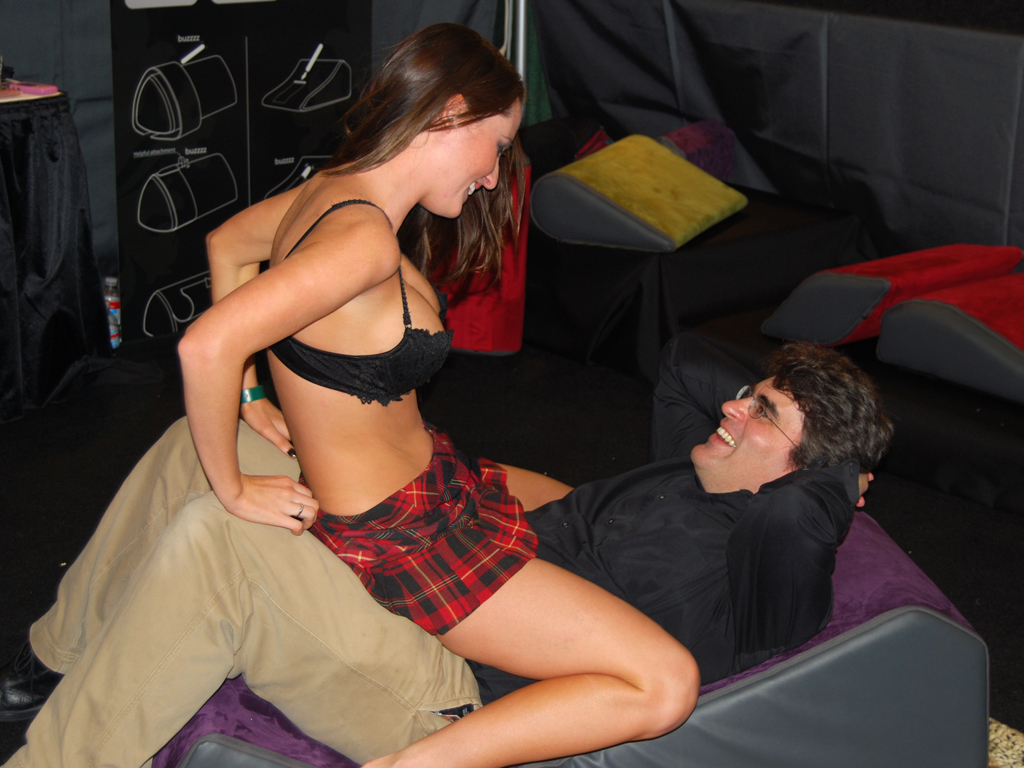
Demonstration of a Lapdance - Wikipedia

Demonstration of a Lapdance Wikipedia

The post will be adult/mature in nature. So those below 18 please excuse. The post is about an anecdote almost 20 years to date, The result its being posted is I had a dinner with a friend to whom I shared this and he thought it would be nice if I shared this hence sharing it. The conversation was about being young and foolish in which I shared the anecdote. The blog post was supposed to be about Aadhar which shocked me both in the way no political discourse happened and the way the public as well as public policy was gamed but that would have to wait for another day. History I left college in 1995. The anecdote/incident probably happened couple of years earlier so probably 1992-1993. At that time, I was in my teens and as a typical teenager I made few friends. One of those friends, who would remain nameless as since we drifted apart, and as I have not take permission from him, taking his name would not be a good idea. Anyway, this gentleman, let s call him Mr. X as an example. Couple of months before, he had bought an open jeep, similar but very different from the jeep being shown below. Open Jeep had become a fashion statement few months back (in those days) as a Salman khan starred movie had that and anybody who had money wanted one just like that.
Illustration of an open jeep, sadly its a military one - wikipedia

Illustration of an open jeep, sadly its a military one wikipedia

Those days we didn t have cell-phones and I had given my land-line phone number to very few friends as in those days, as the land-lines were a finicky instrument. One fine morning, I get a call from my friend telling he is going to come near my place and I should meet him at some xyz place and we would go for a picnic for the whole day and it is possible that we might return next day. As it was holidays and only a fool would throw away a chance to have a ride in open air jeep, I immediately agreed. I shared that my friends had organized a picnic and giving another friend s number (who didn t know anything) got permission and went to meet Mr. X. This was very early morning, around 0600 hrs. . After meeting him, he told that we would be going to Mumbai, take some more friends from there and then move on. In those days, a railway ticket from Shivaji Nagar to V.T. (now C.S.T.) costed INR 30/- . I had been to Mumbai few times before for various technical conferences and knew few cheap places to eat, I knew that going via train, we could go and come back spending at the most INR 150/- and still have some change left-over (today s meal at a roadside/street vendor easily passes that mark). The Journey I shared with him that it will be costly and I don t have any money to cover the fuel expenses and he said he would shoulder the expenses, he just wanted my company for the road. Those days, it was the scenic Old Mumbai-Pune highway and we took plenty of stops to admire that ghats (hills and valleys together). That journey must have taken around 7-8 hours while today by new Expressway, you could do the same thing by 2.5/3 hours. Anyhow, we reached to some swanky hotel in South Mumbai. South Mumbai was not the financial powerhouse that it today is, there was mix of very old buildings and new buildings like the swanky hotel that we had checked in. I have no memory nor any idea whether it was 1 class, 3 class or 5 class and could have cared less as had been tired from the journey. We checked in, I had a long warm water bath and then slept in the king-size bed with curtains drawn. Evening came and we took the jeep and picked up 2-3 of his friends who were from my age or a year or two older and we went to Nariman Point. Seeing the Queen s necklace from Nariman Point at night is a sight in itself. Keeping with the innocence, I was under the impression that we had arrived at our destination, at this our host, Mr. X and his Bombaiya friends had a quiet laugh saying its a young night still. We must have whiled away couple of hours, having chai and throwing rocks in the sea. The Meeting After a while, Mr. X took us to another swanky place. My eyes were out of my sockets as this seemed to be as elitist a place as could be. I saw many White European women in various stages of undress pole-dancing and lap-dancing. I had recently (in those days) come to know the term but was under the impression that it was something that happened in Europe and States only. I had no idea that lap-dancing was older than my birth as according to Wikipedia. So looking back now, I am not surprised that in two decades the concept crossed the oceans. Again, Mr. X being the host, agreed to bear all the costs and all of us had food, drink and a lap-dance from any of the dancers on the floor. As I was young and probably shy (still am) I asked Mr. X s help to pick a girl/woman for me. The woman whom he picked was auburn-aired, was either my age or a year or two older/younger to me. What proceeded next was about 20-30 minutes of totally sexualized erotic experience. While he and all his friends picked girls to go all the way, I was hesitant to let loose. Maybe it was due to my lack of courage or inexperience, maybe it was not in my city so couldn t predict the outcome, maybe was just afraid that reality might mar fantasy, I dunno till date. Although we kissed and necked a lot, I guess that should count for something. The conversation After all my friends had gone to the various rooms, sometime after I excused myself, went to the loo myself, peed a bit, splashed cold water on self, came out and had couple of glasses of water and came back to my seat. The lady came back and I shared that I was not interested in going further and while she was beautiful, I just didn t have the guts. I did ask her if she would give me company though for sometime as I didn t know anyone else at that place. Our conversation was more about her than me as I had more or less an average life upto that moment. There were only three unorthodox things that I had done before meeting her. I had drunk wines of different types, smoked weed and had a Magic Mushrooms experience the year before with another group of friends I had made there. Goa in those days was simply magical in those days but that probably would need its story/own blog post. When I enquired about her, she shared she was from Russia and she rattled off more than half a dozen places around the world where she had been to and this was her second or third stint in Mumbai and she wasn t at all unhappy about the lifestyle and choices she was leading. I had no answer for her as a young penniless college-going student. Her self-confidence and the way she carried herself was impressive, with or without clothes. During course of the conversation she shared a couple of contacts from whom I could get better weed at slightly higher price if I were in Goa. Few months later, those contacts turned out to be true. After sometime, we took all the women and ourselves, around 8-9 people in his jeep (how he negotiated that is beyond me) went to a hygienic Pani puri and Bhel (puffed rice mixed with variety of spices typically tomato, potato, coriander chutney as well as Tamarind Chutney among other things) place and moved them to tears (the spices in bhel and Pani puri did it for them) and this was when we had explicitly asked the bhel-wala guy to make it extremely mild with just a hint of spice in it. Anyways, sometime later, we dropped them at the same place, dropped his friends and came back to the hotel we booked and got drunk again. After-effects Few years later, it came in the newspapers/media that while India had broken out of financial isolation just few years back (1991) and were profiting from it, many countries of the former USSR were going the other way around and hence there was huge human trafficking and immigration that had taken place. This was in-line with what the lady/woman/Miss X had shared with me. The latest trigger The latest trigger happened couple of months back where I learnt of a hero flight attendant saving a girl from human-trafficking. Till date, I am unsure whether she was doing it willingly or putting a brave smile in front of me, because even if she had confided me in any way, I probably would have been too powerless to help her in any-way. I just don t know. Foolishness thy name While my friend took advantage of my innocence and introduced me to a world which otherwise I would probably not know exists, it could have easily have gone some other way as well. While I m still unsure of the choices I made, I was and am happy that I was able to strike a conversation with her and attempt to reach the person therein. Was it the truth or an elaborate fabricated lie to protect myself and herself, this I will never know. Oppression I understand the fact that as a customer or somebody who is taking part in either of those performances or experiences it isn t easy in any way to know/say that whether the performer is doing it wilfully or not as the experiences are in tightly controlled settings.
Filed under: Miscellenous Tagged: #anecdote, #confusion, #elitist, #growing up, #lap dance, #NSFW, #Open Jeep, Mumbai

29 March 2017

Lars Wirzenius: A tiny PC as a router

We needed a router and wifi access point in the office, and simultaneously both I and my co-worker Ivan needed such a thing at our respective homes. After some discussion, and after reading articles in Ars Technica about building PCs to act as routers, we decided to do just that. We got some hardware:
Component Model Cost
Barebone Qotom Q190G4, VGA, 2x USB 2.0, 134x126x36mm, fanless 130
CPU Intel J1900, 2-2.4GHz quad-core -
NIC Intel WG82583, 4x 10/100/1000 -
Memory Crucial CT102464BF160B, 8GB DDR3L-1600 SODIMM 1.35V CL11 40
SSD Kingston SSDNow mS200, 60GB mSATA 42
WLAN AzureWave AW-NU706H, Ralink RT3070L, 300M 802.11b/g/n, half mPCIe 17
mPCIe adapter Half to full mPCIe adapter 3
Antennas 2x 2.4/5GHz 6dBi, RP-SMA, U.FL Cables 7
These were bought at various online shops, including AliExpress and verkkokauppa.com. After assembling the hardware, we installed Debian on them: There's a lot of limitations and problems: If you'd like to use the images and Ansible playbooks, please do. We'd be happy to get feedback, bug reports, and patches. Send them to me (liw@liw.fi) or my ticketing system (bugs@liw.fi).

Daniel Pocock: Brexit: If it looks like racism, if it smells like racism and if it feels like racism, who else but a politician could argue it isn't?

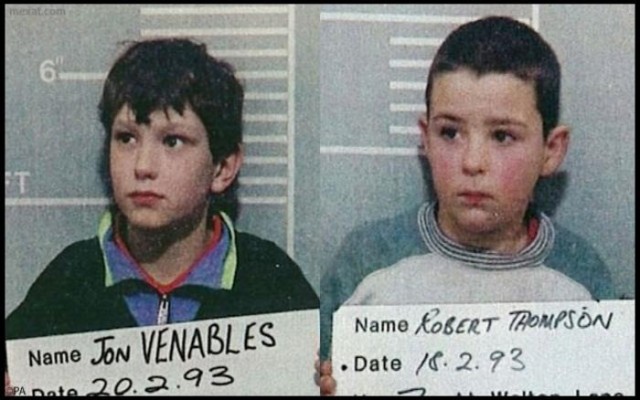
Since the EU referendum got under way in the UK, it has become almost an everyday occurence to turn on the TV and hear some politician explaining "I don't mean to sound racist, but..." (example) Of course, if you didn't mean to sound racist, you wouldn't sound racist in the first place, now would you? The reality is, whether you like politics or not, political leaders have a significant impact on society and the massive rise in UK hate crimes, including deaths of Polish workers, is a direct reflection of the leadership (or profound lack of it) coming down from Westminster. Maybe you don't mean to sound racist, but if this is the impact your words are having, maybe it's time to shut up? Choosing your referendum Why choose to have a referendum on immigration issues and not on any number of other significant topics? Why not have a referendum on nuking Mr Putin to punish him for what looks like an act of terrorism against the Malaysian Airlines flight MH17? Why not have a referendum on cutting taxes or raising speed limits, turning British motorways into freeways or an autobahn? Why choose to keep those issues in the hands of the Government, but invite the man-in-a-white-van from middle England to regurgitate Nigel Farage's fears and anxieties about migrants onto a ballot paper? Even if David Cameron sincerely hoped and believed that the referendum would turn out otherwise, surely he must have contemplated that he was playing Russian Roulette with the future of millions of innocent people? Let's start at the top For those who are fortunate enough to live in parts of the world where the press provides little exposure to the antics of British royalty, an interesting fact you may have missed is that the Queen's husband, Prince Philip, Duke of Edinburgh is actually a foreigner. He was born in Greece and has Danish and German ancestry. Migration (in both directions) is right at the heart of the UK's identity. Queen and Prince Philip Home office minister Amber Rudd recently suggested British firms should publish details about how many foreign people they employ and in which positions. She argued this is necessary to help boost funding for training local people. If that is such a brilliant idea, why hasn't it worked for the Premier League? It is a matter of public knowledge how many foreigners play football in England's most prestigious division, so why hasn't this caused local clubs to boost training budgets for local recruits? After all, when you consider that England hasn't won a World Cup since 1966, what have they got to lose? Kevin Pietersen All this racism, it's just not cricket. Or is it? One of the most remarkable cricketers to play for England in recent times, Kevin Pietersen, dubbed "the most complete batsman in cricket" by The Times and "England's greatest modern batsman" by the Guardian, was born in South Africa. In the five years he was contracted to the Hampshire county team, he only played one match, because he was too busy representing England abroad. His highest position was nothing less than becoming England's team captain. Are the British superior to every other European citizen? One of the implications of the rhetoric coming out of London these days is that the British are superior to their neighbours, entitled to have their cake and eat it too, making foreigners queue up at Paris' Gare du Nord to board the Eurostar while British travelers should be able to walk or drive into European countries unchallenged. This superiority complex is not uniquely British, you can observe similar delusions are rampant in many of the places where I've lived, including Australia, Switzerland and France. America's Donald Trump has taken this style of politics to a new level. Look in the mirror Theresa May: after British 10-year old schoolboys Robert Thompson and Jon Venables abducted, tortured, murdered and mutilated 2 year old James Bulger in 1993, why not have all British schoolchildren fingerprinted and added to the police DNA database? Why should "security" only apply based on the country where people are born, their religion or skin colour? Jon Venables and Robert Thompson In fact, after Brexit, people like Venables and Thompson will remain in Britain while a Dutch woman, educated at Cambridge and with two British children will not. If that isn't racism, what is? Running foreigner's off the roads Theresa May has only been Prime Minister for less than a year but she has a history of bullying and abusing foreigners in her previous role in the Home Office. One example of this was a policy of removing driving licenses from foreigners, which has caused administrative chaos and even taken away the licenses of many people who technically should not have been subject to these regulations anyway. Shouldn't the DVLA (Britain's office for driving licenses) simply focus on the competence of somebody to drive a vehicle? Bringing all these other factors into licensing creates a hostile environment full of mistakes and inconvenience at best and opportunities for low-level officials to engage in arbitrary acts of racism and discrimination. Of course, when you are taking your country on the road to nowhere, who needs a driving license anyway? Run off the road What does "maximum control" over other human beings mean to you? The new British PM has said she wants "maximum control" over immigrants. What exactly does "maximum control" mean? Donald Trump appears to be promising "maximum control" over Muslims, Hitler sought "maximum control" over the Jews, hasn't the whole point of the EU been to avoid similar situations from ever arising again? This talk of "maximum control" in British politics has grown like a weed out of the UKIP. One of their senior figures has been linked to kidnappings and extortion, which reveals a lot about the character of the people who want to devise and administer these policies. Similar people in Australia aspire to jobs in the immigration department where they can extort money out of people for getting them pushed up the queue. It is no surprise that the first member of Australia's parliament ever sent to jail was put there for obtaining bribes and sexual favours from immigrants. When Nigel Farage talks about copying the Australian immigration system, he is talking about creating jobs like these for his mates. Even if "maximum control" is important, who really believes that a bunch of bullies in Westminster should have the power to exercise that control? Is May saying that British bosses are no longer competent to make their own decisions about who to employ or that British citizens are not reliable enough to make their own decisions about who they marry and they need a helping hand from paper-pushers in the immigration department? maximum control over Jewish people Echoes of the Third Reich Most people associate acts of mass murder with the Germans who lived in the time of Adolf Hitler. These are the stories told over and and over again in movies, books and the press. Look more closely, however, and it appears that the vast majority of Germans were not in immediate contact with the gas chambers. Even Gobels' secretary writes that she was completely oblivious to it all. Many people were simply small cogs in a big bad machine. The clues were there, but many of them couldn't see the big picture. Even if they did get a whiff of it, many chose not to ask questions, to carry on with their comfortable lives. Today, with mass media and the Internet, it is a lot easier for people to discover the truth if they look, but many are still reluctant to do so. Consider, for example, the fingerprint scanners installed in British post offices and police stations to fingerprint foreigners and criminals (as if they have something in common). If all the post office staff refused to engage in racist conduct the fingerprint scanners would be put out of service. Nonetheless, these people carry on, just doing their job, just following orders. It was through many small abuses like this, rather than mass murder on every street corner, that Hitler motivated an entire nation to serve his evil purposes. Technology like this is introduced in small steps: first it was used for serious criminals, then anybody accused of a crime, then people from Africa and next it appears they will try and apply it to all EU citizens remaining in the UK. How will a British man married to a French woman explain to their children that mummy has to be fingerprinted by the border guard each time they return from vacation? The Nazis pioneered biometric technology with the tracking numbers branded onto Jews. While today's technology is electronic and digital, isn't it performing the same function? There is no middle ground between "soft" and "hard" brexit An important point for British citizens and foreigners in the UK to consider today is that there is no compromise between a "soft" Brexit and a "hard" Brexit. It is one or the other. Anything less (for example, a deal that is "better" for British companies and worse for EU citizens) would imply that the British are a superior species and it is impossible to imagine the EU putting their stamp on such a deal. Anybody from the EU who is trying to make a life in the UK now is playing a game of Russian Roulette - sure, everything might be fine if it morphs into "soft" Brexit, but if Theresa May has her way, at some point in your life, maybe 20 years down the track, you could be rounded up by the gestapo and thrown behind bars for a parking violation. There has already been a five-fold increase in the detention of EU citizens in British concentration camps and they are using grandmothers from Asian countries to refine their tactics for the efficient removal of EU citizens. One can only wonder what type of monsters Theresa May has been employing to run such inhumane operations. This is not politics Edmund Burke's quote "The only thing necessary for the triumph of evil is for good men to do nothing" comes to mind on a day like today. Too many people think it is just politics and they can go on with their lives and ignore it. Barely half the British population voted in the referendum. This is about human beings treating each other with dignity and respect. Anything less is abhorrent and may well come back to bite.

24 March 2017

Jo Shields: Mono repository changes, beginning Mono vNext

Up to now, Linux packages on mono-project.com have come in two flavours RPM built for CentOS 7 (and RHEL 7), and .deb built for Debian 7. Universal packages that work on the named distributions, and anything newer. Except that s not entirely true. Firstly, there have been compatibility repositories users need to add, to deal with ABI changes in libtiff, libjpeg, and Apache, since Debian 7. Then there s the packages for ARM64 and PPC64el neither of those architectures is available in Debian 7, so they re published in the 7 repo but actually built on 8. A large reason for this is difficulty in our package publishing pipeline apt only allows one version-architecture mix in the repository at once, so I can t have, say, 4.8.0.520-0xamarin1 built on AMD64 on both Debian 7 and Ubuntu 16.04. We ve been working hard on a new package build/publish pipeline, which can properly support multiple distributions, based on Jenkins Pipeline. This new packaging system also resolves longstanding issues such as can t really build anything except Mono and Architecture: All packages still get built on Jo s laptop, with no public build logs So, here s the old build matrix:
Distribution Architectures
Debian 7 ARM hard float, ARM soft float, ARM64 (actually Debian 8), AMD64, i386, PPC64el (actually Debian 8)
CentOS 7 AMD64
And here s the new one:
Distribution Architectures
Debian 7 ARM hard float (v7), ARM soft float, AMD64, i386
Debian 8 ARM hard float (v7), ARM soft float, ARM64, AMD64, i386, PPC64el
Raspbian 8 ARM hard float (v6)
Ubuntu 14.04 ARM hard float (v7), ARM64, AMD64, i386, PPC64el
Ubuntu 16.04 ARM hard float (v7), ARM64, AMD64, i386, PPC64el
CentOS 6 AMD64, i386
CentOS 7 AMD64
The compatibility repositories will no longer be needed on recent Ubuntu or Debian just use the right repository for your system. If your distribution isn t listed sorry, but we need to draw a line somewhere on support, and the distributions listed here are based on heavy analysis of our web server logs and bug requests. You ll want to change your package manager repositories to reflect your system more accurately, once Mono vNext is published. We re debating some kind of automated handling of this, but I m loathe to touch users sources.list without their knowledge. CentOS builds are going to be late I ve been doing all my prototyping against the Debian builds, as I have better command of the tooling. Hopefully no worse than a week or two. edit I guess Ubuntu 12.04 is coming back too, despite being EOL, for TravisCI support.

21 March 2017

Reproducible builds folks: Reproducible Builds: week 99 in Stretch cycle

Here's what happened in the Reproducible Builds effort between Sunday March 12 and Saturday March 18 2017: Upcoming events Reproducible Builds Hackathon Hamburg 2017 The Reproducible Builds Hamburg Hackathon 2017, or RB-HH-2017 for short is a 3 day hacking event taking place May 5th-7th in the CCC Hamburg Hackerspace located inside Frappant, as collective art space located in a historical monument in Hamburg, Germany. The aim of the hackathon is to spent some days working on Reproducible Builds in every distribution and project. The event is open to anybody interested on working on Reproducible Builds issues, with or without prior experience! Accomodation is available and travel sponsorship may be available by agreement. Please register your interest as soon as possible. Reproducible Builds Summit Berlin 2016 This is just a quick note, that all the pads we've written during the Berlin summit in December 2016 are now online (thanks to Holger), nicely complementing the report by Aspiration Tech. Request For Comments for new specification: BUILD_PATH_PREFIX_MAP Ximin Luo posted a draft version of our BUILD_PATH_PREFIX_MAP specification for passing build-time paths between high-level and low-level build tools. This is meant to help eliminate irreproducibility caused by different paths being used at build time. At the time of writing, this affects an estimated 15-20% of 25000 Debian packages. This is a continuation of an older proposal SOURCE_PREFIX_MAP, which has been updated based on feedback on our patches from GCC upstream, attendees of our Berlin 2016 summit, and participants on our mailing list. Thanks to everyone that contributed! The specification also contains runnable source code examples and test cases; see our git repo. Please comment on this draft ASAP - we plan to release version 1.0 of this in a few weeks. Toolchain changes Packages reviewed and fixed, and bugs filed Chris Lamb: Reviews of unreproducible packages 5 package reviews have been added, 274 have been updated and 800 have been removed in this week, adding to our knowledge about identified issues. 1 issue type has been added: Weekly QA work During our reproducibility testing, FTBFS bugs have been detected and reported by: diffoscope development diffoscope 79 and 80 were uploaded to experimental by Chris Lamb. It included contributions from: Chris Lamb: Maria Glukhova: strip-nondeterminism development strip-nondeterminism 0.032-1 was uploaded to unstable by Chris Lamb. It included contributions from: Chris Lamb: tests.reproducible-builds.org Misc. This week's edition was written by Ximin Luo, Holger Levsen and Chris Lamb & reviewed by a bunch of Reproducible Builds folks on IRC & the mailing lists.

20 March 2017

Shirish Agarwal: Tale of two countries, India and Canada

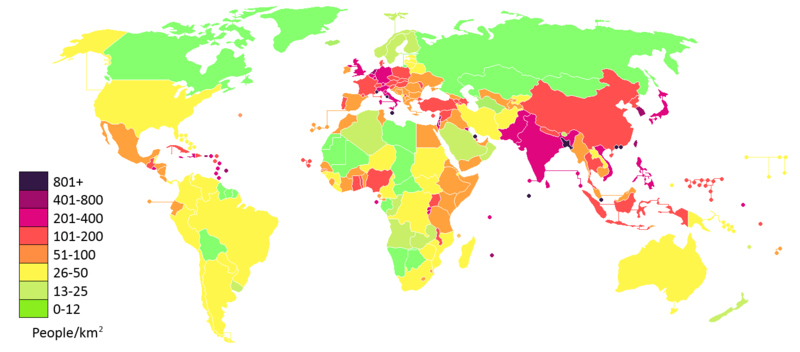
Apologies the first blog post got sent out by mistake. Weather comparisons between the two countries Last year, I had come to know that this year s debconf is happening in Canada, a cold country. Hence, few weeks/month back, I started trying to find information online when I stumbled across few discussion boards where people were discussing about Innerwear and Outerwear and I couldn t understand what that was all about. Then somehow stumbled across this Video, which is of a game called the Long Dark and just seeing couple of episodes it became pretty clear to me why the people there were obsessing with getting the right clothes and everything about it. Couple of Debconf people were talking about the weather in Montreal, and surprise, surprise it was snowing there, in fact supposed to be near the storm of the century. Was amazed to see that they have a website to track how much snow has been lifted. If we compare that to Pune, India weather-wise we are polar opposites. There used to be a time, when I was very young, maybe 5 yrs. old that once the weather went above 30 degree celsius, rains would fall, but now its gonna touch 40 degrees soon. And April and May, the two hottest months are yet to come. China Gate Before I venture further, I was gifted the book China Gate written by an author named William Arnold. When I read the cover and the back cover, it seemed the story was set between China and Taiwan, later when I started reading it, it shares history of Taiwan going back 200 or so odd years. This became relevant as next year s Debconf, Debconf 2018 will be in Taiwan, yes in Asia very much near to India. I am ashamed to say that except for the Tiananmen Square Massacre and the Chinese High-Speed Rail there wasn t much that I knew. According to the book, and I m paraphrasing here the gist I got was that for a long time, the Americans promised Taiwan it will be an Independent country forever, but due to budgetary and other political constraints, the United States took the same stand as China from 1979. Interestingly, now it seems Mr. Trump wants to again recognize Taiwan as a separate entity from China itself but as is with Mr. Trump you can t be sure of why he does, what he does. Is it just a manoeuvrer designed to out-smart the chinese and have a trade war or something else, only time will tell. One thing which hasn t been shared in the book but came to know via web is that Taiwan calls itself Republic of China . If Taiwan wants to be independent then why the name Republic of China ? Doesn t that strengthen China s claim that Taiwan is an integral part of China. I don t understand it. The book does seduce you into thinking that the events are happening in real-time, as in happening now. That s enough OT for now. null Population Density As well in the game and whatever I could find on the web, Canada seems to be on the lower side as far as population is concerned. IIRC, few years back, Canadians invited Indian farmers and gave them large land-holdings for over 100 years on some small pittance. While the link I have shared is from 2006, I read it online and in newspapers even as late as in 2013/2014. The point being there seems to be lot of open spaces in Canada, whereas in India we fight for even one inch literally, due to overpopulation. This sharing reminded me of Mark of Gideon . While I was young, I didn t understand the political meaning of it and still struggle to understand about whom the show was talking about. Was it India, Africa or some other continent they were talking about ? This also becomes obvious when you figure out the surface area of the two countries. When I had started to learn about Canada, I had no idea, nor a clue that Canada is three times the size of India. And this is when I know India is a large country. but seeing that Canada is thrice larger just boggled my mind. As a typical urbanite, would probably become mad if in a rural area in Canada. Montreal, however seems to be something like Gwalior or Bangalore before IT stormed in, seems to be a place where people can work, play and have quite a few gardens as well. Rail This is one thing that is similar in both the great countries. India has Indian Railways and while the Canadians have their own mountain railway called viarail. India chugs on its 68k kilometre network, Canada is at fourth position with 52k network. With thrice the land size, it should have been somewhere where Russia is or even better than them. It would be interesting if a Canadian/s comment about their railway network and why it is so bad in terms of reach. As far as food is concerned, somebody shared this Also, have no idea if Canadian trains are as entertaining as Indian ones, in terms of diverse group of people as well as variety of food to eat as also shared a bit in the video. I am not aware whether Via Rail is the only network operator and there are other network operators unlike Indian Railways which has monopoly on most of the operations. Countries which have first past the post system - Wikipedia Business houses, Political Families This is again something that is similar in both the countries, it seems (from afar) that its only few business houses and more importantly political families which have governed for years. From what little I could understand, both India and Canada have first past the post system which as shared by its critics is unfair to new and small parties. It would be interesting to see if Canada does a re-think. For India, it would need a massive public education outreach policy and implementation. We just had elections in 5 states of India with U.P. (with respect to area-size and population density) and from the last several years, the EVM s (Electronic Voting Machines) tries to make sure that nobody could know which area which party got the most votes. This is to make sure the winning party is not able to take revenge on people or areas which did not vote for them. Instead you have general region counting of votes with probably even the Election Commission not knowing which EVM went to what area and what results are there in sort of double-blind methodology. As far as Business houses are concerned, I am guessing it s the same world-over, only certain people hold the wealth while majority of us are in hard-working, non-wealthy status. Northern Lights - Aurora Borealis Northern Lights, Aurora Borealis Apart from all the social activities that Montreal is famous for, somebody told/shared with me that it is possible to see the Northern Lights, Aurora Borealis can be seen in Canada. I dunno how true or not it is, while probably in Montreal it isn t possible to see due to light pollution, but maybe around 40-50 kms. from the city ? Can people see it from Canada ? IF yes, how far would you have to go ? Are there any companies or people who take people to see the Northern Lights. While I still have to apply for bursary, and if that gets ok, then try getting the visa, but if that goes through, apart from debconf and social activities happening in and around Montreal, Museums, Music etc. , this would be something I would like to experience if it s possible. While I certainly would have to be prepared for the cold that would be, if it s possible, no offence to debconf or anybody else but it probably would be the highlight of the entire trip if its possible. This should be called/labelled as the greatest show on earth TM.
Filed under: Miscellenous Tagged: # Population Density, #Area size, #Aurora Borealis, #Canada, #Trains, DebConf, India, politics

17 March 2017

Shirish Agarwal: Science Day at GMRT, Khodad 2017

The whole team posing at the end of day 2 The above picture is the blend of the two communities from foss community and mozilla India. And unless you were there you wouldn t know who is from which community which is what FOSS is all about. But as always I m getting a bit ahead of myself. Akshat, who works at NCRA as a programmer, the standing guy on the left shared with me in January this year that this year too, we should have two stalls, foss community and mozilla India stalls next to each other. While we had the banners, we were missing stickers and flyers. Funds were and are always an issue and this year too, it would have been emptier if we didn t get some money saved from last year minidebconf 2016 that we had in Mumbai. Our major expenses included printing stickers, stationery and flyers which came to around INR 5000/- and couple of LCD TV monitors which came for around INR 2k/- as rent. All the labour was voluntary in nature, but both me and Akshat easily spending upto 100 hours before the event. Next year, we want to raise to around INR 10-15k so we can buy 1 or 2 LCD monitors and we don t have to think for funds for next couple of years. How will we do that I have no idea atm. Printing leaflets Me and Akshat did all the printing and stationery runs and hence had not been using my lappy for about 3-4 days. Come to the evening before the event and the laptop would not start. Coincidentally, or not few months or even last at last year s Debconf people had commented on IBM/Lenovo s obsession with proprietary power cords and adaptors. I hadn t given it much thought but when I got no power even after putting it on AC power for 3-4 hours, I looked up on the web and saw that the power cord and power adaptors were all different even in T440 and even that under existing models. In fact I couldn t find mine hence sharing it via pictures below. thinkpad power cord male thinkpad power adaptor female I knew/suspected that thinkpads would be rare where I was going, it would be rarer still to find the exact power cord and I was unsure whether it was the power cord at fault or adaptor or whatever goes for SMPS in laptop or memory or motherboard/CPU itself. I did look up the documentation at support.lenovo.com and was surprised at the extensive documentation that Lenovo has for remote troubleshooting. I did the usual take out the battery, put it back in, twiddle with the little hole in the bottom of the laptop, trying to switch on without the battery on AC mains, trying to switch on with battery power only but nothing worked. Couple of hours had gone by and with a resigned thought went to bed, convincing myself that anyways it s good I am not taking the lappy as it is extra-dusty there and who needs a dead laptop anyways. Update After the event was over, I did contact Lenovo support and within a week, with one visit from a service engineer, he was able to identify that it was a faulty cable which was at fault and not the the other things which I was afraid of. Another week gone by and lenovo replaced the cable. Going by service standards that I have seen of other companies, Lenovo deserves a gold star here for the prompt service they provided. I probably would end up subscribing to their extended 2-year warranty service when my existing 3 year warranty is about to be over. Next day, woke up early morning, two students from COEP hostel were volunteering and we made our way to NCRA, Pune University Campus. Ironically, though we were under the impression that we would be the late arrivals, it turned out we were the early birds. 5-10 minutes passed by and soon enough we were joined by Aniket and we played catch-up for a while. We hadn t met each other for a while so it was good to catch-up. Then slowly other people starting coming in and around 07:10-07:15 we started for GMRT, Khodad. Now I had been curious as had been hearing for years that the Pune-Nashik NH-50 highway would be concreted and widened to six-lane highways but the experience was below par. Came back and realized the proposal has now been pushed back to 2020. From the mozilla team, only Aniket was with us, the rest of the group was coming straight from Nashik. Interestingly, all the six people who came, came on bikes which depending upon how you look at it was either brave or stupid. Travelling on bikes on Indian highways you either have to be brave or stupid or both, we have more than enough accidents due to quality of road construction, road design, lane-changing drivers and many other issues. This is probably not the place for it hence will use some other blog post to rant about that. We reached around 10:00 hrs. IST and hung around till lunch as Akshat had all the marketing material, monitors etc. The only thing we had were couple of lappies and couple of SBC s, an RPI 3 and a BBB. Aarti Kashyap sharing something about SBC Our find for the event was Aarti Kashyap who you can see above. She is a third-year student at COEP and one of the rare people who chose to interact with hardware rather than software. From last several years, we had been trying, successfully and unsuccessfully to get more Indian women and girls interested into technology. It is a vicious circle as till a girl/woman doesn t volunteer we are unable to share our knowledge to the extent we can which leads them to not have much interest in FOSS or even technology in general. While there are groups are djangogirls, Pyladies and railgirls and even Outreachy which tries to motivate getting girls into computing but it s a long road ahead. We are short of both funds and ideas as to how to motivate more girls to get into computing and then to get into playing with hardware. I don t know where to start and end for whoever wants to play with hardware. From SBC s, routers to blade servers the sky is the limit. Again this probably isn t the place for it, hence probably we can chew it on more at some other blog post. This year, we had a lowish turnout due to the fact that the 12th board exams 1st paper was on the day we had opened. So instead of 20-25k, we probably had 5-7k fewer people pass through. There were two-three things that we were showing, we were showing Debian on one of the systems, we were showing the output from the SBC s on the other monitor but the glare kept hitting the monitors. While the organizers had done exemplary work over last year. They had taped the carpets on the ground so there was hardly any dust moving around. However, I wished the organizers had taken the pains to have two cloth roofs over our head instead of just one, the other roof head could be say 2 feet up, this would have done two things a. It probably would have cooled the place a bit more as b. We could get diffused sunlight which would have lessened the glare and reflection the LCD s kept throwing back. At times we also got people to come to our side as can be seen in Aarti s photo as can be seen above. If these improvements can be made for next year, this would result in everybody in our Pandal would benefit, not just us and mozilla. This would be benefiting around 10-15 organizations which were within the same temporary structure. Of course, it depends very much on the budget they are able to have and people who are executing, we can just advise. The other thing which had been missing last year and this year is writing about Single Board Computers in Marathi. If we are to promote them as something to replace a computer or something for a younger brother/sister to learn computing upon at a lower cost, we need leaflets written in their language to be more effective. And this needs to be in the language and mannerisms that people in that region understand. India, as probably people might have experienced is a dialect-prone country. Which means every 2-5 kms, the way the language is spoken is different from anywhere else. The Marathi spoken by somebody who has lived in Ravivar Peth for his whole life and a person who has lived in say Kothrud are different. The same goes from any place and this place, Khodad, Narayangaon would have its own dialect, its own mini-codespeak. Just to share, we did have one in English but it would have been a vast improvement if we could do it in the local language. Maybe we can discuss about this and ask for help from people. Outside, Looking in Mozillians helping FOSS community and vice-versa What had been interesting about the whole journey were the new people who were bringing all their passion and creativity to the fore. From the mozilla community, we had Akshay who is supposed to be a wizard on graphics, animation, editing anything to do with the visual medium. He shared some of the work he had done and also shared a bit about how blender works with people who wanted to learn about that. Mayur, whom you see in the picture pointing out something about FOSS and this was the culture that we strove to have. I know and love and hate the browser but haven t been able to fathom the recklessness that Mozilla has been doing the last few years, which has just been having one mis-adventure after another. For instance, mozstumbler was an effort which I thought would go places. From what little I understood, it served/serves as a user-friendly interface to a potential user while still sharing all the data with OSM . They (Mozilla) seems/seemed to have a fatalistic take as it provided initial funding but then never fully committing to the project. Later, at night we had the whole free software and open-source sharings where I tried to emphasize that without free software, the term open-source would not have come into existence. We talked and talked and somewhere around 02:00 I slept, the next day was an extension of the first day itself where we ribbed each other good-naturedly and still shared whatever we could share with each other. I do hope that we continue this tradition for great many years to come and engage with more and more people every passing year.
Filed under: Miscellenous Tagged: #budget, #COEP< #volunteering, #debian, #Events, #Expenses, #mozstumbler, #printing, #SBC's, #Science Day 2017, #thinkpad cable issue, FOSS, mozilla

16 March 2017

Wouter Verhelst: Codes of Conduct

These days, most large FLOSS communities have a "Code of Conduct"; a document that outlines the acceptable (and possibly not acceptable) behaviour that contributors to the community should or should not exhibit. By writing such a document, a community can arm itself more strongly in the fight against trolls, harassment, and other forms of antisocial behaviour that is rampant on the anonymous medium that the Internet still is. Writing a good code of conduct is no easy matter, however. I should know -- I've been involved in such a process twice; once for Debian, and once for FOSDEM. While I was the primary author for the Debian code of conduct, the same is not true for the FOSDEM one; I was involved, and I did comment on a few early drafts, but the core of FOSDEM's current code was written by another author. I had wanted to write a draft myself, but then this one arrived and I didn't feel like I could improve it, so it remained. While it's not easy to come up with a Code of Conduct, there (luckily) are others who walked this path before you. On the "geek feminism" wiki, there is an interesting overview of existing Open Source community and conference codes of conduct, and reading one or more of them can provide one with some inspiration as to things to put in one's own code of conduct. That wiki page also contains a paragraph "Effective codes of conduct", which says (amongst others) that a good code of conduct should include
Specific descriptions of common but unacceptable behaviour (sexist jokes, etc.)
The attentive reader will notice that such specific descriptions are noticeably absent from both the Debian and the FOSDEM codes of conduct. This is not because I hadn't seen the above recommendation (I had); it is because I disagree with it. I do not believe that adding a list of "don't"s to a code of conduct is a net positive to it. Why, I hear you ask? Surely having a list of things that are not welcome behaviour is a good thing, which should be encouraged? Surely such a list clarifies the kind of things your does not want to see? Having such a list will discourage that bad behaviour, right? Well, no, I don't think so. And here's why.

Enumerating badness A list of things not to do is like a virus scanner. For those not familiar with these: on some operating systems, there is specific piece of software that everyone recommends you run, which checks if particular blobs of data appear in files on the disk. If they do, then these files are assumed to be bad, and are kicked out. If they do not, then these files are assumed to be not bad, and are left alone (for the most part). This works if we know all the possible types of badness; but as soon as someone invents a new form of badness, suddenly your virus scanner is ineffective. Additionally, it also means you're bound to continually have to update your virus scanner (or, as the case may be, code of conduct) to a continually changing hostile world. For these (and other) reasons, enumerating badness is listed as number 2 in security expert Markus Ranum's "six dumbest ideas in computer security," which was written in 2005. In short, a list of "things not to do" is bound to be incomplete; if the goal is to clarify the kind of behaviour that is not welcome in your community, it is usually much better to explain the behaviour that is wanted, so that people can infer (by their absense) the kind of behaviour that isn't welcome. This neatly brings me to my next point...

Black vs White vs Gray. The world isn't black-and-white. We could define a list of welcome behaviour -- let's call that the whitelist -- or a list of unwelcome behaviour -- the blacklist -- and assume that the work is done after doing so. However, that wouldn't be true. For every item on either the white or black list, there's going to be a number of things that fall somewhere in between. Let's call those things as being on the "gray" list. They're not the kind of outstanding behaviour that we would like to see -- they'd be on the white list if they were -- but they're not really obvious CoC violations, either. You'd prefer it if people don't do those things, but it'd be a stretch to say they're jerks if they do. Let's clarify that with an example: Is it a code of conduct violation if you post links to pornography websites on your community's main development mailinglist? What about jokes involving porn stars? Or jokes that denigrate women, or that explicitly involve some gender-specific part of the body? What about an earring joke? Or a remark about a user interacting with your software, where the women are depicted as not understanding things as well as men? Or a remark about users in general, that isn't written in a gender-neutral manner? What about a piece of self-deprecating humor? What about praising someone else for doing something outstanding? I'm sure most people would agree that the first case in the above paragraph should be a code of conduct violation, whereas the last case should not be. Some of the items in the list in between are clearly on one or the other side of the argument, but for others the jury is out. Let's call those as being in the gray zone. (Note: no, I did not mean to imply that the list is ordered in any way ;-) If you write a list of things not to do, then by implication (because you didn't mention them), the things in the gray area are okay. This is especially problematic when it comes to things that are borderline blacklisted behaviour (or that should be blacklisted but aren't, because your list is incomplete -- see above). In such a situation, you're dealing with people who are jerks but can argue about it because your definition of jerk didn't cover teir behaviour. Because they're jerks, you can be sure they'll do everything in their power to waste your time about it, rather than improving their behaviour. In contrast, if you write a list of things that you want people to do, then by implication (because you didn't mention it), the things in the gray area are not okay. If someone slips and does something in that gray area anyway, then that probably means they're doing something borderline not-whitelisted, which would be mildly annoying but doesn't make them jerks. If you point that out to them, they might go "oh, right, didn't think of it that way, sorry, will aspire to be better next time". Additionally, the actual jerks and trolls will have been given less tools to argue about borderline violations (because the border of your code of conduct is far, far away from jerky behaviour), so less time is wasted for those of your community who have to police it (yay!). In theory, the result of a whitelist is a community of people who aspire to be nice people, rather than a community of people who simply aspire to be "not jerks". I know which kind of community I prefer.

Giving the wrong impression During one of the BOFs that were held while I was drafting the Debian code of conduct, it was pointed out to me that a list of things not to do may give the impression to people that all these things on this list do actually happen in the code's community. If that is true, then a very long list may produce the impression that the given community is a community with a lot of problems. Instead, a whitelist-based code of conduct will provide the impression that you're dealing with a healthy community. Whether that is the case obviously depends on more factors than just the code of conduct itself, but it will put people in the right mindset for this to become something of a self-fulfilling prophecy.

Conclusion Given all of the above, I think a whitelist-based code of conduct is a better idea than a blacklist-based one. Additionally, in the few years since the Debian code of conduct was accepted, it is my impression that the general atmosphere in the Debian project has improved, which would seem to confirm that the method works (but YMMV, of course). At any rate, I'm not saying that blacklist-based codes of conduct are useless. However, I do think that whitelist-based ones are better; and hopefully, you now agree, too ;-)

15 March 2017

Michal &#268;iha&#345;: Life of free software project

During last week I've noticed several interesting posts about challenges being free software maintainer. After being active in open source for 16 years I can share much of the feelings I've read and I can also share my dealings with the things. First of all let me link some of the other posts on the topic: I guess everybody involved in in some popular free software project knows it - there is much more work to be done than people behind the project can handle. It really doesn't matter it those are bug reports, support requests, new features or technical debt, it's simply too much of that. If you are the only one behind the project it can feel even more pressing. There can be several approaches how to deal with that, but you have to choose what you prefer and what is going to work for you and your project. I've used all of the below mentioned approaches on some of the projects, but I don't think there is a silver bullet. Finding more people Obviously if you can not cope with the work, let's find more people to do the work. Unfortunately it's not that easy. Sometimes people come by, contribute few patches, but it's not that easy to turn them into regular contributor. You should encourage them to stay and to care about the part of the project they have touched. You can try to attract completely new contributors through programs as Google Summer of Code (GSoC) or Outreachy, but that has it's own challenges as well. With phpMyAdmin we're participating regularly in GSoC (we've only missed last year as we were not chosen by Google that year) and it indeed helps to bring new people on the board. Many of them even stay around your project (currently 3 of 5 phpMyAdmin team members are former GSoC students). But I think this approach really works only for bigger organizations. You can also motivate people by money. It's way which is not really much used on free software projects, partly because lack of funding (I'll get to that later) and partly because it doesn't necessarily bring long time contributors, just cash hunters. I've been using Bountysource for some of my projects (Weblate and Gammu) and so far it mostly works other way around - if somebody posts bounty on the issue, it means it's quite important for him to get that fixed, so I use that as indication for myself. On attracting new developers it never really worked well, even when I've tried to post bounties to some easy to fix issues, where newbies could learn our code base and get paid for that. These issues stayed opened for months and in the end I've fixed them myself because they annoyed me. Don't care too much I think this is most important aspect - you simply can never fix all the problems. Let's face it and work according to that. There can be various levels of don't caring. I find it always better to try to encourage people to fix their problem, but you can't expect big success rate in that, so you might find it not worth of the time. What I currently do: If you still can't handle that, you should consider abandoning the project as well. Does it bring something to you other than frustration of not completed work? I know it can be hard decision, in the end it is your child, but sometimes it's the best think you can do. Get paid to do the work Are you doing your fulltime job and then work on free software on nights or weekends? It can probably work for some time, but unless you find some way to make these two match, you will lack free time to relax and spend with friends or family. There are several options to make these work together. You can find job where doing free software will be natural part of it. This worked for me pretty well at SUSE, but I'm sure there are more companies where it will work. It can happen that the job will not cover all your free software activities, but this still helps. You can also make your project to become your employer. This can be sometimes challenging to make volunteers and paid contractors to work on one project, but I think this can be handled. Such setup currently works currently quite well for phpMyAdmin (we will announce second contractor soon) and works quite well for me with Weblate as well. Funding free software projects Once your project is well funded, you can fix many problems by money. You can pay yourself to do the work, hire additional developers, get better infrastructure or travel to conferences to spread word about it. But the question is how to get to the point of being well funded. There are several crowdfunding platforms which can help you with that (Liberapay, Bountysource salt, Gratipay or Snowdrift to mention some). You can also administer the funding yourself or using some legal entity such as Software Freedom Conservancy which handles this for phpMyAdmin. But the most important thing is to persuade people and companies to give back. You know there are lot of companies relying on your project, but how to make them fund the project? I really don't know, I still struggle with this as I don't want to be too pushy in asking for money, but I'd really like to see them to give back. What kind of works is giving your sponsors logo / link placement on your website. If your website is well ranked, you can expect to get quite a lot of SEO sponsors and the question is where to draw a line what you still find acceptable. Obviously the most willing to pay companies will have nothing to do with what you do and they just want to get the link. The industry you can expect is porn, gambling, binary options and various MFA sites. You will get some legitimate sponsors related to your project as well. We felt we've gone too far with phpMyAdmin last year and we've stricten the rules recently, but the outcome is still not visible on our website (as we've just limited new sponsors, but existing contracts will be honored). Another option is to monetize your project more directly. You can offer consulting services or provide it as a service (this is what I currently do with Weblate). It really depends on the product if you can build customer base on that or not, but certainly this is not something what would work well for all projects. Thanks for reading this and I hope it's not too chaotic, as I've moved parts there and back while writing and I'm afraid it got too long in the end.

Filed under: Debian English Gammu phpMyAdmin SUSE Weblate 0 comments

14 March 2017

Reproducible builds folks: Reproducible Builds: week 98 in Stretch cycle

Here's what happened in the Reproducible Builds effort between Sunday March 5 and Saturday March 11 2017: Upcoming events Reproducible Builds Hackathon Hamburg The Reproducible Builds Hamburg Hackathon 2017, or RB-HH-2017 for short, is a 3 day hacking event taking place in the CCC Hamburg Hackerspace located inside the Frappant, which is collective art space located in a historical monument in Hamburg, Germany. The aim of the hackathon is to spent some days working on Reproducible Builds in every distribution and project. The event is open to anybody interested on working on Reproducible Builds issues in any distro or project, with or without prio experience! Packages filed Chris Lamb: Toolchain development Reviews of unreproducible packages 39 package reviews have been added, 7 have been updated and 9 have been removed in this week, adding to our knowledge about identified issues. 2 issue types have been added: Weekly QA work During our reproducibility testing, FTBFS bugs have been detected and reported by: buildinfo.debian.net development reproducible-website development tests.reproducible-builds.org Misc. This week's edition was written by Chris Lamb, Holger Levsen, Vagrant Cascadian & reviewed by a bunch of Reproducible Builds folks on IRC & the mailing lists.

13 March 2017

Sean Whitton: Initial views of 5th edition DnD

I ve been playing in a 5e campaign for around two months now. In the past ten days or so I ve been reading various source books and Internet threads regarding the design of 5th edition. I d like to draw some comparisons and contrasts between 5th edition, and the 3rd edition family of games (DnD 3.5e and Paizo s Pathfinder, which may be thought of as 3.75e). The first thing I d like to discuss is that wizards and clerics are no longer Vancian spellcasters. In rules terms, this is the idea that individual spells are pieces of ammunition. Spellcasters have a list of individual spells stored in their heads, and as they cast spells from that list, they cross off each item. Barring special rules about spontaneously converting prepared spells to healing spells, for clerics, the only way to add items back to the list is to take a night s rest. Contrast this with spending points from a pool of energy in order to use an ability to cast a fireball. Then the limiting factor on using spells is having enough points in your mana pool, not having further castings of the spell waiting in memory. One of the design goals of 5th edition was to reduce the dominance of spellcasters at higher levels of play. The article to which I linked in the previous paragraph argues that this rebalancing requires the removal of Vancian magic. The idea, to the extent that I ve understood it, is that Vancian magic is not an effective restriction on spellcaster power levels, so it is to be replaced with other restrictions adding new restrictions while retaining the restrictions inherent in Vancian magic would leave spellcasters crippled. A further reason for removing Vancian magic was to defeat the so-called five minute adventuring day . The compat ability of a party that contains higher level Vancian spellcasters drops significantly once they ve fired off their most powerful combat spells. So adventuring groups would find themselves getting into a fight, and then immediately retreating to fully rest up in order to get their spells back. This removes interesting strategic and roleplaying possibilities involving the careful allocation of resources, and continuing to fight as hit points run low. There are some other related changes. Spell components are no longer used up when casting a spell. So you can use one piece of bat guano for every fireball your character ever casts, instead of each casting requiring a new piece. Correspondingly, you can use a spell focus, such as a cool wand, instead of a pouch full of material components since the pouch never runs out, there s no mechanical change if a wizard uses an arcane focus instead. 0th level spells may now be cast at will (although Pathfinder had this too). And there are decent 0th level attack spells, so a spellcaster need not carry a crossbow or shortbow in order to have something to do on rounds when it would not be optimal to fire off one of their precious spells. I am very much in favour of these design goals. The five minute adventuring day gets old fast, and I want it to be possible for the party to rely on the cool abilities of non-spellcasters to deal with the challenges they face. However, I am concerned about the flavour changes that result from the removal of Vancian magic. These affect wizards and clerics differently, so I ll take each case in turn. Firstly, consider wizards. In third edition, a wizard had to prepare and cast Read Magic (the only spell they could prepare without a spellbook), and then set about working through their spellbook. This involved casting the spells they wanted to prepare, up until the last few triggering words or gestures that would cause the effect of the spell to manifest. They would commit these final parts of the spell to memory. When it came to casting the spell, the wizard would say the final few words and make the required gestures, and bring out relevant material components from their component pouch. The completed spell would be ripped out of their mind, to manifest its effect in the world. We see that the casting of a spell is a highly mentally-draining activity it rips the spell out of the caster s memory! not to be undertaken lightly. Thus it is natural that a wizard would learn to use a crossbow for basic damage-dealing. Magic is not something that comes very naturally to the wizard, to be deployed in combat as readily as the fighter swings their sword. They are not a superhero or video game character, pew pew ing their way to victory. This is a very cool starting point upon which to roleplay an academic spellcaster, not really available outside of tabletop games. I see it as a distinction between magical abilities and real magic. Secondly, consider clerics. Most of the remarks in the previous paragraph apply, suitably reworked to be in terms of requesting certain abilities from the deity to whom the cleric is devoted. Additionally, there is the downgrading of the importance of the cleric s healing magic in 5th edition. Characters can heal themselves by taking short and long rests. Previously, natural healing was very slow, so a cleric would need to convert all their remaining magic to healing spells at the end of the day, and hope that it was enough to bring the party up to fighting shape. Again, this made the party of adventurers seem less like superheroes or video game characters. Magic had a special, important and unique role, that couldn t be replaced by the abilities of other classes.
There are some rules in the back of the DMG Slow Natural Healing , Healing Kit Dependency , Lingering Wounds which can be used to make healing magic more important. I m not sure how well they would work without changes to the cleric class.
I would like to find ways to restore the feel and flavour of Vancian clerics and wizards to 5th edition, without sacrificing the improvements that have been made that let other party members do cool stuff too. I hope it is possible to keep magic cool and unique without making it dominate the game. It would be easy to forbid the use of arcane foci, and say that material component pouches run out if the party do not visit a suitable marketplace often enough. This would not have a significant mechanical effect, and could enhance roleplaying possibilities. I am not sure how I could deal with the other issues I ve discussed without breaking the game. The second thing I would like to discuss is bounded accuracy. Under this design principle, the modifiers to dice rolls grow much more slowly. The gain of hit points remains unbounded. Under third edition, it was mechanically impossible for a low-level monster to land a hit on a higher-level adventurer, rendering them totally useless even in overwhelming numbers. With bounded accuracy, it s always possible for a low-level monster to hit a PC, even if they do insigificant damage. That means that multiple low-level monsters pose a threat. This change opens up many roleplaying opportunities by keeping low-level character abilities relevant, as well as monster types that can remain involves in stories without giving them implausible new abilities so they don t fall far behind the PCs. However, I m a little worried that it might make high level player characters feel a lot less powerful to play. I want to cease a be a fragile adventurer and become a world-changing hero at later levels, rather than forever remain vulnerable to the things that I was vulnerable to at the start of the game. This desire might just be the result of the video games which I played growing up. In the JRPGs I played and in Diablo II, enemies in earlier areas of the map were no threat at all once you d levelled up by conquering higher-level areas. My concerns about bounded accuracy might just be that it clashes with my own expectations of how fantasy heroes work. A good DM might be able to avoid these worries entirely. The final thing I d like to discuss is the various simplifications to the rules of 5th edition, when it is compared with 3rd edition and Pathfinder. Attacks of opportunity are only provoked when leaving a threatened square; you can go ahead and cast a spell when in melee with someone. There is a very short list of skills, and party members are much closer to each other in skills, now that you can t pump more and more ranks into one or two abilities. Feats as a whole are an optional rule. At first I was worried about these simplifications. I thought that they might make character building and tactics in combat a lot less fun. However, I am now broadly in favour of all of these changes, for two reasons. Firstly, they make the game so much more accessible, and make it far more viable to play without relying on a computer program to fill in the boxes on your character sheet. In my 5th edition group, two of us have played 3rd edition games, and the other four have never played any tabletop games before. But nobody has any problems figuring out their modifiers because it is always simply your ability bonus or penalty, plus your proficiency bonus if relevant. And advantage and disadvantage is so much more fun than getting an additional plus or minus two. Secondly, these simplifications downplay the importance of the maths, which means it is far less likely to be broken. It is easier to ensure that a smaller core of rules is balanced than it is to keep in check a larger mass of rules, constantly being supplemented by more and more addon books containing more and more feats and prestige classes. That means that players make their characters cool by roleplaying them in interesting ways, not making them cool by coming up with ability combos and synergies in advance of actually sitting down to play. Similarly, DMs can focus on flavouring monsters, rather than writing up longer stat blocks. I think that this last point reflects what I find most worthwhile about tabletop RPGs. I like characters to encounter cool NPCs and cool situations, and then react in cool ways. I don t care that much about character creation. (I used to care more about this, but I think it was mainly because of interesting options for magic items, which hasn t gone away.) The most important thing is exercising group creativity while actually playing the game, rather than players and DMs having to spend a lot of time preparing the maths in advance of playing. Fifth edition enables this by preventing the rules from getting in the way, because they re broken or overly complex. I think this is why I love Exalted: stunting is vital, and there is social combat. I hope to be able to work out a way to restore Vancian magic, but even without that, on balance, fifth edition seems like a better way to do group storytelling about fantasy heroes. Hopefully I will have an opportunity to DM a 5th edition campaign. I am considering disallowing all homebrew and classes and races from supplemental books. Stick to the well-balanced core rules, and do everything else by means of roleplaying and flavour. This is far less gimmicky, if more work for unimaginative players (such as myself!). Some further interesting reading:

Michal &#268;iha&#345;: Weblate users survey

Weblate is growing quite well in last months, but sometimes it's development is really driven by people who complain instead of following some roadmap with higher goals. I think it's time to change it at least a little bit. In order to get broader feedback I've sent out short survey to active project owners in Hosted Weblate week ago. I've decided to target at smaller audience for now, though publicly open survey might follow later (but it's always harder to evaluate feedback across different user groups). Overall feelings were really positive, most people find Weblate better than other similar services they have used. This is really something I like to hear :-). Weblate overall experience Weblate compared with other tools But the most important part for me was where users want to see improvements. This somehow matches my expectation that we really should improve the user interface. Weblate future development We have quite a lot features, which are really hidden in the user interface. Also interface for some of the features is far from being intuitive. This all probably comes from the fact that we really don't have anybody experienced with creating user interfaces right now. It's time to find somebody who will help us. In case you are able to help or know somebody who might be interested in helping, please get in touch. Weblate is free software, but this can still be paid job. Last part of the survey was focused on some particular features, but the outcome was not as clear as I hoped for as almost all feature group attracted about same attention (with one exception being extending the API, which was not really wanted by most of the users). Overall I think doing some survey like this is useful and I will certainly repeat it (probably yearly or so), to see where we're moving and what our users want. Having feedback from users is important for every project and this seemed to worked quite well. Anyway if you have further feedback, don't hesitate to use our issue tracker at GitHub or contact me directly.

Filed under: Debian English phpMyAdmin SUSE Weblate 0 comments

Next.

Previous.