Search Results: "ag"

13 May 2025

Ravi Dwivedi: KDE India Conference 2025

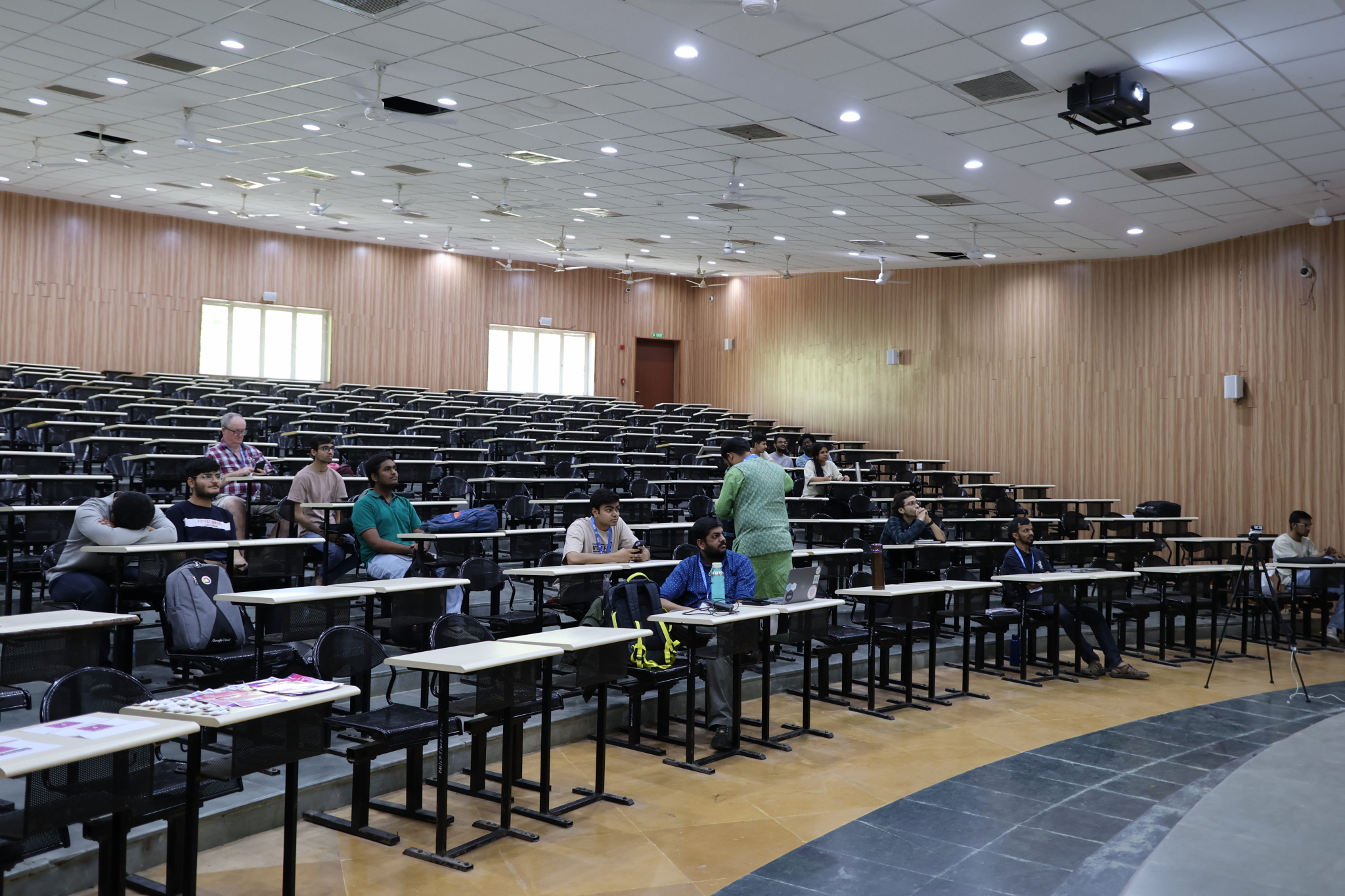
Last month, I attended the KDE India conference in Gandhinagar, Gujarat from the 4th to the 6th of April. I made my mind to attend when Sahil told me about his plans to attend and giving a talk. A day after my talk submission, the organizer Bhushan contacted me on Matrix and informed me that my talk had been accepted. I was also informed that KDE will cover my travel and accommodation expenses. So, I planned to attend the conference at this point. I am a longtime KDE user, so why not ;) I arrived in Ahmedabad, the twin city of Gandhinagar, a day before the conference. The first thing that struck me as soon as I came out of the Ahmedabad airport was the heat. I felt as if I was being cooked exactly how Bhushan put it earlier in the group chat. I took a taxi to get to my hotel, which was close to the conference venue. Later that afternoon, I met Bhushan and Joseph. Joseph lived in Germany. Bhushan was taking him to get a SIM card, so I tagged along and got to roam around. Joseph was unsure about where to go after the conference, so I asked him what he wanted out of his trip and had conversations along that line. Later, Vishal convinced him to go to Lucknow. Since he was adamant about taking the train, I booked a Tatkal train ticket for him to Lucknow. He was curious about how Tatkal booking works and watched me in amusement while I was booking the ticket. The 4th of April marked the first day of the conference, with around 25 attendees. Bhushan started the day with an overview of KDE conferences in India, followed by Vishal, who discussed FOSS United s activities. After the lunch, Joseph gave an overview of his campaign to help people switch from Windows to GNU/Linux due to environmental and security reasons. He continued his session in detail the next day.
Conference hall Conference hall
A key takeaway for me from Joseph s session was the idea pointed out by Adwaith: marketing GNU/Linux as a cheap alternative may not attract as much attention as marketing it as a status symbol. He gave the example of how the Tata Nano didn t do well in the Indian market due to being perceived as a poor person s car. My talk was scheduled for the evening of the first day. I hadn t prepared any slides because I wanted to make my session interactive. During my talk, I did an activity with the attendees to demonstrate the federated nature of XMPP messaging, of which Prav is a part. After the talk, I got a lot of questions, signalling engagement. The audience was cooperative (just like Prav ;)), contrary to my expectations (I thought they will be tired and sleepy). On the third day, I did a demo on editing OpenStreetMap (referred to as OSM in short) using the iD editor. It involved adding points to OSM based on the students suggestions. Since my computer didn t have an HDMI port, I used Subin s computer, and he logged into his OSM account for my session. Therefore, any mistakes I made will be under Subin s name. :) On the third day, I attended Aaruni s talk about backing up a GNU/Linux system. This was the talk that resonated with me the most. He suggested formatting the system with the btrfs file system during the installation, which helps in taking snapshots of the system and provides an easy way to roll back to a previous version if, for example, a file is accidentally deleted. I have tried many backup techniques, including this one, but I never tried backing up on the internal disk. I ll certainly give this a try. A conference is not only about the talks, that s why we had a Prav table as well ;) Just kidding. What I really mean is that a conference is more about interactions than talks. Since the conference was a three-day affair, attendees got plenty of time to bond and share ideas.
Prav stall at the conference Prav stall at the conference
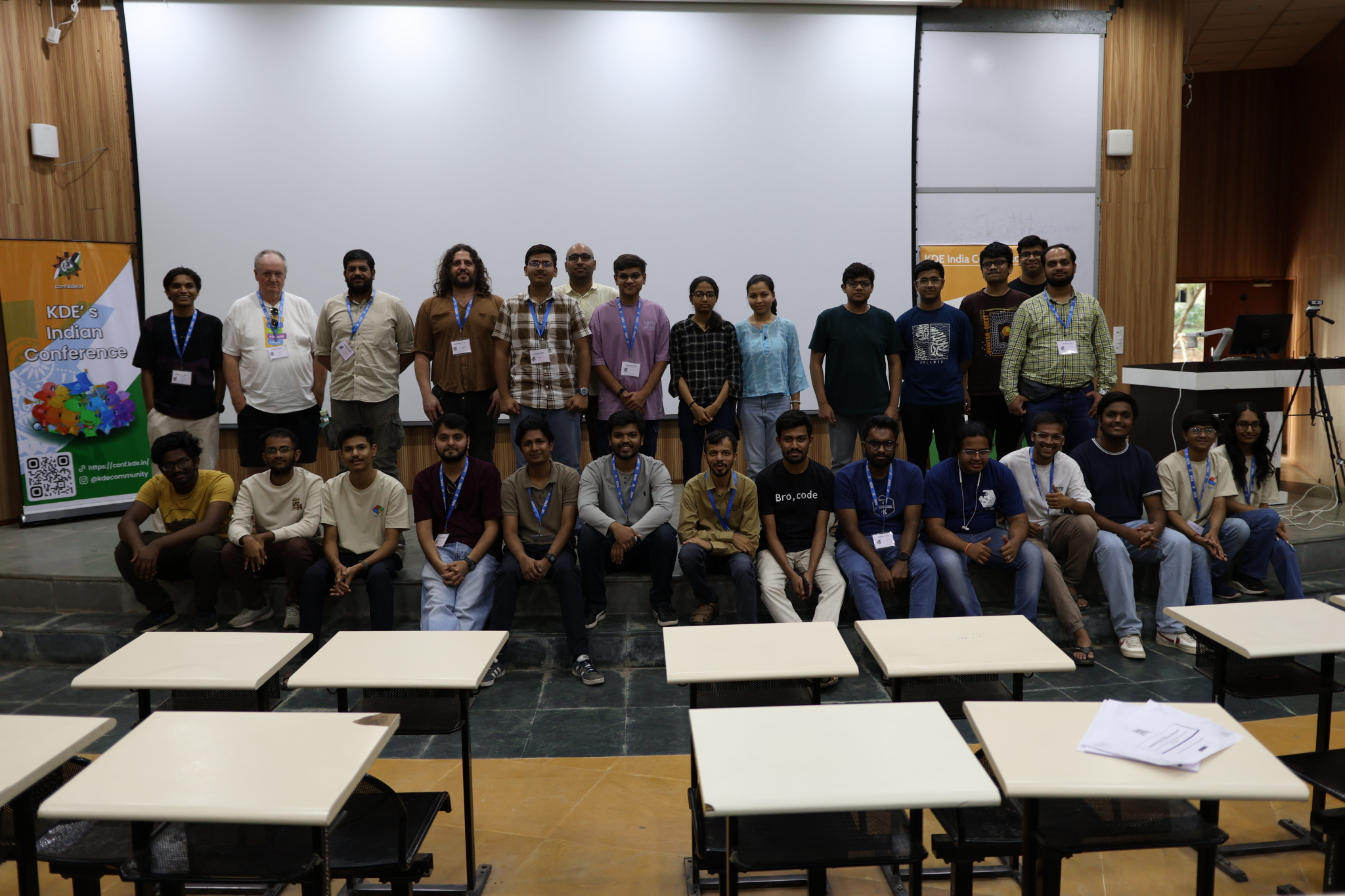
Conference group photo Conference group photo
After the conference, Bhushan took us to Adalaj Stepwell, an attraction near Gandhinagar. Upon entering the complex, we saw a park where there were many langurs. Going further, there were stairs that led down to a well. I guess this is why it is called a stepwell.
Adalaj Stepwell Adalaj Stepwell
Later that day, we had Gujarati Thali for dinner. It was an all-you-can-eat buffet and was reasonably priced at 300 rupees per plate. Aamras (Mango juice) was the highlight for me. This was the only time we had Gujarati food during this visit. After the dinner, Aaruni dropped Sahil and I off at the airport. The hospitality was superb - for instance, in addition to Aaruni dropping us, Bhushan also picked up some of the attendees from the airport. Finally, I would like to thank KDE for sponsoring my travel and accommodation costs. Let s wrap up this post here and meet you in the next one. Thanks to contrapunctus and Joseph for proofreading.

Sergio Talens-Oliag: Running dind with sysbox

When I configured forgejo-actions I used a docker-compose.yaml file to execute the runner and a dind container configured to run using privileged mode to be able to build images with it; as mentioned on my post about my setup, the use of the privileged mode is not a big issue for my use case, but reduces the overall security of the installation. On a work chat the other day someone mentioned that the GitLab documentation about using kaniko says it is no longer maintained (see the kaniko issue #3348) so we should look into alternatives for kubernetes clusters. I never liked kaniko too much, but it works without privileged mode and does not need a daemon, which is a good reason to use it, but if it is deprecated it makes sense to look into alternatives, and today I looked into some of them to use with my forgejo-actions setup. I was going to try buildah and podman but it seems that they need to adjust things on the systems running them:
  • When I tried to use buildah inside a docker container in Ubuntu I found the problems described on the buildah issue #1901 so I moved on.
  • Reading the podman documentation I saw that I need to export the fuse device to run it inside a container and, as I found other option, I also skipped it.
As my runner was already configured to use dind I decided to look into sysbox as a way of removing the privileged flag to make things more secure but have the same functionality.

Installing the sysbox packageAs I use Debian and Ubuntu systems I used the .deb packages distributed from the sysbox release page to install it (in my case I used the one from the 0.6.7 version). On the machine running forgejo (a Debian 12 server) I downloaded the package, stopped the running containers (it is needed to install the package and the only ones running where the ones started by the docker-compose.yaml file) and installed the sysbox-ce_0.6.7.linux_amd64.deb package using dpkg.

Updating the docker-compose.yaml fileTo run the dind container without setting the privileged mode we set sysbox-runc as the runtime on the dind container definition and set the privileged flag to false (it is the same as removing the key, as it defaults to false):
--- a/docker-compose.yml
+++ b/docker-compose.yml
@@ -2,7 +2,9 @@ services:
   dind:
     image: docker:dind
     container_name: 'dind'
-    privileged: 'true'
+    # use sysbox-runc instead of using privileged mode
+    runtime: 'sysbox-runc'
+    privileged: 'false'
     command: ['dockerd', '-H', 'unix:///dind/docker.sock', '-G', '$RUNNER_GID']
     restart: 'unless-stopped'
     volumes:

Testing the changesAfter applying the changes to the docker-compose.yaml file we start the containers and to test things we re-run previously executed jobs to see if things work as before. In my case I re-executed the build-image-from-tag workflow #18 from the oci project and everything worked as expected.

ConclusionFor my current use case (docker + dind) seems that sysbox is a good solution but I m not sure if I ll be installing it on kubernetes anytime soon unless I find a valid reason to do it (last time we talked about it my co workers said that they are evaluating buildah and podman for kubernetes and probably we will use them to replace kaniko in our gitlab-ci pipelines and for those tools the use of sysbox seems an overkill).

12 May 2025

Reproducible Builds: Reproducible Builds in April 2025

Welcome to our fourth report from the Reproducible Builds project in 2025. These monthly reports outline what we ve been up to over the past month, and highlight items of news from elsewhere in the increasingly-important area of software supply-chain security. Lastly, if you are interested in contributing to the Reproducible Builds project, please visit our Contribute page on our website. Table of contents:
  1. reproduce.debian.net
  2. Fifty Years of Open Source Software Supply Chain Security
  3. 4th CHAINS Software Supply Chain Workshop
  4. Mailing list updates
  5. Canonicalization for Unreproducible Builds in Java
  6. OSS Rebuild adds new TUI features
  7. Distribution roundup
  8. diffoscope & strip-nondeterminism
  9. Website updates
  10. Reproducibility testing framework
  11. Upstream patches

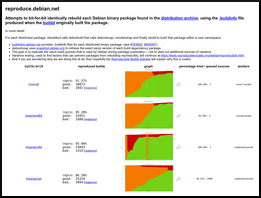
reproduce.debian.net The last few months have seen the introduction, development and deployment of reproduce.debian.net. In technical terms, this is an instance of rebuilderd, our server designed monitor the official package repositories of Linux distributions and attempt to reproduce the observed results there. This month, however, we are pleased to announce that reproduce.debian.net now tests all the Debian trixie architectures except s390x and mips64el. The ppc64el architecture was added through the generous support of Oregon State University Open Source Laboratory (OSUOSL), and we can support the armel architecture thanks to CodeThink.

Fifty Years of Open Source Software Supply Chain Security Russ Cox has published a must-read article in ACM Queue on Fifty Years of Open Source Software Supply Chain Security. Subtitled, For decades, software reuse was only a lofty goal. Now it s very real. , Russ article goes on to outline the history and original goals of software supply-chain security in the US military in the early 1970s, all the way to the XZ Utils backdoor of 2024. Through that lens, Russ explores the problem and how it has changed, and hasn t changed, over time. He concludes as follows:
We are all struggling with a massive shift that has happened in the past 10 or 20 years in the software industry. For decades, software reuse was only a lofty goal. Now it s very real. Modern programming environments such as Go, Node and Rust have made it trivial to reuse work by others, but our instincts about responsible behaviors have not yet adapted to this new reality. We all have more work to do.

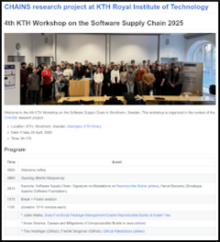
4th CHAINS Software Supply Chain Workshop Convened as part of the CHAINS research project at the KTH Royal Institute of Technology in Stockholm, Sweden, the 4th CHAINS Software Supply Chain Workshop occurred during April. During the workshop, there were a number of relevant workshops, including: The full listing of the agenda is available on the workshop s website.

Mailing list updates On our mailing list this month:
  • Luca DiMaio of Chainguard posted to the list reporting that they had successfully implemented reproducible filesystem images with both ext4 and an EFI system partition. They go on to list the various methods, and the thread generated at least fifteen replies.
  • David Wheeler announced that the OpenSSF is building a glossary of sorts in order that they consistently use the same meaning for the same term and, moreover, that they have drafted a definition for reproducible build . The thread generated a significant number of replies on the definition, leading to a potential update to the Reproducible Build s own definition.
  • Lastly, kpcyrd posted to the list with a timely reminder and update on their repro-env tool. As first reported in our July 2023 report, kpcyrd mentions that:
    My initial interest in reproducible builds was how do I distribute pre-compiled binaries on GitHub without people raising security concerns about them . I ve cycled back to this original problem about 5 years later and built a tool that is meant to address this. [ ]

Canonicalization for Unreproducible Builds in Java Aman Sharma, Benoit Baudry and Martin Monperrus have published a new scholarly study related to reproducible builds within Java. Titled Canonicalization for Unreproducible Builds in Java, the article s abstract is as follows:
[ ] Achieving reproducibility at scale remains difficult, especially in Java, due to a range of non-deterministic factors and caveats in the build process. In this work, we focus on reproducibility in Java-based software, archetypal of enterprise applications. We introduce a conceptual framework for reproducible builds, we analyze a large dataset from Reproducible Central and we develop a novel taxonomy of six root causes of unreproducibility. We study actionable mitigations: artifact and bytecode canonicalization using OSS-Rebuild and jNorm respectively. Finally, we present Chains-Rebuild, a tool that raises reproducibility success from 9.48% to 26.89% on 12,283 unreproducible artifacts. To sum up, our contributions are the first large-scale taxonomy of build unreproducibility causes in Java, a publicly available dataset of unreproducible builds, and Chains-Rebuild, a canonicalization tool for mitigating unreproducible builds in Java.
A full PDF of their article is available from arXiv.

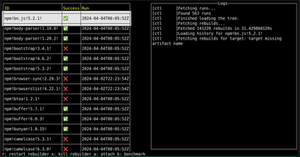
OSS Rebuild adds new TUI features OSS Rebuild aims to automate rebuilding upstream language packages (e.g. from PyPI, crates.io and npm registries) and publish signed attestations and build definitions for public use. OSS Rebuild ships a text-based user interface (TUI) for viewing, launching, and debugging rebuilds. While previously requiring ownership of a full instance of OSS Rebuild s hosted infrastructure, the TUI now supports a fully local mode of build execution and artifact storage. Thanks to Giacomo Benedetti for his usage feedback and work to extend the local-only development toolkit. Another feature added to the TUI was an experimental chatbot integration that provides interactive feedback on rebuild failure root causes and suggests fixes.

Distribution roundup In Debian this month:
  • Roland Clobus posted another status report on reproducible ISO images on our mailing list this month, with the summary that all live images build reproducibly from the online Debian archive .
  • Debian developer Simon Josefsson published another two reproducibility-related blog posts this month, the first on the topic of Verified Reproducible Tarballs. Simon sardonically challenges the reader as follows: Do you want a supply-chain challenge for the Easter weekend? Pick some well-known software and try to re-create the official release tarballs from the corresponding Git checkout. Is anyone able to reproduce anything these days? After that, they also published a blog post on Building Debian in a GitLab Pipeline using their multi-stage rebuild approach.
  • Roland also posted to our mailing list to highlight that there is now another tool in Debian that generates reproducible output, equivs . This is a tool to create trivial Debian packages that might Depend on other packages. As Roland writes, building the [equivs] package has been reproducible for a while, [but] now the output of the [tool] has become reproducible as well .
  • Lastly, 9 reviews of Debian packages were added, 10 were updated and 10 were removed this month adding to our extensive knowledge about identified issues.
The IzzyOnDroid Android APK repository made more progress in April. Thanks to funding by NLnet and Mobifree, the project was also to put more time into their tooling. For instance, developers can now easily run their own verification builder in less than 5 minutes . This currently supports Debian-based systems, but support for RPM-based systems is incoming.
  • The rbuilder_setup tool can now setup the entire framework within less than five minutes. The process is configurable, too, so everything from just the basics to verify builds up to a fully-fledged RB environment is also possible.
  • This tool works on Debian, RedHat and Arch Linux, as well as their derivates. The project has received successful reports from Debian, Ubuntu, Fedora and some Arch Linux derivates so far.
  • Documentation on how to work with reproducible builds (making apps reproducible, debugging unreproducible packages, etc) is available in the project s wiki page.
  • Future work is also in the pipeline, including documentation, guidelines and helpers for debugging.
NixOS defined an Outreachy project for improving build reproducibility. In the application phase, NixOS saw some strong candidates providing contributions, both on the NixOS side and upstream: guider-le-ecit analyzed a libpinyin issue. Tessy James fixed an issue in arandr and helped analyze one in libvlc that led to a proposed upstream fix. Finally, 3pleX fixed an issue which was accepted in upstream kitty, one in upstream maturin, one in upstream python-sip and one in the Nix packaging of python-libbytesize. Sadly, the funding for this internship fell through, so NixOS were forced to abandon their search. Lastly, in openSUSE news, Bernhard M. Wiedemann posted another monthly update for their work there.

diffoscope & strip-nondeterminism diffoscope is our in-depth and content-aware diff utility that can locate and diagnose reproducibility issues. This month, Chris Lamb made the following changes, including preparing and uploading a number of versions to Debian:
  • Use the --walk argument over the potentially dangerous alternative --scan when calling out to zipdetails(1). [ ]
  • Correct a longstanding issue where many >-based version tests used in conditional fixtures were broken. This was used to ensure that specific tests were only run when the version on the system was newer than a particular number. Thanks to Colin Watson for the report (Debian bug #1102658) [ ]
  • Address a long-hidden issue in the test_versions testsuite as well, where we weren t actually testing the greater-than comparisons mentioned above, as it was masked by the tests for equality. [ ]
  • Update copyright years. [ ]
In strip-nondeterminism, however, Holger Levsen updated the Continuous Integration (CI) configuration in order to use the standard Debian pipelines via debian/salsa-ci.yml instead of using .gitlab-ci.yml. [ ]

Website updates Once again, there were a number of improvements made to our website this month including:
  • Aman Sharma added OSS-Rebuild s stabilize tool to the Tools page. [ ][ ]
  • Chris Lamb added a configure.ac (GNU Autotools) example for using SOURCE_DATE_EPOCH. [ ]. Chris also updated the SOURCE_DATE_EPOCH snippet and move the archive metadata to a more suitable location. [ ]
  • Denis Carikli added GNU Boot to our ever-evolving Projects page.

Reproducibility testing framework The Reproducible Builds project operates a comprehensive testing framework running primarily at tests.reproducible-builds.org in order to check packages and other artifacts for reproducibility. In April, a number of changes were made by Holger Levsen, including:
  • reproduce.debian.net-related:
    • Add armel.reproduce.debian.net to support the armel architecture. [ ][ ]
    • Add a new ARM node, codethink05. [ ][ ]
    • Add ppc64el.reproduce.debian.net to support testing of the ppc64el architecture. [ ][ ][ ]
    • Improve the reproduce.debian.net front page. [ ][ ]
    • Make various changes to the ppc64el nodes. [ ][ ]9[ ][ ]
    • Make various changes to the arm64 and armhf nodes. [ ][ ][ ][ ]
    • Various changes related to the rebuilderd-worker entry point. [ ][ ][ ]
    • Create and deploy a pkgsync script. [ ][ ][ ][ ][ ][ ][ ][ ]
    • Fix the monitoring of the riscv64 architecture. [ ][ ]
    • Make a number of changes related to starting the rebuilderd service. [ ][ ][ ][ ]
  • Backup-related:
    • Backup the rebuilder databases every week. [ ][ ][ ][ ]
    • Improve the node health checks. [ ][ ]
  • Misc:
    • Re-use existing connections to the SSH proxy node on the riscv64 nodes. [ ][ ]
    • Node maintenance. [ ][ ][ ]
In addition:
  • Jochen Sprickerhof fixed the risvc64 host names [ ] and requested access to all the rebuilderd nodes [ ].
  • Mattia Rizzolo updated the self-serve rebuild scheduling tool, replacing the deprecated SSO -style authentication with OpenIDC which authenticates against salsa.debian.org. [ ][ ][ ]
  • Roland Clobus updated the configuration for the osuosl3 node to designate 4 workers for bigger builds. [ ]

Upstream patches The Reproducible Builds project detects, dissects and attempts to fix as many currently-unreproducible packages as possible. We endeavour to send all of our patches upstream where appropriate. This month, we wrote a large number of such patches, including:

Finally, if you are interested in contributing to the Reproducible Builds project, please visit our Contribute page on our website. However, you can get in touch with us via:

Sergio Talens-Oliag: Playing with vCluster

After my previous posts related to Argo CD (one about argocd-autopilot and another with some usage examples) I started to look into Kluctl (I also plan to review Flux, but I m more interested on the kluctl approach right now). While reading an entry on the project blog about Cluster API somehow I ended up on the vCluster site and decided to give it a try, as it can be a valid way of providing developers with on demand clusters for debugging or run CI/CD tests before deploying things on common clusters or even to have multiple debugging virtual clusters on a local machine with only one of them running at any given time. On this post I will deploy a vcluster using the k3d_argocd kubernetes cluster (the one we created on the posts about argocd) as the host and will show how to:
  • use its ingress (in our case traefik) to access the API of the virtual one (removes the need of having to use the vcluster connect command to access it with kubectl),
  • publish the ingress objects deployed on the virtual cluster on the host ingress, and
  • use the sealed-secrets of the host cluster to manage the virtual cluster secrets.

Creating the virtual cluster

Installing the vcluster applicationTo create the virtual clusters we need the vcluster command, we can install it with arkade:
  arkade get vcluster

The vcluster.yaml fileTo create the cluster we are going to use the following vcluster.yaml file (you can find the documentation about all its options here):
controlPlane:
  proxy:
    # Extra hostnames to sign the vCluster proxy certificate for
    extraSANs:
    - my-vcluster-api.lo.mixinet.net
exportKubeConfig:
  context: my-vcluster_k3d-argocd
  server: https://my-vcluster-api.lo.mixinet.net:8443
  secret:
    name: my-vcluster-kubeconfig
sync:
  toHost:
    ingresses:
      enabled: true
    serviceAccounts:
      enabled: true
  fromHost:
    ingressClasses:
      enabled: true
    nodes:
      enabled: true
      clearImageStatus: true
    secrets:
      enabled: true
      mappings:
        byName:
          # sync all Secrets from the 'my-vcluster-default' namespace to the
          # virtual "default" namespace.
          "my-vcluster-default/*": "default/*"
          # We could add other namespace mappings if needed, i.e.:
          # "my-vcluster-kube-system/*": "kube-system/*"
On the controlPlane section we ve added the proxy.extraSANs entry to add an extra host name to make sure it is added to the cluster certificates if we use it from an ingress. The exportKubeConfig section creates a kubeconfig secret on the virtual cluster namespace using the provided host name; the secret can be used by GitOps tools or we can dump it to a file to connect from our machine. On the sync section we enable the synchronization of Ingress objects and ServiceAccounts from the virtual to the host cluster:
  • We copy the ingress definitions to use the ingress server that runs on the host to make them work from the outside world.
  • The service account synchronization is not really needed, but we enable it because if we test this configuration with EKS it would be useful if we use IAM roles for the service accounts.
On the opposite direction (from the host to the virtual cluster) we synchronize:
  • The IngressClass objects, to be able to use the host ingress server(s).
  • The Nodes (we are not using the info right now, but it could be interesting if we want to have the real information of the nodes running pods of the virtual cluster).
  • The Secrets from the my-vcluster-default host namespace to the default of the virtual cluster; that synchronization allows us to deploy SealedSecrets on the host that generate secrets that are copied automatically to the virtual one. Initially we only copy secrets for one namespace but if the virtual cluster needs others we can add namespaces on the host and their mappings to the virtual one on the vcluster.yaml file.

Creating the virtual clusterTo create the virtual cluster we run the following command:
vcluster create my-vcluster --namespace my-vcluster --upgrade --connect=false \
  --values vcluster.yaml
It creates the virtual cluster on the my-vcluster namespace using the vcluster.yaml file shown before without connecting to the cluster from our local machine (if we don t pass that option the command adds an entry on our kubeconfig and launches a proxy to connect to the virtual cluster that we don t plan to use).

Adding an ingress TCP route to connect to the vcluster apiAs explained before, we need to create an IngressTcpRoute object to be able to connect to the vcluster API, we use the following definition:
apiVersion: traefik.containo.us/v1alpha1
kind: IngressRouteTCP
metadata:
  name: my-vcluster-api
  namespace: my-vcluster
spec:
  entryPoints:
    - websecure
  routes:
    - match: HostSNI( my-vcluster-api.lo.mixinet.net )
      services:
        - name: my-vcluster
          port: 443
  tls:
    passthrough: true
Once we apply those changes the cluster API will be available on the https://my-cluster-api.lo.mixinet.net:8443 URL using its own self signed certificate (we have enabled TLS passthrough) that includes the hostname we use (we adjusted it on the vcluster.yaml file, as explained before).

Getting the kubeconfig for the vclusterOnce the vcluster is running we will have its kubeconfig available on the my-vcluster-kubeconfig secret on its namespace on the host cluster. To dump it to the ~/.kube/my-vcluster-config we can do the following:
  kubectl get -n my-vcluster secret/my-vcluster-kubeconfig \
    --template=" .data.config "   base64 -d > ~/.kube/my-vcluster-config
Once available we can define the vkubectl alias to adjust the KUBECONFIG variable to access it:
alias vkubectl="KUBECONFIG=~/.kube/my-vcluster-config kubectl"
Or we can merge the configuration with the one on the KUBECONFIG variable and use kubectx or a similar tool to change the context (for our vcluster the context will be my-vcluster_k3d-argocd). If the KUBECONFIG variable is defined and only has the PATH to a single file the merge can be done running the following:
KUBECONFIG="$KUBECONFIG:~/.kube/my-vcluster-config" kubectl config view \
  --flatten >"$KUBECONFIG.new"
mv "$KUBECONFIG.new" "$KUBECONFIG"
On the rest of this post we will use the vkubectl alias when connecting to the virtual cluster, i.e. to check that it works we can run the cluster-info subcommand:
  vkubectl cluster-info
Kubernetes control plane is running at https://my-vcluster-api.lo.mixinet.net:8443
CoreDNS is running at https://my-vcluster-api.lo.mixinet.net:8443/api/v1/namespaces/kube-system/services/kube-dns:dns/proxy
To further debug and diagnose cluster problems, use 'kubectl cluster-info dump'.

Installing the dummyhttpd applicationTo test the virtual cluster we are going to install the dummyhttpd application using the following kustomization.yaml file:
apiVersion: kustomize.config.k8s.io/v1beta1
kind: Kustomization
resources:
  - https://forgejo.mixinet.net/blogops/argocd-applications.git//dummyhttp/?ref=dummyhttp-v1.0.0
# Add the config map
configMapGenerator:
  - name: dummyhttp-configmap
    literals:
      - CM_VAR="Vcluster Test Value"
    behavior: create
    options:
      disableNameSuffixHash: true
patches:
  # Change the ingress host name
  - target:
      kind: Ingress
      name: dummyhttp
    patch:  -
      - op: replace
        path: /spec/rules/0/host
        value: vcluster-dummyhttp.lo.mixinet.net
  # Add reloader annotations -- it will only work if we install reloader on the
  # virtual cluster, as the one on the host cluster doesn't see the vcluster
  # deployment objects
  - target:
      kind: Deployment
      name: dummyhttp
    patch:  -
      - op: add
        path: /metadata/annotations
        value:
          reloader.stakater.com/auto: "true"
          reloader.stakater.com/rollout-strategy: "restart"
It is quite similar to the one we used on the Argo CD examples but uses a different DNS entry; to deploy it we run kustomize and vkubectl:
  kustomize build .   vkubectl apply -f -
configmap/dummyhttp-configmap created
service/dummyhttp created
deployment.apps/dummyhttp created
ingress.networking.k8s.io/dummyhttp created
We can check that everything worked using curl:
  curl -s https://vcluster-dummyhttp.lo.mixinet.net:8443/   jq -cM .
 "c": "Vcluster Test Value","s": "" 
The objects available on the vcluster now are:
  vkubectl get all,configmap,ingress
NAME                             READY   STATUS    RESTARTS   AGE
pod/dummyhttp-55569589bc-9zl7t   1/1     Running   0          24s
NAME                 TYPE        CLUSTER-IP     EXTERNAL-IP   PORT(S)   AGE
service/dummyhttp    ClusterIP   10.43.51.39    <none>        80/TCP    24s
service/kubernetes   ClusterIP   10.43.153.12   <none>        443/TCP   14m

NAME                        READY   UP-TO-DATE   AVAILABLE   AGE
deployment.apps/dummyhttp   1/1     1            1           24s
NAME                                   DESIRED   CURRENT   READY   AGE
replicaset.apps/dummyhttp-55569589bc   1         1         1       24s
NAME                            DATA   AGE
configmap/dummyhttp-configmap   1      24s
configmap/kube-root-ca.crt      1      14m
NAME                                CLASS   HOSTS                             ADDRESS                          PORTS AGE
ingress.networking.k8s.io/dummyhttp traefik vcluster-dummyhttp.lo.mixinet.net 172.20.0.2,172.20.0.3,172.20.0.4 80    24s
While we have the following ones on the my-vcluster namespace of the host cluster:
  kubectl get all,configmap,ingress -n my-vcluster
NAME                                                      READY   STATUS    RESTARTS   AGE
pod/coredns-bbb5b66cc-snwpn-x-kube-system-x-my-vcluster   1/1     Running   0          18m
pod/dummyhttp-55569589bc-9zl7t-x-default-x-my-vcluster    1/1     Running   0          45s
pod/my-vcluster-0                                         1/1     Running   0          19m
NAME                                           TYPE        CLUSTER-IP      EXTERNAL-IP   PORT(S)                  AGE
service/dummyhttp-x-default-x-my-vcluster      ClusterIP   10.43.51.39     <none>        80/TCP                   45s
service/kube-dns-x-kube-system-x-my-vcluster   ClusterIP   10.43.91.198    <none>        53/UDP,53/TCP,9153/TCP   18m
service/my-vcluster                            ClusterIP   10.43.153.12    <none>        443/TCP,10250/TCP        19m
service/my-vcluster-headless                   ClusterIP   None            <none>        443/TCP                  19m
service/my-vcluster-node-k3d-argocd-agent-1    ClusterIP   10.43.189.188   <none>        10250/TCP                18m

NAME                           READY   AGE
statefulset.apps/my-vcluster   1/1     19m
NAME                                                     DATA   AGE
configmap/coredns-x-kube-system-x-my-vcluster            2      18m
configmap/dummyhttp-configmap-x-default-x-my-vcluster    1      45s
configmap/kube-root-ca.crt                               1      19m
configmap/kube-root-ca.crt-x-default-x-my-vcluster       1      11m
configmap/kube-root-ca.crt-x-kube-system-x-my-vcluster   1      18m
configmap/vc-coredns-my-vcluster                         1      19m
NAME                                                        CLASS   HOSTS                             ADDRESS                          PORTS AGE
ingress.networking.k8s.io/dummyhttp-x-default-x-my-vcluster traefik vcluster-dummyhttp.lo.mixinet.net 172.20.0.2,172.20.0.3,172.20.0.4 80    45s
As shown, we have copies of the Service, Pod, Configmap and Ingress objects, but there is no copy of the Deployment or ReplicaSet.

Creating a sealed secret for dummyhttpdTo use the hosts sealed secrets controller with the virtual cluster we will create the my-vcluster-default namespace and add there the sealed secrets we want to have available as secrets on the default namespace of the virtual cluster:
  kubectl create namespace my-vcluster-default
  echo -n "Vcluster Boo"   kubectl create secret generic "dummyhttp-secret" \
    --namespace "my-vcluster-default" --dry-run=client \
    --from-file=SECRET_VAR=/dev/stdin -o yaml >dummyhttp-secret.yaml
  kubeseal -f dummyhttp-secret.yaml -w dummyhttp-sealed-secret.yaml
  kubectl apply -f dummyhttp-sealed-secret.yaml
  rm -f dummyhttp-secret.yaml dummyhttp-sealed-secret.yaml
After running the previous commands we have the following objects available on the host cluster:
  kubectl get sealedsecrets.bitnami.com,secrets -n my-vcluster-default
NAME                                        STATUS   SYNCED   AGE
sealedsecret.bitnami.com/dummyhttp-secret            True     34s
NAME                      TYPE     DATA   AGE
secret/dummyhttp-secret   Opaque   1      34s
And we can see that the secret is also available on the virtual cluster with the content we expected:
  vkubectl get secrets
NAME               TYPE     DATA   AGE
dummyhttp-secret   Opaque   1      34s
  vkubectl get secret/dummyhttp-secret --template=" .data.SECRET_VAR " \
    base64 -d
Vcluster Boo
But the output of the curl command has not changed because, although we have the reloader controller deployed on the host cluster, it does not see the Deployment object of the virtual one and the pods are not touched:
  curl -s https://vcluster-dummyhttp.lo.mixinet.net:8443/   jq -cM .
 "c": "Vcluster Test Value","s": "" 

Installing the reloader applicationTo make reloader work on the virtual cluster we just need to install it as we did on the host using the following kustomization.yaml file:
apiVersion: kustomize.config.k8s.io/v1beta1
kind: Kustomization
namespace: kube-system
resources:
- github.com/stakater/Reloader/deployments/kubernetes/?ref=v1.4.2
patches:
# Add flags to reload workloads when ConfigMaps or Secrets are created or deleted
- target:
    kind: Deployment
    name: reloader-reloader
  patch:  -
    - op: add
      path: /spec/template/spec/containers/0/args
      value:
        - '--reload-on-create=true'
        - '--reload-on-delete=true'
        - '--reload-strategy=annotations'
We deploy it with kustomize and vkubectl:
  kustomize build .   vkubectl apply -f -
serviceaccount/reloader-reloader created
clusterrole.rbac.authorization.k8s.io/reloader-reloader-role created
clusterrolebinding.rbac.authorization.k8s.io/reloader-reloader-role-binding created
deployment.apps/reloader-reloader created
As the controller was not available when the secret was created the pods linked to the Deployment are not updated, but we can force things removing the secret on the host system; after we do that the secret is re-created from the sealed version and copied to the virtual cluster where the reloader controller updates the pod and the curl command shows the new output:
  kubectl delete -n my-vcluster-default secrets dummyhttp-secret
secret "dummyhttp-secret" deleted
  sleep 2
  vkubectl get pods
NAME                         READY   STATUS        RESTARTS   AGE
dummyhttp-78bf5fb885-fmsvs   1/1     Terminating   0          6m33s
dummyhttp-c68684bbf-nx8f9    1/1     Running       0          6s
  curl -s https://vcluster-dummyhttp.lo.mixinet.net:8443/   jq -cM .
 "c":"Vcluster Test Value","s":"Vcluster Boo" 
If we change the secret on the host systems things get updated pretty quickly now:
  echo -n "New secret"   kubectl create secret generic "dummyhttp-secret" \
    --namespace "my-vcluster-default" --dry-run=client \
    --from-file=SECRET_VAR=/dev/stdin -o yaml >dummyhttp-secret.yaml
  kubeseal -f dummyhttp-secret.yaml -w dummyhttp-sealed-secret.yaml
  kubectl apply -f dummyhttp-sealed-secret.yaml
  rm -f dummyhttp-secret.yaml dummyhttp-sealed-secret.yaml
  curl -s https://vcluster-dummyhttp.lo.mixinet.net:8443/   jq -cM .
 "c":"Vcluster Test Value","s":"New secret" 

Pause and restore the vclusterThe status of pods and statefulsets while the virtual cluster is active can be seen using kubectl:
  kubectl get pods,statefulsets -n my-vcluster
NAME                                                                 READY   STATUS    RESTARTS   AGE
pod/coredns-bbb5b66cc-snwpn-x-kube-system-x-my-vcluster              1/1     Running   0          127m
pod/dummyhttp-587c7855d7-pt9b8-x-default-x-my-vcluster               1/1     Running   0          4m39s
pod/my-vcluster-0                                                    1/1     Running   0          128m
pod/reloader-reloader-7f56c54d75-544gd-x-kube-system-x-my-vcluster   1/1     Running   0          60m
NAME                           READY   AGE
statefulset.apps/my-vcluster   1/1     128m

Pausing the vclusterIf we don t need to use the virtual cluster we can pause it and after a small amount of time all Pods are gone because the statefulSet is scaled down to 0 (note that other resources like volumes are not removed, but all the objects that have to be scheduled and consume CPU cycles are not running, which can translate in a lot of savings when running on clusters from cloud platforms or, in a local cluster like the one we are using, frees resources like CPU and memory that now can be used for other things):
  vcluster pause my-vcluster
11:20:47 info Scale down statefulSet my-vcluster/my-vcluster...
11:20:48 done Successfully paused vcluster my-vcluster/my-vcluster
  kubectl get pods,statefulsets -n my-vcluster
NAME                           READY   AGE
statefulset.apps/my-vcluster   0/0     130m
Now the curl command fails:
  curl -s https://vcluster-dummyhttp.localhost.mixinet.net:8443
404 page not found
Although the ingress is still available (it returns a 404 because there is no pod behind the service):
  kubectl get ingress -n my-vcluster
NAME                                CLASS     HOSTS                               ADDRESS                            PORTS   AGE
dummyhttp-x-default-x-my-vcluster   traefik   vcluster-dummyhttp.lo.mixinet.net   172.20.0.2,172.20.0.3,172.20.0.4   80      120m
In fact, the same problem happens when we try to connect to the vcluster API; the error shown by kubectl is related to the TLS certificate because the 404 page uses the wildcard certificate instead of the self signed one:
  vkubectl get pods
Unable to connect to the server: tls: failed to verify certificate: x509: certificate signed by unknown authority
  curl -s https://my-vcluster-api.lo.mixinet.net:8443/api/v1/
404 page not found
  curl -v -s https://my-vcluster-api.lo.mixinet.net:8443/api/v1/ 2>&1   grep subject
*  subject: CN=lo.mixinet.net
*  subjectAltName: host "my-vcluster-api.lo.mixinet.net" matched cert's "*.lo.mixinet.net"

Resuming the vclusterWhen we want to use the virtual cluster again we just need to use the resume command:
  vcluster resume my-vcluster
12:03:14 done Successfully resumed vcluster my-vcluster in namespace my-vcluster
Once all the pods are running the virtual cluster goes back to its previous state, although all of them were started, of course.

Cleaning upThe virtual cluster can be removed using the delete command:
  vcluster delete my-vcluster
12:09:18 info Delete vcluster my-vcluster...
12:09:18 done Successfully deleted virtual cluster my-vcluster in namespace my-vcluster
12:09:18 done Successfully deleted virtual cluster namespace my-vcluster
12:09:18 info Waiting for virtual cluster to be deleted...
12:09:50 done Virtual Cluster is deleted
That removes everything we used on this post except the sealed secrets and secrets that we put on the my-vcluster-default namespace because it was created by us. If we delete the namespace all the secrets and sealed secrets on it are also removed:
  kubectl delete namespace my-vcluster-default
namespace "my-vcluster-default" deleted

ConclusionsI believe that the use of virtual clusters can be a good option for two of the proposed use cases that I ve encountered in real projects in the past:
  • need of short lived clusters for developers or teams,
  • execution of integration tests from CI pipelines that require a complete cluster (the tests can be run on virtual clusters that are created on demand or paused and resumed when needed).
For both cases things can be set up using the Apache licensed product, although maybe evaluating the vCluster Platform offering could be interesting. In any case when everything is not done inside kubernetes we will also have to check how to manage the external services (i.e. if we use databases or message buses as SaaS instead of deploying them inside our clusters we need to have a way of creating, deleting or pause and resume those services).

Freexian Collaborators: Debian Contributions: DebConf 25 preparations, PyPA tools updates, Removing libcrypt-dev from build-essential and more! (by Anupa Ann Joseph)

Debian Contributions: 2025-04 Contributing to Debian is part of Freexian s mission. This article covers the latest achievements of Freexian and their collaborators. All of this is made possible by organizations subscribing to our Long Term Support contracts and consulting services.

DebConf 25 Preparations, by Stefano Rivera and Santiago Ruano Rinc n DebConf 25 preparations continue. In April, the bursary team reviewed and ranked bursary applications. Santiago Ruano Rinc n examined the current state of the conference s finances, to see if we could allocate any more money to bursaries. Stefano Rivera supported the bursary team s work with infrastructure and advice and added some metrics to assist Santiago s budget review. Santiago was also involved in different parts of the organization, including Content team matters, as reviewing the first of proposals, preparing public information about the new Academic Track; or coordinating different aspects of the Day trip activities and the Conference Dinner.

PyPA tools updates, by Stefano Rivera Around the beginning of the freeze (in retrospect, definitely too late) Stefano looked at updating setuptools in the archive to 78.1.0. This brings support for more comprehensive license expressions (PEP-639), that people are expected to adopt soon upstream. While the reverse-autopkgtests all passed, it all came with some unexpected complications, and turned into a mini-transition. The new setuptools broke shebangs for scripts (pypa/setuptools#4952). It also required a bump of wheel to 0.46 and wheel 0.46 now has a dependency outside the standard library (it de-vendored packaging). This meant it was no longer suitable to distribute a standalone wheel.whl file to seed into new virtualenvs, as virtualenv does by default. The good news here is that setuptools doesn t need wheel any more, it included its own implementation of the bdist_wheel command, in 70.1. But the world hadn t adapted to take advantage of this, yet. Stefano scrambled to get all of these issues resolved upstream and in Debian: We re now at the point where python3-wheel-whl is no longer needed in Debian unstable, and it should migrate to trixie.

Removing libcrypt-dev from build-essential, by Helmut Grohne The crypt function was originally part of glibc, but it got separated to libxcrypt. As a result, libc6-dev now depends on libcrypt-dev. This poses a cycle during architecture cross bootstrap. As the number of packages actually using crypt is relatively small, Helmut proposed removing the dependency. He analyzed an archive rebuild kindly performed by Santiago Vila (not affiliated with Freexian) and estimated the necessary changes. It looks like we may complete this with modifications to less than 300 source packages in the forky cycle. Half of the bugs have been filed at this time. They are tracked with libcrypt-* usertags.

Miscellaneous contributions
  • Carles uploaded a new version of simplemonitor.
  • Carles improved the documentation of salsa-ci-team/pipeline regarding piuparts arguments.
  • Carles closed an FTBFS on gcc-15 on qnetload.
  • Carles worked on Catalan translations using po-debconf-manager: reviewed 57 translations and created their merge requests in salsa, created 59 bug reports for packages that didn t merge in more than 30 days. Followed-up merge requests and comments in bug reports. Managed some translations manually for packages that are not in Salsa.
  • Lucas did some work on the DebConf Content and Bursary teams.
  • Lucas fixed multiple CVEs and bugs involving the upgrade from bookworm to trixie in ruby3.3.
  • Lucas fixed a CVE in valkey in unstable.
  • Stefano updated beautifulsoup4, python-authlib, python-html2text, python-packaging, python-pip, python-soupsieve, and unidecode.
  • Stefano packaged python-dependency-groups, a new vendored library in python-pip.
  • During an afternoon Bug Squashing Party in Montevideo, Santiago uploaded a couple of packages fixing RC bugs #1057226 and #1102487. The latter was a sponsored upload.
  • Thorsten uploaded new upstream versions of brlaser, ptouch-driver and sane-airscan to get the latest upstream bug fixes into Trixie.
  • Rapha l filed an upstream bug on zim for a graphical glitch that he has been experiencing.
  • Colin Watson upgraded openssh to 10.0p1 (also known as 10.0p2), and debugged various follow-up bugs. This included adding riscv64 support to vmdb2 in passing, and enabling native wtmpdb support so that wtmpdb last now reports the correct tty for SSH connections.
  • Colin fixed dput-ng s override option, which had never previously worked.
  • Colin fixed a security bug in debmirror.
  • Colin did his usual routine work on the Python team: 21 packages upgraded to new upstream versions, 8 CVEs fixed, and about 25 release-critical bugs fixed.
  • Helmut filed patches for 21 cross build failures.
  • Helmut uploaded a new version of debvm featuring a new tool debefivm-create to generate EFI-bootable disk images compatible with other tools such as libvirt or VirtualBox. Much of the work was prototyped in earlier months. This generalizes mmdebstrap-autopkgtest-build-qemu.
  • Helmut continued reporting undeclared file conflicts and suggested package removals from unstable.
  • Helmut proposed build profiles for libftdi1 and gnupg2. To deal with recently added dependencies in the architecture cross bootstrap package set.
  • Helmut managed the /usr-move transition. He worked on ensuring that systemd would comply with Debian s policy. Dumat continues to locate problems here and there yielding discussion occasionally. He sent a patch for an upgrade problem in zutils.
  • Anupa worked with the Debian publicity team to publish Micronews and Bits posts.
  • Anupa worked with the DebConf 25 content team to review talk and event proposals for DebConf 25.

Taavi V n nen: lua entry thread aborted: runtime error: bad request

The Wikimedia Cloud VPS shared web proxy has an interesting architecture: the management API writes an entry for each proxy to a Redis database, and the web server in use (Nginx with Lua support from ngx_http_lua_module) looks up the backend server URL from Redis for each request. This is maybe not how I would design this today, but the basic design dates back to 2013 and has served us well ever since. However, with a recent operating system upgrade to Debian 12 (we run Nginx from the packages in Debian's repositories), we started seeing mysterious errors that looked like this:
2025/04/30 07:24:25 [error] 82656#82656: *5612 lua entry thread aborted: runtime error: /etc/nginx/lua/domainproxy.lua:32: bad request
stack traceback:
coroutine 0:
[C]: in function 'set_keepalive'
/etc/nginx/lua/domainproxy.lua:32: in function 'redis_shutdown'
/etc/nginx/lua/domainproxy.lua:48: in main chunk, client: [redacted], server: *.wmcloud.org, request: "GET [redacted] HTTP/2.0", host: "codesearch.wmcloud.org", referrer: "https://codesearch.wmcloud.org/search/"
The code in question seems straightforward enough:
function redis_shutdown()
 -- Use a connection pool of 256 connections with a 32s idle timeout
 -- This also closes the current redis connection.
 red:set_keepalive(1000 * 32, 256) -- line 32
end
When searching for this error online, you'll end up finding advice like "the resty.redis object instance cannot be stored in a Lua variable at the Lua module level". However, our code already stores it as a local variable:
local redis = require 'nginx.redis'
local red = redis:new()
red:set_timeout(1000)
red:connect('127.0.0.1', 6379)
Turns out the issue was with the function definition: functions can also be defined as local. Without that, something somewhere in some situations seems to reference the variables from other requests, instead of using the Redis connection for the current request. (Don't ask me what changed between Debian 12 and 13 making this only break now.) So we needed to change our function definition to this instead:
local function redis_shutdown()
 -- Use a connection pool of 256 connections with a 32s idle timeout
 -- This also closes the current redis connection.
 red:set_keepalive(1000 * 32, 256)
end
I spent almost an entire workday looking for this, ultimately making a two-line patch to fix the issue. Hopefully by publishing this post I can save that time from everyone else stumbling upon the same problem after myself.

11 May 2025

Sergio Durigan Junior: Debian Bug Squashing Party Brazil 2025

With the trixie release approaching, I had the idea back in April to organize a bug squashing party with the Debian Brasil community. I believe the outcome was very positive, and we were able to tackle and fix quite a number of release-critical bugs. This is a brief report of what we did.

A remote BSP It s not the first time I organize a BSP: back in 2019, I helped throw another similar party in Toronto. The difference this time is that, because Brazil is a big country and (perhaps most importantly) because I m not currently living there, the BSP had to be done online. I m a fan of social interactions (especially with the Brazilian community), and in my experience we usually can achieve much more when we get together in a physical place, but hey, you gotta do what you gotta do Most (if not all) of the folks interested in participating had busy weekdays, so it was decided that we would meet during the weekends and try to work on a few bugs over Jitsi. Nothing stopped people from working on bugs during the week as well, of course.

A tag to rule them all We used the bsp-2025-04-brazil usertag to mark those bugs that were touched by us. You can see the full list of bugs here, although the current list (as of 2025-05-11) is smaller than the one we had by the end of April. I don t know what happened; maybe it s some glitch with the BTS, or maybe someone removed the usertag by mistake.

Stats In total, we had:
  • 7 participants
  • 37 bugs handled. Of those,
  • 35 bugs fixed
The BSP officially started on 04 April 2025, and ended on 30 April 2025. I was able to attend meetings during two weekends; other people participated more sporadically.

Outcome As I said above, the Debian Brasil community is great and very engaged in the project. Speaking more specifically about the Debian Brasil Devel group, I can say that We have contributors with strong technical skills, and I really love that we have this inclusive, extremely technical culture where debugging and understanding things is really core to pretty much all our discussions. We already meet weekly on Thursdays to talk shop and help newcomers, so having a remote BSP with this group seemed like a logical thing to do. I m really glad to see our results and even happier to hear positive feedback from the community during the last MiniDebConf in Macei . There s some interest in organizing another BSP, this time face-to-face and during the next DebConf. I m all for it, as I love fixing bugs and having a great time with friends. If you re interested in attending, let me know. Thanks, and until next time.

Bits from Debian: Bits from the DPL

Dear Debian community, This is bits from the DPL for April. End of 10 I am sure I was speaking in the interest of the whole project when joining the "End of 10" campaign. Here is what I wrote to the initiators:
Hi Joseph and all drivers of the "End of 10" campaign, On behalf of the entire Debian project, I would like to say that we proudly join your great campaign. We stand with you in promoting Free Software, defending users' freedoms, and protecting our planet by avoiding unnecessary hardware waste. Thank you for leading this important initiative.
Andreas Tille Debian Project Leader
I have some goals I would like to share with you for my second term. Ftpmaster delegation This splits up into tasks that can be done before and after Trixie release. Before Trixie: 1. Reducing Barriers to DFSG Compliance Checks Back in 2002, Debian established a way to distribute cryptographic software in the main archive, whereas such software had previously been restricted to the non-US archive. One result of this arrangement which influences our workflow is that all packages uploaded to the NEW queue must remain on the server that hosts it. This requirement means that members of the ftpmaster team must log in to that specific machine, where they are limited to a restricted set of tools for reviewing uploaded code. This setup may act as a barrier to participation--particularly for contributors who might otherwise assist with reviewing packages for DFSG compliance. I believe it is time to reassess this limitation and work toward removing such hurdles. In October last year, we had some initial contact with SPI's legal counsel, who noted that US regulations around cryptography have been relaxed somewhat in recent years (as of 2021). This suggests it may now be possible to revisit and potentially revise the conditions under which we manage cryptographic software in the NEW queue. I plan to investigate this further. If you have expertise in software or export control law and are interested in helping with this topic, please get in touch with me. The ultimate goal is to make it easier for more people to contribute to ensuring that code in the NEW queue complies with the DFSG. 2. Discussing Alternatives My chances to reach out to other distributions remained limited. However, regarding the processing of new software, I learned that OpenSUSE uses a Git-based workflow that requires five "LGTM" approvals from a group of trusted developers. As far as I know, Fedora follows a similar approach. Inspired by this, a recent community initiative--the Gateway to NEW project--enables peer review of new packages for DFSG compliance before they enter the NEW queue. This effort allows anyone to contribute by reviewing packages and flagging potential issues in advance via Git. I particularly appreciate that the DFSG review is coupled with CI, allowing for both license and technical evaluation. While this process currently results in some duplication of work--since final reviews are still performed by the ftpmaster team--it offers a valuable opportunity to catch issues early and improve the overall quality of uploads. If the community sees long-term value in this approach, it could serve as a basis for evolving our workflows. Integrating it more closely into DAK could streamline the process, and we've recently seen that merge requests reflecting community suggestions can be accepted promptly. For now, I would like to gather opinions about how such initiatives could best complement the current NEW processing, and whether greater consensus on trusted peer review could help reduce the burden on the team doing DFSG compliance checks. Submitting packages for review and automated testing before uploading can improve quality and encourage broader participation in safeguarding Debian's Free Software principles. My explicit thanks go out to the Gateway to NEW team for their valuable and forward-looking contribution to Debian. 3. Documenting Critical Workflows Past ftpmaster trainees have told me that understanding the full set of ftpmaster workflows can be quite difficult. While there is some useful documentation thanks in particular to Sean Whitton for his work on documenting NEW processing rules many other important tasks carried out by the ftpmaster team remain undocumented or only partially so. Comprehensive and accessible documentation would greatly benefit current and future team members, especially those onboarding or assisting in specific workflows. It would also help ensure continuity and transparency in how critical parts of the archive are managed. If such documentation already exists and I have simply overlooked it, I would be happy to be corrected. Otherwise, I believe this is an area where we need to improve significantly. Volunteers with a talent for writing technical documentation are warmly invited to contact me--I'd be happy to help establish connections with ftpmaster team members who are willing to share their knowledge so that it can be written down and preserved. Once Trixie is released (hopefully before DebConf): 4. Split of the Ftpmaster Team into DFSG and Archive Teams As discussed during the "Meet the ftpteam" BoF at DebConf24, I would like to propose a structural refinement of the current Ftpmaster team by introducing two different delegated teams:
  1. DFSG Team
  2. Archive Team (responsible for DAK maintenance and process tooling, including releases)
(Alternative name suggestions are, of course, welcome.) The primary task of the DFSG team would be the processing of the NEW queue and ensuring that packages comply with the DFSG. The Archive team would focus on maintaining DAK and handling the technical aspects of archive management. I am aware that, in the recent past, the ftpmaster team has decided not to actively seek new members. While I respect the autonomy of each team, the resulting lack of a recruitment pipeline has led to some friction and concern within the wider community, including myself. As Debian Project Leader, it is my responsibility to ensure the long-term sustainability and resilience of our project, which includes fostering an environment where new contributors can join and existing teams remain effective and well-supported. Therefore, even if the current team does not prioritize recruitment, I will actively seek and encourage new contributors for both teams, with the aim of supporting openness and collaboration. This proposal is not intended as criticism of the current team's dedication or achievements--on the contrary, I am grateful for the hard work and commitment shown, often under challenging circumstances. My intention is to help address the structural issues that have made onboarding and specialization difficult and to ensure that both teams are well-supported for the future. I also believe that both teams should regularly inform the Debian community about the policies and procedures they apply. I welcome any suggestions for a more detailed description of the tasks involved, as well as feedback on how best to implement this change in a way that supports collaboration and transparency. My intention with this proposal is to foster a more open and effective working environment, and I am committed to working with all involved to ensure that any changes are made collaboratively and with respect for the important work already being done. I'm aware that the ideas outlined above touch on core parts of how Debian operates and involve responsibilities across multiple teams. These are not small changes, and implementing them will require thoughtful discussion and collaboration. To move this forward, I've registered a dedicated BoF for DebConf. To make the most of that opportunity, I'm looking for volunteers who feel committed to improving our workflows and processes. With your help, we can prepare concrete and sensible proposals in advance--so the limited time of the BoF can be used effectively for decision-making and consensus-building. In short: I need your help to bring these changes to life. From my experience in my last term, I know that when it truly matters, the Debian community comes together--and I trust that spirit will guide us again. Please also note: we had a "Call for volunteers" five years ago, and much of what was written there still holds true today. I've been told that the response back then was overwhelming--but that training such a large number of volunteers didn't scale well. This time, I hope we can find a more sustainable approach: training a few dedicated people first, and then enabling them to pass on their knowledge. This will also be a topic at the DebCamp sprint. Dealing with Dormant Packages Debian was founded on the principle that each piece of software should be maintained by someone with expertise in it--typically a single, responsible maintainer. This model formed the historical foundation of Debian's packaging system and helped establish high standards of quality and accountability. However, as the project has grown and the number of packages has expanded, this model no longer scales well in all areas. Team maintenance has since emerged as a practical complement, allowing multiple contributors to share responsibility and reduce bottlenecks--depending on each team's internal policy. While working on the Bug of the Day initiative, I observed a significant number of packages that have not been updated in a long time. In the case of team-maintained packages, addressing this is often straightforward: team uploads can be made, or the team can be asked whether the package should be removed. We've also identified many packages that would fit well under the umbrella of active teams, such as language teams like Debian Perl and Debian Python, or blends like Debian Games and Debian Multimedia. Often, no one has taken action--not because of disagreement, but simply due to inattention or a lack of initiative. In addition, we've found several packages that probably should be removed entirely. In those cases, we've filed bugs with pre-removal warnings, which can later be escalated to removal requests. When a package is still formally maintained by an individual, but shows signs of neglect (e.g., no uploads for years, unfixed RC bugs, failing autopkgtests), we currently have three main tools:
  1. The MIA process, which handles inactive or unreachable maintainers.
  2. Package Salvaging, which allows contributors to take over maintenance if conditions are met.
  3. Non-Maintainer Uploads (NMUs), which are limited to specific, well-defined fixes (which do not include things like migration to Salsa).
These mechanisms are important and valuable, but they don't always allow us to react swiftly or comprehensively enough. Our tools for identifying packages that are effectively unmaintained are relatively weak, and the thresholds for taking action are often high. The Package Salvage team is currently trialing a process we've provisionally called "Intend to NMU" (ITN). The name is admittedly questionable--some have suggested alternatives like "Intent to Orphan"--and discussion about this is ongoing on debian-devel. The mechanism is intended for situations where packages appear inactive but aren't yet formally orphaned, introducing a clear 21-day notice period before NMUs, similar in spirit to the existing ITS process. The discussion has sparked suggestions for expanding NMU rules. While it is crucial not to undermine the autonomy of maintainers who remain actively involved, we also must not allow a strict interpretation of this autonomy to block needed improvements to obviously neglected packages. To be clear: I do not propose to change the rights of maintainers who are clearly active and invested in their packages. That model has served us well. However, we must also be honest that, in some cases, maintainers stop contributing--quietly and without transition plans. In those situations, we need more agile and scalable procedures to uphold Debian's high standards. To that end, I've registered a BoF session for DebConf25 to discuss potential improvements in how we handle dormant packages. These discussions will be prepared during a sprint at DebCamp, where I hope to work with others on concrete ideas. Among the topics I want to revisit is my proposal from last November on debian-devel, titled "Barriers between packages and other people". While the thread prompted substantial discussion, it understandably didn't lead to consensus. I intend to ensure the various viewpoints are fairly summarised--ideally by someone with a more neutral stance than myself--and, if possible, work toward a formal proposal during the DebCamp sprint to present at the DebConf BoF. My hope is that we can agree on mechanisms that allow us to act more effectively in situations where formerly very active volunteers have, for whatever reason, moved on. That way, we can protect both Debian's quality and its collaborative spirit. Building Sustainable Funding for Debian Debian incurs ongoing expenses to support its infrastructure--particularly hardware maintenance and upgrades--as well as to fund in-person meetings like sprints and mini-DebConfs. These investments are essential to our continued success: they enable productive collaboration and ensure the robustness of the operating system we provide to users and derivative distributions around the world. While DebConf benefits from generous sponsorship, and we regularly receive donated hardware, there is still considerable room to grow our financial base--especially to support less visible but equally critical activities. One key goal is to establish a more constant and predictable stream of income, helping Debian plan ahead and respond more flexibly to emerging needs. This presents an excellent opportunity for contributors who may not be involved in packaging or technical development. Many of us in Debian are engineers first--and fundraising is not something we've been trained to do. But just like technical work, building sustainable funding requires expertise and long-term engagement. If you're someone who's passionate about Free Software and has experience with fundraising, donor outreach, sponsorship acquisition, or nonprofit development strategy, we would deeply value your help. Supporting Debian doesn't have to mean writing code. Helping us build a steady and reliable financial foundation is just as important--and could make a lasting impact. Kind regards Andreas. PS: In April I also planted my 5000th tree and while this is off-topic here I'm proud to share this information with my fellow Debian friends.
Dirk Eddelbuettel: RcppSMC 0.2.8 on CRAN: Maintenance

Release 0.2.8 of our RcppSMC package arrived at CRAN yesterday. RcppSMC provides Rcpp-based bindings to R for the Sequential Monte Carlo Template Classes (SMCTC) by Adam Johansen described in his JSS article. Sequential Monte Carlo is also referred to as Particle Filter in some contexts. The package now also features the Google Summer of Code work by Leah South in 2017, and by Ilya Zarubin in 2021. This release is somewhat procedural and contains solely maintenance, either for items now highlighted by the R and CRAN package checks, or to package internals. We had made those changes at the GitHub repo over time since the last release two years ago, and it seemed like a good time to get them to CRAN now. The release is summarized below.

Changes in RcppSMC version 0.2.8 (2025-05-10)
  • Updated continuous integration script
  • Updated package metadata now using Authors@R
  • Corrected use of itemized list in one manual page

Courtesy of my CRANberries, there is also a diffstat report detailing changes. More information is on the RcppSMC page and the repo. Issues and bugreports should go to the GitHub issue tracker.

This post by Dirk Eddelbuettel originated on his Thinking inside the box blog. If you like this or other open-source work I do, you can sponsor me at GitHub.

10 May 2025

Taavi V n nen: Wikimedia Hackathon Istanbul 2025

It's that time of the year again: the Wikimedia Hackathon 2025 happened last weekend in Istanbul. This year was my third time attending what has quickly become one of my favourite events of the year simply due to the concentration of friends and other like-minded nerds in a single location.1 Valerio, Lucas, me and a shark.
Image by Chlod Alejandro is licensed under CC BY-SA 4.0.
This year I did a short presentation about the MediaWiki packages in Debian (slides), which is something I do but I suspect is fairly obscure to most people in the MediaWiki community. I was hoping to do some work on reproducibility of MediaWiki releases, but other interests (plus lack of people involved in the release process at the hackathon) meant that I didn't end up getting any work done on that (assuming this does not count). Other long-standing projects did end up getting some work done! MusikAnimal and I ended up fixing the Commons deletion notification bot, which had been broken for well over two years at that point (and was at some point in the hackathon plans for last year for both of us). Other projects that I made progress on include supporting multiple types of two-factor devices, and LibraryUpgrader which gained support for rebasing and updating existing patches2. In addition to hacking, the other highlight of these events is the hallway track. Some of the crowd is people who I've seen at previous events and/or interact very frequently with, but there are also significant parts of the community and the Foundation that I don't usually get to interact with outside of these events. (Although it still feels extremely weird to heard from various mostly-WMF people with whom I haven't spoken with before that they've heard various (usually positive) rumours stories about me.) Unfortunately we did not end up having a Cuteness Association meetup this year, but we had an impromptu PGP key signing party which is basically almost as good, right? However, I did continue a tradition from last year: I ended up nominating Chlod, a friend of mine, to receive +2 access to mediawiki/* during the hackathon. The request is due to be closed sometime tomorrow. (Usual disclosure: My travel was funded by the Wikimedia Foundation. Thank you! This is my personal blog and these are my own opinions.) Now that you've read this post, maybe check out posts from others?

  1. Unfortunately you can never have absolutely everyone attending :(
  2. Amir, I still have not forgiven you about this.

9 May 2025

Uwe Kleine-K nig: The Linux kernel's PGP Web of Trust

The Linux kernel's development process makes use of PGP. The most relevant part here is that subsystem maintainers are supposed to use signed tags in their pull requests to Linus Torvalds. As the concept of keyservers is considered broken, Konstantin Ryabitsev maintains a collection of relevant keys in a git repository. As of today (at commit a0bc65fb27f5033beddf9d1ad97d67c353849be2) there are 602 valid keys tracked in that repository. The requirement for a key to be added there is that there must be at least one trust path from Linus Torvalds' key to this key of length at most 5 within that keyring. Occasionally it happens that a key loses its trust paths because someone in these paths replaced their key, or keys expired. Currently this affects 2 keys. However there is a problem on the horizon: GnuPG 2.4.x started to reject third-party key signatures using the SHA-1 hash algorithm. In general that's good, SHA-1 isn't considered secure any more for more than 20 years. This doesn't directly affect the kernel-pgpkeys repo, because the trust path checking doesn't rely on GnuPG trusting the signatures; there is a dedicated tool that parses the keyring contents and currently accepts signatures using SHA-1. Also signatures are not thrown away usually, but there are exceptions: Recently Theodore Ts'o asked to update his certificate. When Konstantin imported the updated certificate GnuPG's "cleaning" was applied which dropped all SHA-1 signatures. So Theodore Ts'o's key lost 168 signatures, among them one by Linus Torvalds on his primary UID. That made me wonder what would be the effect on the web of trust if all SHA-1 signatures were dropped. Here are the facts: If you attend Embedded Recipes 2025 next week, there is an opportunity to improve the situation: Together with Ahmad Fatoum I'm organizing a keysigning session. If you want to participate, send your public key to er2025-keysigning@baylibre.com before 2025-05-12 08:00 UTC.

Dirk Eddelbuettel: RcppSpdlog 0.0.22 on CRAN: New Upstream

Version 0.0.22 of RcppSpdlog arrived on CRAN today and has been uploaded to Debian. RcppSpdlog bundles spdlog, a wonderful header-only C++ logging library with all the bells and whistles you would want that was written by Gabi Melman, and also includes fmt by Victor Zverovich. You can learn more at the nice package documention site. This release updates the code to the version 1.15.3 of spdlog which was released this morning, and includes version 1.12.0 of fmt. The NEWS entry for this release follows.

Changes in RcppSpdlog version 0.0.22 (2025-05-09)
  • Upgraded to upstream release spdlog 1.15.3 (including fmt 11.2.0)

Courtesy of my CRANberries, there is also a diffstat report detailing changes. More detailed information is on the RcppSpdlog page, or the package documention site.

This post by Dirk Eddelbuettel originated on his Thinking inside the box blog. If you like this or other open-source work I do, you can sponsor me at GitHub.

Abhijith PA: Bug squashing party, Kochi

Last weekend, 4 people (3 DDs and 1 soon to be, hopefully in coming months) sit together for a Bug squashing party in Kochi. We fixed lot of things including my broken autopkgtest setup. BSP-Kochi It all began from a discussion in #debian-in of not having any BSPs in the past in India. Then twisted in to hosting a BSP by me. I fixed the dates to 3rd & 4th May to get packages migrate naturally to testing with NMUs before the hard freeze on 15th May. Finding a venue was a huge challenge. Unlike other places, we have very limited options on hackerspaces. We also had some company spaces (if we asked), but we may have to follow their office timings and finding accommodation near by was also a challenge. Later we decided to go with a rental apartment where could hack all night and sleep. We booked a very bare minimal apartment for 3 nights and 3 days. I updated wiki page and sent announcement. Not even Wi-Fi was there in the apartment, so we setup everything by ourselves (DebConf style :p ). I short listed some newbie bugs, just in case if newcomers joined the party. But it was only we 4 people and Kathara who joined remotely. We started from May 2nd night, stacked our cabin with snacks, instant noodles and drinks. Arranged beds, tables and started hacking and having discussions. My autopkgtest-lxc setup was broken. I think its related to #1017753, which got fixed magically and now I started using autopkgtest-podman. stack I learned On last day, we went to a nice restaurant and had food. There was a church festival nearby, so we were able to watch wonderful procession and fireworks at night. food All in all we managed to touch 46 bugs of which 35 is now fixed/done and 11 is open, some of this get status done when it reaches testing. It was a fun and productive weekend. More importantly we had fun.

Reproducible Builds (diffoscope): diffoscope 295 released

The diffoscope maintainers are pleased to announce the release of diffoscope version 295. This version includes the following changes:
[ Chris Lamb ]
* Use --walk over the potentially dangerous --scan argument of zipdetails(1).
  (Closes: reproducible-builds/diffoscope#406)
You find out more by visiting the project homepage.

8 May 2025

Thorsten Alteholz: My Debian Activities in April 2025

Debian LTS This was my hundred-thirtieth month that I did some work for the Debian LTS initiative, started by Raphael Hertzog at Freexian. During my allocated time I uploaded or worked on: This month I did a week of FD duties. I also started to work on libxmltok. Adrian suggested to also check the CVEs that might affect the embedded version of expat. Unfortunately these are a bunch of CVEs to check and the month ended before the upload. I hope to finish this in May. Last but not least I continued to work on the second batch of fixes for suricata CVEs. Debian ELTS This month was the eighty-first ELTS month. During my allocated time I uploaded or worked on: This month I did a week of FD duties.
I also started to work on libxmltok. Normally I work on machines running Bullseye or Bookworm. As the Stretch version of libxmltok needs a debhelper version of 5, which is no longer supported on Bullseye, I had to create a separate Buster VM. Yes, Stretch is becoming old. As well as with LTS I need to also check the CVEs that might affect the embedded version of expat.
Last but not least I started to work on the second batch of fixes for suricata CVEs. Debian Printing This month I uploaded new packages or new upstream or bugfix versions of: This work is generously funded by Freexian! misc This month I uploaded new packages or new upstream or bugfix versions of: bottlerocket was my first upload via debusine. It is a really cool tool and I can only recommend everybody to give it at least a try.
I finally filed an RM bug for siggen. I don t think that fixing all the gcc-14 issues is really worth the hassle. I finally filed an RM bug for siggen. I don t think that fixing all the gcc-14 issues is really worth the hassle. FTP master This month I accepted 307 and rejected 55 packages. The overall number of packages that got accepted was 308.

7 May 2025

Jonathan Dowland: procmail versus exim filters

I ve been using Procmail to filter mail for a long time. Reading Antoine s blog post procmail considered harmful, I felt motivated (and shamed) into migrating to something else. Luckily, Enrico's shared a detailed roadmap for moving to Sieve, in particular Dovecot's Sieve implementation (which provides "pipe" and "filter" extensions). My MTA is Exim, and for my first foray into this, I didn't want to change that1. Exim provides two filtering languages for users: an implementation of Sieve, and its own filter language. Requirements A good first step is to look at what I'm using Procmail for:

  1. I invoke external mail filters: processes which read the mail and emit a possibly altered mail (headers added, etc.). In particular, crm114 (which has worked remarkably well for me) to classify mail as spam or not, and dsafilter, to mark up Debian Security Advisories
  2. I file messages into different folders depending on the outcome of the above filters
  3. I drop mail ("killfile") some sender addresses (persistent pests on mailing lists); and mails containing certain hosts in the References header (as an imperfect way of dropping mailing list threads which are replies to someone I've killfiled); and mail encoded in a character set for a language I can't read (Russian, Korean, etc.), and several other simple static rules
  4. I move mailing list mail into folders, semi-automatically (see list filtering)
  5. I strip "tagged" subjects for some mailing lists: i.e., incoming mail has subjects like "[cs-historic-committee] help moving several tons of IBM360", and I don't want the "[cs-historic-committee]" bit.
  6. I file a copy of some messages, the name of which is partly derived from the current calendar year
Exim Filters I want to continue to do (1), which rules out Exim's implementation of Sieve, which does not support invoking external programs. Exim's own filter language has a pipe function that might do what I need, so let's look at how to achieve the above with Exim Filters. autolists Here's an autolist recipe for Debian's mailing lists, in Exim filter language. Contrast with the Procmail in list filtering:
if $header_list-id matches "(debian.*)\.lists\.debian\.org"
then
  save Maildir/l/$1/
  finish
endif
Hands down, the exim filter is nicer (although some of the rules on escape characters in exim filters, not demonstrated here, are byzantine). killfile An ideal chunk of configuration for kill-filing a list of addresses is light on boiler plate, and easy to add more addresses to in the future. This is the best I could come up with:
if foranyaddress "someone@example.org,\
                  another@example.net,\
                  especially-bad.example.com,\
                 "
   ($reply_address contains $thisaddress
    or $header_references contains $thisaddress)
then finish endif
I won't bother sharing the equivalent Procmail but it's pretty comparable: the exim filter is no great improvement. It would be lovely if the list of addresses could be stored elsewhere, such as a simple text file, one line per address, or even a database. Exim's own configuration language (distinct from this filter language) has some nice mechanisms for reading lists of things like addresses from files or databases. Sadly it seems the filter language lacks anything similar. external filters With Procmail, I pass the mail to an external program, and then read the output of that program back, as the new content of the mail, which continues to be filtered: subsequent filter rules inspect the headers to see what the outcome of the filter was (is it spam?) and to decide what to do accordingly. Crucially, we also check the return status of the filter, to handle the case when it fails. With Exim filters, we can use pipe to invoke an external program:
pipe "$home/mail/mailreaver.crm -u $home/mail/"
However, this is not a filter: the mail is sent to the external program, and the exim filter's job is complete. We can't write further filter rules to continue to process the mail: the external program would have to do that; and we have no way of handling errors. Here's Exim's documentation on what happens when the external command fails:
Most non-zero codes are treated by Exim as indicating a failure of the pipe. This is treated as a delivery failure, causing the message to be returned to its sender.
That is definitely not what I want: if the filter broke (even temporarily), Exim would seemingly generate a bounce to the sender address, which could be anything, and I wouldn't have a copy of the message. The documentation goes on to say that some shell return codes (defaulting to 73 and 75) cause Exim to treat it as a temporary error, spool the mail and retry later on. That's a much better behaviour for my use-case. Having said that, on the rare occasions I've broken the filter, the thing which made me notice most quickly was spam hitting my inbox, which my Procmail recipe achieves. removing subject tagging Here, Exim's filter language gets unstuck. There is no way to add or alter headers for a message in a user filter. Exim uses the same filter language for system-wide message filtering, and in that context, it has some extra functions: headers add <string>, headers remove <string>, but (for reasons I don't know) these are not available for user filters. copy mail to archive folder I can't see a way to derive a folder name from the calendar year. next steps Exim Sieve implementation and its filter language are ruled out as Procmail replacements because they can't do at least two of the things I need to do. However, based on Enrico's write-up, it looks like Dovecot's Sieve implementation probably can. I was also recommended maildrop, which I might look at if Dovecot Sieve doesn't pan out.

  1. I should revisit this requirement because I could probably reconfigure exim to run my spam classifier at the system level, obviating the need to do it in a user filter, and also raising the opportunity to do smtp-time rejection based on the outcome

6 May 2025

Enrico Zini: Python-like abspath for c++

Python's os.path.abspath or Path.absolute are great: you give them a path, which might not exist, and you get a path you can use regardless of the current directory. os.path.abspath will also normalize it, while Path will not by default because with Paths a normal form is less needed. This is great to normalize input, regardless of if it's an existing file you're needing to open, or a new file you're needing to create. In C++17, there is a filesystem library with methods with enticingly similar names, but which are almost, but not quite, totally unlike Python's abspath. Because in my C++ code I need to normalize input, regardless of if it's an existing file I'm needing to open or a new file I'm needing to create, here's an apparently working Python-like abspath for C++ implemented on top of the std::filesystem library:
std::filesystem::path abspath(const std::filesystem::path& path)
 
    // weakly_canonical is defined as "the result of calling canonical() with a
    // path argument composed of the leading elements of p that exist (as
    // determined by status(p) or status(p, ec)), if any, followed by the
    // elements of p that do not exist."
    //
    // This means that if no lead components of the path exist then the
    // resulting path is not made absolute, and we need to work around that.
    if (!path.is_absolute())
        return abspath(std::filesystem::current_path() / path);
    // This is further and needlessly complicated because we need to work
    // around https://gcc.gnu.org/bugzilla/show_bug.cgi?id=118733
    unsigned retry = 0;
    while (true)
     
        std::error_code code;
        auto result = std::filesystem::weakly_canonical(path, code);
        if (!code)
         
            // fprintf(stderr, "%s: ok in %u tries\n", path.c_str(), retry+1);
            return result;
         
        if (code == std::errc::no_such_file_or_directory)
         
            ++retry;
            if (retry > 50)
                throw std::system_error(code);
         
        else
            throw std::system_error(code);
     
    // Alternative implementation that however may not work on all platforms
    // since, formally, "[std::filesystem::absolute] Implementations are
    // encouraged to not consider p not existing to be an error", but they do
    // not mandate it, and if they did, they might still be affected by the
    // undefined behaviour outlined in https://gcc.gnu.org/bugzilla/show_bug.cgi?id=118733
    //
    // return std::filesystem::absolute(path).lexically_normal();
 
I added it to my wobble code repository, which is the thin repository of components I use to ease my C++ systems programming.

5 May 2025

Ravi Dwivedi: A visit to Paris

After attending the 2024 LibreOffice conference in Luxembourg, I visited Paris in October 2024. If you are wondering whether I needed another visa to cross the border into France I didn t! Further, they are both also EU members, which means you don t need to go through customs either. Thus, crossing the Luxembourg-France border is no different from crossing Indian state borders - like going from Rajasthan to Uttar Pradesh. I took a TGV train from Luxembourg Central Station, which was within walking distance from my hostel. The train took only 2 hours and 20 minutes to cover the 300 km distance to Paris. It departed from Luxembourg at 10:00 AM and reached Paris at 12:20 PM. The ride was smooth and comfortable, arriving on time. It gave me an opportunity to see the countryside of France. I booked the train ticket online a couple of days prior through the Omio website.
A train standing on a platform TGV train I rode from Luxembourg to Paris

I planned the first day with my friend Joenio, whom I met upon arriving in Paris Gare de l Est station, along with his wife Mari. We went to my hostel (which was within walking distance from the station) to store my luggage, but we were informed that we needed to wait for a couple of hours before I could check in. Consequently, we went to an Italian restaurant nearby for lunch, where I ordered pasta. My hostel was unbelievably cheap by French standards (25 euros per night) that Joenio was shocked when he learned about it.
Pasta on a plate topped with Ricotta cheese Pasta I had in Paris
Walking in the city, I noticed it had separate cycling tracks and wide footpaths, just like Luxembourg. The traffic was also organized. For instance, there were traffic lights even for pedestrian crossings, unlike India, where crossing roads can be a nightmare. Car drivers stopping for pedestrians is a big improvement over what I am used to in India. The weather was also pleasant. It was a bit on the cooler side - around 15 degrees Celsius - and I had to wear a jacket.
A cycling track in Paris A cycling track in Paris
After lunch, we returned to my hostel for my check-in at around 3 o clock. Then, we went to the Luxembourg Museum (Mus e du Luxembourg in French) as Joenio had booked tickets for an exhibition of paintings by the Brazilian painter Tarsila do Amaral. To reach there, we took a subway train from Gare du Nord station. The Paris subway charges 2.15 euros irrespective of the distance (or number of stations) traveled, as opposed to other metro systems I have used. We reached the museum at around 4 o clock. I found the paintings beautiful, but I would have appreciated them much more if the descriptions were in English.
A building wit trees on the left and right side of it and sky in the background. People can be seen in front of the building. Luxembourg Museum
Afterward, we went to a beautiful garden just behind the museum. It served as a great spot to relax and take pictures. Following this, we walked to the Pantheon - a well-known attraction in the city. It is a church built a couple of centuries ago. It has a dome-shaped structure at the top, recognizable from far away.
A building with a garden in front it and people sitting closer to us. Sky can be seen in the background. A shot of the park near to the Luxembourg Museum

A building with a dome shaped structure on top. Closer to camera, roads can be seen. In the background is blue colored cloudy sky. Pantheon, one of the attractions of Paris.

Then we went to Notre Dame after having evening snacks and coffee at a nearby bakery. The Notre Dame was just over a kilometer from the Pantheon, so we took a walk. We also crossed the beautiful Seine river. On the way, I sampled a cr pe, a signature dish of France. The shop was named Cr perie and had many varieties of Cr pe. I took the one with eggs and Emmental cheese. It was savory and delicious.
Photo with Joenio and Mari Photo with Joenio and Mari
Notre Dame, another tourist attraction of Paris. Notre Dame, another tourist attraction of Paris.

By the time we reached Notre Dame, it was 07:30 PM. I learned from Joenio that Notre Dame was closed and being renovated due to a fire a couple of years ago, so we just sat around and clicked photos. It is a catholic cathedral built in French Gothic architecture (I read that on Wikipedia ;)). I read on Wikipedia that it is located on an island named le de la Cit and I didn t even realize we are on an island. At night, we visited the most well-known attraction of Paris, The Eiffel Tower. We again took the subway, alighting at the Bir-Hakeim station, followed by a short walk. We reached the Eiffel Tower at 9 o clock. It was lit bright yellow. There was not much to do there, so we just clicked photos and hung out. After that, I came back to my hostel.
The Eiffel Tower lit with bright yellow My photo with Eiffel Tower in the background

Next day, I roamed around the city by walking mostly. France is known for its bakeries, so I checked out a couple of local bakeries. I had espresso a couple of times and sampled croissant, pain au chocolat and lemon meringue tartlet.
Items from left to right are: Chocolate Twist, Sugar briochette, Pain au Chocolat, Croissant with almonds, Croissant, Croissant with chocolate hazlenut filling.Items at a bakery in Paris Items at a bakery in Paris. Items from left to right are: Chocolate Twist, Sugar briochette, Pain au Chocolat, Croissant with almonds, Croissant, Croissant with chocolate hazlenut filling.

Here are some random shots:
The Paris subway The Paris subway
Inside a Paris metro train Inside a Paris subway
A random building and road in Paris A random building and road in Paris

A shot near Seine river A shot near Seine river

A view of Seine river A view of Seine river
On the third day, I had my flight for India. Thus, I checked out of the hostel early in the morning, took an RR train from Gare du Nord station to reach the airport. It costs 11.8 euros. I heard some of my friends had bad experiences in France. Thus, I had the impression that I would not feel welcomed. Furthermore, I have encountered language problems in my previous Europe trip to Albania and Kosovo. Likewise, I learned a couple of French words, like how to say thank you and good morning, which went a long way. However, I didn t have bad experiences in Paris, except for one instance in which I asked my hostel s reception about my misplaced watch and the person at the reception asked me to be polite by being rude. She said, Excuse me! You don t know how to say Good Morning? Overall, I enjoyed my time in Paris and would like to thank Joenio and Mari for joining me. I would also like to thank Sophie, who gave me a map of Paris. Let s end this post here. I ll meet you in the next one! Credits: Thanks to contrapunctus for reviewing this post before publishing

Daniel Lange: Make apt shut up about "modernize-sources" in Trixie

Apt in Trixie (Debian 13) has the annoying function to tell you "Notice: Some sources can be modernized. Run 'apt modernize-sources' to do so." ... every single time you run apt update. Not cool for logs and log monitoring. And - of course - if you had the option to do this, you ... would have run the indicated apt modernize-sources command to convert your sources.list to "deb822 .sources format" files already. So an information message once or twice would have done. Well, luckily you can help yourself: apt -o APT::Get::Update::SourceListWarnings=false will keep apt shut up. This could go into an alias or your systems management tool / update script. Alternatively add
# Keep apt shut about preferring the "deb822" sources file format
APT::Get::Update::SourceListWarnings "false";
to /etc/apt/apt.conf.d/10quellsourceformatwarnings . This silences the notices about sources file formats (not only the deb822 one) system-wide. That way you can decide when you can / want to migrate to the new, more verbose, apt sources format yourself.

Sergio Talens-Oliag: Argo CD Usage Examples

As a followup of my post about the use of argocd-autopilot I m going to deploy various applications to the cluster using Argo CD from the same repository we used on the previous post. For our examples we are going to test a solution to the problem we had when we updated a ConfigMap used by the argocd-server (the resource was updated but the application Pod was not because there was no change on the argocd-server deployment); our original fix was to kill the pod manually, but the manual operation is something we want to avoid. The proposed solution to this kind of issues on the helm documentation is to add annotations to the Deployments with values that are a hash of the ConfigMaps or Secrets used by them, this way if a file is updated the annotation is also updated and when the Deployment changes are applied a roll out of the pods is triggered. On this post we will install a couple of controllers and an application to show how we can handle Secrets with argocd and solve the issue with updates on ConfigMaps and Secrets, to do it we will execute the following tasks:
  1. Deploy the Reloader controller to our cluster. It is a tool that watches changes in ConfigMaps and Secrets and does rolling upgrades on the Pods that use them from Deployment, StatefulSet, DaemonSet or DeploymentConfig objects when they are updated (by default we have to add some annotations to the objects to make things work).
  2. Deploy a simple application that can use ConfigMaps and Secrets and test that the Reloader controller does its job when we add or update a ConfigMap.
  3. Install the Sealed Secrets controller to manage secrets inside our cluster, use it to add a secret to our sample application and see that the application is reloaded automatically.

Creating the test project for argocd-autopilotAs we did our installation using argocd-autopilot we will use its structure to manage the applications. The first thing to do is to create a project (we will name it test) as follows:
  argocd-autopilot project create test
INFO cloning git repository: https://forgejo.mixinet.net/blogops/argocd.git
Enumerating objects: 18, done.
Counting objects: 100% (18/18), done.
Compressing objects: 100% (16/16), done.
Total 18 (delta 1), reused 0 (delta 0), pack-reused 0
INFO using revision: "", installation path: "/"
INFO pushing new project manifest to repo
INFO project created: 'test'
Now that the test project is available we will use it on our argocd-autopilot invocations when creating applications.

Installing the reloader controllerTo add the reloader application to the test project as a kustomize application and deploy it on the tools namespace with argocd-autopilot we do the following:
  argocd-autopilot app create reloader \
    --app 'github.com/stakater/Reloader/deployments/kubernetes/?ref=v1.4.2' \
    --project test --type kustomize --dest-namespace tools
INFO cloning git repository: https://forgejo.mixinet.net/blogops/argocd.git
Enumerating objects: 19, done.
Counting objects: 100% (19/19), done.
Compressing objects: 100% (18/18), done.
Total 19 (delta 2), reused 0 (delta 0), pack-reused 0
INFO using revision: "", installation path: "/"
INFO created 'application namespace' file at '/bootstrap/cluster-resources/in-cluster/tools-ns.yaml'
INFO committing changes to gitops repo...
INFO installed application: reloader
That command creates four files on the argocd repository:
  1. One to create the tools namespace:
    bootstrap/cluster-resources/in-cluster/tools-ns.yaml
    apiVersion: v1
    kind: Namespace
    metadata:
      annotations:
        argocd.argoproj.io/sync-options: Prune=false
      creationTimestamp: null
      name: tools
    spec:  
    status:  
  2. Another to include the reloader base application from the upstream repository:
    apps/reloader/base/kustomization.yaml
    apiVersion: kustomize.config.k8s.io/v1beta1
    kind: Kustomization
    resources:
    - github.com/stakater/Reloader/deployments/kubernetes/?ref=v1.4.2
  3. The kustomization.yaml file for the test project (by default it includes the same configuration used on the base definition, but we could make other changes if needed):
    apps/reloader/overlays/test/kustomization.yaml
    apiVersion: kustomize.config.k8s.io/v1beta1
    kind: Kustomization
    namespace: tools
    resources:
    - ../../base
  4. The config.json file used to define the application on argocd for the test project (it points to the folder that includes the previous kustomization.yaml file):
    apps/reloader/overlays/test/config.json
     
      "appName": "reloader",
      "userGivenName": "reloader",
      "destNamespace": "tools",
      "destServer": "https://kubernetes.default.svc",
      "srcPath": "apps/reloader/overlays/test",
      "srcRepoURL": "https://forgejo.mixinet.net/blogops/argocd.git",
      "srcTargetRevision": "",
      "labels": null,
      "annotations": null
     
We can check that the application is working using the argocd command line application:
  argocd app get argocd/test-reloader -o tree
Name:               argocd/test-reloader
Project:            test
Server:             https://kubernetes.default.svc
Namespace:          tools
URL:                https://argocd.lo.mixinet.net:8443/applications/test-reloader
Source:
- Repo:             https://forgejo.mixinet.net/blogops/argocd.git
  Target:
  Path:             apps/reloader/overlays/test
SyncWindow:         Sync Allowed
Sync Policy:        Automated (Prune)
Sync Status:        Synced to  (2893b56)
Health Status:      Healthy
KIND/NAME                                          STATUS  HEALTH   MESSAGE
ClusterRole/reloader-reloader-role                 Synced
ClusterRoleBinding/reloader-reloader-role-binding  Synced
ServiceAccount/reloader-reloader                   Synced           serviceaccount/reloader-reloader created
Deployment/reloader-reloader                       Synced  Healthy  deployment.apps/reloader-reloader created
 ReplicaSet/reloader-reloader-5b6dcc7b6f                  Healthy
   Pod/reloader-reloader-5b6dcc7b6f-vwjcx                 Healthy

Adding flags to the reloader serverThe runtime configuration flags for the reloader server are described on the project README.md file, in our case we want to adjust three values:
  • We want to enable the option to reload a workload when a ConfigMap or Secret is created,
  • We want to enable the option to reload a workload when a ConfigMap or Secret is deleted,
  • We want to use the annotations strategy for reloads, as it is the recommended mode of operation when using argocd.
To pass them we edit the apps/reloader/overlays/test/kustomization.yaml file to patch the pod container template, the text added is the following:
patches:
# Add flags to reload workloads when ConfigMaps or Secrets are created or deleted
- target:
    kind: Deployment
    name: reloader-reloader
  patch:  -
    - op: add
      path: /spec/template/spec/containers/0/args
      value:
        - '--reload-on-create=true'
        - '--reload-on-delete=true'
        - '--reload-strategy=annotations'
After committing and pushing the updated file the system launches the application with the new options.

The dummyhttp applicationTo do a quick test we are going to deploy the dummyhttp web server using an image generated using the following Dockerfile:
# Image to run the dummyhttp application <https://github.com/svenstaro/dummyhttp>
# This arg could be passed by the container build command (used with mirrors)
ARG OCI_REGISTRY_PREFIX
# Latest tested version of alpine
FROM $ OCI_REGISTRY_PREFIX alpine:3.21.3
# Tool versions
ARG DUMMYHTTP_VERS=1.1.1
# Download binary
RUN ARCH="$(apk --print-arch)" && \
  VERS="$DUMMYHTTP_VERS" && \
  URL="https://github.com/svenstaro/dummyhttp/releases/download/v$VERS/dummyhttp-$VERS-$ARCH-unknown-linux-musl" && \
  wget "$URL" -O "/tmp/dummyhttp" && \
  install /tmp/dummyhttp /usr/local/bin && \
  rm -f /tmp/dummyhttp
# Set the entrypoint to /usr/local/bin/dummyhttp
ENTRYPOINT [ "/usr/local/bin/dummyhttp" ]
The kustomize base application is available on a monorepo that contains the following files:
  1. A Deployment definition that uses the previous image but uses /bin/sh -c as its entrypoint (command in the k8s Pod terminology) and passes as its argument a string that runs the eval command to be able to expand environment variables passed to the pod (the definition includes two optional variables, one taken from a ConfigMap and another one from a Secret):
    apiVersion: apps/v1
    kind: Deployment
    metadata:
      name: dummyhttp
      labels:
        app: dummyhttp
    spec:
      selector:
        matchLabels:
          app: dummyhttp
      template:
        metadata:
          labels:
            app: dummyhttp
        spec:
          containers:
          - name: dummyhttp
            image: forgejo.mixinet.net/oci/dummyhttp:1.0.0
            command: [ "/bin/sh", "-c" ]
            args:
            - 'eval dummyhttp -b \" \\\"c\\\": \\\"$CM_VAR\\\", \\\"s\\\": \\\"$SECRET_VAR\\\" \"'
            ports:
            - containerPort: 8080
            env:
            - name: CM_VAR
              valueFrom:
                configMapKeyRef:
                  name: dummyhttp-configmap
                  key: CM_VAR
                  optional: true
            - name: SECRET_VAR
              valueFrom:
                secretKeyRef:
                  name: dummyhttp-secret
                  key: SECRET_VAR
                  optional: true
  2. A Service that publishes the previous Deployment (the only relevant thing to mention is that the web server uses the port 8080 by default):
    apiVersion: v1
    kind: Service
    metadata:
      name: dummyhttp
    spec:
      selector:
        app: dummyhttp
      ports:
      - name: http
        port: 80
        targetPort: 8080
  3. An Ingress definition to allow access to the application from the outside:
    apiVersion: networking.k8s.io/v1
    kind: Ingress
    metadata:
      name: dummyhttp
      annotations:
        traefik.ingress.kubernetes.io/router.tls: "true"
    spec:
      rules:
        - host: dummyhttp.localhost.mixinet.net
          http:
            paths:
              - path: /
                pathType: Prefix
                backend:
                  service:
                    name: dummyhttp
                    port:
                      number: 80
  4. And the kustomization.yaml file that includes the previous files:
    apiVersion: kustomize.config.k8s.io/v1beta1
    kind: Kustomization
    resources:
    - deployment.yaml
    - service.yaml
    - ingress.yaml

Deploying the dummyhttp application from argocdWe could create the dummyhttp application using the argocd-autopilot command as we ve done on the reloader case, but we are going to do it manually to show how simple it is. First we ve created the apps/dummyhttp/base/kustomization.yaml file to include the application from the previous repository:
apiVersion: kustomize.config.k8s.io/v1beta1
kind: Kustomization
resources:
  - https://forgejo.mixinet.net/blogops/argocd-applications.git//dummyhttp/?ref=dummyhttp-v1.0.0
As a second step we create the apps/dummyhttp/overlays/test/kustomization.yaml file to include the previous file:
apiVersion: kustomize.config.k8s.io/v1beta1
kind: Kustomization
resources:
- ../../base
And finally we add the apps/dummyhttp/overlays/test/config.json file to configure the application as the ApplicationSet defined by argocd-autopilot expects:
 
  "appName": "dummyhttp",
  "userGivenName": "dummyhttp",
  "destNamespace": "default",
  "destServer": "https://kubernetes.default.svc",
  "srcPath": "apps/dummyhttp/overlays/test",
  "srcRepoURL": "https://forgejo.mixinet.net/blogops/argocd.git",
  "srcTargetRevision": "",
  "labels": null,
  "annotations": null
 
Once we have the three files we commit and push the changes and argocd deploys the application; we can check that things are working using curl:
  curl -s https://dummyhttp.lo.mixinet.net:8443/   jq -M .
 
  "c": "",
  "s": ""
 

Patching the applicationNow we will add patches to the apps/dummyhttp/overlays/test/kustomization.yaml file:
  • One to add annotations for reloader (one to enable it and another one to set the roll out strategy to restart to avoid touching the deployments, as that can generate issues with argocd).
  • Another to change the ingress hostname (not really needed, but something quite reasonable for a specific project).
The file diff is as follows:
--- a/apps/dummyhttp/overlays/test/kustomization.yaml
+++ b/apps/dummyhttp/overlays/test/kustomization.yaml
@@ -2,3 +2,22 @@ apiVersion: kustomize.config.k8s.io/v1beta1
 kind: Kustomization
 resources:
 - ../../base
+patches:
+# Add reloader annotations
+- target:
+    kind: Deployment
+    name: dummyhttp
+  patch:  -
+    - op: add
+      path: /metadata/annotations
+      value:
+        reloader.stakater.com/auto: "true"
+        reloader.stakater.com/rollout-strategy: "restart"
+# Change the ingress host name
+- target:
+    kind: Ingress
+    name: dummyhttp
+  patch:  -
+    - op: replace
+      path: /spec/rules/0/host
+      value: test-dummyhttp.lo.mixinet.net
After committing and pushing the changes we can use the argocd cli to check the status of the application:
  argocd app get argocd/test-dummyhttp -o tree
Name:               argocd/test-dummyhttp
Project:            test
Server:             https://kubernetes.default.svc
Namespace:          default
URL:                https://argocd.lo.mixinet.net:8443/applications/test-dummyhttp
Source:
- Repo:             https://forgejo.mixinet.net/blogops/argocd.git
  Target:
  Path:             apps/dummyhttp/overlays/test
SyncWindow:         Sync Allowed
Sync Policy:        Automated (Prune)
Sync Status:        Synced to  (fbc6031)
Health Status:      Healthy
KIND/NAME                           STATUS  HEALTH   MESSAGE
Deployment/dummyhttp                Synced  Healthy  deployment.apps/dummyhttp configured
 ReplicaSet/dummyhttp-55569589bc           Healthy
   Pod/dummyhttp-55569589bc-qhnfk          Healthy
Ingress/dummyhttp                   Synced  Healthy  ingress.networking.k8s.io/dummyhttp configured
Service/dummyhttp                   Synced  Healthy  service/dummyhttp unchanged
 Endpoints/dummyhttp
 EndpointSlice/dummyhttp-x57bl
As we can see, the Deployment and Ingress where updated, but the Service is unchanged. To validate that the ingress is using the new hostname we can use curl:
  curl -s https://dummyhttp.lo.mixinet.net:8443/
404 page not found
  curl -s https://test-dummyhttp.lo.mixinet.net:8443/
 "c": "", "s": "" 

Adding a ConfigMapNow that the system is adjusted to reload the application when the ConfigMap or Secret is created, deleted or updated we are ready to add one file and see how the system reacts. We modify the apps/dummyhttp/overlays/test/kustomization.yaml file to create the ConfigMap using the configMapGenerator as follows:
--- a/apps/dummyhttp/overlays/test/kustomization.yaml
+++ b/apps/dummyhttp/overlays/test/kustomization.yaml
@@ -2,6 +2,14 @@ apiVersion: kustomize.config.k8s.io/v1beta1
 kind: Kustomization
 resources:
 - ../../base
+# Add the config map
+configMapGenerator:
+- name: dummyhttp-configmap
+  literals:
+  - CM_VAR="Default Test Value"
+  behavior: create
+  options:
+    disableNameSuffixHash: true
 patches:
 # Add reloader annotations
 - target:
After committing and pushing the changes we can see that the ConfigMap is available, the pod has been deleted and started again and the curl output includes the new value:
  kubectl get configmaps,pods
NAME                             READY   STATUS        RESTARTS   AGE
configmap/dummyhttp-configmap   1      11s
configmap/kube-root-ca.crt      1      4d7h
NAME                            DATA   AGE
pod/dummyhttp-779c96c44b-pjq4d   1/1     Running       0          11s
pod/dummyhttp-fc964557f-jvpkx    1/1     Terminating   0          2m42s
  curl -s https://test-dummyhttp.lo.mixinet.net:8443   jq -M .
 
  "c": "Default Test Value",
  "s": ""
 

Using helm with argocd-autopilotRight now there is no direct support in argocd-autopilot to manage applications using helm (see the issue #38 on the project), but we want to use a chart in our next example. There are multiple ways to add the support, but the simplest one that allows us to keep using argocd-autopilot is to use kustomize applications that call helm as described here. The only thing needed before being able to use the approach is to add the kustomize.buildOptions flag to the argocd-cm on the bootstrap/argo-cd/kustomization.yaml file, its contents now are follows:
bootstrap/argo-cd/kustomization.yaml
apiVersion: kustomize.config.k8s.io/v1beta1
configMapGenerator:
- behavior: merge
  literals:
  # Enable helm usage from kustomize (see https://github.com/argoproj/argo-cd/issues/2789#issuecomment-960271294)
  - kustomize.buildOptions="--enable-helm"
  -  
    repository.credentials=- passwordSecret:
        key: git_token
        name: autopilot-secret
      url: https://forgejo.mixinet.net/
      usernameSecret:
        key: git_username
        name: autopilot-secret
  name: argocd-cm
  # Disable TLS for the Argo Server (see https://argo-cd.readthedocs.io/en/stable/operator-manual/ingress/#traefik-v30)
- behavior: merge
  literals:
  - "server.insecure=true"
  name: argocd-cmd-params-cm
kind: Kustomization
namespace: argocd
resources:
- github.com/argoproj-labs/argocd-autopilot/manifests/base?ref=v0.4.19
- ingress_route.yaml
On the following section we will explain how the application is defined to make things work.

Installing the sealed-secrets controllerTo manage secrets in our cluster we are going to use the sealed-secrets controller and to install it we are going to use its chart. As we mentioned on the previous section, the idea is to create a kustomize application and use that to deploy the chart, but we are going to create the files manually, as we are not going import the base kustomization files from a remote repository. As there is no clear way to override helm Chart values using overlays we are going to use a generator to create the helm configuration from an external resource and include it from our overlays (the idea has been taken from this repository, which was referenced from a comment on the kustomize issue #38 mentioned earlier).

The sealed-secrets applicationWe have created the following files and folders manually:
apps/sealed-secrets/
  helm
    chart.yaml
    kustomization.yaml
  overlays
      test
          config.json
          kustomization.yaml
          values.yaml
The helm folder contains the generator template that will be included from our overlays. The kustomization.yaml includes the chart.yaml as a resource:
apps/sealed-secrets/helm/kustomization.yaml
apiVersion: kustomize.config.k8s.io/v1beta1
kind: Kustomization
resources:
- chart.yaml
And the chart.yaml file defines the HelmChartInflationGenerator:
apps/sealed-secrets/helm/chart.yaml
apiVersion: builtin
kind: HelmChartInflationGenerator
metadata:
  name: sealed-secrets
releaseName: sealed-secrets
name: sealed-secrets
namespace: kube-system
repo: https://bitnami-labs.github.io/sealed-secrets
version: 2.17.2
includeCRDs: true
# Add common values to all argo-cd projects inline
valuesInline:
  fullnameOverride: sealed-secrets-controller
# Load a values.yaml file from the same directory that uses this generator
valuesFile: values.yaml
For this chart the template adjusts the namespace to kube-system and adds the fullnameOverride on the valuesInline key because we want to use those settings on all the projects (they are the values expected by the kubeseal command line application, so we adjust them to avoid the need to add additional parameters to it). We adjust global values as inline to be able to use a the valuesFile from our overlays; as we are using a generator the path is relative to the folder that contains the kustomization.yaml file that calls it, in our case we will need to have a values.yaml file on each overlay folder (if we don t want to overwrite any values for a project we can create an empty file, but it has to exist). Finally, our overlay folder contains three files, a kustomization.yaml file that includes the generator from the helm folder, the values.yaml file needed by the chart and the config.json file used by argocd-autopilot to install the application. The kustomization.yaml file contents are:
apps/sealed-secrets/overlays/test/kustomization.yaml
apiVersion: kustomize.config.k8s.io/v1beta1
kind: Kustomization
# Uncomment if you want to add additional resources using kustomize
#resources:
#- ../../base
generators:
- ../../helm
The values.yaml file enables the ingress for the application and adjusts its hostname:
apps/sealed-secrets/overlays/test/values.yaml
ingress:
  enabled: true
  hostname: test-sealed-secrets.lo.mixinet.net
And the config.json file is similar to the ones used with the other applications we have installed:
apps/sealed-secrets/overlays/test/config.json
 
  "appName": "sealed-secrets",
  "userGivenName": "sealed-secrets",
  "destNamespace": "kube-system",
  "destServer": "https://kubernetes.default.svc",
  "srcPath": "apps/sealed-secrets/overlays/test",
  "srcRepoURL": "https://forgejo.mixinet.net/blogops/argocd.git",
  "srcTargetRevision": "",
  "labels": null,
  "annotations": null
 
Once we commit and push the files the sealed-secrets application is installed in our cluster, we can check it using curl to get the public certificate used by it:
  curl -s https://test-sealed-secrets.lo.mixinet.net:8443/v1/cert.pem
-----BEGIN CERTIFICATE-----
[...]
-----END CERTIFICATE-----

The dummyhttp-secretTo create sealed secrets we need to install the kubeseal tool:
  arkade get kubeseal
Now we create a local version of the dummyhttp-secret that contains some value on the SECRET_VAR key (the easiest way for doing it is to use kubectl):
  echo -n "Boo"   kubectl create secret generic dummyhttp-secret \
    --dry-run=client --from-file=SECRET_VAR=/dev/stdin -o yaml \
    >/tmp/dummyhttp-secret.yaml
The secret definition in yaml format is:
apiVersion: v1
data:
  SECRET_VAR: Qm9v
kind: Secret
metadata:
  creationTimestamp: null
  name: dummyhttp-secret
To create a sealed version using the kubeseal tool we can do the following:
  kubeseal -f /tmp/dummyhttp-secret.yaml -w /tmp/dummyhttp-sealed-secret.yaml
That invocation needs to have access to the cluster to do its job and in our case it works because we modified the chart to use the kube-system namespace and set the controller name to sealed-secrets-controller as the tool expects. If we need to create the secrets without credentials we can connect to the ingress address we added to retrieve the public key:
  kubeseal -f /tmp/dummyhttp-secret.yaml -w /tmp/dummyhttp-sealed-secret.yaml \
    --cert https://test-sealed-secrets.lo.mixinet.net:8443/v1/cert.pem
Or, if we don t have access to the ingress address, we can save the certificate on a file and use it instead of the URL. The sealed version of the secret looks like this:
apiVersion: bitnami.com/v1alpha1
kind: SealedSecret
metadata:
  creationTimestamp: null
  name: dummyhttp-secret
  namespace: default
spec:
  encryptedData:
    SECRET_VAR: [...]
  template:
    metadata:
      creationTimestamp: null
      name: dummyhttp-secret
      namespace: default
This file can be deployed to the cluster to create the secret (in our case we will add it to the argocd application), but before doing that we are going to check the output of our dummyhttp service and get the list of Secrets and SealedSecrets in the default namespace:
  curl -s https://test-dummyhttp.lo.mixinet.net:8443   jq -M .
 
  "c": "Default Test Value",
  "s": ""
 
  kubectl get sealedsecrets,secrets
No resources found in default namespace.
Now we add the SealedSecret to the dummyapp copying the file and adding it to the kustomization.yaml file:
--- a/apps/dummyhttp/overlays/test/kustomization.yaml
+++ b/apps/dummyhttp/overlays/test/kustomization.yaml
@@ -2,6 +2,7 @@ apiVersion: kustomize.config.k8s.io/v1beta1
 kind: Kustomization
 resources:
 - ../../base
+- dummyhttp-sealed-secret.yaml
 # Create the config map value
 configMapGenerator:
 - name: dummyhttp-configmap
Once we commit and push the files Argo CD creates the SealedSecret and the controller generates the Secret:
  kubectl apply -f /tmp/dummyhttp-sealed-secret.yaml
sealedsecret.bitnami.com/dummyhttp-secret created
  kubectl get sealedsecrets,secrets
NAME                                        STATUS   SYNCED   AGE
sealedsecret.bitnami.com/dummyhttp-secret            True     3s
NAME                      TYPE     DATA   AGE
secret/dummyhttp-secret   Opaque   1      3s
If we check the command output we can see the new value of the secret:
  curl -s https://test-dummyhttp.lo.mixinet.net:8443   jq -M .
 
  "c": "Default Test Value",
  "s": "Boo"
 

Using sealed-secrets in production clustersIf you plan to use sealed-secrets look into its documentation to understand how it manages the private keys, how to backup things and keep in mind that, as the documentation explains, you can rotate your sealed version of the secrets, but that doesn t change the actual secrets. If you want to rotate your secrets you have to update them and commit the sealed version of the updates (as the controller also rotates the encryption keys your new sealed version will also be using a newer key, so you will be doing both things at the same time).

Final remarksOn this post we have seen how to deploy applications using the argocd-autopilot model, including the use of helm charts inside kustomize applications and how to install and use the sealed-secrets controller. It has been interesting and I ve learnt a lot about argocd in the process, but I believe that if I ever want to use it in production I will also review the native helm support in argocd using a separate repository to manage the applications, at least to be able to compare it to the model explained here.

Next.

Previous.