Search Results: "Dirk Eddelbuettel"

15 December 2011

Dirk Eddelbuettel: R / Finance 2012 Call for Papers

Last night, the text below went out to r-sig-finance along with updates to the R/Finance website and its Call for Papers page; followed by some tweeting and Goggle+'ing (and please do feel free to retweet and share at will...)
Call for Papers: R/Finance 2012: Applied Finance with R
May 11 and 12, 2012
University of Illinois, Chicago, IL, USA
The fourth annual R/Finance conference for applied finance using R will be held on May 11 and 12, 2012 in Chicago, IL, USA on the campus of the University of Illinois at Chicago. The two-day conference will cover topics including portfolio management, time series analysis, advanced risk tools, high-performance computing, market microstructure, and econometrics. All will be discussed within the context of using R as a primary tool for financial risk management, portfolio construction, and trading. Over the past three years, R/Finance has included attendees from around the world and featured keynote presentations from prominent academics and practitioners. We anticipate another exciting line-up for 2012 --- including keynote presentations from Blair Hull, Paul Gilbert, Rob McCulloch, and Simon Urbanek. We invite you to submit complete papers or one-page abstracts (in txt or pdf format) for consideration. Academic and practitioner proposals related to R are encouraged. We welcome submissions for full talks, abbreviated "lightning talks", and for a limited number of (longer) pre-conference seminar sessions. Presenters are strongly encouraged to provide working R code to accompany the presentation/paper. Data sets should also be made public for the purposes of reproducibility (though we realize this may be limited due to contracts with data vendors). Preference may be given to presenters who have released R packages. Travel and accommodation grants may be available for selected presenters at the discretion of the committee. In addition, the conference will award prizes for best papers. To be eligible for a best paper award, a submission must be a full paper. Extended abstracts, even if a full paper by conference time, are not eligible for a best paper award. Please send submissions to: committee at RinFinance.com. The submission deadline is January 31, 2012. Submitters will be notified of acceptance via email by February 28, 2012. Notification of whether a presentation will be a long presentation or a lightning talk will also be made at that time. Additional details will be announced at this website as they become available. Information on previous year's presenters and their presentations are also at the conference website R/Finance 2009, 2010 and 2011. For the program committee:
Gib Bassett, Peter Carl, Dirk Eddelbuettel, Brian Peterson,
Dale Rosenthal, Jeffrey Ryan, Joshua Ulrich
So see you in Chicago in May! Update: Corrected urls to past conference thanks to heads-up by Josh. Thanks!

14 December 2011

Dirk Eddelbuettel: R / Finance 2012 Call for Papers

Last night, the text below went out to r-sig-finance along with updates to the R/Finance website and its Call for Papers page; followed by some tweeting and Goggle+'ing (and please do feel free to retweet and share at will...)
Call for Papers: R/Finance 2012: Applied Finance with R
May 11 and 12, 2012
University of Illinois, Chicago, IL, USA
The fourth annual R/Finance conference for applied finance using R will be held on May 11 and 12, 2012 in Chicago, IL, USA on the campus of the University of Illinois at Chicago. The two-day conference will cover topics including portfolio management, time series analysis, advanced risk tools, high-performance computing, market microstructure, and econometrics. All will be discussed within the context of using R as a primary tool for financial risk management, portfolio construction, and trading. Over the past three years, R/Finance has included attendees from around the world and featured keynote presentations from prominent academics and practitioners. We anticipate another exciting line-up for 2012 --- including keynote presentations from Blair Hull, Paul Gilbert, Rob McCulloch, and Simon Urbanek. We invite you to submit complete papers or one-page abstracts (in txt or pdf format) for consideration. Academic and practitioner proposals related to R are encouraged. We welcome submissions for full talks, abbreviated "lightning talks", and for a limited number of (longer) pre-conference seminar sessions. Presenters are strongly encouraged to provide working R code to accompany the presentation/paper. Data sets should also be made public for the purposes of reproducibility (though we realize this may be limited due to contracts with data vendors). Preference may be given to presenters who have released R packages. Travel and accommodation grants may be available for selected presenters at the discretion of the committee. In addition, the conference will award prizes for best papers. To be eligible for a best paper award, a submission must be a full paper. Extended abstracts, even if a full paper by conference time, are not eligible for a best paper award. Please send submissions to: committee at RinFinance.com. The submission deadline is January 31, 2012. Submitters will be notified of acceptance via email by February 28, 2012. Notification of whether a presentation will be a long presentation or a lightning talk will also be made at that time. Additional details will be announced at this website as they become available. Information on previous year's presenters and their presentations are also at the conference website R/Finance 2009, 2010 and 2011. For the program committee:
Gib Bassett, Peter Carl, Dirk Eddelbuettel, Brian Peterson,
Dale Rosenthal, Jeffrey Ryan, Joshua Ulrich
So see you in Chicago in May!

Dirk Eddelbuettel: RcppArmadillo 0.2.34

And another quick bugfix release by Conrad Sanderson made it version 2.4.2 bug of Armadillo. And this is in RcppArmadillo release 0.2.34 which got to CRAN this morning The NEWS entry below summarises the changes.
0.2.34	2011-12-12
    o   Upgraded to Armadillo release 2.4.2
          * clarified documentation for .reshape()
          * fix for handling of empty matrices by .resize()
Courtesy of CRANberries, there is also a diffstat reports for 0.2.34 relative to 0.2.33 As always, more detailed information is on the RcppArmadillo page. Questions, comments etc should go to the rcpp-devel mailing list off the R-Forge page.

9 December 2011

Dirk Eddelbuettel: RInside 0.2.5

RInside 0.2.5 arrived on CRAN earlier today. RInside is a set of convenience classes which facilitate embedding of R inside of C++ applications and programs, using the classes and functions provided by the Rcpp R and C++ integration package. The big news for this release is that Windows applications once again run! James Bates gets full credit for noticing why Windows binaries died on startup, and provided a short patch which we (after some further simplicifcation) added. So for the first time since the 0.2.0 release, Windows users can just change into the examples/standard directory and issue a simple make -f Makefile.win, and the twelve example binaries will actually work. Yay, and kudos to James. The other main addition is a new examples directory examples/wt containing the web-application of the density estimation demo I had blogged about last week. By combining the Wt toolkit with RInside, we get C++ "web" applications containing R which is pretty nifty. The example otherwise follows the earlier Qt-based example of a standard desktop application with RInside. One minor snafu I just noticed is that I was overzealous with the .Rbuildignore file. By excluding the wt and qtbinaries, I also excluded their source files with the same name (up to the .cpp or .h ending). If you desire to run the examples, just grab these examples files from the SVN repo at R-Forge. All changes since the last release are summarized below:
0.2.5   2011-12-07
   o    Applied (somewhat simplified) patch by James Bates which restores
        RInside to working on Windows -- with a big Thank You! to James for
        fixing a long-standing bug we inadvertendly introduced right after
        0.2.0 almost two years ago
   o    New example embedding R inside a Wt (aka Webtoolkit, pronounced 
        'witty') application, mirroring the previous Qt application
   o    Qt example qtdensity now uses the new svg() device in base R; removed
        test for cairoDevice package as well as fallback png code
   o    Very minor fix to qmake.pro file for Qt app correcting link order
CRANberries also provides a short report with changes from the previous release. More information is on the RInside page. Questions, comments etc should go to the rcpp-devel mailing list off the Rcpp R-Forge page.

8 December 2011

Dirk Eddelbuettel: Rcpp talk at Seattle RUG

Thanks to Zach and the Seattle R User Group for the invitation. Earlier this evening I gave a talk about R, C++ and our Rcpp package, focussing on the why, how, what, who, and "one more thing" higher-level aspects of extending R. This was supposed to be an hour long, and with the examples at the end went a little over, butat least nobody started to snore. The slides are now up at the top of my presentations page.

Dirk Eddelbuettel: RcppArmadillo 0.2.33

Conrad Sanderson made a first 2.4.1 bug fix release of Armadillo. We now have RcppArmadillo release 0.2.33 on CRAN which contains it. earlier today. The NEWS entry below summarises the changes.
0.2.33  2011-12-07
    o   Upgraded to Armadillo release 2.4.1
          * added .resize()
          * fix for vector initialisation
Courtesy of CRANberries, there is also a diffstat reports for 0.2.33 relative to 0.2.32 As always, more detailed information is on the RcppArmadillo page. Questions, comments etc should go to the rcpp-devel mailing list off the R-Forge page.

6 December 2011

Dirk Eddelbuettel: RcppArmadillo 0.2.32

Conrad Sanderson made the official 2.4.0 release of Armadillo last evening. This was wrapped into RcppArmadillo release 0.2.32 which arrived on CRAN earlier today. The NEWS entries summarising the changes since the 2.2.* series, we already saw most of this with the two prerelease 0.2.30 and 0.2.31:
0.2.32  2011-12-04
    o   Upgraded to Armadillo test release 2.4.0 "Loco Lounge Lizard"
    o   Minimal changes relative to 0.2.31 based on 2.3.92, next section is
        relative to the previous stable release series 2.2.* of Armadillo
          * added shorter forms of transposes: .t() and .st()
          * added optional use of 64 bit indices, allowing matrices to have
            more than 4 billion elements 
          * added experimental support for C++11 initialiser lists
          * faster pinv()
          * faster inplace transpose
          * faster handling of expressions with diagonal views
          * fixes for handling expressions with aliasing and submatrices
          * fixes for linking on Ubuntu and Debian systems
          * fixes for inconsistencies in interactions between matrices and
            cubes 
          * refactored code to eliminate warnings when using the Clang C++
            compiler 
          * .print_trans() and .raw_print_trans() are deprecated
Courtesy of CRANberries, there is also a diffstat reports for 0.2.32 relative to 0.2.31 As always, more detailed information is on the RcppArmadillo page. Questions, comments etc should go to the rcpp-devel mailing list off the R-Forge page.

1 December 2011

Dirk Eddelbuettel: Wicked Webapps with R, err, Wt

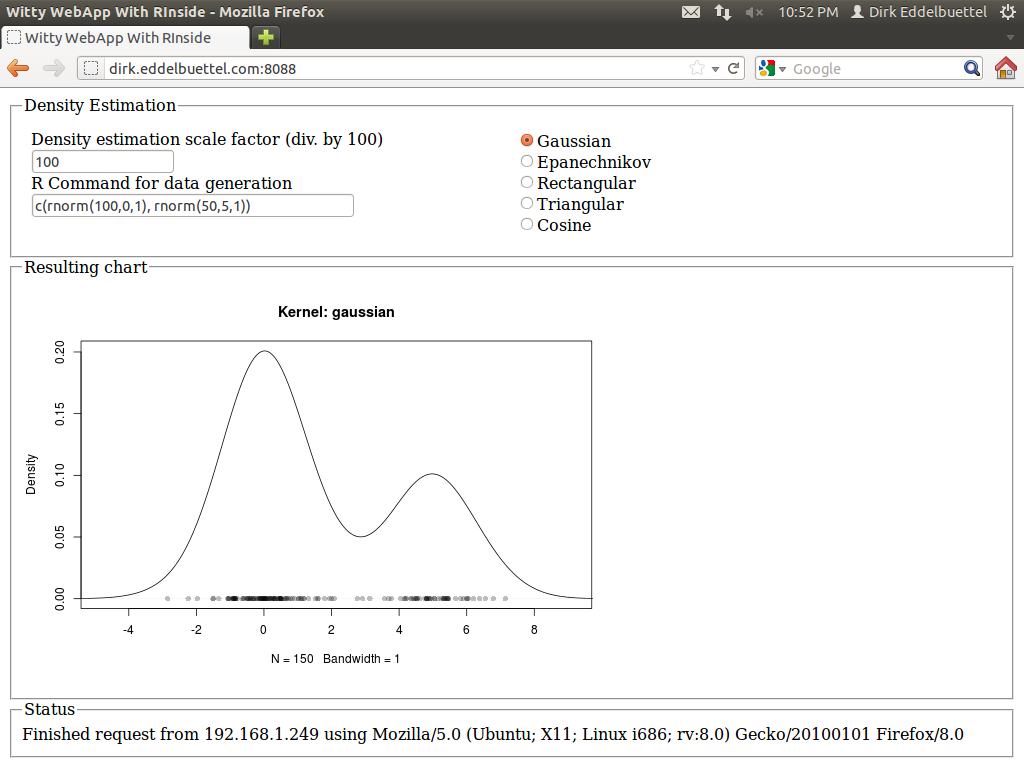
A few months ago, I had blogged about using R inside of Qt. This used our RInside package for embedding the statistical programming environment and language R inside of a C++ application, and further relies on our Rcpp package for R and C++ integration and object mapping. The example was simple yet powerful: a reimplementation of the standard GUI application of a standard density estimate. Here the user can pick a kernel density function from a selection, and also slide a bandwidth parameter. One nice addition was an entry field already populated with a simple expression for a mixture of Normals, allowing for arbitrary random distributions over which to estimate. The example is pretty (thanks to Qt), and was added to RInside with the last CRAN release 0.2.4. The blog post has a nice screenshot. I had long wondered how to do something similar 'on the web'. Web integration and application frameworks are of course a dime a dozen: Just about any language offers this, with more or less ease. But I wanted something simple yet powerful and fast. And I did not like the idea of a multi-tier app, or of a multi-language mix. I remember having seen something about a web-application framework not unlike Qt, and studying the very useful Wikipedia web application framework comparison I re-discovered Wt (pronounced "Witty"). So there it is, using C++ which brings us ample performance, the ability to connect to a number of libraries and applications (which is important in my quantitatively-minded workd) and avoid the whole multi-tier, multi-language combination. The Wt website has a few more good reason why this may be a suitable idea; the toolkit also offers a very decent amount of features and is amply documented with a fair number of examples. And after just a little bit poking around during two weekends, I now have the following webapp committed in the SVN repository of RInside, and it is all implemented in in less than two hundred (generously commented) lines of code. Example of embedding R via RInside into a Wt C++ application: density estimation for a mixture It is currently up and running at the address shown in the screenshot, so give it a go (though I may take it down at another point in time). I quite like it: The application is responsive: changes in the radio buttons (for the density), or the bandwidth, each trigger reestimation of the density, and a new and updated chart is displayed immediately with no noticeable delay---just like the desktop application did. Best of all, the code logic is essentially unchanged from the Qt-based app. Signals and slots related events to actions, the layout is in terms of standard GUI boxen and containers. And best of all, I did not have to write a line of html, javascript, css or ajax: it is all handled by the Wt toolkit. I was able to drive the app from an Android phone, my tablet, various computers around the house, and had a few friends poke a stick at it from afar. There is at one open issue. Wt launches new instances of the application object with each connection, which is a very clean model. That doesn't map perfectly with R (which is single-threaded) and RInside (which runs as a singleton for the same reason). So right now, each action sends its state back to the client. In other words, each clients own its parameters and well as vector of random numbers. Each new action sends these back to the app which passes it to R, launches the re-estimation and gets an updated chart back which is then shown by the the client. That is not perfect, and maybe a forking model as used by Simon's RServe would be better, though it would require a rewrite of RInside. Not sure if we get there anytime soon. And for simple applications not facing legions of concurrent users, the singleton should still work. It's a proof of concept at this point. Feedback welcome, and RInside and Rcpp questions should go to the rcpp-devel list as usual.

30 November 2011

Dirk Eddelbuettel: RcppArmadillo 0.2.31

Conrad Sanderson just released the second pre-release 2.3.92 of what will be Armadillo 2.4.*. This is now in RcppArmadillo release 0.2.31 which is already on CRAN as of this morning. The NEWS entries summarising the changes for both are below:
0.2.31  2011-11-28
    o   Upgraded to Armadillo test release 2.3.92 "Loco Lounge Lizard (Beta 2)"
          * fixes for linking on Ubuntu and Debian systems
          * fixes for inconsistencies in interactions between matrices and
            cubes
Courtesy of CRANberries, there is also a diffstat reports for 0.2.31 relative to 0.2.30 As always, more detailed information is on the RcppArmadillo page. Questions, comments etc should go to the rcpp-devel mailing list off the R-Forge page.

28 November 2011

Dirk Eddelbuettel: A Story of Life and Death. On CRAN. With Packages.

The Comprehensive R Archive Network, or CRAN for short, has been a major driver in the success and rapid proliferation of the R statistical language and environment. CRAN currently hosts around 3400 packages, and is growing at a rapid rate. Not too long ago, John Fox gave a keynote lecture at the annual R conference and provided a lot of quantitative insight into R and CRAN---including an estimate of an incredible growth rate of 40% as a near-perfect straight line on a log-log chart! So CRAN does in fact grow exponentially. (His talk morphed into this paper in the R Journal, see figure 3 for this chart.) The success of CRAN is due to a lot of hard work by the CRAN maintainers, lead for many years and still today by Kurt Hornik whose dedication is unparalleled. Even at the current growth rate of several packages a day, all submissions are still rigorously quality-controlled using strong testing features available in the R system. And for all its successes, and without trying to sound ungrateful, there have always been some things missing at CRAN. It has always been difficult to keep a handle on the rapidly growing archive. Task Views for particular fields, edited by volunteers with specific domain knowledge (including yours truly) help somewhat, but still cannot keep up with the flow. What is missing are regular updates on packages. What is also missing is a better review and voting system (and while Hadley Wickham mentored a Google Summer of Code student to write CRANtastic, it seems fair to say that this subproject didn't exactly take off either). Following useR! 2007 in Ames, I decided to do something and noodled over a first design on the drive back to Chicago. A weekend of hacking lead to CRANberries. CRANberries uses existing R functions to learn which packages are available right now, and compares that to data stored in a local SQLite database. This is enough to learn two things: First, which new packages were added since the last run. That is very useful information, and it feeds a website with blog subscriptions (for the technically minded: an RSS feed, at this URL). Second, it can also compare current versions numbers with the most recent stored version number, and thereby learns about updated packages. This too is useful, and also feeds a website and RSS stream (at this URL; there is also a combined one for new and updated packages.) CRANberries writes out little summaries for both new packages (essentially copying what the DESCRIPTION file contains), and a quick diffstat summary for updated packages. A static blog compiler munges this into static html pages which I serve from here, and creates the RSS feed data at the same time. All this has been operating since 2007. Google Reader tells me the the RSS feed averages around 137 posts per week, and has about 160 subscribers. It does feed to Planet R which itself redistributes so it is hard to estimate the absolute number of readers. My weblogs also indicate a steady number of visits to the html versions. The most recent innovation was to add tweeting earlier in 2011 under the @CRANberriesFeed Twitter handle. After all, the best way to address information overload and too many posts in our RSS readers surely is to ... just generate more information and add some Twitter noise. So CRANberries now tweets a message for each new package, and a summary message for each set of new packages (or several if the total length exceeds the 140 character limit). As of today, we have sent 1723 tweets to what are currently 171 subscribers. Tweets for updated packages were added a few months later. Which leads us to today's innovation. One feature which has truly been missing from CRAN was updates about withdrawn packages. Packages can be withdrawn for a number of reasons. Back in the day, CRAN carried so-called bundles carrying packages inside. Examples were VR and gregmisc. Both had long been split into their component packages, making VR and gregmisc part of the set of packages no longer on the top page of CRAN, but only its archive section. Other examples are packages such as Design, which its author Frank Harrell renamed to rms to match to title of the book covering its methodology. And then there are of course package for which the maintainer disappeared, or lost interest, or was unable to keep up with quality requirements imposed by CRAN. All these packages are of course still in the Archive section of CRAN. But how many packages did disappear? Well, compared to the information accumulated by CRANberries over the years, as of today a staggering 282 packages have been withdrawn for various reasons. And at least I would like to know more regularly when this happens, if only so I have a chance to see if the retired package is one the 120+ packages I still look after for Debian (as happened recently with two Rmetrics packages). So starting with the next scheduled run, CRANberries will also report removed packages, in its own subtree of the website and its own RSS feed (which should appear at this URL). I made the required code changes (all of about two dozen lines), and did some light testing. To not overwhelm us all with line noise while we catch up to the current steady state of packages, I have (temporarily) lowered the frequency with which CRANberries is called by cron. I also put a cap on the number of removed packages that are reported in each run. As always with new code, there may be a bug or two but I will try to catch up in due course. I hope this is of interest and use to others. If so, please use the RSS feeds in your RSS readers, and subscribe to the @CRANberriesFeed, And keep using CRAN, and let's all say thanks to Kurt, Stefan, Uwe, and everybody who is working on CRAN (or has been in the past).
22 November 2011

Dirk Eddelbuettel: RPostgreSQL 0.2-0, 0.2-1 and an unsung Open Source hero

RPostgreSQL goes back to a topic suggestion I had made for the Google Summer of Code 2008, and specifically for the R Project participation that year. And Sameer Kumar Prayaga (whom I then mentored for the project) did a fine job that summer putting together a working framework of package connecting R and the excellent PostgreSQL database system. Unfortunately, Sameer vanished once the summer was up; I heard he got himself a job a another db company. Fast-forward a few years. A caretaker group had maintained the package in the meantime, but without really writing any new code. But thanks to the tireless efforts of Tomoaki Nishiyama, who not only wrote a lot of new code addressing some of issues logged at the Google Code project page, but also stepped forward and became the new lead maintainer, things are much, much better now. The first 0.2-0 release a few weeks ago already addressed a rather large number of issues, bringing the feature set much closer to what one would expect from a feature-complete package. But one big thorn remained: builds on Windows still required a local PostgreSQL library installation as well as local compilation. And as we can tell from the mailing list(s), this is a little daunting for many potential users. But what did release 0.2-1 bring: a complete set of libpq sources so that builds on Windows no longer require presence of local PostgreSQL sources! We tested this using Uwe Ligges' excellent win-builder service for R, and after I reminded Uwe on the weekend to no longer blacklist build attempts of RPostgreSQL, we now have Windows binaries for direct installation. Just call install.packages(), and you're good to go -- much nicer! Tomoaki achieved this pretty much single-handedly, and for that reason he greatly deserves some extra praise as an unsung Open Source hero!

20 November 2011

Dirk Eddelbuettel: RcppArmadillo 0.2.30 (and 0.2.29)

A few days ago, Conrad Sanderson released the first pre-release version of what will be Armadillo 2.4.*, giving it the 2.3.91 release handle. We folded this into RcppArmadillo release 0.2.30, with Romain making a few adjustments to our template structure to accomodate Conrad's underlying changes in Armadillo itself. Armadillo is a wonderfully expressive (thanks to clever modern template programming), powerful yet simple-to-use C++ library for linear algebra, making expressions in C++ as easy as writing in Matlab or R. By deploying our seamless Rcpp glue between R and C++, RcppArmadillo brings this nice C++ library to R users. The CRAN page for RcppArmadillo now lists ten packages using the RcppArmadillo package. There was also an earlier bug-fix release 0.2.29 which I had not blogged about separately. The NEWS entries summarising the changes for both are below:
0.2.30  2011-11-19
    o   Upgraded to Armadillo test release 2.3.91 "Loco Lounge Lizard (Beta 1)"
          * added shorter forms of transposes: .t() and .st()
          * added optional use of 64 bit indices, allowing matrices to have
            more than 4 billion elements
          * added experimental support for C++11 initialiser lists
          * faster pinv()
          * faster inplace transpose
          * bugfixes for handling expressions with aliasing and submatrices
          * refactored code to eliminate warnings when using the Clang C++
            compiler
          * .print_trans() and .raw_print_trans() are deprecated 
0.2.29  2011-09-01
    o   Upgraded to Armadillo release 2.2.3
          * Release fixes a speed issue in the as_scalar() function.
Courtesy of CRANberries, there are also diffstat reports for 0.2.30 relative to 0.2.29 and for 0.2.29 relative to 0.2.28. As always, more detailed information is on the RcppArmadillo page. Questions, comments etc should go to the rcpp-devel mailing list off the R-Forge page.

6 November 2011

Dirk Eddelbuettel: Rcpp talk at Seattle RUG next month

The Seattle R User Group was kind enough to invite me to give a talk about R, C++ and Rcpp. So if you can make it to the Thomas building of the Fred Hutchinson Cancer Research Center in Seattle, WA, on December 7, I would love to see you there. I have some ideas about freshening up the presentation(s) based on material Romain and I have used in the past. This should make the why as well as how a little clearer; now I just have to find some to put this together. And if there are particular aspects you would like to see covered, please do get in touch with me.

24 October 2011

Dirk Eddelbuettel: Kurt Elling and the Kl vers Big Band at the Green Mill

Twenty-four hours ago I was in heaven. Or to more properly recapitulate and situate this, fourty-eight hours ago I was in hell. Now this requires some context. Earlier in the year, I had tweeted briefly about a Kurt Elling live concert still streaming on NPR, and truth be told, I have listened to Kurt Elling a whole lot ever since. The most recent album The Gate is fantastic, the Grammy-winner Dedicated to You (which retakes the very famous Coltrane/Hartman album) is beyond words, and The Messenger is worth it just for 'Nature Boy' and the funkiest-ever 'April in Paris'. I also saw him as part of a larger and otherwise rather neat tour. But I needed to see the man himself. So following what one can see from his touring calendar, I jotted down two October dates. Kurt Elling at the Green Mill. Fine. That was earlier in the summer. Summer has a tendency of evaporating quickly, so here we were in October. And getting going late on Friday, so by the time we got the Green Mill, a long line had formed and we ended up paying tribute to the line for fourty-five minutes with nothing to show. Sad. Home we went, and no live music. But somehow we mustered the energy to go again last night and thought we were early, arriving about 20 minutes before the show was to start. Ha! Others had appeared at 3pm, by 5pm all seats were gone. We were literally the last ones the get in after a short spell in a shorter line, and standing room-only it was. Oh, but what a treat we got. The set for these two days was Kurt Elling with the fourteen piece Kl vers Big Band from Denmark. They played for three marvellous sets, and well over four hours (with two 25 minute breaks). Pieces often alternated between big band arrangements and smaller pieces by Elling's standard rhythm band, and covered standards as well as Elling's catalogue. As I mentioned earlier on a short post (with pictures) on Google+, it is essentially impossible to not fall for Elling's stage presence when being so close to the stage. The man is just that good. Elling and the Kl vers Big Band will now play for six nights at Birdland in New York followed by a night each in Washington, DC, and Boston. If you're around, do yourself a favour and go out to see them.

1 October 2011

Dirk Eddelbuettel: Reminder: One week til Rcpp class in San Francisco

Just a quick note to remind everyone that the Rcpp class in San Francisco, which I am holding together with Revolution Analytics, will take place a week from today. We are happy to report that the number of registrations has met our initial targets. But as a number of open slots remain, we have decided to offer a few places at discounts of 25% for academics (with code acad1) and 50% for students (with code student). Course details are at the Revolution course page, registration is at the Eventbrite page. And just for completeness, here is what I wrote in the previous announcement:
The format will follow the workshop Romain and I gave during the tutorial day preceding this year's R/Finance conference. The style will once again be hands-on, with copious concrete examples and solid coverage of most aspects of Rcpp and related packages such as RInside, RcppArmadillo and others. The eight-hour schedule contains about six hours of instruction, split into four sessions of around ninety minutes. This leaves ample time for both lunch and coffee breaks, and for informal discussions and Q+A. The one-day class will be offered in San Franciso on Saturday, October 8, 2011. Please see the official course page for more details, concrete location info and maps as well as registration details.
Feel free to contact me at the usual email address with questions. Or with suggestions for the after-party in San Francisco :)

30 September 2011

Dirk Eddelbuettel: Rcpp 0.9.7

A fresh maintenance release version 0.9.7 of Rcpp went onto CRAN and into Debian earlier today. This release contains two contributed fixes. The first, suggested by Darren Cook via the rcpp-devel mailing list, corrects how we had set up exceptions specifications, reflecting a bit of Java-think on our part. The idiom is generally discouraged in C++, and we now conform. The second came in two excellent patches by R Core member Martyn Plummer which finally get us compilation on Solaris. This is much appreciated as our hands were tied here for lack of access to such a box. Otherwise, two new examples and a new unit test were added. The complete NEWS entry is below; more details are in the ChangeLog file in the package and on the Rcpp Changelog page.
0.9.7   2011-09-29
    o   Applied two patches kindly provided by Martyn Plummer which provide
        support for compilation on Solaris using the SunPro compiler
    o   Minor code reorganisation in which exception specifiers are removed;
        this effectively only implements a run-time (rather than compile-time) 
        check and is generally seen as a somewhat depreated C++ idiom. Thanks
        to Darren Cook for alerting us to this issue.
    o   New example 'OpenMPandInline.r' in the OpenMP/ directory, showing how
        easily use OpenMP by modifying the RcppPlugin output
    o   New example 'ifelseLooped.r' showing Rcpp can accelerate loops that may
        be difficult to vectorise due to dependencies
    o   New example directory examples/Misc/ regrouping the new example as
        well as the fibonacci example added in Rcpp 0.9.6
    o   New Rcpp-FAQ example warning of lossy conversion from 64-bit long
        integer types into a 53-bit mantissa which has no clear fix yet.
    o   New unit test for accessing a non-exported function from a namespace
Thanks to CRANberries, you can also look at a diff to the previous release 0.9.6. As always, even fuller details are on the Rcpp Changelog page and the Rcpp page which also leads to the downloads, the browseable doxygen docs and zip files of doxygen output for the standard formats. A local directory has source and documentation too. Questions, comments etc should go to the rcpp-devel mailing list off the R-Forge page

21 September 2011

Dirk Eddelbuettel: digest 0.5.1

A new version of the digest package (which generates hash function summaries for arbitrary (and possibly nested) R objects using any of the standard md5, sha-1, sha-256 or crc32 algorithms) is now on CRAN. Bryan Lewis, who is doing very stuff with websockets and Html5 as he demoed last week the Chicago R User Group meeting, needed raw support and was kind enough to send a patch. After some more testing, this change set is now in the new version which went onto CRAN earlier today. CRANberries provides the usual summary of changes to version 0.5.0. As usual, our package is available via the R-Forge page leading to svn and tarball access, my digest page and the local directory here.

19 September 2011

Dirk Eddelbuettel: Fox Valley Marathon 2011

This morning, I was one of a mere 900 or so marathoners in the second (?) annual Fox Valley Marathon, along with a 20 mile training race (as Chicago's big marathon is coming up) and a half marathon. This all took place along the Fox river, which is about an hour west of Chicago. The race went well enough. I had been racing twice a year at this distance, but took a break after running with some minor injury and generally not too well (see e.g. my writeup from last year's Boston and Chicago marathons). So I wasn't even sure I'd run one this year at all, but the bug got me again when two friends signed up for this, and off we went to train over the summer. So with a few more miles from training, I was pretty antsy and went out too fast as usual, and paid with an as-usual slower half and few short walking breaks past mile 20. But I beat the hope-for target time of 3:25 quite handily with a 3:19:03 -- or a 7:36 min/mile pace. Which (as I noted in a quick post to Google+ started right after the race, and since edited/expanded -- prods to Google+) should hopefully get me back to Boston next spring.

17 September 2011

Dirk Eddelbuettel: littler 0.1.5

Brown-bag release time for littler. One of the <emph>minor cleanups</emph> in the 0.1.4 release from Thursday actually introduced a nasty little bug as you can't call Rf_KillAllDevices() when you do not have any graphics device. Doh. So with apologies for the lower quality release, and the two hour malfuntioning window for CRANberries that it cause, a repaired version is now out there. The very brief (upstream) ChangeLog is as follows:
2011-09-17  Dirk Eddelbuettel  <edd>
        * configure.in: Mark as release 0.1.5
        * littler.c (littler_CleanUp): Remove call to Rf_KillAllDevices() 
littler provides r (pronounced littler), a shebang / scripting / quick eval / pipelining front-end to the the R language and data analysis environment. As usual, our code is available via our svn archive or from tarballs off my littler page and the local directory here. A fresh package is in Debian's incoming queue and will hit mirrors shortly.

15 September 2011

Dirk Eddelbuettel: littler 0.1.4

Matthias Klose, the tireless force behind the Debian / Ubuntu gcc, python, and what have you packages, sent me a minimal patch to let littler build when the ld linker uses the --as-needed option (as Ubuntu builds now do): all it took was a little reordering of arguments. With that, I did a little cleanup as it has been a while since version 0.1.3. The brief (upstream) ChangeLog is as follows:
2011-09-15  Dirk Eddelbuettel  <edd>
        * configure.in: Mark as release 0.1.4
        * Makefile.am: Applied patch by Mathias Klose to prevent FTBFS with
          'ld --as-needed', cf LP bug 770980.
        * littler.c: A few small tweaks suggested by 'gcc -Wall'
        * examples/install2.r: Added a second R package installer example
        * examples/update.r: Switch to '/usr/bin/r -t' as shebang line
        * examples/fsizes.r: Dito
        * littler.c: Update copyrights to 2011
        * README: Idem
littler provides r (pronounced littler), a shebang / scripting / quick eval / pipelining front-end to the the R language and data analysis environment. As usual, our code is available via our svn archive or from tarballs off my littler page and the local directory here. A fresh package is in Debian's incoming queue and will hit mirrors shortly.

Next.

Previous.