Hi,
geoip version 1.6.2-2 and geoip-database version 20141027-1 are now available in Debian unstable/sid, with some news of more free databases available :)
geoip changes:
   * Add patch for geoip-csv-to-dat to add support for building GeoIP city DB.
     Many thanks to Andrew Moise for contributing!
   * Add and install geoip-generator-asn, which is able to build the ASN DB. It
     is a modified version from the original geoip-generator. Much thanks for
     contributing also to Aaron Gibson!
   * Bump Standards-Version to 3.9.6 (no changes required).
geoip-database changes:
   * New upstream release.
   * Add new databases GeoLite city and GeoLite ASN to the new package
     geoip-database-extra. Also bump build depends on geoip to 1.6.2-2.
   * Switch to xz compression for the orig tarball.
So much thanks to both contributors!
TL;DR; Those of you who are not able to join "X2Go: The Gathering 2014"... Join us on IRC (#x2go on Freenode) over the coming weekend. We will provide information, URLs to our TinyPads, etc. there. Spontaneous visitors are welcome during the working sessions (please let us know if you plan to come around), but we don't have spare beds anymore for accomodation. (We are still trying hard to set up some sort of video coverage--may it be life streaming or recorded sessions, this is still open, people who can offer help, see below).
Our event "X2Go: The Gathering 2014" is approaching quickly. We will meet with a group of 13-15 people (number of people is still slightly fluctuating) at Linux Hotel, Essen. Thanks to the generous offerings of the Linux Hotel [1] to FLOSS community projects, costs of food and accommodation could be kept really low and affordable to many people.
We are very happy that people from outside Germany are coming to that meeting (Michael DePaulo from the U.S., Kjetil Fleten (
http://fleten.net) from Denmark / Norway). And we are also proud that Martin Wimpress (Mr. Ubuntu MATE Remix) will join our gathering.
In advance, I want to send a big THANK YOU to all people who will sponsor our weekend, either by sending gift items, covering travel expenses or providing help and knowledge to make this event a success for the X2Go project and its community around.
read more
I've been wanting to set up
DANE for my domain, but I seem to be unable to find a provider that offers
DNSSEC that can also do
TLSA records in
DNS. I've contacted several companies and most don't even seem to be offering
DNSSEC. And if they offer
DNSSEC they can't do
TLSA records or rfc3597 style "unknown
DNS resource record types". I would like to avoid actually running my own nameservers.
So if someone knows someone that can provide that, please contact me at kurt@roeckx.be.
Update [29 October 2014]:
Some people suggested that I set up a hidden master. I actually wanted to avoid that, but I guess I'm going to do that.

Goodbye Barnes & Noble
I've read books on electronic devices for many years now; the
convenience of having a huge library with me while traveling makes up
for the lower quality of the presentation. I've read books on a
selection of Palm devices, an old
OpenInkpot
compatible ereader, my phone and, most recently, on my
Kobo Aura.
To get reading material, I've used a variety of sources, including the
venerable
Project Gutenberg, the
Internet Archive, directly from authors like
Cory Doctorow and even our local
Multnomah
County Public Library.
I like to have books in
epub
format; it's a published standard, based on HTML and CSS. My recent
devices have all happily supported that, and it allows for editing
when I feel the need to correct typos or formatting problems.
Purchasing Books
When I wanted to actually purchase a book, I bought from Barnes &
Noble; they have a good selection, and reasonable automatic
recommendations. According to their web site, since I started shopping
there, I've purchased 51 books. I can't tell how much I've spent, but
probably in excess of $500.
Not knowing which device I'd be reading on at any one time, and liking
to have the assurance of ongoing access to my library, I would always
download the epub files to my laptop and then transfer them to
whichever device I wanted to read on. This ensured that my books
would be available even when I didn't have a network connection (as
happened yesterday during a wind storm which cut the power to the
DSLAM which connects me to the internet).
I'd created a simple shell script which captured the file after it was
downloaded on my laptop and prepared it for my reader. A bit of
browser configuration and it really was as simple as clicking the
'download' button to get a book onto both my laptop and my reading
device.
Barnes & Noble Disables Downloading
I was traveling in Bordeaux a couple of weeks ago and wanted to get the
latest volume in a series I was reading. My library didn't have it
available, and so I decided that it was worth a few dollars to
purchase it for the flight home.
After clicking through the Barnes & Noble store, I was ready to
download the book so that I could transfer it to my reader. Going to
'My Library', I found my new purchases but the usual 'Download' button
was missing. I was a bit surprised as I'd purchased and downloaded the
previous volume just before leaving without any troubles.
At first, I assumed there was some kind of region restriction on the
distribution of this book. I'm familiar with that from DVD region
locking of movies, and supposed that the same could be done with books
for some reason. However, after setting up a VPN back to home and
browsing through that (to ensure that my browser would appear with an
Oregon address), the download button was still not present.
The unhelpful Barnes & Noble representative that I accessed through
the 'help' button disclosed that the 'download' "feature" had been
disabled for "security" reasons.
Not really having any alternative, I requested a refund for the new
book.
Barnes & Noble Loses a Customer
With no way to actually use ebooks purchased through the Barnes &
Noble store, I won't be spending any more money with them.
I'm not sure how that helps their "security" issues, although if they
lose enough customers and they close their doors, I guess that would
make them about as secure as imaginable.
Kobo Makes a Sale
Having purchased a Kobo Aura, it had built-in access to their book
store, which made it easy to download the book that I wanted. Then, I
simply connected my reader to my laptop and copied the file over for
safe keeping.
Buying Books under Linux
After I got home, I had to figure out how to get Adobe Digital Editions
installed on my laptop. Fortunately, I discovered that
version 2.0.1
runs fine under wine.
Now, purchasing books can be done with my laptop (a vastly superior
browsing experience). The .acsm file can be dragged straight from the
iceweasel download menu to Adobe Digital Editions, which happily
downloads the actual .epub file and makes it available for transferring
to my reader.
Of course, now that I've got Adobe Digital Editions working, I can
also get digitally restricted books from all over the net, greatly
expanding my options for purchasing (or borrowing) books. It's a bit
less convenient, and requires that I run an icky Windows binary under
wine, but at least I have choices, which is some consolation.
I am happy to report that I on behalf of the Debian Edu team just
sent out
this
announcement:
The Debian Edu Team is pleased to announce the release of Debian Edu
Jessie 8.0+edu0~alpha0
Debian Edu is a complete operating system for schools. Through its
various installation profiles you can install servers, workstations
and laptops which will work together on the school network. With
Debian Edu, the teachers themselves or their technical support can
roll out a complete multi-user multi-machine study environment within
hours or a few days. Debian Edu comes with hundreds of applications
pre-installed, but you can always add more packages from Debian.
For those who want to give Debian Edu Jessie a try, download and
installation instructions are available, including detailed
instructions in the manual[1] explaining the first steps, such as
setting up a network or adding users. Please note that the password
for the user your prompted for during installation must have a length
of at least 5 characters!
 [1] <URL: https://wiki.debian.org/DebianEdu/Documentation/Jessie >
Would you like to give your school's computer a longer life? Are you
tired of sneaker administration, running from computer to computer
reinstalling the operating system? Would you like to administrate all
the computers in your school using only a couple of hours every week?
Check out Debian Edu Jessie!
Skolelinux is used by at least two hundred schools all over the world,
mostly in Germany and Norway.
About Debian Edu and Skolelinux
===============================
Debian Edu, also known as Skolelinux[2], is a Linux distribution based
on Debian providing an out-of-the box environment of a completely
configured school network. Immediately after installation a school
server running all services needed for a school network is set up just
waiting for users and machines being added via GOsa , a comfortable
Web-UI. A netbooting environment is prepared using PXE, so after
initial installation of the main server from CD or USB stick all other
machines can be installed via the network.  The provided school server
provides LDAP database and Kerberos authentication service,
centralized home directories, DHCP server, web proxy and many other
services.  The desktop contains more than 60 educational software
packages[3] and more are available from the Debian archive, and
schools can choose between KDE, Gnome, LXDE, Xfce and MATE desktop
environment.
 [2] <URL: http://www.skolelinux.org/ >
 [3] <URL: http://people.skolelinux.org/pere/blog/Educational_applications_included_in_Debian_Edu___Skolelinux__the_screenshot_collection____.html >
Full release notes and manual
=============================
Below the download URLs there is a list of some of the new features
and bugfixes of Debian Edu 8.0+edu0~alpha0 Codename Jessie. The full
list is part of the manual. (See the feature list in the manual[4] for
the English version.) For some languages manual translations are
available, see the manual translation overview[5].
 [4] <URL: https://wiki.debian.org/DebianEdu/Documentation/Jessie/Features >
 [5] <URL: http://maintainer.skolelinux.org/debian-edu-doc/ >
Where to get it
---------------
To download the multiarch netinstall CD release (624 MiB) you can use
 * ftp://ftp.skolelinux.org/skolelinux-cd/debian-edu-8.0+edu0~alpha0-CD.iso
 * http://ftp.skolelinux.org/skolelinux-cd/debian-edu-8.0+edu0~alpha0-CD.iso
 * rsync -avzP ftp.skolelinux.org::skolelinux-cd/debian-edu-8.0+edu0~alpha0-CD.iso .
The SHA1SUM of this image is: 361188818e036ce67280a572f757de82ebfeb095
New features for Debian Edu 8.0+edu0~alpha0 Codename Jessie released 2014-10-27
===============================================================================
Installation changes
--------------------
 * PXE installation now installs firmware automatically for the hardware present.
Software updates
----------------
Everything which is new in Debian Jessie 8.0, eg:
 * Linux kernel 3.16.x
 * Desktop environments KDE "Plasma" 4.11.12, GNOME 3.14, Xfce 4.10,
   LXDE 0.5.6 and MATE 1.8 (KDE "Plasma" is installed by default; to
   choose one of the others see manual.)
 * the browsers Iceweasel 31 ESR and Chromium 38
 * !LibreOffice 4.3.3
 * GOsa 2.7.4
 * LTSP 5.5.4
 * CUPS print system 1.7.5
 * new boot framework: systemd
 * Educational toolbox GCompris 14.07
 * Music creator Rosegarden 14.02
 * Image editor Gimp 2.8.14
 * Virtual stargazer Stellarium 0.13.0
 * golearn 0.9
 * tuxpaint 0.9.22
 * New version of debian-installer from Debian Jessie.
 * Debian Jessie includes about 42000 packages available for
   installation.
 * More information about Debian Jessie 8.0 is provided in the release
   notes[6] and the installation manual[7].
 [6] <URL: http://www.debian.org/releases/jessie/releasenotes >
 [7] <URL: http://www.debian.org/releases/jessie/installmanual >
Fixed bugs
----------
 * Inserting incorrect DNS information in Gosa will no longer break
   DNS completely, but instead stop DNS updates until the incorrect
   information is corrected (Debian bug #710362)
 * and many others.
Documentation and translation updates
-------------------------------------
 * The Debian Edu Jessie Manual is fully translated to German, French,
   Italian, Danish and Dutch. Partly translated versions exist for
   Norwegian Bokmal and Spanish.
Other changes
-------------
 * Due to new Squid settings, powering off or rebooting the main
   server takes more time.
 * To manage printers localhost:631 has to be used, currently www:631
   doesn't work.
Regressions / known problems
----------------------------
 * Installing LTSP chroot fails with a bug related to eatmydata about
   exim4-config failing to run its postinst (see Debian bug #765694
   and Debian bug #762103).
 * Munin collection is not properly configured on clients (Debian bug
   #764594).  The fix is available in a newer version of munin-node.
 * PXE setup for Main Server and Thin Client Server setup does not
   work when installing on a machine without direct Internet access.
   Will be fixed when Debian bug #766960 is fixed in Jessie.
See the status page[8] for the complete list.
 [8] <URL: https://wiki.debian.org/DebianEdu/Status/Jessie >
How to report bugs
------------------
<URL: http://wiki.debian.org/DebianEdu/HowTo/ReportBugs >
About Debian
============
The Debian Project was founded in 1993 by Ian Murdock to be a truly
free community project. Since then the project has grown to be one of
the largest and most influential open source projects. Thousands of
volunteers from all over the world work together to create and
maintain Debian software. Available in 70 languages, and supporting a
huge range of computer types, Debian calls itself the universal
operating system.
Contact Information
For further information, please visit the Debian web pages[9] or send
mail to press@debian.org.
 [9] <URL: http://www.debian.org/ >

I've taught my laptop to wake up at 7:30 in the morning. When it does, it
will run
whatever's in my ~/bin/goodmorning script. Then, if the lid is
still closed, it will go back to sleep again.
So, it's a programmable alarm clock that doesn't need the laptop to be left
turned on to work.
But it doesn't have to make noise and wake me up (I rarely want to be woken
up by an alarm; the sun coming in the window is a much nicer method).
It can handle other tasks like downloading my email, before I wake up. When
I'm at home and on dialup, this tends to take an hour in the morning, so
it's nice to let it happen before I get up.
This took some time to figure out, but it's surprisingly simple.
Besides ~/bin/goodmorning, which can be any program/script,
I needed just two files to configure systemd to do this.
/etc/systemd/system/goodmorning.timer
[Unit]
Description=good morning
[Timer]
Unit=goodmorning.service
OnCalendar=*-*-* 7:30
WakeSystem=true
Persistent=false
[Install]
WantedBy=multi-user.target
/etc/systemd/system/goodmorning.service
[Unit]
Description=good morning
RefuseManualStart=true
RefuseManualStop=true
ConditionACPower=true
[Service]
Type=oneshot
ExecStart=/bin/systemd-inhibit --what=handle-lid-switch --why=goodmorning /bin/su joey -c "/usr/bin/timeout 45m /home/joey/bin/goodmorning"
installation
After installing those files, run (as root):
systemctl enable goodmorning.timer; systemctl start goodmorning.timer
Then, you'll also need to edit
/etc/systemd/logind.conf, and
set
LidSwitchIgnoreInhibited=no -- this overrides the default, which
is not to let systemd-inhibit block sleep on lid close.
almost too easy
I don't think this would be anywhere near as easy to do without systemd,
logind, etc. Especially the handling of waking the system at the right
time, and the behavior around lid sleep inhibiting.
The WakeSystem=true relies on some
hardware support for waking from sleep;
my laptop supported it with no trouble but I don't know how broadly
available that is.
Also, notice the
ConditionACPower=true, which I added once I realized I
don't want the job to run if I forgot to leave the laptop plugged in
overnight. Technically, it will still wake up when on battery power, but
then it should go right back to sleep.
Quite a lot of nice peices of systemd all working together here!
xfce workaround
If using xfce, xfce4-power-manager takes over handling of lid close from
systemd, and currently prevents the system from going back to sleep if the
lid is still closed when goodmorning finishes. Happily, there is an easy
workaround; this configures xfce to not override the lid switch behavior:
xfconf-query -c xfce4-power-manager -n -p /xfce4-power-manager/logind-handle-lid-switch -t bool -s true
Other desktop environments may have similar issues.
why not a per-user unit?
It would perhaps be better to use the per-user systemd, not the system wide
one. Then I could change the time the alarm runs without using root.
What's prevented me from doing this is that systemd-inhibit uses policykit,
and policykit prevents it from being used in this situation. It's a lot
easier to run it as root and use su, than it is to reconfigure policykit.

The
Ubuntu Code of Conduct says:
Step down considerately: When somebody leaves or disengages from the project, we ask that they do so in a way that minimises disruption to the project. They should tell people they are leaving and take the proper steps to ensure that others can pick up where they left off.
I've been working on Ubuntu for over ten years now, almost right from the very start; I'm Canonical's employee #17 due to working out a notice period in my previous job, but I was one of the founding group of developers. I occasionally tell the story that Mark originally hired me mainly to work on what later became Launchpad Bugs due to my experience maintaining the Debian bug tracking system, but then not long afterwards Jeff Waugh got in touch and said "hey Colin, would you mind just sorting out some installable CD images for us?". This is where you imagine one of those movie time-lapse clocks ... At some point it became fairly clear that I was working on Ubuntu, and the bug system work fell to other people. Then, when Matt Zimmerman could no longer manage the entire Ubuntu team in Canonical by himself, Scott James Remnant and I stepped up to help him out. I did that for a couple of years, starting the Foundations team in the process. As the team grew I found that my interests really lay in hands-on development rather than in management, so I switched over to being the technical lead for Foundations, and have made my home there ever since. Over the years this has given me the opportunity to do all sorts of things, particularly working on our installers and on the GRUB boot loader, leading the development work on many of our archive maintenance tools, instituting the +1 maintenance effort and proposed-migration, and developing the Click package manager, and I've had the great pleasure of working with many exceptionally talented people.
However. In recent months I've been feeling a general sense of malaise and what I've come to recognise with hindsight as the symptoms of approaching burnout. I've been working long hours for a long time, and while I can draw on a lot of experience by now, it's been getting harder to summon the enthusiasm and creativity to go with that. I have a wonderful wife, amazing children, and lovely friends, and I want to be able to spend a bit more time with them. After ten years doing the same kinds of things, I've accreted history with and responsibility for a lot of projects. One of the things I always loved about Foundations was that it's a broad church, covering a wide range of software and with a correspondingly wide range of opportunities; but, over time, this has made it difficult for me to focus on things that are important because there are so many areas where I might be called upon to help. I thought about simply stepping down from the technical lead position and remaining in the same team, but I decided that that wouldn't make enough of a difference to what matters to me. I need a clean break and an opportunity to reset my habits before I burn out for real.
One of the things that has consistently held my interest through all of this has been making sure that the infrastructure for Ubuntu keeps running reliably and that other developers can work efficiently. As part of this, I've been able to do
a lot of work over the years on
Launchpad where it was a good fit with my remit: this has included significant performance improvements to archive publishing, moving most archive administration operations from excessively-privileged command-line operations to the webservice, making build cancellation reliable across the board, and moving live filesystem building from an unscalable ad-hoc collection of machines into the Launchpad build farm. The Launchpad development team has generally welcomed help with open arms, and in fact I joined the
~launchpad team last year.
So, the logical next step for me is to make this informal involvement permanent. As such, at the end of this year I will be moving from Ubuntu Foundations to the Launchpad engineering team.
This doesn't mean me leaving Ubuntu. Within Canonical, Launchpad development is currently organised under the Continuous Integration team, which is part of Ubuntu Engineering. I'll still be around in more or less the usual places and available for people to ask me questions. But I will in general be trying to reduce my involvement in Ubuntu proper to things that are closely related to the operation of Launchpad, and a small number of low-effort things that I'm interested enough in to find free time for them. I still need to sort out a lot of details, but it'll very likely involve me handing over project leadership of Click, drastically reducing my involvement in the installer, and looking for at least some help with boot loader work, among others. I don't expect my Debian involvement to change, and I may well find myself more motivated there now that it won't be so closely linked with my day job, although it's possible that I will pare some things back that I was mostly doing on Ubuntu's behalf. If you ask me for help with something over the next few months, expect me to be more likely to direct you to other people or suggest ways you can help yourself out, so that I can start disentangling myself from my current web of projects.
Please contact me sooner or later if you're interested in helping out with any of the things I'm visible in right now, and we can see what makes sense. I'm looking forward to this!

it's this time of the year^Wrelease cycle again almost. in ten days
(& roughly two hours), the freeze for the next debian release, codenamed
jessie, will start. by this time packages must be in testing in
order to be candidates for the release, as explained in the release team's
detailed
freeze
policy. this also means, with the regular testing migration time set to
ten days, that tonight's
dinstall run closed the regular upload
window.
& this also means that we should all concentrate on fixing RC bugs to
make the freeze as short as possible &
jessie yet another great
release. before I head over to the
UDD
bugs page, I'd like to summarize my work on RC bugs in the last weeks,
which was again focussed on packages in the
Debian Perl Group.
#736739 src:lemonldap-ng: "[src:lemonldap-ng] Sourceless file"
upload new upstream release prepared by Xavier Guimard (pkg-perl)#736807 src:lemonldap-ng: "[src:lemonldap-ng] Non free file"
upload new upstream release prepared by Xavier Guimard (pkg-perl)#742409 libsereal-encoder-perl: "libsereal-encoder-perl: FTBFS on some architectures"
upload new upstream release, with patch from ntyni (pkg-perl)- #755317 src:libnet-bonjour-perl: "libnet-bonjour-perl: FTBFS: Tests failures"
lower severity (pkg-perl)
#755328 src:libgraph-writer-graphviz-perl: "libgraph-writer-graphviz-perl: FTBFS: Tests failures"
update patches for test suite (pkg-perl)#759966 src:libvideo-fourcc-info-perl: "libvideo-fourcc-info-perl: FTBFS: dh_auto_test: perl Build test returned exit code 255"
close bug, fixed in #762334 (pkg-perl)#762333 libcgi-application-plugin-ajaxupload-perl: "libcgi-application-plugin-ajaxupload-perl: FTBFS with libjson-any-perl 1.36-1: test failures"
close, as the bug is fixed in libpackage-stash-perl, cf. #762334 (pkg-perl)#763254 src:libcrypt-gcrypt-perl: "libcrypt-gcrypt-perl: FTBFS: GCrypt.xs:59:5: error: unknown type name 'gcry_ac_handle_t'"
add patch from CPAN RT (pkg-perl)#765053 libapache-dbilogger-perl: "libapache-dbilogger-perl: FTBFS - undefined symbol: modperl_is_running"
close, as the bug is fixed in libapache2-mod-perl2, cf. #765174 (pkg-perl)#765137 src:libcgi-fast-perl: "libcgi-fast-perl: FTBFS: Tests failures"
upload new upstream release (pkg-perl)- #765150 src:libhtml-formfu-perl: "libhtml-formfu-perl: FTBFS: Tests failures"
lower severity (pkg-perl)
#765165 liblog-dispatch-perl: "liblog-dispatch-perl: missing dependency/recommendation on libdevel-globaldestruction-perl"
add missing (build) dependency (pkg-perl)

Recently I was trying some statistics on the qtbase-module (where QtCore, QtGui, QtWidgets and so on lives) and was wondering who made them.
Not based on their current paid affilation, like
Thiago s graphs, but if each commit was made by a person coming from KDE.
So, I got hold of Thiago s scripts, a lovely mix of perl and zsh, and a QtBase git repository. First steps was to try to classify people as person coming from KDE or not. Of course, I m a KDE person. Thiago is a KDE person. David Faure is a KDE person. Olivier Goffart is a KDE person. Lars Knoll is a KDE person.
By the help of the KDE accounts file, and some of the long time KDE contributors, I got after a half day of work a good list of it. Then next steps was trying to put it into Thiago s perlscripts
All of it kind of succeeded:
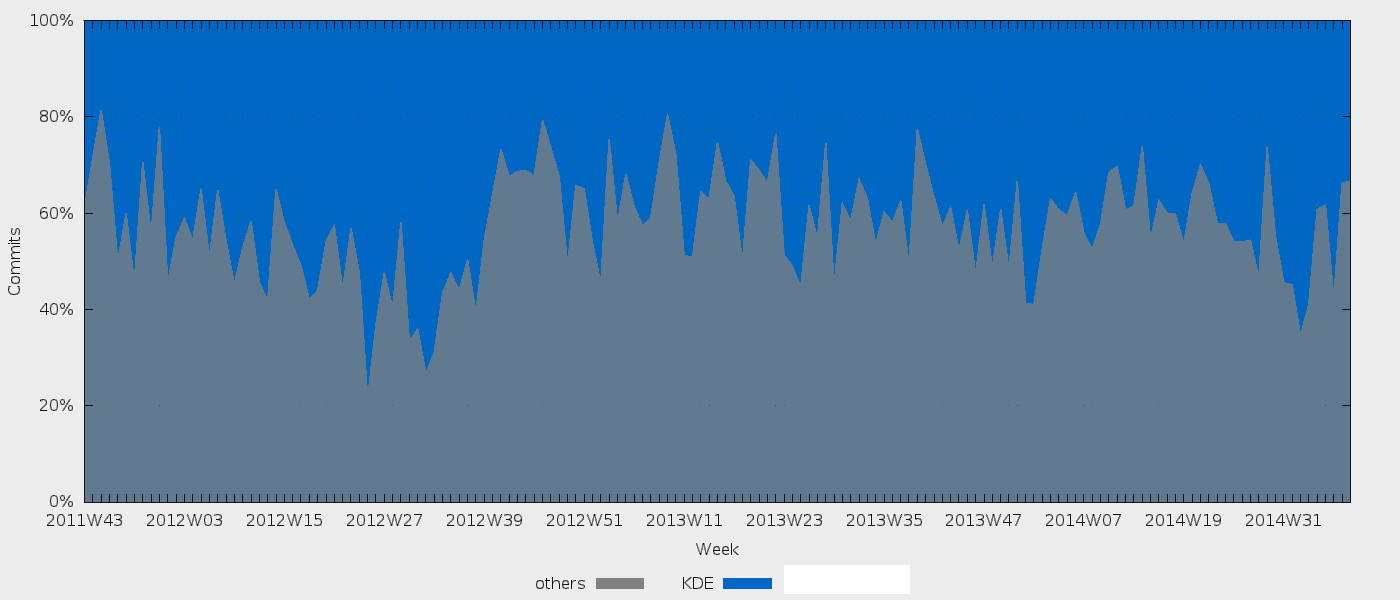
So, KDE people makes up for 40-60% of the weekly commits to QtBase. This is again shows that KDE is important to Qt, just as the reverse is. So, let s keep KDE healthy.
KDE is running a end-of-year fundraiser over here
https://www.kde.org/fundraisers/yearend2014/. Go ahead and donate, and help KDE stay healthy. For your own sake. And for Qt s.
 FOSDEM
is one of the largest gatherings of Free Software contributors in the world and happens each February in Brussels (Belgium). One of the tracks will be the Desktops DevRoom (formerly known as CrossDesktop DevRoom ), which will host Desktop-related talks.
We are now inviting proposals for talks about Free/Libre/Open-source Software on the topics of Desktop development, Desktop applications and interoperability amongst Desktop Environments. This is a unique opportunity to show novel ideas and developments to a wide technical audience.
Topics accepted include, but are not limited to: Enlightenment, Gnome, KDE, Unity, XFCE, LXQt, Windows, Mac OS X, software development for the desktop, general desktop matters, applications that enhance desktops and web (when related to desktop).
Talks can be very specific, such as the advantages/disadvantages of development with Qt on Wayland over X11/Mir; or as general as predictions for the fusion of Desktop and web in 5 years time. Topics that are of interest to the users and developers of all desktop environments are especially welcome. The
FOSDEM 2014 schedule might give you some inspiration.
Please include the following information when submitting a proposal:
- Your name
- The title of your talk (please be descriptive, as titles will be listed with around 250 from other projects)
- Short abstract of one or two paragraphs
- Short bio (with photo)
- Requested time: from 15 to 45 minutes. Normal duration is 30 minutes. Longer duration requests must be properly justified. You may be assigned LESS time than you request.
The deadline for submissions is December 7th 2014. FOSDEM will be held on the weekend of January 31st-February 1st 2015 and the Desktops DevRoom will take place on Sunday, February 1st 2015. Please use the following website to submit your proposals:
https://penta.fosdem.org/submission/FOSDEM15 (you do not need to create a new Pentabarf account if you already have one from past years).
You can also join the devroom s mailing list, which is the official communication channel for the DevRoom:
desktops-devroom@lists.fosdem.org (subscription page for the mailing list)
The Desktops DevRoom 2015 Organization Team
Probably only of interest to California residents.
Time again for the general election voting. This is probably too late to
be helpful for a lot of people voting permanent absentee, but may as well
write this down anyway. (Hm, I apparently didn't do this in 2012.)
Propositions:
Proposition 1: YES. Now is one of the best times in
history to borrow money for infrastructure improvements, and our water
infrastructure in the state can certainly use it.
Proposition 2: YES. I have somewhat mixed feelings
about this, since I hate passing complex legislation like this via
proposition, but this already went through the legislature. It would be
dumb for the federal government, which can more easily borrow money, but
given how the finances of state governments work in the US, this sort of
rainy day fund is probably prudent. This one seems reasonably
well-designed, and the opposition is panic about a secondary effect on how
school reserves are managed that can be changed with later legislative
action and which is rather unconvincing.
Proposition 45: YES. I can't get very enthused about
yet more bandaids on top of our completely broken health care system, but
forcing insurance companies to justify rate increases results in some
public pressure against profit-taking by insurance companies. Single
payer is what we actually need, but this might be mildly helpful. Plus,
the argument against is more incoherent nonsense. So, I'm voting yes, but
I don't think it's important and I won't mind if it loses.
Proposition 46: NO. There are a lot of things that we
should do about preventable medical errors, starting with funding our
health care system properly, testing drugs properly, and investing in
proper inspections and medical licensing investigations. Drug testing
doctors is not among those things. This is a well-meaning but horrible
idea pushed by a victim's advocacy group that won't do anything to improve
our health care system. The fear-mongering of the opponents about
malpractice lawsuits is a bit much, but there are essentially no positive
benefits here.
Proposition 47: YES. Requires that misdemeanor crimes
actually be misdemeanors, rather than giving prosecutors discretion to
charge them as felonies if the person charged happens to be black-- er, I
mean, if the prosecutor doesn't like them for some reason. Obviously a
good idea on all fronts: stop over-charging crimes, stop giving
prosecutors discretion to choose the impact of laws on particular people
(since they rarely use it appropriately), and further try to decriminalize
our completely worthless "war on drugs."
Proposition 48: YES. I'm opposed to the Indian gaming
system in general, but this proposition appears to be a rather cynical
attempt to block new casino development by tribes that already have
casinos. My general feeling is that if we're going to have casinos, they
should generally be legal; the bizarre system where each casino is subject
to public approval seems designed to create political cronyism.
State offices:
I'm not going to comment on the partisan offices, since no one interesting
survived the primaries. Across the board, it's basically the Democratic
incumbants against various Republicans. The state Republican party in
California is dominated by science denialists, Randian objectivists, and
people who think the solution to all problems is ensuring rich people
don't pay taxes, so it takes rather a lot to get me to vote for any of
them. At the moment, the Democrats are doing a reasonably good job
running the state, so while I'd vote for challengers from the left against
several of them, given the boring candidate slate, I'm just voting
Democrat down the line.
California has a system that requires voter approval for various state
judicial offices. In general, I don't agree with voter approval for
judges, since voters are rarely in a position to make reasonable choices
about justices. Since there's a Democratic administration in power at the
moment, these are probably the best judges that we're going to get (the
few I've heard of are good choices), and I don't think the yes/no approval
voting is useful anyway. So I'm voting to approve across the board.
Superintendent of Public Instruction: Tom Torlakson.
I'm not a huge fan of Torlakson, but Tuck is a Harvard MBA who ran charter
schools and then a school privatization initiative. Everyone always
claims that they want to reduce bureaucracy and empower teachers, but Tuck
has a past track record of trying to do so by taking public education
private, something that I am passionately opposed to. So Torlakson it is.
Local measures:
Measure B: YES. Increases the local hotel tax and uses
it for local infrastructure. I'm generally in favor of raising taxes, and
the amount certainly won't be significant in the ridiculous Palo Alto
hotel market. The arguments against feature one of my favorite stupid
right-wing talking points: the tax is unfair because it isn't earmarked to
benefit the people paying it.
Measure C: YES. Reasonable, small reform of the local
utility tax, opposed by the Libertarian Party and "taxpayer associations"
using an "all taxation is theft" argument. What's not to like?
Measure D: NO. Reduces the size of the city council for
no clear reason. The stated reasons are saving money (not credible given
how little money is involved) and making city meetings not take as long.
I'm going to need something better than that to vote for this.
Local offices:
Judge of the Superior Court, Office #24: Matthew
S. Harris. I'm making one exception for my normal rule against voting
for former prosecutors for judges because the incumbant, Diane Ritchie, is
apparently a train wreck. All it takes is a quick Google search to reveal
multiple news stories about strange behavior, clear conflicts of interest,
and other serious problems, including a rebuke by the local bar
association. Even if not all of that information is true, judges should
be above reproach, or at least farther above reproach than this.
Palo Alto City Council: I have an agenda here: I think housing
density is about the best thing that the local community could support.
Housing density enables better mass transit options, makes housing more
affordable and brings more housing under possible rent control, and simply
makes more sense given the cost of housing in the area. A lot of the city
council members run on low-density or anti-growth platforms; I vote
against those and for people who support development. And, of course,
I'll filter out candidates who believe stupid things, like claiming a
minimum wage is un-American (Seelam-Sea Reddy). The best seem to be
Greg Scharff, A.C. Johnston, Nancy Shepherd,
Cory Wolbach, and Wayne Douglass.
Palo Alto Unified School District: The Democratic party has
endorsed four out of the five candidates, so it probably doesn't matter
too much. Gina Dalma and Ken Dauber sound like the best
of the candidates to me, so I will probably vote for them.
Santa Clara Valley Water District #7: I voted for Brian
Schmidt last time, and I don't see a reason to change my mind. His
opponent is a Silicon Valley millionaire who is spending a surprisingly
large amount of money on this race and is involved with a business that
sells software to water boards, which raises some eyebrows.

I have just made an eleventh hour upload of tuxpaint, tuxpaint-config and tuxpaint-stamps. With luck, this will make it in time for the Nov. 5 Jessie freeze deadline so it goes in as an unassisted migration. Coming soon to a mirror near you!

Even though the
Wikipedia defines gamer as
someone who partakes in interactive gaming, such as (predominantly) video games or board games , this doesn t really gets close to that term means socially at the moment. Going back to Wikipedia, we find that
the video game subculture is a form of new media subculture that has been influenced by video games , so it might be quite accurate to define gamers as members of that subculture. You will find that most of the uses of the term gamer in the social networks and in the blogosphere refer to that. Please notice that, even though it is quite likely that most of the gamers play video games, the other way round does not need to be true and, in fact, it isn t. Not everyone who plays video games belongs to the video game subculture, shares their point of view, their values and aesthetics, or even know about it. Kind of like what happens with the word hacker . Not everyone who hacks around with a computer belongs to the hacker subculture.
Mostly everyone who has access to the technology plays video games now. From babies and kids to grandparents. And people play them in every possible technological system around, not only on video game consoles or personal computers, but alse on mobile phones, tablets, web browsers. And many of those people who use different kind of technologies to play video games are not gamers. Not in the sense of belonging to the video game subculture. It is important to acknowledge that: that the video game subculture does not have the monopoly over video games or the video game developing industry anymore.
As you can imagine, all this rand doesn t come from nowhere. During the last months, we have been witnessing a fight between some conservative core members of the video game subculture and people who want to bring some fresh air into the sociocultural elements of that subculture. Namely, that women shouldn t be discriminated inside it. As every time that a women raises her voice to complain about anything in the Internet, they have been subjected to insults, attacks, rape and death threats, etc. I m talking about something called #GamerGate, and even though I m not going to get into it, I will provide some URLs in case someone might be interested. Please acknowledge that not all the points of view might be represented in this list (in fact, they are not, as I won t be promoting in my blog things that I severely disagree with), so search the web for more information if you want to get that.
I ve never been a gamer myself, meaning part of the subculture I mentioned. At some point I was probably closer tho the core values they had then than I am now. In any case, video games have already consolidated themselves as an important part of current culture, entertainment, education and socialization, and are definitely here to stay. That will probably mean that the percentage of gamers (members of the video game subculture) will become smaller. as the number of non-gamer video game players keeps raising.

Wishing all of you a happy Gujarati New Year (Vikram Samvat 2071 called Parabhava.)
May Lakshmi Mata protect you and your loved ones from poverty, misfortune, and systemd in the upcoming year.
Just a friendly reminder: If your package is not in unstable
(and reasonably bug free) by Sunday, it's not in Jessie.
I am not doing full stats as I am unsure about the diff format
at the moment, but in week 43, we had 284 bugs for Squeeze and 468
for Wheezy.
(282 + 468) / 2 = 376; so we are a bit better off than on
average. Still, here's to hoping this freeze will be shorter.
The
UDD bugs
interface currently knows about the following release critical
bugs:
- In Total:
1193
- Affecting Jessie:
319 That's the number we need to get down to zero
before the release. They can be split in two big categories:
- Affecting Jessie and unstable:
240 Those need someone to find a fix, or to finish the
work to upload a fix to unstable:
-
20 bugs are tagged 'patch'. Please help by reviewing
the patches, and (if you are a DD) by uploading them.
-
22 bugs are marked as done, but still affect unstable.
This can happen due to missing builds on some architectures, for
example. Help investigate!
-
198 bugs are neither tagged patch, nor marked done.
Help make a first step towards resolution!
- Affecting Jessie only:
79 Those are already fixed in unstable, but the fix
still needs to migrate to Jessie. You can help by submitting
unblock requests for fixed packages, by investigating why packages
do not migrate, or by reviewing submitted unblock requests.
-
0 bugs are in packages that are unblocked by the release
team.
-
79 bugs are in packages that are not unblocked.








 Participation in DebConf14
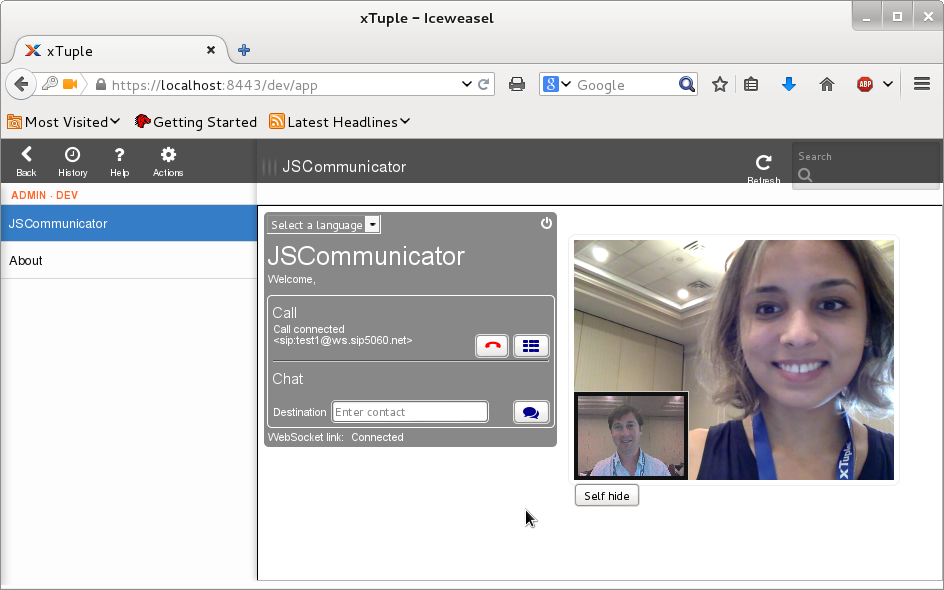
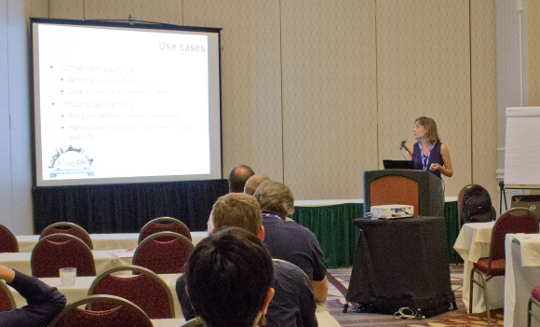
Juliana attended DebConf14 in Portland and gave a presentation of her work on the Debian RTC portal. Many more people were able to try
 It started with OPW
The key point to emphasize is that Juliana's work in GSoC was actually made possible by Debian's decision to participate in and promote Outreach Program for Women in 2013.
I've previously attended DebConf myself to help more developers become familiar with free and open RTC technology. I wasn't able to get there this year but thanks to the way GSoC and OPW are expanding our community, Juliana was there to help out.