Search Results: "ron"

4 November 2006

John Goerzen: Desktop Linux Opinions?

I'm brainstorming about ways of setting up Linux desktops machines for people used to Window users on a LAN. It could be any size of LAN.

I'd like people to be able to sit down at any Linux machine on the LAN and log in -- probably use a LDAP directory for that, and NFS-mounted home directories. I wouldn't want to NFS-mount the entire thing for performance reasons.

So, some of the things I'm thinking about are:


3 November 2006

Simon Richter: Optimisation

The correctness of an optimiser in a conforming C++ implementation is defined by the "volatile" keyword, that is, an optimisation is correct if it does not reorder, add or remove volatile accesses. However, people have come to rely on non-volatile accesses to be finished before a call to a function in another translation unit, even if you hand over a buffer which is then passed on to some external entity (syscall or hardware). Technically, this is undefined behaviour, since the compiler is free to identify the writes to the buffer space as dead stores and optimise them away. The correct way to fix the program is to declare the buffer volatile, but in a lot of cases, this requirement is too strong, for example in the case of TCP checksumming, where it is neither desired to force reading back the data, nor to build up the data in a temporary buffer and write in one go. What we'd need is something in between, that is ordered with respect to volatile accesses, but not internally.

Michael Janssen: The waiting is the hardest part

Exercise is hard work. It is hard to keep going to the exercise room every day, and getting on that machine and doing the exercise. It is only loosely assuaded by the fact that I can listen to music or read a magazine while I am doing it. The saddle on the stationary bike is uncomfortable, and the treadmill is annoying when it asks for my heartrate. Don't get me wrong, I am comitted to my exercise regimen and will be keeping it up for the forseeable future. I really do believe that I am improving my overall health and wellbeing doing it. Walking down the hall back to the apartment is a good feeling, and it's strangely satisfying to be all sweaty and gross. This week was fairly erratic with respect to exercise. I ended up taking saturday off mostly by accident, completely filling up my schedule with other things. Other days I would start early -- around 7pm instead of my normal 10pm, or would start an hour late. Tuesday was a particularly crappy day as half of the exercise room was tripped on the breaker and I had to resort to the horrible stepping machine and some weightlifting to get my 30 minutes in. Hopefully this week I will be able to get a better schedule going.

I am frustrated. Two weeks of dieting and exercise, and I don't seem to be losing weight. This bothers me because in the past I would have received at least a little bonus on the scale just for dieting, and I don't seem to be getting that this time. I tend to weigh myself after my workout, because there is a fairly nice physician's scale which I can use to weigh myself, and doing after every exercise is a good way to remember. This causes a problem however because I usually exercise at the end of the day. One day I may eat more and then weigh more, and another day I may eat less (or ahem, output more) and weigh less that night. It doesn't deal a good hand to my psyche to sometimes weigh more than I did the day before. I do seem to be getting a hang of guessing when I will weigh more though. I am thinking of switching to weighing only once a week, but I am afraid that I will forget, and the hacker in me wants as much data as possible on this.

This week (Oct 27 - Nov 2):
Minimum: 338.5 (Oct 31)
Maximum: 341.0 (Nov 2)
Average: 339.8 (139.8 to goal)
Total Exercise Calories: 2562
Average Exercise Calories: 427

Stefano Zacchiroli: my life wo caps lock

My life without CAPSLOCK Yesterday I spotted the option "Make CapsLock an additional Ctrl" in the Gnome keyboard preferences (Desktop > Preferences > Keyboard > Layout Options > Ctrl key position). I enabled it, obtaining the end of errors due to erroneous enabling of Caps Lock (as suggested to me by several people at DebConf6, but so far I've been too lazy to learn how to do it with xmodmap). In addition to feeling more relaxed when using Vim (we all know how dangerous can be Caps Lock in Vim!), using Caps Lock as CTRL is actually really handy, since key combinations involving CTRL can be formed moving the left pinky way less: probably a dream of all Emacs users out there :-) Now it is just a matter of training my left pinky to stop going in the bottom left corner of the keyboard ...

Ross Burton: Leaves

Yesterday lunchtime after walking Henry Vicky went into our driveway armed with lots of fallen leaves, the SLR, and the bright afternoon winter sun. 20 minutes later and lots of technically dubious photography (one handed grip on camera, leaf at arms length, click and hope) she had some fantastic Autumnal leaf shots. Treasure Embers On fire Autumn's Beauty Update: of course a Javascript library to turn image links into magic floating popups won't work in RSS feeds, so if you want to see them in Flickr go to Vicky's Nature set. Yesterday I ordered a cheap lightbox so we'll hopefully be able to take similar shots in a more controlled environment without wind and camera shake getting in the way. Obviously they won't be as good, I've found that often the first casual attempt at a shot is the best, and the harder you try, the worse the shots get. NP: Protection, Massive Attack

Julien Danjou: DeFuBu contest #4

Bug Welcome to this 4th issue of the DeFuBu contest, the monthly championship of the funniest bug reported to the Debian BTS. The challengers How the vote has been done Four Debian related people voted for these bugs, Philipp Kern, Florent Bayle, Cyril Brulebois and Gregory Colpart.
Mohammed Adn ne Trojette should vote quicker next time. Full ranking Bugs Challengers The winners Notes To participate, simply drop me an email with a bug number. About DeFuBu

Bernhard R. Link: again compiler arguments

I know I repeat myself, but given current discusion, I simply feel the need to do so:

Please do not hide the arguments given to the compiler from me.

I cannot fix what I do not know if wrong. Maybe you can.

Keep the argument list tidy.

Many argument lists are longer than necessary. If there is some -I/<whatever> in the argument list on a Debian system, there is something fishy. (It&aposs not the universial collection of different stuff all going whereever it wants, after all). Common cases are:

- buggy scripts to add -I/usr/include - packages working around upstreams breaking compatibility - plainly broken upstreams - oversight

In short: if the line is too long, that is normaly a bug causing more pain than only a long line. Do something against those bugs, please. There is no need at all for a proper made library to give -I for stuff installed. It&aposs installed in the system, the default search path for /usr/include should suffice. It often does not, but that is simply bad design of that libraries interface. Do something against that, please! Also for stuff not installed, why do you need more than one -I? Are you embedding other libraries into your code? Why are they libraries if noone else uses them? If someone else uses them, why are they not made to proper library packages? If it is all intern stuff, why does it need so many include parts instead just a single include/ dir? Anf if it only needs one include dir why is it added a dozen times? What do you need -D for anything but paths? Ever heared of AM_CONFIG_HEADER?

And yes, I know many modern libraries are written by people never looked at anything but Windows when designing their headers. (Even some seem to have never looked at unixoid systems even after using them for decades). That is a problem, not something to be worked around with even more kludges. Kludges working around kludges are there to stay. So do not add them.

Adrian von Bidder: Microsoft and Novell

Joint press release from Novell and Microsoft. Took me by surprise, thanks for the link, Dani. Diagnosis: Microsoft is very afraid. It lost Massachusetts on the Office front, it lost M nchen on the Desktop front (financially, both cases are no big deal. But they created quite a media stir.), and Xen is the big buzzword in the server rooms, while I can't even remember if Microsoft has a similar offering... What will happen? Microsoft will remember that selling MS Office licenses, even if they run on their arch-enemy-OS, is better than not selling MS Office licenses. Dito for Xen. If played right, I think Novell might be in a very good position here. On the other hand, there are many, many companies who did business with Microsoft once and don't exist anymore. And probably Novell needs the money. Disclaimer: I can call myself Industry Analyst if I want to. Others do, and probably know less than I. Others don't but know a lot more. Update: After reading the coverage on Groklaw: Novell is a business, and it's their business decision. Maybe they end up as roadkill. And I'm not talking about the Linux market, but about Linux as a piece of software. And Microsoft officially investing in Linux technology (even with the goal to embrace and extend it) will still lead to wider Linux adaptation and the eventual breaking of the Microsoft monopoly.

Benjamin Mako Hill: Akismet Plugin for PyBlosxom

I apologize for boring the vast majority of my readers who do not use PyBlosxom but I'm trying to at least mention each "released" projects here once for the sake of completeness even if it's only interesting to a small number of them. I posted a note a few months ago mentioning a stronger CAPTCHA I had created to deal with blog spam. A few friends pointed out that they were having excellent luck with Akismet which filters using a model similar to some of those old collaborative spam filters. Building off earlier work, I build an Akismet plugin for PyBlosxom. I've gone through a couple of iterations on the PyBlosxom lists and the results have been great. If you use don't use PyBlosxom, there are plugins for Wordpress (where the system originated) and I imagine for other blogging systems as well. Its an effective and attractive alternative to a CAPTCHA. You can grab my plugin on my PyBlosxom hacks page

2 November 2006

Steve Langasek: automake obfuscation

Daniel, I fervently hope that this never finds its way into a Debian package without an explicit --verbose switch. There's nothing more frustrating than being unable to reproduce a build failure from an autobuilder, and not having enough information to know if this is because it was a one-off failure, an already-fixed bug in the environment, or an incorrect reproduction of the buildd environment. And libtool --silent sucks too. While I understand the desire for less verbose build output, a good postprocessor for build logs would IMHO help more than a tool that just suppresses output -- once it's suppressed, you can't get that information back...

Ben Hutchings: How to fix www.royalmail.com in Firefox for Linux

The front page of www.royalmail.com displays wrongly in Firefox on Linux (though apparently not Windows). Worst of all, it is impossible to focus the input fields near the top of the page by clicking on them. However, I worked out some style rules that will fix it. These have been tested in Firefox 1.5 on Debian etch and Fedora Core 5. To apply these, you need to copy/add the following text to ~/.mozilla/firefox/profile/chrome/userContent.css and then restart the browser. Perhaps someone who knows about GreaseMonkey can work out a rule for that, which would make it easier to install them.
@-moz-document url-prefix(http://www.royalmail.com)   
  div.Content-Region    position: static !important;  
  div.Content-Region div    position: static !important;  
  div.List-Container   height: auto !important;  
  div.hpBottomWide   clear: left;  
 

Gunnar Wolf: Oaxaca on fire

Before anything else: Please excuse some grammatical mistakes I've made in this post. You should understand the topic is really upsetting, and typing while searching for links, listening to news, and gathering the basic information for a five month old conflict is not exactly compatible with me spewing out proper English ;-)
Just to re-state the obvious: Mexico is, once again, on fire. This posting is mainly written with the Debian people in mind - An important number of them, after Debconf 6, went to visit Oaxaca - In late May, during the first weeks of this incredible, stupid and scary conflict we are now facing.
I've written in my blog every now and then about our political situation. Many of us had high hopes on our current government. We thought that the authoritarian regimes were a thing of the past, we hoped for real democracy, we hoped for a government that would honor human rights and solve long-standing topics for our society - Yes, we all knew president Fox came from a right-wing party, and didn't expect much advance in the social agenda -which many of us perceive as the real problem in Mexico- but still, hoped for openness and reconciliation with the past.
I won't repeat what I've extensively said over and over - The thing is, Fox's government continues to amaze us with its stupidity, with its near-sightedness, with its hypocresy. Fox's term is really close to an end - In one more month, the govt. will change hands to the first de-facto president since Carlos Salinas (going over another story we hoped to forget).
As some of you wittnessed, there was a popular protest taking place mainly in Oaxaca - Basically, the State's public elementary school teachers demanding better payment for their work. Such a protest is already a common occurrence in Mexico, as public school teachers are among the worstly paid workers (no wonder, then, our country is still undeveloped - Make public education worse, and you have the warranty of an unprepared, ignorant population). The teachers went on strike in early May, briefly returned to classes on late June to properly close the 2005-2006 lective year, but went back on strike afterwards.
Of course, the local government (Mexico is a federative republic, each state is autonomous and makes decisions independently) took a very long time to act - and acted the worst way possible: By sending policemen to forcefully throw the teachers from their camps in the downtown streets, with no negotiation, no answer, not a drop of common sense.
That led to the formation of the (pleonasmicaly named) APPO: Popular Assembly of Oaxaca's People - A group of people, partly formed by the unhappy teachers, mainly demanding the Oaxaca state governor to step down, after he proved he is inept for his office. And yes, I'm oversimplifying here, but I don't want to dig too much - There is fortunately plenty of available information in this regard.
That happened over four months ago. APPO kept control of the city. Nobody denies that this has caused Oaxaca, a city that attracts national and international tourism like few others in the country, a great deal of economic damage - Oaxacan people are, however, still sympathetic to APPO's demands. Governor Ulises Ruiz (from PRI, the party that ruled the country for over 70 years) has not been able to be seen in public in his state for some months already. The legislative power has also been unable to work properly, and the judicial power is half-dead, doing only its most basic tasks. Renowned jurists, such as Miguel ngel Granados Chapa, have repeatedly stated that this is enough for the Federal Senate to declare the governing powers in Oaxaca have disappeared - This would put an end to the conflict, leading to immediate elections, but the Senate has denied taking this course of action. Not only that, but the Federal government took the command of the local security forces, tacitly recognizing the local government is unable to coherently excersise their authority. After almost five months, last week they issued an unanymous -but mild- exhort, asking Ulises Ruiz to consider stepping down.
So far, 15 people have been killed in the different represive actions taken, first by the local police under local command, later by the local police under federal command, and starting last week, by the federal police. Today, it seems the army is getting in the conflict as well, despite promises of not doing so by the federal authorities - Of course, they have become masters in the art of breaking promises.
Why is the federal government upholding Ulises Ruiz? Simple: After the undeniable electoral fraud we had some months ago, there are too many indicatives pointing out that our (supposedly) elected president Felipe Calder n (FeCal, as he is better known as) will have a hard time becoming the president, and many people doubt he will be able to hold the authority for the six years. So far, he has shown no better aptitude as a statesman than Vicente Fox: Instead of boldly facing the claims of fraud, he just chickened out and has spent many months hiding from the public, appearing only for selected, friendly audiences. For many months already we have heard "Ulises ya cay , le sigue Calder n" (Ulises has fallen, Calder n is next). This country has not been so badly shaken in decades - Of course, Great Statesman Vicente Fox insists the country is in peace and there are no red spots. Fox even was stupid/blind enough to state that the problems in Oaxaca would be dealt with easily and successfully, just as the problems in Chiapas and Atenco were doing his term. During Fox's campaign, he promised to solve the centuries-old Chiapas problem (that resulted in the EZLN uprising in 1994) in just 15 minutes - He just has not had time to do so. Atenco? Yes, in 2002 an angry people made him step back from the most important project of his term (a new airport for Mexico City). In May 2006, Atenco sprang again to the news because of a massive repression - I'm not going into details on Atenco right now, as it would be off-topic, but you can look at my article in FeCal.org.mx or watch a very strong video by Canal Seis de Julio (both in Spanish only) for further details.
Last Friday, however, something was different. In a repressive action, a USA citizen, the Indymedia reporter and cameraman Brad Will was killed by a paramilitary group. Even more, he was killed while doing his work, and we can clearly see this evidence on his last tape. Of course, the US ambassador issued a warning, asking the US citizens not to go to Oaxaca. And, as Lorenzo Mayer says, hay de muertos and muertos - There are different categories of dead people. A highly visible US citizen is more important than the other 14 dead Mexicans, and now the Federal Preventive Police is clashing in Oaxaca.
What should be shocking, but is not so much to those of us who know this beaten country, is the attitude of the authority when taking the city. After five months of occupation, the Oaxacan people have got used to living with APPO - be it for good or for bad. Tourism has diminished, but the people's living sources have not been attacked. Of course, as soon as the Federal Police took the downtown areas, all sorts of reports of looting have been reported. The policemen are robbing even sodas and chips, and up to TVs and microwaves. As many people state, this is a very Kafkian country.
Of course, we don't know what will come next. Most of the city has been "freed", and the APPO is holding at the University. The University is autonomous, and the PFP commands have promised not to break its autonomy - but we don't believe that. There are fights very close to the University. The Rector himself spoke a couple of hours ago at Radio Universidad, the main broadcasting point for real news on this subject (I am following on the news thanks to KeHuelga, 102.9MHz FM in Southern Mexico City, or at their webpage, from where they link to many other underground or Internet radio stations joining in the broadcast), and the reports are dramatic. Dramatic, as well, is the way all of the commercial news sources are ignoring the facts.
I want to keep you updated, as one of the very few reasons things are not worse is the public opinion and, even more, the international pressure. I'm sorry I'm not giving more links right now, but I will soon. I don't want, of course, to flood people that read my blog through the different syndications with a technical profile, so updates via my blog will be quite sparse. If you can read Spanish, we have posted many articles at FeCal, and many other individual sites are also joining in. A couple of links, and I'm off for now.

Wouter Verhelst: Errrrrrr...

[Wed Nov 01 22:33:32 2006] [error] [client 127.0.0.1] (21)Is a directory: Could not open property database.  [500, #1]
So, we fix that.
wouter@country:~$ sudo rmdir /var/lock/davlock
wouter@country:~$ touch /var/lock/davlock
wouter@country:~$ sudo chown www-data:www-data /var/lock/davlock
That should fix it, right? Wrong.
[Wed Nov 01 22:34:15 2006] [error] [client 127.0.0.1] (20)Not a directory: Could not open property database.  [500, #1]
Right. The fun bit about this is, I was having issues with a mod_dav installation where the authentication was being done by mod_auth_kerb. Which at first wasn't possible because of #395931, but luckily there was a workaround. But then, that approach was not without its share of issues, either:
[Wed Nov 01 21:15:03 2006] [error] [client 192.168.0.101] configuration error: couldn't check access. No groups file?: /
Oh well, stuff it then. I'll use a different way to get this done.

1 November 2006

Simon Richter: Debian and/or Ubuntu in five years

So, the following package exists in Debian:

Package: update-manager
Version: 0.42.2ubuntu22-5

Now, what is this abomination? What does the "ubuntu" tell us? That this package was stolen from Ubuntu? That it has Ubuntu specific patches? Branding? Or that it simply is the same package that is in Ubuntu, and the maintainers saw no good reason to use a different version string in Debian? I prefer the last explanation, and believe this to be part of a greater trend. There have been a number of REJECTs because Debian simply does not have any releases codenamed "dapper" or "edgy", and people simply uploaded the package to the wrong upload queue. I believe the Ubuntu side also had a few uploads to "unstable" that their archive maintenance software could not process. Quite a number of packages are maintained by the same people in both distributions, and in most cases, it does not make sense to have packages differ at all. Even more disturbing, Ubuntu has been built for more architectures than they released edgy for, while some people in Debian are trying to reduce the number of architectures in the hope of getting towards a shorter release cycle, which Ubuntu has just admitted to be suboptimal for server installations by preparing an "LTS" release. So Debian and Ubuntu are becoming more and more alike. Now, is this a good thing, or would we all prefer that both keep a strong "profile"? And: if they are to grow together, where should we meet? I think most of us can agree on an installer with a big "expert" switch, and a lot of eye candy as long as you can deinstall it, but we'd also have to merge the respective communities, which is what I'd consider the more difficult part. Debian's NM process is quite different from the MOTU programme, and on both sides there will be "hardliners" (I consider myself one) who will push for their respective community's standards. Still to be filled remains the spot of the end user friendly distribution. I just got a call asking me to fix a printer setup, and, frankly, this stuff is *way* too complicated. Maybe a joint project, by members of the Debian and Ubuntu communities can tackle this?

Steve Kemp: What I find is pleasing and I m feeling fine

I spent a good few hours reviewing all the logrotate files included in Debian’s Sarge release the other day. Using the Debian package search it was easy to find all the packages which install a file into /etc/logrotate.d/. Once I had the list of packages I simply ran “apt-get source cat packages.txt ” and started looking over the contents. That is another area which has been audited. So far I think the systematic checking like that is quite a good way to find things. So far I can remember: On the one hand spending hours looking at source code to try and detect flaws is frustrating when nothing is found, but on the other hand it is good that we have software in such good shape.

Simon Richter: Idle? Nothing to do?

Yesterday I learned about nLite, which is a program to create customised Windows installation media, with additional drivers, certain questions preseeded etc., which is a great deployment tool. Now, debian-installer can be preseeded too, but there is no frontend that lets you do that comfortably; being able to add installer modules is the killer feature for OEMs wishing to ship a box with an installation medium. So this would be an interesting project for someone who wants to help Debian.

Wouter Verhelst: Hello 2.9.0!

No, not the Linux release of that version (that's still far away, if it will ever be developed, and I don't think I'll be wanting to run that if/when it does). Instead, I'm talking about the NBD userland tools of that version, which I just released. Today we're only a few weeks after the release of 2.8.7—sorry for all you packagers out there who now have to throw away your work. But it's well worth it; nbd-server now finally functions like a real UNIX daemon: you specify exports in a configuration file, you can export more than just one export from the same server, and it has some interesting new features today. If you ever looked at nbd-server and decided that the way it's implemented is too hackish for your taste, then 2.9.0 may be a good time to revisit that opinion. Of course, I should note that 2.9.0 is a .0 release, so does still need some testing in the wild, so might not yet be ready for your production server. But other than that, it should be pretty much okay and usable. Give it a try! In related news, Ronnie Sahlberg, one of the wireshark developers, has made my day by writing an NBD dissector, which I've been wanting to have for quite a while now. Happy happy, joy joy.

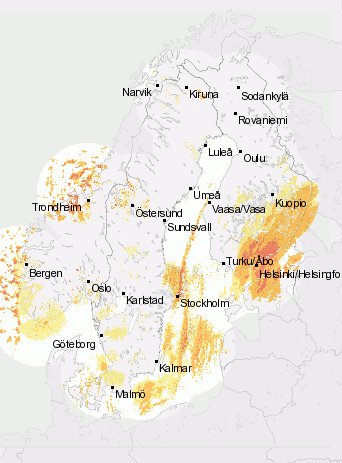
Andreas Schuldei: scandinavia's radar map for gnome weather applet

Here is how to download the scandinavian radar map for rain and snow from the swedish meterologic institute and put it into your gnome weather applet:

put this into your $HOME/bin
#!/bin/sh

codeblob=$(wget "https://xout.smhi.se/natvader/gateway/getmodule.php?module_request=radarsekvens_norden&images=1&user_id=21" --output-document=-)

url=$(echo $codeblob sed -e "s/.*\(https[^\']*\).*/\1/")

wget $url --output-document=/tmp/smhi-radar.png


and this into your user's crontab:

30 */2 * * * $HOME/bin/smhi-radar.sh >/dev/null 2>&1


and this into your gnome weather applet's radar url:

file:///tmp/smhi-radar.png


Here you see the area covered:

Antti-Juhani Kaijanaho: I was wrong

It’s snowier now than it was then.

Next.

Previous.