Search Results: "tar"

17 February 2010

Bastian Venthur: Links not opening in Thunderbird 3?

If you re using KDE and upgraded to Thunderbird 3 lately you might have the problem that links in emails don t open in a browser anymore. For my case that happened even without a user visible error message. If that sounds familiar for you, check the error console (Tools/Error-Console). If there is an error like:
Error: uncaught exception: [Exception... "Component returned failure
code: 0x80004005 (NS_ERROR_FAILURE)
[nsIExternalProtocolService.loadUrl]   nsresult:  0 80004005
(NS_ERROR_FAILURE)   location:  JS frame ::
chrome://communicator/content/contentAreaClick.js :: openLinkExternally
:: line 188   data: no]
Then Thunderbird just (silently) fails to launch the browser. Guido pointed me to gconftool. gconftool -R / grep url-handlers told me that some components of gnome still had Firefox configured as http-handler (which is strange since it was rebranded to iceweasel ages ago). Resetting them solved the problem for me. The sad part of the story: x-www-browser, sensible-browser and KDE s http handler where all correctly configured and pointed to iceweasel. All applications behaved correctly only Icedove used a (for me) hidden setting pointing to firefox.

Wouter Verhelst: Local kernels

LC_ALL=C debian/rules debian/control
md5sum --check debian/control.md5sum --status   \
		/usr/bin/make -f debian/rules debian/control-real
make[1]: Entering directory  /home/wouter/debian/other-peoples-source/linux-2.6-2.6.32'
chmod +x debian/bin/gencontrol.py
debian/bin/gencontrol.py
Traceback (most recent call last):
  File "debian/bin/gencontrol.py", line 331, in <module>
    Gencontrol()()
  File "debian/bin/gencontrol.py", line 14, in __init__
    self.process_changelog()
  File "debian/bin/gencontrol.py", line 305, in process_changelog
    (distribution, version))
RuntimeError: Can't upload to unstable with a version of 2.6.32-8~local1
make[1]: *** [debian/control-real] Error 1
make[1]: Leaving directory  /home/wouter/debian/other-peoples-source/linux-2.6-2.6.32'
make: *** [debian/control] Error 2
The issue at hand was that I'd created a version of '2.6.32-8~local1', to document that I'd locally branched version 2.6.32-7 with that one config option turned on, but that my version should not be deemed larger than 2.6.32-8 (signalled by the ~ and whatever follows that). However, something somewhere in the Debian kernel build system (I was unable to figure out what, exactly) disliked that version number and told me I could not upload to unstable with that version. So it borked, and told me I had to fix my version. Well, no, I don't want to do that. Instead, I wanted to disable that check somehow. Turns out that isn't too hard; gencontrol.py not only checks the version number, it also checks the target distribution. So if you don't want to upload to unstable, you just need to tell the tool that:
-linux-2.6 (2.6.32-8~local1) unstable; urgency=low
+linux-2.6 (2.6.32-8~local1) local; urgency=low
Simple, but you'd need to know.

16 February 2010

Jan Dittberner: New hardware for my server at home

After some stability problems and an unresolvable PCI IRQ problem with my Debian server at home (Internet gateway, mail, PostgreSQL, LDAP and NFS server and test system), I decided to get a new mainboard and wireless card last week. I did some research to get hardware that is properly supported and where I can use the rest of my current components. I had So I had to find a mainboard with at least 2 DDR2 DIMM sockets, an AM2 compatible CPU socket in ATX format with SATA ports at least one IDE Port, a Gigabit ethernet port (serving NFS home directories) and at least 2 PCI slots (one for the wireless card) that is well supported by the current Debian Squeeze Linux kernel. As I had some issues with the previous board's nvidia SATA chipset I wanted to get something else that is AHCI compatible. After some research I decided to buy a Gigabyte GA-MA74GM-S2H (rev. 3.0) which is available for a good price and fits all my criteria (2 DDR2 DIMM slots, 6 SATA ports, an RTL8169 based Gigabit ethernet ports, 2 PCI slots, ...). The mainboard uses an AMD 740G + SB710 Chipset. It has an integrated graphics chipset which I don't really need because I run the machine as a headless system. As I use the server as a wireless access point I need a wireless network adapter that supports AP mode. There are not many chipsets that are properly supported in AP mode and allow good data rates so I decided to get an Atheros ath9k based card, because I don't need non-free firmware like with broadcom based cards and could find some affordable hardware. The previous was a Netgear WG311 ath5k card that had issues that it lost its connection under more than minimum load and could only be reanimated by a system reboot. I looked at the Linux Wireless pages and found out that D-Link has a matching adapter the DWL-G520. Unfortunatelly they don't tell about the used chipset (as almost all other vendors too) and write about possibly changing hardware at the product sheet. To be sure I looked at their Windows driver's .inf files and found nothing indicating that there are any non Atheros variants of the card. I also ordered two Fantec MR-35 SATA mobile racks for more comfort when one of the RAID1 discs crashes (had 2 crashes last year) and a 12" chassis fan to keep the system cool. Today the package arrived and after unpacking and putting everything together I started the system (with keyboard and a display attached) to see how it works. All hardware was automatically detected by the current Debian Squeeze system and I only had to remove the entries for the old onboard network adapter and the old wireless adapter from /etc/udev/rules.d/70-persistent-net.rules and fix the device names for the new network cards. I added a new stanza for the Intel ethernet adapter in /etc/network/interfaces and setup a set of ferm rules to have a working firewall (thanks to Formorer for the suggestion to use ferm). After this was finished everything worked fine so far and I put the machine at its normal place without keyboard and display. To verify that the stability situation had really improved, I copied some huge files over the network (both wired and wireless and in both
directions). Afterwards I did a bonnie++ benchmark to test the SATA and hard drive reliability. Everything went well and I'm happy with my investment.

Ana Beatriz Guerrero Lopez: Not the Debian-KDE post you were waiting for

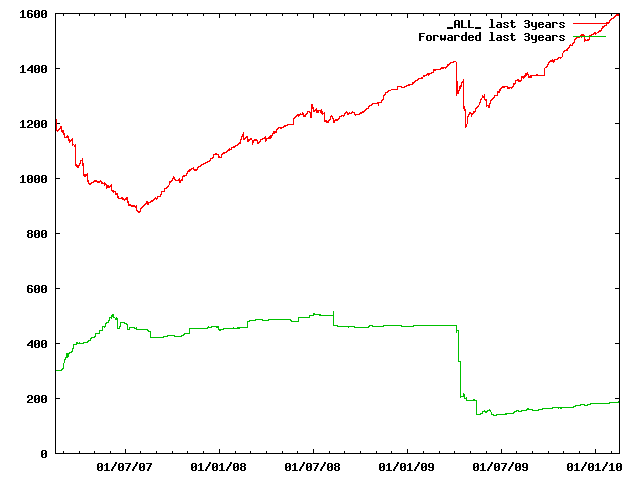
Sorry! I cannot tell you when KDE 4.4 will be uploaded to unstable. I am not working on that. My initial plan was writing about other tasks I am planning to work on and asking for your help. But I realized people would be more interested in knowing about KDE 4.4 packages. Once you know about this, I might trick you into helping in others areas ;) Debian packages for KDE 4.4 are being worked on, just slowly and of course, keeping on with the quality you are used to. There will be also some changes that have been in some people s TODO for long time. The goal is having them in very good shape for Squeeze, that will ship with some point release of 4.4. The doubt is which point release will be: 4.4.2? 4.4.3 ? The schedule for the point releases has not been made yet, so it makes a bit harder trying to predict it. In the same lines, I can not tell you when Squeeze will be released neither, it needs to be frozen first! If you want to know about the reasons of this delay, it is simple math: KDE has been growing a lot of more than the number of people working in Debian packages of KDE. I am not talking about size in lines of code in KDE, it is more the number of new dependencies that the KDE team have to take care now too: soprano, libutempter, Have you wondered why some are under the name of Debian Krap maintainers? :) And there are releases much more often than in the KDE 3 times. You might have notice not only 4.3.5 have been skipped, it also was the case with 4.2.3 or 4.1.4. This is not good or bad, it is just the same number of maintainers (or less) with more work. And what is worse with more bugs open in the Debian BTS! I think reiterated calls for not to file upstream bugs in the Debian BTS and directly in KDE bugzilla (see my blog post about this here) have helped but still we have a large amount of bugs piled through the years. This graph could give you an estimate how we tried in the past fighting against without too much success:
Number of bugs reported against KDE in Debian in the last 3 years Olivier Vitrat, we miss you :) One of the most heavy (and boring) talks that needs to be done for the KDE 4.4 packages is the copyright checking. I am not sure a total newbie can help with this, but if you have knowledge about licenses and you want to try helping, we are waiting for you. About other areas of the packaging maintenance, if you are interested in start learning and helping with future releases, you are welcome to start lurking in the #debian-qt-kde channel in OFTC and in the mailing lists. Update February 21th: 4.4.0 is for sure not being uploaded into the archive. Probably KDE SC 4.4.1 to be released 2nd March will be uploaded to unstable or experimental.

Vincent Sanders: Tempus fugit

Seems I managed to loose a month in there. Been working very hard on a project with an improbable deadline which has not left much time for anything else.

Finally brought to a standstill this weekend by something Joshua brought home (I think it was some form of micro biological warfare agent, judging by how I feel) It is incrediably hard to shrug off the lethargy of illness when you realize all you have to go back to is work.

On the plus side the project deadline is in three weeks time so whatever happens It will all be over by then! Whereupon I can take some time off, calm down and then start all over on the next project...

Yay?

Steve Kemp: I am lightened, can we drop this?

As part of some house-keeping I've been checking over my systems and ensuring they're all tickity-boo for the past couple of days. One thing that I'm getting increasingly tempted by is converting my kvm guest to a 64-bit system. I've not quite sold myself on the prospect of what will be a fair amount of downtime, but I'm 90% there. I do think that a lot of my setup needs an overhaul, for example: One possible plan is to wipe my system, and then restore data from backups. A perhaps saner approach is divide my guest into two smaller ones, and migrate services over one by one (e.g. website1, website2, .. websiteN, email, etc). For the moment I've taken a complete dump of my existing guest, and I'm running it with an IP in the 10.0.0.0/24 range on my desktop. That's at least given me a clear idea of the amount of work involved. I'm still a little unclear on how best to manage running N websites with the intention they'll each run under their own UID. I guess it comes down to having a few instances of nginx/lighttpd/apache and then proxy from *:80 to the actual back-end. Precisely which mixture of services to use is a little overwhelming. Though at some point soon I need to start enabling IPv6 support, and that changes things a little. (Not least because nginx has no IPv6 support present in the Lenny release - I've got a backported package which I run on the Debian Administration website.) It's possible I could hack mod_vhost_alias to redirect/proxy to a local port based upon the virtual hostname present in the request - that's pretty trivial and I've already done something similar for work purposes. Though something like that should presumably already exist? I would expect a map of some form:
example.org: 127.0.0.1:8080
example.net: 127.0.0.1:9090
That has to be about the minimum necessary information to make the decision; a pair of vhost name & local destination. /me googles some.. Update
OK quick update I've added local users for some of my sites, and now have them running under thttpd.
skx:/etc/thttpd# ls -ltr /home/www/   tail -n 4
drwxr-sr-x  4 s-static   s-static   4096 Jan 15 01:41 static.steve.org.uk
drwxr-sr-x  5 s-openid   s-openid   4096 Feb 16 21:31 openid.steve.org.uk
drwxr-sr-x  6 s-images   s-images   4096 Feb 16 21:52 images.steve.org.uk
drwxr-sr-x  5 s-packages s-packages 4096 Feb 16 22:03 packages.steve.org.uk
That seems to work well, with a small wrapper script to start N instances of thttpd instead of a single one. Minor issues are that I'm using mod_proxy to forward requests to the thtpd instances running upon the loopback - and it was initially logging 127.0.0.1 as the source IP. A quick patch later all is well. I'll leave it running a couple of the simple sites for the next few days and see if it kills children. If it does I'll convert the rest. Probably will aim to have nginx in front of thttpd, instead of Apache, but this way I don't have to worry about mod_rewrite rules just yet.
ObFilm: Cruel Intentions

Tollef Fog Heen: Upgrading freedesktop.org hosts

I recently upgraded kemper.freedesktop.org to lenny. Collabora are nice enough to sponsor some of my sysadmin work for freedesktop and so making sure we are actually running a supported distribution was a good start. The actual dist-upgrade went fine, but when I rebooted with a 2.6.26 kernel, it just hung in the early boot phase. Luckily, a newer kernel worked fine. However, a newer kernel also breaks the NFS kernel server in Lenny. A short backport later, NFS was working fine, except annarchy (which NFS mounts from kemper) didn't have nfs-common installed at all, meaning it lacked mount.nfs. Ooops. Now, bugs was broken. It used an SSH tunnel from annarchy to kemper, but the startup script was nowhere to be found. I replaced it with a trivial stunnel setup which has the added advantage of reconnecting if the tunnel goes down. The ssh config had to be fixed slightly. We used to use an old and patched sshd that stored all the keys in a single file. I added a tiny script to split that again. We also had MkHomeDir in sshd's config, now replaced with pam_mkhomedir. Another interesting thing I learnt is that the iLO ssh daemon chucks you out if you try to send enviromental options to it. Like, LANG which is sent by default. Slightly confusing, but easy enough to fix once I knew what the problem was. In addition to kemper, I upgraded, but did not reboot fruit (the admin and LDAP host), due to not having the iLO password. I did not want to risk sitting there with a non-booting machine I could not fix. It's going to be rebooted at some later stage. I also did not have the iLO password for gabe, which runs mail and some other faff, so I'll have to schedule some more downtime in the near future.

15 February 2010

Gustavo Noronha Silva: WebKitGTK+, and the Page Cache

So, one of the things I get to do during work hours for Collabora is to contribute code, and do maintenance tasks for WebKitGTK+, and have been doing so since early last year, working on all kinds of things, from improving the network backend to handle the real-world web, to fixing scrolling problems, while reviewing patches from the many awesome developers who have been joining us (more on that later =D). One of the big features I have worked on this past month or so, along with Xan Lopez is the Page Cache. The page cache is a feature of web browsers that makes going back, and forward between pages in the same view very fast. It s better explained in this post, but to summarize, the idea is that instead of destroying all the work you have done since downloading the resources, and having to reparse/rebuild the structures the view uses to display the page from the cached resources, you hit pause on the page, and store the whole thing as is, and when coming back to it, you just hit play. You can see in the video two instances of Epiphany, one with the page cache enabled, one with it disabled. Easy to see which was has it enabled. Thanks to KiBi for the suggestion regarding a page that shows this easily =D. <video controls="controls" height="302" src="http://kov.eti.br/media/webkit/page-cache.ogv" width="450"></video> We initially thought we had this feature enabled, since our initialization functions (that exists since before the current maintainers were involved) did setup the number of desired pages in the cache, but during the hackfest we held in December we found out we were fooled all this time. Enabling the page cache does make going back faster, but also made lots of things become unstable and crash. Since then, we have been working on figuring out all the problems, and fixing them, using help from adventurous users of in-development software ;D. I believe we re now at a point in which I can happily declare the GTK+ port has a working page cache in trunk! If you re interested in the nasty details, bear with me! Let me go back in time a bit, and show you what problems we had. First, some background: the GTK+ port deviates a lot from the other ports when it comes to scrolling. This is because, when designing this part of the port, Holger Freyther had a very nice idea in mind: that the WebView should be a first-class citizen GTK+ scrollable widget. Meaning it would use GTK+ s adjustments for scrolling, and be able to interact with any parent scrolling widget, be it a GtkScrolledWindow, or a MokoFingerScroll. We cannot just throw away all the rest of the scrolling code in WebCore, though, that deals with all the details related to interacting with the DOM, and JavaScript code. This means our WebView contains adjustments that need to be set, and unset on our port s version of WebKit s own representation of the view, called the FrameView, to interact with it, and to get updates on the bounds of content, and such. For every load, in the non-page-cache case, a new FrameView is created, the previous one is destroyed - this means we need to set the adjustments on every load. The problem starts when you have the page cache enabled, because the code path used to do what is called commit the load of a cached page (that is, start replacing the content that is currently being displayed by the one that should now be displayed) is completely different, and we were not setting the adjustments on this new view, so we started with that. But all was not well. We were still having weird behaviour with scrollbars disappearing, and becoming the wrong size, and worse, crashes when back was hit. We then started investigating in more detail how it is that the page cache does its magic, to try and figure out the source of all evil. It turns out that when you leave a page that can be cached, the existing FrameView is no longer destroyed - it is stored as is in a CachedFrame to be restored if you go back, and a new one is created for the new page. This was having the undesired effect of having the adjustment be set in more than one FrameView at once, causing all kinds of (predictable, after we knew for real what was going on) unwanted effects. Thus, we reworked the code to make sure the adjustments are only ever set in one FrameView at once, making sure they are unset when the FrameView is being frozen, and reset when it s being restored from the page cache. Last, but not least, it was discovered that going back to a page that contained resources with data: URIs (such as Google results pages which contain a small number of image hits) also caused a crash. This was because our network backend was not storing the data: URI in the ResourceResponse objects it fed into WebCore. The page cache relies on those responses to recreate the requests it uses to artificially replay the load when restoring the page from the page cache, so we fixed that as well. What can be taken from all this? Building browsers is a lot of hard work! I can t think how we could deal with this level of complexity without the awesome testing suite of WebKit. The good news is all of those issues I talked about in this post are now covered by the automate tests that run as part of the normal buildbot cycle in our bots, so we re covered for the future, at least for these specific problems =D.

Biella Coleman: Timing Life

The Chronicle recently published a piece that drew a lot of attention on the difficulties that female academics with kids face during the first 4-7 seven years of their job when academics are expected to do nothing but produce, produce, and produce and yet because they have produced children, they can t produce all that much writing. I don t share the author s predicament in that I don t have kids. But I have had to be an (often long-distance) caretaker for the last 8 years, 4 of which I spent considerable time in PR taking over my mom s caretaker s duties. Although when it comes to female academics and kids there is a lot that can (really must) be done to facilitate a career and motherhood, when it comes to taking care of my mom, being an academic has been an odd and mixed blessing, although it did require me to play with the system self-consciously or else it would have been an early academic death. When my mom was first falling pretty ill, I was wrapping up my dissertation. Though I was ready (on paper at least) to go on the market, I did not step foot in it. I knew that if I landed a job it would be the end of seeing my mom and since she only had a few years of capacity left, I decided to 1) apply only for one postdoctoral position (that had no teaching and was in NJ making it very easy to fly home frequently) 2) if I did not land it, I would return home to spend time with her, keep on writing but not graduate. If I had started a job right after my dissertation, I would have killed my chances of churning out articles, and worse, not have seen much of my mom. I was lucky enough to land this postdoctoral fellowship, which was a life savior. I was able to get a heck of a lot of work done that I would never ever would have been able to do my first two years of teaching (kids or no kids) and I spent many months in PR as well. I always encourage graduate students to apply for these positions because the payback is enormous (with the exception of fellowships that require a ton of teaching), even if the applications are really time consuming, more so than applying for jobs. Though rarely stated in such terms, the first few years of an academic position is not unlike medical residency. It takes a brutal amount of time, not only because of the sheer time you have to work but also because there is so much new to learn and so many different responsibilities to juggle. It is exhiliarting but draining, even disorienting. But there is one important difference from our medical school counterparts (aside from the blood and guts and gore :-)): their hell continues throughout the year, while our hell diminishes during the summer when classes end and writing is supposed to dominate your attention. Also since I am not required to be here once classes ended, I am able to leave NYC and spend it back home. I would simply not be able to do this with most any other full time job (unless it involved telecommunting) and for that I am grateful I landed the job I did. Academia, despite its rat race quality, has allowed me to visit my mom throughout the year and summer. Given the importance of summers for writing it seem that departments/universities can do a lot for female faculty simply by sponsoring or helping to pay for summer day care for two years, thus offsetting some of the costs and then providing them with the space needed to write/produce.This can accompany the policy that some, though not enough schools have, which is turning off your tenure clock for the year you are pregnant, and in some cases, even giving you leave. Thankfully at NYU you can stop your clock not just for pregnancy (which they now automatically do because when it was optional some female professors were not taking it!) but also for circumstances like mine. I was given a short tenure extension, which was not easy to ask for but it is important to do so. I am extremely grateful they have this policy. Something else partially unique about caring for a parent is the perspective it affords. Although it would be a lie to say I suffer no anxieties about my job, I find it hard to get embroiled in a lot of the petty politics of academia, a perspective that clings to me, especially after having to take care of someone with Alzheimers, and especially my mom who we nicknamed the Russian Terror for her turbulent (but really fun) personality. Sitting in front of your computer to write and think about some obscure academic topic feels not only easy after those experiences but a scamish sort of privilege. My mom is now in a nursing home and I no longer have to spend time taking care of her. Instead I visit and see her and get overwhelmingly sad when I do. In one month, it will be her 2 year anniversary in a nursing home and I still have not come to grips with the situation. It strikes me as obscene and unreasonably cruel that this illness can afflict a person for years, even a decade or more. Perhaps more than anything it is the sheer massive length and persistence of this illness that makes it so hard to bear. And I am sure my work for better or for worse has acted as an emotional refuge, where I drown myself in work that I love instead of drowning in the sorrow that I often feel, making what is a difficult job far easier.

Russell Coker: Links February 2010

Popular Mechanics has a good article about 911 [1]. Experts in all the relevant fields were consulted to debunk popular myths. It s an old article but I hadn t read it before and learned a lot. Former CIA analyst Raw McGovern and former FBI attorney/special agent Coleen Rowley, a colleague in Veteran Intelligence Professionals for Sanity wrote an interesting article titled Why Counter-Terrorism Is in Shambles [2]. Such sanity from people who are associated with the intelligence industry is unusual. Gizmodo has an amusing and informative poster about the true risks of airline travel post 911 [3]. Reuters has an interesting article about drug smugglers using Gulfstream and 727 aircraft to smuggle cocaine from South America to Africa [4]. They claim a link to al Quaeda, but such a link seems tenuous from the evidence provided, it does seem reasonable to claim that groups who claim affiliation to al Quaeda are involved in smuggling anyone can claim anything really. An 8yo boy is on the TSA terrorism watch list , he regularly gets frisked when traveling by air [5]. His mother had a security clearance to fly on Air Force 2 when Al Gore was the Vice President, any sane security system would look at the parents rather than an 8yo child children of that age aren t going to independently become terrorists. The Dallas Observer has an interesting article by Kimberly Thorpe about how to beat debt collectors [6]. Apparently most debt collectors break the law in some way and can be sued for damages with a typical settlement of $3,500. Some debtors are suing multiple debt collectors, after one debt collector is successfully sued the debt is passed to another collector who also breaks the law. What I really like about this is that the community of people who sue debt collectors keep the industry honest and protect the majority of the population who don t have the time or interest for engaging in law suits. Read Write Web has an informative article about SourceForge being forced to deny access to people in Cuba, Iran, North Korea, Sudan and Syria [7]. A problem for free software developers is that we often don t know the location of the people we collaborate with so it s best to be as open as possible. This means that the US is not a good place to host servers, probably some part of the EU would be better. Also this sort of thing makes the field of free software development less welcoming to US citizens. Did the congress people learn nothing in high-school? They should know that someone who starts a campaign of ostracism may end up being in the small group. Google is developing a new Native Client (NaCl) system that seems to be like Microsoft ActiveX [8]. I can t imagine this doing anything that couldn t be done with Java, it seems most likely to just marginalise the less popular platforms which isn t in the best interests of Google. Kevin Kelly of the Technium wrote an interesting post about 1000 true fans [9]. The concept is that if you are doing creative work you only need 1000 dedicated fans who buy everything you sell to make a living. If you make $20 per year from each of the 1000 fans and you will earn enough to live. Make $100 per year from each of the 1000 fans and you will be earning more money than most people. The updates show that artists who try this aren t having much success yet, but the Internet population is still increasing dramatically PaxStreamline offers an innovation in commercial air-conditioning, apparently a significant amount of electricity is wasted on heating the air after chilling it excessively to remove moisture [10]. So instead of cooling it they use a liquid dessicant to extract the moisture. Ben Schwartz explains why you should never create files in H.264 or MPEG formats, unless you have a special commercial license then you (and your viewers) will all be liable for patent infringement for any type of commercial use [11]. Note that storing the data on a web site with Google adverts counts as commercial use. I wonder if all those digital cameras and mobile phones that create MPEG videos have appropriate licenses, maybe uploading a file created on your phone breaches the patent. J. K. Rowling (author of Harry Potter) gave an inspiring speech for Harvard graduates [12]. I particularly liked the following reference to her work for Amnesty International Choosing to live in narrow spaces leads to a form of mental agoraphobia, and that brings its own terrors. I think the willfully unimaginative see more monsters. They are often more afraid . Peter Eigen gave an interesting TED talk about the formation of Transparency International and the economic problems that are caused by corruption [13]. The Monthly Review has an interesting article about the failure of the US justice system [14]. The prison industrial complex has captured part of the US government, neo-liberalism is to blame. 59% of Americans agree that homosexuals ought to be able to serve in the U.S. military. But 70 percent believe that gays and lesbians ought to be able to serve in the military [15]. Apparently 11% of Americans think that gays and lesbians are better than homosexuals .

John Goerzen: Review: Linux IM Software

I ve been looking at instant messaging and chat software lately. Briefly stated, I connect to Jabber and IRC networks from at least three different computers. I don t like having to sign in and out on different machines. One of the nice features about Jabber (XMPP) is that I can have clients signing in from all over the place and it will automatically route messages to the active one. If the clients are smart enough, that is. Gajim I have been using Gajim as my primary chat client for some time now. It has a good feature set, but has had a history of being a bit buggy for me. It used to have issues when starting up: sometimes it would try to fire up two copies of itself. It still has a bug when being fired up from a terminal: if you run gajim & exit, it will simply die. You have to wait a few seconds to close the terminal you launched it from. It has also had issues with failing to reconnect properly after a dropped network connection and generating spurious resource already in use errors. Upgrades sometimes fix bugs, and sometimes introduce them. The latest one I ve been dealing with is its auto-idle support. Sometimes it will fail to recognize that I am back at the machine. Even weirder, sometimes it will set one of my accounts to available status, but not the other. So much for my complaints about Gajim; it also has some good sides. It has excellent multi-account support. You can have it present your multiple accounts as separate sections in the roster, or you can have them merged. Then, say, all your contacts in a group called Friends will be listed together, regardless of which account you use to contact them. The Jabber protocol (XMPP) permits you to connect from multiple clients. Each client specifies a numeric priority for its connection. When someone sends you a message, it will be sent to the connection with the highest priority. The obvious feature, then, is to lower your priority when you are away (or auto-away due to being idle), so that you always get IMs at the device you are actively using. Gajim supports this via letting you specify timeouts that get you into different away states, and using the advanced configuration editor, you can also set the priority that each state goes to. So, if Gajim actually recognized your idleness correctly, this would be great. I do also have AIM and MSN accounts which I use rarely. I run Jabber gateways to each of these on my server, so there is no need for me to use a multiprotocol client. That also is nice because then I can use a simple Jabber client on my phone, laptop, whatever and see all my contacts. Gajim does not support voice or video calls. Due to an apparent bug in Facebook, the latest Gajim release won t connect to Facebook servers, but there is a patch that claims to fix it. Psi Psi is another single-protocol Jabber client, and like Gajim, it runs on Linux, Windows, and MacOS. Psi has a nicer GUI than Gajim, and is more stable. It is not quite as featureful, and one huge omission is that it doesn t support dropping priority on auto-away (though it, weirdly, does support a dropped priority when you manually set yourself away). Psi doesn t support account merging, so it always shows my contacts from one account separately from those from another. I like having the option in Gajim. There is a fork of Psi known variously as psi-dev or psi-plus or Psi+. It adds that missing priority feature and some others. Unfortunately, I ve had it crash on me several times. Not only that, but the documentation, wiki, bug tracker, everything is available only in Russian. That is not very helpful to me, unfortunately. Psi+ still doesn t support account merging. Both branches of Psi support media calling. Kopete Kopete is a KDE multiprotocol instant messenger client. I gave it only about 10 minutes of time because it is far from meeting my needs. It doesn t support adjustable priorities that I can tell. It also doesn t support XMPP service discovery, which is used to do things like establish links to other chat networks using a Jabber gateway. It also has no way to access ejabberd s send message to all online users feature (which can be accessed via service discovery), which I need in emergencies at work. It does offer multimedia calls, but that s about it. Update: A comment pointed out that Kopete can do service discovery, though it is in a very non-obvious place. However, it still can t adjust priority when auto-away, so I still can t use it. Pidgin Pidgin is a multiprotocol chat client. I have been avoiding it for years, with the legitimate fear that it was jack of all trades, master of none. Last I looked at it, it had the same limitations that Kopete does. But these days, it is more capable. It supports all those XMPP features. It supports priority dropping by default, and with a plugin, you can even configure all the priority levels just like with Gajim. It also has decent, though not excellent, IRC protocol support. Pidgin supports account merging and in fact, it doesn t support any other mode. You can, for instance, tell it that a given person on IRC is the same as a given Jabber ID. That works, but it s annoying because you have to manually do it on every machine you re running Pidgin on. Worse, they used to support a view without merged accounts, but don t anymore, and they think that s a feature. Pidgin does still miss some nifty features that Gajim and Psi both have. Both of those clients will not only tell you that someone is away, but if you hover over their name, tell you how long someone has been away. (Gajim says away since , while Pidgin shows last status at . Same data either way.) Pidgin has the data to show this, but doesn t. You can manually find it in the system log if you like, but unhelpfully, it s not on the log for an individual person. Also, the Jabber protocol supports notifications while in a chat: The contact is typing , paying attention to a conversation, or closed the chat window. Psi and Gajim have configurable support for these; you can send whatever notifications your privacy preferences say. Pidgin, alas, removed that option, and again they see this as a feature. Pidgin, as a result, makes me rather nervous. They keep removing useful features. What will they remove next? It is difficult to change colors in Pidgin. It follows the Gtk theme, and there is a special plugin that will override some, but not all, Gtk options. Empathy Empathy supports neither priority dropping when away nor service discovery, so it s not usable for me. Its feature set appears sparse in general, although it has a unique desktop sharing option. Update: this section added in response to a comment. On IRC I also use IRC, and have been using Xchat for that for quite some time now. I tried IRC in Pidgin. It has OK IRC support, but not great. It can automatically identify to nickserv, but it is under-documented and doesn t support multiple IRC servers for a given network. I ve started using xchat with the bip IRC proxy, which makes connecting from multiple machines easier.

Julian Andres Klode: Maemo + Moblin = MeeGo = Failure


Today, Nokia and Intel announced the merge of Maemo and Moblin into the MeeGo project. This is sad, because it will end the era of the Debian-based mobile operating system Maemo and replace it with a system using RPM and probably some other evil stuff as well. In fact, dpkg & apt-get where two of my main reasons to buy the N900. And another question is why yet another name. Moblin was already a well-known name and they shouldn t have changed the name just because they switch the servers and add some Nokia developers. Furthermore, does this all mean that there will be no Maemo 6? What will happen to the Maemo users on the N900, will it be possible for them to use MeeGo? Maybe this is the time to start a new project, Debian Mobile. Debian Mobile would take the MeeGo experience and apply it to a Debian system. This would probably the best mobile operating system ever, being backed by Debian s large repositories with thousands of software packages. Filed under: Debian

William Pitcock: 5 Healthy Eating Oout Diet Tips

bbsteakbsr
It s hard to do a healthy diet outside the home? Whereas many of the activities carried out. Try some tips refer to following a healthy diet that you can do outside. re Dieting to reduce consumption of fats, carbohydrates or sugar? That does not mean you can not eat well. With a few tricks and cunning look of food, you can even a good meal in a restaurant also order food from fast-food restaurant. Try it voyeur tips from DASH, Dietary Approaches to Stop Hypertension. With these healthy tips you can still eat well and avoid high blood pressure or high cholesterol levels. Well, try telling refer to the following tips: 1. Avoid foods with saturated fats and cholesterol High
But avoid foods that contain saturated fatty acids and also high yan foods contain cholesterol. You can avoid these foods but still give priority to taste, a variety of menus to choose from, even a favorite. If you re eating out make sure the following things:
- Make sure your food is cooked using olive oil instead of butter or
fat if the dish was a stir-fried or something.
- Ask for salad dressing or salad dressings are low in fat.
- If mkan meat or chicken, remove the parts that contain fat such as chicken skin.
- Choose foods with dimaska burned, boiled, or baked. In addition to not using oil, usually healthier. 2. Watchful Against Salt
Another thing to note that this works DASH diet is salt. Because salt can raise your blood pressure, while salt is often used in a variety of restaurants to make food more delicious. You still can control the salt in your food when eating out by doing:
- Ask the waiter to not put salt or MSG in your food.
- Beware of any food that a high salt content such as pickles, soy sauce, broth, bacon, and others.
- Keep the salt from your desk, because usually you will reflexively add salt to the food.
- Reduce the use of mustard, ketchup, pickles, and other Condiment a high salt content.
- Choose fruits or vegetables as the opening menu. 3. Avoid foods with a portion of
But avoid foods with large portions. In addition you will feel
unfortunately if the foods are not consumed, you will feel sick if you eat too much excess. We recommend that you order enough food. Or if that portion is too big, shared with friends is much better. 4. Always Instill Healthy Living Patterns in the Mind
More and more people realize how important a healthy life, making a lot of restaurants started to state that low-fat or rich in antioxidants to the food they sell. Actually do not stop until the food alone, you
also have to think about drinks or dessert healthy what happens to the balance. For example:
- Choose a drink that does not cause side effects, such as mineral water, fruit juice, or herbal tea.
- Expand vegetables and fruits as well as the opening menu to avoid overeating at the main menu.
- If you decide to eat a salad, choose low-fat sauce or put the sauce on the plate edge so that its use is not excessive.
- Avoid mouthwashes that contain high fat like cheese cake. We recommend that you choose desserts such as fruit, sorbet, or fruit jelly. 5. Order careful in Resto Fast Food
Fast-food restaurant is the most dangerous enemy to your diet. But if you are careful, you can still enjoy fast food without the fear of cholesterol or high blood pressure soared and certainly does not ruin your diet program. Here are some tips if your food in the restaurant inginmemesan fast food:
- Take your time choosing foods, read the content carefully to what
contained in one serving. And do not be shy to ask the waiter about
Andapesan food.
- Combine your foods such as grilled chicken with whole wheat and yogurt drinks or low-fat milk.
- Do not order more servings.
- Be aware of and avoid salad dressings containing Condiment bleak high salt soy sauce, ketchup, and pickles.
- To drink mineral water should choose, even if others want to order to avoid fizzy drinks.

William Pitcock: Vierra guys Stump in 2010

vierra_285 Vierra band to be different in 2010. The personnel men, Kevin cs, want to look more muscular. Of course there are reasons why the personnel Ballerina boys want to look more muscular. Raka Cyril, the guitarist, spoke up to express that excuse. . To create a more muscular body would need a business. So, Kevin (keyboards), Raka (guitar) and Tryan (drums), do not forget the additional bass player, Deryansha Azhary, melakoni fitness. Fitness together can maintain cohesion, said Raka again. The desire for fitness with the new fact emerged two weeks ago. At that time only as an expense only. But after thinking together, three boys Vierra agreed to be different in 2010. Apart from personnel appearance that her boyfriend would be more muscular, there is no change from the Ballerina in 2010. Band with hits Are You Really it was not planning to release a new album. We do not want to hurry. s Album coming out yesterday, not to waste too, added Widi, the vocalist.

Russell Coker: Will Aliens be Alien?

The Telegraph has a silly article titled Aliens are likely to look and behave like us [1]. It s based on the ideas of Professor Simon Conway Morris [2] who is a big fan of evolutionary convergence. He seems to believe that humans evolved in a way that is close to optimal and that aliens would have to evolve in a similar manner. The article s claim that aliens will look and behave like us has three flaws, one is assuming that humans are the ideal form for space travel, another is the significant possibilities for vast objective differences between species, and the final one is the human tendency to regard small differences as being really significant. The Arrogance of Assuming that Humans are Ideal. It seems extremely arrogant to assume that humans have the ideal form for performing tasks that we have not yet performed such as traveling to another star system. To assume that it is certain that humans will colonise the stars is also extremely arrogant and foolish as well, I think that a significant amount of money should be devoted to existential risks that we face. People who believe that humans will inevitably colonise the stars (probably because God told them there s no other reason for such certainty) will tend to oppose taking prudent measures to reduce the probability of failure. We should also consider the possibility that a human society that colonises another star system at some future time might be so different from us that we regard them as alien. How Might Aliens be Different? It seems to me that one problem with the theory of convergent evolution (as applied to different planets) is that evolution doesn t seem to work in big steps. It seems to me that for an increasing portion of the jobs in our technological society there would be a benefit in having four arms and two legs, and maybe having more than four fingers on two of the hands. But evolving a bone structure that makes four arms useful is not a minor tweak so it seems unlikely to happen naturally we might be able to genetically modify humans to have four arms and two legs with some future technology. I can t believe that four limbs is the optimal number for every mammal, amphibian and reptile (apart from the legless ones), that two legs plus two wings is the optimal number for every bird, and that six legs is the optimal number for every insect. I also can t believe that two arms and two legs is the optimum number for every primate with the only significant difference in limbs being the primates that possess a prehensile tail. Evolution doesn t produce perfect creatures, what it does is to produce creatures that tend to be slightly fitter than their ancestors. So even if there was an optimal form for a species that develops interstellar-craft, there would be no reason to assume that humans have such a form even if we had developed interstellar travel. I think it s relatively safe to assume that aliens would have two eyes (stereoscopic vision is a significant advantage), but apart from that I don t think we can assume much about their appearance. For example I don t think that there s any inherent reason why creatures as intelligent as current humans could not evolve from octopuses 8 arms would be quite useful for operating machines. Aliens that spread beyond their own home planet don t have to be optimal for such tasks, they only need to become the dominant species on their planet, develop decent technology, and then want to leave their planet. A species that took 100,000 years to achieve what humans have achieved in the past 100 years might not be considered optimal but it might still be able to eventually launch interstellar craft. I don t think it s reasonable to assume that aliens would have to be as intelligent as humans to do that. But it does seem most likely that any aliens who manage to get here would be more intelligent than us. Guns, Germs, and Steel: The Fates of Human Societies by Jared Diamond has a really interesting analysis of how human history was determined by geography and the availability of plants and animals suitable for domestication. Part of the explanation for the apparent lack of intelligent aliens could be planets where the dominant species was stuck in a situation like that of the people of New Guinea, the lack of plants and animals suitable for domestication prevented their society from developing. A stone-age human civilisation could potentially be stable for millions of years. The article says Extra-terrestrials might not only resemble us but have our foibles, such as greed, violence and a tendency to exploit others resources . Well for starters a species that can displace all other contenders to become the dominant species in their planet would have to be capable of greed and violence. So that is probably correct but is not really going out on a limb. Physorg.com has a short article describing the benefits of sexual reproduction in terms of the rate of accumulation of harmful mutations [3]. So it seems that sexual reproduction is most likely among intelligent aliens. But I don t think that there is any reason to assume that aliens couldn t be hermaphrodites. The Telegraph article claims that Star Wars and Star Trek could be more accurate than they ever imagined in depicting alien life , but given that Star Trek has avoided homosexuality even when demanded by the plot it seems that whatever aliens do in the bedroom would be way outside the range of activities alluded to in Star Trek. It seems that almost all sci-fi has aliens that are less alien than a significant portion of the human population. I think it s safe to predict that if we should meet aliens they will not look like humans wearing cheap make-up or rubber suits that has more to do with the budgets assigned to movie studios than any claim to potential realism. It seems most likely that a society capable of developing space travel would need a great deal of training for it s young before they become self-sufficient. Species of animal that abandon their eggs and hope for the best seem unlikely to succeed in doing that. I think that this implies that a pair-bonded species that spends an extended amount of time raising their young is most likely to succeed. Perceptions of Aliens Vulcans are widely regarded as being on the Autism spectrum. So it seems that having some similarities in personality to about 1% of the human population is enough to convince most human viewers that the character in question is an alien. A Google search for such things just turns up many references to people on the Autism spectrum who feel like aliens which incidentally is the source of the alias ETBE [4] that I used for more than 10 years before being diagnosed as an Aspie. Star Trek aliens aren t actually very alien by human standards! Given the repeated demonstrations of the general human inability to recognise the psychological similarities in people from different countries or racial/ethnic/religious backgrounds it seems likely that few people would recognise aliens as being at all similar to us. As so many people are unable to recognise the fundamental similarities in people who happen to have a different skin color I can t imagine many people immediately regarding beings that look like octopuses as having human traits. Could an eusocial organism (such as bees or ants) develop space travel? It seems to me that most people wouldn t regard humans who act in a manner that resembles ants (such as the Borg Collective) as being like us . The possibility of an eusocial race evolved from humans is explored in Coalescent: A Novel (Destiny s Children, Bk. 1) by Stephen Baxter (and more briefly in the sequels). Probability The universe is a large place. Making a specific prediction about the first alien species that we might encounter might make some sense. But given the potentially billions of species that might be out there we should assume that some of the more improbable forms are represented. Claiming that anything in particular is impossible seems very rash. Also anyone who makes claims about what evolution should do seems to have missed the point. What evolution does is to give rise to species that tend to be a better fit for the environment. Different environments result in different creatures. We can try and predict what creatures might evolve, but we don t get to say that things should happen.

Bdale Garbee: TeleMetrum v0.2 First Test Flight

On Saturday, I joined The Albuquerque Rocket Society monthly launch in Rio Rancho, NM. A friend, Mike, who lives in the area joined me for the launch. While the morning started off clear and calm, if a bit cold... the wind came up hard and we had to call it quits before lunch. But before the wind "blew us away", I managed to get one flight in. And it was an absolutely perfect test of one of my brand-new TeleMetrum v0.2 boards! My cut-down Hawk Mountain "Raptor" kit, renamed "G-Spot" last October during my quest to exceed 50 g acceleration, was loaded with TeleMetrum serial number 51... and launched on a Cesaroni 229H255WT-14A motor. The ascent was beautiful! I've put a few photos of the rocket leaving the launch rail up on flickr. However, despite a clear sky, we quickly lost sight of it! I managed to spot a bit of the smoke trail from the delay grain as the rocket approached apogee, but that was it! None of us at the launch saw anything after apogee! After losing sight of the rocket, I turned my attention to my computer, where we were receiving a solid telemetry stream. It quickly became apparent that the rocket was descending normally under chute. As it got closer to the ground, I started calling out elevation, azimuth, and distance numbers, but still nobody could spot the rocket. As expected, we lost the RF link once the rocket reached the ground. As various folks on the flight line wished me luck finding my rocket, I put the last reported GPS position into my hand-held receiver. Staring at the map display, Mike and I realized the rocket was far down range, near one of the roads into the site. We jumped into my vehicle and drove down the road to the point closest to the rocket's reported position. We then walked to where the GPS receiver said the rocket should be... And found the rocket within about 20 feet! That was well within the window of position uncertainty my hand-held GPS was reporting at the time. Things just don't get much better than that! We picked up the rocket, and returned to the flight line only a few minutes after leaving it. After dumping the data from the board's on-board memory, I quickly generated the usual plots, along with a kml file that can be viewed in Google Earth. The rocket reached 1881 meters apogee, or around 6173 feet, and the maximum acceleration was 19.5 g. It touched down nearly 1.3 miles down range from the launch rail, in sage-brush desert. I honestly don't think I would have found the rocket without at least the radio beacon. It was hugely gratifying that the GPS worked and let me walk right up to the rocket! I could not have asked for a better test of the new electronics! Later in the day, Keith flew a successful test of serial number 52 at a launch in Wilsonville, Oregon. We're very happy with these results! Weather permitting, I hope to get more test flights in next weekend at Hudson Ranch. Stay tuned!

Robert Collins: Yay Dell-with-Ubuntu down under


Dell has been offering Ubuntu on selected models for a while. I had however nearly given up hope on being able to buy one, because they hadn t started doing that in Australia. I am very glad to see this has changed though check out their notebook page. Not all models yet, but a reasonable number have Ubuntu as an option. Yay!

Christine Spang: a foray into emacs

This spring I'm taking a class that does all its programming assignments in MIT Scheme. The last time I had to write Scheme for class, we used PLT Scheme, and thus the DrScheme editor. This time, with that option out, I've decided to do the assignments in Emacs. It is, after all, an editor built out of lisp. I've used vim for the last five years or so. Some people ask me why this is so I do go to MIT after all, where Emacs was originally written. The answer to that is simply that Debian got to me first, and at the time at least, the people I knew there used vim. I've heard Emacs is good, but up until this point every time I've tried it I've thrown it down in frustration and then couldn't figure out how to exit the damn thing. This time I was more determined, and made it through the initial hump of being completely useless at the editor. Here are a few of my observations so far, after mucking around for a couple days over a period of about two weeks: I'm pretty sure at this point that I'm still trying to bend emacs into being vim with different keybindings instead of figuring out how emacs wants to be used. It's also difficult to compare and contrast between the two editors in that my .vimrc contains years of tweaks and customizations whereas my .emacs started out as a clean slate. There are two things I'm doing to try to mentally separate emacs from vim, to avoid my fingers' muscle memory from becoming confused:
  1. I'm always using emacs in an X window with dark-on-light text, whereas I always use vim in a terminal with light-on-dark text.
  2. I'm only writing scheme in emacs. No other languages so far.
I'm planning to keep working on these programming assignments in emacs, despite it being annoying slower than I would be in vim. Tips and pointers for improving my experience are welcome.

Keith Packard: TeleMetrum v0.2 testing

Test Flying TeleMetrum v0.2 Bdale and I got a chance to test fly the new version (0.2) of our TeleMetrum flight computers. Bdale flew with the Albuquerque Rocket Society down in New Mexico while I flew near home with Oregon Rocketry during our February model launch. I flew my Dynastar Grappler which I have modified to create a large payload bay out of a foot of the original body tube: I cut a sled out of plywood and mounted the TeleMetrum on one side, and a small 110mAh battery on the back: The field we use for model launches is surrounded by tall fir trees, so we tend to stick to reasonably small motors. This time, I loaded up an Aerotech 24mm E18 motor and trimmed the delay down to about 5 seconds as this rocket uses simple motor ejection. This flight didn t exercise the new ejection circuitry. In any case, the flight was perfect, telemetry worked all the way down to the ground using just a 1/4 wave whip antenna on the receiver. Here s the data recorded in the on-board eeprom: The maximum reported altitude was 186m, velocity was 49m/s and acceleration was 53m/s . As expected, the GPS loses tracking during boost, but rapidly re-acquires near apogee and tracks the rocket all the way back to the ground. The flight track can be viewed in Google Earth. Needless to say, both Bdale and I are extremely pleased with the performance of the new hardware.

Next.

Previous.