Search Results: "spa"

5 March 2006

James Morrison: Visitors

Apparently it's been a month since I've said anything. No wonder people say I don't update this blog enough. A few weeks ago, Simon came to visit/make supper for some of us down here. It was good to see him again. Unfortunatly, after he left my fridge had stuff in it, so I had to leave it plugged in. That stuff I mentioned was mostly flavoured vodka and ice cream.

The weekend after Simon visited, I visited Victoria to see Gordo, who was on his last weekend on the west coast. I partied it up pretty hard with him and had quite a walk around Victoria saturday night while trying to find Esquimalt.

Before my mother arrive last saturday I figured it was a good idea to get rid of the ice cream and vodka in my freezer. So, I got to watch spaceballs with some friends while mixing some vodka smoothies.

My mom and auth Faye were down last week. I was partial tour guide, partial tourist this last week as we explored big basin, Stanford and San Francisco. It was fun to have visitors for once. I even got a lamp, some bowls and some wine glasses out of the deal.

Tonight, I went out to the Dana St. Roasting Company to see what was going on in Mountain View. To my surprised, tonights show was belly dancers. There was some very impressive dancers. It was a good night to go out.

(less than 900 emails to catch up on)

Kai Hendry: X40 versus the T30

T30 and X40 batteries I am a little disappointed with the new Thinkpad X40 I have from work. I wanted a MacBook Pro, but their availability and price in Korea is bad. Unplugging the mains leaves me about 2:30hrs. That’s almost the same as my personal T30 machine! My T30 has about 2 hours of battery life, although it also has about twice the CPU power (going by Bogomips)! If I do processor intensive stuff like compiling and watching videos then we can half those times… (!) My T30 also has better wireless performance after my little tests. I’m also wary of this little X40 keyboard. I don’t think it’s good for my RSI. Though it’s too early to tell. You can get a bigger battery pack for the X40. But it will probably be expensive. :/ The X40 is brand new and is branded IBM thinkpad. The build quality is excellent, just like my other thinkpads I’ve used. It does say “Lenovo” on all the copyright stickers. I whipped out the hard drive and I thought I might upgrade to a quieter Seagate Momentus. I was surprised to see a 2” drive that was about half the height. I didn’t know about this form factor! I’ll miss my T30’s roomy 100G. It was tricky installing Debian without a CDROM. I managed in the end with an external USB hard drive and my experiences are documented in debian-boot threads starting here and here. One major redeeming thing about the X40 is that I get 18371880.31 bytes/sec compared with the T30’s 959174.47 bytes/sec for USB throughput. That’s an amazing 20x speed up! So I’ll be using external USB drives to compensate for the tiny 30GB hard drive. I am giving away my old T30 to my sister. I just wish the X40 fealt a little more like an upgrade from the T30. The X40 is my workplace’s equipment after all. I think I will aim to get a Mac Pro still if I visit Japan in the next weeks for myself.

4 March 2006

Andrew Pollock: [tech] Yes, MSN's crawler really is that dumb

So it isn't just me, who has noticed that MSN's crawler seems to be going a bit nuts on the downloading front. Chris Siebenmann from the University of Toronto has also got problems. Given that the mirror in question is intended to be benefiting Linux Australia members and Australian Linux users in general, and not some half-baked wannabe search engine that doesn't know when to stop downloading, I might need to take the step of banning MSNBot as well.

David Welton: Command Facade pattern

Several weeks ago, Wolfgang asked after a rename command for Hecl. Pretty simple to do in terms of the Hashtable that maps strings to commands, so I added it. However, there was a problem: in order to save space, I'd been grouping commands together in one class, and dispatching on "argv[0]". A nearly empty class in Java compiles to something like 500 bytes, so mapping one command to one class is not an acceptable practice when you are working, in some cases, with an upper limit of 64K. Dispatching on argv[0] meant treating it as a string, and doing a compare against the command name, which meant hard coding the command names into the classes implementing commands. Try renaming one of those commands and...oops! I struggled for a bit trying to find an answer I was happy with, and after talking it over on the mailing list, arrived at doing things like this: A big class that implements a number of commands, with a dispatch method:
static void dispatch(int cmd, Interp interp, Thing[] argv) throws HeclException  
That method then does a plain old 'switch' on the cmd int to go to the correct block of code. The code that calls this is simple, and it has to be, because one gets instantiated for every command, and so it's imperitive that it doesn't take up much memory:
class MathCmdFacade implements Command  
    private int cmdtype;
    public MathCmdFacade(int cmd)  
        cmdtype = cmd;
     
    public void cmdCode(Interp interp, Thing[] argv) throws HeclException  
        MathCmds.dispatch(cmdtype, interp, argv);
     
 
So far, I'm pretty happy with the results. By making the 'facade' (I'm not sure it's really the facade pattern, but... oh well, the name works for me) small, I don't waste memory. Plopping all the code in the switch statements is probably loathsome to purists, but it makes the code smaller, something that's never far from mind when working on Hecl. Things are also a bit faster, because we don't do the string comparisons to dispatch commands either. All things considered, the code isn't illegible by any means, either. Furthermore, because the new 'facade' commands still just implement the regular old Command interface, which means that Proc still works, and that you can still associate a class implementing Command with a string, so that it remains very easy to implement new Hecl commands in Java, and the interface hasn't changed. Faster, smaller, backwards compatible, and 'rename' works too... life is good!

MJ Ray: Language Translation Software Discussion Panel chaired by Mark Shuttleworth

Seeing that headline in the latest edition of The Linguist made me do a double-take. It turned out to be a namespace collision. Also interesting was an A-level student's comments on (lack of) English grammar teaching holding back foreign language learning. I was lucky: I was taught grammar basics at primary school and it continued through most of my secondary school, but that was thanks to clever educators who ignored national guidelines.

Michael Banck: 3 Mar 2006

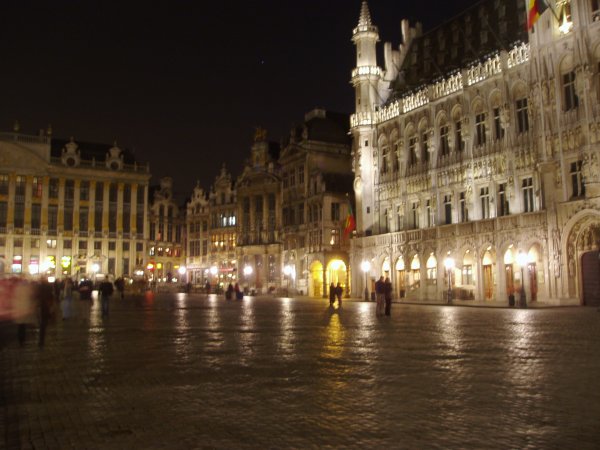
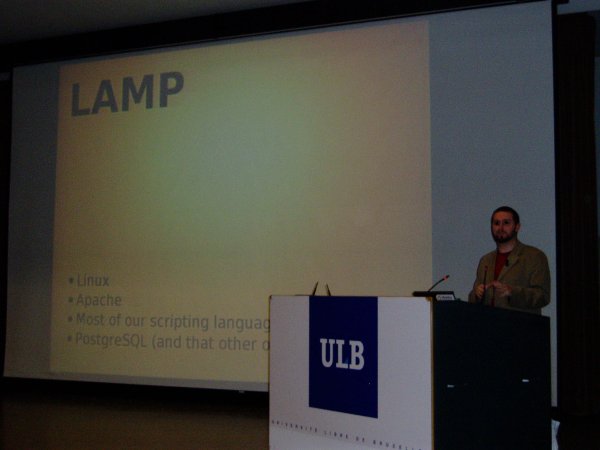
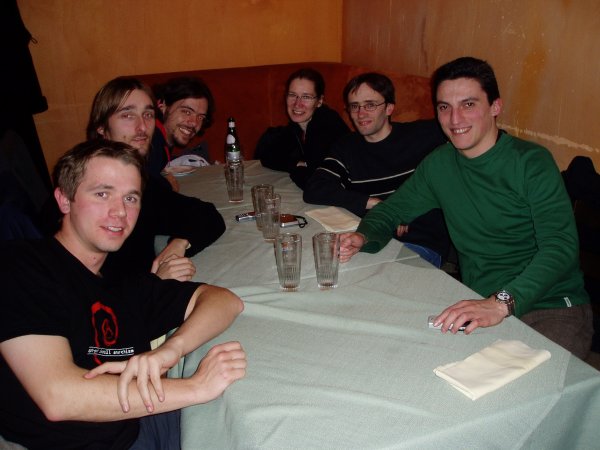
FOSDEM 2006 This year, the days before FOSDEM were the stressful ones, as I got to organize accomodation. Initially, we wanted to have similar appartments as last year, but by the time I was less busy at uni to actually look into it, most of them were already booked, so we had to put up with a youth hostel instead. The positive sides of this were the much lower expenses and a location in the city centre, making us actually look at Bruxelles a bit in detail this time. "Us" were the Hurd people, including Martin "earliest Hurd adopter present" Michlmayr. I got to FOSDEM by car again, picking up Marcus Brinkmann, Neal Walfield and Olaf Buddenhagen on the way in Cologne. Finding the youth hostel seemed to be pretty hard as we just had a street address and a map without street names, but we managed to find it pretty quickly to my great surprise (driving around in Bruxelles usually ended up being a complete disaster over the last years). After a strange encounter with a Guillem Jover lookalike in front of the hostel, we met the other guys (Thomas Schwinge, Marco Gerards, Stefan Siegl and Ognyan Kulev) and had a discussion about Neal's and Marcus' plan to move to a persistent system. After dinner, I met the other Debian people in the Roi d'Espagne and hat some longer chats with Jeroen van Wolffelaar, Rob Bradford, Martin Michlmayr and Jordi Mallach, who I finally met for the first time and who did not cop out of FOSDEM this year as usual... The pub is getting more and more crowded each year, all the hackers barely fit even though they opened the balustrade this time as well. It was great to see everybody again and have a few beers. Martin and I then managed to find the way back to the hostel by foot. We had no developer room, and no talks in the Debian room either, so FOSDEM was a pretty relaxed event this year. I met some more familiar faces like Noel Koethe and Andreas Mueller and listened to a couple of talks, most notably Richard Stallman's and Jeff Waugh's keynotes and Hanna Wallach's talk about FLOSSPOLS. Stefan Siegl also managed to get GNU Mach working for both my 3Com PCMCIA NIC and my Orinoco PCMCIA WLAN card, confirming his title as Hurd "hacker of the month". On Saturday evening, we (at this time, Guillem Jover, Gianluca Guida, Bas Wijnen and Jeroen Dekkers had joined) had dinner with the french Hurd guys (Manuel Menal, Marc Dequenes, Richard Braun, Arnaud Fontaine and others) in an italian restaurant. At 10:40 PM, the waiter told us in a rather unfriendly tone that they would close at 11 and presented us with the bill, along with handing out the menu again so that we could look up our share. By the time the bill arrived the french part of the table (at 10:55 PM), the guys were pretty surprised by this whole business and complained loudly that they did not have a dessert yet and insistent on having one. After some more minutes of discussion, the waiter gave in and served their desserts, after which each of them paid his share with his carte bleue. I believe we left the restaurant around 11:30. On Sunday evening, we had dinner again (the french guys had left Bruxelles already) and then drove back to Germany after having desserts and coffee in a bar. We left Bruxelles at around midnight and arrived in Duesseldorf at 2:30 PM, so we were glad that Neal offered us to stay at his place. We had breakfast the next morning with him and Isabel and then I proceeded to drive back to Frankfurt in the early afternoon. FOSDEM rocked, as usual. After being with the Debian crowd for the first three years or so, and mostly sticking with the Hurd crowd last year, I think I managed a pretty good balance between the two this year. This will not have been my last FOSDEM.

3 March 2006

Uwe Hermann: Nexuiz - a fast-paced, GPL'd ego shooter

Nexuiz screenshot Although I'm not a "gamer", I enjoy playing computer games from time to time. First-person shooters are especially well-suited for relaxing after a long and exhausting day ;-) IMHO a very good choice, if you're looking for a fun Free Software first-person shooter running on Linux, is Nexuiz. Nexuiz Nexuiz version 1.5 has recently been released, which features new maps, new characters, better AI and lots more. Check it out!

MJ Ray: Spammers Hall of Shame

IBM Rational spammed me on 1 March 2006. They invited me to "get on board with open source" (a forkinthehead to the copywriter for that gem) by sleeping through a presentation at IBM Bedfont Lakes (wherever that may be: the invite didn't say). The address used gave consent once for certain types of marketing, but not this. The address has not been verified accurate for years, so the message is spam and that address now gives an Unknown User error.

Jaldhar Vyas: The Future of GNOME

Wouter: way back when this whole usability madness started, this is a rendition I did of the ultimate future of GNOME. Future of GNOME

Clint Adams: For Jane and Barry, staid and stoic

In the free space, between the notility and the wire
Did a spot cam be apple day
Yet urging on, like wind and fire
Reigned spotted chains of stained McCrae

2 March 2006

Enrico Zini: DPL Elections - My questions for the candidates

Campaigning started and everyone is trying their best to ask something that's never been asked before to a DPL candidate. It tickles me, and today I don't feel like hacking: I have to try. Here's my list of questions:
  • Please write a list of 5 Debian Developers you would like to kick out of the project.
  • Please write a list of 5 Debian Developers you would like to see as DPL instead of you.
  • Please point to 5 threads in which you were happy to take part.
  • Please point to 5 threads in which you didn't want to take part, but you ended up doing it anyway.
  • Please point to 5 websites you usually visit.
  • Vim or Emacs?
  • What do you see in the image at http://tinyurl.com/d6s59 ?
  • What is the next word in the sequence "GIANT ROBOTS, sex, JET PACKS, sex, CITIES ON THE MOON, sex, SPACE COLONIES, sex, FLYING CARS, beer..." ?
  • Please ask yourself a question, then answer it.
  • Is life a dream, or dreams help to live better?
(this blog post is dedicated to Gigi Marzullo) Update: http://www.enricozini.org/store/dplquestion.grm

Jordi Mallach: L MIDDLE DOT in X.Org

English (Queen's English) is the only real language.
After this required short announcement by our main sponsor, Daniel Stone, lets go ahead and explain something of interest to the many Catalan X.Org users out there. Ivan and I have been looking at the issues that block a GNU/Linux user from using the compound geminate L, , instead of the more usual L L spelling. The and characters are unfortunately not included in ISO-8859-1, so fonts were the first big problem we faced. When modern X desktops started using True Type fonts by default, the de-facto free font in most distributions became Bitstream Vera as soon as they were licensed under a Free Software license back in 2003. Bitstream did not include the Unicode glyphs U+013F and U+0140, but some time after, chatting with daf, I learned he was working on Olwen, a Vera extension which would add proper Welsh coverage. He promptly added the Catalan glyphs, but Olwen never got widely exposed in distributions. Luckily, things are changing lately. Due to the lack of bugfixes or new releases of Vera, the list of Vera derivatives like Olwen started growing. The DejaVu project is building a font family, based on Vera, which merged many of these smaller purpose Vera derivatives, including Olwen. DejaVu, is, as far as I know, slowly replacing Bitstream Vera as the standard free, high quality true type font in free desktops. With the font blocker easily solvable now, the next problem was making the input easy. Some terminals, such as GNOME's or rxvt, allow you to insert Unicode typing a Unicode code point. The Spanish layouts don't provide a shortcut for it though, and if you try to do Level3-Shift+l, you'll get a Polish character, , that is of no use in neither Catalan, Spanish, Galician, Basque or other languages in the Spanish state. We wanted to replace that with , but when we had a look at it last Saturday night during our stay in Bruxelles, we couldn't find what the name for Unicode's U+0140/U+013F was in XKB-speak. So, as I said, on Sunday I went looking for Daniel and Keith to see if we would be clued up. The solution is easy: there is no name mapping, but you can use Unicode in 0x100XXXX notation directly in your X config file to make it work. He tried in his laptop, and why not, generated a patch for X.Org 7.0's xkeyboard-config. Daniel can't be that good, so he forced me to spread lies about the English language in this blog entry if we wanted the patch committed. :) Support for X.Org 6.8 and 6.9 isn't planned, unless you bribe your X maintainer to add a tiny patch. This has been implemented as an "es" keyboard extension (named cat ) because other systems don't have that feature in the Spanish layout, and X.Org wants to remain compatible with the rest. We'll have to add a
        Option          "XkbVariant"     "cat"
option to our keyboard section in xorg.conf. If you're not using X.Org 7.0, you might want to try:
xmodmap -e "keycode 46 = l L U140 U13f U140 U13f"
but I don't know if that'll work in all systems. To test in your keyboard, that'll probably be AltGr+l or AltGR+L . What we need to do now is to add support for the character in more fonts, alternative spellings for words using the ela geminada (ie, col labora and co labora ) in dictionaries, wordlists..., and of course, teach users about the avalability of this, and promote its usage.

Jordi Mallach: FOSDEM 2006

I'm so glad I finally decided to attend FOSDEM this year, as last weekend in Bruxelles was so cool it reminded me of the unforgettable week in Helsinki for DebConf 5 last summer. I travelled early on Friday with Ivan Vilata, the dude who dragged me into the Catalan translations world, and about 12:30 we were finding our way through Bruxelles airport. We had barely no problems getting to Ra l's place in Boulevard Louis Schmidt, thanks to the detailed HOWTO he provided a few days before. We dropped our bags in his appartment and went out with him and Virginia after a well deserved mini-nap. On our way to the Grand' Place, where we'd hook up with the Softcatal crowd and the rest of FOSDEM people, we stopped in A la Morte Subite, where we Ivan and I started our personal training on Belgian beers. The Roy d'Espagne is an excellent name for a place where to meet our friends from Catalunya. I didn't know that was a formal meeting point that kickstarts FOSDEM, so I was really impressed when I got to the second floor and found the place was packed with Free Software people, many of them I already knew in person. Reaching Softcatala's table near the window took about 15 minutes, and after saying hi to most people, we decided we could use a quieter place to have dinner, and then go back.


The Grand' Place was bombed by seb128 in 1695 Ra l and Virginia, our official guides during the weekend, chose a Vietnamese restaurant in the Stock Exchange area they frequent, and for little money we got an enormous meal. Back at the Roy d'Espagne, I tried to say hello to most Debian people I saw around, while at the same time I tried to be with my hosts and the Catalan people. A while after, I spotted tbm and azeem downstairs, who I finally met. I talked to Michael for a long while, and at some point we left as we didn't want to miss the last tram. Ivan, luckily, only snores rarely, so we slept for a while, and then took the tram to the Universit Libre du Bruxelles. The main room was already packed for RMS's keynote, which was pretty good. After that, we went to several talks here and there, while I kept meeting some people around the place. Ivan and I left when the show ended and we met with Virginia and Ra l at the centre. This time, we hooked up with Xevi and Jes s Corrius from Softcatal , as Toni Hermoso had abandoned us for a cheap dinner with the Mozilla.org people. We were taken to a packed bar/restaurant (don't remember the name right now), which had a few interesting features: they wouldn't sell any Coca-Cola, would not accept credit cards in protest for the high fees Visa charges on small businesses, and something I wouldn't expect to see in 2006, their chart of prices hadn't been rounded up when they switched to the Euro. So some plate would be 9.72, others 12.43, etc. After dinner we had a few beers at the Th atre de Toone, located in some tiny alley in the centre and being pretty tired, we went back home at 23:30 or so. Sunday was a busy days, due to the number of interesting Debian and GNOME talks going on. I'd highlight liw's talk on Piuparts, Enrico's on debtags and fjp's on Debian Installer in the Debian room, and kris' on the future of GTK+. There was also a cool demo of Novell's XGL. During a dead slot, I approached Little Daniel and keithp to see if he could point me at some mapping between UTF-8 and XKB symbol names. But Daniel was cool enough to solve a problem a lot simpler than expected. :) jdub's closing talk was just fantastic, and telling him "See you in Vilanova, we left the University, for our last dinner around Bruxelles.


jdub clues the audience about some basic acronyms We managed to rescue madduck from the Debian UK beer trap and went to an Italian for dinner, this time with Josep and Mia, from Softcatal , making a nice mix of German, Valencian/Catalan, and Swedish at our table.


Mia, Josep, Ra l, Ivan, Martin and Jordi after pizza Ra l took us around the city centre and told us about the underground river, the remaining city wall's tower, and the church that leaned against it. That night's beer lesson happened in the "2000 beer bar". We all had a 7 Trappist Westvleteren Bleu 8, apparently "the best beer of the world". It was pretty good, actually. Our weekend in Bruxelles was about to end. After not that much sleep, Ivan and I took a tram and a bus to the Airport, arriving in Val ncia around 10AM, and after seeing the best view of the Pyrenees ever, which were absolutely covered with snow, as well as many other places in the Pa s Valenci and Teruel due to massive snows during the two days we were out. FOSDEM is probably a "can't miss" yearly event now. Thanks to all the organisers for their hard work to make it happen. You rock.

MJ Ray: Blog moves: How not to antispam

How not to do it: The blog of Alexis Sukrieh not only uses broken letter image tests just now, but sends rude error messages when you fail and has a broken trackback system that returns 403 Forbidden. If that's the Spam Karma 2 mentioned in the footer, I suspect someone will be reincarnated as flame-roasted tinned meat soon. (Is this comment offensive? Report bad content.)

Brett Parker: Wooo! Shiny New Toy!

Well, the Portégé R200 arrived today - and it's shiny (and light, and mostly pretty...) - so the next thing to do is remove the aboloshment that is windows xp from the thing and get me debian unstable installed on it - so, netbooting fun to come up! (or maybe boot from SD, hmm, that's possible ;) bounce

1 March 2006

Arnaud Vandyck: MDR is not DFSG-compatible

Wolfgang was right about SPL not being free. MDR is a library that ArgoUML will use. ArgoUML is in contrib at the moment because of Swing issues so it can’t be built and run with free software, but there are a lot of progresses in free Classpath based runtime. But now that ArgoUML will switch to MDR, we have another problem: SPL. It seems that SPL is not DFSG-compatible. Bad. I filed an issue on the Netbeans website (Issue#73161) to ask if they could change the license to one DFSG-compatible. If it’s not possible, I’ll have to package MDR to non-free and leave ArgoUML in contrib.

Robert Collins: 1 Mar 2006

Why oh why oh why are there adverts in movie theatres ? Surely we pay enough that we dont have to be inundated with advertising. Even the toilets have advertising. Now, at Greater Union they are advertising the ability to bu advertising space on staff clothing and soft drink cups. Not to mention cable tv - what happened to 'paying for content'.... less adverts than free to air, but still more than a DVD. BAH!

Clint Adams: Secret Changes to Blog Entry

It has come to my attention that AJ has made some updates. He says,
Of course, the two responses above are fundamentally contradictory: if Clint's right a ban (or similar) would've been appropriate, in spite of Joerg's claim. On the other hand, Google's sole definition of "snarky" seems to be "A colloquialism meaning short-tempered or snappish." which doesn't seem terribly applicable here -- however short tempered anyone was, anon left before anyone had a chance to lose theirs. Sadly, the rest of Clint's epithet assumes you've got some idea what the problem is in the first place.
Apparently I've been too cryptic, so I will attempt to rectify that slightly. The episode begins, I believe, with Anthony invoking a reference to secret changes . Ryan perpetuates the joking. Matt acknowledges the Sneakers reference, though it could have been interpreted as approval of the discourteous and disrespectful banter. anon expresses his confusion about this apparent disparity between the charter of the channel and what is occurring in practice. Ryan implies by inquiry that no such discrepancy exists. anon , clearly frustrated, storms off in a huff. Anthony cites this occurrence in his blog. As far as I am aware, none of the channel moderators listed on the Charter have made their opinions known publicly. In other examples, we see Anthony wielding the Charter as a threatening weapon. In this case, we see a failure to self-censor. It does not surprise me at all that someone would not want to put up with this. So I am not saying that either AJ or Ryan or Matt should have been banned for this; that would seem rather extreme and unproductive. I am saying that I have little faith in the #debian-tech team to enforce things fairly.

Jordi Mallach: He's Welcome in Pakistan

I would have thought that three years after the start of the war, Iraq would be yet another forgotten war, as it tends to happen when murder, bombings, famine and corruption become the routine in some country or area. It's been nearly three years since the holy coalition made up of United States and the UK, with a selected group of allies which included the Spain of our beloved Aznar, invaded the country to save the poor iraqi people from the fierce Sadam. After a few months of hard fight against the bloody dictator, Iraq would finally be able to live in peace and Democracy, and the world would understand the goodness behind the reasoning that made the superpowers start the second war in Iraq, against the opinion of the UN security council and an overwhelming majority of the people in the planet. Today, after years of bloodbaths in different parts of Iraq, we're witnessing the start of a civil war. I hope the mass media stop talking about "the terrorists" now, because what's been going on for the last week is random people against random people. It makes me sick to think how bad the near future looks in Iraq. All of this happened in the name of freedom, or so they said. And then, it was in the name of the War on Terror , because Iraq was infested with terrorists (they never told us how they planned to stop that from happening). In the meanwhile, little they talk about the most wanted man on earth, uncle Osama. Today's edition of EL PAIS includes a translation of an article by Ahmed Rashid in The Washington Post's edition of February 26, apropos of George Bush's visit to Pakistan and Afghanistan this week. He's Welcome In Pakistan is surely worth a read; I'm sure Miguel will enjoy.

John Goerzen: Asterisk At Work

It's been a little while since I wrote about Asterisk. It's about time to update the story. I've been using Asterisk at home for awhile, but now we're going to use it at work. The need We have approximately 150 internal extensions here, and they are being supported by a Nortel PBX. This PBX is being end-of-lifed, and it would cost well over $100,000 to replace it, once the cost of the two required Windows servers (!) was factored in. Not only that, but it still isn't as flexible as Asterisk. Along with that, we have a need for internal wireless phones. We have a large manufacturing area, and we have people that would like to be able to use a wireless phone anywhere on the shop floor or office areas. No single cellphone company provides a signal that is strong enough to reach everywhere in the building -- not to mention that there would be big airtime fees. So we are planning to deploy 802.11b wireless phones for this purpose. Hardware The decision was made to go ahead with Asterisk. We will be replacing all office phones with Polycom IP501 units. This means running about 90 new runs of CAT5 to people's desks. For our Asterisk server, we got a HP DL385 2U server with dual dual-core Opteron 2GHz CPUs. We've really had good luck with Linux on these DL385s, and with HP's support. We got redundant power supplies, disks, fans, etc. on that machine. The CPU on here is probably more than we need, but telephones are very important to us and we wanted to make sure that we don't have any issues down the road. We purchased two A104d quad-T1 interface cards with hardware echo cancellation. Very nice cards. The drivers have been a little troublesome. But Sangoma's tech support is awesome. They logged onto our box and I was watching as they were hacking on the kernel module right there. Tech support like that is rare. I highly recommend Sangoma. We really need only one of those cards, but they're the only component of the Asterisk server that isn't completely standard. So the second is on hand as a spare. For our analog phones, we are using two Adtran TA 750 channel banks. Each has a T1 interface and a 50-pin telco ("Amphenol") connector for a punch block. So we can run 24 channels off each of those. Our consultants (see below) suggested getting them used from Colspar Communications. We found them fully loaded with FXS cards for $250 each. We bought three -- two for production use and one for a hot spare. These are very solid and nice units. The only problem we had is that the voicemail indicator lamps (MWI lights) on our old analog phones wouldn't light up. Turns out that Asterisk with a T1 channel bank uses digital FSK lamp, whereas our older analog phones expected a certain line voltage to indicate messages waiting. After some Googling, I found add-on FSK lamps from American Science & Surplus for $1.50 each. Nice. In our other building, we have a gigabit fiber-optic link, so we purchased an AudioCodes MP124 SIP-analog gateway. It's working well so far, except it's not working with voicemail indicator lamps at all. It seems to be a firmware issue that is incompatible with Asterisk in some way. We're investigating now. For wireless phones, we're using the Hitachi IP5000. We're not terribly pleased with the quality of wifi phones in general, but this one seems pretty solid. And it doesn't crash every few minutes like the Zyxel model we tried. The Telco Our current phone system has about 23 analog lines for interaction with the outside world. We wanted to get a voice T1 with PRI channel for the Asterisk system. Our local telephone company is Sprint, and this has been the annoying part. First they tried to quote us an Internet connection. Then it took a very long time for them to even get us a quote for the voice T1. And now we have signed the contracts but are still waiting for an install date. Consultants While I had used Asterisk before, it was in a home setting. Not exactly business-critical, and not dealing with hundreds of extensions, T1 lines, and all the rest. So it seemed reasonable to get someone experienced with that sort of thing to help us out and make sure we weren't making mistakes that would cost us down the road. I posted on the asterisk-biz mailing list describing what we would like to do. I got a bunch of supplies from consultants, and we wound up selecting Asteria Solutions Group. At the beginning, we wanted some advice about server sizing, phones that work well in business settings, etc. I think that most consultants are not used to working with people that have significant Linux experience, and a good deal of Asterisk experience, already. Asteria was a little surprised with our situation at first, I think, but has been very helpful. They've educated us on the ins and outs of T1 technology, pointed us to Colspar (which saved us a ton of money on analog gateways), and helped us with some obscure questions. They were also fine to have a much smaller involvement with our project than they would probably normally have. I highly recommend them. Surprises You'll never believe just how hard it is to buy phones from Polycom. They won't sell directly to people, nor will they even list authorized retailers on their website. You have to call them, leave a message, and in a few days they'll let you know where to go. Some online retailers such as atacomm sell Polycom phones, but they're not authorized to do so, so you don't get any warranty or have the right to get firmware from Polycom. What's more, Polycom usually expects people to need configuration assistance with their phones. But I think that when I told them we need 90 IP-501s, had already configured 5 on our network, and needed no assistance, they were happy to work with us. Reactions We've deployed desk phones all over by now. So office workers have two phones on their desk right now (one from the old system, one from the new). We've heard a lot of positive comments from people about the new phones. And all the features of Asterisk -- music on hold, flexible queues, etc -- will be really helpful here. Cost Even with the cost of all new phones, new CAT5 runs and labor for that, consulting time, etc., we still expect Asterisk to be far cheaper than the latest Nortel PBX. Also... I recently wrote an article about Asterisk for Free Software Magazine. I'll let you know when/if it gets published.

Next.

Previous.