Search Results: "ag"

4 April 2014

Andrew Pollock: [life] Day 66: Story time, Science Friday, impromptu play date, scootering and the Hawthorne Markets

Zoe slept through last night, which was lovely. We had nothing really planned for today. The Bulimba Library has a story time thing at 10:30am on a Friday. I've never bothered to take Zoe because it would have been too much of a hustle to get her there after her Brazilian Jiu-Jitsu class, particularly by bike. Since today we didn't have a BJJ class, it made getting to story time much easier. So we had a nice lazy start to the day, and then Zoe just wanted to procrastinate anyway, so since we were in no particular rush, I let her play in her room for a bit and I read for a while. We eventually had teeth and hair brushed and biked over to the library. Not having been to the story time thing before, I assumed it was in the kids area, but it turned out it was downstairs in the general purpose room, which we only discovered after story time had started. I'm certainly glad I never busted a gut to get to the library in time for it, because it wasn't anything particularly exciting. They did give all the kids a colouring sheet and there was some colouring and a couple of songs, but really it was nothing to phone home about. I did run into Jacob and his mum Laura from Kindergarten. They live locally, and so I invited them over for lunch and a play date. They had some grocery shopping to do, and I had to go to the pharmacy to get a prescription filled, so we agreed to meet at our place in about an hour. We biked to the pharmacy to get my prescription filled and some more sunscreen for Zoe, and the pharmacist gave her a free Chupa Chups We biked home, and grabbed some balloons from the convenience store next door for our Science Friday activity. I was slightly more organised today, and figured out what I wanted to do in the morning while Zoe was watching TV. We did yeast and sugar and warm water in a bottle with a balloon on top and watched it inflate itself with all the carbon dioxide produced by the yeast eating the sugar. The only problem was the balloons we bought were total rubbish. They'd been on the shelf for too long and they'd all stuck to themselves and either popped when I tried to blow them up or had holes in them. So we marched back to the corner store in our lab coats to get some more, and the store keeper gave Zoe one of the little flashlights she keeps playing with in the bowl at the check out. It was a good day for freebies. We were able to complete our Science Friday activity before Laura and Jacob and his baby brother Ethan came over for lunch. Zoe didn't have a particularly good lunch, I think it was the distraction of having Jacob there as well. After lunch, they couldn't really agree on anything to play. Laura said Jacob just plays out in the yard at Kindergarten the whole day. The one thing they both managed to agree on briefly was bubbles. Ethan was getting tired and needed a nap by about 2pm, so they left. Zoe wanted to ride her scooter, but I had to clean up from lunch and the aftermath of the play date on the balcony first, so she went and played some games on her Nexus 7 while I did that, and then we headed out on the scooter. It was about 2:30pm by this point, and the Hawthorne Markets, which have now moved to a Friday "twilight" thing, were due to start at 4pm, so I figured we could just kill time on the scooter. It's funny how the scooter is now the in thing as of Tuesday. It's sat unused on the balcony for most of the year, but I'm glad she wants to use it now because it guarantees she moves faster than if she were to walk and want to be picked up every 5 minutes. We scootered around to the playground and she played there until about 3:45pm, when we headed around to the markets. We ran into Nicky Noo from the Ooniverse Family Cafe, who we'd met on Tuesday, and she made Zoe another dog balloon and she got her face painted. After that, it was the obligatory jumping castle for a while. It was getting time to get home for Sarah to pick her up, when I dropped the dog balloon on the ground and it popped. That made Zoe very sad. Then the lack of a decent lunch kicked in. Zoe wanted some poffertjes, but they would have taken too long, so I gave her a few of the free samples to tide her over, and we headed home. Sarah was waiting for her when we got home, so we parted ways at that point. I like how the days that have nothing planned often end up as full if not fuller than the days when I do have something planned.

Gunnar Wolf: Mozilla: So our communitary echobox *does* resound with social issues

I woke up to the news that, after a very short tenure, Brendan Eich steps down as the Mozilla CEO. Why? Because of the community outcry. Because some years ago, Eich pubilcly supported (and donated funds) the ban of any kind of marriages in California that were not between a man and a woman. The world has advanced enormously in this regard in the last years/decades, and so many individuals and organizations opposed and announced they would boycott Mozilla that either him or Mozilla could not stand the pressure anymore. So, of course, it's sad the person had to resign. Many people talked about freedom of speech, freedom of harbouring his own personal opinion But when it comes to the rights of minorities, particularly of minorities that have suffered such hard prejudice and abuse as the gay, lesbian and all the other non-orthodox sexual- and gender- orientations, righting a wrong is much more important than preserving an individual's freedom of opinion. Besides, it's not just thinking or talking about something The concrete proposition Eich supported (and eventually made him resign) is about bringing the life of thousands of people to a hellish state of uncertainty, and going back to not having a way for the society to legally recognize their way of being, their love, their lifes. But anyway What prompts me into writing this is that, once again, the Free Software (and related denominations) community has shown that a set of core values, seemingly shared by a very large amount of our own people with no coordination or correlation with what conforms us as a community (and thus, being emergent traits), are strong enough to create a critical mass, to achieve cohesion. And that ours is not just a technical community of people writing software at all layers of the stack, but first and foremost is a group of social activists, committed to making the world better. I will quote from Matthew Garrett's post on this topic, clearly more contundent and thorough that what I'm trying to come up with:
The Mozilla Manifesto discusses individual liberty in the context of use of the internet, not in a wider social context. Brendan's appointment was very much in line with the explicit aims of both the Foundation and the Corporation - whatever his views on marriage equality, nobody has seriously argued about his commitment to improving internet freedom. So, from that perspective, he should have been a fine choice. But that ignores the effect on the wider community. People don't attach themselves to communities merely because of explicitly stated goals - they do so because they feel that the community is aligned with their overall aims. The Mozilla community is one of the most diverse in free software, at least in part because Mozilla's stated goals and behaviour are fairly inspirational. People who identify themselves with other movements backing individual liberties are likely to identify with Mozilla. So, unsurprisingly, there's a large number of socially progressive individuals (LGBT or otherwise) in the Mozilla community, both inside and outside the Corporation. A CEO who's donated money to strip rights from a set of humans will not be trusted by many who believe that all humans should have those rights. It's not just limited to individuals directly affected by his actions - if someone's shown that they're willing to strip rights from another minority for political or religious reasons, what's to stop them attempting to do the same to you? Even if you personally feel safe, do you trust someone who's willing to do that to your friends? In a community that's made up of many who are either LGBT or identify themselves as allies, that loss of trust is inevitably going to cause community discomfort.

3 April 2014

Matthew Garrett: Mozilla and leadership

A post I wrote back in 2012 got linked from a couple of the discussions relating to Brendan Eich being appointed Mozilla CEO. The tldr version is "If members of your community doesn't trust their leader socially, the leader's technical competence is irrelevant". That seems to have played out here.

In terms of background[1]: in 2008, Brendan donated money to the campaign for Proposition 8, a Californian constitutional amendment that expressly defined marriage as being between one man and one woman[2]. Both before and after that he had donated money to a variety of politicians who shared many political positions, including the definition of marriage as being between one man and one woman[3].

Mozilla is an interesting organisation. It consists of the for-profit Mozilla Corporation, which is wholly owned by the non-profit Mozilla Foundation. The Corporation's bylaws require it to work to further the Foundation's goals, and any profit is reinvested in Mozilla. Mozilla developers are employed by the Corporation rather than the Foundation, and as such the CEO is responsible for ensuring that those developers are able to achieve those goals.

The Mozilla Manifesto discusses individual liberty in the context of use of the internet, not in a wider social context. Brendan's appointment was very much in line with the explicit aims of both the Foundation and the Corporation - whatever his views on marriage equality, nobody has seriously argued about his commitment to improving internet freedom. So, from that perspective, he should have been a fine choice.

But that ignores the effect on the wider community. People don't attach themselves to communities merely because of explicitly stated goals - they do so because they feel that the community is aligned with their overall aims. The Mozilla community is one of the most diverse in free software, at least in part because Mozilla's stated goals and behaviour are fairly inspirational. People who identify themselves with other movements backing individual liberties are likely to identify with Mozilla. So, unsurprisingly, there's a large number of socially progressive individuals (LGBT or otherwise) in the Mozilla community, both inside and outside the Corporation.

A CEO who's donated money to strip rights[4] from a set of humans will not be trusted by many who believe that all humans should have those rights. It's not just limited to individuals directly affected by his actions - if someone's shown that they're willing to strip rights from another minority for political or religious reasons, what's to stop them attempting to do the same to you? Even if you personally feel safe, do you trust someone who's willing to do that to your friends? In a community that's made up of many who are either LGBT or identify themselves as allies, that loss of trust is inevitably going to cause community discomfort.

The first role of a leader should be to manage that. Instead, in the first few days of Brendan's leadership, we heard nothing of substance - at best, an apology for pain being caused rather than an apology for the act that caused the pain. And then there was an interview which demonstrated remarkable tone deafness. He made no attempt to alleviate the concerns of the community. There were repeated non-sequiturs about Indonesia. It sounded like he had no idea at all why the community that he was now leading was unhappy.

And, today, he resigned. It's easy to get into hypotheticals - could he have compromised his principles for the sake of Mozilla? Would an initial discussion of the distinction between the goals of members of the Mozilla community and the goals of Mozilla itself have made this more palatable? If the board had known this would happen, would they have made the same choice - and if they didn't know, why not?

But that's not the real point. The point is that the community didn't trust Brendan, and Brendan chose to leave rather than do further harm to the community. Trustworthy leadership is important. Communities should reflect on whether their leadership reflects not only their beliefs, but the beliefs of those that they would like to join the community. Fail to do so and you'll drive them away instead.

[1] For people who've been living under a rock
[2] Proposition 8 itself was a response to an ongoing court case that, at the point of Proposition 8 being proposed, appeared likely to support the overturning of Proposition 22, an earlier Californian ballot measure that legally (rather than constitutionally) defined marriage as being between one man and one woman. Proposition 22 was overturned, and for a few months before Proposition 8 passed, gay marriage was legal in California.
[3] http://www.theguardian.com/technology/2014/apr/02/controversial-mozilla-ceo-made-donations-right-wing-candidates-brendan-eich
[4] Brendan made a donation on October 25th, 2008. This postdates the overturning of Proposition 22, and as such gay marriage was legal in California at the time of this donation. Donating to Proposition 8 at that point was not about supporting the status quo, it was about changing the constitution to forbid something that courts had found was protected by the state constitution.

comment count unavailable comments

Daniel Pocock: LogAnalyzer and rsyslog MongoDB support now in wheezy-backports and Ubuntu

LogAnalyzer is a powerful but simple log file analysis tool. The upstream web site gives an online demo. It is developed in PHP, runs in Apache and has no other dependencies such as databases - it can read directly from the log files. For efficiency, however, it is now trivial to make it work with MongoDB on Debian. Using a database (including MongoDB and SQL backends) also means that severity codes (debug/info/notice/warn/error/...) are retained. These are not available from many log files. The UI can only colour-code and filter the messages by severity if it has a database backend. Package status The packages just entered Debian recently. It has now been migrated to wheezy-backports and Ubuntu so anybody on wheezy or Ubuntu can use it. Quick start with MongoDB The version of rsyslog in Debian wheezy does not support MongoDB output. It is necessary to grab 7.4.8 from backports. Some versions, up to 7.4.4 in backports, had bugs with MongoDB support - if you tried those, please try again now. The backported rsyslog is a drop-in replacement for the standard rsyslog package and for users with a default configuration it is unlikely you will notice any difference. For users who customized the configuration, as always, make a backup before trying the new version.
  • Install all the necessary packages: apt-get install rsyslog-mongodb php5-mongo mongodb-server
  • Add the following to /etc/rsyslog.conf:
    module (load="ommongodb")
    *.* action(type="ommongodb" server="127.0.0.1" db="logs" collection="syslog")
  • Look for the MongoDB settings in /etc/loganalyzer/config.php and uncomment them. Comment out the stuff for disk log access.
  • Restart rsyslog and then browse your logs at http://localhost/loganalyzer

Gunnar Wolf: DrupalCamp Mexico City: April 23-25

We are organizing a DrupalCamp in Mexico City! DrupalCamp Mexico City logo As a Drupal user, I have so far attended two DrupalCamps (one in Guadalajara, Mexico, and one in Guatemala, Guatemala). They are as Free Software conferences usually are great, informal settings where many like-minded users and developers meet and exchange all kinds of contacts, information, and have a good time. Torre de Ingenier a Torre de Ingenier a, UNAM This year, I am a (minor) part of the organizing team. DrupalCamp will be held in Torre de Ingenier a, UNAM Just by Facultad de Ingenier a, where I teach. A modern, beautiful building in Ciudad Universitaria. Talks, tracks So, who is this for? You can go look at the accepted sessions, you will find there is a lot of ground. Starting from the very introduction to how Drupal is structured and some tips on how to work with it (delivered by yours truly), through workflows for specific needs, to strong development-oriented talks. The talks are structured along four tracks: "Training", "Theming", "Development", "Business" and "SymfonyDay". "SymfonyDay"? Yes. Drupal is a fast-evolving Free Software project. Most users are currently using versions 6 and 7, which are as different between each other as day and night... But the upcoming Drupal 8 brings even greater changes. One of the most interesting changes I can see is that Drupal will now be based on a full MVC framework, Symfony. One of the days of our DrupalCamp will be devoted to Symfony (dubbed the Symfony Day). ...And... Again, just look at the list of talks. You will find a great amount of speakers interested in coming here. Not just from Mexico City. Not just from Mexico. Not just from Latin America. I must say I am personally impressed. Sponsors! Of course, as with any volunteer-run conferences: We are still looking for sponsors. We believe being a DrupalCamp sponsor will greatly increase your brand visibility in the community you want to work with. There are still a lot of expenses to cover to make this into all that we want. And surely, you want to be a part of this great project. There are many sponsor levels Surely you can be part of it!

AttachmentSize
drupalcampmx.png57.81 KB
torre_ing.jpg90.22 KB
torre_ing_mini.jpg21.64 KB

Johannes Schauer: mapbender - maps for long-distance travels

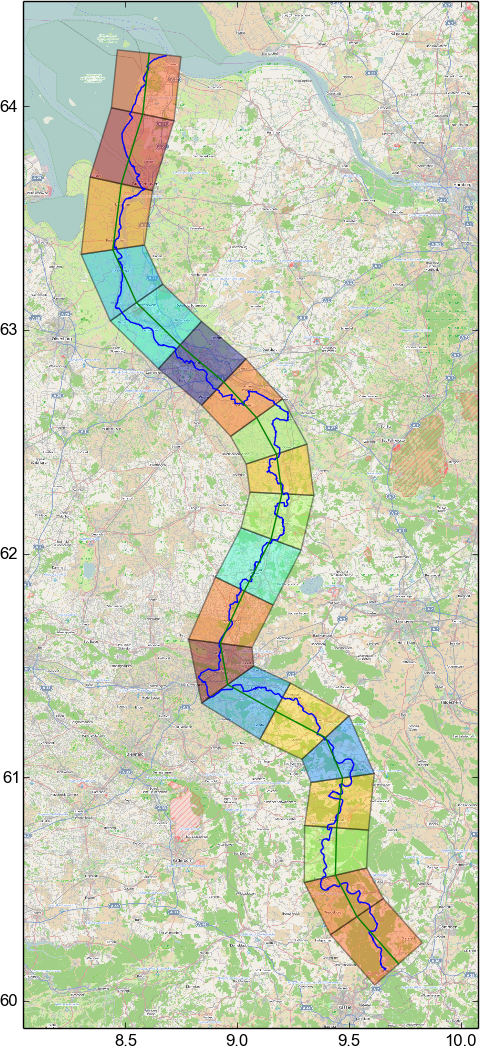
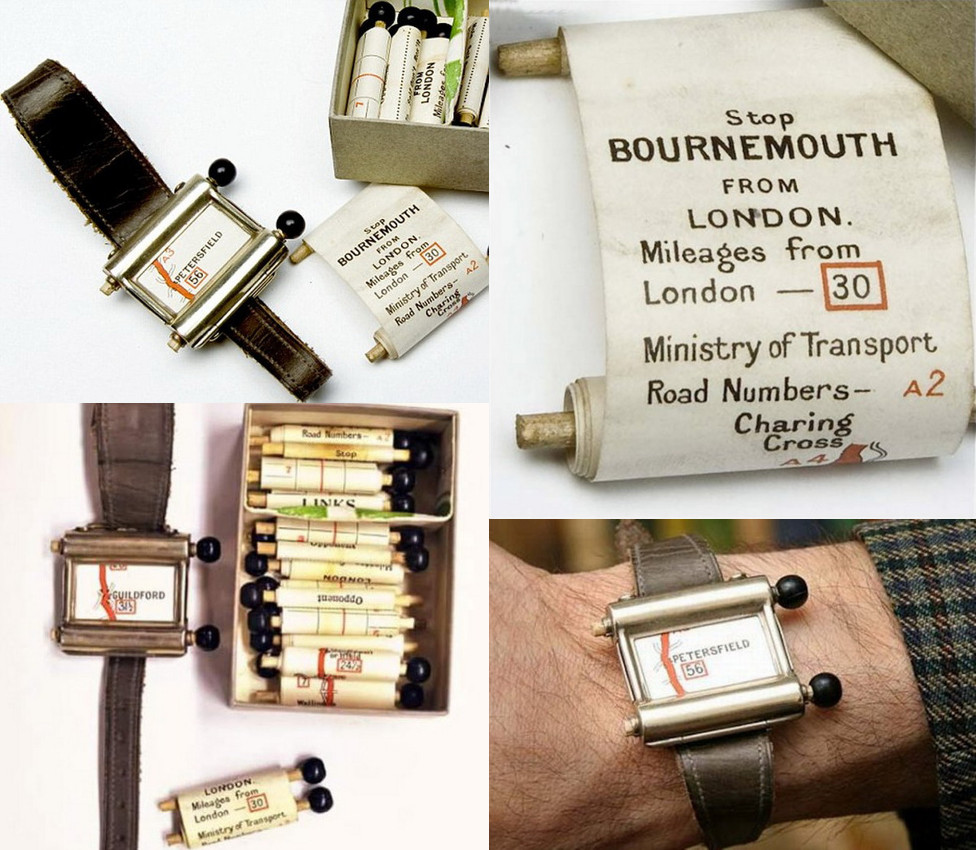
Back in 2007 I stumbled over the "Plus Fours Routefinder", an invention of the 1920's. It's worn on the wrist and allows the user to scroll through a map of the route they planned to take, rolled up on little wooden rollers. At that point I thought: that's awesome for long trips where you either dont want to take electronics with you or where you are without any electricity for a long time. And creating such rollable custom maps of your route automatically using openstreetmap data should be a breeze! Nevertheless it seems nobody picked up the idea. Years passed and in a few weeks I'll go on a biking trip along the Weser, a river in nothern Germany. For my last multi-day trip (which was through the Odenwald, an area in southern Germany) I printed a big map from openstreetmap data which contained the whole route. Openstreetmap data is fantastic for this because in contrast to commercial maps it doesnt only allow you to just print the area you need but also allows you to highlight your planned route and objects you would probably not find in most commercial maps like for example supermarkets to stock up on supplies or bicycle repair shops. Unfortunately such big maps have the disadvantage that to show everything in the amount of detail that you want along your route, they have to be pretty huge and thus easily become an inconvenience because the local plotter can't handle paper as large as DIN A0 or because it's a pain to repeatedly fold and unfold the whole thing every time you want to look at it. Strong winds are also no fun with a huge sheet of paper in your hands. One solution would be to print DIN A4 sized map regions in the desired scale. But that has the disadvantage that either you find yourself going back and forth between subsequent pages because you happen to be right at the border between two pages or you have to print sufficiently large overlaps, resulting in many duplicate map pieces and more pages of paper than you would like to carry with you. It was then that I remembered the "Plus Fours Routefinder" concept. Given a predefined route it only shows what's important to you: all things close to the route you plan to travel along. Since it's a long continuous roll of paper there is no problem with folding because as you travel along the route you unroll one end and roll up the other. And because it's a long continuous map there is also no need for flipping pages or large overlap regions. There is not even the problem of not finding a big enough sheet of paper because multiple DIN A4 sheets can easily be glued together at their ends to form a long roll. On the left you see the route we want to take: the bicycle route along the Weser river. If I wanted to print that map on a scale that allows me to see objects in sufficient detail along our route, then I would also see objects in Hamburg (upper right corner) in the same amount of detail. Clearly a waste of ink and paper as the route is never even close to Hamburg.
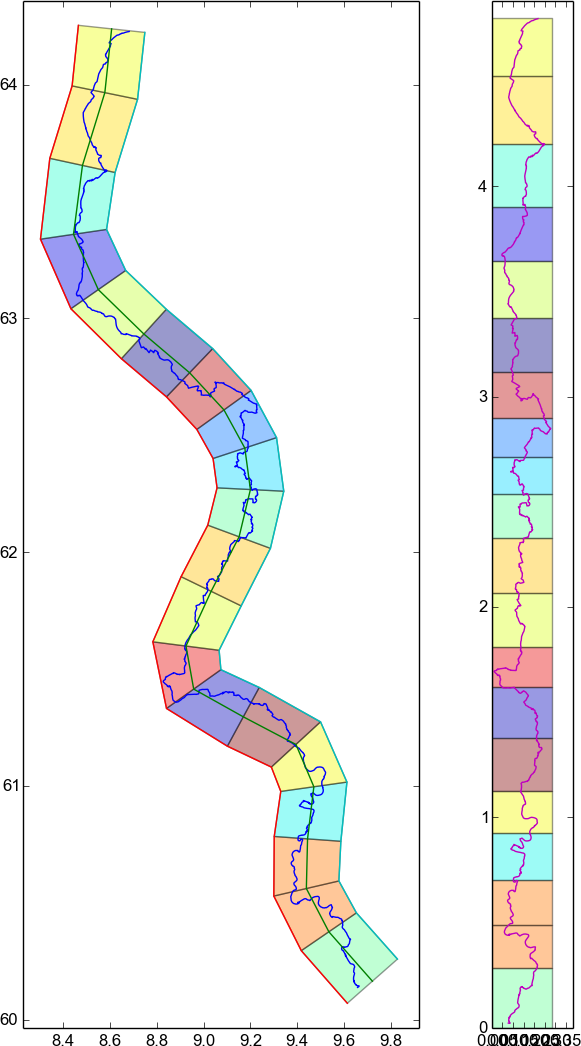
As the first step, a smooth approximation of the route has to be found. It seems that the best way to do that is to calculate a B-Spline curve approximating the input data with a given smoothness. On the right you can see the approximated curve with a smoothing value of 6. The curve is sampled into 20 linear segments. I calculated the B-Spline using the FITPACK library to which scipy offers a Python binding.
The next step is to expand each of the line segments into quadrilaterals. The distance between the vertices of the quadrilaterals and the ends of the line segment they belong to is the same along the whole path and obviously has to be big enough such that every point along the route falls into one quadrilateral. In this example, I draw only 20 quadrilaterals for visual clarity. In practice one wants many more for a smoother approximation.
Using a simple transform, each point of the original map and the original path in each quadrilateral is then mapped to a point inside the corresponding "straight" rectangle. Each target rectangle has the height of the line segment it corresponds to. It can be seen that while the large scale curvature of the path is lost in the result, fine details remain perfectly visible. The assumption here is, that while travelling a path several hundred kilometers long, it does not matter that large scale curvature that one is not able to perceive anyways is not preserved. The transformation is done on a Mercator projection of the map itself as well as the data of the path. Therefore, this method probably doesnt work if you plan to travel to one of the poles. Currently I transform openstreetmap bitmap data. This is not quite optimal as it leads to text on the map being distorted. It would be just as easy to apply the necessary transformations to raw openstreetmap XML data but unfortunately I didnt find a way to render the resulting transformed map data as a raster image without setting up a database. I would've thought that it would be possible to have a standalone program reading openstreetmap XML and dumping out raster or svg images without a round trip through a database. Furthermore, tilemill, one of the programs that seem to be one of the least hasslesome to set up and produce raster images is stuck in an ITP and the existing packaging attempt fails to produce a non-empty binary package. Since I have no clue about nodejs packaging, I wrote about this to the pkg-javascript-devel list. Maybe I can find a kind soul to help me with it.
Here a side by side overview that doesnt include the underlying map data but only the path. It shows how small details are preserved in the transformation. The code that produced the images in this post is very crude, unoptimized and kinda messy. If you dont care, then it can be accessed here

Steve Kemp: Tagging images, and maintaining collections?

I'm an amateur photographer, although these days I tend to drop the amateur prefix, given that I shoot people for cash at least once a month. (It isn't my main job, and I'd never actually want it to be, because I'm certain I'd become unhappy hustling for jobs and doing the promotion thing.) Anyway over the years I've built up a large library of images, mostly organized in a hierarchy of directories beneath ~/Images. Unlike most photographers I don't use aperture, lighttable, or any similar library management. I shoot my images in RAW, convert to JPG via rawtherapee, and keep both versions of the images. In short I don't want to mix the "library management" functions with the "RAW conversion" because I do regard them as two separate steps. That said I'm reaching a point where I do want to start tagging images, and finding them more quickly. In the past I wrote a couple of simple tools to inject tags into the EXIF data of images, and then indexed them. But that didn't work so well in practise. I'm starting to think instead I should index images into sqlite: The downside is that this breaks utterly as soon as you move images around on-disk. Which is something my previous exif-manipulation was designed to avoid. Anyway I'm thinking at the moment, but I know that the existing tools such as F-Spot, shotwell, DigiKam, and similar aren't suitable. So I either need to go standalone and use EXIF tags, accepting the fact that the tags I enter won't be visible to other tools, or I cope with the file-rename issues by attempting to update an existing sqlite database via hash/size/etc.

Gerfried Fuchs: 2CELLOS

A good friend just yesterday sent me a link to a one and a half hour lasting live concert of 2CELLOS. And wow, I was deeply impressed. Terrific! Even Sir Elton John approves. Have to share them with you, too. :) Enjoy! P.S.: I sooo love them also for their pun in their second album title, In2ition. :D

/music permanent link Comments: 2 Flattr this

Aigars Mahinovs: Wireless photo workflow

For a while now I've been looking for ways to improve my photo workflow - to simplify and speed up the process. Now I've gotten a new toy to help that along - a Panasonic FlashAir SD card with WiFi connectivity. I was pretty sure that build-in workflows of some more automated solutions would not be a perfect fit for me, so I got this card which has a more manual workflow and a reasonable API, so I could write my own. Now I am trying to work out my requirements, the user stories if you will. I see two distinct workflows: live event and travel pictures. In both cases I want the images to retain the file names, Exif information and timing of the original photos and also have embedded GPS information from the phone synced to the time the photo was taken. And if I take a burst of very similar photos, I want the uploading process to only select and upload the "best" one (trivial heiristic being the file size) with an ability for me to later choose another one to replace it. There would need to be some way of syncing phone and camera time, especially considering that phones usually switch to local time zone when traveling and cameras do not, maybe the original time the photo was taken would need to be changed to local time zone, so that there are no photos that are taken during the day, but have a timestamp of 23:45 GMT. When I am in Live Event mode I would like the photos that I take to immediately start uploading to an event album that I create (or choose) at the start of the shoot with a preset privacy mode. This assumes that either I am willing to upload via 3G of my phone or that I have access to a stable WiFi network on-site. It might be good if I could upload a scaled down version of the pictures during the event and then later replace the image files with full-size images when the even is over and I am at home in my high-speed network. I probably don't need the full size files on my phone. When I am in Travel mode, I want to delay photo uploading until I am back at the hotel with its high speed Wifi, but also have an option to share some snapshots immediately over 3G or random cafe Wifi. I am likely to take more photos that there is memory in my phone, so I would like to clear original files from the phone while keeping them in the SD card and in the cloud, but still keeping enough metadata to allow re-uploading an image or choosing another image in a burst. Now I need to flesh out the technical requirements from the above and write an Android app to implement that. Or maybe start by writing this in Python as a cross-platform command-line/desktop app and only later porting it to Android when all the rought parts are ironed out. This will have an extra benefit of people being able to run the same workflow on a laptop instead of a phone or tablet. Let's assume that this is written in a pretty flexible way, allowing to plug in backends for different WiFi SD cards, cloud services, plug-in points for things like instant display of the latest photo on the laptop screen in full-screen mode and other custom actions, what else would people love to see in something like this? What other workflow am I completely overlooking?

Andrew Pollock: [life] Day 65: Playgroup, and the foil confetti play date

Zoe slept pretty well last night. She only woke up briefly at 4am because Cowie had fallen out of bed and she couldn't find her. Today was the last Playgroup of the term. Megan, her little sister and her Dad came as well to check it out, which was nice, because Zoe then had someone to actively play with in addition to me. After Playgroup, we went to the adjacent Bulimba Memorial Park with Megan, and then had some lunch at Grill'd. Megan's Dad wanted to do some work on their house while Megan's little sister napped, so I offered to give Megan a play date at our place. The plan was to watch a movie and chill out. The girls picked Ratatouille and I made a batch of popcorn for them. Unfortunately Megan seemed to be less of a square eyes than Zoe, and she lost interest after a bit, so we stopped watching the movie and moved out to the balcony to do some craft. Zoe had been wanting to make a crown for Mummy's boss for a while, so we made a couple of crowns with the hot glue gun. I had bought this bag of mixed craft "jewels" and it's probably the best single craft thing I've bought. Zoe loves gluing them onto everything. After that, Zoe pulled out the bag of coloured foil confetti. If the gems were the best thing I've bought, this would have to be the worst. So far, all it's done is leak in the drawer it's been stored in, and I've been avoiding using it because it was going to be messy. Today, Zoe wanted to glue it onto the outside of her cardboard box, so I decided to give in and embrace the mess, and boy, did we make a mess. It probably ended up being the longest bit of cooperative play the girls did. They'd alternate between handing each other a fistful of confetti while I applied globs of glue where directed. Probably about 10 percent of each handful ended up stuck to the rocket, so the balcony looked like quite a mess by the end of it all, but at least it was a dry mess, so I could just vacuum it all up. I suspect I'll be encountering dregs for quite a while, because I doubt it's stuck to the cardboard particularly well. After that, the girls played indoors for a bit, and watched a bit more of the movie, but Megan seemed to be scared of Anton Ego, so I think that was why it wasn't holding her attention. The other activity that the girls seemed to thoroughly enjoy was tearing around the living room squealing while they took turns at throwing a grapefruit-sized beach ball at me, and I threw it back at them. Jason came back to pick up Megan, and I started dinner. Not that long after Megan left, Sarah arrived to watch Zoe for me so I could go visit my cousin in hospital. I had dinner on the table pretty much as soon as she walked in the door, and headed out.

2 April 2014

Joey Hess: propellor type-safe reversions

Propellor ensures that a list of properties about a system are satisfied. But requirements change, and so you might want to revert a property that had been set up before. For example, I had a system with a webserver container:
Docker.docked container hostname "webserver"
I don't want a web server there any more. Rather than having a separate property to stop it, wouldn't it be nice to be able to say:
revert (Docker.docked container hostname "webserver")
I've now gotten this working. The really fun part is, some properies support reversion, but other properties certianly do not. Maybe the code to revert them is not worth writing, or maybe the property does something that cannot be reverted. For example, Docker.garbageCollected is a property that makes sure there are no unused docker images wasting disk space. It can't be reverted. Nor can my personal standardSystem Unstable property, which amoung other things upgrades the system to unstable and sets up my home directory.. I found a way to make Propellor statically check if a property can be reverted at compile time. So revert Docker.garbageCollected will fail to type check! The tricky part about implementing this is that the user configures Propellor with a list of properties. But now there are two distinct types of properties, revertable ones and non-revertable ones. And Haskell does not support heterogeneous lists.. My solution to this is a typeclass and some syntactic sugar operators. To build a list of properties, with individual elements that might be revertable, and others not:
 props
        & standardSystem Unstable
        & revert (Docker.docked container hostname "webserver")
        & Docker.docked container hostname "amd64-git-annex-builder"
        & Docker.garbageCollected

Tassia Camoes Araujo: Mini-Debconf Barcelona videos now available

Hello world!!! For those who were impatiently waiting for the Mini-Debconf Barcelona videos, there you go, enjoy it! We ll probably have subtitles and some late slides soon, so come back after a while. Thank you very much for all those who make this adventure possible! If you also want to thank the videoteam, the orgateam, Debian Women, or the Universe, for converging and bringing us together in Barcleona, please do it! Just for the records, it was a great success in terms of women participation. As we didn t collect gender information at the registration, it is hard to make a clear comparison with previous Debconfs. Since 2007, the rate of non-male participants ranged from 13% to 17%. For this Mini-Debconf, the orga team did the gender identification per name and found a non-male rate of 36%. Again, since the methods were not the same we cannot safely compare, but still, I think it s worth it to make this info public ;-) The most important thing to save from this experience is that we were around 160 human beings together, sharing common goals, in a lovely and warm place, with kids around, baby trollers on the stage, painting table in the patio yes it was fun!
BCN group photo - first try

BCN group photo first try

BCN group photo - second try

BCN group photo second try

Last but not least, now we need to gather information for a final report, so if you can help, please speak up! Hope to see you all soon!

Francesca Ciceri: On translations

"Take, for example, the opening to Eleanor Catton's The Luminaries: 'The twelve men congragated in the smoking room of the Crown Hotel gave the impression of a party accidentally met.' This is emphatically not the same as starting a novel with 'So there they were: a dozen men in the Crown Hotel, all together in the smoking-lounge, looking like they'd only met there by chance.' Yes, the explicit narrative data conveyed in the two are the same, but just as you wouldn't be happy with your publisher simply producing a sort of casual paraphrase of your writing and publishing that under your name, so your foreign-language publishers are hiring people to write exactly the same book as the one you've written. (Except for all the words, obviously.) Sound difficult? The reality is harder still. Every language is different. There's no single word in one language that maps perfectly onto a word in another - not one. And every language has things it can do, and things it can't."
[...]
"Once the contract is signed, the translator takes a deep breath and dives in. Their job is two-fold, and simple: they read you, then they write you.
They read you with more care than anybody else will, more demandigly, more inquiringly. Yes, your editor might take a moment to consider your punctuation if it doesn't work and needs rethinking, but translators have to think hard about it even - or especially - if it does."
A beautiful piece on translators: "The curious condition of being a translator" by Daniel Hahn via Paula G es on GV-Authors mailing list.

Andrew Pollock: [life] Day 64: Baking, Last day of Kindergarten term 1, BJJ

I had a busy morning this morning. I had a small flood of emails in response to various inquiries I made yesterday, so it took me a while to get my inbox under control. One of Zoe's Kindergarten teachers is returning to New Zealand as of the end of term 1, so they were having an afternoon tea for her today. Parents were requested to "bring a plate", so I thought I'd bake some spinach, pumpkin and feta muffins that I've been meaning to try making. After my chiropractic adjustment I got stuck into that. I'd hoped to finalise my US taxes today, but I learned I could deduct my moving expenses, so now I have to dig up the documentation for them. I had a later than usual massage, and drove directly from there to Kindergarten, muffins in hand. They'd omitted rest time today to facilitate the afternoon tea, so the upside of that was Zoe was happy. Zoe's Brazilian Jiu-Jitsu teacher had said that she could try out one of the 4-7 year old classes, so for her last class of the 10 week block, we went to one of them this afternoon. I wasn't sure if today would be a good day for it or not, given she'd had Kindergarten and hadn't napped, but I gave her the option, and she wanted to do it. It worked out well, aside from Zoe really not wanting to wear her gi (I managed to convince her to wear the pants). There were three other kids of varying school ages in the class, and Zoe followed the instructions really well. I'm really glad we signed up the classes. I'm pretty sure Zoe has enjoyed herself, and she's definitely bonded with the teacher. I'll miss it. I can't believe how fast this term has gone by. There's now two weeks of "school holidays", where I'll have to entertain Zoe for the entire week. I'm not too worried about finding things to do, I'm more worried about contention with all the other kids on school holidays. Zoe was pretty tired tonight, I'd say with the combination of Kindergarten, no nap and BJJ class. Nonetheless, she procrastinated all the way through the bed time routine anyway. When I finally got her to bed, she fell asleep without a peep. She went on her second "bushwalk" at Kindergarten yesterday and picked up three mosquito bites, so I'm hoping they don't trouble her overnight.

1 April 2014

Lars Wirzenius: Obnam 1.7.4 release (backup software)

I have just released version 1.7.4 of Obnam, my backup program. Actually, the release date was yesterday, but I had trouble building the binaries. Version 1.7.4, released 2014-03-31 Bug fixes:

Marco d'Itri: Real out of band connectivity with network namespaces

This post explains how to configure on a Linux server a second and totally independent network interface with its own connectivity. It can be useful to access the server when the regular connectivity is broken. This can happen thanks to network namespaces, a virtualization feature available in recent kernels. We need to create a simple script to be run at boot time which will create and configure the namespace. First, move in the new namespace the network interface which will be dedicated to it:
ip netns add oob
ip link set eth2 netns oob
And then configure it as usual with iproute, by executing it in the new namespace with ip netns exec:
ip netns exec oob ip link set lo up
ip netns exec oob ip link set eth2 up
ip netns exec oob ip addr add 192.168.1.2/24 dev eth2
ip netns exec oob ip route add default via 192.168.1.1
The interface must be configured manually because ifupdown does not support namespaces yet, and it would use the same /run/network/ifstate file which tracks the interfaces of the main namespace (this is also a good argument in favour of something persistent like Network Manager...). Now we can start any daemon in the namespace, just make sure that they will not interfere with the on-disk state of other instances:
ip netns exec oob /usr/sbin/sshd -o PidFile=/run/sshd-oob.pid
Netfilter is virtualized as well, so we can load a firewall configuration which will be applied only to the new namespace:
ip netns exec oob iptables-restore < /etc/network/firewall-oob-v4
As documented in ip-netns(8), iproute netns add will also create a mount namespace and bind mount in it the files in /etc/netns/$NAMESPACE/: this is very useful since some details of the configuration, like the name server IP, will be different in the new namespace:
mkdir -p /etc/netns/oob/
echo 'nameserver 8.8.8.8' > /etc/netns/oob/resolv.conf
If we connect to the second SSH daemon, it will create a shell in the second namespace. To enter the main one, i.e. the one used by PID 1, we can use a simple script like:
#!/bin/sh -e
exec nsenter --net --mount --target 1 "$@"
To reach the out of band namespace from the main one we can use instead:
#!/bin/sh -e
exec nsenter --net --mount --target $(cat /var/run/sshd-oob.pid) "$@"
Scripts like these can also be used in fun ssh configurations like:
Host 10.2.1.*
 ProxyCommand ssh -q -a -x -N -T server-oob.example.net 'nsenter-main nc %h %p'

Thorsten Glaser: Sorry about the MediaWiki-related breakage in wheezy

I would like to publicly apologise for the inconvenience caused by my recent updates to the mediawiki and mediawiki-extensions source packages in Debian wheezy (stable-security). As for reasons I m doing Mediawiki-related work at my dayjob, as part of FusionForge/Evolvis development, and try to upstream as much as I can. Our production environment is a Debian wheezy-based system with a selection of newer packages, including MediaWiki from sid (although I also have a test system running sid, so my uploads to Debian are generally better tested). I haven t had experience with stable-security uploads before, and made small oversights (and did not run the full series of tests on the final , permitted-to-upload, version, only beforehand) which led to the problems. The situation was a bit complicated by the need to update the two packages in lockstep, to fight an RC bug file/symlink conflict, which was hard enough to do in sid already, plus the desire to fix other possibly-RC bugs at the same time. I also got no external review, although I cannot blame anyone since I never asked anyone explicitly, so I accept this as my fault. The issues with the updates are: My unfamiliarity with some of the packaging concepts used here, combined with this being something I do during $dayjob (which can limit the time I can invest, although I m doing much more work on Mediawiki in Debian than I thought I could do on the job), can cause some of those oversights. I guess I also should install a vanilla wheezy environment somewhere for testing I do not normally do stable uploads (jmw did them before), so I was not prepared for that. And, while here: thanks to the Debian Security Team for putting up with me (also in this week s FusionForge issue), and thanks to Mediawiki upstream for agreeing to support releases shipped in Debian stable for longer support, so we can easily do stable-security updates.

Michal &#268;iha&#345;: New SSL certificates

Today, I've replaced server SSL certificates with new ones issues by GlobalSign. These should not suffer of same trust problems as CACert one used so far (especially after CACert root certificate being removed from Debian). While doing this, I had to use SNI on server to be able to decide which SSL certificate it should use. This should work for any decent browser, but I guess your scripts might have problems, but I hope this will be rare. Anyway if you will face some issues because of this, please let me know. Other than that I've also tweaked SSL setup to follow current best practice, what could also cause troubles to some ancient clients, but I hope these are non existing in this case :-). See Qualys SSL report for more details. Anyway thanks to GlobalSign free SSL certificates for open source projects you can use hosted Weblate without any SSL warnings. PS: Similar change (just without SNI) has happened last week on phpMyAdmin web servers as well.

Filed under: English phpMyAdmin Weblate 3 comments Flattr this!

Raphael Geissert: Rant: no more squeeze LTS

Following my blog post about Long Term Support for Debian squeeze, the news was picked up by Slashdot, Reddit (again), Barrapunto, Twitter, and Phoronix (in spite of their skepticism).

Over 300 persons, some representing their companies, contacted the security team since the news about the LTS came out - it all seemed like things were finally rrolling.

However, a few days before the coordination mailing list was setup, a not-so-friendly mail was received from a legal officer of a company that produces a RPM derivative with Long Term Support and paid support contracts. The company-that-can't-be-named from here on, due to trademark abuse.

Long story short: the Debian Squeeze LTS project has been boycotted and threatened. Unfair competition (antitrust law) has been brought up against the project, among other threats.

So, great move company-that-can't-be-named, you got it - there won't be LTS, it's been decided and the interested parties have been notified. Perhaps you want to take over the actual development?

Russell Coker: Comparing Telcos Again

Late last year I compared the prices of mobile providers after Aldi started getting greedy [1]. Now Aldi have dramatically changed their offerings [2] so at least some of the phones I manage have to be switched to another provider. There are three types of use that are of interest to me. One is for significant use, that means hours of calls per month, lots of SMS, and at least 2G of data transfer. Another is for very light use, maybe a few minutes of calls per month where the aim is to have the lowest annual price for an almost unused phone. The third is somewhere in between and being able to easily switch between plans for moderate and significant use is a major benefit. Firstly please note that I have no plans to try and compare all telcos, I ll only compare ones that seem to have good offers. Ones with excessive penalty clauses or other potential traps are excluded. Sensible Plans The following table has the minimum costs for plans where the amount paid counts as credit for calls and data, this makes it easy to compare those plans.
Plan Cost per min or SMS Data Minimum cost
AmaySIM As You Go [3] $0.12 $0.05/meg, $19.90 for 2.5G in 30 days, $99.90 for 10G in 365days $10 per 90 days
AmaySIM Flexi [4] $0.09 500M included, free calls to other AmaySIM users, $19.90 for 2.5G in 30 days, $99.90 for 10G in 365days $19.90 per 30 days
Aldi pre-paid [5] $0.12 $0.05/meg, $30 for 3G in 30 days $15 per 365 days
Amaysim has a $39.90 Unlimited plan which doesn t have any specific limits on the number of calls and SMS (unlike Aldi Unlimited ) [6], that plan also offers 4G of data per month. The only down-side is that changing between plans is difficult enough to discourage people from doing so, but if you use your phone a lot every month then this would be OK. AmaySIM uses the Optus network. Lebara has a $29.90 National Unlimited plan that offers unlimited calls and SMS and 2G of data [7]. The Lebara web site doesn t seem to include details such as how long pre-paid credit lasts, the lack of such detail doesn t give me confidence in their service. Lebara uses the Vodafone network which used to have significant problems, hopefully they fixed it. My lack of confidence in the Vodafone network and in Lebara s operations makes me inclined to avoid them. Obscure Plans Telechoice has a $28 per month i28 plan that offers unlimited SMS, $650 of calls (which can be international) at a rate of over $1 per minute, unlimited SMS, unlimited calls to other Telechoice customers, and 2G of data [8]. According to the Whirlpool forum they use the Telstra network although the TeleChoice web site doesn t state this (one of many failings of a horrible site). The TeleChoice Global Liberty Starter plan costs $20 per month and includes unlimited calls to other TeleChoice customers, unlimited SMS, $500 of calls at a rate of over $1 per minute, and 1G of data [9]. Which One to Choose For my relatives who only rarely use their phones the best options are the AmaySIM As You Go [3] plan which costs $40 per 360 days and the Aldi prepaid which costs $15 per year. Those relatives are already on Aldi and it seems that the best option for them is to keep using it. My wife typically uses slightly less than 1G of data per month and makes about 25 minutes of calls and SMS. For her use the best option is the AmaySIM As You Go [3] plan which will cost her about $4 in calls per month and $99.90 for 10G of data which will last 10 months. That will average out to about $13 per month. It could end up being a bit less because the 10G of data that can be used in a year gives an incentive to reduce data use while previously with Aldi she had no reason to use less than 2G of data per month. Her average cost will be $11.30 per month if she can make 10G of data last a year. The TeleChoice Global Liberty Starter [9] plan is also appealing, but it is a little more expensive at $20 per month, it would be good value for someone who averages more than 83 minutes per month and also uses almost 1G of data. Some of my relatives use significantly less than 1G of data per month. For someone who uses less than 166MB of billable data per month then the Aldi pre-paid rate of $0.05 per meg [5] is the best, but with a modern phone that does so many things in the background and a plan that rounds up data use it seems almost impossible to be billed for less than 300MB/month. Even when you tell the phone not to use any mobile data some phones still do, on a Nexus 4 and a Nexus 5 I ve found that the only way to prevent being billed for 3G data transfer is to delete the APN from the phone s configuration. So it seems that the AmaySIM As You Go [3] plan with a 10G annual data pack is the best option. One of my relatives needs less than 1G of data per month and not many calls, but needs to be on the Telstra network because their holiday home is out of range of Optus. For them the TeleChoice Global Liberty Starter [9] plan seems best. I have been averaging a bit less than 2G of data transfer per month. If I use the AmaySIM As You Go [3] plan with the 10G data packs then I would probably average about $18 worth of data per month. If I could keep my average number of phone calls below $10 (83 minutes) then that would be the cheapest option. However I sometimes spend longer than that on the phone (one client with a difficult problem can involve an hour on the phone). So the TeleChoice i28 plan looks like the best option for me, it gives $650 of calls at a rate of $0.97 per minute + $0.40 connection (that s $58.60 for a hour long call I can do 11 of those calls in a month) and 2G of data. The Telstra coverage is an advantage for TeleChoice, I can run my phone as a Wifi access point so my wife can use the Internet when we are out of Optus range. Please let me know if there are any good Australian telcos you think I ve missed or if there are any problems with the above telcos that I m not aware of.

Next.

Previous.