From http://www.symantec.com/connect/articles/active-directory-and-linux...
An alternative to allowing anonymous searches on your Active Directory is to allow the nss_ldap routines to bind as an administrator DN to your directory and perform searches in privileged mode. To do this, insert the following lines in your /etc/ldap.conf file: binddn cn=Administrator,cn=Users, bindpw You should be used to the "" thing by now. WARNING: The above example shows that the administrator user name and password have been coded in clear text in the /etc/ldap.conf file! Unfortunately, this file must always remain world-readable, because otherwise users logged on to the system will not be able to read data from the directory. You should not do this on a system where any user has shell access to your system, or can in any other way read this file.If you've put the Administrator password in a world-readable file, you've already lost.
axi-cache search foo bar baz facet::tag sec:section
In fact, you can use most of the things described here.
You can then say axi-cache more to get more results, or axi-cache again to
retry a search, or axi-cache again wibble wabble to add keywords to the
last search.
This allows to start with a search and tweak it. In order to work it needs to
save the last search so again or more can amend it. Searches are saved in
~/.cache/axi-cache.state.
You can search tags instead of packages by adding --tags.
It will suggest extra terms for the search, and also suggest extra tags.
It can even correct spelling mistakes in the query terms once the index has
been rebuilt with this new version of update-apt-xapian-index.
I need to thank Carl Worth who, with
notmuch, reminded me that if I just build a nice
interface on top of Xapian's query parser
I go quite a long way towards making a Xapian database
extremely useful indeed.
axi-cache also integrates with bash-completion so that tab completion is
context-sensitive to the command line being typed:
$ axi-cache search image pro
probability process processors programmability provides
problem processing production pronounced proving
$ axi-cache search kernel pro
problems processor production proved provided
processing processors programming provide provides
Thanks to David Paleino who wrote the bash completion script.
Just for reference, this is the command line help:
$ axi-cache help
Usage: axi-cache [options] command [args]
Query the Apt Xapian index.
Commands:
axi-cache help show a summary of commands
axi-cache search [terms] start a new search
axi-cache again [query] repeat the last search, possibly adding query terms
axi-cache more [count] show more terms from the last search
Options:
--version show program's version number and exit
-h, --help show this help message and exit
-s SORT, --sort=SORT sort by the given value, as listed in /var/lib/apt-
xapian-index/values
--tags show matching tags, rather than packages
--tabcomplete=TYPE suggest words for tab completion of the current
command line (type is 'plain' or 'partial')
If you install the package for the first time, you may need to rebuild the
index by running update-apt-xapian-index as root before using axi-cache.
Freitag, 9. April 2010 21:45
[Nokia N97]
Changes of Events in writeprotected calendar on this phone are not permitted. These changes were ignored: test, 04/09/2010 23:00
...you want to run many. Everybody told me so. Which is why I was
warned when I ran my first one year ago in Paris, I knew I would run
other.
So, on Sunday will be my fourth one and my second Paris Marathon.

So, after 4h10mins in Paris (april 2009), 4h12 in Rambouillet Forest
(all alone in full autonomy mode) and 4h00'49" in Cologne, my target
this time is 3h50.
Weather is announced to be perfect, my physical condition is AFAIK
good, the motivation is very high....my only fear is that I registred
in the "4h target" group (because, back in November, I wasn't
expecting the results I got in February/March in half-marathons). As many people overestimate their target, I
expect to be passing hundreds of runners during the first 5
kilometers, which is not the best way to start....but, hey, Paris
streets are wide enough (except Place de la Bastille, my nightmare....I hope
organizers solved the jam problem there).
Of course, I kinda hope seeing fellow Paris DD's waving giant Debian
swirls, including our wanabee-DPL.....but let's stop dreaming. And
running in a sunny day all across Paris and along river Seine, will be
great again even without Zack. I'll also be missing Ralf and No l who
ran it last year: Ralf is unfortunately suffering from knee problems
and No l is preparing for Mainz marathon (target: 3h??).
Anyway, more news on Sunday afternoon....and let's enjoy a full rest tomorrow!
It looks like we have just enough interest for a second run of Debian Tartan. If we get it ordered in the next couple of weeks there will be time for kilts to be made in time be worn at DebConf10.The only issue at present is that it would be rather cheaper if more people were involved. For short runs the cloth costs 26.00 GBP per yard, and one also needs to find 400.00 GBP for the loom setup. Once you get to an order of 80 yards, the weavers will swallow the setup cost, and only charge 24.00 GBP per yard.In other words, if we're making only 46 yards (which seems like the current level) it's going to cost 10 GBP extra per yard, which is frustrating, as that then means that buying the remaining 36 yards to make it up to 80 yards will only cost another 365.00 GBP or a tenner a yard.If I wanted to make a profit out of this, I suppose I could speculate on the spare cloth, and then knock it out for 150% profit, but I have no desire to make money from my fellow developers, so while I'm chivying, and talking to the weavers, I'm not going to be underwriting the order like I did last time.So if you're even slightly tempted to join this cheerful clan then mail me now! Every extra kilt, skirt, tie, or other item ordered not only results in you owning a beautifully crafted item, but it also does your fellows good by making their orders cheaper too.At an order of 60 yards, the prices cross over, at which point there is no point in not making the full 80 yards, which can then be sold to late-comers to recoup costs for the early-birds.Go on -- you know you want one.Update: not sure what happened to the spam unfriendly mail link - use this: phil at hands dot com
Thanks to the great work of Nobuhiro Iwamatsu and others, Debian has an unofficial SH4 port which is close to complete (> 90% of the packages built).
In order to help developers to fix bugs on this architecture, I have produced an SH4 QEMU image which is available at the same location as my other QEMU images.
You will need a recent GIT HEAD QEMU to use it. Previous versions suffer from bugs in the MMU, causing segfaults and gratuitous TLB flushing. The MMU emulation is now hopefully correct, but still a bit slow. Also the emulated board is limited to 64 MB of memory, and this value can t be changed as memory extension would overlap the addresses used for peripherals.
Update: I have backported the necessary SH4 patches into the QEMU Debian package version 0.12.3+dfsg-4.
A special report on America's economy: Time to rebalance I've been thinking about that for a while too, especially after the dollar's recent weakness, although it has been strengthening some, lately, apparently due to the state of Greece's finances... I think that the computing industry is, in general, well poised to take advantage of that. For instance, what could be easier to export than computing power or "Software as a Service"? All it takes is a few minutes for someone in Europe to sign up to a US-based service with a credit card. For instance, compare Linode's prices and good service with most of their European competitors (gandi.net for instance, who are good people, and you have to love that they put "no bullshit" right on their front page). Not that they don't have good service in Europe, but it's very difficult to compete on price with the dollar being significantly cheaper. With the dollar where it is right now, gandi is almost, but not quite, competitive with Linode. If you don't include taxes. If the dollar weakens again, though, things could easily tilt far in Linode's favor. Besides a weak dollar, I think it will be important for companies in a position to do so in the US to focus on "the rest of the world". The US is a big, populous country where it's very easy to forget about far-off lands. Compare my home town of Eugene, Oregon to where I live in Padova. Google Maps says that it takes 7+ hours to drive to Vancouver, Canada (which, to tell the truth, isn't all that foreign in that they speak English with an accent much closer to mine than say, Alabama or Maine). Going south, Google says it's 15+ hours just to San Diego, although I think that's optimistic myself, given traffic in California. From Padova, I can be in France in 5 hours, according to Google, 3 hours to Switzerland, 4 to Innsbruck, in Austria, less than 3 hours to the capital of Slovenia, Ljubljana, and around 3 hours to Croatia, too. And if you wanted to throw in another country, the Republic of San Marino is also less than 3 hours away, according to Google's driving time estimates. You could probably live your entire life in a place like Eugene and never really deal much with foreigners, whereas here, nearby borders are both a historic and an ever-present fact. The outcome of this is that, to some degree, people in the US have traditionally focused their businesses "inwards" until they got to a certain size. Which is, of course, a natural thing to do when you have such a big, homogenous market to deal with before you even start thinking about foreign languages, different laws, exchange rates and all the hassle those things entail. However, if exchange rates hold steady or favor the US further, and internal spending remains weaker, it appears as if it may be sensible for companies to invest some time and energy to attract clients in "the rest of the world". "Cloud" (anyone got a better term? this one's awfully vague, but I want to encompass both "computing power" like Linode or Amazon's EC2, as well as "software as a service") companies likely will have a much easier time of things: for many services, it's easy to just keep running things in the US for a while, and worry about having physical or legal infrastructure abroad later. Your service might not be quite as snappy as it may be with a local server, but it'll do, if it performs a useful function. Compare that with a more traditional business where you might have to do something like open a factory abroad, or at the very least figure out the details of how to ship physical products abroad and sell them, and do so in a way that you're somewhat insured against the large array of things that could go wrong between sending your products on their merry way, and someone buying them in Oslo, Lisbon or Prague. Since this barrier to entry is lower, it makes more sense to climb over it earlier on. As an example, Linode recently did a deal to provide VPS services from a London data center, to make their service more attractive to European customers. However, they still don't appear have marketing materials translated into various languages, and presumably they don't have support staff capable of speaking languages like Chinese, German or Russian either (well, at least not in an official capacity). This isn't to pick on them; they may have considered those things and found them too much of an expense/distraction/hassle for the time being - they certainly know their business better than I do - and that they simply are content to make do with English. Other businesses, however, may decide that a local touch is important to attracting clients. What do you need to look at to make your service more attractive to people in other countries? In no particular order:
The first production run of TeleMetrum
boards arrived from our assembler today, and overall things are looking good!
Unfortunately, I specified the wrong value for a capacitor associated
with the new and improved 150mA 3.3 volt regulator. The resulting symptom
was interesting to debug... everything seemed to be fine except that the GPS
chip wouldn't talk to us. After some investigation, it became clear that
the 3.3 volt power
supply was taking much longer to stabilize than it should... long enough that
the power-on reset circuit was relaxing before the supply was stable! The
cc1111 apparently handles this just fine, but the GPS chip doesn't. Since
the new cap is optional, just removing it caused everything on the
first test board to
start working! The ultimate solution will probably be to both replace the
new bypass capacitor with one of the correct value, and to swap out the cap
in the reset circuit for a somewhat larger value to ensure we have plenty
of margin in the reset circuit.
I now have 4 of the new boards completed, turned on, and passing initial
tests. Hopefully tomorrow I'll be able to wrap up the rest of the required
functional testing. I then need to focus my attention on a business trip
all of next week... but if all keeps going well, we're very close to
taking our first orders.
Stay tuned!
Have you ever seen, while dealing in a support channel with a novice that just got in touch with the power of UNIX a conversation that goes like this?:
<novice> How can I process the output of a command, so that any number of spaces gets turned into a newline?I have seen this numerous times, even as one of the actors. At times I was the novice, and many times in #debian-br I was the seasoned person trying to get the novice to focus on the problem they were trying to solve, not on the solution they thought was right. While reading M ir n Duffy s awesome paper about contributing to Free Software as a designer I couldn t help but get that image brought to my memory again, and again. Specially when I read this part:
<seasoned> What are you trying to do?
<novice> I want to list the contents of a directory, but I want one per line.
<seasoned> ls -1
This means the language and even the approach FLOSS projects take to solving problems tend to be focused on implementation and technology rather than starting with a real-life user problem to solve and determining appropriate implementation afterwards.That does sound like us, and it does sound like many of the solutions we come up with. While I was reading her paper, there was a reference I got very interested in checking. It s a PDF with no links in it, so I only had the number of the reference. What I would have to do is I would have to scroll to the end of the paper, and find the reference, then somehow come back to the place I was looking at. My most immediate thought was you know, maybe evince should have tabs . Why? Because I could open a new tab, go to the place the reference was at, and to go back I just needed to close the new tab. Other options require much more effort - remembering the page I was at, or maybe the scroll offset more or less, and scan for the part of the text I was at. But those are not the only options! I could have the application set a marker on where I am, and have an easy command to go back to that marker, for instance, or evince could provide a way of looking ahead without throwing away the current state at all. I m pretty sure if I look around enough I will find tools that solve this problem in a fairly good way. Now, I think that is exactly how we ended up with tabs in so many places they do not make sense in, and with so many ad-hoc solutions that solve our problems in half-assed ways. Even in browsers, we tend to use tabs as ad-hoc solutions to real problems we have no real solution to handle yet, such as I want to check this other thing out real quick, but I do not want to lose any state of this page , or I want to check this out, but not right now, so let me open it, and then I ll come back to it , or maybe even I want to look at this now, but since it is going to take a while to load, I might as well let it load in the background, and when I finish reading this I can go look at it . These are the real problems we have, and I think we need better designs that solve them for real, instead of just patching them with the ad-hoc solution that tabs are. The other extreme of the spectrum is, of course, not doing something, or even anything for lack of the perfect solution. Using this is not a real solution as an excuse to not implement something that could serve as a temporary solution to a problem may cause more frustration than having to deal with the ad-hoc solution that is tested, and being applied to other applications for some time. After all, in many cases the ad-hoc solution can be later replaced with a proper one. I guess this is another instance of the very difficult problem of balancing different realities: proper design is not always available to start something up, specially if the application is backed by individuals and not by a company or a bigger project that could bring in designers to work on it from the start. In this case having something up and running is usually a very important first step in a free software project - usually required to get enough interest to make it worth designing for.
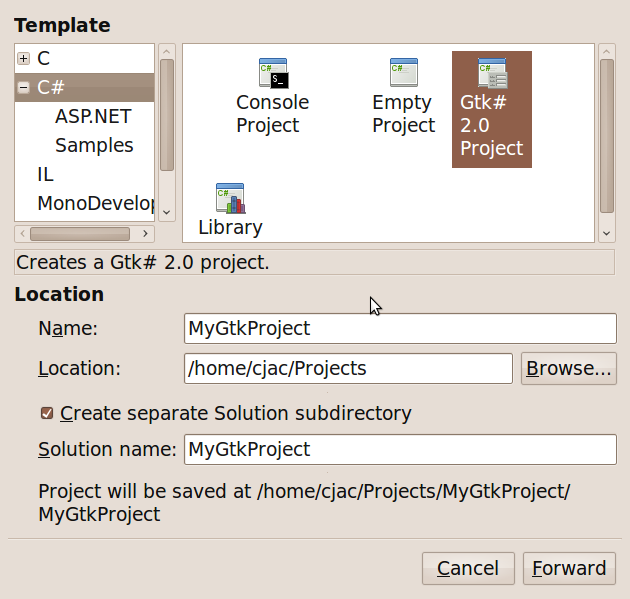
This is a quick tutorial for getting a first gtk-sharp app up and going.
Install MonoDevelop
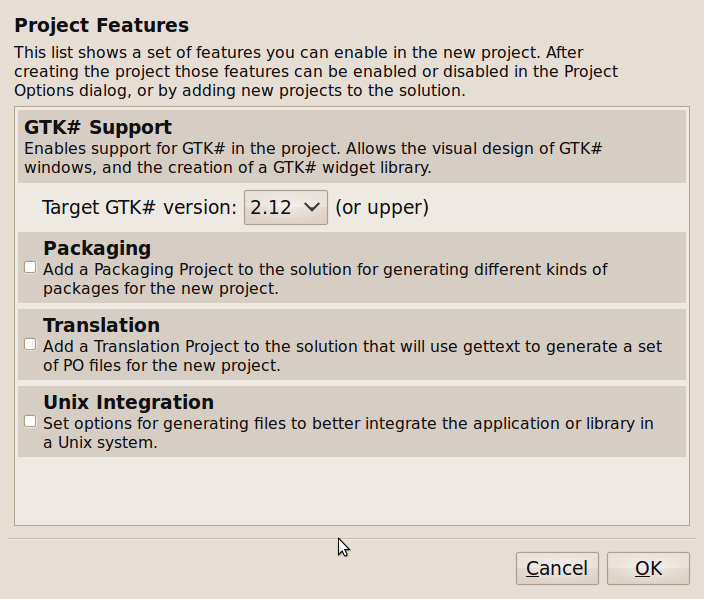
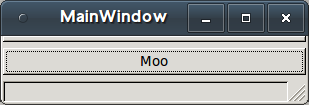
$ sudo apt-get install monodevelop libgtk2.0-cil-devStart MonoDevelop It ll be in your GNOME application menu under Applications->Programming->MonoDevelop Create a new Gtk# Project Run project You can run this boilerplate by pressing Ctrl-F5 Using the Designer Double-click on the file named MainWindow.cs in the Solution section. When the file opens, click the Designer button below the code view. The Toolbox To add the Toolbox, press Alt-Shift-B or click View->Toolbox. Drag a VBox widget from the Toolbox to the main window. Drop a Menu Bar widget into the top cell of the VBox, and a Statusbar into the bottom. Properties grid Drop a Button widget into the middle cell of the VBox.
protected virtual void MyButtonClickHandler (object sender, System.EventArgs e)
var contextId = this.statusbar1.GetContextId("clicked");
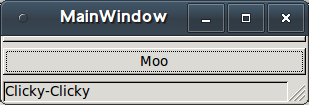
this.statusbar1.Push(contextId, "Clicky-Clicky" );
Modify button layout
The size of the running window is a little weird. I fixed mine by un-setting the Auto Size boolean and setting the Expand and Fill in the Box Child Layout section of the Properties grid.
Exercise button click handler
Run your application with Ctrl-F5 and click on the button. You should see the new string show up in the status bar at the bottom left of the window.
Add Menu items
I've put up a proposal for the Debian part of the Google Summer of Code 2010 and this proposal is based on previous work with edos-debcheck for Emdebian Grip. It started from a simple mailing list post. Sorry, the only response here is "Don't Do That Then"
# update-alternatives --config libblas.so.3gf There are 3 choices for the alternative libblas.so.3gf (providing /usr/lib/libblas.so.3gf). Selection Path Priority Status ------------------------------------------------------------ * 0 /usr/lib/atlas-core2sse3/atlas/libblas.so.3gf 55 auto mode 1 /usr/lib/atlas-base/atlas/libblas.so.3gf 35 manual mode 2 /usr/lib/atlas-core2sse3/atlas/libblas.so.3gf 55 manual mode 3 /usr/lib/libblas/libblas.so.3gf 10 manual mode # update-alternatives --config liblapack.so.3gf There are 3 choices for the alternative liblapack.so.3gf (providing /usr/lib/liblapack.so.3gf). Selection Path Priority Status ------------------------------------------------------------ * 0 /usr/lib/atlas-core2sse3/atlas/liblapack.so.3gf 55 auto mode 1 /usr/lib/atlas-base/atlas/liblapack.so.3gf 35 manual mode 2 /usr/lib/atlas-core2sse3/atlas/liblapack.so.3gf 55 manual mode 3 /usr/lib/lapack/liblapack.so.3gf 10 manual modeThanks to this, it is just trivial to switch from one to the other... Conclusion:
Last year, I had a great time participating in the Google Summer of Code with the Debian project. I had a neat project with some rather interesting implications for helping developers to package and maintain their work. It s still a work-in-progress, of course, as many projects in open source are, but I was able to accomplish quite a bit and am proud of my work. I learned quite a bit about coding in C, working with Debian and met some very intelligent people.
My student peers were also very intelligent and great to learn from. I enjoyed meeting them virtually and discussing our various projects on the IRC channel as the summer progressed and the Summer of Code kicked into full swing. The Debian project in particular also helps arrange travel grants for students to attend the Debian Conference (this year, DebConf10 is being held in New York City!). DebConf provides a great venue to learn from other developers (both in official talks but also unofficial hacking sessions). As the social aspect is particularly important to Debian, DebConf helps people meet those with whom they are working with the most, thereby creating lifelong friendships and making open source fun.
I have had several interviews for internships, and the bit of my work experience most asked about is my time doing the Google Summer of Code. I really enjoyed seeing a project go from the proposal stage, setting a reasonable timeline with my mentor, exploring the state of the art, and most importantly, developing the software. I think this is the sort of indispensible industry-type experience we often lack in our undergrad education. We might have an honours thesis or presentation, but much of the work in the Google Summer of Code actually gets used in the field.
Developing software for people rather than for marks is significant in a number of ways, but most importantly it means there are real stakeholders that must be considered at all stages. Proposing brilliant new ideas is important, however, without highlighting the benefits they can have for various users, the reality is that it simply will not gain traction. Learning how to write proposals effectively is an important skill and working with my prospective mentor (at the time he later mentored my project once it was accepted) to develop mine was tremendously useful for my future endeavours.
The way I see the Google Summer of Code is, in many ways, similar to an academic grant (and the stipend is about the same as well). It provides a modest salary (this year it s US$5000) but more importantly, personal contact with a mentor. Mentors are typically veterans in software development or the Debian project and act in the same role as supervisors for post-graduate work: they help monitor your progress and propose new ideas to keep you on track.
The Debian Project is looking for more students and proposals. We have a list of ideas as well as application instructions available on our Wiki. As I will be going on internship starting May, I have offered to be a mentor this year. I look forward to seeing your submissions (some really interesting ones have already begun to filter in as the deadline approaches).
I m working for a customer who s using IBM blades. Remote access isn t limited to e.g. SoL but also possible through a Remote Console feature using a Java applet.
After migrating one of my 32bit systems to a fresh 64bit system I suddenly couldn t use this Remote Console feature any longer. The error message was (leaving it for search engines and help other affected users):
load: class vnc.VncViewer.class not found. java.lang.ClassNotFoundException: vnc.VncViewer.class at sun.plugin2.applet.Applet2ClassLoader.findClass(Applet2ClassLoader.java:152) at java.lang.ClassLoader.loadClass(ClassLoader.java:303) at java.lang.ClassLoader.loadClass(ClassLoader.java:248) at sun.plugin2.applet.Plugin2ClassLoader.loadCode(Plugin2ClassLoader.java:447) at sun.plugin2.applet.Plugin2Manager.createApplet(Plugin2Manager.java:2880) at sun.plugin2.applet.Plugin2Manager$AppletExecutionRunnable.run(Plugin2Manager.java:1397) at java.lang.Thread.run(Thread.java:619) Caused by: java.net.ConnectException: Network is unreachable at java.net.PlainSocketImpl.socketConnect(Native Method) at java.net.PlainSocketImpl.doConnect(PlainSocketImpl.java:333) at java.net.PlainSocketImpl.connectToAddress(PlainSocketImpl.java:195) at java.net.PlainSocketImpl.connect(PlainSocketImpl.java:182) at java.net.SocksSocketImpl.connect(SocksSocketImpl.java:366) at java.net.Socket.connect(Socket.java:525) at sun.net.NetworkClient.doConnect(NetworkClient.java:161) at sun.net.www.http.HttpClient.openServer(HttpClient.java:394) at sun.net.www.http.HttpClient.openServer(HttpClient.java:529) at sun.net.www.http.HttpClient.<init>(HttpClient.java:233) at sun.net.www.http.HttpClient.New(HttpClient.java:306) at sun.net.www.http.HttpClient.New(HttpClient.java:323) at sun.net.www.protocol.http.HttpURLConnection.getNewHttpClient(HttpURLConnection.java:860) at sun.net.www.protocol.http.HttpURLConnection.plainConnect(HttpURLConnection.java:801) at sun.net.www.protocol.http.HttpURLConnection.connect(HttpURLConnection.java:726) at sun.net.www.protocol.http.HttpURLConnection.getInputStream(HttpURLConnection.java:1049) at java.net.HttpURLConnection.getResponseCode(HttpURLConnection.java:373) at sun.plugin2.applet.Applet2ClassLoader.getBytes(Applet2ClassLoader.java:458) at sun.plugin2.applet.Applet2ClassLoader.access$000(Applet2ClassLoader.java:46) at sun.plugin2.applet.Applet2ClassLoader$1.run(Applet2ClassLoader.java:126) at java.security.AccessController.doPrivileged(Native Method) at sun.plugin2.applet.Applet2ClassLoader.findClass(Applet2ClassLoader.java:123) ... 6 more Exception: java.lang.ClassNotFoundException: vnc.VncViewer.classThe error message might not be obvious at a glance and that s why I m writing about it actually. It s NOT the:
load: class vnc.VncViewer.class not found.why it s failing but instead the real reason for the failure is the:
java.net.ConnectException: Network is unreachableAs you can read in Debian s Bug Tracking System in bug #560044:
Netbase has recently introduced the sysctl-settingTo quote /etc/sysctl.d/bindv6only.conf:
net.ipv6.bindv6only=1 in /etc/sysctl.d/bindv6only.conf and this setting will probably be the default in squeeze. This setting breaks networking in java, and any traffic will always
result in a java.net.SocketException: Network is unreachable .
When disabled, IPv6 sockets will also be able to send and receive IPv4 traffic with addresses in the form ::ffff:192.0.2.1 and daemons listening on IPv6 sockets will also accept IPv4 connections. When IPV6_V6ONLY is enabled, daemons interested in both IPv4 and IPv6 connections must open two listening sockets.To work around this issue you can either execute the Java process through "java -Djava.net.preferIPv4Stack=true" or to change the IPv6 behaviour system wide execute "sysctl -w net.ipv6.bindv6only=0". To make this setting permanent across reboots adjust the setting inside /etc/sysctl.d/bindv6only.conf. After applying this workaround the Remote Console should work again.
Next.