Search Results: "tim"

11 July 2011

Thorsten Glaser: [Update] Big Brother , or: Help wanted arguments against monitoring employees

English version of this posting lese stattdessen die deutsche Version The head system administrator of a henceforth unnamed company I happen to be employed at wants to force us to use the shell s persistent history feature disabled by default in mksh as is sensible, for privacy reasons on all systems, so he can retrace what we do (of course, his wording was more like, so he can reconstruct how I fixed a problem the last time it occurred yeah, sure). Now I ve escalated this to the boss, since this just cannot happen, what ll be next, video monitoring our offices or what and the boss said he sees my concerns and would like a meeting to get an agreement between all parties involved. Most sysadmin coworkers actually don t even think about this, they are sheeple, really; but my project manager (for when I m not a sysadmin but a programmer) and the leaderess of our QA department agree with me, luckily. Now I m in dire need of arguments, especially German-Legalese, to fight this total surveillance of employees, mostly targetted at these who use the command line almost exclusively, which I m a prime example of. Please mail me at my address, which is not junk@mirbsd.org but with tg instead of the waste part here to catch address grabbers (sending mail to that address yields a 24-hour total blacklist of your IPv4 address I ve yet to get enough spam via IPv6 to say filtering it is worth the cost). Thanks in advance!


Update 2011-07-12: We talked, and it was agreed to not force a shell history; instead I will now put problem solutions into smallish scripts and commit them into the sysadmin SCM. It was not solved using legal arguments, as many people commented would have been difficult; instead, they acknowledged that I was concerned with this, and we searched for a different solution to the head sysadmin s original concerns (apparently, to figure out how to fix things without reinventing the fix every time, and to find out what was changed on a server in case it breaks).

Thorsten Glaser: New releases

You might have noticed the release of mksh R40 recently, after more than a year of development. Well, stay tuned for both R40b (with accumulated fixes) and R41 (intent to speed up array handling a lot and prepare for what we postponed to mksh R42 now associative, multi-dimensional arrays). You should also upgrade, if you have not yet done so, to kwalletcli 2.11. Finally, jupp 3.1.15 was left out to the world, including Minix 3 users this time, by special request of one of these on our mailing list. In addition to the MidnightBSD mport which has been there in like forever and the MirPort and the FreeWRT package, in December 2011 a user submitted it to FreeBSD ports, and Benny is going to add it to NetBSD pkgsrc soon, he said. (He also updated their mksh source package. Thanks!) I ve been asked by two people, independent from each other, when I ll upload it to Debian proper, instead of the private-repo packaging. Maybe I should indeed do that, comments?

Thorsten Glaser: Yugoslawia, I ll be back

So yes, this means I m going to DebConf 11 to what used to be Yugoslawia when I was there the last time, although in the Pore region of Istria, Hrvatska. Thanks to my my boss who s sending me there.

Raphaël Hertzog: 7 tips to file useful Debian bug reports and get your problem solved

Filing bug reports is the most common way for users to contribute. Even if it s not too difficult, I ll give you some advice to improve the quality of your reports. After all, when you go out of your way to report a bug, it is in the hope to see it fixed so let s see how we can make this more likely. 1. Try to reproduce the bug If you can t reproduce the bug, it s next to impossible to find the root cause and thus to fix it. In that case, I would suggest you to wait until you experienced the bug multiple times. Maybe you ll be able to find something that triggers it (or that makes it more likely to encounter it). If the application has a debug/verbose mode, it might be a good idea to enable it until you experience the bug a second time. The generated log might be helpful for the developer to understand what happens exactly. So don t file bug reports straight away unless you can reproduce it. The exception to the rule is when the application gives some useful information like a core-dump, a back-trace or an error message. Obviously if the bug happens during an upgrade, it s difficult to reproduce it (unless you have multiple computers) but you should still report it. Be sure to include all the relevant information (versions of packages before and after the upgrade, logs of the upgrade, etc.). 2. Do your best to identify the faulty package When you report a bug to Debian, you must assign it to a package. While there are pseudo-packages useful for problems which are not directly attributable to a real package, in most of the cases you should report a bug against the specific package that seems to be the cause of the problem you encountered. In turn this often requires you to attribute the problem to a file (for example the executable of the application that triggers the bug). Once you have a filename you can use dpkg -S to identify the corresponding package.
$ dpkg -S /usr/bin/hamster-time-tracker
hamster-applet: /usr/bin/hamster-time-tracker
Note that reportbug accepts a filename as parameter and will do the above conversion for you. If you only know the name of the application (but not the filename of the associated executable), you can use dpkg -S with a pattern to let it return all possible matches:
$ dpkg -S hamster
hamster-applet: /usr/share/applications/hamster-applet.desktop
hamster-applet: /usr/share/gnome/help/hamster-applet/es/statistics.page
[ ]
hamster-applet: /usr/bin/hamster-time-tracker
[ ]
Or you can also verify in the list of installed packages:
$ dpkg -l "*hamster*"
Desired=Unknown/Install/Remove/Purge/Hold
  Status=Not/Inst/Conf-files/Unpacked/halF-conf/Half-inst/trig-aWait/Trig-pend
 / Err?=(none)/Reinst-required (Status,Err: uppercase=bad)
 / Name            Version         Description
+++-===============-===============-==============================================
ii  hamster-applet  2.32.1-1        time tracking applet for GNOME
3. Verify that the bug is not already reported and/or fixed If there s a newer version of the software available, it s a good idea to try to reproduce the problem with this version too. Because the developers tend to care only about the latest version, they will want to reproduce it with this version, and they will be annoyed if the problem that you reported is already fixed. That s why bug reports of users of testing/unstable tend to be more useful than bug reports of stable users. In any case, you want to verify that the bug has not yet been reported: filing a duplicate bug is useless and only generates more work for the developers to merge both bugs together. On the opposite, it s highly appreciated to add supplementary information to an existing bug report, even a simple confirmation that the bug still exists on a newer version is useful. Note that reportbug will automatically show you the list of open bugs before allowing you to submit a new one. 4. Use reportbug While the Debian bug tracking system allows anyone to submit a new bug with a simple mail, you should really use a dedicated program like reportbug (or reportbug-ng) because it will automatically include lots of useful information in the generated report (version of dependencies, current architecture, etc.) and will assist you in all the steps. 5. Describe the problem so that the developer can reproduce it Ideally your report should include everything required so that the developer can reproduce the problem on his system. If a given document triggers the bug, attach it. Describe the steps required to reproduce the bug in great details just like you would explain it to your grand-ma. Explain how you expected the program to react and what happened instead. You can learn much more on how to draft a good bug report in this article: How to report bugs effectively. It s a bit long but well worth it if you intend to report bugs and thus interact with developers. 6. Be kind and willing to help When you draft a bug report, keep in mind that you re writing to a volunteer free software developer and not to a customer service. You should be respectful and follow the usual rules of courtesy. Developers attention is scarce and should not be wasted. Be willing to help, if the developer starts investigating your problem, he might need your help to get supplementary information (in particular if he can t reproduce it) and you should be ready to provide it. Thus it s important to keep whatever you need to reproduce the problem. In some cases, the Debian maintainer might be overworked and you can offer your help to forward the bug to the upstream bug tracker, it s always appreciated. If you re reasonably confident that the problem is not Debian-specific, you can do it straight away and set the forwarded field to the URL of the upstream bug report (for example with bts forwarded <bug> <url>). 7. Use the correct severity The Debian bug tracking system lets you set the initial severity of the bug report (in decreasing severity: critical, grave, serious, important, normal, minor, wishlist). Pick the correct severity according to the official definitions but don t misread them. In particular, don t over-inflate the severity: for instance if you lost some data due to a misuse of the software, it s not critical (i.e. rm -rf * doesn t warrant a critical bug against rm). If you use only a tiny part of a software, and that part doesn t work, the package might be unusable for you but it s not unusable for everybody, so it doesn t warrant the grave severity. The important severity is often a good choice in those cases. Do not under-estimate the severity either, if a problem is important enough that it must be fixed before the next stable release (for example a regression compared to the previous release), pick a release-critical severity (i.e. at least serious ). The maintainer and the release manager can always lower the severity if they do not agree with your initial judgment. And now, happy bug-reporting!
Follow me on Identi.ca, Twitter and Facebook. Or subscribe to this blog by RSS or by email.

6 comments Liked this article? Click here. My blog is Flattr-enabled.

10 July 2011

NeuroDebian: NeuroDebian@HBM2011.ca

NeuroDebian@HBM2011.ca On June 26-30 the annual meeting of the Organization for Human Brain Mapping (HBM2011) took place in Quebec City, Canada. Encouraged by our positive experience at last year s SfN in San Diego and enthusiasm of our scientific adviser, James V. Haxby, we hosted another NeuroDebian booth. The setup was pretty much the same as last year: Some chairs and tables, lots of people, our tri-fold flyers, a Debian mirror and some virtual machine images to show Debian in action. This time we also had an LCD display attracting visitors with the package swarm, some demos, and our recent paper. We had many curious people have their first exposure to Debian, long-time users expressing their gratitude to Debian, and our upstream developers getting together to discuss various topics. Having registered the booth as NeuroDebian , we had the additional pleasure of explaining visitors the concept of a project inside Debian, in contrast to a derived distribution. But that is nothing new really, so let s talk about the differences from last year s booth. First of all, we had more people at the booth. Dominique Belhachemi volunteered to help us out and that was very much appreciated. Although HBM has only about a tenth of the attendees that SfN has, we had significantly more traffic. While last year people were primarily interested in knowing about the project, this time many of them wanted to give it a try immediately. People came with their laptops, got the VM images and started playing with Debian. After a day or so, some came back and asked for recommendations on particular software after having been exposed to the wealth of the Debian archive. What also had increased was the number of developers, or rather research labs developing neuroimaging software that came to the booth to discuss how to get their software into Debian and how to arrange ongoing maintenance of these future Debian packages. As we have our plates already quite full, we have been spending some time on mentoring interested developers to learn the art of Debian packaging and making them familiar with Debian s procedures and standards (e.g. working on #609820 with Yannick Schwartz, upstream, at the booth). ../../_images/BusyBooth216.jpg Two promising new developments need to be mentioned. First, we were approached by companies that develop hardware for brain-imaging and psychophysics research. They were curious to learn about Debian as an integrated platform that offers free software solutions that an increasing amount of their customers demands (e.g. PsychoPy). Apparently, the movement towards open research software has finally made it into the business plans of companies, as they seem to start perceiving compatibility with free software systems as a competitive advantage. We explained how software gets into Debian, and how its release cycle is managed. To foster their motivation we also pointed them to the existing open-source software that is already available or even present in Debian. Let s see whether we see more Debian-certified research products in the future. Lastly, we started talking with folks from the INCF to explore possibilities of collaborating on INCF projects using Debian as the integration and development platform. The INCF is an OECD-funded organization that develops collaborative neuroinformatics infrastructure and promotes the sharing of data and computing resources to the international research community. At least one INCF project is already relying on the efforts of the NeuroDebian project. We are going to continue this discussion during a workshop in September. A report will follow...
../../_images/DDs13.jpg

Debian people at the booth (f.l.t.r): Michael Hanke, Yaroslav Halchenko, Stephan Gerhard, Dominique Belhachemi. Not shown: Swaroop Guntupalli.

Acknowledgments This booth has been made possible by the generous support of Prof. James V. Haxby (Dartmouth College, New Hampshire, USA).

Christian Perrier: 33094 spam posts removed from Debian mailing lists in two years

Debian mailing lists' standard policy is to allow posts from unsubscribed users. That of course fits our standards for opened development but has the drawback of allowing a lot of spam to reach our mailing lists. This spam also clutters the mailing lists archives. Since 2009, a working system allows removing spam from the mailing list archives. Today, I would like to put some light on the results of this system : Results are impressive for mailing lists where a coordinated effort is done over time: the debian-boot mailing list (first coorindated effort, initiated by regretted Frans Pop), the Italian and French mailing lists. You want to help? You can. Reporting spam is as easy as reading Debian mailing lists. When you see a mail that you consider being a spam mail, just bounce it to report-listspam at lists dot debian dotte org. Don't forward it, you need to bounce it ("b" keyboard shortcut in mutt). Alternatively, you can check for this message on Debian mailing lists archives and hit the "Report as spam" button. If you're a Debian developer, you can help in reviewing nominated spam. It takes me about 20 minutes every week. Go to the spam review home page and register for an account there. Then, you'll be able to process through nominated posts. Once a given post is confirmed as spam by at least 3 reviewers with nobody else reporting it as "ham", it is removed the next week from the archive. Feel free to join the game and be part of the Debian moppers team!

James Morrison: Code reviews

I'm reading through http://scientopia.org/blogs/goodmath/2011/07/06/things-everyone-should-do-code-review/. So, I'll make my comments here since I expect they will be long. As a caveat, I still work at Google and have done a lot of code reviews. I've made a lot of mistakes while code reviewing, I've had difficult code reviews, but my biggest problems were non-code reviews. The caveat is for most of the code reviews, I know the code being changed better than the person changing the code.

I'll reply to sections as I come across them: "Given a problem, there are usually a dozen different ways to solve it. Andgiven a solution, there's a million ways to render it as code. As a reviewer, your job isn't to make sure that the code is what you would have written - because it won't be.". I disagree with this. There are many times where code is first written in a (1) Ignorant way (2) Sloppy way (to try to save trivial amounts of work). I agree that the code probably won't be the way the reviewer wrote it, but it is good to comment on how it could have been written. Many times the reviewee isn't familiar (or ignores) with the idiomatic style of a larger bit of code.

"The second major pitfall of review is that people feel obligated to say something.". It's fine to say something, but if that's what you say most of the time then you are wasting the reviewee's time. If you do a first pass and don't find anything, you should go back and read the code and be sure that you understand it. Most times I've seen people say nothing is that they don't want to know what the new (or changed) code does.

The last section is about speed. For speed there are two types of code reviews, one which is quick, small and fixes something important. Those should only take one round and typically only need the reviewer to ask for tests. Then there is everything else, which includes small and unimportant. For those, it's ok to take more time to start the review, but each iteration should get smaller and faster.

For anyone that's gotten this far, I guess I can say my comments about Mark's blog post are purely bike shedding, but that's something with code reviews, it's ok to say you think the bike shed should be neon pink as long as you don't force the reviewee to paint the bike shed neon pink.

9 July 2011

Stefano Zacchiroli: debconf11 video hardware

And Now For Something Completely Different There are those weird coincidences that flock together and have the power of subverting initial expectations. Something like that has happened to me this week, when I've ended up spending a considerable amount of my IRILL work time (you know, something like 1000% of it) as a Debian Video Team volunteer. Mean as I am, I'm not going to explain the concatenation of coincidences. Suffices to say that most of the video hardware meant to be used at DebConf11 ended up being in my IRILL office. Of course all of it for about 200 kg and 2000 liters was in need of some inventory, packing, and shipment love. Together with Holger, Mehdi, and Etci we have tamed all of it. The following box miscellanea will therefore soon be on its way to Banja Luka:
DebConf11 video hardware
As an undesirable side effect, I had to join Bdale's knows more about ATA than he'd like to -club.
Holger opted not to join the club and I really can't blame him.

Wouter Verhelst: Freedom, continued

Okay, so the story continues: Joe Brockmeier has posted a rebuttal to Nina Paley's post that I commented on earlier today. Basically, Joe says that Culture is not the same things as Software, and gives a lot of arguments as to why this would be true. But I can't agree with him. Let's see why. His first argument is "One of these things is not like the other". As in,
But it's far more reasonable and sensible to discuss Perl scripts and software written in assembler embedded on a chip together, and the rights that they come with, than to try to talk about rights to modify sculpture and essays.
I don't see how one could combine a perl script with an embedded assembler program, except perhaps over a network, or by using exec() two cases in which the FSF would consider that they are not even derivatives anymore, they are "at arm's length", and it would be legal to do something like this if one bit was released under the GPL while the other was not. At the same time, it's possible to engrave (part of) an essay into a statue, for example. Or make a technical apparatus which looks like a statue but which will play music if you come near it. Both would be valid cases of some artist combining two separate and (at first sight) distinct things into one work.
Sure, you could crowdsource sculpture, but I doubt it will have much practical application. (And certainly difficult over the Internet, but I digress...)
It's called RepRap, and it's very much possible over the Internet. Joe moves on, with 'Unintended consequences of forkable prose'.
Take the GNU Manifesto, for example. If you could "fork" the manifesto, I could easily see variant versions modified to justify open source instead of free software.
This argument had been brought forward during the discussions which Debian had on the GFDL vote, and has been seriously debunked there. In short: the ability and right to fork someone's prose does not, in any way, give you the right to misrepresent them. While I believe it should be okay for someone to base a theoretical Open Source Manifesto on the GNU Manifesto, I do not believe it should be okay for them to still keep calling it the GNU Manifesto. It's not the same thing anymore, so that should be clear. This is true within Free Software as well: if you fork, you give it a new name, so it becomes clear that you're not the original anymore. Moreover, I doubt the kind of prose found in the GNU Manifesto is the same kind of prose that Nina would like to see in a free culture movement. Not because the GNU Manifesto is a bad piece of writing it isn't but because Free Culture likely focuses on other things than manifestos. Next, we get "Solving a problem that doesn't exist"
The spark that fired off the GNU revolution was a legitimate problem because of non-free code, a user was unable to make use of hardware they (or their university) legitimately owned.
(...)
While Paley and others may want the same freedoms to go with cultural works, it is not a real problem in the same sense.
Pardon ye me? I am a musician. Not a very brilliant one, mind you, but I play the flute with much enthusiasm, and have done so in a number of places. If you've been to any debconf since 2007, surely you must've heard me play. Also, I've been singing in choirs since I was sixteen which, I just realized, means I've now been singing for more than half my lifetime. Time flies, it must be said. One of the orchestra that I've been playing in was an extended flute choir with a rather unusual instrumentarium: apart from 30-something flautists, the orchestra also had a piano and drummer, a number of guitar players, and a bass guitar. Such an unusual set of music means you have three options: you play original music, written specifically for your group; you play something written for a different set of instruments, without changing anything, and hope nobody notices that it doesn't actually sound very well; or you make modifications. You make a derivative work of the music, so you can actually play it. There, I've said the word. This isn't just true for music; I've yet to see the first theatre performance that is true, word-for-word, to the original script. Also, movies use music all the time. When they do, there are usually two options: either they have original pieces of music written specifically for their movie (as is the case for most Hollywood blockbusters), or they take a piece of existing music, and adapt it so it fits the events in the movie better. By, say, shortening it, so it doesn't run into the next scene. Or by repeating the refrain an extra time, so the words line up nicely with the action. Or by having a group of musicians record a version of that piece specifically for your movie, which is the same thing in everything except the speed so that the feet of the actor walking on the big screen hit the ground in sync with the music. Or... well. You get the idea. By claiming that artists have no need to modify and derive from others, the only thing Joe accomplishes is to show that he really, really, really doesn't know what the fuck he's talking about. Artists have a need to modify other artists' works all the time. The only difference with free software is that they either need to invoke the fair use clause, or need to pay big bucks to the original rightsholder. Sound familiar? Joe finishes up with stating that despite all of that, Free Culture is still possible. And:
That doesn't mean that free culture is impossible. It simply means that different standards apply.
Exactly: different standards apply. And why? There is no good reason for that. Because people make money from cultural works? Well, money is made from software, too, that has never been a good enough reason. Because Culture is not functional? How many in the Free Software movement would even be willing to only be doing software all the time, and not ever do anything remotely related to Culture? None, I would say. Culture is just as functional as Software, it just serves different functions. In the comments, Joe clarifies that he isn't against people preferring not to use the ND clause in the CC licenses they select, he's just against demanding that others do the same. That argument would make sense if not for the fact that the FSF demands, mostly, that Software Should Be Free!!1!. By not complaining about the GNU Manifesto, but complaining about Paley's "Rantifesto", which basically complains about the lack of such an environment in the free culture movement, Joe just makes a fool of himself. Anyway, 'nuff said.

Wouter Verhelst: On Software (and Cultural) Freedom

Nina Paley, author/actor/director/animatrist of the excellent sita sings the blues, blogs about the FSF's double standards when it comes to freedom. To the FSF, Software Should Be Free!!1!, and it is willing to go to great lengths to accomplish that. For example, the FSF will create dracionian requirements on their Hardware endorsement criteria, that will most likely render it unusable, just for the remote possibility that they might convert a single soul to their religion. They will add propaganda to their documentation, and slap on a license that makes it illegal for anyone to modify or remove that propaganda. They will claim to make an update to that license, just to make their friends happy, but then do not make any effort to finish the job. Most of all, the FSF is led by a person who deserves our respect for jumpstarting a movement that has made all this free software even possible, but whose atypical behaviour might be interfering with his message these days. I have stated before that I'm not a member of the FSF, and that 'I have my reasons'. In case you were wondering: the above are my reasons. I can't be a member of, or be supporting of, any organization that uses such double standards in anything. In the case of Debian, it took us a long time to come to the conclusion that the GNU FDL is a non-free license. And though we came to that conclusion through other arguments than "Culture should be free, too" (specifically, the arguments boiled down to "if it's digital, it's software, and software should be free"), I have since come to the conclusion that there is nothing special about 'digital stuff' that should mean it should be more free than 'non-digital stuff'. If I hand you a piece of music on a sheet of paper, why should you not have the right to redistribute and/or modify that, while you should have the exact same right if I were to hand you the exact same paper on a digital medium? That makes no sense. So, in short, I agree with you, Nina: there is no Free Culture movement, and that's a shame; and while it would be nice if the FSF were to take a lead role in guiding such a movement, I find it highly unlikely that they will. The FSF may claim they care about Freedom, that doesn't mean they do; they care about Software Freedom. And while that certainly was an issue thirty years ago, when the FSF was formed, it isn't so much anymore today. There can only be one conclusion: the FSF is obsolete.

Wouter Verhelst: CUPS: ghaaah!

So I have a postscript color printer. This is nice, because I can just throw postscript at it, and it will provide me with a hardcopy of whatever that postscript describes. Since postscript is what Unix-like systems like most, that's great. Today, I needed to print something. It had been a while, and apparently some things in sid that are related to printing had changed, because it did not work anymore. I don't print every day (I absolutely don't print every day), so it had been, well, "a fair while" since I last used it. Of course it didn't work. Of course, it is not the first time this happens. Every so often, my printer loses track with the cups installation on my server, and then I have to prod it a bit usually by restarting the printer or the CUPS server, or both and then it works again. The usual CUPS failure mode is that the printer was not available when I tried to print something, which causes CUPS to mark the printer as 'offline' or something, resulting in it being 'disabled'. The 'cupsenable' command is supposed to fix this, except that once in a blue moon it doesn't. I've learned to live with it. But today was different. Rather than the printer being disabled, something in the printer stack would just discard print jobs. That is, they would show up in the cups queue for a moment, and then disappear. I wouldn't get a piece of paper with something useful on it. I would just get nothing at all. This featureful printer supports syslog, and so I told it to send syslog messages to a useful system somewhere on the network. But that didn't produce anything interesting. It would tell me when the system had been powercycled, sure, but not why something would fail. After trying many things for about an hour, sick of it all, I purged CUPS off my system and reinstalled it, then had it search for a printer again. It did find the printer through zeroconf messages, and I allowed the autoconfiguration stuff do things as it saw fit. When I asked it to print the exact same postscript file again, something came out of the printer. Finally, I thought, "success"! Except it wasn't. Instead, the printer just produced gibberish. It turned out that cups had decided that my HP 2550n network-enabled postscript laserprinter was instead a HP 9xx-something USB-only PCL printer. Going back to the configuration interface and telling it to use the 2550n ppd file instead got me back to square one: the print job would appear in the print queue for a few seconds, then magically disappear. At this point I was using 'tail -F' to monitor any logfile that might remotely be related. /var/log/cups/*, /var/log/syslog, /var/log/daemon.log, you name it. But nothing gave me any remote clue what was happening with the postscript that I'd been throwing at cups. So I used netcat. This printer supports LPR, but will also accept postscript on port 9100 (I forgot what HP calls it), so a simple 'nc printer 9100 < foo.ps' should in theory just produce a printed page. And since someone told me that a "modern" (yeah, right) Linux printing system uses pdf throughout rather than postscript (for what, I don't know), I thought it might've been possible that something somewhere was just mangling the postscript in a way that things would not work anymore. I was right, ut I never expected to e right in this manner.

Did you think this would be listed in the cups logs somewhere? Of
course not! That would be too easy!
But then of course fixing this was fairly easy: just throw the
original file from which this postscript was generated through a
different postscript-generating program, and try again. Magic: suddenly
the printer prints what I want! And it only took me 90 minutes.
Sometimes I wonder what the "userfriendly" police is smoking. Oh
well. 
 

8 July 2011

Joey Hess: thoughts on the last shuttle launch

I watched the final shuttle launch this morning; for several years I've tried to catch shuttle events, knowing it would soon be over, but before that the shuttle had faded into the background for me as it did for so many of us. It was an impractical rocket to nowhere that we mostly only paid attention to when it blew up. Fourteen years ago today, Debian was flying in space aboard Columbia. According to the press release, it ran on an SSD on an embedded 486 in the lab module, and controlled plant watering, telemetry, and video. At the time, I had just become a Debian developer, and was very impressed to be part of a project that was involved in that. It was early days for Debian, and near the midpoint of the shuttle's thirty years. Now it seems likely that Debian, or its derivatives (or at least Free Software) will easily outlast that thirty year run, but I do wonder to what extent our work will fade into the background (and what interesting ways it will find to explode) over that time span and beyond. We'd say we have better methods than the centralized, committee-driven, top-down, PR-conscious NASA... impressive though it can be at its best. We have dreams just as noble as the ones behind the space program, but also goals that are more adaptable, equally at home flying in space, or emebdded in some pocket-lint laden artifact of a perhaps more contemporary inward turn.

6 July 2011

Ritesh Raj Sarraf: Console Gaming - Sony Playstation 3

I have been thinking of this topic for some time. I am a happy owner of the old Phat PS3 Model. At one time, I use to do a fair amount of gaming on my computers. So when Sony marketed the PlayStation 3 product, it was cool to see a machine that did:
  1. Gaming
  2. Movies, Music, Pictures
  3. Blu-Ray
  4. Ran Linux
I convinced myself to buy a PlayStation 3, that I'd use it for playing with Linux apart from gaming. The regular gaming did not excite any more, perhaps it had to do with the limitation of time. On running Debian on it, was when I realized that the Linux support was merely a joke. The Linux support included running a Linux distribution in a VM with not much access to the full hardware resources. Not a Great Experienceread more

John Goerzen: Geeks, Hobbies, and Free/Open Source: Feedback Wanted

I ve been thinking lately about ways to improve ways in which I interact with Free Software projects, and ways in which they interact with me. Before I proceed to take steps or make suggestions, I d like to see if others share my traits and observations. Here are some questions I have been thinking of. If you d like to help give me anecdotal evidence, please post a comment below this post. Identify the question numbers you are answering. It helps me if you can give specific examples, but if you don t have the time or memory for that, no problem. I will post my own answers in a day or two, but the point of this post is listening, not talking, so I ll not post them immediately. Hobbies (General any geeks) Examples: video games might be a challenging hobby (depending on the person) but in most cases aren t educational. A hobby might be video game playing or being a Debian developer. A sub-hobby might be playing GTA IV , playing RPGs , or maintaining mutt . Free/Open Source Hobbies Examples on F9: If, say, you are a long-time Perl user and have gone to Perl conferences, but now you are interested in Ruby, would your involvement with the Perl community cause you to avoid taking up the Ruby programming hobby? Or would it cause you to cut your ties with Perl less quickly than your changing interest might dictate? (This is a completely arbitrary example and isn t meant to start a $LANGUAGE thread.) Changes over time

Dirk Eddelbuettel: Even faster linear model fits with R using RcppEigen

Linear regression models are a major component of every applied researcher's toolbox. Obtaining results more quickly is therefore of central importance, particularly when many such models have to be fit. Common examples in this context are Monte Carlo simulation or bootstrapping. My talks introducing High Performance Computing with R (see e.g. these slides from a five-hour workshop at the ISM in Tokyo) frequently feature an example of how to extend R with dedicated compiled code for linear regressions. Romain and I also frequently use this a motivating examples with our Rcpp package for seamless R and C++ integration. In fact, the examples directory for Rcpp still contains an earlier version of a benchmark for fastLm(), a faster alternative for R's lm() and lm.fit() functions. We have also extended this with the RcppArmadillo package which brings Conrad Sanderson's excellent Armadillo library with templated C++ code for linear algebra to R, as well as a simple integration to the GNU GSL via our RcppGSL package. The Rcpp section on my blog contains several posts about fastLm benchmarks. Doug Bates has been a key Rcpp contributor, helping particularly with the initial Armadillo integration. His research, however, also requires highly performing sparse matrix operations which Armadillo does not yet offer. So Doug has started to explore the Eigen project---a free C++ template math library mainly focused on vectors, matrices, and linear algebra (note that we will refer to the Eigen, Eigen2 and Eigen3 APIs as just 'Eigen' here, focusing on the latest version, Eigen3). Better still, Doug went to work and pretty much single-handedly wrote a new package RcppEigen which integrates the templated C++ library Eigen with R using Rcpp. RcppEigen also provides a fastLm implementation and benchmark script. In fact, it contains a full six different implementations as Doug is keenly interested in rank-revealing decompositions which can guard against ill-conditioned model matrices. Some more background information on this is also available in Doug's article on Least Squares Calculations in R in R News 4(1). Doug's implementation also uses an elegant design. It comprises a base class with common functionality, and six subclasses which specialize accordingly for these six different decompositions approaches: On my server, the result of running the included benchmark script lmBenchmark is as follows:
lm benchmark for n = 100000 and p = 40: nrep = 20
     test   relative elapsed user.self sys.self
7     LLt   1.000000   0.918      0.91     0.00
3    LDLt   1.002179   0.920      0.92     0.00
5 SymmEig   3.021786   2.774      2.19     0.57
6      QR   5.136166   4.715      4.24     0.48
2   PivQR   5.303922   4.869      4.27     0.58
8    arma   6.592593   6.052      6.03     0.02
1  lm.fit   9.386710   8.617      7.14     1.45
4     SVD  33.858388  31.082     30.19     0.84
9     GSL 114.972767 105.545    104.79     0.63
From this first set of results, the preferred method may be 'PivQR', the pivoted QR. Strictly-speaking, it is the only one we can compare to lm.fit() which also uses a pivoting scheme. In the case of a degenerated model matrix, all the other methods, including the four fastest approaches, are susceptible to producing incorrect estimates. Doug plans to make SVD and SymmEig rank-revealing too. As for pure speed, the LL and LDL decomposition have almost identical performance, and are clearly faster than the other approaches. Compared to lm.fit(), which is the best one could do with just R, we see an improvement by a factor of eight which is quite impressive (albeit not robust to rank-deficient model matrices). Apart from the SVD, all approaches using Eigen are faster than the one using Armadillo, which itself is still faster than R's lm.fit(). Doug and I were very surprised by the poor performance of the GNU GSL (which also uses SVD) via RcppGSL. Now, Eigen uses its own code for all linear algebra operations, bypassing BLAS and LAPACK libraries. The results above were achieved with the current Atlas package in Ubuntu. If we take advantage of the BLAS / LAPACK plug-in architecture offered on Debian / Ubuntu systems (see the vignette in my gcbd package for more) and use Goto BLAS which provide tuning as well as parallelism on multi-core machines, the results are as follow:
lm benchmark for n = 100000 and p = 40: nrep = 20
     test   relative elapsed user.self sys.self
3    LDLt   1.000000   0.907      0.90     0.00
7     LLt   1.000000   0.907      0.91     0.00
5 SymmEig   2.981257   2.704      2.14     0.56
6      QR   5.004410   4.539      4.03     0.50
8    arma   5.072767   4.601     15.30     3.05
2   PivQR   5.307607   4.814      4.27     0.55
1  lm.fit   8.302095   7.530      9.55    12.25
4     SVD  33.015436  29.945     29.06     0.85
9     GSL 195.413451 177.240    244.64   319.89
We see that the BLAS-using Armadillo approach improves a little and moves just slightly ahead of the pivoted QR. On the other hand, lm.fit(), which also uses a pivoting scheme and hence only level 1 BLAS operations, changes less. GSL performs even worse (and it is unclear why). Doug's post announcing RcppEigen on the Eigen list has a few more sets of results. This post has illustrated some of the performance gains that can be obtained from using Eigen via RcppEigen. When not using rank-revealing methods, computing time can be reduced by up to eight times relative to lm.fit(). Rank-revealing method can still improve by almost a factor of two. The main disadvantage of Eigen may be one of the reasons behind its impressive performance: its heavily templated code does not use BLAS, and the resulting object code (as e.g. in RcppEigen) becomes enormous (when compiling with debugging symbols). As one illustration, the shared library for RcppEigen on my Ubuntu 64-bit system has a size of 24.6 mb whereas RcppArmadillo comes in at a mere 0.78 mb; without debugging symbols it is a more reasonable 0.52 mb. The performance of Eigen is certainly intriguiging, and its API is rather complete. It seems safe to say that we may see more R projects going to make use of Eigen thanks to the RcppEigen wrapper.

Update: Clarified statement about large object size which was entirely due to building with debugging support.

5 July 2011

MJ Ray: #coops14 continues: Guardian, Facebook, Cyberunions and Breakfast

Thanks to the Guardian for publishing Why co-operatives matter written by two members of our co-op. Co-operative Congress 2011Also today, I m pictured being given a share by Giles Simon of our national co-ordinating co-op on the Co-operatives Fortnight Facebook page. I m not a big fan of facebook and I still want to try the more sharing alternatives that cyberunions reviewed. Speaking of cyberunions, apparently they answer the criticisms from my review in episode six which I still haven t found time to listen to yet and there s an episode seven out already. Maybe I ll start to catch up later today (Tuesday), if I don t go to the Bristol Wireless Annual Meeting. Tomorrow is another busy day, hopefully including the Koha Town Hall Meeting. And there s still half a week of Co-operatives Fortnight to go, so we re not done by a long way yet! If you d like to take part, there s a Co-operative Business Breakfast in Weston-super-Mare on Friday morning at 9am please leave me a comment if you d like to come along.

Rudy Godoy: Compute Clusters Integration for Debian Development and Testing Report 3

Hello this is the third report regarding my project. As usual, quick
summary first. From my last report I have progressed much little than I
would like but, as stated previously also, I m finishing semester
and between exams and projects it takes almost all my time. However, I m
free of academic duties next week and I ll double the speed on the project. What was done so far

- Started working on the modifications to the Eucalyptus code, as
expected.
I ve almost complete the code for the Libvirt s XML Domain
definition. I ve abstracted the wrapper in order to support a broader
number of arches. Previously it was tailored for supporting x86/amd64
based machines. The idea is to have a list of supported arches and
generate the XML file according that. For ARM some parameters and
elements are different than for the others. This would allow for
people to support another architectures, given they are well supported
by KVM-Qemu.
Started working on changes to util/data.c to make sure the correct
parameters are being passed to the XML generator and to libvirt kvm
calls.
- Define and start to setup the testing / demo environment. Basically
involves having one machine to run KVM as hypervisor so the Eucalyptus
handler uses it to run ARM kvm-qemu images.
- Over this weekend I ll be publising the code changes on my
website. Steffen suggested to create some docs regarding the progress
too. I ll do that once I feel I m on track again for my current
pending work, that s coding. What I ll be working over the next two weeks

- My primary goal is to catch up on the work pace and finish the neccesary
code for Eucalyptus to support ARM images. This means to finish
modifications to:
node/handlers_kvm.c handling nc creation. Little changes are need
here from what I ve indentified already.
util/data. c,h handling instance creation. This is the part where
most of the work shall be done. I ve started to work here already.
- Test the code I ve complete already and send the patches to the teams
involved. To date I m still working on a local environment, because no
usable patches have been generated already, just little pieces here
and there.
- Since this is a sort of gluing project, that is code here and there
and make it work together. I m in the process of finding a machine to
be able to test parts of it once they are complete. I m still
contacting people to get such machine, in anycase I gues I can manage
to get one myself. I can t use my current machine since it involves
reinstalling and working at the OS level.
- For the project s demo I ll use both machines, one as the front-end
and the kvm one for NCs (nodes). That s the goal. What is required after that

- I d like to release a package that includes my changes, so it can be
installed either from official packages or my own packages, this
involves:
Updating the packaging bits to the pkg-Eucalyptus repo.
Talking to upstream about it.
- Write the reference Steffen suggested. I believe that I can finish the first part in one week, because of the
work I ve done in the past weeks to understand the Eucalyptus code. I m
also will be talking more to the Eucalyptus team and also to the
maintainers about such changes. I guess that s all for now.

John Goerzen: The Lives of Others

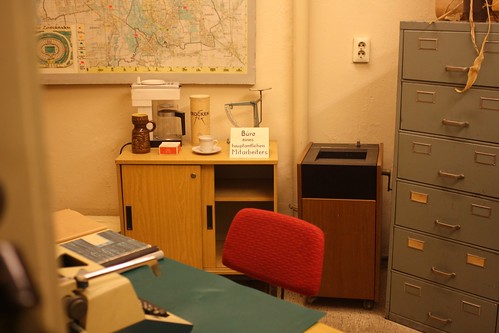
It s not very often that I watch a movie anymore. It s been a few years since I ve actually purchased one (normally I see them from Netflix). But yesterday I saw one that may change that. The Lives of Others is an incredible film set in the former East Germany (GDR/DDR) mostly in 1984. The authenticity of it is incredible and so is the story. It s subtitled, but if you re an American wary of subtitled European films, don t be wary of this one. It is easy to watch and worth every minute. The story revolves around the Stasi, the GDR Ministry for State Security ( secret police ). It is an incredible picture of what living in a police state was like, and how many of the informants were victims of the regime too. My breath caught near the beginning of the film, showing the inside of a Stasi building. A prisoner was being interrogated for helping someone attempt to escape to the west. But the reason my breath caught was this incredible feeling of I was there . Last year, Terah and I were in Leipzig and visited the Stasi museum there, Museum in der Runden Ecke . I always have an incredible sense of history when being in a preserved place, and this building was literally the Stasi headquarters for Leipzig. Much of it was preserved intact, and seeing it in the film brought home even more vividly the terrible things that happened in that building, and others like it, not so very long ago. IMG_2717 We watched the special features on the Blu-Ray disc, and one of them was an interview with director Florian Henckel von Donnersmarck. He described how he spent a lot of time interviewing both victims of the Stasi, as well as ex-Stasi officers. One of the most disturbing things to me was his almost offhand comment that most of the former Stasi officers still had some pride in performing their jobs well. Even now, freed of the state s ideology, they were proud of the work they did which could be put most charitably as ruining people s lives. What leads a person to view life that way? How can we try to make sure it doesn t happen again elsewhere? I am happy to say that most of us have never experienced anything like the Stasi. And yet, small reflections of that mindset can be seen almost everywhere. Societies at wartime or feeling under threat, even Western democracies, can drum up those feelings. In the USA, for instance, the McCarthyism era saw people s careers ruined for alleged anti-state behavior. Contemporary examples include the indefinite detention (I hate that word; shouldn t we say imprisonment ?) of terrorism suspects at Guantanamo Bay, and the terrible treatment of Bradley Manning, who revealed some true but embarrassing things about the US military which really needed to be revealed. Even tobacco farmers and companies are selling a product they know ruins lives, but somehow keep doing it. And there are still members of the public that try to make life difficult for people that don t think like they do. From organizing campaigns of telephone harassment of colleges that don t perform the American national anthem before sporting events, to tossing about the term un-American (a loaded McCarthyist one, which many may not even be aware) at an inflated rate, we are not immune from attempts at forcing conformity or silence in others, and blind loyalty to state. I am never in a particularly celebratory mood on July 4, the biggest day for American boasting, faux patriotism, militarism, and general flag-waving. We do have a lot to be proud of and thankful for, but it seems that we celebrate all the wrong things on July 4, and see it as an occasion to proclaim American exceptionalism rather than as one to see how far we ve come and bolster hope for how far we can, and should, yet go. No, I don t think that the land of the free ought to have operated secret prisons in Europe (nor the Europeans to have been complicit in it), or that the American military was defending our freedom 100% of the time they were deployed, or that it is right for governments to mandate daily recitation of an untrue document (the pledge of allegiance) in schools. And yet, I am mindful that I have a lot to be thankful for stability, lack of much internal violent conflict, etc. And this particular day I am happy that a post like this is not something that gets the attention of some government agency and mostly that I will have a handful of angry emails to delete.

4 July 2011

Joerg Jaspert: DebConf11 - Looks like we will be there

So it finally looks like I will be at DebConf11 too. Including my (then) wife (ohwow, feels weird to write this). At least we just booked the flight tickets. There is a small chance that we still won t make it, but for now it looks good. Lucky beings we seem to be - we found flights going directly to Banja Luka, no need to take train from somewhere like Zagreb or so. (Well, for some values of directly, we have one stop included). We will arrive on Friday the 22nd, afternoon and leave on Sunday the 31st, again afternoon. Since DC6 this is the shortest time I had attending DebConf (DC5 I only did DebConf, not Camp, DC10 I skipped entirely). Somehow feels weird. Update: Well, due to some <censored> we now do have to go via Zagreb and an annoying bus trip. Meh. Should make us arrive on Thursday late night, but still annyoing.

Lucas Nussbaum: Going to RMLL (LSM) and Debconf!

Next week, I ll head to Strasbourg for Rencontres Mondiales du Logiciel Libre 2011. On monday morning, I ll be giving my Debian Packaging Tutorial for the second time. Let s hope it goes well and I can recruit some future DDs! Then, at the end of July, I ll attend Debconf again. Unfortunately, I won t be able to participate in Debcamp this year, but I look forward to a full week of talks and exciting discussions. There, I ll be chairing two sessions about Ruby in Debian and Quality Assurance.

Next.

Previous.