Search Results: "sto"

30 May 2008

MJ Ray: Told You So: Exhibitions and Spammer Registrars

I used to help staff more exhibition stands than I do now. Part of the reason I stopped was that few free software people seem to appreciate the basics of running a good exhibition stand and I got bored of arguing that we should give people space, avoid putting a counter across the stand, keep notes of contacts made and basic stuff like that. So, it was good to read Connecting People: Making an exhibition of yourself - the exhibitor and the linked Business Startup Coach shares Exhibition & Trade show secrets which repeat many points I've made before. Don't want to listen to me? Listen to the marketing experts. Some time after noticing WDPRS, I tried reporting as much spam as possible for a while, to hosters and registrars based on WHOIS details. Some hosts and registrars were good at dealing with spam (Yahoo and walla.net.il were exceptionally good) many were bad (bresnan.net, registrationtek.com, publicdomainregistry.com (PDR), ait.com, omantel.co.om, ttnet.net.tr) and some were ugly (Tucows/OpenSRS wrote back to say they don't do anything about domains they register, while ENom and Moniker never sent human answers). So it's no surprise to see ENom, Moniker, PDR and AIT on the list of
"Top Ten Worst Spam Registrars Notified By ICANN"
ultimately taken from this report.

29 May 2008

MJ Ray: Getting Linux InfraRed Beaming to a Palm III with a Belkin USB Device

I lent someone my old Palm IIIe as a data entry device for an exhibition this week. I don't use it much since I got a Samsung K608i last year. They weren't comfortable with using their smart phone as a data entry device. I can understand that: I'm still pretty slow at phone-typing and it corrupted data when its memory filled recently. The batteries had been removed from the Palm to avoid them leaking, so it needed reloading with useful Palm free software for data entry. The first problem was that I decommissioned bouncing a while ago and that was the last machine to sync with the Palm. I wasn't keen to pull it out of the store cupboard and connect all the wires, but my current desktop machine nail doesn't have a 9-pin serial port for the cradle and that's the only connector on the Palm. Actually, it's not the only connector: the Palm has an InfraRed emitter and I have a Belkin F5U230 USB-IrDA dongle thing. I don't use it that often, but it worked enough to connect nail to the internet through my old mobile phone. That was a while ago and I forgot the specifics, but eventually I noticed the key phrase in the irattach man page:-
"Note that there is another USB driver for those devices called ir-usb which is NOT compatible with the IrDA stack and conflicts with irda-usb. Because it always loads first, you have to remove ir-usb completely."
Sure enough, I checked the lsmod output and found ir-usb there, screwing stuff up. A few modprobe -r commands, then I simply ran
"irattach irda-usb"
and saw the irda0 network device appear. Still one thing to do: beam the actual applications. This was pretty easy because I remembered reading that obexftp defaulted to IRDA sending when I was getting bluetooth working. All I had to do was enter a command like
"obexftp --irda --put db.prc"
and the Palm asked if I wanted to accept it! Yes! First test with obexftpd for receiving files wasn't encouraging, though and I can't see how to use sobexsrv for this: I'll probably write next week whether we get any data off the Palm! The Palm IIIe is too old to hotsync over infra-red, as far as I can tell. I've got a roundabout route through the K608i but it doesn't seem to be very reliable. Anyone got any expert tips?

28 May 2008

Philipp Kern: Debconf 8? Going or not?

Yesterday I got a note from the Debconf organizers about my place in the sponsorship queue (15 of 58). The drawback, however: there is no money to be given out, yet. At least that's what I heared on IRC. The mail sounds a tad different. Considering that I applied for 2300 USD (~1300 EUR) there is no way that I pay this alone, being a job-less full-time student spending the other time with volunteer work. It would be nice to meet up all the other people driving Debian (apart from those I already met at FOSDEM), but considering that I wouldn't even see much of Argentina, well: no. Flights aren't getting cheaper, too. Back then when I searched (February I guess) Lufthansa return flights were offered for 1000 EUR flying non-stop from Frankfurt. I don't might paying a few hundred dollars on this myself, but how are other non-company-sponsored individuals dealing with this notice? (Comments are enabled, but need OpenID. Comments mailed in will be converted if allowed to do so.)

MJ Ray: Kewstoke Annual Village Meeting

Tomorrow (Thu 29th) at 7.30pm is the Kewstoke annual village meeting. That should be my first meeting as a councillor, if I get back from London in time. (I hope I do - councillors who miss meetings get this sort of criticism but at least village councillors aren't paid that much: I think expenses for all 12 or so councillors totalled under 60 last year.) Apart from the two reports, the agenda is a good summary of the challenges affecting the village this year: Cygnet Liaison, Sand Bay Management and the Toll Road.

Wouter Verhelst: Geekdinner

Another interesting geekdinner last night. Since Bart had offered to do some cooking, I offered to do the desert: my favourite, waffles. Unfortunately, Bart kindof misunderstood me, and when he decided that there were too many people for him to cook, he decided that there weren't too many people for me to make waffles. Grunt. Also, he didn't really follow my instructions in buying the ingredients, so I had to improvise a bit. All in all, I think it's safe to say the waffles were a success, so that's okay then, I guess. Anyway, going home was a bit of an adventure... 23:40(ish) – step in the car, leave Paal 00:15 – arrive at Cambio car's home, check out. 00:35 – take train to Antwerp Central station 00:40 – arrive at Antwerp Central, walk to Rooseveltplaats 00:30 – final bus of the evening left home 00:45 – arrive at Rooseveltplaats, decide to walk home, because a taxi is too damn expensive. 02:35 – arrive home, hit the sack. 07:45(ish) – wake up I hate my biological clock. I really do.

Russell Coker: Xen Hosting

I’m currently deciding where to get a Xen DomU hosted. It will be used for a new project that I’m about to start which will take more bandwidth than my current ISP is prepared to offer (or at least they would want me to start paying and serious bandwidth is expensive in Australia). Below is a table of the options I’ve seriously considered so far (I rejected Dreamhost based on their reputation and some other virtual hosts were obviously not able to compare with the prices of the ones in the table). For each ISP I listed the two cheapest options, as I want to save money I’ll probably go for the cheapest option at the ISP I choose but want the option of upgrading if I need more. I’m not sure how much storage I need, I think that 4.5G is probably not enough and even 6G might get tight. Also of course it depends on how many friends I share the server with. Quantact has a reasonable cheap option for $15, but the $25 option is expensive and has little RAM. Probably 192M of RAM would be the minimum if I’m going to share the machine with two or more friends (to share the costs). VPSland would have rated well if it wasn’t for the fact that they once unexpectedly deleted a DomU belonging to a client (they claimed that the bill wasn’t paid) and had no backups. Disabling a service when a bill is not paid is fair, charging extra for the “service” of reenabling it is acceptable, but just deleting it with no backups is unacceptable. But as I’m planning on serving mostly static data this won’t necessarily rule them out of consideration. It seems that linode and slicehost are the best options (Slicehost seems the most clueful and Linode might be the second most). Does anyone have suggestions about other Xen servers that I haven’t considered? XenEurope seems interesting. One benefit that they have is being based in the Netherlands which has a strong rule of law (unlike the increasingly corrupt US). A disadvantage is that the Euro is a strong currency and is expected to get even stronger. Services paid in Euros should be expected to cost more in future when paid in Australian dollars, while services paid in US dollars should be expected to cost less. Gandi.net has an interesting approach, they divide a server into 64 “shares” and then you can buy as many as you want (up to 16 shares for 1/4 of a server) for your server. If at any time you run out of bandwidth then you just buy more shares. They also limit bandwidth by guaranteed transfer rate (in multiples of 3Mb/s) instead of limiting the overall data transferred on a per-monthly basis (as most providers do). They don’t mention whether you can burst above that 3Mb/s limit - while 3Mb/s for 24*7 is a significant amount of data transfer it isn’t that much if you have a 200MB file that will be downloaded a few times a day while interactive tasks are also in progress (something that may be typical usage for my server). Of course other providers generally don’t provide any information on how fast data can be transferred and will often be smaller than 3Mb/s. Also if anyone who I know wants to share access to a server then please contact me via private mail.
ISPRAMDiskBandwidth (per month)Price $US
Linode360M10G200GB$20
Linode540M15G300GB$30
Slicehost256M10G100GB$20
Slicehost512M20G200GB$38
VPSLand192M6G150GB$16
VPSLand288M8G200GB$22
Quantact96M4.5G96GB$15
Quantact128M6G128GB$25
rimuhosting96M4G30G$20
XenEurope128M10G100G$16 (E10)
XenEurope256M20G150G$28 (E17.50)
Gandi.net256M5G3Mb/s$7.50 or E6

27 May 2008

Christian Perrier: Reading blog summary

During the last 4 days, I didn't read Planet. So I started an interesting exercise and wanted to comment very briefly on a few entries I just read quickly to catch up. My Planet premium, so to say..

Stefano Zacchiroli: debian ocaml news

Catching up: some OCaml in Debian news Hei, it looks like I stopped giving updates about OCaml news in Debian, time to catch up. 2 hot news basically:
  1. OCaml 3.10.2 transition is ongoing. Release managers did not forget about our old request of transitioning OCaml to 3.10.2 in time for Lenny, and as soon as the last Perl transition was other they pinged us about the transition. Together with Luk we are now working on it. After some initial issues on arm which was unable to run docbook2html on our poor little policy document without segfaulting(!), it now looks like is not going too bad ... get ready for OCaml 3.10.2 in Debian Lenny!
  2. the "core" OCaml library by Jane St Capital (which I consider a really good replacement for the legacy standard library FWIW) has entered testing a few days ago. It will be released with Debian Lenny, no matter if with 3.10.1 or 3.10.2
Stay tuned!

Joachim Breitner: My first OpenStreetMap Contribution

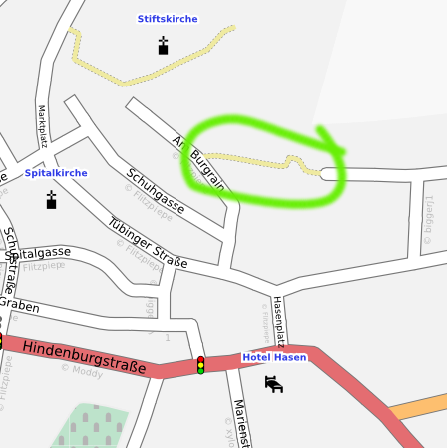
Yesterday I was visiting the Open Source Expo Karlsruhe, a new, quite small conference, at which the guys from OpenStreetMap hat a booth. I was amazed by the progress of OpenStreetMap while I wasn t looking (which is just a few months, I guess); their level of detail in some places like Karlsruhe is astonishing.Anyways, I got hooked and started to try out some of the tools and websites and finally, by tracing the Yahoo satellite image, added my first way to the map: A small footpath in Herrenberg that I know quite well:
The live data can also be seen on the OpenStreetMap map, of course.Unfortunately, there is not much to map around where I live in Karlsruhe, even the driveway to my dorm is included, but maybe I can do some proper mapping (with a GPS device) in Herrenberg someday.

MJ Ray: Fuel Price Bleating and Biking

[Photo of Cyclists]
England swings like a pendulum do! There's another fuel price protest and the coverage in the London press is pretty biased, with occasional balanced reports and very rare dissenting opinion. One of the favourite whines on news-and-nutters phone-ins is "waah, I live in a village, I need my car". While that's true for some people, most villagers could switch to bicycles for many journeys without problems. At the moment, the biggest problem with cycling to town is the number of cars on the small lanes, followed by the number of potholes. Switching to cycling or walking will have a triple benefit: fewer cars on the road will free up space for cycling, wear the roads out less and reduce fuel demand (so petrol should become cheaper for those who really need it). Over the last few days, I've been happy to read Bike The Drive 2008 [Dirk Eddelbuettel], Mountainbike, By Joerg Jaspert and How to Start Bicycling to Work, by John Goerzen. A couple of tweaks to that last one: in England, I don't think that a cycling helmet is necessary. I've not worn one for the last few months (it went mouldy after a rain storm) - I find I can hear traffic better and many drivers seem to give me more room on the road. I wonder if helmet-wearing "dehumanises" cyclists to drivers? The safety data seems rather confused, but it's a personal choice. If you feel safer with a helmet, wear one. I also wear ordinary business or casual clothes, relying on a good quality commuter saddle rather than cycling shorts. I suspect that drivers here are developing a sort of blindness to the "screaming yellow" hi-vis jackets, so I don't wear those - but sometimes I wear hi-vis reflective armbands if I'm wearing black in the dark. I agree completely with the comments on that page about being predictable, Cateye lights and pannier bags. Finally, Bike Week 2008 starts on 14 June, which would be an ideal time to try a group ride - or just get a free breakfast for cycling into town.

MJ Ray: Bristol and Bath Perl Mongers

The first meeting of the new Bristol and Bath Perl M[ou]ngers is tonight (Tue 27th) at 7pm, according to this mailing list post. Despite their rules, I've already been well-flamed by one member, so it will be interesting to see what sort of group it becomes. Hopefully the flamers are nicer in real life.

26 May 2008

David Moreno Garza: return Dumper $self->updates;

Chris Lawrence: The use and abuse of technology in the classroom

Michelle’s post‡ today on laptops in the classroom (in a similar vein to this article I read last month on the suggestion of Glenn Reynolds) reminded me that I had a few items from the past few weeks still in my Google Reader queue of “things to blog about” related to Margaret Soltan’s continuing crusade against the use of PowerPoint* and its ilk, and specifically Timothy Burke’s partial rebuttal:
What’s the difference between bad usage of PowerPoint in lectures and bad lectures that involve hand-outs, overhead transparencies and writing on the chalkboard? Are we just complaining about old wine in new bottles here? Is the real culprit professorial droning at classrooms of 200+ students followed by recite-repeat-and-forget examinations? I think it’s at least plausible that the technology is just giving us a new reason to pay attention to a pedagogy whose effectiveness has been suspect for two generations.
I dare say I’m among the last doctoral students who was “trained”—and I use that word loosely—to teach prior to the widespread use of PowerPoint. Four years of full-time in-classroom experience, mostly with small lectures and seminars, has brought me basically to agreement with Burke on this point—complaints about PowerPoint essentially boil down to complaints about either instructional laziness or the whole nature of lecturing, or as a Burke commenter puts it, ”[e]xactly how does one teach even 80† students at once without succumbing to passive data transfer?” The non-use of PowerPoint or some other form of instructional technology seems to me to be a luxury confined to those who only teach small seminars and graduate students, and while my personal career aspirations lean in that direction the reality is that I’m several years away (in terms of research productivity) from being there—if I ever get there. Burke in his comments hits the nail on the head, I think, when it comes to any sort of visual presentation in class:
It seems to me that the absolutely key thing is to avoid speaking the slides literally. They’re best as definitions, key concepts, images: the kind of thing you’d stop your flow of lecturing to write on the chalkboard. They’re not the lecture itself.
I think there are three useful aspects to a lecture: what you put on the board (or slides), what you say, and the general outline. If you’re preparing a handout or something to stick on Blackboard for students, the outline or outline-plus-slides is what they need, along with space to fill in the gaps. An alternative approach is to make the slides/board material the outline; several of the more effective teachers I had (my high school history teacher and a political science professor at Rose-Hulman) took that approach. But you can’t shovel your script into PowerPoint and expect that to work well, any more than you’d expect that writing it up on the board, or for that matter reading a paper verbatim at a conference would be a good presentation, to work. All this discussion leaves aside the question of teaching anything that involves symbols (chemistry, mathematics, statistics) which I think requires a different approach than bullet-points. In class, mathematics and statistics (and, by extension, social science research methods courses) lend themselves to a combination of “passive” PowerPoint-style presentation and more spontaneous problem-solving and brainstorming; for example, one of my early activities is to have the class try to operationalize (define in terms of a measurable quantity or quality) a concept like “globalization,” which you can’t really do with a static slideshow even though you can define terms like “operationalization” that way. Similarly, while you can step through the process of solving a problem in a slideshow I think it’s more effective to demonstrate how to step through the process on the board. Unfortunately, many classrooms aren’t set up to allow you to present and use a board simultaneously; some of TAMIU‘s lecture halls have a nice design where the projection screen is above the board, so you can write on the board without having to do anything special with the slideshow, but rooms most places are designed for “either-or” which can be a real pain—fiddle with the control system to blank the screen, raise the screen, write on the board, then lower the screen, switch the screen back on. After a few iterations of that in a single class, you’ll never do it again. I freely admit I haven’t figured everything out yet; my current methods slides are pretty good lecture notes but pretty rotten for projection. One of my projects for this summer (postponed from last summer after I learned I wouldn’t be teaching any methods courses this year) is to work on my research methods lectures to incorporate advice from Andrew Gelman’s book so I can lay the groundwork for my plot to take over the world effort to produce a workable, but rigorous, methods curriculum at both the undergraduate and master’s levels for political science, sociology, and (at the grad level) public administration. More on this theme from Laura at 11D, who takes note of some of the more positive technological developments associated with academe. And, another of Burke’s commenters links this hilarious example of what not to do with your slides.

* I use “PowerPoint” as shorthand for the use of a computer-projector based slideshow-style sequential presentation of items associated with a lecture, a technique obviously made famous by the Microsoft software package but also available with many other software packages such as Apple’s Keynote, OpenOffice.org Impress, and several PDF viewers including Adobe Reader, xpdf, and GNOME‘s Evince.
† I’d put the cutoff significantly lower, at around 30–40 students. Beyond that point, one might as well just blow the cap off the class.
‡ By the way, it’s nice to see Michelle’s blog back from haïtus! (Where else would I keep up with current Mexican politics?)

25 May 2008

Axel Beckert: Google Open Source Jam and Webtuesday Hackday

I was at two geek events in Zurich this week: At the Google Open Source Jam Zurich on Thursday evening and at the first Webtuesday Hackday on Saturday. Somehow I expected both events to be quite similar, but they weren’t. Google Open Source Jam When I read “Jam” or “Jam Session” I think of Jazz musicians spontaneously playing together. So for me “Open Source Jam” sounded like a hack session where some spontaneous coding is done. But there was no spontaneous collaboration at Open Source Jam at all. It’s just (more or less spontaneous) talks about different topics and chatting. So I was quite disappointed from that event. There were though quite a lot of people I knew from e.g. Webtuesday, Chaostreff or Debian. I even met some people I just knew from IRC until then. Half of the talks were sole propaganda talks though, e.g. for Webtuesday Hackday, OpenExpo and Soaring as a geek sport. Not really wrongly placed talks, but not what I expected in talks at Open Source Jam. The few rooms and floors I saw reminded me very much to IKEA Children’s Paradies, just even more motley. Though it felt all sterile and wasn’t by far as cool as I expected after what I read elsewhere of Google offices. I also think that several of the Google employees showed some contrived friendlyness, and questions I asked e.g. why I have to give them my e-mail address and employer’s name (what do unemployed or self-employed people do?) got answered with answers I do not really believe – like “for security”. A leopard doesn’t change its spots. A data squid probably neither, even not at events labeled with OSS and said to be for the community. I suspect that finding new employees is one of the reasons behind such events at Google. But after my first visit at one of their locations, this company still makes me feel uncomfortable. And I’m even more sure than before that I wouldn’t want to work there. Not sure if I’ll attend the Google Open Source Jam a second time. Webtuesday Hackday Webtuesday Hackday also was not as I expected, but still more close to my expectations: the Webtuesday crowd gathers for hacking instead of having long talks. :-) There were surprisingly many people from outside Zurich, from Munich and Belgium, from Lake Constance and Lausaunne – not only the usual suspects (who were there anyway ;-). The event took place at Liip’s new office. They still look a little bit empty and steril, but all the toys (mini rugby balls, Wii, plush figures on floor lamps) and people around made them very alive. And they had very cool lamps in the form of their company logo in the office. They sure have a good interior designer. :-) Although most participants found time to do some hacking, many found less time than they expected so we hope that we can glue the talks a little bit more together in regards of timing to cause less interruptions of the hacking. The food was also better at Hackday, too, but mostly because we ate outside. ;-) For lunch we were at Lily’s Stomach Supply at Langstrasse (very recommendable!) and in 6he evening we were at Pizzeria Grottino 79 near Helvetiaplatz. Had a Pizza Vesuvio with Gruyère cheese there. Hackday also had a surprise for me: The IRC channel at Hackday was but when I entered the channel there were someone in I didn’t expect there: tklauser aka Tobias Klauser aka tuxedo. Even more surprising, he read about my project idea for Hackday – a semantic feed cache proxy – and liked it, so he decided to come over to Zurich and join the project. We didn’t came that far until Tobias had to leave again, but the progamming language and partially also libraries had been nailed: Ruby and it’s WEBrick framework. After the Hackday I worked on it a few more hours and it now already saves feeds to a cache. The Mercurial repository is at http://noone.org/hg/sfc-proxy. There were several reasons which spoke for using Ruby instead of Perl (my favourite progamming language and the one I’m most experienced in): Ruby brings HTTP and RSS support already in it’s standard classes and Tobias is more experienced in Ruby than Perl. I started to learn Ruby a few years ago to look beyond my own nose and to get my hands dirty on some object-oriented and nice programming language, but I hadn’t found an appropriate project until now, so this was one more reason to not do it in Perl. I also worked on my Debian package of Conkeror during Hackday. It’s already usable and I now use Conkeror as primary web browser on my EeePC, but e.g. the man page is still missing. As soon as I have the minimum in necessary documentation ready I’ll let it upload to Debian Experimental (since its dependency XULRunner 1.9 is also only in Debian Experimental yet). The Mercurial repository for the Debian packaging of Conkeror is at http://noone.org/hg/conkeror/debian Those who were still at Hackday in the evening decided that the Webtuesday Hackday should become a regular institution and should take place approximately every two months, but stay a one day event (for now). I already look forward to the next Webtuesday Hackday.

Andrew Pollock: [life] Prague to Zurich, and driving in Europe in general

We got back to Zurich late last night (not quite as late as we got into Prague though, thankfully). We stopped off in Deggendorf on the way through Germany to visit our friend Christine from the Bilbys, who has moved back to Germany, along with her Australian boyfriend, who is now furiously learning German (we're talking a year-long immersion program). Deggendorf was a gorgeous little town, with cobblestone streets and more Churches than you can shake a stick at. Unfortunately we could only stay for a few hours, so we had a barbecue lunch and a quick wander around, and headed off on our way again. This morning we dropped the rental car back at the airport, had one of our typical misadventures on the train (went the wrong way at first) and then caught a tram back to the apartment. Everything being in German is a bit of a challenge. Parts of it you can make out, parts of it are totally unintelligible. There seems to be a general tendency to concatenate words, for example, our apartment is on what would translate to "Rehalp Street", but in the local vernacular, is expressed as "Rehalpstrasse". So when you're looking around and trying to follow directions, the names don't seem quite so ludicrously long and intimidating if you just drop the "strasse" or the "br cke" (bridge). The car that we rented from the Zurich airport developed some kind of non-critical fault on the way to Prague, and Sarah exchanged it for another one in Prague, as Hertz seemed unable to fix it. (It had the "check engine" and "check vehicle stability control" lights on). So we drove to Prague in a petrol Toyota Auris, and drove back in a diesel Audi A3. We both preferred the Auris over the A3, as the A3 seemed easier to stall, and harder to recover from a stall. Putting it in reverse was totally unintuitive as well. Speaking of fuel, it sure is expensive over here. We paid about 60 euros in Germany somewhere to put about three quarters of a tank in the Auris on the way to Prague, and we spent about 100 CHF to refill the A3 in Zurich. I think Sarah said the diesel cost converted to about $9 USD per gallon. So it was a nice novelty value to drive across Europe, but I don't think we'll be doing it again in a hurry. I did enjoy driving on the autobahns though. While I'm writing about driving in Europe, I might as well make a note about the traffic signs. We really should have researched them before hopping behind the wheel, as there were quite a few we didn't understand, and they weren't terribly intuitive (to us anyway). For example, European 'No Entry' sign versus European 'No vehicles' sign versus European 'No stopping' sign The first is the pretty internationally standard "no entry" sign, but when you see the third sign in isolation, it seemed to us at least, that perhaps that meant "no entry", where it actually means "no standing". "No parking" is a variant of "no standing", with just one diagonal line. The middle sign means "no vehicles", which makes no sense at all, unless you've seen (and understood) the other versions of this sign, which have lesser restrictions of "no cars" or "no bicycles" and feature an icon of either inside the circle. Speed limit signs were also a bit interesting. You'd have European speed limit sign, which specifies a speed limit, but then you'd have European end of speed limit sign, which means "End of speed limit". Our question was "well what is the speed limit now?" The answer seems to be "the default national limit for the class of road you're on". The final set of signs we didn't understand until Christine explained them to us when we saw her yesterday, were European priority road sign and European end of priority road sign, which are "priority road" and "end of priority road", respectively. We just didn't know what a priority road was. Turns out it means traffic on the priority road has right of way over traffic on roads intersecting it. I would have thought this was pretty obvious, but apparently on a non-priority road, you have to give way to traffic on the right, regardless of whether you have a stop sign or a yield/give-way sign. So there's some sort of implicit four-way stop thing going on on a non-priority road. Every time I see European traffic signs, particularly the triangular warning signs, it gives me a flash back to my childhood. My Aunty Peggy used to have a huge big bag of mixed Lego pieces, including a bunch of European traffic signs, and some square Lego mats, and when we were kids, and we used to go to her house to play, we'd build little towns out of all of the Lego. This was the first time we've driven a manual left-hand drive car, and it was fine, except your immediate subconscious reaction the first few times is to go reaching for the gear stick with your left hand, and bash it into the door. It was also the first time we've driven on a roundabout on the right hand side of the road. That was interesting, because it added an additional thing to think about: the traffic on the left.

24 May 2008

Francois Marier: Encrypting your home directory using LUKS on Debian/Ubuntu

Laptops are easily lost or stolen and in order to protect your emails, web passwords, encryption keys, etc., you should really think about encrypting (at least) your home directory.

If you happen to have /home on a separate partition already (/dev/hda5 in this example), then it's a really easy process:
  1. Copy your home directory to a temporary directory on a different partition:
    mkdir /homebackup
    cp -a /home/* /homebackup
  2. Encrypt your home partition:
    umount /home
    cryptsetup -h sha256 -c aes-cbc-essiv:sha256 -s 256 luksFormat /dev/hda5
    cryptsetup luksOpen /dev/hda5 chome
    mkfs.ext3 -m 0 /dev/mapper/chome
  3. Add this line to /etc/crypttab:
    chome    /dev/hda5    none    luks,timeout=30
  4. Set the home partition to this in /etc/fstab:
    /dev/mapper/chome /home ext3 nodev,nosuid,relatime 0 2
  5. Copy your home data back into the encrypted partition:
    mount /home
    cp -a /homebackup/* /home
    rm -rf /homebackup
That's it. Now to fully secure your laptop against theft, you should think about an encrypted backup strategy for your data...

John Goerzen: How to Start Bicycling to Work

Yesterday, I wrote about bicycling to work, pointing out that it's a safe, inexpensive, way for many people (including office workers without access to showers) to get to work. There were a lot of thoughtful comments there too.

Today I'd like to provide some tips for getting started commuting on a bicycle. As I'm just getting started on this, these are mainly things I've learned from poking around online, so I'll be including lots of links.

The Bicycle

This varies from person to person, but as a general rule: if you have a very short ride -- say a mile or less -- you can probably just use any old bike and a bicycling helmet. Don't try to use a motorcycle helmet. It won't vent your head, so you could overheat. Also, it won't be comfortable.

Most people will have a longer ride and will want to get a bike that works specifically for them. Each model of bicycle comes in different frame sizes. It's important to get a bicycle that is the right size for you. Also, you'll want to get a quality bicycle that will let you be fast and won't break down along the way.

For all these reasons, I -- and every single other person I've ever seen talk about this -- highly recommend that you buy your bicycle from a bicycle shop. Don't buy a bicycle from a "big box" store like Walmart or Target. They may be cheaper up front, but you'll pay for it in the long run because they won't last as long, won't fit you as well, and may even be unsafe. Bike shop staff will help you find a bike that fits you, which is important for avoiding aches and pains and even injury. They'll be able to help you find appropriate accessories for your bike, as well as repair it. Here is a helpful article on this topic, written by a bike shop.

Generally speaking, bike shops can repair bikes bought at any other bike shops. However, they can instantly recognize bikes bought at big box stores. Many will repair those too, but some refuse to work on some of those bikes on the grounds that it is impossible to bring them to the level of service they expect their mechanics to do.

Aches and Pains

With any sport, when you start it, you can expect a little bit of aches and pains at first, as you start using muscles that you may not have really used at first. Bicycling is no exception, but it's easy to deal with.

Your first stop if you have aches and pains might be the where does it hurt page. It provides detailed, helpful advice. There are also some common things that go wrong for people.

First on the list is wrong size of bike or improper adjustment of your bike. You want a bike frame that is the right size for you, and you want the seat and handlebars adjusted properly for you. A bike shop can help you get this done easily. If your feet can reach the ground while you're on the seat, you almost certainly have the seat too low, which is a common mistake.

Sometimes the way you position yourself on the bike, or your technique, could be to blame.

Also, clothing can be a problem. A good place to start here is with some cycling shorts. Another common complaint from new cyclists appears to be blisters on the feet. This can be caused by improper positioning on the pedals, or by using the wrong type of sock. Typical socks absorb moisture and trap it next to the skin; bicycling socks will wick it away and let it evaporate. In fact, cycling clothes: socks, shorts, and jerseys (shirts) are all designed to wick moisture away from you and let it evaporate, which keeps you cooler and more comfortable. Bicycling gloves are cheap and can help your hands stay comfortable.

Expense

You can easily save thousands of dollars by riding a bicycle instead of driving a car. Bicycles do need periodic maintenance, just like a car. Usually you can do a lot of that yourself. It probably will pay off to take your bike in to the shop for an annual tuneup. If you have no bicycling equipment at all, and buy your equipment at a bike shop new, you can probably get started for around $500. Even that will probably pay for itself in less than a year if you average riding your bike at least a few times a week.

Safety

Safety on a bicycle can usually be summed up with three rules: be visible, be predictable, and ride with traffic.

Unless there are dedicated bicycle-only lanes or paths, the safest way (in the United States) to ride your bike is on the road, riding with traffic (acting like a car). Don't ride on a sidewalk, and never ride against traffic. This may sound counter-intuitive, but it is backed up by solid research. It all has to do with being predictable. Nobody is looking for something the speed of a bicycle to emerge from a sidewalk to cross a road or driveway. Sidewalks often aren't that visible and frequently don't provide enough room to pass. Sidewalk-riding cyclists get into accidents all the time with cars backing pulling out of driveways, making turns, or even just driving down a road where the cyclist cuts in front of them to cross a street.

A great book for learning how to ride in traffic can be viewed free online: the Bicycling Street Smarts book. There are also some safety videos online that are helpful.

Staying visible is certainly important. In some places, like cities where cyclists are common, drivers are going to be on the lookout for you already. In my case, I'm riding on rural roads that have some hills, where cyclists are rare, so I'm putting extra effort into this.

Staying visible in the day or at night starts with high-visibility clothing. A "screaming yellow" jersey or an ANSI safety reflective vest (less than $10) are good ways to do that. Several people recommend a Cateye TL-LD1100 flashing tail light for use at night, or even for daytime use when visibility is critical (such as my situation). If you will ever ride at night, laws require you to have the proper reflectors on your bike. And, you must also have a white headlight that does not cover up your front reflector (in some locations, you may also be required to have a red tail light that doesn't cover up your reflector). Companies like Cateye carry those products as well.

Other tips: avoid drainage covers; they sometimes have slats that a bicycle tire could fall into.

Accessories

Here are some suggestions you might consider as a commuter.

Start with pannier bags. They mount over your rear tire and are cooler for you than a backpack because your back can still breathe. They're more aerodynamic than a front basket. You can get bags suitable for carrying papers, laptops, a change of clothes, etc.

Next on your list might be a bicycle lock, to help keep it from being stolen. Your local bike shop can make suggestions here.

You might want to consider a spare inner tube (about $5) and tire-changing tools (also about $5) to carry with you in your bag. You wouldn't want to have to walk 5 miles if you get a flat.

Along with that goes an air pump. I suggest a frame pump -- it's a small pump that can clip on to your bicycle's frame, so you always have it handy. Obviously you will need this if you have to change a tube, but it could be handy even if you don't.

You can find some more suggestions from bicycling.about.com and from Mike or your local bike shop.

Where to buy

Besides your local bike shop, you can buy a lot of accessories online. I wouldn't suggest buying a bicycle online, because you really want to get a good fit at a bike shop.

When I asked at bikeforums.net, readers suggested three online stores:

www.pricepoint.com
www.bikenashbar.com
www.performancebike.com

You can also find some bicycling accessories at general-purpose stores like Amazon or sporting goods stores like REI. I personally wouldn't recommend local "big box" sporting goods stores any more than I would Walmart or Target for this stuff, though.

More info

For more information, check out my bicycling links at del.icio.us.

Russell Coker: IPSEC is Pain

I’ve been trying to get ipsec to work correctly as a basic VPN between two CentOS 5 systems. I set up the ipsec devices according to the IPSEC section of the RHEL4 security guide [1] (which is the latest documentation available and it seems that nothing has changed since). The documentation is quite good, but getting IPSEC working is really difficult. One thing I really don’t like about IPSEC is the way that it doesn’t have a device, I prefer to have my VPN have it’s own device so that I can easily run tcpdump on the encrypted or the unencrypted stream (or two separate tcpdump sessions) if that’s necessary to discover the cause of the problem). I’ve got IPSEC basically working, and I probably could get it working fully, but it doesn’t seem worth the effort. While fighting with IPSEC at the more complex site (multiple offices which each have multiple networks, and switching paths to route around unreliable networks) I set up an IPSEC installation at a very simple site (two offices within 200 meters both with static public IP addresses, no dynamic routing or anything else complex). The simple site STILL doesn’t work as well as desired, one issue that still concerns me is the arbitrary MTU sizes in some routing gear which (for some reason I haven’t diagnosed yet) lose packets if I have an MTU over 1470 bytes. So today I set up a test network with OpenVPN [2]. It was remarkably simple, the server config file (/etc/openvpn/server.conf) is as follows:
dev tun
ifconfig 10.8.0.1 10.8.0.2
secret static.key
comp-lzo This means that the IP address 10.8.0.1 will be used for the “server” end of the tunnel, and 10.8.0.2 is the “client” end. The secret is stored in /etc/openvpn/static.key (which is the same on both machines and is generated by “openvpn --genkey --secret static.key“). The client config file (/etc/openvpn/client.conf) is as follows:
remote 10.5.0.2
dev tun
ifconfig 10.8.0.2 10.8.0.1
secret static.key
comp-lzo Then I enable IP forwarding on both VPN machines, open UDP port 1194 (the command “lokkit -q -p 1194:udp” does this) and start the daemon on each end. The script /etc/init.d/openvpn (in Dag Wieers package for CentOS 5 - which I believe is the standard script) will just take every file matching /etc/openvpn/*.conf as a service to start. The end result is a point to point link that I can easily route other packets to, I can easily get dynamic routing daemons to add routes pointing to it. Nothing like the IPSEC configuration where the config file needs to have the IP address range hard-coded, I can just add routes whenever I want. This isn’t necessarily going to be the way I deploy it. The documentation notes that a disadvantage is “lack of perfect forward secrecy — key compromise results in total disclosure of previous sessions“. But what gives me confidence is the fact that it was so easy to get it going, if I have problems in adding further features to the configuration it should be easy to debug. As opposed to IPSEC where it’s all complex and if it doesn’t work then it’s all pain. Also I tested this out with four Xen DomU’s, two running as VPN routers and two as clients on separate segments of the VPN. They were connected with three bridge devices. I’ll blog about how to set this up if there is interest.

MJ Ray: Sky Data Protection

For the first time in a while, I've filed a data protection complaint with the Information Commissioner's Office about a company's bad behaviour. Take a bow, Sky TV! Claiming that you can't remove my details from your mailing lists because I'm not one of your customers is stupid beyond belief. If I'm not one of your customers, never have been and have never permitted you to have my personal details, then you shouldn't have them anyway and you definitely shouldn't keep them after I've asked you to stop.

23 May 2008

Russell Coker: School Bag Weight

Matt Bottrell has written about some issues related to the acceptable weight of laptops for school use [1]. Matt cites a reference from the Victorian government stating that a school bag should not be heavier than 10% of the body weight of the child who carries it [2]. So the next thing we need to do is to calculate what a student can carry without being at risk of spinal injuries. Firstly we need to determine what children weigh, if we restrict this to the 14+ age range (the older children have more need of computers) then children are almost as heavy as they will be when they are 18 and can carry significantly heavier bags than those in the 10+ age range. Also it seems reasonable to consider the 25th percentile weight (the weight which is exceeded by 75% of children). Of course this means that 25% would be carrying overly heavy bags but it does give us a bit more weight allowance. The 25th percentile weight for white girls in the US is 48Kg [3]. The 25th percentile weight for white boys in the US is also 48Kg [4]. When considering the Australian situation it seems that white children in the US will be most similar (in terms of genetics and diet). The 25th percentile weights at age 18 are 53Kg for girls and 64Kg for boys. So the acceptable bag weights would be 4.8Kg for 14yos, 5.3Kg for 18yo girls, and 6.4Kg for 18yo boys. The next step is to determine the weight carried to school. The weight of one of my laptop bags is almost 1Kg, I think that a school-bag would have a similar weight. When I was at school I recall that the worst days for carrying baggage were when I had PE (Physical Education - sports), the weight of PE gear was a significant portion of the overall weight I carried. I tried to estimate this by weighing a track-suit top, a t-shirt, and a pair of board-shorts (the only shorts I could find at short notice), and it was almost 1Kg. While the board-shorts might weigh more than PE uniform shorts I didn’t include the weight of track-suit pants. Assuming that a female PE uniform has the same weight as a male uniform is the least of my assumptions. The weight of a good pair of sneakers (suitable for playing basketball and other school sports) that is in my size is just over 1Kg. To get a rough estimate of the weight of lunch I put six slices of bread and a small apple in a lunch box and found that it weighed 500g. A real lunch would probably include four slices of bread but the other things would weigh at least as much as the extra two slices. If a drink was included then it could be more than 500g. So the total is 3.5Kg for bare essentials (including PE gear) without including any books! It seems that it would be impossible to stick to the government recommendations for school bag weight if a full set of PE gear is included. Probably the best thing that could be done would be to make a school uniform allow wearing sneakers which removes 1Kg from the overall bag weight. So a bag with lunch and PE gear (minus sneakers) is about 2.5Kg, leaving 2.3Kg for books etc at age 14. As text books for 14yo children are considerably thinner than those for 18yo children, it seems that this might be achievable. Fitting a couple of text books and an EeePC into the 2.3Kg weight budget should be achievable. But fitting a full size laptop (which seems to start at about 1.8Kg) and some text books into a 2.3Kg budget will be a challenge - it might be possible to do that but wouldn’t leave any budget for the random junk that children tend to carry around. For an 18yo girl, the weight budget (after the basics have been deducted) is 2.8Kg, it seems likely that on occasion the weight of year-12 text books will exceed that. Therefore it seems that the only way of avoiding spinal injuries in year-12 girls would be to have text books stored in digital form on a light laptop such as an EeePC. Rather than avoiding the use of laptops because of weight (as some people suggest), laptops with electronic text books should be used to replace traditional text books! An EeePC weighing less than 1Kg will give a significant amount of extra capacity for any other things that need to be carried. If there is little other stuff to be carried then 75% of 18yo girls should be able to carry a full size laptop plus PE gear without risk of back injuries. If digital text books are used then if in any journey two text books (which according to my previous measurements can be as much as 1.6Kg [5]) can be replaced with an EeePC then overall something like 600g is saved (depending on the configuration of the EeePC, if one battery was stored at home and another at school then it could save more than that). It seems that a year 12 girl who has PE and three science subjects scheduled on the same day would be most likely to exceed the recommended weight in the current situation (even without having to carry a spare pair of shoes), and that carrying a laptop with digital text books would be the only way of avoiding back injury. For an 18yo boy the weight budget is 3.9Kg after the basics have been deducted. So if they don’t carry other random stuff in their bag (I probably had 1Kg of random junk in my bag on occasion) then they could carry PE gear, a full sized laptop, AND a full set of text books. It seems to me that there is no situation where children would be unable to have a laptop within the reasonable weight allowance if digital text books were used. The only way that the weight of a laptop could be a problem would be if it was carried in addition to all the text books. One final point, it would be good if books from the Gutenberg project were used for studying English literature, that’s one easy way of reducing weight (and cost). Also it would be good if there was an option for a non-literature based English subject. Knowledge of English literature is of no value to most students. It would be better to teach students how to write while using topics that interest them. Maybe have blogging as an English project. ;)

Next.

Previous.