Search Results: "ana"

4 March 2006

Aigars Mahinovs: Just when you think you're done ...

Just a day after I announced my new blog, the server hosting it went off-line. The funny thing is - it was because of an upgrade. As it turns out after I updated Debian sid on the server, a new version of udev was installed. A version that did not work anymore with kernels << 2.6.12 and surely the kernel I had there was 2.6.11. I mean, what the hell is that? Why would you drop support for kernels that are only 4 version old??? Could you not just have a copy of the old code around and call that if the kernel is old? Anyway it appears that it was the udev that was tasked with loading the drivers for my servers network card and as the server was rebooted (power problems) it would not bring its network back up. I only today managed to get to that server and find out what the problem was. Oh and I also noticed that LVM packages are also just to be broken - apparently new packages will only work with kernel >> 2.6.14 . Just wonderful!

Josselin Mouette: Making fun of people is bad...

... but sometimes you just can't hold on.

Mike Hearn, author of the wonderful autopackage installation software - the one that's breaking your distribution by overwriting files installed by the package manager - has been entertaining me these days. After claiming to have "designed a versioning scheme" that he compared to ELF, he started a flamewar about how Debian likes to break upstream's software - without any relevant example so far. Interestingly, this thread also showed there are still some people to believe D.J. Bernstein's teachings can be useful.

His latest blog entry really made my day. After complaining about people not using autopackage enough (guess why), he started again to claim Debian is breaking upstream's software, with finally one example: the user-agent in Xulrunner being broken. A bug in the first public release of the package. Just like we didn't fix bugs...

Junichi Uekawa: libpkg-guide in PDF format?

I received a mail asking if libpkg-guide is in PDF format.I checked, and saw that it's not available, but I have a reference to a PDF file in the Makefile.The hooks are there, but it was just not published. I built the PDF, and looked at it, and looked away after several seconds.It was ugly.All the tables were broken.It's built through dxml-db2latex, but that's not actually a very good docbook-to-latex translator.I wonder if there is a good docbook-to-PDF translator?debacle told me 'db2latex' is usable, I tried; and it indeed does look much more beautiful.Thanks for those who had helped, I managed to get libpkg-guide into PDF, although it was locally getting too late at night... Phew.Things sometimes move too fast for me.

Clint Adams: Mangos and paw-paws and guava, oh my

In the sack: Mango vomit Wet: That's right. Mango vomit Dry down: Yes, yes, mango vomit The touch: Slight greasiness The feel: Little eddies. Dragons and a cloaked Death. The kissing of lips, the kissing of toes, the smelling of armpits, the coming to blows. The kissing of toes, the kissing of lips, the smelling of armpits, the coming to grips. The magic of our lives: Must be a coincidence, but I don't see a gollywog on a pin. Final verdict: Nah.

Michael Banck: 3 Mar 2006

FOSDEM 2006 This year, the days before FOSDEM were the stressful ones, as I got to organize accomodation. Initially, we wanted to have similar appartments as last year, but by the time I was less busy at uni to actually look into it, most of them were already booked, so we had to put up with a youth hostel instead. The positive sides of this were the much lower expenses and a location in the city centre, making us actually look at Bruxelles a bit in detail this time. "Us" were the Hurd people, including Martin "earliest Hurd adopter present" Michlmayr. I got to FOSDEM by car again, picking up Marcus Brinkmann, Neal Walfield and Olaf Buddenhagen on the way in Cologne. Finding the youth hostel seemed to be pretty hard as we just had a street address and a map without street names, but we managed to find it pretty quickly to my great surprise (driving around in Bruxelles usually ended up being a complete disaster over the last years). After a strange encounter with a Guillem Jover lookalike in front of the hostel, we met the other guys (Thomas Schwinge, Marco Gerards, Stefan Siegl and Ognyan Kulev) and had a discussion about Neal's and Marcus' plan to move to a persistent system. After dinner, I met the other Debian people in the Roi d'Espagne and hat some longer chats with Jeroen van Wolffelaar, Rob Bradford, Martin Michlmayr and Jordi Mallach, who I finally met for the first time and who did not cop out of FOSDEM this year as usual... The pub is getting more and more crowded each year, all the hackers barely fit even though they opened the balustrade this time as well. It was great to see everybody again and have a few beers. Martin and I then managed to find the way back to the hostel by foot. We had no developer room, and no talks in the Debian room either, so FOSDEM was a pretty relaxed event this year. I met some more familiar faces like Noel Koethe and Andreas Mueller and listened to a couple of talks, most notably Richard Stallman's and Jeff Waugh's keynotes and Hanna Wallach's talk about FLOSSPOLS. Stefan Siegl also managed to get GNU Mach working for both my 3Com PCMCIA NIC and my Orinoco PCMCIA WLAN card, confirming his title as Hurd "hacker of the month". On Saturday evening, we (at this time, Guillem Jover, Gianluca Guida, Bas Wijnen and Jeroen Dekkers had joined) had dinner with the french Hurd guys (Manuel Menal, Marc Dequenes, Richard Braun, Arnaud Fontaine and others) in an italian restaurant. At 10:40 PM, the waiter told us in a rather unfriendly tone that they would close at 11 and presented us with the bill, along with handing out the menu again so that we could look up our share. By the time the bill arrived the french part of the table (at 10:55 PM), the guys were pretty surprised by this whole business and complained loudly that they did not have a dessert yet and insistent on having one. After some more minutes of discussion, the waiter gave in and served their desserts, after which each of them paid his share with his carte bleue. I believe we left the restaurant around 11:30. On Sunday evening, we had dinner again (the french guys had left Bruxelles already) and then drove back to Germany after having desserts and coffee in a bar. We left Bruxelles at around midnight and arrived in Duesseldorf at 2:30 PM, so we were glad that Neal offered us to stay at his place. We had breakfast the next morning with him and Isabel and then I proceeded to drive back to Frankfurt in the early afternoon. FOSDEM rocked, as usual. After being with the Debian crowd for the first three years or so, and mostly sticking with the Hurd crowd last year, I think I managed a pretty good balance between the two this year. This will not have been my last FOSDEM.

3 March 2006

MJ Ray: Walks Management Forum

On 9 March 2006, the Walks Management Forum will discuss:
  • Gaywood River works;
  • Resurfacing of Broad Walk and Extension Walk;
  • Management building;
  • Basketball court and new playground.
If you have comments on these or wish any other issue to be raised, please email me. As far as I know, the public can't speak at these meetings.

Wouter Verhelst: MythTV

Several people replied to my last blog post about a silly TV station scheduling ST: Enterprise at 8 AM, pointing me to MythTV. Well, point taken. However, to do that, you need a specific piece of hardware—one which I don't have. And a cable to my computer, which, I presume, isn't going to happen very soonishly. The alternative would be to use the VCR to videotape it. Not as good a quality, but at least it should work, right? Try again. I did try, but the VCR ate the fscking video tape. Maybe I shouldn't be angry with Kanaal 2 and be angry with the fact that hardware will always let you down, but that's just too easy.

Lars Wirzenius: Debian: D-W Python tutorial

In February, I have an online IRC tutorial for Python on #debian-women. I finally managed to write the written version of it, and it is now on the Debian-Women wiki, thanks to Angelina Carlton.

Andrew Pollock: [opinion] Why we bought a Prius

Fortune magazine's written an interesting article on the birth of the Prius. There were some interesting quotes in the article, like this one from Carlos Ghosn, CEO of Nissan:
"Some of our competitors say they are doing things for the benefit of humanity," he says. "Well, we are in business, and we have a mission of creating value."
That just smacks of capitalist greed if ever I heard it. I mean, what this guy's effectively saying is "Fuck the planet at all costs, shareholder value reigns supreme". I wonder how the shareholders might feel about that when the next hurricane Katrina wipes them off the map? Anyway, why did we by a Prius? Well, originally, a Prius in the US looked cheaper than one in Australia, however after we were forced to buy one with the more higher-priced options (with a lot of options we didn't particularly want) just to get the options we wanted, and on-road costs, I think it works out much of a muchness, price-wise, when you take into account the exchange rate. So cost (compared to Australia) wasn't a big part of the decision in the end. The main reasons (for me) were: In California at least, these things are selling like hotcakes for the above reasons. The Prius is the iPod of cars at the moment. The fact that we get reduced fuel consumption/better fuel efficiency is a really just a bonus. Petrol prices in the US are already a lot cheaper than in Australia. We filled up the (11 gallon/41 litre) tank today at $2.439/gallon (or about AUD $0.85/litre), and we're getting around 45 miles per gallon at the moment. Petrol in Australia is up around the AUD $1.20/litre at the moment, I'm told. The other thing that makes the Prius cool is that it really is a geek's car. It has an engine management system that doesn't try to hide itself. It's got a very obvious computer in the middle of the dash with a touch screen. It screams hack me!. Third-party mods already exist (if only I could get the temperature to display in Celsius). Sarah was initially fairly apprehensive about getting the car because of the initial cost, given the timing of it with all the other expenses of moving. It was pretty tight, but she really loves the car too, and we managed to scrape by. She was concerned about its fuel efficiency for highway driving, because reports had said that it was more efficient in start/stop city driving than on the highway, but as we discovered from our trip to Phoenix, the car did really well. I think we spent about $60 in fuel for the entire trip. The fact that the cost saving in fuel doesn't necessarily recoup the extra premium paid for getting a hybrid is a total non-issue (to me). The fact that a hybrid isn't insanely more expensive than a conventional car makes it a justifiable expense on the grounds of environmental sensitivity. These cars are only going to get more affordable and more mainstream if people buy them.

Clint Adams: For Jane and Barry, staid and stoic

In the free space, between the notility and the wire
Did a spot cam be apple day
Yet urging on, like wind and fire
Reigned spotted chains of stained McCrae

2 March 2006

Wouter Verhelst: Grmbl.

I'm angry with Kanaal 2. They've broadcasted Star Trek series since they were founded approximately a decade ago, which was nice; not that I'm a fanatic who would never miss an episode, but I do appreciate a bit of science fiction now and then—and in my opinion, Star Trek is some nice SF. Well—most of it, anyway. This year, they've started the first season of Star Trek: Enterprise as well... at 8 AM, on saturday morning. Morons.

Enrico Zini: My ideas for a DPL platform

My ideas for a DPL platform I regret I didn't candidate because this year I have great ideas for a DPL charter. Here's a list.
Debian press No more people in charge of press: we replace it with a polygen grammar generating press messages, and we run it once a week. This way we won't have the problem of a silent press team, and Debian will be a steady, rocking voice in the world of Linux distributions. This will solve visibility problems compared to Ubuntu, where people perceive that Ubuntu is more important than Debian because they make more frequent and flashy press releases.
Debian releases Whenever the autogenerated polygen press message will mention a new release, we immediately release. This will allow Debian to finally release early and often like a good Open Source project should do, and still won't make us give up the unpredictability of the release cycle that makes things interesting and fun.
Security support This goes in two steps:
  1. By correctly designing the frequency patterns of the Press polygen grammar, we can tweak the mean time between releases to be about a month.
  2. We increase the quality of security support we offer to our users by supporting release updates for both stable and oldstable.
This means having to do security support for a package for no more than 2 months, and would greatly ease the workload of the Security Team.
Migration of packages into testing The migration procedure of a package into testing needs to be changed. In particular, every version of a package which is a suitable candidate for testing must be manually approved by the maintainer using a non-obvious procedure. Say, send a cryptographically signed mail to a bot that will reply with an encrypted mail with a one-shot web link to a page requiring Java to log in so that you can't set your browser to remember your password. And instructions written in very long complicated phrases by a literate Italian and then translated into English by a literate German. This will ensure that only maintainers motivated enough to maintain good quality in their packages will have them transitioned to testing, and ultimately in the stable release. In case of maintainers who are MIA or don't care about their packages, then the damage they would cause to the stable release would be drastically limited.
Version numbers As a GNU/Linux distribution, we have a duty to protest against the new crazy versioning scheme adopted by the Linux Kernel. For that purpose, I propose to adopt a new versioning scheme for our releases (and possibly for our packages as well). The idea is simple: replace numbers with names of fruits and vegetables, properly alphabetically sorted. Such as:
  1. Artichoke
  2. Banana
  3. Carrot
  4. Dates
  5. Eucaliptus
  6. Fig
  7. Garlic
...and so on. Etch release would then be "Debian GNU/Linux Etch 3.Banana". This would also help when choosing an alternative logo for the release, in case the release name summons only bad ideas like it happened with Sarge. In case one has to choose among various fruits and vegetables with the same initials, please prefer the ones that are in season at the time of the release.
Flamewars Flamewars are easily solved by approval of this extra-reduced community guideline:
  1. If you think that mailing list are unpleasant, stop reading them for a while and fix some bugs.
  2. If you think mailing lists are lots of fun, chances are that you're wasting too much time on them and you should fix some bugs instead.
The simplicity of these guidelines also makes them easily enforceable with a simple algorithm:
  • You can only post in the mailing lists if you have fixed some bugs.
  • Fixing a bugs entitles you to post up to 2 messages in the Debian mailing lists.
  • All further postings will be held until bugs are fixed, and automatically discarded if not enough bugs are fixed within 1 day of the message being held.

Jordi Mallach: FOSDEM 2006

I'm so glad I finally decided to attend FOSDEM this year, as last weekend in Bruxelles was so cool it reminded me of the unforgettable week in Helsinki for DebConf 5 last summer. I travelled early on Friday with Ivan Vilata, the dude who dragged me into the Catalan translations world, and about 12:30 we were finding our way through Bruxelles airport. We had barely no problems getting to Ra l's place in Boulevard Louis Schmidt, thanks to the detailed HOWTO he provided a few days before. We dropped our bags in his appartment and went out with him and Virginia after a well deserved mini-nap. On our way to the Grand' Place, where we'd hook up with the Softcatal crowd and the rest of FOSDEM people, we stopped in A la Morte Subite, where we Ivan and I started our personal training on Belgian beers. The Roy d'Espagne is an excellent name for a place where to meet our friends from Catalunya. I didn't know that was a formal meeting point that kickstarts FOSDEM, so I was really impressed when I got to the second floor and found the place was packed with Free Software people, many of them I already knew in person. Reaching Softcatala's table near the window took about 15 minutes, and after saying hi to most people, we decided we could use a quieter place to have dinner, and then go back.
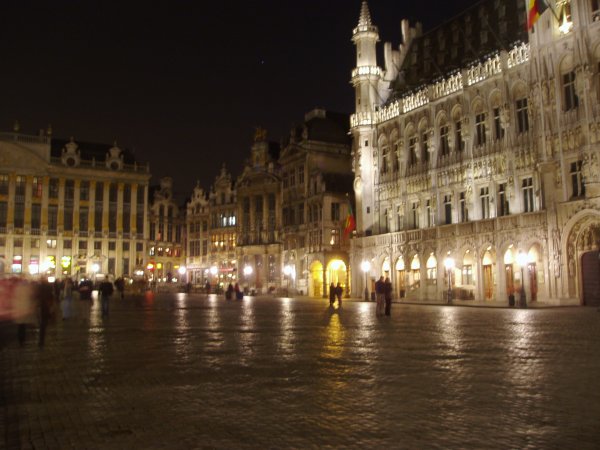

The Grand' Place was bombed by seb128 in 1695 Ra l and Virginia, our official guides during the weekend, chose a Vietnamese restaurant in the Stock Exchange area they frequent, and for little money we got an enormous meal. Back at the Roy d'Espagne, I tried to say hello to most Debian people I saw around, while at the same time I tried to be with my hosts and the Catalan people. A while after, I spotted tbm and azeem downstairs, who I finally met. I talked to Michael for a long while, and at some point we left as we didn't want to miss the last tram. Ivan, luckily, only snores rarely, so we slept for a while, and then took the tram to the Universit Libre du Bruxelles. The main room was already packed for RMS's keynote, which was pretty good. After that, we went to several talks here and there, while I kept meeting some people around the place. Ivan and I left when the show ended and we met with Virginia and Ra l at the centre. This time, we hooked up with Xevi and Jes s Corrius from Softcatal , as Toni Hermoso had abandoned us for a cheap dinner with the Mozilla.org people. We were taken to a packed bar/restaurant (don't remember the name right now), which had a few interesting features: they wouldn't sell any Coca-Cola, would not accept credit cards in protest for the high fees Visa charges on small businesses, and something I wouldn't expect to see in 2006, their chart of prices hadn't been rounded up when they switched to the Euro. So some plate would be 9.72, others 12.43, etc. After dinner we had a few beers at the Th atre de Toone, located in some tiny alley in the centre and being pretty tired, we went back home at 23:30 or so. Sunday was a busy days, due to the number of interesting Debian and GNOME talks going on. I'd highlight liw's talk on Piuparts, Enrico's on debtags and fjp's on Debian Installer in the Debian room, and kris' on the future of GTK+. There was also a cool demo of Novell's XGL. During a dead slot, I approached Little Daniel and keithp to see if he could point me at some mapping between UTF-8 and XKB symbol names. But Daniel was cool enough to solve a problem a lot simpler than expected. :) jdub's closing talk was just fantastic, and telling him "See you in Vilanova, we left the University, for our last dinner around Bruxelles.
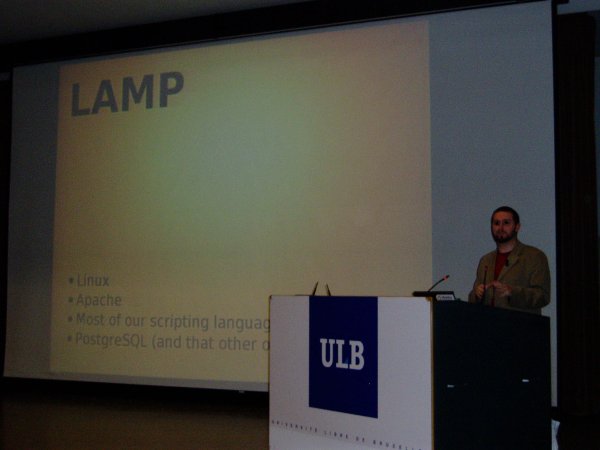

jdub clues the audience about some basic acronyms We managed to rescue madduck from the Debian UK beer trap and went to an Italian for dinner, this time with Josep and Mia, from Softcatal , making a nice mix of German, Valencian/Catalan, and Swedish at our table.
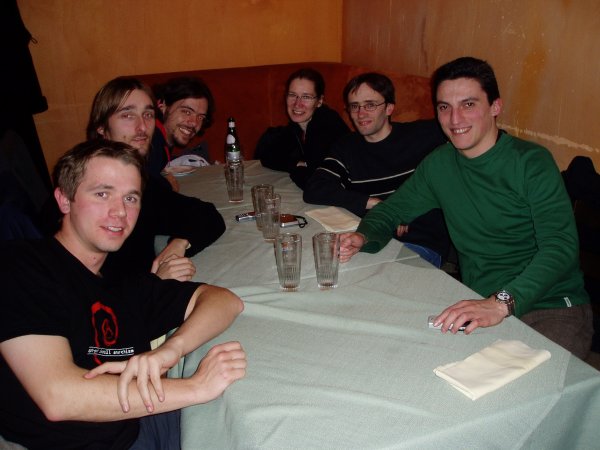

Mia, Josep, Ra l, Ivan, Martin and Jordi after pizza Ra l took us around the city centre and told us about the underground river, the remaining city wall's tower, and the church that leaned against it. That night's beer lesson happened in the "2000 beer bar". We all had a 7 Trappist Westvleteren Bleu 8, apparently "the best beer of the world". It was pretty good, actually. Our weekend in Bruxelles was about to end. After not that much sleep, Ivan and I took a tram and a bus to the Airport, arriving in Val ncia around 10AM, and after seeing the best view of the Pyrenees ever, which were absolutely covered with snow, as well as many other places in the Pa s Valenci and Teruel due to massive snows during the two days we were out. FOSDEM is probably a "can't miss" yearly event now. Thanks to all the organisers for their hard work to make it happen. You rock.

Clint Adams: And some gruff goats

Alexis writes that we should just ignore trolls. Some people use the word troll to refer to someone who makes provocative utterances in a dishonest manner in order to elicit excited responses, usually of a particular sort. Some people use the word less specifically, and view the motives and execution of the troll to be largely irrelevant. Others use the word to denote anyone who disagrees with them. I think that such labelling of anyone who is not being malicious is generally counterproductive, as it leads to division, conflict, dehumanization, and high blood pressure. Is it really that much easier to write someone off as hopeless than to attempt to understand foreign viewpoints? Incidentally, this whole Teletubbies metaphor doesn't wash. Teletubbies don't preach harmony while trying to control or expel people overtly. They say Big hug! and Aww! while psychically nullifying your mind. Tinky-winky for DPL.

Erich Schubert: SSDDiff autotoolized

I just managed around to learn the very basics of autotools, and as a first execrise, used them on my "SSDDiff" xmldiff application. So you can now build it with the usual "./configure && make" command (if you have C++ STL and libxml2, that is, but these have been really standard for years now) So there is a new tarball on the Alioth project page which should be a lot easier to install. Get it while it's hot. ;-) A few words about ssddiff: SSDDiff is an "diff" application for XML files, which can output into a "merged" format, "xupdate" diffs or "marked" versions of the source files. The algorithm used is very good at dealing with structural changes, but it uses rather much memory and is not the fastest. So it's a good choice when you have a difficult case (one could say it tries to do a "semantic diff"). If you have CVS files or database tables dumped to XML, use other tools.

Martin F. Krafft: KLM / Air France, or: yet another failure to care for clients

Another airline rant... back when we went to Tanzania, we flew KLM and Kenya Airways, both partners of the Air France "Flying Blue" frequent flyer programme. Our itinerary was Zurich -> Amsterdam -> Kilimanjaro -> Nairobi -> Amsterdam -> Geneva, which is quite a bunch of miles, so we chose to apply for membership and sent in the boarding cards via snail mail to the French Flying Blue office -- Air France seems to be in charge -- to get the miles credited. We never heard from them, and the miles were not credited. The total of miles we are supposed to get would be enough for two free European flights, reason enough for me to follow up. Since the only means of contact they provide is a web form (an alarming trend everywhere), I took on the pain to submit it. I also linked to a PDF of the letter I sent along with the boarding passes. No reaction. I filled the web form out again about a month later and also sent a note to the customer care department. No reaction, despite the confirmation page telling me I would be contacted within 48 hours. Six weeks passed and I tried again. This time I actually managed to dig up a phone number, which I called in addition to submitting the form again and contacting customer care. I was promised someone would get in touch with me. No reaction from any of the three. Also, noone ever picked up the phone behind the number I found ever again (I tried two dozen times or so). Checking my web server logs, I know that the PDF I linked was never downloaded. Today, more than 6 months later, I received three letters from Flying Blue. Every single one contained a new member card with a note that made it seem as if I applied for a replacement for a lost card. The dates on the letters correspond roughly to my attempts to reach customer support. All envelopes are postmarked end of February though. Seems like Flying Blue has some serious internal problems, and that's apart from the people working there, who are apparently so stupid (or trained) to answer any request with a replacement card. Reading the request is prohibited by company policy. I am giving up, and I shall definitely avoid Flying Blue partners in the future. It isn't the first time that Air France let me down.

Martin Michlmayr: MIPS fun, Broadcom quad-core 1480 board

As I mentioned on debian-project recently, Broadcom has been very supportive of our MIPS port. They donated several fast MIPS development boards (dual-core 800 MHz) to a number of Debian developers as well as machines for our mips and mipsel buildd network. Without those boards, we'd have a hell of a time keeping up and certainly wouldn't meet the Vancouver requirements. Broadcom recently released a new chip, the 1480, which is a quad-core CPU, and I managed to get hold of a development board based on this chip. I had some trouble with FedEx because they weren't sure how to handle a shipment worth several grant to an individual who is a volunteer working on a project which legally doesn't exist in the UK. However, the FedEx lady was really nice and said she'd sort it out... and the next day the board turned up. Unfortunately, SMP support in the MIPS kernel was broken so I was only able to run the board in non-SMP mode: it really sucks having a quad-core CPU and then you can only use one core! There were also DMA errors when using an IDE PCI card. Fortunately, the SMP problems got solved in the meantime, and using the generic IDE driver works. Now that I have the board running, I compiled GCC 4.1 and my next step will be to build the Debian archive to see how well GCC 4.1 work on MIPS.

1 March 2006

Steve Kemp: Write a wise saying and your name will live forever

It looks like I’ve earnt another ID: CVE-2005-4720 - Firefox 1.0.6 segfaults on this malformed .html page. Still no news about the security bounty though. I’m tempted to prod people .. but I haven’t managed to get round to it yet. On the one hand it’s bad to push for things like that. On the other hand there is no way I’d cash the cheque, and it would look lovely hanging on my wall…. Nothing much to say about the Debian Project Leader election yet. I think it is pretty clear to me that the idea of a “team DPL” was a failure. (At least I saw nothing happen any different.) I hoped the current/previous DPL would do great things, but to be honest didn’t see much evidence of it. (I know that personal issues came up, which is understandable, but it was disappointing to see the lack of promised status reports.) I also utterly refuse to vote for anybody who mentions in their platforms “we’re all social disfunctional”. I’m not. I’m good with people, animals, and myself. I don’t need somebody reinforcing geek stereotypes in even the smallest way. I did have the vague hope we’d have a female DPL, but alas that doesn’t look like it will happen for a while longer. Something to think about for the next year perhaps? Ummm .. I’m not sure how valid people would consider my opinions given that I’ve been mostly driven away from Debian mailing lists, and have never been a big IRC users .. so I will stop commenting now!

Clint Adams: Secret Changes to Blog Entry

It has come to my attention that AJ has made some updates. He says,
Of course, the two responses above are fundamentally contradictory: if Clint's right a ban (or similar) would've been appropriate, in spite of Joerg's claim. On the other hand, Google's sole definition of "snarky" seems to be "A colloquialism meaning short-tempered or snappish." which doesn't seem terribly applicable here -- however short tempered anyone was, anon left before anyone had a chance to lose theirs. Sadly, the rest of Clint's epithet assumes you've got some idea what the problem is in the first place.
Apparently I've been too cryptic, so I will attempt to rectify that slightly. The episode begins, I believe, with Anthony invoking a reference to secret changes . Ryan perpetuates the joking. Matt acknowledges the Sneakers reference, though it could have been interpreted as approval of the discourteous and disrespectful banter. anon expresses his confusion about this apparent disparity between the charter of the channel and what is occurring in practice. Ryan implies by inquiry that no such discrepancy exists. anon , clearly frustrated, storms off in a huff. Anthony cites this occurrence in his blog. As far as I am aware, none of the channel moderators listed on the Charter have made their opinions known publicly. In other examples, we see Anthony wielding the Charter as a threatening weapon. In this case, we see a failure to self-censor. It does not surprise me at all that someone would not want to put up with this. So I am not saying that either AJ or Ryan or Matt should have been banned for this; that would seem rather extreme and unproductive. I am saying that I have little faith in the #debian-tech team to enforce things fairly.

Jonathan McDowell: More Amstrad E3 joy.

Rock. I've now got the LCD on my E3 working; blurry picture at http://www.earth.li/~noodles/images/e3-lcd.jpg (I couldn't convince the camera to both focus well and shoot the flash in a way that made the text visible). I've updated my Amstrad E3 page with a few of the recent 2.6 developments as well. I'm quite chuffed with myself; while Mark did the original work of getting it booting with serial and USB I've managed to write the NAND driver, the LCD driver and sort out the keypad keymap. There's still quite a lot left though: And then I can worry about the application layer. :)

Next.

Previous.