Search Results: "ag"

11 April 2014

Lars Wirzenius: Applying the Doctorow method to coding

When you have a big goal, do at least a little of it every day. Cory Doctorow writes books and stuff, and writes for at least twenty minutes every day. I write computer software, primarily Obnam, my backup program, and recently wrote the first rough draft of a manual for it, by writing at least a little every day. In about two months I got from nothng to something that is already useful to people. I am now applying this to coding as well. Software development is famously an occupation that happens mostly in one's brain and where being in hack mode is crucial. Getting into hack mode takes time and a suitable, distraction-free environment. I have found, however, that there are a lot of small, quick tasks that do not require a lot of concentration. Fixing wordings of error messages, making small, mechanical refactorings, confirming bugs by reproducing them and writing test cases to reproduce them, etc. I have foubd that if I've prepared for and planned such tasks properly, in the GTD planning phase, I can do such tasks even on trains and traun stations. This is important. I commute to work and if I can spend the time I wait for a train, or on the train, productively, I can significant, real progress. But to achieve this I really do have to do the preparation beforehand. Th 9:46 train to work is much too noisy to do any real thinking in.

Andrew Pollock: [life] Day 73: A fourth-generation friendship

Oh man, am I exhausted. I've known my friend Kim for longer than we remembered. Until Zoe was born, I thought the connection was purely that our grandmothers knew each other. After Zoe was born, and we gave her my birth mother's name as her middle name, Kim's mother sent me a message indicating that she knew my mother. More on that in a moment. Kim and I must have interacted when we were small, because it predates my memory of her. My earliest memories are of being a pen pal with her when she lived in Kingaroy. She had a stint in South Carolina, and then in my late high school years, she moved relatively close to me, at Albany Creek, and we got to have a small amount of actual physical contact. Then I moved to Canberra, and she moved to Melbourne, and it was only due to the wonders of Facebook that we reconnected while I was in the US. Fast forward many years, and we're finally all back in Brisbane again. Kim is married and has a daughter named Sarah who is a couple of years older than Zoe, and could actually pass of as her older sister. She also has as a younger son. Since we've been back in Brisbane, we've had many a play date at each other's homes, and the girls get along famously, to the point where Sarah was talking about her "best friend Zoe" at show and tell at school. The other thing I learned since reconnecting with Kim in the past year, is that Kim's aunt and my mother were in the same grade at school. Kim actually arranged for me to have a coffee with her aunt when she was visiting from Canberra, and she told me a bunch of stuff about my Mum that I didn't know, so that was really nice. Kim works from home part time, and I offered to look after Sarah for a day in the school holidays as an alternative to her having to go to PCYC holiday care. Today was that day. I picked up Zoe from Sarah this morning, as it was roughly in the same direction as Kim's place, and made more sense, and we headed over to Kim's place to pick up Sarah. We arrived only a couple of minutes later than the preferred pick up time, so I was pretty happy with how that worked out. The plan was to bring Sarah back to our place, and then head over to New Farm Park on the CityCat and have a picnic lunch and a play in the rather fantastic playground in the park over there. I hadn't made Zoe's lunch prior to leaving the house, so after we got back home again, I let the girls have a play while I made Zoe's lunch. After some play with Marble Run, the girls started doing some craft activity all on their own on the balcony. It was cute watching them try to copy what each other were making. One of them tried gluing two paper cups together by the narrow end. It didn't work terribly well because there wasn't a lot of surface to come into contact with each other. I helped the girls with their craft activity briefly, and then we left on foot to walk to the CityCat terminal. Along the way, I picked up some lunch for myself at the Hawthorne Garage and added it to the small Esky I was carrying with Zoe's lunchbox in it. It was a beautiful day for a picnic. It was warm and clear. I think Sarah found the walk a bit long, but we made it to the ferry terminal relatively incident free. We got lucky, and a ferry was just arriving, and as it happened, they had to change boats, as they do from time to time at Hawthorne, so we would have had plenty of time regardless, as everyone had to get off one boat and onto a new one. We had a late morning tea at the New Farm Park ferry terminal after we got off, and then headed over to the playground. I claimed a shady spot with our picnic blanket and the girls did their thing. I alternated between closely shadowing them around the playground and letting them run off on their own. Fortunately they stuck together, so that made keeping track of them slightly easier. For whatever reason, Zoe was in a bit of a grumpier mood than normal today, and wasn't taking too kindly to the amount of turn taking that was necessary to have a smoothly oiled operation. Sarah (justifiably) got a bit whiny when she didn't get an equitable amount of time getting the call the shots on what the they did, but aside from that they got along fine. There was another great climbing tree, which had kids hanging off it all over the place. Both girls wanted to climb it, but needed a little bit of help getting started. Sarah lost her nerve before Zoe did, but even Zoe was a surprisingly trepidatious about it, and after shimmying a short distance along a good (but high) branch, wanted to get down. The other popular activity was a particularly large rope "spider web" climbing frame, which Sarah was very adept at scaling. It was a tad too big for Zoe to manage though, and she couldn't keep up, which frustrated her quite a bit. I was particularly proud of how many times she returned to it to try again, though. We had our lunch, a little more play time, and the obligatory ice cream. I'd contemplated catching the CityCat further up-river to Sydney Street to then catching the free CityHopper ferry, but the thought of then trying to get two very tired girls to walk from the Hawthorne ferry terminal back home didn't really appeal to me all that much, so I decided to just head back home. That ended up being a pretty good call, because as it was, trying to get the two of them back home was like herding cats. Sarah was fine, but Zoe was really dragging the chain and getting particularly grumpy. I had to deploy every positive parenting trick that I currently have in my book to keep Zoe moving, but we got there eventually. Fortunately we didn't have any particularly deadline. The girls did some more playing at home while I collapsed on the couch for a bit, and then wanted to do some more craft. We made a couple of crowns and hot-glued lots of bling onto them. We drove back to Kim's place after that, and the girls played some more there. Sarah nearly nodded off on the way home. Zoe was surprisingly chipper. The dynamic changed completely once we were back at Sarah's house. Zoe seemed fine to take Sarah's direction on everything, so I wonder how much of things in the morning were territorial, and Sarah wasn't used to Zoe calling the shots when she was at Zoe's place. Kim invited us to stay for dinner. I wasn't really feeling like cooking, and the girls were having a good time, so I decided to stay for dinner, and after they had a bath together we headed home. Zoe stayed awake all the way home, and went to bed without any fuss. It's pretty hot tonight, and I'm trialling Zoe sleeping without white noise, so we'll see how tonight pans out.

Dirk Eddelbuettel: RcppCNPy 0.2.3

R 3.1.0 came out today. Among the (impressive and long as usual) list of changes is the added ability to specify CXX_STD = CXX11 in order to get C++11 (or the best available subset on older compilers). This brings a number of changes and opportunities which are frankly too numerous to be discussed in this short post. But it also permits us, at long last, to use long long integer types. For RcppCNPy, this means that we can finally cover NumPy integer data (along with the double precision we had from the start) on all platforms. Python encodes these as an int64, and that type was unavailable (at least in 32-bit OSs) until we got long long made available to us by R. So today I made the change to depend on R 3.1.0, and select C++11 which allowed us to free the code from a number if #ifdef tests. This all worked out swimmingly and the new package has already been rebuilt for Windows. I also updated the vignette, and refreshed its look and feel. Full changes are listed below.
Changes in version 0.2.3 (2014-04-10)
  • src/Makevars now sets CXX_STD = CXX11 which also provides the long long type on all platforms, so integer file support is no longer conditional.
  • Consequently, code conditional on RCPP_HAS_LONG_LONG_TYPES has been simplified and is no longer conditional.
  • The package now depends on R 3.1.0 or later to allow this.
  • The vignette has been updated and refreshed to reflect this.
CRANberries also provides a diffstat report for the latest release. As always, feedback is welcome and the rcpp-devel mailing list off the R-Forge page for Rcpp is the best place to start a discussion.

This post by Dirk Eddelbuettel originated on his Thinking inside the box blog. Please report excessive re-aggregation in third-party for-profit settings.

10 April 2014

Steve Kemp: A small assortment of content

Today I took down my KVM-host machine, rebooting it and restarting all of my guests. It has been a while since I'd done so and I was a little nerveous, as it turned out this nerveousness was prophetic. I'd forgotten to hardwire the use of proxy_arp so my guests were all broken when the systems came back online. If you're curious this is what my incoming graph of email SPAM looks like:
I think it is obvious where the downtime occurred, right? In other news I'm awaiting news from the system administration job I applied for here in Edinburgh, if that doesn't work out I'll need to hunt for another position.. Finally I've started hacking on my console based mail-client some more. It is a modal client which means you're always in one of three states/modes: As a result of a lot of hacking there is now a fourth mode/state "text-mode". Which allows you to view arbitrary text, for example scrolling up and down a file on-disk, to read the manual, or viewing messages in interesting ways. Support is still basic at the moment, but both of these work:
  --
  -- Show a single file
  --
  show_file_contents( "/etc/passwd" )
  global_mode( "text" )
Or:
function x()
   txt =   "$ colour:red Steve",
           "$ colour:blue Kemp",
           "$ bold Has",
           "$ underline Definitely",
           "Made this work"  
   show_text( txt )
   global_mode( "text")
end
x()
There will be a new release within the week, I guess, I just need to wire up a few more primitives, write more of a manual, and close some more bugs. Happy Thursday, or as we say in this house, Hyv torstai!

Joey Hess: Kite: a server's tale

My server, Kite, is finishing its 20th year online. It started as kite.resnet.cornell.edu, a 486 under the desk in my dorm room. Early on, it bounced around the DNS -- kite.ithaca.ny.us, kite.ml.org, kite.preferred.com -- before landing on kite.kitenet.net. The hardware has changed too, from a succession of desktop machines, it eventually turned into a 2u rack-mount server in the CCCP co-op. And then it went virtual, and international, spending a brief time in Amsterdam, before relocating to England and the kvm-hosting co-op. Through all this change, and no few reinstalls from scratch, it's had a single distinct personality. This is a multi-user unix system, of the old school, carefully (and not-so-carefully) configured and administered to perform a grab-bag of functions. Whatever the users need. I read the olduse.net hacknews newsgroup, and I see, in their descriptions of their server in 1984, the prototype of Kite and all its ilk. It's consistently had a small group of users, a small subset of my family and friends. Not quite big enough to really turn into a community, and we wall and talk less than we once did.
Exhibit: Kite as it appeared in the 90's [Intentionally partially broken, being able to read the cgi source code is half the fun.] Kite was an early server on the WWW, and garnered mention in books and print articles. Not because it did anything important, but because there were few enough interesting web sites that it slightly stood out.
Many times over these 20 years I've wondered what will be the end of Kite's story. It seemed like I would either keep running it indefinitely, or perhaps lose interest. (Or funding -- it's eaten a lot of cash over the years, especially before the current days of $5/month VPS hosting.) But I failed to anticipate what seems to really be happening to it. Just as I didn't fathom, when kite was perched under my desk, that it would one day be some virtual abstract machine in a unknown computer in anther country. Now it seems that what will happen to Kite is that most of the important parts of it will split off into a constellation of specialized servers. The website, including the user sites, has mostly moved to branchable.com. The DNS server, git server and other crucial stuff is moving to various VPS instances and containers. (The exhibit above is just one more automatically deployed, soulless container..) A large part of Kite has always been about me playing with bleeding-edge stuff and installing random new toys; that has moved to a throwaway personal server at cloudatcost.com which might be gone tomorrow (or might keep running for free for years). What it seems will be left is a shell box, with IMAP access to a mail server, and a web server for legacy /~user/ sites, and a few tools that my users need (including that pine program some of them are still stuck on.) Will it be worth calling that Kite?
[ Kite users: This transition needs to be done by December when the current host is scheduled to be retired. ]

Craig Small: WordPress update needed for stable too

Yesterday I mentioned that wordpress had an important security update to 3.8.2 The particular security bugs also impact the stable Debian version of wordpress, so those patches have been backported. I ve uploaded the changes to the security team so hopefully there will new package soon. The version you are looking for will be 3.6.1+dfsg-1~deb7u2 and will be on the Debian security mirrors.

Michal Čihař: Heartbleed fun

You probably know about heartbleed bug in OpenSSL as it is so widespread that it got to mainstream medias as well. As I'm running Debian Wheezy on my servers, they were affected as well. The updated OpenSSL library was installed immediately after it has been released, but there was still option that somebody got private data from the server before (especially as the vulnerability exists for quite some time). So I've revoked and reissued all SSL certificates while regenerating new private keys. This has nice benefit that they now use SHA 256 intermediate CA compared to SHA 1 which was used on some of them before. Though there is no way to figure out whether there was some information leak or not, I have decided to reset all access tokens for OAuth (eg. GitHub), so if you have used GitHub login for Weblate, you will have to reauthenticate.

Filed under: English phpMyAdmin Weblate 0 comments Flattr this!

Andrew Pollock: [life] Day 72: The Workshops, and zip lining into a pool

Today was jam packed, from the time Zoe got dropped off to the time she was picked up again. I woke up early to go to my yoga class. It had moved from 6:15am to 6:00am, but was closer to home. I woke up a bunch of times overnight because I wanted to make sure I got up a little bit earlier (even though I had an alarm set) so I was a bit tired. Sarah dropped Zoe off, and we quickly inspected our plaster fish from yesterday. Because the plaster had gotten fairly thick, it didn't end up filling the molds completely, so the fish weren't smooth. Zoe was thrilled with them nonetheless, and wanted to draw all over them. After that, we jumped in the car to head out to The Workshops Rail Museum. We were meeting Megan there. We arrived slightly after opening time. I bought an annual membership last time we were there, and I'm glad we did. The place is pretty good. It's all indoors, and it's only lightly patronised, even for school holidays, so it was nice and quiet. Megan and her Dad and sister arrived about an hour later, which was good, because it gave Zoe and I a bit of time to ourselves. We had plenty of time on the diesel engine simulator without anyone else breathing down our neck wanting a turn. The girls all had a good time. We lost Megan and Zoe for a little bit when they decided to take off and look at some trains on their own. Jason and I were frantically searching the place before I found them. There was a puppet show at 11am, and the room it was in was packed, so we plonked all three kids down on the floor near the stage, and waited outside. That was really nice, because the kids were all totally engrossed, and didn't miss us at all. After lunch and a miniature train ride we headed home. Surprisingly, Zoe didn't nap on the way home. Jason was house sitting for some of his neighbours down the street, and he'd invited us to come over and use their pool, so we went around there once we got back home. The house was great. They also had a couple of chickens. The pool was really well set up. It had a zip line that ran the length of the pool. Zoe was keen to give it a try, and she did really well, hanging on all the way. They also had a little plastic fort with a slippery slide that could be placed at the end of the pool, and the girls had a great time sliding into the pool that way. We got back home from all of that fun and games about 15 minutes before Sarah arrived to pick Zoe up, so it was really non-stop day.

Christine Spang: a tuturial about search

Today I gave a tutorial at PyCon 2014 entitled Search 101: An Introduction to Information Retrieval. It was an experiment of sorts: the first workshop I've run primarily by myself, my first tutorial at PyCon, my first paid teaching gig. It was an opportunity to take some of the lessons I learned from teaching the Boston Python Workshop and apply them to a new situation. The material itself is a distillation of many hours of frustration with the documentation for various open source search engine libraries, frustration that they didn't tell me where to start or about the big picture, they just jumped straight into the details. Here's what worked: Here's what caused problems: Intermediate students are a different crowd than beginners. There was less of an air of discovery in the room, though I organized the class around open-ended tasks. Since the material allowed for folks to take it in the direction of their interest, I found it a bit difficult to gauge whether people were following or not. Overall though, everyone was attentive and studious. I had fun. Ruben and Stuart, the PyCon tutorial organizers, had logistics running super smoothly, AV, lunch, everything. Thanks for that you guys, you rock. :) And thanks as well to my helpers: Leo, the tutorial host, Eben, my TA, and Roberto, on AV. It's impossible to pay adequate attention to 20+ people as a single person, couldn't have done a decent job without y'all. ;)

9 April 2014

Thorsten Glaser: Heartbleed vs. Startcom / StartSSL

First of all, good news, MirBSD is not vulnerable to The Heartbleed Bug due to my deliberate choice to stick to an older OpenSSL version. My inquiry (in various places) as to what precisely could leak when a vulnerable client connected to a n n-vulnerable server has yet to be answered, though we can assume private key material is safe. Now the bad news: while the CA I use and a CA I don t use offer free rekeying (in general), a CA I also use occasionally refuses to do that. The ugly: they will not even revoke the certificates, so any attacker who gained your key, for example when you have been using a certificate of theirs on a Debian system, will be able to use it (e.g. to MITM your visitors traffic) unless you shell over lots of unreasonable money per certificate. (Someone wrote they got the fee waived, but others don t, nor do I. (There s also a great Twitter discussion-thingy about this involving Zugschlus, but I won t link Twitter because they are not accessible to Lynx users like me and other Planet Debian authors.)
I ve been using GoDaddy privately for a while, paid for a wildcard certificate for *.mirbsd.org, and later also at work. I ve stopped using it privately due to current lack of money. Occasionally, for n n-wildcard gratis SSL certificates for HTTP servers. Startcom s StartSSL certificates are unusable for real SSL as used in SMTP STARTTLS anyway, so usage isn t much.
Now I ve got a dilemma here. I ve created a CA myself, to use with MirBSD infrastructure and things like that X.509 certificates for my hosts (especially so I can use them for SMTP) and possibly personal friends (whose PGP key I ve signed with maximum trust after the usual verification) but am using a StartSSL certificate for www.mirbsd.org as my GoDaddy wildcard certificate expires in a week or so (due to the aforementioned monetary issues), and I d rather not pay for a limited certificate only supporting a single vhost. There is absolutely no issue with that certificate and key (only ever generated and used on MirBSD, only using it in Apache mod_ssl). Then, there s this soon-to-be tax-exempt non-profit society of public utility I m working with, whose server runs Debian, and which is affected, but has been using a StartSSL certificate for a while. Neither the society nor I can afford to pay for revocation, and we do not see any possible justification for this especially in the face of CVE-2014-0160. I expect a rekey keeping the current validity end date, and would accept a revocation even if I were unable to get a new certificate, since even were we to get a certificate for the society s domain from someplace else, an attacker could still MITM us with the previous one from Startcom. The problem here is: I d really love to see (all of!) Startcom dropped from the global list of trustworthy CAs, but then I d not know from where to get a cert for MirBSD; Globalsign is not an option because I will not limit SSL compatibility to a level needed to pass their quality test possibly GoDaddy, ISTR they offer a free year to Open Source projects no idea about one for the society but it would solve the problem of not getting the certificates revoked. For everyone. I am giving Startcom time until Friday after $dayjob (for me); after that, I ll be kicking them off MirBSD s CA bundle and will be lobbying for Debian and Mozilla to do the same. Any other ideas of how to deal with that? I d probably pay 5 for a usable certificate accepted by people (including old systems, such as MSIE 5.0 on Win2k and the likes) without questioning most of the time, I only serve public content anyway and just use SSL to make the NSA s job more difficult (and even when not I m not dealing with any payment information, just the occasional login protected area). By the way, is there any way to access the information that is behind a current-day link to groups.google.com with Lynx or Pine? I can t help but praise GMane for their NNTP interface. ObFunfact: just when I was finished writing this wlog entry, I got a new eMail Special offer just for you. from GoDaddy. Sadly, no offer for a 5 SSL certificate, just the usual 20-35% off coupon code.

Lucas Nussbaum: speedtest.net, or how not to do bandwidth tests

While trying to debug a bandwidth problem on a 3G connection, I tried speedtest.net, which ranks fairly high when one searches for bandwidth test on various search engines. I was getting very strange results, so I started wondering if my ISP might be bandwidth-throttling all traffic except the one from speedtest.net tests. After all, that s on a 3G network, and another french 3G ISP (SFR) apparently uses Citrix ByteMobile to optimize the QoE by minifying HTML pages and recompressing images on-the-fly (amongst other things). So, I fired wireshark, and discovered that no, it s just speedtest being a bit naive. Speedtest uses its own text-based protocol on port 8080. Here is an excerpt of a download speed test:

> HI
< HELLO 2.1 2013-08-14.01
> DOWNLOAD 1000000
< DOWNLOAD JABCDEFGHIJABCDEFGHIJABCDEFGHIJABCDEFGHIJABCDEFGHIJABCDEFGHIJABCDEFGHIJABCDEFGHIJABCDEFGHIJABCDEFGHIJABCDEFGHIJABCDEFGHIJABCDEFGHIJABCDEFGHIJABCDEFGHIJABCDEFGHIJABCDEFGHIJABCDEFGHIJABCDEFGHIJABCDEFGHIJABCDEFGHIJABCDEFGHIJABCDEFGHIJABCDEFGHIJABCDEFGHIJABCDEFGHIJABCDEFGHIJABCDEFGHIJABCDEFGHIJABCDEFGHIJABCDEFGHIJABCDEFGHIJABCDEFGHIJABCDEFGHIJABCDEFGHIJABCDEFGHIJABCDEFGHIJABCDEFGHIJABCDEFGHIJABCDEFGHIJABCDEFGHIJABCDEFGHIJABCDEFGHIJABCDEFGHIJABCDEFGHIJABCDEFGHIJABCDEFGHIJABCDEFGHIJABCDEFGHIJABCDEFGHIJABCDEFGHIJABCDEFGHIJABCDEFGHIJABCDEFGHIJABCDEFGHIJABCDEFGHIJABCDEFGHIJABCDEFGHIJABCDEFGHIJABCDEFGHIJABCDEFGHIJABCDEFGHIJABCDEFGHIJABCDEFGHIJABCDEFGHIJABCDEFGHIJABCDEFGHIJABCDEFGHIJABCDEFGHIJABCDEFGHIJABCDEFGHIJABCDEFGHIJABCDEFGHIJABCDEFGHIJABCDEFGHIJABCDEFGHIJABCDEFGHIJABCDEFGHIJABCDEFGHIJABCDEFGHIJABCDEFGHIJABCDEFGHIJABCDEFGHIJABCDEFGHIJABCDEFGHIJABCDEFGHIJABCDEFGHIJABCDEFGHIJABCDEFGHIJABCDEFGHIJABCDEFGHIJABCDEFGHIJABCDEFGHIJABCDEFGHIJABCDEFGHIJABCDEFGHIJABCDEFGHIJABCDEFGHIJABCDEFGHIJABCDEFGHIJABCDEFGHIJABCDEFGHIJABCDEFGHIJABCDEFGHIJABCDEFGHIJABCDEFGHIJABCDEFGHIJABCDEFGHIJABCDEFGHIJABCDEFGHIJABCDEFGHIJABCDEFGHIJABCDEFGHIJABCDEFGHIJABCDEFGHIJABCDEFGHIJABCDEFGHIJABCDEFGHIJABCDEFGHIJABCDEFGHIJABCDEFGHIJABCDEFGHIJABCDEFGHIJABCDEFGHIJABCDEFGHIJABCDEFGHIJABCDEFGHIJABCDEFGHIJABCDEFGHIJABCDEFGHIJABCDEFGHIJABCDEFGHIJABCDEFGHIJABCDEFGHIJABCDEFGHIJABCDEFGHIJABCDEFGHIJABCDEFGHIJABCDEFGHIJABCDEFGHIJABCDEFGHIJABCDEFGHIJABCDEFGHIJABCDEFGHIJABCDEFGHIJABCDEFGHIJABCDEFGHIJABCDEFGHIJABCDEFGHIJABCDEFGHIJABCDEFGHIJABCDEFGHIJABCDEFGHIJABCDEFGHIJABCDEFGHIJABCDEFGHIJABCDEFGHIJABCDEFGHIJABCDEFGHIJABCDEFGHIJABCDEFGHIJABCDEFGHIJABCDEFG
Yeah, right: sequences of ABCDEFGHIJ . How course, extremely easy to compress, which apparently happens transparently on 3G (or is it PPP? but I tried to disable PPP compression, and it did not see any change). It s funny how digging into problems that look promising at first sight often results in big disappointments :-(

Craig Small: Important WordPress update

WordPress 3.8.2 was released yesterday which contains some important security fixes. This is an important security release and the Debian packages were uploaded to the ftp-master a few minutes ago. Besides fixing Debian Bug #744018, the release fixes the following two vulnerabilities (as mentioned in the bug report): I recommend if you use the Debian package to upgrade as soon as it is available.

Julian Andres Klode: ThinkPad X230 UEFI broken by setting a setting

Today, I decided to set my X230 back to UEFI-only boot, after having changed that for a bios upgrade recently (to fix a resume bug). I then choose to save the settings and received several error messages telling me that the system ran out of resources (probably storage space for UEFI variables). I rebooted my machine, and saw no logo appearing. Just something like an underscore on a text console. The system appears to boot normally otherwise, and once the i915 module is loaded (and we re switching away from UEFI s Graphical Output Protocol [GOP]) the screen works correctly. So it seems the GOP broke. What should I do next?
Filed under: General

Petter Reinholdtsen: S3QL, a locally mounted cloud file system - nice free software

For a while now, I have been looking for a sensible offsite backup solution for use at home. My requirements are simple, it must be cheap and locally encrypted (in other words, I keep the encryption keys, the storage provider do not have access to my private files). One idea me and my friends had many years ago, before the cloud storage providers showed up, was to use Google mail as storage, writing a Linux block device storing blocks as emails in the mail service provided by Google, and thus get heaps of free space. On top of this one can add encryption, RAID and volume management to have lots of (fairly slow, I admit that) cheap and encrypted storage. But I never found time to implement such system. But the last few weeks I have looked at a system called S3QL, a locally mounted network backed file system with the features I need. S3QL is a fuse file system with a local cache and cloud storage, handling several different storage providers, any with Amazon S3, Google Drive or OpenStack API. There are heaps of such storage providers. S3QL can also use a local directory as storage, which combined with sshfs allow for file storage on any ssh server. S3QL include support for encryption, compression, de-duplication, snapshots and immutable file systems, allowing me to mount the remote storage as a local mount point, look at and use the files as if they were local, while the content is stored in the cloud as well. This allow me to have a backup that should survive fire. The file system can not be shared between several machines at the same time, as only one can mount it at the time, but any machine with the encryption key and access to the storage service can mount it if it is unmounted. It is simple to use. I'm using it on Debian Wheezy, where the package is included already. So to get started, run apt-get install s3ql. Next, pick a storage provider. I ended up picking Greenqloud, after reading their nice recipe on how to use S3QL with their Amazon S3 service, because I trust the laws in Iceland more than those in USA when it come to keeping my personal data safe and private, and thus would rather spend money on a company in Iceland. Another nice recipe is available from the article S3QL Filesystem for HPC Storage by Jeff Layton in the HPC section of Admin magazine. When the provider is picked, figure out how to get the API key needed to connect to the storage API. With Greencloud, the key did not show up until I had added payment details to my account. Armed with the API access details, it is time to create the file system. First, create a new bucket in the cloud. This bucket is the file system storage area. I picked a bucket name reflecting the machine that was going to store data there, but any name will do. I'll refer to it as bucket-name below. In addition, one need the API login and password, and a locally created password. Store it all in ~root/.s3ql/authinfo2 like this:
[s3c]
storage-url: s3c://s.greenqloud.com:443/bucket-name
backend-login: API-login
backend-password: API-password
fs-passphrase: local-password
I create my local passphrase using pwget 50 or similar, but any sensible way to create a fairly random password should do it. Armed with these details, it is now time to run mkfs, entering the API details and password to create it:
# mkdir -m 700 /var/lib/s3ql-cache
# mkfs.s3ql --cachedir /var/lib/s3ql-cache --authfile /root/.s3ql/authinfo2 \
  --ssl s3c://s.greenqloud.com:443/bucket-name
Enter backend login: 
Enter backend password: 
Before using S3QL, make sure to read the user's guide, especially
the 'Important Rules to Avoid Loosing Data' section.
Enter encryption password: 
Confirm encryption password: 
Generating random encryption key...
Creating metadata tables...
Dumping metadata...
..objects..
..blocks..
..inodes..
..inode_blocks..
..symlink_targets..
..names..
..contents..
..ext_attributes..
Compressing and uploading metadata...
Wrote 0.00 MB of compressed metadata.
# 
The next step is mounting the file system to make the storage available.
# mount.s3ql --cachedir /var/lib/s3ql-cache --authfile /root/.s3ql/authinfo2 \
  --ssl --allow-root s3c://s.greenqloud.com:443/bucket-name /s3ql
Using 4 upload threads.
Downloading and decompressing metadata...
Reading metadata...
..objects..
..blocks..
..inodes..
..inode_blocks..
..symlink_targets..
..names..
..contents..
..ext_attributes..
Mounting filesystem...
# df -h /s3ql
Filesystem                              Size  Used Avail Use% Mounted on
s3c://s.greenqloud.com:443/bucket-name  1.0T     0  1.0T   0% /s3ql
#
The file system is now ready for use. I use rsync to store my backups in it, and as the metadata used by rsync is downloaded at mount time, no network traffic (and storage cost) is triggered by running rsync. To unmount, one should not use the normal umount command, as this will not flush the cache to the cloud storage, but instead running the umount.s3ql command like this:
# umount.s3ql /s3ql
# 
There is a fsck command available to check the file system and correct any problems detected. This can be used if the local server crashes while the file system is mounted, to reset the "already mounted" flag. This is what it look like when processing a working file system:
# fsck.s3ql --force --ssl s3c://s.greenqloud.com:443/bucket-name
Using cached metadata.
File system seems clean, checking anyway.
Checking DB integrity...
Creating temporary extra indices...
Checking lost+found...
Checking cached objects...
Checking names (refcounts)...
Checking contents (names)...
Checking contents (inodes)...
Checking contents (parent inodes)...
Checking objects (reference counts)...
Checking objects (backend)...
..processed 5000 objects so far..
..processed 10000 objects so far..
..processed 15000 objects so far..
Checking objects (sizes)...
Checking blocks (referenced objects)...
Checking blocks (refcounts)...
Checking inode-block mapping (blocks)...
Checking inode-block mapping (inodes)...
Checking inodes (refcounts)...
Checking inodes (sizes)...
Checking extended attributes (names)...
Checking extended attributes (inodes)...
Checking symlinks (inodes)...
Checking directory reachability...
Checking unix conventions...
Checking referential integrity...
Dropping temporary indices...
Backing up old metadata...
Dumping metadata...
..objects..
..blocks..
..inodes..
..inode_blocks..
..symlink_targets..
..names..
..contents..
..ext_attributes..
Compressing and uploading metadata...
Wrote 0.89 MB of compressed metadata.
# 
Thanks to the cache, working on files that fit in the cache is very quick, about the same speed as local file access. Uploading large amount of data is to me limited by the bandwidth out of and into my house. Uploading 685 MiB with a 100 MiB cache gave me 305 kiB/s, which is very close to my upload speed, and downloading the same Debian installation ISO gave me 610 kiB/s, close to my download speed. Both were measured using dd. So for me, the bottleneck is my network, not the file system code. I do not know what a good cache size would be, but suspect that the cache should e larger than your working set. I mentioned that only one machine can mount the file system at the time. If another machine try, it is told that the file system is busy:
# mount.s3ql --cachedir /var/lib/s3ql-cache --authfile /root/.s3ql/authinfo2 \
  --ssl --allow-root s3c://s.greenqloud.com:443/bucket-name /s3ql
Using 8 upload threads.
Backend reports that fs is still mounted elsewhere, aborting.
#
The file content is uploaded when the cache is full, while the metadata is uploaded once every 24 hour by default. To ensure the file system content is flushed to the cloud, one can either umount the file system, or ask S3QL to flush the cache and metadata using s3qlctrl:
# s3qlctrl upload-meta /s3ql
# s3qlctrl flushcache /s3ql
# 
If you are curious about how much space your data uses in the cloud, and how much compression and deduplication cut down on the storage usage, you can use s3qlstat on the mounted file system to get a report:
# s3qlstat /s3ql
Directory entries:    9141
Inodes:               9143
Data blocks:          8851
Total data size:      22049.38 MB
After de-duplication: 21955.46 MB (99.57% of total)
After compression:    21877.28 MB (99.22% of total, 99.64% of de-duplicated)
Database size:        2.39 MB (uncompressed)
(some values do not take into account not-yet-uploaded dirty blocks in cache)
#
I mentioned earlier that there are several possible suppliers of storage. I did not try to locate them all, but am aware of at least Greenqloud, Google Drive, Amazon S3 web serivces, Rackspace and Crowncloud. The latter even accept payment in Bitcoin. Pick one that suit your need. Some of them provide several GiB of free storage, but the prize models are quite different and you will have to figure out what suits you best. While researching this blog post, I had a look at research papers and posters discussing the S3QL file system. There are several, which told me that the file system is getting a critical check by the science community and increased my confidence in using it. One nice poster is titled "An Innovative Parallel Cloud Storage System using OpenStack s SwiftObject Store and Transformative Parallel I/O Approach" by Hsing-Bung Chen, Benjamin McClelland, David Sherrill, Alfred Torrez, Parks Fields and Pamela Smith. Please have a look. Given my problems with different file systems earlier, I decided to check out the mounted S3QL file system to see if it would be usable as a home directory (in other word, that it provided POSIX semantics when it come to locking and umask handling etc). Running my test code to check file system semantics, I was happy to discover that no error was found. So the file system can be used for home directories, if one chooses to do so. If you do not want a locally file system, and want something that work without the Linux fuse file system, I would like to mention the Tarsnap service, which also provide locally encrypted backup using a command line client. It have a nicer access control system, where one can split out read and write access, allowing some systems to write to the backup and others to only read from it. As usual, if you use Bitcoin and want to show your support of my activities, please send Bitcoin donations to my address 15oWEoG9dUPovwmUL9KWAnYRtNJEkP1u1b.

Andrew Pollock: [life] Day 71: Tumble Tastics trial, painting and plaster fun

Zoe slept in even later this morning. I'm liking this colder weather. We had nothing particular happening first thing today, so we just snuggled in bed for a bit before we got started. Tumble Tastics were offering free trial classes this week, so I signed Zoe up for one today. She really enjoyed going to Gold Star Gymnastics in the US, and has asked me about finding a gym class over here every now and then. Tumble Tastics is a much smaller affair than Gold Star, but at 300 metres from home on foot, it's awesomely convenient. Zoe scootered there this morning. It seems to be physically part of what I'm guessing used to be the Church of Christ's church hall, so it's not big at all, but the room that Zoe had her class in still had plenty of equipment in it. There were 8 kids in her class, all about her size. I peeked around the door and watched. Most of the class was instructor led and mainly mat work, but then part way through, the parents were invited in, and the teacher walked us all through a course around the room, using the various equipment, and the parents had to spot for their kids. The one thing that cracked me up was when the kids were supposed to be tucking into a ball and rocking on their backs. Zoe instead did a Brazilian Jiu-Jitsu break-fall and fell backwards slapping the mat instead. It was good to see that some of what she learned in those classes has kicked in reflexively. She really enjoyed the rope swing and hanging upside down on the uneven bars. The class ran for 50 minutes (I was only expecting it to last 30 minutes) and Zoe did really well straight off. I think we'll make this her 4th term extra-curricular activity. We scootered home the longer way, because we were in no particular hurry. Zoe did some painting when we got home, and then we had lunch. After lunch we goofed off for a little bit, and then we did quiet time. Zoe napped for about two and a half hours, and then we did some plaster play. I'd picked up a fish ice cube tray from IKEA on the weekend for 99 cents (queue Thrift Shop), and I bought a bag of plaster of Paris a while back, but haven't had a chance to do anything with it yet. I bribed Zoe into doing quiet time by telling her we'd do something new with the ice cube tray I'd bought. We mixed up a few paper cups with plaster of Paris in them and then I squirted some paint in. I'm not sure if the paint caused a reaction, or the plaster was already starting to set by the time the paint got mixed in, but it became quite viscous as soon as the paint was mixed in. We did three different colours and used tongue depressers to jam it into the tray. Zoe seemed to twig that it was the same stuff as the impressions of her baby feet, which I thought was a pretty clever connection to make. After that, there was barely enough time to watch a tiny bit of TV before Sarah arrived to pick Zoe up. I told her that her plaster would be set by the time she got dropped off in the morning. I procrastinated past the point of no return and didn't go for a run. Instead I decided to go out to Officeworks and print out some photos to stick in the photo frame I bought from IKEA on the weekend.

Dirk Eddelbuettel: BH release 1.54.0-1

A new release of the BH package is now on CRAN and its mirrors. BH provides (a sizeable subset of) the Boost library for C++, particularly (large) parts delivered as pure template headers not requiring linking. See the BH page for more details. This release provides our first update relative to the Boost tarballs we started with. It moves us from 1.51.0 (which was getting a little long in the tooth) to 1.54.0. This is just about the first time ever that I didn't package something straight from the current release (now 1.55.0). My aim was to to balance the oh, shiny, new aspect with some stability. Comments welcome--maybe I will go to the bleeding edge next time. As before, the CRAN is created by running bcp over a number of selected components of Boost. If you'd like to see additional ones include, please do get in touch too. Before uploading, I also tested against all of these sixteen CRAN dependents I could quickly test on my server given the installed dependencies there. The complete list changes follows below.
Changes in version 1.54.0-1 (2014-04-07)
  • Upgraded to Boost 1.54.0
  • Adjust build script local/script/CreateBoost.sh accordingly
  • Renamed generation_runge_kutta_cash_karp54_classic.hpp to generation_runge_kutta_cash_karp54_cl.hpp to remain within 100-character limit for tar
Courtesy of CRANberries, there is also a diffstat report for the most recent release. Comments and suggestions are welcome via the mailing list or issue tracker at the GitHub repo.

This post by Dirk Eddelbuettel originated on his Thinking inside the box blog. Please report excessive re-aggregation in third-party for-profit settings.

8 April 2014

Tanguy Ortolo: Disable your spammed addresses with Postfix

Using address extension Postfix (and many other mail servers) offers one nice address extension feature: addresses like <user+whaterver@> are implicit aliases to <user@>. This allows users to implement a simple measure to fight spam:

  1. when SomeCompany or whatever asks for your email address, give them <user+somecompany@>;
  2. if you start receiving spam at that address, you know who sold or was stolen your address;
  3. finally, you will be able to disable that address so messages are simply refused with a permanent error code.
Road sign  you shall not pass  with Gandalf
Disabling an extended address So, here is how to implement that last step with Postfix, when you detect that your extended address <user+evilcorp@> is being spammed. In /etc/postfix/main.cf:
smtpd_recipient_restrictions =
    check_recipient_access hash:/etc/postfix/recipients,
    [ ]
Then, create /etc/postfix/recipients containing the addresses to disable:
user+evilcorp@example.com   553 5.7.1 I did not subscribe to receive spam, go away
Of course, the error codes and message can be freely configured, just make sure you are using a permanent error code so senders do not retry. Hash that table, reload Postfix and it is done:
# postmap /etc/postfix/recipients
# service postfix reload
After that, your mail server will reject messages sent to these addresses. And it will do so at the RCPT TO step, saving your bandwidth for more useful things.

Daniel Pocock: reConServer for easy SIP conferencing

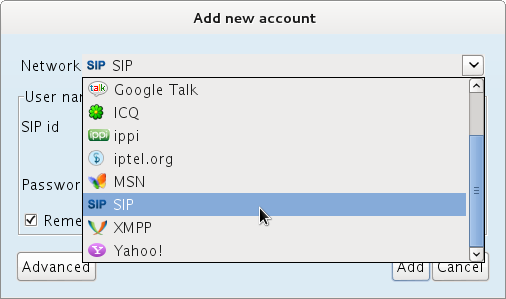
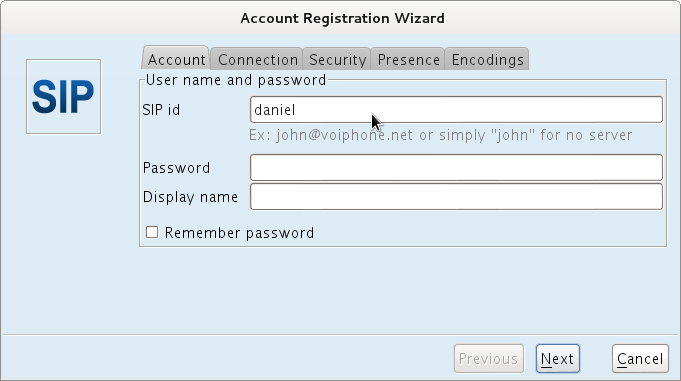
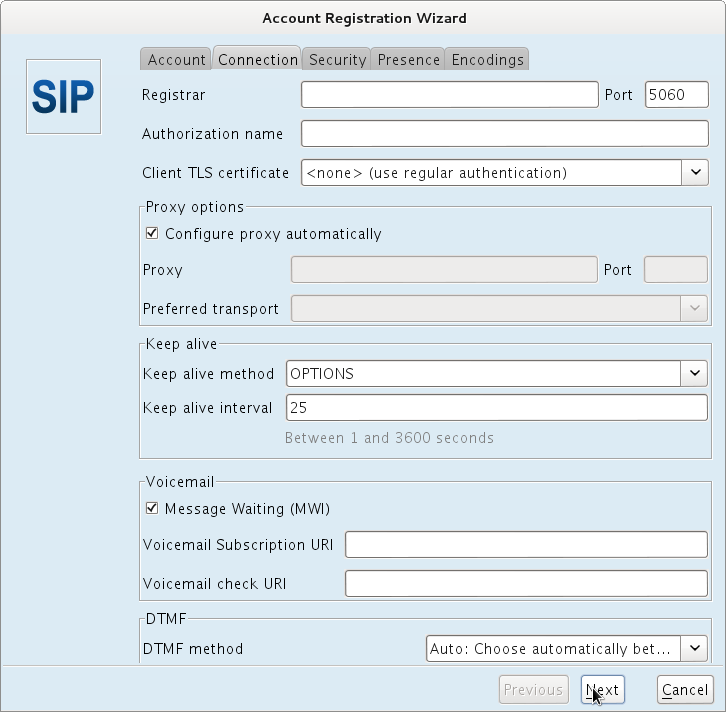
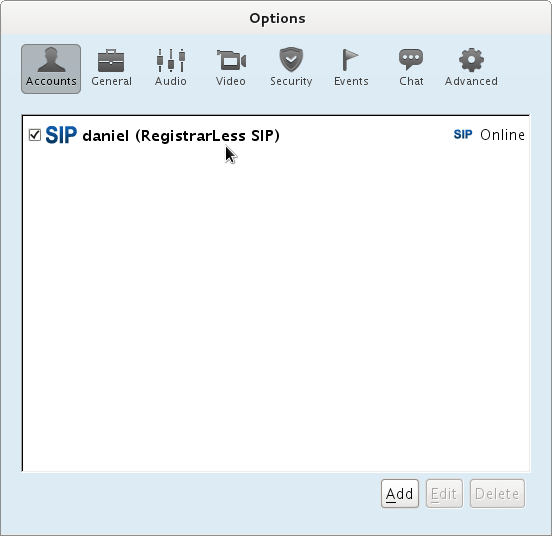
In the lead up to the release of Debian wheezy, there was quite some debate about the Mumble conferencing software which uses the deprecated and unsupported CELT codec. Although Mumble has very recently added Opus support, it is still limited by the fact that it is a standalone solution without any support for distributed protocols like SIP or XMPP. Making SIP conferencing easy Of course, people could always set up SIP conferences by installing Asterisk but for many use cases that may be overkill and may simply introduce alternative security and administration overheads. Enter reConServer The popular reSIProcate SIP stack includes a high-level programming API, the Conversation Manager, dubbed librecon. It was developed and contributed to the open source project by Scott Godin of SIP Spectrum. In very simple terms, a Conversation object with two Participants is a phone call. A Conversation object with more than two Participants is a conference. The original librecon includes a fully functional demo app, testUA that allows you to control conferences from the command line. As part of Google Summer of Code 2013, Catalin Constantin Usurelu took the testUA.cxx code and converted it into a proper daemon process. It is now available as a ready-to-run SIP conferencing server package in Debian and Ubuntu. The quick and easy way to try it Normally, a SIP conferencing server will be linked to a SIP proxy and other infrastructure. For trying it out quickly, however, no SIP proxy is necessary. Simply install the package with the default settings and then configure a client to talk to the reConServer directly by dialing the IP address of the server. For example, set the following options in /etc/reConServer/reConServer.config:
UDPPort = 5062
EnableAutoAnswer = true
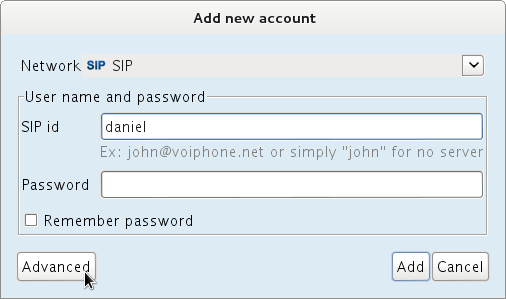
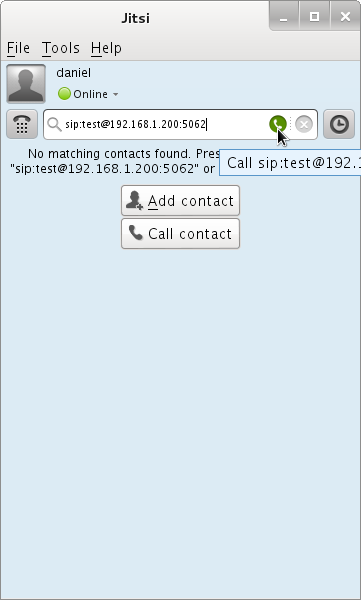
and it will happily accept all SIP calls sent to the IP address where it is running. Now configure Jitsi to talk to it directly in serverless SIP configuration: Notice here that we simply put a username without any domain part, this tells Jitsi to create an account that can operate without a SIP proxy or registration server: Calling in to the conference Notice in the screenshot below we simply dial the IP address and port number of the reConServer process, sip:192.168.1.100:5062. When the first call comes in, reConServer will answer and place the caller on hold. When the next caller arrives, the hold should automatically finish and audio will be heard. Next steps To make it run as part of a proper SIP deployment, set the necessary configuration options (username, password, proxy) to make reConServer register to the SIP proxy. Users can then call the conference through the proxy. To discuss any problems or questions, please come and join the recon-users mailing list or the Jitsi users list Consider using Wireshark to observe the SIP packets and learn more about the protocol.
Russ Allbery: Review: With Charity for All

Review: With Charity for All, by Ken Stern
Publisher: Anchor
Copyright: November 2013
ISBN: 0-307-74381-0
Format: Trade paperback
Pages: 244
I've been reading a lot lately about how to measure charitable organizations and where best to give your money, which has already prompted a rethinking of which organizations I want to support. Most of that has been shorter, on-line blog posts, but I've been wanting a deeper analysis. This is the first of a couple of books I've found on the topic. (The second, an analysis of microfinance, is waiting for me to have more time to read.) For this kind of book, the background of the author matters a lot. Stern was the former CEO of National Public Radio for eight and a half years, so he has practical experience in the business side of non-profits. He's credited with improving NPR's financial position and management and oversaw an era of rapid growth. In With Charity for All, he speaks frankly about his own personal experiences as well as his research. My impression is that he's typical of competent business managers of non-profits: not particularly radical, focused mostly on business issues, and the sort of person that a non-profit needs to turn a mission or cause into a sustainable organization. It's worth noting in advance that With Charity for All is specifically about the United States charitable sector and US laws and approaches. Some of this may generalize to other countries, but non-profit and charity law is very different between different countries, and the US attitude towards government, non-profits, and the appropriate division of responsibilities between them often doesn't match the prevailing view elsewhere. This book may well be interesting to people outside the US, but only if they're curious about the US charitable sector. The short summary of the message of this book is that we're not getting our money's worth out of charity, either as donors or as taxpayers who are indirectly subsidizing these organizations. This is not (usually) due to any outright fraud, although there certainly is some of that due to the almost total lack of oversight of charitable organizations. Rather, it's the result of a complex combination of history and institutional momentum, focus on the aspects of a charity that play well to potential donors, a concerted effort at feel-good marketing, well-intentioned but misguided donor dictates, adoption of approaches and business practices from the for-profit sector, and, above everything else, the almost complete absence of evidence-based evaluation of charities. Evidence-based evaluation is currently a hot trend among charities. I heard about this book via one of the organizations that is focusing on this (GiveWell). This is not what sites like Charity Navigator do, and indeed Stern talks at some length about the serious limitations of the Charity Navigator approach. All that sites of that type can do is look at spending breakdowns. Stern makes a strong argument that a focus on reducing overhead, as measured by those financial forms, is misguided and leads to very ineffective and unorganized charities. Worse, all Charity Navigator can tell you is if the charity is spending money on something they declare to be in line with their goal, not whether that money did any good whatsoever. The short and depressing news is that most of that money does little or no good, and worse, that most charities have no systematic way of measuring whether it does any good. I'm particularly interested in how to ground charities in more concrete evidence, and Stern's discussion does not disappoint. But one of the things I liked about the book is that he doesn't stop there. Other topics include the dizzying variety of charities and the resulting confusion and dispersion of resources, the non-profits that are practically indistinguishable from for-profit companies except that they get huge tax breaks (sports organizations, as you might expect, are probably the worst offenders, but Stern has harsh commentary on the US hospital system), the mess of compensation in the non-profit sector, and the serious problems created by major donors who want to get directly involved and oversee how their money is spent. All of these topics are fascinating, if a bit depressing in the aggregate. As is typical for a book of this sort, it's a lot easier to see the problems than to describe the solutions. Stern does try to offer his own prescriptions, most of which are variations on more oversight: more regulation, more effort put into measuring results, more concrete standards for success or failure, and a stronger culture of treating tax-exempt status as a privilege, not a right, that has to be defended by showing clear social benefit. I'm convinced those steps would be helpful, although less convinced that we're able to get there from here. One of his ideas I am already using on a small scale: pooling charitable donations with professional evaluators who can take the time to look deeper than financial breakdowns and do some independent measurement of results, or at least survey relevant studies done by others and possibly demand more be done. This model of a mutual fund for charitable giving has some promise, I think (more than a managed mutual fund, in fact), and is very similar to what GiveWell is doing. This is an advocacy book, and one that's primarily focused on concrete, measurable deliverables and on the finances. There are a few places where I have reason to be dubious of the black-and-white conclusions Stern draws. For example, he makes much of the bill collecting practices of charitable hospitals, which I agree is a travesty, but doesn't mention that non-profit hospitals produce better health outcomes. I'm also not sure his analysis is as directly applicable to advocacy organizations, where measuring success is a much more challenging proposition. I think the Southern Poverty Law Center is one of the best charities in the United States (admittedly based largely on gut feeling and presentation), but the nature of their work is not amenable to the style of analysis that Stern is doing here. It's therefore worth taking this book with a grain of salt. But, that said, Stern's conclusions are in line with things I've read elsewhere. I think he's pointing in the right direction, and I would recommend this book to anyone who gives regularly to charity. Hopefully it won't just cause you to stop. There are charities out there that are trying hard to measure their results and ensure they deliver social value for the money that we give them. Our system just doesn't support them very well, yet. Rating: 8 out of 10

Dirk Eddelbuettel: RcppArmadillo 0.4.200.0

Conrad released a new upstream release 4.200 for Armadillo, his templated C++ library for linear algebra, earlier today. As usual, this was rolled up in a new RcppArmadillo release 0.4.200.0; I had actually made two pre-releases leading up his 4.200 release and was hence not expecting any surprises. Prior to uploading to CRAN, I also tested against all 61 reverse dependencies of the package. Last but not least, I also updated the corresponding Debian package.
Changes in RcppArmadillo version 0.4.200.0 (2014-04-07)
  • Upgraded to Armadillo release Version 4.200 (Flintlock Swoop)
    • faster transpose of sparse matrices
    • more efficient handling of aliasing during matrix multiplication
    • faster inverse of matrices marked as diagonal
Courtesy of CRANberries, there is also a diffstat report for the most recent release As always, more detailed information is on the RcppArmadillo page. Questions, comments etc should go to the rcpp-devel mailing list off the R-Forge page.

This post by Dirk Eddelbuettel originated on his Thinking inside the box blog. Please report excessive re-aggregation in third-party for-profit settings.

Next.

Previous.