Search Results: "will"

18 April 2010

Russell Coker: ATI ES1000 Video on Debian/Squeeze

The Problem I ve just upgraded my Dell PowerEdge T105 [1] from Debian/Lenny to Debian/Squeeze. Unfortunately the result of the upgrade was that everything in an X display looked very green while the console display looked the way it usually did. I asked for advice on the LUV mailing list [2] and got a lot of good advice. Daniel Pittman offered a lot of great advice. The first suggestion was to check the gamma levels, the program xgamma displays the relative levels of Red, Green, and Blue (the primary colors for monitors) where it is usually expected that all of them will have the value of 1.0. This turned out to not be the problem, but it s worth noting for future instances of such problems. It s also worth noting the potential use of this to correct problems with display hardware, I ve had two Thinkpads turn red towards the end of their lives due to display hardware problems and I now realise I could have worked around the problem with xgamma. He also suggested that it might be ICC, the command xprop -root grep -i icc might display something if that was the case. I m still not sure what ICC is about but I know it s not set on my system. The next suggestion was to use the VESA display driver to try and discover whether it was a bug in the ATI driver. It turned out that the VESA driver solved that problem, I was tempted to continue using the VESA driver until I realised that the VESA driver has a maximum resolution of 1280*1024 which isn t suitable for a 1680*1050 resolution display. After reviewing my Xorg configuration file Daniel noted that my frame buffer depth of 16 bits per pixel is regarded as unusual by today s standards and probably isn t tested well. As 24bpp is generally implemented with 32bits for each pixel that means it takes twice the frame-buffer storage (both in the X server and in some applications) as well as twice the memory bandwidth to send data around. So I generally use 16bpp for my systems to make them run a little faster. (II) RADEON(0): Not using mode 1680 1050 (mode requires too much memory bandwidth) I tried using a depth of 24bpp and then I saw messages such as the above in /var/log/Xorg.0.log. It seems that the display hardware in my ATI ES1000 (the on-motherboard video card in the Dell server) doesn t have the memory bandwidth to support 1680*1050*24bpp. I tried using the gtf to generate new mode lines, but it seems that there is no 24bpp mode which has a low enough vertical refresh rate to not exhaust memory bandwidth but which is also high enough for the monitor to get a signal lock. The Solution My current solution is to use 15bpp mode which gives almost the same quality as 16bpp and uses the same small amount of memory bandwidth. It seems that 15bpp doesn t trigger the display driver bug. Of course one down-side to this is that the default KDE4 desktop background in Debian seems perfectly optimised to make 15bpp modes look ugly, it has a range of shades of blue that look chunky. What I really want to do is to get a better video card. Among other things I want to get a 1920*1080 resolution monitor in the near future, Dell is selling such monitors at very low prices and there are a bunch of affordable digital cameras that record video at that resolution. Even if I can get the ES1000 to work at 1920*1080 resolution it won t support playing Full HD resolution video I can barely play Youtube videos with it! I ve previously described my experience with the awful Computers and Parts Land (CPL) store [3] where they insisted that a PCIe*16 graphics card would work in my PCIe*8 system and then claimed to be doing me a favor by giving me a credit note for the full value (not a refund). This convinced me to not bother trying to buy such a card for the past year. But now it seems that I will be forced to buy one. What I Want to Buy I want a PCIe*8 video card that supports 1920*1080 resolution at 24bpp and has good enough performance with free Linux drivers to support Full HD video playback. Also PCIe*4 would do, and I m prepared to compromise on support of Full HD video. Basically anything better than the ES1000 will do. Does anyone know how I can buy such a card? I would prefer an ATI card but will take an NVidia if necessary. Note that I have no plans to cut one of the PCIe sockets on my motherboard (it s an expensive system and I m not going to risk breaking it). I will consider cutting the excess pins off a video card as a last resort. But I would rather just buy a PCIe*8 video card. Note that I am not going to pay cash in advance to a random person who reads my blog. Anyone who wants to sell me a second-hand card must either have a good reputation in the Linux community or ship the card to me on the condition that I pay after it passes the tests. Update: The first version of this post said that I upgraded TO Lenny, not FROM it.

Christian Perrier: Debian Installer localization status

I just published the following in debian-i18n. If you read this on Planet Debian, please followup on debian-i18n. The situation for D-I translations is currently the following. It is not that brilliant, I have to say. And I limit details to "level 1". In very short: 33 languages are in good shape. *26 languages are in danger of being deactivated* More details The safe side 16 languages are complete:
ar bg cs de es fr ga it ja lt nb pt ru sk th vi
14 languages were complete before changes to sublevel 5 and only have 5 fuzzy strings to very seldomly used packages:
ast bn el eo et eu fi gu mr pl sl sq sv tr zh_TW
3 languages have a few strings to update in sublevels 1 to 3 but have active translators who will probably easy cope with them:
be nl zh_CN
The unsafe side 12 languages had random updates since lenny but not on a regular basis. These languages are at risk of being deactivated for Squeeze if they are not complete for sublevels 1 and 2:
da gl ko pa ro he hi hu ka pt_BR ml tl
8 languages were complete in lenny but had no update since then. These languages are at risk of being deactivated for Squeeze if they are not complete for sublevels 1 and 2: bs ca dz hr id km lv mk ne nn ta wo Other languages are in various situations. Those marked "(P)" are not activated and have nearly no chance to be activated for Squeeze, the exception being Sinhala (si) which is making great progress. The 6 active languages listed below are at risk of being deactivated:
089%  uk     1
087%  ku     1
086%  am     1
083%  kk
083%  si (P) 2
072%  sr     1
069%  cy     1
064%  is (P) 1
043%  ms (P) 1
034%  kn (P) 1
025%  br (P) 1
015%  se     1
014%  mg (P)
014%  te (P) 2
012%  fa (P) 1
009%  xh (P) 1
008%  ur (P) 1
002%  hy (P) 1
000%  lo (P)
Squeeze release plans have not been made yet but I would say this is time to become aware of the situation and start hunting for translators for "endangered" languages.

15 April 2010

Jan Hauke Rahm: MiniDebconf in Berlin, T 8 weeks

To give a short update on where we stand now with the amazing plan of having a Mini Debconf in Berlin this year. There are just 8 weeks left which means there is lots of stuff to do and it needs to be done soon. But luckily Of course, all this is written in the wiki and you can put yourself in it at any time to offer your help! And if you have questions or want to join more real time ;), point your IRC client to OFTC and
/join #debian-miniconf-berlin
Help is still needed with video and audio stuff. If you think you know how to move a camera, or you can even work a sound mixer, get in touch with us. We need a few volunteers to cover the whole two days. Also, more generally help is needed in order to have people to talk to at all times both for speakers and visitors. No special knowledge is necessary although it might prove handy to know what Debian actually is. :) Interested? As a visitor or helper? Anyways, get in touch with us and it s going to be awesome! </commercial>

Gustavo Noronha Silva: WebKit2 and WebKitGTK+

So you ve seen people talking about WebKit2, perhaps have seen someone claiming it drops support for Linux , and you ve been wondering what the hell that means for WebKitGTK+. Well, welcome to the preemptive Q&A section with WebKitGTK+ maintainers =D. Let s first explore some history so we can better understand what exactly is going on. What exactly is WebKit2? Currently, when we say WebKit we really mean one of the ports that are built on top of WebCore using the WebKit layer. WebCore is the part that does all of the hard Web-related work, WebKit an API layer that exposes WebCore functionality in a coherent way, so that the platform-specific ports can expose a public API layer for their applications to use, which is usually also called WebKit . This WebKit layer was designed by Apple to build the Mac, and Windows ports it maintains, and was later released as Free Software so that other ports, such as the GTK+, Qt, EFL ports could be built on top of it, instead of having to do all the heavy lifting from WebCore directly.

Current WebKit model WebKit2 is nothing more than the second version of that interface, with a whole lot of changes on what you can expect from it, and on how it interacts with WebCore, and the platform-specific API and UI. First of all, the first WebKit was not API stable, and that interface was usually not made public by the various ports - they only exposed their platform-specific APIs. WebKit2 is being designed to provide a stable, cross-platform, C-based, non-blocking public API. This is huge. It will allow cross-platform code to be written without having to consider language, and port differences for basic functionality. The second big change is the API will be made fully non-blocking. Currently most things you do are asynchronous already, but some of them may be completed in a synchronous ways (like, loading a string into WebKit instead of an URI). This is important for responsiveness, and is also a very important need for what comes next: process splitting. WebKit2 will bring into WebKit proper the concept of splitting the UI process from the Web process, similar to what Chromium has. It also much more awesome than what Chrome has for a large number of reasons, including, but not limited to:

  1. It s being contributed directly to the WebKit project, in a cross-platform way that lets ports such as WebKitGTK+ take advantage of it, instead of being shipped directly into Safari, like Google does with Chrome;
  2. The process separation goes bellow the API layer, meaning that all complexity involved in managing the process separation is handled by the library, and hopefully none of it leaks to the application using it; that means that applications like Devhelp and Yelp will be able to take advantage of this without having to make their lives more complicated;
There s a much better diagram in WebKit2 s wiki page, but here goes a simplified version that demonstrates what I m talking about:
WebKit2 model
What WebKit2 is not? WebKit2 is NOT a rewrite of the whole WebKit stack. Webcore will continue mostly unchanged, and all ports currently building on top of it will keep working. It is also not a fork - the code lives in the same tree as the current version of WebKit, which will allow us to progressively move towards using this new, improved layer. WebKit2 is not Apple-only, and it is not dropping Linux support. Initial builds of the code that is being landed will likely show up building on Linux in the near future (specially because us porters are already eager to play with it). What happens to WebKitGTK+? In the near future, nothing special. We will continue working towards making it feature-complete, more stable, faster, and rocking on it as always. We will, though, start working out how we can best take advantage of WebKit2 in order to provide an even more awesome library for the G world. What this means is you can expect us to have a library that will provide a nice GTK+ widget, just like we have today, with a GObject-based API, like we have today, but that is built on top of this new WebKit2 infrastructure, taking advantage of the process-splitting, and the bigger focus on not blocking the UI thread. This should give us a platform that is more stable, and faster and more responsive than what we already have today. The API is bound to change, of course, but the WebKit2 version of WebKitGTK+ will be a separate, parallel-installable library, and we will keep supporting the WebKit1 version while we work on making the new one at least as good as the current one. This is long term we re talking here. We ll likely see WebKitGTK+ 1.4, and 1.6 come to life before we are satisfied enough with WebKitGTK+2. We hope this clears some of the doubts up, and lightens your hearts! The WebKitGTK+ maintainers.

Biella Coleman: Cultural Cornucopia

Today all across America, many are experiencing a soft form of hell, anxiety, and constant cursing for it is tax day. Thankfully last night I squared those away (more or less). Today is also the last day to register forDebconf sponsored registration. Even if there is a chance you can t make it, it is worth filling out the form just in case. For those spending a little extra time in NYC or planning on sneaking out to take a whirl in the city, here are some more fun options. NYC is known to be a cultural cornucopia of sorts and one reason are the many museums. I just found a twitter list listing those museums with a feed. Probably one of my favorite museums is located in the far north of Manhattan, the Cloisters. It is a haven, an oasis with small beautiful gardens, as well large stone rooms and buildings filled with medieval art, tapestry, and manuscripts. If you need to get away from people, chatter, and computers, this might be a good place to visit. Museums are easy enough to find but there are other spots in NYC that may be a little harder to spot. If you want to hit Chinatown for dim sum, I would recommend Jing Fong, which is mind blowing largely because of its LARGE (like there are escalators that take you up) room, which gets pretty darn packed on the weekend. If you want something that involves not just food but involves sweat, water, food, sun, hot rocks, body scrubs, funny looking pink, orange and blue uniforms and all in a cross-cultural context, then Spa Castle is the place to go to. Just check out the website and you will see what I am talking about. It s family friendly, has a cornucopia of saunas (filled with jade, gold, ice, Tibetan bricks), some decent Korean food, among many other attractions. In general is one of the best deals in NY.

Joachim Breitner: A mathematician s status symbol

While writing my diploma thesis, I often wished I had a blackboard in my room: A place to quickly scribble some ideas on, somewhere where I can easily erease and replace stuff. Also, somewhere where you can literally (and not just figuratively) step back from and look at from the distance. For my 25th birthday, my parents organized a discharged part of a blackboard from my old scool, and yesterday, we installed it in my room in Karlsruhe:
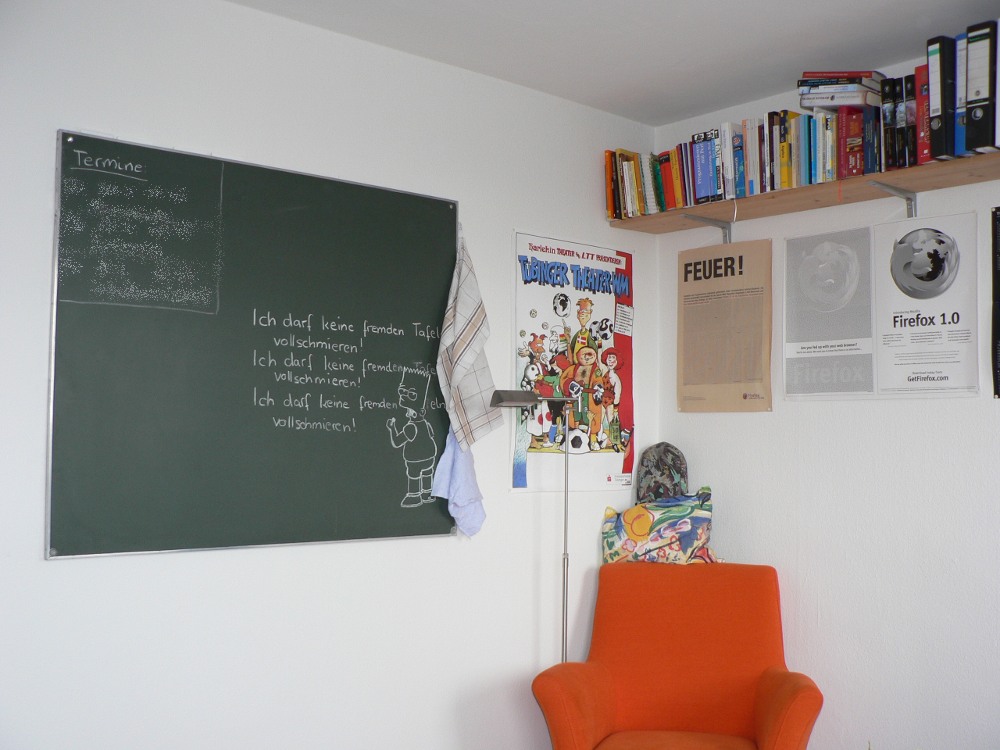
A blackboard in my room
Although my diploma thesis is finished, I m sure it will be a nice and useful piece of furniture, and if only to draw funny things on (as my girlfriend did on this picture).

MJ Ray: Debian Project Leader Election Campaign Round-up

I ve been AWOL for most of the debian project leader election campaigns this year, but I still want to vote, so I ve been dredging the emails on the last day. Maybe someone still has to vote and reads this, or maybe it ll help someone to interpret the result. What I ve done this year is to make a quick tally of platform points and campaign answers that I liked and disliked for each candidate, then total them up to get an order. If anyone gets a negative (more dislikes than likes), then I ll rank them below NOTA. Platforms: Margarita Manterola, Stefano Zacchiroli, Wouter Verhelst, Charles Plessy. Some of the questions: Make of that what you will. It surprised me which way the scores came out, but there was one answer with such a massive problem (in my opinion) that I ranked its giver equal with the next candidate down anyway. If you re a debian developer (DD), have you voted yet?

14 April 2010

Adrian von Bidder: Yay! Debian Logo!

Conditions for ordering: Not yet. The umbrella will be available ca. end of May, I'll give details about ordering it then. Information so far: CHF 25 per umbrella (ca. EUR 17 / USD 23), including ca. CHF 6 donation to Debian (via debian.ch); at least at first, I plan to ship in lots of 5 or more to save postage. International travellers should coordinate... (if you're close to Basel, Switzerland, you will obviously be able to get one directly as well.) So, stay tuned for the next announcement here.

Sandro Tosi: select count(bugs) in reportbug where status is open = 91

well, the actual select (against UDD) would be
udd=> select source, all_bugs from bugs_count where source = 'reportbug';
source all_bugs
----------+----------
reportbug 91
but the result is the same: less than 100 bugs against reportbug! Yay!

As you can see from the bugs graph, the Christmas and Easter holidays helped quite a lot to squash those bugs. When I first step into the reportbug world, the bugs count was around 250, and I first imagined in my mind to brake the 200 barrier, than the 150 and finally the less-than-100 one: while the first 2 limits where the hardest one (new to the codebase, other interest) the last one is the one I'm most proud of.
They seem quite nice-to-have stuff but recently I've tried to concentrate on reply fast to new report, fix as many reported crashes as possible and implement some of the long-awaited features.

Additionally, sometimes "No, sorry" is the proper reply to a bug and then it can be closed: it's hypocrite to keep bugs opened while internally you think it's a wontfix but you're not closing them because of a fear of possibly upset the reporters.

There will be more in the future, that's for sure, but I think this is the reportbug we'll see in squeeze, modulo some new crashes or very interesting feature we want it, so expect minor releases from now until squeeze+1

Petter Reinholdtsen: Kerberos for Debian Edu/Squeeze?

Yesterdays NUUG presentation about Kerberos was inspiring, and reminded me about the need to start using Kerberos in Skolelinux. Setting up a Kerberos server seem to be straight forward, and if we get this in place a long time before the Squeeze version of Debian freezes, we have a chance to migrate Skolelinux away from NFSv3 for the home directories, and over to an architecture where the infrastructure do not have to trust IP addresses and machines, and instead can trust users and cryptographic keys instead. A challenge will be integration and administration. Is there a Kerberos implementation for Debian where one can control the administration access in Kerberos using LDAP groups? With it, the school administration will have to maintain access control using flat files on the main server, which give a huge potential for errors. A related question I would like to know is how well Kerberos and pam-ccreds (offline password check) work together. Anyone know? Next step will be to use Kerberos for access control in Lwat and Nagios. I have no idea how much work that will be to implement. We would also need to document how to integrate with Windows AD, as such shared network will require two Kerberos realms that need to cooperate to work properly. I believe a good start would be to start using Kerberos on the skolelinux.no machines, and this way get ourselves experience with configuration and integration. A natural starting point would be setting up ldap.skolelinux.no as the Kerberos server, and migrate the rest of the machines from PAM via LDAP to PAM via Kerberos one at the time. If you would like to contribute to get this working in Skolelinux, I recommend you to see the video recording from yesterdays NUUG presentation, and start using Kerberos at home. The video show show up in a few days.

Michael Prokop: EtherPad.com gone long live TitanPad.com!

I love EtherPad for online collaboration in real-time. By today (14th of April 2010) new pad creation will be disabled at EtherPad.com. Being aware of that in advance and as the EtherPad software was open sourced recently friends of mine and I were working on providing a dedicated EtherPad setup. TitanPad was born! Quoting our TOS / Privacy Info:
TitanPad was launched to provide an EtherPad setup which is unrelated to any commercial and political entities. Its goal is to offer a stable service through proper operating.
[...]
Now TitanPad is officially up and running and you re free to use it for online collaboration. Feel free to drop your feedback, questions and suggestions to our team via mail to support (at) titanpad.com.

13 April 2010

Gunnar Wolf: Regarding the fatal cycling accident in Ciudad Universitaria

My blog is written in English, even though I sometimes post content relevant locally. Anyway, I want this to be as widely known as possible. We are about to launch a website/community for my University's cyclists, BiciUNAMonos. Please note the site I'm linking is still very preliminary in several ways. But that's the least relevant for now. I am translating here a message written by fellow cyclist (and researcher in the Institute of Astronomy of my University) Sergio Mendoza.
Regarding the fatal cycling accident in Ciudad Universitaria Yesterday night I got home, and was quite surprised to open my mailbox and find a considerable amount of messages under the subject Urgent: Fallen cyclist! I immediately noticed something was very wrong, and was surprised they were contacting me. When I decided to read the first such message, I realized what happened: Dr. Jorge Villanueva was run over by the Puma [internal University service] bus number 14, route 2, which was being driven over the speed limit. This happened last Sunday, April 11. On Sundays, all of Ciudad Universitaria becomes a cycling and running circuit. I was immediately brought back to the moment that, when I was leaving my office in the Astronomy Institute and heading towards Cerro del Agua avenue, a lady driving over the speed limit on the circuit that comes from Metro Universidad threw her car at me. I saw her at a few centimeters distance from her windshield... To the day I don't know how I pulled my bike away, as I was going to hit the windshield with my shoulder. Everything happened in slow motion, I just heard several cars honking at this imprudent lady. I didn't have a scratch, but got excessively close to getting a strong hit, and with the adrenaline raging I gave a kind caress with my closed fist to her brand new car. I had to free my adrenaline somehow... My legs were trembling when I tried to pedal. I told her, lady, I am excessively visible in my bike, why did you do this? , she didn't answer, she just looked despectively at me. This kind of accidents happen every day in the University and its main entries. Precisely today, a University professor threw his car at me entering the University via Cerro del Agua. When I reached him and confronted him, he told me completely sure of his words that I was invading the lane with my bike, and that it was my fault. Anybody would have thought a car-driving university professor is capable of reading the Metropolitant Transit Regulations that clearly states on its 1st article: The priority for using the public space, for the different transport modes will be according to the following priorization: I. Pedestrians; II. Cyclists; III. Users and providers of massive, collective or individual public transport service; IV. users of particular automotor transport; and V. users and providers of freight transport. We are now organizing to put up the first ghost bike in Ciudad Universitaria. This happens few days before the formal inauguration of BiciUNAMonos, the universitary association of urban cyclists; we will do this remembering our university mate. I see every day more people in the University hitting their bike pedals to get to their faculties, centers and research institutes, but what is striking is the lack of University infrastructure. The few cycleways we have are built to use a bycicle system that is open only until 16:00. It is good, but it is in no way useful for those of us who use the bike every day and at every hour, no matter the weather. The main problem lies at the communication points, when cyclists arrive from outside Ciudad Universitaria and have to take the regular circuits to reach the cycleways. The Transit Regulation, in the 1st article I quoted above, defines in an excellent way the priorities that must exist to allow human movility. In this regard we have to mention that:
  1. The pedestrians must be enormously protected with walkways and semaphores to allow them to safely walk. In Ciudad Unviersitaria there are many places that don't even have a walkway or semaphores, and drivers do not respect the pedestrian's preference. Also, now in the central area of Ciudad Universitaria we have the Pumabus system on a confined lane, providing an excellent service to the pedestrians to move within the campus.
  2. The cyclist comes next in this priorization, but there is nothing obvious for him. There are a couple of cyclist ways, usually invaded by pedestrians, and explicitly made to use the Bicipuma system. Cyclists need their own lane for circulation in the Universitary circuit; pedestrians have walkways, Pumab s has its confined lanes, but the cyclists still lack it. The third lane that remains is precisely for the IV and V entries in the Metropolitan Transport Regulations. They can perfectly share the remaining lane in the campus.
The last thing I wanted was to formally announce BiciUNAMonos reminding a fallen cyclist and dedicating a ghost bycicle to his memory in Ciudad Universtiaria, but we don't have a choice. We have to make it very clear to the University community that the bicycle is the best transport system, and that the drivers' imprudence inside Ciudad Universitaria must be strongly punished. Sergio Mendoza
President
http://www.biciunamonos.org
Coincidentally, today I also had a freightening experience. Taking one of my usual routes to work, going up from the sporting area in the Western half of the campus (just before where the map lists the highest point in my ride), just by Investigaciones Biom dicas, I heard a car hitting the breaks behind me and passing me (on my right side) quite narrowly. I was, as always, driving towards the center of the lane, to be able to respond to unforseen events (as this one, precisely). The Universitary authorities had the great(?) idea of placing round, small bumps before the Pumabus stations to avoid drivers parking in front of them. I have seen a strong accident caused by them, and was close to suffering one myself some months ago. I know that just after Biom dicas there are some such bumps, so I never ride too much to the right I don't know what was on this driver's head. Ciudad Universitaria has a 40 Km/h speed limit. Yes, it might seem too low - Circuits are wide and well planned. But there is a lot of cyclist and pedestrian transit, at all times, and I must recognize such a limit is well in place. I often take a longer route to my Institute, bordering the University along Av. Delf n Madrigal. People tell me I'm crazy, as this is an avenue that's often taken at high speed - Usually, cars pass me by between 60 and 80 Km/h. However, I even feel safer going that way than going inside the University. Contrary to the popular belief, Universitary people do not have better driving habits than the bulk of the population. And it's often much easier to drive along a way where the traffic even if it goes at three times my speed runs only in one direction, unlike the swarming of people going in every possible direction inside the main campus. Anyway, last Sunday we lost a University professor, we lost a cyclist. Some people lost a friend, a family member. We have to make this case well known, we have to speak with the authorities so they see the Bicipuma system is good, but not enough. Cycling is the only way to go for a city as complex as ours. A much needed first step is to allow proper vial connections linking the University and the many avenues that surround it. Another one is to make a campaign so the cyclists are not seen as Sergio regards as intruders in the streets The street belongs to us all. Cyclists should never drive on walkways or among pedestrians. Drivers need to learn to share the streets with us.

Asheesh Laroia: Let people help your project: Give them a button to click

This note goes out to the maintainers and contributors of Free and open source projects. (Cross-posted at the OpenHatch blog.) I recently had the chance to look at Mozilla Quality Assurance's research into the people who help out with testing versions of Firefox. I saw numbers that really spoke to my experience as a volunteer. On one hand, the vast majority of people put in three or fewer hours a week, most of whom put in one hour or fewer (such as zero). On the other hand, a huge number wish they could put in a lot more: Now imagine you're that one-hour-a-week contributor. You have all these other bits of your life tugging at your time. You want to make sure that when you sit down to work on free software, you're doing something that really helps out. Otherwise, not only will you feel bad that you aren't giving free software as much time as you wish, you'll feel bad that you're not even making a difference. In my experience, even reading the project mailing list counts toward that time you're putting into the project. But that doesn't feel productive. So fellow contributors, I have a request for you: Would you be willing to make it super easy for someone to stand waiting, on guard, for instructions from you? Imagine if all they had to do is click a button on your website, write a little bit of info about what they could do, and you would suggest something for them to work on. Maybe you can offer them a bitesize bug to fix, or maybe you need someone to download and test the latest version before you release it. If you're handing out assignments, then part-time contributors don't have to spend their time figuring out what they should do. I want to tell you that I can give you such a button. It would look like this: To get it, you just have to add a little snippet of HTML to your project website. Just go to the OpenHatch project list. and find your project. If it's not there yet, search for it, and click the link to create it. Then find the box labeled "Have your own website?" and click. Ta-da! HTML source code you can copy-paste. Since OpenHatch itself is an open source project, we added the button to our own "source code, etc." page. When people click it, they appear in a list of "People willing to help" on your project's OpenHatch page. Like all the friendly faces on the Gwibber page. Would you try it, too?

12 April 2010

Ingo Juergensmann: Syncing N97 with DAViCal

A few days ago I blogged about my problems syncing my N97 with iCal, Sunbird and other calendar apps. Today I tried DAViCal instead of Apples calendarserver (caldavd). To my surprise it worked fairly well, although not flawlessly. To make it short: I can now sync between my N97 smartphone via Bluetooth and iCal on OS X and Sunbird (tested on OS X as well): creating appointments on the N97, syncing via iSync and having the appointment exported to DAViCal via iCal works pretty well. Deleting dates works well in iCal as well. It has some problems as mentioned before on N97, though. But when you delete the date in iCal, it will vanish on the N97 as well.


It was somewhat tricky to get it that far. The problem is, that iSync can only sync to a local calendar in iCal. But with DAViCal you can publish/export that local calendar to the server where it is display a another calendar principal. That why syncing with the N97 works pretty well, although you might end up with double entry in iCal. I unchecked the N97 prinicipal/calendar from the server in iCal, as you can see in the screenshot above.

I haven't been able to test calendar sycing on Debian yet, but I believe that there will be some app that will work. And there are still problems. For example I have an appointment in July and August that are displayed in iCal and Sunbird, but not on the N97. Maybe there are some attributes to those dates that prevent them from being imported into the N97. Dunno.
But so far this is the best syncing solution so far. I'll test how well this works out for me...

Chris Lawrence: epcp for R

I finally have packaged up a very rough port of my epcp routine from Stata to R as part of a package unimaginatively called cnlmisc; you can download it here. In addition to the diagnostics that the Stata routine provides, the glm method includes a bunch of R-square-like measures from various sources (including Greene and Long). The only part I m sure works at the moment is the epcp for glm objects (including survey s and Zelig s wrappers thereof); the others that are coded (for polr and VGAM) are probably half-working or totally broken, and some wrappers aren t there yet at all. The error bounds suggested by Herron aren t there either. The print routines need a lot of work too; eventually it will have a nice toLatex() wrapper as well. But it beats having it sit on my hard drive gathering dust; plus I may eventually get motivated to write a JSS piece or something based on it. epcp for Stata is still available at my site. For more information on the measure, see Michael C. Herron (1999), Postestimation Uncertainty in Limited Dependent Variable Models Political Analysis 8(1): 83 98 or Moshe Ben-Akiva and Steven Lerman (1985), Discrete Choice Analysis, MIT Press.

11 April 2010

Gunnar Wolf: Lets all get running

There is no clear reason, but for many months already, I have almost given up running Which is a shame, as I enjoy it so much. And yes, I can talk a lot about why not, but outside of one seemingly stupid point there is really no reason. And yes, I have taken on cycling, although on a very different fashion: Cycling is by far not as good as an exercise as running Yes, cycling for ~1h on average 3 times a week has kept my body from becoming sedentary again, but I do feel some increased clumsiness and a undeniable weight gain that I don't want to allow. I said there is one seemingly stupid point: Shoes. My running shoes are around two year old, and they are an important factor on me not running. Why? Because they started giving me blisters at ~5Km. And my shoe size is beyond what is considered as normal by Mexican standards European 44-45 (US 10 -11). Shoe-shopping is always frustrating and very off-putting for me, as instead of what most people do (go to one store, ask for their favorite n pairs on their size, test them on, pay, be happy), I follow almost the opposite process (go to n stores, ask for whatever they have on my size, test it on, pray, pay). Of course, for some people, entering many stores and checking what's offered at each is a thrill by itself. For me, that sounds as thrilling as visiting the dentist for an endodontic treatment. Oh, and to make things even better, I am quite low on cash. Scarcity economics explain that if a given good is hard to find, it will probably be more expensive. So, while many people in Mexico buy ~US$30 shoes, I often get to pay ~US$90. Fun, hah? Anyway, I had a short semi-vacation to Argentina. I decided to kill this excuse, and went shoe-shopping. Fearsome memories sprang in my mind when the first store said they didn't have anything right for me. But they pointed to a second store, one block away, where I found (I was even able to choose between several models!) a nice pair of Olimpikus. In 2008, I was routinely running slightly over 10Km. Today I went out to get back the feeling, and made a not-so-great-but-still-satisfying 4Km. And upon arriving back home, I read Christian's chronicle on his Paris Marathon run Well, only 10% of what my fellow DD achieved But I am definitively back on track. I expect to make some time to get a run, at least three times a week, trying to push my limit at least back to the nice spot I was at two years ago.

Kumar Appaiah: I'm going to Debconf 10

So, I will be at DebConf10 from 4th August onwards. The prime purpose of my visit is to meet all Debian developers, so I don't think the delayed attendance should matter much.Customary banner: I'm going to DebConf10!See you all there!Tags: debconf, debconf10, debian

Christian Perrier: [life] Paris marathon 2010~bubulle-1 ACCEPTED

Upload accepted by organisers. Upload time has been 3h49'29" (my watch says 27", eh!). That was a good one, really (actually, I can compare to only 3 as it was my fourth marathon after Paris and Cologne 2009, plus the unofficial Rambouillet Forest marathon I ran alone 6 weeks after Paris 2009). For marathoners around, here are the chronometric data. Please note that GPS watches tend to overestimate the distance, mostly because of the jerky way one runs in mass events, as well as geometric considerations related to the imprecision of GPS (imprecision may be lateral and thus the line recorded by the watch is often less straight than the real one). For instance, according to my watch, Paris marathon was 42.63km long, so an overestimate by nearly 500meters. As a consequence, the recorded speed of 5'23"/km should be corrected to 5'25". So, times below should be increased by 2 seconds. As a conclusion, even though I can improve the pace and avoid going too fast in the first 25km, I'm very happy as I avoided nearly collapsing as I did last year (with sometimes over 7'00/km and a few walks). Going back home was OK and I had no cramps and I still haven't any. This is also what one gets when preparing well. My only regret is that I didn't run over 30km since, indeed, Cologne Marathon! That made the difference in the last 12 kilometers, obviously. Having spent the winter on many half-marathons (either alone, or a few officials) clearly improved my "performance" up to 25km. For the next marathon (a marathoner always thinks about the next one), I need to have 1 or 2 long trainings a few weeks before. Now, I have to find out which one will be the next one... and I wish good luck to my friend No l K the, who is preparing the Mainz marathon for May 9th as well as Dirk who's certainly preparing another one. Guys, rendez-vous is of course for Debconf10 in NYC. We won't run a marathon for sur, but how about an half one? :-)

Russell Coker: Debian/Testing and KDE4

I ve just upgraded my Thinkpad (which I use for most of my work) to Debian/testing with KDE4. Improvements Kde 3.5 (from Debian/Lenny) didn t properly display the applets in a vertical task bar. I want a vertical task bar because my screen resolution is 1680*1050 and I find that a less rectangular screen workspace is best for my usage patterns. In my previous post about my Thinkpad T61 I described how the sound controls weren t working [1]. These problems were fixed as part of the upgrade, KDE just does the right thing. Now when I press the buttons to increase or decrease the volume the ALSA settings are changed and a small window is briefly displayed in the center of the screen to show the new volume. Sounds are now made when I plug or unplug the power cable, this was configured in KDE 3.5 but just didn t work. Problems If I have a maximised Konqueror window and I use the middle mouse button to open a link in a new window then the new window will also be maximised. Previously when I did that the new window was not maximised. What sometimes happens is that I want to open several links from a web page in different windows, so if I can open them in non-maximised windows then I can click the title-bar or the bottom status-bar of the parent window to get it in the foreground again. Probably an ideal solution to this use-case would be to configure the middle mouse button to open a new window in the background or minimised. I can t figure out how to implement accelerator keys for window controls. In particular I like to use ALT-F9 to minimise a window (CUA89 standard). The upgrade from KDE 3.5 to KDE 4 lost this and I can t get it back. I want to have an icon on my panel to launch a Konqueror session. I don t want a large amount of space taken up for a launcher for several different Konqueror options, I just want a regular Konqueror for web browsing available at a single click. There didn t seem to be an option for this. KDE 3.5 has an option in the add widgets to toolbar dialogue to add icons for applications. I have just discovered that in KDE 4 the only way to do this is to go through the menu structure and then click the secondary mouse button. Having two ways to do something is often a good thing, particularly when the other way is the way that was most obvious in the previous version! It was annoying that the font choices for my Konsole session were lost on the KDE 4 upgrade, it s not a complex setting. Also the option to resize a Konsole session to a common size (such as 80*25) seems to have been lost. I had to spend at least 30 minutes configuring kmail to get it to display mail in much the same manner as it used to. You have to use the Select View Appearance (Theme) icon off at the right of the Search box and select Classic and then go to Select Aggregation Mode (immediately to the left) to select Flat Date View . I m happy for KDE 4 to default to new exciting things when run the first time, but when upgrading from KDE 3.5 it should try to act like KDE 3.5. I decided to use Kopete for Jabber just to preempt the GNOME people adding Mono support to Pidgin. I had to install the libqca2-plugin-ossl and qca-tls packages to enable SSL connection, missing either of those gives you an incomprehensible error condition that even strace doesn t clarify much. Given that it s generally agreed that sending passwords unencrypted over the Internet is a bad idea and that it s a configuration option in Jabber servers to reject non-SSL connections it seems to me that the Kopoete package should depend on the packages that are needed for SSL support. Failing that it would be good to have Kopete offer big visible warnings when you don t have them. I use the KDE 2 theme and the right side of the title bar of each window is a strange dappled pattern. Not sure why and I have more important problems to fix. Parts of KDE crash too often. I ll start filing bug reports soon. The management of the Desktop folder has changed. In previous versions of KDE the directory ~/Desktop had it s contents displayed in iconic form on the root window. Now by default it doesn t do that. It is possible to change it, but this is one of those things where the default in the case of an upgrade should be to act like previous versions. The way to enable the previous functionality is to go to the desktop settings (click the secondary mouse button on the background, select Desktop Settings and then under Desktop Activity change the Type: to the value Folder View and then specify the directory below. The facility to have different background colors or pictures for each of the virtual desktops seems to have been removed either that or the KDE configuration system doesn t have enough functionality to let me discover how to configure it. When the panel that I have on the left of the screen crashes everything that was next to the panel gets dragged to the left, this includes extending the width of maximised windows. Then when the panel starts again (which if lucky happens automatically) it pushes things back and if icons had been moved left it just obscures them. When using Konqueror to browse a directory full of pictures it doesn t generate thumbnail icons. When I middle-click on an icon for a picture it is opened with Konqueror not the image viewer that was used in KDE 3.5. The image viewer from KDE 3.5 had less options and therefore more screen space was used for the picture. Also the Konqueror window that is opened for this has a navigator panel at the left which I can t permanently remove. When I use Konqueror my common action is to perform a Google search and then use the middle button to open a search result in a new window. Most of my Google searches return pages that have more than one screen-full of data so shortly after opening a window with a search result I press PgDn to see the next page. That press of PgDn for some reason takes me back to the Google search. It seems that when a web page is opened in a new window the keyboard focus will be in the URL entry field, and pressing PgDn in that field takes you to the previous web page. This combination is really annoying for me. Conclusion Getting the sound working correctly is a great feature! Lots of little things are fancier and generally the upgrade is a benefit. The lack of thumbnails when displaying a folder of JPG files is really annoying though. The time taken to configure things is also annoying, I support four relatives who are just users so that probably means at least an hour of configuration work and training for each one so KDE 4 is going to cost me at least half a day because of this.

Next.

Previous.