Search Results: "tim"

15 July 2011

Jon Dowland: puppet revisited

In an earlier post, I asked a number of questions, most of which are now answered. Here's a recap: I wrote
I stumbled across some CF Engine-style definitions for puppet in a Debian Administration article (taken originally from puppet's own wiki, which have since been moved/deleted)
Perhaps it was removed with good reason This is a fairly horrid solution to the problem. Phil was the first to suggest investigating Augeas, a neat tool that abstracts away the nasty specifics of parsing the myriad configuration file formats and provides a unified, tree-like interface for adjusting configurations. The interface reminds me of manipulating XML via the DOM. More on Augeas in a later blog post I also wrote
package [foo,bar]: syntax worked fine, but is a little verbose and the package list is awkward to maintain buried inside the puppet syntax. I spent some time trying to see whether I could populate a puppet list based on the contents of a file: then I could list the packages one-per-line in a separate file. I haven't found a way of doing that yet.
I haven't found a more concise way of solving this problem, but as I have grown more familiar with puppet's syntax I have become less bothered by it. I igo suggested pre-processing the puppet configuration, but I'd rather not complicate my provisioning approach (VCS hooks) by attempting that. Finally I wrote
Using my laptop as a second node also exposed some interesting puppet client behaviour. Once I went off-site, the laptop tried to look up puppet on foreign networks (such as my home network). I would have assumed that, once the strong SSL association had been made, the client would try to connect to the FQDN of the server. This probably isn't a serious problem in practice, as we probably won't need to rely on nodes off-site talking to the configuration server, but I hope that the client doesn't trust any host that happens to answer to puppet...
I'm pleased to report that the client is at least this clever: it refused to talk to a local puppetmaster that I setup at home.

Dirk Eddelbuettel: MCMC and faster Gibbs Sampling using Rcpp

Sanjog Misra, who uses Rcpp for Monte Carlo Markov Chain (MCMC) analyses in quantitative marketing, kindly set me a short example of Rcpp use. The example is based on a blog post by Darren Wilkinson which itself discusses and compares the suitability of R, Python, Java or C for MCMC analysis, using the Gibbs sampler as a concrete example. Darren's post is worth checking out: he stresses the rather pragmatic aspects of how fast and/or easy it is to write the code, rather than just the mere runtime. As such, he is not too concerned with a speed advantage of Python over R which he sees at a factor of around 2.4, leaving him to continue to prototype in R. Similarly, with C 'only' being faster than Java by a factor of two, he prefers Java for the numerically more demanding parts. We do of course advocate the use of Rcpp to combine the best aspects of R and C++, respectively. This Gibbs sampler example provides a nice backdrop. So working with Darren's example, consider the same Gibbs sampler for a bivariate distribution (and apologies for the lack of latex typesetting on my blog)
f(x,y) = k x^2 exp( -x y^2 - y^2 + 2y - 4x)
where the conditional distributions are
f(x y) = (x^2)*exp(-x*(4+y*y))               ## a Gamma density kernel
f(y x) = exp(-0.5*2*(x+1)*(y^2 - 2*y/(x+1))  ## a Gaussian kernel
Sanjog then spotted and corrected a small error in the variance expression in Darren's derivation; this is now acknowledged on Darren's website. Full details are in the R script now committed in SVN. The R code for the Gibbs sample can therefore be written as follows below. Note that this uses thinning to minimize serial correlation in the conditional densities--which renders the computation more demanding as 'N times thin' draws have to be generated:
## Here is the actual Gibbs Sampler
## This is Darren Wilkinsons R code (with the corrected variance)
## But we are returning only his columns 2 and 3 as the 1:N sequence
## is never used below
Rgibbs <- function(N,thin)  
    mat <- matrix(0,ncol=2,nrow=N)
    x <- 0
    y <- 0
    for (i in 1:N)  
        for (j in 1:thin)  
            x <- rgamma(1,3,y*y+4)
            y <- rnorm(1,1/(x+1),1/sqrt(2*(x+1)))
         
        mat[i,] <- c(x,y)
     
    mat
 
A second variant can be computed using the R bytecode compiler which appeared with the recent release of R 2.13.0 (and which we analysed in this blog post from April). This is as easy as
## We can also try the R compiler on this R function
RCgibbs <- cmpfun(Rgibbs)
Thanks to Rcpp and the inline package, we can also write a C++ variant that can be built and launched from R with ease. The C++ code is assigned to an R text variable gibbscode. (And we used to typeset such code on the blog as a character string, ie in a faint red color---but have now switched to highlight it as if it were freestanding C++ code. It really is passed as a single string to R which then uses the cxxfunction() to compile, link and load a C++ function built around the code. See previous posts on the inline package for more.)
## Now for the Rcpp version -- Notice how easy it is to code up!
gibbscode <- '

  using namespace Rcpp;   // inline does that for us already
  // n and thin are SEXPs which the Rcpp::as function maps to C++ vars
  int N   = as<int>(n);
  int thn = as<int>(thin);
  int i,j;
  NumericMatrix mat(N, 2);
  RNGScope scope;         // Initialize Random number generator
  // The rest of the code follows the R version
  double x=0, y=0;
  for (i=0; i<N; i++)  
    for (j=0; j<thn; j++)  
      x = ::Rf_rgamma(3.0,1.0/(y*y+4));
      y = ::Rf_rnorm(1.0/(x+1),1.0/sqrt(2*x+2));
     
    mat(i,0) = x;
    mat(i,1) = y;
   
  return mat;             // Return to R
'
# Compile and Load
RcppGibbs <- cxxfunction(signature(n="int", thin = "int"),
                         gibbscode, plugin="Rcpp")
It is noteworthy how the code logic is essentially identical between the basic R version, and the C++ version. Two nested loops control draws of x from a Gamma distribution, conditional on y, as well as draws of y from a Normal, conditional on x. Add a small amount of parameter passing to obtain the parameters N and thin, allocation of a results matrix and setup of the random number generator state to remain consistent with R, as well as a return of the matrix---and that is all. As Darren's code uses the GNU GSL in its C variant, I also became interested in seeing how a C/C++ hybrid variant using our RcppGSL package would fare. The code is below.
gslgibbsincl <- '
  #include <gsl/gsl_rng.h>
  #include <gsl/gsl_randist.h>
  using namespace Rcpp;  // just to be explicit
'
gslgibbscode <- '
  int N = as<int>(ns);
  int thin = as<int>(thns);
  int i, j;
  gsl_rng *r = gsl_rng_alloc(gsl_rng_mt19937);
  double x=0, y=0;
  NumericMatrix mat(N, 2);
  for (i=0; i<N; i++)  
    for (j=0; j<thin; j++)  
      x = gsl_ran_gamma(r,3.0,1.0/(y*y+4));
      y = 1.0/(x+1)+gsl_ran_gaussian(r,1.0/sqrt(2*x+2));
     
    mat(i,0) = x;
    mat(i,1) = y;
   
  gsl_rng_free(r);
  return mat;           // Return to R
'
## Compile and Load
GSLGibbs <- cxxfunction(signature(ns="int", thns = "int"),
                        body=gslgibbscode, includes=gslgibbsincl,
                        plugin="RcppGSL")
This code is similar to the version using just Rcpp, but we need to allocate space for the GSL random generator object (and later release that memory allocation), and we do of course call the GSL functions. This also necessitates declaring the function using the two header files listed as arguments for the include argument of cxxfunction(). So how is the performance? The script (now committed in Rcpp's SVN repo as examples/RcppGibbs/RcppGibbs.R, and also part of the next release) creates the output below when running in non-interactive mode (whereas interactive mode creates a few charts too):
edd@max:~/svn/rcpp/pkg/Rcpp/inst/examples/RcppGibbs$ r RcppGibbs.R
Replication # 1 complete 
Replication # 2 complete 
Replication # 3 complete 
Replication # 4 complete 
                    N=1000 N=5000 N=10000 N=20000
Elasped Time (R)     0.124  2.650  10.511  41.773
Elasped Time (RC)    0.081  1.916   7.594  30.280
Elapsed Time (Rcpp)  0.003  0.076   0.306   1.221
Elapsed Time (Rgsl)  0.002  0.049   0.196   0.784
SpeedUp Rcomp.       1.530  1.380   1.380   1.380
SpeedUp Rcpp        41.330 34.870  34.350  34.210
SpeedUp GSL         62.000 54.080  53.630  53.280
               test replications elapsed  relative user.self sys.self
4  GSLGibbs(N, thn)           10   7.845  1.000000      7.84        0
3 RcppGibbs(N, thn)           10  12.218  1.557425     12.22        0
2   RCgibbs(N, thn)           10 312.296 39.808286    311.98        0
1    Rgibbs(N, thn)           10 420.953 53.658764    420.59        0
The first block is a hand-computed comparison using four sets of parameters; the second block uses the excellent rbenchmark package to compare ten runs at twenty-thousand draws. We see a nominal increase in performance due to the bytecode compiler, saving roughly 38 percent which seems appropriate given that the R code mostly controls the loops; actual work in undertaken in the already compiled RNG functions. The Rcpp variant is about 34 times faster than the pure R code. Sanjog reported higher increases on his OS X machines (and Darren's post echos a similar order of magnitude). However, on my i7 running Linux I always obtained an improvement in the mid- to high thirties. That is certainly already a rather pleasant result. What surprised and stunned me at first was that the GSL solution scores an improvement of around 53 times (close to the factor of 60 reported by Darren). A closer look at the code (shown above) makes it clear that there are very few compute-intensive operations outside of the RNG draws. I validated this further with a second study timing just one million draws each from a Gaussian and Gamma using R via Rcpp, and using the GSL. It turns out that the R code is about 2.5 times slower for random draws from the Gamma distribution than the GSL. Inspection of the source code---in files src/nmath/rgamma.c for R and randist/gamma.c for the GSL shows why. R uses a much more complex (and presumably more precise) algorithm. I may follow up with Martin Maechler to see if we can illustrative the numerical benefits of this more expensive approach---this blog entry is getting long enough already. So to sum up: Gibbs sampling is a somewhat resource-heavy Monte Carlo Markov Chain method for investigating multivariate distributions. R excels at quick and simple explorations, albeit at somewhat slower execution speed. The Rcpp package can help by providing easy means to accelerate simulations by a significant factor. The example discussed here is now in SVN repository for Rcpp and will be part of the next release.

Updated 2011-07-16: Darren has just updated his comparison; fixed two typos here too.

14 July 2011

Jamie McClelland: GnuCash with python bindings

Hats off to the GnuCash developers and the Parit Worker Collective for the python bindings to GnuCash. If there is any doubt that free software makes life easier it's being able to write your own accounting import scripts while reading the original source code. I had to re-compile Debian's version of GnuCash because it doesn't have the python bindings enabled by default. As root:
apt-get build-dep gnucash
apt-get install python-dev
As a non privileged user:
apt-get source gnucash
cd gnucash-N.N.N # varies depending on your version)
Then, edit debian/rules and add --enable-python-bindings to the dhautoconfigure command. I replaced the line:
--enable-locale-specific-tax
With the lines:
--enable-locale-specific-tax \
--enable-python-bindings
Then, update the change log with:
dch
Built the new package:
dpkg-buildpackage -rfakeroot -uc -b
I then wrote a python module. It logs into the server running our members database, runs a script to export tab delimited lists, and then imports them into our gnucash xml file. It's far from perfect (I'm fairly new to python). Also - I have sheepishly inserted code that searches for certain values by accessing the gnucash file directly (via python's xml handling modules). I couldn't figure out how to do the search I needed with they available python methods, although it may very well be there and I just couldn't figure it out. If anyone is interested in using it for a template:
#!/usr/bin/python
import sys 
import os
import time
import csv
import warnings
from xml.dom.minidom import parse
from gnucash import Session,  GncNumeric
from gnucash.gnucash_business import Customer, Invoice, Entry, BillTerm
from decimal import Decimal
import datetime
import tempfile
import subprocess
def main(argv = None):
  if argv is None:
    argv = sys.argv
  path = os.environ['MFPL_GNUCASH_PATH']
  if not os.path.exists(path):
    print """Path (%s) does not exist. Please set 
    MFPL_GNUCASH_PATH environment variable\n""" % path
    return 1 
  if os.path.exists(path + '.LCK'):
    print """Lock file exists. Is GNUCash running?\n"""
    return 1 
  command = argv[1]
  import_file = None
  if 2 in argv:
    if argv[2] == '--from-file':
      if argv[3]:
        if os.path.exists(argv[3]):
          file_path = argv[3]
          import_file = open(file_path,'r')
        else:
          print "Can't find file to import: %s" % argv[3]
          return 1
      else:
        print "Please pass path to file if using --from-file"
        return 1
    else:
      print "I didn't understand the argument: %s" %s
  # download import file if not provided
  if import_file == None:
    import_file = get_data(command)
  # The file might be gzipped, so
  # open and save it 
  s = get_gnucash_session(path) 
  s.save()
  s.end()
  # Wait a second, so we can create a backup
  # without a name collision
  time.sleep(1)
  # Open for real now...
  s = get_gnucash_session(path) 
  xml_dom = parse(path) 
  if command == "members":
    ret = import_members_from_file(s, xml_dom, import_file)
  if command == "invoices":
    ret = import_invoices_from_file(s, xml_dom, import_file)
  s.save()
  s.end()
  return ret
def get_data(command):
  import_file = tempfile.NamedTemporaryFile()   
  if command == 'members':
    remote_cmd = 'acc-member-list'
  else:
    remote_cmd = 'acc-invoice-list'
  args = [ '/usr/bin/ssh', 'mayfirst@hay.mayfirst.org', '/home/mayfirst/bin/' + remote_cmd ]
  subprocess.call(args,stdout = import_file)
  return import_file
def import_invoices_from_file(s, xml_dom, csvfile):
  dialect = 'excel-tab'
  csvfile.seek(0)
  reader = csv.reader(csvfile, dialect)
  nodes = xml_dom.getElementsByTagName('gnc:GncCustomer')
  already_entered = 0
  entered = 0
  for row in reader:
    member_id = row[0]
    invoice_id = row[1]
    invoice_date = row[2]
    invoice_amount = row[3]
    invoice_desc = row[4]
    if not member_id.isdigit():
      # header line or not coded to a member?
      continue
    member_id = int(member_id)
    invoice_id = int(invoice_id)
    if invoice_exists(xml_dom, invoice_id):
      # print "Already entered %s (%s)" % (invoice_date,invoice_id)
      already_entered += 1
    else:
      if not member_exists(xml_dom, "No Name McGoo - fix me" , member_id):
        print "Skipping member id %s, invoice id %s - member doesn't exist" % (member_id, invoice_id)
      else:
        invoice_enter(s, member_id, invoice_id, invoice_date, invoice_amount, invoice_desc )
        entered += 1
  print "Invoices entered from last two months: %s (%s already existed)" % (entered, already_entered)
  return True
def get_guid_from_member_id(nodes,member_id):
  member_id = pad_number(member_id)
  for node in nodes:
    for child in node.childNodes:
      if child.nodeName == 'cust:guid':
        guid = child.childNodes[0].data
      if child.nodeName == 'cust:id':
        if member_id == child.childNodes[0].data:
          return guid   
def import_members_from_file(s, dom, csvfile):
  dialect = 'excel-tab'
  csvfile.seek(0)
  reader = csv.reader(csvfile, dialect)
  already_entered = 0
  entered = 0
  for row in reader:
    member = row[0]
    member_id = row[1]
    if not member_id.isdigit():
      # header line?
      continue
    member_id = int(member_id)
    if member_exists(dom, member, member_id):
      #print "Already entered %s (%s)" % (member, member_id)
      already_entered += 1
    else:
      member_enter(s, member, member_id )
      entered += 1
  print "Members entered from last two months: %s (%s already existed)" % (entered, already_entered)
  return True
def get_gnucash_session(path):
  with warnings.catch_warnings():
    warnings.simplefilter("ignore")
    return Session(path, is_new = False)
def member_enter(s, member, member_id):
  print "Entering %s with id %s" % (member, member_id)
  book = s.book
  root = book.get_root_account()
  commod_table = book.get_table()
  USD = commod_table.lookup('CURRENCY', 'USD')
  member_id = pad_number(member_id)
  new_customer = Customer(book, member_id, USD, member)
def invoice_enter(s, member_id, invoice_id, invoice_date, invoice_amount, invoice_desc):
  book = s.book
  root = book.get_root_account()
  commod_table = book.get_table()
  USD = commod_table.lookup('CURRENCY', 'USD')
  invoice_id = pad_number(invoice_id)
  member_id = pad_number(member_id)
  invoice_date_object = datetime.datetime.strptime(invoice_date, "%Y-%m-%d %H:%M:%S") 
  member = book.CustomerLookupByID(member_id)
  assert( member != None )
  assert( isinstance(member, Customer) )
  assets = root.lookup_by_name("Assets")
  recievables = assets.lookup_by_name("Recievables")
  income = root.lookup_by_name("Membership Dues")
  invoice = Invoice(book, invoice_id, USD, member, invoice_date_object )
  invoice_value = gnc_numeric_from_decimal(Decimal(invoice_amount))
  invoice_entry = Entry(book, invoice)
  invoice_entry.SetDescription(invoice_desc)
  invoice_entry.SetQuantity( GncNumeric(1) )
  invoice_entry.SetInvAccount(income)
  invoice_entry.SetInvPrice(invoice_value)
  invoice_entry.SetDate(invoice_date_object)
  invoice_entry.SetDateEntered(invoice_date_object)
  print "Entering invoice %s %s %s" % (invoice_id, invoice_date, invoice_amount)
  invoice.PostToAccount(recievables, invoice_date_object, invoice_date_object, "", True)
def pad_number(num):
  return "%(number)06d" %   'number': num  
def member_exists(dom, member, member_id):
  member_id = pad_number(member_id)
  for node in dom.getElementsByTagName('gnc:GncCustomer'):
    for child in node.childNodes:
      if child.nodeName == 'cust:name':
        for grandchild in child.childNodes:
          if member == grandchild.data:
            return True
      if child.nodeName == 'cust:id':
        for grandchild in child.childNodes:
          if member_id == grandchild.data:
            return True
  return False
def invoice_exists(dom, invoice_id):
  invoice_id = pad_number(invoice_id)
  for node in dom.getElementsByTagName('gnc:GncInvoice'):
    for child in node.childNodes:
      if child.nodeName == 'invoice:id':
        for grandchild in child.childNodes:
          if invoice_id == grandchild.data:
            return True
  return False
def gnc_numeric_from_decimal(decimal_value):
    sign, digits, exponent = decimal_value.as_tuple()
    # convert decimal digits to a fractional numerator
    # equivlent to
    # numerator = int(''.join(digits))
    # but without the wated conversion to string and back,
    # this is probably the same algorithm int() uses
    numerator = 0
    TEN = int(Decimal(0).radix()) # this is always 10
    numerator_place_value = 1
    # add each digit to the final value multiplied by the place value
    # from least significant to most sigificant
    for i in xrange(len(digits)-1,-1,-1):
        numerator += digits[i] * numerator_place_value
        numerator_place_value *= TEN
    if decimal_value.is_signed():
        numerator = -numerator
    # if the exponent is negative, we use it to set the denominator
    if exponent < 0 :
        denominator = TEN ** (-exponent)
    # if the exponent isn't negative, we bump up the numerator
    # and set the denominator to 1
    else:
        numerator *= TEN ** exponent
        denominator = 1
    return GncNumeric(numerator, denominator)
if __name__ == "__main__":
  sys.exit(main())

Matthew Garrett: Booting with EFI

One of the ways in which EFI is *actually* better than BIOS is its native support for multiple boot choices. All EFI systems should have an EFI system partition which holds the OS bootloaders. Collisions are avoided by operating system vendors registering a unique name here, so there's no risk that Microsoft will overwrite the Fedora bootloader or whatever. After installing the bootloader the OS installer simply sets an NVRAM variable pointing at it, along with a descriptive name and (if they want) sets the default boot variable to point at that. The firmware will then typically provide some mechanism to override that default by providing a menu of all the configured variables.

This obviously doesn't work so well for removable media, where otherwise you'd have an awkward chicken and egg problem or have to force people to drop to a shell and run the bootloader themselves. This is handled by looking for EFI/boot/boot(architecture).efi, where architecture depends on the system type - examples include bootia32.efi, bootia64.efi and bootx64.efi. Since vendors have complete control over their media, there's still no risk of collisions.

Why do we care about collisions? The main reason this is helpful is that it means that there's no single part of the disk that every OS wants to control. If you install Windows it'll write stuff in the MBR and set the Windows partition as active. If you install Linux you'll either have to install grub in the MBR or set the Linux partition as active. Multiple Linux installations, more problems. It's very, very annoying to handle the multiple OS case with traditional BIOS.

This was all fine until UEFI 2.3 added section 3.4.1.2 of the spec, which specifies that in the absence of any configured boot variables it is permitted for the firmware to treat the EFI system partition in the same way as removable media - that is, it'll boot EFI/boot/bootx64.efi or whatever. And, if you install Windows via EFI, it'll install an EFI/boot/bootx64.efi fallback bootloader as well as putting one in EFI/microsoft.

Or, in other words, if your system fails to implement the boot variable section of the specification, Windows will still boot correctly.

As we've seen many times in the past, the only thing many hardware vendors do is check that Windows boots correctly. Which means that it's utterly unsurprising to discover that there are some systems that appear to ignore EFI boot variables and just look for the fallback bootloader instead. The fallback bootloader that has no namespacing, guaranteeing collisions if multiple operating systems are installed on the same system.

It could be worse. If there's already a bootloader there, Windows won't overwrite it. So things are marginally better than in the MBR days. But the Windows bootloader won't boot Linux, so if Windows gets there first we still have problems. The only solution I've come up with so far is to have a stub bootloader that is intelligent enough to scan the EFI system partition for any other bootloaders and present them as a menu, and for every Linux install to just blindly overwrite bootx64.efi if it already exists. Spec-compliant firmware should always ignore this and run whatever's in the boot variables instead.

This is all clearly less than optimal. Welcome to EFI.

( Comments Comment on this)

David Welton: The Long Tail of the Clued In

Nearly three years ago, I wrote an article comparing Linode and Slicehost having been first a Slicehost customer and then switched to Linode. I would have been happy to stay with Slicehost, because they seemed like good people, but the 64bit vs 32bit issue, especially, tilted things very far in Linode's favor. I thought the results were damning, and many people agreed with me, judging by the number of people clicking through the affiliate link I added later. Based on some comments I read from this guy, who did a similar comparison, at http://journal.uggedal.com/vps-performance-comparison/ I think that between the two of us we drove a lot of customers towards Linode.
Those articles have been out there for years, and are very easy to find with Google. Curious to monitor the situation, a while ago, I set up a Twitter search feed for "Slicehost vs Linode" to see if people were talking about my article, and what other people were suggesting. Overwhelmingly, those suggestions have been for Linode too. Recently, Rackspace, who acquired Slicehost several years ago, announced they would be shutting down Slicehost and transitioning their customers to Rackspace: http://www.readwriteweb.com/cloud/2011/05/rackspace-shutting-down-sliceh.php And yet - people are still asking about Slicehost vs Linode on Twitter! This is a useful reminder to me of how much, in our profession (and likely others, but I'm going with what I know) there is a core of the very clued in, who follow all the latest trends (and, negatively, fads too, at times), and are highly informed about everything that's going on. Outside that, though, there is a pretty long tail of people who are much less informed. That's not a criticism of those people, either; perhaps they follow the latest developments in gold mining technology or something else that's much more relevant to their lives than "computer stuff". It's something to keep in mind when marketing things - you think that everyone must have got the message, that no one could possibly not know what's going on, but it's actually quite difficult to really, reliably communicate something to a broad range of people.

Rapha&#235;l Hertzog: How to squash Debian release critical bugs

Squashing release critical (RC) bugs is one of the most helpful way to contribute to Debian. Because those are the bugs that we need to get rid of in order to release the next stable version. Let s see how you can help. The process is really simple:

  1. Find a RC bug that you can fix
  2. Prepare a fixed package
  3. Send the patch to the BTS
  4. Get your fixed package uploaded
I have already covered points 2 and 3 in a former article: How to prepare patches for Debian packages. So I m not going to repeat myself in this article, instead I ll cover how to find a release critical bug to fix and how to get your package uploaded. Find a RC bug with UDD The Ultimate Debian Database (UDD) provides a neat interface to query the bug tracking system: http://udd.debian.org/bugs.cgi. The form contains many options to customize the query, we ll try explain some. First, at the top, you can decide to list bugs based on whether or not they affect testing/stable/unstable. Indeed, thanks to version tracking the BTS knows if a bug applies to the version of the package present in a given distribution. I suggest you pick a choice that includes sid because that s where you re going to push your fixed package. If sid is not affected by the bug, you can t do much about it (except if you want to join the release team and help ensure updates are flowing from unstable to testing). I usually go for wheezy and sid because that filters out packages which are not in testing (and are thus not blocking the next release). Then you have lots of filters to further reduce the list of bugs. It s important to reduce the noise as you typically have several hundreds of RC bugs at a given time. I suggest you the following settings for a start, but you re free to try other combinations depending on what you want to achieve (I ll give some examples later): I usually sort the results by source package so that I immediately see if several RC bugs are affecting the source package. And I might add popularity contest information to get a feel of whether the package is widely used or not. You can see the results of the suggested query here. Other interesting queries: Find a RC bug with rc-alert The downside of the above method is that you get bugs on packages that you don t know at all and that you might not care about. Some of them might even be better removed instead of fixed. With the rc-alert command (provided by the devscripts package), you will get a list of RC bugs
on packages that are installed on your computer. It should be much more restrictive. And you have command line options to further filter the list just like with the UDD form. Bonus feature: you can also filter by debtags allowing you to restrict the bugs to packages which are implemented in programming languages that you know.
$ rc-alert --include-dists TU --exclude-tags P+ --debtags implemented-in::perl,implemented-in::python
Package: gwibber
Bug:     608724
Title:   gwibber bypasses certificate checking when providing the login/password for OAuth
Flags:   [     S  ] (security)
Dists:   [STU] (stable, testing, unstable)
Debtags: implemented-in::python, interface::x11, role::program, uitoolkit::gtk, works-with::im, x11::application
[...]
Get your fixed package uploaded Usually sending the patch to the BTS is more than enough. The maintainer or another Debian developer will pick it up at some point. But if you re interested in becoming a Debian maintainer/developer, it might be worth to push your changes more quickly and get credited by a proper upload with your name. Instead of just preparing a patch, you should also prepare a fixed package following the rules of a Non-Maintainer Upload. Put this package somewhere online (for example on mentors.debian.net). When you send your patch to the BTS, include the link to the updated package and express your wish to get this update sponsored. If you haven t heard anything from the maintainer after 2-3 days, try to find a sponsor on debian-mentors@lists.debian.org. NMUs are easier to review than completely new packages and many Debian developers like to kill RC bugs, so there s a good chance that you ll find someone. Now happy RC bug-squashing! And if you really enjoy it, you can subscribe to debian-bugs-rc (~3000 mails per month) :-)
If you want to read more articles like this one, click here to subscribe to my free newsletter. You can also follow me on Identi.ca, Twitter and Facebook.

No comment Liked this article? Click here. My blog is Flattr-enabled.

Asheesh Laroia: Open Source Bridge 2011: they love me (and gave me a scarf)!

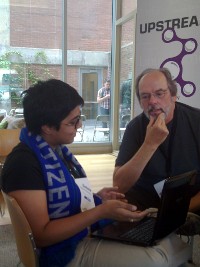
On Friday, June 24, the last day of Open Source Bridge, I won a scarf! It says, "Open Source Citizen." I wasn't the only one. The attendees nominated people who "made an extra effort to help others and share their knowledge," and the conference committee chose the three people they felt exemplified this. The winners were Sumana Harihareswara, Igal Koshevoy, and me. In case you don't know Sumana, she's the new Wikimedia Volunteer Development Coordinator, a friend, and a commenter here at Asheeshworld. In the photo of her and her new scarf, you can also see Ward Cunningham. I suggest reading her wrap-up about the conference, and checking out the notes from her talk. I haven't met Igal, but I've learned he's a fixture of the Portland tech scene. He's user number one on opensourcebridge.org and one of the original contributors to calagator, the most important event calendar in the Portland tech world. That's just a brief summary; follow him on Twitter to keep in touch. I started the conference a little shy, not wanting to introduce myself to people, so I hung out with Sumana. She talked to everyone she could find, and there I was standing next to her. On the first day, it was only because of Sumana's outgoingness that people knew who I was. On the second and third days, I was involved in two sessions: a panel on open source communities and a talk about the OpenHatch training missions. I was extremely honored to be chosen. There were so many other spectacular people I met for the first time, like Valerie Aurora, Jacinta Richardson, Brian Aker, and Alex Linsker. These are all people with three crucial traits: they're extremely knowledgeable, friendly, and opinionated. I'm glad I had a chance to attend and meet them! Photo credits: Thanks to Noah Swartz for the photo of me. Sumana's photo comes from her post to wikitech-l. Igal's comes from his Open Source Bridge user profile.

13 July 2011

Steve McIntyre: Project Harmony?

So, the "Harmony Project" launched their set of contributor agreements and tools last week. Colour me unimpressed... There's a claim on their website that they are a "community-centered group", but I don't see any list of people and organisations who contributed to this work. That bothers me. Regarding their aim to "assist organisations which use contribution agreements", I don't think that there is anything of value here for the Free Software community at all. Free Software developers don't need contribution agreements, and in my opinion encouraging their use like this is only going to cause further splintering of the community. We've managed for a very long time without them, why start now? As a developer, I personally don't believe in contribution agreements at all. If I contribute code to a project, it will be under the terms of a good Free Software license or not at all. That's all that's needed. There's a fair body of opinion out there on this - see pieces from Bradley Kuhn, Richard Fontana and Dave Neary for more discussion. What do you think?

Clint Adams: Savannah Doldrums

About a month ago, I submitted a project request to Savannah. It made sense at the time to host it there for a variety of reasons, but now I am still waiting for project approval. I am told that the reason my very exciting project is sitting there collecting moss is that there is a lack of reviewers. So if you want to help Savannah out, you should write to savannah-hackers-public@gnu.org.

Daniel Baumann: Debian Live 6.0.2 Images

Two days before the 6.0.2 squeeze point release a user reported that usb-hdd images are not bootable for him. We could not reproduce that for several days but thanks to David Endler, we found out a few days ago that the reason for this is the following commit: Setting partition flags after creating the filesystem, workaround for bug in parted where we result in having the partition type set to linux otherways. The original problem was that in some situation the code resulted in having a wrong partition type and that can let to confusion for some bioses. For other reasons, the applied workaround has the side effect to cause parted to not set the bootable flat at all anymore and by that creating an even bigger problem - most crappy bioses these days require the bootable flag to be set and refuse to boot from a device otherwise (Missing Operating System). Or in other words, the fix solved the original problem but created another one that is affecting much more bioses. Rather than doing a hasty and suboptimal build of 6.0.2 with the commit reverted (and wasting resources for a 6.0.2a build some time later), we have looked into fixing the original problem properly without causing side effects. Images for the 6.0.2 squeeze point release will therefore be published in the next couple of days.

Jordi Mallach: Not going to DebConf 11

3 months ago, I was positive I would be attending DebConf 11 in Banja Luka, but as the time to buy tickets and plan the trip came closer, I began to realise I don't have lots and lots of vacation, and I probably prefer spending them doing something that absolutely rocks my world. I've always enjoyed the Debian conferences when I've been lucky to be there, but last year's experience in the Pyrenees was nothing a DebConf can compare to, and I've decided to spend time seeking similar experiences this summer. With much regret, because I love meeting the wonderful people that make up Debian and DebConfs, I have to say that after all and once again, I won't make it.

Kai Wasserb ch: Vim: How to prevent trailing whitespaces

As the local geek I get all sorts of (Linux) questions asked, like "How can you delete the nth line with Sed?" or "Is there a way to search for the following in a file?" (the latter being a request to construct a regular expression for grep). And while I'm pretty sure, you can find answers for such questions quickly with $SEARCH_ENGINE I find myself generally typing the answer into the IM session. This, and just seeing Bernd's post about Vim on Planet Debian, prompted me to start a little, irregular series of posts, to which I can point people, whenever I get asked such questions. I start this off with a tip for Vim, a very powerful text editor. The problem is simple: you get (source code) files with trailing whitespaces (sometimes accumulated in "empty" lines). This makes diffing (and merging) difficult. Thus the question is: how do I prevent that from happening? How do I notice, that I have whitespaces at the end of a line? The solution consists of two lines in your .vimrc:
:highlight TrailWhitespace ctermbg=red guibg=red
:match TrailWhitespace /\s\+$\  \+\ze\t/
If you just want this functionality if syntax highlighting is also active, then you should use
:autocmd Syntax * syn match TrailWhitespace /\s\+$\  \+\ze\t/
instead of the :match line. The regular expression used in both cases matches trailing whitespaces and whitespaces in front of tabs. Of course there are several other options on how to do this or what you might want to highlight, but that would be beyond the scope of this little post.

Jaldhar Vyas: A Dance With Dragons (No Spoilers)

Somehow, even though I'd know about it for the longest time, I had never get around to reading George R.R. Martins A Song of Ice and Fire series until I heard about the Game of Thrones HBO series. Then I thought I had better hurry up and read the books as TV adaptations tend to be inferior. (I must say HBO did a pretty good job though.) I was instantly hooked and finished all four books in a week. Today the long-awaited fifth installment called A Dance with Dragons and I immediately got myself a copy. (Nowadays I mostly do my recreational reading with the Kindle app on my Android smartphone.) As before, I'm spellbound. I'm already about 25% through it and loving it. What I love about Martin is that he really gets how traditional, "pagan", "feudal" societies work. Take religion for instance. A lot of Sci-Fi/Fantasy authors if they deal with the subject at all usually give a cartoon version of polytheism that owes more to Christian canards and Dungeons & Dragons than any existing human religion. But in Westeros, one can be simultaneously devout, amoral, superstitious, and cynical in a way that makes a lot of sense to me as a Hindu. Or class. Being a peasant in Martins' world is horrible. Your life is completely at the mercy of Lords and Ladies and can end in an instant. But the upper class despite its wealth and power is trapped in its own way too. They must constantly protect their status from jealous competitors and a reversal of political or military fortune can destroy an ancient noble family just as suddenly as a bad harvest can destroy a family of farmers. Like the other books in the series, this one has a huge cast of characters whose stories weave in and out with each chapter told mainly from one characters viewpoint. This is a tactic which I for one found helpful to keep my attention from flagging but it means you can't really enjoy it unless you've read the previous volumes in order first. I definitely think it's worth the effort though.

Matthew Palmer: "Wireless Internet is the future" my arse

Here in Australia we re building out a giant, nationwide fiber network (with degraded service to the few parts of the country that aren t heavily populated like, nearly all of it), known as the National Broadband Network . Many critics of the planned network are saying that it s technology is outdated, and that the future of last-mile Internet access is wireless; that by the time the network is completed, we ll have no need for fibre optic cable to the home, and we ll all just use some magical wireless network for all our Internetting needs. Well, right at this moment, I m sitting in the middle of Australia s largest city, with full bars of coverage being reported by my phone, and getting ping times of over 3 minutes (you heard that right; my record so far is ping reporting time=194001 ms for a reply) and no ability to usefully access the Internet. If wireless is the future, I hope it s a long way away. To misquote a great man, I WANT MY ADSL BACK YOU SON OF A BITCH!

12 July 2011

Tim Retout: The Prisoner

I have recently finished watching The Prisoner (1967). All the surrealism is messing with my head. In other news, I updated GNU Enscript. Oh, and I filed an ITP for the real Data::UUID, and promptly found a symlink attack which I suspect I failed to disclose responsibly. Hmm. I could write a lot more, but the short version is: I need a holiday.

John Goerzen: First Look at Google Plus

Seems like everybody s writing Google+ reviews these days, but most of the ones I ve found seem to be fluff pieces. I haven t used it long, but have some initial impressions to share. First, an analogy. Facebook reminds me of the sleazy guy selling stuff from his car down the street. They do things like change privacy defaults when they think it s good for Facebook, rather than good for you. Google+ reminds me of an Apple product. It s beautiful, easy to learn, but locks everything down and is lacking some critical features. So here goes with the details. The good I think that this can be best summed up by: it s not Facebook. Facebook has, perhaps, set an incredibly low bar but still, this holds. Facebook is the only website I can ever remember using that changes things so much, so often, and so completely that I keep having this feeling of not knowing how to do things. Try maintaining a Facebook page or two and you ll especially feel my pain then. But even the basics: how many times have I accidentally posted a partial comment because I pressed Enter to start a new paragraph (that has only been the button used for that for, hmm, let s see now, decades), and instead it posted the comment. Principle of least surprise, anyone? Google+ has a simple and, on the surface anyway, intuitive interface. However, it does get muddy; more on that below. I m going to spend a lot more space on the bad below, but don t let that diminish my excitement about having a viable alternative to Facebook. I am keen to get rid of that monster. The Bad I ll start of this section with the fact that Google+ is a tightly-controlled walled garden. There is no way to take a copy of your status updates, comments, etc. and back them up with your own devices. If your Google account goes away, so do all your updates about your kids first words. Facebook does have this feature these days. It has broken half the time, but it exists, works, and I use it. Twitter doesn t have the feature built in, but its API makes it pretty easy; you could easily use my twidge program to do this, for instance. But whatever you put in G+ stays in G+. There is no autoposting it to twitter or Facebook, no backups, nothing. I m disappointed in that, given Google s prior attitude about openness to individual data ownership. (Update 7/12/2011: There is a way to get a backup, which I hadn t noticed; see comments below.) Almost as bad, there s also no way to get data in. So I now have identi.ca, twitter, Facebook, and now also G+ accounts. When I post an item in identi.ca, it autoposts to twitter, and then it autoposts from twitter to Facebook. Handy one place to notify people of my public activities. My uploads to Flickr and blog posts also auto-post to Facebook, so people I m friends with there get a picture of what I m doing outside of Facebook without me manually having to link it in. Not so with G+. There is no way to even add an RSS feed for my blog to auto-post to G+ as there is with Facebook. If you use G+, the only way to get stuff into it is with a keyboard. Poor integration with other Google apps is also an issue. G+ is nowhere near Google s first social app. They also have Blogger, Google Reader, Buzz, Gmail, etc. So here s the rub. These aren t integrated well, and when they have tried to integrate them, they ve done an exceedingly poor job of it. As an example: Buzz is a twitter-like service for posting updates. Very similar to what G+ does, right? Well, the best you can do is link your Buzz account to a separate tab on your profile. You can t even have your Buzz updates flow straight into G+, from what I can see. You have a separate list of followers in Buzz from G+. Reader is even worse; it has a sharing feature, but it s not G+ aware, so it goes to a reader inbox. But what takes the cake is the integration with Gmail Contacts. Sounds easy? Not entirely. When you add someone to G+, apparently it sometimes links the record with their entry in Contacts. And the help gives you the handy warning that when you remove them from G+, you have the option of removing them from Contacts, which could impact what you see on a mobile device. It is unclear what happens when it doesn t link the record, or how it decides which record to link (some people have more than one person in a family sharing phone numbers and email addresses, for instance.) One very nice feature of G+ is you can add email addresses, even if they aren t G+ members. Then when you post updates to the circle you ve added them to, G+ offers to send them an email with an update. Very handy. Except the undocumented part is that if you select Your circles (meaning all your circles), rather than individually ticking the box by each circle, they don t get the email. And they also don t get it if you set it Public. You have to select their specific circle, which is a significant difference from how people with G+ accounts are treated. And that s just an example. There are a ton of things that work one way 95% of the time, but have non-obvious exceptions. Some of these exceptions are documented in the help, and some aren t. I m still confused about the integration with Picasa. G+ help says that you can upload unlimited numbers of photos for free (though they will be downscaled at a certain point). Picasa has definite storage limits. But G+ uploads are showing up in Picasa. Do I really get free storage by uploading to the same place via a different tool? Very odd. And finally, a gripe about web standards. I ve been using Firefox/Iceweasel 3.5, which came out in Debian squeeze and is still supported there. It is also pretty darn new by corporate IT standards. And Google Plus refuses to let me log in with it, saying it s incompatible. Perhaps it can t do some fancy animation, but then again I don t really care. Seems Google has forgotten the old RFC adage: be liberal in what you accept and conservative in what you generate. If you can detect that my browser won t animate something right, then you could give me a stripped-down version of the page rather than an error message.

Bernd Zeimetz: re-indenting files with vim

Sometimes projects with a long history of committers tend to collect various styles of indentation. Unfortunately not for all programming languages exist specialized tools like indent for C/C++, so we need to find a different way to mass-indent files properly. Using vim is one of them. First you need to create a file (let's call it /tmp/indent.vim) including all the vim commands you want to run on your code. The following piece is a good start:

gg=G
:x!
Now run vim on your source code files, using the created vim script file. The following example reindents all .php files in the current folder and subfolders

find . -name '*.php' -exec vim -s /tmp/indent.vim   \;
If you don't like the result it might be that the indentation settings in you .vimrc don't suit your needs. Of course you are able to add other fancy vim commands to modify your files - like adding or modifying copyright headers.

Gunnar Wolf: Free Software must migrate to become Free Culture

Cineast and Free Culture activist Nina Paley wrote some days ago a rantifesto on why the FSF has a double standard: Why are the Freedoms guaranteed for Free Software not guaranteed for Free Culture?, by not following its own very strict rules on software when it comes to culture as a whole. Her post was widely circulated, and got (at least) one reply by fellow Debian Developer Wouter Verhelst, largely agreeing with her, and an anti-rantifesto by Joe Brockmeier Which was promptly answered again by Wouter with a very fun and inspired post, written from the right angle: From the viewpoint of a person who is both a programmer and a musician, and understands the concepts at hand. I'd love to write a longer, better thought post But I'm tired and frankly stressed by many things, so I am just echoing their very interesting discussion to other people who might want to read it. I have been thinking and writing bits on that subject over the last couple of months. An example of that was the talk I gave at the Senate ~6 weeks ago. Following that talk, I wrote a short article for Revista Z calo (a widely circulated magazine mainly dealing with Mexican politics and social issues) called simply Software libre, cultura libre (full text available, but in Spanish only You can try reading an automated translation if it suits you). I wrote the article, mind you, with very limited time, and I'll be the first to recognize the prose was quite poor this time :( Anyway My point is that our nature is to share culture, to build it in a collaborative fashion, and having the Internet as a practically zero-cost, zero loss medium with which we can interchange our creativity with other like-minded people will naturally boost creativity. Free Software emerged before other Free Culture groups just because programmers had privileged access to Internet in the 80s and early 90s; as network access and digital creation tools have got to more people, it's just natural for all kinds of free culture to grow. Software is just a form of knowledge. Code is just a notation for a certain kind of ideas, just as the mathematical or musical notations. I believe (and hope) it's just unavoidable for us all to eventually switch to a mainly free cultural creation system.

Jaldhar Vyas: Google^wBraincells Summer^wChaturmasa of Code

Barring a miracle, it looks like I won't be going to Debconf 11 this year which is a shame as that is a part of the world I have yet to visit. Anyway it got me thinking, I've neglected a lot of my Open Source activities this past year or so what with struggling to stay in good financial shape. As Chaturmasa started today in which we take up additional religious duties, I thought it might be a good time to recommit to getting all my projects up to speed again. So during the next four months I aim to (in no particular order) Hopefully by writing this down here in public, I will be able to shame myself into getting most if not all of this done.

11 July 2011

Thorsten Glaser: [Update] Hilfe gesucht: Mitarbeiter berwachung

Deutsche Version dieses Postings read the English Version instead Der Leiter der Abteilung Systemadministration einer Firma, welche in diesem Artikel ungenannt bleiben soll, wo der Zufall es will, da ich f r sie arbeite, m chte uns Mitarbeiter dazu zwingen, das Feature der persistenten Historie (also einen niedergeschriebenen Verlauf der abgesetzten Befehle) der Shell (Kommandozeile) auf allen Systemen zu benutzen. Nun hat die mksh dies vern nftigerweise, w hrend immer noch verf gbar, standardm ig aus Gr nden der Privatsph re deaktiviert, und ich finde, dies sollte sich nicht ndern. Es kann ja nicht sein, da man mir beim Arbeiten ber die Schulter guckt; was kommt als n chstes, Video berwachung der B ros? (Seine Argumentation l uft darauf hinaus, da er nachvollziehen/verstehen kann, wie ich (ha! ich! nicht die anderen, nein, ich!) ein Problem das letzte Mal gel st habe; es ist aber nichts anderes als rekonstru eren zu k nnen, wer wann was eingetippt/gemacht hat. Naja, Argumentationen sind eh relativ, andere jagen Flugzeuge in ihre eigenen Verteidigungsministerien, welche gerade zuf llig umgebaut werden ) Ich habe dies nat rlich in die F hrungsetage eskaliert, und unser Gesch ftsf hrer versteht meine Bedenken und m chte nun ein Gespr ch anraunen, um eine L sung zu finden. Die meisten meiner Kollegen im Bereich Systemadministration denken leider nichtmals dr ber nach, obschon ich in anderen Bereichen Gleichgesinnte gefunden habe. Einen Betriebsrat haben wir auch gro er Fehler, ich wei nicht (aber ich s e eh nicht drin, ich hasse Politik jeder Art). Dies l t mich in dringender Not, Argumente wider diese Total berwachung aller (insbesondere auf der Kommandozeile arbeitenden also besonders mich) Kollegen zu finden, idealerweise solche, die durch deutsches Recht gest tzt sind. Wenn ihr solche habt, bitte mailt die schnell an meine eMail-Adresse, welche da nicht junk@mirbsd.org lautet, sondern mit einem tg vor dem Klammeraffen (dies dient der Abwehr unerw nschter Werbemails). Vielen Dank bereits im Voraus! Update 12.07.2011: Wir haben geredet, und wie viele kommentierten keine L sung auf rechtlicher Ebene gefunden, sondern stattdessen, nachdem wir festgestellt hatten, da mir dieses Problem sehr am Herzen liegt, nach anderen L sungen f r das eigentliche Ziel des Chefadmins gesucht; dies z hlt als ein Entgegenkommen auf Seiten der Firma. Ich habe zugestimmt, meine L sungen in kleine Skripte zu verpacken und ins VCS zu committen f r das Herausfinden, wann was auf einem Server ge ndert wurde, im Fehlerfall, denken wir uns gerade ohnehin was aus. Danke an alle, die kommentiert haben!

Next.

Previous.