Search Results: "tar"

17 March 2010

Steve Kemp: Are you sure you don't mind me going without you?

Recently I received a small flurry of patches to my blog compiler, from Chris Frey. These patches significantly speedup rebuilding a static blog when using Danga's memcached. The speedup is sufficiently fast that my prior SQLite based approach is no longer required - and (re)building my blog now takes on the order of 5 seconds. On the topic of other people's blogs I've been enjoying David Watson's recent photo challenge. I was almost tempted to join in, but I'm not sure I could manage one every day - Although I can pretend I recently carried out my my first real photoshoot. I'm still taking pictures of "things/places" but I'm starting to enjoy "people" more. With a bit of luck I'll get some more people to pose in the near future, even if I have to rely upon posting to gumtree for local bodies! ObFilm: Love Actually

Robert Collins: LCA 2010 videos are showing up

Not all the videos are there yet, but they are starting to show up . Yay. See http://mirror.internode.on.net/pub/linux.conf.au/2010/index.html or your local LA mirror.

16 March 2010

Bdale Garbee: TeleMetrum v1.0 Order Placed

I've been too busy (work, family, and fighting a nasty cold!) to write much text lately, other than the comments I put on launch photos uploaded to my Flickr stream, but the remainder of our testing of the prototype TeleMetrum v0.2 boards went really well! The only significant change we decided to make before going to production was to change the 3.3 volt regulator from a 100mA to a 150mA part. This will ensure adequate power for the companion boards we have planned, even when the GPS chip is in maximum power mode searching for satellites during a cold start. So... [drum roll, please] Keith and I just placed the orders for our first production lot of TeleMetrum v1.0 boards! With any luck, in 3-4 weeks we should have a pile of altimeters to sell, along with the associated TeleDongle ground stations already in stock. Stay tuned!

Russell Coker: Starting with KVM

I ve just bought a new Thinkpad that has hardware virtualisation support and I ve got KVM running. HugePages The Linux-KVM site has some information on using hugetlbfs to allow the use of 2MB pages for KVM [1]. I put vm.nr_hugepages = 1024 in /etc/sysctl.conf to reserve 2G of RAM for KVM use. The web page notes that it may be impossible to allocate enough pages if you set it some time after boot (the kernel can allocate memory that can t be paged and it s possible for RAM to become too fragmented to allow allocation). As a test I reduced my allocation to 296 pages and then increased it again to 1024, I was surprised to note that my system ran extremely slow while reserving the pages it seems that allocating such pages is efficient when done at boot time but not so efficient when done later. hugetlbfs /hugepages hugetlbfs mode=1770,gid=121 0 0 I put the above line in /etc/fstab to mount the hugetlbfs filesystem. The mode of 1770 allows anyone in the group to create files but not unlink or rename each other s files. The gid of 121 is for the kvm group. I m not sure how hugepages are used, they aren t used in the most obvious way. I expected that allocating 1024 huge pages would allow allocating 2G of RAM to the virtual machine, that s not the case as -m 2048 caused kvm to fail. I also expected that the number of HugePages free according to /proc/meminfo would reliably drop by an amount that approximately matches the size of the virtual machine which doesn t seem to be the case. I have no idea why KVM with Hugepages would be significantly slower for user and system CPU time but still slightly faster for the overall build time (see the performance section below). I ve been unable to find any documents explaining in which situations huge pages provide advantages and disadvantages or how they work with KVM virtualisation the virtual machine allocates memory in 4K pages so how does that work with 2M pages provided to it by the OS? But Hugepages does provide a slight benefit in performance and if you have plenty of RAM (I have 5G and can afford to buy more if I need it) you should just install it as soon as you start. I have filed Debian bug report #574073 about KVM displaying an error you normally can t see when it can t access the hugepages filesystem [6]. Permissions open /dev/kvm: Permission denied
Could not initialize KVM, will disable KVM support One thing that annoyed me about KVM is that the Debian/Lenny version will run QEMU instead if it can t run KVM. I discovered this when a routine rebuild of the SE Linux Policy packages in a Debian/Unstable virtual machine took an unreasonable amount of time. When I halted the virtual machine I noticed that it had displayed the above message on stderr before changing into curses mode (I m not sure the correct term for this) such that the message was obscured until the xterm was returned to the non-curses mode at program exit. I had to add the user in question to the kvm group. I ve filed Debian bug report #574063 about this [2]. Performance Below is a table showing the time taken for building the SE Linux reference policy on Debian/Unstable. It compares running QEMU emulation (using the kvm command but without permission to access /dev/kvm), KVM with and without hugepages, Xen, and a chroot. Xen is run on an Opteron 1212 Dell server system with 2*1TB SATA disks in a RAID-1 while the KVM/QEMU tests are on an Intel T7500 CPU in a Thinkpad T61 with a 100G SATA disk [4]. All virtual machines had 512M of RAM and 2 CPU cores. The Opteron 1212 system is running Debian/Lenny and the Thinkpad is running Debian/Lenny with a 2.6.32 kernel from Testing.
Elapsed User System
QEMU on Opteron 1212 with Xen installed 126m54 39m36 8m1
QEMU on T7500 95m42 42m57 8m29
KVM on Opteron 1212 7m54 4m47 2m26
Xen on Opteron 1212 6m54 3m5 1m5
KVM on T7500 6m3 2m3 1m9
KVM Hugepages on T7500 with NCurses console 5m58 3m32 2m16
KVM Hugepages on T7500 5m50 3m31 1m54
KVM Hugepages on T7500 with 1800M of RAM 5m39 3m30 1m48
KVM Hugepages on T7500 with 1800M and file output 5m7 3m28 1m38
Chroot on T7500 3m43 3m11 29
I was surprised to see how inefficient it is when compared with a chroot on the same hardware. It seems that the system time is the issue. Most of the tests were done with 512M of RAM for the virtual machine, I tried 1800M which improved performance slightly (less IO means less context switches to access the real block device) and redirecting the output of dpkg-buildpackage to /tmp/out and /tmp/err reduced the built time by 32 seconds it seems that the context switches for networking or console output really hurt performance. But for the default build it seems that it will take about 50% longer in a virtual machine than in a chroot, this is bearable for the things I do (of which building the SE Linux policy is the most time consuming), but if I was to start compiling KDE then I would be compelled to use a chroot. I was also surprised to see how slow it was when compared to Xen, for the tests on the Opteron 1212 system I used a later version of KVM (qemu-kvm 0.11.0+dfsg-1~bpo50+1 from Debian/Unstable) but could only use 2.6.26 as the virtualised kernel (the Debian 2.6.32 kernels gave a kernel Oops on boot). I doubt that the lower kernel version is responsible for any significant portion of the extra minute of build time. Storage One way of managing storage for a virtual machine is to use files on a large filesystem for it s block devices, this can work OK if you use a filesystem that is well designed for large files (such as XKS). I prefer to use LVM, one thing I have not yet discovered is how to make udev assign the KVM group to all devices that match /dev/V0/kvm-*. Startup KVM seems to be basically designed to run from a session, unlike Xen which can be started with xm create and then run in the background until you feel like running xm console to gain access to the console. One way of dealing with this is to use screen. The command screen -S kvm-foo -d -m kvm WHATEVER will start a screen session named kvm-foo that will be detached and will start by running kvm with WHATEVER as the command-line options. When screen is used for managing virtual machines you can use the command screen -ls to list the running sessions and then commands such as screen -r kvm-unstable to reattach to screen sessions. To detach from a running screen session you type ^A^D. The problem with this is that screen will exit when the process ends and that loses the shutdown messages from the virtual machine. To solve this you can put exec bash or sleep 200 at the end of the script that runs kvm. start-stop-daemon -S -c USERNAME --exec /usr/bin/screen -- -S kvm-unstable -d -m /usr/local/sbin/kvm-unstable On a Debian system the above command in a system boot script (maybe /etc/rc.local) could be used to start a KVM virtual machine on boot. In this example USERNAME would be replaced by the name of the account used to run kvm, and /usr/local/sbin/kvm-unstable is a shell script to run kvm with the correct parameters. Then as user USERNAME you can attach to the session later with the command screen -x kvm-unstable . Thanks to Jason White for the tip on using screen. I ve filed Debian bug report #574069 [3] requesting that kvm change it s argv[0] so that top(1) and similar programs can be used to distinguish different virtual machines. Currently when you have a few entries named kvm in top s output it is annoying to match the CPU hogging process to the virtual machine it s running. It is possible to use KVM with X or VNC for a graphical display by the virtual machine. I don t like these options, I believe that Xephyr provides better isolation, I ve previously documented how to use Xephyr [5]. kvm -kernel /boot/vmlinuz-2.6.32-2-amd64 -initrd /boot/initrd.img-2.6.32-2-amd64 -hda /dev/V0/unstable -hdb /dev/V0/unstable-swap -m 512 -mem-path /hugepages -append "selinux=1 audit=1 root=/dev/hda ro rootfstype=ext4" -smp 2 -curses -redir tcp:2022::22 The above is the current kvm command-line that I m using for my Debian/Unstable test environment. Networking I m using KVM options such as -redir tcp:2022::22 to redirect unprivileged ports (in this case 2022) to the ssh port. This works for a basic test virtual machine but is not suitable for production use. I want to run virtual machines with minimal access to the environment, this means not starting them as root. One thing I haven t yet investigated is the vde2 networking system which allows a private virtual network over multiple physical hosts and which should allow kvm to be run without root privs. It seems that all the other networking options for kvm which have appealing feature sets require that the kvm process be started with root privs. Is KVM worth using? It seems that KVM is significantly slower than a chroot, so for a basic build environment a secure chroot environment would probably be a better option. I had hoped that KVM would be more reliable than Xen which would offset the performance loss however as KVM and Debian kernel 2.6.32 don t work together on my Opteron system it seems that I will have some reliability issues with KVM that compare with the Xen issues. There are currently no Xen kernels in Debian/Testing so KVM is usable now with the latest bleeding edge stuff (on my Thinkpad at least) while Xen isn t. Qemu is really slow, so Xen is the only option for 32bit hardware. Therefore all my 32bit Xen servers need to keep running Xen. I don t plan to switch my 64bit production servers to KVM any time soon. When Debian/Squeeze is released I will consider whether to use KVM or Xen after upgrading my 64bit Debian server. I probably won t upgrade my 64bit RHEL-5 server any time soon maybe when RHEL-7 is released. My 64bit Debian test and development server will probably end up running KVM very soon, I need to upgrade the kernel for Ext4 support and that makes KVM more desirable. So it seems that for me KVM is only going to be seriously used on my laptop for a while. Generally I am disappointed with KVM. I had hoped that it would give almost the performance of Xen (admittedly it was only 14.5% slower). I had also hoped that it would be really reliable and work with the latest kernels (unlike Xen) but it is giving me problems with 2.6.32 on Opteron. Also it has some new issues such as deciding to quietly do something I don t want when it s unable to do what I want it to do.

Wouter Verhelst: Stuff

I'm running again. No, not running in a bubulle style; I'm running for DPL. It started as a fairly last-minute decision because I would hate to see an election with only one candidate, but then two other people submitted their candidacy right after me. As I stated in my candidacy email, I had "a concert" this weekend. Actually, there were three two-hour performances; two on saturday, one on sunday. Early on, I also suggested videotaping the performance (using the excellent dvswitch, for which I added a patch to support crossfading transitions) to the organising group within the choir, and they liked that. Apart from dvswitch, we used the theatre's own audio mixing setup (so I wouldn't have to worry about that too much) and the theatre's intercom system. I'd made some tally lights, but in the end we were not entirely able to use them, because there were some issues to be dealt with that meant I couldn't quite get them working properly. So on saturday, I was in the theatre pretty early to get everything set up, did some explanations to the volunteers who would do the actual recording, drove my dad (who'd done the direction for the video parts) home, went home, and found my bed at around midnight. On sunday, I got up fairly early, booted my laptop to update the live images with some fixes for some issues we'd encountered on saturday, left for the theatre fairly early again, set up the extra camera position, found out that one of the laptops was actually running at 100Mbit rather than a gigabit and that therefore the extra camera wasn't going to work, learned that one of the volunteers for sunday had done some other camera work for another performance right before that, for which he'd rented some high-end DV-capable cameras. So we broke down the two low-end set-ups, set up the high-end cameras, connected them to the laptops, recalibrated the whitebalance and the diaphragm setting, and restarted the streams. Then one laptop started failing. Since we had had to remove one camera anyway, I just replaced it. By that time, I had about 15 minutes left before sunday's performance would start, so I went to prepare for that. After the performance had finished, I found out that something had gone wrong with the sound of sunday's performance; rather than music, we only heard crackling all the time. Luckily, the sound had also been separately recorded to a different medium, and that recording is fine, so we only need to resync the audio to the video, which should not be a problem. All in all, I had an extremely busy weekend. The alert reader will note that I didn't mention 'food' anywhere in the above paragraphs, mostly because I hardly ever found the time to eat. But it was also extremely satisfying. We still have some postprocessing to do, but I expect I'll put some videos online once we've done that. They're truly stunning, at times. And then yesterday I still had to spend some time writing my DPL platform, and doing some campaigning work. All in all, I didn't find my bed until approximately 4 AM... oh well. I look forward to the election time, and hope that I will do well. I don't need to win, but I'd hope my result will be at least as good as the last time... Update: we used the theatre's audio setup, not video setup -- oops :-)

Joachim Breitner: kexec saved my day

Yesterday evening, when returning from a two-day trip with no connectivity, I found my server to be broken. I still reacted on ping, but no service would respond. I tried to restart it using my hoster s web interface, but it would not come back up. I booted into the recovery system and checked the hard disk, but could not find any issues. File system checks went through without a hitch. But it would still not boot. Unfortunately, my hoster does not provide access to the system console, so I had no idea what was going wrong. I never did anything with kexec, (a relatively new feature of the Linux kernel to act as a bootloader to load another system) and I was very positively surprised to find that it works out-of-the-box and flawlessly: I was able to load my system s kernel and initrd from the recovery system and successfully booted it. I then ran lilo and rebooted right again, which now worked. I m not sure if running lilo fixed it, or the clean shut-down, nor do I know what caused the problem in the first place, but kexec saved my day here.

Russell Coker: Thinkpad T61

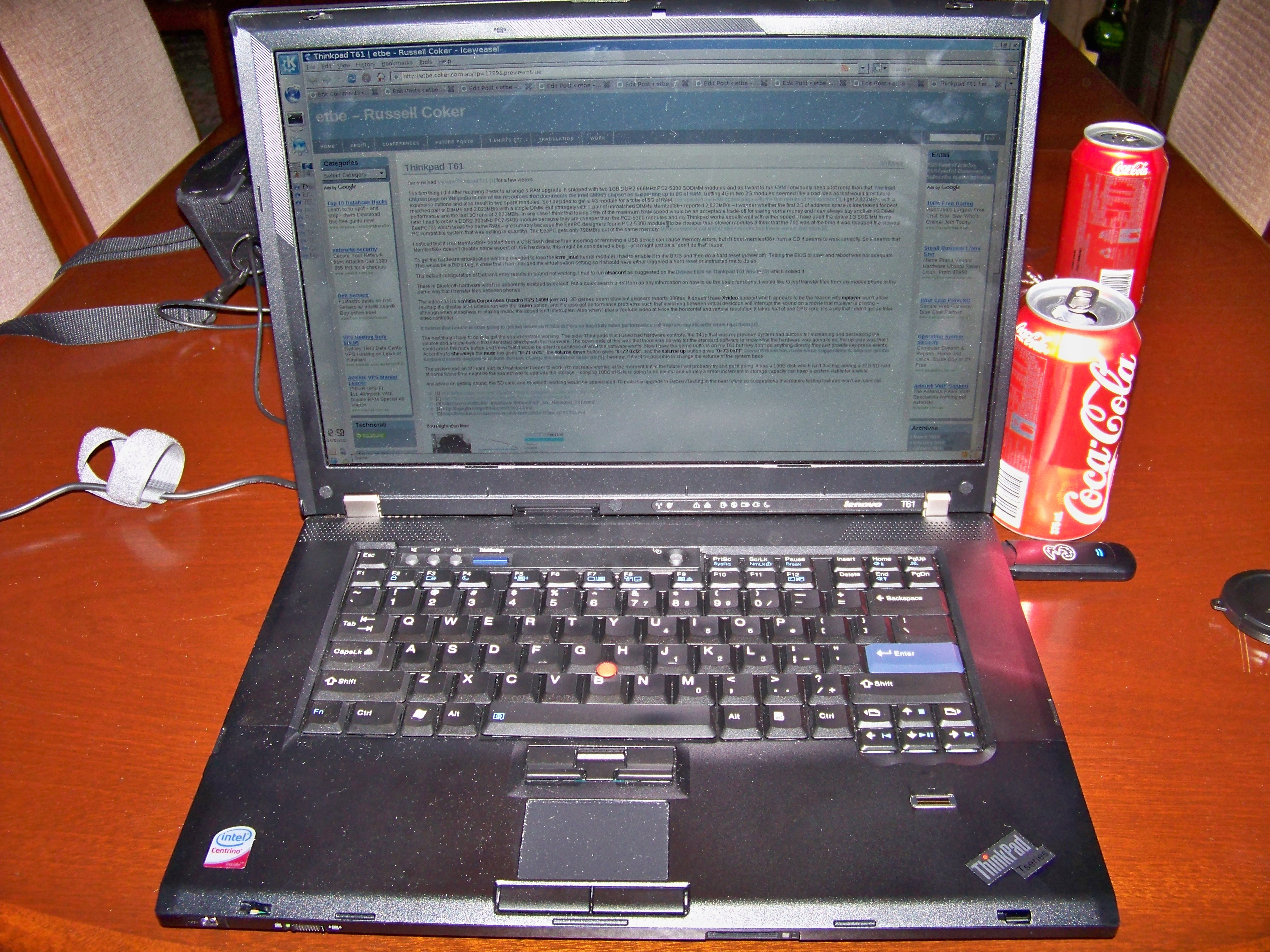
picture of my new Thinkpad T61 I ve now had my new Thinkpad T61 [1] for almost a month. The letters on the keyboard are not even starting to wear off which is unusual, either this Thinkpad is built with harder plastic than the older ones or I m typing more softly. Memory The first thing I did after receiving it was to arrange a RAM upgrade. It shipped with two 1GB DDR2 666MHz PC2-5300 SODIMM modules and as I want to run KVM I obviously need a lot more than that. The Intel Chipset page on Wikipedia is one of the resources that documents the Intel GM965 chipset as supporting up to 8G of RAM. Getting 4G in two 2G modules seemed like a bad idea as that would limit future expansion options and also result in two spare modules. So I decided to get a 4G module for a total of 5G of RAM. I ve updated my RAM speed page with the test results of this system [2], I get 2,823MB/s with a matched pair of DIMMs and 2,023MB/s with a single DIMM. But strangely with a pair of unmatched DIMMs Memtest86+ reported 2,823MB/s I wonder whether the first 2G of address space is interleaved for best performance and the last 3G runs at 2,023MB/s. In any case I think that losing 29% of the maximum RAM speed would be an acceptable trade-off for saving some money and I can always buy another 4G DIMM later. I had to order a DDR2-800MHz PC2-6400 module because they are cheaper than the PC2-5300 modules and my Thinkpad works equally well with either speed. I have used the spare 1G SODIMM in my EeePC701 which takes the same RAM presumably because the EeePC designers found PC2-5300 modules to be cheaper than slower modules (I think that the 701 was at the time it was released the slowest PC compatible system that was selling in quantity). The EeePC gets only 798MB/s out of the same memory. My document about Memtest86+ results has these results and more [2]. I noticed that if I run Memtest86+ booted from a USB flash device then inserting or removing a USB device can cause memory errors, but if I boot memtest86+ from a CD it seems to work correctly. So it seems that Memtest86+ doesn t disable some aspect of USB hardware, this might be considered a bug or it might just be a don t do that issue. Misc To get the hardware virtualisation working (needed to load the kvm_intel kernel module) I had to enable it in the BIOS and then do a hard reset (power off). Telling the BIOS to save and reboot was not adequate. This would be a BIOS bug, it knew that I had changed the virtualisation setting so it should have either triggered a hard reset or instructed me to do so. The default configuration of Debian/Lenny results in sound not working, I had to run alsaconf as suggested on the Debian Etch on Thinkpad T61 howto [3] which solved it. Generally I m happy with this system, the screen resolution is 1680*1050 which has 20% more pixels than the 1400*1050 screen on my Thinkpad T41p, it s a lot faster for CPU operations and should be a lot faster for video when I get the drivers sorted out (currently it s a lot slower), and I have virtualisation working again. But when you buy a system that s much like the last one but 6 years newer you expect it to be better. Generally the amount of effort involved in the process of buying a new system, upgrading the RAM to the desired specs, installing Linux and tweaking all the options is enough to make me want to wait at least another 6 years before buying another. Part of the reason for this difficulty is that I want to get so much functionality from the machine, a machine with more modest goals (such as a Netbook) takes a lot less time to configure. Problems There is Bluetooth hardware which is apparently enabled by default. But a quick search didn t turn up any information on how to do the basic functions, I would like to just transfer files from my mobile phone in the same way that I transfer files between phones. The video card is a nVidia Corporation Quadro NVS 140M (rev a1). 3D games seem slow but glxgears reports 300fps. It doesn t have Xvideo support which appears to be the reason why mplayer won t allow resizing it s display area unless run with the -zoom option, and it s also got performance problems such that switching between virtual desktops will interrupt the sound on a movie that mplayer is playing although when alsaplayer is playing music the sound isn t interrupted. Also when I play a Youtube video at twice the horizontal and vertical resolution it takes half of one CPU core. It s a pity that I didn t get an Intel video controller. It seems that Debian is soon going to get the Nouveau NVidia drivers so hopefully video performance will improve significantly when I get them [4]. The next thing I have to do is to get the sound controls working. The older Thinkpads that I used had hardware controls, the T41p that was my previous system had buttons for increasing and decreasing the volume and a mute button that interacted directly with the hardware. The down-side of this was that there was no way for the standard software to know what the hardware was going to do, the up-side was that I could press the mute button and know that it would be silent regardless of what the software wants. Now I have the same buttons on my T61 but they don t do anything directly, they just provide key-press events. According to showkeys the mute key gives 0 71 0xf1 , the volume down button gives 0 72 0xf2 , and the volume up button gives 0 73 0xf3 . Daniel Pittman has made some suggestions to help me get the keyboard events mapped to actions that can change the sound via software [5] which I haven t yet had time to investigate. I wonder if it will ever be possible to change the volume of the system beep. The system has an SD card slot, but that doesn t seem to work. I m not really worried at the moment but in the future I will probably try and get it going. It has a 100G disk which isn t that big, adding a 32G SD card at some future time might be the easiest way to upgrade the storage copying 100G of data is going to be painful and usually a small increment in storage capacity can keep a system viable for a while. Any advice on getting sound, the SD card, and Bluetooth working would be appreciated. I ll probably upgrade to Debian/Testing in the near future so suggestions that require testing features won t be ruled out.

15 March 2010

Joey Hess: pre to droid

in which the Pre unsuprisingly continues to suck My Palm Pre was killed by a forced over the air WebOS upgrade. You can't avoid those upgrades, even if you are sure they'll be bad news. The previous WebOS upgrade spared my Debian partition, but lost all other customizations (including Palm Pre privacy fixes), and wasted hours. When I went to use my phone and it didn't even boot, and displayed only "http://palm.com/rom", I knew that was the last straw. (Shouldn't forcing an upgrade that breaks a working phone to the point that it can't even call 911 be well, illegal?) switching cell providers in the US: suprisingly doable I thought about ditching the smart phone and using VOIP, but I seem to have gotten addicted. So I got a Droid. That meant switching cell phone companies. I've heard a lot about how horrible the US cell phone company contracts are. My experience has me wondering if all that is well... not overblown, but oversimplified. I was half a year into a two year contract. Today I got my closing statement, and I really got out of it with no early termination fee. The trick seems to be, switch to a different cell phone company. They'll be happy to get you out of your old contract, salivating at the chance of locking you in to a new one. They probably have a script to use when calling to cancel. Or "know a guy". Or claim to know a guy, then just use a script, and get lucky. Given the hard sells and vague promises they tried on me, I assume that these places are where all the car salesmen ended up. Trust == 0. But it worked. If you're good on the phone, and are looking for a new business idea: Start a business of getting people out of their cell phone contracts, for a reasonable fee and no other obligation. Use loopholes like rate changes. As long as the cell phone companies can raise their monthly rate 2 cents, and 99.9999% of their users accept it, and they make untold millions of dollars, for free, they seem to not care if the remaining fraction use a loophole to get out. Especially if they're able to take advantage of other comanies loopholes to switch over users. So there seems to be a niche there in which one could prosper. droid first impressions So now I have a slightly larger lump in my pocket and the Pre is on a shelf, and will either be used for future development and testing of Debian piggyback ideas, or donated to someone like Lennart who can make good use of it. Compared with the Pre, the droid's hardware is all superior. The keyboard, especially, is great, with arrow keys, and all the symbols I need. At the same time, the phone is bigger, and oddly clunky. But in an endearing way. Only thing I really dislike about the hardware is the "back" button is easy to accidentially swipe while typing on the keyboard. Compared with WebOS, the Android UI has some clunkiness and non-obvious things. Like the status bar at the top not doing anything when you click on it. And there being no way to close an app. Especially annoying is that this means opening the web browser returns to whatever page I was on last, which is never what I want. The UI is however much, much snappier. I don't use the Google email, etc services so can't comment on them; I assume the amount of info Google is gathering about me went up by a few percentage points; I've blocked their analytics on my network to knock it back down. (PS: DuckDuckGo now avoids logging IP addresses at all.) The best thing is the ConnectBot application, which is a very usable shell and ssh client. It's a terminal, in my pocket, which I can easily use for an hour without feeling like my interactions are feeding through a stifling soda straw. Between the keyboard and the app, the Pre has nothing at all that compares. Under the hood, Android annoys me terribly, with its lack of busybox, its kernel that does not even have the ext* filesystem, its hard-partitioned storage, and its general lack of every single thing I like in a Linux system. Compare this with the Pre, which has a package manager, a userspace based on busybox with a full standard Linux stack (all the way up to PulseAudio) and a kernel with lots of standard filesystems, and even LVM. Sigh. It's amazing that WebOS and Android have found such broadly different ways to suck. There is significant interest and activity around running a Debian chroot on the Droid. The best tries so far put it on a loop mounted ext2 filesystem (which means you need to get ahold of a matching ext2.ko somehow), living on the FAT formatted SSD. And there are apparently some bad problems with IO to that starving/locking the system, so I have not tried it.

Russell Coker: The Yubikey

Picture of Yubikey Some time ago Yubico were kind enough to send me an evaluation copy of their Yubikey device. I ve finally got around to reviewing it and making deployment plans for buying some more. Above is a picture of my Yubikey on the keyboard of my Thinkpad T61 for scale. The newer keys apparently have a different color in the center of the circular press area and also can be purchased in white plastic. The Yubikey is a USB security token from Yubico [1]. It is a use-based token that connects via the USB keyboard interface (see my previous post for a description of the various types of token [2]). The Yubikey is the only device I know of which uses the USB keyboard interface, it seems that this is an innovation that they invented. You can see in the above picture that the Yubikey skips the metal that is used to surround most USB devices, this probably fails to meet some part of the USB specification but does allow them to make the key less than half as thick as it might otherwise be. Mechanically it seems quite solid. The Yubikey is affordable, unlike some token vendors who don t even advertise prices (if you need to ask then you can t afford it) and they have an online sales site. $US25 for a single key and discounts start when you buy 10. As it seems quite likely that someone who wants such a token will want at least two of them for different authentication domains, different users in one home, or as a backup in case one is lost or broken (although my experiments have shown that Yubikeys are very hardy and will not break easily). The discount rate of $20 will apply if you can find four friends who want to use them (assuming two each), or if you support several relatives (as I do). The next discount rate of $15 applies when you order 100 units, and they advise that customers contact their sales department directly if purchasing more than 500 units so it seems likely that a further discount could be arranged when buying more than 500 units. They accept payment via Paypal as well as credit cards. It seems to me that any Linux Users Group could easily arrange an order for 100 units (that would be 10 people with similar needs to me) and a larger LUG could possibly arrange an order of more than 500 units for a better discount. If an order of 500 can t be arranged then an order of 200 would be a good thing to get half black keys and half white ones you can only buy a pack of 100 in a single color. There is a Wordpress plugin to use Yubikey authentication [3]. It works, but I would be happier if it had an option to accept a Yubikey OR a password (currently it demands both a Yubikey AND a password). I know that this is less secure, but I believe that it s adequate for an account that doesn t have administrative rights. To operate the Yubikey you just insert it into a USB slot and press the button to have it enter the pass code via the USB keyboard interface. The pass code has a prefix that can be used to identify the user so it can replace both the user-name and password fields of course it is technically possible to use one Yubikey for authentication with multiple accounts in which case a user-name would be required. Pressing the Yubikey button causes the pass code to be inserted along with the ENTER key, this can take a little getting used to as a slow web site combined with a habit of pressing ENTER can result in a failed login (at least this has happened to me with Konqueror). As the Yubikey is use-based, it needs a server to track the usage count of each key. Yubico provides source to the server software as well as having their own server available on the net obviously it might be a bad idea to use the Yubico server for remote root access to a server, but for blog posting that is a viable option and saves some effort. If you have multiple sites that may be disconnected then you will either need multiple Yubikeys (at a cost of $20 or $15 each) or you will need to have one Yubikey work with multiple servers. Supporting a single key with multiple authentication servers means that MITM attacks become possible. The full source to the Yubikey utilities is available under the new BSD license. In Debian the base functionality of talking to the Yubikey is packaged as libyubikey0 and libyubikey-dev, the server (for validating Yubi requests via HTTP) is packaged as yubikey-server-c, and the utility for changing the AES key to use your own authentication server is packaged as yubikey-personalization thanks Tollef Fog Heen for packaging all this! The YubiPAM project (a PAM module for Yubikey) is licensed under the GPL [4]. It would be good if this could be packaged for Debian (unfortunately I don t have time to adopt more packages at the moment). There is a new model of Yubikey that has RFID support. They suggest using it for public transport systems where RFID could be used for boarding and the core Yubikey OTP functionality could be used for purchasing tickets. I don t think it s very interesting for typical hobbyist and sysadmin work, but RFID experts such as Jonathan Oxer might disagree with me on this issue.

Adnan Hodzic: FoolControl, Gnome, Squeeze?

Other day I read Refreshing The Ubuntu Brand , upcoming visual style changes for Ubuntu 10.04 Lucid Lynx and my only comment to this whole story was Don t tell me you re moving window control elements to the left side of window in Lucid Side Frown
Either way if this is the revolutionary change for Ubuntu, then I have a visual style suggestion for Squeeze as well. Since Gnome is default desktop environment in Debian and as it looks like right now 2.30 will be what s going to be included into Squeeze; nothing much, or nothing really will visually change in Gnome by then. So how about this Lamp For some time now I ve been troubled by some things in Gnome, and what s bothering me the most is System menu. Why? Well because the list of utilities listed both under Administration and Preferences is so long that it s almost useless. So without losing your precious seconds of your life and losing fair amount of nerves well this is what s required to find what you were initially looking for. Interesting enough is the fact (please do stress) that Gnome consists of a fine thing called gnome-control-center which is not included in any of Gnome menus. IDK I really do enjoy Gnome vanilla flavor (overall am fan of vanilla flavored apps.) but what I ve been doing for quite time now is fixing this ridicule by having my own version of Systems menu, which consists of Add/Remove App. (synaptic) and Fool Control (gnome-control-center) Final result is that I get what I m looking for in couple of seconds without any lost nerves Victory Either way, after reading the redesigning Ubuntu article, this only encouraged me to go live with this suggestion. I know it s a minor change, but how about we have this implemented into Squeeze? Of course change my silly button labels; if not, what are my options? Make package that will do this for you? Rolls Eyes I m really interested to hear your input on this topic. Talking about redesigning stuff, is anyone up to do start doing this with Debian homepage? Yea? Count me in Wink

Gerfried Fuchs: stable RC Bug Squashing, Part 2

A while ago I blogged about squashing release-critical bugs in stable. Yesterday we have reached a big milestone on that area: The amount of release-critical bugs in stable dropped below 1000 (blue graph). This might sound like it's still pretty high but given that we were well over 1600 RC bugs in stable a while ago I consider this quite a success. This is though no time for rest. There is still way too many RC bugs in stable, there are definitely still a lot of bugs that just aren't affecting stable and thus can be marked as such meaning no upload needs to get done for them. I'm taking a close look at those with higher numbers and most of those seem to be validly affecting stable too so they might require a bit more work than just tagging them. Thanks to all people who helped on that area, I can just remember a few names and don't want to make anyone else also working on stable to feel singled out, though I want to thank Lucas for tagging his FTBFS rounds with squeeze sid right from the start because the packages obviously have built before due to his regular rebuilds. Thanks to all, but like said, not the time to rest. The green squeeze graph is still around 250 bugs away from us!

Jaldhar Vyas: 7DRL Challenge - Final days

I'm afraid that in the end I failed the challenge. As the last minutes of Saturday night ticked down, I was still mired in the minutiae of C++ Run-Time Type Identification (RTTI.) Sunday was my 12th wedding anniversary and I know from past experience that this is one day when it is advisable to step away from the computer. So I have to concede defeat for now. But I only actually spent about 48 hours on this project this week so if you really think about it, I still have 120 hours available. That's what I choose to believe anyway. The galling thing is in theory I know how this is supposed to work. A.L.F.s model (in the model-view-controller design pattern) is a class called World. World has an array of Rooms which represent rooms in the dungeon. In my original almost working version of a few days back, this Room class had all manner of verious members for different objects in the dungeon but I decided to redesign it the right way by consolidating all the redundant bits into an abstract base class called Item which would have concrete subclasses: Potion, Treasure, Monster etc. Room now only has to hold a pointer to the Item associated with that room. (Later on I will consider allowing multiple items per room but for now there can only be one.) A factory function creates Items and assigns them to each Room (or leaves them empty) It returns a pointer to an object of the appropriate class but we can access that object through the Item* because they are derived from Item. So far so good. The fun part happens when we want to know what the Item* really is. For example, combat makes sense for Monsters but not for Treasure. I only want to activate combat if the Item* is a Monster*. It's easy in theory:

if(dynamic_cast<Monster*>(contents))
    return FIGHT;
                            
...but it didn't work. Problem number 1. C++ RTTI only works on polymorphous classes. (Ones that contain atleast one virtual member.) So a little redesign of my classes was necessary. Problem #2, once you start slinging pointers around, segfaults soon follow. I had to go back and make absolutely sure I wasn't double-deleting objects and things of that nature. As I write this, I think I have finally got it all sorted out. So I am going to persevere and finish this game, its just going to take a bit longer than 7 days.

Gregor Herrmann: RC bugs 2010/09, 2010/10

not many closed bugs in the last two weeks, & not even one RC bug per day worked on. anyway, here's my recent list:

14 March 2010

David Bremner: Functional programming on the JVM

I'm collecting information (or at least links) about functional programming languages on the the JVM. I'm going to intentionally leave "functional programming language" undefined here, so that people can have fun debating :). Functional Languages Languages with functional features Projects and rumours.

13 March 2010

David Watson: 7 Day Photo Challenge - Day 1

I have challenged myself to take a photo every day this week starting today, I am doing this to force myself to spend less time working on my photos ( and to publish pictures more often). I generally spend too much time playing with photos and seldom actually put them online for any one to see. Here is todays shot of a rose I took this afternoon. IMG_1966 I would love to have people join me in this challenge, so I have created a flickr group for it.

Joerg Jaspert: Vacation fun

As some people know, I had a vacation in February. Only very few knew that I was heading down to Taiwan. I was leaving Germany at the 8th and back here on the 24th of February. Yes, that neatly fit this years Chinese New Years parties. Was at home for four days (and at work for one), after which I went off to this years Cebit. Until the day I arrived in Taiwan it looked like we do not have a booth there, but then everything changed while I was having a nice vacation. I really have to thank Alex here. Cebit was actually my task, but he jumped in and did all the preparatory work that was needed right in the time I started my vacation. Without that either my vacation would have been much different and less nice or we wouldn t have had a booth. I am back home since some days now, without any travel plans for the next few weeks/months to come. Though I wish I had a job (and private life) that would allow me to just go off again, ie. something I could do everywhere where there is net. Meh. Of course I did take some pictures (more than 2500) and also some notes during the trip. And having a blog that one or two people read, I think I should bore you all with it. But hey, you can skip it if you want. :) Yes, I should really take some time and work a bit on the pictures I took. Right now I only selected around seven hundred which I show off to people (and to link to from here), but they are basically just copies. While some are great in itself, many can need a bit of work here and there (cut out unimportant, blurry, colors, the usual stuff). And I also prepared multiple shots for HDR processing or to make a panorama view from, but thats something that takes time and has to wait. Just for the record, I think that this, this and this are very nice ones.
This is a public version of this text, so names and also various events and days have been cut out. Yes, people who know those in my pictures will know names, but thats no reason to feed the evil $searchengine caches more with hits for their names. Flight down, 8 Feb. Flight down from Frankfurt, using KLM so it went via Amsterdam and Bangkok (short Transit stop) to Taipei. The days before we had lots of snow and cold and all that stuff which tends to get flights cancelled, but I was lucky, none of that for me. The only slightly annoying thing was in Taipei, where KLM demonstrated how much a Business class Priority luggage sign is worth for them sometimes. We came in half an hour before schedule, but then had to wait an hour for our luggage (while all of economy luggage passed by). I think the business class Priority sign actually meant Priority to wait . The food on the flight from AMS to BGK was good, having a No Lactose Meal actually tasting well. Can t remember what it was, but better than the fish I got from BGK to TPE. Catering from Thai Airways, they do not know anything besides Fish when preparing No lactose meal and then they also manage to prepare it in the most boring way possible. Sad thing, but happened four times now, all the times I had catering prepared by them. Other than those points, no trouble at all. Immigration was done in about 20 seconds, customs didn t want to look at me, just the asians in front and behind me, all fine. Met my Travel Companion outside and off we got. First to the Taipei Main Station, where we got some food. Some rice (with a bit of meat) and red sauce, together with a soup. And a glass of tea, but that had an oily surface. Umm. Guess the cup wasn t all that clean, we both skipped that. Then I tried to get money from an ATM. First had to find one that actually wants my european credit card. And then, as usual when I travel offroad, I managed to forget my pin. Bah. Well, found an HSBC somewhere that actually takes my Maestro card, so at some point I got money (a pretty helpful thing, that is).
Wednesday, 10 Feb. First night in a new Timezone which is 7 hours before my normal one. Makes my body think I should not be allowed to sleep much. So it only allowed me some two hours before I woke up again. It didn t listen to any argument and didn t care that it was all dark and night, so I couldn t sleep more. Wellwell, got up at the same time as $TC then, we got some breakfast, egg/ham sandwich and tea. From there I set off and juggled my way through Taipei MRT over to YuanShan Station.
Confucius Temple
It is good for a visit of the Confucius Temple and also the Dalongdong Baoan Temple which is right beside it. Later on I got told there are much more impressive Confucius temples elsewhere, but it is still a good place to start off. And it just means I have one more reason for another visit. After those two temples I moved over to the Taipei Fine Arts Museum. Took about an hour to go through that museum, which again made it pretty clear to me: Some people just have too much time and money. I do not even get the setup in the entry hall, even though it looks nice, and let s not start about the rest they show there. Definitely not my thing, Fine Arts , nothing worth to waste money on, at least for me.
Having fun
So I left there after just about an hour and fought the MRT again. This time it spit me out at the Taipei Zoo station and I went through that. Appearently the nice sunny weather let some animals have fun, and that all in public. Tssk. Won t someone please think of the children?! :) Otherwise it is a pretty big area with lots of animals. Not all of them seem to be in areas that (I think) are big enough for them, though I m no expert in that. But it looked small for them. Also, while I thought it pretty well visited, many people there, I bet for Taiwanese standards the zoo was nearly empty. At least looking at their preparations for queues, like in front of the koala house, they are used to deal with like 20 times the amount of people. I count me lucky that there haven t been that many, else I would have needed to wait everywhere, which I hate. Queues are bad, mmmmmkay? As I already mentioned, the weather that day was pretty nice. Mostly sunny, only few clouds and some 25 til 29 degrees. No rain. Now that s a nice winter day.
HotPot
Dinner was scheduled for 1800h, a Hot Pot session. 5 people in total. Appears you order the meat for the hot pots from the waiter and let them bring it, but all the additional stuff you get yourself. They have a big selection of vegetables, seafood, bread/cake like stuff and whatnot you can take. I first also went there and got a small dish with stuff. But stopped right then and let the Taiwanese do the rest. Better that way, they know it. And hey, we had been 5 and they got stuff for like 35 people. :) It was a nice 2 hour session, in which we had lots of different kinds of additions to the hotpot (two pots actually, one spicy and one not spicy). I know of some meats, some vegetables, but then there also was said to be duck bladder and some other organs which they couldn t (or didn t want to? :) ) name in english. Now, db sounds worse than it is, it doesn t have a special taste and is mostly boring, I think. Of course, not liking seafood, I skipped on that, but about all the rest was nice. I like Hot Pot :) After this session the other 3 left for various reasons and $TC and me had a nice walk around/through the University, before going back to $TCs place.
Thursday, 11 Feb Had another short night as I only got to bed around 2AM, just to get up around 9AM. Additional fun that my body again insisted in being elsewhere, not accustomed to the timezone in Taiwan yet, waking me up a few times during the night.
Fishermans Wharf
Got an easypass for the MRT as that is a little better than buying a chip for every single trip and battled with MRT again, finally emerging at Danshui station. Sat a bit at the beach eating breakfast before finally starting a walk out to the Fisherman s Wharf . It is some 4 kilometers to it, made out as a bicycle path, but I just walked. Visited Fort San Domingo on the way and then went all the way up in that Wharf area, another kilometer. Got me a nice peppermint ice tea, though it was a funny process to it. The salesperson didn t speak english and my chinese is - well, limited is a too soft word to describe it. But it worked pretty well, with us pointing around on the menu and then the salesman showing me various additions, if I would want them. Like showing a milk bottle Want milk in tea? , showing sugar,
Spongebob
At the bridge in that Wharf I was approached by some Asian people, asking me to take a picture of them in front of the bridge. Fine, did it, did it again in another setting and then, when done, they asked me where I am from. When I said Germany they thanked me in German which surprised me a little. :) That is something funny anyways. Wherever I go, people look. They aren t much used to someone my size. Kids are usually more direct with pointing, grinning and sometimes crossing my way on purpose, just saying hi (some kind of test of courage, I bet). Every now and then I also get asked if they can take a picture with me. Right now there are like 20 pictures of me (that I know of) all over Taiwan that I didn t take, nor have. :) Now, who here loves Spongebob? This is the country for you! The picture only shows one small table, you can find much much more. Same goes for Hello Kitty and other such stuff.
Food!
Dinner this day was initially planned to be at some place called Maokong, but then plans changed, as $TC and others that we should meet there needed to pack for the next day. So $TC and me just went to the Shilin Night Market. Right beside it is a big food plaza. Like a thousand square meters (or probably a few more, what do I know, I haven t measured it, but it wasn t all too big) having some hundred or more little kitchens where you can get a very broad mix of things. We had cold noodles with some slightly spicy sauce and then some fresh guava juice. Tasty tasty. Though noodles with chopsticks was something new, but it worked out well enough. Later I had a noodle soup, that was something more tricky, but in the end you just need to find the right trick.
Little crowded
After food we went through the night market. Well. Parts of it. It s big. And its crowded. About the most crowded place I ve been to. Heck, half of Taiwan was in that street area. :) Didn t buy anything. The only stuff I thought interesting was a T-Shirt with a Taiwan map on it, but do try getting some in my size. Ha. Small asians. They say they have big sizes, but then its XL only (or a totally ugly color, brrr). We finished early here, as the packing for the trip starting Friday right in the middle of the night still needed to be done, and getting up at 6AM you do not want to stay up too late. But it was nice there anyways.
Friday, 12 Feb Got up early. I mean, early. 6 AM. ARGS. Not really my favorite thing to do, but as our plan said we have to get the HighSpeedRail to Kaohsiung at 7:42AM there wasn t much else to do. Pretty nice train, lots of room to sit, even in second class. Don t know business, but probably even more. And it looks fast, if I can trust the display it had we where going near 300km/h. After arrival in Kaohsiung we went out to $TC s place to get our luggage away, as it is annoying to move around with all the stuff. I got another easypass here, this time a lent one from $TC s Mother. It s fun, there are two MRT systems in Taiwan using the same technics, basically the one in Kaohsiung is built like the one in Taipei, using the same style of RFID cards (and chips for single trips). But they made them incompatible. One can not use a pass from Taipei in Kaohsiung and vice versa, for whatever reason. It s not like the two cities are very far away from each other, it would actually make sense to be compatible, but that is probably what stops them doing it. We took this Friday and also the Saturday to get around Kaohsiung, visiting several places. As the MRT in Kaohsiung has a different station design at every of its stations we did look at some of those too. Especially Formosa Boulevard , a station that has two points describing it best:
one part of the dome of light
Right outside one of the exits is a funny little cosmetic surgery. I only remember it thanks to the english name of the Doc, but somehow I don t think it was chosen wisely: Dr. Luck . . Aiik, you need be lucky to get out there looking better? Dr. Unlucky might not be good for you taking a wrong cut? :) (Yes, I know, I m crazy, don t tell me. Ok, if you really want, queue up, you aren t the first.) At one point we went out to Sizihwan, where we walked to a ferry. Actually we tried renting bikes, but this little bike shop wasn t prepared for a small german like me, not having bikes my size. (And no safe way to get the saddle of the smaller ones into a height I could start using the bike). So walk it was, not nice bike trip. Still ok, got to the ferry, got over to the other side and had a nice walk there to the/along the coast.
one more temple
We bypassed multiple temples there, at one of which a great cite came up: Temples in Taiwan are something like 7-eleven. They are everywhere. I love it. And somehow it s true, you can find one around each other corner, a little like those churches in Puebla, Mexico. In the evening we had been out for a night market. The first one was pretty boring. While having been announced in the MRT station near it to be a night market for New Years things, we found it to be about empty and very boring, so we went over to another one nearby. Wasn t as crowded as the Shilin one, and not as large, but nice. At the end of it had been a small game stand, where one could shoot balloons to get some price. I ended up getting the biggest available, as this isn t really a challenge. How anyone can miss hitting a balloon there I don t know. They are only like 3m away, not moving, you have clear view, and if you really need it even get a laser pointer on your gun. Anyways, was fun enough, I repeated shooting enough times to get the biggest available Patrick doll they had (a meter). Hrhr. Who likes Spongebob, eh? Speak up! :) I got a few nice shots of the night skyline of Kaohsiung late one of those evenings, where we went to the Dream Mall and up into the big wheel . Also had some game spots there, but turns out I m not as good throwing things at a target than I am shooting at them. We also went out to a historical sugar refinery, looking around. Of course, this being Chinese New Years eve, there haven t been that much people moving around, it was pretty empty. And the people working there all just waiting for their shift to end. But still got some pretty nice pictures from and around it. Also tasted a new kind of icecream (new for me that is), which actually has a kind of sand like feel. I like it. Like I actually liked most of the food, pretty much all the time. Of course everyone has things one does not like, but in general the food is great. Especially the largely different style compared to the european way of cooking. I ate lots of things I won t ever touch here in Germany.
Sunday, 14 Feb; Monday 15 Feb A nice two days some way out of Kaohsiung. Found out I am pretty good at losing various things: I got a bag full of (Li n w ; Syzygium samarangense; wax apple, love apple, java apple, bellfruit, see the wikipedia page for more on it) and about an hour later I totally had lost track where it ended up. The same happened with a big bag of tissues I had bought. Somehow both of the bags got feet and ended up elsewhere without telling me.
ocean place
That one evening we went out for Dinner, a big party of people. Was a place right beside the ocean, so yes, seafood. Oh yay, I don t like that too much. Happy enough there must have been a conversation going on like Hey people, this silly german doesn t like seafood much, lets get one other option too . So we had a plate with some cold chicken on. But I tried various of the seafood dishes too and liked some of them. Actually some I had tried in Germany at some point where I learned to hate them and now I liked them as I got them in Taiwan. People also seemed to think I am good at using chopsticks, though I think I am just fiddling around and be lucky when I get my stuff. But maybe it just means Hey, it looks funny what you are doing. Keep going, we like to laugh. :) ). We actually had been around this place a little earlier that day, taking a walk around it, drinking some tea, that type of thing. And got a set of nice bottles of fresh coconut juice. My first time i got it fresh, I think. But I also managed to lose track of it. I bet somewhere there is a party consisting of tissues, (Li n w ) and a bottle of coconut juice, singing classic songs like Strike, we escaped the german Lunch the other day happened to be a big family meetup. Lots of people, lots of chatting, lots of fun (I think :) ). When we arrived it started out by about all of them trying to get me to sit down somewhere. And me bad impolite german not wanting to. But there was no way to escape, so finally they won and I sat, with a number of people around me, trying to chat with me. Which is actually hard work for both sides, but every now and then gets a good laugh. But my chinese is far far away from being useful for even a small meaningful sentence, so they had to activate their english knowledge, especially for the times $TC had been elsewhere and couldn t help out translating. Somehow the job got done, they asked their questions and I hope they mostly understood my replies. Bad me, speaking too fast english sometimes. We had a nice lunch there, with the most notable part being the way I got called to it. It s interesting how much you can say by just using body language and pointing. (Oh, of course food was very good too, but that fact is one you can take as a given, even if I don t mention it again). Later on a dice game started, and after a short explanation of the rules I joined in. Took only a little, but then I got the rules, its easy. I didn t get any of the chatting that happened during the whole game, but it was very much fun and really insane (so would also fit DebConf very well) and nearly no times you do need words to understand what is going on. I like this game and they gave me a set of dices, so I can train it and come back to play again. Ha. A bit after that dice game people unpacked some of the sweets I brought from Germany. One of them being spicy. Really nicely spicy, at least for the average Taiwanese. If you happen to have been at DebConf9 and also had the luck to be one of those I offered some chocolate or wine gum to, you know what I write about. The stuff here was slightly less spicy, but still more than enough to leave a nice impression. They had lots of - well - fun trying them out, gave a good set of laughter. And ordered more for next time. Uhoh, I already know which I will take with me, but then there have to be special preparations before testing. :) I ve also got invited to come back next year. Might be I haven t made the worst impression. Well, lets see if I can take this up and if they still want me in a years time. At least my chinese should be much better by then, given another year of training. (Even if I find it actually hard to learn. For some reason its not easy for me to memorize language things, at least not chinese. Oh my, one year, I should have some 3 words more, I hope :) ). In the evening, back in Kaohsiung, $TC also told me rules of a second dice game that I had seen some people playing. Also seems like fun if played with enough people.
Tuesday, 16th Feb
35mins delay
We started the trip by taking the train from Kaohsiung to Taitung. We had been a little late for it, had to run from the MRT to the train station. Silly me took that as an opportunity to fall down a set of stairs. Only to discover, when getting to the platform, that the Taiwan Railway wanted to give me a feeling of home, delaying the train. First by 31 minutes, later it got up to 43 minutes. Somehow felt like Deutsche Bahn, being late is also their best quality. When the train finally got in we saw that we had been lucky to have seats reserved, this train was full, lots of people moving around within Taiwan that day. We got to Taitung all fine and had the Hotel send someone to pick us up at the train station, as it is a long way from the train station over to the Hotel. Got our room and left it pretty soon again to look around.
Hello Kitty
Spotted a funny little Hello Kitty car and got some food for lunch followed by a walk along the beach. Found some sculptures made of wood, where one of it seems to have some bad stomach problems
Wooden figure with stomach problems
Later on we had a nice and long walk through Taitung Forest Park. Took some time, got some nice pictures. It was getting dark when we got back into town, time for Dinner already. Yay, food. Next day a train trip to Hualien was set, but only for the afternoon, so we had time to look around. We first went through the Peinan Cultural Park, but unfortunately
Park your dog
we had no dog to park there. After that we rented a scooter to get a little farther away from the train station. After getting some fuel for it we headed to National Museum of Prehistory (which was much more interesting than the Fine Arts one earlier) and later on just drove around some time. Just looking around, without a clear direction, simply for the look around. Was fun, but too short actually. But we had to head back at some point to catch our train over to Hualien. In Hualien we again got a Taxi to the Hotel. We left that soon after arriving, Hotel rooms are boring, and it was food time again anyways. Only a little annoying, one of the few days we had rain and I can imagine something nicer than rain when I am outside. But somehow this damn weather doesn t bother to stop raining when I go out.
Thursday, 18th Feb A full day stay in Hualien, no Hotel change. Just a trip over to the Taroko Gorge.
Taroko Gorge
Which is a very nice and impressive place to visit, sure too much for a single day, I definitely have to come back here. (Well, I have to come back for multiple other reasons, but this sure is one). We took the bus to the first stop in that park, somewhere around the Leader Village Taroko. Probably a nice place for a night or ten.
Nice place?
There was a short trail we followed, getting some more pictures and impressions, but it didn t take us long until we where back in a queue for a bus, this one going all the way up to the furthest away spot a bus goes to. There we had some lunch before we wanted to start walking around. Unfortunately (for my nose) we then passed by a place selling Stinking Tofu . Other customers there said that this is not the best available, but I got a taste of it. Don t really need that version more often, even though its not as bad as it smells or the name suggests. We walked a little there and I got some more pictures before we set off to climb the stairs to the Hsiang-Te Temple of Taroko .
Hsiang-Te Temple of Taroko
Looking down from there we saw a lot of buses which was our sign to get back to the bus station, as the last bus was scheduled to get off somewhere at 3 in the afternoon. And as we didn t have a Hotel place here it is pretty helpful to catch the bus. So we queued up once more and had a bus ride back to the train station. Next time there should definitely be a night or more in some Hotel somewhere there. On the way back we took a slight detour, having another time at the beach, not enjoying the weather which insisted on a little rain and lots of wind.
Friday, 19th Feb This day saw us moving to Luodong, another place with a day of rain. Still, my gps log tells me we where moving around a lot, even though I do not have a single picture from the whole day. And as pictures are the main source of my memory ups. Well, I remember the rain, of course. I also remember that I got a steak at some place and that we bought various kinds of food (and tea and juice! :) ) on one of those markets, eating it in our Hotel room. (Rain is bad, mmmmmmmkay?!). And there was some kind of park too, in which I got a funny little game. Oh well.
Saturday, 20th Feb
Way to go
There is nothing nicer than starting a day with a fun bus trip in the morning. Going high up into the mountains. On a day where the clouds reach down to some level underground, more or less. Using very narrow streets and the usual mountain like narrow curves. While not being able to see far. We got up to Taipingshan all fine but once there we had to wait for our room to be ready. So we took a walk around. Actually not a walk. More a climb. Being a mountain place, and those mountains never having heard of those nice invention called elevator or that other named escalator, people setup stairs. Millions of them.
atmosphere
Besides the stairs it is a very nice place to walk around. We took various of the trails through the area and besides me sometimes nearly falling down (damn slippery grounds) it was great. At some point in the afternoon we got our room and also ate some instant noodles before taking another trail, one that took us some 2 hours. You should really take a look at all the pictures I took, as the few I link directly sure do not present this area right. Taipingshan starts at Picture 434 and continues up to Picture 634, but a good number of them is from the second day too.
Sunday, 21st Feb Contrary to the day before there wasn t a single cloud to spot. Ok, ok, there have been some, pictures proof it, but it was a nice sunny day. Nice start of the end of the trip through Taiwan (still one and a half day in Taipei to follow, but the trip around country is over). Of course that meant taking a lot of pictures again,
a sunny morning
and soon after breakfast we took the BongBong Train over over to the Maosing station. There are again a few prepared trails, most of which we took. We only skipped on the one going to the waterfalls, as it wouldn t have fit into our schedule. Got compensated with a pretty adventurous track with lots of nice sights following the old train tracks. Thanks to a number of landslides there is no train going anymore and thus it is a nice way to walk.
rails
It is a 1500m long walk and sometimes you really have to be careful, but it provides many great views and is a really nice trail. Got a few hundred pictures, yay. Including a proof I ve really been there. I hate pictures with me, really, they are just shit by default (maybe I shouldn t be in them?), but in total I got 11 pictures that proof I was really there and not only sent a camera (four of those are included in that gallery I always link to). We got back to the main place around noon and after Lunch we took the Bus back down to Ylan. The bus was scheduled to go at 15:30h, so we went to it fifteen minutes earlier. While we had a sunny day, clouds had started coming in at 15:00h, and at the time the bus started it was all white and there wasn t much too see for the driver again.
me was there
But it turned out that this makes no difference. The driver must have a very prominent wish to die while taking his passengers with him. Or he is insane. Or has a very important appointment somewhere else. Whatever it is, he drove down, on narrow streets, very tight curves, not too much sight and all that with a speed thats incredible. Several times a part of our bus was out over the abyss. I found it pretty fun and all that, especially as it made for a set of very nice views all over the area, and appearently another passenger thought similar, but $TC did have quite the opposite of thoughts and did not feel all that great. We arrived in Ylan one hour before schedule, which, on a 70km trip through mountain area should give a hint how it was. Took a minute off to regenerate and then we wanted to look around a bit. Having our luggage with us that is annoying so we tried to leave that at the train stations baggage service counter. Turns out the personell there is a bunch of crackmonkeys not following their own advertised opening times. Probably wanted to go home early, those lazy dolts. Fortunately the people at the ticket counter were better and exchanged our tickets and we took the Train back to Taipei a little earlier than initially planned.
Monday, 22nd Feb Bad day for all those people who had a nice vacation during Chinese New Year, they had to get back to work. I didn t have that problem and so went around Taipei a bit. Initially I had plans of going to some tourist spots, like the National Palace Museum or others, but then just skipped them all and just took a walk through various spots of Taipei. Basically just Get out of MRT station XY, walk around . The GPS track later told me that I actually covered about 15 km that way, and my feet agreed to that. At some point I did bypass a German Cuisine restaurant, called Zum Fass . Don t ask me how the food is there, I wasn t in, but still had to grin a little when reading the menu. In the evening we went out to get me some Tea to bring back to Germany. Well, some is some kind of understatement, it was lots, as much as I could pack. But good stuff, some of it is steaming right now right besides the keyboard here. Yummy.
Tuesday, 23rd Feb
lantern
As always, the worst day of any vacation. The day you have to leave and go back home. My flight was scheduled for 20:00h, so I took another half a day just looking around Taipei. Which made me even more jealous of those not having to get away, as I happened to pass by some preparations for the Lantern festival. Which happened only a few days after I got away. Next year I have to plan better and stay longer, what I saw on preparations, and that only at the Sun Yat-sen Memorial Hall definitely makes it worth it. Timing in the afternoon was very tight, I actually got the last bus that was in time for my flight. Just one later would have created some trouble, my total time on the airport was something around 30 minutes before boarding started. Just enough to get the minimum needed amount of postcards written and off to boarding. The flight back was boring. Food from TPE to BGK was a pretty good variation on No lactose , some noodles with stuff. Of course from BGK over to AMS it was fish again, same boring Thai Catering as usual. I was unable to sleep well on the flight. Somehow I woke up very often despite earplugs and eye mask. With all that I turned out to be half asleep when we arrived in Amsterdam and so I accidently took an opened half litre bottle of water with me through security. Funny, they didn t spot it. Instead they decided to make a big fuss about my camera bag, asking me in detail what I have in there, supposedly trying to check if I know what I carry. And made an even bigger show of scanning it again. And that bad liquid that those idiotic stupid laws written by brainless monkeys from our governments forbid got no notice at all. Imagine what I could have done to air safety with it! Oh my. Back in Germany my luggage got out first, so no waiting at all. I passed by work to leave some weight there (Hello boss, want some tea?) and went back home. This was also my first trip where I had a noticable jetlag after coming back. For nearly a week my damn body insisted on being in Taiwans timezone, waking me up at times I should sleep, feeling tired when I should be awake. Tssk. Conclusion of this trip: I will be back in Taiwan for sure. I don t care if you take this as a promise or threat, but I will be back! :)

Lucas Nussbaum: RC bugs of the week

I just couldn t resist I joined the game, but did it the other way around. I could only file 51 new FTBFS (Fail To Build From Source) bugs this time. Looks like Squeeze is getting closer! I ve also been doing rebuilds of Ubuntu lucid. There are currently 561 packages that fail to build from source in lucid/amd64, versus 430 in sid/amd64 (I will start rebuilding squeeze instead of sid after the freeze). Surprisingly, only 131 packages fail in both. I would have expected that number to be much higher. The 51 new FTBFS bugs:
#573648: gnome-chemistry-utils: FTBFS: Nonexistent build-dependency: libgoffice-0-8-dev
#573649: /api/package-list is no longer compressed
#573650: /api/package-list is no longer compressed
#573651: virt-top: FTBFS: configure: error: Cannot find required OCaml package extlib
#573652: heartbeat: FTBFS: Nonexistent build-dependency: libcluster-glue-dev
#573653: abiword: FTBFS: Nonexistent build-dependency: libgoffice-0-8-dev
#573654: helium: FTBFS: Makefile: hGetLine: invalid argument (Invalid or incomplete multibyte or wide character)
#573655: mlton-cross: FTBFS: /bin/sh: wget: not found
#573656: pytest-xdist: FTBFS: ImportError: No module named setuptools
#573657: libfile-fu-perl: FTBFS: tests failed
#573658: libphysfs: FTBFS: docs/man/man3/PHYSFS_addToSearchPath.3: No such file or directory at /usr/bin/dh_installman line 127.
#573659: ecl: FTBFS: rm: cannot remove /build/user-ecl_10.2.1-1-amd64-S2bazb/ecl-10.2.1/debian/ecl/usr/share/info/dir : No such file or directory
#573660: /api/package-list is no longer compressed
#573661: libdbix-class-schema-loader-perl: FTBFS: tests failed
#573662: /api/package-list is no longer compressed
#573663: libthai: FTBFS: /usr/bin/install: cannot stat ./../doc/man/man3/th_render_text_tis.3 : No such file or directory
#573664: /api/package-list is no longer compressed
#573665: hunspell-dict-ko: FTBFS: build hangs
#573666: plexus-active-collections: FTBFS: missing junit:junit:jar:debian
#573667: nuapplet: FTBFS: Can t find gnutls library developpement files!
#573668: binutils-z80: FTBFS: /bin/sh: cannot open /build/user-binutils-z80_2.20-3-amd64-MwJBIl/binutils-z80-2.20/binutils-2.20.tar.bz2: No such file
#573669: keynav: FTBFS: keynav.c:799: error: too few arguments to function xdo_mousemove
#573670: moblin-panel-applications: FTBFS: moblin-netbook-launcher.c:1640: undefined reference to mx_scroll_view_get_vscroll_bar
#573671: tetradraw: FTBFS: /bin/bash: line 1: automake-1.7: command not found
#573672: beid: FTBFS: rm: cannot remove _src/eidmw/bin/eidmw_*.qm : No such file or directory
#573673: swfdec-gnome: FTBFS: Nonexistent build-dependency: libswfdec-0.8-dev
#573674: swfdec-mozilla: FTBFS: Nonexistent build-dependency: libswfdec-0.8-dev
#573675: jasmin-sable: FTBFS: Error: JAVA_HOME is not defined correctly.
#573676: corosync: FTBFS: Depends field, reference to libcorosync4 : error in version: version string is empty
#573677: banshee-extension-mirage: FTBFS: ./PlaylistGeneratorSource.cs(469,39): error CS0539: Banshee.PlaybackController.IBasicPlaybackController.Next in explicit interface declaration is not a member of interface
#573678: gnucash: FTBFS: Nonexistent build-dependency: libgoffice-0-8-dev
#573679: libwx-perl: FTBFS: xvfb-run: error: Xvfb failed to start
#573680: /api/package-list is no longer compressed
#573681: fso-usaged: FTBFS: fsobasics-2.0.vapi:110.2-110.84: error: FsoFramework already contains a definition for AsyncWorkerQueue
#573682: libiscwt-java: FTBFS: Nonexistent build-dependency: libswt-gtk-3.4-java
#573683: nordugrid-arc-nox: FTBFS: ld: cannot find -larccrypto
#573684: cssc: FTBFS: rm: cannot remove /build/user-cssc_1.2.0-1-amd64-XCK7aQ/cssc-1.2.0/debian/cssc/usr/share/info/dir* : No such file or directory
#573685: django-threaded-multihost: FTBFS: distutils.errors.DistutilsError: Could not find suitable distribution for Requirement.parse( setuptools-hg )
#573686: /api/package-list is no longer compressed
#573687: davical: FTBFS: /bin/sh: phpdoc: not found
#573688: gauche-gtk: FTBFS: gauche-gtk.c:450: error: too few arguments to function Scm_Apply
#573689: quilt: FTBFS: tests failed
#573690: pyabiword: FTBFS: Nonexistent build-dependency: libgoffice-0-8-dev
#573691: flumotion: FTBFS: configure: error: You need at least version 2.0.1 of Twisted
#573692: libnet-dns-zone-parser-perl: FTBFS: tests failed
#573693: nip2: FTBFS: Nonexistent build-dependency: libgoffice-0-8-dev
#573694: hedgewars: FTBFS: Error: Illegal parameter: -Nu
#573695: epsilon: FTBFS: FAILED (skips=5, expectedFailures=1, errors=7, successes=229)
#573696: python-glpk: FTBFS: Unsatisfiable build-dependency: libglpk-dev(inst 4.43-1 ! <= wanted 4.38.999)
#573697: libnanoxml2-java: FTBFS: cp: cannot stat /usr/share/doc/default-jdk-doc/api/package-list.gz : No such file or directory
#573698: doxia-maven-plugin: FTBFS: Reason: Cannot find parent: org.apache.maven.doxia:doxia

Steve Kemp: You do know there are more guns in the country than there are in the city.

Lenny Backports
After a couple of days I've spotted a few things that don't work so well on Lenny:
gtk-gnutella
gtk-gnutella is a client for a peer-to-peer filesharing system. Unfortunately the version of the client in Lenny dies on startup "This version is too old to connect".
gimp
The graphics program, The Gimp, doesn't show a live preview when carrying out things such as colour desaturation. Although not an insurmountable problem it is moderately annoying if you do such things often.
So I've placed backported packages online. I expected to have to backport KVM, and I guess I realised I needed a new kernel to match too. So they're available in the kvm-hosting repository; take the kernel with "birthday" in its name - the other is more minimal and has no USB support, etc.
blog spam
Since I last reset the statistics the blog spam detector has reported, rejected, and refused just over half a million bogus comments. It can and should do better. I've been planning on overhauling this for some time; even to the extent of wondering if I can move the XML::RPC service into a C daemon with embedded lua/perl to do the actual analysis. (Right now the whole service is Perl, but I'm a little suspicious of the XML::RPC library - my daemon dies at times and I don't understand why.) I'd say "test suggestions welcome", but then I'd have to explain what is already done. If you're curious take a look at the code...
ObSubject: Hot Fuzz

12 March 2010

Matt Brubeck: Discovering Urbit: Functional programming from scratch

C. Guy Yarvin is a good friend of Mencius Moldbug, a pseudonymous blogger known for iconoclastic novella-length essays on politics and history (and occasionally computer science). Guy recently published under his own name a novel project in language and systems design. His own writing about his work is entertaining but verbose (as Moldbug's readers might expect), so I will attempt to summarize it here. Nock, Urbit, Watt First there is Nock, a tool for defining higher-level languages comparable to the lambda calculus, but meant as foundational system software rather than foundational meta mathe matics. Its primitives include positive integers with equality and increment operators, cons cells with car/cdr/cadr/etc., and a macro for convenient branching. Nock uses trees of integers to represent both code and data. Next, Guy provides the rationale for Nock. In short, he asks how a planet-wide computing infrastructure (OS, networking, and languages) would look if designed from first priniciples for robustness and interoperability. The answer he proposes is Urbit: a URI-like name space distributed globally via content-centric networking, with a feudal structure for top-level names and cryptographic identities. Urbit is a static functional name space: it is both referentially transparent and monotonic (a name, once bound to a value, cannot be un- or re-bound). Why does this require a new formal logic and a new programming language? In Urbit, all data and code are distributed via the global namespace. For interoperability, the code must have a standard format. Nock's minimal spec is meant to be an un ambiguous, unchanging, totally standardized basis for computation in Urbit. Above it will be Watt, a self-hosting language that compiles to Nock. Urbit itself will be implemented in Watt, so Nock and Watt are designed to treat data as code using metacircular evaluation. The code A prototype implementation of Watt is on GitHub. It is not yet self-hosting; the current compiler is written in C. Watt is a functional language with static types called molds and a mechanism for explicit lazy evaluation. (I was suprised to find I had accidentally created an in com patible lazy dialect of Nock despite its goal of unambiguous semantics just by implementing it in Haskell.) The code is not fully documented, but the repository contains draft specs for both Watt and Urbit. Beware: the syntax and terminology are a bit unconventional. Guy has offered a few exercises to help get started with Nock and Watt:
The Nock challenge:
Write a decrement operator in Nock, and an interpreter that can evaluate it.
Basic Watt:
Write an integer square root function in Watt.
Advanced Watt:
How would you write a function that tests whether molds A and B are orthogonal (no noun is in both A and B)? Or compatible (any noun in A is also in B)? Are these functions NP-complete? If so, how might one work around this in practice?
If you want to learn more, start with these problems. You can email your solutions to Guy. Will it work? I find Urbit intellectually appealing; it is a simple and clean architecture that could potentially replace a lot of complex system software. But can we get there from here? Guy imagines Urbit as the product of an ages-old Martian civilization:
Since Earth code is fifty years old, and Martian code is fifty million years old, Martian code has been evolving into a big ball of mud for a million times longer than Earth software. (And two million times longer than Windows.) Therefore, at some point in Martian history, some abject fsck of a Martian code-monkey must have said: fsck this entire fscking ball of mud. For lo, its defects cannot be summarized; for they exceed the global supply of bullet points; for numerous as the fishes in the sea, like the fishes in the sea they fsck, making more little fscking fishes. For lo, it is fscked, and a big ball of mud. And there is only one thing to do with it: obliterate the trunk, fire the developers, and hire a whole new fscking army of Martian code-monkeys to rewrite the entire fscking thing. This is the crucial inference we can draw about Mars: since the Martians had 50 million years to try, in the end they must have succeeded. The result: Martian code, as we know it today. Not enormous and horrible tiny and diamond-perfect. Moreover, because it is tiny and diamond-perfect, it is perfectly stable and never changes or decays. It neither is a big ball of mud, nor tends to become one. It has achieved its final, permanent and excellent state.
Do Earthlings have the will to throw out the whole ball of mud and start from scratch? I doubt it. We can build Urbit but no one will come, unless it solves some problem radically better than current software. Moldbug thinks feudalism will produce better online reputation, but feudal reputation does not require feudal identity; it is not that much harder to build Moldbug's reputation system on Earth than on Mars. I still have not figured out the killer app that will get early adopters to switch to Urbit.

Stefano Zacchiroli: RC bugs of the week - issue 24

RCBW - #24 Some pause, and here we go with another RCBW issue. The pause has involved various Debian-related work, such as preparing OCaml batteries included for Squeeze and of course preparing my DPL platform. Without any further ado, here are this week's squashes: Random points:

Next.

Previous.