Search Results: "tim"

23 July 2011

Joerg Jaspert: DebConf 11, Laptops

I m here at DebConf11 and it started in the worst possible way. First my wife and me had the pleasure of being guests of the Bosnien border police for 11 hours. Overnight stay in a small room in a small building far away from whatever we know. And unknown status when it goes on. Oh fun. And then, after finally arriving here, my Laptop breaks. Stupid machine, why break at the beginning and not at the end of the conf? It heated up, all to 120 C (which I don t believe is good, nono) and then turned off. Came back on some time later, but the graphics card got a kick. The left part of the screen now shows a big white strip all over it. Which doesn t help it at all. Additionally the thing does not want to operate below 70 C anymore. At least it only takes seconds for it to heat up that far. The fans stay off. There is a way to turn them on by software. If i use that way - the temperate quickly climbs over 100 C. WTF? Well. Guess that means I am looking for a replacement. I don t have too many requirements. Basically I want a BIG screen (and I mean big, my current has 17 ) and that it works well with Debian. Reasonable battery life (1.5hours is reasonable for such a thing, anything more is fine. Its NOT a mobile thing to use on trips, for that I have other devices. It is a workstation you can easily take with you) and the usual rest of a good CPU, at least 4GB RAM and >60GB Harddiskspace. Any suggestions?

Dirk Eddelbuettel: RcppArmadillo 0.2.26 and 0.2.27

Earlier this week, Conrad Sanderson issued a minor bug fix release 2.0.2 of his Armadillo library which provides templated C++ code for linear algebra. We wrapped that into a new RcppArmadillo release 0.2.26 and shipped it to CRAN. Due to it being summer and the otherwise tirelesss human operator behind the curtain being on a well-deserved vacation, it sat in the incoming queue til this morning---but is now on CRAN. Conrad did not rest either and just yesterday released version 2.1.91 as a first step towards a new 2.2.0 release sometime soon. And also yesterday, we wrapped that new version into RcppArmadillo release 0.2.27. With CRAN being back in full swing, we pushed it over there this morning and it already made its way into the repository. The NEWS entries summarising the changes---which are exclusively upstream---are below:
0.2.27  2011-07-22
    o   Upgraded to Armadillo release 2.1.91 "v2.2 beta 1"
          * faster multiplication of small matrices
          * faster trans()
          * faster handling of submatrices by norm()
          * added economical singular value decomposition: svd_thin()
          * added circ_toeplitz()
          * added .is_colvec() & .is_rowvec()
0.2.26  2011-07-17
    o   Upgraded to Armadillo release 2.0.2 
          * fix for handling of conjugate transpose by as_scalar()
          * fix for handling of aliasing by diagmat()
          * fix for handling of empty matrices by symmatu()/symmatl()
Courtesy of CRANberries, there are also diffstat reports for 0.2.27 relative to 0.2.26 and for 0.2.26 relative to 0.2.25. As always, more detailed information is on the RcppArmadillo page. Questions, comments etc should go to the rcpp-devel mailing list off the R-Forge page.

Stefano Zacchiroli: harmonious assignments

why proprietary relicensing is unacceptable for a Free Software enthusiast The past few months have witnessed a large debate about copyright assignment, which seems to has neared its peak around the time Project Harmony has released version 1.0 of its agreement templates. (Note: I use the expression "copyright assignment" in this post, but I'd happily include into it both actual Copyright Assignment Agreements CCAs and Contributor License Agreements CLAs, as both could be used to permit various forms of proprietary relicensing.) Mark Shuttleworth has been one of the most prominent voices campaigning in favor of copyright assignments (to for-profit companies). A couple of interesting blog posts of his where this is evident are "On balancing economic power in the FLOSS ecosystem" and "The responsibilities of ownership". Voices against the opportunity of increasing the popularity of copyright assignments are aplenty and it is pointless to repeat good arguments which I find fully convincing. If you are interested in the subject, here are a few good reads I recommend: What I would like to add to the debate is the point of view of a Free Software enthusiast, not unlike yours truly. I contribute to Free Software not because it is superior to proprietary software in either its software products or in its development methodology. (It actually is superior in many cases, but that's just not my primary motivation.) I do contribute to Free Software to build a world in which users are in complete control of the software they run. Let's assume we have a broken toaster at home. We are all free to (1) open it up and try to repair it by ourselves. If we don't have the needed knowledge, we are free to (2) hand it over to a person that we trust and who does have the needed knowledge to repair it. That failing, we can (3) ask the toaster producer to repair it for us. Many people like me simply don't accept to live in a world where, once all the toasters will be software-driven, the only repair option will be (3), just because the toaster software is proprietary. (Given various kind of [broken] metaphors have been used to explain copyright assignments, it seemed sensible to propose my broken toaster metaphor in exchange.) When I contribute to some Free Software project, I not only care about being able myself to get a Free Software licensed copy of the whole product (i.e. the original software product + my own contribution). I care that all recipients of the product, present and future, will be able to get that contribution with enough freedoms attached to put them in control of the software that includes it. This desire can be fulfilled with a varying degree of success, depending on the license of the code base I contribute to. For instance, I find more pleasant to contribute to a copyleft licensed code base than to a weak-/non-copyleft licensed one, and more pleasant to contribute to an AGPL-ed web app than to a copyleft web app. It also means that, given the option, I will not allow the code base maintainer to re-license my contribution under terms that allow distributing it without suitable freedoms attached. Different contributors will be ready to accept different re-licensing promises, but the mere fact we are debating all this and that companies like Canonical feel the need of campaigning for copyright assignments is evidence that many contributors like me exists and actually have a problem with allowing downstream relicensing of their contributions. What is feared the most is of course proprietary relicensing. According to my moral horizon this is the case not because the company might end up gaining money out of my code: I wouldn't have a problem with that. The reason is rather that the company will be able to distribute my own code in a way that grants less freedoms to users than those that were implicitly "agreed upon" when the contribution has been written. In that respect, I can't help thinking at harmony agreements as a large scale smoke screen experiment meant to convince volunteers that copyright assignments are something Free Software needs. By exploiting the creative-commons-like "it's easy, just choose one" scheme, Harmony takes the chance of offering misleading options such as the one labeled "any OSI approved license". Via that option, which is seemingly fine, the copyright recipient will be allowed to relicense the contribution under some non-copyleft license (e.g. BSD) and from there do essentially what they want. All in all, companies campaigning for copyright assignments seem to have failed to understand two main points. The first one is that contributors motivated by Free Software ideals want the code to remain free not only for themselves, but for all recipients of the code. I'm not claiming that all contributors to FOSS projects belong to this category, but the fact that there is a considerable amount of such people is undeniable. Hoping that they will be fooled by tricks like the "any OSI approved license" agreement is foolish. The second is that while volunteer Free Software communities do respect companies that provide huge amounts of code contributions, they also expect companies to figure out by themselves which business models make their businesses sustainable. Telling volunteers that current business models are not sustainable without proprietary relicensing is worthless. Volunteers just don't care. They want software freedom guarantees and are not willing to renounce to them in exchange of the wealth of companies, not even under the (implicit) threat that otherwise those companies will be forced to reduce the amount of their code contributions.
Update: explain in the initial note why my reasoning here encompasses both CCAs and CLAs. Thanks Tollef for noticing that it wasn't clear.

Mike Hommey: debian-rules-missing-recommended-target, dh, and dumb make

Lintian now has a warning for debian/rules missing build-arch and build-indep targets. As a dh user, I was surprised that some of my dh-using packages had this problem. And when looking at the source, I remembered how I came to this: GNU make is stupid. Considering the following excerpt of the GNU make manual:
.PHONY
The prerequisites of the special target .PHONY are considered to be phony targets. When it is time to consider such a target, make will run its recipe unconditionally, regardless of whether a file with that name exists or what its last-modification time is.
And considering the following debian/rules:
.PHONY: build
%:
        dh $@
What do you think happens when you run debian/rules build in a directory containing a build file or directory?
make: Nothing to be done for build .
However, an explicit rule, like the following, works:
.PHONY: build
build:
        dh $@
It happens that many of the packages I maintain contain a build subdirectory in their source. As such, to work around the aforementioned issue, I just declared the dh rules explicitely, as in:
.PHONY: build binary binary-arch binary-indep (...)
build binary binary-arch binary-indep (...):
        dh $@
And this obviously doesn t scale for new rules such as build-arch and build-indep. To be future-proof, I ll use the following instead:
.PHONY: build
build %:
        dh $@
I don t know why I didn t do that the first time

Wouter Verhelst: IT BUILDS!

Finally. Since the release of squeeze, I've been fighting to get nbd to actually build on "most" architectures. There had been several issues, not the least of which was the fact that it had categorically refused to build on the kFreeBSD ports. I'd tried to debug that several times, but could not understand the issues. So then I set up a VirtualBox image with kFreeBSD to test, and when I finally got it to build there, I did an upload with the changes that I'd applied. Only to find it didn't build on the autobuilders. I briefly considered building it myself and uploading that, but then we have two kFreeBSD ports, so that wouldn't help. And, I guess, it would be severely frowned upon. Eventually I found the final issue: the test suite has recently acquired a set of "integrity" tests, that replay a recorded session and verify that the responses from the server are correct. This implementation in nbd-tester-client, however, has non-blocking writes to the server, and the server also does non-blocking writes. The "integrityhuge" test tries to write rather large blocks in one go; so basically, what happened not only on kfreebsd-* but also on some Linux architectures, like s390 and ia64, was that the buffers of both the server and the tester client were full, and they would deadlock when both wait for the other to read before they could continue writing. This is a bug, yes, but one that has existed for a very long time, and one which is unlikely to hit in actual usage the integrityhuge test fires off a multitude of very large reads and writes, without waiting; a situation that is highly unlikely to occur in real usage. So for now, I will disable the integrityhuge test, until such a time when I can implement async writes a feature that has been on my TODO list for a significant amount of time.

Antonio Terceiro: Hello, Planet Debian

Hello, world! So, now this blog is being syndicated on Planet Debian, and I decided to write something to introduce myself. I was born in Salvador, Bahia, Brazil. I am married to Josy, a wonderful person; we do not have any kids yet, but anyone can notice we both discretely drooling when close to small children. I have a passion for building things, and making things work. Programming happens to be the better building toy that someone already invented. I became am official Debian Developer a little more than one week ago, but I have been working in the project for some time already. In the very beginning I was involved with the Perl group, but now almost all my work is in the Ruby team. I am a PhD student at Federal University of Bahia under supervision of professor Christina Chavez. My research involves three topics I am just fascinated about: Free ("and Open Source") Software, Software Design and Empirical Software Engineering. I am investigating whether it is possible to explain the variation in Structural Complexity by analyzing developer attributes. I want to answer questions such as "do developers with more experience in a project produce more complex code?", or "do developers that focus on a single part of the project produce more complex code than developers who work on the entire project?". As part of my PhD research I have been working on analizo, a multi-language source code analysis and visualization toolkit. I plan to write specifically about it in a later opportunity. My other job is running my own company, Colivre, together with several other great people. Colivre is a cooperative, which basically means that everyone who works there is also an owner of the company. We provide web solutions, in special social networking environments, social media websites and the like. Working on (and with) free software is our premise at Colivre, and most of our work involves either Noosfero or Foswiki. Right now I am taking some time off from Colivre to be able to concentrate on (and finish!) my PhD. Until late September I live at the beautiful Vancouver, BC, Canada, where I am currenly a visiting reasearcher at the Software Practices Lab at UBC under supervision of professor Gail Murphy. So that's it, I hope to post interesting stuff here and to get your feedback whenever you find it's worth. I also maintain a microblog at identi.ca, where you'll find shorter (and more frequent) updates.

Michael Schultheiss: [ ] I want to attend this conference

Earlier this month, for the first time in 4 years I unchecked the box "I want to attend this conference" in Penta, the DebConf conference management system. Despite this, I *do* want to attend DebConf11 but unfortunately due to work obligations I'm unable to attend this year. Hope to see you in Nicaragua!

22 July 2011

Stefano Zacchiroli: 16 months of debian sprints

average sprint speed: 1 sprint/month I've proposed a DebConf11 BoF on Debian sprints and, more generally, on how we have been using Debian money in the past 1.3 years. As part of the BoF preparation, I've taken the time to review the last 16 months of sprints and check how the Debian Sprint Program which we've recently streamlined and "marketed" quite a bit is going. In particular, I've finally done the homework of preparing the big table of sprints and their costs, in order to evaluate how sustainable the sprint program is. Without further ado, here is the table:
Debian sprints held from April 2010 to June 2011
No Sprint When (month) Where Attendees Debian cost (EUR)
1 groupware (report) 04/2010 de 4 240
2 FAI (report) 06/2010 de 7 570
(DebConf10) 08/2010 us
3 ftpmaster (report) 09/2010 de 3 350
4 DSA (report) 09/2010 de 3 400
5 release team (report) 10/2010 fr 6 0
6 kernel team (report) 10/2010 fr 3 120
7 www team 12/2010 at 5 1430
8 debian med 01/2011 de 25 460
9 security team 01/2011 de 7 1000
10 emdebian 02/2011 uk 17 0
11 ftpmaster 03/2011 de 5 2000
12 groupware 04/2011 de 6 300
13 alioth 05/2011 uk 4 500
14 debian edu 06/2011 de 9 760
15 release team 06/2011 be 5 1640
(DebConf11) 07/2010 ba
Total 15 sprints 16 months 9770
To better understand the table, several comments are in order: Please note that the purpose of the table is not to be precise and transparent about Debian finances and how we use them. That is a (very!) worthwhile goal and I do think Debian should do much better in informing its community about how donated money are used to further Debian goals. But that is a broader topic on which the auditors are working; it is not up to me to discuss it here. If you are interested in that topic though, you might want to follow tbm's BoF at DebConf11. The purpose of the table is rather to find out some general figures about Debian sprints held in the recent past: I'm personally quite happy about those figures. Enabling volunteer developers to meet and hack together in person is possibly the most valuable way of using donated money. Having 1 sprint/month is not bad, but in a project the size of Debian is quite possibly a minimum. Doing more than that is highly desirable. It is also financially sustainable, especially if we will be able to show by actually having more sprints and being transparent about them that we can put into good use donated money. Another, more subtle, aspect of sustainability is that related to sprint management. Processing sprint requests and ensuring that transparency guidelines are actually followed by the organizers is still quite some work. I've been mostly doing that myself up to now, which is all fine and well, but does not necessarily scale. Other organizations (such as KDE e.V.) have realized that to the point of having hired people specifically to manage sprints in an otherwise volunteer community. In Debian we are quite keen of maintaining the project running on a volunteer basis. At the same time I feel we should have more room for scalability in the number of sprints we could run. So if you are looking for a management task to help Debian with, think about becoming, err, "sprint master", and contact me. If otherwise you want to focus on Debian hacking, what are you waiting for? Check the guidelines and propose your sprint! To know more about sprints, Debian money, and how you could help with all that, be sure not to miss the Sprint and money BoF.

Cosimo Alfarano: D-Bus eavesdroppers and unicast signals

There was an interesting issue in D-Bus, related to unicast vs broadcast signals, which led [edit: typo] to a small change in specs and which might be of some interest for D-Bus developers.

Unicast signals are not widely known and probably even less used, but they are possible.
They are useful, for instance, when you need to trigger an action from a single client, among your listeners.

Until some days ago, when a unicast signal was emitted, it was actually received by everyone listening to the signal's interface (unless a strict rule was added, unusual), waking up a number of processes which actually weren't interested in the signal.
Collateral effect, waking up cost apart: those processes might actually consider the signal as they were the actual recipient and take some action upon it. Bad.

Typical rule having this problem is "sender="org.foo,interface=org.bar".
Imagine several clients using this rule to listen to org.foo, but org.foo wanting to send a signal to :1.23 only.
Specifying destination=:1.23 for the signal object didn't really work since no dest=val was specified in the rule, allowing any destination actually matching it and all the listeners to be woken up anyway.

The problem with this situation was fixing the bad behaviour without filter out eavesdroppers, which actually wanted to receive the message even if not for them.

The solution is a sort of "eavesdrop opt-in", as Thiago proposed to add a keyword to DBusMatchRule, "eavesdrop=true false" which defaults to false and with which the listener declares that it really wants to eavesdrop, enabling it to receive messages (including signals) not meant for it (AKA eavesdropping).
Otherwise any message (again, including signals) with a specified destination won't match a filter with no or different destination. Also a rule with a specific destination won't match broadcast messages.


In other words, by default a match rule filter will match only broadcast messages or the ones specifically for you, unless you declare your very nature of eavesdropper by adding "eavesdrop=true" to your filter rule.

This is a behavioural change and consequently means a small amend to the D-Bus spec for 1.5.x.

It also means that if you maintain some code which acts as an eavesdropper, you should fix the code adding "eavesdrop=true" to your filter.
Note that it's only for 1.5.x branch; adding the "eavesdrop" keyword to a filter sent to a 1.4.x bus will fail as the keyword is not recognized.
An example on how to deal with this change keeping compatibility toward 1.4.x (stable branch) and 1.5.x (devel branch) at the same time is shown by this bustle fix. It checks for the feature presence and prepends the keyword if supported.

Cosimo Alfarano: Facebook, Google+ and Diaspora (part 2)

This probable is more a tweet [Edit: typo.Thanks to Robot101 :D] than a blog article, but since my last post was about the same subject, I felt it'd make sense to point this article out.

Its author analysed in a deeper way than what I did what the future looks (or is?) like and, I have to say, that after a bit of time spent on G+, I envisioned pretty much a similar future, reason for which I started following Edd Dumbill on G+ and of Twitter ;)
Also thanks to Zack for mentioning the article.

End of post, I said it was short, didn't I? ... and I made it longer than what originally conceived :)

Tim Retout: No comments

I have turned off comments on my blog - there was too much spam, and I'm not planning to invest the time to fix that properly. On the one hand, this is a shame - it removes an opportunity for other people to respond to what I might write. On the other hand, the idea that this was any kind of two-way conversation was always a badly-maintained illusion. I didn't have any kind of notifications set up to tell me when comments arrived; so I rarely read them, and almost never replied. I don't want to build a commercial enterprise or a "community". So for the moment, if you want to get in touch, email me. If you want to respond publically, write your own damn blog post. :)

Russell Coker: /run and SE Linux Policy

Currently Debian/Unstable is going through a transition to using /run instead of /var/run. Naturally any significant change to the filesystem layout requires matching changes to SE Linux policy. We currently have Debian bug #626720 open about this. Currently the initscripts package breaks selinux-policy-default in Debian/Unstable so that you can t have initscripts using /run if the SE Linux policy doesn t support it. A patch has been suggested to the policy which uses a subst file, basically that causes the SE Linux labeling programs to treat one directory tree the same way as another. The problem with this is that it depends on a libselinux patch that is not in any yet released version of libselinux (and certainly won t be in a Squeeze update). The upside of such a fix is that it would work for policy that I package as well as custom policy, so if someone wrote custom policy referring to /var/run it would automatically work with /run without any extra effort. I think that the only way to do this is to just have regular expressions that deal with this in the file contexts. It s a bit ugly and slows the relabel process down a little (probably no more than about 10%) but it will work and work on Squeeze as well. One thing I really like to do is to have the SE Linux policy for version X of Debian work with version X+1. This makes upgrades a lot easier for the users. Ideally upgrading a server could be a process that involves separate upgrades of the kernel, the SE Linux policy, and user-space in any particular order because upgrading everything at once almost guarantees that something will break and it may be difficult to determine the cause. At this time I m not sure whether I ll add a new policy using the subs file before the release of Wheezy (the next stable release of Debian) or just keep using regular expressions. I can have the Wheezy policy depend on a new enough libselinux so it won t be a problem in that regard (a new upstream version of libselinux with the subst feature should be released soon). In any case I need a back-port to Squeeze to use regular expressions to make an upgrade to Wheezy easier. for n in $(find . -name "*.fc" xargs grep var/run cut -f1 -d: uniq) ; do
sed -e "s/\/var\/run/\/(var\/)?run/" < $n > $n.new
mv $n.new $n
done
for n in $(find . -name "*.fc" xargs grep var/lock cut -f1 -d: uniq) ; do
sed -e "s/\/var\/lock/\/((var\/run) (run) (var))\/lock/" < $n > $n.new
mv $n.new $n
done
for n in $(find . -name "*.fc" xargs grep dev/shm cut -f1 -d: uniq) ; do
sed -e "s/\/dev\/shm/\/((var\/run) (run) (dev))\/shm/" < $n > $n.new
mv $n.new $n
done I used the above fragment of shell code to change /var/run to /(var/)?run , /var/lock to /((var/run) (run) (var))/lock , and change /dev/shm to /(var/run) (run) (dev))/shm . It involves a reasonable number of changes to policy (mostly for /var/run), but hopefully this will be acceptable to the release team for inclusion in the next Squeeze update as the changes are relatively simple and obvious and the size of the patch is due to it being generated code. There is one final complication, Squeeze currently has selinux-policy-default version 2:0.2.20100524-7+squeeze1, but initscripts in Unstable breaks versions <= 2:0.2.20100524-9. So I guess I could submit a proposed version 2:0.2.20100524-9+squeeze1 to the release team to fix this. I would really like to have the Squeeze policy work with initscripts from Unstable or Wheezy. Any suggestions for how to deal with this? Update: I wrote the above before testing the code, and it turned out to not work. I ve written another post describing a better solution that I have now uploaded to Unstable. I still have to sort something out with an update for Squeeze.

Olly Betts: Xapian 1.3 Branched

(Actually, we branched six weeks ago, but I've not got around to writing about it until now.) The development branch approach we used for 1.1.x development releases leading to a stable 1.2.0 release seemed to work pretty well, so we're adopting that again. The main problem last time was that it took a long time to actually stabilise 1.1.x because we kept slipping more changes in. For 1.3.x, we need to be more disciplined and changes should be developed on a branch and not merged prematurely. We now have solid git mirroring, so developing on a branch is a more pleasant experience than before. We also need to be brutal sooner. It's better for everyone to (say) achieve two releases series in two years than have one release series take two years. When I was in the UK back in May, Richard and I sat down and hashed out a list of goals for a 1.4 release series. This is what we came up with (the order is just how they came to mind, so isn't really significant):
read more

21 July 2011

Stefano Zacchiroli: Test Driven Development in Debian

... or TDDD and DEP8 context As a nice byproduct of the huge "rolling" discussion we had back in April/May, various people have brainstormed about applying Test-Driven Development (TDD) techniques to Debian development. Here is a brief summary of some opinions on the matter: ... and hey, they've also coined the cool TDDD acronym, which I hereby took the freedom to re-target to Test-Driven Development in Debian. Having a cool acronym, we are already half-way to actually having the process up and running *g*. more testing I believe Debian needs more testing and I've been advocating for that since quite a while e.g. at DebConf10, as one of the main goals we should pursue in the near future. Of course advocating alone is not enough in Debian to make things happen and that is probably why this goal has been (thus far) less successful that others we have put forward, such as welcoming non-packaging contributors as Debian Project members. There are important reasons for increasing testing in Debian. quality assurance Quality Assurance has always been, and still is, one of the distinctive traits of Debian. I often say that Debian has a widespread culture of technical excellence and that is visible in several places: the Debian Policy process, lintian, piuparts, periodic full archive rebuilds, the EDOS/Mancoosi QA tools, the cultural fact that maintainers tend to know a lot about the software they're packaging rather than only about packaging, the we release when it's ready mantra, etc. But caring about quality is not a boolean, it's rather something that should be continuously cherished, refining quality requirements over time. By simply maintaining the status quo in its QA tools and processes, Debian won't remain for long a distribution who could claim to care about package quality. Others will catch up and are in fact already doing that. In particular, we surely have room for improvements in our quality tools and processes for: reducing inertia Inertia is a recurring topic among Debian lovers (and haters). It is often argued how difficult it is to make changes in Debian, both small and large, due to several (alleged) hindrances such as the size of the archive, the number of ports, the number of maintainers that should agree before proceeding with a cross-package change, etc. It's undeniable that the more code/ports/diversity you have, the more difficult is to apply "global" changes. But at least for what concerns the archive size, I believe that for the most part it's just FUD: simply debunking the self-inflicted culture about how "dangerous" doing NMUs is might go and has already gone, imho a long way to fight inertia. Adding per-package and integration tests will make us go another long way in reducing inertia when it comes to performing archive-wide changes. Indeed if a package you are not entirely familiar with has extensive test suites, and if they still pass after your changes, you can be more confident in your changes. The barrier to contribution, possibly via NMU, gets reduced as a result. And if your change will turn out to be bad but still not spot by the test suites, then you can NMU (or otherwise contribute) again to extend the test suite and make the life easier for future contributors to that package. It smells a lot like an useful virtuous cycle to me. autopkgtest / DEP8 how you can help Of all the above, the topic that intrigues me the most is as-installed package testing. Work on that front has been started a few years ago by Ian Jackson when he was working for Canonical. The status quo is embodied by the autopkgtest package. At present, the package contains of various tools and the following two specs:
  1. README.package-tests provides a standard format to declare per-package tests using the new debian/tests/control file. Tests come as executable files which will be run by the adt-run tool in a testbed where the package(s) to be tested is already installed. This part of the specs has been reified as DEP8 which I'm (supposedly) co-driving with Iustin Pop and Ian (for well-deserved credits).
  2. README.virtualisation-sever describes the interface among the test runner and the testbed. A nice separation is provided among the runner and the testbed, enabling different testbed environments with a varying degree of isolation: you can have a "null" testbed which runs tests on your real machines (needless to say, this is highly discouraged, but is provided by the adt-virt-null tool), a chroot testbed (adt-chroot), or a XEN/LVM based testbed (adt-virt-xenlvm).
The specs allow for several runtime testing scenarios and look quite flexible. The tools on the other hand suffer a bit of bitrot, which is unsurprisingly given they haven't been used much for several years. At the very minimum the following Python development tasks are in need of some love: If you are both interested in TDDD and grok Python, the above and many others tasks might whet your appetite. If this is the case don't hesitate to contact me, I'll be happy to provide some guidance.
Note: this post is the basis for the TDDD BoF that I will co-host with Tom Marble at DebConf11. If you plan to come, we will appreciate your thoughts on this matter as well as your help in getting the autopkgtest toolchain up and running again.

Kai Wasserb ch: pbuilder: building a source package

From time to time I get e-mails about my wine-unstable packages being uninstallable. Most often it turns out, that the problem stems from using e.g. oldstable (Lenny) instead of at least stable (Squeeze). The same problem arises, if you wish to install the wine-unstable packages on a platform for which I don't offer binaries. In either case you need to build the package from source, which isn't as difficult, as many think. This entry in my ongoing tips mini-series of posts is thus going to detail how you setup pbuilder and afterwards use it to build a package. Please note, that I'm just focusing on pbuilder here and ignore things like cowbuilder. Preparations The following steps are needed just once, in general. Some would be needed again, if you want to create a second base.tgz, e.g. for a different distribution.
  1. Install pbuilder with your favourite package manager, e.g. aptitude: aptitude install pbuilder
  2. Become root
  3. Configure pbuilder. Have a look at /etc/pbuilderrc, /usr/share/doc/pbuilder/examples/pbuilderrc and the manual page for pbuilderrc for reference. If you want to change some settings made in /etc/pbuilderrc, create a /root/.pbuilderrc and override any settings you don't like.
  4. Create the base.tgz (the chroot environment for your builds). In the easiest case all your settings are made in the configuration files and you just need to run pbuilder --create, which creates the base.tgz in /var/cache/pbuilder, unless you changed the configuration.
    You should also note, that you can override certain settings, like the distribution or the path to (and name of) the base.tgz file created. See the manual page for pbuilder for all options and when they can be used.
Build a package The following steps are needed for every build:
  1. Download the source package, you want to build. No matter how you fetch them (dget, apt-get source, ), you should end up with three files, one of them ending in .dsc.
  2. Become root.
  3. Update your base.tgz file: pbuilder --update. Again, see the manual page for further options. (You can skip this step, if you just created the base.tgz or you just updated it for another build.)
  4. Build the source package: run pbuilder --build /path/to/source-package.dsc (obviously you need to replace the last argument with a real path)
  5. If you haven't changed the configuration of pbuilder in that regard, then your binaries end up in /var/cache/pbuilder/result. Install the binaries, you want, from there (with dpkg -i).
Now you should be able to build your own packages from source! And to answer one question, that some of you might have now ("Why use pbuilder at all and not just build the package with dpkg-buildpackage directly?"): because pbuilder allows you to reliably build in a clean environment. That can safe you a lot of trouble, especially if you modified the source package. And it helps to keep the number of installed packages on your system down.

Rapha&#235;l Hertzog: People behind Debian: Martin Michlmayr, former Debian Project Leader

Martin Michlmayr is a Debian developer since 2000 and I share quite a few things with him, starting with his age and involvement in the quality assurance team. He managed to be elected Debian Project Leader in 2003 and 2004. He s no longer as active as he used to be but his input is always very valuable and he continues to do very interesting things in particular concerning the support of NAS devices. Read on for the details. Raphael: Who are you? Martin: I m Martin Michlmayr. I m 32, originally from Austria, and currently living in the UK. I ve contributed to various free software projects over the years but Debian is without doubt the one I m most passionate about. I joined Debian in 2000 when I was a student. I worked on Debian more or less full time for a few years while I was pretending to study. Later I started a PhD to do research about quality and management aspects of volunteer free software projects. I investigated the release process in several free software projects, in particular looking at time-based releases. After finishing my PhD in 2007, I joined Hewlett-Packard. I m part of HP s Open Source Program Office and work on various free software and open source activities, both internally and within the community. Raphael: How did you start contributing to Debian? Martin: I first used Debian in the days of 0.93R6, some time around the end of 1995. The 0.93R6 release was still based on a.out but I needed an ELF-based system for some application, so I moved to Slackware. I then quickly moved to Red Hat Linux where I stayed for several years. I rediscovered Debian in 2000 and quickly decided to join the project. I cannot recall how I rediscovered Debian but when I did, it was clear to me that Debian was the ideal project for me: I could identify with its philosophy, I liked the volunteer nature of the project, and I found the size and diversity of Debian interesting since a large project offers a lot of different challenges and opportunities. I remember how many new things there were to learn and back then the documentation and other resources for new contributors were nowhere as good as they are today. My application manager, Julian Gilbey, was a great help he was incredibly friendly and passionate about Debian. I also remember meeting up with Peter Palfrader (weasel) for key signing when we were both in the New Maintainer queue. I was incredibly lucky with my New Maintainer process and soon became an official Debian Developer. Because there was a shortage of application managers, my first major contribution in Debian was to become an application manager myself and help other people join the project. Debian is a large project with a long history and a rich culture, so new contributors should expect that it will take some time to become familiar with everything. Fortunately, there are many resources, such as documentation and the debian-mentors list, for new contributors. Another great way to become familiar with the way things are done in Debian is to subscribe to various Debian mailing lists and ideally to read some mailing list archives. It s also a great idea to attend the Debian Conference or other conferences since meeting people in real life is a great way to integrate. I remember attending Debian Conference 1 in Bordeaux where I gave my first public talk. Finally, new contributors should find an area where they can make a unique contribution. Most people in Debian maintain packages but there are so many other ways to contribute. For example, most of my contributions were not technical but were about coordination and other organizational activities. Raphael: What s your biggest achievement within Debian? Martin: I m particularly proud of a number of achievements: Raphael: Speaking about NAS devices: what exactly are you doing on this topic and how can people help? Martin: There are plenty of instructions on the Internet to install Linux distributions on NAS or various embedded devices by connecting a serial console and then typing in hundreds of commands. What I found is that such instructions significantly limit the user base because they are way too complicated for most users. There are just too many steps that can go wrong. So instead, in Debian, we provide a solution that just works: usually, you download a firmware image for your NAS device from Debian and when you upgrade you get the Debian installer. You connect to the installer via SSH and perform a normal installation. The installer knows about the device and will prepare everything for you automatically for example, it knows if the device has requirements for the partition layout and it will install the kernel where the device expects to find it; unfortunately, NAS devices are not like PCs, so the requirements are different for almost every device and therefore you need special code to support a new device. Finally, there are detailed installation guides and we provide help on our mailing lists. There are a number of technical areas for improvement. The installation could be made even easier, and it would be nice to support new platforms and devices. A bigger problem is that while we ve implemented a great solution for NAS devices, we haven t really extended this work to support other classes of devices. For example, tablets and mobile phones are getting incredibly popular and we don t have a compelling solution for such devices, mostly because of the lack of an appropriate GUI. Raphael: What are your plans for Debian Wheezy? Martin: I ve recently been asked by Stefano Zacchiroli, our current Debian Project Leader, to coordinate the care-taking of Debian finances. Debian, as a volunteer project, relies on donations and in-kind gifts (e.g. hardware) to maintain its infrastructure and to support various development efforts, such as funding sprints and other developer gatherings. Debian s money and other assets are held by affiliate organizations around the world. My responsibility will be to keep track of money and other assets (e.g. hardware and trademarks), work with the DPL to establish procedures related to the use of Debian s assets, and make sure that the procedures are followed. Finally, we want to publish public statements so our donors know how we use their donations to further improve Debian. I just started working on this and this will be my main activity in Debian in the coming months. Raphael: Speaking of money, I plan to run a fundraising to get the Debian book I wrote with Roland Mas translated (cf. http://debian-handbook.info). Is this something Debian should support? Martin: First of all, I should make it clear that I don t decide how Debian spends its money. This is up to the DPL to decide together with the project at a whole. I ll just make sure that procedures are followed and expenses tracked and reported properly. Having said that, in my opinion, it s unlikely that Debian as a project will fund this effort. It would be inconsistent with the position of the project not to fund work directly (only some related expenses, such as travel costs to allow Debian teams to organize face-to-face meetings). Whether Debian should support the fundraising effort by helping to promote it is another question and that s probably not as clear cut. It looks like a worthwhile effort, but on the other hand it would be unfair for authors of other Debian books for Debian to put its weight behind one and there are many other efforts that are worth promoting if you promote one, where do you stop? So while it sounds worthwhile, it s probably better for Debian to stay out of it. But somehow related to this, I sometimes worry about the fact that there are so few paid opportunities around Debian. If you contribute to the Linux kernel for a while, you have an excellent chance to get hired by someone and to work on the kernel full time. The kernel may be an extreme example but there are a lot of projects that have more paid opportunities than Debian, e.g. Mono, GNOME, OpenOffice/LibreOffice and KDE. Obviously, there are some Debian Developers who can spend some time on Debian as part of their job. I know that some Canonical employees contribute to Debian, that support companies like credativ improve Debian as part of their work, and that system administrators fix bugs or package new software as they deploy Debian. But I think this is a minority of contributors and even they don t work full time on Debian. Instead what I see is that a lot of people leave university, get a job and then no longer have time for Debian or people start a family and no longer have time. I can take myself as an example since I don t have nearly as much time as I did in the past when I was a student. I guess there are different ways to deal with this problem one would be to create more paid opportunities around Debian outside the project, another one might be to make it easier for new volunteers to join the project. I don t have the answers to these questions but it s something I wonder about, and I also wonder whether pure volunteer projects can still keep up with projects with a lot of full time contributors. Raphael: What motivates you to continue to contribute year after year? Martin: Debian is a great project with a great mission, goals and people. I contribute to make Debian a better solution and to promote the free software philosophy. Finally, the community around Debian provides a lot of motivation. It s amazing how much I ve learned about other cultures because of my involvement in Debian and how many friends I ve made over the years all around the world. Raphael: Do you have wishes for Debian Wheezy? Martin: Not really. I m pretty happy with the way things are going at the moment. We have made a lot of organizational changes in the last few years from which the project has greatly benefited. I m particularly pleased about the plans to adopt a time-based freeze. Raphael: Is there someone in Debian that you admire for their contributions? Martin: There are many people I admire greatly. I d like to mention Joey Hess because he s a great example to follow. He doesn t get involved in politics, is easy to work with and does great technical work. In fact, he has made not one but several contributions that have completely changed Debian (debconf, debhelper, and debian-installer). Furthermore, Debian has a lot of contributors who have done great work over the years but who are not very vocal about it. People like Colin Watson or Peter Palfrader. Debian has many unique contributors and the list of people I admire is much longer than the few people I just mentioned.
Thank you to Martin for the time spent answering my questions. I hope you enjoyed reading his answers as I did. He raised some interesting questions. Subscribe to my newsletter to get my monthly summary of the Debian/Ubuntu news and to not miss further interviews. You can also follow along on Identi.ca, Twitter and Facebook.

No comment Liked this article? Click here. My blog is Flattr-enabled.

20 July 2011

Andrew Pollock: [life/americania] 4th of July in the Grand Canyon

Our adventurous friends Eric and Katie had invited us to join them on a hike in the Grand Canyon over the 4th of July weekend. As this struck us as something we'd never have considered doing otherwise, we thought we'd accept their kind offer. We're so glad we did. It was quite a bit of traveling just to get there. We flew out of San Jose on Thursday night, got into Las Vegas, rented a car, and then drove to Peach Springs, Arizona, where we stayed the night. We didn't get in at the Grand Canyon Caverns Inn until around midnight, and we had to get up again for a 5:00am departure (I think we actually got away by more like 5:30am), to drive to the Hualapai Hilltop, where the trail head was. Zoe handled all of this very well. She didn't end up falling asleep in the car until about 10:30pm I think, and dealt with the transfer out of the car at midnight very well and went back to sleep. The drive to the Hualapai Hilltop, along Indian Road 18, took about an hour. We had to dodge a bit of livestock on the road. The road itself was sealed and of good quality. We remarked on the way back out that as soon as you left the Havasupai Reservation and entered the Hualapai Reservation that there was a distinct degradation in the quality of the road. We parked at the Hilltop, and got ourselves organised, and commenced our descent by about 7:10am. The first 1.5 miles was very steep. There were a bunch of switchbacks and there was a fair few people coming up the other way already. There were also a few mule trains coming in the opposite direction that we had to dodge. The mule trains have right of way, so we had to stop and get out of the way to let them pass. Zoe thought they were pretty cool because they invariably had a few dogs with them as well, and she thinks dogs are awesome. The remaining 6.5 miles (it was an 8 mile/13 kilometre hike in total) were fairly easy. There was a lot of variety in terrain. Rocks, sand, dirt. It wasn't all in the sun, which was made it more comfortable. Heat wise, I think it was in the high 30's Celsius, with pretty much no humidity, so it didn't feel too uncomfortable. Towards the end, as we got near the water, there was a distinct change in the canyon. There was more greenery, and we started hearing insects and seeing bird life. When we first saw the water, it was hard not to just jump in, it looked so inviting. The total hiking time was about 4 hours 45 minutes, which included a reasonable stop to give Zoe some breakfast. We arrived in the village at around midday. Unfortunately the lodge wasn't ready for check ins until 1pm, so we had to twiddle our thumbs for a little bit. Zoe handled the hike incredibly well. We used a Macpac Possum child carrier that Nigel had passed down to us, and she didn't complain the whole time. She even took a nap in it. We were very relieved that it wasn't a problem for her. Sarah carried her, and I carried everything else. (I'm so glad I didn't see the photo of how I looked until well afterwards). In hindsight we probably brought too much stuff, but we didn't really know what to expect down there, so we'd rather have too much than too little. The village completely exceeded my expectations. I had this (silly) mental picture of it being just the lodge and not much else, but somewhere between 450 and 700 people live in the village. It had two general-type stores, a cafe that was pretty much like a fast food/takeaway place, an elementary school, and some sort of basic medical clinic. There was also a small general purpose community centre of some sort. The main store had pretty much everything you'd need in the food department. The cafe frequently ran out of various different things, but you weren't going to go hungry. For the remainder of Friday, we just stayed put in the village and let Zoe stretch her legs. Eric and Katie and their kids explored the first set of falls down from the village, unofficially named Rock Falls. On Saturday, we all hiked down to Havasu Falls. We met a couple of other families (amusingly both from the Bay Area) along the way, so we had some interesting conversations. I have no idea how long the hike was. Havasu Falls was impressive. Quite tall and narrow at the top, and quite loud. Zoe was impressed. We took her for a bit of a swim in the pools in the bottom. We had lunch there, and then Zoe and Sarah stayed there (Zoe took a nap in the KinderKot (also courtesy of Nigel) in the shade by the falls, and I took the Macpac with a water bladder in it to refill it at the spring in the campground, which was further down stream, and to check out Mooney Falls with Eric and Katie (and their kids), which was further downstream again from the campground. Mooney Falls was pretty insane. A lot taller than Havasu Falls, and a lot more treacherous to get to the bottom of. Parts of it were vertical. Chains and rickety ladders were involved. Caves were involved. I'm so glad I didn't have Zoe in the Macpac, because on multiple occasions, the top of it got bashed into rocks, so without having Sarah with me also to act as a guide, there's no way I could have safely descended with Zoe in the backpack. My favourite photo illustrating how crazy this was is this one that I took of Eric and Katie. This photo highlights some of the craziness involved to get down. I pretty much got to the bottom, had a quick look around and left Eric and Katie to it, because I figured Zoe would have woken up by now, and was probably bored. Turned out I had all of the sunscreen with me as well. So I climbed back up, and trekked back to the campground, refilled at the spring, and headed back up to Havasu Falls. After we reunited, we then hiked back up to the village, which to be honest, was the hardest bit of hiking we did. I was carrying Zoe in the Macpac, and it was hot, and it was mostly loose sand all the way. We were very glad to get back to the village. Zoe started showing signs of coming down with a cold and a cough, so we decided to cut short our stay in the village and leave on Sunday instead of Monday. We'd been tossing up between getting a helicopter or horses out. We ended up opting for the helicopter after learning that the horses still took about 3.5 hours, and you basically had no control over the animal. We were dubious as to how Zoe would go being bounced around on the back of a horse for that long. The helicopter ride also took all of about 5 minutes. The tribal members get first dibs on the helicopter, and there had been a death in the village, and I think a lot of people had come to the village for the viewing (the casket itself was flown out earlier on Sunday morning for a burial out of the village), so I suspect there was a higher number of tribal passengers than usual. We didn't get out until 2pm. Again, Zoe was incredibly good. She just hung out with us while we waiting for a flight out. There were plenty of dogs for her to be entertained by, and some other kids. She also took a pretty decent nap. So we finally got out, and got back to our car, and then the heavens opened. It absolutely poured down with rain. Sarah was keen to check out Hoover Dam, so we decided to stay near Boulder City in Nevada, and got a suite in the Hacienda Hotel and Casino for cheap. The next day was the Monday public holiday for Independence Day, and we were tossing up whether or not to take Zoe to a doctor to get her checked to see if she had bronchitis (we've been a bit gun-shy about bronchitis since the time she came down with it when we were in Australia). She ended up falling asleep in the car while we were hunting around for an Urgent Care facility that was open, so we decided to let her sleep and drove to Las Vegas. After she woke up, we took her to see the flamingos at Flamingo and the lions at MGM Grand. Zoe absolutely loved all the lights, sights and sounds of Las Vegas. In the afternoon, we took her to a doctor, and got the "first child, huh?" from the doctor (she didn't have bronchitis). After that, we went and briefly checked out Hoover Dam (just walked half way across the bridge in front of it and walked across the dam itself). The following day, we packed up and spent the morning on the Las Vegas strip again. This time we went to the Venetian (Zoe thought the gondolas were pretty cool) and then we flew out in the afternoon. So it was a lovely little family vacation. We ended up spending about as much time in Las Vegas as we did in the Grand Canyon, but that was okay. I'd really like to go back to Supai again, but I'm not sure if the stars will align themselves appropriately. If we did, knowing what I know now, I'd take a lot less food and put all of the luggage on a horse, and just hike in with the minimum of stuff. I'd probably be game to hike out as well if the bulk of the luggage was on a horse. Photos from the trip are here.

Cyril Brulebois: Smile of the day

It s been a while since my last patches for GNU/kFreeBSD, and Christoph kindly took over the kfreebsd-* build daemons from me some time ago, but still: smile of the day. Thanks, Russ.

Aigars Mahinovs: Debconf11 the arrival and Debcamp

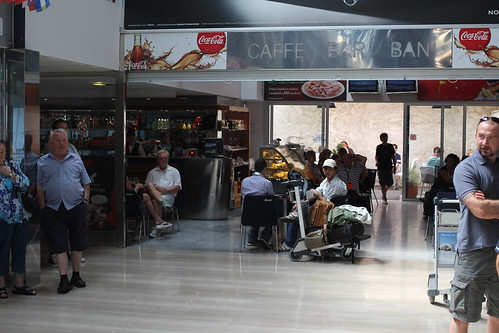
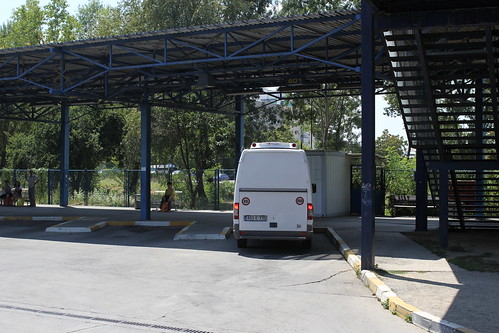
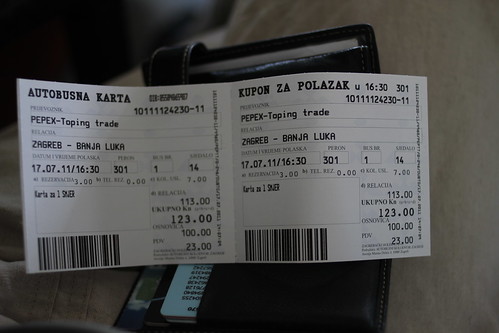
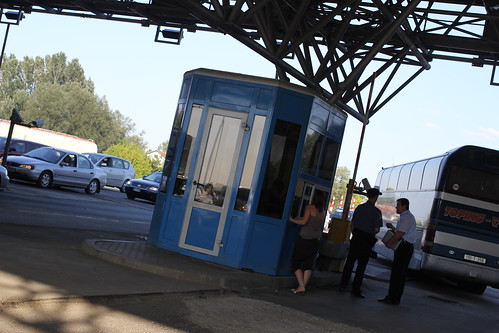
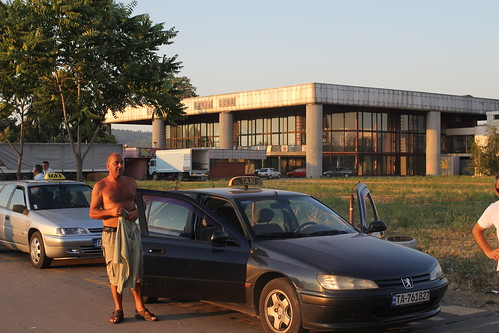
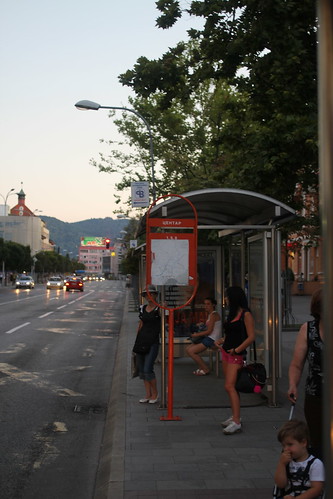
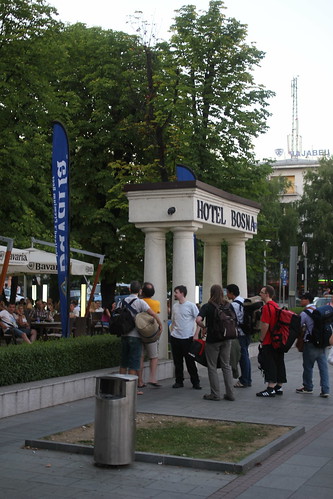
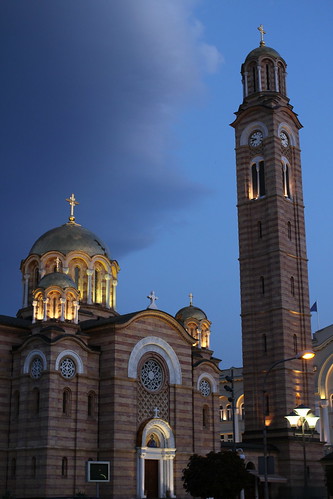
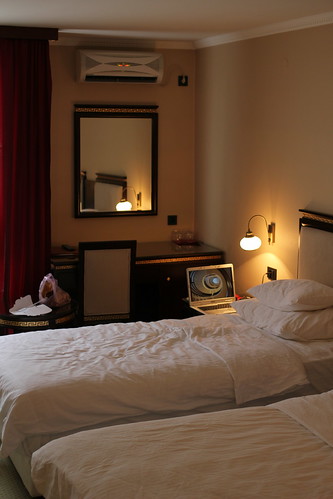
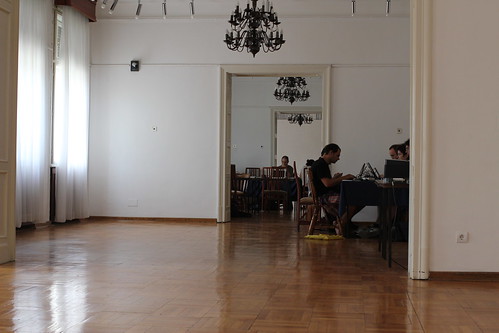
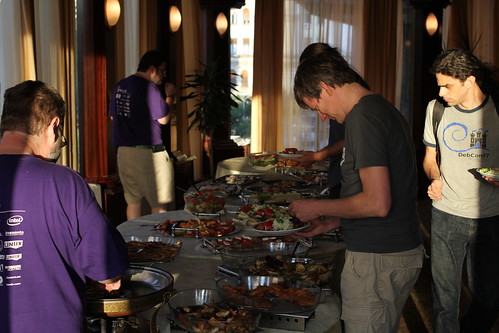
Short version arrival was quite easy, the arrival wiki page is now up-to-date and my photos are uploaded every day to this Flickr set. I had a small problem departing from CDG to Zagreb after scanning my suit twice and complaining that it had too many electronic devices, they had me remove my Nexus S, Nokia N950 and Kindle 3 from the suit pockets and then scanned that all lot again. After that another security guy asked me to open my suitcase and started squishing my Ligo cheese and declaring in a grave voice that it was too soft to be legal . As I kept calm and explained the DebConf cheese party to him, he looked around, put the cheese back in the bag and said ok, ok, off you go . So I still have that softness for the party. I heard an even better anecdote from our next years hosts when they were travelling trough Germany, a border official asked a typical so, what are you here for? question. They answered that they were in transit for an IT conference and gave him the invitation letter. He read the letter, nodded and then said: DebConf, huh? So, who was the author of the Linux kernel? and when after the initial shock they gave the right answer, they were immediately waved trough. Now that s what I call good border security. :) Meeting point - cafe at the Zagreb airport I met up with the guys in the Zagreb airport caf , which was immediately after exiting the secure zone. We waited for dkg to arrive and get his baggage. The passport check too a couple of minutes, but the baggage claim looked to be taking almost a half an hour. The airport bus After that was sorted out, we took out some local money in one of the 5 ATMs around and went to the bus. We were waived to just put our bags into the bus luggage space and get on, the driver went around to sell us tickets just before we drove off. It was one of the most comfortable and well air-conditioned buses I have been on in a long time. We were in the Zagreb bus station in less than half an hour. Non-official bus that tried to lure us Then a funny part started an old man came up to dkg and immediately asked Are you going to Banja Luka? , and when he said yes, the man started dragging us along to the bus station saying that there is a bus to there that will leave in a couple minutes, but we were in luck, so we should follow him right to the bus. Driven by curiosity, we went on. The man dragged us to the far side of the bus terminal bus stops where there was a minibus with Bosnian number plates, but no official designation as a passenger transit bus and no other passengers. They asked a reasonable 120 kuna for the trip, but they looked very shady to me, so we refused. I think that if we agreed and we were lucky enough that they actually did get us to Banja Luka, the price would have risen along the way, for example using the highway tolls as an excuse. Bus ticket to Banja Luka After getting cursed at by the old man and being demanded to buy him a beer for his efforts, we went upstairs to the real bus station where we were told that there were two buses to Banja Luka: one at 15:00 and another at 16:30, but that those two buses arrive in Banja Luka almost at the same time, so we got us tickets for the latter bus and went to a local bar to get some food and drinks. I somehow managed to get sausages in deepfried bread that for some reason cost almost triple of a hamburger and fries that others got, but it sure helped to pass the time and after all those 9 was not a bad price for a good meal. Bus to Banja Luka at Zagreb bus station We were a bit surprised by the bus drivers asking us to pay 1 (or 8 kuna) for bags to be put into bus bag storage, especially as we for several minutes could not quite understand what they want of us as neither of them spoke either English, Russian or German. Border crossing I don t remember when was the last time I crossed a real (i.e. non-Shengen) border in a bus, so getting out of the bus and walking one-by-one to the border official was a new experience. On the other border of two bus drivers collected the passports an then brought them back later, so that was less painful. And by then we were in Bosnia! And of the things that greeted us was a billboard for the casino in Banja Luka Hotel Bosna. :) By the time we got to Banja Luka, dkg had already made friends with an official from Croatian ministry of regional development that sat behind us on the bus and knew English very well (after living in Canada for some time). The bus station in Banja Luka looked almost abandoned like the bus stopped in the field with only a few taxi drivers and a bunch of buildings some distance away showing that this was indeed part of civilization. Banja Luka taxis The taxi drivers would take you to the venue for 8-10 KM 5 or 50-100 kuna (if their meter is broken and you look to be really ignorant of the exchange rates). If you walk on a bit, there is a bus station with an ATM taking Visa cards and a bit further on a bus stop that will take you to the centre of the city for 1.5 KM. The train station looked fully abandoned when we went there, only a news kiosk was working there. The bus driver reacted well to the name Hotel Bosna and wave toward it when we passed by it. Central bus stop - get off here Meeting first Debian peoples at the hotel It is hard to miss, especially the blinking Casino sign or the white pillars with black letters Hotel Bosna on top. You just get off at the bus station Central and walk back a couple hundred meters. Then see all you Debian friends drinking in the cool bar and walk around the corner to the main entrance of the hotel to check in. Church at sunset Main event location Hotel room The rooms are looking really great this is the best DebConf location that I have been to (I was not in Argentina). Soft beds with linens changed daily, nice air conditioning, towels (changed daily, if used), good shower, It is lacking in the speed and power of its free WiFi and in some place there is a clear impression that the hotel was built as a top of the line hotel a couple decades ago, but somehow has fallen into a disrepair since. Or it is simply used much more than expected. IMG_4973 So far I would say that the DebCamp is running full steam two hacklabs have desks, chairs, power and network connection, one of them even has sufficient air conditioning. The network works great for me so far, at least in the venue. The hotel wireless is barely usable to read a blog post, preferably without photos. Dinner buffet The food is being served well and on time. So far for lunch and dinner you walk up to the reception and get a food ticket based on your room number and go to the M level for the food (the M level is between the ground floor, labelled as PR , and first floor) where for breakfast and dinner there is a buffet, but for lunch you sit at a table and they bring you food. Vegetarians should clearly say vegetarian while pointing at themselves to get the special vegetarian option. So far food has been very good, except that that they often run out of popular items, such as fries, in the buffet. You can also ask for beer and other extra drinks with your food, but know that they cost extra up to 2.5KM for a beer, for example.

Lior Kaplan: Linux 20th anniversary T-shirts

I m organizing August Penguin, the yearly free software / open source conference in Israel for and by the community. We celebrate the 10th time we re holding this conference. I started going to these conferences just after high school, later I got more and more involved and now this is my 2nd year of being the main organizer (with a few others who provide great help). To celebrate the Linux 20th anniversary and August Penguins 10th anniversary, I thought to print copies of the Linux 20th anniversary T-shirts. I tired to contact the Linux Foundation to coordinate this, but got no response. I m writing this post to ask for help with finding the people who can approve this printing in behalf of the Linux Foundation. For those who can read Hebrew, the conference schedule is available at Hamakor s wiki. The rest are welcome to read the English version (provided by Google translate, so not totally accurate).
Filed under: Israeli Community

Next.

Previous.