Search Results: "ron"

17 December 2006

Andrew Pollock: [life] On departing the home of the Spanish Inquisition

I'm currently in (the really lovely) Philadelphia airport again, waiting for my connecting flight to San Francisco. I'm rapidly arriving at the conclusion that it is easier to enter the US once you've landed on US soil, than it is to depart from the country bound for the US. I had the most harrowing experience of my life this morning, trying to check in for my return flight. Due to the way various people's itineraries worked out, I ended up having to share a taxi from Badajoz to Madrid Airport at 12:30am. My flight didn't depart until something like 12:20pm, but the bus with the bulk of the people on it wasn't going to get me to the airport with less than 2 hours before departure, and I didn't want to risk missing my flight, especially given I'm feeling under the weather. So I got to the airport at about 4am, having had little sleep in the taxi. Terminal 1 has a real dearth of seating for people waiting to check in. I spent 4 hours trying to make myself as comfortable as possible on the hard floor, and didn't get a lot of sleep then either. For the record, check-ins (at least for US Airways) seem to open around 4 hours before the scheduled departure time. So I went to check in, and the way they were working it was there was a bunch of podiums out the front of what I would consider a conventional check-in counter. The people at these podiums then proceeded to give you your first Spanish Inquisition. I'd previously remarked to myself at how trivial it was to get into Spain... I was asked the purpose of my trip to Spain. I told the woman it was for a business meeting. She then asked where I'd spent my time I Spain. I told her Badajoz. She asked if I had a hotel receipt to show for it. I told her the accommodation was paid for my someone else. She then asked if I had any business cards to show for the business meeting. Sheesh, I thought. Luckily I still had all the copies of people's keys leftover from the keysigning we did, and some of them were in a business card format, so I pulled out a fistful of them and gave them to her. Oh, and she wanted to see a copy of my itinerary, and seemed satisfied that the flights were a reversal of what got me there in the first place. She wandered off with my passport, itinerary and the fistful of "business cards" and came back, seemingly satisfied that everything was in order. She stuck little blue stickers on my luggage and passport (the size of an Australian convenience-store price tag) and I was allowed to wait for the next check-in person. The rest of the checking-in process was fairly normal. I can appreciate the airline wanting to avoid having to deal with passengers being refused entry to the US, but I had a valid US visa in my passport, so that should make all of that a moot point. I don't know why I had to prove my trip's legitimacy to the airline. So I thought that was the end of it. Hardly. Terminal 1 of Madrid Airport seems to have heaps of gates, with a letter/number combination. Mine was in the B series, and I went through the security screening, and it became apparent that I had to go through another guard post looking thing to get from the A series to the B series. The signage looked like it said "Police". Anyway, the guy there had so-so English, and he initially was a little unhappy that I had an Australian passport and was flying to the US and not Australia. I pointed out the US visa, and he seemed less concerned. Then he asked me to say something in Spanish. I don't know if he was trying to be conversational, or I had to be able to speak some Spanish to get past or what the story was, but by this stage I was pretty tired, and this caught me totally off guard. I think I stammered out a Buenos d as or something. He then wanted to know how many hours it took to fly from Australia to Spain. I told him I had no idea, because I'd only flown from the US to Spain. He then begrudgingly gave me an exit stamp in my passport, and I was allowed on my way. I think the whole thing was made the more harrowing by the fact I was deadly tired, the Police guy didn't speak terribly fantastic English, and I wasn't expecting a second Spanish Inquisition (let alone the first). Oh, and closer to boarding time, they chucked everyone out of the lounge area closest to the gate, and rechecked everyone's passports and boarding passes. That was fair enough, and not unlike what happens in Sydney going to the US, but they don't even let you into the lounge area in the first place. That departure process was more what I would have expected an entry process to be like, and has put me off returning to Spain a little bit. The entry process was a joke. The guy barely looked at my passport long enough to give me the entry stamp. Fortunately I slept for the bulk of the flight from Madrid to Philly, and now I'm feeling a bit more human.
Aurelien Jarno: New ARM autobuilders

I am really upset by the way the ARM build daemons are managed. The packages are not uploaded regularly, with sometimes three days between two uploads. Well it should not be a problem, if packages that have failed to build due to some packages not uploaded fast enough (see for example python-gnome, or rkward) were requeued, but that’s actually not the case. Also last week, the build daemon named “cats” stopped to upload packages, despite it continued to build them. 11 days later, nothing has changed even after a mail to arm@buildd.debian.org. And I do not speak about build daemons building nothing. All of that resulted in ARM being the slowest architecture to build packages. It looks like the ARM build daemon maintainer does not know the excellent page made by Jeroen. As arm@buildd.debian.org is everything but responsive (well if you can assign a level of responsiveness to /dev/null), I have decided to act. I have installed QEMU on an 8-way Opteron machine, and created 8 emulated ARM machines, which 256MB of RAM and 10GB of disk for each, all running buildd + sbuild. Altogether those 8 emulated ARM machines should be faster than all the Debian ARM build daemons. I have setup a wanna-build database on my server. During the day it has built around 100 packages. Yes I agree that real machines would be better, but I don’t have a stack of fast ARM machines at home. Anyway when you see random segfaults on the build daemons, or strange failures (that happen for weeks) on the build daemon named “netwinder“, you may think to that again. Unfortunately the machine I use for that is only available for a few months, and I will have to stop the emulated machine then. I just hope that the situation with respect to the build daemons will improve, so that I can stop them even before.

16 December 2006

Adam Rosi-Kessel: Questionable Verizon EVDO Support

Once you’ve had a taste of EVDO (presently offered only by Verizon and Sprint), it’s hard to imagine not having it. Like cell service, you quickly forget what it was like not to be online always everywhere. (It’s a great example of our rising “baseline” standard of living). Recently, I switched to an embedded EVDO card on a new laptop (running Windows for reasons beyond the scope of this blog entry). It worked for a couple of days, and then I started getting mysterious “error 913” messages when trying to connect. After trying all the solutions that seemed obvious to me, I contacted Verizon Wireless Tech Support as suggested by the error message, which otherwise provided no information about error 913. Perhaps surprisingly, Verizon Wireless Tech Support didn’t really know what error 913 was either. After a few minutes, I was escalated to second level tech support. They had me reboot. Then they had me reinstall the card controller software. The second-level tech support person put me on hold to speak with whatever higher level tech support she had access to. Then they had me delete the EVDO connection from the dial-up networking control panel and re-create it. None of these things worked. So she said I should just return the laptop to the store and get a new one. It was perhaps the best example of the three “R’s” of Windows Tech Support I had ever experienced: reboot, reinstall, replace. This may perhaps be the only cost effective way of providing such support. I persisted, though, as I was pretty sure there wasn’t a hardware issue given that all the diagnostics were coming up without error. I would rather not return a perfectly good laptop just because we couldn’t figure it out. I was also suspicious because I had seen several instances of precisely this problem popping up in message boards, and the tech support person herself told me that she had recently been unable to solve the same problem with another customer. It just didn’t have the symptomology of broken hardware. After a few more minutes of speculating about why this might happen, the tech support person said she had an idea, and asked me to try to reconnect. Since then, it has worked perfectly. As I understand the problem, my account was enabled for unlimited “roaming” EVDO access, but did not actually have authorization for “non-roaming” (i.e., within the network) access. Thus the connection was rejected. There are several things wrong with this picture. Why didn’t the EVDO access manager software provide an error message that actually indicated that the connection was refused for lack of authorization? Why didn’t anyone at Verizon know what error 913 was? Shouldn’t Verizon have a checklist for such issues that includes “check to see if the subscriber is properly signed up”? (For that matter, why did my account spontaneously lose non-roaming access?) These are just a few questions that come to mind. I hate to beat on Verizon, since I’ve done it three times before, but it’s almost like they’re just asking for it. Maybe it’s time they rethink their organizational strategy.

Robert McQueen: Telepathy and OLPC (part 2)

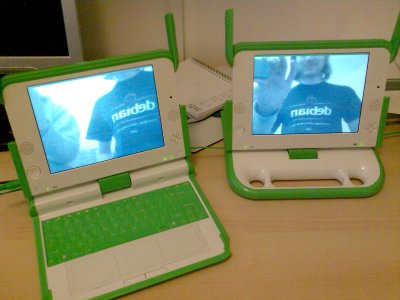
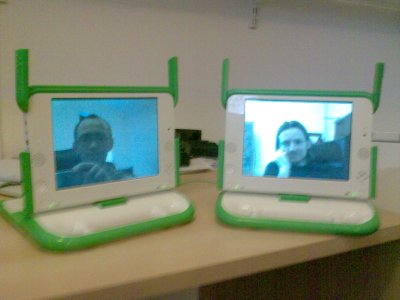
I’ve been away from the office for a couple of days, but when I got back to Cambridge, Daf and Sjoerd had some pretty cool stuff to show me: These screenshots are taken by using an environment variable to tell stream-engine just to create an xvimagesink for any call, but Daf’s writing a simple pygtk UI which handles embedding the output window into the UI properly and should make placing/receiving calls slightly less mystical. Even so, a graphical video call APP in ~150 lines of python… not too bad if you ask me. :)

Ian Murdock: More on iAccessible2 and cross platform accessibility interfaces

Aaron Leventhal of IBM has more details on the relationship between iAccessible2 and the UNIX/Linux accessibility API (ATK/AT-SPI) as well as the motivations behind iAccessible2’s evolutionary approach:
[A]n evolutionary path was needed for applications which already had MSAA (IAccessible) support… [and] an API was needed that did not require separate accessibility implementations for each platform. […] The IAccessible2 interface itself collects important ATK features from other areas, as well some completely new methods and features… For the most part, features were added either to bring Windows capabilities up to the level of ATK/AT-SPI, or in order to support the features of ARIA (previously known of DHTML accessibility). […] [W]hat we’re doing is expanding MSAA while matching ATK/AT-SPI to a very helpful degree. […] [B]ecause IAccessible2 is backwards-compatible with MSAA, the current support of Windows screen readers and other assistive technologies can continue to work on applications that add IAccessible2 support. However, the newer IAccessible2 capabilities will also be exposed, and thus newer assistive technologies will be able to take advantage of them.
Peter Korn of Sun weighs in as well. (Via Andy Updegrove.)

Evan Prodromou: 25 Frimaire CCXV

I'm pretty happy to note that I've been invited to speak at South by Southwest Interactive in March on the subject of wikis and commercialization. I'm pretty psyched about the subject, as I think a rich and varied ecosphere of wikis -- from personal to informal clusters to formalized non-profits to formalized commercial ventures -- is a necessary step to the development of a read-write Web. OK, so, it wasn't like they invited me out of the blue -- I submitted an idea for a wiki panel a few months ago, and it got morphed into a one-person presentation instead. Which will be fun, since I'll be able to pontificate at length on this interesting subject. Maj booked us our hotel rooms in November -- I wanted to stay at the Austin Motel, but they have some kind of one-time callin system for the week of SxSW, and their rooms sell-out in an hour or so. We missed the callin time, which was no big deal. tags:

Recidivista Bad Vista is a clumsy and confusing name. Who's running the Wordplay Department over at the FSF nowadays? I hope it's some wily Germans, and that "Bad Vista" is some sort of elaborate spa joke. But for some reason I doubt it. Offer to the FSF: I just registered recidivista.org today. It's an awesome name. It is yours for free if you promise to use it well and be funny instead of shrill. Deal? tags:

Maptastic I'm pretty happy to note that I got around to developing a new MediaWiki plug-in that uses the Mapstraction library to switch between well-known-but-proprietary mapping services like Google Maps and unknown-but-open-and-cool services like OpenStreetMap. Each page on Wikitravel that's had some geo-data RDF magic added to it gets a link to the Mapstraction page, which will focus on that destination. Eventually it will have icons for each museum, restaurant, bar, hotel, or other feature of the city, and you could move them around or even edit their information through the map interface. But, for now, I'm starting small. More map-centrism will come with time. You can check out Montreal for an example of a mapped-up page right now. tags:

C-List So, I like this Are you an A-list Bloglebrity? tool on kineda.com. A simple re-packaging of some publicly-available data from Technorati, ranking blogs into lists by authority. Excellent hit-mongering. I'm sad to say that I'm still in the C-list on the blogging front, but that's really just dependent on longevity. I've only been doing this since last May -- errr, Flor al -- which is just 7 months (that's 49 months in blog years). If the A-list gets the Lear jets and the red-carpets, I don't know what kind of perks come along with the C-list. Free refills on your orange soda? tags:

Parenthood One of the things that parents often notice is that they have a hard time relating to their non-parent friends. And, of course, single non-parents have a hard time relating to their friends who've bred. Why is it so hard for these two kinds of people to connect with each other? I think there are some superficial reasons, like having different schedules, different imperatives, different needs. But I also think there's something more fundamental about the split. Organisms who've survived long enough to successfully reproduce have realised one goal in life -- if you listen to Charles Darwin, the only goal in life. If you have children, you have found a purpose for yourself -- an answer to all those questions about who you are and what you're supposed to do with your time on earth. If you survive to breed, you have won the game. Now, it's not the only way of winning, and it's not really the most interesting game in town. But I know at least for myself, and for other parents I've talked to, there is an existential satisfaction in finding yourself almost accidentally filling this purpose. Having never felt before that I had a definite purpose, it's been a strange sensation. Non-parents don't get the same sensation -- or, at least, they don't get it in the same way. So they're still looking, thinking, questing, trying to find some answers. And that gives them a vibrant edge that fulfillment dulls. I doubt there are many non-parents who would be satisfied with the Darwinian answer to their questions -- spawning like crayfish isn't a very lofty goal in life. Or at least it doesn't seem so from the outside. I'm not sure how to tell my friends how my life's changed since we had a daughter -- how when I'm reflecting and summing up my life, I don't feel the same panic as I did before. It's a good feeling, though. tags:

Iraqi taxi This blog post with a graphic illustration of the process for a build-your-own Iraqi taxi cracked me up. It was also nice for giving me a link to Wrecked Exotics. No, it's not about drunk strippers, nor orchids that went unfed; it's crashed cars. tags:

15 December 2006

Russell Coker: some questions about disk encryption

On a mailing list some questions were asked about disk encryption, I decided to blog the answer for the benefit of others:

What type of encryption would be the strongest? the uncrackable if you will? im not interested in DES as this is a US govt recommendation - IDEA seems good but what kernel module implements this?


The US government (which incidentally employs some of the best cryptologists in the world) recommends encryption methods for data that is important to US interests (US military and banking operations for starters). Why wouldn't you want to follow those recommendations? Do you think that they are putting back-doors in their own systems?

If they were putting in back-doors do you think that they would use them (and potentially reveal their methods) for something as unimportant as your data?

I think that if the US military wanted to apply a serious effort to breaking the encryption on your data then you would have an assortment of other things to worry about, most of which would be more important to you than the integrity of your data.

I've read some good things about keeping a usb key for system boot so that anything on the computer itself is unreadable without the key - but thats simply just a physical object - I'd like both the system to ask for the passphrase for the key as well as needing the usb key

I believe that can be done with LUKS, however it seemed broken last time I experimented with it so I've stuck with the older operation of cryptsetup.

What kind of overheads does something like this entangle? - will my system crawl because of the constant IO load of the disk?

My laptop has a Pentium-M 1.7GHz and a typical laptop drive. The ratio of CPU power to hard drive speed is reasonable. For most operations I don't notice the overhead of encryption, the only problem is when performing CPU intensive IO operations (such as bzip compression of large files). When an application and the kernel both want to use a lot of CPU time then things can get slow.

More recent machines have a much higher ratio of CPU power to disk IO as CPU technology has been advancing much faster than disk technology. A high-end desktop system might have 2-3x the IO capacity
of my machine, but a single core would have 2-3x the computer power of the CPU in my laptop and for any system you might desire nowadays 2 cores is the minimum. Single-core machines are still on sale and still work well for many people - I am still deploying Pentium-3 machines in new installations, but for machines that make people drool it's all dual-core in laptops and one or two dual-core CPUs in desktop systems (with quad core CPUs on sale soon).

If you want to encrypt data on a P3 system with a RAID array (EG a P3 server) then you should expect some performance loss. But for a typical modern desktop system you shouldn't expect to notice any overhead.

Julien Blache: Digi AccelePort drivers updated to 1.3-6

I have just updated the dgap packages to dgap 1.3-6 (Digi part number 40002347_C). Packages version 1.3.6-1 are available at the usual location, and apt-gettable using this source
deb http://debian.technologeek.org/ sarge non-free I’ve added proper Release and Release.gpg files, the key used for signing being mine (0xF5D65169). This release addresses the TTY flip buffer changes in kernel >= 2.6.16. Previous releases are available in the old directory, should you need them; apt-get should be able to get the old packages if you explicitely specify the version. If you are using these packages in a production environment and would like to see them land in Debian, even if in the non-free section, please drop me a mail. I’m mailing Digi again to try and solve the issues that prevent me from uploading the drivers into non-free.

Ian Murdock: Software installation on Linux: Today, it sucks (part 1)

As anyone who follows my blog knows, I’m fond of linking to other sites with brief little quotes that either get me thinking or reinforce points I’m trying to make elsewhere. (Credit where credit is due: Dave Winer and Doc Searls both do this very effectively, and I’m just shamelessly copying them, down to the quoting style they typically use.) One of the quotes I’ve had queued up for a long time is this one from Jon Udell:
I have a confession to make. Sometimes, when I m trying out an unfamiliar open source component, I cheat. Even if the software I m working on will deploy to Linux, I ll sometimes develop it on Windows first. Why? Because on Windows, an open source component is likely to come with an installer that just works.
He’s right. Unless an application is included with your Linux distribution of choice, installing that application on Linux is a nightmare compared to Windows. Here’s an example. To install Sun’s Java Studio Creator on Windows, I just click on the .exe on Sun’s web site, which downloads the file and places it on my desktop. I double click the .exe (after, of course, checking it for viruses) and am up and running in a few minutes. In contrast, on Linux, I click on the .bin, which downloads the file and.. up pops a text editor showing me a /bin/sh script. Nice. Fortunately, I know what that is, so I save the script to a file on my desktop. I double click the file, and.. up pops a dialog box telling me the file isn’t executable. Nice. Fortunately, I know what that means, so I drop into a shell and run chmod +x ./creator-2_1-linux-ml.bin. I double click the file again, and there’s a nice graphical installer now. Finally, it looks like everything is going my way. Halfway through, though, the installation fails, telling me I need to install the RPMs for compat-libstdc++ and compat-libstdc++-dev. Nice. Assuming I even know what an “RPM” is, I then realize: I’m running Debian, and Debian doesn’t use RPM. Maybe I know about alien, but even if I do, where do I go about getting the compat-libstdc++ and compat-libstdc++-dev RPMs? At this point, I’ll probably hit Google—that is, if I haven’t already thrown up my hands in disgust and gone back to Windows. After a bit of Googling, I find this page, which tells me on Debian what I really need is libstdc++2.10-glibc2.2 and libstdc++2.10-dev. Of course! I should have known that. (Note: I’m being sarcastic.) After installing those two packages, I restart the installer (which, thankfully, knows how to deal with the fact that it’s already half installed, but that won’t always be true). The installation finishes this time, and the installer kindly offers to start the program for me. However, after poking around a bit and exiting back to the desktop, I don’t see a menu entry or a desktop icon, so I’m not sure how I’m going to find it again (and I hope I don’t have to explain why cd’ing to ~/sun/Creator2_1/bin is not an answer). Anyone who has ever installed software on Linux is familiar with this song and dance. If it’s in your distro of choice, you’re only an apt-get or a yum install away from running it. But if not, you’d better know what you’re doing, have a lot of patience, and understand how to construct effective Google search terms. (And, no, moving everything into the distribution is not a very good option. Remember that one of the key tenets of open source is decentralization, so if the only solution is to centralize everything, there’s something fundamentally wrong with this picture.) Oh, well. At least I didn’t have to check for viruses! Fortunately, some of the problems I experienced are bugs. The above was done on a pre-release Debian etch system over the summer, so it’s likely the problems have been fixed. I repeated the experiment on an Ubuntu edgy system, and it didn’t open the text editor, nor did it complain about an incompatible C++ environment. However, there were still no menu entries or desktop icons, and there was an additional problem too in that when I double clicked the file, it opened it in CrossOver Office, which I also have installed. Regardless, even if it works better on some distros than others, there’s still no usable solution until ISVs and end users alike can depend on things consistently working regardless of the distro being used. Again, fortunately, we have solutions to parts of the problem already. The LSB abstracts away the differences between the runtime environments of the various distros, so the Java Studio Creator installer could have simply said “you must install the LSB environment” rather than trying to deal with the hundreds of little variations in both the environments and the package namespaces that provide them (e.g., compat-libstdc++ vs. libstdc++2.10-glibc2.2). Better yet, on distros that provide the LSB environment in their default configuration, the installer doesn’t have to do anything. And Project Portland promises to give us a consistent interface for creating menu entries, desktop icons and such things. However, far too few applications take advantage of the LSB today (though that’s changing), and Project Portland isn’t in any of the distros yet (though we’re looking at bundling its primary deliverable, xdg-utils, with the LSB 3.2 SDK to work around that). Finally, even though the LSB provides ISVs with a consistent way to create an LSB compliant executable, there’s no consistent way to deliver an LSB compliant application that’s easy to install and that integrates well with the distribution’s package system. Yes, the LSB includes RPM today, but for a variety of reasons, ISVs don’t want to use RPM, and as already mentioned, not all distributions support RPM natively. Fortunately, once again, this isn’t just a rant. The LSB tackled these very issues at the LSB face to face and Packaging Summit last week in Berlin, Germany, and we think we have a way forward that’s acceptable to all involved: Linux distribution vendors who already have well established package systems and systems management tools built around them; ISVs who need to support multiple platforms and so don’t want to support the Linux specific RPM format or who otherwise want more control over the installation experience; and end users who want to use the software management facilities their distributions provide, whether that’s RPM or something higher level like APT and yum. More in part 2…

Jonathan McDowell: Holy fridge, Batman!

I have a new fridge freezer. It has a hole in the back of the fridge. I can see through it to the outside world. This is apparently a drainage duct and part of the deicing/condensation thingy-ma-jig. It strikes me as just wrong. Won't all the cold escape? Simon tells me it's only a small hole and his fridge has one too, but I'm not convinced. I'll have to hide it behind some beer so I forget about it.

14 December 2006

Julien Blache: mbpeventd v0.8

mpbeventd made it to unstable today, and I’ve just released version 0.8. Changelog: Version 0.7 also fixed the machine identifier string for the Core2 Duo MacBook, which was wrong despite coming straight from the Apple Technote for the machine. Tarball available on http://people.debian.org/~jblache/pkg/mbpeventd/ Browse the SVN repository or check it out from http://svn.technologeek.org/repos/mbpeventd/trunk

Joey Hess: missing the deep of the night

Ever since I got back from Germany I've had some screwy and wrong sleep habits, that seem to involve going to bed before midnight, and waking up about 8-9 hours later, around 7 or 8 am. Partly because I was sick, but I'm not that sick anymore and it's persisting. This is so deeply wrong.

Edd Dumbill: JavaScript frameworks, new heroes of the web

Makers of Dojo, Prototype, jQuery and Mochikit, I salute you.It is immensely gratifying that there are those with the courage and sense to make JavaScript in the browser workable for the rest of us. Like many busy developers, I've steered myself away from hacking JavaScript for many years. Cross-browser incompatibilities, the troubles of debugging and the relatively small reward for effort have kept me focusing on the server side (not to mention the temptation JavaScript poses to those prone to stray from the REST religion).This is now starting to change. The immense efforts of JavaScript developers are providing frameworks that allow developers to work on the client side with something approaching the elegance and concision that we can now wield on the server side.One of the wonderful things about the web is that it has become the forum for its own improvement. JavaScript has ensured that this is now true of the browser too. New techniques can be proved in script before they ever need baking into a markup language.Even the most ardent of declarative programming hacks will appreciate the way toolkits such as jQuery allow painting of behaviour onto pages rather than littering semantic markup with snippets of script.The problem that faces us now is: which JavaScript framework to choose?As is my habit in programming languages, I've found myself move from framework to framework depending on the actual tools available. Starting off in Prototype as it came with Rails, paying a happy visit to jQuery because of Thickbox, considering Dojo because of its rich text editor, and now being wowed by Plotkit and thus checking out Mochikit.So, here's an idea for aspiring XTech presenters: we'd love to hear more about these toolkits. Experiences, future plans for the kits themselves, and how developers should choose between them.

13 December 2006

Amaya Rodrigo: Zazu found some clues about Jazz's past

Jazz, adopted in June 2005 is wrong! I adopted him in 2006 :)

Maybe he was adopted previously and then abandoned. Poor Jazz!

: A much better URL to Jazz's story.

David Moreno Garza: The Killers

We‘ll be attending The Killers‘ concert tonight. I’m not completely fan of their synthesized-rock-indie music, but she likes them so much and she made me dig their last album, Sam’s Town, like a thousand times in the car; so I acceded and bought the tickets online. She was even jelaous of a friend who is also attending, heh :) I wasn’t happy at all since they are still a more or less new band, they only have two albums released and prices for tickets were high as hell (ironic), but her surprise smile worth it, it definitively does. ;)

Holger Levsen: virtual reality?

You probably know this famous cartoon-map, the world according to Ronald Reagan or the USA. Welcome to the new world order. Companies are as big as whole continents. And there is still some room for more companies or web 3.0.

I wonder how IPv6 really looks like.

Paul van Tilburg: Master Project - Take 1

Today I have effectively started with my Master Project! I have been been at it for a few days already in the past weeks though, but now I’m sitting on my own spot working on some proofs. So, what am I actually doing? Well that’s still hard to put in words yet and it also requires some process algebra and general math prior knowledge, but I’ll try. My graduation supervisor is Bas Luttik and in July he co-published a paper on defining a finite equational base (a set of equations from which all others can be derived) for a specific process algebra called CCS. This paper used a specific subset of CCS, namely without restriction (hiding) and relabelling. Restriction is an operator of the process algebra to block certain actions of happening, relabelling is an operator to replace actions by other actions. Take 1 of my project is to try to consider this algebra with restriction and finding a new equational base and proof that either it works or it can not be done. This is a risky assignment because it can lead to: we have tried but haven’t gotten either results. The short period to come will entail considering CCS with restriction but without concurrency to drastically reduce the cases to be considered. If we succeed, we’ll continue with CCS with restriction and concurrency. If we do not succeed it’s quite possible we’ll change my project assignment. More to come!

12 December 2006

Biella Coleman: The Moose is On the Loose and a little Usenet History

So I am back to le study of le hackers, trying to write a super-secret paper that I will present in January and then of course I am back with and to my beloved book (which for now has the following title: “Freedom’s Pleasures: Hacker Practice And The Limits of Liberalism” but I am sure it will morph, endlessly). As part of my transition I just finished re-reading one of my favorite articles on the history of Usenet: If I want it, it s OK: Usenet and the (outer) limits of free speech by B. Pfaffenberger (available here for download. When I released one of my dissertation chapters where I addressed the phenomenon of the Cabal, Bryan was nice enough to write me and point me to his article, which also examines the existence of Backbone Usenet Cabal. The artile, which provides just the right mix of history and commentary, analyzes how a free speech ethic came to be valued on Usenet and the ways in which technological and social factors co-mingled to facilitate and dampen the free flow of expression. You are provided with classic Usenet quotes like:
Usenet is like a herd of performing elephants with diarrhea–massive, diffi-
cult to redirect, awe-inspiring, entertaining, and a source of mind-boggling
amounts of excrement when you least expect it. (Spafford, 1993b)
You learn about the early attempts to control spam by the likes of “CancelMoose:”
In 1995, a secret, shadowy figure known as the CancelMoose
devised a spam-canceling program called a cancelbot.”
And then in the end, he provides his challeng to one of the dominant STS theories of the time, SCOT: “It should be noted that this picture is at odds with the predictions of the social construc-
tion of technology (SCOT) theory (Pinch & Bijker, 1987), in which the outcome of a period
of technical controversy is ascribed solely to social factors. Underlying SCOT s dogmatism
is a justifiable aversion to technological determinism, the doctrine that a technology s con-
tent leads irresistably to predictable social consequences a doctrine that is simply the re-
verse of SCOT s insistence on social causation. Two wrongs, as we were taught in kinder-
garten, do not make a right. What we see in the history of Usenet is a contingent outcome
that is shaped neither exclusively by social nor by technical factors, but rather is best under-
stood as a long process in which contesting groups attempt to mold and shape the technol-
ogy to suit their ends sometimes successfully, and sometimes not. They are as likely to be
blindsided by technological developments as they were to succeed in changing the system
to meet their ends. As this article attests, it is one thing to create new technologies with a
coherent social vision, and it is quite another to control the way it grows and develops.” I could not agree with him more. I think what he is highlighting is that if we dip into the historical record, we have instances in which technology can trump the social and vice-versa (and often instead it is a co-mixture), so in the end, understanding the impact of technologies is less about theories of technology and more of a historical question…

Ian Murdock: VMware as operating system?

Now this is interesting: BEA is coming out with a version of its application server that runs directly atop VMware. With this move, VMware takes another step toward becoming a full fledged operating system in its own right. VMware is already promoting the distribution of applications as virtual machine images, and operating systems are first and foremost application platforms. If VMware is an application platform, why not cut out the middle man entirely, particularly given that the middle man adds a few hundred megabytes of largely invisible baggage to the application, not to mention an enormous amount of maintenance burden for the ISVs that make or break an application platform? For me, the real question is: Why BEA and not VMware? A JavaOS makes a lot of sense, since it builds on one of the world’s largest developer communities—it’s a well known environment among developers, and there are a huge stable of applications that could take advantage of the new platform with minimal porting. Furthermore, applications are increasingly server based, with the browser providing the UI, so this matches well with industry trends and nicely addresses the problem that VMware would have a very hard time building any sort of graphical user interface into its platform, just given the nature of what it is. That said, VMware should really want to provide the JavaOS directly. With Xen and Virtual Server moving aggressively to bundle their products with widely deployed operating systems, the game’s already afoot, and if virtualization becomes just another operating system feature, VMware is at a distinct disadvantage, as it owns no operating system to bundle its product with. Finally, what about standards? New kind of operating system or operating system feature, there are going to be multiple application platforms if history is any indication (and it usually is), so how do applications take advantage of the new platforms without the inevitable fragmentation? It’s going to be an interesting space to watch, that’s for sure.

11 December 2006

Yves-Alexis Perez: NM Queue, Xfce 4.4rc2 and Etch freeze...

It's been more than one year that I'm waiting on NM queue, waiting for an Applicant Manager, performing Philosophy & Procedure part 1 & 2, then Tasks & Skills.

When applying for NM, it's really appreciated to already maintain a few packages in the archive, so for T&S the AM can check them and appreciate the work done. I guess people applying for NM first start by taking care of some package, before submitting.

But for me, it was the opposite way. I joined pkg-xfce team more than 18 months ago, and got my first packages in the archive a few weeks later.

I only applied to NM 6 months later, because, as I was dedicating more time to pkg-xfce, it would be more efficient for me to be able to upload directly, without
bothering huggie or ema (the two DDs in the team). It wasn't really required, but
it interested me, and huggie said me that it'd take some time so the sooner, the better.

Now, due to personal reason, huggie and ema don't have time/motivation anymore to work on pkg-xfce. I'm currently the one in charge, as I spent some time on it, and tries to spent some time on debian-desktop team, so we have a nice and consistent look for desktop environments in Etch. But I can't upload my packages myself, I need to find a sponsor. Xfce represent more than 50 packages (including goodies), that's quite a lot, and we have scripts and procedure to be efficient when rebuilding everything. If I could do everything myself, Xfce 4.4rc2 (released 2006/11/05) would have been in Etch since a long time. But I can't, because I'm stuck in NM queue.

Most of 4.4rc2 packages have been uploaded by my AM, Dafydd Harries (which I want to thank, though), but not everything, and few packages won't be in Etch, now that it's frozen. Yeah, that means that Etch will have half rc1 and half rc2, which isn't really good. Not really bad either, but still... (ok, and not as bad as shipping broken svn snapshots...)

I'm interested in beeing a Debian Developper because I *know* it'll make my work and my time more efficient. And not beeing able to push rc2 to Etch because of that really makes me sad...

Next.

Previous.