Search Results: "tim"

2 December 2024

Jonathan Dowland: jungle/acid/etc

I thought it had been a full year since I last shared a playlist, but it's been two! I had a plan to produce more, but it seems I haven't. Instead here's a few tracks I've discovered recently which share a common theme. In August I stumbled across a Sound on Sound video interviewing Pete Cannon, who creates authentically old-school Jungle music using tools and techniques from the time, including AKAI samplers and the Commodore Amiga computer.
Here's three tracks that I found since then. Some 8-bit Amiga-jungle, by some slower-paced acid house from someone ostensibly based on Whitley Bay, by and a darker piece I heard on the radio. by

Russ Allbery: Review: Long Live Evil

Review: Long Live Evil, by Sarah Rees Brennan
Series: Time of Iron #1
Publisher: Orbit
Copyright: July 2024
ISBN: 0-316-56872-4
Format: Kindle
Pages: 433
Long Live Evil is a portal fantasy (or, arguably more precisely, a western take on an isekai villainess fantasy) and the first book of a series. If the author's name sounds familiar, it's possibly because of In Other Lands, which got a bunch of award nominations in 2018, She has also written a lot of other YA fantasy, but this is her first adult epic fantasy novel. Rae is in the hospital, dying of cancer. Everything about that experience, from the obvious to the collapse of her friendships, absolutely fucking sucks. One of the few bright points is her sister's favorite fantasy series, Time of Iron, which her sister started reading to her during chemo sessions. Rae mostly failed to pay attention until the end of the first book and the rise of the Emperor. She fell in love with the brooding, dangerous anti-hero and devoured the next two books. The first book was still a bit hazy, though, even with the help of a second dramatic reading after she was too sick to read on her own. This will be important later. After one of those reading sessions, Rae wakes up to a strange woman in her hospital room who offers her an option. Rather than die a miserable death that bankrupts her family, she can go through a door to Eyam, the world of Time of Iron, and become the character who suits her best. If she can steal the Flower of Life and Death from the imperial greenhouse on the one day a year that it blooms, she will wake up, cured. If not, she will die. Rae of course goes through, and wakes in the body of Lady Rahela, the Beauty Dipped in Blood, the evil stepsister. One of the villains, on the night before she is scheduled to be executed. Rae's initial panic slowly turns to a desperate glee. She knows all of these characters. She knows how the story will turn out. And she has a healthy body that's not racked with pain. Maybe she's not the heroine, but who cares, the villains are always more interesting anyway. If she's going to be cast as the villain, she's going to play it to the hilt. It's not like any of these characters are real. Stories in which the protagonists are the villains are not new (Nimona and Hench come to mind just among books I've reviewed), but they are having a moment. Assistant to the Villain by Hannah Nicole Maehrer came out last year, and this book and Django Wexler's How to Become the Dark Lord and Die Trying both came out this year. This batch of villain books all take different angles on the idea, but they lean heavily on humor. In Long Live Evil, that takes the form of Rae's giddy embrace of villainous scheming, flouncing, and blatant plot manipulation, along with her running commentary on the various characters and their in-story fates. The setup here is great. Rae is not only aware that she's in a story, she knows it's full of cliches and tropes. Some of them she loves, some of them she thinks are ridiculous, and she isn't shy about expressing both of those opinions. Rae is a naturally dramatic person, and it doesn't take her long to lean into the opportunities for making dramatic monologues and villainous quips, most of which involve modern language and pop culture references that the story characters find baffling and disconcerting. Unfortunately, the base Time of Iron story is, well, bad. It's absurd grimdark epic fantasy with paper-thin characters and angst as a central character trait. This is clearly intentional for both in-story and structural reasons. Rae enjoys it precisely because it's full of blood and battles and over-the-top brooding, malevolent anti-heroes, and Rae's sister likes the impossibly pure heroes who suffer horrible fates while refusing to compromise their ideals. Rae is also about to turn the story on its head and start smashing its structure to try to get herself into position to steal the Flower of Life and Death, and the story has to have a simple enough structure that it doesn't get horribly confusing once smashed. But the original story is such a grimdark parody, and so not my style of fantasy, that I struggled with it at the start of the book. This does get better eventually, as Rae introduces more and more complications and discovers some surprising things about the other characters. There are several delightful twists concerning the impossibly pure heroine of the original story that I will not spoil but that I thought retroactively made the story far more interesting. But that leads to the other problem: Rae is both not very good at scheming, and is flippant and dismissive of the characters around her. These are both realistic; Rae is a young woman with cancer, not some sort of genius mastermind, and her whole frame for interacting with the story is fandom discussions and arguments with her sister. Early in the book, it's rather funny. But as the characters around her start becoming more fleshed out and complex, Rae's inability to take them seriously starts to grate. The grand revelation to Rae that these people have their own independent existence comes so late in the book that it's arguably a spoiler, but it was painfully obvious to everyone except Rae for hundreds of pages before it got through Rae's skull. Those are my main complaints, but there was a lot about this book that I liked. The Cobra, who starts off as a minor villain in the story, is by far the best character of the book. He's not only more interesting than Rae, he makes everyone else in the book, including Rae, more interesting characters through their interactions. The twists around the putative heroine, Lady Rahela's stepsister, are a bit too long in coming but are an absolute delight. And Key, the palace guard that Rae befriends at the start of the story, is the one place where Rae's character dynamic unquestionably works. Key anchors a lot of Rae's scenes, giving them a sense of emotional heft that Rae herself would otherwise undermine. The narrator in this book does not stick with Rae. We also get viewpoint chapters from the Cobra, the Last Hope, and Emer, Lady Rahela's maid. The viewpoints from the Time of Iron characters can be a bit eye-roll-inducing at the start because of how deeply they follow the grimdark aesthetic of the original story, but by the middle of the book I was really enjoying the viewpoint shifts. This story benefited immensely from being seen from more angles than Rae's chaotic manipulation. By the end of the book, I was fully invested in the plot line following Cobra and the Last Hope, to the extent that I was a bit disappointed when the story would switch back to Rae. I'm not sure this was a great book, but it was fun. It's funny in places, but I ended up preferring the heartfelt parts to the funny parts. It is a fascinating merger of gleeful fandom chaos and rather heavy emotional portrayals of both inequality and the experience of terminal illness. Rees Brennan is a stage four cancer survivor and that really shows; there's a depth, nuance, and internal complexity to Rae's reactions to illness, health, and hope that feels very real. It is the kind of book that can give you emotional whiplash; sometimes it doesn't work, but sometimes it does. One major warning: this book ends on a ridiculous cliffhanger and does not in any sense resolve its main plot arc. I found this annoying, not so much because of the wait for the second volume, but because I thought this book was about the right length for the amount of time I wanted to spend in this world and wish Rees Brennan had found a way to wrap up the story in one book. Instead, it looks like there will be three books. I'm in for at least one more, since the story was steadily getting better towards the end of Long Live Evil, but I hope the narrative arc survives being stretched out across that many words. This one's hard to classify, since it's humorous fantasy on the cover and in the marketing, and that element is definitely present, but I thought the best parts of the book were when it finally started taking itself seriously. It's metafictional, trope-subverting portal fantasy full of intentional anachronisms that sometimes fall flat and sometimes work brilliantly. I thought the main appeal of it would be watching Rae embrace being a proper villain, but then the apparent side characters stole the show. Recommended, but you may have to be in just the right mood. Content notes: Cancer, terminal illness, resurrected corpses, wasting disease, lots of fantasy violence and gore, and a general grimdark aesthetic. Rating: 7 out of 10

Charles: Hello World

Or how it took more than a year for me to set up this website - As the computer science tradition demands, we must start with a Hello World. Though I have to say this hello world took quite a long time to reach the internet. I ve been thinking about setting up this website for way over a year, but there are always too many things to decide - what Static Site Generator will I use? Where should I get a domain from? Which registrar would be better now? What if I want to set up a mail server, is it good enough? Oh, and what about the theme, which one to choose? Can I get one simple enough to not fetch javascript or css from external sources? This was taking so long that even my friends were saying Please, just share your screen and let s do it now! . Well, rejoice friends, now it s done!

1 December 2024

Guido G nther: Free Software Activities November 2024

Another short status update of what happened on my side last month. The larger blocks are the Phosh 0.43 release, the initial file chooser portal, phosh-osk-stub now handling digit, number, phone and PIN input purpose via special layouts as well as Phoc mostly catching up with wlroots 0.18 and the current development version targeting 0.19. phosh phoc phosh-mobile-settings libphosh-rs phosh-osk-stub phosh-tour pfs xdg-desktop-portal-phosh meta-phosh Debian Calls libcall-ui git-buildpackage wlroots python-dbusmock xdg-spec ashpd govarnam varnam-schemes Reviews This is not code by me but reviews I did on other peoples code. The list is incomplete, but I hope to improve on this in the upcoming months. Thanks for the contributions! Help Development If you want to support my work see donations. This includes a list of hardware we want to improve support for. Thanks a lot to all current and past donors. Comments? Join the Fediverse thread

Colin Watson: Free software activity in November 2024

Most of my Debian contributions this month were sponsored by Freexian. You can also support my work directly via Liberapay. Conferences I attended MiniDebConf Toulouse 2024, and the MiniDebCamp before it. Most of my time was spent with the Freexian folks working on debusine; Stefano gave a talk about its current status with a live demo (frantically fixed up over the previous couple of days, as is traditional) and with me and others helping to answer questions at the end. I also caught up with some people I haven t seen in ages, ate a variety of delicious cheeses, and generally had a good time. Many thanks to the organizers and sponsors! After the conference, Freexian collaborators spent a day and a half doing some planning for next year, and then went for an afternoon visiting the Cit de l espace. Rust team I upgraded these packages to new upstream versions, as part of upgrading pydantic and rpds-py: Python team Last month, I mentioned that we still need to work out what to do about the multipart vs. python-multipart name conflict in Debian (#1085728). We eventually managed to come up with an agreed plan; Sandro has uploaded a renamed binary package to experimental, and I ve begun work on converting reverse-dependencies (asgi-csrf, fastapi, python-curies, and starlette done so far). There s a bit more still to do, but I expect we can finish it soon. I fixed problems related to adding Python 3.13 support in: I fixed some packaging problems that resulted in failures any time we add a new Python version to Debian: I fixed other build/autopkgtest failures in: I packaged python-quart-trio, needed for a new upstream version of python-urllib3, and contributed a small packaging tweak upstream. I backported a twisted fix that caused problems in other packages, including breaking debusine s tests. I disentangled some upstream version confusion in python-catalogue, and upgraded to the current upstream version. I upgraded these packages to new upstream versions: Other small fixes I contributed Incus support to needrestart upstream. In response to Helmut s Cross building talk at MiniDebConf Toulouse, I fixed libfilter-perl to support cross-building (5b4c2e10, f9788c27). I applied a patch to move aliased files from / to /usr in iprutils (#1087733). I adjusted debconf to use the new /usr/lib/apt/apt-extracttemplates path (#1087523). I upgraded putty to 0.82.

Junichi Uekawa: Lots of travel and back to Tokyo.

Lots of travel and back to Tokyo. Then I got sick. Trying to work on my bass piece, but it's really hard and I am having hard time getting to a reasonable shape. Discussions on Debconf 2026 bid. Hoping it will materialize soon.

Russ Allbery: Review: Unexploded Remnants

Review: Unexploded Remnants, by Elaine Gallagher
Publisher: Tordotcom
Copyright: 2024
ISBN: 1-250-32522-6
Format: Kindle
Pages: 111
Unexploded Remnants is a science fiction adventure novella. The protagonist and world background would support an episodic series, but as of this writing it stands alone. It is Elaine Gallagher's first professional publication. Alice is the last survivor of Earth: an explorer, information trader, and occasional associate of the Archive. She scouts interesting places, looks for inconsistencies in the stories the galactic civilizations tell themselves, and pokes around ruins for treasure. As this story opens, she finds a supposedly broken computer core in the Alta Sidoie bazaar that is definitely not what the trader thinks it is. Very shortly thereafter, she's being hunted by a clan of dangerous Delosi while trying to decide what to do with a possibly malevolent AI with frightening intrusion abilities. This is one of those stories where all the individual pieces sounded great, but the way they were assembled didn't click for me. Unusually, I'm not entirely sure why. Often it's the characters, but I liked Alice well enough. The Lewis Carroll allusions were there but not overdone, her computer agent Bugs is a little too much of a Warner Brothers cartoon but still interesting, and the world building has plenty of interesting hooks. I certainly can't complain about the pacing: the plot moves briskly along to a somewhat predictable but still adequate conclusion. The writing is smooth and competent, and the world is memorable enough that I'm still thinking about it. And yet, I never connected with this story. I think it may be because both Alice and the tight third-person narrator tend towards breezy confidence and matter-of-fact descriptions. Alice does, at times, get scared or angry, but I never felt those emotions. They were just events that were described to me. There wasn't an emotional hook, a place where the character grabbed me, and so it felt like everything was happening at an odd remove. The advantage of this approach is that there are no overwrought emotional meltdowns or brooding angstful protagonists, just an adventure story about a competent and thoughtful character, but I think I wanted a bit more emotional involvement than I got. The world background is the best part and feels like it could be part of a larger series. The Milky Way is connected by an old, vast, and only partly understood network of teleportation portals, which had cut off Earth for unknown reasons and then just as mysteriously reactivated when Alice, then Andrew, drunkenly poked at a standing stone while muttering an old prayer in Gaelic. The Archive spent a year sorting out her intellectual diseases (capitalism was particularly alarming) and giving her a fresh start with a new body. Humanity subsequently destroyed itself in a paroxysm of reactionary violence, leaving Alice a free agent, one of a kind in a galaxy of dizzying variety and forgotten history. Gallagher makes great use of the weirdness of the portal network to create a Star Wars style of universe: the focus is more on the diversity of the planets and alien species than on a coherent unifying structure. The settings of this book are not prone to Planet of the Hats problems. They instead have the contrasts that one would get if one dropped portals near current or former Earth population centers and then took a random walk through them (or, in other words, what playing GeoGuessr on a world map feels like). I liked this effect, but I have to admit that it also added to that sense of sliding off the surface of the story. The place descriptions were great bits of atmosphere, but I never cared about them. There isn't enough emotional coherence to make them memorable. One of the more notable quirks of this story is the description of ideologies and prejudices as viral memes that can be cataloged, cured, and deployed like weapons. This is a theme of the world-building as well: this society, or at least the Archive-affiliated parts of it, classifies some patterns of thought as potentially dangerous but treatable contagious diseases. I'm not going to object too much to this as a bit of background and characterization in a fairly short novella stuffed with a lot of other world-building and plot, but there's was something about treating ethical systems like diseases that bugged me in much the same way that medicalization of neurodiversity bugs me. I think some people will find that sense of moral clarity relaxing and others will find it vaguely irritating, and I seem to have ended up in the second group. Overall, I would classify this as an interesting not-quite-success. It felt like a side story in a larger universe, like a story that would work better if I already knew Alice from other novels and had an established emotional connection with her. As is, I would not really recommend it, but there are enough good pieces here that I would be interested to see what Gallagher does next. Rating: 6 out of 10

Sandro Knau : QML Dependency tracking in Debian

Tracking library dependencies work in Debian to resolve from symbols usage to a library and add this to the list of dependencies. That is working for years now. The KDE community nowadays create more and more QML based applications. Unfortunately QML is a interpreted language, this means missing QML dependencies will only be an issue at runtime. To fix this I created dh_qmldeps, that searches for QML dependencies at build time and will fail if it can't resolve the QML dependency. Me didn't create an own QML interpreter, just using qmlimportscanner behind the scenes and process the output further to resolve the QML modules to Debian packages. The workflow is like follows: The package compiles normally and split to the binary packages. Than dh_qmldeps scans through the package content to find QML content ( .qml files, or qmldirfor QML modules). All founded files will be scanned by qmlimportscanner, the output is a list of depended QML modules. As QML modules have a standardized file path, we can ask the Debian system, which packages ship this file path. We end up with a list of Debian packages in the variable $ qml6:Depends . This variable can be attached to the list of dependencies of the scanned package. A maintainer can also lower some dependencies to Recommends or Suggest, if needed. You can find the source code on salsa and usage documentation you can find on https://qt-kde-team.pages.debian.net/dh_qmldeps.html. The last weeks I now enabled dh_qmldeps for newly every package, that creates a QML6 module package. So the first bugs are solved and it should be usable for more packages. By scanning with qmlimportscanner trough all code, I found several non-existing QML modules: YEAH - the first milestone is reached. We are able to simply handle QML modules. But QML applications there is still room for improvement. In apps the QML files are inside the executable. Additionally applications create internal QML modules, that are shipped directly in the same executable. I still search for a good way to analyse an executable to get a list of internal QML modules and a list of included QML files. Any ideas are welcomed :) As workaround dh_qmldeps scans currently all QML files inside the application source code.

30 November 2024

Dima Kogan: Strava track filtering validation

After years of seeing people's strava tracks, I became convinced that they insufficiently filter the data, resulting in over-estimating the effort. Today I did a bit of lazy analysis, and half-confirmed this: in the one case I looked at, strava reported reasonable elevation gain numbers, but greatly overestimated the distance traveled. I looked at a single gps track of a long bike ride. This was uploaded to strava manually, as a .gpx file. I can imagine that different things happen if you use the strava app or some device that integrates with the service (the filtering might happen before the data hits the server, and the server could decide to not apply any more filtering). I processed the data with a simple hysteretic filter, ignoring small changes in position and elevation, trying out different thresholds in the process. I completely ignore the timestamps, and only look at the differences between successive points. This handles the usual GPS noise; it does not handle GPS jumps, which I completely ignore in this analysis. Ignoring these would produce inflated elevation/gain numbers, but I'm working with a looong track, so hopefully this is a small effect. Clearly this is not scientific, but it's something.

The code
Parsing .gpx is slow (this is a big file), so I cache that into a .vnl:
import sys
import gpxpy
filename_in  = 'INPUT.gpx'
filename_out = 'OUTPUT.gpx'
with open(filename_in, 'r') as f:
    gpx = gpxpy.parse(f)
f_out = open(filename_out, 'w')
tracks = gpx.tracks
if len(tracks) != 1:
    print("I want just one track", file=sys.stderr)
    sys.exit(1)
track = tracks[0]
segments = track.segments
if len(segments) != 1:
    print("I want just one segment", file=sys.stderr)
    sys.exit(1)
segment = segments[0]
time0 = segment.points[0].time
print("# time lat lon ele_m")
for p in segment.points:
    print(f" (p.time - time0).seconds   p.latitude   p.longitude   p.elevation ",
          file = f_out)
And I process this data with the different filters (this is a silly Python loop, and is slow):
#!/usr/bin/python3
import sys
import numpy as np
import numpysane as nps
import gnuplotlib as gp
import vnlog
import pyproj
geod = None
def dist_ft(lat0,lon0, lat1,lon1):
    global geod
    if geod is None:
        geod = pyproj.Geod(ellps='WGS84')
    return \
        geod.inv(lon0,lat0, lon1,lat1)[2] * 100./2.54/12.
f = 'OUTPUT.gpx'
track,list_keys,dict_key_index = \
    vnlog.slurp(f)
t      = track[:,dict_key_index['time' ]]
lat    = track[:,dict_key_index['lat'  ]]
lon    = track[:,dict_key_index['lon'  ]]
ele_ft = track[:,dict_key_index['ele_m']] * 100./2.54/12.
@nps.broadcast_define( ( (), ()),
                       (2,))
def filter_track(ele_hysteresis_ft,
                 dxy_hysteresis_ft):
    dist        = 0.0
    ele_gain_ft = 0.0
    lon_accepted = None
    lat_accepted = None
    ele_accepted = None
    for i in range(len(lat)):
        if ele_accepted is not None:
            dxy_here  = dist_ft(lat_accepted,lon_accepted, lat[i],lon[i])
            dele_here = np.abs( ele_ft[i] - ele_accepted )
            if dxy_here < dxy_hysteresis_ft and dele_here < ele_hysteresis_ft:
                continue
            if ele_ft[i] > ele_accepted:
                ele_gain_ft += dele_here;
            dist += np.sqrt(dele_here * dele_here +
                            dxy_here  * dxy_here)
        lon_accepted = lon[i]
        lat_accepted = lat[i]
        ele_accepted = ele_ft[i]
    # lose the last point. It simply doesn't matter
    dist_mi = dist / 5280.
    return np.array((ele_gain_ft, dist_mi))
Nele_hysteresis_ft    = 20
ele_hysteresis0_ft    = 5
ele_hysteresis1_ft    = 100
ele_hysteresis_ft_all = np.linspace(ele_hysteresis0_ft,
                                    ele_hysteresis1_ft,
                                    Nele_hysteresis_ft)
Ndxy_hysteresis_ft = 20
dxy_hysteresis0_ft = 5
dxy_hysteresis1_ft = 1000
dxy_hysteresis_ft  = np.linspace(dxy_hysteresis0_ft,
                                 dxy_hysteresis1_ft,
                                 Ndxy_hysteresis_ft)
# shape (Nele,Ndxy,2)
gain,distance = \
    nps.mv( filter_track( nps.dummy(ele_hysteresis_ft_all,-1),
                          dxy_hysteresis_ft),
            -1,0 )
# Stolen from mrcal
def options_heatmap_with_contours( plotoptions, # we update this on output
                                   *,
                                   contour_min           = 0,
                                   contour_max,
                                   contour_increment     = None,
                                   do_contours           = True,
                                   contour_labels_styles = 'boxed',
                                   contour_labels_font   = None):
    r'''Update plotoptions, return curveoptions for a contoured heat map'''
    gp.add_plot_option(plotoptions,
                       'set',
                       ('view equal xy',
                        'view map'))
    if do_contours:
        if contour_increment is None:
            # Compute a "nice" contour increment. I pick a round number that gives
            # me a reasonable number of contours
            Nwant = 10
            increment = (contour_max - contour_min)/Nwant
            # I find the nearest 1eX or 2eX or 5eX
            base10_floor = np.power(10., np.floor(np.log10(increment)))
            # Look through the options, and pick the best one
            m   = np.array((1., 2., 5., 10.))
            err = np.abs(m * base10_floor - increment)
            contour_increment = -m[ np.argmin(err) ] * base10_floor
        gp.add_plot_option(plotoptions,
                           'set',
                           ('key box opaque',
                            'style textbox opaque',
                            'contour base',
                            f'cntrparam levels incremental  contour_max , contour_increment , contour_min '))
        if contour_labels_font is not None:
            gp.add_plot_option(plotoptions,
                               'set',
                               f'cntrlabel format "%d" font " contour_labels_font "' )
        else:
            gp.add_plot_option(plotoptions,
                               'set',
                               f'cntrlabel format "%.0f"' )
        plotoptions['cbrange'] = [contour_min, contour_max]
        # I plot 3 times:
        # - to make the heat map
        # - to make the contours
        # - to make the contour labels
        _with = np.array(('image',
                          'lines nosurface',
                          f'labels  contour_labels_styles  nosurface'))
    else:
        gp.add_plot_option(plotoptions, 'unset', 'key')
        _with = 'image'
    using = \
        f'( dxy_hysteresis0_ft +$1* float(dxy_hysteresis1_ft-dxy_hysteresis0_ft)/(Ndxy_hysteresis_ft-1) ):' + \
        f'( ele_hysteresis0_ft +$2* float(ele_hysteresis1_ft-ele_hysteresis0_ft)/(Nele_hysteresis_ft-1) ):3'
    plotoptions['_3d']     = True
    plotoptions['_xrange'] = [dxy_hysteresis0_ft,dxy_hysteresis1_ft]
    plotoptions['_yrange'] = [ele_hysteresis0_ft,ele_hysteresis1_ft]
    plotoptions['ascii']   = True # needed for using to work
    gp.add_plot_option(plotoptions, 'unset', 'grid')
    return \
        dict( tuplesize=3,
              legend = "", # needed to force contour labels
              using = using,
              _with=_with)
contour_granularity = 1000
plotoptions = dict()
curveoptions = \
    options_heatmap_with_contours( plotoptions, # we update this on output
                                   # round down to the nearest contour_granularity
                                   contour_min = (np.min(gain) // contour_granularity)*contour_granularity,
                                   # round up to the nearest contour_granularity
                                   contour_max = ((np.max(gain) + (contour_granularity-1)) // contour_granularity) * contour_granularity,
                                   do_contours = True)
gp.add_plot_option(plotoptions, 'unset', 'key')
gp.add_plot_option(plotoptions, 'set', 'size square')
gp.plot(gain,
        xlabel  = "Distance hysteresis (ft)",
        ylabel  = "Elevation hysteresis (ft)",
        cblabel = "Elevation gain (ft)",
        wait = True,
        **curveoptions,
        **plotoptions,
        title    = 'Computed gain vs filtering parameters')
contour_granularity = 10
plotoptions = dict()
curveoptions = \
    options_heatmap_with_contours( plotoptions, # we update this on output
                                   # round down to the nearest contour_granularity
                                   contour_min = (np.min(distance) // contour_granularity)*contour_granularity,
                                   # round up to the nearest contour_granularity
                                   contour_max = ((np.max(distance) + (contour_granularity-1)) // contour_granularity) * contour_granularity,
                                   do_contours = True)
gp.add_plot_option(plotoptions, 'unset', 'key')
gp.add_plot_option(plotoptions, 'set', 'size square')
gp.plot(distance,
        xlabel  = "Distance hysteresis (ft)",
        ylabel  = "Elevation hysteresis (ft)",
        cblabel = "Distance (miles)",
        wait = True,
        **curveoptions,
        **plotoptions,
        title    = 'Computed distance vs filtering parameters')

Results: gain
Strava says the gain was 46307ft. The analysis says:
strava-gain.png
strava-gain-zoom.png
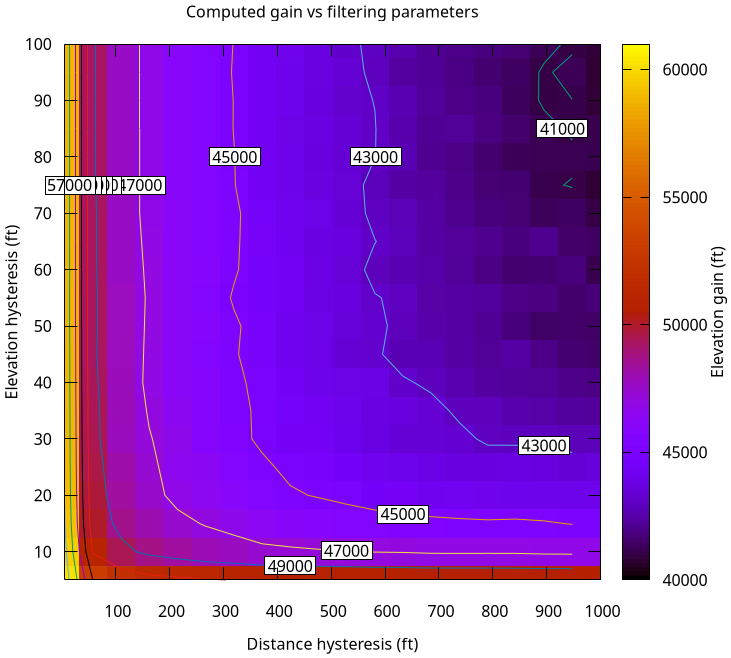
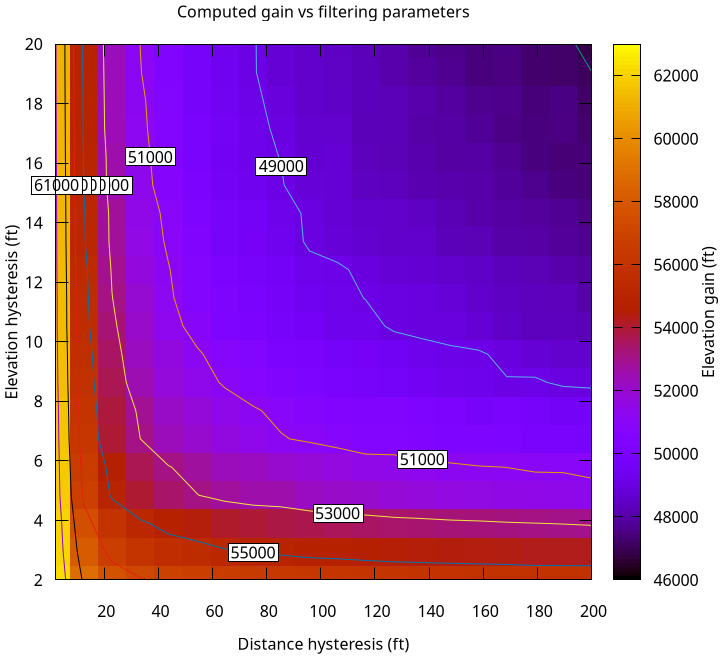
These show the filtered gain for different values of the distance and gain hysteresis thresholds. The same data is shown at diffent zoom levels. There's no sweet spot, but we get 46307ft with a reasonable amount of filtering. Maybe 46307ft is a bit low even.

Results: distance
Strava says the distance covered was 322 miles. The analysis says:
strava-distance.png
strava-distance-zoom.png
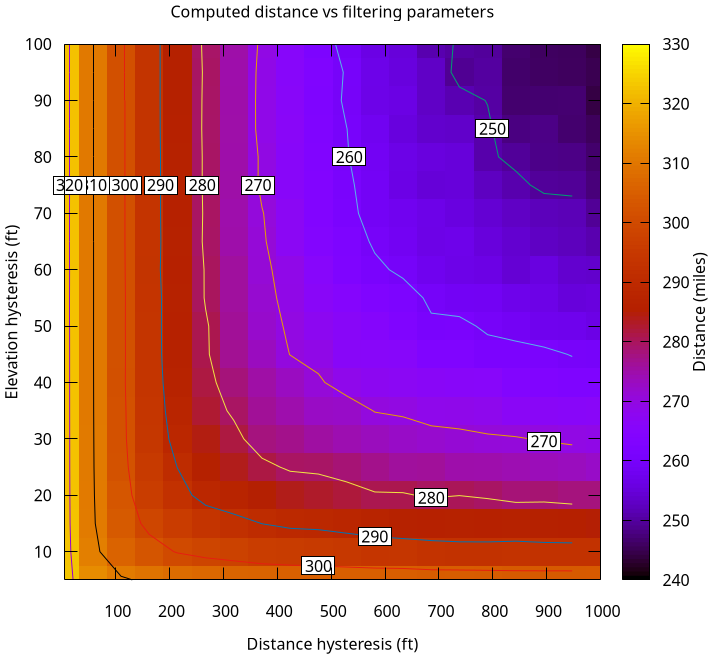
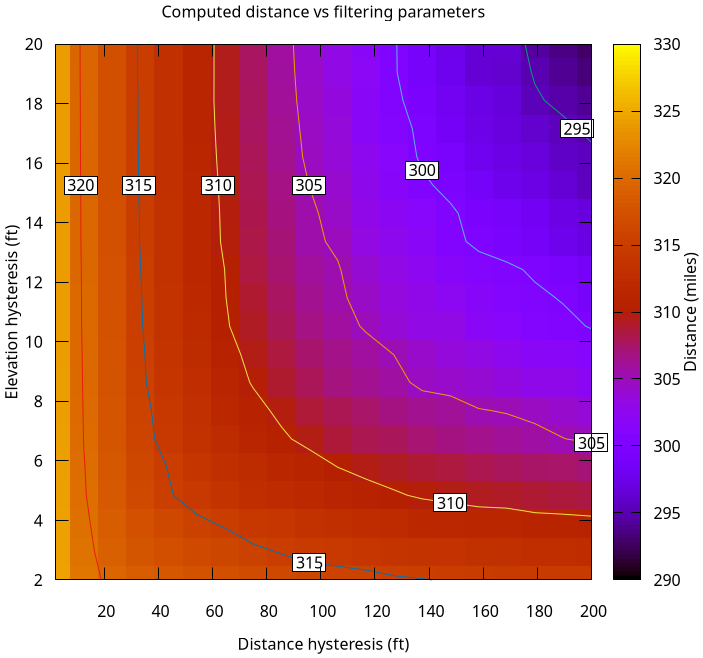
Once again, there's no sweet spot, but we get 322 miles only if we apply no filtering at all. That's clearly too high, and is not reasonable. From the map (and from other people's strava routes) the true distance is closer to 305 miles. Why those people's strava numbers are more believable is anybody's guess.

Enrico Zini: New laptop setup

My new laptop Framework (Framework Laptop 13 DIY Edition (AMD Ryzen 7040 Series)) arrived, all the hardware works out of the box on Debian Stable, and I'm very happy indeed. This post has the notes of all the provisioning steps, so that I can replicate them again if needed. Installing Debian 12 Debian 12's installer just worked, with Secure Boot enabled no less, which was nice. The only glitch is an argument with the guided partitioner, which was uncooperative: I have been hit before by a /boot partition too small, and I wanted 1G of EFI and 1G of boot, while the partitioner decided that 512Mb were good enough. Frustratingly, there was no way of changing that, nor I found how to get more than 1G of swap, as I wanted enough swap to fit RAM for hybernation. I let it install the way it pleased, then I booted into grml for a round of gparted. The tricky part of that was resizing the root btrfs filesystem, which is in an LV, which is in a VG, which is in a PV, which is in LUKS. Here's a cheatsheet. Shrink partitions: note that I used an increasing size because I don't trust that each tool has a way of representing sizes that aligns to the byte. I'd be happy to find out that they do, but didn't want to find out the hard way that they didn't. Resize with gparted: Move and resize partitions at will. Shrinking first means it all takes a reasonable time, and you won't have to wait almost an hour for a terabyte-sized empty partition to be carefully moved around. Don't ask me why I know. Regrow partitions: Setup gnome When I get a new laptop I have a tradition of trying to make it work with Gnome and Wayland, which normally ended up in frustration and a swift move to X11 and Xfce: I have a lot of long-time muscle memory involved in how I use a computer, and it needs to fit like prosthetics. I can learn to do a thing or two in a different way, but any papercut that makes me break flow and I cannot fix will soon become a dealbreaker. This applies to Gnome as present in Debian Stable. General Gnome settings tips I can list all available settings with:
gsettings list-recursively
which is handy for grepping things like hotkeys. I can manually set a value with:
gsettings set <schema> <key> <value>
and I can reset it to its default with:
gsettings reset <schema> <key>
Some applications like Gnome Terminal use "relocatable schemas", and in those cases you also need to specify a path, which can be discovered using dconf-editor:
gsettings set <schema>:<path> <key> <value>
Install appindicators First thing first: app install gnome-shell-extension-appindicator, log out and in again: the Gnome Extension manager won't see the extension as available until you restart the whole session. I have no idea why that is so, and I have no idea why a notification area is not present in Gnome by default, but at least now I can get one. Fix font sizes across monitors My laptop screen and monitor have significantly different DPIs, so:
gsettings set org.gnome.mutter experimental-features "['scale-monitor-framebuffer']"
And in Settings/Displays, set a reasonable scaling factor for each display. Disable Alt/Super as hotkey for the Overlay Seeing all my screen reorganize and reshuffle every time I accidentally press Alt leaves me disoriented and seasick:
gsettings set org.gnome.mutter overlay-key ''
Focus-follows-mouse and Raise-or-lower My desktop is like my desktop: messy and cluttered. I have lots of overlapping window and I switch between them by moving the focus with the mouse, and when the visible part is not enough I have a handy hotkey mapped to raise-or-lower to bring forward what I need and send back what I don't need anymore. Thankfully Gnome can be configured that way, with some work: This almost worked, but sometimes it didn't do what I wanted, like I expected to find a window to the front but another window disappeared instead. I eventually figured that by default Gnome delays focus changes by a perceivable amount, which is evidently too slow for the way I move around windows. The amount cannot be shortened, but it can be removed with:
gsettings set org.gnome.shell.overrides focus-change-on-pointer-rest false
Mouse and keyboard shortcuts Gnome has lots of preconfigured sounds, shortcuts, animations and other distractions that I do not need. They also either interfere with key combinations I want to use in terminals, or cause accidental window moves or resizes that make me break flow, or otherwise provide sensory overstimulation that really does not work for me. It was a lot of work, and these are the steps I used to get rid of most of them. Disable Super+N combinations that accidentally launch a questionable choice of programs:
for i in  seq 1 9 ; do gsettings set org.gnome.shell.keybindings switch-to-application-$i '[]'; done
Gnome-Shell settings: gnome-tweak-tool settings: Gnome Terminal settings: Thankfully 10 years ago I took notes on how to customize Gnome Terminal, and they're still mostly valid: Other hotkeys that got in my way and had to disable the hard way:
for n in  seq 1 12 ; do gsettings set org.gnome.mutter.wayland.keybindings switch-to-session-$n '[]'; done
gsettings set org.gnome.desktop.wm.keybindings move-to-workspace-down '[]'
gsettings set org.gnome.desktop.wm.keybindings move-to-workspace-up '[]'
gsettings set org.gnome.desktop.wm.keybindings panel-main-menu '[]'
gsettings set org.gnome.desktop.interface menubar-accel '[]'
Note that even after removing F10 from being bound to menubar-accel, and after having to gsetting binding to F10 as is:
$ gsettings list-recursively grep F10
org.gnome.Terminal.Legacy.Keybindings switch-to-tab-10 '<Alt>F10'
I still cannot quit Midnight Commander using F10 in a terminal, as that moves the focus in the window title bar. This looks like a Gnome bug, and a very frustrating one for me. Appearance Gnome-Shell settings: gnome-tweak-tool settings: Gnome Terminal settings: Other decluttering and tweaks Gnome Shell Settings: Set a delay between screen blank and lock: when the screen goes blank, it is important for me to be able to say "nope, don't blank yet!", and maybe switch on caffeine mode during a presentation without needing to type my password in front of cameras. No UI for this, but at least gsettings has it:
gsettings set org.gnome.desktop.screensaver lock-delay 30
Extensions I enabled the Applications Menu extension, since it's impossible to find less famous applications in the Overview without knowing in advance how they're named in the desktop. This stole a precious hotkey, which I had to disable in gsettings:
gsettings set org.gnome.shell.extensions.apps-menu apps-menu-toggle-menu '[]'
I also enabled: I didn't go and look for Gnome Shell extentions outside what is packaged in Debian, as I'm very wary about running JavaScript code randomly downloaded from the internet with full access over my data and desktop interaction. I also took care of checking that the Gnome Shell Extensions web page complains about the lacking "GNOME Shell integration" browser extension, because the web browser shouldn't be allowed to download random JavaScript from the internet and run it with full local access. Yuck. Run program dialog The default run program dialog is almost, but not quite, totally useless to me, as it does not provide completion, not even just for executable names in path, and so it ends up being faster to open a new terminal window and type in there. It's possible, in Gnome Shell settings, to bind a custom command to a key. The resulting keybinding will now show up in gsettings, though it can be located in a more circuitous way by grepping first, and then looking up the resulting path in dconf-editor:
gsettings list-recursively grep custom-key
org.gnome.settings-daemon.plugins.media-keys custom-keybindings ['/org/gnome/settings-daemon/plugins/media-keys/custom-keybindings/custom0/']
I tried out several run dialogs present in Debian, with sad results, possibly due to most of them not being tested on wayland: Both gmrun and xfrun4 seem like workable options, with xfrun4 being customizable with convenient shortcut prefixes, so xfrun4 it is. TODO I'll try to update these notes as I investigate. Conclusion so far I now have something that seems to work for me. A few papercuts to figure out still, but they seem manageable. It all feels a lot harder than it should be: for something intended to be minimal, Gnome defaults feel horribly cluttered and noisy to me, continuosly getting in the way of getting things done until tamed into being out of the way unless called for. It felt like a device that boots into flashy demo mode, which needs to be switched off before actual use. Thankfully it can be switched off, and now I have notes to do it again if needed. gsettings oddly feels to me like a better UI than the interactive settings managers: it's more comprehensive, more discoverable, more scriptable, and more stable across releases. Most of the Q&A I found on the internet with guidance given on the UI was obsolete, while when given with gsettings command lines it kept being relevant. I also have the feeling that these notes would be easier to understand and follow if given as gsettings invocations instead of descriptions of UI navigation paths. At some point I'll upgrade to Trixie and reevaluate things, and these notes will be a useful checklist for that. Fingers crossed that this time I'll manage to stay on Wayland. If not, I know that Xfce is still there for me, and I can trust it to be both helpful and good at not getting in the way of my work.

29 November 2024

Dirk Eddelbuettel: RcppAPT 0.0.10: Maintenance

A new version of the RcppAPT package arrived on CRAN earlier today. RcppAPT connects R to the C++ library behind the awesome apt, apt-get, apt-cache, commands (and their cache) which powering Debian, Ubuntu and other derivative distributions. RcppAPT allows you to query the (Debian or Ubuntu) package dependency graph at will, with build-dependencies (if you have deb-src entries), reverse dependencies, and all other goodies. See the vignette and examples for illustrations. This release moves the C++ compilation standard from C++11 to C++17. I had removed the setting for C++11 last year as compilation by compiler default worked well enough. But the version at CRAN still carried, which started to lead to build failures on Debian unstable so it was time for an update. And rather than implicitly relying on C++17 as selected by the last two R releases, we made it explicit. Otherwise a few of the regular package and repository updates have been made, but no new code or features were added The NEWS entries follow.

Changes in version 0.0.10 (2024-11-29)
  • Package maintenance updating continuous integration script versions as well as coverage link from README, and switching to Authors@R
  • C++ compilation standards updated to C++17 to comply with libapt-pkg

Courtesy of my CRANberries, there is also a diffstat report for this release. A bit more information about the package is available here as well as at the GitHub repo. If you like this or other open-source work I do, you can now sponsor me at GitHub.

This post by Dirk Eddelbuettel originated on his Thinking inside the box blog. Please report excessive re-aggregation in third-party for-profit settings.

Bits from Debian: Debian welcomes its new Outreachy interns

Outreachy logo Debian continues participating in Outreachy, and we're excited to announce that Debian has selected two interns for the Outreachy December 2024 - March 2025 round. Patrick Noblet Appiah will work on Automatic Indi-3rd-party driver update, mentored by Thorsten Alteholz. Divine Attah-Ohiemi will work on Making the Debian main website more attractive by switching to HuGo as site generator, mentored by Carsten Schoenert, Subin Siby and Thomas Lange.

Congratulations and welcome Patrick Noblet Appiah and Divine Attah-Ohiemi! From the official website: Outreachy provides three-month internships for people from groups traditionally underrepresented in tech. Interns work remotely with mentors from Free and Open Source Software (FOSS) communities on projects ranging from programming, user experience, documentation, illustration and graphical design, to data science. The Outreachy programme is possible in Debian thanks to the efforts of Debian developers and contributors who dedicate their free time to mentor students and outreach tasks, and the Software Freedom Conservancy's administrative support, as well as the continued support of Debian's donors, who provide funding for the internships. Join us and help extend Debian! You can follow the work of the Outreachy interns reading their blogs (they are syndicated in Planet Debian), and chat with us in the #debian-outreach IRC channel and mailing list.

Bits from Debian: Debian welcomes its new Outreachy interns

Outreachy logo Debian continues participating in Outreachy, and we're excited to announce that Debian has selected two interns for the Outreachy December 2024 - March 2025 round. Patrick Noblet Appiah will work on Automatic Indi-3rd-party driver update, mentored by Thorsten Alteholz. Divine Attah-Ohiemi will work on Making the Debian main website more attractive by switching to HuGo as site generator, mentored by Carsten Schoenert, Subin Siby and Thomas Lange.
Congratulations and welcome Patrick Noblet Appiah and Divine Attah-Ohiemi! From the official website: Outreachy provides three-month internships for people from groups traditionally underrepresented in tech. Interns work remotely with mentors from Free and Open Source Software (FOSS) communities on projects ranging from programming, user experience, documentation, illustration and graphical design, to data science. The Outreachy programme is possible in Debian thanks to the efforts of Debian developers and contributors who dedicate their free time to mentor students and outreach tasks, and the Software Freedom Conservancy's administrative support, as well as the continued support of Debian's donors, who provide funding for the internships. Join us and help extend Debian! You can follow the work of the Outreachy interns reading their blogs (they are syndicated in Planet Debian), and chat with us in the #debian-outreach IRC channel and mailing list.

Russ Allbery: Review: The Duke Who Didn't

Review: The Duke Who Didn't, by Courtney Milan
Series: Wedgeford Trials #1
Publisher: Femtopress
Copyright: September 2020
ASIN: B08G4QC3JC
Format: Kindle
Pages: 334
The Duke Who Didn't is a Victorian romance novel, the first of a loosely-connected trilogy in the romance sense of switching protagonists between books. It's self-published, but by Courtney Milan, so the quality of the editing and publishing is about as high as you will see for a self-published novel. Chloe Fong has a goal: to make her father's sauce the success that it should be. His previous version of the recipe was stolen by White and Whistler and is now wildly popular as Pure English Sauce. His current version is much better. In a few days, tourists will come from all over England to the annual festival of the Wedgeford Trials, and this will be Chloe's opportunity to give the sauce a proper debut and marketing push. There is only the small matter of making enough sauce and coming up with a good name. Chloe is very busy and absolutely does not have time for nonsense. Particularly nonsense in the form of Jeremy Yu. Jeremy started coming to the Wedgeford Trials at the age of twelve. He was obviously from money and society, obviously enough that the villagers gave him the nickname Posh Jim after his participation in the central game of the trials. Exactly how wealthy and exactly which society, however, is something that he never quite explained, at first because he was having too much fun and then because he felt he'd waited too long. The village of Wedgeford was thriving under the benevolent neglect of its absent duke and uncollected taxes, and no one who loved it had any desire for that to change. Including Jeremy, the absent duke in question. Jeremy had been in love with Chloe for years, but the last time he came to the Trials, Chloe told him to stop pursuing her unless he could be serious. That was three years and three Trials ago, and Chloe was certain Jeremy had made his choice by his absence. But Jeremy never forgot her, and despite his utter failure to become a more serious person, he is determined to convince her that he is serious about her. And also determined to finally reveal his identity without breaking everything he loves about the village. Somehow. I have mentioned in other reviews that I mostly read sapphic instead of heterosexual romance because the gender roles in heterosexual romance are much more likely to irritate me. It occurred to me that I was probably being unfair to the heterosexual romance genre, I hadn't read nearly widely enough to draw any real conclusions, and I needed to find better examples. I've followed Courtney Milan occasionally on social media (for reasons unrelated to her novels) for long enough to know that she was unlikely to go for gender essentialism, and I'd been meaning to try one of her books for a while. Hence this novel. It is indeed not gender-essentialist. Neither Chloe nor Jeremy fit into obvious gender boxes. Chloe is the motivating force in the novel and many of their interactions were utterly charming. But, despite that, the gender roles still annoyed me in ways that are entirely not the fault of this book. I'm not sure I can even put a finger on something specific. It's a low-grade, pervasive feeling that men do one type of thing and women do a different type of thing, and even if these characters don't stick to that closely, it saturates the vibes. (Admittedly, a Victorian romance was probably not the best choice when I knew this was my biggest problem with genre heterosexual romance. It was just what I had on hand.) The conceit of the Wedgeford Trials series is that the small village of Wedgeford in England, through historical accident, ended up with an unusually large number of residents with Chinese ancestry. This is what I would call a "believable outlier": there was not such a village so far as I know, but there could well have been. At the least, there were way more people with non-English ancestry, including east Asian ancestry, in Victorian England than modern readers might think. There is quite a lot in this novel about family history, cultural traditions, immigration, and colonialism that I'm wholly unqualified to comment on but that was fascinating to read about and seemed (as one would expect from Milan) adroitly written. As for the rest of the story, The Duke Who Didn't is absolutely full of banter. If your idea of a good time with a romance novel is teasing, word play, mock irritation, and endless verbal fencing as a way to avoid directly confronting difficult topics, you will be in heaven. Jeremy is one of those people who is way too much in his own head and has turned his problems into a giant ball of anxiety, but who is good at being the class clown, and therefore leans heavily on banter and making people laugh (or blush) as a way of avoiding whatever he's anxious about. I thought the characterization was quite good, but I admit I still got a bit tired of it. 350 pages is a lot of banter, particularly when the characters have some serious communication problems they need to resolve, and to fully enjoy this book you have to have a lot of patience for Jeremy's near-pathological inability to be forthright with Chloe. Chloe's most charming characteristic is that she makes lists, particularly to-do lists. Her ideal days proceed as an orderly process of crossing things off of lists, and her way to approach any problem is to make a list. This is a great hook, and extremely relatable, but if you're going to talk this much about her lists, I want to see the lists! Chloe is all about details; show me the details! This book does not contain anywhere close to enough of Chloe's lists. I'm not sure there was a single list in this book that the reader both got to see the details of and that made it to more than three items. I think Chloe would agree that it's pointless to talk about the concept of lists; one needs to commit oneself to making an actual list. This book I would unquestioningly classify as romantic comedy (which given my utter lack of familiarity with romance subgenres probably means that it isn't). Jeremy's standard interaction style with anyone is self-deprecating humor, and Chloe is the sort of character who is extremely serious in ways that strike other people as funny. Towards the end of the book, there is a hilarious self-aware subversion of a major romance novel trope that even I caught, despite my general lack of familiarity with the genre. The eventual resolution of Jeremy's problem of hidden identity caught me by surprise in that way where I should have seen it all along, and was both beautifully handled and quite entertaining. All the pieces are here for a great time, and I think a lot of people would love this book. Somehow, it still wasn't quite my thing; I thoroughly enjoyed parts of it, but I don't find myself eager to read another. I'm kind of annoyed at myself that it didn't pull me in, since if I'd liked this I know where to find lots more like it. But ah well. If you like banter-heavy heterosexual romance that is very self-aware about its genre without devolving into metafiction, this is at least worth a try. Followed in the romance series way by The Marquis Who Mustn't, but this is a complete story with a satisfying ending. Rating: 7 out of 10

Freexian Collaborators: Tryton 7.0 LTS reaches Debian trixie (by Mathias Behrle, Rapha l Hertzog and Anupa Ann Joseph)

Tryton is a FOSS software suite which is highly modular and scalable. Tryton along with its standard modules can provide a complete ERP solution or it can be used for specific functions of a business like accounting, invoicing etc. Debian packages for Tryton are being maintained by Mathias Behrle. You can follow him on Mastodon or get his help on Tryton related projects through MBSolutions (his own consulting company). Freexian has been sponsoring Mathias s packaging work on Tryton for a while, so that Debian gets all the quarterly bug fix releases as well as the security release in a timely manner.

About Tryton 7.0 LTS Lately Mathias has been busy packaging Tryton 7.0 LTS. As the LTS tag implies, this release is recommended for production deployments since it will be supported until November 2028. This release brings numerous bug fixes, performance improvements and various new features. As part of this work, 41 new Tryton modules and 3 dependency packages have been added to Debian, significantly broadening the options available to Debian users and improving integration with Tryton systems.

Running different versions of Tryton on different Debian releases To provide extended compatibility, a dedicated Tryton mirror is being managed and is available at https://debian.m9s.biz/debian/. This mirror hosts backports for all supported Tryton series, ensuring availability for a variety of Debian releases and deployment scenarios. These initiatives highlight MBSolutions technical contributions to the Tryton community, made possible by Freexian s financial backing. Together, we are advancing the Tryton ecosystem for Debian users.

27 November 2024

Bits from Debian: OpenStreetMap migrates to Debian 12

You may have seen this toot announcing OpenStreetMap's migration to Debian on their infrastructure.
After 18 years on Ubuntu, we've upgraded the @openstreetmap servers to Debian 12 (Bookworm). openstreetmap.org is now faster using Ruby 3.1. Onward to new mapping adventures! Thank you to the team for the smooth transition. #OpenStreetMap #Debian
We spoke with Grant Slater, the Senior Site Reliability Engineer for the OpenStreetMap Foundation. Grant shares: Why did you choose Debian?
There is a large overlap between OpenStreetMap mappers and the Debian community. Debian also has excellent coverage of OpenStreetMap tools and utilities, which helped with the decision to switch to Debian. The Debian package maintainers do an excellent job of maintaining their packages - e.g.: osm2pgsql, osmium-tool etc. Part of our reason to move to Debian was to get closer to the maintainers of the packages that we depend on. Debian maintainers appear to be heavily invested in the software packages that they support and we see critical bugs get fixed.
What drove this decision to migrate?
OpenStreetMap.org is primarily run on actual physical hardware that our team manages. We attempt to squeeze as much performance from our systems as possible, with some services being particularly I/O bound. We ran into some severe I/O performance issues with kernels ~6.0 to < ~6.6 on systems with NVMe storage. This pushed us onto newer mainline kernels, which led us toward Debian. On Debian 12 we could simply install the backport kernel and the performance issues were solved.
How was the transition managed?
Thankfully we manage our server setup nearly completely with code. We also use Test Kitchen with inspec to test this infrastructure code. Tests run locally using Podman or Docker containers, but also run as part of our git code pipeline. We added Debian as a test target platform and fixed up the infrastructure code until all the tests passed. The changes required were relatively small, simple package name or config filename changes mostly.
What was your timeline of transition?
In August 2024 we moved the www.openstreetmap.org Ruby on Rails servers across to Debian. We haven't yet finished moving everything across to Debian, but we will upgrade the rest when it makes sense. Some systems may wait until the next hardware upgrade cycle. Our focus is to build a stable and reliable platform for OpenStreetMap mappers.
How has the transition from another Linux distribution to Debian gone?
We are still in the process of fully migrating between Linux distributions, but we can share that we recently moved our frontend servers to Debian 12 (from Ubuntu 22.04) which bumped the Ruby version from 3.0 to 3.1 which allowed us to also upgrade the version of Ruby on Rails that we use for www.openstreetmap.org. We also changed our chef code for managing the network interfaces from using netplan (default in Ubuntu, made by Canonical) to directly using systemd-networkd to manage the network interfaces, to allow commonality between how we manage the interfaces in Ubuntu and our upcoming Debian systems. Over the years we've standardised our networking setup to use 802.3ad bonded interfaces for redundancy, with VLANs to segment traffic; this setup worked well with systemd-networkd. We use netboot.xyz for PXE networking booting OS installers for our systems and use IPMI for the out-of-band management. We remotely re-installed a test server to Debian 12, and fixed a few minor issues missed by our chef tests. We were pleasantly surprised how smoothly the migration to Debian went. In a few limited cases we've used Debian Backports for a few packages where we've absolutely had to have a newer feature. The Debian package maintainers are fantastic. What definitely helped us is our code is libre/free/open-source, with most of the core OpenStreetMap software like osm2pgsql already in Debian and well packaged. In some cases we do run pre-release or custom patches of OpenStreetMap software; with Ubuntu we used launchpad.net's Personal Package Archives (PPA) to build and host deb repositories for these custom packages. We were initially perplexed by the myriad of options in Debian (see this list - eeek!), but received some helpful guidance from a Debian contributor and we now manage our own deb repository using aptly. For the moment we're currently building deb packages locally and pushing to aptly; ideally we'd like to replace this with a git driven pipeline for building the custom packages in the future.
Thank you for taking the time to share your experience with us.
Thank you to all the awesome people who make Debian!

We are overjoyed to share this in-use case which demonstrates our commitment to stability, development, and long term support. Debian offers users, companies, and organisations the ability to plan, scope, develop, and maintain at their own pace using a rock solid stable Linux distribution with responsive developers. Does your organisation use Debian in some capacity? We would love to hear about it and your use of 'The Universal Operating System'. Reach out to us at Press@debian.org - we would be happy to add your organisation to our 'Who's Using Debian?' page and to share your story! About Debian The Debian Project is an association of individuals who have made common cause to create a free operating system. This operating system that we have created is called Debian. Installers and images, such as live systems, offline installers for systems without a network connection, installers for other CPU architectures, or cloud instances, can be found at Getting Debian.

26 November 2024

Sandro Knau : Akademy 2024 in W rzburg

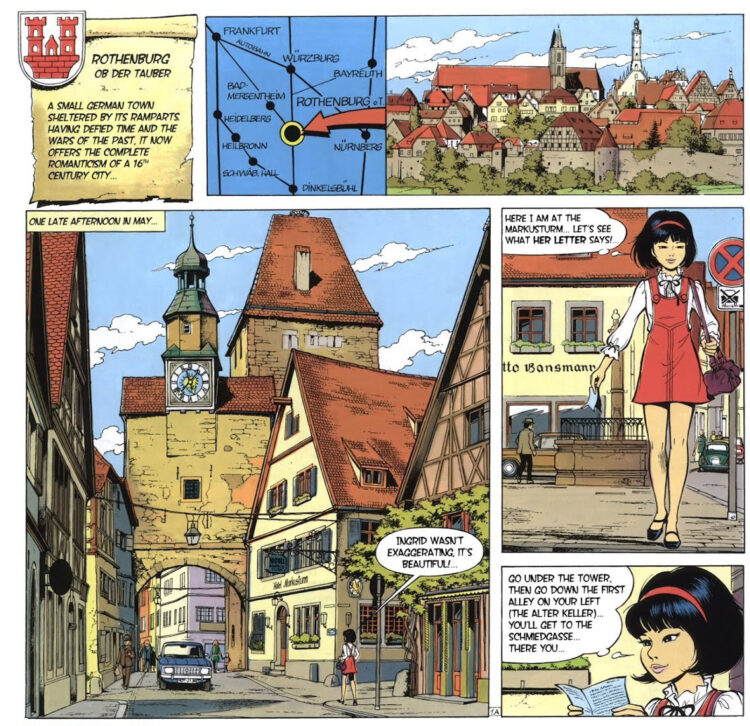
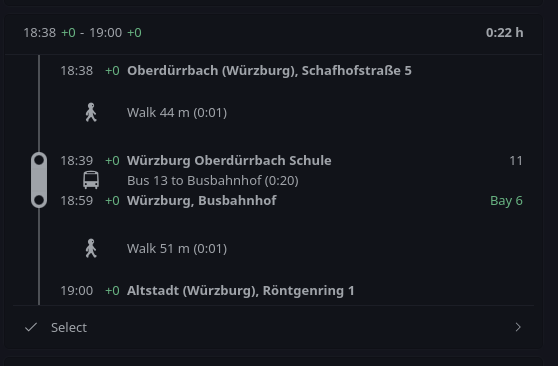
In order to prepare for the Akademy I started some days before to give my Librem 5 ( an Open Hardware Phone) another try and ended up with a non starting Plasma 6. Actually this issue was known already, but hasn't been addressed. In the end I reached the Akademy with my Librem 5 having phosh installed (which is Gnome based), in order to have something working. I met Bushan and Bart who took care and the issue was fixed two days later I could finally install Plasma 6 on it. The last time I tested my Librem 5 with Plasma 5 it felt sluggish and not well working. But this time I was impressed how well the system reacts. Sure there are some things here and there, but in the bigger picture it is quite useable. One annoying issue is that the camera is only working with one app and the other issue is the battery capacity, you have to charge it once a day. Because of missing a QR reader that can use the camera, getting data to the phone was quite challenging. Unfortunately the conference Wifi separated the devices and I couldn't use KDE Connect to transfer data. In the end the only way to import data was taking five photos from the QR Code to import my D-Ticket to Itinerary. With a device with Plasma Mobile, it directly was used for a experiment: How well does Dolphin works on a Plasma Mobile device. Together with Felix Ernst we tried it out and were quite impressed, that Dolphin does work very well on Plasma Mobile, after some simple modifications on the UI. That resulted in a patch to add a mobile UI for Dolphin !826. With more time to play with my Librem 5 I also found an bug in KWeather, that is missing a Refresh option, when used in a Plasma Mobile environment #493656. Akademy is a good place to identify and solve some issues. It is always like that, you chat with someone and they can tell you who to ask to answer the concrete question and in the end you can solve things, that seems unsolvable in the beginning. There was also time to look into the travelling app Itinerary. A lot people are faced with a lot of real world issues, when not in their home town. Itinerary is the best traveling apps I know about. It can import nearly every ticket you have and can get location information from restaurant websites and allow routing to that place. It does add many useful information, while traveling like current delays, platform changes, live updates for elevator, weather information at the destination, a station map and all those features with strong focus on privacy. In detail I found some small things to improve: I additionally learned that it has a lot of details that helps people who have special needs. That is the reason why Daniel Kraut wants to get Itinerary available for iOS. As spoken out, that Daniel wants to reach this goal, others already started to implement the first steps to build apps for iOS. This year I was volunteering in helping out at Akademy. For me it was a lot of fun to meet everyone at the infodesk or help the speakers setup the beamer and microphone. It is also a good opportunity to meet many new faces and get in contact with them. I see also room for improvement. As we were quite busy at the Welcome Event to get out the badges to everyone, I couldn't answer the questions from newcomers, as the queue was too long. I propose that some people volunteer to be available for questions from newcomers. Often it is hard for newcomers to get their first contact(s) in a new community. There is a lot of space for improvement to make it easier for newcomers to join. Some ideas in my head are: Make an event for the newcomers to get them some links into the community and show that everyone is friendly. The tables at the BoFs should make a circle, so everyone can see each other. It was also hard for me to understand everyone as they mostly spoken towards the front. And then BoFs are sometimes full of very specific words and if you are not already deep in the topic you are lost. I can see the problem, on the one side BoFs are also the place where the person that knows the topic already wants to get things done. On the other side new comers join BoFs, are overwhelmed by to many new words get frustrated and think, that they are not welcome. Maybe at least everyone should present itself with name and ask new faces, why they joined the BoF to help them joining. I'm happy, that the food provided for the attendees was very delicious and that I'm not the only one mostly vegetarian with a big amount to be vegan. At the conference the KDE Eco initiation really caught me, as I see a lot of new possibilities in giving more reasons to switch to an Open Source system. The talk from Natalie was great to see how pupils get excited about Open Source and also help their grandparents to move to a Linux system. As I also will start to work as a teacher, I really got ideas what I can do at school. Together with Joseph and Nicole, we finally started to think about how to drive an exploration on what kind of old hardware is still KDE software running. The ones with the oldest hardware will get an old KDE shirt. For more information see #40. The conference was very motivating for me, I also had still energy at the evening to do some Debian packaging and finally pushed kweathercore to Debian and started to work on KWeather. Now I'm even more interested in the KDE apps focusing the mobile world, as I now have some hardware that can actually use those apps. I really enjoyed the workshop how to contribute to Qt by Volker Hilsheimer, especially the way how Volker explained things in a very friendly way, answered every question, sometime postponed some questions but came back to them later. All in all I now have a good overview how Qt is doing development and how I can fix bugs. The daytrip to Rothenburg ob der Tauber was very interesting for me. It was the first time I visited the village. But in my memory it feels like I know the village already. I grew up with reading a lot of comic albums including the good SiFi comic album series "Yoku Tsuno" created by the Belgian writer Roger Leloup. Yoku Tsuno is an electronics engineer, raised in Japan but now living in Belgium. In "On the edge of life" she helps her friend Ingard, who actually lives in Rothenburg. Leloup invested a lot of time to travel to make the make his drawings as accurate as possible. a comic page with Yoko Tsuno in Rothenburg ob der Tauber In order to not have a hard cut from Akademy to normal life, I had a lunch with Carlos, to discuss KDE Neon and how we can improve the interaction with Debian. In the future this should have less friction and make both communities work together more smoothly. Additionally as I used to develop on KDEPIM with the help of Docker images based on Neon I ask for a meta kf6 dev meta package. That should help to get rid of most hand written lists of dev packages in the Docker file in order to make it more simple for new contributors to start hacking on KDEPIM. The rest of the day I finally found time to do the normal tourist stuff: Going to the Wine bridge and having a walk to the castle of W rzburg. Unfortunately you hear a lot of car noises up there, but I could finally relaxe in a Japanese designed garden. Finally at Saturday I started my trip back. The trains towards Eberswalde are broken and I needed to find alternative routing. I got a little bit nervous, as it was the first time I travelled with my Librem 5 and Itinerary only and needed to reach the next train in less than two mins. With the indoor maps provided, I could prepare my run through the train station so I reached successfully my next train. By the way, also if you only only use KDE software, I would recommend everyone to join Akademy ;)

24 November 2024

Edward Betts: A mini adventure at MiniDebConf Toulouse

A mini adventure at MiniDebConf Toulouse Last week, I ventured to Toulouse, for a delightful mix of coding, conversation, and crepes at MiniDebConf Toulouse, part of the broader Capitole du Libre conference, akin to the more well-known FOSDEM but with a distinctly French flair. This was my fourth and final MiniDebConf of the year. no jet bridge My trek to Toulouse was seamless. I hopped on a bus from my home in Bristol to the airport, then took a short flight. I luxuriated in seat 1A, making me the first to disembark a mere ten minutes later, I was already on the bus heading to my hotel.

Exploring the Pink City pink img 29 duck shop Once settled, I wasted no time exploring the charms of Toulouse. Just a short stroll from my hotel, I found myself beside a tranquil canal, its waters mirroring the golden hues of the trees lining its banks. Autumn in Toulouse painted the city in warm oranges and reds, creating a picturesque backdrop that was a joy to wander through. Every corner of the street revealed more of the city's rich cultural tapestry and striking architecture. Known affectionately as 'La Ville Rose' (The Pink City) for its unique terracotta brickwork, Toulouse captivated me with its blend of historical allure and vibrant modern life.

MiniDebCamp FabLab sign laptop setup Prior to the main event, the MiniDebCamp provided two days of hacking at Artilect FabLab a space as creative as it was welcoming. It was a pleasure to reconnect with familiar faces and forge new friendships.
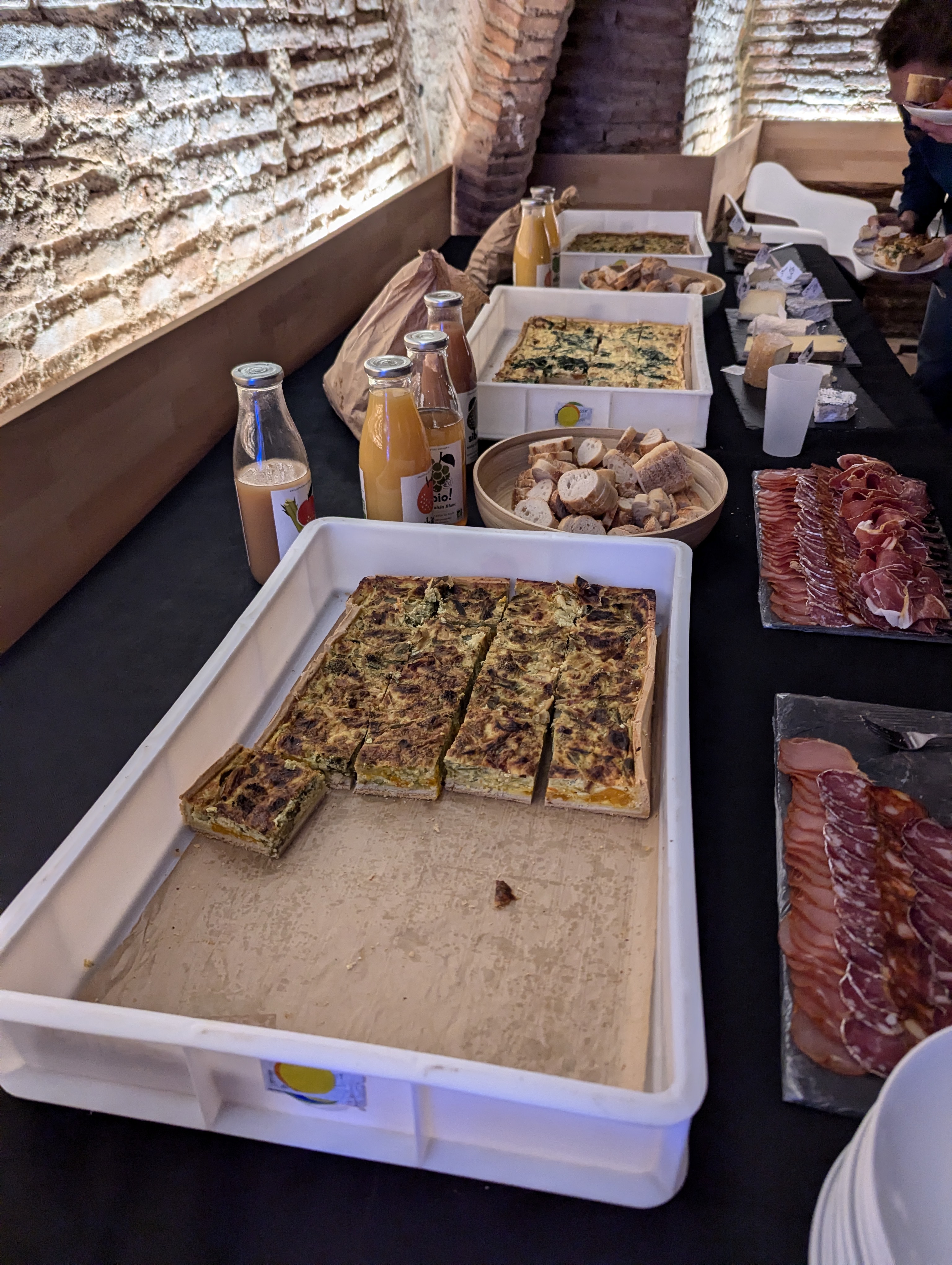
Culinary delights lunch 1 img 14 img 15 img 16 img 17 cakes The hospitality was exceptional. Our lunches boasted a delicious array of quiches, an enticing charcuterie board, and a superb selection of cheeses, all perfectly complemented by exquisite petite fours. Each item was not only a feast for the eyes but also a delight for the palate.
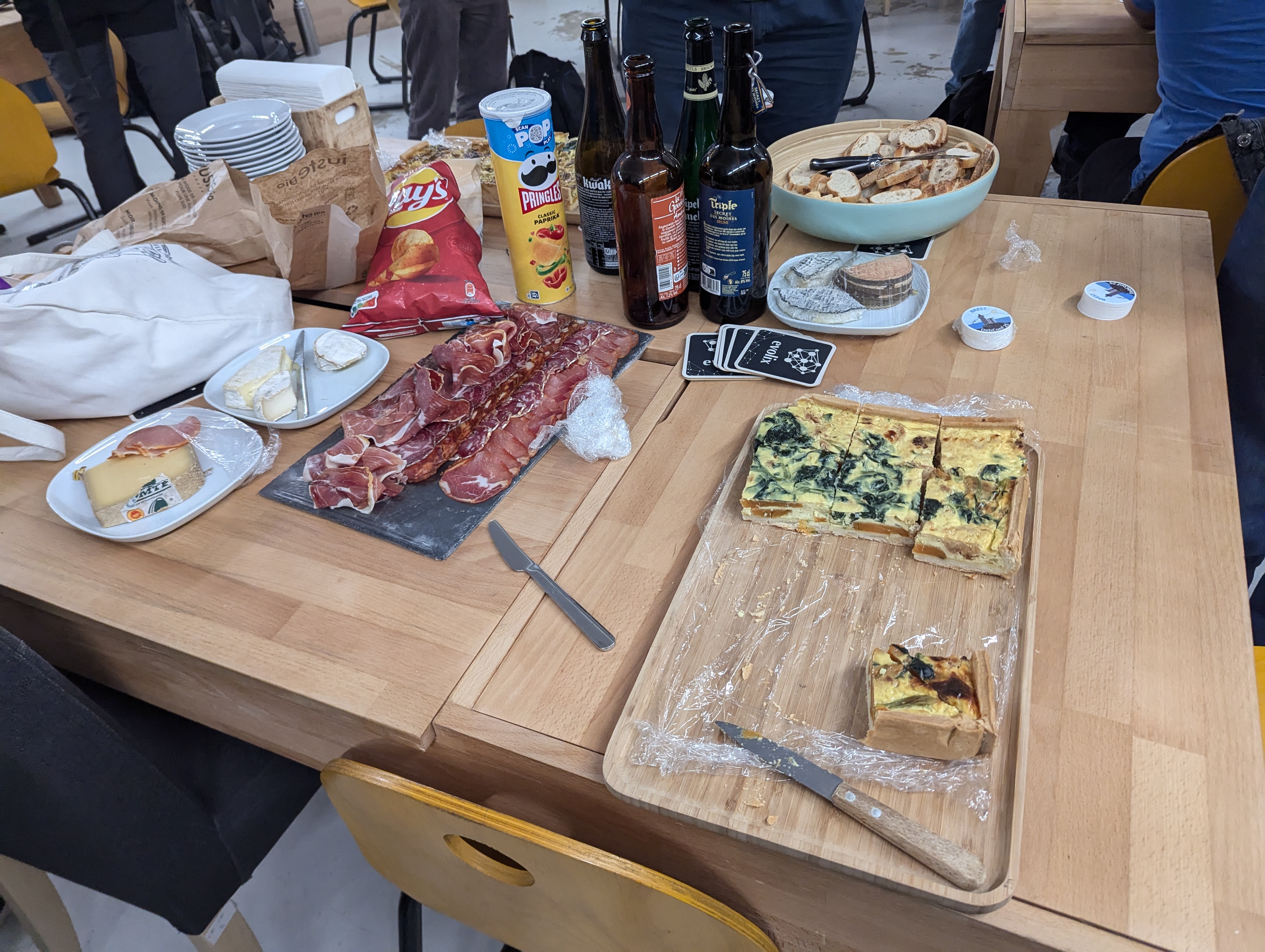
Wine and cheese wine and cheese 1 wine and cheese 2 Leftovers from these gourmet feasts fuelled our impromptu cheese and wine party on Thursday evening a highlight where informal chats blended seamlessly with serious software discussions.


The river at night night river 1 night river 2 night river 3 night river 4 The enchantment of Toulouse doesn't dim with the setting sun; instead, it transforms. My evening strolls took me along the banks of the Garonne, under a sky just turning from twilight to velvet blue. The river, a dark mirror, perfectly reflected the illuminated grandeur of the city's architecture. Notably, the dome of the H pital de La Grave stood out, bathed in a warm glow against the night sky. This architectural gem, coupled with the soft lights of the bridge and the serene river, created a breathtaking scene that was both tranquil and awe-inspiring.

Capitole du Libre making crepes The MiniDebConf itself, part of the larger Capitole du Libre event, was a fantastic immersion into the world of free software. Unlike the ticket-free FOSDEM, this conference required QR codes for entry and even had bag searches, adding an unusual layer of security for a software conference. Highlights included the crepe-making by the organisers, reminiscent of street food scenes from larger festivals. The availability of crepes for MiniDebConf attendees and the presence of food trucks added a festive air, albeit with the inevitable long queues familiar to any festival-goer.

v l Toulouse bike cyclocity The city's bike rental system was a boon easy to use with handy bike baskets perfect for casual city touring. I chose pedal power over electric, finding it a pleasant way to navigate the streets and absorb the city's vibrant atmosphere.

Markets market flatbreads Toulouse's markets were a delightful discovery. From a spontaneous visit to a market near my hotel upon arrival, to cycling past bustling marketplaces, each day presented new local flavours and crafts to explore. The Za'atar flatbread from a Syrian stall was a particularly memorable lunch pick.

La brasserie Les Arcades img 25 img 26 img 27 Our conference wrapped up with a spontaneous gathering at La Brasserie Les Arcades in Place du Capitole. Finding a caf that could accommodate 30 of us on a Sunday evening without a booking felt like striking gold. What began with coffee and ice cream smoothly transitioned into dinner, where I enjoyed a delicious braised duck leg with green peppercorn sauce. This meal rounded off the trip with lively conversations and shared experiences.

The journey back home img 30 img 31 img 32 img 33 Returning from Toulouse, I found myself once again in seat 1A, offering the advantage of being the first off the plane, both on departure and arrival. My flight touched down in Bristol ahead of schedule, and within ten minutes, I was on the A1 bus, making my way back into the heart of Bristol.

Anticipating DebConf 25 in Brittany My trip to Toulouse for MiniDebConf was yet another fulfilling experience; the city was delightful, and the talks were insightful. While I frequently travel, these journeys are more about continuous learning and networking than escape. The food in Toulouse was particularly impressive, a highlight I've come to expect and relish on my trips to France. Looking ahead, I'm eagerly anticipating DebConf in Brest next year, especially the opportunity to indulge once more in the excellent French cuisine and beverages.

22 November 2024

Matthew Palmer: Your Release Process Sucks

For the past decade-plus, every piece of software I write has had one of two release processes. Software that gets deployed directly onto servers (websites, mostly, but also the infrastructure that runs Pwnedkeys, for example) is deployed with nothing more than git push prod main. I ll talk more about that some other day. Today is about the release process for everything else I maintain Rust / Ruby libraries, standalone programs, and so forth. To release those, I use the following, extremely intricate process:
  1. Create an annotated git tag, where the name of the tag is the software version I m releasing, and the annotation is the release notes for that version.
  2. Run git release in the repository.
  3. There is no step 3.
Yes, it absolutely is that simple. And if your release process is any more complicated than that, then you are suffering unnecessarily. But don t worry. I m from the Internet, and I m here to help.

Sidebar: annotated what-now?!? The annotated tag is one git s best-kept secrets. They ve been available in git for practically forever (I ve been using them since at least 2014, which is practically forever in software development), yet almost everyone I mention them to has never heard of them. A tag , in git parlance, is a repository-unique named label that points to a single commit (as identified by the commit s SHA1 hash). Annotating a tag is simply associating a block of free-form text with that tag. Creating an annotated tag is simple-sauce: git tag -a tagname will open up an editor window where you can enter your annotation, and git tag -a -m "some annotation" tagname will create the tag with the annotation some annotation . Retrieving the annotation for a tag is straightforward, too: git show tagname will display the annotation along with all the other tag-related information. Now that we know all about annotated tags, let s talk about how to use them to make software releases freaking awesome.

Step 1: Create the Annotated Git Tag As I just mentioned, creating an annotated git tag is pretty simple: just add a -a (or --annotate, if you enjoy typing) to your git tag command, and WHAM! annotation achieved. Releases, though, typically have unique and ever-increasing version numbers, which we want to encode in the tag name. Rather than having to look at the existing tags and figure out the next version number ourselves, we can have software do the hard work for us. Enter: git-version-bump. This straightforward program takes one mandatory argument: major, minor, or patch, and bumps the corresponding version number component in line with Semantic Versioning principles. If you pass it -n, it opens an editor for you to enter the release notes, and when you save out, the tag is automagically created with the appropriate name. Because the program is called git-version-bump, you can call it as a git command: git version-bump. Also, because version-bump is long and unwieldy, I have it aliased to vb, with the following entry in my ~/.gitconfig:
[alias]
    vb = version-bump -n
Of course, you don t have to use git-version-bump if you don t want to (although why wouldn t you?). The important thing is that the only step you take to go from here is our current codebase in main to everything as of this commit is version X.Y.Z of this software , is the creation of an annotated tag that records the version number being released, and the metadata that goes along with that release.

Step 2: Run git release As I said earlier, I ve been using this release process for over a decade now. So long, in fact, that when I started, GitHub Actions didn t exist, and so a lot of the things you d delegate to a CI runner these days had to be done locally, or in a more ad-hoc manner on a server somewhere. This is why step 2 in the release process is run git release . It s because historically, you can t do everything in a CI run. Nowadays, most of my repositories have this in the .git/config:
[alias]
    release = push --tags
Older repositories which, for one reason or another, haven t been updated to the new hawtness, have various other aliases defined, which run more specialised scripts (usually just rake release, for Ruby libraries), but they re slowly dying out. The reason why I still have this alias, though, is that it standardises the release process. Whether it s a Ruby gem, a Rust crate, a bunch of protobuf definitions, or whatever else, I run the same command to trigger a release going out. It means I don t have to think about how I do it for this project, because every project does it exactly the same way.

The Wiring Behind the Button
It wasn t the button that was the problem. It was the miles of wiring, the hundreds of miles of cables, the circuits, the relays, the machinery. The engine was a massive, sprawling, complex, mind-bending nightmare of levers and dials and buttons and switches. You couldn t just slap a button on the wall and expect it to work. But there should be a button. A big, fat button that you could press and everything would be fine again. Just press it, and everything would be back to normal.
  • Red Dwarf: Better Than Life
Once you ve accepted that your release process should be as simple as creating an annotated tag and running one command, you do need to consider what happens afterwards. These days, with the near-universal availability of CI runners that can do anything you need in an isolated, reproducible environment, the work required to go from annotated tag to release artifacts can be scripted up and left to do its thing. What that looks like, of course, will probably vary greatly depending on what you re releasing. I can t really give universally-applicable guidance, since I don t know your situation. All I can do is provide some of my open source work as inspirational examples. For starters, let s look at a simple Rust crate I ve written, called strong-box. It s a straightforward crate, that provides ergonomic and secure cryptographic functionality inspired by the likes of NaCl. As it s just a crate, its release script is very straightforward. Most of the complexity is working around Cargo s inelegant mandate that crate version numbers are specified in a TOML file. Apart from that, it s just a matter of building and uploading the crate. Easy! Slightly more complicated is action-validator. This is a Rust CLI tool which validates GitHub Actions and Workflows (how very meta) against a published JSON schema, to make sure you haven t got any syntax or structural errors. As not everyone has a Rust toolchain on their local box, the release process helpfully build binaries for several common OSes and CPU architectures that people can download if they choose. The release process in this case is somewhat larger, but not particularly complicated. Almost half of it is actually scaffolding to build an experimental WASM/NPM build of the code, because someone seemed rather keen on that. Moving away from Rust, and stepping up the meta another notch, we can take a look at the release process for git-version-bump itself, my Ruby library and associated CLI tool which started me down the Just Tag It Already rabbit hole many years ago. In this case, since gemspecs are very amenable to programmatic definition, the release process is practically trivial. Remove the boilerplate and workarounds for GitHub Actions bugs, and you re left with about three lines of actual commands. These approaches can certainly scale to larger, more complicated processes. I ve recently implemented annotated-tag-based releases in a proprietary software product, that produces Debian/Ubuntu, RedHat, and Windows packages, as well as Docker images, and it takes all of the information it needs from the annotated tag. I m confident that this approach will successfully serve them as they expand out to build AMIs, GCP machine images, and whatever else they need in their release processes in the future.

Objection, Your Honour! I can hear the howl of the but, actuallys coming over the horizon even as I type. People have a lot of Big Feelings about why this release process won t work for them. Rather than overload this article with them, I ve created a companion article that enumerates the objections I ve come across, and answers them. I m also available for consulting if you d like a personalised, professional opinion on your specific circumstances.

DVD Bonus Feature: Pre-releases Unless you re addicted to surprises, it s good to get early feedback about new features and bugfixes before they make it into an official, general-purpose release. For this, you can t go past the pre-release. The major blocker to widespread use of pre-releases is that cutting a release is usually a pain in the behind. If you ve got to edit changelogs, and modify version numbers in a dozen places, then you re entirely justified in thinking that cutting a pre-release for a customer to test that bugfix that only occurs in their environment is too much of a hassle. The thing is, once you ve got releases building from annotated tags, making pre-releases on every push to main becomes practically trivial. This is mostly due to another fantastic and underused Git command: git describe. How git describe works is, basically, that it finds the most recent commit that has an associated annotated tag, and then generates a string that contains that tag s name, plus the number of commits between that tag and the current commit, with the current commit s hash included, as a bonus. That is, imagine that three commits ago, you created an annotated release tag named v4.2.0. If you run git describe now, it will print out v4.2.0-3-g04f5a6f (assuming that the current commit s SHA starts with 04f5a6f). You might be starting to see where this is going. With a bit of light massaging (essentially, removing the leading v and replacing the -s with .s), that string can be converted into a version number which, in most sane environments, is considered newer than the official 4.2.0 release, but will be superceded by the next actual release (say, 4.2.1 or 4.3.0). If you re already injecting version numbers into the release build process, injecting a slightly different version number is no work at all. Then, you can easily build release artifacts for every commit to main, and make them available somewhere they won t get in the way of the official releases. For example, in the proprietary product I mentioned previously, this involves uploading the Debian packages to a separate component (prerelease instead of main), so that users that want to opt-in to the prerelease channel simply modify their sources.list to change main to prerelease. Management have been extremely pleased with the easy availability of pre-release packages; they ve been gleefully installing them willy-nilly for testing purposes since I rolled them out. In fact, even while I ve been writing this article, I was asked to add some debug logging to help track down a particularly pernicious bug. I added the few lines of code, committed, pushed, and went back to writing. A few minutes later (next week s job is to cut that in-process time by at least half), the person who asked for the extra logging ran apt update; apt upgrade, which installed the newly-built package, and was able to progress in their debugging adventure. Continuous Delivery: It s Not Just For Hipsters.

+1, Informative Hopefully, this has spurred you to commit your immortal soul to the Church of the Annotated Tag. You may tithe by buying me a refreshing beverage. Alternately, if you re really keen to adopt more streamlined release management processes, I m available for consulting engagements.

Matthew Palmer: Invalid Excuses for Why Your Release Process Sucks

In my companion article, I made the bold claim that your release process should consist of no more than two steps:
  1. Create an annotated Git tag;
  2. Run a single command to trigger the release pipeline.
As I have been on the Internet for more than five minutes, I m aware that a great many people will have a great many objections to this simple and straightforward idea. In the interests of saving them a lot of wear and tear on their keyboards, I present this list of common reasons why these objections are invalid. If you have an objection I don t cover here, the comment box is down the bottom of the article. If you think you ve got a real stumper, I m available for consulting engagements, and if you turn out to have a release process which cannot feasibly be reduced to the above two steps for legitimate technical reasons, I ll waive my fees.

But I automatically generate my release notes from commit messages! This one is really easy to solve: have the release note generation tool feed directly into the annotation. Boom! Headshot.

But all these files need to be edited to make a release! No, they absolutely don t. But I can see why you might think you do, given how inflexible some packaging environments can seem, and since that s how we ve always done it .

Language Packages Most languages require you to encode the version of the library or binary in a file that you want to revision control. This is teh suck, but I m yet to encounter a situation that can t be worked around some way or another. In Ruby, for instance, gemspec files are actually executable Ruby code, so I call code (that s part of git-version-bump, as an aside) to calculate the version number from the git tags. The Rust build tool, Cargo, uses a TOML file, which isn t as easy, but a small amount of release automation is used to take care of that.

Distribution Packages If you re building Linux distribution packages, you can easily apply similar automation faffery. For example, Debian packages take their metadata from the debian/changelog file in the build directory. Don t keep that file in revision control, though: build it at release time. Everything you need to construct a Debian (or RPM) changelog is in the tag version numbers, dates, times, authors, release notes. Use it for much good.

The Dreaded Changelog Finally, there s the CHANGELOG file. If it s maintained during the development process, it typically has an archive of all the release notes, under version numbers, with an Unreleased heading at the top. It s one more place to remember to have to edit when making that preparing release X.Y.Z commit, and it is a gift to the Demon of Spurious Merge Conflicts if you follow the policy of every commit must add a changelog entry . My solution: just burn it to the ground. Add a line to the top with a link to wherever the contents of annotated tags get published (such as GitHub Releases, if that s your bag) and never open it ever again.

But I need to know other things about my release, too! For some reason, you might think you need some other metadata about your releases. You re probably wrong it s amazing how much information you can obtain or derive from the humble tag so think creatively about your situation before you start making unnecessary complexity for yourself. But, on the off chance you re in a situation that legitimately needs some extra release-related information, here s the secret: structured annotation. The annotation on a tag can be literally any sequence of octets you like. How that data is interpreted is up to you. So, require that annotations on release tags use some sort of structured data format (say YAML or TOML or even XML if you hate your release manager), and mandate that it contain whatever information you need. You can make sure that the annotation has a valid structure and contains all the information you need with an update hook, which can reject the tag push if it doesn t meet the requirements, and you re sorted.

But I have multiple packages in my repo, with different release cadences and versions! This one is common enough that I just refer to it as the monorepo drama . Personally, I m not a huge fan of monorepos, but you do you, boo. Annotated tags can still handle it just fine. The trick is to include the package name being released in the tag name. So rather than a release tag being named vX.Y.Z, you use foo/vX.Y.Z, bar/vX.Y.Z, and baz/vX.Y.Z. The release automation for each package just triggers on tags that match the pattern for that particular package, and limits itself to those tags when figuring out what the version number is.

But we don t semver our releases! Oh, that s easy. The tag pattern that marks a release doesn t have to be vX.Y.Z. It can be anything you want. Relatedly, there is a (rare, but existent) need for packages that don t really have a conception of releases in the traditional sense. The example I ve hit most often is automatically generated bindings packages, such as protobuf definitions. The source of truth for these is a bunch of .proto files, but to be useful, they need to be packaged into code for the various language(s) you re using. But those packages need versions, and while someone could manually make releases, the best option is to build new per-language packages automatically every time any of those definitions change. The versions of those packages, then, can be datestamps (I like something like YYYY.MM.DD.N, where N starts at 0 each day and increments if there are multiple releases in a single day). This process allows all the code that needs the definitions to declare the minimum version of the definitions that it relies on, and everything is kept in sync and tracked almost like magic.

Th-th-th-th-that s all, folks! I hope you ve enjoyed this bit of mild debunking. Show your gratitude by buying me a refreshing beverage, or purchase my professional expertise and I ll answer all of your questions and write all your CI jobs.

Next.

Previous.